WO2024201972A1 - レーン変更制御可能な車両、およびサーバ装置 - Google Patents
レーン変更制御可能な車両、およびサーバ装置 Download PDFInfo
- Publication number
- WO2024201972A1 WO2024201972A1 PCT/JP2023/013472 JP2023013472W WO2024201972A1 WO 2024201972 A1 WO2024201972 A1 WO 2024201972A1 JP 2023013472 W JP2023013472 W JP 2023013472W WO 2024201972 A1 WO2024201972 A1 WO 2024201972A1
- Authority
- WO
- WIPO (PCT)
- Prior art keywords
- lane
- vehicle
- diverging
- lane change
- information
- Prior art date
- Legal status (The legal status is an assumption and is not a legal conclusion. Google has not performed a legal analysis and makes no representation as to the accuracy of the status listed.)
- Ceased
Links
Images






Classifications
-
- G—PHYSICS
- G08—SIGNALLING
- G08G—TRAFFIC CONTROL SYSTEMS
- G08G1/00—Traffic control systems for road vehicles
- G08G1/16—Anti-collision systems
- G08G1/167—Driving aids for lane monitoring, lane changing, e.g. blind spot detection
-
- B—PERFORMING OPERATIONS; TRANSPORTING
- B60—VEHICLES IN GENERAL
- B60W—CONJOINT CONTROL OF VEHICLE SUB-UNITS OF DIFFERENT TYPE OR DIFFERENT FUNCTION; CONTROL SYSTEMS SPECIALLY ADAPTED FOR HYBRID VEHICLES; ROAD VEHICLE DRIVE CONTROL SYSTEMS FOR PURPOSES NOT RELATED TO THE CONTROL OF A PARTICULAR SUB-UNIT
- B60W30/00—Purposes of road vehicle drive control systems not related to the control of a particular sub-unit, e.g. of systems using conjoint control of vehicle sub-units
- B60W30/10—Path keeping
-
- B—PERFORMING OPERATIONS; TRANSPORTING
- B60—VEHICLES IN GENERAL
- B60W—CONJOINT CONTROL OF VEHICLE SUB-UNITS OF DIFFERENT TYPE OR DIFFERENT FUNCTION; CONTROL SYSTEMS SPECIALLY ADAPTED FOR HYBRID VEHICLES; ROAD VEHICLE DRIVE CONTROL SYSTEMS FOR PURPOSES NOT RELATED TO THE CONTROL OF A PARTICULAR SUB-UNIT
- B60W40/00—Estimation or calculation of non-directly measurable driving parameters for road vehicle drive control systems not related to the control of a particular sub unit, e.g. by using mathematical models
- B60W40/02—Estimation or calculation of non-directly measurable driving parameters for road vehicle drive control systems not related to the control of a particular sub unit, e.g. by using mathematical models related to ambient conditions
- B60W40/06—Road conditions
Definitions
- the present invention relates to a vehicle capable of lane change control, and a server device.
- Patent Documents 1 and 2 disclose controls for maintaining a vehicle in a lane with a dividing traffic flow.
- Patent Document 3 discloses a technique for determining when a vehicle is traveling in such a way that it is diverging from a current lane into a diverging lane.
- a vehicle such as an automobile may travel in a section in which a diverging lane is provided in the current lane.
- the vehicle can use the techniques described in Patent Documents 1 and 2 to travel in the current lane and pass through the section in which the diverging lane is provided.
- a vehicle capable of lane change control is a vehicle capable of controlling the driving of a moving vehicle with lane change control from the moving lane to a diverging lane, and includes a memory for recording map data including information on the moving lane and the diverging lane, a position generating device for generating information on the current position of the vehicle, and a driving control device for controlling the driving of the vehicle using the current position information of the position generating device and the map data in the memory, and the driving control device sets a lane change start point in the moving lane of the vehicle for the lane change control, the position of which changes depending on the degree of increase in the lane width of the diverging lane, based on a future position prediction of the vehicle using the current position information and the map data, and executes lane change control from the moving lane to the diverging lane based on the lane change start point.
- a server device is a server device that generates driving control information that can be used by a vehicle to control driving and transmits it from a server communication device to a vehicle that is moving, and includes a server memory that is provided in the vehicle and records map data including information on the lane in which the vehicle is moving and the diverging lane, a position acquisition device that acquires information on the current position of the vehicle, and a server driving control device that generates the driving control information that can be used by the vehicle to control driving using the information on the current position acquired by the position acquisition device and the map data in the server memory, and the server driving control device transmits the driving control information to the vehicle that can be used by the vehicle to control driving.
- a lane change start point for the currently traveling lane of the vehicle is generated for the lane change control, the position of which changes depending on the degree of increase in the lane width of the diverging lane, based on the information on the current position of the vehicle while traveling and a future position prediction of the vehicle using the map data, and the information on the lane change start point, or information for the vehicle to execute lane change control from the currently traveling lane to the diverging lane based on the lane change start point, is transmitted from the server communication device as the driving control information.
- vehicle driving is controlled using information on the current position of the vehicle and map data including information on the currently traveling lane and the diverging lane.
- a lane change start point corresponding to the degree of increase in the lane width of the diverging lane is set in the currently traveling lane of the vehicle based on a future position prediction of the vehicle using the current position information and the map data.
- the driving control device executes lane change control from the currently traveling lane to the diverging lane based on the lane change start point. This makes it possible for a vehicle traveling under the control of the present invention to control traveling accompanied by lane change control from the traveling lane to the diverging lane.
- the present invention uses a lane change start point according to the degree of increase in the lane width of the diverging lane as a reference, rather than a diverging start point of the diverging lane diverging from the currently traveling lane.
- the present invention executes lane change control from the currently traveling lane to the diverging lane based on the lane change start point whose position changes according to the degree of increase in the lane width of the diverging lane. This allows a vehicle traveling under the control of the present invention to travel in a manner that makes it difficult for the vehicle to get too close to the lane edge or lane boundary line of the diverging lane on the opposite side of the currently traveling lane.
- FIG. 1 is an explanatory diagram of an example of a running state of an automobile according to a first embodiment of the present invention.
- FIG. 2 is an explanatory diagram of another example of the running state of the automobile of FIG.
- FIG. 3 is an explanatory diagram of a main part of a control system provided in the automobile of FIG.
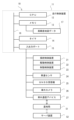
- FIG. 4 is an explanatory diagram of the configuration of the main parts for lane change control, which is realized in the control system of the automobile shown in FIG.
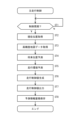
- FIG. 5 is a flowchart of basic main driving control that is steadily and repeatedly executed by the main control unit in FIG. 4 while the automobile is automatically driving.
- FIG. 6 is a flowchart of a pre-control for lane change control that is repeatedly executed by the main control unit in FIG.
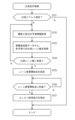
- FIG. 7 is a flowchart of the lane-diverging driving control that is executed by the main control unit in FIG. 4 in order to start the execution of the lane change control.
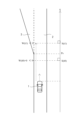
- FIG. 8 is an explanatory diagram of the driving environment prediction in the main driving control of FIG. 5 when the vehicle of FIG. 1 is located just before a section in which a diverging lane is provided at time t1.
- FIG. 9 is an explanatory diagram of the driving environment prediction in the main driving control of FIG. 5 when the vehicle of FIG. 1 is located just before a section in which a diverging lane is provided at time t2, which is after time t1.
- FIG. 8 is an explanatory diagram of the driving environment prediction in the main driving control of FIG. 5 when the vehicle of FIG. 1 is located just before a section in which a diverging lane is provided at time t2, which is after time t1.
- FIG. 10 is an explanatory diagram of the increasing slope of the lane width of the diverging lane and the lane change end point obtained by calculation by the main control unit in FIG. 4 in step ST25 of the diverging travel control in FIG.
- FIG. 11 is an explanatory diagram of the lane change start point acquired by the main control unit in FIG. 4 through calculation in step ST25 of the diversion traveling control in FIG. 12 is an explanatory diagram of the total remaining distance from the vehicle to the lane change start point and the passing time of the total remaining distance, which can be obtained by the main control unit in FIG. 4 through calculation in step ST25 of the diversion driving control in FIG.
- FIG. 13 is an explanatory diagram of a main part of a server device according to the second embodiment of the present invention.
- FIG. 1 is an explanatory diagram of an example of a running state of an automobile 1 according to a first embodiment of the present invention.
- a vehicle 1 is traveling in a current lane 2 of a road on which the vehicle 1 is traveling, toward a diverging section DL in which a diverging lane 3 is connected to the current lane 2.
- Such a diverging lane 3 is provided, for example, at an exit point of a highway or an entrance point to a service area of the highway.
- the driving control device 11 of the automobile controls the traveling of the automobile 1 based on the current position of the automobile 1 and information on the traveling lane 2 and the diverging lane 3 recorded in the high-precision map data 17.
- the cruise control device 11 uses the route information S of the current lane 2 recorded in the high-precision map data 17 to control the travel of the vehicle so that the vehicle maintains the current lane 2.
- the route information S may basically be information based on a line segment indicating the center of the lane width of the lane to which it corresponds.
- the position in the route information S indicates a unique position in the lane to which it corresponds.
- the driving control device 11 uses the route information S of the current lane 2 and the information of the diverging lane 3 recorded in the high-precision map data 17 to control the driving of the vehicle so that the vehicle changes lanes from the current lane 2 to the diverging lane 3.
- the course of the automobile 1 when traveling from the current lane 2 to the diverging lane 3 is shown by a broken line.
- the driving control device 11 starts lane change control from the current lane 2 to the diverging lane 3 before the vehicle reaches the diverging start point Ps.
- the automobile 1, the traveling of which is controlled by automatic driving can start entering the diverging lane 3 immediately after passing the diverging start point Ps of the diverging lane 3.
- the automobile 1 can travel so as to move smoothly from the current lane 2 to the diverging lane 3.
- the road information S is indicated by a straight arrow because it corresponds to the straight current lane 2.
- the road on which the automobile 1 travels may be curved.
- the road information S may be curved along the curved lane.
- the curved road information S may be expanded into a straight line.
- the cruise control device 11 can travel, for example, from the curved current lane 2 to the curved diverging lane 3 by lane change control based on the diverging start point Ps of the diverging lane 3.
- Such lane change control by the cruise control device 11 enables the automobile 1 to travel from the current lane 2 towards the diverging lane 3 .
- FIG. 2 is an explanatory diagram of another example of the running state of the automobile 1 of FIG. 2, the cruise control device 11 of the automobile 1, similar to that of FIG 1, starts lane change control for traveling from the current lane 2 to the diverging lane 3 before reaching the diverging start point Ps of the diverging lane 3 as a reference.
- the automobile 1 travels so as to move from the current lane 2 to the diverging lane 3 on the course shown by the dashed line in FIG 2.
- the lane width of the diversion lane 3 in Fig. 2 is smaller than that of the diversion lane 3 in Fig. 1.
- the lane width of the diversion lane 3 is narrower than the vehicle width of the automobile 1 even after the automobile 1 travels for a while in the diversion section DL away from the diversion start point Ps.
- the automobile 1 approaches the end of the diversion lane 3 after entering the diversion lane 3. If the automobile 1 travels close to the end of the diversion lane 3 in this way, the passengers of the automobile 1 may feel uneasy about driving under lane change control toward the diversion lane 3 by automatic driving.
- the lane width of the diversion lane 3 may narrow as shown in Fig. 2 due to restrictions such as the topography on which they are located.
- FIG. 3 is an explanatory diagram of a main part of the control system 10 provided in the automobile 1 of FIG. 3 shows a driving control device 11 in a control system 10 of the automobile 1.
- the driving control device 11 has a CPU (Central Processing Unit) 12, a memory 13, a timer 14, an input/output port 15, and an internal bus 16 to which these are connected.
- a steering control device 21, a drive control device 22, a braking control device 23, a vehicle speed sensor 24, a GNSS (Global Navigation Satellite System) receiver 25, an exterior camera 26, and an exterior communication device 27 are connected to the input/output port 15.
- the control system 10 of the automobile 1 basically has a structure in which a plurality of control devices are connected to a vehicle network using a harness or the like.
- the vehicle network may be, for example, a vehicle network conforming to a standard such as CAN (Controller Area Network) or LIN (Local Interconnect Network).
- the various devices connected to the above-mentioned input/output port 15 may be directly connected to the vehicle network or to another control device connected to the vehicle network.
- the steering control device 21 can exchange information with the various devices described above by connecting an in-vehicle communication device (not shown) to the vehicle network instead of or together with the input/output port 15.
- FIG. 3 shows a simplified main part of the control system 10 actually provided in the automobile 1.
- the steering control device 21 controls the direction of the steering wheels provided on the automobile 1 based on a steering control value based on, for example, the steering angle of the steering wheel operated by the driver of the automobile 1. As a result, the traveling direction of the automobile 1 can be controlled to a straight direction, a right direction, a left direction, etc.
- the drive control device 22 controls the power source and the power transmission mechanism provided in the automobile 1 based on a drive control value based on the amount of operation of an accelerator pedal operated by the driver of the automobile 1, for example. This allows the speed of the automobile 1 to accelerate.
- the brake control device 23 controls the brake device provided in the automobile 1 based on a braking control value based on the amount of operation of a brake pedal operated by the driver of the automobile 1, for example.
- the automobile 1 stops.
- the steering control device 21, the drive control device 22, and the braking control device 23 enable the automobile 1 to travel on a road under driving control by a driver or the like.
- the vehicle speed sensor 24 detects the current speed of the automobile 1.
- the vehicle speed sensor 24 it is possible to use not only a speed sensor but also an acceleration sensor.
- the speed can be obtained by integrating the acceleration detected by the acceleration sensor over time.
- the speed sensor it is preferable that the speed sensor be one that can detect not only the speed component in the longitudinal direction of the automobile 1, but also the speed component in the transverse direction of the automobile 1 as the speed of the automobile 1.
- the GNSS receiver 25 receives radio waves from GNSS satellites launched into satellite orbit around the Earth, and generates information on the current position of the automobile 1 in which the GNSS receiver 25 is installed and the current time.
- the GNSS receiver 25 is provided in the automobile 1 and is a position generating device that repeatedly generates information on the current position of the automobile 1 while it is moving.
- the exterior camera 26 captures the surroundings outside the automobile 1, particularly the area in front of the automobile 1.
- the exterior camera 26 may be a camera capable of capturing an image in a specified angle of view from the automobile 1, or a camera capable of capturing an image of the entire surroundings of the automobile 1 in 360 degrees.
- the automobile 1 may also be provided with multiple cameras.
- the multiple cameras provided on the automobile 1 may have their angles of view and parallax specified. Two cameras with specified parallax can calculate the relative distance and direction from the automobile 1 for an external object that they both capture. Even if a so-called monocular camera is used, it is possible to obtain the relative distance and direction from the automobile 1 on the virtual road surface based on the image capture position of the monocular camera.
- the external vehicle communication device 27 establishes a wireless communication path with a base station 51 provided on a road on which the automobile 1 travels.
- the base station 51 may be, for example, one for ADAS (Advanced Driver Assistance Systems) or one for a carrier communication network. In the autonomous driving of the automobile 1, it is assumed that a base station for 5G communication or the like will be mainly used.
- the exterior communication device 27 can transmit and receive information to and from a server device 52 connected to a carrier communication network or the Internet, using a wireless communication path established with the base station 51.
- the driving control device 11 can transmit and receive information to and from the server device 52 using the exterior communication device 27.
- the timer 14 measures the time or duration.
- the memory 13 records programs executed by the CPU 12 and various information used by the CPU 12 during execution of the programs.
- Fig. 3 shows high-precision map data 17 as information recorded in the memory 13.
- the memory 13 may be, for example, a combination of a volatile memory such as a RAM (Random Access Memory) and a non-volatile memory such as a ROM (Read Only Memory) or a HDD (Hard Disk Device).
- the high-precision map data 17 includes information on the roads on which the automobile 1 travels.
- the high-precision map data 17 prepared as a basis for autonomous driving includes route information S for each driving lane in which the automobile 1 can travel, and lane width information.
- the high-precision map data 17 includes lane width information for the traveling lane 2 in Fig.
- the high-precision map data 17 also includes information on the diverging start point Ps. In this manner, the memory 13 stores high-precision map data 17 including information on the current lane 2 and the diverging lane 3 .
- the CPU 12 reads and executes the programs recorded in the memory 13. This realizes a control unit in the driving control device 11.
- the control unit may be composed of multiple modules for controlling the driving of the automobile 1.
- FIG. 4 shows a position acquisition unit 31, a main control unit 32, and an ALC (adaptive lane control) control unit 33 as modules realized in the driving control device 11 by the CPU 12.
- the CPU 12 executes driving control involving lane change control from the driving lane 2 to the diverging lane 3 for the traveling automobile 1 through a combination of the position acquisition unit 31, the main control unit 32, and the ALC control unit 33.
- FIG. 4 is an explanatory diagram of a configuration of essential parts for lane change control, which is realized in the control system 10 of the automobile 1 shown in FIG. Figure 4 shows a driving control device 11 that controls the driving of the automobile 1 through automatic driving, and a steering control device 21, a drive control device 22, and a braking control device 23 to which driving control values generated by the driving control device 11 for automatic driving are input.
- the driving control device 11 also has a memory 13, a position acquisition unit 31, a main control unit 32, and an ALC control unit 33.
- the memory 13 records high-precision map data 17, prediction information 34, and a diverging event flag 35.
- the prediction information 34 and the diverging event flag 35 are information that the CPU 12 dynamically updates in the memory 13 during processing as the main control unit 32.
- the prediction information 34 is prediction information 34 related to the future position of the automobile 1.
- the diverging event flag 35 is set when the automobile 1 travels from the traveling lane 2 toward the diverging lane 3.
- the position acquisition unit 31 acquires the latest current position of the automobile 1 from the GNSS receiver 25.
- the position acquisition unit 31 may correct the current position and current time of the automobile 1 acquired from the GNSS receiver 25 using information on the base station 51 with which the external communication device 27 can communicate, information on the reception status of public radio waves, and the like.
- the current position that the automobile 1 can acquire can be acquired with an error accuracy of several tens of centimeters at the highest accuracy.
- the ALC control unit 33 basically generates a driving control value for the automobile 1 to maintain the lane 2 while traveling, and outputs the value to the steering control device 21.
- the ALC control unit 33 may generate and output a driving control value to the drive control device 22 and the braking control device 23. For example, when it is determined that the position of the automobile 1 in the vehicle width direction in the traveling lane 2 is not in the center of the lane width of the traveling lane 2 based on the positions of the left and right lane boundary lines of the traveling lane 2 in the image captured by the exterior camera 26, the ALC control unit 33 generates a steering travel control value for returning the position of the automobile 1 in the vehicle width direction to the center of the lane width of the traveling lane 2 and outputs it to the steering control device 21.
- the ALC control unit 33 may determine whether the position of the automobile 1 in the vehicle width direction is in the center of the lane width of the traveling lane 2 based on the current position of the automobile 1 and the information on the lane width of the traveling lane 2 included in the high-precision map data 17. Thereby, even if the traveling lane 2 is curved, for example, the automobile 1 can run while maintaining the center of the lane width of the traveling lane 2 in the same way as when the traveling lane 2 is straight. The automobile 1 can run while keeping the center of the lane width of the traveling lane 2.
- the ALC control unit 33 of this embodiment can stop the lane keeping control described above and execute derail control to drive the vehicle 1 from the lane 2 currently in motion to another lane. This allows the ALC control unit 33 to drive the vehicle 1 from the lane 2 currently in motion to another lane adjacent to the lane 2 currently in motion, or to drive the vehicle 1 from the lane 2 currently in motion to the diverging lane 3 as shown in FIG. 1.
- the ALC control unit 33 may execute derail control based on an image captured by the exterior camera 26.
- the ALC control unit 33 may execute derail control to drive the vehicle 1 from the lane 2 currently in motion to another lane so as not to generate excessive acceleration or moment under the speed of the vehicle 1 when the derail control is started.
- the ALC control unit 33 ends the derail control and resumes the lane keeping control.
- the automobile 1 can travel in the other lane after the movement as the new current traveling lane 2 while keeping to the center of the lane width of the current traveling lane 2.
- Such an ALC control unit 33 functions as an automated lane changing device.
- the main control unit 32 basically predicts the future position and driving environment of the automobile 1 while it is moving, and generates driving control values for safe driving based on the predictions.
- the main control unit 32 then outputs the generated driving control values to the steering control unit 21, the drive control unit 22, and the braking control unit 23.
- Such lane keeping control while driving by the ALC control unit 33 and driving control in the driving lane 2 while driving by the main control unit 32 enable the automobile 1 to continue driving in the driving lane 2 while ensuring a certain level of safety.
- the driving control device 11 is capable of executing lane change control from the traveling lane 2 to the diverging lane 3 . Therefore, the ALC control unit 33 executes a drop-off driving to drive from the traveling lane 2 toward the diverging lane 3.
- the ALC control unit 33 functions as an automobile lane changing device in the automobile 1 that can execute lane change control from the lane 2 to the diverging lane 3 while the automobile 1 is traveling.
- the main control unit 32 In addition to the main driving control for continuing to travel in lane 2 while traveling, the main control unit 32 also performs advance control for lane changing from the currently traveling lane 2 to the diverging lane 3, and diverging driving control for changing lanes from the currently traveling lane 2 to the diverging lane 3 using the ALC control unit 33.
- FIG. 5 is a flowchart of basic main driving control that is steadily and repeatedly executed by the main control unit 32 in FIG. 4 while the automobile 1 is automatically driving.
- the CPU 12 of the driving control device 11 in FIG. 3 may function as the main control unit 32 in FIG. 4 to steadily and repeatedly execute the basic main driving control in FIG. 5 while the automobile 1 is traveling.
- step ST1 the main control unit 32 determines whether it is time for the control cycle for the basic main driving control of FIG. 5.
- the control cycle for the main driving control of FIG. 5 may be measured by the timer 14. If the time elapsed since the previous control timing measured by the timer 14 is not equal to or greater than the control cycle, the main control unit 32 repeats this process. If the time elapsed since the previous control timing measured by the timer 14 is equal to or greater than the control cycle, the main control unit 32 advances the process to step ST2 to newly execute basic main driving control.
- step ST2 the main control unit 32 acquires the latest current position of the automobile 1 from the position acquisition unit 31.
- step ST3 the main control unit 32 acquires high-precision map data 17 from the memory 13.
- the information acquired from the high-precision map data 17 may be, for example, information about the current lane 2 in which the automobile 1 is traveling.
- the acquired information may also include information about the road that includes the current lane 2, etc., depending on the needs of control.
- step ST4 the main control unit 32 predicts the future position of the automobile 1 in the currently traveling lane 2 using the information acquired in the processing up to step ST3.
- the main control unit 32 predicts, for example, the future position of the automobile 1 in the currently traveling lane 2 after a predetermined time when the automobile 1 travels from its current position while maintaining its traveling state under the current control.
- the predetermined time may be a fixed value that is equal to or greater than the control period of the main traveling control.
- the predetermined time may be a value that increases or decreases depending on the traveling speed. This allows the main control unit 32 to predict, for example, the future position of the automobile 1 moving from its current position at the current speed in a predetermined time.
- step ST5 the main control unit 32 predicts the driving environment of the automobile 1 in the current lane 2 from the current position to the future position.
- the main control unit 32 may predict the driving environment by obtaining information on the driving of other vehicles in the current lane 2 in addition to the information obtained in steps ST3 and ST4.
- the traveling environment of the automobile 1 is suitable for maintaining the current traveling and traveling in a straight line.
- the automobile 1 needs to steer so as to travel along the curve of the traveling lane 2.
- another vehicle or the like is stopped in the section due to a breakdown, the automobile 1 needs to stop or change course in front of the broken-down vehicle.
- step ST6 the main control unit 32 generates driving control values for executing driving in accordance with the predictions made in steps ST4 and ST5. If steering or course changes are required when driving in the predicted driving environment, the main control unit 32 generates a driving control value for steering. If acceleration is required, the main control unit 32 generates a driving control value for driving. If deceleration or stopping is required, the main control unit 32 generates a driving control value for deceleration.
- step ST7 the main control unit 32 outputs the various driving control values generated in step ST6 to the respective target control devices.
- the main control unit 32 outputs a steering driving control value to the steering control device 21.
- the steering control device 21 controls the direction of the steering wheels provided on the automobile 1 according to the steering driving control value.
- the main control unit 32 also outputs a driving control value for driving to the drive control device 22.
- the drive control device 22 controls the power source and power transmission mechanism provided on the automobile 1 according to the driving driving control value.
- the main control unit 32 also outputs a braking driving control value to the brake control device 23.
- the brake control device 23 controls the brake device provided on the automobile 1 according to the braking driving control value. This allows the automobile 1 to automatically drive along the lane 2 or the road during travel according to the driving control value generated by the main control unit 32 based on prediction.
- the main control unit 32 may execute the processes of steps ST6 and ST7 multiple times during the current control cycle.
- step ST8 the main control unit 32 records the information predicted for the current control cycle in the memory 13.
- the prediction information 34 may be accumulated and recorded in the memory 13. Thereafter, the main control unit 32 ends this control.
- the main control unit 32 can repeatedly control the driving of the automobile 1 for each control period using information on the current position of the automobile 1 obtained from the GNSS receiver 25 via the position acquisition unit 31 and the high-precision map data 17 recorded in the memory 13.
- the main control unit 32 can repeatedly perform the following operations for each control period: predicting the future position of the vehicle 1 in the lane 2 in which the vehicle 1 is traveling using information on the current position and high-precision map data 17 while the vehicle 1 is traveling and recording the predicted position in the memory 13; and executing driving control of the vehicle 1 in accordance with the driving environment of the predicted future position.
- the prediction information 34 shown in FIG. 4 is accumulated and recorded in the memory 13 a number of times.
- FIG. 6 is a flowchart of pre-control for lane change control that is repeatedly executed by the main control unit 32 in FIG. 4 for lane change during autonomous driving.
- the CPU 12 of the driving control device 11 in FIG. 3 may function as the main control unit 32 in FIG. 4 to steadily and repeatedly execute pre-control for lane change control in FIG. 6 while the automobile 1 is traveling.
- the main control unit 32 may execute the pre-control of Fig. 6 at longer intervals than the basic main driving control of Fig. 5. That is, the main control unit 32 may repeatedly execute the pre-control of Fig. 6, for example, at multiple control intervals for the basic main driving control of Fig. 5.
- the pre-control of Fig. 6 By executing the pre-control of Fig.
- step ST11 the main control unit 32 acquires the latest current position of the automobile 1 from the position acquisition unit 31.
- the main control unit 32 acquires the high-precision map data 17 from the memory 13.
- the information of the high-precision map data 17 acquired here may include, for example, not only information on the lane 2 in which the automobile 1 is traveling, but also information on other lanes of the road including the lane 2 in which the automobile 1 is traveling, other roads connected to the lane 2 in which the automobile 1 is traveling or the other lanes, and other lanes of the other roads.
- the main control unit 32 may acquire information on these other lanes and roads within a predetermined distance range from the current position of the automobile 1 from the high-precision map data 17 in the memory 13.
- the information on the other lanes and the other roads includes not only each route information S but also information on each branch start point Ps.
- the main control unit 32 can use the actual moving direction connecting the multiple current positions of the automobile 1 as the traveling direction of the automobile 1.
- step ST13 the main control unit 32 determines whether or not there is another lane connected to the lane 2 currently in motion in the direction of travel of the automobile 1, such as the diverging lane 3 in FIG. 1, based on the information acquired from the high-precision map data 17 in step ST12.
- information on a one-lane road is treated as information on one lane. For example, as in FIG. 1, if the diverging lane 3 is connected to the lane 2 currently in motion within a predetermined distance range from the current position of the automobile 1, the main control unit 32 determines that there is another lane connected to the lane 2 currently in motion, and proceeds to step ST14.
- the main control unit 32 determines that there is no other lane connected to the lane 2 currently in motion, and ends this control. In this case, since there is no other lane connected to the lane 2 currently in motion, the automobile 1 continues to travel in the lane 2 currently in motion within a predetermined distance range from the current position of the automobile 1.
- step ST14 the main control unit 32 determines whether or not a lane change is required for the vehicle. For example, when the main control unit 32 is executing the control of FIG. 5, the vehicle 1 is traveling toward the destination of the automatic driving. The destination is set in the vehicle 1 by the driver or the like. In this case, the main control unit 32 may determine whether or not a lane change is required to the other lane determined in step ST13, based on, for example, the currently traveling lane 2 in the high-precision map data 17 and the positional relationship between the other lane determined in step ST13 and the destination. Then, if it is determined that a lane change to the other lane is required, the main control unit 32 advances the process to step ST15. If it is determined that a lane change to the other lane is not required, the main control unit 32 ends this control. In this case, the vehicle 1 continues traveling in the currently traveling lane 2 within a predetermined distance range from the current position of the vehicle 1.
- step ST15 the main control unit 32 sets a diversion event.
- the main control unit 32 updates the diversion event flag 35 recorded in the memory 13, for example, from an insignificant value to a significant value. Thereafter, the main control unit 32 ends this control.
- the main control unit 32 determines whether or not the vehicle 1 needs to change lanes from the traveling lane 2 to the diverging lane 3.
- the main control unit 32 may execute preparatory control for lane change from the driving lane 2 to the diverging lane 3 in the basic main driving control of Fig. 5. For example, the main control unit 32 acquires the value of the diversion event flag 35 in step ST5 of Fig. 5. Then, if the diversion event flag 35 has a significant value, the main control unit 32 generates a steering driving control value for lane change so that the lane in which the vehicle is driving becomes the lane to which the diverging lane 3 is directly connected in step ST6 of Fig. 5, and outputs the generated steering control value to the steering control device 21, etc.
- the automobile 1 traveling by automatic driving will be in a state in which the lane to which the diverging lane 3 is directly connected is the driving lane 2 before reaching the diverging lane 3.
- the main control unit 32 may instruct the ALC control unit 33 to change lanes, and the ALC control unit 33 may generate driving control values for steering for changing lanes and output them to the steering control device 21, etc.
- FIG. 7 is a flowchart of the lane-diverging driving control that is executed by the main control unit 32 in FIG. 4 in order to start the execution of the lane change control.
- the CPU 12 of the driving control device 11 in FIG. 3 functions as the main control unit 32 in FIG. 4 and repeatedly executes the shunting driving control in FIG.
- step ST21 the main control unit 32 acquires the diversion event flag 35 from the memory 13 and determines whether the diversion event flag 35 is set to a significant value. If the acquired diversion event flag 35 is a significant value, the main control unit 32 determines that the diversion event flag 35 is a significant value and proceeds to step ST22. If the acquired diversion event flag 35 is an insignificant value, the main control unit 32 determines that the diversion event flag 35 is not a significant value and ends this control. As a result, if a diversion event flag 35 with a significant value is recorded in the memory 13, the main control unit 32 will execute the diversion driving control from step ST22 onwards.
- step ST22 the main control unit 32 acquires the most recent two pieces of prediction information 34 from the memory 13.
- the memory 13 stores and records information predicted for each control cycle through the processing of step ST8 in FIG. 5.
- the main control unit 32 may also acquire the most recent three or more pieces of prediction information 34 from the memory 13.
- step ST23 the main control unit 32 obtains the lane width of the diverging lane 3 at each prediction timing from the high-precision map data 17 using the multiple pieces of prediction information 34 obtained in step ST22.
- Information on the lane width of the diverging lane 3 is recorded in the high-precision map data 17.
- FIG. 8 illustrates an example of the lane width W(t1) of the diverging lane 3 corresponding to the first future position S(t1) predicted at time t1.
- FIG. 9 illustrates an example of the lane width W(t2) of the diverging lane 3 corresponding to the second future position S(t2) predicted at time t2, which is a time after time t1.
- the first future position S(t1) and the second future position S(t2) are positions not based on the path information S of the diverting lane 3 but based on the path information S of the currently traveling lane 2.
- the path information S of the currently traveling lane 2 in FIG. 8 and FIG. 9 is linear.
- the main control unit 32 may then obtain from the high-precision map data 17 the lane width W (t1) of the diverging lane 3 determined by a perpendicular line to the route information S of the currently traveling lane 2 at the first future position S (t1), and the lane width W (t2) of the diverging lane 3 determined by a perpendicular line to the route information S of the currently traveling lane 2 at the second future position S (t2).
- step ST24 the main control unit 32 determines whether or not a significant one has been acquired for each of the multiple lane widths at the multiple predicted timings acquired in step ST23. For example, unlike the first future position S(t1) in FIG. 8 and the second future position S(t2) in FIG. 9, if a future position at a certain prediction timing has not reached the diverging start point Ps, naturally the high-precision map data 17 does not include information on the lane width of the corresponding diverging lane 3. In such a case, the main control unit 32 cannot obtain a significant lane width for the multiple lane widths at the multiple prediction timings obtained in step ST23. The main control unit 32 determines that a significant lane width has not been obtained, and returns the process to step ST22.
- the main control unit 32 repeats the processes from step ST22 to step ST24 until a significant lane width can be obtained for each of the multiple lane widths at the multiple prediction timings obtained in step ST23.
- the lane width W(t0) of the diversion lane 3 corresponding to the 0th future position S(t0) in Fig. 8 is "0", indicating that the lane width is meaningless. Therefore, the main control unit 32 returns the process to step ST22 at the prediction timing in Fig. 8. Then, the main control unit 32 advances the process to step ST25 at the prediction timing in Fig. 9.
- step ST25 the main control unit 32 executes the processes of FIG. 8 to FIG. 12, which will be described later, using the multiple significant prediction information 34 acquired in step ST22, and sets a lane change start point, etc., for the currently traveling lane 2.
- the lane change start point is a reference position for the main control unit 32 to instruct the ALC control unit 33 to start derail control from the currently traveling lane 2 toward the diverging lane 3. This allows the main control unit 32 to set the lane change start point in the currently traveling lane 2 based on the current position of the automobile 1, the map data recorded in the memory 13, and multiple future positions.
- the main control unit 32 sets a lane change start point in the currently traveling lane 2 according to the increasing slope of the lane width of the diverging lane 3, as will be described later.
- step ST26 the main control unit 32 acquires the latest current position of the automobile 1 and determines whether the automobile 1 has reached the lane change start point. If the automobile 1 has not reached the lane change start point, the main control unit 32 repeats this process. When the automobile 1 reaches the lane change start point, the main control unit 32 advances the process to step ST27.
- step ST27 the main control unit 32 instructs the ALC control unit 33 to start derail control from the current lane 2 to the diverging lane 3.
- the ALC control unit 33 stops the lane keeping control for the current lane 2 and starts derail control for traveling from the current lane 2 to the diverging lane 3.
- the ALC control unit 33 executes derail control for traveling from the current lane 2 to the diverging lane 3 so as not to generate excessive acceleration or moment under the speed of the automobile 1 at the timing of starting the derail control.
- the ALC control unit 33 ends the derail control and resumes the lane keeping control.
- the automobile 1 moves from the current lane 2 to the diverging lane 3, and can travel while keeping the center of the lane width of the current lane 2 with the diverging lane 3 as the new current lane 2.
- the main control unit 32 ends this control.
- the main control unit 32 executes the diverging driving control of FIG. 7 when it determines that a lane change is necessary through the prior control of FIG. 6. Then, in the diverging driving control of FIG. 7, the main control unit 32 sets a lane change start point in the traveling lane 2 of the vehicle 1 according to the increasing slope of the lane width of the diverging lane 3 based on the current position of the vehicle 1 and the high-precision map data 17 and information on multiple future positions recorded in the memory 13. Also, the main control unit 32 instructs the ALC control unit 33 to start lane change control based on the vehicle 1 reaching the lane change start point. This allows the main control unit 32 to execute lane change control from the traveling lane 2 to the diverging lane 3 based on the lane change start point in the diverging driving control of FIG. 7.
- step ST25 the setting process of step ST25 will be described in detail with reference to Figures 8 to 12.
- FIG. 8 is an explanatory diagram of the driving environment prediction in the main driving control of FIG. 5 when the automobile 1 of FIG. 1 is located just before the section in which the diverging lane 3 is provided at time t1.
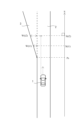
- FIG. 8 shows a current lane 2 in which the automobile 1 is traveling, a diverging lane 3 connected to the current lane 2, and route information S for the current lane 2.
- the route information S for the currently traveling lane 2 indicates the zeroth future position S(t0) of the vehicle 1 at time t0, the first future position S(t1) of the vehicle 1 at time t1, and the branching start point Ps.
- the zeroth lane width W(t0) of the diverging lane 3 is shown at the end of the dashed perpendicular line at the zeroth future position S(t0).
- the first lane width W(t1) of the diverging lane 3 is shown at the end of the dashed perpendicular line at the first future position S(t1).
- the 0th lane width W(t0) is "0" indicating that there is no width, since it is located just before the diverging start point Ps on the side of vehicle 1.
- the 1st lane width W(t1) is located on the opposite side of vehicle 1 from the diverging start point Ps, and therefore has a significant width value.
- FIG. 9 is an explanatory diagram of the driving environment prediction in the main driving control of FIG. 5 when the automobile 1 of FIG. 1 is located just before the section in which the diverging lane 3 is provided at time t2, which is after time t1.
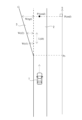
- FIG. 9 shows the current lane 2 in which the vehicle 1 is traveling, the diverging lane 3 connected to the current lane 2, and route information S for the current lane 2.
- the route information S for the currently traveling lane 2 indicates a first future position S(t1) of the vehicle 1 at time t1, a second future position S(t2) of the vehicle 1 at time t2, and a branching start point Ps.
- the first lane width W(t1) of the diverging lane 3 is shown at the end of the dashed perpendicular line at the first future position S(t1).
- the second lane width W(t2) of the diverging lane 3 is indicated at the end of the dashed perpendicular line at the second future position S(t1).
- the first lane width W(t1) and the second lane width W(t2) are on the opposite side of the vehicle 1 from the branching start point Ps, and therefore have significant width values.
- the main control unit 32 accumulates and records the information shown in Fig. 8 and Fig. 9 as prediction information 34 in the memory 13 by the basic main driving control of Fig. 5. In addition, at the timing of time t2 in Fig. 9, the main control unit 32 acquires information relating to the first future position S(t1) and information relating to the second future position S(t2), which are the latest two pieces of information, from information relating to the zeroth future position S(t0), information relating to the first future position S(t1), and information relating to the second future position S(t2) accumulated in the memory 13 by processing steps ST22 and ST23 of the diversion driving control of Fig. 7.
- FIG. 10 is an explanatory diagram of the lane width increase gradient G of the diverging lane 3 and the lane change end point P1 (end) obtained by calculation by the main control unit 32 in FIG. 4 in step ST25 of the diverging driving control in FIG.
- FIG. 10 shows the current lane 2 in which the vehicle 1 is traveling, the diverging lane 3 connected to the current lane 2, and route information S for the current lane 2.
- the first lane width W(t1) and the second lane width W(t2) of the diversion lane 3 are separated by a distance L(dt) that the vehicle 1 travels in the control period dt of FIG.
- step ST25 the main control unit 32 first calculates the increase slope G of the lane width of the diverging lane 3 with respect to the distance along the currently traveling lane 2, using the following formula 1. As a result, the main control unit 32 calculates and obtains the increase slope G of the lane width of the diverging lane 3 with respect to the distance along the currently traveling lane 2, from the lane width information of the multiple diverging lanes 3 obtained based on the information of multiple current positions.
- the main control unit 32 uses the increasing slope G of the lane width of the diverging lane 3 to calculate the point where the lane width of the diverging lane 3 becomes the reserved lane width W(tgt) that is preset for the vehicle 1.
- the reserved lane width W(tgt) may be the width of the vehicle 1.
- the reserved lane width W(tgt) may be a width that ensures a certain margin with respect to the width of the vehicle 1.
- the main control unit 32 sets a lane change end point P1 (end) of the currently traveling lane 2, which corresponds to the calculated point of the diverging lane 3, in the currently traveling lane 2.
- the main control unit 32 only needs to set a lane change end point P (end) for control purposes, which corresponds to the calculated point of the diverging lane 3, in the route information S of the currently traveling lane 2.
- the lane change end point P1 (end) in the currently traveling lane 2 corresponds to the lane change end point P (end) in the route information S of the currently traveling lane 2.
- FIG. 11 is an explanatory diagram of the lane change start point P1 (start) acquired by the main control unit 32 in FIG. 4 through calculation in step ST25 of the diversion traveling control in FIG.
- FIG. 11 shows the current lane 2 in which the vehicle 1 is traveling, the diverging lane 3 connected to the current lane 2, and route information S for the current lane 2.
- 11 shows a lane change end point P1(end) in the currently traveling lane 2.
- the route information S for the currently traveling lane 2 shows a controlled lane change end point P(end) that corresponds to the lane change end point P1(end).
- the diverging lane 3 in FIG 11 shows the lane change end point P1(end) and an actual lane change end point P2(end) in the diverging lane 3 that corresponds to the lane change end point P1(end).
- the main control unit 32 calculates the position of a lane change start point P1 (start) for ending lane change control from the traveling lane 2 to the diverging lane 3 at a lane change end point P2 (end) in the diverging lane 3.
- the ALC control unit 33 causes the automobile 1 traveling in the traveling lane 2 to travel from the lane change start point P1 (start) toward the lane change end point P2 (end) by lane change control (Derail ctrl.).
- the automobile 1 moves a movement distance L (Derail) in the direction of the traveling lane 2.
- the automobile 1 also moves a movement width Wy in a direction perpendicular to the direction of the traveling lane 2.
- the speed component along the road of the lane 2 in which the automobile 1 is traveling is defined as Vx
- Vy the speed component in the lane width direction perpendicular thereto
- the travel distance L (Derail) can be calculated by the following formula 2.
- the speed component Vx may be the speed component Vx in the front-rear direction of the automobile 1 with respect to the speed of the automobile 1.
- the speed component Vy may be the speed component Vx in the vehicle width direction of the automobile 1 with respect to the speed of the automobile 1.
- the movement width Wy can be calculated by the following formula 3.
- the lane width of the current lane 2 and the lane width of the diverging lane 3 at the lane change end point P2 (end) are both assumed to be "WL x 2".
- the main control unit 32 can calculate the movement distance L (Derail) during lane change control using the lateral movement time (Wy x Vy) required to end lane change control from the currently traveling lane 2 to the diverging lane 3 and the vehicle speed component Vx along the currently traveling lane 2 of the vehicle 1 at the time when the vehicle 1 reaches the lane change end point P1 (end) if the vehicle 1 continues to travel in the currently traveling lane 2.
- the main control unit 32 actually sets a lane change start point P (start) in terms of control for the route information S of the currently traveling lane 2.
- the lane change start point P (start) in terms of control corresponds to a lane change start point P1 (start) in the currently traveling lane 2.
- the lane change start point P1 (start) is located a moving distance L (Derail) before the lane change end point P1 (end) in the currently traveling lane 2.
- the main control unit 32 sets the lane change start point P (start) in terms of control obtained by the above processing to the route information S of the currently traveling lane 2 in step ST25 of the diversion driving control in FIG.
- step ST26 in FIG. 7 the main control unit 32 determines whether or not the automobile 1 has reached the lane change start point P1 (start) in the current lane 2 in which the automobile 1 is traveling. For this reason, the main control unit 32 may use information that makes it easy to determine whether the lane change start point P1 (start) has been reached, instead of the controlled lane change start point P (start), and set it as information indicating the lane change start point P1 (start).
- FIG. 12 is an explanatory diagram of the total remaining distance D(all) from the vehicle 1 to the lane change start point P1(start) and the passing time T(all) of the total remaining distance D(all), which can be obtained by calculation by the main control unit 32 of Figure 4 in step ST25 of the diversion driving control of Figure 7.
- FIG. 12 shows the current lane 2 in which the vehicle 1 is traveling, the diverging lane 3 connected to the current lane 2, and route information S for the current lane 2.
- a lane change start point P1 (start) is shown in the currently traveling lane 2.
- the route information S of the currently traveling lane 2 shows a lane change end point P (start) in terms of control that corresponds to the lane change start point P1 (start).
- automobile 1 is currently traveling in lane 2, at a position that is a remaining distance Lrest from the lane change start point Ps.
- lane change start point P1(start) is separated from the lane change start point Ps by an in-line distance Lin.
- the main control unit 32 can calculate the total remaining distance D(all) from automobile 1 to lane change start point P1(start) using the following formula 4.
- the main control unit 32 can calculate the passing time T(all) required to travel to lane change start point P1(start) from the total remaining distance D(all) using the following formula 5.
- the main control unit 32 may set the total remaining distance D(all) or the passing time T(all) as information indicating the lane change start point P1(start).
- the main control unit 32 of the driving control device 11 sets information indicating the lane change start point P1 (start) in step ST25 of the diversion driving control in FIG. That is, the main control unit 32 acquires the diverging start point Ps of the diverging lane 3 diverging from the traveling lane 2 from the high-precision map data 17. The main control unit 32 also acquires the total remaining distance D(all) from the automobile 1 to the lane change start point P1(start) by calculation from the diverging in-line distance Lin from the diverging start point Ps to the lane change start point P1(start) and the remaining distance Lrest from the automobile 1 to the diverging start point Ps. Then, in step ST26 of the diverging travel control in FIG.
- the main control unit 32 judges the passing of the lane change start point P1(start) by using, for example, the total remaining distance D(all) or the passing time T(all). Then, when the automobile 1 passes the lane change start point P1(start), the main control unit 32 instructs the ALC control unit 33 to perform lane change control from the traveling lane 2 to the diverging lane 3. As a result, the ALC control unit 33 starts lane change control (Derail ctrl.).
- the main control unit 32 can set a lane change start point P1 (start) corresponding to the lane width increase degree G of the diverging lane 3 in the traveling lane 2 of the automobile 1 for lane change control based on the future position prediction of the automobile 1 using the current position information and the high-precision map data 17.
- the main control unit 32 can also start lane change control from the traveling lane 2 to the diverging lane 3 based on the lane change start point P1 (start).
- the main control unit 32 does not start lane change control from the traveling lane 2 to the diverging lane 3. Thereafter, when the automobile 1 completes the traveling distance and reaches the lane change start point P1 (start), the main control unit 32 can start lane change control from the traveling lane 2 to the diverging lane 3.
- the automobile 1 includes the memory 13 that records the high-precision map data 17 including information on the currently traveling lane 2 and the diverging lane 3, the GNSS receiver 25 that generates information on the current position of the automobile 1, and the cruise control device 11.
- the cruise control device 11 basically repeatedly controls the traveling of the automobile 1 using the current position information of the GNSS receiver 25 and the high-precision map data 17 of the memory 13. Then, based on a future position prediction of the automobile 1 using the current position information and the map data, the cruise control device 11 sets a lane change start point P1 (start) in the currently traveling lane 2 of the automobile 1 according to the degree of increase in the lane width of the diverging lane 3 for lane change control.
- the cruise control device 11 starts lane change control from the currently traveling lane 2 to the diverging lane 3 based on the lane change start point P1 (start). This makes it possible for the automobile 1 of the present invention to control driving that involves lane change control from the driving lane 2 to the diverging lane 3.
- the cruise control device 11 starts lane change control from the traveling lane 2 to the diverging lane 3, not based on the diverging start point Ps of the diverging lane 3 diverging from the traveling lane 2, but based on a lane change start point P1 (start) corresponding to the lane width increase degree G of the diverging lane 3.
- start a lane change start point P1 (start) corresponding to the lane width increase degree G of the diverging lane 3.
- start corresponding to the lane width increase degree G of the diverging lane 3.
- the vehicle 1 in this embodiment if lane change control is started based on the diverging start point Ps of the diverging lane 3, the lane width of the diverging lane 3 immediately after the diverging start point Ps may be small as shown in Fig. 2.
- the vehicle 1 may approach the lane edge or lane boundary line of the diverging lane 3 on the opposite side to the traveling lane 2. In this embodiment, the occurrence of such approach can be suppressed.
- FIG. 13 is an explanatory diagram of a main part of a server device 52 according to the second embodiment of the present invention.
- the server device 52 has a server CPU 53, a server memory 54, a server timer 55, a server communication device 56, and a server bus 57 to which these are connected.
- the server communication device 56 transmits and receives information to and from the external communication device 27 of the control system 10 of the automobile 1 via the base station 51 .
- the server communication device 56 serves as a position acquisition device and receives and acquires information on the current position of the automobile 1 to be controlled.
- the server timer 55 measures the time or duration.
- the server memory 54 records the programs executed by the server CPU 53 and various information used by the server CPU 53 while the programs are being executed.
- FIG. 13 shows server high-precision map data 58 as information recorded in the server memory 54.
- the server memory 54 may be, for example, a combination of volatile memory such as RAM and non-volatile memory such as ROM or HDD.
- the server high-precision map data 58 may be similar to the high-precision map data 17 of the automobile 1 in FIG. 3.
- Such server high-precision map data 58 includes information on the road on which the automobile 1 is traveling, such as route information S of each travel lane and diverging lane 3 in which the automobile 1 can travel, and lane width information.
- the server high-precision map data 58 also includes information on the diverging start point Ps for the diverging lane 3.
- the server CPU 53 reads and executes the programs recorded in the server memory 54.
- a server control unit that controls the operation of the server device 52 is realized in the server device 52.
- the server control unit may execute the basic main driving control of Fig. 5, the pre-control for the lane change control of Fig. 6, and the diverging driving control of Fig. 7, similar to the main control unit 32 of the above-described embodiment.
- the server control unit causes the controlled vehicle 1 to execute lane change control by remote control or administrative control, it is preferable to execute at least the pre-control for the lane change control of Fig. 6.
- the server control unit may execute the diverging driving control of Fig. 7 in addition to the pre-control of Fig. 6.
- the server control unit acquires the current position of the controlled vehicle 1 using the server communication device 56 in step ST2, and outputs a driving control value to the controlled vehicle 1 using the server communication device 56 in step ST7. Also, the server control unit accumulates and records the prediction information 34 in the server memory 54 in step ST8. 6, in step ST11, the server control unit acquires the current position from the controlled vehicle 1 using the server communication device 56. Alternatively, the server control unit may acquire the current position of the controlled vehicle 1 from the server memory 54. In addition, the server control unit sets a diversion event in the server memory 54 in step ST15. 7 , the server control unit, in step ST21, acquires a shunting event set in the server memory 54. In addition, the server control unit, in step ST22, may acquire the two most recent pieces of prediction information 34 from the vehicle 1 to be controlled using the server communication device 56, or may acquire the two most recent pieces of prediction information 34 from the server memory 54.
- the server CPU 53 of the server device 52 can use the current position information acquired by the server communication device 56 and the server high-precision map data 58 in the server memory 54 to repeatedly generate driving control information, such as lane departure control instructions and driving control values, which can be used by the controlled vehicle 1 for driving control to change lanes, and transmit this information to the vehicle 1 when necessary.
- the controlled vehicle 1 can then perform lane change control from the traveling lane 2 to the diverging lane 3 under the control of the server device 52 by the main control unit 32 controlling the traveling of the vehicle using the traveling control information received and acquired from the server device 52.
- the driving control device 11 of the automobile 1 can start and execute lane change control from the traveling lane 2 to the diverging lane 3 based on the lane change start point obtained from the server device 52. This makes it possible for the automobile 1 of the present invention to control driving that involves lane change control from the driving lane 2 to the diverging lane 3.
Landscapes
- Engineering & Computer Science (AREA)
- Physics & Mathematics (AREA)
- Automation & Control Theory (AREA)
- Transportation (AREA)
- Mechanical Engineering (AREA)
- General Physics & Mathematics (AREA)
- Mathematical Physics (AREA)
- Traffic Control Systems (AREA)
Priority Applications (4)
| Application Number | Priority Date | Filing Date | Title |
|---|---|---|---|
| PCT/JP2023/013472 WO2024201972A1 (ja) | 2023-03-31 | 2023-03-31 | レーン変更制御可能な車両、およびサーバ装置 |
| DE112023006131.9T DE112023006131T5 (de) | 2023-03-31 | 2023-03-31 | Für fahrspurwechselsteuerung ausgelegtes fahrzeug und servervorrichtung |
| JP2025509565A JPWO2024201972A1 (https=) | 2023-03-31 | 2023-03-31 | |
| CN202380014936.7A CN119072422A (zh) | 2023-03-31 | 2023-03-31 | 能够进行车道变更控制的车辆、以及服务器装置 |
Applications Claiming Priority (1)
| Application Number | Priority Date | Filing Date | Title |
|---|---|---|---|
| PCT/JP2023/013472 WO2024201972A1 (ja) | 2023-03-31 | 2023-03-31 | レーン変更制御可能な車両、およびサーバ装置 |
Publications (1)
| Publication Number | Publication Date |
|---|---|
| WO2024201972A1 true WO2024201972A1 (ja) | 2024-10-03 |
Family
ID=92904501
Family Applications (1)
| Application Number | Title | Priority Date | Filing Date |
|---|---|---|---|
| PCT/JP2023/013472 Ceased WO2024201972A1 (ja) | 2023-03-31 | 2023-03-31 | レーン変更制御可能な車両、およびサーバ装置 |
Country Status (4)
| Country | Link |
|---|---|
| JP (1) | JPWO2024201972A1 (https=) |
| CN (1) | CN119072422A (https=) |
| DE (1) | DE112023006131T5 (https=) |
| WO (1) | WO2024201972A1 (https=) |
Cited By (1)
| Publication number | Priority date | Publication date | Assignee | Title |
|---|---|---|---|---|
| US20250104269A1 (en) * | 2023-09-25 | 2025-03-27 | Toyota Jidosha Kabushiki Kaisha | Lane change detection using a graph representation |
Citations (2)
| Publication number | Priority date | Publication date | Assignee | Title |
|---|---|---|---|---|
| JP2017165184A (ja) * | 2016-03-15 | 2017-09-21 | 本田技研工業株式会社 | 車両制御システム、車両制御方法、および車両制御プログラム |
| JP2020166393A (ja) * | 2019-03-28 | 2020-10-08 | 株式会社Subaru | 自動運転支援装置 |
Family Cites Families (3)
| Publication number | Priority date | Publication date | Assignee | Title |
|---|---|---|---|---|
| US9830517B2 (en) | 2014-06-19 | 2017-11-28 | Toyota Motor Engineering & Manufacturing North America, Inc. | Road branch detection and path selection for lane centering |
| JP6344275B2 (ja) | 2015-03-18 | 2018-06-20 | トヨタ自動車株式会社 | 車両制御装置 |
| JP6703423B2 (ja) | 2016-03-14 | 2020-06-03 | 株式会社Subaru | 車両の走行制御装置 |
-
2023
- 2023-03-31 WO PCT/JP2023/013472 patent/WO2024201972A1/ja not_active Ceased
- 2023-03-31 DE DE112023006131.9T patent/DE112023006131T5/de active Pending
- 2023-03-31 CN CN202380014936.7A patent/CN119072422A/zh active Pending
- 2023-03-31 JP JP2025509565A patent/JPWO2024201972A1/ja active Pending
Patent Citations (2)
| Publication number | Priority date | Publication date | Assignee | Title |
|---|---|---|---|---|
| JP2017165184A (ja) * | 2016-03-15 | 2017-09-21 | 本田技研工業株式会社 | 車両制御システム、車両制御方法、および車両制御プログラム |
| JP2020166393A (ja) * | 2019-03-28 | 2020-10-08 | 株式会社Subaru | 自動運転支援装置 |
Cited By (1)
| Publication number | Priority date | Publication date | Assignee | Title |
|---|---|---|---|---|
| US20250104269A1 (en) * | 2023-09-25 | 2025-03-27 | Toyota Jidosha Kabushiki Kaisha | Lane change detection using a graph representation |
Also Published As
| Publication number | Publication date |
|---|---|
| CN119072422A (zh) | 2024-12-03 |
| DE112023006131T5 (de) | 2026-02-26 |
| JPWO2024201972A1 (https=) | 2024-10-03 |
Similar Documents
| Publication | Publication Date | Title |
|---|---|---|
| CN111833645B (zh) | 停车场管理装置、停车场管理方法、及存储介质 | |
| JP7207256B2 (ja) | 車両制御システム | |
| JP7190393B2 (ja) | 車両制御装置、車両管理装置、車両制御方法、およびプログラム | |
| CN110949388A (zh) | 车辆控制装置、车辆控制方法及存储介质 | |
| JP6788751B2 (ja) | 車両制御装置、車両制御方法、およびプログラム | |
| CN111768633A (zh) | 停车场管理装置、停车场管理方法及存储介质 | |
| US20190278285A1 (en) | Vehicle control device, vehicle control method, and storage medium | |
| RU2760714C1 (ru) | Способ содействия вождению и устройство содействия вождению | |
| US10144428B2 (en) | Traffic light operation | |
| US20210070289A1 (en) | Vehicle control device, vehicle control method, and storage medium | |
| JP7125910B2 (ja) | 車両管理装置、車両管理方法、およびプログラム | |
| CN111986505A (zh) | 控制装置、上下车设施、控制方法及存储介质 | |
| CN112172826B (zh) | 车辆控制装置、车辆控制方法及存储介质 | |
| JP7155065B2 (ja) | 情報処理装置、情報処理方法、およびプログラム | |
| JP6966626B2 (ja) | 車両制御装置、車両制御方法、及びプログラム | |
| CN114261405A (zh) | 车辆控制装置、车辆控制方法以及存储介质 | |
| JP7376634B2 (ja) | 車両制御装置、車両制御方法、およびプログラム | |
| JP7385697B2 (ja) | 車両制御装置、車両制御方法、およびプログラム | |
| US12377775B2 (en) | Vehicle control method and vehicle control device | |
| CN111688693B (zh) | 车辆控制装置、车辆控制方法及存储介质 | |
| WO2024201972A1 (ja) | レーン変更制御可能な車両、およびサーバ装置 | |
| JP7599358B2 (ja) | 移動体制御システム、移動体制御方法、およびプログラム | |
| JP2019087188A (ja) | 車両制御装置、車両制御方法、及びプログラム | |
| JP7474279B2 (ja) | 車両制御装置、車両制御方法、およびプログラム | |
| CN117980207B (zh) | 驾驶控制方法及驾驶控制装置 |
Legal Events
| Date | Code | Title | Description |
|---|---|---|---|
| WWE | Wipo information: entry into national phase |
Ref document number: 202380014936.7 Country of ref document: CN |
|
| 121 | Ep: the epo has been informed by wipo that ep was designated in this application |
Ref document number: 23930608 Country of ref document: EP Kind code of ref document: A1 |
|
| ENP | Entry into the national phase |
Ref document number: 2025509565 Country of ref document: JP Kind code of ref document: A |
|
| WWE | Wipo information: entry into national phase |
Ref document number: 2025509565 Country of ref document: JP |
|
| WWE | Wipo information: entry into national phase |
Ref document number: 112023006131 Country of ref document: DE |
|
| WWP | Wipo information: published in national office |
Ref document number: 112023006131 Country of ref document: DE |
|
| 122 | Ep: pct application non-entry in european phase |
Ref document number: 23930608 Country of ref document: EP Kind code of ref document: A1 |