WO2024195586A1 - 改質用触媒 - Google Patents
改質用触媒 Download PDFInfo
- Publication number
- WO2024195586A1 WO2024195586A1 PCT/JP2024/009087 JP2024009087W WO2024195586A1 WO 2024195586 A1 WO2024195586 A1 WO 2024195586A1 JP 2024009087 W JP2024009087 W JP 2024009087W WO 2024195586 A1 WO2024195586 A1 WO 2024195586A1
- Authority
- WO
- WIPO (PCT)
- Prior art keywords
- catalyst
- layer
- honeycomb substrate
- catalyst layer
- resistance layer
- Prior art date
- Legal status (The legal status is an assumption and is not a legal conclusion. Google has not performed a legal analysis and makes no representation as to the accuracy of the status listed.)
- Ceased
Links
Images


Classifications
-
- C—CHEMISTRY; METALLURGY
- C01—INORGANIC CHEMISTRY
- C01B—NON-METALLIC ELEMENTS; COMPOUNDS THEREOF; METALLOIDS OR COMPOUNDS THEREOF NOT COVERED BY SUBCLASS C01C
- C01B3/00—Hydrogen; Gaseous mixtures containing hydrogen; Separation of hydrogen from mixtures containing it; Purification of hydrogen; Reversible storage of hydrogen
- C01B3/02—Production of hydrogen; Production of gaseous mixtures containing hydrogen
- C01B3/32—Production of hydrogen; Production of gaseous mixtures containing hydrogen by reaction of gaseous or liquid organic compounds with gasifying agents, e.g. water, carbon dioxide or air
- C01B3/34—Production of hydrogen; Production of gaseous mixtures containing hydrogen by reaction of gaseous or liquid organic compounds with gasifying agents, e.g. water, carbon dioxide or air by reaction of hydrocarbons with gasifying agents
- C01B3/38—Production of hydrogen; Production of gaseous mixtures containing hydrogen by reaction of gaseous or liquid organic compounds with gasifying agents, e.g. water, carbon dioxide or air by reaction of hydrocarbons with gasifying agents using catalysts
- C01B3/40—Production of hydrogen; Production of gaseous mixtures containing hydrogen by reaction of gaseous or liquid organic compounds with gasifying agents, e.g. water, carbon dioxide or air by reaction of hydrocarbons with gasifying agents using catalysts characterised by the catalyst
-
- B—PERFORMING OPERATIONS; TRANSPORTING
- B01—PHYSICAL OR CHEMICAL PROCESSES OR APPARATUS IN GENERAL
- B01J—CHEMICAL OR PHYSICAL PROCESSES, e.g. CATALYSIS OR COLLOID CHEMISTRY; THEIR RELEVANT APPARATUS
- B01J35/00—Catalysts, in general, characterised by their form or physical properties
- B01J35/30—Catalysts, in general, characterised by their form or physical properties characterised by their physical properties
- B01J35/33—Electric or magnetic properties
-
- B—PERFORMING OPERATIONS; TRANSPORTING
- B01—PHYSICAL OR CHEMICAL PROCESSES OR APPARATUS IN GENERAL
- B01J—CHEMICAL OR PHYSICAL PROCESSES, e.g. CATALYSIS OR COLLOID CHEMISTRY; THEIR RELEVANT APPARATUS
- B01J23/00—Catalysts comprising metals or metal oxides or hydroxides, not provided for in group B01J21/00
- B01J23/002—Mixed oxides other than spinels, e.g. perovskite
-
- B—PERFORMING OPERATIONS; TRANSPORTING
- B01—PHYSICAL OR CHEMICAL PROCESSES OR APPARATUS IN GENERAL
- B01J—CHEMICAL OR PHYSICAL PROCESSES, e.g. CATALYSIS OR COLLOID CHEMISTRY; THEIR RELEVANT APPARATUS
- B01J23/00—Catalysts comprising metals or metal oxides or hydroxides, not provided for in group B01J21/00
- B01J23/10—Catalysts comprising metals or metal oxides or hydroxides, not provided for in group B01J21/00 of rare earths
-
- B—PERFORMING OPERATIONS; TRANSPORTING
- B01—PHYSICAL OR CHEMICAL PROCESSES OR APPARATUS IN GENERAL
- B01J—CHEMICAL OR PHYSICAL PROCESSES, e.g. CATALYSIS OR COLLOID CHEMISTRY; THEIR RELEVANT APPARATUS
- B01J23/00—Catalysts comprising metals or metal oxides or hydroxides, not provided for in group B01J21/00
- B01J23/38—Catalysts comprising metals or metal oxides or hydroxides, not provided for in group B01J21/00 of noble metals
- B01J23/54—Catalysts comprising metals or metal oxides or hydroxides, not provided for in group B01J21/00 of noble metals combined with metals, oxides or hydroxides provided for in groups B01J23/02 - B01J23/36
- B01J23/56—Platinum group metals
- B01J23/63—Platinum group metals with rare earths or actinides
-
- B—PERFORMING OPERATIONS; TRANSPORTING
- B01—PHYSICAL OR CHEMICAL PROCESSES OR APPARATUS IN GENERAL
- B01J—CHEMICAL OR PHYSICAL PROCESSES, e.g. CATALYSIS OR COLLOID CHEMISTRY; THEIR RELEVANT APPARATUS
- B01J33/00—Protection of catalysts, e.g. by coating
-
- B—PERFORMING OPERATIONS; TRANSPORTING
- B01—PHYSICAL OR CHEMICAL PROCESSES OR APPARATUS IN GENERAL
- B01J—CHEMICAL OR PHYSICAL PROCESSES, e.g. CATALYSIS OR COLLOID CHEMISTRY; THEIR RELEVANT APPARATUS
- B01J35/00—Catalysts, in general, characterised by their form or physical properties
- B01J35/50—Catalysts, in general, characterised by their form or physical properties characterised by their shape or configuration
- B01J35/56—Foraminous structures having flow-through passages or channels, e.g. grids or three-dimensional [3D] monoliths
- B01J35/57—Honeycombs
-
- B—PERFORMING OPERATIONS; TRANSPORTING
- B01—PHYSICAL OR CHEMICAL PROCESSES OR APPARATUS IN GENERAL
- B01J—CHEMICAL OR PHYSICAL PROCESSES, e.g. CATALYSIS OR COLLOID CHEMISTRY; THEIR RELEVANT APPARATUS
- B01J37/00—Processes, in general, for preparing catalysts; Processes, in general, for activation of catalysts
- B01J37/0009—Use of binding agents; Moulding; Pressing; Powdering; Granulating; Addition of materials ameliorating the mechanical properties of the product catalyst
- B01J37/0018—Addition of a binding agent or of material, later completely removed among others as result of heat treatment, leaching or washing,(e.g. forming of pores; protective layer, desintegrating by heat)
-
- B—PERFORMING OPERATIONS; TRANSPORTING
- B01—PHYSICAL OR CHEMICAL PROCESSES OR APPARATUS IN GENERAL
- B01J—CHEMICAL OR PHYSICAL PROCESSES, e.g. CATALYSIS OR COLLOID CHEMISTRY; THEIR RELEVANT APPARATUS
- B01J37/00—Processes, in general, for preparing catalysts; Processes, in general, for activation of catalysts
- B01J37/02—Impregnation, coating or precipitation
- B01J37/0215—Coating
-
- B—PERFORMING OPERATIONS; TRANSPORTING
- B01—PHYSICAL OR CHEMICAL PROCESSES OR APPARATUS IN GENERAL
- B01J—CHEMICAL OR PHYSICAL PROCESSES, e.g. CATALYSIS OR COLLOID CHEMISTRY; THEIR RELEVANT APPARATUS
- B01J37/00—Processes, in general, for preparing catalysts; Processes, in general, for activation of catalysts
- B01J37/08—Heat treatment
- B01J37/082—Decomposition and pyrolysis
- B01J37/088—Decomposition of a metal salt
-
- B—PERFORMING OPERATIONS; TRANSPORTING
- B01—PHYSICAL OR CHEMICAL PROCESSES OR APPARATUS IN GENERAL
- B01J—CHEMICAL OR PHYSICAL PROCESSES, e.g. CATALYSIS OR COLLOID CHEMISTRY; THEIR RELEVANT APPARATUS
- B01J2523/00—Constitutive chemical elements of heterogeneous catalysts
-
- C—CHEMISTRY; METALLURGY
- C01—INORGANIC CHEMISTRY
- C01B—NON-METALLIC ELEMENTS; COMPOUNDS THEREOF; METALLOIDS OR COMPOUNDS THEREOF NOT COVERED BY SUBCLASS C01C
- C01B2203/00—Integrated processes for the production of hydrogen or synthesis gas
- C01B2203/08—Methods of heating or cooling
- C01B2203/0805—Methods of heating the process for making hydrogen or synthesis gas
- C01B2203/085—Methods of heating the process for making hydrogen or synthesis gas by electric heating
-
- C—CHEMISTRY; METALLURGY
- C01—INORGANIC CHEMISTRY
- C01B—NON-METALLIC ELEMENTS; COMPOUNDS THEREOF; METALLOIDS OR COMPOUNDS THEREOF NOT COVERED BY SUBCLASS C01C
- C01B2203/00—Integrated processes for the production of hydrogen or synthesis gas
- C01B2203/10—Catalysts for performing the hydrogen forming reactions
- C01B2203/1005—Arrangement or shape of catalyst
- C01B2203/1023—Catalysts in the form of a monolith or honeycomb
Definitions
- This disclosure relates to reforming catalysts, and in particular to reforming electric field catalysts.
- the electric field catalyst disclosed in Patent Document 1 is a catalyst that has a catalyst layer formed on a honeycomb-structured support made of an insulating material, and that promotes a reaction by contacting electrodes with the support and/or catalyst layer and applying an electric field.
- the catalyst layer is formed by sintering catalyst particles that are made of a catalyst metal supported on carrier particles made of mixed ionic and electronic conductive ceramic, and the inter-catalyst resistivity at 450°C measured between the electrodes is 50 ⁇ m or more and 270 ⁇ m or less.
- One objective of an embodiment of the present invention is to provide a catalyst that is used by applying an electric field and that can induce a catalytic reaction at a lower reaction temperature than conventional catalysts.
- a catalyst used by applying an electric field The honeycomb substrate includes a porous honeycomb substrate and a catalyst layer covering a surface of the honeycomb substrate.
- the catalyst further comprises a high resistance layer having an electrical resistivity higher than that of the catalyst layer, the high resistance layer being provided between the honeycomb substrate and the catalyst layer.
- Aspect 2 of the present invention is 2.
- the catalyst according to claim 1, wherein the electrical resistivity of the high resistance layer is at least twice as high as the electrical resistivity of the catalyst layer.
- Aspect 3 of the present invention is The honeycomb substrate has a surface on which holes originating from porosity are opened, 3.
- the catalyst according to claim 1 or 2 wherein at least a portion of the hole is filled with the high resistance layer.
- Aspect 4 of the present invention is the catalytic layer is made of an electric field catalytic material containing Ru, Ba, Zr, Y and O;
- the high resistance layer is made of an insulating material containing Ba, Zr, Y and O.
- the catalyst according to the embodiment of the present invention can be used with an electric field applied to it, allowing catalytic reactions to occur at lower reaction temperatures than in the past.
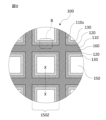
- FIG. 1 is a schematic cross-sectional view for explaining a catalyst according to an embodiment of the present invention.
- FIG. 2 is an enlarged cross-sectional view of a portion of region A in FIG.
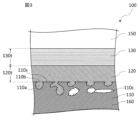
- FIG. 3 is a partially enlarged cross-sectional view of region B in FIG.
- FIG. 4 is a partially enlarged schematic cross-sectional view for explaining a catalyst according to a first modified example.
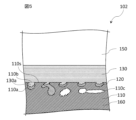
- FIG. 5 is a partially enlarged schematic cross-sectional view for explaining a catalyst according to a second modified example.
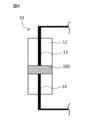
- FIG. 6 is a schematic diagram showing an example of a reaction apparatus used in a gas reforming method using a catalyst.
- Patent Document 1 proposes controlling the resistivity between catalysts at 450° C. to 50 ⁇ m or more and 270 ⁇ m or less. "450°C" is considered to be the lower limit of the reaction temperature of the steam reforming reaction, and Patent Document 1 also assumes that the catalytic reaction takes place at 450°C or higher.
- the reaction temperature of 450°C is a temperature at which the catalytic reaction proceeds to a certain extent even when the power applied to the electric field catalyst is 0 W (i.e., when no electric field is applied).
- the inventors conducted extensive research to obtain an electric field catalyst that can realize steam reforming reactions, etc., even at lower reaction temperatures, particularly at reaction temperatures so low that catalytic reactions do not proceed when an applied power of 0 W (e.g., 300°C). As a result, they discovered that by providing a high-resistance layer with a higher electrical resistance than the catalyst layer between the substrate and the catalyst layer, catalytic reactions can be achieved even at low reaction temperatures, which led to the completion of the present invention.
- the catalyst according to the embodiment is described in detail below.
- FIG. 1 is a schematic cross-sectional view of a catalyst 100 according to an embodiment of the present invention
- FIG. 2 is a partially enlarged cross-sectional view of region A in FIG. 1
- FIG. 3 is a partially enlarged cross-sectional view of region B in FIG.
- the catalyst 100 is a so-called electric field catalyst that is used by applying an electric field.
- the catalyst 100 includes a porous honeycomb substrate 110 and a catalyst layer 130 that covers a surface 110s of the honeycomb substrate 110.
- the honeycomb substrate 110 shown in Fig. 1 has a cylindrical outer shape and contains a large number of cells 150 (gas passages through which the gas to be treated passes).
- the cells 150 extend in the axial direction of the cylinder (perpendicular to the plane of the paper in Fig. 1).
- the honeycomb substrate 110 shown in Fig. 1 is a type that includes cells 150 with a rectangular cross section, and honeycomb substrates that include cells with a hexagonal or circular cross section are also known. Adjacent cells 150 are separated from one another by partitions 160 .
- the “surface 110 s of the honeycomb substrate 110 ” refers to the inner surfaces of the cells 150 of the honeycomb substrate 110 , that is, the surfaces of the partition walls 160 .
- the gas to be treated passing through the cells 150 comes into contact with the surface 110s of the honeycomb substrate 110. Therefore, by forming the catalyst layer 130 so as to cover the surface 110s, the gas to be treated comes into contact with the catalyst layer 130, accelerating the gas treatment.
- the catalyst 100 has a high-resistance layer 120 between the honeycomb substrate 110 and the catalyst layer 130.
- This high-resistance layer 120 has a higher electrical resistivity than the catalyst layer 130.
- the actual catalyst 100 is analyzed to examine the component composition and structure (particularly porosity) of each of the catalyst layer 130 and the high-resistance layer 120, and samples with similar component composition and structure are prepared and the electrical resistivity of the samples is measured, thereby making it possible to estimate the electrical resistivity of each of the catalyst layer 130 and the high-resistance layer 120.
- holes 110a open pores originating from the porous material may be formed on a surface 110s of the honeycomb substrate 110. It is preferable that at least a portion of the holes 110a is filled with the high resistance layer 120.
- the phrase "at least a portion of the hole 110a" can have two meanings. The first meaning is that a plurality of holes 110a exists, and some of the holes 110a are filled with the high resistance layer 120, while others are not filled.
- the second meaning is that, in each of the multiple holes, a part of the pore volume of the hole is filled with the high resistance layer 120 (see, for example, FIG. 5). The second meaning will be described in detail below with reference to FIGS. 3 to 5.
- the high resistance layer 120 fills all of the holes 110 a and further covers the entire surface 110 s of the honeycomb substrate 110 .
- 4 shows a first modified example of the catalyst 101, in which the high resistance layer 120 fills all of the holes 110a, and the surface of the high resistance layer 120 is substantially flush with the surface 110s of the honeycomb substrate 110. In the first modified example, the surface 110s of the honeycomb substrate 110 is not covered with the high resistance layer 120.
- Figure 5 shows a second modified example of the catalyst 102, in which the high-resistance layer 120 fills only a portion of the internal cavity of each hole 110a.
- the surface of the high-resistance layer 120 does not reach the surface 110s of the honeycomb substrate 110, and even after the high-resistance layer 120 is formed, there is a recess on the surface 110s of the honeycomb substrate 110 due to the unfilled holes 110a (although this is shallower than before the high-resistance layer 120 is formed).
- This recess is filled by a portion 130a of the catalyst layer 130 that is formed later.
- the volume of the "part 130a of the catalyst layer 130" that enters the holes 110a can be reduced compared to when the high resistance layer 120 is not provided. This is expected to have the following effects.
- the gas to be treated passing through the cell 150 has difficulty reaching the portion 130a of the catalyst layer 130 present in the hole 110a, and therefore the portion 130a of the catalyst layer 130 hardly contributes to the catalytic reaction.
- a current also flows through the portion 130a of the catalyst layer 130 present in the hole 110a. In other words, the current flows through the region of the catalyst layer 130 that does not contribute to the catalytic reaction, and the amount of current that contributes to the catalytic reaction is reduced.
- the amount of the catalytic layer 130 that enters the hole 110a is reduced, thereby reducing the amount of current that does not contribute to the catalytic reaction (i.e., increasing the amount of current that contributes to the catalytic reaction), thereby promoting the catalytic reaction.
- the amount of catalyst layer 130 that enters the hole 110a can be reduced, it is expected that the amount of catalyst material used when forming the catalyst layer 130 can be reduced.
- the same effect as if the hole were completely filled with the high resistance layer 120 can be obtained. For example, even if there is a cavity inside the hole 110a that could not be filled with the high resistance layer 120, if the opening 110b of the hole 110a is completely blocked by the high resistance layer 120, the catalyst layer 130 cannot penetrate into the remaining cavity, and the same effect as if the hole were completely filled can be expected.
- the surface 110s of the honeycomb substrate 110 is exposed from the high-resistance layer 120.
- the surface 110s of the honeycomb substrate 110 comes into contact with the catalyst layer 130.
- a chemical reaction may occur between the honeycomb substrate 110 and the catalyst layer 130, which may adversely affect the catalytic reaction. Therefore, it is particularly preferable to cover the entire surface 110s of the honeycomb substrate 110 with a high-resistance layer 120 to avoid contact between the surface 110s of the honeycomb substrate 110 and the catalyst layer 130, as in the catalyst 100 shown in FIG.
- voids 110c closed pores inside the partition walls 160 that do not open to the surface 110s.
- Such voids 110c may or may not be filled with the high resistance layer 120.
- the thickness 120t of the high resistance layer 120 is not particularly limited, but is, for example, 0 ⁇ m to 70 ⁇ m, preferably 5 ⁇ m to 70 ⁇ m, and more preferably 10 ⁇ m to 40 ⁇ m. It should be noted that the thickness 120t of the high-resistance layer 120 is measured from the surface 110s of the honeycomb substrate 110. Therefore, when the high-resistance layer 120 fills only a portion of the hole 110a, as in Figure 5, the thickness of the high-resistance layer 120 may be 0 ⁇ m even though the high-resistance layer 120 is present between the honeycomb substrate 110 (more specifically, the inner surface of the hole 110a of the honeycomb substrate 110) and the catalyst layer 130.
- the thickness 130t of the catalyst layer 130 is preferably 5 ⁇ m to 80 ⁇ m, more preferably 10 ⁇ m to 50 ⁇ m, and particularly preferably 20 ⁇ m to 40 ⁇ m.
- Increasing the thickness of the high-resistance layer 120 and catalyst layer 130 increases the amount of material used and the risk of clogging the cells 150 of the honeycomb substrate 110 during coating. For example, for a 3 mil/750 cpsi honeycomb substrate 110, it is preferable that the total thickness of the high-resistance layer 120 and catalyst layer 130 be 80 ⁇ m or less.
- the thickness 120t of the high-resistance layer 120 and the thickness 130t of the catalyst layer 130 are measured by SEM observation (1000x or 2000x) of the cross section of the sample.
- the honeycomb substrate 110 is cut in a cross section (cross section shown in FIGS. 1 and 2) perpendicular to the extension direction (flow direction of the gas to be treated) of the cells 150.
- the thickness 130t of the catalyst layer 130 and the thickness 120t of the high-resistance layer 120 in the direction perpendicular to the side of the cell 150 are measured at approximately the center position of one side 150L of the cell 150.
- Three cross sections are made and thickness measurements are taken on three randomly selected sides of each cross section.
- the cross section is formed at a position excluding 1/10 of the total length of the honeycomb substrate 110 (the dimension of the honeycomb substrate 110 in the extension direction of the cells 150) from both ends.
- the sides are selected to be those excluding 1/10 of the outer periphery.
- the catalyst layer 130 may be formed from an electric field catalyst material containing Ru, Ba, Zr, Y, and O, and the high resistance layer 120 may be formed from an insulating material containing Ba, Zr, Y, and O.
- the electric field catalyst material constituting the catalyst layer 130 is preferably an oxide of Ba, Zr and Y (chemical formula: Ba(Zr,Y) O3 ) as the main component, with Ru added as an active metal. By controlling the amount of Ru added, the conductivity (electrical resistivity) of the catalyst layer 130 can be controlled.
- each element (Y, Ru) are, when the content of Ba is 1.0 mol, It is preferable that Y is 0 to 0.03 mol and Ru is 0.04 to 0.20 mol.
- Y is within the above range, a catalyst material having high electric field activity can be obtained.
- Ru is in the above range, the electrical resistivity of the catalyst layer 130 can be sufficiently reduced, and a catalyst material with high electric field activity can be obtained. Note that, although adding Ru in excess of the upper limit of Ru does not adversely affect the catalytic action, adding Ru in excess of 0.20 mol saturates the electric field catalytic activity and simply increases the cost, so the preferred upper limit is 0.20 mol.
- More preferable contents of Y and Ru are, when the content of Ba is 1.0 mole, Y: 0 to 0.02 mol Ru: 0.04 to 0.12 mol
- the insulating material constituting the high resistance layer 120 is mainly composed of oxides of Ba, Zr and Y (chemical formula: Ba(Zr,Y) O3 ).
- the high resistance layer 120 is insulating because it does not contain Ru, which is an element that imparts electrical conductivity.
- the catalyst material constituting the catalyst layer 130 may be a material capable of exhibiting an electric field reforming reaction, such as YSZ containing Ni, BaZrO3-based material containing Ni, or CeO2 - based material supporting at least one of Pd, Pt, Rh, and Ru.
- the insulating material constituting the high resistance layer 120 is not particularly limited as long as it has a higher electrical resistivity than the catalyst layer 130, and may be a general ceramic such as Al 2 O 3. It is also preferable to select a material that has low reactivity with both the material constituting the honeycomb substrate 110 (usually an insulating material) and the catalyst material constituting the catalyst layer 130, and has a thermal expansion coefficient close to both materials.
- the porous honeycomb substrate 110 is usually made of an insulating material. This makes it possible to suppress the flow of current through the honeycomb substrate 110 and concentrate the current in the catalyst layer 130 when an electric field is applied to the electric field catalyst.
- An example of a suitable material for the honeycomb substrate 110 is cordierite.
- Method of manufacturing catalyst 100 In the method for producing the catalyst 100, The method includes the steps of 1) preparing a honeycomb substrate 110, 2) forming a high-resistance layer 120, and 3) forming a catalyst layer 130, in this order. A generally known method can be applied as a method for producing the catalyst 100. A representative method for producing the catalyst 100 will be described below.
- Step 1) Step of preparing honeycomb substrate 110
- the honeycomb substrate 110 is obtained by extruding ceramics having an appropriate resistivity (e.g., cordierite, alumina, stabilized zirconia, etc.), drying and firing the extrusion molding.
- an appropriate resistivity e.g., cordierite, alumina, stabilized zirconia, etc.
- cordierite a commercially available honeycomb substrate can also be used.
- Step 2) Step of forming the high resistance layer 120 The high resistance layer 120 can be formed from, for example, an insulating material.
- an insulating material There is no restriction on the synthesis method of the insulating material, and any synthesis method used in the synthesis of ceramic materials, such as the solid-phase method or coprecipitation method, can be applied.
- the solid-phase method will be explained.
- Raw materials for example, BaCO 3 and ZrO 2 in the case of hydrocarbon reforming
- boulders and water are added and wet mixed to obtain a mixture.
- the resulting mixture is dried in an oven at a temperature of 100 to 150° C., and then baked in air at a temperature of 900 to 1300° C. for 1 to 6 hours to obtain an insulating material.
- the obtained insulating material is mixed with water as a solvent and, optionally, a pore-forming agent (carbon, resin, etc.) in a ball mill for two hours to produce a slurry for coating.
- a pore-forming agent carbon, resin, etc.
- a predetermined amount of slurry for the high-resistance layer 120 is applied (wash-coated) to the entire surface of the honeycomb substrate 110 and dried to form the high-resistance layer 120 (containing a pore-forming agent).
- Step 3) Step of forming catalyst layer 130
- Raw materials e.g., BaCO3, ZrO2 , and RuO2 for hydrocarbon reforming
- Raw materials are prepared, weighed out to a predetermined molar ratio, and then mixed with boulders and water to obtain a mixture.
- the resulting mixture is dried in an oven at a temperature of 100 to 150° C., and then calcined in air at 900 to 1200° C. for 1 to 6 hours to obtain a catalyst material.
- the manufacturing method described here is one example, and it goes without saying that a person skilled in the art can manufacture the catalyst 100 according to the embodiment using a different method by taking into account known techniques.
- the essence of the present invention is not limited to the examples described here, but is that it can provide a more efficient catalyst even if the optimal conditions differ depending on the substrate and catalyst material used.
- honeycomb substrate 110 a commercially available cylindrical honeycomb substrate made of cordierite ( ⁇ 30 mm x 30 mmt, cell count: 750 cpsi) was used (manufactured by NGK Insulators, Honeyceram, 3 mil/750 cpsi).
- the obtained insulating material was mixed with water as a solvent and a pore former in a ball mill for 2 hours to prepare a slurry for coating.
- the pore former was an acrylic resin with an average particle size of 1.8 ⁇ m (MX-180TA manufactured by Soken Chemical Industries, Ltd.), and the amount of the pore former was added in the amount shown in Table 2, calculated as a ratio when the total solid content in the slurry was 100% by mass.
- the slurry for the high-resistance layer 120 was applied (wash-coated) to the entire surface of the honeycomb substrate 110 in the amount shown in Table 2, and then dried to form the high-resistance layer 120 (containing a pore-forming agent).
- BaCO3 , ZrO2 , Y2O3 , and RuO2 were weighed out so that the ratio of each element was as shown in Table 1 , and then cobbles and water were added to the mixture for wet mixing to obtain a mixture.
- the resulting mixture was dried in an oven at a temperature of 120° C., and then calcined in air at 1100° C. for 1 hour to obtain a catalyst material.
- the obtained catalyst material was mixed with water as a solvent and a pore-forming agent in a ball mill for 2 hours to prepare a slurry for coating.
- the pore-forming agent used was an acrylic resin with an average particle size of 0.8 ⁇ m (MX-80H3wT manufactured by Soken Chemical & Engineering Co., Ltd.), and the amount of the pore-forming agent added was the amount shown in Table 1, calculated as a ratio when the total solid content in the slurry was 100% by mass.
- the slurry for the catalyst layer 130 was applied (wash-coated) to the entire surface of the honeycomb substrate 110 on which the high resistance layer 120 was formed, in the amount shown in Table 1, and dried to form the catalyst layer 130 (containing a pore-forming agent). Then, the substrate was fired at 800° C. for 3 hours. The pore-forming agent was burned away by combustion, thermal decomposition, or the like during firing. In this manner, a catalyst sample for measurement was prepared.
- the thickness 130t of the catalyst layer 130 and the thickness 120t of the high-resistance layer 120 were measured by SEM observation (1000x or 2000x) of the cross section of the sample.
- the honeycomb substrate 110 was cut at a cross section (cross section shown in Figs. 1 and 2) perpendicular to the extension direction of the cells 150 (flow path direction of the gas to be treated).
- the thickness 130t of the catalyst layer 130 and the thickness 120t of the high-resistance layer 120 in the direction perpendicular to the side of the cell 150 (direction of line X-X in Fig. 2) were measured at approximately the center position of one side 150L of the cell 150.
- the thicknesses were automatically measured using image processing software.
- the resistance value of each layer is an important design value.
- the resistivity ( ⁇ ) was evaluated by the following method, and the relationship with the catalytic activity was summarized.
- the ceramics and pore-forming agent used in the catalyst layer 130 and the high-resistance layer 120 were prepared in the mixing ratios shown in Tables 1 and 2, and after adding a solvent and a binder, the mixture was kneaded and press-molded. The molded product was fired at the same temperature as the honeycomb firing to obtain a sample for resistance measurement.
- the sample size was 4 mm ⁇ 3 mm ⁇ 30 mm, and the measurement was performed by the four-terminal method.
- the resistivity is expressed by the following formula, which is a value normalized from the thickness, width, and length, and takes into account the influence of the material, pores, and the contact state between the materials.
- ⁇ R ⁇ A/T
- resistivity ⁇ cm
- resistance ⁇
- A Sample cross-sectional area (cm 2 )
- T sample length (cm) It is.
- Table 3 shows the measurement results when an electric field was applied with an input power of 100 W.
- Samples 1 to 13 are examples, and a high-resistance layer 120 was provided between the honeycomb substrate 110 and the catalyst layer 130.
- the high-resistance layer 120 allowed current to concentrate on the catalyst layer 130, improving the methane conversion rate (the methane conversion rate was more than twice as high as that of the comparative example described later).
- the state of the high resistance layer 120 was one of those shown in FIG.
- sample 14 does not have a high resistance layer 120. Therefore, in sample 14, the hole 110a opening in the surface 110s of the honeycomb substrate 110 is filled with a part of the catalyst layer 130.
- the part 130a of the catalyst layer 130 present in the hole 110a does not come into contact with the gas to be treated passing through the cell 150, so a current flows through it even though it hardly contributes to the catalytic reaction.
- the amount of current flowing through the part of the catalyst layer 130 that contributes to the catalytic reaction (mainly the upper part of the catalyst layer 130 adjacent to the cell 150) is reduced, which is thought to have lowered the methane conversion rate.
- Sample 1 used a catalyst material containing 0.04 Ru (molar ratio) and provided a catalyst layer 130 with a thickness 130t of 10 ⁇ m.
- the high resistance layer 120 had a thickness 120t of 10 ⁇ m. Because the amount of Ru in the catalyst layer was relatively small and the catalyst layer was relatively thin, the electrical resistance of the catalyst as a whole was relatively high and the methane conversion rate was low among the examples.
- Sample 2 was the same as Sample 1, except that the thickness 130t of the catalyst layer 130 was 20 ⁇ m. Since the catalyst layer was thicker than that of Sample 1, the electrical resistance of the entire catalyst was lowered and more current flowed, resulting in an improved methane conversion rate.
- the Ru content (molar ratio) in the catalyst material was changed to 0.08, 0.10, and 0.12, and the catalyst layer 130 was provided with a thickness 130t of 10 ⁇ m.
- the thickness 120t of the high resistance layer 120 was 10 ⁇ m.
- samples 3 and 4 with low Ru content showed a higher methane conversion rate than sample 5 with high Ru content. This is thought to be because the Ru content increased, the dispersion of Ru decreased, and the interface between Ru and BaZrYO3 , which is considered to be the reaction field of the electric field catalytic reaction, decreased.
- Sample 7 in which the thickness 130t of the catalyst layer 130 was 15 ⁇ m, had a higher electric resistance of the entire catalyst than Samples 8 and 9, but the methane conversion rate was improved.
- sample 3 catalog layer 130 thickness 130t 10 ⁇ m
- Ru content (molar ratio) 0.08
- the Ru content (molar ratio) in the catalyst layer was fixed at 0.08
- the thickness 130t of the catalyst layer 130 was fixed at 10 ⁇ m
- the thickness 120t of the high-resistance layer 120 was varied in the range of 0 to 40 ⁇ m.
- the high-resistance layer 120 was formed with a coating amount of 40 g/L, but only partially filled the holes (more precisely, only partially the space inside the holes) that opened on the surface of the honeycomb substrate 110 ( Figure 5). Therefore, the "thickness 120t of the high-resistance layer 120" measured from the surface 110s of the honeycomb substrate 110 was 0 ⁇ m.
- Sample 13 was the same as sample 3, except that the composition of the high resistance layer 120 was changed to a composition that did not contain Ba. Compared to sample 3, a similar methane conversion rate was achieved.
- the electrical resistivity of the high resistance layer 120 was more than twice as high as that of the catalyst layer 130, the electric field catalytic reaction could be efficiently generated (samples 1 and 2). It is more preferable that the electrical resistivity of the high resistance layer 120 is at least one order of magnitude higher than that of the catalyst layer 130 (samples 3 to 13).
- the catalyst according to the present disclosure is expected to enable catalytic reactions at low temperatures by being applied to steam reforming, trireforming, dry reforming, methanation treatment, reverse water gas shift (RWGS) reaction, oxidative coupling of methane (OCM) reaction, ammonia synthesis, dehydrogenation reaction from methylcyclohexane (MCH), and three-way catalytic reaction for waste methane treatment.
- RWGS reverse water gas shift
- OCM oxidative coupling of methane
- MCH methylcyclohexane
Landscapes
- Chemical & Material Sciences (AREA)
- Chemical Kinetics & Catalysis (AREA)
- Engineering & Computer Science (AREA)
- Organic Chemistry (AREA)
- Materials Engineering (AREA)
- Health & Medical Sciences (AREA)
- General Health & Medical Sciences (AREA)
- Combustion & Propulsion (AREA)
- Inorganic Chemistry (AREA)
- Physics & Mathematics (AREA)
- Thermal Sciences (AREA)
- Catalysts (AREA)
Priority Applications (4)
| Application Number | Priority Date | Filing Date | Title |
|---|---|---|---|
| CN202480020323.9A CN120835814A (zh) | 2023-03-23 | 2024-03-08 | 转化用催化剂 |
| DE112024000526.8T DE112024000526T5 (de) | 2023-03-23 | 2024-03-08 | Reformierungskatalysator |
| JP2025508315A JPWO2024195586A1 (https=) | 2023-03-23 | 2024-03-08 | |
| US19/325,592 US20260008039A1 (en) | 2023-03-23 | 2025-09-11 | Reforming catalyst |
Applications Claiming Priority (2)
| Application Number | Priority Date | Filing Date | Title |
|---|---|---|---|
| JP2023-047176 | 2023-03-23 | ||
| JP2023047176 | 2023-03-23 |
Related Child Applications (1)
| Application Number | Title | Priority Date | Filing Date |
|---|---|---|---|
| US19/325,592 Continuation US20260008039A1 (en) | 2023-03-23 | 2025-09-11 | Reforming catalyst |
Publications (1)
| Publication Number | Publication Date |
|---|---|
| WO2024195586A1 true WO2024195586A1 (ja) | 2024-09-26 |
Family
ID=92842103
Family Applications (1)
| Application Number | Title | Priority Date | Filing Date |
|---|---|---|---|
| PCT/JP2024/009087 Ceased WO2024195586A1 (ja) | 2023-03-23 | 2024-03-08 | 改質用触媒 |
Country Status (5)
| Country | Link |
|---|---|
| US (1) | US20260008039A1 (https=) |
| JP (1) | JPWO2024195586A1 (https=) |
| CN (1) | CN120835814A (https=) |
| DE (1) | DE112024000526T5 (https=) |
| WO (1) | WO2024195586A1 (https=) |
Cited By (1)
| Publication number | Priority date | Publication date | Assignee | Title |
|---|---|---|---|---|
| WO2026058699A1 (ja) * | 2024-09-12 | 2026-03-19 | 株式会社村田製作所 | 電場触媒用の反応器およびそれを含むリアクター |
Citations (5)
| Publication number | Priority date | Publication date | Assignee | Title |
|---|---|---|---|---|
| JPH0810566A (ja) * | 1994-07-05 | 1996-01-16 | Ngk Insulators Ltd | 排ガス浄化用触媒−吸着体及び排ガス浄化方法 |
| JP2005035852A (ja) * | 2003-07-17 | 2005-02-10 | Nissan Motor Co Ltd | 水素製造装置および該装置を用いた水素リッチガスの製造方法 |
| JP2017087088A (ja) * | 2015-11-02 | 2017-05-25 | 田中貴金属工業株式会社 | 電場印加により活性化可能な触媒、及び、該触媒を用いた水蒸気改質方法 |
| WO2020012687A1 (ja) * | 2018-07-09 | 2020-01-16 | 株式会社村田製作所 | 炭化水素改質触媒および炭化水素改質装置 |
| WO2021131545A1 (ja) * | 2019-12-26 | 2021-07-01 | 株式会社キャタラー | 排ガス浄化用触媒 |
-
2024
- 2024-03-08 DE DE112024000526.8T patent/DE112024000526T5/de active Pending
- 2024-03-08 WO PCT/JP2024/009087 patent/WO2024195586A1/ja not_active Ceased
- 2024-03-08 JP JP2025508315A patent/JPWO2024195586A1/ja active Pending
- 2024-03-08 CN CN202480020323.9A patent/CN120835814A/zh active Pending
-
2025
- 2025-09-11 US US19/325,592 patent/US20260008039A1/en active Pending
Patent Citations (5)
| Publication number | Priority date | Publication date | Assignee | Title |
|---|---|---|---|---|
| JPH0810566A (ja) * | 1994-07-05 | 1996-01-16 | Ngk Insulators Ltd | 排ガス浄化用触媒−吸着体及び排ガス浄化方法 |
| JP2005035852A (ja) * | 2003-07-17 | 2005-02-10 | Nissan Motor Co Ltd | 水素製造装置および該装置を用いた水素リッチガスの製造方法 |
| JP2017087088A (ja) * | 2015-11-02 | 2017-05-25 | 田中貴金属工業株式会社 | 電場印加により活性化可能な触媒、及び、該触媒を用いた水蒸気改質方法 |
| WO2020012687A1 (ja) * | 2018-07-09 | 2020-01-16 | 株式会社村田製作所 | 炭化水素改質触媒および炭化水素改質装置 |
| WO2021131545A1 (ja) * | 2019-12-26 | 2021-07-01 | 株式会社キャタラー | 排ガス浄化用触媒 |
Cited By (1)
| Publication number | Priority date | Publication date | Assignee | Title |
|---|---|---|---|---|
| WO2026058699A1 (ja) * | 2024-09-12 | 2026-03-19 | 株式会社村田製作所 | 電場触媒用の反応器およびそれを含むリアクター |
Also Published As
| Publication number | Publication date |
|---|---|
| US20260008039A1 (en) | 2026-01-08 |
| DE112024000526T5 (de) | 2025-11-06 |
| JPWO2024195586A1 (https=) | 2024-09-26 |
| CN120835814A (zh) | 2025-10-24 |
Similar Documents
| Publication | Publication Date | Title |
|---|---|---|
| JP3777903B2 (ja) | 電極−電解質間に傾斜組成を持つ固体酸化物型燃料電池 | |
| EP2977363B1 (en) | Joined body, and production method therefor | |
| Fabbri et al. | High-performance composite cathodes with tailored mixed conductivity for intermediate temperature solid oxide fuel cells using proton conducting electrolytes | |
| EA007525B1 (ru) | Керамический анод и способ его изготовления | |
| US20090130522A1 (en) | Fuel cell module and structure for gas supply to fuel cell | |
| US20110195342A1 (en) | Solid oxide fuel cell reactor | |
| EA009790B1 (ru) | Пористый электрод, твердый окисный топливный элемент и способ их изготовления | |
| US20180331381A1 (en) | Method for manufacturing protonic ceramic fuel cells | |
| JP6337146B2 (ja) | Sofc陰極拡散バリア層を生成する方法およびsofc | |
| CN105531860A (zh) | 燃料电极用电极材料、固体电解质-电极层叠体、固体电解质-电极层叠体的制造方法以及燃料电池 | |
| US20260008039A1 (en) | Reforming catalyst | |
| JP2023017750A (ja) | メタネーション反応触媒担体用のセラミックハニカム構造体、およびその製造方法 | |
| JP2009195863A (ja) | 酸素分離膜エレメント | |
| WO2014122807A1 (ja) | 固体酸化物形燃料電池及びその製造方法 | |
| JP4149337B2 (ja) | 酸素分離膜エレメント及びその製造方法 | |
| JP4149343B2 (ja) | 酸素分離膜エレメント及びその製造方法 | |
| JP4776930B2 (ja) | 固体酸化物形燃料電池の支持基体 | |
| JP2014203632A (ja) | 燃料電池 | |
| MXPA05006424A (es) | Anodos de ceramica de alto desempeno y metodo para producirlos. | |
| JP4508340B2 (ja) | 固体電解質形燃料電池セルの製法 | |
| EP2760071A1 (en) | Fuel electrode doubling as support of solid oxide fuel cell and method of producing same | |
| JP6818960B1 (ja) | セル、セルスタック装置、モジュールおよびモジュール収容装置 | |
| JPH11121019A (ja) | 電気化学セルおよび電気化学装置 | |
| JP2001097789A (ja) | セラミック複合材料 | |
| JPH04355059A (ja) | 燃料電池 |
Legal Events
| Date | Code | Title | Description |
|---|---|---|---|
| 121 | Ep: the epo has been informed by wipo that ep was designated in this application |
Ref document number: 24774725 Country of ref document: EP Kind code of ref document: A1 |
|
| ENP | Entry into the national phase |
Ref document number: 2025508315 Country of ref document: JP Kind code of ref document: A |
|
| WWE | Wipo information: entry into national phase |
Ref document number: 2025508315 Country of ref document: JP |
|
| WWE | Wipo information: entry into national phase |
Ref document number: 112024000526 Country of ref document: DE |
|
| WWE | Wipo information: entry into national phase |
Ref document number: 202480020323.9 Country of ref document: CN |
|
| WWP | Wipo information: published in national office |
Ref document number: 202480020323.9 Country of ref document: CN |
|
| WWP | Wipo information: published in national office |
Ref document number: 112024000526 Country of ref document: DE |
|
| 122 | Ep: pct application non-entry in european phase |
Ref document number: 24774725 Country of ref document: EP Kind code of ref document: A1 |