WO2024195503A1 - 仮固定基板および仮固定基板の製造方法 - Google Patents
仮固定基板および仮固定基板の製造方法 Download PDFInfo
- Publication number
- WO2024195503A1 WO2024195503A1 PCT/JP2024/008119 JP2024008119W WO2024195503A1 WO 2024195503 A1 WO2024195503 A1 WO 2024195503A1 JP 2024008119 W JP2024008119 W JP 2024008119W WO 2024195503 A1 WO2024195503 A1 WO 2024195503A1
- Authority
- WO
- WIPO (PCT)
- Prior art keywords
- temporary fixing
- fixing substrate
- thin
- thickness
- main surface
- Prior art date
- Legal status (The legal status is an assumption and is not a legal conclusion. Google has not performed a legal analysis and makes no representation as to the accuracy of the status listed.)
- Ceased
Links
Images


Classifications
-
- H—ELECTRICITY
- H10—SEMICONDUCTOR DEVICES; ELECTRIC SOLID-STATE DEVICES NOT OTHERWISE PROVIDED FOR
- H10W—GENERIC PACKAGES, INTERCONNECTIONS, CONNECTORS OR OTHER CONSTRUCTIONAL DETAILS OF DEVICES COVERED BY CLASS H10
- H10W74/00—Encapsulations, e.g. protective coatings
- H10W74/01—Manufacture or treatment
- H10W74/019—Manufacture or treatment using temporary auxiliary substrates
-
- B—PERFORMING OPERATIONS; TRANSPORTING
- B28—WORKING CEMENT, CLAY, OR STONE
- B28B—SHAPING CLAY OR OTHER CERAMIC COMPOSITIONS; SHAPING SLAG; SHAPING MIXTURES CONTAINING CEMENTITIOUS MATERIAL, e.g. PLASTER
- B28B1/00—Producing shaped prefabricated articles from the material
- B28B1/14—Producing shaped prefabricated articles from the material by simple casting, the material being neither forcibly fed nor positively compacted
- B28B1/16—Producing shaped prefabricated articles from the material by simple casting, the material being neither forcibly fed nor positively compacted for producing layered articles
-
- B—PERFORMING OPERATIONS; TRANSPORTING
- B28—WORKING CEMENT, CLAY, OR STONE
- B28B—SHAPING CLAY OR OTHER CERAMIC COMPOSITIONS; SHAPING SLAG; SHAPING MIXTURES CONTAINING CEMENTITIOUS MATERIAL, e.g. PLASTER
- B28B11/00—Apparatus or processes for treating or working the shaped or preshaped articles
- B28B11/08—Apparatus or processes for treating or working the shaped or preshaped articles for reshaping the surface, e.g. smoothing, roughening, corrugating, making screw-threads
- B28B11/0845—Apparatus or processes for treating or working the shaped or preshaped articles for reshaping the surface, e.g. smoothing, roughening, corrugating, making screw-threads for smoothing
-
- B—PERFORMING OPERATIONS; TRANSPORTING
- B28—WORKING CEMENT, CLAY, OR STONE
- B28B—SHAPING CLAY OR OTHER CERAMIC COMPOSITIONS; SHAPING SLAG; SHAPING MIXTURES CONTAINING CEMENTITIOUS MATERIAL, e.g. PLASTER
- B28B11/00—Apparatus or processes for treating or working the shaped or preshaped articles
- B28B11/08—Apparatus or processes for treating or working the shaped or preshaped articles for reshaping the surface, e.g. smoothing, roughening, corrugating, making screw-threads
- B28B11/0863—Apparatus or processes for treating or working the shaped or preshaped articles for reshaping the surface, e.g. smoothing, roughening, corrugating, making screw-threads for profiling, e.g. making grooves
-
- B—PERFORMING OPERATIONS; TRANSPORTING
- B28—WORKING CEMENT, CLAY, OR STONE
- B28B—SHAPING CLAY OR OTHER CERAMIC COMPOSITIONS; SHAPING SLAG; SHAPING MIXTURES CONTAINING CEMENTITIOUS MATERIAL, e.g. PLASTER
- B28B11/00—Apparatus or processes for treating or working the shaped or preshaped articles
- B28B11/08—Apparatus or processes for treating or working the shaped or preshaped articles for reshaping the surface, e.g. smoothing, roughening, corrugating, making screw-threads
- B28B11/10—Apparatus or processes for treating or working the shaped or preshaped articles for reshaping the surface, e.g. smoothing, roughening, corrugating, making screw-threads by using presses
-
- C—CHEMISTRY; METALLURGY
- C04—CEMENTS; CONCRETE; ARTIFICIAL STONE; CERAMICS; REFRACTORIES
- C04B—LIME, MAGNESIA; SLAG; CEMENTS; COMPOSITIONS THEREOF, e.g. MORTARS, CONCRETE OR LIKE BUILDING MATERIALS; ARTIFICIAL STONE; CERAMICS; REFRACTORIES; TREATMENT OF NATURAL STONE
- C04B35/00—Shaped ceramic products characterised by their composition; Ceramics compositions; Processing powders of inorganic compounds preparatory to the manufacturing of ceramic products
- C04B35/01—Shaped ceramic products characterised by their composition; Ceramics compositions; Processing powders of inorganic compounds preparatory to the manufacturing of ceramic products based on oxide ceramics
- C04B35/10—Shaped ceramic products characterised by their composition; Ceramics compositions; Processing powders of inorganic compounds preparatory to the manufacturing of ceramic products based on oxide ceramics based on aluminium oxide
- C04B35/111—Fine ceramics
- C04B35/115—Translucent or transparent products
-
- H—ELECTRICITY
- H10—SEMICONDUCTOR DEVICES; ELECTRIC SOLID-STATE DEVICES NOT OTHERWISE PROVIDED FOR
- H10P—GENERIC PROCESSES OR APPARATUS FOR THE MANUFACTURE OR TREATMENT OF DEVICES COVERED BY CLASS H10
- H10P72/00—Handling or holding of wafers, substrates or devices during manufacture or treatment thereof
- H10P72/70—Handling or holding of wafers, substrates or devices during manufacture or treatment thereof for supporting or gripping
- H10P72/74—Handling or holding of wafers, substrates or devices during manufacture or treatment thereof for supporting or gripping using temporarily an auxiliary support
-
- H—ELECTRICITY
- H10—SEMICONDUCTOR DEVICES; ELECTRIC SOLID-STATE DEVICES NOT OTHERWISE PROVIDED FOR
- H10P—GENERIC PROCESSES OR APPARATUS FOR THE MANUFACTURE OR TREATMENT OF DEVICES COVERED BY CLASS H10
- H10P72/00—Handling or holding of wafers, substrates or devices during manufacture or treatment thereof
- H10P72/70—Handling or holding of wafers, substrates or devices during manufacture or treatment thereof for supporting or gripping
- H10P72/74—Handling or holding of wafers, substrates or devices during manufacture or treatment thereof for supporting or gripping using temporarily an auxiliary support
- H10P72/7412—Handling or holding of wafers, substrates or devices during manufacture or treatment thereof for supporting or gripping using temporarily an auxiliary support the auxiliary support including means facilitating the separation of a device or wafer from the auxiliary support
-
- H—ELECTRICITY
- H10—SEMICONDUCTOR DEVICES; ELECTRIC SOLID-STATE DEVICES NOT OTHERWISE PROVIDED FOR
- H10P—GENERIC PROCESSES OR APPARATUS FOR THE MANUFACTURE OR TREATMENT OF DEVICES COVERED BY CLASS H10
- H10P95/00—Generic processes or apparatus for manufacture or treatments not covered by the other groups of this subclass
-
- H—ELECTRICITY
- H10—SEMICONDUCTOR DEVICES; ELECTRIC SOLID-STATE DEVICES NOT OTHERWISE PROVIDED FOR
- H10W—GENERIC PACKAGES, INTERCONNECTIONS, CONNECTORS OR OTHER CONSTRUCTIONAL DETAILS OF DEVICES COVERED BY CLASS H10
- H10W74/00—Encapsulations, e.g. protective coatings
- H10W74/01—Manufacture or treatment
-
- H—ELECTRICITY
- H10—SEMICONDUCTOR DEVICES; ELECTRIC SOLID-STATE DEVICES NOT OTHERWISE PROVIDED FOR
- H10W—GENERIC PACKAGES, INTERCONNECTIONS, CONNECTORS OR OTHER CONSTRUCTIONAL DETAILS OF DEVICES COVERED BY CLASS H10
- H10W74/00—Encapsulations, e.g. protective coatings
- H10W74/01—Manufacture or treatment
- H10W74/014—Manufacture or treatment using batch processing
-
- H—ELECTRICITY
- H10—SEMICONDUCTOR DEVICES; ELECTRIC SOLID-STATE DEVICES NOT OTHERWISE PROVIDED FOR
- H10W—GENERIC PACKAGES, INTERCONNECTIONS, CONNECTORS OR OTHER CONSTRUCTIONAL DETAILS OF DEVICES COVERED BY CLASS H10
- H10W99/00—Subject matter not provided for in other groups of this subclass
-
- H—ELECTRICITY
- H10—SEMICONDUCTOR DEVICES; ELECTRIC SOLID-STATE DEVICES NOT OTHERWISE PROVIDED FOR
- H10P—GENERIC PROCESSES OR APPARATUS FOR THE MANUFACTURE OR TREATMENT OF DEVICES COVERED BY CLASS H10
- H10P72/00—Handling or holding of wafers, substrates or devices during manufacture or treatment thereof
- H10P72/70—Handling or holding of wafers, substrates or devices during manufacture or treatment thereof for supporting or gripping
- H10P72/74—Handling or holding of wafers, substrates or devices during manufacture or treatment thereof for supporting or gripping using temporarily an auxiliary support
- H10P72/7428—Handling or holding of wafers, substrates or devices during manufacture or treatment thereof for supporting or gripping using temporarily an auxiliary support used to support diced chips prior to mounting
-
- H—ELECTRICITY
- H10—SEMICONDUCTOR DEVICES; ELECTRIC SOLID-STATE DEVICES NOT OTHERWISE PROVIDED FOR
- H10P—GENERIC PROCESSES OR APPARATUS FOR THE MANUFACTURE OR TREATMENT OF DEVICES COVERED BY CLASS H10
- H10P72/00—Handling or holding of wafers, substrates or devices during manufacture or treatment thereof
- H10P72/70—Handling or holding of wafers, substrates or devices during manufacture or treatment thereof for supporting or gripping
- H10P72/74—Handling or holding of wafers, substrates or devices during manufacture or treatment thereof for supporting or gripping using temporarily an auxiliary support
- H10P72/744—Details of chemical or physical process used for separating the auxiliary support from a device or a wafer
- H10P72/7442—Separation by peeling
Definitions
- the present invention relates to a temporary fixing substrate used in the manufacturing process of semiconductor packages.
- FOWLP Fluorescence-out Wafer Level Package
- FOWLP technology involves the steps of: molding a resin onto a temporary fixing substrate on which a semiconductor chip is temporarily fixed with an adhesive; grinding the resin mold to expose the electrode ends of the semiconductor chip; forming a thin-film redistribution layer (multilayer wiring) and solder balls on the surface where the electrode ends are exposed; and singulating the individual packages and peeling them off from the temporary fixing substrate, resulting in a semiconductor package with a lower height than conventional packages.
- the temporary fixing substrate is peeled off by irradiating it with light from a light source such as a laser light source or a lamp.
- a light source such as a laser light source or a lamp.
- the method of peeling off by irradiating it with light from a laser light source is known as laser lift-off. That is, the interface (adhesive bonding surface) between the temporary fixing substrate and the objects to be fixed, the semiconductor chip and resin, is irradiated with light such as a laser from the side of the temporary fixing substrate, and the adhesive is ablated, thereby peeling off the temporary fixing substrate.
- the adhesive is ablated, thereby peeling off the temporary fixing substrate.
- the support substrate, etc. can also be considered as a temporary fixing substrate. Even when light irradiation is used to peel off such a support substrate, it is undesirable for the resin, etc. used for adhesion to remain on the support substrate, etc.
- the present invention was made in consideration of the above problems, and aims to realize a temporary fixing substrate that is less likely to leave behind resin or other materials when peeled off by exposure to light.
- a first aspect of the present invention is a temporary fixing substrate, which has a predetermined object temporarily fixed to one of its main surfaces and is then peeled off from the object, and is characterized in that it has a thin region that is an annular region of a predetermined width from a side end, and has a first thin portion on the one main surface side of the thin region that is recessed below the one main surface, the thickness of the thin region is smaller than the thickness outside the thin region, and the difference between the thickness at the side end and the thickness outside the thin region is 1 ⁇ m to 5 ⁇ m.
- the second aspect of the present invention is a temporary fixing substrate according to the first aspect, further comprising a second thin portion on the other main surface side of the thin region that is recessed further than the other main surface, and the sum of the surface recess amount, which is the recess amount of the first thin portion from the one main surface at least at the side end, and the back surface recess amount, which is the recess amount of the second thin portion from the other main surface at least at the side end, is 1 ⁇ m to 5 ⁇ m.
- the third aspect of the present invention is a temporary fixing substrate according to the second aspect, characterized in that the first thin portion and the second thin portion are tapered.
- the fourth aspect of the present invention is a temporary fixing substrate according to the second aspect, characterized in that the first thin portion and the second thin portion are stepped.
- the fifth aspect of the present invention is a temporary fixing substrate according to any one of the first to fourth aspects, characterized in that the temporary fixing substrate is disk-shaped and the predetermined width of the thin region is 0.5% to 3% of the radius of the temporary fixing substrate.
- the sixth aspect of the present invention is a method for producing a temporary fixing substrate, which is peeled off from a predetermined fixing object after a predetermined fixing object is temporarily fixed on one of the main surfaces, and is characterized in that the temporary fixing substrate is obtained by carrying out a molding process in which a raw material slurry containing a translucent ceramic powder is poured into a mold and solidified by mold casting, in which a mold is used to produce a molded body having a shape corresponding to the temporary fixing substrate and mainly composed of the translucent ceramic, a firing process in which the molded body is fired to obtain a sintered body, a chamfering process in which corners of the sintered body are chamfered, and a polishing process in which the sintered body after the chamfering is polished. ...
- the seventh aspect of the present invention is a method for manufacturing a temporary fixing substrate, in which a predetermined fixing object is temporarily fixed to one of the main surfaces and then peeled off from the fixing object, by carrying out a forming process in which a molded body mainly composed of a translucent ceramic is produced, a firing process in which the molded body is deformed into a shape corresponding to the temporary fixing substrate, a firing process in which the molded body is fired to obtain a sintered body, a chamfering process in which corners of the sintered body are chamfered, and a polishing process in which the sintered body with the chamfered edges is polished, thereby obtaining a temporary fixing substrate having a thin region that is an annular region of a predetermined width from a side end, a first thin portion on the side of the one main surface of the thin region that is recessed below the one main surface, the thickness of the thin region is smaller than the thickness outside the thin region, and the difference between the thickness at the side end and the thickness outside the thin region is
- the eighth aspect of the present invention is a method for manufacturing a temporary fixing substrate according to the seventh aspect, characterized in that the molding step includes a mold casting step in which a raw material slurry containing the translucent ceramic powder is cast into a mold and solidified to obtain the molded body, and a deformation step in which the molded body obtained in the mold casting step is deformed by pressing it.
- the ninth aspect of the present invention is a manufacturing method for a temporary fixing substrate according to the seventh aspect, characterized in that the molding step includes a tape molding step of molding a raw material slurry containing the translucent ceramic powder into a plurality of tapes, a lamination step of stacking and integrating the plurality of tapes to obtain a laminate, a punching step of punching the laminate to obtain the molded body, and a deformation step of deforming the molded body obtained in the punching step by pressing it.
- a temporary fixing substrate used for temporarily fixing a fixing object such as a semiconductor chip
- a fixing object such as a semiconductor chip
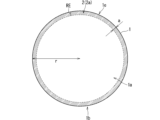
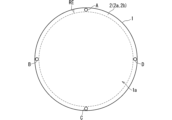
- FIG. 2 is a plan view of one main surface (front surface) 1a of the temporary fixing substrate 1.
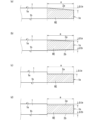
- 1A to 1C are partial cross-sectional views of various temporary fixing substrates 1 in the vicinity of side ends 1e.
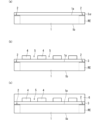
- 1A to 1C are schematic cross-sectional views showing stages in the process of fabricating a semiconductor package by the FOWLP technique using a temporary fixing substrate 1.
- 1A to 1C are schematic cross-sectional views showing stages in the process of fabricating a semiconductor package by the FOWLP technique using a temporary fixing substrate 1.
- FIG. 2 is a flow diagram illustrating a manufacturing process of the temporary fixing substrate 1.
- FIG. 2 is a diagram showing a schematic diagram of the production of molded body 1 ⁇ by a mold casting method.
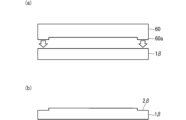
- FIG. 13 is a diagram showing a state in which a molded body 1 ⁇ produced by a tape casting method is used to produce a temporary fixing substrate 1 having a step-like thin front surface portion 2a.
- FIG. 13 is a diagram illustrating measurement points for a surface recession amount ⁇ ta.
- ⁇ Temporary Fixing Substrate> 1 is a plan view of one main surface (front surface) 1a of a temporary fixing substrate 1, which is one embodiment of a support substrate according to the present invention.
- the temporary fixing substrate 1 is a substrate to which a semiconductor chip is temporarily fixed, for example, when a semiconductor package is manufactured by a fan-out wafer level package (FOWLP) technique.
- FOWLP fan-out wafer level package
- the temporary fixing substrate 1 is a disc-shaped translucent ceramic substrate having a diameter of several hundred mm (e.g., 300 mm), a thickness of several hundred ⁇ m to several mm (e.g., 1 mm), an in-plane thickness difference of several ⁇ m or less (e.g., 3 ⁇ m or less), and a warpage of several hundred ⁇ m or less (e.g., 200 ⁇ m).
- the translucent ceramic is a ceramic having a forward total light transmittance of 20% or more in the entire wavelength range of 200 nm to 1500 nm. Examples of such translucent ceramic include alumina, silicon nitride, aluminum nitride, and silicon oxide.
- a suitable example of the temporary fixing substrate 1 is one having alumina as the main component and a forward total light transmittance of 70% or more at a wavelength of 1500 nm.
- alumina is the main component, it is preferable to use high purity alumina powder of 99.9% or more (preferably 99.95% or more) as the raw material, and it is preferable to add magnesium oxide and zirconia ( ZrO2 ) and yttria ( Y2O3 ) as sintering aids to such alumina powder.
- the front surface 1a, on which the semiconductor chip is placed, and the other main surface (back surface) 1b are both polished in advance to form flat polished surfaces with low surface roughness. More specifically, the front surface 1a and back surface 1b have an in-plane thickness difference of within a few ⁇ m as described above, and an arithmetic mean roughness Ra of 100 nm or less (preferably 20 nm or less). More specifically, both the front surface 1a and back surface 1b are surfaces that have been subjected to lapping. There is no particular limit to the lower limit of the arithmetic mean roughness Ra of the front surface 1a and back surface 1b, but 1 nm is sufficient for practical purposes.
- an annular region of a certain width a from the side end 1e around the entire periphery of the front surface 1a is a thin portion 2 (2a) that is recessed (in other words, has a lower height in the thickness direction of the substrate) than the remaining portions.
- a thin portion 2 (2b) may also be provided around the entire periphery of the back surface 1b in a similar manner.
- the annular region of width a from the side end 1e in which the thin portion 2 is provided will be referred to as the thin region RE.
- the thickness of the temporary fixing substrate 1 which is about several hundred ⁇ m to several mm as described above, is essentially the distance between the front surface 1a and the back surface 1b other than the thin region RE, but as described below, the difference in thickness between the thin region RE and other parts is slight. Therefore, it can be said that the temporary fixing substrate 1 has a thickness of about several hundred ⁇ m to several mm, including the thin region RE.
- the arithmetic mean roughness Ra of the front surface 1a and the back surface 1b which is 100 nm or less as described above, is realized at least on the front surface 1a and the back surface 1b other than the thin region RE.
- the thin portion 2 is provided with the intention of ensuring that peeling by irradiation with light from a light source, which is one step in the process of manufacturing a semiconductor package, can be performed favorably when the temporary fixing substrate 1 is used in the process of manufacturing a semiconductor package, the details of which will be described later.
- FIG. 2 is a partial cross-sectional view of various temporary fixing substrates 1 near the side end 1e to illustrate specific ways of forming the thin portion 2.
- the thin portion 2 is formed in a thin region RE of a predetermined width a.
- FIG. 2(a) is a diagram illustrating a temporary fixing substrate 1 having a tapered thin surface portion 2a on the outer periphery of the surface 1a.
- FIG. 2(b) is a diagram illustrating a temporary fixing substrate 1 having a tapered front-side thin portion 2a and a tapered back-side thin portion 2b on the outer periphery of each of the front surface 1a and back surface 1b.
- FIG. 2(c) is a diagram illustrating a temporary fixing substrate 1 having a stepped thin surface portion 2a on the outer periphery of the surface 1a.
- FIG. 2(d) is a diagram illustrating a temporary fixing substrate 1 having a stepped front surface thin portion 2a and a stepped back surface thin portion 2b on the outer periphery of each of the front surface 1a and back surface 1b.
- the thicknesswise distance between the front surface 1a and the side end 1e in the front surface thin portion 2a is the front surface recess amount ⁇ ta
- the thicknesswise distance between the back surface 1b and the side end 1e in the back surface thin portion 2b is the back surface recess amount ⁇ tb
- the total recess amount ⁇ t corresponds to the maximum difference in thickness between the thin region RE and the other parts. Furthermore, if the front side thin portion 2a and the back side thin portion 2b are stepped, the front side recess amount ⁇ ta and the back side recess amount ⁇ tb correspond to the step distance of the step.
- the shape of the thin portion 2 is not limited to a tapered or stepped shape, but may be curved and convex upward or downward in cross-sectional view.
- the shape of the thin portion 2a on the front side and the thin portion 2b on the back side may be different.
- the thin portion 2 provided on the temporary fixing substrate 1 in the above-mentioned manner is intended to ensure the manufacturing yield of the semiconductor package by making the temporary fixing substrate 1 preferably peeled off by light irradiation, which is one step in the manufacturing process of the semiconductor package. This point will be described below.
- Figures 3 and 4 are schematic cross-sectional views showing the steps of the manufacturing process of a semiconductor package by FOWLP technology using a temporary fixing substrate 1.
- the thin part 2 is shown with diagonal lines only on the front surface 1a side.
- a layer of adhesive (adhesive layer) 3 ⁇ is formed on temporary fixing substrate 1.
- adhesive include double-sided tape and hot melt adhesives, and various known methods can be used to form the adhesive, such as roll coating, spray coating, screen printing, and spin coating.
- temporary fixing substrate 1 has a slightly convex warped shape on the surface 1a side, but for convenience of illustration in FIG. 3, such warping is ignored.
- a plurality (a large number) of semiconductor chips 4 are placed on the adhesive layer 3 ⁇ .
- the semiconductor chips 4 are also placed on the thin region RE.
- the adhesive layer 3 ⁇ is then cured to form the adhesive layer 3.
- the curing method is selected from heating, ultraviolet light irradiation, and the like, depending on the material of the adhesive used in the adhesive layer 3 ⁇ . As a result, the semiconductor chips 4 are adhesively fixed to the temporary fixing substrate 1.
- molding resin is poured onto the entire upper surface of the temporary fixing substrate 1, that is, over the gaps 5 between the semiconductor chips 4 and the entire upper surface of the semiconductor chip 4.
- the molding resin is cured to form a resin mold 6, as shown in FIG. 3(c).
- molding resins include epoxy resins, polyimide resins, polyurethane resins, and urethane resins.
- FIG. 4(a) shows the state after such grinding.
- device components such as rewiring layers and solder balls are formed on each of the semiconductor chips 4 exposed by grinding.
- cut lines CL are formed in the resin mold 6 to separate the resin mold 6 into a plurality of semiconductor packages 7, each of which includes a semiconductor chip 4.
- the cut lines CL are formed by a technique such as dicing.
- the temporary fixing substrate 1 is peeled off (separated) by irradiation with light. That is, as shown in FIG. 4(b), light LB is irradiated from, for example, a laser light source or a lamp to the adhesive layer 3 from the side of the temporary fixing substrate 1.
- light LB include UV light in the wavelength range of 200 nm to 400 nm and IR light in the wavelength range of 900 nm to 1200 nm.
- Examples of light sources for irradiating these lights include a UV lamp, a UV laser, and an IR laser.
- the use of a temporary fixing substrate 1 having a thin portion 2 on its outer periphery allows the temporary fixing substrate 1 to be peeled off more effectively and reliably by the light irradiation.
- the thin region RE provided on the periphery has better transmittance of light LB than other parts (e.g., the central part).
- peeling occurs preferentially in the peripheral part, and peeling progresses starting from the peripheral part, ultimately achieving good and reliable peeling without any attached (residual) resin. This can be achieved regardless of the form of the light source, i.e., whether the light source is a lamp or a laser light source, as long as light LB satisfying the above-mentioned wavelength range is irradiated.
- the greater the total recess amount ⁇ t the greater the transmittance of light LB.
- the surface recess amount ⁇ ta is set to 1 ⁇ m to 5 ⁇ m.
- the back surface recess amount ⁇ tb does not need to take into consideration the interference as described above, but in practice, it is sufficient to set the front surface recess amount ⁇ ta to 1 ⁇ m or more and the total recess amount ⁇ t to be approximately 1 ⁇ m to 5 ⁇ m.
- the thickness at the side end 1e is 1 ⁇ m to 5 ⁇ m smaller than the thickness outside the thin region RE.
- the greater the width a of the thin region RE the wider the range of excellent transmittance of the light LB; however, in terms of ensuring peelability, a maximum width a of 3% of the radius r of the temporary fixing substrate 1 is sufficient. Furthermore, if the width a exceeds 3% of the radius r, the number of semiconductor chips 4 placed in the thin region RE increases, and the risk of grinding defects increases. On the other hand, if the width a is less than 0.5% of the radius r, the effect of suppressing peeling defects by providing a thin region RE including the front-side thin portion 2a cannot be obtained. Taking the above into consideration, the width a of the thin region RE is set to 0.5% to 3% of the radius r of the temporary fixing substrate 1.
- Fig. 5 is a flow diagram that shows an outline of the manufacturing process of the temporary fixing substrate 1.
- the temporary fixing substrate 1 is generally manufactured through a molded body preparation step (step S1), a firing step (step S2), a chamfering step (step S3), and a polishing step (step S4).
- FIG. 6 is a diagram showing a schematic diagram of the production of molded body 1 ⁇ by the mold casting method. Note that FIG. 6 illustrates the production procedure of molded body 1 ⁇ to obtain a temporary fixing substrate 1 having a tapered thin portion 2a on the front surface side as shown in FIG. 2(a).
- a mold 50 consisting of an upper mold 50a and a lower mold 50b is prepared as shown in FIG. 6(a).
- the upper mold 50a and the lower mold 50b are integrated to form a disk-shaped internal space 50s corresponding to the molded body 1 ⁇ to be produced.
- a tapered portion 50t corresponding to the thin surface portion 2a is provided on the upper outer periphery of the inner surface of the upper mold 50a that constitutes the internal space 50s.
- slurry S which is the raw material of the temporary fixing substrate 1
- slurry S is injected into the internal space 50s through an injection port 50c provided in the upper mold 50a, thereby casting the slurry S.
- the slurry S is prepared, for example, by kneading the above-mentioned alumina or other translucent ceramic raw material powder, ceramic powder such as magnesia or sintering aid, and organic materials such as a dispersion medium, gelling agent, dispersant, and catalyst in a ball mill or the like.
- the slurry S injected into the internal space 50s is solidified by being left for a predetermined time according to a predetermined temperature profile. During this process, the slurry S is released from the upper and lower molds 50a and 50b as shown in FIG. 6(c). Finally, a molded body 1 ⁇ having a tapered thin portion 2 ⁇ on the outer periphery of the upper surface is obtained.
- a mold 50 appropriate for this is used.
- FIG. 7 shows the case where a molded body 1 ⁇ produced by a tape casting method is used to produce a temporary fixing substrate 1 having a stepped thin surface portion 2a on the front side, such as the temporary fixing substrate 1 shown in FIG. 2(c).
- the slurry prepared as described above is first molded into a tape.
- the obtained tape is sheared (cut) to obtain rectangular sheets of a predetermined size, which are then stacked and pressed, and the pressed laminate is punched into a circle. This produces the disk-shaped molded body 1 ⁇ .
- the outer peripheral portion of the disk-shaped molded body 1 ⁇ is pressed (deformed) by a press die 60 having a pressing portion 60a corresponding to the outer peripheral portion, and a step-like thin portion 2 ⁇ is formed in the molded body 1 ⁇ as shown in FIG. 7(b).
- a press die 60 appropriate for this is used.
- the size and shape of the molded body including the shape of the thin and thick portions 2 ⁇ and 2 ⁇ , are determined taking into account the firing shrinkage in the firing process. In other words, the size and shape of the molded body are determined so that a temporary fixing substrate 1 of the desired shape is ultimately obtained.
- a molded body 1 ⁇ produced by a mold casting method without providing a thin front portion 2a or a thin back portion 2b may be pressed (deformed) by a press die 60 to provide a thin front portion 2a and a thin back portion 2b.
- the molded body may be obtained by a doctor blade method, extrusion method, or the like.
- the produced molded body is fired (step S2).
- the organic components are desorbed, and a ceramic sintered body (temporarily fixed substrate 1 before chamfering and polishing) is obtained.
- a ceramic sintered body temporaryly fixed substrate 1 before chamfering and polishing
- the sintering temperature during main firing is preferably 1700°C to 1900°C, and more preferably 1750°C to 1850°C.
- the obtained sintered body may be further annealed in a hydrogen furnace in order to adjust (correct) the warpage.
- the annealing is preferably performed at a temperature within ⁇ 100°C of the maximum temperature during the main firing, and more preferably at 1900°C or less.
- the annealing time is preferably 1 to 6 hours.
- the edge portions (corners) of the sintered body are then chamfered (beveled) (step S3).
- the chamfering is performed for the purpose of suppressing chipping at the corners of the temporary fixing substrate 1.
- step S4 the front and back surfaces (both main surfaces) of the chamfered temporary fixing substrate 1 are polished.
- An example of a polishing method is lapping using diamond slurry.
- a thin region is provided at least over a predetermined width from the side end of the semiconductor chip, so that the temporary fixing substrate can be suitably peeled off from the semiconductor chip and the resin mold by irradiation with light from a light source.
- the temporary fixing substrate having a thin portion is used as a substrate to which a plurality of semiconductor chips are temporarily fixed when a semiconductor package is produced by the FOWLP technique, but the use of the temporary fixing substrate is not limited thereto, and the temporary fixing substrate may be used for temporarily fixing electronic components other than semiconductor chips. That is, in a case where a resin mold is formed after a plurality of electronic components are bonded to the temporary fixing substrate with an adhesive, the temporary fixing substrate according to the above-described embodiment may be used for the purpose of suitably peeling off the temporary fixing substrate by laser lift-off.
- a thin region may be provided in advance on the outer periphery of the support substrate.
- substrates that may be bonded to the support substrate include silicon substrates, compound semiconductor substrates, epitaxial substrates, other composite substrates, multilayer substrates, and multi-layer substrates. In such cases, the same effects as those of the above-mentioned embodiment can be obtained.
- Comparative Example 1 a temporary fixing substrate 1 with a total recess amount ⁇ t exceeding 5 ⁇ m was produced, and as Comparative Example 2, a temporary fixing substrate 1 was also produced that did not have a thin front portion 2a or a thin rear portion 2b and did not have a thin region RE (i.e., the total recess amount ⁇ t was 0), and the grindability of the resin mold 6 and the peelability of the temporary fixing substrate 1 by laser lift-off were evaluated in the same manner as in Examples 1 to 6.
- test samples were prepared for each of Examples 1 to 6 and Comparative Examples 1 and 2, and the grindability of the resin mold 6 and the peelability of the temporary fixed substrate 1 by laser lift-off were evaluated based on these test samples.
- ⁇ -alumina powder having a specific surface area of 3.5 to 4.5 m 2 /g and an average primary particle size of 0.35 to 0.45 ⁇ m was used as the translucent ceramic raw material powder, and magnesia powder, zirconia powder and yttria powder as sintering aids were used as other ceramic powders.
- Dimethyl glutarate and ethylene glycol were used as the dispersion medium.
- MDI resin was used as the gelling agent.
- a polymer surfactant was used as the dispersing agent.
- N,N-dimethylaminohexanol was used as the catalyst.
- ⁇ -alumina powder 100 parts by weight; Magnesia: 0.025 parts by weight; Zirconia: 0.040 parts by weight; Yttria: 0.0015 parts by weight; Dimethyl glutarate: 27 parts by weight; Ethylene glycol: 0.3 parts by weight; MDI resin: 4 parts by weight; Polymer surfactant: 3 parts by weight; N,N-Dimethylaminohexanol: 0.1 parts by weight.
- the prepared slurry was used to prepare molded bodies for obtaining the temporary fixing substrates 1 of Examples 1 to 6 and Comparative Examples 1 and 2 by a mold casting method.
- An aluminum alloy mold 50 was used.
- the final temporary fixing substrates 1 all had a diameter of 300 mm and a thickness of 1.00 mm, and the width a of the thin region was 4.5 mm except for Comparative Example 2, but the shapes of the thin region RE were different.
- Examples 1, 2, 5, and Comparative Example 1 molded bodies were produced so as to obtain a temporary fixing substrate 1 having only a tapered thin portion 2a on the front surface side, as shown in FIG. 2(a).
- the surface recess amount ⁇ ta which is also the total recess amount ⁇ t, was set to 5 ⁇ m or less
- Comparative Example 1 the surface recess amount ⁇ ta exceeded 10 ⁇ m.
- Example 3 a molded body was produced so as to obtain a temporary fixing substrate 1 having only a stepped thin portion 2a on the surface side, as shown in FIG. 2(c). At that time, the surface recess amount ⁇ ta, which is also the total recess amount ⁇ t, was set to 5 ⁇ m or less.
- Example 4 a molded body was produced so as to obtain a temporary fixing substrate 1 having a stepped front-side thin portion 2a and a rear-side thin portion 2b as shown in FIG. 2(d). At that time, the total recess amount ⁇ t was set to 5 ⁇ m or less.
- Example 6 a molded body was produced so as to obtain a temporary fixing substrate 1 having a tapered front-side thin portion 2a and a back-side thin portion 2b as shown in FIG. 2(b).
- the total recess amount ⁇ t was set to 5 ⁇ m or less.
- Comparative Example 2 a molded body was produced so that the thin front portion 2a and the thin back portion 2b were not formed.
- the slurry when producing the molded body, the slurry was poured into the internal space 50s of the mold 50 at room temperature and left there for one hour, and then left at 40°C for 30 minutes. The slurry, which had solidified to a certain extent as a result, was released from the mold 50 and then left at room temperature and 90°C for two hours each. Through the above process, a molded body was obtained.
- Each of the resulting molded bodies was pre-fired at 1100°C in air, and then fired at 1750°C in an atmosphere of 3 parts hydrogen and 1 part nitrogen. Sintered bodies were then obtained by performing an annealing treatment in the same atmosphere and temperature.
- the sintered body was subjected to lapping using a diamond slurry with a diamond particle size of 6 ⁇ m, and then washed to obtain the temporary fixing substrate 1 of Examples 1 to 6 and Comparative Examples 1 and 2.
- the surface dent amount ⁇ ta and the back surface dent amount ⁇ tb were measured for one of the obtained temporary fixing substrates 1 using a laser displacement meter of the spectral interference type that employs an infrared SLD light source with a central wavelength of 820 nm, and the total dent amount ⁇ t was calculated. Specifically, a laser was irradiated onto both the front and back surfaces of the temporary fixing substrate 1 to measure the shape, and the surface dent amount ⁇ ta and the back surface dent amount ⁇ tb were obtained by comparing with a standard block gauge.
- FIG. 8 is a diagram illustrating the measurement points of the surface recess amount ⁇ ta.
- the temporary fixing substrate 1 When measuring the surface recess amount ⁇ ta, the temporary fixing substrate 1 was first placed horizontally so that the surface 1a was the upper surface. In this state, the difference values between the height positions of the four measurement points A, B, C, and D, which are spaced at equal angular intervals in the circumferential direction of the surface side thin portion 2a included in the thin region RE, which is the annular outer peripheral end of the temporary fixing substrate 1, and the height positions outside the thin region RE, were measured using a laser displacement meter. The average value of the difference values for the four measurement points A, B, C, and D was taken as the surface recess amount ⁇ ta. Note that when the surface side thin portion 2a is tapered, the four measurement points A, B, C, and D were taken as the radial end positions of the surface side thin portion 2a.
- the surface recess amount ⁇ ta is used as the total recess amount ⁇ t.
- the semiconductor chip 4 was temporarily fixed by the resin mold 6, the resin mold 6 was ground, the cut line CL was formed, and laser lift-off was performed according to the process illustrated in Figures 3 and 4.
- the semiconductor chip 4 was also arranged in the thin region RE.
- the grindability of the resin mold 6 was evaluated based on the rate of defects (defect rate) that occurred when grinding the resin mold 6 for all 200 test samples. In this evaluation, it was determined that a defect had occurred when the semiconductor chips 4 arranged in the thin region RE were not exposed despite a predetermined amount of grinding that would have exposed all of the semiconductor chips 4.
- the releasability of the temporary fixing substrate 1 was also evaluated based on the rate of defects (defective rate) that occurred when the temporary fixing substrate was peeled off by laser lift-off. In this evaluation, it was determined that a defect had occurred if resin components originating from the resin mold 6 or adhesive layer 3 were attached to the temporary fixing substrate 1 after peeling.
- Table 1 shows the total recess amount ⁇ t (simply referred to as “total recess amount” in Table 1), the evaluation results of the peelability of the temporary fixing substrate, and the evaluation results of the grindability of the resin mold for Examples 1 to 6 and Comparative Examples 1 and 2.
- Comparative Example 2 which does not have a thin region RE (total recess amount ⁇ t is 0), the grindability was good, but there were more peeling failures than in Examples 1 to 6, and the peeling properties were insufficient.
Landscapes
- Engineering & Computer Science (AREA)
- Chemical & Material Sciences (AREA)
- Ceramic Engineering (AREA)
- Mechanical Engineering (AREA)
- Structural Engineering (AREA)
- Manufacturing & Machinery (AREA)
- Materials Engineering (AREA)
- Organic Chemistry (AREA)
- Mechanical Treatment Of Semiconductor (AREA)
- Adhesives Or Adhesive Processes (AREA)
Priority Applications (4)
| Application Number | Priority Date | Filing Date | Title |
|---|---|---|---|
| KR1020257030055A KR20250145080A (ko) | 2023-03-17 | 2024-03-04 | 가고정 기판 및 가고정 기판의 제조 방법 |
| CN202480016737.4A CN120752734A (zh) | 2023-03-17 | 2024-03-04 | 临时固定基板、以及临时固定基板的制造方法 |
| JP2025508286A JPWO2024195503A1 (https=) | 2023-03-17 | 2024-03-04 | |
| US19/326,939 US20260011597A1 (en) | 2023-03-17 | 2025-09-12 | Temporary fixation substrate and method of manufacturing temporary fixation substrate |
Applications Claiming Priority (2)
| Application Number | Priority Date | Filing Date | Title |
|---|---|---|---|
| JP2023-042969 | 2023-03-17 | ||
| JP2023042969 | 2023-03-17 |
Related Child Applications (1)
| Application Number | Title | Priority Date | Filing Date |
|---|---|---|---|
| US19/326,939 Continuation US20260011597A1 (en) | 2023-03-17 | 2025-09-12 | Temporary fixation substrate and method of manufacturing temporary fixation substrate |
Publications (1)
| Publication Number | Publication Date |
|---|---|
| WO2024195503A1 true WO2024195503A1 (ja) | 2024-09-26 |
Family
ID=92841875
Family Applications (1)
| Application Number | Title | Priority Date | Filing Date |
|---|---|---|---|
| PCT/JP2024/008119 Ceased WO2024195503A1 (ja) | 2023-03-17 | 2024-03-04 | 仮固定基板および仮固定基板の製造方法 |
Country Status (6)
| Country | Link |
|---|---|
| US (1) | US20260011597A1 (https=) |
| JP (1) | JPWO2024195503A1 (https=) |
| KR (1) | KR20250145080A (https=) |
| CN (1) | CN120752734A (https=) |
| TW (1) | TW202443721A (https=) |
| WO (1) | WO2024195503A1 (https=) |
Cited By (2)
| Publication number | Priority date | Publication date | Assignee | Title |
|---|---|---|---|---|
| WO2026074915A1 (ja) * | 2024-10-03 | 2026-04-09 | 日本碍子株式会社 | 仮固定基板および仮固定基板の製造方法 |
| WO2026074917A1 (ja) * | 2024-10-03 | 2026-04-09 | 日本碍子株式会社 | 仮固定基板および仮固定基板の製造方法 |
Citations (9)
| Publication number | Priority date | Publication date | Assignee | Title |
|---|---|---|---|---|
| JPH11176714A (ja) * | 1997-12-08 | 1999-07-02 | Toshiba Corp | チャンバ内堆積膜測定装置とメンテナンス管理システム |
| JP2005032882A (ja) * | 2003-07-09 | 2005-02-03 | Naoetsu Electronics Co Ltd | 半導体接合ウエーハの製造方法 |
| JP2013105909A (ja) * | 2011-11-14 | 2013-05-30 | Toshiba Corp | 半導体装置の製造方法 |
| WO2014188879A1 (ja) * | 2013-05-24 | 2014-11-27 | 富士電機株式会社 | 半導体装置の製造方法 |
| WO2016088868A1 (ja) * | 2014-12-04 | 2016-06-09 | 日本電気硝子株式会社 | ガラス板 |
| JP2016171212A (ja) * | 2015-03-12 | 2016-09-23 | 株式会社東芝 | 半導体装置の製造方法 |
| WO2020195932A1 (ja) * | 2019-03-22 | 2020-10-01 | 日本碍子株式会社 | 仮固定基板、複合基板および電子部品の剥離方法 |
| JP2021052053A (ja) * | 2019-09-24 | 2021-04-01 | 日本碍子株式会社 | 仮固定基板、複合基板および電子部品の剥離方法 |
| JP2023149989A (ja) * | 2022-03-31 | 2023-10-16 | 日本碍子株式会社 | 仮固定基板、仮固定基板の製造方法、および電子部品の仮固定方法 |
Family Cites Families (4)
| Publication number | Priority date | Publication date | Assignee | Title |
|---|---|---|---|---|
| JP5304112B2 (ja) | 2008-09-01 | 2013-10-02 | 日本電気硝子株式会社 | 薄膜付きガラス基板の製造方法 |
| JP2011023438A (ja) | 2009-07-14 | 2011-02-03 | Nippon Electric Glass Co Ltd | 基板接合体の製造方法 |
| TW201837009A (zh) | 2017-03-30 | 2018-10-16 | 日商日本碍子股份有限公司 | 暫時固定基板及電子元件的模塑方法 |
| TWI770110B (zh) | 2017-03-30 | 2022-07-11 | 日商日本碍子股份有限公司 | 暫時固定基板及電子元件的暫時固定方法 |
-
2024
- 2024-03-04 CN CN202480016737.4A patent/CN120752734A/zh active Pending
- 2024-03-04 KR KR1020257030055A patent/KR20250145080A/ko active Pending
- 2024-03-04 WO PCT/JP2024/008119 patent/WO2024195503A1/ja not_active Ceased
- 2024-03-04 JP JP2025508286A patent/JPWO2024195503A1/ja active Pending
- 2024-03-06 TW TW113108116A patent/TW202443721A/zh unknown
-
2025
- 2025-09-12 US US19/326,939 patent/US20260011597A1/en active Pending
Patent Citations (9)
| Publication number | Priority date | Publication date | Assignee | Title |
|---|---|---|---|---|
| JPH11176714A (ja) * | 1997-12-08 | 1999-07-02 | Toshiba Corp | チャンバ内堆積膜測定装置とメンテナンス管理システム |
| JP2005032882A (ja) * | 2003-07-09 | 2005-02-03 | Naoetsu Electronics Co Ltd | 半導体接合ウエーハの製造方法 |
| JP2013105909A (ja) * | 2011-11-14 | 2013-05-30 | Toshiba Corp | 半導体装置の製造方法 |
| WO2014188879A1 (ja) * | 2013-05-24 | 2014-11-27 | 富士電機株式会社 | 半導体装置の製造方法 |
| WO2016088868A1 (ja) * | 2014-12-04 | 2016-06-09 | 日本電気硝子株式会社 | ガラス板 |
| JP2016171212A (ja) * | 2015-03-12 | 2016-09-23 | 株式会社東芝 | 半導体装置の製造方法 |
| WO2020195932A1 (ja) * | 2019-03-22 | 2020-10-01 | 日本碍子株式会社 | 仮固定基板、複合基板および電子部品の剥離方法 |
| JP2021052053A (ja) * | 2019-09-24 | 2021-04-01 | 日本碍子株式会社 | 仮固定基板、複合基板および電子部品の剥離方法 |
| JP2023149989A (ja) * | 2022-03-31 | 2023-10-16 | 日本碍子株式会社 | 仮固定基板、仮固定基板の製造方法、および電子部品の仮固定方法 |
Cited By (2)
| Publication number | Priority date | Publication date | Assignee | Title |
|---|---|---|---|---|
| WO2026074915A1 (ja) * | 2024-10-03 | 2026-04-09 | 日本碍子株式会社 | 仮固定基板および仮固定基板の製造方法 |
| WO2026074917A1 (ja) * | 2024-10-03 | 2026-04-09 | 日本碍子株式会社 | 仮固定基板および仮固定基板の製造方法 |
Also Published As
| Publication number | Publication date |
|---|---|
| TW202443721A (zh) | 2024-11-01 |
| JPWO2024195503A1 (https=) | 2024-09-26 |
| KR20250145080A (ko) | 2025-10-13 |
| US20260011597A1 (en) | 2026-01-08 |
| CN120752734A (zh) | 2025-10-03 |
Similar Documents
| Publication | Publication Date | Title |
|---|---|---|
| WO2024195503A1 (ja) | 仮固定基板および仮固定基板の製造方法 | |
| EP2960925B1 (en) | Semiconductor device and method for manufacturing semiconductor device | |
| US9425083B2 (en) | Handle substrate, composite substrate for semiconductor, and semiconductor circuit board and method for manufacturing the same | |
| WO2013179764A1 (ja) | 撮像装置の製造方法および半導体装置の製造方法 | |
| JP2025078770A (ja) | 仮固定基板 | |
| US9673282B2 (en) | Handle substrates of composite substrates for semiconductors, and composite substrates for semiconductors | |
| TWI744768B (zh) | 半導體裝置之製造方法 | |
| JP7561157B2 (ja) | 仮固定基板、仮固定基板の製造方法、および電子部品の仮固定方法 | |
| TWI815002B (zh) | 暫時固定基板、複合基板及電子構件的剝離方法 | |
| CN110494956A (zh) | 临时固定基板以及电子部件的模塑方法 | |
| JP7266036B2 (ja) | 仮固定基板、仮固定方法および電子部品の製造方法 | |
| CN110462804B (zh) | 临时固定基板以及电子部件的临时固定方法 | |
| WO2026074915A1 (ja) | 仮固定基板および仮固定基板の製造方法 | |
| WO2026074917A1 (ja) | 仮固定基板および仮固定基板の製造方法 | |
| JP2021052053A (ja) | 仮固定基板、複合基板および電子部品の剥離方法 | |
| JP2003332279A (ja) | 電子部品の製造法 | |
| KR20250167825A (ko) | 세라믹 플레이트 및 그 제조방법 | |
| WO2024214219A1 (ja) | 半導体装置の製造方法 | |
| CN112838056A (zh) | 一种用于制造半导体芯片的方法 |
Legal Events
| Date | Code | Title | Description |
|---|---|---|---|
| 121 | Ep: the epo has been informed by wipo that ep was designated in this application |
Ref document number: 24774647 Country of ref document: EP Kind code of ref document: A1 |
|
| ENP | Entry into the national phase |
Ref document number: 2025508286 Country of ref document: JP Kind code of ref document: A |
|
| WWE | Wipo information: entry into national phase |
Ref document number: 2025508286 Country of ref document: JP Ref document number: 202480016737.4 Country of ref document: CN |
|
| ENP | Entry into the national phase |
Ref document number: 1020257030055 Country of ref document: KR Free format text: ST27 STATUS EVENT CODE: A-0-1-A10-A15-NAP-PA0105 (AS PROVIDED BY THE NATIONAL OFFICE) |
|
| WWP | Wipo information: published in national office |
Ref document number: 202480016737.4 Country of ref document: CN |
|
| WWP | Wipo information: published in national office |
Ref document number: 1020257030055 Country of ref document: KR |
|
| NENP | Non-entry into the national phase |
Ref country code: DE |
|
| 122 | Ep: pct application non-entry in european phase |
Ref document number: 24774647 Country of ref document: EP Kind code of ref document: A1 |