WO2024190657A1 - 重合体組成物および成形体 - Google Patents
重合体組成物および成形体 Download PDFInfo
- Publication number
- WO2024190657A1 WO2024190657A1 PCT/JP2024/009016 JP2024009016W WO2024190657A1 WO 2024190657 A1 WO2024190657 A1 WO 2024190657A1 JP 2024009016 W JP2024009016 W JP 2024009016W WO 2024190657 A1 WO2024190657 A1 WO 2024190657A1
- Authority
- WO
- WIPO (PCT)
- Prior art keywords
- propylene
- ethylene
- mass
- polymer
- parts
- Prior art date
- Legal status (The legal status is an assumption and is not a legal conclusion. Google has not performed a legal analysis and makes no representation as to the accuracy of the status listed.)
- Ceased
Links
Images

Classifications
-
- C—CHEMISTRY; METALLURGY
- C08—ORGANIC MACROMOLECULAR COMPOUNDS; THEIR PREPARATION OR CHEMICAL WORKING-UP; COMPOSITIONS BASED THEREON
- C08L—COMPOSITIONS OF MACROMOLECULAR COMPOUNDS
- C08L23/00—Compositions of homopolymers or copolymers of unsaturated aliphatic hydrocarbons having only one carbon-to-carbon double bond; Compositions of derivatives of such polymers
- C08L23/02—Compositions of homopolymers or copolymers of unsaturated aliphatic hydrocarbons having only one carbon-to-carbon double bond; Compositions of derivatives of such polymers not modified by chemical after-treatment
- C08L23/04—Homopolymers or copolymers of ethene
-
- C—CHEMISTRY; METALLURGY
- C08—ORGANIC MACROMOLECULAR COMPOUNDS; THEIR PREPARATION OR CHEMICAL WORKING-UP; COMPOSITIONS BASED THEREON
- C08L—COMPOSITIONS OF MACROMOLECULAR COMPOUNDS
- C08L23/00—Compositions of homopolymers or copolymers of unsaturated aliphatic hydrocarbons having only one carbon-to-carbon double bond; Compositions of derivatives of such polymers
- C08L23/02—Compositions of homopolymers or copolymers of unsaturated aliphatic hydrocarbons having only one carbon-to-carbon double bond; Compositions of derivatives of such polymers not modified by chemical after-treatment
- C08L23/10—Homopolymers or copolymers of propene
-
- C—CHEMISTRY; METALLURGY
- C08—ORGANIC MACROMOLECULAR COMPOUNDS; THEIR PREPARATION OR CHEMICAL WORKING-UP; COMPOSITIONS BASED THEREON
- C08L—COMPOSITIONS OF MACROMOLECULAR COMPOUNDS
- C08L53/00—Compositions of block copolymers containing at least one sequence of a polymer obtained by reactions only involving carbon-to-carbon unsaturated bonds; Compositions of derivatives of such polymers
Definitions
- the present invention relates to a polymer composition, and more specifically to a composition containing an ethylene-based polymer and a propylene-based polymer, and a molded article thereof.
- Polyolefins such as polyethylene (hereinafter also referred to as “PE”) and polypropylene (hereinafter also referred to as “PP”) are used in a variety of fields, including daily necessities, kitchen utensils, packaging films, home appliances, machine parts, electrical parts, and automobile parts. Polyolefins require little energy to produce, are lightweight, and have excellent recyclability, so they are attracting more attention in various industrial sectors as they work toward the so-called 3Rs (Reduce, Reuse, and Recycle) to create a recycling-oriented society.
- 3Rs Reduce, Reuse, and Recycle
- Non-Patent Document 1 Non-Patent Document 1
- Patent Document 1 discloses a polypropylene-polyethylene blend containing 75-90% by weight of a blend of polypropylene and polyethylene and 10-25% by weight of a compatibilizer which is a heterophasic polyolefin composition, the heterophasic polyolefin composition comprising 55-90% by weight of polypropylene and 45-10% by weight of an ethylene-based copolymer having an intrinsic viscosity [ ⁇ ] of at least 3.0 dl/g.
- a compatibilizer which is a heterophasic polyolefin composition
- the heterophasic polyolefin composition comprising 55-90% by weight of polypropylene and 45-10% by weight of an ethylene-based copolymer having an intrinsic viscosity [ ⁇ ] of at least 3.0 dl/g.
- heterophasic polyolefin composition a heterophasic propylene-ethylene copolymer having a cold xylene soluble content of 24.5% by weight and an intrinsic viscosity of the cold xylene soluble content of 6.3 dl/g is disclosed.
- Patent Document 2 discloses a polyolefin composition containing 20 to 48% by weight of a heterophasic propylene copolymer (a), 2 to 30% by weight of a propylene homopolymer (b), and 40 to 60% by weight of a recycled plastic material (c) containing polypropylene and polyethylene, and describes the heterophasic propylene copolymer (a) as having a solvent-soluble portion of 10.0 to 25.0% by weight and an intrinsic viscosity of the solvent-soluble portion of 4.5 dl/g or less.
- the present invention aims to improve the impact resistance and tensile elongation performance of a composition containing an ethylene-based polymer and a propylene-based polymer (for example, an ethylene-based polymer and a propylene-based polymer that are recycled materials) and a compatibilizer.
- the present invention relates to, for example, the following [1] to [6].
- a polymer composition comprising: 1 to 60 parts by mass of a propylene-based polymer (B) having an n-decane insoluble content at 23° C. of 45% by mass or more and an n-decane soluble portion at 23° C.
- Requirement (3) The ethylene content in the n-decane soluble portion at 23° C. is 25 to 55 mol %.
- the propylene polymer (B) is a propylene homopolymer having a melt flow rate (MFR) of 0.1 to 50 g/10 min measured at a temperature of 230° C. and a load of 2.16 kg;
- MFR melt flow rate
- the polymer composition according to any one of [1] to [3] above, wherein the polymer composition is at least one propylene-based polymer selected from the group consisting of a propylene-ethylene block copolymer having a melt flow rate (MFR) of 0.1 to 50 g/10 min, measured at 230° C. under a load of 2.16 kg, a 23° C. n-decane soluble portion of 5 to 20 mass%, and an ethylene content of the 23° C.
- MFR melt flow rate
- n-decane soluble portion of 25 to 50 mol% and a propylene- ⁇ -olefin random copolymer having a melt flow rate (MFR) of 0.1 to 50 g/10 min, measured at 230° C. under a load of 2.16 kg, and containing 95 mass% or more but less than 100 mass% of structural units derived from propylene and 5 mass% or less of structural units derived from an ⁇ -olefin (excluding propylene).
- MFR melt flow rate
- the impact resistance and tensile elongation performance of a composition containing an ethylene-based polymer and a propylene-based polymer (e.g., an ethylene-based polymer and a propylene-based polymer that are recycled materials) and a compatibilizer are improved.
- the polymer composition according to the present invention is characterized by comprising 40 to 99 parts by mass of an ethylene polymer (A), 1 to 60 parts by mass of a propylene polymer (B), and 1 to 30 parts by mass of a propylene-ethylene block copolymer (C) (wherein the total of the ethylene polymer (A) and the propylene polymer (B) is 100 parts by mass).
- examples of the ethylene-based polymer (A) include ethylene homopolymers and copolymers of ethylene and ⁇ -olefins having 3 or more carbon atoms.
- the ⁇ -olefins having 3 or more carbon atoms are preferably ⁇ -olefins having 3 to 20 carbon atoms, and specific examples thereof include propylene, 1-butene, 1-pentene, 3-methyl-1-butene, 3-methyl-1-pentene, 4-methyl-1-pentene, 1-hexene, 1-octene, 1-decene, 1-dodecene, 1-tetradecene, 1-hexadecene, 1-octadecene, and 1-eicosene. Of these, 1-hexene and 1-octene are preferred, and 1-hexene is more preferred.
- the ⁇ -olefins having 3 or more carbon atoms may be one type or two or more types.
- the melt flow rate (MFR) of the ethylene polymer (A), measured in accordance with JIS K7210 at a temperature of 190°C and a load of 2.16 kg, is preferably 0.1 to 50 g/10 min, more preferably 0.1 to 25 g/10 min, and even more preferably 0.1 to 15 g/10 min.
- the density of the ethylene polymer (A), as measured in accordance with JIS K7112, is usually from 890 to 980 kg/m 3 , and preferably from 900 to 970 kg/m 3 .
- the density is measured by the density gradient tube method after the strand obtained during MFR measurement is heat-treated at 100°C for 1 hour and then left at room temperature for 1 hour.
- the method for producing the ethylene polymer (A) is not particularly limited, and examples include well-known production methods using well-known catalysts such as a high-pressure method, a Ziegler-Natta catalyst, or a metallocene catalyst.
- the ethylene polymer (A) may be a virgin material, a recycled material, or a mixture of both.
- Examples of recycled materials i.e., regenerated ethylene polymers, include defective products generated during the manufacture of various products made of ethylene polymers, and regenerated ethylene polymers regenerated from various used and discarded products made of ethylene polymers.
- Propylene-based polymer (B) examples include a propylene homopolymer and a copolymer of propylene and an ⁇ -olefin (excluding propylene).
- the copolymer of propylene and ⁇ -olefin may be a random copolymer or a block copolymer.
- the amount of the portion of the propylene-based polymer (B) that is insoluble in n-decane at 23°C (hereinafter also referred to as the "23°C n-decane insoluble portion”) measured by the method employed in the examples described later is 45% by mass or more, and the intrinsic viscosity [ ⁇ ] of the portion that is soluble in n-decane at 23°C (hereinafter also referred to as the "23°C n-decane soluble portion”) measured by the method employed in the examples described later is less than 6.5 dl/g when measured in tetralin at 135°C.
- the melt flow rate (MFR) of the propylene polymer (B), measured in accordance with JIS K7210 at a temperature of 230°C and a load of 2.16 kg, is preferably 0.1 to 50 g/10 min, more preferably 0.25 to 40 g/10 min, and even more preferably 0.5 to 30 g/10 min.
- the random copolymer is a random copolymer of propylene and at least one ⁇ -olefin having 2 to 8 carbon atoms (excluding propylene).
- the ⁇ -olefin include ethylene, 1-butene, 1-pentene, 1-hexene, 1-octene, 3-methyl-1-butene, 3-methyl-1-pentene, 3-ethyl-1-pentene, 4-methyl-1-pentene, 4-methyl-1-hexene, 4,4-dimethyl-1-hexene, 4,4-dimethyl-1-pentene, 4-ethyl-1-hexene, and 3-ethyl-1-hexene.
- the ⁇ -olefin may be one type or two or more types.
- the propylene content of the random copolymer i.e., the content of structural units derived from propylene
- the ⁇ -olefin content i.e., the content of structural units derived from ⁇ -olefin
- block copolymer is a propylene-ethylene block copolymer in which the amount of n-decane solubles at 23°C is 5 to 20 mass%, preferably 10 to 20 mass%, the content of structural units derived from ethylene in the n-decane solubles at 23°C, i.e., the ethylene content, is 25 to 50 mol%, preferably 30 to 45 mol%, and the intrinsic viscosity [ ⁇ ] of the n-decane solubles at 23°C, measured by the method employed in the examples described below, is less than 6.5 dl/g, preferably 2.0 or more and less than 6.5 dl/g.
- the method for producing the propylene polymer (B) is not particularly limited, and examples thereof include well-known production methods using well-known catalysts such as high pressure methods, Ziegler-Natta catalysts, and metallocene catalysts.
- Examples of the production method include a production method in which propylene is homopolymerized, or polymerized together with an ⁇ -olefin as necessary, in the presence of a well-known olefin polymerization catalyst.
- olefin polymerization catalysts include titanium catalysts and metallocene catalysts.
- the propylene-based polymer (B) may be a virgin material, a recycled material, or a mixture of both.
- Examples of recycled materials i.e., regenerated propylene-based polymers, include defective products generated during the manufacture of various products made of propylene-based polymers, and regenerated propylene-based polymers regenerated from various used and discarded products made of propylene-based polymers.
- Propylene-ethylene block copolymer (C) The propylene-ethylene block copolymer (C) (hereinafter also referred to as “component (C)”) is a propylene-ethylene block copolymer that satisfies the requirements (1) to (4) described below.
- the propylene-ethylene block copolymer (C) consists of a portion soluble in n-decane at 23°C and a portion insoluble in n-decane at 23°C.
- the 23°C n-decane soluble portion is usually a component consisting mainly of structural units derived from propylene and ethylene.
- the 23°C n-decane soluble portion is a component that does not exhibit crystallinity or has low crystallinity, has a low glass transition temperature, exhibits impact resistance, and is thought to exhibit compatibility with other polymers when mixed with other polymers. This is sometimes called a rubber component.
- the portion insoluble in n-decane at 23°C is usually a component mainly composed of structural units derived from propylene, and is considered to have crystallinity and high rigidity.
- Requirement (1) is that the melt flow rate (MFR) of the propylene-ethylene block copolymer (C) is 0.05 to 5 g/10 min, measured at a temperature of 230° C. and a load of 2.16 kg.
- the MFR is preferably 0.05 to 4 g/10 min, more preferably 0.05 to 3 g/10 min.
- the composition containing component (A), component (B) and the propylene-ethylene block copolymer will have poor tensile elongation performance or impact resistance.
- the requirement (2) is that the amount of the portion soluble in n-decane at 23° C. in the propylene-ethylene block copolymer (C) is 30 to 55% by mass.
- the amount of n-decane solubles at 23°C is preferably 30 to 50% by mass, and more preferably 30 to 45% by mass.
- the composition of the present invention has excellent impact resistance.
- the composition containing component (A), component (B) and the propylene-ethylene block copolymer has poor impact resistance.
- the requirement (3) is that the ethylene content of the 23° C. n-decane soluble portion in the propylene-ethylene block copolymer (C) is 25 to 55 mol %.
- the ethylene content is preferably 25 to 50 mol%, more preferably 30 to 50 mol%, and even more preferably 35 to 45 mol%.
- the composition of the present invention has excellent impact resistance.
- Requirement (4) is that the 23° C. n-decane soluble portion in the propylene-ethylene block copolymer (C) has an intrinsic viscosity [ ⁇ ] of 6.5 to 10.0 dl/g as measured under the conditions employed in the examples described below.
- the intrinsic viscosity [ ⁇ ] is preferably 7.0 to 10.0 dl/g, more preferably 7.0 to 9.5 dl/g.
- the composition of the present invention has excellent tensile elongation performance and impact resistance.
- the composition containing the component (A), the component (B) and the propylene-ethylene block copolymer has poor impact resistance.
- the propylene-ethylene block copolymer (C) preferably satisfies requirement (5) described below.
- the requirement (5) is that the propylene-ethylene block copolymer (C) has an intrinsic viscosity [ ⁇ ] of 1.0 to 6.0 dl/g, preferably 3.0 to 6.0 dl/g, as measured under conditions employed in the examples described below.
- the propylene-ethylene block copolymer (C) can be produced by various known methods, such as a method of polymerizing a propylene homopolymer and a propylene-ethylene copolymer so as to satisfy the above physical properties, and then mixing or melt-kneading the propylene homopolymer and the propylene-ethylene copolymer to obtain the propylene-ethylene block copolymer (C), or a method of polymerizing the propylene homopolymer and the propylene-ethylene copolymer in one polymerization system or two or more polymerization systems so as to satisfy the above physical properties.
- a commercially available product may be used as the propylene-ethylene block copolymer (C).
- the intrinsic viscosity [ ⁇ ] of the 23°C n-decane insoluble portion of the propylene-ethylene block copolymer (C) is usually 0.5 to 4.0 dl/g, preferably 1.0 to 3.0 dl/g.
- the ethylene polymer (A), the propylene polymer (B), or the propylene-ethylene block copolymer (C) may each contain a constituent unit derived from one or more biomass-derived monomers (ethylene, propylene, etc.).
- the monomers constituting the polymer may be only biomass-derived monomers, only fossil fuel-derived monomers, or both biomass-derived monomers and fossil fuel-derived monomers.
- the biomass-derived monomer is a monomer made from any renewable natural raw material, such as a plant-derived or animal-derived monomer, including fungi, yeast, algae, and bacteria, and its residue, which contains about 1 ⁇ 10 ⁇ 12 of 14 C isotope as carbon and has a biomass carbon concentration (pMC) of about 100 (pMC) measured in accordance with ASTM D-6866.
- the biomass-derived monomer can be obtained, for example, by a conventionally known method.
- the ethylene polymer (A), the propylene polymer (B), or the propylene-ethylene block copolymer (C) contain a structural unit derived from a biomass-derived monomer.
- the polymer production conditions such as the polymerization catalyst, the polymerization process, and the polymerization temperature
- the polymer production conditions such as the polymerization catalyst, the polymerization process, and the polymerization temperature
- the molecular structure other than the inclusion of 14C isotopes at a ratio of about 1 ⁇ 10 -12 to 1 ⁇ 10 -14 is the same as that of an ethylene polymer, a propylene polymer, or a propylene-ethylene block copolymer made of a fossil fuel-derived monomer. Therefore, the performance is said to be the same.
- the ethylene-based polymer (A), the propylene-based polymer (B), or the propylene-ethylene block copolymer (C) may contain structural units derived from one or more chemically recycled monomers (ethylene, propylene, etc.).
- the monomers constituting the polymer may be only chemically recycled monomers, or may contain chemically recycled monomers and fossil fuel-derived monomers and/or biomass-derived monomers.
- the chemically recycled monomers can be obtained, for example, by a conventionally known method.
- the ethylene polymer (A), the propylene polymer (B), or the propylene-ethylene block copolymer (C) preferably contain a constituent unit derived from a monomer derived from chemical recycling from the viewpoint of reducing the environmental load (mainly reducing waste). Even if the raw material monomer contains a monomer derived from chemical recycling, the monomer derived from chemical recycling is a monomer obtained by depolymerizing or pyrolyzing a polymer such as waste plastic back into a monomer unit such as ethylene, and is also a monomer produced using the monomer as a raw material.
- the polymer production conditions such as the polymerization catalyst, polymerization process, and polymerization temperature are the same, the molecular structure is the same as that of an ethylene polymer, propylene polymer, or propylene-ethylene block copolymer made of a monomer derived from a fossil fuel. Therefore, the performance is said to be the same.
- the polymer composition according to the present invention may or may not contain components (hereinafter also referred to as “optional components”) other than the ethylene polymer (A), the propylene polymer (B), and the propylene-ethylene block copolymer (C) within a range that does not impair the effects of the present invention.
- optional components other than the ethylene polymer (A), the propylene polymer (B), and the propylene-ethylene block copolymer (C) within a range that does not impair the effects of the present invention.
- the optional components include, for example, additives such as heat stabilizers, weather stabilizers, light stabilizers, antioxidants, antioxidants, fatty acid metal salts, softeners, dispersants, colorants, pigments, ultraviolet absorbers, and nucleating agents, as well as resins, elastomers, and inorganic fillers.
- additives such as heat stabilizers, weather stabilizers, light stabilizers, antioxidants, antioxidants, fatty acid metal salts, softeners, dispersants, colorants, pigments, ultraviolet absorbers, and nucleating agents, as well as resins, elastomers, and inorganic fillers.
- the optional components may be mixed with the ethylene polymer (A), the propylene polymer (B) and the propylene-ethylene block copolymer (C), or may be incorporated into each component before mixing these components.
- the polymer composition according to the present invention is characterized by comprising 40 to 99 parts by mass of the ethylene polymer (A), 1 to 60 parts by mass of the propylene polymer (B), and 1 to 30 parts by mass of the propylene-ethylene block copolymer (C) (the total amount of the ethylene polymer (A) and the propylene polymer (B) is defined as 100 parts by mass).
- the propylene-ethylene block copolymer (C) used as the compatibilizer contains more n-decane soluble portions at 23°C and has a large intrinsic viscosity [ ⁇ ] of the n-decane soluble portions at 23°C compared to conventional products. Therefore, when mixed with the ethylene-based polymer (A) and the propylene-based polymer (B), the present inventors presume that microvoids are easily formed in the dispersed particles of the propylene-ethylene block copolymer (C), which results in improved impact resistance and tensile elongation performance of the composition.
- the impact resistance and tensile elongation performance of the composition can be improved compared to the case where the rubber component is added alone to the components (A) and (B).
- the content of the ethylene polymer (A) in the polymer composition according to the present invention is 40 to 99 parts by mass, preferably 45 to 85 parts by mass, more preferably 45 to 80 parts by mass, and even more preferably 65 to 80 parts by mass.
- the content of the propylene-based polymer (B) in the polymer composition according to the present invention is 1 to 60 parts by mass, preferably 15 to 55 parts by mass, more preferably 20 to 55 parts by mass, and even more preferably 20 to 35 parts by mass.
- the content of the propylene-ethylene block copolymer (C) in the polymer composition according to the present invention is 1 to 30 parts by mass, preferably 5 to 30 parts by mass, more preferably 10 to 30 parts by mass, and even more preferably 15 to 30 parts by mass.
- the technology disclosed in Patent Document 2 requires the addition of a propylene homopolymer together with a heterophasic propylene copolymer (propylene block copolymer) as a compatibilizer, whereas the present invention does not require the addition of a propylene homopolymer together with the propylene-ethylene block copolymer (C) as a compatibilizer. This may allow the recycled mixture to be modified by a simpler process.
- the polymer composition of the present invention can be produced by mixing the ethylene polymer (A), the propylene polymer (B), the propylene-ethylene block copolymer (C), and, if necessary, the optional components using a dry blend, a Henschel mixer, a Banbury mixer, or the like, or by mixing and then melt-kneading the mixture using a single-screw extruder, a twin-screw extruder, a high-speed twin-screw extruder, or the like.
- the ethylene polymer (A), the propylene polymer (B), the propylene-ethylene block copolymer (C), and the optional components, if necessary, may be mixed at once, or the ethylene polymer (A) and the propylene polymer (B) may be mixed, and then the resulting mixture, the propylene-ethylene block copolymer (C), and the optional components, if necessary, may be mixed.
- the mixture obtained by mixing the ethylene polymer (A) and the propylene polymer (B) may be in the form of pellets or powder, or may be crushed molded products formed from the mixture.
- the molded article of the present invention is formed from the polymer composition of the present invention.
- molded product of the present invention examples include injection molded products, foam molded products, injection foam molded products, extrusion molded products, hollow molded products, vacuum/pressure molded products, calendar molded products, stretched films, and inflation films.
- molding method There are no particular limitations on the molding method, and any known molding method can be used.
- MFR Melt flow rate
- solution (1) was cooled to 23°C over approximately 2 hours and left at 23°C for 30 minutes to obtain solution (2) containing precipitate ( ⁇ ).
- precipitate ( ⁇ ) was filtered from solution (2) using a filter cloth with an opening of approximately 15 ⁇ m, and precipitate ( ⁇ ) was dried and then its mass was measured.
- the mass of precipitate ( ⁇ ) divided by the sample mass (5 g) was determined as the amount of n-decane insolubles at 23°C.
- solution (2) from which precipitate ( ⁇ ) was filtered was placed in acetone in an amount approximately three times the amount of solution (2) to precipitate the components dissolved in n-decane, obtaining precipitate ( ⁇ ).
- the precipitate ( ⁇ ) was then filtered using a glass filter (G2, mesh size approximately 100-160 ⁇ m) and dried, after which the mass of precipitate ( ⁇ ) was measured.
- the mass of precipitate ( ⁇ ) divided by the sample mass (5 g) was determined as the amount of n-decane solubles at 23°C.
- Test piece shape ISO-1A dumbbell Tensile speed: 50 mm/min [Charpy impact strength]
- test pieces were prepared from the polymer compositions obtained in the Examples and Comparative Examples, and the notched Charpy impact strength was measured under the following conditions.
- the mixture was transferred to a 2-liter glass flask (with stirrer) containing 1 liter of refined kerosene previously cooled to -10°C, using a Teflon (registered trademark) tube with an inner diameter of 5 mm.
- Teflon registered trademark
- the resulting solid was filtered and thoroughly washed with refined n-hexane, to obtain a solid adduct in which 2.8 moles of ethanol were coordinated to 1 mole of magnesium chloride.
- the solid adduct (45 mmol in terms of magnesium atoms) was then suspended in 20 ml of decane, and the entire amount was introduced into 195 ml of titanium tetrachloride kept at -20°C while stirring. The resulting mixture was heated to 80°C over 5 hours, and 1.8 ml (6.2 mmol) of diisobutyl phthalate was added. The mixture was then heated to 110°C and stirred for 1.5 hours.
- solid titanium (a-1) was obtained, containing 3.8% by weight of titanium, 16% by weight of magnesium, 18.2% by weight of diisobutyl phthalate, and 1.1% by weight of ethanol residues.
- This solid portion was resuspended in 101 ml of paraxylene, and 1.7 ml (15 mmol) of titanium tetrachloride and 0.22 ml (0.8 mmol) of diisobutyl phthalate were added.
- the inventors speculate that the diethyl phthalate detected in the solid titanium catalyst component (i-1) is probably due to the accompanying transesterification of diisobutyl phthalate with the ethanol used to produce the solid titanium (a-1) during the production process of the solid titanium catalyst component.
- the obtained prepolymerized catalyst (b-1) was resuspended in purified heptane, and the concentration was adjusted with heptane to 0.7 g/L in terms of the solid catalyst component (i-1).
- This prepolymerized catalyst (b-1) contained 6 g of polypropylene per 1 g of the solid catalyst component (i-1).
- the temperature of the tubular polymerization vessel was 63°C, and the pressure was 3.1 MPa/G.
- the obtained slurry was sent to a vessel polymerization vessel having an internal volume of 70 L equipped with a stirrer, and further polymerization was carried out.
- propylene was supplied at a rate of 45 kg/hour, and hydrogen was supplied so that the hydrogen concentration in the gas phase portion was 7.1 mol%.
- Polymerization was carried out at a polymerization temperature of 62°C and a pressure of 2.7 MPa/G, and a slurry of homopropylene polymer (H-1) was obtained.
- the obtained slurry was transferred to a 2.4 L liquid transfer tube, where it was gasified and subjected to gas-solid separation.
- the homopropylene polymer (H-1) powder was sent to a 480 L gas-phase polymerization vessel, where ethylene/propylene block copolymerization was carried out.
- Polymerization was carried out at a polymerization temperature of 75°C and a pressure of 1.6 MPa/G.
- the obtained slurry was sent to a 70 L vessel polymerization reactor equipped with an agitator for further polymerization.
- Propylene was supplied to the polymerization reactor at 15 kg/hour, and hydrogen was supplied so that the hydrogen concentration in the gas phase was 5.5 mol%.
- Polymerization was carried out at a polymerization temperature of 70°C and a pressure of 3.1 MPa/G to obtain a homopropylene polymer (H-2).
- the obtained slurry was transferred to a 2.4 L liquid transfer tube, gasified, and subjected to gas-solid separation.
- the homopropylene polymer (H-2) powder was sent to a 480 L gas-phase polymerization vessel, where ethylene/propylene block copolymerization was carried out.
- Polymerization was carried out at a polymerization temperature of 70°C and a pressure of 1.3 MPa/G.
- the resulting slurry was sent to a 70 L vessel polymerization reactor equipped with an agitator for further polymerization.
- Propylene was supplied to the polymerization reactor at 15 kg/hour, and hydrogen was supplied so that the hydrogen concentration in the gas phase was 4.7 mol%.
- Polymerization was carried out at a polymerization temperature of 70°C and a pressure of 3.0 MPa/G to obtain a homopropylene polymer (H-3).
- the obtained slurry was transferred to a 2.4 L liquid transfer tube, gasified, and subjected to gas-solid separation.
- the homopropylene polymer (H-3) powder was then sent to a 480 L gas-phase polymerization vessel, where ethylene/propylene block copolymerization was carried out.
- Polymerization was carried out at a polymerization temperature of 70°C and a pressure of 1.9 MPa/G.
- the resulting slurry was sent to a 70 L vessel polymerization reactor equipped with an agitator for further polymerization.
- Propylene was supplied to the polymerization reactor at 45 kg/hour, and hydrogen was supplied so that the hydrogen concentration in the gas phase was 7.2 mol%.
- Polymerization was carried out at a polymerization temperature of 62°C and a pressure of 2.7 MPa/G to obtain a homopropylene polymer (H-4).
- the obtained slurry was transferred to a 2.4 L liquid transfer tube, gasified, and subjected to gas-solid separation.
- the homopropylene polymer (H-4) powder was sent to a 480 L gas-phase polymerization vessel, where ethylene/propylene block copolymerization was carried out.
- Polymerization was carried out at a polymerization temperature of 75°C and a pressure of 1.6 MPa/G.
- the resulting slurry was sent to a 70 L vessel polymerization reactor equipped with an agitator for further polymerization.
- Propylene was supplied to the polymerization reactor at 45 kg/hour, and hydrogen was supplied so that the hydrogen concentration in the gas phase was 7.2 mol%.
- Polymerization was carried out at a polymerization temperature of 62°C and a pressure of 2.7 MPa/G to obtain a homopropylene polymer (H-5).
- the obtained slurry was transferred to a 2.4 L liquid transfer tube, gasified, and subjected to gas-solid separation.
- the homopropylene polymer (H-5) powder was then sent to a 480 L gas-phase polymerization vessel, where ethylene/propylene block copolymerization was carried out.
- Polymerization was carried out at a polymerization temperature of 75°C and a pressure of 1.9 MPa/G.
- the obtained slurry was sent to a 70 L vessel polymerization reactor equipped with an agitator for further polymerization.
- Propylene was supplied to the polymerization reactor at 45 kg/hour, and hydrogen was supplied so that the hydrogen concentration in the gas phase was 5.9 mol%.
- Polymerization was carried out at a polymerization temperature of 62°C and a pressure of 2.7 MPa/G to obtain a homopropylene polymer (H-6).
- the obtained slurry was transferred to a 2.4 L liquid transfer tube, gasified, and subjected to gas-solid separation.
- the homopropylene polymer (H-6) powder was sent to a 480 L gas-phase polymerization vessel, where ethylene/propylene block copolymerization was carried out.
- Polymerization was carried out at a polymerization temperature of 75°C and a pressure of 1.6 MPa/G.
- the resulting slurry was sent to a 70 L vessel polymerization reactor equipped with an agitator for further polymerization.
- Propylene was supplied to the polymerization reactor at 45 kg/hour, and hydrogen was supplied so that the hydrogen concentration in the gas phase was 1.6 mol%.
- Polymerization was carried out at a polymerization temperature of 70°C and a pressure of 2.9 MPa/G to obtain a propylene polymer (H-7).
- the obtained slurry was transferred to a 2.4 L liquid transfer tube, where it was gasified and subjected to gas-solid separation.
- the homopropylene polymer (H-7) powder was sent to a 480 L gas-phase polymerization vessel, where ethylene/propylene block copolymerization was carried out.
- Polymerization was carried out at a polymerization temperature of 70°C and a pressure of 1.6 MPa/G.
- the ethylene content of the ethylene polymers (A-1) and (A-2) is 80 mol%, that the amount of n-decane insolubles at 23°C of the propylene polymers (B-1) and (B-2) is 45 mass% or more, and that the intrinsic viscosity [ ⁇ ] of the n-decane solubles at 23°C measured in tetralin at 135°C is less than 6.5 dl/g.
- Example 1 75 parts by mass of ethylene polymer (A-1), 25 parts by mass of propylene polymer (B-1), 10 parts by mass of propylene-ethylene block copolymer (C-1) obtained in Production Example 2, 0.1 parts by mass of calcium stearate (manufactured by NOF Corp.), and 0.1 parts by mass of IRGANOX1010 (trade name, manufactured by BASF Japan Ltd.) and 0.1 parts by mass of IRGAFOS168 (trade name, manufactured by BASF Japan Ltd.) as antioxidants were blended and dry-blended in a tumbler mixer.
- the resulting mixture was then melt-kneaded and pelletized in a twin-screw extruder (manufactured by The Japan Steel Works, Ltd., TEX (registered trademark) 30 ⁇ ) under conditions of a cylinder temperature of 180° C., a screw rotation of 750 rpm, and an extrusion rate of 60 kg/h.
- the pellets were molded into test pieces using an injection molding machine, and the above-mentioned evaluations were performed. The results are shown in Table 2.
- Example 2 Pellets and test pieces of the polymer composition were produced and evaluated in the same manner as in Example 1, except that the polymers and their blending ratios were as shown in Table 1. The evaluation results are shown in Table 2.
- the resulting mixture was then melt-kneaded and pelletized in a twin-screw extruder (manufactured by The Japan Steel Works, Ltd., TEX (registered trademark) 30 ⁇ ) under conditions of a cylinder temperature of 180° C., a screw rotation of 750 rpm, and an extrusion rate of 60 kg/h.
- TEX registered trademark
- the resulting mixture was then melt-kneaded and pelletized in a twin-screw extruder (manufactured by The Japan Steel Works, Ltd., TEX (registered trademark) 30 ⁇ ) under conditions of a cylinder temperature of 180°C, a screw rotation of 750 rpm, and an extrusion rate of 60 kg/h.
- the pellets were molded into test pieces using an injection molding machine, and the above-mentioned evaluations were performed. The results are shown in Table 3.
- Example 9 100 parts by mass of a sample obtained by pulverizing the injection-molded test piece obtained in Comparative Example 2, 20 parts by mass of the propylene-ethylene block copolymer (C-1) obtained in Production Example 2, 0.1 parts by mass of calcium stearate (manufactured by NOF Corp.), and 0.1 parts by mass of IRGANOX1010 (trade name, manufactured by BASF Japan Ltd.) and 0.1 parts by mass of IRGAFOS168 (trade name, manufactured by BASF Japan Ltd.) as antioxidants were blended and dry-blended in a tumbler mixer.
- the mixture was melt-kneaded and pelletized in a twin-screw extruder (manufactured by The Japan Steel Works, Ltd., TEX (registered trademark) 30 ⁇ ) under conditions of a cylinder temperature of 180°C, a screw rotation of 750 rpm, and an extrusion rate of 60 kg/h.
- TEX registered trademark
- propylene-ethylene block copolymer (C) shows excellent effects in various PE/PP blend systems.
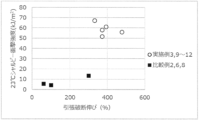
- FIG. 1 shows a plot comparing Examples 3, 9 to 12, in which 19 to 20 parts by mass of a compatibilizer (propylene-ethylene block copolymer (C)) was used in a system in which HDPE and homo-PP were mixed at a ratio of 75 parts by mass/25 to 26 parts by mass, with Comparative Examples 2, 6 and 8. It can be seen that the Examples in which the propylene-ethylene block copolymer (C) was used were excellent in both tensile elongation at break and Charpy impact strength, and in particular, the Charpy impact strength was remarkably excellent.
- a compatibilizer propylene-ethylene block copolymer (C)
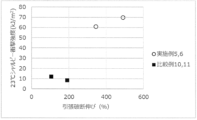
- Figure 2 shows a plot comparing Example 4, which uses 20 parts by mass of a compatibilizer (propylene-ethylene block copolymer (C)) in a 50 parts by mass/50 parts by mass mixture of HDPE and homo-PP, with Comparative Examples 3, 7, and 9. It can be seen that the examples using propylene-ethylene block copolymer (C) are excellent in both tensile elongation at break and Charpy impact strength, with the Charpy impact strength being particularly outstanding.
- a compatibilizer propylene-ethylene block copolymer (C)
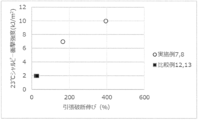
- FIG. 3 shows plots of Examples 7 and 8, in which LLDPE and homo-PP are mixed at 75 parts by mass/25 parts by mass or 50 parts by mass/50 parts by mass, and Comparative Examples 12 and 13. It can be seen that the Examples using the propylene-ethylene block copolymer (C) are remarkably excellent in both tensile elongation at break and Charpy impact strength.
Landscapes
- Chemical & Material Sciences (AREA)
- Health & Medical Sciences (AREA)
- Chemical Kinetics & Catalysis (AREA)
- Medicinal Chemistry (AREA)
- Polymers & Plastics (AREA)
- Organic Chemistry (AREA)
- Compositions Of Macromolecular Compounds (AREA)
Priority Applications (1)
| Application Number | Priority Date | Filing Date | Title |
|---|---|---|---|
| JP2025506795A JPWO2024190657A1 (https=) | 2023-03-13 | 2024-03-08 |
Applications Claiming Priority (2)
| Application Number | Priority Date | Filing Date | Title |
|---|---|---|---|
| JP2023038877 | 2023-03-13 | ||
| JP2023-038877 | 2023-03-13 |
Publications (1)
| Publication Number | Publication Date |
|---|---|
| WO2024190657A1 true WO2024190657A1 (ja) | 2024-09-19 |
Family
ID=92755731
Family Applications (1)
| Application Number | Title | Priority Date | Filing Date |
|---|---|---|---|
| PCT/JP2024/009016 Ceased WO2024190657A1 (ja) | 2023-03-13 | 2024-03-08 | 重合体組成物および成形体 |
Country Status (2)
| Country | Link |
|---|---|
| JP (1) | JPWO2024190657A1 (https=) |
| WO (1) | WO2024190657A1 (https=) |
Citations (4)
| Publication number | Priority date | Publication date | Assignee | Title |
|---|---|---|---|---|
| JPH07286022A (ja) * | 1994-04-18 | 1995-10-31 | Mitsui Petrochem Ind Ltd | プロピレン系ブロック共重合体 |
| JP2010180282A (ja) * | 2009-02-03 | 2010-08-19 | Mitsui Chemicals Inc | プロピレン系樹脂組成物および該組成物からなる成形体 |
| JP2013529706A (ja) * | 2010-06-21 | 2013-07-22 | ダウ グローバル テクノロジーズ エルエルシー | 相溶化剤としての結晶性ブロック複合体 |
| JP2015504102A (ja) * | 2011-12-14 | 2015-02-05 | ダウ グローバル テクノロジーズ エルエルシー | 相溶化剤としての官能化ブロック複合材料及び結晶性ブロック複合組成物 |
-
2024
- 2024-03-08 JP JP2025506795A patent/JPWO2024190657A1/ja active Pending
- 2024-03-08 WO PCT/JP2024/009016 patent/WO2024190657A1/ja not_active Ceased
Patent Citations (4)
| Publication number | Priority date | Publication date | Assignee | Title |
|---|---|---|---|---|
| JPH07286022A (ja) * | 1994-04-18 | 1995-10-31 | Mitsui Petrochem Ind Ltd | プロピレン系ブロック共重合体 |
| JP2010180282A (ja) * | 2009-02-03 | 2010-08-19 | Mitsui Chemicals Inc | プロピレン系樹脂組成物および該組成物からなる成形体 |
| JP2013529706A (ja) * | 2010-06-21 | 2013-07-22 | ダウ グローバル テクノロジーズ エルエルシー | 相溶化剤としての結晶性ブロック複合体 |
| JP2015504102A (ja) * | 2011-12-14 | 2015-02-05 | ダウ グローバル テクノロジーズ エルエルシー | 相溶化剤としての官能化ブロック複合材料及び結晶性ブロック複合組成物 |
Also Published As
| Publication number | Publication date |
|---|---|
| JPWO2024190657A1 (https=) | 2024-09-19 |
Similar Documents
| Publication | Publication Date | Title |
|---|---|---|
| CN116406402B (zh) | 由再生聚烯烃获得的聚烯烃组合物 | |
| CN102803374B (zh) | 多相聚烯烃组合物 | |
| JPWO1997010299A1 (ja) | ポリオレフィン組成物および該組成物からなる成形体 | |
| WO2006053661A1 (en) | Novel propylene polymer compositions | |
| JP6948977B2 (ja) | プロピレン樹脂組成物及び射出成形体 | |
| JP2006193643A (ja) | ポリプロピレン系樹脂組成物 | |
| EP3390525B1 (en) | Polyolefin blends comprising single-site catalyst produced isotactic polypropylene and polyethylene, process and articles made from these blends | |
| US9315657B2 (en) | Propylene resin composition | |
| US8084540B2 (en) | Propylene-based resin composition and molded article thereof | |
| US20120225994A1 (en) | Propylene resin composition | |
| JP2020158652A (ja) | プロピレン系重合体組成物およびその成形体 | |
| JPWO2019139125A1 (ja) | プロピレン系樹脂組成物、成形体および容器 | |
| JP2012229303A (ja) | プロピレン系樹脂組成物及びその射出成形体 | |
| JP5956278B2 (ja) | プロピレン樹脂組成物およびその射出成形体 | |
| WO1998031744A1 (en) | Impact polypropylene composition having high impact resistance and stiffness | |
| JP2014077131A (ja) | プロピレン樹脂材料およびその製造方法 | |
| WO2024190657A1 (ja) | 重合体組成物および成形体 | |
| WO2017037122A1 (en) | Polyolefin blends comprising single-site catalyst produced syndiotactic polypropylene and polyethylene, process and articles made from these blends | |
| EP2526146A1 (en) | Polypropylene copolymers with specific crystal nucleation | |
| JP7515284B2 (ja) | プロピレン系樹脂組成物および成形体 | |
| JP2021155613A (ja) | プロピレン系樹脂組成物、およびそれを用いた射出成型品 | |
| JP7645096B2 (ja) | プロピレン系樹脂組成物およびその用途 | |
| JP7645097B2 (ja) | プロピレン系樹脂組成物およびその用途 | |
| JP2003327643A (ja) | プロピレン−エチレンブロック共重合体 | |
| WO2026008753A1 (en) | Polypropylene composition |
Legal Events
| Date | Code | Title | Description |
|---|---|---|---|
| 121 | Ep: the epo has been informed by wipo that ep was designated in this application |
Ref document number: 24770763 Country of ref document: EP Kind code of ref document: A1 |
|
| ENP | Entry into the national phase |
Ref document number: 2025506795 Country of ref document: JP Kind code of ref document: A |
|
| WWE | Wipo information: entry into national phase |
Ref document number: 2025506795 Country of ref document: JP |
|
| NENP | Non-entry into the national phase |
Ref country code: DE |
|
| 122 | Ep: pct application non-entry in european phase |
Ref document number: 24770763 Country of ref document: EP Kind code of ref document: A1 |