WO2024185734A1 - ポリリン酸化ヌクレオシド、ポリリン酸化ヌクレオシドの合成に用いられるリン酸部活性化ヌクレオチド及びその合成方法、ならびにリン酸部活性化ヌクレオチドを用いたポリリン酸化ヌクレオシドの合成方法 - Google Patents
ポリリン酸化ヌクレオシド、ポリリン酸化ヌクレオシドの合成に用いられるリン酸部活性化ヌクレオチド及びその合成方法、ならびにリン酸部活性化ヌクレオチドを用いたポリリン酸化ヌクレオシドの合成方法 Download PDFInfo
- Publication number
- WO2024185734A1 WO2024185734A1 PCT/JP2024/007991 JP2024007991W WO2024185734A1 WO 2024185734 A1 WO2024185734 A1 WO 2024185734A1 JP 2024007991 W JP2024007991 W JP 2024007991W WO 2024185734 A1 WO2024185734 A1 WO 2024185734A1
- Authority
- WO
- WIPO (PCT)
- Prior art keywords
- nucleoside
- polyphosphorylated
- chloride
- och
- diphosphate
- Prior art date
- Legal status (The legal status is an assumption and is not a legal conclusion. Google has not performed a legal analysis and makes no representation as to the accuracy of the status listed.)
- Ceased
Links
Images



Classifications
-
- C—CHEMISTRY; METALLURGY
- C07—ORGANIC CHEMISTRY
- C07H—SUGARS; DERIVATIVES THEREOF; NUCLEOSIDES; NUCLEOTIDES; NUCLEIC ACIDS
- C07H21/00—Compounds containing two or more mononucleotide units having separate phosphate or polyphosphate groups linked by saccharide radicals of nucleoside groups, e.g. nucleic acids
- C07H21/02—Compounds containing two or more mononucleotide units having separate phosphate or polyphosphate groups linked by saccharide radicals of nucleoside groups, e.g. nucleic acids with ribosyl as saccharide radical
-
- C—CHEMISTRY; METALLURGY
- C07—ORGANIC CHEMISTRY
- C07H—SUGARS; DERIVATIVES THEREOF; NUCLEOSIDES; NUCLEOTIDES; NUCLEIC ACIDS
- C07H19/00—Compounds containing a hetero ring sharing one ring hetero atom with a saccharide radical; Nucleosides; Mononucleotides; Anhydro-derivatives thereof
- C07H19/02—Compounds containing a hetero ring sharing one ring hetero atom with a saccharide radical; Nucleosides; Mononucleotides; Anhydro-derivatives thereof sharing nitrogen
- C07H19/04—Heterocyclic radicals containing only nitrogen atoms as ring hetero atom
- C07H19/16—Purine radicals
- C07H19/20—Purine radicals with the saccharide radical esterified by phosphoric or polyphosphoric acids
-
- C—CHEMISTRY; METALLURGY
- C07—ORGANIC CHEMISTRY
- C07H—SUGARS; DERIVATIVES THEREOF; NUCLEOSIDES; NUCLEOTIDES; NUCLEIC ACIDS
- C07H1/00—Processes for the preparation of sugar derivatives
-
- C—CHEMISTRY; METALLURGY
- C07—ORGANIC CHEMISTRY
- C07H—SUGARS; DERIVATIVES THEREOF; NUCLEOSIDES; NUCLEOTIDES; NUCLEIC ACIDS
- C07H1/00—Processes for the preparation of sugar derivatives
- C07H1/02—Phosphorylation
- C07H1/04—Introducing polyphosphoric acid radicals
-
- C—CHEMISTRY; METALLURGY
- C07—ORGANIC CHEMISTRY
- C07H—SUGARS; DERIVATIVES THEREOF; NUCLEOSIDES; NUCLEOTIDES; NUCLEIC ACIDS
- C07H19/00—Compounds containing a hetero ring sharing one ring hetero atom with a saccharide radical; Nucleosides; Mononucleotides; Anhydro-derivatives thereof
- C07H19/02—Compounds containing a hetero ring sharing one ring hetero atom with a saccharide radical; Nucleosides; Mononucleotides; Anhydro-derivatives thereof sharing nitrogen
- C07H19/04—Heterocyclic radicals containing only nitrogen atoms as ring hetero atom
- C07H19/06—Pyrimidine radicals
-
- C—CHEMISTRY; METALLURGY
- C07—ORGANIC CHEMISTRY
- C07H—SUGARS; DERIVATIVES THEREOF; NUCLEOSIDES; NUCLEOTIDES; NUCLEIC ACIDS
- C07H19/00—Compounds containing a hetero ring sharing one ring hetero atom with a saccharide radical; Nucleosides; Mononucleotides; Anhydro-derivatives thereof
- C07H19/02—Compounds containing a hetero ring sharing one ring hetero atom with a saccharide radical; Nucleosides; Mononucleotides; Anhydro-derivatives thereof sharing nitrogen
- C07H19/04—Heterocyclic radicals containing only nitrogen atoms as ring hetero atom
- C07H19/06—Pyrimidine radicals
- C07H19/10—Pyrimidine radicals with the saccharide radical esterified by phosphoric or polyphosphoric acids
-
- C—CHEMISTRY; METALLURGY
- C07—ORGANIC CHEMISTRY
- C07H—SUGARS; DERIVATIVES THEREOF; NUCLEOSIDES; NUCLEOTIDES; NUCLEIC ACIDS
- C07H19/00—Compounds containing a hetero ring sharing one ring hetero atom with a saccharide radical; Nucleosides; Mononucleotides; Anhydro-derivatives thereof
- C07H19/02—Compounds containing a hetero ring sharing one ring hetero atom with a saccharide radical; Nucleosides; Mononucleotides; Anhydro-derivatives thereof sharing nitrogen
- C07H19/04—Heterocyclic radicals containing only nitrogen atoms as ring hetero atom
- C07H19/16—Purine radicals
-
- C—CHEMISTRY; METALLURGY
- C07—ORGANIC CHEMISTRY
- C07H—SUGARS; DERIVATIVES THEREOF; NUCLEOSIDES; NUCLEOTIDES; NUCLEIC ACIDS
- C07H19/00—Compounds containing a hetero ring sharing one ring hetero atom with a saccharide radical; Nucleosides; Mononucleotides; Anhydro-derivatives thereof
- C07H19/02—Compounds containing a hetero ring sharing one ring hetero atom with a saccharide radical; Nucleosides; Mononucleotides; Anhydro-derivatives thereof sharing nitrogen
- C07H19/04—Heterocyclic radicals containing only nitrogen atoms as ring hetero atom
- C07H19/16—Purine radicals
- C07H19/20—Purine radicals with the saccharide radical esterified by phosphoric or polyphosphoric acids
- C07H19/207—Purine radicals with the saccharide radical esterified by phosphoric or polyphosphoric acids the phosphoric or polyphosphoric acids being esterified by a further hydroxylic compound, e.g. flavine adenine dinucleotide or nicotinamide-adenine dinucleotide
-
- Y—GENERAL TAGGING OF NEW TECHNOLOGICAL DEVELOPMENTS; GENERAL TAGGING OF CROSS-SECTIONAL TECHNOLOGIES SPANNING OVER SEVERAL SECTIONS OF THE IPC; TECHNICAL SUBJECTS COVERED BY FORMER USPC CROSS-REFERENCE ART COLLECTIONS [XRACs] AND DIGESTS
- Y02—TECHNOLOGIES OR APPLICATIONS FOR MITIGATION OR ADAPTATION AGAINST CLIMATE CHANGE
- Y02P—CLIMATE CHANGE MITIGATION TECHNOLOGIES IN THE PRODUCTION OR PROCESSING OF GOODS
- Y02P20/00—Technologies relating to chemical industry
- Y02P20/50—Improvements relating to the production of bulk chemicals
- Y02P20/55—Design of synthesis routes, e.g. reducing the use of auxiliary or protecting groups
Definitions
- the present invention relates to polyphosphorylated nucleosides, phosphate-activated nucleotides used in the synthesis of polyphosphorylated nucleosides and a method for synthesizing the same, as well as a method for synthesizing polyphosphorylated nucleosides using phosphate-activated nucleotides.
- U 2 P 4 P 1 ,P 4 -di(uridine 5'-)tetraphosphate (hereinafter referred to as "U 2 P 4 ”) represented by the following formula (A) or a salt thereof has an expectoration-inducing effect and is expected to be a therapeutic drug for chronic obstructive pulmonary disease (Patent Document 1).
- U 2 P 4 is commercially available as an eye drop treatment for a chronic disease of the corneal and conjunctival epithelium known as dry eye, and is in high demand.
- Patent Document 2 employs the following steps (1) to (3): (1) the counter cation of the starting uridine 5'-diphosphate is replaced with tributylammonium, (2) the resulting substitute is reacted with carbonyldiimidazole (CDI) in DMF to convert one of the hydroxyl groups of the terminal phosphate of the uridine 5'-diphosphate moiety into an imidazolide, and (3) the imidazolide is reacted with uridine 5'-diphosphate in DMF.
- CDI carbonyldiimidazole
- Patent Document 2 discloses another method for producing U2P4 , in which one of the hydroxyl groups of uridine 5'-diphosphate is activated with imidazole, and then uridine 5'-diphosphate and the imidazole-activated uridine 5'-diphosphate are reacted in water in the presence of a Lewis acid.
- Messenger RNA also has a triphosphorylated nucleoside structure called a cap structure at its 5' end.
- Patent Document 3 discloses an example of producing a cap structure by activating one of the hydroxyl groups of the nucleoside 5'-phosphate with imidazole, as described above.
- Patent Document 4 discloses a method for synthesizing a triphosphorylated nucleoside, in which DMF is used as a reaction solvent and a coupling reaction is carried out between a nucleoside 5'-monophosphate and a nucleoside 5'-diphosphate in which one of the hydroxyl groups has been activated with imidazole in the presence of a Lewis acid catalyst.
- nucleoside 5'-diphosphate As the starting material, but nucleoside 5'-diphosphate is expensive.
- all of the manufacturing methods use a condensing agent or an activating agent to produce nucleoside triphosphate or nucleoside tetraphosphate, which requires a multi-step process.
- reaction efficiency at each stage is not necessarily high, it takes a lot of time to purify the crude product and to concentrate the solution obtained by purification. As a result, the product yield is low, and the time efficiency and cost performance of the production are poor.
- the present invention has been made in consideration of these circumstances, and aims to provide polyphosphorylated nucleosides that can be efficiently produced using less expensive raw materials with fewer steps and simple operations, phosphate-activated nucleotides used in the synthesis of polyphosphorylated nucleosides and a method for synthesizing the same, and a method for synthesizing polyphosphorylated nucleosides using phosphate-activated nucleotides.
- the polyphosphorylated nucleosides, phosphate-activated nucleotides used in the synthesis of polyphosphorylated nucleotides and the synthesis method thereof, as well as the synthesis method of polyphosphorylated nucleosides using phosphate-activated nucleotides of the present invention employ the following means.
- the first aspect of the present invention provides a polyphosphorylated nucleoside having the structure shown in formula (I).
- B is independently a natural or artificial nucleoside base, protected by a protecting group or unprotected;
- R 1 and R 2 are independently any one of H, OCH 2 CH ⁇ CH 2 , CH 2 C 6 H 5 , CH 2 C 6 H 4 -p-OCH 3 , 2-CH 2 C 10 H 7 , 1-pyrenylmethyl, acetyl, benzoyl, dichloroacetyl, 1-pentenoyl, levyl, phenoxyacetyl, CONHC 6 H 5 , CONHC 10 H 7 , Boc, Fmoc, allyloxycarbonyl, benzyloxycarbonyl, TOM, Pivom, CEM, CH 2 OCH 2 C 6 H 4 -p-OCH 3 (PMBOM), and CH 2 O-2-CH 2 C 10 H 7 (NAPOM); 1 and R 2 may be the same or different; R3 is independently methyl, ethyl, a vinyl derivative, an allyl derivative, an isopropy
- R 1 and R 2 may be dichloroacetyl groups, and R 3 may be H or a metal salt.
- R 1 and R 2 may be phenoxyacetyl groups, and R 3 may be H or a metal salt.
- the second aspect of the present invention provides a 5'-diphosphate activated nucleotide having the structure shown in formula (II) below, which is used to produce the polyphosphorylated nucleoside according to the first aspect.
- B is independently a natural or artificial nucleoside base, protected by a protecting group or unprotected
- X, Y, Z are independently OH, OR6 , SH, SR, BH3 , halogen, azolide, NR2 , NH2
- R 1 and R 2 are independently H, OH, halogen, an alkyl group, an acyl-based protecting group, a hydroxyl group protected by a carbamoyl-based protecting group or a silyl-based protecting group, or a 3- to 11-mer oligonucleotide having a natural or artificial nucleoside base that is unprotected or protected by a protecting group, and R 1 and R 2 may be the same or different;
- R6 is OBT, OAt, a substituted or unsubstituted vinyl group, or a substituted or unsubstituted allyl group, and the substituted vinyl group may contain a cyclic structure.
- the present invention provides a method of synthesis comprising the steps of:
- the present invention provides a method of synthesis comprising the steps of:
- the present invention provides a method of synthesis comprising the steps of:
- the promoter compound may be imidazole or benzimidazole.
- the catalyst compound may be an organic catalyst such as HOBT, HOAu, Oxyma (ethyl isonitrosocyanoacetate) or DMT-MM, a Lewis acid such as iron(III) chloride, aluminum chloride, zinc chloride, copper(II) chloride, magnesium chloride or cesium chloride, cerium triflate or scandium triflate.
- organic catalyst such as HOBT, HOAu, Oxyma (ethyl isonitrosocyanoacetate) or DMT-MM
- a Lewis acid such as iron(III) chloride, aluminum chloride, zinc chloride, copper(II) chloride, magnesium chloride or cesium chloride, cerium triflate or scandium triflate.
- the polychlorinating agent may be phosphoryl chloride, dichlorophosphoric anhydride, phosphorus pentachloride, thionyl chloride, or 2-chloro-1,3-dimethylimidazolinium chloride.
- a sixth aspect of the present invention is a method for synthesizing a polyphosphorylated nucleoside according to the first aspect, comprising the steps of:
- the present invention provides a method for synthesizing a polyphosphorylated nucleoside, comprising the step of condensing a 5'-diphosphate activated nucleotide according to any one of the third to fifth aspects with a nucleoside 5'-phosphate in the presence of water to obtain a polyphosphorylated nucleoside.
- the nucleoside 5'-phosphate may be guanosine 5'-phosphate, N7-methylguanosine 5'-phosphate, or a 5'-monophosphorylated nucleic acid selected from RNA, DNA, DNA/RNA chimera, and modified nucleoside-containing RNA.
- the method for synthesizing polyphosphorylated nucleosides of the present invention allows the production of the desired polyphosphorylated nucleosides through simple operations using less expensive raw materials.
- the desired product can be produced efficiently in a short process.
- the 5'-diphosphate activated nucleotide used in the synthesis of the polyphosphorylated nucleoside of the present invention allows the reaction to proceed in water alone or in an organic solvent containing water. This makes it possible to make the synthesis method environmentally friendly.
- FIG. 2 shows HPLC charts of G 2 P 3 synthesized by the synthesis method according to the present embodiment before (a) and after (b) purification by anion exchange column chromatography.
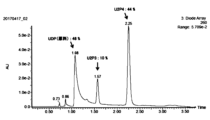
- FIG. 2 is a diagram showing an HPLC chart of a crude product after a reaction in which U 2 P 4 was synthesized using uridine 5′-diphosphate as a starting material in Example 1 of the present embodiment.
- 1 is a diagram showing MS spectra for the synthesis of U 2 P 4 using uridine 5'-diphosphate as a starting material in Example 2 of this embodiment, showing, from the top, the MS spectra of the reaction solution, U 2 P 4 , UDP, and uridine monophosphate.
- FIG. 1 is an HPLC chart of a crude product obtained after a synthesis reaction in Example 2 of the present embodiment.
- FIG. 2 is a diagram showing a preparative LC chromatogram of the crude product obtained after the synthesis reaction in Example 2 of the present embodiment.
- FIG. 6 is a diagram showing an HPLC chart of U 2 P 4 obtained by freeze-drying the Peak 4 fraction in FIG. 5 .
- FIG. 2 is a diagram showing an HPLC chart of a crude product obtained after the reaction in Example 3 of the present embodiment.
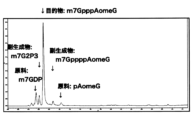
- FIG. 13 is a diagram showing an HPLC chart of the crude product obtained after the synthesis reaction in Example 5 of the present embodiment.
- the polyphosphorylated nucleoside in this embodiment has the structure of the following formula (I):
- B is independently a natural or artificial nucleoside base, protected by a protecting group or unprotected;
- R 1 and R 2 are independently H, OCH 2 CH ⁇ CH 2 , CH 2 C 6 H 5 , CH 2 C 6 H 4 -p-OCH 3 , 2-CH 2 C 10 H 7 , 1-pyrenylmethyl, acetyl, benzoyl, dichloroacetyl, 1-pentenoyl, levyl, phenoxyacetyl, a fatty acid ester having 5 to 22 carbon atoms, an alkyl group having 3 to 11 carbon atoms and containing an alkyne moiety, biotin ester, CONHC 6 H 5 , CONHC 10 H 7 , Boc, Fmoc, allyloxycarbonyl, benzyloxycarbonyl, TOM, Pivom, CEM, CH 2 OCH 2 C 6 H 4 -p-OCH 3 (PMBOM), CH 2 O-2-CH 2 C 10 H 7 (NAPO
- nucleoside located at the most 5'-terminus in formula (I) is referred to as the "left wing”
- a nucleoside or nucleotide having polyphosphate at its 5'-terminus bound to the 3'-hydroxyl group of the left wing is referred to as the "right wing”.
- both the 2'- and 3'-hydroxyl groups of the nucleoside may be protected with acyl groups.
- acyl groups include, but are not limited to, acetyl, benzoyl, dichloroacetyl, 1-pentenoyl, levulinyl, phenoxyacetyl, and fatty acid esters having 5 to 22 carbon atoms.
- the sugars of the nucleosides may all be natural pentoses (ribose or 2' deoxyribose) or may include morpholino nucleosides.
- Light Wing may have an oligonucleotide structure in which multiple nucleotides are linked.
- p, n, m, and q are in no particular order. p, n, m, and q are each 0 or an integer, and (p+n+m+q) is an integer from 0 to 5,000. (p+n+m+q) is preferably from 0 to 200, more preferably from 0 to 50, and even more preferably from 0 to 25.
- B in formula (I) is a natural or artificial nucleoside base.
- the base portion may be protected by a protecting group.
- the base portion may be unprotected.
- the protecting group may include a labeled functional group. Examples of labeling include, but are not limited to, labeling with a fluorescent functional group, labeling with a radioisotope, labeling with a stable isotope, and labeling with biotin.
- protecting groups for the base moiety include, but are not limited to, acyl-based protecting groups, alkyloxy protecting groups, carbamoyl protecting groups, and amidine protecting groups.
- protecting groups for the phosphate moiety include methyl, ethyl, vinyl derivatives, allyl derivatives, isopropyl, phenyl derivatives, and polyfluorinated alkyl derivatives.
- R 1 and R 2 located at the 2' or 3' position of the left wing nucleoside are H, OCH 2 CH ⁇ CH 2 , CH 2 C 6 H 5 , CH 2 C 6 H 4 -p-OCH 3 , 2-CH 2 C 10 H 7 , 1-pyrenylmethyl, acetyl, benzoyl, dichloroacetyl, 1-pentenoyl, levelnyl, phenoxyacetyl, fatty acid ester having 5 to 22 carbon atoms, alkyl group having 3 to 11 carbon atoms containing an alkyne moiety, biotin ester, CONHC 6 H 5 , CONHC 10 H 7 , Boc, Fmoc, allyloxycarbonyl, benzyloxycarbonyl, TOM, Pivom, CEM, CH 2 OCH 2 C 6 H 4 -p-OCH 3 (PMBOM), or CH 2 O-2-CH 2 C 10 H 7 (NAPOM).
- PMBOM CH 2 O-2-CH 2 C
- alkyl group examples include OCH 2 CH ⁇ CH 2 , CH 2 C 6 H 5 , CH 2 C 6 H 4 -p-OCH 3 , 2-CH 2 C 10 H 7 , and 1-pyrenylmethyl.
- acyl group examples include an acetyl group, a benzoyl group, a dichloroacetyl group, a 1-pentenoyl group, a levyl group, and a phenoxyacetyl group.
- carbamoyl group examples include CONHC 6 H 5 and CONHC 10 H 7.
- carbonates such as Boc and Fmoc, allyloxycarbonyl, and benzyloxycarbonyl can be used.
- acetal-type protecting groups include TOM, Pivom, CEM, CH 2 OCH 2 C 6 H 4 -p-OCH 3 (PMBOM), CH 2 O-2-CH 2 C 10 H 7 (NAPOM), etc.
- silyl-based protecting groups include trimethylsilyl group, triethylsilyl group, t-butyldimethylsilyl group, t-butyldiphenylsilyl group, tetraisopropyldisiloxy group, di-t-butylsilyl, etc.
- R 1 and R 2 may be the same or different in one molecule.
- R 4 and R 5 located at the 2' or 3' position of the nucleoside located at the 3' end of the right wing are H, OCH 2 CH ⁇ CH 2 , CH 2 C 6 H 5 , CH 2 C 6 H 4 -p-OCH 3 , 2-CH 2 C 10 H 7 , 1-pyrenylmethyl, acetyl, benzoyl, dichloroacetyl, 1-pentenoyl, levyl, phenoxyacetyl, CONHC 6 H 5 , CONHC 10 H 7 , Boc, Fmoc, allyloxycarbonyl, benzyloxycarbonyl, TOM, Pivom, CEM, CH 2 OCH 2 C 6 H 4 -p-OCH 3 (PMBOM), CH 2 O-2-CH 2 C 10H7 ( NAPOM ).
- acyl group examples include acetyl, benzoyl, dichloroacetyl , 1- pentenoyl , levyl, and phenoxyacetyl.
- carbamoyl group include CONHC6H5 and CONHC10H7 .
- carbonates such as Boc and Fmoc, allyloxycarbonyl , and benzyloxycarbonyl can be used.
- acetal-type protecting groups include TOM, Pivom, CEM, CH 2 OCH 2 C 6 H 4 -p-OCH 3 (PMBOM), CH 2 O-2-CH 2 C 10 H 7 (NAPOM), etc.
- silyl-based protecting groups include trimethylsilyl group, triethylsilyl group, t-butyldimethylsilyl group, t-butyldiphenylsilyl group, tetraisopropyldisiloxy group, di-t-butylsilyl, etc.
- R 4 and R 5 may be the same or different in one molecule.
- polyphosphorylated nucleosides include diquafosol (structural formula U2P4 ), which is used as an ingredient in eye drops , and the mRNA cap structure having a guanosine ( m7G ) methylated at the 7th position on the left side of the triphosphate moiety.
- diquafosol structural formula U2P4
- m7G guanosine
- the polyphosphorylated nucleoside of this embodiment differs from these known substances in that a protecting group has been introduced into the 2'-hydroxyl group and/or the 3'-hydroxyl group of the left wing ribose ring.
- the polyphosphorylated nucleoside of this embodiment has such a structure that it can obtain high double-strand formation ability and lipid solubility. Furthermore, the reactive site is protected by protecting the hydroxyl group, thereby obtaining high reactivity and selectivity.
- nucleosides with activated 5'-diphosphate moieties are used as synthetic intermediates.
- B is independently a natural or artificial nucleoside base, protected by a protecting group or unprotected
- X, Y, Z are independently OH, OR6 , SH, SR, BH3 , halogen, azolide, NR2 , NH2
- R 1 and R 2 are independently H, OH, halogen, an alkyl group, an acyl-based protecting group, a hydroxyl group protected by a carbamoyl-based protecting group or a silyl-based protecting group, or a 3- to 11-mer oligonucleotide having a natural or artificial nucleoside base that is unprotected or protected by a protecting group, and R 1 and R 2 may be the same or different;
- R6 is OBT, OAt, a substituted or unsubstituted vinyl group, or a substituted or unsubstituted allyl group, and the substituted vinyl group may contain a cyclic structure.
- the bases in this embodiment include all of the bases of naturally occurring nucleosides (hereinafter also referred to as "natural bases").
- the most common bases in naturally occurring nucleosides are purines and pyrimidines.
- naturally occurring purine rings include adenine, guanine, and N6-methyladenine.
- naturally occurring pyrimidines include cytosine, thymine, 5-methylcytosine, and pseudouracil.
- Examples of natural nucleosides include ribo, 2'-O-methyl, or 2'-deoxyribo derivatives of adenosine, guanosine, cytidine, thymidine, uridine, inosine, 7-methylguanosine, or pseudouridine.
- the base in this embodiment may be an unnatural base or an artificial base.
- An unnatural base or an artificial base refers to an artificially synthesized base analogue that has similar properties to those of a natural base and can form an artificial base pair with a base analogue (also called a "complementary artificial base") that is the other end of the base pair, just like a natural base.
- the phosphorylating agent is activated in the first step and reacted with a nucleoside or nucleoside monophosphate in the second step.
- the cocatalyst compound used in synthetic route (1) may be imidazole or benzimidazole, with benzimidazole being preferred.
- the catalyst compound used in synthetic route (1) includes organic catalysts such as HOBT, HOAT, HOCU, or DMT-MM, Lewis acids such as iron(III) chloride, aluminum chloride, zinc chloride, copper(II) chloride, magnesium chloride, or cesium chloride, and inorganic or organic salts such as cerium triflate or scandium triflate.
- a catalyst compound is not essential, and activated phosphoric acid can be prepared even if a catalyst compound is not added to the reaction solution. If a catalyst compound is added, a Lewis acid is preferred in this synthetic route (1), and iron(III) chloride is more preferred.
- the synthetic route (1) it is preferable to use 0.3 to 5.0 equivalents of the catalyst compound, 1.0 to 5.0 equivalents of the co-catalyst compound per hydroxyl group of the phosphoric acid moiety, and 1.0 to 5.0 equivalents of the polychlorinating agent per hydroxyl group of the phosphoric acid moiety.
- the synthesis in synthetic route (1) can be carried out in a hydrophilic organic solvent or in a hydrophilic organic solvent containing water.
- Trimethyl phosphate is a suitable hydrophilic organic solvent.
- the reaction temperature is preferably -30°C to 30°C, more preferably 0°C, in the stage of preparing the phosphoric acid activation product. After the addition of the nucleoside, the reaction temperature is preferably 10°C to 70°C, more preferably 50°C.
- Hydrophilic organic solvents used in the synthesis in synthetic route (1) include trimethyl phosphate, trimethyl phosphite, acetonitrile, THF, dimethyl carbonate, DMF, etc., with acetonitrile being preferred.
- Examples of azolides include imidazolides, benzimidazolides, 1,2,4-triazolides, tetrazolides, pyrazolides, and derivatives thereof.
- Examples of heterocyclic compound derivatives include pyridinium, 4-N,N'-dimethylaminopyridinium, and derivatives thereof.
- the polychlorinating agents used in synthetic route (2) include phosphoryl chloride, dichlorophosphoric anhydride, thionyl chloride, or 2-chloro-1,3-dimethylimidazolinium chloride.
- dichlorophosphoric anhydride When dichlorophosphoric anhydride is mixed with a Lewis acid catalyst compound, it forms an activated diphosphate, but depending on the reaction conditions, the main product is a nucleoside monophosphate with just one additional phosphate.
- the cocatalyst compound used in synthetic route (2) may be imidazole or benzimidazole, with imidazole being preferred.
- the catalytic compound used in synthetic route (2) includes organic catalysts such as HOBT, HOAu, HOCU, or DMT-MM, Lewis acids such as iron(III) chloride, aluminum chloride, zinc chloride, copper(II) chloride, magnesium chloride, or cesium chloride, and inorganic or organic salts such as cerium triflate or scandium triflate.
- organic catalysts such as HOBT, HOAu, HOCU, or DMT-MM
- Lewis acids such as iron(III) chloride, aluminum chloride, zinc chloride, copper(II) chloride, magnesium chloride, or cesium chloride
- inorganic or organic salts such as cerium triflate or scandium triflate.
- a catalytic compound is not essential, and activated phosphoric acid can be prepared even if a catalytic compound is not added to the reaction solution. If a catalytic compound is added, a Lewis acid is preferred in synthetic route (2), and iron(III) chloride is more preferred.
- the synthetic route (2) it is preferable to use 0.3 to 5.0 equivalents of the catalyst compound, 1.0 to 5.0 equivalents of the co-catalyst compound per hydroxyl group of the phosphoric acid moiety, and 1.0 to 5.0 equivalents of the polychlorinating agent per hydroxyl group of the phosphoric acid moiety.
- the synthesis in synthetic route (2) can be carried out in a hydrophilic organic solvent, a hydrophilic organic solvent containing water, or in water.
- the reaction temperature is preferably 10°C to 30°C at the stage of preparing the activated phosphate, and the desired activated phosphate can be obtained even at room temperature.
- the reaction temperature is preferably 0°C to 70°C, and more preferably 25°C.
- Hydrophilic organic solvents used in the synthesis in synthetic route (2) include acetonitrile, THF, dimethyl carbonate, DMF, etc., with acetonitrile being preferred.
- nucleoside 5'-Diphosphate as Starting Material
- the pH of the aqueous solution is preferably 1-5, more preferably pH 2.
- the azolide include imidazolide, benzimidazolide, 1,2,4-triazolide, tetrazolide, pyrazolide and derivatives thereof.
- heterocyclic compound derivative include pyridinium, 4-N,N'-dimethylaminopyridinium and derivatives thereof.
- the polychlorinating agent used in the synthetic route (3) includes phosphoryl chloride, dichlorophosphoric acid anhydride, phosphorus pentachloride, thionyl chloride, 2-chloro-1,3-dimethylimidazolinium chloride, and Vilsmeier reagent, with 2-chloro-1,3-dimethylimidazolinium chloride being preferred.
- dichlorophosphoric acid anhydride When dichlorophosphoric acid anhydride is mixed with a Lewis acid catalyst compound, it forms a diphosphate-type activated product, but depending on the reaction conditions, the main product is a nucleoside monophosphate with only one additional phosphate.
- 2-chloro-1,3-dimethylimidazolinium chloride can be used to chlorinate without adding any additional phosphate. For this reason, it can be used when chlorinating nucleoside diphosphate.
- a condensing agent can be used in combination.
- DMT-MM or COMU which are uronium-type condensing agents
- DCC, DIC, or EDC which are carbodiimide-type condensing agents
- Py-BOP which is a phosphonium-type condensing agent
- the cocatalyst compound used in synthetic route (3) can be imidazole or benzimidazole, with benzimidazole being preferred.
- benzimidazole is preferred.
- the high acidity and steric hindrance of benzimidazole improve the reactivity and selectivity in synthetic route (3).
- the catalytic compounds used in synthetic route (3) include organic catalysts such as HOBT, HOAT, and Oxyma, Lewis acids such as iron(III) chloride, aluminum chloride, zinc chloride, copper(II) chloride, magnesium chloride, and cesium chloride, and inorganic or organic salts such as cerium triflate or scandium triflate.
- organic catalysts such as HOBT, HOAT, and Oxyma
- Lewis acids such as iron(III) chloride, aluminum chloride, zinc chloride, copper(II) chloride, magnesium chloride, and cesium chloride
- inorganic or organic salts such as cerium triflate or scandium triflate.
- a catalytic compound is not essential, and activated phosphoric acid can be prepared even if a catalytic compound is not added to the reaction solution. If a catalytic compound is added, a Lewis acid is preferred in this synthetic route (3), and iron(III) chloride is more preferred.
- the synthetic route (3) it is preferable to use 0.3 to 5.0 equivalents of the catalyst compound, 1.0 to 5.0 equivalents of the co-catalyst compound per hydroxyl group of the phosphoric acid moiety, and 1.0 to 5.0 equivalents of the polychlorinating agent per hydroxyl group of the phosphoric acid moiety.
- the synthesis in synthetic route (3) can be carried out in a hydrophilic organic solvent, a hydrophilic organic solvent containing water, or in water.
- the reaction temperature is preferably -30°C to 30°C, and more preferably 25°C, at the stage of preparing the phosphoric acid activation product. After the promoter compound is added, the reaction temperature is preferably 10°C to 70°C, and more preferably 25°C.
- the pH of the aqueous solution is preferably 1 to 5, and more preferably pH 3.
- Hydrophilic organic solvents used in the synthesis in synthetic route (3) include acetonitrile, trimethyl phosphate, trimethyl phosphite, THF, dimethyl carbonate, DMF, DMSO, etc., with acetonitrile being preferred.
- the production of the 5'-diphosphate activated nucleotide according to this embodiment can be confirmed in the reaction system by LC-MS or 31 P-NMR.
- the method for synthesizing a polyphosphorylated nucleoside using a 5'-phosphate activated nucleotide is described below.
- the method includes a step of condensing the 5'-diphosphate activated nucleotide obtained by the above-mentioned synthetic pathways (1) to (3) with a nucleoside 5'-phosphate in the presence of water to obtain a polyphosphorylated nucleoside.
- the nucleoside 5'-phosphate used may be guanosine 5'-phosphate, N7-methylguanosine 5'-phosphate, or a 5'-monophosphorylated nucleic acid selected from RNA, DNA, DNA/RNA chimera, and modified nucleoside-containing RNA.
- a phosphate-activated nucleoside can be synthesized using a commercially available and inexpensive chlorinating agent or polychlorinating agent. This minimizes the synthetic route that uses a nucleoside or monophosphate as a starting material, making it possible to obtain raw materials at a lower cost than with conventional synthesis methods.
- synthesis is performed via a 5'-diphosphate activated nucleotide.
- the 5'-diphosphate activated nucleotide of this embodiment can efficiently construct polyphosphate when water is used as a solvent for polyphosphate synthesis. It has high position selectivity, functional group selectivity, and reactivity, and few side reactions.
- the synthesis method of this embodiment has fewer steps and a simpler reaction system than conventional methods, making the purification process easier.
- synthesis of 5'-diphosphate activated nucleotides and synthesis of polyphosphorylated nucleosides can be carried out in water or in a hydrophilic organic solvent containing water. This makes it possible to recover the nucleoside monophosphates and nucleoside diphosphates used as raw materials and reuse them in synthesis.
- one type of raw material can be converted into an activated diphosphorylated nucleoside, and a polyphosphorylated nucleoside with a bilaterally symmetric structure can be synthesized.
- one type of raw material is converted into an activated diphosphorylated nucleotide, which is then reacted with a monophosphorylated or diphosphorylated nucleotide.
- a non-activated phosphorylated nucleoside solution 0.1 to 5.0 equivalents relative to the activated diphosphorylated nucleotide, preferably 1.0 equivalents
- a left-right asymmetric polyphosphorylated nucleoside can be synthesized.
- the target product can be obtained by affinity purification.
- polyphosphate nucleoside As an example of polyphosphate nucleoside, a method for synthesizing G 2 P 3 using guanosine as a starting material will be described.
- Iron(III) chloride (162 mg, 1.0 mmol) is suspended in trimethyl phosphate (2.0 mL). Pyrophosphoryl chloride (138 ⁇ L, 1.0 mmol) is slowly added dropwise to the solution at 0° C. and stirred for 20 minutes. Guanosine (113 mg, 0.4 mmol) is added in small portions and stirred for 10 minutes. A solution of benzimidazole (307 mg, 2.6 mmol) in acetonitrile (0.8 mL) is added dropwise to the reaction solution at room temperature over 5 minutes. After stirring for 10 minutes at 50° C., 200 ⁇ L of deionized water is added dropwise 10 times (total of 2 mL) and stirred for 10 minutes.
- a viscous crude product is obtained in the lower layer.
- the crude product is diluted with deionized water (50 mL) and purified using an ion exchange column (YMC BioPro IEX SmartSep Q). Elution is performed using 0.05 M NH 4 HCO 3 (liquid A) and 1.0 M NH 4 HCO 3 (liquid B).
- the obtained fractions are analyzed by UPLC-MS, and fractions containing G 2 P 3 are collected. The collected fractions are concentrated and lyophilized to obtain white G 2 P 3 (isolation yield 20% to 26%).
- Uridine 5'-diphosphate disodium salt (20 g, 45 mmol) and imidazole (6.0 g, 90 mmol) were dissolved in deionized water (23 ml), 2-chloro-1,3-dimethylimidazolinium chloride (7.5 g, 45 mmol) was added, and the mixture was reacted at 40°C for 1 hour. Furthermore, imidazole (6.0 g, 90 mmol) and 2-chloro-1,3-dimethylimidazolinium chloride (7.5 g, 45 mmol) were added, and the mixture was reacted at 40°C for 3 hours.
- the HPLC chart of the crude product after the reaction is shown in Figure 2.
- the reaction solution was adjusted to pH 7 with 1.0 M NH 4 HCO 3 , diluted with deionized water (500 mL), and purified with an ion exchange column (TOYOPEARL GigaCap Q-650M).
- TOYOPEARL GigaCap Q-650M ion exchange column
- 0.05M NH 4 HCO 3 was used as solution A
- 1.0M NH 4 HCO 3 was used as solution B.
- the obtained fractions were analyzed by UPLC-MS, and diuridine tetraphosphate (U 2 P 4 ) was recovered.
- the recovered U 2 P 4 was dissolved in deionized water (100 ml) and passed through Dowex 50Wx4Na + .
- the eluted solution was concentrated and freeze-dried to obtain white U 2 P 4 tetrasodium salt (5.55 g, isolated yield 30%).
- N-methyl-imidazole (1.9 mL, 24 mmol) was added dropwise and reacted at 50°C for 2 to 15 hours. The reaction solution was then returned to room temperature, the upper layer was removed by decantation, and the viscous crude product in the lower layer was obtained.
- the obtained crude product was diluted with deionized water (50 mL) and purified with an ion exchange column (TOYOPEARL GigaCap Q-650M). For elution, 0.05 M NH 4 HCO 3 (liquid A) and 1.0 M NH 4 HCO 3 (liquid B) were used. The obtained fractions were analyzed by UPLC-MS, and fractions containing diuridine tetraphosphate (U 2 P 4 ) were collected. The eluted liquid was concentrated and freeze-dried to obtain U 2 P 4 (0.47 g, isolated yield 17.8%, purity 98%) as a white solid.
- the LCMS spectrum of the liquid extracted from the reaction solution during the reaction is shown in Figure 2.
- the MS spectrum of the reaction solution confirmed peaks corresponding to the molecular weights of U 2 P 3 , in which two uridines are linked by three phosphates, and a substance in which two imidazoles are linked to uridine 5'-diphosphate (hereinafter referred to as IntD).
- IntD uridine 5'-diphosphate
- IntD is an active intermediate, via which it is converted to U 2 P 3 or U 2 P 4 .
- FIG. 3 shows MS spectra during the synthesis of U 2 P 4 .
- Figure 4 shows the HPLC chart of the crude product obtained after the synthesis reaction in Example 2.
- Figure 5 shows a preparative LC chromatogram of the crude product obtained after the synthesis reaction in Example 2.
- Figure 6 shows an HPLC chart of U2P4 obtained by freeze-drying the Peak 4 fraction in Figure 5.
- Example 3 Synthesis of G2P3 using guanosine 5' - monophosphate as the starting material
- Benzimidazole (18.1 g, 153 mmol) was suspended in acetonitrile (10.3 mL).
- Phosphoryl chloride (2.1 mL, 23.5 mmol) was slowly added to the solution over 3 minutes at room temperature and stirred for 5 minutes, after which a raw material-catalyst solution prepared in advance by dissolving guanosine 5'-monophosphate sodium salt (10 g, 24 mmol) and iron(III) chloride (3.8 g, 23.5 mmol) in hydrochloric acid (23.5 mL) at pH 2.0 was added dropwise, and the reaction solution was stirred for 30 minutes. Thereafter, the reaction solution was returned to room temperature and the pH was adjusted to 8.0 with saturated carbonated water to obtain a crude product solution.
- the obtained crude product solution was diluted to 100 mL with deionized water and purified using (YMC BioPro IEX SmartSep Q). For elution, 0.05 M NH 4 HCO 3 was used as solution A, and 1.0 M NH 4 HCO 3 was used as solution B.
- the obtained fractions were analyzed by UPLC-MS, and fractions containing G 2 P 3 were collected.
- the obtained fractions were analyzed by UPLC-MS, and fractions containing diguanosine triphosphate (G 2 P 3 ) were collected.
- the eluted solution was concentrated and freeze-dried to obtain white G 2 P 3 (7.1 g, isolated yield 39.0%, purity 98%).
- the HPLC chart of the crude product aqueous solution is shown in FIG. 7.
- Iron(III) chloride (162 mg, 1.0 mmol) is suspended in acetonitrile (2.0 mL). Pyrophosphoryl chloride (138 ⁇ L, 1.0 mmol) is slowly added dropwise to the solution at 0° C., and the mixture is stirred for 20 minutes. 2',3'-diphenoxyacetyl-N7-methylguanosine (215 mg, 0.4 mmol) is added in small portions, and the mixture is stirred for 10 minutes. A solution of benzimidazole (307 mg, 2.6 mmol) in acetonitrile (0.8 mL) is added dropwise to the reaction solution.
- the crude product solution was diluted with deionized water (10 mL) and purified with an ion exchange column (YMC BioPro IEX SmartSep Q). For elution, 0.05 M NH 4 HCO 3 was used as solution A, and 1.0 M NH 4 HCO 3 was used as solution B. The obtained fractions were analyzed by UPLC-MS, and the target CAPanalog was recovered. The eluted solution was concentrated and freeze-dried to obtain the target product as a white solid (100 mg, isolated yield 18.8%, purity 98%).
- Benzimidazole (307 mg, 2.6 mmol) was suspended in acetonitrile (2.0 mL). 2-Chloro-1,3-dimethylimidazolinium chloride (203 mg, 1.2 mmol) was slowly added to the solution over 3 minutes at room temperature and stirred for 5 minutes. Then, a raw material-catalyst solution prepared in advance by dissolving 5'-diphosphorylated N7-methylguanosine sodium salt (215 mg, 0.4 mmol) and iron(III) chloride (162 mg, 1.0 mmol) in hydrochloric acid (23.5 mL) at pH 3.0 was added dropwise at room temperature, and the reaction solution was stirred at room temperature for 30 minutes.
- the crude product was diluted with 20% acetonitrile aqueous solution (10 mL) and purified with an ion exchange column (YMC BioPro IEX SmartSep Q). For elution, 0.05 M NH 4 HCO 3 was used as solution A, and 1.0 M NH 4 HCO 3 was used as solution B. The obtained fraction was analyzed by UPLC-MS, and the target CAPanalog was collected. The eluted liquid was concentrated and freeze-dried to obtain the target product as a white solid (398 mg, isolated yield 56.0%, purity 98%).
- the HPLC chart of the crude product obtained after the reaction is shown in FIG. 8.
- the method for synthesizing polyphosphorylated nucleosides according to this embodiment allows the production of the desired polyphosphorylated nucleosides through simple operations using less expensive raw materials.
- the desired product can be produced efficiently in a short process.
- the reaction can be carried out in water alone or in an organic solvent containing water, which makes it possible to provide a synthesis method with a small environmental impact.
Landscapes
- Chemical & Material Sciences (AREA)
- Organic Chemistry (AREA)
- Health & Medical Sciences (AREA)
- Life Sciences & Earth Sciences (AREA)
- Biochemistry (AREA)
- Molecular Biology (AREA)
- Engineering & Computer Science (AREA)
- Biotechnology (AREA)
- General Health & Medical Sciences (AREA)
- Genetics & Genomics (AREA)
- Saccharide Compounds (AREA)
Priority Applications (4)
| Application Number | Priority Date | Filing Date | Title |
|---|---|---|---|
| CN202480016624.4A CN120813591A (zh) | 2023-03-03 | 2024-03-04 | 多磷酸化核苷、用于其合成的磷酸部分活化核苷酸及其合成方法、以及使用磷酸部分活化核苷酸的多磷酸化核苷的合成方法 |
| EP24767102.7A EP4667479A1 (en) | 2023-03-03 | 2024-03-04 | Polyphosphorylated nucleoside, phosphate-activated nucleotide used for synthesis of polyphosphorylated nucleoside and method for synthesis of same, and method for synthesis of polyphosphorylated nucleoside using phosphate-activated nucleotide |
| JP2025505323A JPWO2024185734A1 (https=) | 2023-03-03 | 2024-03-04 | |
| KR1020257033564A KR20250157528A (ko) | 2023-03-03 | 2024-03-04 | 폴리인산화 뉴클레오시드, 폴리인산화 뉴클레오시드의 합성에 사용되는 인산부 활성화 뉴클레오티드 및 그 합성 방법, 및 인산부 활성화 뉴클레오티드를 사용한 폴리인산화 뉴클레오시드의 합성 방법 |
Applications Claiming Priority (2)
| Application Number | Priority Date | Filing Date | Title |
|---|---|---|---|
| US202363488207P | 2023-03-03 | 2023-03-03 | |
| US63/488,207 | 2023-03-03 |
Publications (1)
| Publication Number | Publication Date |
|---|---|
| WO2024185734A1 true WO2024185734A1 (ja) | 2024-09-12 |
Family
ID=92675140
Family Applications (1)
| Application Number | Title | Priority Date | Filing Date |
|---|---|---|---|
| PCT/JP2024/007991 Ceased WO2024185734A1 (ja) | 2023-03-03 | 2024-03-04 | ポリリン酸化ヌクレオシド、ポリリン酸化ヌクレオシドの合成に用いられるリン酸部活性化ヌクレオチド及びその合成方法、ならびにリン酸部活性化ヌクレオチドを用いたポリリン酸化ヌクレオシドの合成方法 |
Country Status (5)
| Country | Link |
|---|---|
| EP (1) | EP4667479A1 (https=) |
| JP (1) | JPWO2024185734A1 (https=) |
| KR (1) | KR20250157528A (https=) |
| CN (1) | CN120813591A (https=) |
| WO (1) | WO2024185734A1 (https=) |
Citations (11)
| Publication number | Priority date | Publication date | Assignee | Title |
|---|---|---|---|---|
| US20030194759A1 (en) * | 2002-03-25 | 2003-10-16 | Edward Darzynkiewiz | Synthesis and use of anti-reverse mRBA cap analogues |
| US20040014713A1 (en) * | 1997-07-25 | 2004-01-22 | Yerxa Benjamin R. | Di(uridine 5')-tetraphosphate and salts thereof |
| WO2008012949A1 (en) | 2006-07-26 | 2008-01-31 | Yamasa Corporation | Process for producing di(pyrimidine nucleoside 5'-)polyphosphate |
| WO2008016473A2 (en) * | 2006-07-28 | 2008-02-07 | Applera Corporation | Dinucleotide mrna cap analogs |
| WO2014103704A1 (ja) | 2012-12-28 | 2014-07-03 | ヤマサ醤油株式会社 | P1,p4-ジ(ウリジン5'-)テトラホスフェートの製造法 |
| WO2017053297A1 (en) | 2015-09-21 | 2017-03-30 | Trilink Biotechnologies, Inc. | Compositions and methods for synthesizing 5'-capped rnas |
| WO2019036682A1 (en) * | 2017-08-18 | 2019-02-21 | Modernatx, Inc. | RNA VARIANTS POLYMERASE |
| CN113603739A (zh) * | 2021-08-27 | 2021-11-05 | 上海兆维科技发展有限公司 | 一种加帽类似物及其应用 |
| CN113957108A (zh) * | 2021-09-09 | 2022-01-21 | 上海兆维科技发展有限公司 | 一种加帽rna的合成方法以及加帽rna转录反应液 |
| CN114941018A (zh) * | 2022-06-28 | 2022-08-26 | 翌圣生物科技(上海)股份有限公司 | cap1帽类似物的合成方法 |
| WO2022212442A1 (en) | 2021-03-31 | 2022-10-06 | Modernatx, Inc. | Synthesis of trinucleotide and tetranucleotide caps for mrna production |
-
2024
- 2024-03-04 WO PCT/JP2024/007991 patent/WO2024185734A1/ja not_active Ceased
- 2024-03-04 JP JP2025505323A patent/JPWO2024185734A1/ja active Pending
- 2024-03-04 CN CN202480016624.4A patent/CN120813591A/zh active Pending
- 2024-03-04 EP EP24767102.7A patent/EP4667479A1/en active Pending
- 2024-03-04 KR KR1020257033564A patent/KR20250157528A/ko active Pending
Patent Citations (11)
| Publication number | Priority date | Publication date | Assignee | Title |
|---|---|---|---|---|
| US20040014713A1 (en) * | 1997-07-25 | 2004-01-22 | Yerxa Benjamin R. | Di(uridine 5')-tetraphosphate and salts thereof |
| US20030194759A1 (en) * | 2002-03-25 | 2003-10-16 | Edward Darzynkiewiz | Synthesis and use of anti-reverse mRBA cap analogues |
| WO2008012949A1 (en) | 2006-07-26 | 2008-01-31 | Yamasa Corporation | Process for producing di(pyrimidine nucleoside 5'-)polyphosphate |
| WO2008016473A2 (en) * | 2006-07-28 | 2008-02-07 | Applera Corporation | Dinucleotide mrna cap analogs |
| WO2014103704A1 (ja) | 2012-12-28 | 2014-07-03 | ヤマサ醤油株式会社 | P1,p4-ジ(ウリジン5'-)テトラホスフェートの製造法 |
| WO2017053297A1 (en) | 2015-09-21 | 2017-03-30 | Trilink Biotechnologies, Inc. | Compositions and methods for synthesizing 5'-capped rnas |
| WO2019036682A1 (en) * | 2017-08-18 | 2019-02-21 | Modernatx, Inc. | RNA VARIANTS POLYMERASE |
| WO2022212442A1 (en) | 2021-03-31 | 2022-10-06 | Modernatx, Inc. | Synthesis of trinucleotide and tetranucleotide caps for mrna production |
| CN113603739A (zh) * | 2021-08-27 | 2021-11-05 | 上海兆维科技发展有限公司 | 一种加帽类似物及其应用 |
| CN113957108A (zh) * | 2021-09-09 | 2022-01-21 | 上海兆维科技发展有限公司 | 一种加帽rna的合成方法以及加帽rna转录反应液 |
| CN114941018A (zh) * | 2022-06-28 | 2022-08-26 | 翌圣生物科技(上海)股份有限公司 | cap1帽类似物的合成方法 |
Non-Patent Citations (1)
| Title |
|---|
| See also references of EP4667479A1 |
Also Published As
| Publication number | Publication date |
|---|---|
| CN120813591A (zh) | 2025-10-17 |
| JPWO2024185734A1 (https=) | 2024-09-12 |
| KR20250157528A (ko) | 2025-11-04 |
| EP4667479A1 (en) | 2025-12-24 |
Similar Documents
| Publication | Publication Date | Title |
|---|---|---|
| JP7525687B2 (ja) | ホスフェート誘導体の合成 | |
| JP7484951B2 (ja) | オリゴヌクレオチドの製造方法 | |
| CN106795198B (zh) | 用于制备吉西他滨-[苯基(苄氧基-l-丙氨酸基)]磷酸酯的方法 | |
| KR20180101370A (ko) | 인산염 유도체 및 젬시타빈 전구약물 nuc-1031의 부분입체 이성질체 선별적 합성 | |
| EP3684780B1 (en) | Floxuridine synthesis | |
| FI111265B (fi) | Menetelmä lääkeaineina käyttökelpoisten modifioitujen oligodeoksiribonukleotidien valmistamiseksi ja niiden välituotteita | |
| EP0519464B1 (en) | Nucleoside derivatives and production thereof | |
| WO2019021945A1 (ja) | 可視光域で光架橋可能な光応答性ヌクレオチドアナログ | |
| CN100484949C (zh) | 用于rna寡核苷酸合成中的核苷亚磷酰胺及其合成方法 | |
| US8614312B2 (en) | Method for preparing nucleotides and related analogues by synthesis on soluble substrate, and biological tools thus prepared | |
| WO2024185734A1 (ja) | ポリリン酸化ヌクレオシド、ポリリン酸化ヌクレオシドの合成に用いられるリン酸部活性化ヌクレオチド及びその合成方法、ならびにリン酸部活性化ヌクレオチドを用いたポリリン酸化ヌクレオシドの合成方法 | |
| CN111187325B (zh) | 抗肿瘤(4′R)-甲基-α-L-呋喃苏糖核苷及其制备方法 | |
| JP4802712B2 (ja) | リボ核酸化合物及びオリゴ核酸化合物の液相合成法 | |
| CA3284869A1 (en) | Polyphosphorylated nucleoside, phosphate-activated nucleotide used for synthesis of polyphosphorylated nucleoside and method for synthesis of same, and method for synthesis of polyphosphorylated nucleoside using phosphate-activated nucleotide | |
| JP2796089B2 (ja) | リン脂質誘導体の製造法 | |
| JP3609411B2 (ja) | 不斉リン酸ジエステル及びその塩の製造方法 | |
| JP5599078B2 (ja) | アデノシンテトラホスフェート化合物の製造法 | |
| WO2021080021A1 (ja) | オリゴヌクレオチドを製造する方法 | |
| US20030204079A1 (en) | Process for producing 2', 3'-diethy substituted nucleoside derivatives | |
| JPWO2024185734A5 (https=) | ||
| Fowler et al. | Chemical and Enzymatic Synthesis of 4′-Thio-β-d-Arabinofuranosylcytosine Monophosphate and Triphosphate | |
| EA043691B1 (ru) | Получение фосфатных производных |
Legal Events
| Date | Code | Title | Description |
|---|---|---|---|
| 121 | Ep: the epo has been informed by wipo that ep was designated in this application |
Ref document number: 24767102 Country of ref document: EP Kind code of ref document: A1 |
|
| ENP | Entry into the national phase |
Ref document number: 2025505323 Country of ref document: JP Kind code of ref document: A |
|
| WWE | Wipo information: entry into national phase |
Ref document number: 2025505323 Country of ref document: JP |
|
| WWE | Wipo information: entry into national phase |
Ref document number: 202480016624.4 Country of ref document: CN |
|
| WWE | Wipo information: entry into national phase |
Ref document number: 2024767102 Country of ref document: EP |
|
| WWE | Wipo information: entry into national phase |
Ref document number: 202547093318 Country of ref document: IN |
|
| ENP | Entry into the national phase |
Ref document number: 1020257033564 Country of ref document: KR Free format text: ST27 STATUS EVENT CODE: A-0-1-A10-A15-NAP-PA0105 (AS PROVIDED BY THE NATIONAL OFFICE) |
|
| WWE | Wipo information: entry into national phase |
Ref document number: KR1020257033564 Country of ref document: KR Ref document number: 1020257033564 Country of ref document: KR |
|
| NENP | Non-entry into the national phase |
Ref country code: DE |
|
| WWP | Wipo information: published in national office |
Ref document number: 202480016624.4 Country of ref document: CN |
|
| WWP | Wipo information: published in national office |
Ref document number: 202547093318 Country of ref document: IN |
|
| ENP | Entry into the national phase |
Ref document number: 2024767102 Country of ref document: EP Effective date: 20250916 |
|
| WWP | Wipo information: published in national office |
Ref document number: 2024767102 Country of ref document: EP |