WO2024185641A1 - 中空断面繊維並びにこれを含む加工糸、複合加工糸、撚糸、織編物及び衣類 - Google Patents
中空断面繊維並びにこれを含む加工糸、複合加工糸、撚糸、織編物及び衣類 Download PDFInfo
- Publication number
- WO2024185641A1 WO2024185641A1 PCT/JP2024/007528 JP2024007528W WO2024185641A1 WO 2024185641 A1 WO2024185641 A1 WO 2024185641A1 JP 2024007528 W JP2024007528 W JP 2024007528W WO 2024185641 A1 WO2024185641 A1 WO 2024185641A1
- Authority
- WO
- WIPO (PCT)
- Prior art keywords
- fiber
- yarn
- section
- hollow cross
- cross
- Prior art date
- Legal status (The legal status is an assumption and is not a legal conclusion. Google has not performed a legal analysis and makes no representation as to the accuracy of the status listed.)
- Ceased
Links
Images


Classifications
-
- A—HUMAN NECESSITIES
- A41—WEARING APPAREL
- A41D—OUTERWEAR; PROTECTIVE GARMENTS; ACCESSORIES
- A41D31/00—Materials specially adapted for outerwear
-
- A—HUMAN NECESSITIES
- A41—WEARING APPAREL
- A41D—OUTERWEAR; PROTECTIVE GARMENTS; ACCESSORIES
- A41D31/00—Materials specially adapted for outerwear
- A41D31/04—Materials specially adapted for outerwear characterised by special function or use
-
- A—HUMAN NECESSITIES
- A41—WEARING APPAREL
- A41D—OUTERWEAR; PROTECTIVE GARMENTS; ACCESSORIES
- A41D31/00—Materials specially adapted for outerwear
- A41D31/04—Materials specially adapted for outerwear characterised by special function or use
- A41D31/06—Thermally protective, e.g. insulating
-
- A—HUMAN NECESSITIES
- A41—WEARING APPAREL
- A41D—OUTERWEAR; PROTECTIVE GARMENTS; ACCESSORIES
- A41D31/00—Materials specially adapted for outerwear
- A41D31/04—Materials specially adapted for outerwear characterised by special function or use
- A41D31/24—Resistant to mechanical stress, e.g. pierce-proof
-
- D—TEXTILES; PAPER
- D01—NATURAL OR MAN-MADE THREADS OR FIBRES; SPINNING
- D01D—MECHANICAL METHODS OR APPARATUS IN THE MANUFACTURE OF ARTIFICIAL FILAMENTS, THREADS, FIBRES, BRISTLES OR RIBBONS
- D01D5/00—Formation of filaments, threads, or the like
- D01D5/253—Formation of filaments, threads, or the like with a non-circular cross section; Spinnerette packs therefor
-
- D—TEXTILES; PAPER
- D01—NATURAL OR MAN-MADE THREADS OR FIBRES; SPINNING
- D01F—CHEMICAL FEATURES IN THE MANUFACTURE OF ARTIFICIAL FILAMENTS, THREADS, FIBRES, BRISTLES OR RIBBONS; APPARATUS SPECIALLY ADAPTED FOR THE MANUFACTURE OF CARBON FILAMENTS
- D01F6/00—Monocomponent artificial filaments or the like of synthetic polymers; Manufacture thereof
- D01F6/58—Monocomponent artificial filaments or the like of synthetic polymers; Manufacture thereof from homopolycondensation products
- D01F6/60—Monocomponent artificial filaments or the like of synthetic polymers; Manufacture thereof from homopolycondensation products from polyamides
-
- D—TEXTILES; PAPER
- D01—NATURAL OR MAN-MADE THREADS OR FIBRES; SPINNING
- D01F—CHEMICAL FEATURES IN THE MANUFACTURE OF ARTIFICIAL FILAMENTS, THREADS, FIBRES, BRISTLES OR RIBBONS; APPARATUS SPECIALLY ADAPTED FOR THE MANUFACTURE OF CARBON FILAMENTS
- D01F6/00—Monocomponent artificial filaments or the like of synthetic polymers; Manufacture thereof
- D01F6/58—Monocomponent artificial filaments or the like of synthetic polymers; Manufacture thereof from homopolycondensation products
- D01F6/62—Monocomponent artificial filaments or the like of synthetic polymers; Manufacture thereof from homopolycondensation products from polyesters
-
- D—TEXTILES; PAPER
- D03—WEAVING
- D03D—WOVEN FABRICS; METHODS OF WEAVING; LOOMS
- D03D15/00—Woven fabrics characterised by the material, structure or properties of the fibres, filaments, yarns, threads or other warp or weft elements used
- D03D15/30—Woven fabrics characterised by the material, structure or properties of the fibres, filaments, yarns, threads or other warp or weft elements used characterised by the structure of the fibres or filaments
- D03D15/37—Woven fabrics characterised by the material, structure or properties of the fibres, filaments, yarns, threads or other warp or weft elements used characterised by the structure of the fibres or filaments with specific cross-section or surface shape
Definitions
- the present invention relates to hollow cross-section fibers and textured yarns. Furthermore, the present invention relates to composite textured yarns, twisted yarns, woven and knitted fabrics, and clothing that contain these.
- Synthetic fibers such as polyester and nylon fibers
- Synthetic fibers have many excellent properties, including mechanical properties, and are widely used in a variety of fields, from general clothing applications to industrial applications and functional products.
- they are durable and easy to handle, they are ideal for use as innerwear for sports and outdoor clothing.
- high-performance polyester fibers with properties such as bulkiness and light weight are attracting attention because they are worn for long periods of time in harsh environments.
- fabrics are also required to have improved abrasion resistance.
- Patent Document 1 proposes a fiber that has excellent bulkiness and a lightweight feel by having a core portion with at least one hollow portion in a fiber cross section perpendicular to the fiber axis direction, and fin portions that protrude radially from the outer surface of the core portion toward the center of the core portion, and a woven or knitted fabric using the same.
- the cross-sectional shape is a star-shaped polygon
- the fiber diameter is 1 ⁇ m or more and 50 ⁇ m or less
- a hollow portion is provided, thereby improving the abrasion resistance.
- Patent Document 1 the technology of imparting bulkiness by highly irregular cross-sectional shapes as disclosed in Patent Document 1 increases bulkiness due to the high irregular shapes, but there is a problem in that fuzzing and whitening of the fabric occur due to fibrillation of the irregular shapes, making it impossible to obtain abrasion resistance.
- Fibers with a round hollow cross section such as those disclosed in Patent Document 3 have a hollow section within the single yarn, making them lightweight.
- the outer periphery of the single fiber has a round cross section, there are no gaps between the single yarns when the fibers are densely packed, making it impossible to achieve a bulky texture such as fullness, and there are also issues with glare.
- the present invention was made in consideration of the above circumstances, and its objective is to provide hollow cross-section fibers, textured yarns, composite textured yarns, twisted yarns, woven and knitted fabrics, and clothing that, when made into fabric, are bulky and lightweight, have excellent abrasion resistance, and have functionality such as heat retention, abrasion resistance, and glare suppression.
- the hollow cross section fiber of the present invention has the following configuration.
- a hollow cross-section fiber having at least one hollow portion The hollow cross section fiber has a hollow ratio of 10 to 40%,
- the hollow cross-section fiber has 4 to 8 protrusions on the outer periphery of its cross section, the degree of irregularity of the hollow cross section fiber (the circumscribing circle diameter of a single fiber of the hollow cross section fiber/the inscribing circle diameter of the single fiber when assumed to be solid) is 1.3 to 2.0,
- the ratio R1/R2 of the recess diameter the diameter R1 of a circle passing through the apexes of adjacent protrusions and the deepest points of recesses located between adjacent protrusions
- the protrusion diameter the diameter R2 of a circle passing through the apexes of the protrusions and the midpoints of the protrusions
- the ratio R1/R2 of the recess diameter the diameter R1 of a circle passing through the apexes of adjacent protrusion
- a composite textured yarn as described in (5) above which has a core-sheath structure in which the hollow cross-section fiber as described in any one of (1) to (3) above or the textured yarn as described in (4) is used as the sheath part.
- a composite textured yarn according to (5) or (6) above in which the other yarn is a composite fiber.
- a twisted yarn comprising the hollow cross section fiber according to any one of (1) to (3), the textured yarn according to (4), or the composite textured yarn according to any one of (5) to (8), and having a twist number of 11,000 to 40,000.
- a woven or knitted fabric at least in part comprising the hollow cross section fiber according to any one of (1) to (3), the textured yarn according to (4), the composite textured yarn according to any one of (5) to (8), or the twisted yarn according to (9).
- the present invention makes it possible to provide hollow cross-section fibers, processed yarns, composite processed yarns, and twisted yarns that, when made into fabrics, have excellent bulkiness and light weight, as well as abrasion resistance, and have functionalities such as heat retention, abrasion resistance, and glare suppression. Furthermore, woven and knitted fabrics and clothing that contain these have excellent bulkiness and light weight, as well as abrasion resistance, and have functionalities such as heat retention, abrasion resistance, and glare suppression.
- processed yarns, composite processed yarns, twisted yarns, woven and knitted fabrics, and clothing that use the hollow cross-section fibers of the present invention can be suitably used for items in the outerwear field worn as women's and men's clothing, such as jackets, suits, and bottoms.
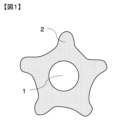
- FIG. 2 is a schematic diagram of an example of a cross section of a hollow cross section fiber of the present invention.
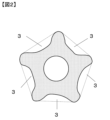
- FIG. 2 is a schematic diagram showing a recess in the cross section of a single fiber of the hollow cross section fiber of the present invention.
- FIG. 2 is a cross-sectional view showing the measurement positions of the degree of irregularity of the hollow cross section fiber of the present invention.
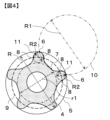
- FIG. 1 is a cross-sectional view showing the measurement positions of the ratio of the diameter R1 of a circle passing through the apexes of adjacent protrusions of the hollow cross-section fiber of the present invention and the deepest point of the recess located between the adjacent protrusions, to the diameter R2 of a circle passing through the apexes of the protrusions and the midpoint of the protrusions.
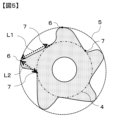
- FIG. 2 is a cross-sectional view showing the measurement positions for the ratio of the distance from the apex of a protrusion to the deepest points of two adjacent recesses of the hollow cross-section fiber of the present invention.
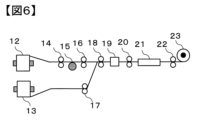
- FIG. 1 is a schematic diagram showing an example of a composite processing apparatus preferably used when producing the composite textured yarn of the present invention.
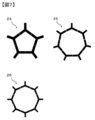
- FIG. 1 is a schematic diagram showing an example of the shape of an outlet hole of a spinneret for producing a hollow cross section fiber of the present invention.
- FIG. 13 is a schematic diagram showing an example of the shape of an outlet hole of a spinneret for a solid cross section fiber having five protrusions.
- the hollow cross section fiber of the present invention satisfies the following requirements.
- a hollow cross-section fiber having at least one hollow portion, The hollow cross section fiber has a hollow ratio of 10 to 40%,
- the hollow cross-section fiber has 4 to 8 protrusions on the outer periphery of its cross section, the degree of irregularity of the hollow cross section fiber (the circumscribing circle diameter of a single fiber of the hollow cross section fiber/the inscribing circle diameter of the single fiber when assumed to be solid) is 1.3 to 2.0,
- the ratio R1/R2 of the recess diameter (the diameter R1 of a circle passing through the apexes of adjacent protrusions and the deepest points of recesses located between adjacent protrusions) to the protrusion diameter (the diameter R2 of a circle passing through the apexes of the protrusions and the midpoints of the protrusions) is 4.5 to 10.0.
- the hollow cross section fiber of the present invention is a fiber made of a thermoplastic polymer.
- the thermoplastic polymer include polyesters such as polyethylene terephthalate, polybutylene terephthalate, polytrimethylene terephthalate, and polylactic acid, polyamides such as polycaproamide (polyamide 6), polydodecanoamide (polyamide 12), polyhexamethylene adipamide (polyamide 66), polyhexamethylene sebacamide (polyamide 610), and polyhexamethylene dodecanoamide (polyamide 612), polyolefins such as polypropylene, polyethylene, and polyurethane, and combinations thereof.
- polyesters or polyamides that are widely used as clothing fibers are preferred.
- the intrinsic viscosity of the polymer is preferably in the range of 0.5 to 0.7.
- polymers derived from PET bottles or recovered clothing, so-called recycled polymers may be used within a range that does not impede the object of the present invention.
- the above polymers may be blended with additives, such as matting agents (titanium oxide, etc.), pigments, dyes, antifouling agents, fluorescent whitening agents, flame retardants, stabilizers, weather resistance agents, UV absorbers, lubricants, or moisture absorbents, to the extent that the purpose of the present invention is not hindered.
- additives such as matting agents (titanium oxide, etc.), pigments, dyes, antifouling agents, fluorescent whitening agents, flame retardants, stabilizers, weather resistance agents, UV absorbers, lubricants, or moisture absorbents, to the extent that the purpose of the present invention is not hindered.
- functional agents are incompatible with the polymer, they may be added by first preparing a master batch and then melt blending and spinning the resulting mixture.
- the hollow cross section fiber of the present invention has at least one hollow section and a hollow ratio of 10 to 40%.
- the hollow ratio is more preferably 20 to 30%. If the hollow ratio is less than 10%, the bulkiness and heat retention effects of the hollow section will be insufficient, and if the hollow ratio exceeds 40%, the abrasion resistance will decrease.
- the hollow ratio in the present invention is a value calculated by the method described in the examples below.
- the number and shape of the hollow sections may be any number and shape as long as they do not impede the object of the present invention.
- the shape of the hollow section may be a triangle or pentagon, a shape in which the hollow section is divided into two parts above and below, or a square shape in which the hollow section is divided into four parts.
- the hollow shape is not limited to these shapes, and any known shape may be used.
- the hollow cross-section fiber of the present invention has 4 to 8 protrusions on the outer periphery of the cross section.
- the protrusions refer to the areas protruding from the inscribed circle when the single fiber is assumed to be solid. If there are fewer than four protrusions, the effect of suppressing glare during weaving and knitting cannot be obtained. If there are more than eight protrusions, the cross section of the fiber approaches a round shape, and it is difficult for gaps between the single yarns due to the protrusions to occur, resulting in a decrease in bulkiness and heat retention.
- the number of protrusions is more preferably 5, 7, or 8.
- FIG. 1 is a schematic diagram of an example of a cross section of the hollow cross-section fiber of the present invention, which has a hollow section 1 and five protrusions 2.
- the unevenness of the single fibers is less likely to interlock, and the single fiber arrangement of the yarn is left with gaps, which gives the fabric the most bulk and heat retention.
- the uneven structure can scatter light from all angles, resulting in a woven or knitted fabric with a natural appearance that suppresses glare.
- the hollow cross section fiber of the present invention has an irregularity (circumscribed circle diameter of a single fiber of the hollow cross section fiber/inscribed circle diameter of the single fiber when assumed to be solid) of 1.3 to 2.0, preferably 1.4 to 1.8.
- the irregularity in the present invention is a value calculated by the method described in the Examples below. If the irregularity is less than 1.3, the abrasion resistance of the woven or knitted fabric is good, but sufficient bulkiness and heat retention cannot be obtained. If the irregularity exceeds 2.0, the abrasion resistance of the woven or knitted fabric decreases due to the long protrusions, although bulkiness and heat retention are obtained.
- the ratio R1/R2 of the recess diameter (the diameter R1 of the circle passing through the apexes of adjacent protrusions and the deepest point of the recess located between the adjacent protrusions) to the protrusion diameter (the diameter R2 of the circle passing through the apex of the protrusion and the midpoint of the protrusion) is 4.5 to 10.0, and preferably 4.5 to 8.0.
- the ratio R1/R2 in the present invention is a value calculated by the method described in the Examples below.
- the deepest point of the recess is the point of contact between the outer periphery of the fiber cross section and the inscribed circle when the single fiber is assumed to be solid, and the apex of the protrusion is the point of contact between the outer periphery of the fiber cross section and the circumscribed circle of the single fiber.
- the point at which the distance from the center of the inscribed circle is the shortest is taken as the deepest point of the recess.
- the apex of the protrusion is taken as the point at which the distance from the center of the circumscribed circle is the longest. If R1/R2 is less than 4.5, the single fibers tend to interlock with each other, making it impossible to obtain bulkiness. On the other hand, if R1/R2 exceeds 10.0, the recesses become shallower and the cross-sectional shape approaches a circle, reducing the effect of extending the protrusions outward, making it impossible to obtain bulkiness.
- the protrusion may protrude at an incline in a certain direction in the circumferential direction of the fiber cross section.
- the protrusion is inclined when the central axis of the protrusion (the straight line connecting the apex of the protrusion and the midpoint of the line segment connecting the deepest points of the recesses on both sides of the protrusion) is inclined with respect to the straight line passing through the apex of the protrusion and the center of the fiber cross section.
- the ratio L1/L2 is preferably 1.2 to 3.0, more preferably 1.3 to 2.6.
- L1 is the long side (longer side) of the line drawn from the apex of the protrusion to the deepest point of the recess
- L2 is the short side (shorter side).
- the ratio L1/L2 of the distances from the apex of the protrusion to the deepest points of the two recesses on both sides of the protrusion is a value calculated by the method described in the examples below.
- L1/L2 is 1.2 or more, it is possible to obtain a smooth fabric that creates a dry and comfortable feel.
- L1/L2 is 3.0 or less, the gaps between the single fibers become larger, thereby further improving bulkiness.
- the inclination direction of the protrusions is constant in the circumferential direction of the fiber cross section for a single fiber, but may be different for each single fiber. If there are 50% right-inclined (clockwise) fibers and 50% left-inclined (counterclockwise) fibers, the single fibers are less likely to interlock, which gives the fiber more bulk, and is therefore preferable.
- the hollow cross section fiber of the present invention preferably has a single fiber fineness of 1.0 to 3.0 dtex, and more preferably 1.7 to 2.8 dtex. If the single fiber fineness is 1.0 dtex or more, the strength of the fiber is improved and the abrasion resistance is further improved. On the other hand, if the single fiber fineness is 3.0 dtex or less, the fiber becomes thinner and the softness is improved.
- the hollow cross section fiber of the present invention preferably has a total fineness of 33 to 330 dtex. By making the total fineness 33 to 330 dtex, it is preferable from the viewpoint of productivity because it is easy to process at an appropriate weaving and knitting density when manufacturing woven and knitted fabrics for clothing applications. More preferably, it is 33 to 300 dtex.
- the hollow cross section fiber of the present invention may be multifilamented within a range that does not impede the object of the present invention. By making it 12 to 144 filaments, sufficient bulkiness can be obtained. In addition, it is preferable from the viewpoint of productivity because it has good spinnability.
- the hollow cross section fiber of the present invention preferably has a strength of 2.0 to 4.0 cN/dtex. By making the strength within this range, it is possible to obtain durability for actual wear when made into clothing.
- the hollow cross-section fiber of the present invention may be in the form of textured yarn, composite textured yarn with other fibers, or twisted yarn.
- the fiber structure using the hollow cross section fiber of the present invention can be appropriately selected depending on the purpose, such as woven fabric or knitted fabric, and can be suitably used for innerwear, outerwear, shirts, blouses, pants, etc.
- the hollow cross section fiber of the present invention may be mixed with other yarns to produce woven fabrics, knitted fabrics, etc., within the scope that does not impede the purpose of this development, and there is no problem in using any method that exhibits the characteristics of the hollow cross section fiber of the present invention.
- the textured yarn of the present invention is a fiber obtained by subjecting the hollow cross section fiber (multifilament) to yarn processing such as drawing, thick & thin drawing, false twisting, blending, etc. Also, so-called POY, which will be described later, may be subjected to yarn processing such as drawing, false twisting, blending, etc.
- the processed yarn of the present invention preferably contains a single fiber composed of the hollow cross-section fiber of the present invention and has an elongation of 70 to 150%.
- the elongation is more preferably 110 to 140%, and even more preferably 120 to 140%.
- the elongation is more preferably 70 to 110%.
- the fiber orientation is appropriate and the protrusions of the single fiber cross-section are less likely to collapse due to frictional forces, so the abrasion resistance of the woven or knitted fabric is particularly excellent, and the protrusions are also favorably maintained, so the bulkiness is also particularly excellent.
- the elongation is a value measured according to the method described in the JIS L1013 (2010) 8.5.1 standard time test.
- One example of a method for setting the elongation within the above range is to adjust the draw ratio and the overfeed rate during heat treatment to a predetermined range during the yarn processing step, as described below.
- the design of the elongation is not limited to this, and can be set in consideration of the quality of the single yarn fluff, etc. In the case of drawn yarn (FOY) and false twist textured yarn (DTY), the elongation is preferably 20 to 50%.
- the hollow cross section fiber or textured yarn can be composited with at least one other type of yarn to form a composite textured yarn.
- the composite processed yarn of the present invention is formed by combining the processed yarn of the present invention with at least one other type of yarn, using a composite processing device as exemplified in FIG. 6.
- FIG. 6 is a schematic diagram showing an example of a composite processing device preferably used when manufacturing the composite processed yarn of the present invention.
- the hollow cross section fiber 12 of the partially oriented undrawn yarn is hot drawn with a hot pin 15 by utilizing the speed difference between the first feed roller 14 and the second feed roller 16.
- the other yarn 13 is combined with the hollow cross section fiber 12 by using the third feed roller 17, and is mixed with the intertwining nozzle 19 while being overfed by utilizing the speed difference between the fourth feed roller 18 and the fifth feed roller 20.
- the fifth feed roller 20 and the sixth feed roller 22 are set to the same speed, heat set by the heater 21, and the composite processed yarn 23 is wound up. This makes it possible to obtain a composite processed yarn with excellent bulkiness characterized by a heathered feel, and the bulkiness when made into a woven or knitted fabric is further improved.
- the composite textured yarn of the present invention preferably has a core-sheath structure in which the hollow cross-section fiber or textured yarn of the present invention serves as the sheath.
- the hollow cross-section fiber or textured yarn of the present invention serves as the sheath.
- composite fibers are preferable, and more preferably, eccentric core-sheath composite yarns having a composite cross section formed by bonding two types of polymers with different shrinkage differences.
- composite fibers refer to yarns in which two types of polymers, component A and component B, with different shrinkage differences, are bonded together in a side-by-side or eccentric core-sheath type.
- polymers examples include polyethylenes such as polyethylene terephthalate, polyethylene naphthalate, polybutylene terephthalate, and polytrimethylene terephthalate, polyamides, polylactic acid, thermoplastic polyurethanes, polyphenylene sulfide, and copolymers thereof.
- the molecular weights of these can be changed to use a high molecular weight polymer for one component and a low molecular weight polymer for the other component, or one component can be a homopolymer and the other component a copolymer.
- component A/component B such as polybutylene terephthalate/polyethylene terephthalate, polytrimethylene terephthalate/polyethylene terephthalate, thermoplastic polyurethane/polyethylene terephthalate, and polytrimethylene terephthalate/polybutylene terephthalate, can be mentioned.
- polyester, polyamide, polyethylene, polypropylene, etc. are preferably used as the polymer, and among them, polyester is more preferable because it also has mechanical properties.
- the polyester referred to here includes polyethylene terephthalate, polybutylene terephthalate, polypropylene terephthalate, and copolymers thereof with dicarboxylic acid components, diol components, or oxycarboxylic acid components, or blends of these polyesters. This results in a composite textured yarn that exhibits functionality such as a high sense of bulk and worsted texture while having stretchability.
- An eccentric sheath-core composite yarn is a composite fiber made of two polymers, component A and component B, and has an eccentric sheath-core structure in which component A is covered by component B in the fiber cross section. Of these, it is preferable that component A is completely covered by component B.
- An even more preferable embodiment is a yarn in which the ratio S/D of the minimum thickness S of component B covering component A to the fiber diameter D is 0.01 to 0.10, and the perimeter of the fiber in the part where the minimum thickness is within 1.05 times is 1/3 or more of the perimeter of the entire fiber. This allows the single fiber fineness to be reduced, resulting in a high-count yarn, and a composite textured yarn can be obtained that has a soft and smooth feel while also exhibiting functionality such as abrasion resistance and stretchability.
- the composite textured yarn of the present invention preferably has an intertwining number of 10 to 50 pieces/m, and more preferably 15 to 45 pieces/m. If the intertwining number is 10 pieces/m or more, the textured yarn is less likely to separate from other threads, and glare from other threads can be further reduced. If the intertwining number is 50 pieces/m or less, point bundling can be suppressed, and a decrease in bulkiness can be further reduced.
- the intertwining number in the present invention is a value calculated by the method described in the Examples below.
- the composite textured yarn of the present invention preferably has a bundle portion ratio of 15 to 50%, and more preferably 30 to 38%. If the bundle portion ratio is 15% or more, a dry texture due to the irregular cross section can be obtained. If the bundle portion ratio is 50% or less, a soft texture due to the spread portions of the single fibers can be obtained.
- the bundle portion ratio in this invention is a value calculated by the method described in the examples below.
- the composite textured yarn of the present invention preferably has an intertwining number of 10-50/m and a bundle ratio of 15-50%, and more preferably has an intertwining number of 15-45/m and a bundle ratio of 30-38%.
- an intertwining number of 10-50/m and a bundle ratio of 15-50% it is possible to maintain bulkiness by suppressing glare while retaining a dry texture and a soft texture due to the spread fiber parts.
- the irregular hollow cross section creates spaces between the single yarns in the bundle parts and increases the fiber bundle diameter, which makes it possible to obtain a bulky texture with improved firmness, especially when twisted.
- the hollow cross section fiber, textured yarn, or composite textured yarn may be twisted yarn.
- the twisted yarn of the present invention includes any one of the hollow cross section fiber, textured yarn, and composite textured yarn of the present invention, and preferably has a twist coefficient of 11,000 to 40,000, more preferably 15,000 to 25,000.
- the twist coefficient is 11,000 or more, gaps are generated between the single fibers, and a soft and dry texture can be obtained while preventing a decrease in bulkiness and heat retention during twisting.
- the twist coefficient is 40,000 or less, the hollow can be suppressed from being crushed by the twisting force, and a soft and dry texture can be obtained while maintaining bulkiness and heat retention.
- twist coefficient twist number (T/m) ⁇ ⁇ (fineness (dtex) ⁇ 0.9).
- the woven or knitted fabric of the present invention at least partially contains any one of the hollow cross section fiber, textured yarn, composite textured yarn, or twisted yarn thereof of the present invention.
- the proportion of these used is preferably 30% by mass or more, more preferably 40% by mass or more, based on the mass of the woven or knitted fabric. It is also a preferred embodiment that all of the fibers constituting the woven or knitted fabric are any one of the hollow cross section fiber, textured yarn, composite textured yarn, or twisted yarn of the present invention.
- the fabric structure of the woven or knitted fabric of the present invention is a woven or knitted fabric.
- the weave structure is selected from plain weave, twill weave, satin weave, and variations thereof according to the texture and design.
- a multi-layer weave structure such as a double weave may be used.
- the knit structure may be selected according to the desired texture and design. Examples of weft knitting include plain weave, elastic weave, pearl weave, tuck knit, floating knit, lace knit, and variations thereof, while examples of warp knitting include single denbigh knit, single vandyke knit, single cord knit, berlin knit, double denbigh knit, atlas knit, cord knit, half tricot knit, satin knit, sharkskin knit, and variations thereof.
- relatively simple weave structures such as plain weave or variations thereof, twill weave or variations thereof, and satin weave are more preferable in order to achieve a delicate worsted texture and a deep, natural appearance.
- the woven or knitted fabric of the present invention preferably has a heat retention rate of 8 to 34%, and more preferably 13 to 33%, as measured in accordance with JIS L 1096:2010 8.27.1. By being within this range, the fabric can have comfortable heat retention when made into clothing.
- the woven or knitted fabric of the present invention preferably has a bending stiffness G calculated by the following formula using the bending softness L measured according to JIS L 1096:2010 8.21.1 and the mass per unit area W, of 3.5 ⁇ 10 -5 to 50.0 ⁇ 10 -5 g ⁇ cm, and more preferably 5.0 ⁇ 10 -5 to 40.0 ⁇ 10 -5 g ⁇ cm.
- G W ⁇ (L/2 ⁇ 0.1) 3
- G Bending stiffness (g cm)
- W mass per unit area (g/cm 2 )
- L bending resistance (mm)
- the clothing of the present invention contains at least a part of the woven or knitted fabric of the present invention. In this way, the clothing can have a bulky worsted texture and functional properties such as heat retention, abrasion resistance, and glare suppression, which are possessed by the hollow cross section fiber, textured yarn, composite textured yarn, twisted yarn, or woven or knitted fabric of the present invention.
- the clothing of the present invention includes items in the field of outerwear worn as women's and men's clothing, sports clothing, and outdoor clothing, particularly jackets, suits, bottoms, and parts thereof, such as those including the front body, back body, collar, sleeves, chest pocket, and side pocket, as well as innerwear, socks, hats, etc.
- the hollow cross section fiber of the present invention can be obtained by a known melt spinning method of a thermoplastic polymer.
- An example of a melt spinning method of a thermoplastic polymer is melting a thermoplastic polymer, measuring and transporting it by a gear pump, and discharging it from a spinneret to form a thread.
- the thread is cooled by blowing cooling air onto it using a thread cooling device such as a chimney, oiled and bundled using an oiling device, entangled in a fluid treatment device, taken up by a roller with a specified peripheral speed, and wound up by a winding device.
- the fiber is classified as a so-called partially oriented yarn (POY: partially oriented undrawn yarn), and its manufacturing method is based on the POY method (high-speed spinning method).
- a spinneret as shown in Fig. 7 is used, and a polymer is discharged from the spinneret, and conditions for increasing the solidification point of the polymer immediately after discharge (quenching conditions) are set to easily obtain a stable cross-sectional shape, and it is preferable to set the distance from the spinneret surface to the chimney cooling air outlet surface to 20 to 120 mm, since this will obtain an undrawn yarn with an appropriate degree of irregularity and stabilize spinnability.
- the melting temperature is preferably 270 to 295°C
- the spinning speed is preferably in the range of 2000 to 4000 m/min.
- the elongation of the POY is preferably 140 to 190%.
- the obtained POY can be subjected to yarn processing such as drawing, thick & thin drawing, false twisting, and mixed fiber processing within a range that does not impair the object of the present invention to obtain a processed yarn.
- yarn processing such as drawing, thick & thin drawing, false twisting, and mixed fiber processing within a range that does not impair the object of the present invention to obtain a processed yarn.
- a hot roller type drawing method having a plurality of heatable rollers (hot rollers) and performing preheating and heat treatment on the rollers, or a hot roller/hot plate type drawing method in which preheating is performed with a hot roller and heat treatment is performed with a hot plate can be applied.
- a method of uneven drawing using a friction resistor can also be applied.
- a drawing friction false twist process using a pin, belt, friction disk, or the like as a twisting body can be applied.
- the elongation is preferably 20 to 50%.
- the elongation is preferably 70 to 110%.
- the yarn processing method is not limited to these, and can be carried out using known methods.
- the yarn is stretched using a yarn processing device, and then heat-treated at 70°C or higher.
- the stretch ratio is 1.01 to 1.40 times, preferably 1.01 to 1.20 times, and when the overfeed rate during heat treatment is 5 to 40%, the stretch ratio is 1.01 to 1.70 times, preferably 1.01 to 1.45 times, to obtain a processed yarn with an elongation in the above elongation range.
- this processed yarn may be composited with other yarns before or after winding, for example, by blending.
- interlaced blending is preferable, and more preferable interlaced nozzles have two or more fluid injection holes, more preferably the cross-sectional shape of the interlaced nozzle is non-circular, and even more preferably the wall surface facing the fluid injection hole is inclined.
- This allows for a composite textured yarn in which the textured yarn is sufficiently intertwined without swirling, does not flow in the opposite direction to the yarn advancement, and has a large convergence area.
- a method of blending fibers in a state where the yarn tension of the core yarn is greater than that of the sheath yarn, or a method of covering using a yarn twisting machine can be used.
- the processed yarn produced through the above yarn processing steps can be twisted to the extent that the object of the present invention is not hindered.
- the twist coefficient is preferably 11,000 to 40,000, more preferably 15,000 to 25,000.
- a steam treatment can be performed after twisting, which can suppress bills.
- the twisting machine for twisting the yarn includes, but is not limited to, a double twister, an up twister, an Italian twister, a ring twister, a doubling twister, a covering machine, etc., and can be performed using a known method.
- the textured yarn or composite textured yarn can be woven into a woven or knitted fabric.
- a woven fabric an air jet loom, a water jet loom, a rapier loom, a projectile loom, a shuttle loom, etc. are used for weaving.
- a weft knitting machine such as a flat knitting machine, a fully fashioned knitting machine, a circular knitting machine, a computer jacquard knitting machine, a sock knitting machine, or a tubular knitting machine, or a warp knitting machine such as a tricot knitting machine, a raschel knitting machine, an air jet loom, or a Milanese knitting machine, are used for knitting.
- the woven or knitted fabric obtained in the above-mentioned woven or knitted fabric forming process may be subjected to conventional scouring, relaxation, intermediate heat setting, dyeing, and finishing heat setting (in the present invention, these processes may be collectively referred to as the "dyeing process").
- Dyeing depends on the dyeability of the thermoplastic polymer constituting the textured yarn or other yarns to be combined, but in the case of polyethylene terephthalate, for example, it is preferably carried out in a dyeing solution at 110 to 130°C using a disperse dye or a cationic dye.
- the intrinsic viscosity (IV) was measured by dissolving 0.8 g of sample in 10 ml of 98% pure o-chlorophenol at 100°C and using an Ubbelohde viscometer at 25°C.
- Hollow ratio area of hollow part / area of inscribed circle of single fiber when assumed to be solid ⁇ 100 (Equation 1)
- the inscribed circle of a single fiber refers to a circle with the maximum radius that can be formed inside the cross section of a single fiber when the single fiber is assumed to be solid, i.e., inscribed circle 4 in Figure 3.
- Single fibers of a number calculated by the following formula 2 were selected from the multifilament, and the hollow ratio of all the single fibers was measured five times at a frequency of once per 1000 m, and the average value was taken as the hollow ratio listed in the table. When the number calculated by the following formula was not an integer, it was rounded up to the nearest whole number.
- the circumscribed circle is the circle with the smallest radius that contains the entire area of the single fiber cross section, i.e., the circumscribed circle 5 in FIG. 3, and the inscribed circle is the circle with the largest radius that can be formed inside the single fiber cross section when the single fiber is assumed to be solid (the inscribed circle 4 in FIG. 3).
- Single fibers having a number calculated by the following formula were selected from the multifilament, and the degree of irregularity of all the single fibers was measured five times at a frequency of once per 1000 m, and the average value was taken as the degree of irregularity listed in the table.
- the number calculated by the following formula 3 was not an integer, the value was rounded up to the nearest whole number.
- the ratio R1/R2 of the diameter (R1) of a circle passing through the apex of the protrusion and the deepest point of the recess to the diameter (R2) of a circle passing through the apex of the protrusion and the midpoint of the protrusion 4 is a cross-sectional view showing the measurement positions of the ratio of the diameter R1 of a circle passing through the apexes of adjacent protrusions of the hollow cross section fiber of the present invention and the deepest point of the recess between the adjacent protrusions, to the diameter R2 of a circle passing through the apexes of the protrusions and the midpoint of the protrusions.
- the method of determining the ratio R1/R2 will be described with reference to FIG. 4.
- the deepest point 7 of the recess in the present invention is the point of contact between the outer periphery of the fiber cross section and the inscribed circle when the single fiber is assumed to be solid, and the apex 6 of the protrusion is the point of contact between the outer periphery of the fiber cross section and the circumscribed circle of the single fiber.
- the point at which the distance from the center of the inscribed circle is the shortest is the deepest point of the recess.
- the apex of the protrusion is the point at which the distance from the center of the circumscribed circle is the longest.
- the midpoint of the protrusion is the intersection of the intermediate circle 9 and the protrusion
- the intermediate circle is a circle with the same center as the circumscribed circle and the inscribed circle, and has a diameter calculated by the following formula from the circumscribed circle diameter R of the single fiber cross section and the inscribed circle diameter r1 of the single fiber cross section when the single fiber is assumed to be solid.
- Mid circle diameter r1 + (R - r1) / 2 (Equation 4).
- the diameter R1 of the circle passing through the vertices 6 of the two protrusions and the deepest point 7 of the recess sandwiched between the protrusions was measured.
- the diameter of the circle 11 passing through the vertex 6 of the protrusion and the two midpoints 8 of the protrusions was measured, and the average value was calculated as the diameter R2 of the circle passing through the vertices of the protrusions and the midpoints of the protrusions, and R1/R2 was calculated.
- the elongation (%) of the textured yarn was measured in a temperature-controlled room with an air temperature of 20°C and a humidity of 65% under the constant-speed elongation conditions specified in JIS L1013 (2010) 8.5.1 standard time test. The measurement was performed under conditions of a test length of 200 mm and a tensile speed of 200 mm/min. The test was performed five times, and the average value was taken as the elongation. The elongation was determined from the elongation at the point showing the maximum strength in the S-S curve.
- the woven and knitted fabrics were set in a wet state in the upper and lower holders of an appearance retention type tester specified in JIS L 1076 7.3 (2012) and abraded for 10 minutes with a pressure of 7.3 N.
- the upper test piece was then left in standard conditions for 4 hours or more, and the degree of discoloration due to abrasion was graded using the gray scale for discoloration specified in JIS L 0804 (2004).
- the measurement was performed three times, and the average value was used as the result.
- the measurement samples were woven fabrics made using hollow cross-section fibers as weft yarns.
- L1 is defined as the long side (longer side) of the line connecting the apex of the protrusion to the deepest point of the recess (L1 in FIG. 5)
- L2 is defined as the short side (shorter side) of the line connecting the apex of the protrusion to the deepest point of the recess (L2 in FIG. 5)
- L1/L2 was calculated.
- Number of entanglements The number of entanglements (pieces/m) of composite textured yarn is the number of entangled parts per meter under a tension of 0.1 cN/dtex.
- a pin was inserted into the non-entangled parts of the yarn under a tension of 0.02 cN/dtex, and the pin was moved up and down in the longitudinal direction of the yarn over 1 m of the yarn under a tension of 0.1 cN/dtex, and the number of entangled parts was measured, with the parts where the pin moved until it stopped being non-entangled parts and the parts where the pin stopped being entangled parts. This procedure was repeated 30 times, and the number of entangled parts per meter listed in the table was calculated from the average number of entangled parts.
- the bundle ratio due to entanglement of composite textured yarn is the ratio of the length of the bundle under a tension of 0.02 cN/dtex, and is the value obtained by dividing the length of the bundle by the length of the yarn floating on water when the fibers are floated on water without tension and tension of 0.02 cN/dtex is applied.
- the bundle is the part where the diameter of the fiber bundle (the projected length in the width direction of the fiber bundle when the longitudinal side of the fiber bundle is viewed from the vertical direction) (diameter air ) under a tension of 0.02 cN/dtex is measured, the fiber is floated on water without tension, and the diameter of the fiber bundle (diameter water ) is measured in the same manner under a tension of 0.02 cN/dtex, and the diameter water is 1.2 times or less than the diameter air .
- the lengths of the individual bundles are summed up to obtain the length of the bundle.
- the length of the fibers floating on water to be measured is 30 cm. This was measured five times, and the average value was taken as the convergence ratio.
- the thickness (mm) was measured in accordance with JIS L 1096:8.4 (2010) using an Intec fabric thickness measuring device at five different points on the woven and knitted fabrics for a fixed time and pressure, and the average value was calculated.
- the fixed time was 10 seconds
- the fixed pressure was 0.7 kPa for woven fabrics and 0.3 kPa for knitted fabrics.
- the mass per unit area (g/ m2 ) was determined in accordance with JIS L 1096:8.3.2 (2010) by taking two pieces of woven or knitted fabric measuring 200 mm x 200 mm, measuring their mass (g) under standard conditions, and calculating the mass per m2 (g/ m2 ) using the following formula, and then calculating the average value.
- Mass per unit area mass under standard conditions / area of woven or knitted fabric (Equation 8).
- Glare suppression degree Woven or knitted fabrics were dyed black, and the dyed woven or knitted fabrics were observed using a digital microscope "VHX-2000" manufactured by Keyence Corporation.
- the observation conditions were a magnification of 50x, illuminance settings of auto 60, supercharge 60 ms, and gain 0 dB.
- an area with a brightness of 200 to 255 was extracted from the entire observation area, and the glare suppression degree was calculated by the following formula.
- Glare suppression level 1/(area of area with brightness 200 to 255/total area of observation area) (Equation 11) The measurement was carried out three times, and the average value was taken as the degree of glare suppression.
- the length of the left skein was measured and designated as L. Furthermore, the measurement load was removed and the skein was left for 3 minutes with only the initial load, and the length of the skein was measured and designated as L0.
- PET Polyethylene terephthalate
- a spinneret having 48 discharge holes shown in Fig. 7 at 24, after which cooling air was blown at a position 30 mm from the spinneret surface, an oil was supplied to focus the yarn, and entanglement was performed while winding up at a spinning speed of 2000 m/min to obtain a hollow cross section fiber of a partially oriented undrawn yarn having a total fineness of 130 dtex.
- the obtained partially oriented undrawn yarn was drawn at a heating temperature of 85°C, a heat setting temperature of 130°C, and a draw ratio of 1.60 in the drawing step to obtain a hollow cross section fiber of a drawn yarn having a total fineness of 80 dtex-48f.
- the fabric was woven in a 1/3 twill weave with 120 warp threads/2.54 cm (inch) and 140 weft threads/2.54 cm (inch).
- the resulting fabric was scoured at 80°C for 20 minutes, and then intermediate set in a pin tenter at 180°C for 60 seconds.
- the fabric was then dyed black at 130°C for 30 minutes.
- the fabric was then finished and set at 170°C for 60 seconds using a pin tenter to obtain a woven fabric.
- Table 1 the resulting fabric had excellent abrasion resistance of grade 3.
- Example 2 to 3 Except for changing the hole spacing in the hole shape of the spinneret, a hollow cross section fiber of a drawn yarn was obtained in the same manner as in Example 1. A woven fabric was produced and evaluated in the same manner as in Example 1, and the obtained woven fabric had good properties as shown in Table 1.
- Example 4 Except for using PET with an IV of 0.68, a hollow cross section fiber was obtained in the same manner as in Example 1. A woven fabric was produced and evaluated in the same manner as in Example 1. As shown in Table 1, the obtained woven fabric had good properties.
- Example 5 The same procedure as in Example 1 was carried out except that the polymer discharge rate was adjusted, the spinning temperature was 280°C, the spinning speed was 2800 m/min, and cooling air was blown at a position 120 mm from the spinneret face, to obtain a hollow cross section fiber of partially oriented undrawn yarn with a total fineness of 190 dtex.
- a woven fabric was produced and evaluated in the same manner as in Example 1 except that the weft yarn was 110/2.54 cm, and the obtained woven fabric had good properties as shown in Table 1.
- Example 6 Except for changing the length of the slit in the hole shape of the spinneret, a hollow cross section fiber was obtained in the same manner as in Example 1. When a woven fabric was produced and evaluated in the same manner as in Example 1, the obtained woven fabric was slightly inferior in bulkiness as shown in Table 1.
- Example 7 to 8 Except for changing the number of Y-holes in the spinneret (example 25 of a spinneret shape with 6 protrusions in FIG. 7 for Example 7, and example 26 of a spinneret shape with 8 protrusions in FIG. 7 for Example 8), a hollow cross section fiber was obtained in the same manner as in Example 1. When a woven fabric was produced and evaluated in the same manner as in Example 1, the obtained woven fabric had good properties as shown in Table 1.
- the obtained hollow cross section fiber had excellent bulkiness and light weight.
- a 56 dtex-24f round cross section drawn yarn nylon yarn
- the hollow cross section fiber was used as the weft yarn
- the fiber was woven in a 1/3 twill weave with 120 warps/2.54 cm and 140 wefts/2.54 cm.
- the resulting woven fabric was scoured at 80°C for 20 minutes, then intermediate set in a pin tenter at 180°C for 60 seconds. It was then dyed black at 100°C for 30 minutes. It was then finish-set at 170°C for 60 seconds using a pin tenter to obtain a woven fabric.
- the resulting woven fabric had good properties as shown in Table 1.
- Example 3 A hollow cross section fiber was obtained in the same manner as in Example 5, except that the spinning temperature was 290° C. A woven fabric was produced and evaluated in the same manner as in Example 5, and the obtained woven fabric was inferior in bulkiness as shown in Table 2.
- Example 8 A solid five-lobe cross section fiber was obtained in the same manner as in Example 1, except that the hole shape of the spinneret was changed to a five-lobe spinneret with slits extending radially from the center (example 27 of the spinneret shape of a solid cross section fiber with five protrusions in FIG. 8) and cooling air was blown at a position 120 mm from the spinneret face.
- a woven fabric was produced in the same manner as in Example 1 and evaluated, and the obtained woven fabric was inferior in bulkiness as shown in Table 2.
- PET Polyethylene terephthalate
- FIG. 7 an example of a nozzle shape with five protrusions 24
- cooling air was blown onto the extruded material at a position 30 mm from the nozzle face, an oil was supplied to the extruded material to focus the material, and the material was wound up at a spinning speed of 2000 m/min while providing intertwining.
- a hollow cross section fiber of a partially oriented undrawn yarn having a total fineness of 140 dtex was obtained.
- the hollow cross-section fiber was then fed from a feed roller using a friction false twisting machine (ATF12, manufactured by TMT Machinery Co., Ltd.) at a processing speed of 400 m/min and a draw ratio of 1.70 to obtain a drawn yarn with a fineness of 80 dtex and an elongation of 30%.
- the single yarn cross section perpendicular to the fiber axis direction of the obtained drawn yarn had one hollow portion and five protrusions, with a hollowness of 25%, an irregularity of 1.7, a single yarn fineness of 1.7 dtex, and a ratio R1/R2 of the recess diameter to the protrusion diameter of 6.0.
- the obtained drawn yarn was then twisted with a twist factor of 4000 and a twist direction S.
- the above twisted yarn was used as the warp and weft to produce a plain weave fabric with a warp density of 153 threads/2.54 cm and a weft density of 91 threads/2.54 cm.
- the fabric was then scoured, relaxed and heat-set. After that, the fabric was dyed using the disperse dye "Dystar Navy Blue S-GL" at a concentration of 1.0 owf% at 130°C for 30 minutes, and then heat-set at 160°C for a final time.
- the fabric obtained had glare-suppressing properties and was excellent in both bulkiness, heat retention and abrasion resistance. The results are shown in Table 3.
- Example 11 A partially oriented undrawn yarn with a total fineness of 100 dtex was taken, and a textured yarn and a woven fabric were obtained in the same manner as in Example 10, except that the hot pin temperature was 80°C, the draw ratio was 1.25 times, and the textured yarn elongation was 85%.
- the resulting woven fabric had a wool-like heathered feel, glare suppression properties, and was excellent in both bulkiness, heat retention, and abrasion resistance. The results are shown in Table 3.
- Example 12 A relaxation heat treatment was performed at a draw ratio of 1.03 times, a heat treatment heater temperature of 180°C, and an overfeed rate during heat treatment of 15%, and a plain weave fabric was produced using a textured yarn with a fineness of 156 dtex and an elongation of 110%, a warp density of 110 threads/2.54 cm, and a weft density of 65 threads/2.54 cm.
- the textured yarn and woven fabric were obtained in the same manner as in Example 10.
- the resulting woven fabric had deep color and glare suppression properties, and was excellent in both bulkiness, heat retention, and abrasion resistance. The results are shown in Table 3.
- Example 13 A partially oriented undrawn yarn with a total fineness of 40 dtex was collected, and a textured yarn and a woven fabric were obtained in the same manner as in Example 10, except that a textured yarn fineness of 45 dtex, a single yarn fineness of 0.9 dtex, a warp density of 205 yarns/2.54 cm, and a weft density of 121 yarns/2.54 cm were used to produce a plain weave fabric.
- the resulting woven fabric had glare suppression properties, excellent bulkiness and heat retention, and a soft texture. The results are shown in Table 3.
- Example 14 In Comparative Example 12 described later, a textured yarn and a woven fabric were obtained in the same manner as in Comparative Example 12, except that the ratio R1/R2 of the recess diameter to the protrusion diameter in the single yarn cross section perpendicular to the fiber axis direction of the textured yarn was set to 6.0.
- This example is substantially the same as the example in which a textured yarn and a woven fabric were obtained in the same manner as in Example 10, except that a partially oriented undrawn yarn with a total fineness of 100 dtex was taken, the textured yarn fineness was set to 112 dtex, the single yarn fineness was set to 2.3 dtex, the warp density was set to 130/2.54 cm, and the weft density was set to 77/2.54 cm, and a plain weave woven fabric was produced.
- the obtained woven fabric had deep color and glare suppression properties, a soft texture, and was particularly excellent in both bulkiness, heat retention, and abrasion resistance. The results are shown in Table 3.
- Example 15 In Example 10, a partially oriented undrawn yarn with a total fineness of 100 dtex was taken, the textured yarn fineness was 112 dtex, the single yarn fineness was 2.3 dtex, the number of protrusions on the single yarn cross section perpendicular to the fiber axis direction of the textured yarn was 6, the warp density was 130/2.54 cm, and the weft density was 77/2.54 cm. Except for this, a textured yarn and a woven fabric were obtained in the same manner as in Example 10. The obtained woven fabric had excellent bulkiness, heat retention, and abrasion resistance, and had a smooth texture. The results are shown in Table 3.
- Example 16 In Example 10, a partially oriented undrawn yarn with a total fineness of 100 dtex was taken, and a plain weave woven fabric was produced with a textured yarn fineness of 112 dtex, a single yarn fineness of 2.3 dtex, a hollow ratio of a single yarn cross section perpendicular to the fiber axis of the textured yarn of 15%, a warp density of 130 yarns/2.54 cm, and a weft density of 77 yarns/2.54 cm.
- the textured yarn and woven fabric were obtained in the same manner as in Example 10.
- the obtained woven fabric had deep color and glare suppression properties, and was particularly excellent in abrasion resistance. The results are shown in Table 3.
- Example 17 In Example 10, a partially oriented undrawn yarn with a total fineness of 100 dtex was taken, and a plain weave woven fabric was produced with a textured yarn fineness of 112 dtex, a single yarn fineness of 2.3 dtex, a hollow ratio of a single yarn cross section perpendicular to the fiber axis direction of the textured yarn of 35%, a warp density of 130 yarns/2.54 cm, and a weft density of 77 yarns/2.54 cm.
- the textured yarn and woven fabric were obtained in the same manner as in Example 10.
- the obtained woven fabric had deep color and glare suppression properties, and was particularly excellent in bulkiness and heat retention. The results are shown in Table 3.
- Example 18 In Example 10, a partially oriented undrawn yarn with a total fineness of 100 dtex was taken, the textured yarn fineness was 112 dtex, the single yarn fineness was 2.3 dtex, the ratio L1/L2 of the distance from the apex of the protrusion to the deepest point of two adjacent recesses in the single yarn cross section perpendicular to the fiber axis direction of the textured yarn was 2.5, and the warp density was 130/2.54 cm, the weft density was 77/2.54 cm, and a plain weave fabric was produced.
- the textured yarn and woven fabric were obtained in the same manner as in Example 10. The obtained woven fabric had a deep color, was excellent in both bulkiness, heat retention and abrasion resistance, and further had luster and smoothness. The results are shown in Table 3.
- Example 19 A partially oriented, undrawn yarn with a total fineness of 120 dtex was collected, and when the partially oriented, undrawn yarn was fed from a feed roller using a friction false twist machine in the same manner as in Example 10, a high-shrinkage PET drawn yarn with a fineness of 84 dtex and 18 single filaments containing 0.3% titanium oxide was fed at the same time, and entanglement was performed by spraying compressed air at 3.0 MPa from an interlace nozzle having a circular nozzle cross section and a non-inclined wall surface facing the compressed air jet hole, and mixed yarn, false twist, and heat treatment were performed at a processing speed of 400 m/min, a false twist section heater temperature of 25°C, a false twist coefficient of 28,000, and a heat treatment heater temperature of 25°C, to obtain a composite textured yarn with a fineness of 198 dtex, single filament number of 66 filaments, number of entanglements of 25/m, and a bundle section ratio of 10%
- the resulting composite textured yarn was twisted with a twist factor of 8000 and twist direction S.
- the above twisted yarn was used as the warp and weft to produce a plain weave fabric with a warp density of 97 threads/2.54 cm and a weft density of 58 threads/2.54 cm.
- This fabric was subjected to the same dyeing process as in Example 10.
- the resulting fabric had a natural material look due to the deep dyeing of the sheath, and glare suppression, and was excellent in both bulkiness, heat retention, and abrasion resistance.
- the results are shown in Table 4.
- Example 20 a processed yarn and a woven fabric were obtained in the same manner as in Example 19, except that a composite fiber having a fineness of 84 dtex and a single yarn number of 18 filaments was mixed.
- This composite fiber is a side-by-side type composite fiber containing 0.3% titanium oxide composed of polyethylene terephthalate having a weight average molecular weight of 25,000 and polyethylene terephthalate having a weight average molecular weight of 15,000, and has a stretch recovery rate of 30%.
- the obtained woven fabric had glare suppression properties, was excellent in both bulkiness, heat retention and abrasion resistance, and had stretchability due to the composite fiber in the core. The results are shown in Table 4.
- Example 21 In Example 20, compressed air of 3.0 MPa was sprayed from an interlace nozzle with a noncircular nozzle cross section and an inclined wall surface facing the compressed air spray hole to perform entanglement, resulting in 25 entanglements/m and a bundle ratio of 35%, and a textured yarn and fabric were obtained in the same manner as in Example 20.
- the fabric obtained had glare suppression properties, excellent abrasion resistance, and stretchability due to the composite fiber in the core, and was particularly bulky and warm, with a dry texture. The results are shown in Table 4.
- Example 22 a processed yarn and a woven fabric were obtained in the same manner as in Example 20, except that the number of entanglements was set to 15/m by injecting compressed air of 1.5 MPa from an interlace nozzle.
- the obtained woven fabric had glare suppression properties, was excellent in both bulkiness, heat retention and abrasion resistance, had stretchability due to the composite fiber in the core, and was particularly excellent in bulkiness and heat retention. The results are shown in Table 4.
- Example 23 In Example 20, a textured yarn and a woven fabric were obtained in the same manner as in Example 20, except that the number of entanglements was set to 45/m by injecting compressed air of 4.5 MPa from an interlace nozzle.
- the obtained woven fabric was excellent in both bulkiness, heat retention, and abrasion resistance, had stretchability due to the composite fiber in the core, and was particularly excellent in suppressing glare. The results are shown in Table 4.
- Example 24 a textured yarn and a woven fabric were obtained in the same manner as in Example 20, except that the ratio of bundled parts was set to 25% by injecting compressed air of 1.5 MPa using an interlace nozzle with a noncircular nozzle cross section and an inclined wall surface facing the compressed air injection hole to perform interlacing.
- the obtained woven fabric had glare suppression properties, was excellent in both bulkiness, heat retention and abrasion resistance, had stretchability due to the composite fiber in the core, and was particularly excellent in soft texture. The results are shown in Table 4.
- Example 25 a textured yarn and a woven fabric were obtained in the same manner as in Example 20, except that the ratio of bundled parts was set to 40% by injecting compressed air of 4.5 MPa using an interlace nozzle with a noncircular nozzle cross section and an inclined wall surface facing the compressed air injection hole to perform interlacing.
- the obtained woven fabric had glare suppression properties, was excellent in both bulkiness, heat retention and abrasion resistance, had stretchability due to the composite fiber in the core, and was particularly excellent in dry texture. The results are shown in Table 4.
- Example 26 a textured yarn and a woven fabric were obtained in the same manner as in Example 20, except that an eccentric core-sheath composite yarn with a fineness of 84 dtex and a single yarn number of 72 filaments was mixed.
- the eccentric core-sheath composite yarn is a composite fiber containing 0.3% titanium oxide composed of two polymers, component A and component B, component A is completely covered with component B in the fiber cross section, the ratio S/D of the minimum thickness S of the thickness of component B covering component A to the fiber diameter D is 0.05, and the perimeter of the fiber at the part where the minimum thickness is 1.03 times is 1/3 or more of the perimeter of the entire fiber.
- the obtained woven fabric has glare suppression properties, is excellent in both bulkiness, heat retention and abrasion resistance, and has an extremely soft feel due to the high count fiber. The results are shown in Table 4.
- Example 27 In Example 20, a processed yarn and a woven fabric were obtained in the same manner as in Example 20, except that the twisting was performed with a twisting factor of 20,000 and a twisting direction of S.
- the obtained woven fabric had glare suppression properties, excellent heat retention and abrasion resistance, and stretchability due to the composite fiber in the core.
- the strong twisting created gaps between the single yarns in the bundled part due to the irregular hollow cross section, which increased the fiber bundle diameter, giving it a bulky, crisp, and improved texture.
- Table 4 The results are shown in Table 4.
- Example 9 The textured yarn and the woven fabric were obtained in the same manner as in Example 14, except that the ratio of the recess diameter to the protrusion diameter R1/R2 was set to 3.0, no stretching was performed, the overfeed rate was set to 30%, the textured yarn elongation was set to 165%, the warp density was set to 120/2.54 cm, and the weft density was set to 71/2.54 cm, and a plain weave fabric was produced.
- the resulting woven fabric had low alkali resistance, fibrillation occurred during dyeing, and poor abrasion resistance. The results are shown in Table 5.
- PET Polyethylene terephthalate
- TiO titanium oxide
- a spinneret having 48 nozzles.
- cooling air was blown onto the extruded material, an oil was supplied to the extruded material, the extruded material was focused, and the extruded material was entangled while being wound up at a spinning speed of 2000 m/min, to obtain a partially oriented undrawn yarn having a total fineness of 140 dtex.
- the partially oriented undrawn yarn was then fed from a feed roller using a friction false twisting machine (ATF12, manufactured by TMT Machinery Co., Ltd.) and subjected to a relaxation heat treatment at a processing speed of 400 m/min, a draw ratio of 1.03 times, a heat treatment heater temperature of 180°C, and an overfeed rate during heat treatment of 15%, resulting in a textured yarn with a fineness of 156 dtex and an elongation of 110%.
- ATF12 manufactured by TMT Machinery Co., Ltd.
- the single yarn cross section perpendicular to the fiber axis direction of the textured yarn obtained had one hollow portion and five protrusions, a hollowness of 25%, an irregularity of 1.7, a single yarn fineness of 3.3 dtex, and a ratio R1/R2 of the recess diameter to the protrusion diameter of 3.0.
- the textured yarn obtained was then twisted with a twist factor of 4000 and twist direction S.
- the above twisted yarn was used as the warp and weft to produce a plain weave fabric with a warp density of 110 threads/2.54 cm and a weft density of 65 threads/2.54 cm.
- the fabric was then scoured, relaxed, and heat-set. After that, it was dyed with the disperse dye "Dystar Navy Blue S-GL" at a concentration of 1.0 owf% for 30 minutes at 130°C, and then heat-set at 160°C for a final time.
- the resulting fabric had poor bulk and heat retention compared to Example 12. The results are shown in Table 5.
- Comparative Example 11 In Comparative Example 10, partially oriented undrawn yarn with a total fineness of 40 dtex was taken, and a plain weave fabric was produced with a textured yarn fineness of 45 dtex, a single yarn fineness of 0.9 dtex, a warp density of 205 yarns/2.54 cm, and a weft density of 121 yarns/2.54 cm. Except for this, a textured yarn and a woven fabric were obtained in the same manner as in Comparative Example 10. The resulting woven fabric had poor bulkiness and heat retention compared to Example 13. The results are shown in Table 5.
- Comparative Example 12 In Comparative Example 10, partially oriented undrawn yarn with a total fineness of 100 dtex was taken, and a plain weave fabric was produced with a textured yarn fineness of 112 dtex, a single yarn fineness of 2.3 dtex, a warp density of 130 yarns/2.54 cm, and a weft density of 77 yarns/2.54 cm. Except for this, a textured yarn and a woven fabric were obtained in the same manner as in Comparative Example 10. The resulting woven fabric had poor bulkiness and heat retention compared to Example 14. The results are shown in Table 5.
- Comparative Example 13 A textured yarn and a woven fabric were obtained in the same manner as in Comparative Example 12, except that the number of protrusions on the single yarn cross section perpendicular to the fiber axis direction of the textured yarn was set to 6. The resulting woven fabric had poorer bulk and heat retention than Example 15. The results are shown in Table 5.
- Comparative Example 14 A textured yarn and a woven fabric were obtained in the same manner as in Comparative Example 12, except that the hollow ratio of the single yarn cross section perpendicular to the fiber axis direction of the textured yarn was 15%. The resulting woven fabric had poorer bulkiness and heat retention than Example 16. The results are shown in Table 5.
- Comparative Example 15 A textured yarn and a woven fabric were obtained in the same manner as in Comparative Example 12, except that the hollow ratio of the single yarn cross section perpendicular to the fiber axis direction of the textured yarn was 35%. The obtained woven fabric had poorer bulkiness and heat retention than Example 17. The results are shown in Table 5.
- Comparative Example 16 A textured yarn and a woven fabric were obtained in the same manner as in Comparative Example 12, except that the ratio L1/L2 of the distances from the apex of a protrusion to the deepest points of two adjacent recesses in a single yarn cross section perpendicular to the fiber axis direction of the textured yarn was set to 2.5. The resulting woven fabric had poorer bulk and heat retention than Example 18. The results are shown in Table 5.
- Comparative Example 17 A textured yarn and a woven fabric were obtained in the same manner as in Comparative Example 12, except that the ratio R1/R2 of the recess diameter to the protrusion diameter in the single yarn cross section perpendicular to the fiber axis direction of the textured yarn was set to 12.0.
- the resulting woven fabric had poorer bulk and heat retention than Example 14. The results are shown in Table 5.
- Example 18 A composite textured yarn and woven fabric were obtained in the same manner as in Example 21, except that the melt temperature during spinning was 295°C, the ratio R1/R2 of the recess diameter to the protrusion diameter was 3.0, and the hollow portion in the single yarn cross section perpendicular to the fiber axis direction of the textured yarn was 0%.
- the resulting woven fabric had poor bulk and heat retention compared to Example 21, since there were no hollow portions. The results are shown in Table 6.
- Example 19 A composite textured yarn and woven fabric were obtained in the same manner as in Example 21, except that the melt temperature during spinning was 295°C, the ratio of recess diameter to protrusion diameter R1/R2 was 3.0, and the hollow portion of the single yarn cross section perpendicular to the fiber axis direction of the textured yarn was 50%.
- the resulting woven fabric had larger hollow portions than Example 21, which made the fiber cross section more fragile and reduced abrasion resistance. The results are shown in Table 6.
- Example 20 A composite textured yarn and woven fabric were obtained in the same manner as in Example 21, except that the melt temperature during spinning was 295°C, the ratio of recess diameter to protrusion diameter R1/R2 was 3.0, and the number of protrusions in the single yarn cross section perpendicular to the fiber axis direction of the textured yarn was three.
- the resulting woven fabric did not achieve the glare suppression effect compared to Example 21, and was poor in bulkiness and heat retention. The results are shown in Table 6.
- Example 21 A composite textured yarn and woven fabric were obtained in the same manner as in Example 21, except that the melt temperature during spinning was 295°C, the hollow portion in the single yarn cross section perpendicular to the fiber axis direction of the textured yarn was 10%, and the number of protrusions was 0. The resulting woven fabric was poorer in bulkiness and heat retention than Example 21, and was particularly glittery. The results are shown in Table 6.
- Example 22 A composite textured yarn and a woven fabric were obtained in the same manner as in Example 21, except that the melt temperature during spinning was 295°C, the ratio R1/R2 of the recess diameter to the protrusion diameter was 3.0, and the irregularity of the single yarn cross section perpendicular to the fiber axis direction of the textured yarn was 1.1.
- the resulting woven fabric did not have glare suppression properties, had small voids between the single yarns, and was poor in bulkiness and heat retention. The results are shown in Table 6.
- Example 23 A composite textured yarn and woven fabric were obtained in the same manner as in Example 21, except that the melt temperature during spinning was 295°C, the ratio R1/R2 of the recess diameter to the protrusion diameter was 3.0, and the irregularity of the single yarn cross section perpendicular to the fiber axis direction of the textured yarn was 2.1.
- the resulting woven fabric had larger protrusions than Example 21 and was more likely to crumble due to frictional forces, so its abrasion resistance was insufficient. The results are shown in Table 6.
- the resulting composite textured yarn was twisted with a twist factor of 8000 and twist direction S.
- the above twisted yarn was used as the warp and weft to produce a plain weave fabric with a warp density of 97 threads/2.54 cm and a weft density of 58 threads/2.54 cm.
- Comparative Example 25 a processed yarn and a woven fabric were obtained in the same manner as in Comparative Example 24, except that a composite fiber having a fineness of 84 dtex and a number of single filaments of 18 was mixed.
- This composite fiber is a side-by-side type composite fiber made of polyethylene terephthalate having a weight average molecular weight of 25,000 and polyethylene terephthalate having a weight average molecular weight of 15,000, and has a stretch recovery rate of 30%.
- the obtained woven fabric had poor bulkiness and heat retention compared to Example 20. The results are shown in Table 6.
- Example 26 A processed yarn and a woven fabric were obtained in the same manner as in Example 21, except that the melting temperature during spinning was 295°C, the ratio R1/R2 of the recess diameter to the protrusion diameter was 3.0, the twist coefficient was 20,000, and the twist direction was S.
- the obtained woven fabric has glare suppression properties, is excellent in both heat retention and abrasion resistance, and has stretchability due to the composite fiber in the core.
- the strong twist creates gaps between the single yarns in the bundled part due to the irregular hollow cross section, and the fiber bundle diameter is increased, so that the fabric has a bulky, crisp, and improved texture, but it was inferior in bulkiness and heat retention to Example 27.
- Table 6 The results are shown in Table 6.
Landscapes
- Engineering & Computer Science (AREA)
- Textile Engineering (AREA)
- Chemical & Material Sciences (AREA)
- Chemical Kinetics & Catalysis (AREA)
- General Chemical & Material Sciences (AREA)
- Mechanical Engineering (AREA)
- Physics & Mathematics (AREA)
- Thermal Sciences (AREA)
- Yarns And Mechanical Finishing Of Yarns Or Ropes (AREA)
- Woven Fabrics (AREA)
Abstract
生地にした際に嵩高・軽量性に優れ、かつ耐摩耗性を兼ね備え、保温性、耐摩耗性、ギラツキ抑制といった機能性を有した中空断面繊維、加工糸、複合加工糸、撚糸、織編物及び衣類を提供するために、 本発明の中空断面繊維は、上記課題を解決するために次の構成を有する。 少なくとも1個の中空部を備える中空断面繊維であり、 前記中空断面繊維の中空率が10~40%であり、 前記中空断面繊維の横断面外周に突起部が4~8個存在し、 前記中空断面繊維の異形度(前記中空断面繊維の単繊維の外接円直径/中実と仮定した時の前記単繊維の内接円直径)が1.3~2.0であり、 前記中空断面繊維の横断面において、凹部径(隣り合う突起部の頂点と、隣り合う突起部の間に位置する凹部の最深点を通る円の直径R1)と突起径(突起部の頂点と突起部の中点を通る円の直径R2)の比R1/R2が4.5~10.0である中空断面繊維。
Description
本発明は、中空断面繊維および加工糸に関する。さらにまた、本発明はこれらを含む複合加工糸、撚糸、織編物、衣類に関する。
ポリエステル繊維やナイロン繊維を代表とする合成繊維は、機械的特性をはじめ、数多くの優れた性質を有しており、一般衣料用途をはじめ、産業用途、機能製品まで各種分野に幅広く用いられている。特に耐久性やハンドリング容易性を有していることから、スポーツ・アウトドア衣料向けインナー用途などに好適に用いられる。これらの用途では、過酷な環境下にて長時間着用するため、嵩高・軽量性などの機能を有する高機能なポリエステル繊維が注目を集めている。また、スポーツやアウトドアでは、衣料同士や衣料と他の物体との激しい摩擦が起こるため(競技者同士の接触、リュックサックやロープなどとの摩擦、草木や岩との摩擦など)、生地には耐摩耗性の向上も求められている。
また、従来から、天然繊維を模した合成繊維の開発や、高機能性な合成繊維の開発として、断面形状の異形化が検討されている。
断面形状の異形化による嵩高性の付与などの機能性の向上として、以下の技術が提案されている。
例えば、特許文献1の方法によれば、繊維軸方向に対して直交する繊維横断面において、少なくとも1個の中空部を備えるコア部と、コア部外表面からコア部中心に対して放射状に突出したフィン部を有することにより、優れた嵩高性と軽量感を付与した繊維やそれを用いた織編物が提案されている。
また、断面形状を星形多角形とすることによって、中空繊維の耐摩耗性を向上させる方法が提案されている(特許文献2参照)。この方法によれば、横断面が星形多角形であり、かつ、繊維径が1μm以上50μm以下とし、中空部を付与することにより、耐摩耗性を向上させることができる。
また、合成繊維の機械的特性を維持しながら、嵩高性や保温性といった機能性、ナチュラルな外観を持つ素材が求められている。嵩高性の付与などの機能性の向上として、例えば特許文献3に開示されるような、無機酸化物微粒子を含有する仮撚中空マルチフィラメントを含む熱収縮性複合糸を用いて、中空による軽量性を持つ繊維及び織編物が提案されている。
しかしながら、特許文献1、2に記載の繊維では、嵩高・軽量性を付与するために繊維横断面の凸部を大きくするため、生地同士が擦れた際に繊維がフィブリル化してしまい、十分な耐摩耗性を得ることができない。一方で、生地に耐摩耗性を付与するために繊維横断面の凸部を小さくすると、耐摩耗性は向上するものの、嵩高・軽量性が十分ではなく、嵩高・軽量性と耐摩耗性を両立することができない。また、特許文献1に開示されるような断面形状の高異形化による嵩高性付与の技術は、高異形により嵩高性は増加するものの、異形部のフィブリル化による毛羽や生地としての白化が発生し、耐摩耗性を得ることができないという課題がある。
特許文献3に開示されるような丸中空断面の繊維は、単糸内に中空部を持つため軽量性は得られるものの、単繊維外周が丸断面であることから、繊維密集時の単糸間の空隙ができないためふくらみといった嵩高い風合いを得ることができず、またギラツキが発生するといった課題がある。
本発明は、上記の事情に鑑みてなされたものであって、その目的は、生地にした際に嵩高・軽量性に優れ、かつ耐摩耗性を兼ね備え、保温性、耐摩耗性、ギラツキ抑制といった機能性を有した中空断面繊維、加工糸、複合加工糸、撚糸、織編物及び衣類を提供することを課題とする。
本発明の中空断面繊維は、上記課題を解決するために次の構成を有する。
(1)少なくとも1個の中空部を備える中空断面繊維であり、
前記中空断面繊維の中空率が10~40%であり、
前記中空断面繊維の横断面外周に突起部が4~8個存在し、
前記中空断面繊維の異形度(前記中空断面繊維の単繊維の外接円直径/中実と仮定した時の前記単繊維の内接円直径)が1.3~2.0であり、
前記中空断面繊維の横断面において、凹部径(隣り合う突起部の頂点と、隣り合う突起部の間に位置する凹部の最深点を通る円の直径R1)と突起径(突起部の頂点と突起部の中点を通る円の直径R2)の比R1/R2が4.5~10.0である
中空断面繊維。
(2)単繊維繊度が1.0~3.0dtexである前記(1)に記載の中空断面繊維。
(3)前記突起部が5個である前記(1)または(2)に記載の中空断面繊維。
(4)前記(1)~(3)のいずれかに記載の中空断面繊維で構成される単繊維を含み、かつ伸度が70~150%である加工糸。
(5)前記(1)~(3)のいずれかに記載の中空断面繊維、または(4)に記載の加工糸と、少なくとも1種の他の糸条が複合されている複合加工糸。
(6)前記(1)~(3)のいずれかに記載の中空断面繊維、または(4)に記載の加工糸を鞘部とする芯鞘構造を有する(5)に記載の複合加工糸。
(7)前記他の糸条が複合繊維である前記(5)または(6)に記載の複合加工糸。
(8)交絡数が10~50個/mであり、集束部割合が15~50%である前記(5)~(7)のいずれかに記載の複合加工糸。
(9)前記(1)~(3)のいずれかに記載の中空断面繊維、(4)に記載の加工糸、または(5)~(8)のいずれかに記載の複合加工糸を含み、撚り数が11000~40000である撚糸。
(10)前記(1)~(3)のいずれかに記載の中空断面繊維、(4)に記載の加工糸、前記(5)~(8)のいずれかに記載の複合加工糸、または(9)に記載の撚糸を少なくとも一部に含む織編物。
(11)JIS L 1096:2010 8.27.1に基づき測定された保温率が8~34%である前記(10)に記載の織編物。
(12)JIS L 1096:2010 8.21.1に基づき測定された剛軟度Lと、単位面積当たりの質量Wを用いて、下式により算出される曲げ剛さGが、3.5×10⁻⁵~50.0×10⁻⁵g・cmである前記(10)又は(11)に記載の織編物。
G=W×(L/2×0.1)3
G:曲げ剛さ(g・cm)
W:単位面積当たりの質量(g/cm2)
L:剛軟度(mm)
(13)前記(10)~(12)のいずれかに記載の織編物を少なくとも一部に含む衣類。
本発明によれば、生地にした際に嵩高・軽量性に優れ、かつ耐摩耗性を兼ね備え、保温性、耐摩耗性、ギラツキ抑制といった機能性を有した中空断面繊維、加工糸、複合加工糸、撚糸を提供できるようになった。また、これらを含む織編物、衣類は、嵩高・軽量性に優れ、かつ耐摩耗性を兼ね備え、保温性、耐摩耗性、ギラツキ抑制といった機能性を有する。特に、本発明の中空断面繊維を用いた加工糸や複合加工糸、撚糸、織編物、衣類は、婦人・紳士衣料として着用されるアウトウエア分野のアイテム、例えば、ジャケット、スーツ、ボトムス等の衣類に好適に用いることができる。
本発明の中空断面繊維は、以下の要件を満たす。
少なくとも1個の中空部を備える中空断面繊維であり、
前記中空断面繊維の中空率が10~40%であり、
前記中空断面繊維の横断面外周に突起部が4~8個存在し、
前記中空断面繊維の異形度(前記中空断面繊維の単繊維の外接円直径/中実と仮定した時の前記単繊維の内接円直径)が1.3~2.0であり、
前記中空断面繊維の横断面において、凹部径(隣り合う突起部の頂点と、隣り合う突起部の間に位置する凹部の最深点を通る円の直径R1)と突起径(突起部の頂点と突起部の中点を通る円の直径R2)の比R1/R2が4.5~10.0である。
少なくとも1個の中空部を備える中空断面繊維であり、
前記中空断面繊維の中空率が10~40%であり、
前記中空断面繊維の横断面外周に突起部が4~8個存在し、
前記中空断面繊維の異形度(前記中空断面繊維の単繊維の外接円直径/中実と仮定した時の前記単繊維の内接円直径)が1.3~2.0であり、
前記中空断面繊維の横断面において、凹部径(隣り合う突起部の頂点と、隣り合う突起部の間に位置する凹部の最深点を通る円の直径R1)と突起径(突起部の頂点と突起部の中点を通る円の直径R2)の比R1/R2が4.5~10.0である。
以下に、本発明について詳細に説明するが、本発明はその要旨を超えない限り、以下に説明する範囲に何ら限定されるものではない。
[中空断面繊維]
本発明の中空断面繊維は、熱可塑性ポリマーからなる繊維である。熱可塑性ポリマーとしては、例えば、ポリエチレンテレフタレート、ポリブチレンテレフタレート、ポリトリメチレンテレフタレート、ポリ乳酸などのポリエステル、ポリカプロアミド(ポリアミド6)、ポリドデカノアミド(ポリアミド12)、ポリヘキサメチレンアジパミド(ポリアミド66)、ポリヘキサメチレンセバカミド(ポリアミド610)、ポリヘキサメチレンドデカノアミド(ポリアミド612)などのポリアミド、ポリプロピレン、ポリエチレン、ポリウレタンなどのポリオレフィン、これらの組み合わせがあげられる。一般的に衣料用繊維として広く利用されているポリエステルまたはポリアミドが好ましい。この場合、ポリマー固有粘度は0.5~0.7の範囲が適当である。また、本発明の目的を阻害しない範囲でPETボトルや回収衣料由来のポリマー、いわゆるリサイクルポリマーを用いても良い。
本発明の中空断面繊維は、熱可塑性ポリマーからなる繊維である。熱可塑性ポリマーとしては、例えば、ポリエチレンテレフタレート、ポリブチレンテレフタレート、ポリトリメチレンテレフタレート、ポリ乳酸などのポリエステル、ポリカプロアミド(ポリアミド6)、ポリドデカノアミド(ポリアミド12)、ポリヘキサメチレンアジパミド(ポリアミド66)、ポリヘキサメチレンセバカミド(ポリアミド610)、ポリヘキサメチレンドデカノアミド(ポリアミド612)などのポリアミド、ポリプロピレン、ポリエチレン、ポリウレタンなどのポリオレフィン、これらの組み合わせがあげられる。一般的に衣料用繊維として広く利用されているポリエステルまたはポリアミドが好ましい。この場合、ポリマー固有粘度は0.5~0.7の範囲が適当である。また、本発明の目的を阻害しない範囲でPETボトルや回収衣料由来のポリマー、いわゆるリサイクルポリマーを用いても良い。
上記ポリマーには、本発明の目的を阻害しない範囲で添加剤、例えば艶消剤(酸化チタン等)や顔料、染料、防汚剤、蛍光増白剤、難燃剤、安定剤、耐候剤、紫外線吸収剤、滑剤、あるいは吸湿剤などの機能剤を配合しても良い。また、こうした機能剤がポリマーに非相溶性である場合は、一旦、マスターバッチを調製した後に溶融ブレンド紡糸する方法等を用いて添加しても良い。
本発明の中空断面繊維は少なくとも1個の中空部を備え、中空率が10~40%である。中空率は、より好ましくは20~30%である。中空率が10%未満であると中空部による嵩高性、保温性の効果が不十分なものとなり、中空率が40%を超えると耐摩耗性が低下する。本発明でいう中空率は、後述の実施例に記載の方法で算出した値である。また、中空部の個数や形状は本発明の目的を阻害しない範囲で任意の個数、形状としてよい。例えば、中空部の形状が三角形や五角形、中空部が上下に2個に分断された形状や中空部が4個に分断された田形形状などを適用できる。中空形状はこれらの形状に限定されず、公知の形状を用いることができる。
本発明の中空断面繊維は横断面外周に突起部が4~8個存在する。本発明でいう突起部とは、単繊維を中実と仮定した際の内接円から突出している領域を指す。突起部が4個未満であると織編物の際のギラツキ抑制効果を得ることができない。突起部が8個を超えると繊維断面が丸形状に近づき、突起部による単糸間の空隙が生じにくく、嵩高性と保温性が低下する。また、突起部の個数のより好ましい個数は5、7又は8個である。突起部の個数が6個の場合、単繊維同士が噛み合うことで、最密充填となりやすいため、5、7又は8個が特に嵩高性に優れる。また、突起部の個数のさらに好ましい個数は5個である。図1は、本発明の中空断面繊維の横断面の一例の模式図であり、中空部1と5個の突起部2を有する。突起部の個数が5個であることで、単繊維の凹凸が噛み合い難く、糸条の単繊維配置においては隙間のある状態となり、最も嵩高性と保温性を付与することができる。また、凹凸構造によりあらゆる角度からの光を散乱することができ、ギラツキを抑制したナチュラルな外観の織編物とすることができる。
本発明の中空断面繊維は異形度(前記中空断面繊維の単繊維の外接円直径/中実と仮定した時の前記単繊維の内接円直径)が1.3~2.0であり、好ましくは1.4~1.8である。本発明でいう異形度は、後述の実施例に記載の方法で算出した値である。異形度が1.3未満であると、織編物の耐摩耗性は良好であるものの、十分な嵩高性と保温性を得ることができない。異形度が2.0を超えると、嵩高性と保温性は得られるものの、突起部が長くなるため織編物の耐摩耗性が低下する。
本発明の中空断面繊維は横断面において、凹部径(隣り合う突起部の頂点と、隣り合う突起部の間に位置する凹部の最深点を通る円の直径R1)と突起径(突起部の頂点と突起部の中点を通る円の直径R2)の比R1/R2が4.5~10.0であり、好ましくは、4.5~8.0である。本発明でいう比R1/R2は、後述の実施例に記載の方法で算出した値である。また、凹部の最深点とは、繊維横断面外周と単繊維を中実と仮定した際の内接円との接点であり、突起部の頂点は、繊維横断面外周と単繊維の外接円との接点をいう。凹部において、繊維横断面外周と単繊維を中実と仮定した際の内接円が接しない場合は、内接円の中心との距離が最も短くなる点を凹部の最深点とする。また、突起部において、繊維横断面外周と外接円が接しない場合は、外接円の中心との距離が最も長くなる点を突起部の頂点とした。R1/R2が4.5未満であると、単繊維同士が噛み合いやすくなり、嵩高性を得ることができない。一方、R1/R2が10.0を超えると、凹部が浅くなり、断面形状は丸に近づくため、突起部を外に伸ばした効果が薄れ、嵩高性を得ることができない。
本発明においては、前記突起部が繊維横断面の外周方向において一定の方向に傾斜して突出していてもよい。突起部が傾斜しているとは、突起部の中心軸(突起部の頂点と、該突起部の両側の凹部の最深点を結んだ線分の中点とを結ぶ直線)が、突起部の頂点と繊維横断面の中心を通る直線に対して傾斜していることを言う。
本発明の中空断面繊維は横断面において、突起部の頂点から該突起部の両側の2つの凹部の最深点までの距離をそれぞれL1、L2としたとき、その比L1/L2が1.2~3.0であることが好ましく、より好ましくは1.3~2.6である。ここで、L1は突起部の頂点から凹部の最深点まで引いた直線のうちの長辺(長い方)、L2は短辺(短い方)である。本発明でいう突起部の頂点から該突起部の両側の2つの凹部の最深点までの距離の比L1/L2は、後述の実施例に記載の方法で算出した値である。L1/L2が1.2以上であると、さらりとした着心地を生む、生地の平滑性を得ることができる。L1/L2が3.0以下であると、単繊維間の空隙が大きくなることで嵩高性がより向上する。
突起部の傾斜している方向は1本の繊維においては繊維横断面の外周方向において一定であるが、単繊維毎に異なってもよく、右傾斜(時計回り)の繊維と、左傾斜(反時計回り)の繊維が50%ずつ存在すると、より単繊維が噛み合いにくくなり、より嵩高性を付与することができ、好ましい。
本発明の中空断面繊維は、単繊維繊度が1.0~3.0dtexであることが好ましく、より好ましくは1.7~2.8dtexである。単繊維の繊度が1.0dtex以上であると繊維の強度が向上し耐摩耗性がより向上する。一方で、単繊維の繊度が3.0dtex以下であると繊維が細くなるためソフト感が向上する。
本発明の中空断面繊維は、総繊度が33~330dtexであることが好ましい。総繊度が33~330dtexとすることで、衣料用途にて、織編物を製造する際に、適切な織編密度での加工が容易となるため生産性の観点で好適である。さらに好ましくは33~300dtexである。本発明の中空断面繊維は、本発明の目的を阻害しない範囲で多フィラメント化しても良い。12~144フィラメントとすることで、十分な嵩高性を得ることができる。また、製糸性が良好となるため生産性の観点で好適である。本発明の中空断面繊維は、強度が2.0~4.0cN/dtexであることが好ましい。強度をかかる範囲とすることで、衣料品とした際の実着用の耐久性を得ることができる。
本発明の中空断面繊維は加工糸、他の繊維との複合加工糸、撚糸の形態であっても良い。
また、本発明の中空断面繊維を用いた繊維構造体は、織物、編物など目的に応じて適宜選択でき、インナー、アウター、シャツ、ブラウス、パンツ等に好適に用いることができる。本発明の中空断面繊維は、本開発の目的を阻害しない範囲で他の糸と混繊して織物、編物等を作製してもよく、本発明の中空断面繊維の特長を発揮させるいかなる方法を用いても何ら差し支えない。
[加工糸]
本発明の加工糸は、上記中空断面繊維(マルチフィラメント)に、延伸加工、シック&シン延伸加工、仮撚加工、混繊加工などの糸加工を施した繊維である。また、後述するいわゆるPOYに延伸加工、仮撚加工、混繊加工などの糸加工を行っても良い。
本発明の加工糸は、上記中空断面繊維(マルチフィラメント)に、延伸加工、シック&シン延伸加工、仮撚加工、混繊加工などの糸加工を施した繊維である。また、後述するいわゆるPOYに延伸加工、仮撚加工、混繊加工などの糸加工を行っても良い。
本発明の加工糸は、本発明の中空断面繊維で構成される単繊維を含み、かつ伸度が70~150%であることが好ましい。伸度は、より好ましくは110~140%であり、さらに好ましくは120~140%である。シック&シン糸の場合、伸度は70~110%であることがより好ましい。伸度が70%以上であることで、繊維配向が適度で、摩擦による力で単繊維断面の突起部が崩れにくいため、織編物の耐摩耗性に特に優れ、さらに突起部が好適に維持されることで嵩高性も特に優れる。伸度が150%以下であることで、耐アルカリ性の低下が抑制され、染色加工時のフィブリル化発生も抑制されるため耐摩耗性に特に優れる。ここで伸度は、JIS L1013(2010)8.5.1標準時試験に記載の方法により測定した値である。伸度を上記範囲にする方法の一例としては、後述する通り、糸加工工程において、延伸倍率と熱処理時のオーバーフィード率を所定の範囲に調整する方法等があげられる。伸度の設計はこれらに限定されず、単糸毛羽などの品位を鑑みて設定することができる。なお、延伸糸(FOY)や仮撚加工糸(DTY)の場合、伸度は20~50%であることが好ましい。
[複合加工糸]
上記中空断面繊維または加工糸は、少なくとも1種の他の糸条と複合することにより複合加工糸とすることができる。
上記中空断面繊維または加工糸は、少なくとも1種の他の糸条と複合することにより複合加工糸とすることができる。
本発明の複合加工糸は、本発明の加工糸と、少なくとも1種の他の糸条が複合されており、図6に例示するような複合加工装置を用いて形成される。例えば、図6は本発明の複合加工糸を製造する際に好ましく使用される複合加工装置の一例を示す概略図である。図6の複合加工装置では、部分配向未延伸糸の中空断面繊維12を、第1フィードローラー14と第2フィードローラー16の速度差を利用してホットピン15で熱延伸する。続いて、他の糸条13を第3フィードローラー17を用いて中空断面繊維12と合わせ、第4フィードローラー18と第5フィードローラー20の速度差を利用して、オーバーフィードさせながらの交絡ノズル19で混繊する。続いて、第5フィードローラー20と第6フィードローラー22を同速にしてヒーター21で熱セットして、複合加工糸23を巻き取る。これにより杢感を特長とする嵩高性に優れた複合加工糸を得ることができ、織編物とした際の嵩高性が更に良好となる。
本発明の複合加工糸は、本発明の中空断面繊維、または加工糸を鞘部とする芯鞘構造を有することが好ましい。本発明の中空断面繊維、または加工糸を鞘部にあることで、嵩高性が大きくなりハリ感も向上する。またギラツキ抑制性が向上する。
本発明の複合加工糸に用いる上記他の糸条として本発明の加工糸と異なるものであれば特に限定されないが、なかでも、複合繊維であることが好ましく、さらに好ましくは、収縮差の異なる2種類のポリマーが接合してなる複合断面を有した偏心芯鞘複合糸である。ここでは複合繊維とは、収縮差の異なるA成分とB成分の2種のポリマーをサイドバイサイド型や偏心芯鞘型に貼り合わせた糸を示す。ポリマーとしては、ポリエチレンテレフタレート、ポリエチレンナフタレート、ポリブチレンテレフタレート、ポリトリメチレンテレフタレートなどのポリエチレン、ポリアミド、ポリ乳酸、熱可塑性ポリウレタン、ポリフェニレンサルファイド、およびこれらの共重合ポリマーが挙げられる。これらの分子量を変更して一方成分に高分子量ポリマーを、また他方成分に低分子量ポリマーを使用する、あるいは一方成分をホモポリマーとし、他方成分を共重合ポリマーとして使用することもできる。
また、ポリマー組成が異なる組み合わせについても、例えば、A成分/B成分でポリブチレンテレフタレート/ポリエチレンテレフタレート、ポリトリメチレンテレフタレート/ポリエチレンテレフタレート、熱可塑性ポリウレタン/ポリエチレンテレフタレート、ポリトリメチレンテレフタレート/ポリブチレンテレフタレートなどの種々の組み合わせが挙げられる。特に、ポリマーとしてはポリエステル、ポリアミド、ポリエチレン、ポリプロピレンなどが好ましく用いられ、中でもポリエステルは力学特性等も兼ね備えるため、より好ましい。ここで言うポリエステルとは、ポリエチレンテレフタレート、ポリブチレンテレフタレート、ポリプロピレンテレフタレートや、それらにジカルボン酸成分、ジオール成分あるいはオキシカルボン酸成分が共重合されたもの、あるいはそれらのポリエステルをブレンドしたものが挙げられる。これにより、ストレッチ性を有しながらより嵩高い梳毛調の高感性といった機能性を発揮する複合加工糸が得られる。
また、偏心芯鞘複合糸とは、A成分とB成分の2種のポリマーから成る複合繊維であり、繊維横断面においてA成分がB成分で覆われている偏心芯鞘構造を有するものである。なかでもA成分がB成分に完全に覆われていることが好ましい。さらに好ましい様態としては、A成分を覆っているB成分の厚みの最小厚みSと繊維径Dの比S/Dが0.01~0.10であり、かつ最小厚みが1.05倍以内の部分の繊維の周囲長が繊維全体の周囲長の1/3以上である糸である。これにより、単繊維繊度を小さくできるためハイカウントな糸となり、ソフトで滑らかな風合いを持ちつつ、耐摩耗性とストレッチ性といった機能性を発揮する複合加工糸が得られる。
本発明の複合加工糸は、交絡数が10~50個/mであることが好ましく、15~45個/mであることがより好ましい。交絡数が10個/m以上であると、本加工糸と他の糸条とが分離しにくく、他の糸条によるギラツキをより低減できる。交絡数が50個/m以下であると、点集束を抑制でき嵩高性が低下することをより低減できる。本発明でいう交絡数は、後述の実施例に記載の方法で算出した値である。
本発明の複合加工糸は、集束部割合が15~50%であることが好ましく、30~38%であることがより好ましい。集束部割合が15%以上であると異形断面によるドライな風合いを得ることができる。集束部割合が50%以下であると、単繊維の開繊部によるソフトな風合いを得ることができる。本発明でいう集束部割合は、後述の実施例に記載の方法で算出した値である。
本発明の複合加工糸は、交絡数が10~50個/mであり、かつ集束部割合が15~50%であることが好ましく、より好ましくは交絡数が15~45個/mであり、かつ集束部割合が30~38%である。交絡数が10~50個/mであり、かつ集束部割合が15~50%であることでドライな風合いと開繊部によるソフトな風合いを残しつつギラツキをより抑制し嵩高性を維持できる。さらに異形中空断面により集束部の単糸間空隙が生まれ繊維束径が大きくなることで、特に撚糸時に嵩高く、かつハリ感を向上させた風合いを得ることができる。
[撚糸]
上記中空断面繊維、加工糸、または複合加工糸は、撚糸とすることも可能である。
上記中空断面繊維、加工糸、または複合加工糸は、撚糸とすることも可能である。
本発明の撚糸は、本発明の中空断面繊維、加工糸、複合加工糸のいずれかを含み、撚り係数が11000~40000であることが好ましく、より好ましくは15000~25000である。撚り係数が11000以上であることにより、単繊維間に空隙が生じることで、撚糸時の嵩高性と保温性の低下を防ぎつつソフトでドライな風合いを得ることができる。撚り係数が40000以下であることにより、撚る力による中空が潰れを抑制でき、嵩高性と保温性を維持しつつソフトでドライな風合いを得ることができる。上記加工糸又は上記複合加工糸を撚糸とし、撚り係数を上記範囲とすることにより、単糸同士が触れ合う際の空隙によって嵩高性と保温性を維持しつつ、ソフトでドライな風合いを持ちつつ、製織工程の工程通過性を向上させることができる。ここで、撚り係数は、以下の式により算出することができる。
撚り係数(K)=撚り数(T/m)×√(繊度(dtex)×0.9)。
撚り係数(K)=撚り数(T/m)×√(繊度(dtex)×0.9)。
[織編物]
本発明の織編物は、本発明の中空断面繊維、加工糸、複合加工糸またはそれらの撚糸のいずれかを少なくとも一部に含む。これらが使用される割合は、織編物の質量に対して30質量%以上が好ましく、40質量%以上がより好ましい。織編物を構成する繊維の全てが本発明の中空断面繊維、加工糸、複合加工糸、撚糸のいずれかからなることも好ましい態様である。
本発明の織編物は、本発明の中空断面繊維、加工糸、複合加工糸またはそれらの撚糸のいずれかを少なくとも一部に含む。これらが使用される割合は、織編物の質量に対して30質量%以上が好ましく、40質量%以上がより好ましい。織編物を構成する繊維の全てが本発明の中空断面繊維、加工糸、複合加工糸、撚糸のいずれかからなることも好ましい態様である。
本発明の織編物の布帛構造は、織物または編物である。織物組織としては、風合いや意匠性に合わせて、平織り、綾織り、繻子織りやそれらの変化組織から選択される。さらに、二重織りなどの多重織り組織としてもよい。編物組織としては、所望する風合いや意匠性に合わせて選択すればよく、緯編では、天竺編、ゴム編、パール編、タック編、浮き編、レース編やそれらの変化組織などが挙げられ、経編では、シングル・デンビー編、シングル・バンダイク編、シングル・コード編、ベルリン編、ダブル・デンビー編、アトラス編、コード編、ハーフ・トリコット編、サテン編、シャークスキン編やそれらの変化組織などが挙げられる。これらの中でも、繊細な梳毛調と深みのあるナチュラルな外観を有させるために、平織もしくはその変化組織、綾織もしくはその変化組織、サテン織等の比較的単純な織編構造がより好ましい。
本発明の織編物は、JIS L 1096:2010 8.27.1に基づき測定された保温率が8~34%であることが好ましく、13~33%であることがより好ましい。この範囲内であることで衣類にした際に快適な保温性をもつことができる。
本発明の織編物は、JIS L 1096:2010 8.21.1に基づき測定された剛軟度Lと、単位面積当たりの質量Wを用いて、下式により算出される曲げ剛さGが、3.5×10⁻⁵~50.0×10⁻⁵g・cmであることが好ましく、5.0×10⁻⁵~40.0×10⁻⁵g・cmであることがより好ましい。この範囲内であることで、衣類にした際のハリ感が向上しインナーの凹凸感を軽減でき美しいシルエットの衣類となる。
G=W×(L/2×0.1)3
G:曲げ剛さ(g・cm)
W:単位面積当たりの質量(g/cm2)
L:剛軟度(mm)
G=W×(L/2×0.1)3
G:曲げ剛さ(g・cm)
W:単位面積当たりの質量(g/cm2)
L:剛軟度(mm)
[衣類]
本発明の衣類は、本発明の織編物を少なくとも一部に含む。このようにすることで、本発明の中空断面繊維、加工糸、複合加工糸若しくは撚糸又は織編物が有する、嵩高い梳毛調の風合いを持ち、保温性、耐摩耗性、ギラツキ抑制といった機能性を有する衣類とすることができる。本発明の衣類とは、婦人・紳士衣料、スポーツ衣料、アウトドア衣料として着用されるアウトウエア分野のアイテム、特に、ジャケット、スーツ、ボトムス、及び、これらの一部分、たとえば、前身頃、後身頃、襟部、袖部、胸ポケット、サイドポケットを含むものや、インナー、靴下、帽子などである。
本発明の衣類は、本発明の織編物を少なくとも一部に含む。このようにすることで、本発明の中空断面繊維、加工糸、複合加工糸若しくは撚糸又は織編物が有する、嵩高い梳毛調の風合いを持ち、保温性、耐摩耗性、ギラツキ抑制といった機能性を有する衣類とすることができる。本発明の衣類とは、婦人・紳士衣料、スポーツ衣料、アウトドア衣料として着用されるアウトウエア分野のアイテム、特に、ジャケット、スーツ、ボトムス、及び、これらの一部分、たとえば、前身頃、後身頃、襟部、袖部、胸ポケット、サイドポケットを含むものや、インナー、靴下、帽子などである。
[製造方法]
次に、本発明の中空断面繊維、加工糸、複合加工糸、織編物の好ましい製造方法の一例について述べる。
次に、本発明の中空断面繊維、加工糸、複合加工糸、織編物の好ましい製造方法の一例について述べる。
[紡出工程]
本発明の中空断面繊維は、熱可塑性ポリマーを公知の溶融紡糸方法によって得ることができる。熱可塑性ポリマーの溶融紡糸方法を例示すると、熱可塑性ポリマーを溶融し、ギヤポンプにて計量、輸送し、紡糸口金から吐出し糸条を形成する。チムニー等の糸条冷却装置によって冷却風を吹きあてることにより糸条を冷却し、給油装置で給油するとともに集束し、流体処理装置で交絡し、規定の周速になったローラーで引き取り、巻取装置で巻き取る。繊維は、いわゆるPartially Oriented Yarn(POY:部分配向未延伸糸)に分類されるものであり、その製造方法は、POY方式(高速紡糸法)に準拠する。このとき、紡糸口金は図7に例示するような紡糸口金を用いて紡糸口金よりポリマーを吐出し、吐出直後のポリマーの固化点を上げる条件(急冷条件)とすることで安定した断面形状が得られやすく、口金面~チムニー冷却風の吹き出し面までの距離を20~120mmにすると適切な異形度を有する未延伸糸が得られ、また、製糸性が安定するため好ましい。部分配向未延伸糸の製造において、溶融温度は270~295℃、紡糸速度は2000~4000m/分の範囲であることが好ましい。POYの伸度は140~190%であることが好ましい。
本発明の中空断面繊維は、熱可塑性ポリマーを公知の溶融紡糸方法によって得ることができる。熱可塑性ポリマーの溶融紡糸方法を例示すると、熱可塑性ポリマーを溶融し、ギヤポンプにて計量、輸送し、紡糸口金から吐出し糸条を形成する。チムニー等の糸条冷却装置によって冷却風を吹きあてることにより糸条を冷却し、給油装置で給油するとともに集束し、流体処理装置で交絡し、規定の周速になったローラーで引き取り、巻取装置で巻き取る。繊維は、いわゆるPartially Oriented Yarn(POY:部分配向未延伸糸)に分類されるものであり、その製造方法は、POY方式(高速紡糸法)に準拠する。このとき、紡糸口金は図7に例示するような紡糸口金を用いて紡糸口金よりポリマーを吐出し、吐出直後のポリマーの固化点を上げる条件(急冷条件)とすることで安定した断面形状が得られやすく、口金面~チムニー冷却風の吹き出し面までの距離を20~120mmにすると適切な異形度を有する未延伸糸が得られ、また、製糸性が安定するため好ましい。部分配向未延伸糸の製造において、溶融温度は270~295℃、紡糸速度は2000~4000m/分の範囲であることが好ましい。POYの伸度は140~190%であることが好ましい。
[糸加工工程]
得られたPOYは、本発明の目的を阻害しない範囲で、延伸加工、シック&シン延伸加工、仮撚加工、混繊加工などの糸加工を施し加工糸を得ることができる。例えば延伸加工では、複数個の加熱可能なローラー(ホットローラー)を有し、予熱、熱処理をローラー上で行うホットローラー系の延伸加工方法や予熱をホットローラーで行い、熱処理を熱板で行うホットローラー・熱板系の延伸加工方法を適用することができる。また、摩擦抵抗体を用いて不均一延伸する方法なども適用することができる。また仮撚加工では、ピン、ベルト、フリクションディスク等を施撚体として用いた延伸摩擦仮撚加工方法を適用することができる。これら延伸糸(FOY)や仮撚加工糸(DTY)の場合の伸度は20~50%であることが好ましい。シック&シン糸の場合、伸度は70~110%であることが好ましい。
得られたPOYは、本発明の目的を阻害しない範囲で、延伸加工、シック&シン延伸加工、仮撚加工、混繊加工などの糸加工を施し加工糸を得ることができる。例えば延伸加工では、複数個の加熱可能なローラー(ホットローラー)を有し、予熱、熱処理をローラー上で行うホットローラー系の延伸加工方法や予熱をホットローラーで行い、熱処理を熱板で行うホットローラー・熱板系の延伸加工方法を適用することができる。また、摩擦抵抗体を用いて不均一延伸する方法なども適用することができる。また仮撚加工では、ピン、ベルト、フリクションディスク等を施撚体として用いた延伸摩擦仮撚加工方法を適用することができる。これら延伸糸(FOY)や仮撚加工糸(DTY)の場合の伸度は20~50%であることが好ましい。シック&シン糸の場合、伸度は70~110%であることが好ましい。
糸加工の方法はこれらに限定されず、公知の方法を用いて実施することができる。
また、加工糸の伸度が70~150%、好ましくは110~150%となる範囲で糸加工することが好ましく、例えば、糸加工装置を用いて延伸し、その後70℃以上で熱処理する。このときの熱処理時のオーバーフィード率を0~5%にする際は延伸倍率1.01~1.40倍、好ましくは1.01~1.20倍とし、熱処理時のオーバーフィード率を5~40%にする際は延伸倍率1.01~1.70倍、好ましくは1.01~1.45倍とすることで上記伸度範囲の伸度の加工糸を得ることができる。また、この加工糸に対して巻取り前もしくは巻取り後に、他の糸条を混繊などで複合して複合加工としてもよい。複合方法としては特に限定されないが、インターレース混繊が好ましく、より好ましいインターレースノズルは、流体噴射孔が2つ以上あり、さらに好ましくはインターレースノズルの断面形状が非円形型であり、さらに好ましくは流体噴射孔と対面する壁面に傾斜があることである。これにより、加工糸が旋回せず十分に交絡され、かつ糸進行方向と逆流せず集束部が大きい複合加工糸を得ることができる。また、芯鞘構造を形成するために、鞘糸よりも芯糸の糸張力が大きい状態で混繊する方法や、撚糸機によってカバーリングする方法を用いることができる。
[撚糸工程]
上記の糸加工工程を経て製造された加工糸を、本発明の目的を阻害しない範囲で撚糸することができる。撚り係数は11000~40000であることが好ましく、より好ましくは15000~25000である。撚糸後にスチーム処理を行うことができ、これによりビリを抑制できる。撚糸を施す撚糸機は、ダブルツイスター、アップツイスター、イタリー撚糸機、リング撚糸機、合撚機、カバーリングマシンなどが挙げられるがこれらに限定されず、公知の方法を用いて実施することができる。
上記の糸加工工程を経て製造された加工糸を、本発明の目的を阻害しない範囲で撚糸することができる。撚り係数は11000~40000であることが好ましく、より好ましくは15000~25000である。撚糸後にスチーム処理を行うことができ、これによりビリを抑制できる。撚糸を施す撚糸機は、ダブルツイスター、アップツイスター、イタリー撚糸機、リング撚糸機、合撚機、カバーリングマシンなどが挙げられるがこれらに限定されず、公知の方法を用いて実施することができる。
[織編物の形成工程]
加工糸又は複合加工糸を製編織することにより、織物あるいは編物とすることができる。織物の場合は、エアジェット織機、ウォータージェット織機、レピア織機、プロジェクタイル織機、シャトル織機などを使用して製織する。編物の場合は、横編機、フルファッション編機、丸編機、コンピュータージャガード編機、ソックス編機、筒編み機といった緯編み機や、トリコット編機、ラッセル編機エアジェット織機、ミラニーズ編機とった経編み機を使用して編成する。
加工糸又は複合加工糸を製編織することにより、織物あるいは編物とすることができる。織物の場合は、エアジェット織機、ウォータージェット織機、レピア織機、プロジェクタイル織機、シャトル織機などを使用して製織する。編物の場合は、横編機、フルファッション編機、丸編機、コンピュータージャガード編機、ソックス編機、筒編み機といった緯編み機や、トリコット編機、ラッセル編機エアジェット織機、ミラニーズ編機とった経編み機を使用して編成する。
[染色工程]
さらに、上記の織編物の形成工程で得られた織編物を、常法の精練、リラックス処理、中間熱セット、染色加工、仕上げ熱セットを施してもよい(本発明では、これらの加工を総称して「染色工程」と称する場合がある)。染色は、加工糸を構成する熱可塑性ポリマー、あるいは複合する他の糸条の染色性にもよるが、例えばポリエチレンテレフタレートの場合は、分散染料あるいはカチオン染料を用いて好ましくは110~130℃の染色液中で行う。
さらに、上記の織編物の形成工程で得られた織編物を、常法の精練、リラックス処理、中間熱セット、染色加工、仕上げ熱セットを施してもよい(本発明では、これらの加工を総称して「染色工程」と称する場合がある)。染色は、加工糸を構成する熱可塑性ポリマー、あるいは複合する他の糸条の染色性にもよるが、例えばポリエチレンテレフタレートの場合は、分散染料あるいはカチオン染料を用いて好ましくは110~130℃の染色液中で行う。
次に、実施例に基づき本発明を具体的に説明する。ただし、本発明はこれらの実施例のみに限定されるものではない。なお、各物性の測定において、特段の記載がないものは、上述した方法に基づいて測定を行ったものである。
なお、固有粘度(IV)は、試料0.8gを純度98%のo-クロロフェノール10mlに100℃で溶解し、ウベローデ粘度管を用いて25℃で測定した。
[測定方法]
(1)中空率
中空断面繊維及び加工糸をメタクリル樹脂にて包埋し、繊維軸に垂直に切断し、デジタルマイクロスコープ(キーエンス社製VHX-5000)を用いて糸条を構成する単繊維の観察像を撮影した。撮影した観察像から、中空部1の面積を求め、単繊維横断面の内接円直径を、単繊維を中実と仮定した際の単繊維横断面の内接円直径r1として測定し、下記式より算出した。また、中空部が複数ある場合はそれぞれの中空部の面積を足し合わせた値を中空部の面積とした。
中空率=中空部の面積/中実と仮定した際の単繊維の内接円面積×100 (式1)
ここで、単繊維の内接円とは、単繊維を中実と仮定した際の単繊維横断面の内側に形成出来る最大半径の円、すなわち図3中の内接円4のことである。マルチフィラメント中で下記式2により算出される本数の単繊維を選定し、該単繊維のすべての中空率の測定を1回/1000mの頻度で5回行い、その平均値を表に記載の中空率とした。下記式により算出される本数が整数でない場合、小数点切り上げとした。また、単繊維の長さが1000m以下の場合は全長を6等分し、両端を除く5か所について測定を行った。
中空率測定本数=糸条を構成する単繊維数/6 (式2)。
(2)異形度
上記(1)の観察像について、単繊維横断面の外接円直径(R)を単繊維横断面の内接円直径(r1)で除した値を求めた。外接円とは、単繊維横断面の全面積を内包する最小半径の円、すなわち図3中の外接円5であり、内接円とは、単繊維を中実と仮定した際の単繊維横断面の内側に形成出来る最大半径の円(図3中の内接円4)のことである。マルチフィラメント中で下記式により算出される本数の単繊維を選定し、該単繊維のすべての異形度の測定を1回/1000mの頻度で5回行い、その平均値を表に記載の異形度とした。下記式3により算出される本数が整数でない場合、小数点切り上げとした。また、単繊維の長さが1000m以下の場合は全長を6等分し、両端を除く5か所について測定を行った。
異形度測定本数=糸条を構成する単繊維数/6 (式3)。
(3)突起部の頂点と凹部の最深点を通る円の直径(R1)と突起部の頂点と突起部の中点を通る円の直径(R2)の比R1/R2
図4は、本発明の中空断面繊維の隣り合う突起部の頂点と、隣り合う突起部の間に位置する凹部の最深点を通る円の直径R1と、突起部の頂点と突起部の中点を通る円の直径R2の比の測定位置を示す断面図である。以下図4を用いて比R1/R2の求め方を説明する。
図4は、本発明の中空断面繊維の隣り合う突起部の頂点と、隣り合う突起部の間に位置する凹部の最深点を通る円の直径R1と、突起部の頂点と突起部の中点を通る円の直径R2の比の測定位置を示す断面図である。以下図4を用いて比R1/R2の求め方を説明する。
本発明でいう凹部の最深点7とは、繊維横断面外周と単繊維を中実と仮定した際の内接円との接点であり、突起部の頂点6は、繊維横断面外周と単繊維の外接円との接点をいう。凹部において、繊維横断面外周と単繊維を中実と仮定した際の内接円が接しない場合は、内接円の中心との距離が最も短くなる点を凹部の最深点とする。また、突起部において、繊維横断面外周と外接円が接しない場合は、外接円の中心との距離が最も長くなる点を突起部の頂点とした。また、本発明でいう突起部の中点とは、中間円9と突起部の交点であり、中間円とは、外接円、内接円と中心が同様で、単繊維横断面の外接円直径Rと単繊維を中実と仮定した際の単繊維横断面の内接円直径r1より、下式により計算される直径を有する円である。
中間円直径=r1+(R-r1)/2 (式4)。
中間円直径=r1+(R-r1)/2 (式4)。
突起部の中点は1つの突起について2つずつあり、この2つの突起部の中点と突起部の頂点とを通る円が、突起部の頂点と突起部の中点を通る円である。また、隣り合う2つ突起部の各頂点とその間の凹部の最深点を通る円が、突起部の頂点と凹部の最深点を通る円である。上記(1)の観察像について、図4に示すように2つの突起部の頂点6と該突起部に挟まれる凹部の最深点7を通る円、すなわち隣り合う突起部の頂点と、隣り合う突起部の間に位置する凹部の最深点を通る円10の直径R1を測定した。また、上記2つの突起部に関して、突起部の頂点6と該突起部の2つの中間点8を通る円11の直径を測定し、その平均値を突起部の頂点と突起部の中点を通る円の直径R2として算出し、R1/R2を算出した。これらをマルチフィラメント中で下記式により算出される本数の単繊維を選定し、該単繊維のすべての凹部、突起部に関してR1/R2の測定を1回/1000mの頻度で5回行い、その平均値をR1/R2とした。下記式5により算出される本数が整数でない場合、小数点切り上げとした。また、単繊維の長さが1000m以下の場合は全長を6等分し、両端を除く5か所について測定を行った。
R1/R2測定本数=糸条を構成する単繊維数/6 (式5)。
R1/R2測定本数=糸条を構成する単繊維数/6 (式5)。
(4)伸度
加工糸の伸度(%)は気温20℃、湿度65%の温調室において、JIS L1013(2010)8.5.1標準時試験に示される定速伸長条件で測定した。試長200mm、引張速度200mm/分の条件で測定を行った。試験回数は5回とし、その平均値を伸度とした。なお、伸度はS-S曲線における最大強力を示した点の伸びから求めた。
加工糸の伸度(%)は気温20℃、湿度65%の温調室において、JIS L1013(2010)8.5.1標準時試験に示される定速伸長条件で測定した。試長200mm、引張速度200mm/分の条件で測定を行った。試験回数は5回とし、その平均値を伸度とした。なお、伸度はS-S曲線における最大強力を示した点の伸びから求めた。
(5)耐摩耗性
織編物をJIS L 1076 7.3(2012) に規定のアピアランス・リテンション形試験機の上下ホルダに湿潤状態でセットし、押圧7.3Nで10分間摩耗させた。その後、上部の試験片を標準状態で4時間以上放置し、摩耗による変色の程度をJIS L 0804(2004)に規定の変退色用グレースケールで等級判定した。測定は3回行い、その平均値を結果とした。実施例1~9については、中空断面繊維を緯糸に用いて作製した織物を測定サンプルとした。
織編物をJIS L 1076 7.3(2012) に規定のアピアランス・リテンション形試験機の上下ホルダに湿潤状態でセットし、押圧7.3Nで10分間摩耗させた。その後、上部の試験片を標準状態で4時間以上放置し、摩耗による変色の程度をJIS L 0804(2004)に規定の変退色用グレースケールで等級判定した。測定は3回行い、その平均値を結果とした。実施例1~9については、中空断面繊維を緯糸に用いて作製した織物を測定サンプルとした。
以下(6)の測定は実施例1~9、比較例1~8に適用されるものである。
(6)嵩高・軽量性
中空断面繊維を、栄光産業社製の整列巻評価装置を用いて、幅6.0cm、厚み0.2cmのプレートに、張力0.10g/dtex、巻き幅3.0cmにて500m巻き取り、繊維の重量とパッケージの体積から巻き密度を算出し、3回測定の平均値を以下の3段階で評価した。A、Sが合格レベルである。
S:8.0g/cm3未満
A:8.0g/cm3以上10.0g/cm3未満
B:10.0g/cm3以上。
中空断面繊維を、栄光産業社製の整列巻評価装置を用いて、幅6.0cm、厚み0.2cmのプレートに、張力0.10g/dtex、巻き幅3.0cmにて500m巻き取り、繊維の重量とパッケージの体積から巻き密度を算出し、3回測定の平均値を以下の3段階で評価した。A、Sが合格レベルである。
S:8.0g/cm3未満
A:8.0g/cm3以上10.0g/cm3未満
B:10.0g/cm3以上。
以下(7)~(15)の測定は実施例10~27、比較例9~26に適用されるものである。
(7)突起部の頂点から該突起部の両側の2つの凹部の最深点までの距離の比(L1/L2)
上記(1)の観察像について、図5に示すように繊維横断面外周と単繊維横断面の外接円5との接点を突起部の頂点6、繊維横断面外周と単繊維横断面の内接円4との接点を凹部の最深点7とし、突起部の頂点6から該突起部の両側の2つの凹部の最深点7までの距離を測定した。L1を突起部の頂点から凹部の最深点を結んだ直線のうちの長辺(長い方)(図5中L1)、L2は突起部の頂点から凹部の最深点を結んだ直線の短辺(短い方)(図5中L2)とし、L1/L2を算出した。これらをマルチフィラメント中で下記式6により算出される本数の単繊維を選定し、該単繊維のすべての頂点に関して1回/1000mの頻度で5回実施し、その平均値をL1/L2とした。下記式により算出される本数が整数でない場合、小数点切り上げとした。また、単繊維の長さが1000m以下の場合は全長を6等分し、両端を除く5か所について測定を行った。
L1/L2測定本数=糸条を構成する単繊維数/6 (式6)。
(8)交絡数
複合加工糸の交絡数(個/m)は、0.1cN/dtexの張力下における1m当たりの交絡部の数であり、糸に0.02cN/dtexの張力下で非交絡部にピンを刺し、糸条1mにわたり0.1cN/dtexの張力でピンを糸の長手方向の上下に移動せしめ、ピンが止まるまで移動した部分を非交絡部、ピンが止まる部分を交絡部として交絡部数を測定した。この作業を30回繰り返し、その交絡部数の平均値から表に記載の1m当たりの交絡数を算出した。
複合加工糸の交絡数(個/m)は、0.1cN/dtexの張力下における1m当たりの交絡部の数であり、糸に0.02cN/dtexの張力下で非交絡部にピンを刺し、糸条1mにわたり0.1cN/dtexの張力でピンを糸の長手方向の上下に移動せしめ、ピンが止まるまで移動した部分を非交絡部、ピンが止まる部分を交絡部として交絡部数を測定した。この作業を30回繰り返し、その交絡部数の平均値から表に記載の1m当たりの交絡数を算出した。
(9)集束部割合
複合加工糸の交絡による集束部割合は、0.02cN/dtexの張力下における集束部の長さの割合であり、繊維を無張力で水上に浮かべ、0.02cN/dtexの張力を与えた際に、集束部の長さを水に浮かべた糸の長さで除した値である。ここで、集束部は0.02cN/dtexの張力下における繊維束の直径(繊維束の長手方向の側面を垂直方向からみたときの繊維束の幅方向の投影長さ)(直径air)を測定し、繊維を無張力で水上に浮かべ、0.02cN/dtexの張力をかけた状態で同様に繊維束の直径(直径water)を測定したとき、直径waterが直径airに対し、1.2倍以下である部分とする。この集束部の個々の長さを合計し、集束部の長さとする。水中に浮かべた繊維について、測定対象とする長さは、30cmとする。これを5回測定した際の平均値を集束部割合とした。
複合加工糸の交絡による集束部割合は、0.02cN/dtexの張力下における集束部の長さの割合であり、繊維を無張力で水上に浮かべ、0.02cN/dtexの張力を与えた際に、集束部の長さを水に浮かべた糸の長さで除した値である。ここで、集束部は0.02cN/dtexの張力下における繊維束の直径(繊維束の長手方向の側面を垂直方向からみたときの繊維束の幅方向の投影長さ)(直径air)を測定し、繊維を無張力で水上に浮かべ、0.02cN/dtexの張力をかけた状態で同様に繊維束の直径(直径water)を測定したとき、直径waterが直径airに対し、1.2倍以下である部分とする。この集束部の個々の長さを合計し、集束部の長さとする。水中に浮かべた繊維について、測定対象とする長さは、30cmとする。これを5回測定した際の平均値を集束部割合とした。
(10)嵩高性
織編物の嵩高性(cm3/g)はJIS L 1096:8.5(2010)に従い下記式によって算出した。
嵩高性(cm3/g)=(厚さ(mm)/単位面積当たりの質量(g/m2))×1000 (式7)。
織編物の嵩高性(cm3/g)はJIS L 1096:8.5(2010)に従い下記式によって算出した。
嵩高性(cm3/g)=(厚さ(mm)/単位面積当たりの質量(g/m2))×1000 (式7)。
厚さ(mm)はJIS L 1096:8.4(2010)に従い、インテック社製布厚さ測定器を用いて、一定時間及び一定圧力の下で織編物の異なる5箇所の厚さを測定し、その平均値を算出した。ここで一定時間は10秒間、一定圧力は織物の場合0.7kPa、編物の場合0.3kPaである。
単位面積当たりの質量(g/m2)はJIS L 1096:8.3.2(2010)に従い、200mm×200mmの織編物2枚を採取し、それぞれの標準状態における質量(g)を量り、下記式によって1m2当たりの質量(g/m2)を求め、その平均値を算出した。
単位面積当たりの質量=標準状態における質量/織編物の面積 (式8)。
単位面積当たりの質量=標準状態における質量/織編物の面積 (式8)。
(11)保温性
織編物をJIS L 1096:8.27(2010)に従い、KES-F7 サーモラボの恒温発熱体に取り付け、織編物を透過して拡散される熱損失a(J/cm2・s)と、織編物のない裸状時の熱損失b(J/cm2・s)を測定し、下記式を用いて保温率(%)を算出した。織編物3枚についてそれぞれ保温率を算出し、その平均値を算出した。
保温率=(1-b/a)×100 (式9)。
織編物をJIS L 1096:8.27(2010)に従い、KES-F7 サーモラボの恒温発熱体に取り付け、織編物を透過して拡散される熱損失a(J/cm2・s)と、織編物のない裸状時の熱損失b(J/cm2・s)を測定し、下記式を用いて保温率(%)を算出した。織編物3枚についてそれぞれ保温率を算出し、その平均値を算出した。
保温率=(1-b/a)×100 (式9)。
(12)曲げ剛さ
織編物をJIS L 1096:2010 8.21.1に従い、一端が45°の斜面をもつ表面の滑らかな水平台の上に試験片置き、試験片を斜面の方向に緩やかに滑らせて、剛軟度を測定し、測定した剛軟度と、織編物の単位面積当たりの質量Wを用いて、下式により曲げ剛さGを算出した。織編物3枚についてそれぞれ、剛軟度と単位面積当たりの質量を算出しその平均値から曲げ剛さを求めた。
G=W×(L/2×0.1)3 (式10)
G:曲げ剛さ(g・cm)
W:単位面積当たりの質量(g/cm2)
L:剛軟度(mm)。
織編物をJIS L 1096:2010 8.21.1に従い、一端が45°の斜面をもつ表面の滑らかな水平台の上に試験片置き、試験片を斜面の方向に緩やかに滑らせて、剛軟度を測定し、測定した剛軟度と、織編物の単位面積当たりの質量Wを用いて、下式により曲げ剛さGを算出した。織編物3枚についてそれぞれ、剛軟度と単位面積当たりの質量を算出しその平均値から曲げ剛さを求めた。
G=W×(L/2×0.1)3 (式10)
G:曲げ剛さ(g・cm)
W:単位面積当たりの質量(g/cm2)
L:剛軟度(mm)。
(13)ギラツキ抑制度
織編物を黒色に染色し、染色後の織編物をキーエンス株式会社製デジタルマイクロスコープ“VHX-2000”を用いて観察した。観察条件は倍率50倍、照度設定はオート60、スーパーチャージ60ms、ゲイン0dBとした。上記の条件で織編物の表面を撮影後に、全観察領域から明度200~255の領域を抽出し、下記式によってギラツキ抑制度を算出した。
ギラツキ抑制度=1/(明度200~255の領域面積/全観察領域面積) (式11)
測定は3回行い、その平均値をギラツキ抑制度とした。
織編物を黒色に染色し、染色後の織編物をキーエンス株式会社製デジタルマイクロスコープ“VHX-2000”を用いて観察した。観察条件は倍率50倍、照度設定はオート60、スーパーチャージ60ms、ゲイン0dBとした。上記の条件で織編物の表面を撮影後に、全観察領域から明度200~255の領域を抽出し、下記式によってギラツキ抑制度を算出した。
ギラツキ抑制度=1/(明度200~255の領域面積/全観察領域面積) (式11)
測定は3回行い、その平均値をギラツキ抑制度とした。
(14)伸縮復元率(CR)
加工糸と複合する他の糸条の伸縮復元率(CR)(%)はJIS L 1013:8.12(2010) に従い求めた。他の糸条を周長1.0mの検尺機にて10回巻きしてカセ取りした後、このカセに繊度×0.002×巻取回数×2/1.111gの初加重をかけて、90℃×20分間熱水処理し、脱水後12時間以上放置する。放置後のカセに初荷重と繊度×0.1×巻取回数×2/1.111gの測定加重をかけて水中に垂下し2分間放置する。放置したカセの長さを測り、Lとする。さらに、測定荷重を除き初荷重だけにした状態で3分間放置し、カセの長さを測り、L0とする。下記式により、伸縮復元率CRを求めた。試験回数は5回としその平均値を伸縮復元率とした。
伸縮復元率CR(%)={(L-L0)/L}×100 (式12)。
(15)織編物のソフト感、ドライ感の評価
本発明における織編物のサンプルを、健康な成人10名(男性と女性各5名)を評価者として、織編物のソフト感、ドライ感を触感によって、評価した。ソフト感は、非常に良い(触り心地がふわっとしてとても気持ち良い)(5点)、良い(触り心地がふわっとして気持ち良い)(4点)、普通(3点)、あまり良くない(ゴワゴワする)(2点)、悪い(非常にゴワゴワする)(1点)の5段階、ドライ感は、非常に良い(触り心地がさらさらとしてとても気持ち良い)(5点)、良い(触り心地がさらさらとして気持ち良い)(4点)、普通(3点)、あまり良くない(少し肌にまとわりつく)(2点)、悪い(肌にまとわりつく)(1点)の5段階で官能評価し、各検査者の平均値を四捨五入して評価をした。
本発明における織編物のサンプルを、健康な成人10名(男性と女性各5名)を評価者として、織編物のソフト感、ドライ感を触感によって、評価した。ソフト感は、非常に良い(触り心地がふわっとしてとても気持ち良い)(5点)、良い(触り心地がふわっとして気持ち良い)(4点)、普通(3点)、あまり良くない(ゴワゴワする)(2点)、悪い(非常にゴワゴワする)(1点)の5段階、ドライ感は、非常に良い(触り心地がさらさらとしてとても気持ち良い)(5点)、良い(触り心地がさらさらとして気持ち良い)(4点)、普通(3点)、あまり良くない(少し肌にまとわりつく)(2点)、悪い(肌にまとわりつく)(1点)の5段階で官能評価し、各検査者の平均値を四捨五入して評価をした。
[実施例1]
固有粘度が0.65のポリエチレンテレフタレート(以下、PET)を290℃で溶融し、図7の24に示す吐出孔を48個有する紡糸口金より吐出した後、口金面から30mmの位置にて冷却風を吹き付け、油剤を供給し集束させ、交絡付与を行いながら、紡糸速度2000m/分の速度で巻取り、総繊度130dtexの部分配向未延伸糸の中空断面繊維を採取した。得られた部分配向未延伸糸を延伸工程の加熱温度を85℃、熱セット温度を130℃、倍率を1.60にて延伸し、総繊度が80dtex-48fの延伸糸の中空断面繊維を得た。
固有粘度が0.65のポリエチレンテレフタレート(以下、PET)を290℃で溶融し、図7の24に示す吐出孔を48個有する紡糸口金より吐出した後、口金面から30mmの位置にて冷却風を吹き付け、油剤を供給し集束させ、交絡付与を行いながら、紡糸速度2000m/分の速度で巻取り、総繊度130dtexの部分配向未延伸糸の中空断面繊維を採取した。得られた部分配向未延伸糸を延伸工程の加熱温度を85℃、熱セット温度を130℃、倍率を1.60にて延伸し、総繊度が80dtex-48fの延伸糸の中空断面繊維を得た。
次いで、経糸として56dtex-24fの丸断面延伸糸(PET)、緯糸として中空断面繊維を用い、経糸120本/2.54cm(インチ)、緯糸140本/2.54cm(インチ)で織組織1/3斜文織にて製織した。得られた織物を温度80℃で時間20分間の条件で精練を行い、次いで、ピンテンターにて乾熱180℃、時間60秒間の条件で中間セットを行った。次いで、温度130℃で時間30分の条件で、黒色に染色加工を施した。次いでピンテンターを用い、乾熱170℃、時間60秒の条件で仕上げセットを行い、織物を得た。得られた織物は表1にしめす通り、耐摩耗性は3級と優れるものであった。
[実施例2~3]
紡糸口金の孔形状において、孔間隔を変更した以外は、実施例1と同様に延伸糸の中空断面繊維を得た。実施例1と同様に織物を作製して評価したところ、得られた織物は、表1に示すとおり、良好な性質を持っていた。
紡糸口金の孔形状において、孔間隔を変更した以外は、実施例1と同様に延伸糸の中空断面繊維を得た。実施例1と同様に織物を作製して評価したところ、得られた織物は、表1に示すとおり、良好な性質を持っていた。
[実施例4]
IV0.68のPETを用いた以外は、実施例1と同様に中空断面繊維を得た。実施例1と同様に織物を作製して評価したところ、得られた織物は、表1に示すとおり、良好な性質を持っていた。
IV0.68のPETを用いた以外は、実施例1と同様に中空断面繊維を得た。実施例1と同様に織物を作製して評価したところ、得られた織物は、表1に示すとおり、良好な性質を持っていた。
[実施例5]
ポリマー吐出量を調整し、紡糸温度を280℃、紡糸速度2800m/min、口金面から120mmの位置にて冷却風を吹き付けた以外は、実施例1と同様に行い、総繊度190dtex部分配向未延伸糸の中空断面繊維を得た。また、緯糸110本/2.54cmとした以外は実施例1と同様に織物を作製して評価したところ、得られた織物は、表1に示すとおり、良好な性質を持っていた。
ポリマー吐出量を調整し、紡糸温度を280℃、紡糸速度2800m/min、口金面から120mmの位置にて冷却風を吹き付けた以外は、実施例1と同様に行い、総繊度190dtex部分配向未延伸糸の中空断面繊維を得た。また、緯糸110本/2.54cmとした以外は実施例1と同様に織物を作製して評価したところ、得られた織物は、表1に示すとおり、良好な性質を持っていた。
[実施例6]
紡糸口金の孔形状において、スリットの長さ変更した以外は、実施例1と同様に中空断面繊維を得た。実施例1と同様に織物を作製して評価したところ、得られた織物は、表1に示すとおり嵩高性にやや劣るものとなった。
紡糸口金の孔形状において、スリットの長さ変更した以外は、実施例1と同様に中空断面繊維を得た。実施例1と同様に織物を作製して評価したところ、得られた織物は、表1に示すとおり嵩高性にやや劣るものとなった。
[実施例7~8]
紡糸口金において、Y孔の個数を変更した(実施例7については図7の突起部6個の口金形状の一例25、実施例8については図7の突起部8個の口金形状の一例26)以外は、実施例1と同様に中空断面繊維を得た。実施例1と同様に織物を作製して評価したところ、得られた織物は、表1に示すとおり、良好な性質を持っていた。
紡糸口金において、Y孔の個数を変更した(実施例7については図7の突起部6個の口金形状の一例25、実施例8については図7の突起部8個の口金形状の一例26)以外は、実施例1と同様に中空断面繊維を得た。実施例1と同様に織物を作製して評価したところ、得られた織物は、表1に示すとおり、良好な性質を持っていた。
[実施例9]
使用ポリマーをポリカプロアミド(ナイロン6;硫酸相対粘度ηr=3.3)に変更し、275℃で溶融し、図7の突起部5個の口金形状の一例24に示す吐出孔を48個有する紡糸口金より吐出した後、口金面から60mmの位置にて冷却風を吹き付け、油剤を供給し集束させ、交絡付与を行いながら、紡糸速度2800m/分、熱セット温度150℃、延伸倍率1.3倍にて巻取り、総繊度78dtex-48fの中空断面繊維を採取した。得られた中空断面繊維は表1に示す通り、嵩高・軽量性に優れたものであった。次いで、経糸として56dtex-24fの丸断面延伸糸(ナイロン糸)、中空断面繊維を緯糸として用い、経糸120本/2.54cm、緯糸140本/2.54cmで織組織1/3斜文織にて製織した。得られた織物を温度80℃で時間20分間の条件で精練を行い、次いで、ピンテンターにて乾熱180℃、時間60秒間の条件で中間セットを行った。次いで、温度100℃で時間30分の条件で、黒色に染色加工を施した。次いでピンテンターを用い、乾熱170℃、時間60秒の条件で仕上げセットを行い、織物を得た。得られた織物は、表1に示すとおり、良好な性質を持っていた。
使用ポリマーをポリカプロアミド(ナイロン6;硫酸相対粘度ηr=3.3)に変更し、275℃で溶融し、図7の突起部5個の口金形状の一例24に示す吐出孔を48個有する紡糸口金より吐出した後、口金面から60mmの位置にて冷却風を吹き付け、油剤を供給し集束させ、交絡付与を行いながら、紡糸速度2800m/分、熱セット温度150℃、延伸倍率1.3倍にて巻取り、総繊度78dtex-48fの中空断面繊維を採取した。得られた中空断面繊維は表1に示す通り、嵩高・軽量性に優れたものであった。次いで、経糸として56dtex-24fの丸断面延伸糸(ナイロン糸)、中空断面繊維を緯糸として用い、経糸120本/2.54cm、緯糸140本/2.54cmで織組織1/3斜文織にて製織した。得られた織物を温度80℃で時間20分間の条件で精練を行い、次いで、ピンテンターにて乾熱180℃、時間60秒間の条件で中間セットを行った。次いで、温度100℃で時間30分の条件で、黒色に染色加工を施した。次いでピンテンターを用い、乾熱170℃、時間60秒の条件で仕上げセットを行い、織物を得た。得られた織物は、表1に示すとおり、良好な性質を持っていた。
[比較例1]
紡糸口金の孔形状において、突起部にあたるスリットの長さ変更し、IV0.68のPETを用いた以外は、実施例1と同様に延伸糸の中空断面繊維を得た。実施例1と同様に織物を作製して評価したところ、得られた織物は、表2に示すとおり耐摩耗性に劣るものとなった。
紡糸口金の孔形状において、突起部にあたるスリットの長さ変更し、IV0.68のPETを用いた以外は、実施例1と同様に延伸糸の中空断面繊維を得た。実施例1と同様に織物を作製して評価したところ、得られた織物は、表2に示すとおり耐摩耗性に劣るものとなった。
[比較例2]
紡糸口金の孔形状において、突起部にあたるスリットの長さ変更し、IV0.68のPETを用いた以外は、実施例1と同様に延伸糸の中空断面繊維を得た。実施例1と同様に織物を作製して評価したところ、得られた織物は、表2に示すとおり嵩高性に劣るものとなった。
紡糸口金の孔形状において、突起部にあたるスリットの長さ変更し、IV0.68のPETを用いた以外は、実施例1と同様に延伸糸の中空断面繊維を得た。実施例1と同様に織物を作製して評価したところ、得られた織物は、表2に示すとおり嵩高性に劣るものとなった。
[比較例3]
紡糸温度を290℃とした以外は、実施例5と同様に中空断面繊維を得た。実施例5と同様に織物を作製して評価したところ、得られた織物は、表2に示すとおり嵩高性に劣るものとなった。
紡糸温度を290℃とした以外は、実施例5と同様に中空断面繊維を得た。実施例5と同様に織物を作製して評価したところ、得られた織物は、表2に示すとおり嵩高性に劣るものとなった。
[比較例4~7]
紡糸口金の孔形状において、孔間隔、スリット長さ、スリット個数を変更した以外は、実施例1と同様に中空断面繊維を得た。実施例1と同様に織物を作製して評価したところ、得られた織物は、表2に示すとおり、嵩高性に劣るものとなった。
紡糸口金の孔形状において、孔間隔、スリット長さ、スリット個数を変更した以外は、実施例1と同様に中空断面繊維を得た。実施例1と同様に織物を作製して評価したところ、得られた織物は、表2に示すとおり、嵩高性に劣るものとなった。
[比較例8]
紡糸口金の孔形状を中心から放射状にスリットが伸びる5葉の紡糸口金(図8の突起部5個の中実断面繊維の口金形状の一例27)へと変更し、口金面から120mmの位置にて冷却風を吹き付けた以外は実施例1と同様にして、中実5葉断面繊維を得た。実施例1と同様に織物を作製して評価したところ、得られた織物は、表2に示すとおり嵩高性に劣るものとなった。
紡糸口金の孔形状を中心から放射状にスリットが伸びる5葉の紡糸口金(図8の突起部5個の中実断面繊維の口金形状の一例27)へと変更し、口金面から120mmの位置にて冷却風を吹き付けた以外は実施例1と同様にして、中実5葉断面繊維を得た。実施例1と同様に織物を作製して評価したところ、得られた織物は、表2に示すとおり嵩高性に劣るものとなった。
[実施例10]
固有粘度が0.65、酸化チタンが0.3%含有されたポリエチレンテレフタレート(以下、PET)を290℃で溶融し、図7の突起部5個の口金形状の一例24に示す吐出孔を48個有する紡糸口金より吐出した後、口金面から30mmの位置にて冷却風を吹き付け、油剤を供給し集束させ、交絡付与を行いながら、紡糸速度2000m/分の速度で巻取り、総繊度140dtexの部分配向未延伸糸の中空断面繊維を採取した。
固有粘度が0.65、酸化チタンが0.3%含有されたポリエチレンテレフタレート(以下、PET)を290℃で溶融し、図7の突起部5個の口金形状の一例24に示す吐出孔を48個有する紡糸口金より吐出した後、口金面から30mmの位置にて冷却風を吹き付け、油剤を供給し集束させ、交絡付与を行いながら、紡糸速度2000m/分の速度で巻取り、総繊度140dtexの部分配向未延伸糸の中空断面繊維を採取した。
続いて、フリクション仮撚機(ATF12:TMTマシナリー(株)製)を用いて上記中空断面繊維をフィードローラーから給糸し、加工速度:400m/min、延伸倍率:1.70倍を行い、繊度80dtex、伸度30%の延伸糸を得た。得られた延伸糸の繊維軸方向に対して直交する単糸横断面は、中空部を一つと突起部を5つ持ち、中空率25%、異形度1.7、単糸繊度1.7dtex、凹部径と突起径の比R1/R2が6.0であった。得られた延伸糸に撚り係数4000、撚り方向Sで撚糸を行った。
上記撚糸を経糸および緯糸として用い、経糸密度153本/2.54cm、緯糸密度91本/2.54cmで、平組織の織物を作製した。
さらにこの織物に、精練、リラックス処理、中間熱セットを施した。その後、染色工程として分散染料「Dystar Navy BlueS-GL」を用いて濃度1.0owf%、130℃の温度で30分間染色し、160℃での仕上げ熱セットを施した。得られた織物は、ギラツキ抑制性を持ち、嵩高性、保温性と耐摩耗性の両方に優れるものであった。結果を表3に示す。
[実施例11]
総繊度100dtexの部分配向未延伸糸を採取し、ホットピン温度:80℃、延伸倍率1.25倍とし、加工糸伸度を85%にした以外は、実施例10と同様に加工糸および織物を得た。得られた織物は、ウール調の杢感を有しつつギラツキ抑制性を持ち、嵩高性、保温性と耐摩耗性の両方に優れるものであった。結果を表3に示す。
総繊度100dtexの部分配向未延伸糸を採取し、ホットピン温度:80℃、延伸倍率1.25倍とし、加工糸伸度を85%にした以外は、実施例10と同様に加工糸および織物を得た。得られた織物は、ウール調の杢感を有しつつギラツキ抑制性を持ち、嵩高性、保温性と耐摩耗性の両方に優れるものであった。結果を表3に示す。
[実施例12]
延伸倍率:1.03倍、熱処理ヒーター温度:180℃、熱処理時のオーバーフィード率:15%で弛緩熱処理を行い、繊度156dtex、伸度110%の加工糸を用いて、経糸密度110本/2.54cm、緯糸密度65本/2.54cmで、平組織の織物を作製した以外は、実施例10と同様に加工糸、織物を得た。得られた織物は、濃色性とギラツキ抑制性を持ち、嵩高性、保温性と耐摩耗性の両方に優れるものであった。結果を表3に示す。
延伸倍率:1.03倍、熱処理ヒーター温度:180℃、熱処理時のオーバーフィード率:15%で弛緩熱処理を行い、繊度156dtex、伸度110%の加工糸を用いて、経糸密度110本/2.54cm、緯糸密度65本/2.54cmで、平組織の織物を作製した以外は、実施例10と同様に加工糸、織物を得た。得られた織物は、濃色性とギラツキ抑制性を持ち、嵩高性、保温性と耐摩耗性の両方に優れるものであった。結果を表3に示す。
[実施例13]
総繊度40dtexの部分配向未延伸糸を採取し、加工糸繊度を45dtex、単糸繊度を0.9dtexとし、経糸密度205本/2.54cm、緯糸密度121本/2.54cmで、平組織の織物を作製した以外は実施例10と同様に加工糸、織物を得た。得られた織物は、ギラツキ抑制性を持ち、嵩高性、保温性に優れ、ソフトな風合いを持つものであった。結果を表3に示す。
総繊度40dtexの部分配向未延伸糸を採取し、加工糸繊度を45dtex、単糸繊度を0.9dtexとし、経糸密度205本/2.54cm、緯糸密度121本/2.54cmで、平組織の織物を作製した以外は実施例10と同様に加工糸、織物を得た。得られた織物は、ギラツキ抑制性を持ち、嵩高性、保温性に優れ、ソフトな風合いを持つものであった。結果を表3に示す。
[実施例14]
後述の比較例12において、加工糸の繊維軸方向に対して直交する単糸横断面の、凹部径と突起径の比R1/R2を6.0とした以外は比較例12と同様に加工糸、織物を得た。本例は、総繊度100dtexの部分配向未延伸糸を採取し、加工糸繊度を112dtex、単糸繊度を2.3dtexとし、経糸密度130本/2.54cm、緯糸密度77本/2.54cmで、平組織の織物を作製した以外は実施例10と同様に加工糸、織物を得た場合の例と実質的に同等である。得られた織物は、濃色性とギラツキ抑制性を持ち、ソフトな風合いを持ちつつ、特に嵩高性、保温性と耐摩耗性の両方に優れるものであった。結果を表3に示す。
後述の比較例12において、加工糸の繊維軸方向に対して直交する単糸横断面の、凹部径と突起径の比R1/R2を6.0とした以外は比較例12と同様に加工糸、織物を得た。本例は、総繊度100dtexの部分配向未延伸糸を採取し、加工糸繊度を112dtex、単糸繊度を2.3dtexとし、経糸密度130本/2.54cm、緯糸密度77本/2.54cmで、平組織の織物を作製した以外は実施例10と同様に加工糸、織物を得た場合の例と実質的に同等である。得られた織物は、濃色性とギラツキ抑制性を持ち、ソフトな風合いを持ちつつ、特に嵩高性、保温性と耐摩耗性の両方に優れるものであった。結果を表3に示す。
[実施例15]
実施例10において、総繊度100dtexの部分配向未延伸糸を採取し、加工糸繊度を112dtex、単糸繊度を2.3dtexとし、加工糸の繊維軸方向に対して直交する単糸横断面の、突起部数を6個とし、経糸密度130本/2.54cm、緯糸密度77本/2.54cmで、平組織の織物を作製した以外は実施例10と同様に加工糸、織物を得た。得られた織物は、嵩高性、保温性と耐摩耗性の両方に優れ、さらさらとした風合いを持つものであった。結果を表3に示す。
実施例10において、総繊度100dtexの部分配向未延伸糸を採取し、加工糸繊度を112dtex、単糸繊度を2.3dtexとし、加工糸の繊維軸方向に対して直交する単糸横断面の、突起部数を6個とし、経糸密度130本/2.54cm、緯糸密度77本/2.54cmで、平組織の織物を作製した以外は実施例10と同様に加工糸、織物を得た。得られた織物は、嵩高性、保温性と耐摩耗性の両方に優れ、さらさらとした風合いを持つものであった。結果を表3に示す。
[実施例16]
実施例10において、総繊度100dtexの部分配向未延伸糸を採取し、加工糸繊度を112dtex、単糸繊度を2.3dtex、加工糸の繊維軸方向に対して直交する単糸横断面の、中空率を15%とし、経糸密度130本/2.54cm、緯糸密度77本/2.54cmで、平組織の織物を作製した以外は実施例10と同様に加工糸、織物を得た。得られた織物は、濃色性とギラツキ抑制性を持ち、特に耐摩耗性に優れるものであった。結果を表3に示す。
実施例10において、総繊度100dtexの部分配向未延伸糸を採取し、加工糸繊度を112dtex、単糸繊度を2.3dtex、加工糸の繊維軸方向に対して直交する単糸横断面の、中空率を15%とし、経糸密度130本/2.54cm、緯糸密度77本/2.54cmで、平組織の織物を作製した以外は実施例10と同様に加工糸、織物を得た。得られた織物は、濃色性とギラツキ抑制性を持ち、特に耐摩耗性に優れるものであった。結果を表3に示す。
[実施例17]
実施例10において、総繊度100dtexの部分配向未延伸糸を採取し、加工糸繊度を112dtex、単糸繊度を2.3dtex、加工糸の繊維軸方向に対して直交する単糸横断面の、中空率を35%とし、経糸密度130本/2.54cm、緯糸密度77本/2.54cmで、平組織の織物を作製した以外は実施例10と同様に加工糸、織物を得た。得られた織物は、濃色性とギラツキ抑制性を持ち、特に嵩高性と保温性に優れるものであった。結果を表3に示す。
実施例10において、総繊度100dtexの部分配向未延伸糸を採取し、加工糸繊度を112dtex、単糸繊度を2.3dtex、加工糸の繊維軸方向に対して直交する単糸横断面の、中空率を35%とし、経糸密度130本/2.54cm、緯糸密度77本/2.54cmで、平組織の織物を作製した以外は実施例10と同様に加工糸、織物を得た。得られた織物は、濃色性とギラツキ抑制性を持ち、特に嵩高性と保温性に優れるものであった。結果を表3に示す。
[実施例18]
実施例10において、総繊度100dtexの部分配向未延伸糸を採取し、加工糸繊度を112dtex、単糸繊度を2.3dtex、加工糸の繊維軸方向に対して直交する単糸横断面の、突起部の頂点から隣り合う2つの凹部の最深点までの距離の比L1/L2を2.5とし、経糸密度130本/2.54cm、緯糸密度77本/2.54cmで、平組織の織物を作製した以外は実施例10と同様に加工糸、織物を得た。得られた織物は、濃色性を持ち、嵩高性、保温性と耐摩耗性の両方に優れ、さらに光沢と平滑性を持つものであった。結果を表3に示す。
実施例10において、総繊度100dtexの部分配向未延伸糸を採取し、加工糸繊度を112dtex、単糸繊度を2.3dtex、加工糸の繊維軸方向に対して直交する単糸横断面の、突起部の頂点から隣り合う2つの凹部の最深点までの距離の比L1/L2を2.5とし、経糸密度130本/2.54cm、緯糸密度77本/2.54cmで、平組織の織物を作製した以外は実施例10と同様に加工糸、織物を得た。得られた織物は、濃色性を持ち、嵩高性、保温性と耐摩耗性の両方に優れ、さらに光沢と平滑性を持つものであった。結果を表3に示す。
[実施例19]
総繊度120dtexの部分配向未延伸糸を採取し、実施例10と同様にフリクション仮撚機を用いて部分配向未延伸糸をフィードローラーから給糸する際に、繊度84dtex-単糸数18フィラメントの酸化チタンが0.3%含有された高収縮PET延伸糸を同時に給糸し、ノズル断面が円形で圧空噴射孔と対面する壁面に傾斜が無いインターレースノズルにて圧空3.0MPaの空気を噴射させ交絡を施し、加工速度:400m/min、仮撚部ヒーター温度:25℃、仮撚係数:28000、熱処理ヒーター温度:25℃で混繊-仮撚り-熱処理を行い、繊度198dtex、単糸数66フィラメント、交絡数25個/m、集束部割合10%の複合加工糸を得た。得られた複合加工糸は配向差により、鞘部に部分配向未延伸糸、芯部に高収縮PET延伸糸となり、鞘部の伸度は140%であった。
総繊度120dtexの部分配向未延伸糸を採取し、実施例10と同様にフリクション仮撚機を用いて部分配向未延伸糸をフィードローラーから給糸する際に、繊度84dtex-単糸数18フィラメントの酸化チタンが0.3%含有された高収縮PET延伸糸を同時に給糸し、ノズル断面が円形で圧空噴射孔と対面する壁面に傾斜が無いインターレースノズルにて圧空3.0MPaの空気を噴射させ交絡を施し、加工速度:400m/min、仮撚部ヒーター温度:25℃、仮撚係数:28000、熱処理ヒーター温度:25℃で混繊-仮撚り-熱処理を行い、繊度198dtex、単糸数66フィラメント、交絡数25個/m、集束部割合10%の複合加工糸を得た。得られた複合加工糸は配向差により、鞘部に部分配向未延伸糸、芯部に高収縮PET延伸糸となり、鞘部の伸度は140%であった。
得られた複合加工糸に撚り係数8000、撚り方向Sで撚糸を行った。
上記撚糸を経糸および緯糸として用い、経糸密度97本/2.54cm、緯糸密度58本/2.54cmで、平組織の織物を作製した。
この織物に、実施例10と同様の染色工程を施した。得られた織物は、鞘部の濃染色性による天然素材調の見た目とギラツキ抑制性を持ち、嵩高性、保温性と耐摩耗性の両方に優れるものであった。結果を表4に示す。
[実施例20]
実施例19において、繊度84dtex-単糸数18フィラメントの複合繊維を混繊した以外は実施例19と同様に加工糸、織物を得た。この複合繊維は、重量平均分子量25000のポリエチレンテレフタレートと重量平均分子量15000のポリエチレンテレフタレートからなる酸化チタンが0.3%含有されたサイドバイサイド型複合繊維であり、伸縮復元率は30%である。得られた織物は、ギラツキ抑制性を持ち、嵩高性、保温性と耐摩耗性の両方に優れ、芯部の複合繊維によるストレッチ性を有していた。結果を表4に示す。
実施例19において、繊度84dtex-単糸数18フィラメントの複合繊維を混繊した以外は実施例19と同様に加工糸、織物を得た。この複合繊維は、重量平均分子量25000のポリエチレンテレフタレートと重量平均分子量15000のポリエチレンテレフタレートからなる酸化チタンが0.3%含有されたサイドバイサイド型複合繊維であり、伸縮復元率は30%である。得られた織物は、ギラツキ抑制性を持ち、嵩高性、保温性と耐摩耗性の両方に優れ、芯部の複合繊維によるストレッチ性を有していた。結果を表4に示す。
[実施例21]
実施例20において、ノズル断面が非円形で圧空噴射孔と対面する壁面に傾斜があるインターレースノズルにて圧空3.0MPaの空気を噴射させ交絡を施すことで交絡数25個/m、集束部割合35%した以外は実施例20と同様に加工糸、織物を得た。得られた織物は、ギラツキ抑制性を持ち、耐摩耗性に優れ、芯部の複合繊維によるストレッチ性を有しており、特に嵩高性、保温性に優れ、ドライな風合いを持つものであった。結果を表4に示す。
実施例20において、ノズル断面が非円形で圧空噴射孔と対面する壁面に傾斜があるインターレースノズルにて圧空3.0MPaの空気を噴射させ交絡を施すことで交絡数25個/m、集束部割合35%した以外は実施例20と同様に加工糸、織物を得た。得られた織物は、ギラツキ抑制性を持ち、耐摩耗性に優れ、芯部の複合繊維によるストレッチ性を有しており、特に嵩高性、保温性に優れ、ドライな風合いを持つものであった。結果を表4に示す。
[実施例22]
実施例20において、インターレースノズルにて圧空1.5MPaの空気を噴射させ交絡を施すことで交絡数15個/mにした以外は実施例20と同様に加工糸、織物を得た。得られた織物は、ギラツキ抑制性を持ち、嵩高性、保温性と耐摩耗性の両方に優れ、芯部の複合繊維によるストレッチ性を有しており、特に嵩高性、保温性に優れていた。結果を表4に示す。
実施例20において、インターレースノズルにて圧空1.5MPaの空気を噴射させ交絡を施すことで交絡数15個/mにした以外は実施例20と同様に加工糸、織物を得た。得られた織物は、ギラツキ抑制性を持ち、嵩高性、保温性と耐摩耗性の両方に優れ、芯部の複合繊維によるストレッチ性を有しており、特に嵩高性、保温性に優れていた。結果を表4に示す。
[実施例23]
実施例20において、インターレースノズルにて圧空4.5MPaの空気を噴射させ交絡を施すことで交絡数45個/mにした以外は実施例20と同様に加工糸、織物を得た。得られた織物は、嵩高性、保温性と耐摩耗性の両方に優れ、芯部の複合繊維によるストレッチ性を有しており、特にギラツキ抑制性に優れていた。結果を表4に示す。
実施例20において、インターレースノズルにて圧空4.5MPaの空気を噴射させ交絡を施すことで交絡数45個/mにした以外は実施例20と同様に加工糸、織物を得た。得られた織物は、嵩高性、保温性と耐摩耗性の両方に優れ、芯部の複合繊維によるストレッチ性を有しており、特にギラツキ抑制性に優れていた。結果を表4に示す。
[実施例24]
実施例20において、ノズル断面が非円形で圧空噴射孔と対面する壁面に傾斜があるインターレースノズルにて圧空1.5MPaの空気を噴射させ交絡を施すことで集束部割合を25%にした以外は実施例20と同様に加工糸、織物を得た。得られた織物は、ギラツキ抑制性を持ち、嵩高性、保温性と耐摩耗性の両方に優れ、芯部の複合繊維によるストレッチ性を有しており、特にソフトな風合いに優れていた。結果を表4に示す。
実施例20において、ノズル断面が非円形で圧空噴射孔と対面する壁面に傾斜があるインターレースノズルにて圧空1.5MPaの空気を噴射させ交絡を施すことで集束部割合を25%にした以外は実施例20と同様に加工糸、織物を得た。得られた織物は、ギラツキ抑制性を持ち、嵩高性、保温性と耐摩耗性の両方に優れ、芯部の複合繊維によるストレッチ性を有しており、特にソフトな風合いに優れていた。結果を表4に示す。
[実施例25]
実施例20において、ノズル断面が非円形で圧空噴射孔と対面する壁面に傾斜があるインターレースノズルにて圧空4.5MPaの空気を噴射させ交絡を施すことで集束部割合を40%にした以外は実施例20と同様に加工糸、織物を得た。得られた織物は、ギラツキ抑制性を持ち、嵩高性、保温性と耐摩耗性の両方に優れ、芯部の複合繊維によるストレッチ性を有しており、特にドライな風合いに優れていた。結果を表4に示す。
実施例20において、ノズル断面が非円形で圧空噴射孔と対面する壁面に傾斜があるインターレースノズルにて圧空4.5MPaの空気を噴射させ交絡を施すことで集束部割合を40%にした以外は実施例20と同様に加工糸、織物を得た。得られた織物は、ギラツキ抑制性を持ち、嵩高性、保温性と耐摩耗性の両方に優れ、芯部の複合繊維によるストレッチ性を有しており、特にドライな風合いに優れていた。結果を表4に示す。
[実施例26]
実施例20において、繊度84dtex-単糸数72フィラメントの偏心芯鞘複合糸を混繊した以外は実施例20と同様に加工糸、織物を得た。ここで偏心芯鞘複合糸は、A成分とB成分の2種のポリマーから成る酸化チタンが0.3%含有された複合繊維であり、繊維横断面においてA成分がB成分で完全に覆われており、A成分を覆っているB成分の厚みの最小厚みSと繊維径Dの比S/Dが0.05であり、かつ最小厚みが1.03倍の部分の繊維の周囲長が繊維全体の周囲長の1/3以上である。得られた織物は、ギラツキ抑制性を持ち、嵩高性、保温性と耐摩耗性の両方に優れ、ハイカウントな繊維によって極めてソフトな風合いを持つものであった。結果を表4に示す。
実施例20において、繊度84dtex-単糸数72フィラメントの偏心芯鞘複合糸を混繊した以外は実施例20と同様に加工糸、織物を得た。ここで偏心芯鞘複合糸は、A成分とB成分の2種のポリマーから成る酸化チタンが0.3%含有された複合繊維であり、繊維横断面においてA成分がB成分で完全に覆われており、A成分を覆っているB成分の厚みの最小厚みSと繊維径Dの比S/Dが0.05であり、かつ最小厚みが1.03倍の部分の繊維の周囲長が繊維全体の周囲長の1/3以上である。得られた織物は、ギラツキ抑制性を持ち、嵩高性、保温性と耐摩耗性の両方に優れ、ハイカウントな繊維によって極めてソフトな風合いを持つものであった。結果を表4に示す。
[実施例27]
実施例20において、撚り係数20000、撚り方向Sで撚糸を行った以外は実施例20と同様に加工糸、織物を得た。得られた織物は、ギラツキ抑制性を持ち、保温性と耐摩耗性の両方に優れ、芯部の複合繊維によるストレッチ性を有しており、強撚によって異形中空断面により集束部の単糸間空隙が生まれ繊維束径が大きくなることで、嵩高く、シャリ感を持ち、かつハリ感を向上させた風合いを持っていた。結果を表4に示す。
実施例20において、撚り係数20000、撚り方向Sで撚糸を行った以外は実施例20と同様に加工糸、織物を得た。得られた織物は、ギラツキ抑制性を持ち、保温性と耐摩耗性の両方に優れ、芯部の複合繊維によるストレッチ性を有しており、強撚によって異形中空断面により集束部の単糸間空隙が生まれ繊維束径が大きくなることで、嵩高く、シャリ感を持ち、かつハリ感を向上させた風合いを持っていた。結果を表4に示す。
[比較例9]
凹部径と突起径の比R1/R2を3.0とし、延伸は行わず、オーバーフィード率を30%とし、加工糸伸度を165%にし、経糸密度120本/2.54cm、緯糸密度71本/2.54cmで、平組織の織物を作製した以外は、実施例14と同様に加工糸および織物を得た。得られた織物は、耐アルカリ性が低く染色加工時にフィブリル化が発生し、耐摩耗性が劣るものであった。結果を表5に示す。
凹部径と突起径の比R1/R2を3.0とし、延伸は行わず、オーバーフィード率を30%とし、加工糸伸度を165%にし、経糸密度120本/2.54cm、緯糸密度71本/2.54cmで、平組織の織物を作製した以外は、実施例14と同様に加工糸および織物を得た。得られた織物は、耐アルカリ性が低く染色加工時にフィブリル化が発生し、耐摩耗性が劣るものであった。結果を表5に示す。
[比較例10]
酸化チタンが0.3%含有されたポリエチレンテレフタレート(以下、PET)を295℃で溶融し、吐出孔を48個有する紡糸口金より吐出した後、冷却風を吹き付け、油剤を供給し集束させ、交絡付与を行いながら、紡糸速度2000m/分の速度で巻取り、総繊度140dtexの部分配向未延伸糸を採取した。
酸化チタンが0.3%含有されたポリエチレンテレフタレート(以下、PET)を295℃で溶融し、吐出孔を48個有する紡糸口金より吐出した後、冷却風を吹き付け、油剤を供給し集束させ、交絡付与を行いながら、紡糸速度2000m/分の速度で巻取り、総繊度140dtexの部分配向未延伸糸を採取した。
続いて、フリクション仮撚機(ATF12:TMTマシナリー(株)製)を用いて上記部分配向未延伸糸をフィードローラーから給糸し、加工速度:400m/min、延伸倍率:1.03倍、熱処理ヒーター温度:180℃、熱処理時のオーバーフィード率:15%で弛緩熱処理を行い、繊度156dtex、伸度110%の加工糸を得た。得られた加工糸の繊維軸方向に対して直交する単糸横断面は、中空部を一つと突起部を5つ持ち、中空率25%、異形度1.7、単糸繊度3.3dtex、凹部径と突起径の比R1/R2が3.0であった。得られた加工糸に撚り係数4000、撚り方向Sで撚糸を行った。
上記撚糸を経糸および緯糸として用い、経糸密度110本/2.54cm、緯糸密度65本/2.54cmで、平組織の織物を作製した。
さらにこの織物に、精練、リラックス処理、中間熱セットを施した。その後、染色工程として分散染料「Dystar Navy BlueS-GL」を用いて濃度1.0owf%、130℃の温度で30分間染色し、160℃での仕上げ熱セットを施した。
得られた織物は、実施例12と比べ嵩高性、保温性が乏しいものであった。結果を表5に示す。
[比較例11]
比較例10において、総繊度40dtexの部分配向未延伸糸を採取し、加工糸繊度を45dtex、単糸繊度を0.9dtexとし、経糸密度205本/2.54cm、緯糸密度121本/2.54cmで、平組織の織物を作製した以外は比較例10と同様に加工糸、織物を得た。得られた織物は、実施例13と比べ嵩高性、保温性が乏しいものであった。結果を表5に示す。
比較例10において、総繊度40dtexの部分配向未延伸糸を採取し、加工糸繊度を45dtex、単糸繊度を0.9dtexとし、経糸密度205本/2.54cm、緯糸密度121本/2.54cmで、平組織の織物を作製した以外は比較例10と同様に加工糸、織物を得た。得られた織物は、実施例13と比べ嵩高性、保温性が乏しいものであった。結果を表5に示す。
[比較例12]
比較例10において、総繊度100dtexの部分配向未延伸糸を採取し、加工糸繊度を112dtex、単糸繊度を2.3dtexとし、経糸密度130本/2.54cm、緯糸密度77本/2.54cmで、平組織の織物を作製した以外は比較例10と同様に加工糸、織物を得た。得られた織物は、実施例14と比べ嵩高性、保温性が乏しいものであった。結果を表5に示す。
比較例10において、総繊度100dtexの部分配向未延伸糸を採取し、加工糸繊度を112dtex、単糸繊度を2.3dtexとし、経糸密度130本/2.54cm、緯糸密度77本/2.54cmで、平組織の織物を作製した以外は比較例10と同様に加工糸、織物を得た。得られた織物は、実施例14と比べ嵩高性、保温性が乏しいものであった。結果を表5に示す。
[比較例13]
比較例12において、加工糸の繊維軸方向に対して直交する単糸横断面の、突起部数を6個とした以外は比較例12と同様に加工糸、織物を得た。得られた織物は、実施例15と比べ嵩高性、保温性が乏しいものであった。結果を表5に示す。
比較例12において、加工糸の繊維軸方向に対して直交する単糸横断面の、突起部数を6個とした以外は比較例12と同様に加工糸、織物を得た。得られた織物は、実施例15と比べ嵩高性、保温性が乏しいものであった。結果を表5に示す。
[比較例14]
比較例12において、加工糸の繊維軸方向に対して直交する単糸横断面の、中空率を15%とした以外は比較例12と同様に加工糸、織物を得た。得られた織物は、実施例16と比べ嵩高性、保温性が乏しいものであった。結果を表5に示す。
比較例12において、加工糸の繊維軸方向に対して直交する単糸横断面の、中空率を15%とした以外は比較例12と同様に加工糸、織物を得た。得られた織物は、実施例16と比べ嵩高性、保温性が乏しいものであった。結果を表5に示す。
[比較例15]
比較例12において、加工糸の繊維軸方向に対して直交する単糸横断面の、中空率を35%とした以外は比較例12と同様に加工糸、織物を得た。得られた織物は、実施例17と比べ嵩高性、保温性が乏しいものであった。結果を表5に示す。
比較例12において、加工糸の繊維軸方向に対して直交する単糸横断面の、中空率を35%とした以外は比較例12と同様に加工糸、織物を得た。得られた織物は、実施例17と比べ嵩高性、保温性が乏しいものであった。結果を表5に示す。
[比較例16]
比較例12において、加工糸の繊維軸方向に対して直交する単糸横断面の、突起部の頂点から隣り合う2つの凹部の最深点までの距離の比L1/L2を2.5とした以外は比較例12と同様に加工糸、織物を得た。得られた織物は、実施例18と比べ嵩高性、保温性が乏しいものであった。結果を表5に示す。
比較例12において、加工糸の繊維軸方向に対して直交する単糸横断面の、突起部の頂点から隣り合う2つの凹部の最深点までの距離の比L1/L2を2.5とした以外は比較例12と同様に加工糸、織物を得た。得られた織物は、実施例18と比べ嵩高性、保温性が乏しいものであった。結果を表5に示す。
[比較例17]
比較例12において、加工糸の繊維軸方向に対して直交する単糸横断面の、凹部径と突起径の比R1/R2を12.0とした以外は比較例12と同様に加工糸、織物を得た。得られた織物は、実施例14と比べ嵩高性、保温性が乏しいものであった。結果を表5に示す。
比較例12において、加工糸の繊維軸方向に対して直交する単糸横断面の、凹部径と突起径の比R1/R2を12.0とした以外は比較例12と同様に加工糸、織物を得た。得られた織物は、実施例14と比べ嵩高性、保温性が乏しいものであった。結果を表5に示す。
[比較例18]
紡糸時の溶融温度を295℃とし、凹部径と突起径の比R1/R2を3.0とし、加工糸の繊維軸方向に対して直交する単糸横断面の中空部を0%にした以外は、実施例21と同様に複合加工糸および織物を得た。得られた織物は、実施例21と比べ中空部分が無いため、嵩高性、保温性に乏しいものであった。結果を表6に示す。
紡糸時の溶融温度を295℃とし、凹部径と突起径の比R1/R2を3.0とし、加工糸の繊維軸方向に対して直交する単糸横断面の中空部を0%にした以外は、実施例21と同様に複合加工糸および織物を得た。得られた織物は、実施例21と比べ中空部分が無いため、嵩高性、保温性に乏しいものであった。結果を表6に示す。
[比較例19]
紡糸時の溶融温度を295℃とし、凹部径と突起径の比R1/R2を3.0とし、加工糸の繊維軸方向に対して直交する単糸横断面の中空部を50%にした以外は、実施例21と同様に複合加工糸および織物を得た。得られた織物は、実施例21と比べ中空部分が大きいため繊維断面が壊れやすく耐摩耗性が低下したものであった。結果を表6に示す。
紡糸時の溶融温度を295℃とし、凹部径と突起径の比R1/R2を3.0とし、加工糸の繊維軸方向に対して直交する単糸横断面の中空部を50%にした以外は、実施例21と同様に複合加工糸および織物を得た。得られた織物は、実施例21と比べ中空部分が大きいため繊維断面が壊れやすく耐摩耗性が低下したものであった。結果を表6に示す。
[比較例20]
紡糸時の溶融温度を295℃とし、凹部径と突起径の比R1/R2を3.0とし、加工糸の繊維軸方向に対して直交する単糸横断面の突起部を3個にした以外は、実施例21同様に複合加工糸および織物を得た。得られた織物は、実施例21と比べギラツキ抑制効果を得られず、また嵩高性、保温性に乏しいものであった。結果を表6に示す。
紡糸時の溶融温度を295℃とし、凹部径と突起径の比R1/R2を3.0とし、加工糸の繊維軸方向に対して直交する単糸横断面の突起部を3個にした以外は、実施例21同様に複合加工糸および織物を得た。得られた織物は、実施例21と比べギラツキ抑制効果を得られず、また嵩高性、保温性に乏しいものであった。結果を表6に示す。
[比較例21]
紡糸時の溶融温度を295℃とし、加工糸の繊維軸方向に対して直交する単糸横断面の中空部を10%、突起部を0個にした以外は、実施例21と同様に複合加工糸および織物を得た。得られた織物は、実施例21と比べ嵩高性、保温性に乏しく、特にギラツキが顕著なものであった。結果を表6に示す。
紡糸時の溶融温度を295℃とし、加工糸の繊維軸方向に対して直交する単糸横断面の中空部を10%、突起部を0個にした以外は、実施例21と同様に複合加工糸および織物を得た。得られた織物は、実施例21と比べ嵩高性、保温性に乏しく、特にギラツキが顕著なものであった。結果を表6に示す。
[比較例22]
紡糸時の溶融温度を295℃とし、凹部径と突起径の比R1/R2を3.0とし、加工糸の繊維軸方向に対して直交する単糸横断面の異形度を1.1にした以外は、実施例21と同様に複合加工糸および織物を得た。得られた織物は、ギラツキ抑制性が得られず、単糸間の空隙が小さく、嵩高性、保温性に乏しいものであった。結果を表6に示す。
紡糸時の溶融温度を295℃とし、凹部径と突起径の比R1/R2を3.0とし、加工糸の繊維軸方向に対して直交する単糸横断面の異形度を1.1にした以外は、実施例21と同様に複合加工糸および織物を得た。得られた織物は、ギラツキ抑制性が得られず、単糸間の空隙が小さく、嵩高性、保温性に乏しいものであった。結果を表6に示す。
[比較例23]
紡糸時の溶融温度を295℃とし、凹部径と突起径の比R1/R2を3.0とし、加工糸の繊維軸方向に対して直交する単糸横断面の異形度を2.1にした以外は、実施例21と同様に複合加工糸および織物を得た。得られた織物は、実施例21と比べ突起部が大きく摩擦による力で崩れやすくなるため、耐摩耗性が不十分なものであった。結果を表6に示す。
紡糸時の溶融温度を295℃とし、凹部径と突起径の比R1/R2を3.0とし、加工糸の繊維軸方向に対して直交する単糸横断面の異形度を2.1にした以外は、実施例21と同様に複合加工糸および織物を得た。得られた織物は、実施例21と比べ突起部が大きく摩擦による力で崩れやすくなるため、耐摩耗性が不十分なものであった。結果を表6に示す。
[比較例24]
総繊度120dtex-単糸数48フィラメントの部分配向未延伸糸を採取し、比較例10と同様にフリクション仮撚機を用いて部分配向未延伸糸をフィードローラーから給糸する際に、繊度84dtex-単糸数18フィラメントの高収縮PET延伸糸を同時に給糸し、ノズル断面が円形で圧空噴射孔と対面する壁面に傾斜が無いインターレースノズルにて圧空3.0MPaの空気を噴射させ交絡を施し、加工速度:400m/min、仮撚部ヒーター温度:25℃、仮撚係数:28000、熱処理ヒーター温度:25℃で混繊-仮撚り-熱処理を行い、繊度198dtex、単糸数66フィラメント、交絡数25個/m、集束部割合10%の複合加工糸を得た。得られた複合加工糸は配向差により、鞘部に部分配向未延伸糸、芯部に高収縮PET延伸糸となり、鞘部の伸度は140%であった。
総繊度120dtex-単糸数48フィラメントの部分配向未延伸糸を採取し、比較例10と同様にフリクション仮撚機を用いて部分配向未延伸糸をフィードローラーから給糸する際に、繊度84dtex-単糸数18フィラメントの高収縮PET延伸糸を同時に給糸し、ノズル断面が円形で圧空噴射孔と対面する壁面に傾斜が無いインターレースノズルにて圧空3.0MPaの空気を噴射させ交絡を施し、加工速度:400m/min、仮撚部ヒーター温度:25℃、仮撚係数:28000、熱処理ヒーター温度:25℃で混繊-仮撚り-熱処理を行い、繊度198dtex、単糸数66フィラメント、交絡数25個/m、集束部割合10%の複合加工糸を得た。得られた複合加工糸は配向差により、鞘部に部分配向未延伸糸、芯部に高収縮PET延伸糸となり、鞘部の伸度は140%であった。
得られた複合加工糸に撚り係数8000、撚り方向Sで撚糸を行った。
上記撚糸を経糸および緯糸として用い、経糸密度97本/2.54cm、緯糸密度58本/2.54cmで、平組織の織物を作製した。
この織物に、比較例10と同様の染色工程を施した。得られた織物は、実施例19と比べ嵩高性、保温性が乏しいものであった。結果を表6に示す。
[比較例25]
比較例24において、繊度84dtex-単糸数18フィラメントの複合繊維を混繊した以外は比較例24と同様に加工糸、織物を得た。この複合繊維は、重量平均分子量25000のポリエチレンテレフタレートと重量平均分子量15000のポリエチレンテレフタレートからなるサイドバイサイド型複合繊維であり、伸縮復元率は30%である。得られた織物は、実施例20と比べ嵩高性、保温性が乏しいものであった。結果を表6に示す。
比較例24において、繊度84dtex-単糸数18フィラメントの複合繊維を混繊した以外は比較例24と同様に加工糸、織物を得た。この複合繊維は、重量平均分子量25000のポリエチレンテレフタレートと重量平均分子量15000のポリエチレンテレフタレートからなるサイドバイサイド型複合繊維であり、伸縮復元率は30%である。得られた織物は、実施例20と比べ嵩高性、保温性が乏しいものであった。結果を表6に示す。
[比較例26]
紡糸時の溶融温度を295℃とし、凹部径と突起径の比R1/R2を3.0とし、撚り係数20000、撚り方向Sで撚糸を行った以外は実施例21と同様に加工糸、織物を得た。得られた織物は、ギラツキ抑制性を持ち、保温性と耐摩耗性の両方に優れ、芯部の複合繊維によるストレッチ性を有しており、強撚によって異形中空断面により集束部の単糸間空隙が生まれ繊維束径が大きくなることで、嵩高く、シャリ感を持ち、かつハリ感を向上させた風合いを持っているが、実施例27と比べ嵩高性、保温性に劣るものであった。結果を表6に示す。
紡糸時の溶融温度を295℃とし、凹部径と突起径の比R1/R2を3.0とし、撚り係数20000、撚り方向Sで撚糸を行った以外は実施例21と同様に加工糸、織物を得た。得られた織物は、ギラツキ抑制性を持ち、保温性と耐摩耗性の両方に優れ、芯部の複合繊維によるストレッチ性を有しており、強撚によって異形中空断面により集束部の単糸間空隙が生まれ繊維束径が大きくなることで、嵩高く、シャリ感を持ち、かつハリ感を向上させた風合いを持っているが、実施例27と比べ嵩高性、保温性に劣るものであった。結果を表6に示す。
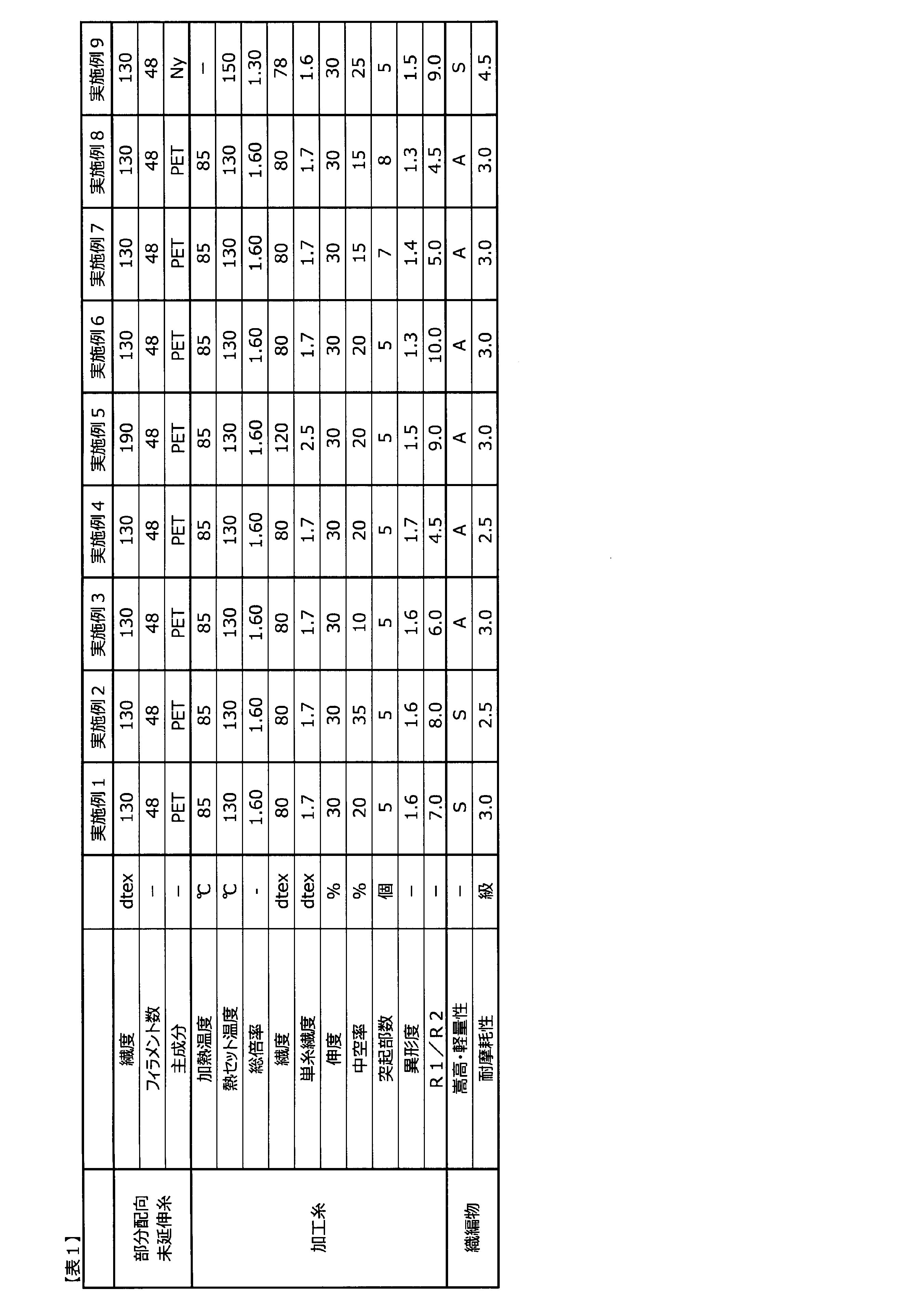
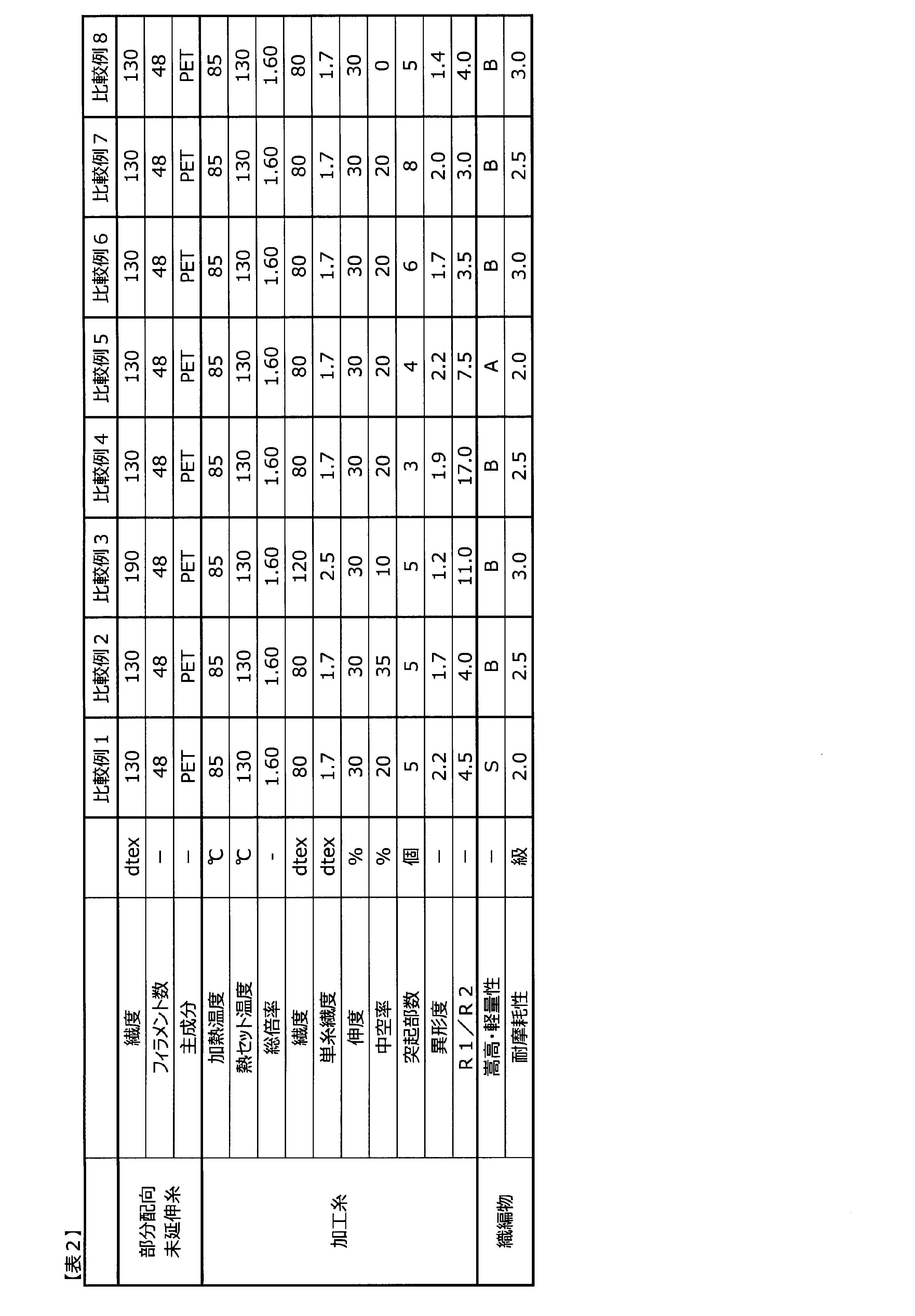
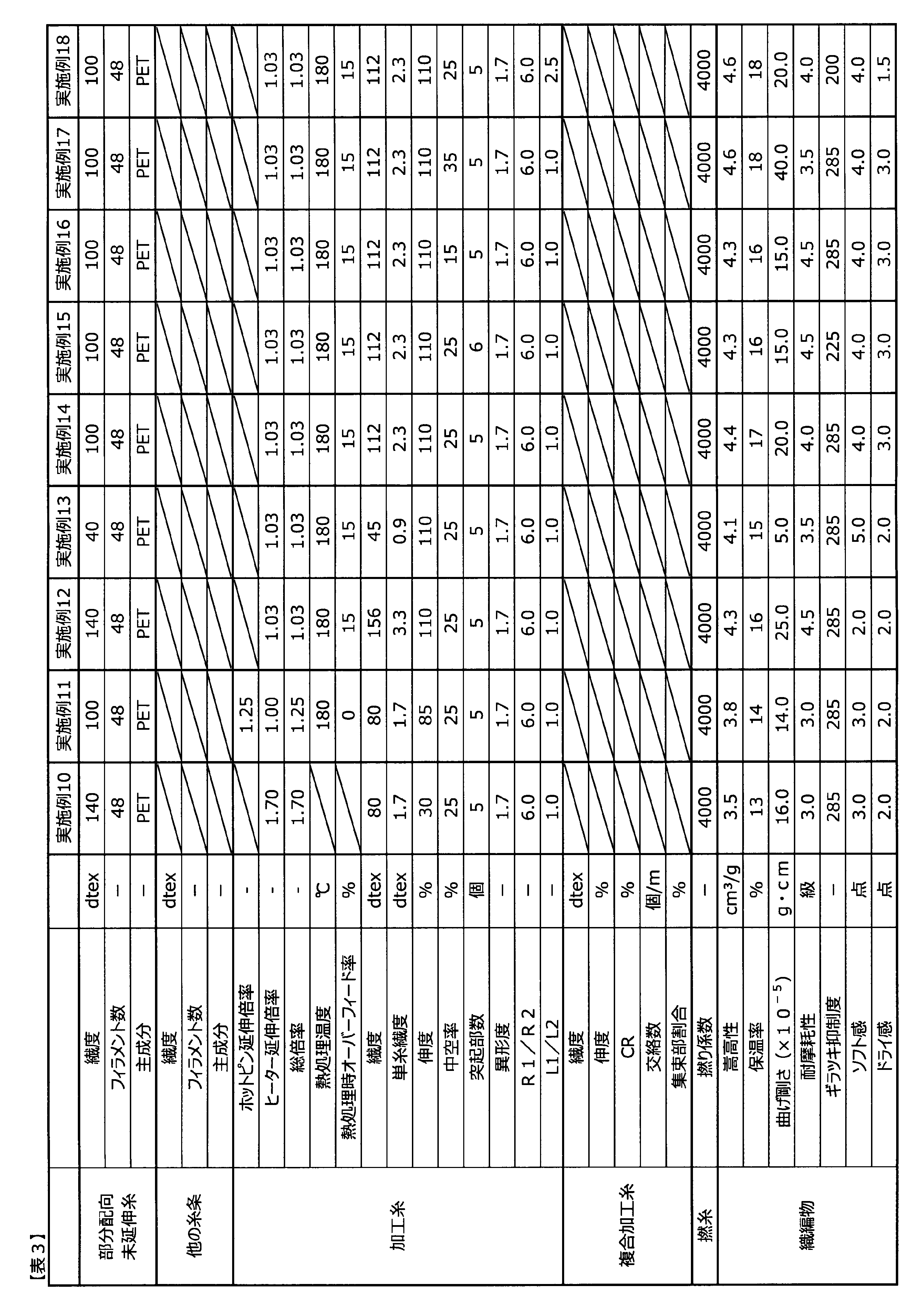

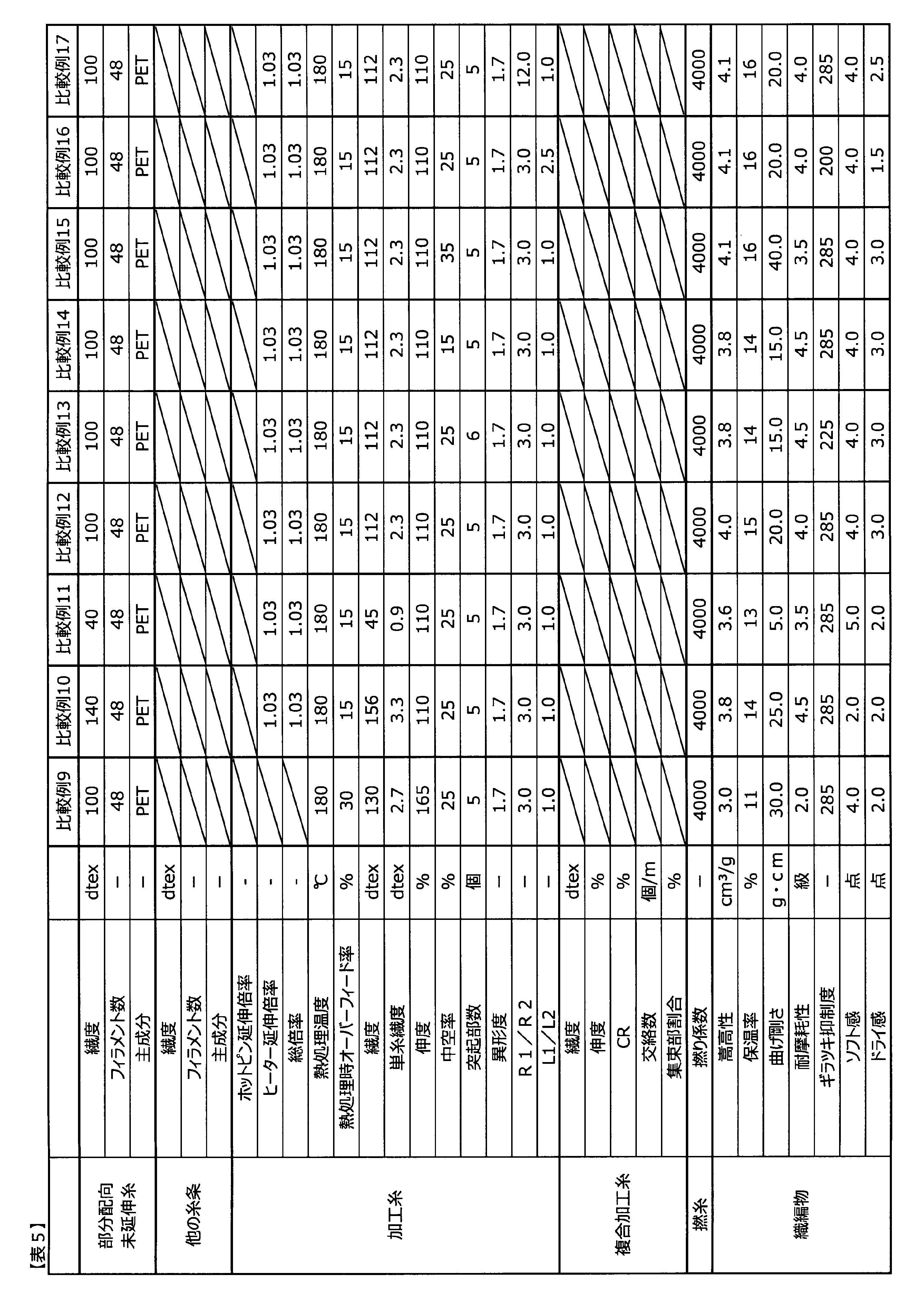
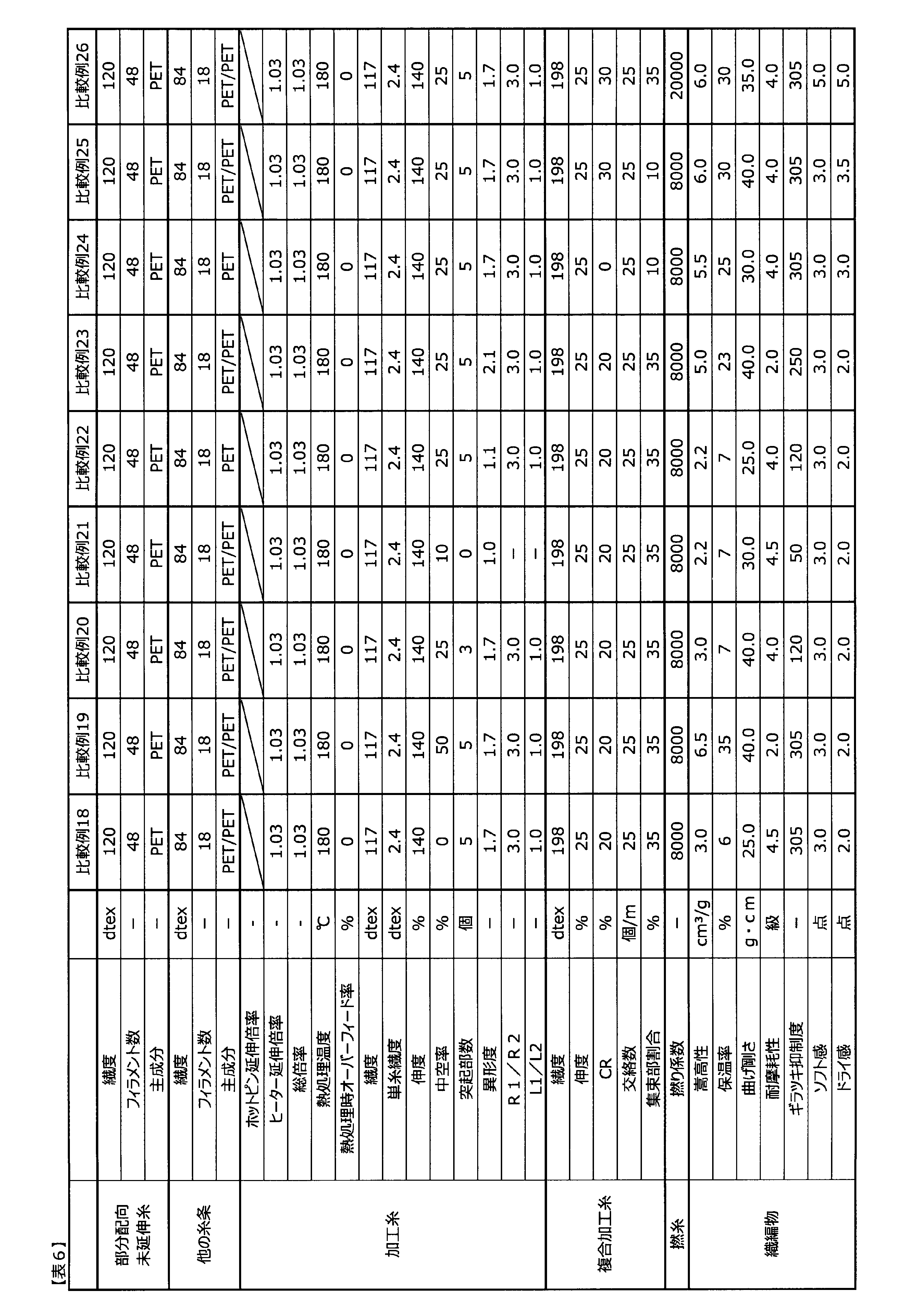
1:中空部
2:突起部
3:凹部
4:内接円
5:外接円
6:突起部の頂点
7:凹部の最深点
8:突起部の中点
9:中間円
10:隣り合う突起部の頂点と、隣り合う突起部の間に位置する凹部の最深点を通る円
11:突起部の頂点と突起部の中点を通る円
12:中空断面繊維
13:他の糸条
14:第1フィードローラー
15:ホットピン
16:第2フィードローラー
17:第3フィードローラー
18:第4フィードローラー
19:交絡ノズル
20:第5フィードローラー
21:ヒーター
22:第6フィードローラー
23:複合加工糸
24:突起部5個の口金の吐出孔形状の一例
25:突起部7個の口金の吐出孔形状の一例
26:突起部8個の口金の吐出孔形状の一例
27:突起部5個の中実断面繊維の口金の吐出孔形状の一例
R:単繊維横断面の外接円直径
r1:単繊維を中実と仮定した際の単繊維横断面の内接円直径
R1:隣り合う突起部の頂点と、隣り合う突起部の間に位置する凹部の最深点を通る円の直径
R2:突起部の頂点と突起部の中点を通る円の直径
L1:突起部の頂点から凹部の最深点を結んだ直線の長辺(長い方)
L2:突起部の頂点から凹部の最深点を結んだ直線の短辺(短い方)
Claims (13)
- 少なくとも1個の中空部を備える中空断面繊維であり、
前記中空断面繊維の中空率が10~40%であり、
前記中空断面繊維の横断面外周に突起部が4~8個存在し、
前記中空断面繊維の異形度(前記中空断面繊維の単繊維の外接円直径/中実と仮定した時の前記単繊維の内接円直径)が1.3~2.0であり、
前記中空断面繊維の横断面において、凹部径(隣り合う突起部の頂点と、隣り合う突起部の間に位置する凹部の最深点を通る円の直径R1)と突起径(突起部の頂点と突起部の中点を通る円の直径R2)の比R1/R2が4.5~10.0である
中空断面繊維。 - 単繊維繊度が1.0~3.0dtexである請求項1に記載の中空断面繊維。
- 前記突起部が5個である請求項1または2に記載の中空断面繊維。
- 請求項1~3のいずれかに記載の中空断面繊維で構成される単繊維を含み、かつ伸度が70~150%である加工糸。
- 請求項1~3のいずれかに記載の中空断面繊維、または請求項4に記載の加工糸と、少なくとも1種の他の糸条が複合されている複合加工糸。
- 請求項1~3のいずれかに記載の中空断面繊維、または請求項4に記載の加工糸を鞘部とする芯鞘構造を有する請求項5に記載の複合加工糸。
- 前記他の糸条が複合繊維である請求項5または6に記載の複合加工糸。
- 交絡数が10~50個/mであり、集束部割合が15~50%である請求項5~7のいずれかに記載の複合加工糸。
- 請求項1~3のいずれかに記載の中空断面繊維、請求項4に記載の加工糸、または請求項5~8のいずれかに記載の複合加工糸を含み、撚り数が11000~40000である撚糸。
- 請求項1~3のいずれかに記載の中空断面繊維、請求項4に記載の加工糸、請求項5~8のいずれかに記載の複合加工糸、または請求項9に記載の撚糸を少なくとも一部に含む織編物。
- JIS L 1096:2010 8.27.1に基づき測定された保温率が8~34%である請求項10に記載の織編物。
- JIS L 1096:2010 8.21.1に基づき測定された剛軟度Lと、単位面積当たりの質量Wを用いて、下式により算出される曲げ剛さGが、3.5×10⁻⁵~50.0×10⁻⁵g・cmである請求項10又は11に記載の織編物。
G=W×(L/2×0.1)3
G:曲げ剛さ(g・cm)
W:単位面積当たりの質量(g/cm2)
L:剛軟度(mm) - 請求項10~12のいずれかに記載の織編物を少なくとも一部に含む衣類。
Priority Applications (1)
| Application Number | Priority Date | Filing Date | Title |
|---|---|---|---|
| JP2024515045A JPWO2024185641A1 (ja) | 2023-03-03 | 2024-02-29 |
Applications Claiming Priority (4)
| Application Number | Priority Date | Filing Date | Title |
|---|---|---|---|
| JP2023-032466 | 2023-03-03 | ||
| JP2023032465 | 2023-03-03 | ||
| JP2023-032465 | 2023-03-03 | ||
| JP2023032466 | 2023-03-03 |
Publications (1)
| Publication Number | Publication Date |
|---|---|
| WO2024185641A1 true WO2024185641A1 (ja) | 2024-09-12 |
Family
ID=92674999
Family Applications (1)
| Application Number | Title | Priority Date | Filing Date |
|---|---|---|---|
| PCT/JP2024/007528 Ceased WO2024185641A1 (ja) | 2023-03-03 | 2024-02-29 | 中空断面繊維並びにこれを含む加工糸、複合加工糸、撚糸、織編物及び衣類 |
Country Status (2)
| Country | Link |
|---|---|
| JP (1) | JPWO2024185641A1 (ja) |
| WO (1) | WO2024185641A1 (ja) |
Citations (6)
| Publication number | Priority date | Publication date | Assignee | Title |
|---|---|---|---|---|
| JP2011047067A (ja) * | 2009-08-26 | 2011-03-10 | Teijin Fibers Ltd | 撥水性ポリエステル混繊糸 |
| JP2013256743A (ja) * | 2012-06-12 | 2013-12-26 | Suminoe Teijin Techno Co Ltd | 車両内装用布帛 |
| JP2014210989A (ja) * | 2013-04-18 | 2014-11-13 | 帝人株式会社 | 細繊度異型中空短繊維、これを用いてなる紡績糸、織編物、及び細繊度異型中空繊維の製造方法 |
| CN205556935U (zh) * | 2016-01-06 | 2016-09-07 | 湖南理工学院 | 一种远红外亲肤服装面料 |
| JP2019060049A (ja) * | 2017-09-27 | 2019-04-18 | 東レ株式会社 | 中空ポリエステル短繊維及びそれを用いた紡績糸 |
| JP2023012164A (ja) * | 2021-07-13 | 2023-01-25 | 帝人フロンティア株式会社 | 速乾性布帛および繊維製品 |
-
2024
- 2024-02-29 WO PCT/JP2024/007528 patent/WO2024185641A1/ja not_active Ceased
- 2024-02-29 JP JP2024515045A patent/JPWO2024185641A1/ja active Pending
Patent Citations (6)
| Publication number | Priority date | Publication date | Assignee | Title |
|---|---|---|---|---|
| JP2011047067A (ja) * | 2009-08-26 | 2011-03-10 | Teijin Fibers Ltd | 撥水性ポリエステル混繊糸 |
| JP2013256743A (ja) * | 2012-06-12 | 2013-12-26 | Suminoe Teijin Techno Co Ltd | 車両内装用布帛 |
| JP2014210989A (ja) * | 2013-04-18 | 2014-11-13 | 帝人株式会社 | 細繊度異型中空短繊維、これを用いてなる紡績糸、織編物、及び細繊度異型中空繊維の製造方法 |
| CN205556935U (zh) * | 2016-01-06 | 2016-09-07 | 湖南理工学院 | 一种远红外亲肤服装面料 |
| JP2019060049A (ja) * | 2017-09-27 | 2019-04-18 | 東レ株式会社 | 中空ポリエステル短繊維及びそれを用いた紡績糸 |
| JP2023012164A (ja) * | 2021-07-13 | 2023-01-25 | 帝人フロンティア株式会社 | 速乾性布帛および繊維製品 |
Also Published As
| Publication number | Publication date |
|---|---|
| JPWO2024185641A1 (ja) | 2024-09-12 |
Similar Documents
| Publication | Publication Date | Title |
|---|---|---|
| US6803000B2 (en) | Process of making yarn from two types of polyester | |
| US10323341B2 (en) | Highly air-permeable woven fabric resistant to washing | |
| JP3915398B2 (ja) | 織物 | |
| KR20250038198A (ko) | 가연 가공사 및 이것을 포함하는 복합 가연 가공사, 연사, 직편물 및 의류 | |
| JP3624824B2 (ja) | 織・編物 | |
| US20240060217A1 (en) | Composite fiber, composite mixed-filament fiber including same, woven/knitted fabric, and garment | |
| KR100635857B1 (ko) | 멜란지 효과가 우수한 이수축 혼섬사 및 그의 제조방법 | |
| WO2024018818A1 (ja) | 複合繊維、構造糸、織編物及び衣類 | |
| JP2006214056A (ja) | 織物 | |
| JP2019099925A (ja) | ポリエステル混繊糸布帛 | |
| JP5012646B2 (ja) | 分割型ポリアミド・ポリエステル複合繊維、それからなる織編物、繊維製品 | |
| TWI922793B (zh) | 複合假撚加工紗、編織/針織物及衣服 | |
| JP2001248034A (ja) | 混繊糸からなる織編物およびその製造方法 | |
| JP7669697B2 (ja) | 織物 | |
| JP2024124644A (ja) | 中空断面繊維 | |
| JP4202210B2 (ja) | 混繊糸及び織編物及び着古し外観を有する縫製品 | |
| JP7615594B2 (ja) | 混繊糸 | |
| KR100635860B1 (ko) | 스웨드 효과가 우수한 극세 혼섬사 | |
| US12516449B2 (en) | Woven/knitted fabric | |
| JP2020015992A (ja) | 異繊度異形断面混繊ポリアミド糸および繊維製品 | |
| KR102276508B1 (ko) | 위사 삽입 방식에 의해 제조되는 애슬레저용 원단 및 그 제조방법 | |
| WO2023100570A1 (ja) | 偏心芯鞘複合仮撚糸及びそれを用いた織編物 | |
| JP2024024786A (ja) | 複合仮撚糸及びそれを含む織編物 | |
| JP2019085676A (ja) | ポリエステル複合仮撚糸 | |
| JP4228504B2 (ja) | 混繊糸からなる織編物 |
Legal Events
| Date | Code | Title | Description |
|---|---|---|---|
| WWE | Wipo information: entry into national phase |
Ref document number: 2024515045 Country of ref document: JP |
|
| 121 | Ep: the epo has been informed by wipo that ep was designated in this application |
Ref document number: 24767011 Country of ref document: EP Kind code of ref document: A1 |
|
| NENP | Non-entry into the national phase |
Ref country code: DE |
|
| 122 | Ep: pct application non-entry in european phase |
Ref document number: 24767011 Country of ref document: EP Kind code of ref document: A1 |