WO2024180622A1 - 車体構造 - Google Patents
車体構造 Download PDFInfo
- Publication number
- WO2024180622A1 WO2024180622A1 PCT/JP2023/007108 JP2023007108W WO2024180622A1 WO 2024180622 A1 WO2024180622 A1 WO 2024180622A1 JP 2023007108 W JP2023007108 W JP 2023007108W WO 2024180622 A1 WO2024180622 A1 WO 2024180622A1
- Authority
- WO
- WIPO (PCT)
- Prior art keywords
- vehicle
- surface portion
- body structure
- vehicle body
- vertical wall
- Prior art date
- Legal status (The legal status is an assumption and is not a legal conclusion. Google has not performed a legal analysis and makes no representation as to the accuracy of the status listed.)
- Ceased
Links
Images


Classifications
-
- B—PERFORMING OPERATIONS; TRANSPORTING
- B62—LAND VEHICLES FOR TRAVELLING OTHERWISE THAN ON RAILS
- B62D—MOTOR VEHICLES; TRAILERS
- B62D25/00—Superstructure or monocoque structure sub-units; Parts or details thereof not otherwise provided for
- B62D25/08—Front or rear portions
-
- F—MECHANICAL ENGINEERING; LIGHTING; HEATING; WEAPONS; BLASTING
- F02—COMBUSTION ENGINES; HOT-GAS OR COMBUSTION-PRODUCT ENGINE PLANTS
- F02M—SUPPLYING COMBUSTION ENGINES IN GENERAL WITH COMBUSTIBLE MIXTURES OR CONSTITUENTS THEREOF
- F02M37/00—Apparatus or systems for feeding liquid fuel from storage containers to carburettors or fuel-injection apparatus; Arrangements for purifying liquid fuel specially adapted for, or arranged on, internal-combustion engines
- F02M37/22—Arrangements for purifying liquid fuel specially adapted for, or arranged on, internal-combustion engines, e.g. arrangements in the feeding system
Definitions
- This case concerns a vehicle body structure equipped with a fender shield.
- a structure for mounting an on-board device to a vehicle using mounting brackets to mount the on-board device to a vehicle compartment such as an engine compartment, motor compartment, or power unit compartment.
- a bracket is fixed to a dash panel or frame that constitutes part of the compartment, and the on-board device (such as a fuel filter) is supported by this bracket (see Patent Document 1).
- the shape of the accommodation chamber itself may deform, and the position of the bracket fixed to the dash panel or frame may move.
- the on-board device may move to follow the deformation of the accommodation chamber itself, which may cause concerns about interference with other devices placed nearby or with the vehicle structure. Therefore, it is desirable to realize a new structure that can improve the protective performance of the on-board device.
- One of the objectives of this case was devised in light of the above-mentioned problems, and is to provide a vehicle body structure that can improve the protective performance of on-board devices. However, this objective is not the only objective. Another objective of this case is to achieve effects that cannot be obtained with conventional technology, which are derived from the configurations shown in the "Mode for carrying out the invention" described below.
- the disclosed vehicle body structure can be realized as the embodiments (application examples) disclosed below, which solve at least part of the above problems.
- Each embodiment from embodiment 2 onwards is an embodiment that can be selected additionally as appropriate, and each is an embodiment that can be omitted. None of the embodiments from embodiment 2 onwards discloses an embodiment or configuration that is essential to the present case.
- the disclosed vehicle body structure is a vehicle body structure that includes a fender shield that is provided inside a fender panel of a vehicle and forms part of the bottom surface of a storage compartment in which an on-board device is stored.
- the fender shield includes a first surface portion that is formed in a surface shape that slopes downward toward the front side and in which a first on-board device is disposed, a second surface portion that is formed in a substantially flat band shape extending in the vehicle width direction behind the first surface portion, a ridge portion that includes a wall portion formed by bulging the plate surface in the plate thickness direction behind the second surface portion, and a third surface portion in which a second on-board device is disposed behind the second surface portion and approximately to the side of the ridge portion.
- the first surface portion has a bead formed by extending a portion of the plate surface that bulges in the plate thickness direction in the vehicle front-rear direction.
- Aspect 3 In the above aspect 1 or 2, it is preferable that the ridge portion has a surface shape with an upward gradient toward the rear side of the second surface portion and has a first vertical wall portion extending along the vehicle width direction.
- the ridge portion has a second vertical wall portion that extends rearward from an end portion on an inner side in the vehicle width direction of the first vertical wall portion and is formed in a surface shape that has an upward gradient toward an outer side in the vehicle width direction.
- the third surface portion preferably has a first reinforcing portion formed by swelling in a plate thickness direction around a portion where the second in-vehicle device is fixed.
- the third surface portion has a first reinforcing portion formed by bulging in a plate thickness direction around a portion where the second on-board device is fixed, and the first reinforcing portion is located to the side of the second vertical wall portion.
- the fender shield preferably includes a second reinforcing portion formed by the first vertical wall portion and the second vertical wall portion, the top of which is flat and bulging upward. Also, it is preferable that a strut tower is disposed in the second reinforcing portion.
- a tray member is provided that is attached substantially horizontally to the first surface portion, the first vehicle-mounted device is fixed to the first surface portion via the tray member, and the tray member has a tray bead formed by extending a portion of the plate surface that bulges in the plate thickness direction in the vehicle front-rear direction.
- the vehicle includes a pair of left and right upper frames supporting both left and right end edges of the bonnet hood, and a pair of left and right front subframes extending from the front end of each of the upper frames toward the inside of the vehicle and toward the front and downward and connected to a front support member, and that the front end of the first surface portion is joined to the front subframes, and the side end of the third surface portion is joined to the upper frames.
- the vehicle includes a first cross member that has a hat-shaped cross section, extends in the vehicle width direction, and connects the pair of left and right front support members in the vehicle width direction, and that the height position of the front end of the first surface portion is set to the same height as the first cross member.
- the disclosed vehicle body structure can promote mountain-fold deformation in the second surface portion between the first surface portion, the third surface portion, and the ridge line portion of the fender shield when the fender shield is deformed by an external force applied from the front side of the storage compartment. This can reduce interference between the on-board device and other surrounding devices or the vehicle body structure, improving the protective performance of the on-board device.
- FIG. 1 is a perspective view showing a vehicle body structure according to an embodiment in an exploded and partially see-through state
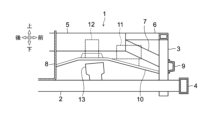
- FIG. 2 is a vertical cross-sectional view showing the structure of the storage chamber shown in FIG. 1 .
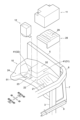
- FIG. 2 is an exploded perspective view showing the structure around the left fender shield.
- A) is a top view of the left fender shield, and
- B) is a side view thereof.
- the disclosed vehicle body structure is applied to the vehicle shown in the following embodiment.
- This vehicle body structure includes a fender shield.
- the fender shield is provided inside the vehicle's fender panel and forms part of the bottom surface of the accommodation chamber that houses the on-board equipment.
- the accommodation chamber here includes, for example, the engine room, motor room, power unit room, etc.
- the on-board equipment here includes the vehicle's drive-related devices (fuel filters, fuel pumps, canisters, air cleaners, various reservoir tanks, brake boosters, transformers, batteries, etc.) and other devices (air conditioning-related devices, electrical equipment-related devices, etc.).
- the front-to-rear direction (vehicle length direction) is defined based on the forward and backward direction of the vehicle
- the left-to-right direction is defined based on the front-to-rear direction
- the up-to-down direction is defined based on the state in which the vehicle is stopped on a flat road surface. Note that in the vehicle width direction, in the part to the left of the vehicle body centerline in a top view of the vehicle, the left is the outside of the vehicle and the right is the inside of the vehicle. Also, in the part to the right of the vehicle body centerline in a top view of the vehicle, the right is the outside of the vehicle and the left is the inside of the vehicle.
- FIG. 1 is an exploded perspective view showing a partially see-through state of a storage compartment 1 of a vehicle to which a vehicle body structure according to an embodiment is applied, and Fig. 2 is a vertical cross-sectional view of the storage compartment 1.
- the storage compartment 1 in this embodiment is a power unit room that houses a drive unit of the vehicle, and is disposed in the front of the passenger compartment in which the occupants sit.
- the accommodation chamber 1 shown in Figures 1 and 2 accommodates an engine (internal combustion engine as a drive unit), a first vehicle-mounted device 11 (battery), and a second vehicle-mounted device 12 (fuel filter), all of which are not shown.
- An opening is provided at the upper end of the accommodation chamber 1, and a bonnet hood, not shown, is attached to this opening so that it can be opened and closed freely.
- the engine is located inside the accommodation chamber 1, for example, in a position from near the center to the right side in the vehicle width direction.
- the first on-board device 11 is a secondary battery (so-called auxiliary battery) that stores electricity generated by an alternator (not shown) attached to the engine, and is arranged on the left side (left of the engine) inside the accommodation chamber 1.
- the second on-board device 12 is a filter device for filtering fuel supplied to the engine, and is arranged on the left side (left of the engine) inside the accommodation chamber 1, rear of the first on-board device 11.
- the first on-board device 11 and the second on-board device 12 are fixed to the fender shield 10, which will be described later.
- the first on-board device 11 and the second on-board device 12 may be arranged in a different position (for example, to the right of the engine).
- a pair of left and right side members 2 are arranged below the accommodation chamber 1.
- the side members 2 are one of the skeletal members that are provided to extend in the front-to-rear direction, and are provided at a specified interval in the left-to-right direction.
- a front bumper beam 4 is connected to the front end of each side member 2.
- the front bumper beam 4 is a protective member that absorbs impact when an external force is input from the front of the vehicle, and is provided approximately horizontally so as to extend outward in the vehicle width direction beyond the left and right side members 2.
- a front support member 3 (radiator core support member) is connected to the front portion of each side member 2 at a position slightly rearward of the front bumper beam 4.
- the front support member 3 is a member that extends in the vertical direction and has the function of supporting the radiator unit and headlamp unit that are attached to the front end of the vehicle.
- a pair of front support members 3 are provided at the front end of the accommodation chamber 1 with a specified distance between them in the left-right direction.
- the upper frame 5 is a member that extends almost horizontally forward from near the lower end of the vehicle's front pillar and is connected to both ends of the upper bar 6.
- a pair of upper frames 5 are arranged on the left and right at the top of the accommodation compartment 1.
- the front fender panel of the vehicle is attached to the outside of the upper frames 5.
- the front wheel tires and strut tower 13 (not shown) are arranged below the upper frame 5.
- the upper frame 5 and upper bar 6 function to support the portion of the bonnet hood from both the left and right ends to the front end.
- the strut tower 13 is a tower-shaped portion to which the upper part of the strut (spring and damper) of the suspension device is fixed.
- the lower end of the strut tower 13 is fixed to the side member 2.
- a first cross member 9 is provided on the front side of the joint between the front support member 3 and the front subframe 7.
- the first cross member 9 is a member that has a hat-shaped cross section and extends in the vehicle width direction, connecting the pair of left and right front support members 3 in the vehicle width direction.
- the orientation of the first cross member 9 is set so that the top surface of the hat-shaped cross section faces the front of the vehicle, and the brim portion of the hat-shaped cross section is in surface contact with the front side of the front support member 3.
- a fender shield 10 is attached inside the accommodation chamber 1.
- the fender shield 10 is a planar member that forms part of the bottom surface of the accommodation chamber 1 on the inside of the vehicle's fender panel. As shown in FIG. 1, a pair of fender shields 10 in this embodiment are provided on the inside of each of the left and right fender panels.
- the outer edge of the fender shield 10 on the vehicle side is connected to the upper frame 5 and the front subframe 7.
- the inner edge of the fender shield 10 on the vehicle side is provided so as to be spaced upward from the side member 2.
- the strut tower 13 and wheel house are disposed below the fender shield 10.
- the overall shape of the fender shield 10 is such that it does not interfere with the wheel house, and is arched in shape with the center bulging slightly upward from the front end in a side view.
- a first vehicle-mounted device 11 and a second vehicle-mounted device 12 are fixed to the top of the left fender shield 10.
- the fender shield 10 on the side to which the first vehicle-mounted device 11 and the second vehicle-mounted device 12 are not fixed can be omitted.
- FIG. 3 is an exploded perspective view showing the structure around the left fender shield 10, Fig. 4(A) is a top view of the left fender shield 10, and Fig. 4(B) is a side view thereof.
- the left fender shield 10 has at least a first surface portion 21, a second surface portion 22, a third surface portion 23, and a ridge portion 41.
- a fourth surface portion 24 is provided.
- the fourth surface portion 24 is an optional portion.
- the first surface portion 21 is a planar portion that forms the front end portion of the fender shield 10, and is formed as a surface that slopes downward toward the front side.
- the first on-board device 11 is disposed on the first surface portion 21.
- the surface shape of the first surface portion 21 may be curved or flat.
- the front end portion of the first surface portion 21 is joined to the front subframe 7, and the left end portion of the first surface portion 21 is joined to the upper frame 5 and the front subframe 7.
- the front end of the first surface portion 21 is joined to the front support member 3 and the front subframe 7 so that the front end of the first surface portion 21 is located immediately behind the first cross member 9 in a side view.
- the height position of the front end of the first surface portion 21 fixed to the rear surface of the front support member 3 and the front subframe 7 is set to the same height as the first cross member 9 fixed to the front surface of the front support member 3 and the front subframe 7.
- a reinforcing bead 25 is formed on the first surface portion 21.
- the bead 25 is a portion of the plate surface that bulges in the plate thickness direction and extends in the vehicle front-rear direction.
- the bead 25 is formed in a shape in which multiple linear portions that bulge downward from the surrounding area are arranged at intervals in the vehicle width direction.
- the second surface 22 is a planar portion formed in a substantially flat band shape extending in the vehicle width direction behind the first surface 21.
- the left end of the second surface 22 is joined to the upper frame 5.
- the bending rigidity of the second surface 22 is set to be smaller than that of the first surface 21 and also smaller than that of the third surface 23 described below.
- the second surface 22 is more easily bent than the first surface 21 and the third surface 23, and forms a portion that becomes the ridge of a mountain fold when an external force is applied from the front side of the storage compartment 1 (for example, part or all of the second surface 22 is bent and deformed into an upwardly convex shape).
- the ridge portion 41 is a portion including a wall portion formed by bulging the plate surface in the plate thickness direction on the rear side of the second surface portion 22.
- the ridge portion 41 has a first vertical wall portion 31 extending in the vehicle width direction and a second vertical wall portion 32 extending in the front-rear direction.
- the first vertical wall portion 31 is a portion that constitutes the front portion of the wall portion of the ridge portion 41
- the second vertical wall portion 32 is a portion that constitutes the right side portion of the wall portion of the ridge portion 41, and is shaped to extend rearward from the inner end of the first vertical wall portion 31 in the vehicle width direction.
- the overall shape of the ridge portion 41 when viewed from above is L-shaped.
- the first vertical wall portion 31 is formed in a surface shape with an upward gradient toward the rear side of the second surface portion 22 (a downward gradient toward the front side).
- the boundary portion between the first vertical wall portion 31 and the second surface portion 22 has a shape that resembles a valley fold in a downward convex shape (a shape that forms an upside-down ridgeline).
- the second vertical wall portion 32 is formed in a surface shape with an upward gradient toward the outside in the vehicle width direction (a downward gradient toward the right side).
- the boundary portion between the second vertical wall portion 32 and the third surface portion 23 described below also has a shape that resembles a valley fold in a downward convex shape (a shape that forms an upside-down ridgeline).
- the third surface portion 23 is a planar portion on which the second in-vehicle device 12 is disposed, rearward of the second surface portion 22 and approximately to the side of the ridge portion 41.
- the left end portion of the third surface portion 23 is joined to the upper frame 5.
- the third surface portion 23 is provided with a first reinforcing portion 51 (in-vehicle device reinforcing portion).
- the first reinforcing portion 51 is a portion formed by bulging out in the plate thickness direction around the location where the second in-vehicle device 12 is fixed, and is formed, for example, in a rectangular shape that bulges downward beyond the surrounding area.
- the first reinforcing portion 51 is located to the side of the second vertical wall portion 32.
- a second reinforcement portion 52 (strut tower reinforcement portion) is provided on the outer side (left side) of the first reinforcement portion 51 in the vehicle width direction.
- the second reinforcement portion 52 is a portion formed by bulging upward around the area where the strut tower 13 is located, and is formed by a first vertical wall portion 31 and a second vertical wall portion 32, with a top portion (flat portion 30) that is flat.
- the flat portion 30 is formed in a substantially horizontal plane so as to face the top surface of the strut tower 13.
- the first vertical wall portion 31 is disposed to the right (inner side in the vehicle width direction) of the flat portion 30, and the second vertical wall portion 32 is disposed forward of the flat portion 30.
- the first vertical wall portion 31 forms an inclined surface that connects the flat portion 30 and the second surface portion 22, and the second vertical wall portion 32 forms an inclined surface that connects the flat portion 30 and the first reinforcement portion 51.
- the fourth surface 24 is a planar portion located rearward of the third surface 23.
- the fourth surface 24 is formed, for example, in a planar shape that slopes downward toward the rear side (toward the center in the vehicle's longitudinal direction).
- the rear end of the fourth surface 24 is joined to the dash panel 8, and the left end of the fourth surface 24 is joined to the upper frame 5.
- the fourth surface 24 may be formed in a substantially horizontal shape so as to be in the same plane as the third surface 23.
- the first vehicle-mounted device 11 is fixed to the first surface 21 via a tray member 28.
- the tray member 28 is a bracket member for fixing the first vehicle-mounted device 11, and is attached approximately horizontally to the first surface 21.
- the tray member 28 shown in FIG. 3 has a horizontal surface portion that is an approximately horizontal surface on which the first vehicle-mounted device 11 is placed and a wall portion that extends downward from its front end edge, and has an approximately L-shaped vertical cross section.
- the tray member 28 may be fixed to the first surface 21 using a bracket (not shown), may be fixed by a fastener (not shown), or may be fixed by welding.
- the position of the tray member 28 is set at a position where it overlaps with the bead 25 when viewed from above. This improves the stability of the first vehicle-mounted device 11.
- a tray bead 29 is formed on the tray member 28.
- the tray bead 29 is a portion formed by extending a portion of the plate surface that bulges in the plate thickness direction in the fore-and-aft direction of the vehicle.
- the tray bead 29 is formed in a shape in which multiple linear portions that bulge downward from the surrounding area are arranged at intervals in the vehicle width direction.
- the vehicle body structure according to this embodiment includes a fender shield 10 having a first surface 21, a second surface 22, a ridge portion 41, and a third surface 23.
- the first surface 21 is formed in a surface shape with a downward slope toward the front side, and a first vehicle-mounted device 11 is disposed on the first surface 21.
- the second surface 22 is formed in a substantially flat band shape extending in the vehicle width direction on the rear side of the first surface 21.
- the ridge portion 41 is disposed on the rear side of the second surface 22, and includes a wall portion (first vertical wall portion 31, second vertical wall portion 32) formed by expanding a plate surface in the plate thickness direction.
- the third surface 23 is disposed on the rear side of the second surface 22 and approximately to the side of the ridge portion 41, and a second vehicle-mounted device 12 is fixed thereto.
- This configuration can promote mountain-fold deformation in the second surface 22 between the first surface 21 and the third surface 23 and the ridgeline 41 when the fender shield 10 is deformed by an external force from the front side of the storage compartment 1.
- the front of the second vehicle-mounted device 12 is covered by the fender shield 10, making it difficult for the first vehicle-mounted device 11 and the vehicle body structure to approach the second vehicle-mounted device 12 from the front side.
- This can reduce interference between the second vehicle-mounted device 12 and other surrounding devices and vehicle body structures, improving the protection performance of the vehicle-mounted devices (e.g., the first vehicle-mounted device 11, the second vehicle-mounted device 12) accommodated in the storage compartment 1.
- the first surface portion 21 has a bead 25 formed by extending a portion of the plate surface bulging in the plate thickness direction in the front-rear direction. This increases the bending rigidity of the first surface portion 21 and relatively reduces the bending rigidity of the second surface portion 22. This promotes mountain-folding deformation in the second surface portion 22 when an external force is applied from the front side, further improving the protective performance of the vehicle-mounted device accommodated in the accommodation chamber 1.
- the shape of the bead 25 bulge downward from the surrounding area, interference between the tray member 28 and the first vehicle-mounted device 11 attached on the first surface portion 21 and the bead 25 can be prevented, and the degree of freedom in the layout of the first vehicle-mounted device 11 inside the accommodation chamber 1 can be increased.
- the ridge portion 41 is provided with a first vertical wall portion 31 that forms an upwardly sloping surface toward the rear side of the second surface portion 22 and extends along the vehicle width direction. This increases the bending rigidity of the rear side of the second surface portion 22, and promotes mountain-folding deformation of the second surface portion 22 against an external force from the front side of the storage chamber 1. This further improves the protective performance of the vehicle-mounted device stored in the storage chamber 1.
- the first vertical wall portion 31 into a surface that slopes upwardly toward the rear side of the second surface portion 22, it becomes easier to ensure installation space for the strut tower 13 below the fender shield 10, as shown in FIG. 2. This improves the protective performance of the storage chamber 1 without impairing the operation or performance of the vehicle suspension device.
- the ridgeline portion 41 is provided with a second vertical wall portion 32 that extends rearward from the end of the first vertical wall portion 31 on the inner side in the vehicle width direction and is formed in a plane shape with an upward gradient toward the outer side in the vehicle width direction. This can further increase the bending rigidity of the rear side of the second surface portion 22.
- the second vertical wall portion 32 is shaped to receive the load in the front-rear direction within the plane, it is difficult to deform due to an external force from the front side, and its shape is likely to be maintained. This makes it relatively easy for bending deformation to occur in the second surface portion 22 forward of the second vertical wall portion 32. Therefore, the protective performance of the vehicle-mounted device accommodated in the accommodation chamber 1 can be further improved.
- the protective performance of the accommodation chamber 1 can be improved without impairing the operation or performance of the suspension device of the vehicle.
- the third surface portion 23 has a first reinforcing portion 51 formed by bulging in the plate thickness direction around the portion where the second in-vehicle device 12 is fixed. This increases the bending rigidity of the third surface portion 23 and relatively reduces the bending rigidity of the second surface portion 22. Therefore, when an external force is applied from the front side, it is possible to promote mountain-folding deformation in the second surface portion 22, and the protective performance of the in-vehicle device accommodated in the accommodation chamber 1 can be further improved.
- the mounting position of the second in-vehicle device 12 in the height direction can be lowered.
- the second in-vehicle device 12 is likely to be positioned lower than the ridge of the bent second surface portion 22. Therefore, interference between the second in-vehicle device 12 and other surrounding devices and vehicle body structure can be more reliably suppressed, and the protective performance of the second in-vehicle device 12 can be further improved.
- the above-mentioned first reinforcing portion 51 is disposed on the side of the second vertical wall portion 32.
- the mounting state of the second in-vehicle device 12 can be stabilized.
- the surface shape of the first reinforcing portion 51 is likely to be maintained. This makes it possible to prevent the second in-vehicle device 12 from moving to an unintended position or changing its attitude to an unintended direction. Therefore, the protective performance of the second in-vehicle device 12 can be further improved.
- the fender shield 10 includes a second reinforcing portion 52.
- the second reinforcing portion 52 is formed by the first vertical wall portion 31 and the second vertical wall portion 32, and has a flat top and an upwardly bulging shape.
- the strut tower 13 is disposed below the second reinforcing portion 52. This increases the bending rigidity around the strut tower 13, and promotes bending deformation near the boundary between the second vertical wall portion 32 and the second surface portion 22 located in front of it, promoting mountain-fold deformation at the second surface portion 22. This further improves the protective performance of the vehicle-mounted device accommodated in the accommodation chamber 1.
- the fender shield 10 includes a tray member 28.
- the tray member 28 is attached substantially horizontally to the first surface 21.
- the first vehicle-mounted device 11 is fixed to the first surface 21 via the tray member 28.
- the tray member 28 also has a tray bead 29 formed by extending a portion of the plate surface that bulges in the plate thickness direction in the front-rear direction.
- the first vehicle-mounted device 11 is indirectly fixed to the first surface 21 of the fender shield 10 via the tray member 28. As a result, even if the first surface 21 is slightly deformed due to an external force, the effect of that deformation is unlikely to extend to the first vehicle-mounted device 11, and deformation or damage to the first vehicle-mounted device 11 is prevented. In this sense as well, the protective performance of the first vehicle-mounted device 11 can be improved.
- the vehicle of this embodiment is equipped with a pair of left and right upper frames 5 that support both left and right end edges of the bonnet hood, and a pair of left and right front subframes 7 that extend from the front ends of the upper frames 5 toward the inside of the vehicle and toward the front and downward and are connected to the front support member 3.
- the front end of the first surface portion 21 is joined to the front subframes 7, and the side end of the third surface portion 23 is joined to the upper frames 5.
- This configuration ensures the bending rigidity of the fender shield 10 when no external force is acting, while easily achieving mountain-fold deformation when an external force is acting.
- the mounting state of the first on-vehicle device 11 fixed to the first surface portion 21 can be stabilized, preventing the first on-vehicle device 11 from wobbling while the vehicle is traveling, for example.
- the vehicle of this embodiment is equipped with a first cross member 9 that has a hat-shaped cross-sectional shape, extends in the vehicle width direction, and connects a pair of left and right front support members 3 in the vehicle width direction.
- the height direction position of the front end of the first surface portion 21 is set to the same height as the first cross member 9.
- the first vehicle-mounted device 11 may be attached directly to the first surface 21.
- the second surface 22 between the first surface 21 on which the first vehicle-mounted device 11 is disposed and the third surface 23 on which the second vehicle-mounted device 12 is disposed and by providing a ridge portion 41 on the rear side of the second surface 22, a structure that provides the same effect as the above embodiment can be realized.
- This invention can be used in the vehicle manufacturing industry where a body structure equipped with a fender shield is used.
Landscapes
- Engineering & Computer Science (AREA)
- Chemical & Material Sciences (AREA)
- Combustion & Propulsion (AREA)
- Mechanical Engineering (AREA)
- General Engineering & Computer Science (AREA)
- Transportation (AREA)
- Body Structure For Vehicles (AREA)
Priority Applications (2)
| Application Number | Priority Date | Filing Date | Title |
|---|---|---|---|
| PCT/JP2023/007108 WO2024180622A1 (ja) | 2023-02-27 | 2023-02-27 | 車体構造 |
| JP2025503255A JPWO2024180622A1 (https=) | 2023-02-27 | 2023-02-27 |
Applications Claiming Priority (1)
| Application Number | Priority Date | Filing Date | Title |
|---|---|---|---|
| PCT/JP2023/007108 WO2024180622A1 (ja) | 2023-02-27 | 2023-02-27 | 車体構造 |
Publications (1)
| Publication Number | Publication Date |
|---|---|
| WO2024180622A1 true WO2024180622A1 (ja) | 2024-09-06 |
Family
ID=92589468
Family Applications (1)
| Application Number | Title | Priority Date | Filing Date |
|---|---|---|---|
| PCT/JP2023/007108 Ceased WO2024180622A1 (ja) | 2023-02-27 | 2023-02-27 | 車体構造 |
Country Status (2)
| Country | Link |
|---|---|
| JP (1) | JPWO2024180622A1 (https=) |
| WO (1) | WO2024180622A1 (https=) |
Citations (6)
| Publication number | Priority date | Publication date | Assignee | Title |
|---|---|---|---|---|
| JPS63181531U (https=) * | 1987-05-15 | 1988-11-24 | ||
| JPH06344946A (ja) * | 1993-06-07 | 1994-12-20 | Mazda Motor Corp | 自動車の前部構造 |
| JPH07132820A (ja) * | 1993-11-10 | 1995-05-23 | Nissan Motor Co Ltd | 自動車のブレーキ系コントロールユニット取付構造 |
| JPH11287128A (ja) * | 1998-04-01 | 1999-10-19 | Nissan Motor Co Ltd | セジメンタの保護構造 |
| JP2006199102A (ja) * | 2005-01-19 | 2006-08-03 | Mazda Motor Corp | 車体前部構造 |
| JP2011011669A (ja) * | 2009-07-03 | 2011-01-20 | Suzuki Motor Corp | 車両用エンジンの燃料フィルタ装置 |
-
2023
- 2023-02-27 JP JP2025503255A patent/JPWO2024180622A1/ja active Pending
- 2023-02-27 WO PCT/JP2023/007108 patent/WO2024180622A1/ja not_active Ceased
Patent Citations (6)
| Publication number | Priority date | Publication date | Assignee | Title |
|---|---|---|---|---|
| JPS63181531U (https=) * | 1987-05-15 | 1988-11-24 | ||
| JPH06344946A (ja) * | 1993-06-07 | 1994-12-20 | Mazda Motor Corp | 自動車の前部構造 |
| JPH07132820A (ja) * | 1993-11-10 | 1995-05-23 | Nissan Motor Co Ltd | 自動車のブレーキ系コントロールユニット取付構造 |
| JPH11287128A (ja) * | 1998-04-01 | 1999-10-19 | Nissan Motor Co Ltd | セジメンタの保護構造 |
| JP2006199102A (ja) * | 2005-01-19 | 2006-08-03 | Mazda Motor Corp | 車体前部構造 |
| JP2011011669A (ja) * | 2009-07-03 | 2011-01-20 | Suzuki Motor Corp | 車両用エンジンの燃料フィルタ装置 |
Also Published As
| Publication number | Publication date |
|---|---|
| JPWO2024180622A1 (https=) | 2024-09-06 |
Similar Documents
| Publication | Publication Date | Title |
|---|---|---|
| CN110239627B (zh) | 车辆后部构造 | |
| US10632827B2 (en) | Vehicle lower portion structure | |
| US9731766B2 (en) | Front vehicle body structure | |
| JP7408927B2 (ja) | 車両の後部車体構造 | |
| CN103587366B (zh) | 用于车辆的减震器外壳支撑装置 | |
| JP5493897B2 (ja) | 車体後部の下部構造 | |
| JP4346313B2 (ja) | 自動車の車体前部構造 | |
| JP2011126439A (ja) | バッテリ搭載車両の構造 | |
| CN113120089B (zh) | 汽车车身的前部构造 | |
| KR102586934B1 (ko) | 자동차의 전방 차체 구조 | |
| JP2013075535A (ja) | 車体後部構造 | |
| JP7567844B2 (ja) | 車両前部構造 | |
| CN114644055A (zh) | 用于车辆的前围板结构 | |
| KR20170068326A (ko) | 전기 자동차용 배터리 조립 구조 | |
| CN115848508A (zh) | 车身下部结构 | |
| JP2009002267A (ja) | 車両用キャニスタの取付構造 | |
| JP2008037135A (ja) | 車体後部のバッテリ搭載構造 | |
| WO2024180622A1 (ja) | 車体構造 | |
| JP2012066687A (ja) | カウルカバー構造 | |
| JP5857655B2 (ja) | 車両のハーネス配設構造 | |
| WO2019198752A1 (ja) | 自動車の車体構造 | |
| JP7213224B2 (ja) | 車体構造 | |
| WO2023170746A1 (ja) | バッテリ取付部構造 | |
| JP5496727B2 (ja) | 自動車の前部車体構造 | |
| JP3428518B2 (ja) | 車両の前部カバー取付け構造 |
Legal Events
| Date | Code | Title | Description |
|---|---|---|---|
| 121 | Ep: the epo has been informed by wipo that ep was designated in this application |
Ref document number: 23925180 Country of ref document: EP Kind code of ref document: A1 |
|
| WWE | Wipo information: entry into national phase |
Ref document number: 2025503255 Country of ref document: JP |
|
| WWE | Wipo information: entry into national phase |
Ref document number: 2501005266 Country of ref document: TH |
|
| NENP | Non-entry into the national phase |
Ref country code: DE |
|
| 122 | Ep: pct application non-entry in european phase |
Ref document number: 23925180 Country of ref document: EP Kind code of ref document: A1 |