WO2024162347A1 - 標的rnaの検出方法及びキット - Google Patents
標的rnaの検出方法及びキット Download PDFInfo
- Publication number
- WO2024162347A1 WO2024162347A1 PCT/JP2024/002871 JP2024002871W WO2024162347A1 WO 2024162347 A1 WO2024162347 A1 WO 2024162347A1 JP 2024002871 W JP2024002871 W JP 2024002871W WO 2024162347 A1 WO2024162347 A1 WO 2024162347A1
- Authority
- WO
- WIPO (PCT)
- Prior art keywords
- reverse transcription
- ica
- reaction
- target dna
- target rna
- Prior art date
- Legal status (The legal status is an assumption and is not a legal conclusion. Google has not performed a legal analysis and makes no representation as to the accuracy of the status listed.)
- Ceased
Links
Images




Classifications
-
- C—CHEMISTRY; METALLURGY
- C12—BIOCHEMISTRY; BEER; SPIRITS; WINE; VINEGAR; MICROBIOLOGY; ENZYMOLOGY; MUTATION OR GENETIC ENGINEERING
- C12Q—MEASURING OR TESTING PROCESSES INVOLVING ENZYMES, NUCLEIC ACIDS OR MICROORGANISMS; COMPOSITIONS OR TEST PAPERS THEREFOR; PROCESSES OF PREPARING SUCH COMPOSITIONS; CONDITION-RESPONSIVE CONTROL IN MICROBIOLOGICAL OR ENZYMOLOGICAL PROCESSES
- C12Q1/00—Measuring or testing processes involving enzymes, nucleic acids or microorganisms; Compositions therefor; Processes of preparing such compositions
- C12Q1/68—Measuring or testing processes involving enzymes, nucleic acids or microorganisms; Compositions therefor; Processes of preparing such compositions involving nucleic acids
- C12Q1/6813—Hybridisation assays
- C12Q1/6827—Hybridisation assays for detection of mutation or polymorphism
-
- C—CHEMISTRY; METALLURGY
- C12—BIOCHEMISTRY; BEER; SPIRITS; WINE; VINEGAR; MICROBIOLOGY; ENZYMOLOGY; MUTATION OR GENETIC ENGINEERING
- C12Q—MEASURING OR TESTING PROCESSES INVOLVING ENZYMES, NUCLEIC ACIDS OR MICROORGANISMS; COMPOSITIONS OR TEST PAPERS THEREFOR; PROCESSES OF PREPARING SUCH COMPOSITIONS; CONDITION-RESPONSIVE CONTROL IN MICROBIOLOGICAL OR ENZYMOLOGICAL PROCESSES
- C12Q1/00—Measuring or testing processes involving enzymes, nucleic acids or microorganisms; Compositions therefor; Processes of preparing such compositions
- C12Q1/68—Measuring or testing processes involving enzymes, nucleic acids or microorganisms; Compositions therefor; Processes of preparing such compositions involving nucleic acids
- C12Q1/6813—Hybridisation assays
- C12Q1/6816—Hybridisation assays characterised by the detection means
- C12Q1/6823—Release of bound markers
-
- C—CHEMISTRY; METALLURGY
- C12—BIOCHEMISTRY; BEER; SPIRITS; WINE; VINEGAR; MICROBIOLOGY; ENZYMOLOGY; MUTATION OR GENETIC ENGINEERING
- C12M—APPARATUS FOR ENZYMOLOGY OR MICROBIOLOGY; APPARATUS FOR CULTURING MICROORGANISMS FOR PRODUCING BIOMASS, FOR GROWING CELLS OR FOR OBTAINING FERMENTATION OR METABOLIC PRODUCTS, i.e. BIOREACTORS OR FERMENTERS
- C12M23/00—Constructional details, e.g. recesses, hinges
- C12M23/02—Form or structure of the vessel
- C12M23/12—Well or multiwell plates
-
- C—CHEMISTRY; METALLURGY
- C12—BIOCHEMISTRY; BEER; SPIRITS; WINE; VINEGAR; MICROBIOLOGY; ENZYMOLOGY; MUTATION OR GENETIC ENGINEERING
- C12N—MICROORGANISMS OR ENZYMES; COMPOSITIONS THEREOF; PROPAGATING, PRESERVING, OR MAINTAINING MICROORGANISMS; MUTATION OR GENETIC ENGINEERING; CULTURE MEDIA
- C12N15/00—Mutation or genetic engineering; DNA or RNA concerning genetic engineering, vectors, e.g. plasmids, or their isolation, preparation or purification; Use of hosts therefor
- C12N15/09—Recombinant DNA-technology
- C12N15/10—Processes for the isolation, preparation or purification of DNA or RNA
- C12N15/1096—Processes for the isolation, preparation or purification of DNA or RNA cDNA Synthesis; Subtracted cDNA library construction, e.g. RT, RT-PCR
-
- C—CHEMISTRY; METALLURGY
- C12—BIOCHEMISTRY; BEER; SPIRITS; WINE; VINEGAR; MICROBIOLOGY; ENZYMOLOGY; MUTATION OR GENETIC ENGINEERING
- C12Q—MEASURING OR TESTING PROCESSES INVOLVING ENZYMES, NUCLEIC ACIDS OR MICROORGANISMS; COMPOSITIONS OR TEST PAPERS THEREFOR; PROCESSES OF PREPARING SUCH COMPOSITIONS; CONDITION-RESPONSIVE CONTROL IN MICROBIOLOGICAL OR ENZYMOLOGICAL PROCESSES
- C12Q1/00—Measuring or testing processes involving enzymes, nucleic acids or microorganisms; Compositions therefor; Processes of preparing such compositions
- C12Q1/68—Measuring or testing processes involving enzymes, nucleic acids or microorganisms; Compositions therefor; Processes of preparing such compositions involving nucleic acids
- C12Q1/6806—Preparing nucleic acids for analysis, e.g. for polymerase chain reaction [PCR] assay
-
- C—CHEMISTRY; METALLURGY
- C12—BIOCHEMISTRY; BEER; SPIRITS; WINE; VINEGAR; MICROBIOLOGY; ENZYMOLOGY; MUTATION OR GENETIC ENGINEERING
- C12Q—MEASURING OR TESTING PROCESSES INVOLVING ENZYMES, NUCLEIC ACIDS OR MICROORGANISMS; COMPOSITIONS OR TEST PAPERS THEREFOR; PROCESSES OF PREPARING SUCH COMPOSITIONS; CONDITION-RESPONSIVE CONTROL IN MICROBIOLOGICAL OR ENZYMOLOGICAL PROCESSES
- C12Q1/00—Measuring or testing processes involving enzymes, nucleic acids or microorganisms; Compositions therefor; Processes of preparing such compositions
- C12Q1/68—Measuring or testing processes involving enzymes, nucleic acids or microorganisms; Compositions therefor; Processes of preparing such compositions involving nucleic acids
- C12Q1/6813—Hybridisation assays
- C12Q1/6816—Hybridisation assays characterised by the detection means
- C12Q1/6825—Nucleic acid detection involving sensors
Definitions
- the present invention relates to a method and a kit for detecting a target RNA.
- This application claims priority to Japanese Patent Application No. 2023-013023, filed in Japan on January 31, 2023, the contents of which are incorporated herein by reference.
- Patent Document 1 Patent Document 1
- Patent Document 2 Patent Document 2
- Non-Patent Document 1 describe a technique for performing an enzyme reaction in a large number of microcompartments. These methods are called digital measurement.
- the sample solution is divided into an extremely large number of micro-solutions.
- the signal from each micro-solution is then binarized, and the number of target molecules is measured by determining only whether or not the target molecule is present.
- nucleic acid quantification has been carried out using real-time PCR methods, etc.
- Digital measurement can significantly improve detection sensitivity and quantitation compared to conventional real-time PCR methods, etc.
- Patent Document 1 discloses a method for measuring target molecules by flowing a sample into a well array in which a large number of wells, each 3 ⁇ m deep and 5 ⁇ m in diameter, are formed in a flow path, introducing the sample into each well, and then pushing out excess reagent in the flow path with oil to introduce the sample into each well.
- RNA in cells is quickly degraded when the cells die, methods have been developed to detect living cells such as microorganisms and to distinguish whether they are alive or dead by detecting RNA.
- the RT-PCR method in which RNA is converted to DNA by a reverse transcription (RT) reaction and then PCR is performed, is well known (for example, Non-Patent Document 2).
- Non-Patent Document 3 describes a platform that combines CRISPR-based nucleic acid detection with microchamber technology as an amplification-free RNA detection platform.
- RNA detection requires a nucleic acid cleavage enzyme and a highly optimized nucleic acid reagent.
- the enzyme has low single-base discrimination performance, and it is not possible to detect mutant types in a large amount of wild type.
- Patent No. 6183471 Special Publication No. 2014-503831
- Detection of target RNA requires a detection method with high sensitivity and high discrimination performance. To perform analysis at a practical level, it is required that the method is excellent in all respects, including low cost, simplicity of the method, short signal detection time, and accuracy of detection results.
- the object of the present invention is to provide a method and kit for detecting target RNA.
- a method for detecting a target RNA comprising the steps of: introducing into a container a reaction solution containing the target RNA, a reverse transcription reagent for reverse transcribing the target RNA to produce a target DNA, and a detection reagent for detecting the target DNA; subjecting the reaction solution to reverse transcription conditions to produce the target DNA; and subjecting the reaction solution to detection conditions to detect the target DNA.
- ICA Invasive Cleavage Assay
- a detection reagent for detecting the target DNA includes a first single-stranded oligonucleotide (allele probe), a second single-stranded oligonucleotide (ICA oligo), a third single-stranded oligonucleotide (FRET cassette), and a flap endonuclease, and when the allele probe and the ICA oligo hybridize to the target DNA, a first triple-stranded structure is formed at the 5'-end of the allele probe, and the first triple-stranded structure is cleaved by the flap endonuclease that recognizes the first triple-stranded structure to generate a fourth single-stranded oligonucleotide, and the FRET cassette includes a fluorescent substance and The method according to [2], wherein the allele probe is labeled with a fourth single-stranded oligonucleotide and a quencher, the 5' side forms a hairpin structure by self-h
- reverse transcriptase comprises an enzyme derived from any one of a wild-type, mutant, and improved type Moloney murine leukemia virus, or an enzyme derived from any one of a mutant and improved type avian myeloblastosis virus.
- reverse transcription reaction conditions include a reverse transcription temperature of 20° C. or higher and 50° C. or lower, and a reaction time of 5 minutes or longer and 60 minutes or shorter.
- a fluidic device including a substrate and a well array arranged on the substrate, a reverse transcription reagent for reverse transcribing a target RNA to generate a target DNA, and a detection reagent for detecting the target DNA
- the detection reagent for detecting the target DNA includes a first single-stranded oligonucleotide (allele probe), a second single-stranded oligonucleotide (ICA oligo), a third single-stranded oligonucleotide (FRET cassette), and a flap endonuclease
- the allele probe and the ICA oligo hybridize to the target DNA, a first triple-stranded structure is formed at the 5' end of the allele probe, and the first triple-stranded structure is cleaved by the flap endonuclease that recognizes the first triple-stranded structure to generate a fourth single-stranded oligonucleotide (ICA oligo), a
- a kit for detecting a target RNA, which generates a single-stranded oligonucleotide the FRET cassette is labeled with a fluorescent substance and a quencher, and forms a hairpin structure on the 5' side by self-hybridization, and the 3' side has a base sequence complementary to the fourth single-stranded oligonucleotide, and when the fourth single-stranded oligonucleotide hybridizes to the 3' side, a second triple-stranded structure is formed at the 5' end, which is cleaved by a flap endonuclease that recognizes the second triple-stranded structure, releasing the fluorescent substance and the quencher, and emitting fluorescence when irradiated with excitation light, and the allele probe has a modification at the 3' end that prevents nucleotides from being extended by a reverse transcription reaction.
- the reverse transcription reagent comprises a reverse transcription primer and a reverse transcriptase, and the reverse transcription primer binds to the target RNA in a sequence-specific manner.
- the present invention provides a method and kit for detecting target RNA.
- FIG. 1 is a schematic diagram explaining the Invasive Cleavage Assay (ICA) method.
- FIG. 2 is a schematic cross-sectional view showing an example of a fluidic device.
- FIG. 3 is a schematic cross-sectional view showing an example of a fluidic device.
- FIG. 4 is a photograph showing the results of agarose gel electrophoresis in Experimental Example 2.
- FIG. 5 is a photograph showing the results of agarose gel electrophoresis in Experimental Example 3.
- FIG. 6 is a graph showing the results of the ICA reaction in Experimental Example 4.
- FIG. 7 is a graph showing the results of the ICA reaction in Experimental Example 4.
- FIG. 8 is a fluorescent microscope image showing the results of the reverse transcription-ICA reaction in Experimental Example 5.
- the present invention provides a method for detecting a target RNA, the method comprising the steps of: introducing into a container a reaction solution containing the target RNA, a reverse transcription reagent for reverse transcribing the target RNA to generate a target DNA, and a detection reagent for detecting the target DNA; subjecting the reaction solution to reverse transcription conditions to generate the target DNA; and subjecting the reaction solution to detection conditions to detect the target DNA.
- Step of introducing reaction solution a reaction solution containing a target RNA, a reverse transcription reagent for reverse transcribing the target RNA to generate a target DNA, and a detection reagent for detecting the target DNA is introduced into a vessel.
- the vessel, the target RNA, the reverse transcription reagent, and the detection reagent will be described later.
- Step of Reverse Transcription of Target RNA the reaction solution is subjected to reverse transcription conditions, and the target RNA is reverse transcribed to generate target DNA.
- the target RNA is RNA to be detected.
- the target RNA include, but are not limited to, viral RNA and disease-related RNA.
- the target RNA may be contained in a biological sample. Examples of the biological sample include, but are not limited to, whole blood, serum, plasma, urine, saliva, cells, tissues, viruses, and plant tissues.
- reverse transcriptase reaction can be used as a method for reverse transcribing the target RNA.
- Specific examples of reverse transcription reactions include reverse transcription reactions using reverse transcription kits from the PrimeScript (registered trademark) series and the SuperScript (registered trademark) series. It is particularly preferable to use the PrimeScript (registered trademark) series.
- the reverse transcription primer used in the reverse transcription reaction of the target RNA it is preferable to use a random primer or a primer that binds to the target RNA in a sequence-specific manner.
- the primer that binds to the target RNA in a sequence-specific manner may be a PCR primer that amplifies the target DNA (also called cDNA) obtained by reverse transcribing the target RNA.
- the process for detecting the target DNA is the Invasive Cleavage Assay (ICA) method
- the position where the reverse transcription primer binds to the target RNA in a sequence-specific manner and the position where the ICA oligo hybridizes to the target DNA are separated by 20 or more bases. If the position where the reverse transcription primer binds to the target RNA in a sequence-specific manner and the position where the ICA oligo hybridizes to the target DNA are separated by 20 or more bases, the allele probe and the ICA oligo are more likely to hybridize, improving the processing performance of base discrimination and increasing detection efficiency. It is preferable that the position where the reverse transcription primer binds to the target RNA in a sequence-specific manner and the position where the ICA oligo hybridizes to the target DNA are separated by 100 or less bases.
- the reverse transcriptase is preferably an enzyme derived from any one of wild-type, mutant, and improved types of Moloney murine leukemia virus (also called MMLV), or any one of mutant and improved types of avian myeloblastosis virus (also called AMV).
- MMLV has high base discrimination processing performance and a low reverse transcription error rate.
- AMV has high thermal stability.
- the reaction solution is subjected to reverse transcription conditions to generate target DNA from the target RNA.
- Reverse transcription conditions can be achieved, for example, by heating or cooling the reaction solution to a temperature at which the reverse transcriptase is active. Temperatures at which the reverse transcriptase is active include isothermal conditions of, for example, 20°C or higher, 40°C or higher, and preferably about 48°C. In reverse transcription conditions, the reverse transcription temperature is preferably 20°C or higher and 50°C or lower.
- the time for the reverse transcription reaction can be, for example, 5 minutes or more and 60 minutes or less, at least 30 minutes, and preferably about 60 minutes.
- the target RNA and the target DNA may be hybridized. Therefore, it is preferable to separate the target RNA and the target DNA.
- the temperature of the reaction solution can be kept at 90°C to 99°C for 1 to 10 minutes to cause thermal denaturation, thereby separating the target RNA and the target DNA.
- Step of detecting target DNA the reverse transcribed target DNA is detected.
- the reverse transcription of the target RNA and the detection of the reverse transcribed target DNA are performed in the same container.
- Any known detection method can be used to detect the target DNA according to the characteristics of the target DNA to be detected.
- a method is exemplified in which a reaction (also called a signal amplification reaction) is first performed to amplify the signal derived from the target DNA to a detectable level as necessary, and then the amplified signal is detected using an appropriate means.
- signals include fluorescence, chemiluminescence, color development, potential change, and pH change.
- Examples of signal amplification reactions include the Invasive Cleavage Assay (ICA) method such as the Invader (registered trademark) method, the LAMP method, the TaqMan (registered trademark) method, and the fluorescent probe method.
- ICA Invasive Cleavage Assay
- the ICA method is particularly preferable to use the ICA method. This is related to the principle of the ICA reaction in which signal amplification proceeds through a cycle of two reactions: (1) complementary binding between nucleic acids, and (2) recognition and cleavage of the triple-stranded structure by an enzyme. In such signal amplification reactions, the effect of reaction cycle inhibition by contaminants other than the target molecule is small.
- FIG. 1 is a schematic diagram for explaining an example of ICA.
- the presence of the target DNA 100 is detected by detecting the presence of a T (thymine) base 101 in the target DNA 100.
- a first single-stranded oligonucleotide sometimes referred to as an allele probe 110
- a second single-stranded oligonucleotide sometimes referred to as an ICA oligo 120
- the ICA oligo 120 hybridizes to a site of the target DNA 100 adjacent to the position where the allele probe 110 hybridizes.
- at least one base at the 3' end of the ICA oligo 120 invades the 5' end position of the region 141 where the allele probe 110 and the target DNA 100 are hybridized, and a first triplex structure 130 is formed.
- a flap endonuclease when reacted with the first triplex structure 130, the flap portion 140 of the first triplex structure 130 is cleaved, and a fourth single-stranded oligonucleotide (sometimes referred to as a nucleic acid fragment 140) is generated.
- the nucleic acid fragment 140 then hybridizes to a third single-stranded oligonucleotide (sometimes referred to as a FRET cassette 150) to form a second triplex structure 160.
- fluorescent substance F is bound to the 5' end of FRET cassette 150, and quencher Q is bound to a few bases 3' from the 5' end of FRET cassette 150. Fluorescent substance F and quencher Q are located in close spatial proximity. Therefore, the fluorescence emitted by fluorescent substance F is quenched by quencher Q through fluorescence resonance energy transfer (FRET).
- FRET fluorescence resonance energy transfer
- the second triplex structure 160 is reacted with a flap endonuclease, the flap site 170 of the second triplex structure 160 is cut, and a nucleic acid fragment 170 is generated.
- the fluorescent substance F is released from the quenching substance Q, and emits fluorescence when irradiated with excitation light. By detecting this fluorescence, the presence of the target DNA (the presence of the T (thymine) base 101 in the target DNA 100) can be detected.
- the detection reagent for detecting the target DNA contains a first single-stranded oligonucleotide (sometimes referred to as an allele probe), a second single-stranded oligonucleotide (sometimes referred to as an ICA oligo), a third single-stranded oligonucleotide (sometimes referred to as a FRET cassette), and a flap endonuclease.
- a first triplex structure is formed at the 5' end of the allele probe, and the first triplex structure is cleaved by a flap endonuclease that recognizes the first triplex structure to generate a fourth single-stranded oligonucleotide.
- the FRET cassette is labeled with a fluorescent substance and a quenching substance, and the 5' side forms a hairpin structure by self-hybridization, and the 3' side has a base sequence complementary to the fourth single-stranded oligonucleotide.
- a second triplex structure is formed at the 5' end. Then, the second triplex structure is cleaved by a flap endonuclease that recognizes the second triplex structure, and the fluorescent substance and the quenching substance are released, and fluorescence is emitted when irradiated with excitation light.
- the allele probe has a modification at the 3' end that prevents nucleotides from being extended by a reverse transcription reaction.
- the allele probe does not have such a modification, undesired nucleotides may be extended in the reverse transcription reaction of the target RNA, inhibiting the intended detection.
- the ICA oligo has a modification at the 3' end that prevents nucleotides from being extended by a reverse transcription reaction, the ICA reaction itself may be inhibited.
- Modifications that prevent nucleotide elongation by reverse transcription reaction include binding of an amino group to the 3'-terminus, substitution of the OH group at the 3'-terminus with a hydrogen atom, substitution of the OH group at the 3'-terminus with an azide group ( N3 group), and the like.
- flap endonuclease 1 NCBI accession number: WP_011012561.1, Holliday junction 5' flap endonuclease (GEN1) (NCBI accession number: NP_001123481.3), excision repair protein (NCBI accession number: AAC37533.1, etc. can be used.
- the reaction solution is set to detection conditions, and the target DNA is detected.
- Setting the reaction solution to detection conditions includes, for example, heating or cooling the reaction solution to a temperature at which the ICA reaction proceeds.
- the temperature at which the ICA reaction proceeds is, for example, an isothermal condition of 60°C or higher, preferably about 66°C.
- the time for the ICA reaction is, for example, at least 10 minutes, preferably about 30 minutes.
- the reaction solution preferably further contains a salt concentration adjuster.
- salt concentration adjusters include sodium chloride and magnesium chloride.
- the magnesium chloride concentration in the reaction solution is preferably in the range of 3 mM to 100 mM, and more preferably in the range of 5 mM to 50 mM.
- the magnesium chloride concentration is 3 mM.
- the magnesium chloride concentration is 25 mM.
- the container is preferably a well, and the well preferably constitutes a well array in which a plurality of wells are arranged.
- the well array is preferably arranged in a flow path of a fluidic device.
- Digital measurement can be carried out by introducing one or less molecules of target RNA per well.
- FIG. 2 is a schematic cross-sectional view showing an example of a fluidic device in which the method of the present embodiment can be suitably carried out.
- the fluidic device 200 includes a substrate 210 and a cover member 220 arranged opposite the substrate 210.
- the cover member 220 has a convex portion 221, and the tip of the convex portion 221 is in contact with the substrate 210.
- the well array 240 is integrally molded with the substrate 210 on one side of the substrate 210 and faces the cover member 220.
- the well array 240 has a plurality of wells 241.
- the cover member 220 may be welded or bonded to the substrate 210.
- the wells 241 open onto the surface of the substrate 210.
- the wells 241 are microwells with a small volume.
- the volume of one well 241 may be approximately 10 fL to 100 pL.
- multiple wells 241 of the same shape and size form a well array 240.
- the same shape and size means that the wells have the same shape and volume to the extent required for digital measurement, and variations within the range of manufacturing errors are acceptable.
- the diameter of the wells 241 may be, for example, about 1 to 10 ⁇ m, and the depth of the wells 241 may be, for example, about 1 to 10 ⁇ m.
- the arrangement of the wells 241 is not particularly limited, and may be, for example, arranged in a triangular lattice pattern, a square lattice pattern, or randomly arranged.
- the flow path 230 functions as a path for sending the reaction liquid L210 containing the target RNA, reverse transcription reagent, and detection reagent described above, as well as the sealing liquid described below.
- the shape, structure, capacity, etc. of the flow path 230 are not particularly limited, but the height of the flow path 230 (the distance between the surface of the substrate 210 and the surface of the cover member 220 facing the substrate 210) may be, for example, 500 ⁇ m or less, for example, 300 ⁇ m or less, for example, 200 ⁇ m or less, or for example, 100 ⁇ m or less.
- the protrusion 221 may be molded integrally with the lid member 220.
- the lid member 220 may be molded into a plate shape having the protrusion 221, for example, by molding a thermoplastic resin fluid using a molding die.
- the lid member 220 may also be formed with an inlet port 222 and an outlet port 223 for the reagent.
- the lid member 220 has a protrusion 221
- the lid member 220 and the substrate 210 are overlapped so that the protrusion 221 contacts the surface of the substrate 210 where the well 241 opens.
- the space between the lid member 220 and the substrate 210 becomes the flow path 230.
- the lid member 220 and the substrate 210 may be welded by laser welding or the like.
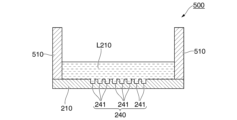
- Fig. 3 is a schematic cross-sectional view showing an example of a fluidic device.
- the fluidic device 500 includes a substrate 210 and a wall member 510.
- the well array 240 is integrally formed with the substrate 210 on one side of the substrate 210.
- the well array 240 has a plurality of wells 241.
- the fluidic device 500 is mainly different from the above-described fluidic device 200 in that the fluidic device 500 does not include a cover member 220.
- cover member 220 and the protrusion 221 are integrally molded.
- the cover member 220 and the protrusion 221 may be molded as separate bodies.
- the well array 240 is integrally molded with the substrate 210 on one side of the substrate 210.
- the well array does not have to be integrally molded with the substrate 210.
- the well array 240 molded separately from the fluidic device may be disposed on the substrate 210 of the fluidic device.
- a resin layer may be laminated on the surface of the substrate 210, and the well array may be formed in the resin layer by etching or the like.
- the substrate 210 is formed using, for example, a resin.
- the type of resin is not particularly limited, but it is preferable that the resin is resistant to the reagent and the sealing liquid. In addition, when the signal to be detected is fluorescence, it is preferable that the resin has little autofluorescence.
- the resin include, but are not limited to, cycloolefin polymer, cycloolefin copolymer, silicone, polypropylene, polycarbonate, polystyrene, polyethylene, polyvinyl acetate, fluororesin, amorphous fluororesin, etc.
- a plurality of wells 241 may be formed on one surface of the substrate 210 in the thickness direction.
- Methods for forming wells using resin include injection molding, thermal imprinting, and optical imprinting.
- a fluororesin may be laminated on the substrate 210 and the fluororesin may be processed by etching or the like to form a well array.
- CYTOP registered trademark, Asahi Glass
- the fluororesin may be laminated on the substrate 210 and the fluororesin may be processed by etching or the like to form a well array.
- CYTOP registered trademark, Asahi Glass
- the fluororesin may be laminated on the substrate 210 and the fluororesin may be processed by etching or the like to form a well array.
- CYTOP registered trademark, Asahi Glass
- the material of the lid member 220 is preferably a resin with low autofluorescence, and may be, for example, a thermoplastic resin such as a cycloolefin polymer or a cycloolefin copolymer.
- the lid member 220 may be made of a material that does not transmit light of wavelengths close to the wavelength detected during fluorescent observation of the signal, or may be made of a material that does not transmit light at all.
- the lid member 220 may be made of a thermoplastic resin to which carbon, metal particles, etc. have been added.
- reaction liquid containing target RNA, reverse transcription reagent, and detection reagent is delivered to the internal space (e.g., flow path) of the fluidic device and introduced into the wells of the well array.
- the reaction liquid is preferably an aqueous solution.
- a surfactant or the like may be added to the reaction liquid to make it easier to introduce the liquid into the wells.
- a sealing liquid is sent into the internal space (e.g., a flow path) of the fluidic device, forming a layer of sealing liquid on top of the liquid introduced into the well, and sealing the liquid within the well.
- This process forms microdroplets in the well, and each well forms an independent reaction space.
- the process of reverse transcribing the target RNA is preferably carried out after sealing the reaction liquid within the well.
- a sealing liquid e.g., oil
- a sealing liquid may be gently dripped from above to seal the well array with the sealing liquid.
- the sealing liquid is a liquid capable of forming droplets (microdroplets) by individually sealing the liquids introduced into the multiple wells so that they do not mix with each other, and is preferably an oil-based solution, more preferably an oil.
- an oil a fluorine-based oil, a silicone-based oil, a hydrocarbon-based oil, or a mixture thereof can be used.
- the boiling point of the sealing liquid is preferably 150° C. or more.
- the upper limit of the boiling point of the sealing liquid is, for example, 3300° C.
- the boiling point of the sealing liquid is more preferably 150° C. or more and 3300° C. or less.
- the viscosity of the sealing liquid is preferably 2 mm 2 /s or more.
- the upper limit of the viscosity of the sealing liquid is, for example, 300 mm 2 /s or less.
- the viscosity of the sealing liquid is more preferably 2 mm 2 /s or more and 300 mm 2 /s or less.
- the sealing liquid is preferably a fluorine-based oil or a silicone-based oil having a boiling point of 150° C.
- the viscosity of the sealing liquid can be measured by a capillary viscometer according to JIS Z 8803:2011, a method for measuring the viscosity of liquids.
- FC-40 fluorine-based oils
- FC-40 Emulseo's product name "FLUO-OIL 40”
- Shin-Etsu Chemical's product name "KF-96” silicone oil can be used.
- FC-40 (CAS number: 86508-42-1) is a fluorinated aliphatic compound with a specific gravity of 1.85 g/mL at 25°C.
- the method for observing signals after the ICA reaction can be selected from known appropriate methods depending on the type of signal to be observed. For example, when performing bright-field observation, white light is irradiated perpendicularly onto the substrate on which the well array is provided. When observing fluorescent signals, excitation light corresponding to the fluorescent substance is irradiated into the well from the bottom side of the well, and the fluorescence emitted by the fluorescent substance is observed. It is advisable to take an image of the entire or part of the observed well array, save it, and perform image processing using a computer system.
- the present invention includes a fluidic device including a substrate and a well array disposed on the substrate, a reverse transcription reagent for reverse transcribing a target RNA to generate a target DNA, and a detection reagent for detecting the target DNA
- the detection reagent for detecting the target DNA includes a first single-stranded oligonucleotide (allele probe), a second single-stranded oligonucleotide (ICA oligo), a third single-stranded oligonucleotide (FRET cassette), and a flap endonuclease
- the allele probe and the ICA oligo hybridize to the target DNA, a first triple-stranded structure is formed at the 5' end portion of the allele probe, and the first triple-stranded structure is cleaved by the flap endonuclease that recognizes the first triple-stranded structure
- the kit provides a kit for detecting a
- the kit of this embodiment can suitably carry out the above-mentioned method for detecting target RNA.
- the kit of this embodiment may further include a sealing liquid.
- the fluid device, reverse transcription reagent, detection reagent, sealing liquid, ICA reaction, allele probe, ICA oligo, FRET cassette, flap endonuclease, and modifications that prevent nucleotides from being extended by reverse transcription reaction are the same as those described above.
- the modification that prevents the nucleotide from being extended by the reverse transcription reaction may be the binding of an amino group to the 3' end.
- the kit of the present embodiment further includes a sealing liquid.
- the sealing liquid is preferably a fluorine-based oil or a silicone-based oil, and the boiling point of the sealing liquid is 150° C. or higher and the viscosity of the sealing liquid is 2 mm 2 /s or higher.
- the reverse transcription reagent contains a reverse transcription primer and a reverse transcriptase, and that the reverse transcription primer binds to the target RNA in a sequence-specific manner.
- the position where the reverse transcription primer binds to the target RNA in a sequence-specific manner and the position where the ICA oligo hybridizes to the target DNA are designed to be separated by 20 or more bases.
- the reverse transcriptase contains an enzyme derived from any one of wild-type, mutant, and improved Moloney murine leukemia viruses, or an enzyme derived from any one of mutant and improved avian myeloblastosis viruses.
- the volume of each well in the well array is preferably 10 fL to 100 pL.
- Example 1 (Study of reverse transcription efficiency using reverse transcription primers) A random 6-mer primer and a primer specific to the target RNA were used as the reverse transcription primer to examine the reverse transcription efficiency. 0 pM (negative control), 1.5 pM, and 30 pM of the target RNA (5'-GCCAGGAUGUUUCCUAACGCGCCCUACCUGCCCAGCUGCCUCGAGAGCCAGCCCGCUAUUCGCAAUCAGGGUUACAGCACGGUCACCUUCGACGGGACGCCCAGCUACGGUCACACGCCCUCGCACCAUGCGGCGCAGUU-3', SEQ ID NO: 1), the reverse transcription primer, and the reverse transcription reaction reagent were mixed, and the reverse transcription reaction was performed using a thermal cycler.
- the reverse transcription reaction reagent contained reverse transcriptase derived from Moloney murine leukemia virus.
- the reverse transcription primers used were 2.5 ⁇ M random 6-mer primer (Takara Bio), 0.1 ⁇ M reverse transcription primer specific to the target RNA (Fasmac, 5'-AACTGCGCCGCATGGTGC-3', sequence number 2), or 0.1 ⁇ M TaqMan PCR antisense primer (Fasmac, 5'-AACTGCGCCGCATGG-3', sequence number 3).
- the reverse transcription reaction was carried out at 42°C for 60 minutes, 95°C for 5 minutes, and 4°C for 5 minutes. 1 ⁇ L of RNase H was added to the reaction solution after the reverse transcription reaction, and the reaction was carried out at 37°C for 20 minutes in a thermal cycler.
- the reaction solution after reverse transcription or the target DNA for creating a standard curve was mixed with TaqMan PCR reaction reagent, and quantitative real-time PCR reaction was performed using a LightCycler LC480 (Roche).
- quantitative real-time PCR reaction TaqMan PCR primers (sense primer: 5'-CGCAATCAGGGTTACAGCAC-3', sequence number 4; antisense primer: 5'-AACTGCGCCGCATGG-3', sequence number 3) and TaqMan probe (5'-(VIC)CGTCCCGTCGAAGGTGAC(MGB)-3', sequence number 5) were used.
- the quantitative real-time PCR reaction was performed for 70 cycles, with one cycle consisting of 98°C for 10 seconds and 68°C for 60 seconds.
- a 2.5 ⁇ M random 6-mer primer (Takara Bio) was used as the reverse transcription primer.
- ICA reagents samples were prepared using 2 ⁇ M allele probe (Fasmac, 5'-CGCGCCGAGGGTTACAGCACGGTCA-3', sequence number 6), 1 ⁇ M ICA oligo (Fasmac, 5'-CCTCGAGAGCCAGCCCGCTATTCGCAATCAGGA-3', sequence number 7), and 4 ⁇ M FRET cassette (Alexa488-BHQ, Japan Bioservice, 5'-(Alexa488)TTCTT(BHQ1)AGCCGGTTTTCCGGCTGAGACCTCGGCGCG-3', sequence number 8), and a sample was prepared using 0.2 mg/mL flap endonuclease as the ICA reagent.
- the reverse transcription reaction was carried out at 42°C for 60 minutes, 95°C for 5 minutes, and 4°C for 5 minutes.
- the reaction solution after the reverse transcription reaction was then mixed with the PCR reaction reagent, and the PCR reaction was carried out using a thermal cycler.
- a sense primer (5'-CGCAATCAGGGTTACAGCAC-3', sequence number 9) and an antisense primer (5'-GTGCGAGGGCGTGTGACC-3', sequence number 10) were used for the PCR reaction.
- the PCR reaction was carried out for 30 cycles, with one cycle consisting of 98°C for 10 seconds, 65°C for 15 seconds, and 68°C for 60 seconds.
- reaction solution after the PCR reaction was mixed with a loading buffer, and each was loaded onto a 4% PrimeGel Agarose gel (Takara Bio Inc.), and electrophoresed at 100V for approximately 40 minutes.
- the gel after electrophoresis was then immersed in a 10,000-fold diluted SYBR Gold solution and stained for 30 minutes while stirring with a rotator. The stained gel was then photographed using a gel imaging analyzer.
- FIG. 4 is a photograph showing the results of agarose gel electrophoresis.
- M indicates a marker
- RT only indicates the result of reverse transcription reaction performed in the absence of ICA reagent
- RT + ICA probe indicates the result of reverse transcription reaction performed in the presence of allele probe, ICA oligo, and FRET cassette
- RT + FEN-1 indicates the result of reverse transcription reaction performed in the presence of flap endonuclease.
- RT only reverse transcription reaction was performed at KCl concentrations of 0 mM and 75 mM.
- RT + ICA probe indicates the position of the target cDNA band.
- a DNA fragment having the same base sequence as the above cDNA (5'-AACTGCGCCGCATGGTGCGAGGGCGTGTGACCGTAGCTGGGCGTCCCGTCGAAGGTGACCGTGCTGTAACCCTGATTGCGAATAGCGGGCTGGCTCTCGAGGCAGCTGGGCAGGTAGGGCGCGTTAGGAAACATCCTGGC-3', SEQ ID NO: 11) was mixed with PCR reaction reagents, and PCR reaction was carried out using a thermal cycler.
- a combination of a sense primer (5'-CGCAATCAGGGTTACAGCAC-3', SEQ ID NO: 9) and an antisense primer (5'-GTGCGAGGGCGTGTGACC-3', SEQ ID NO: 10) or a TaqMan PCR primer (sense primer: 5'-CGCAATCAGGGTTACAGCAC-3', SEQ ID NO: 4; antisense primer: 5'-AACTGCGCCGCATGG-3', SEQ ID NO: 3) was used.
- the PCR reaction was carried out for 30 cycles, with one cycle consisting of 98°C for 10 seconds, 65°C for 15 seconds, and 68°C for 60 seconds.
- the ICA reagents used were an allele probe with an amino group modified at the 3' end (5'-CGCGCCGAGGGTTACAGCACGGTCA-3', sequence number 6) and an allele probe without amino group modification (FASMAC, 5'-CGCGCCGAGGGTTACAGCACGGTCA-3', sequence number 6).
- reaction solution after the PCR reaction was mixed with a loading buffer, and each was loaded onto a 4% PrimeGel Agarose gel (Takara Bio Inc.), and electrophoresed at 100V for approximately 40 minutes.
- the gel after electrophoresis was then immersed in a 10,000-fold diluted SYBR Gold solution and stained for 30 minutes while stirring with a rotator. The stained gel was then photographed using a gel imaging analyzer.
- Figure 5 is a photograph showing the results of agarose gel electrophoresis.
- M indicates a marker
- PCR primer indicates the result of PCR reaction using primers whose base sequences are shown in SEQ ID NOs: 9 and 10 in the absence of ICA reagent
- TaqMan PCR primer indicates the result of PCR reaction using primers whose base sequences are shown in SEQ ID NOs: 3 and 4 in the absence of ICA reagent
- PCR + ICA probe indicates the result of PCR reaction using primers whose base sequences are shown in SEQ ID NOs: 9 and 10 in the presence of an allele probe that has not been modified with an amino group
- PCR + amino terminal ICA probe indicates the result of PCR reaction using primers whose base sequences are shown in SEQ ID NOs: 9 and 10 in the presence of an allele probe whose 3' end has been modified with an amino group
- the arrow indicates the position of the band of the target DNA.
- Example 4 (Investigation of the effect of terminally modified ICA probes on ICA reaction) 0 pM (negative control), 1.5 pM, and 30 pM of target DNA (5'-AACTGCGCCGCATGGTGCGAGGGCGTGTGACCGTAGCTGGGCGTCCCGTCGAAGGTGACCGTGCTGTAACCCTGATTGCGAATAGCGGGCTGGCTCTCGAGGCAGCTGGGCAGGTAGGGCGCGTTAGGAAACATCCTGGC-3', sequence number 11), a reverse transcription reaction reagent containing reverse transcriptase derived from Moloney murine leukemia virus, and an ICA reagent were mixed, and an ICA reaction was performed using a thermal cycler.
- target DNA 5'-AACTGCGCCGCATGGTGCGAGGGCGTGTGACCGTAGCTGGGCGTCCCGTCGAAGGTGACCGTGCTGTAACCCTGATTGCGAATAGCGGGCTGGCTCTCGAGGCAGCTGGGCAGGTAGGGCGCGTTAGGAAACATCCTGGC-3', sequence
- the ICA reagents used were 2 ⁇ M allele probe (Fasmac, 5'-CGCGCCGAGGGTTACAGCACGGTCA-3', sequence number 6) with or without amino group modification at the 3' end, 1 ⁇ M ICA oligo (Fasmac, 5'-CCTCGAGAGCCAGCCCGCTATTCGCAATCAGGA-3', sequence number 7) with or without amino group modification at the 3' end, 4 ⁇ M FRET cassette (Alexa488-BHQ, Japan Bioservice, 5'-(Alexa488)TTCTT(BHQ1)AGCCGGTTTTCCGGCTGAGACCTCGGCGCG-3', sequence number 8), and flap endonuclease.
- the mixed reagents were dispensed into a 96-well plate and the ICA reaction was performed using a LightCycler LC480 (Roche). The ICA reaction was performed at a constant temperature of 65°C.
- Figures 6 and 7 are graphs showing the results of the ICA reaction.
- the vertical axis shows the fluorescence intensity (relative value) detected as a result of the ICA reaction
- the horizontal axis shows the reaction time (seconds).
- the top panel of Figure 6 shows the results using an allele probe with an amino group modified at the 3' end and an ICA oligo with an amino group modified at the 3' end
- the bottom panel of Figure 6 shows the results using an allele probe that is not amino group modified and an ICA oligo that is not amino group modified.
- the top panel of Figure 7 shows the results using an allele probe with an amino group modified at the 3' end and an ICA oligo with no amino group modification
- the bottom panel of Figure 7 shows the results using an allele probe with no amino group modification and an ICA oligo with an amino group modified at the 3' end.
- Example 5 Reverse transcription-ICA reaction using a fluidic device
- a substrate made of cycloolefin polymer formed by injection molding and a cover material (colored with carbon black, with liquid supply and waste liquid ports) were bonded to form an internal space (channel) with a height of 30 ⁇ m.
- a well array was formed on the substrate, and the wells had a diameter of 5 or 10 ⁇ m and a volume that allowed signal detection by ICA reaction in a few minutes.
- reverse transcription-ICA reaction means reverse transcription reaction followed by ICA reaction.
- the reverse transcription-ICA reaction reagents used were 0.1 ⁇ M target RNA-specific reverse transcription primer (Fasmac, 5'-AACTGCGCCGCATGGTGC-3', sequence number 2), Moloney murine leukemia virus-derived reverse transcriptase, 2 ⁇ M allele probe with amino group modification at the 3' end (Fasmac, 5'-CGCGCCGAGGGTTACAGCACGGTCA-3', sequence number 6), 0.05 ⁇ M ICA oligo with no amino group modification (Fasmac, 5'-CCTCGAGAGCCAGCCCGCTATTCGCAATCAGGA-3', sequence number 7), 4 ⁇ M FRET cassette (Alexa488-BHQ, Japan Bioservice, 5'-(Alexa488)TTCTT(BHQ1)AGCCGGTTTTCCGGCTGAGACCTCGGCGCG-3', sequence number 8), and flap endonuclease.
- target RNA-specific reverse transcription primer
- the fluidic device with each sealed well was placed on a hot plate and reverse transcription-ICA reaction was carried out.
- the reverse transcription reaction was carried out at 48°C for 60 minutes, 95°C for 5 minutes, and 4°C for 5 minutes.
- an ICA reaction was carried out.
- the ICA reaction was carried out at 66°C for 30 minutes.
- each fluidic device was cooled and then observed under a fluorescence microscope (BZ-710, Keyence Corporation).
- a 4x objective lens was used to obtain bright-field images of each well in the well array and fluorescent images of the fluorescence obtained during the ICA detection reaction.
- Figure 8 shows a fluorescence microscope image. As a result, it was confirmed that the number of detection wells at target RNA concentrations of 20 fM and 200 fM increased compared to the number of detection wells at a target RNA concentration of 0 fM.
- the present invention provides a method and kit for detecting target RNA.
Landscapes
- Chemical & Material Sciences (AREA)
- Life Sciences & Earth Sciences (AREA)
- Organic Chemistry (AREA)
- Health & Medical Sciences (AREA)
- Engineering & Computer Science (AREA)
- Zoology (AREA)
- Wood Science & Technology (AREA)
- Genetics & Genomics (AREA)
- Bioinformatics & Cheminformatics (AREA)
- Proteomics, Peptides & Aminoacids (AREA)
- Biotechnology (AREA)
- General Engineering & Computer Science (AREA)
- General Health & Medical Sciences (AREA)
- Microbiology (AREA)
- Analytical Chemistry (AREA)
- Biochemistry (AREA)
- Molecular Biology (AREA)
- Physics & Mathematics (AREA)
- Biophysics (AREA)
- Immunology (AREA)
- Biomedical Technology (AREA)
- Chemical Kinetics & Catalysis (AREA)
- Bioinformatics & Computational Biology (AREA)
- Crystallography & Structural Chemistry (AREA)
- Plant Pathology (AREA)
- Clinical Laboratory Science (AREA)
- Sustainable Development (AREA)
- Measuring Or Testing Involving Enzymes Or Micro-Organisms (AREA)
Priority Applications (3)
| Application Number | Priority Date | Filing Date | Title |
|---|---|---|---|
| EP24750296.6A EP4660320A4 (en) | 2023-01-31 | 2024-01-30 | Method and kit for detecting target rna |
| JP2024574944A JPWO2024162347A1 (https=) | 2023-01-31 | 2024-01-30 | |
| US19/287,133 US20260009067A1 (en) | 2023-01-31 | 2025-07-31 | Method and kit for detecting target rna |
Applications Claiming Priority (2)
| Application Number | Priority Date | Filing Date | Title |
|---|---|---|---|
| JP2023013023 | 2023-01-31 | ||
| JP2023-013023 | 2023-01-31 |
Related Child Applications (1)
| Application Number | Title | Priority Date | Filing Date |
|---|---|---|---|
| US19/287,133 Continuation US20260009067A1 (en) | 2023-01-31 | 2025-07-31 | Method and kit for detecting target rna |
Publications (1)
| Publication Number | Publication Date |
|---|---|
| WO2024162347A1 true WO2024162347A1 (ja) | 2024-08-08 |
Family
ID=92146913
Family Applications (1)
| Application Number | Title | Priority Date | Filing Date |
|---|---|---|---|
| PCT/JP2024/002871 Ceased WO2024162347A1 (ja) | 2023-01-31 | 2024-01-30 | 標的rnaの検出方法及びキット |
Country Status (4)
| Country | Link |
|---|---|
| US (1) | US20260009067A1 (https=) |
| EP (1) | EP4660320A4 (https=) |
| JP (1) | JPWO2024162347A1 (https=) |
| WO (1) | WO2024162347A1 (https=) |
Citations (8)
| Publication number | Priority date | Publication date | Assignee | Title |
|---|---|---|---|---|
| JP2009501532A (ja) * | 2005-07-15 | 2009-01-22 | アプレラ コーポレーション | 核酸増幅物の検出 |
| JP2014503831A (ja) | 2011-01-28 | 2014-02-13 | クワンテリクス コーポレーション | 分子または粒子の超高感度検出用のシステム、デバイスおよび方法 |
| WO2016152812A1 (ja) * | 2015-03-20 | 2016-09-29 | タカラバイオ株式会社 | 標的核酸の高感度検出方法 |
| JP6183471B2 (ja) | 2014-01-31 | 2017-08-23 | 凸版印刷株式会社 | 生体分子解析キット及び生体分子解析方法 |
| JP2018038341A (ja) * | 2016-09-09 | 2018-03-15 | タカラバイオ株式会社 | 標的核酸の高感度検出方法 |
| WO2020235607A1 (ja) * | 2019-05-21 | 2020-11-26 | 凸版印刷株式会社 | 標的分子の検出方法 |
| JP2022518510A (ja) * | 2019-01-25 | 2022-03-15 | ジェン-プローブ・インコーポレーテッド | 薬物耐性mycoplasma genitaliumの検出 |
| JP2023013023A (ja) | 2021-07-15 | 2023-01-26 | 古河電気工業株式会社 | 電子部品用粘着テープ |
-
2024
- 2024-01-30 JP JP2024574944A patent/JPWO2024162347A1/ja active Pending
- 2024-01-30 EP EP24750296.6A patent/EP4660320A4/en active Pending
- 2024-01-30 WO PCT/JP2024/002871 patent/WO2024162347A1/ja not_active Ceased
-
2025
- 2025-07-31 US US19/287,133 patent/US20260009067A1/en active Pending
Patent Citations (8)
| Publication number | Priority date | Publication date | Assignee | Title |
|---|---|---|---|---|
| JP2009501532A (ja) * | 2005-07-15 | 2009-01-22 | アプレラ コーポレーション | 核酸増幅物の検出 |
| JP2014503831A (ja) | 2011-01-28 | 2014-02-13 | クワンテリクス コーポレーション | 分子または粒子の超高感度検出用のシステム、デバイスおよび方法 |
| JP6183471B2 (ja) | 2014-01-31 | 2017-08-23 | 凸版印刷株式会社 | 生体分子解析キット及び生体分子解析方法 |
| WO2016152812A1 (ja) * | 2015-03-20 | 2016-09-29 | タカラバイオ株式会社 | 標的核酸の高感度検出方法 |
| JP2018038341A (ja) * | 2016-09-09 | 2018-03-15 | タカラバイオ株式会社 | 標的核酸の高感度検出方法 |
| JP2022518510A (ja) * | 2019-01-25 | 2022-03-15 | ジェン-プローブ・インコーポレーテッド | 薬物耐性mycoplasma genitaliumの検出 |
| WO2020235607A1 (ja) * | 2019-05-21 | 2020-11-26 | 凸版印刷株式会社 | 標的分子の検出方法 |
| JP2023013023A (ja) | 2021-07-15 | 2023-01-26 | 古河電気工業株式会社 | 電子部品用粘着テープ |
Non-Patent Citations (6)
| Title |
|---|
| "NCBI", Database accession no. NP_001123481.3 |
| KIM S. H. ET AL.: "Large-scale femtoliter droplet array for digital counting of single biomolecules", LAB CHIP, vol. 12, 2012, pages 4986 - 4991 |
| no. 86508-42-1 |
| See also references of EP4660320A1 |
| SELVARATNAM S. ET AL.: "Application of reverse transcriptase PCR for monitoring expression of the catabolic dmpN gene in a phenol-degrading sequencing batch reactor", APPL ENVIRON MICROBIOL, vol. 61, no. 11, 1995, pages 3981 - 3985 |
| SHINODA H. ET AL.: "Automated amplification-free digital RNA detection platform for rapid and sensitive SARS-CoV-2 diagnosis", COMMUN BIOL, vol. 5, no. 1, 2022, pages 473 |
Also Published As
| Publication number | Publication date |
|---|---|
| US20260009067A1 (en) | 2026-01-08 |
| JPWO2024162347A1 (https=) | 2024-08-08 |
| EP4660320A4 (en) | 2026-05-06 |
| EP4660320A1 (en) | 2025-12-10 |
Similar Documents
| Publication | Publication Date | Title |
|---|---|---|
| US20220290222A1 (en) | Biomolecule analysis method | |
| Men et al. | Digital polymerase chain reaction in an array of femtoliter polydimethylsiloxane microreactors | |
| CN212515199U (zh) | 对核酸阵列成像的显微镜的物镜和用于dna测序的系统 | |
| US20090186401A1 (en) | Lid for pcr vessel comprising probes permitting pcr amplification and detection of the pcr product by hybridisation without opening the pcr vessel | |
| US10724089B2 (en) | Spatial molecular analysis of tissue | |
| JP2011062119A (ja) | 生体試料定量用チップ | |
| US8017327B2 (en) | Single nucleotide polymorphism genotyping detection via the real-time invader assay microarray platform | |
| US20210189478A1 (en) | Simplified polynucleotide sequence detection method | |
| JP2001269196A (ja) | 被検体核酸の定量方法、および被検体核酸の分子数の計数方法 | |
| WO2024162347A1 (ja) | 標的rnaの検出方法及びキット | |
| US12173354B2 (en) | Method of detecting nucleic acid and detection reagent | |
| JP5092405B2 (ja) | 選択結合性物質固定化担体 | |
| EP4567126A1 (en) | Evaluation method, complex, and kit | |
| JP5505646B2 (ja) | 生体試料定量方法 | |
| US20220340953A1 (en) | Detection method | |
| JP2007304094A (ja) | 分析チップ | |
| EP2035142A1 (en) | Lid for pcr vessel comprising probes permitting pcr amplification and detection of the pcr product by hybridisation without opening the pcr vessel | |
| JP5145752B2 (ja) | 分析チップ | |
| WO2025254035A1 (ja) | 複数種類の標的分子を検出する方法 | |
| EP4521119A1 (en) | Detection kit, sealing liquid, method for preserving sealing liquid, and method for detecting sample | |
| JP2010158182A (ja) | Dna定量方法、及び遺伝子解析方法 | |
| JP2024000309A (ja) | 蛍光を検出するための方法 | |
| JP2010158183A (ja) | Dna定量方法、及び遺伝子解析方法 |
Legal Events
| Date | Code | Title | Description |
|---|---|---|---|
| 121 | Ep: the epo has been informed by wipo that ep was designated in this application |
Ref document number: 24750296 Country of ref document: EP Kind code of ref document: A1 |
|
| WWE | Wipo information: entry into national phase |
Ref document number: 2024574944 Country of ref document: JP |
|
| WWE | Wipo information: entry into national phase |
Ref document number: 0025000121 Country of ref document: IQ |
|
| NENP | Non-entry into the national phase |
Ref country code: DE |
|
| WWP | Wipo information: published in national office |
Ref document number: 2024750296 Country of ref document: EP |