WO2024162071A1 - 組成物、重合性組成物、イオン交換樹脂、イオン交換膜、膜電極接合体、水素製造装置、及びイオン交換膜の製造方法 - Google Patents
組成物、重合性組成物、イオン交換樹脂、イオン交換膜、膜電極接合体、水素製造装置、及びイオン交換膜の製造方法 Download PDFInfo
- Publication number
- WO2024162071A1 WO2024162071A1 PCT/JP2024/001678 JP2024001678W WO2024162071A1 WO 2024162071 A1 WO2024162071 A1 WO 2024162071A1 JP 2024001678 W JP2024001678 W JP 2024001678W WO 2024162071 A1 WO2024162071 A1 WO 2024162071A1
- Authority
- WO
- WIPO (PCT)
- Prior art keywords
- quaternary ammonium
- ammonium salt
- ion exchange
- group
- carbon atoms
- Prior art date
- Legal status (The legal status is an assumption and is not a legal conclusion. Google has not performed a legal analysis and makes no representation as to the accuracy of the status listed.)
- Ceased
Links
Images
Classifications
-
- C—CHEMISTRY; METALLURGY
- C07—ORGANIC CHEMISTRY
- C07C—ACYCLIC OR CARBOCYCLIC COMPOUNDS
- C07C211/00—Compounds containing amino groups bound to a carbon skeleton
- C07C211/62—Quaternary ammonium compounds
- C07C211/63—Quaternary ammonium compounds having quaternised nitrogen atoms bound to acyclic carbon atoms
-
- C—CHEMISTRY; METALLURGY
- C07—ORGANIC CHEMISTRY
- C07C—ACYCLIC OR CARBOCYCLIC COMPOUNDS
- C07C309/00—Sulfonic acids; Halides, esters, or anhydrides thereof
- C07C309/01—Sulfonic acids
- C07C309/02—Sulfonic acids having sulfo groups bound to acyclic carbon atoms
- C07C309/03—Sulfonic acids having sulfo groups bound to acyclic carbon atoms of an acyclic saturated carbon skeleton
- C07C309/06—Sulfonic acids having sulfo groups bound to acyclic carbon atoms of an acyclic saturated carbon skeleton containing halogen atoms, or nitro or nitroso groups bound to the carbon skeleton
-
- C—CHEMISTRY; METALLURGY
- C08—ORGANIC MACROMOLECULAR COMPOUNDS; THEIR PREPARATION OR CHEMICAL WORKING-UP; COMPOSITIONS BASED THEREON
- C08F—MACROMOLECULAR COMPOUNDS OBTAINED BY REACTIONS ONLY INVOLVING CARBON-TO-CARBON UNSATURATED BONDS
- C08F212/00—Copolymers of compounds having one or more unsaturated aliphatic radicals, each having only one carbon-to-carbon double bond, and at least one being terminated by an aromatic carbocyclic ring
- C08F212/02—Monomers containing only one unsaturated aliphatic radical
- C08F212/04—Monomers containing only one unsaturated aliphatic radical containing one ring
- C08F212/14—Monomers containing only one unsaturated aliphatic radical containing one ring substituted by heteroatoms or groups containing heteroatoms
-
- C—CHEMISTRY; METALLURGY
- C08—ORGANIC MACROMOLECULAR COMPOUNDS; THEIR PREPARATION OR CHEMICAL WORKING-UP; COMPOSITIONS BASED THEREON
- C08J—WORKING-UP; GENERAL PROCESSES OF COMPOUNDING; AFTER-TREATMENT NOT COVERED BY SUBCLASSES C08B, C08C, C08F, C08G or C08H
- C08J5/00—Manufacture of articles or shaped materials containing macromolecular substances
- C08J5/20—Manufacture of shaped structures of ion-exchange resins
Definitions
- the present invention relates to a composition, a polymerizable composition, an ion exchange resin, an ion exchange membrane, a membrane electrode assembly, a hydrogen production device, and a method for producing an ion exchange membrane.
- An AEM water electrolysis device for example, comprises an AEM, and an anode chamber and a cathode chamber separated by the AEM and each chamber is equipped with an anode and a cathode.
- the AEM is obtained, for example, by filling a porous substrate with an ion exchange resin. It is known to use a resin having a quaternary ammonium group as the ion exchange resin.
- the object of the present invention is to provide a highly soluble composition containing a quaternary ammonium salt, a polymerizable composition containing this composition, an ion exchange resin containing a hardened body of the polymerizable composition, an ion exchange membrane, a membrane electrode assembly, and a hydrogen production device, and a method for producing an ion exchange membrane.
- a first quaternary ammonium salt selected from the group consisting of a para-quaternary ammonium salt represented by the following formula (I), a meta-quaternary ammonium salt represented by the following formula (II), and an ortho-quaternary ammonium salt represented by the following formula (III), a second quaternary ammonium salt which is a structural isomer of the first quaternary ammonium salt;
- a composition in which the ratio M1/M2 of the mass M1 of the first quaternary ammonium salt to the mass M2 of the second quaternary ammonium salt is 0.01 or more and 99 or less:
- R 1 is an alkenyl group having 2 to 5 carbon atoms
- R2 is an alkylene group having 1 to 5 carbon atoms
- R 3 , R 4 , and R 5 are each independently a linear or branched alkyl group having 1 to 4 carbon atoms, a linear or branched alkoxy group having 1 to 4 carbon atoms, a linear or branched alkyleneoxyalkyl group having 2 to 4 carbon atoms, a cycloalkyl group having 3 to 6 carbon atoms, an aryl group having 3 to 8 carbon atoms, a heterocycloalkyl group having 2 to 5 carbon atoms and 1 to 3 heteroatoms, a heteroaryl group having 2 to 5 carbon atoms and 1 to 2 heteroatoms, an alkylenearyl group having 4 to 10 carbon atoms, an alkyleneheterocycloalkyl group having 3 to 10 carbon atoms and 1 to 3 heteroatoms, a group having 2 to 10 carbon atoms
- R 1 , R 2 , R 3 , R 4 , R 5 and X ⁇ each independently have the same meaning as in formula (I);
- R 1 , R 2 , R 3 , R 4 , R 5 and X ⁇ each independently have the same meaning as in formula (I) above.
- composition according to [1] wherein the anion includes a chloride ion, a triflate, a bistrifluoromethanesulfonimide, or a nonafluorobutanesulfonate.
- the first quaternary ammonium salt is a para-, meta-, or ortho-vinylbenzyltrimethylammonium chloride.
- the first quaternary ammonium salt is a para-quaternary ammonium salt represented by formula (I)
- the second quaternary ammonium salt is a meta-quaternary ammonium salt represented by formula (II).
- a polymerizable composition comprising the composition according to [1] and a radical polymerizable monomer.
- the radical polymerizable monomer includes at least one selected from the group consisting of divinylbenzene, a divinylbenzene derivative, and styrene.
- the polymerizable composition according to [7] further comprising an organic solvent.
- the present invention provides a highly soluble composition containing a quaternary ammonium salt, a polymerizable composition containing this composition, an ion exchange resin containing a cured product of the polymerizable composition, an ion exchange membrane, a membrane electrode assembly, and a hydrogen production device, and a method for producing an ion exchange membrane.
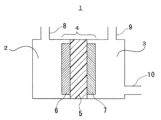
- FIG. 1 is a cross-sectional view illustrating an example of a hydrogen production device according to an embodiment.
- the composition according to the embodiment includes a first quaternary ammonium salt and a second quaternary ammonium salt.
- the first quaternary ammonium salt and the second quaternary ammonium salt are structural isomers.
- the first and second quaternary ammonium salts are each selected from the group consisting of a para-quaternary ammonium salt represented by the above formula (I), a meta-quaternary ammonium salt represented by the above formula (II), and an ortho-quaternary ammonium salt represented by the above formula (III).
- the ratio M1/M2 of the mass M1 of the first quaternary ammonium salt to the mass M2 of the second quaternary ammonium salt is 0.01 or more and 99 or less.
- the composition contains a first quaternary ammonium salt and a second quaternary ammonium salt that are structural isomers, the composition has lower crystallinity than a composition consisting of a single-structure quaternary ammonium salt. That is, the composition according to the embodiment is less likely to crystallize and has higher solubility in organic solvents than a quaternary ammonium salt that contains almost no structural isomers. In addition, the composition is less likely to solidify and can be in a liquid state with low viscosity. Therefore, by using the composition according to the embodiment, a liquid polymerizable composition having a high concentration of quaternary ammonium salt can be obtained.
- an ion exchange resin having a high molar amount of ion exchange groups per unit mass can be realized.
- an ion exchange membrane with excellent ion exchange performance, and a hydrogen generation device, a water electrolysis device, an electrodialysis device, etc. equipped with this ion exchange membrane can be obtained.
- composition contains two or more quaternary ammonium salts selected from the group consisting of a para-quaternary ammonium salt represented by the following formula (I), a meta-quaternary ammonium salt represented by the following formula (II), and an ortho-quaternary ammonium salt represented by the following formula (III).
- R 1 is an alkenyl group having 2 to 5 carbon atoms.
- R2 is an alkylene group having 1 to 5 carbon atoms.
- R 3 , R 4 , and R 5 are each independently a linear or branched alkyl group having 1 to 4 carbon atoms, a linear or branched alkoxy group having 1 to 4 carbon atoms, a linear or branched alkyleneoxyalkyl group having 2 to 4 carbon atoms, a cycloalkyl group having 3 to 6 carbon atoms, an aryl group having 3 to 8 carbon atoms, a heterocycloalkyl group having 2 to 5 carbon atoms and 1 to 3 heteroatoms, a heteroaryl group having 2 to 5 carbon atoms and 1 to 2 heteroatoms, an alkylenearyl group having 4 to 10 carbon atoms, an alkyleneheterocycloalkyl group having 3 to 10 carbon atoms and 1 to 3 heteroatoms, or an alkyleneheteroaryl group having 2 to 10 carbon atoms and 1 to 3 heteroatoms.
- X ⁇ is an anion
- R 1 , R 2 , R 3 , R 4 , R 5 and X ⁇ each independently have the same meaning as in formula (I).
- R 1 , R 2 , R 3 , R 4 , R 5 and X ⁇ each independently have the same meaning as in formula (I).
- R 1 is preferably an alkenyl group having a double bond at the terminal, more preferably an alkenyl group having from 2 to 3 carbon atoms, and further preferably a vinyl group.
- R2 is preferably an alkylene group having 1 to 3 carbon atoms, and more preferably a methylene group.
- R3 , R4 , and R5 are each preferably independently a linear or branched alkyl group having from 1 to 4 carbon atoms, and more preferably an alkyl group having from 1 to 2 carbon atoms.
- R3 and R5 are further preferably a methyl group, and R4 is further preferably a methyl group or an ethyl group.
- X 1 - may be a monovalent anion or a divalent anion.
- X 1 - is, for example, a halide ion, tetrafluoroborate, bicarbonate ion, hydroxide ion, triflate, or bistrifluoromethanesulfonimide.
- the halide ion is, for example, a fluoride ion, a chloride ion, or a bromide ion.
- X 1 - is preferably a chloride ion, triflate, or bistrifluoromethanesulfonimide.
- X 1 - is a chloride ion
- an ion exchange resin having a large amount of ion exchange groups per unit mass can be realized.
- X 1 - is triflate or bistrifluoromethanesulfonimide
- the solubility of the composition is increased, and the concentration of the quaternary ammonium salt in the polymerizable composition tends to be easily increased.
- quaternary ammonium salts include vinylbenzyltrialkylammonium salts, 4-ethenyl-1-N,N-dimethylbenzeneethanaminium salts, 4-ethenyl-N,N-dimethylbenzenepropanaminium salts, and 4-ethenyl-N,N-dimethylbenzenepropanaminium salts.
- Vinylbenzyltrialkylammonium salts include vinylbenzyltrimethylammonium chloride, vinylbenzyltrimethylammonium triflate, vinylbenzyltrimethylammonium bistrifluoromethanesulfonimide, vinylbenzyldimethylethylammonium chloride, vinylbenzyldimethylethylammonium triflate, vinylbenzyldimethylethylammonium bistrifluoromethanesulfonimide, vinylbenzyltrimethylammonium tetrafluoroborate, vinylbenzyltrimethylammonium bicarbonate, vinylbenzyltrimethylammonium hydroxide, 4-ethenyl-N,N-dimethylbenzenepropanaminium salts, and 4-ethenyl-N,N-dimethylbenzenepropanaminium salts.
- methylbenzeneethanaminium chloride 4-ethenyl-N,N-dimethylbenzeneethanaminium triflate, 4-ethenyl-N,N-dimethylbenzeneethanaminium bistrifluoromethansulfonium, 4-ethenyl-N,N-dimethylbenzeneethanaminium hydroxide, 4-ethenyl-N,N-dimethylbenzenepropanaminium chloride, 4-ethenyl-N,N-dimethylbenzenepropanaminium triflate, 4-ethenyl-N,N-dimethylbenzenepropanaminium bistrifluoromethansulfonium, 4-ethenyl-N,N-dimethylbenzenepropanaminium hydroxide, etc.
- X 1 ⁇ may be a nonafluorobutanesulfonate represented by the following formula (1).
- quaternary ammonium salts having nonafluorobutanesulfonate include vinylbenzyltrialkylammonium salts, such as vinylbenzyltrimethylammonium nonafluorobutanesulfonate and vinylbenzyldimethylethylammonium nonafluorobutanesulfonate.
- the melting point of the quaternary ammonium salt having nonafluorobutanesulfonate is, for example, from 0° C. to 130° C., and for another example, from 20° C. to 100° C. The melting point can be measured, for example, by a differential scanning calorimeter (DSC) method.
- DSC differential scanning calorimeter
- the solubility of the quaternary ammonium salt having nonafluorobutanesulfonate in methanol at 25° C. is, in one example, 1 g/mL or more and 10 g/mL or less, and in another example, 2 g/mL or more and 6 g/mL or less.
- the solubility of the quaternary ammonium salt having nonafluorobutanesulfonate in 1-propanol at 25° C. is, in one example, 0.1 g/mL or more and 5 g/mL or less, and in another example, 0.2 g/mL or more and 3 g/mL or less.
- the solubility of the quaternary ammonium salt having nonafluorobutanesulfonate in dimethylsulfoxide (DMSO) at 25°C is, in one example, 0.5 g/mL or more and 10 g/mL or less, and in another example, 1 g/mL or more and 5 g/mL or less.
- the solubility of a quaternary ammonium salt having nonafluorobutanesulfonate in toluene at 25° C. is 0.1 g/mL or less.
- a quaternary ammonium salt having nonafluorobutanesulfonate can be produced, for example, by the following method.
- a tertiary amine is added to a mixed solution of a halogenated alkylstyrene derivative and tetrahydrofuran to obtain a first mixed solution.
- This first mixed solution is stirred at room temperature for 24 hours, and hexane is added to produce crystals.
- the produced crystals are filtered to obtain vinylbenzyltrialkylammonium halide.
- Potassium nonafluorobutane-1-sulfonate is added to the obtained mixed solution of vinylbenzyltrialkylammonium halide and water to obtain a second mixed solution.
- This second mixed solution is stirred at room temperature for 24 hours, then separated with ethyl acetate and concentrated at 35° C.
- the structure of the quaternary ammonium salt having nonafluorobutanesulfonate can be identified, for example, by nuclear magnetic resonance (NMR) spectroscopy.
- the composition according to the embodiment may be in a liquid state, a slurry state, or a solid state.
- the composition according to the embodiment is preferably in a liquid state.
- the second quaternary ammonium salt is a meta-quaternary ammonium salt represented by formula (II) or an ortho-quaternary ammonium salt represented by formula (III).
- the first quaternary ammonium salt is a meta-quaternary ammonium salt represented by formula (II)
- the second quaternary ammonium salt is a para-quaternary ammonium salt represented by formula (I) or an ortho-quaternary ammonium salt represented by formula (III).
- the second quaternary ammonium salt is a para-quaternary ammonium salt represented by formula (I) or a meta-quaternary ammonium salt represented by formula (II).
- the first quaternary ammonium salt is a para-quaternary ammonium salt represented by formula (I) and the second quaternary ammonium salt is a meta-quaternary ammonium salt represented by formula (II).
- the ratio M1/M2 of the mass M1 of the first quaternary ammonium salt to the mass M2 of the second quaternary ammonium salt is 0.01 or more and 99 or less.
- the ratio M1/M2 is preferably 0.05 or more and 20 or less, more preferably 0.10 or more and 10 or less, even more preferably 0.30 or more and 3.5 or less, particularly preferably 0.50 or more and 2 or less, and most preferably 0.75 or more and 1.25 or less.
- the ratio M1/M2 is close to 1, the crystallinity of the composition tends to decrease further.
- the proportion of the first quaternary ammonium salt is, for example, 5% by mass or more and 95% by mass or less.
- the proportion of the first quaternary ammonium salt may be 10% by mass or more and 75% by mass or less, or may be 40% by mass or more and 70% by mass or less.
- the proportion of the second quaternary ammonium salt is, for example, 5% by mass or more and 95% by mass or less.
- the proportion of the second quaternary ammonium salt may be 10% by mass or more and 75% by mass or less, or may be 30% by mass or more and 60% by mass or less.
- the quaternary ammonium salt having the highest mass ratio may be the first quaternary ammonium salt, and the structural isomer having the next highest mass ratio may be the second quaternary ammonium salt.
- the composition according to the embodiment may contain only the first quaternary ammonium salt and the second quaternary ammonium salt, or may further contain a third quaternary ammonium salt.
- the third quaternary ammonium salt is a structural isomer of the first and second quaternary ammonium salts. That is, a composition containing a third quaternary ammonium salt contains all structural isomers of the ortho-, meta-, and para-isomers of the quaternary ammonium salt. Such a composition is less likely to crystallize, and tends to facilitate increasing the concentration of the quaternary ammonium salt in the polymerizable composition.
- the third quaternary ammonium salt is an ortho-quaternary ammonium salt represented by formula (III) when the first and second quaternary ammonium salts are a para-quaternary ammonium salt represented by formula (I) and a meta-quaternary ammonium salt represented by formula (II).
- the third quaternary ammonium salt is a para-quaternary ammonium salt represented by formula (I) when the first and second quaternary ammonium salts are a meta-quaternary ammonium salt represented by formula (II) and an ortho-quaternary ammonium salt represented by formula (III).
- the third quaternary ammonium salt is a meta-quaternary ammonium salt represented by formula (II) when the first and second quaternary ammonium salts are a para-quaternary ammonium salt represented by formula (I) and an ortho-quaternary ammonium salt represented by formula (III).
- the proportion of the third quaternary ammonium salt is, for example, 0.01% by mass or more and 50% by mass or less.
- the proportion of the third quaternary ammonium salt may be 0.1% by mass or more and 10% by mass or less, or 1% by mass or more and 5% by mass or less.
- the quaternary ammonium salt having the highest mass ratio may be the first quaternary ammonium salt
- the structural isomer having the next highest mass ratio may be the second quaternary ammonium salt
- the structural isomer having the lowest mass ratio may be the third quaternary ammonium salt.
- the proportions of the first, second, and third quaternary ammonium salts in the composition can be measured, for example, by a combination of nuclear magnetic resonance (NMR) spectroscopy and ion chromatography.
- NMR nuclear magnetic resonance
- the composition according to the embodiment contains structural isomers and has low crystallinity, so it tends to have a lower melting point than the para form.
- the melting point of the composition is preferably at least 10°C lower than the melting point of the para form, more preferably at least 20°C lower, and even more preferably at least 30°C lower.
- the melting point of the composition can be measured, for example, by a differential scanning calorimeter (DSC) method.
- the melting point of the para isomer of vinylbenzyltrimethylammonium chloride is 232°C
- the melting point of a composition in which the mass ratio of para isomer to meta isomer is 50:50 is 170°C
- the melting point of the para isomer of vinylbenzyltrimethylammonium triflate is 233°C
- the melting point of a composition in which the mass ratio of para isomer to meta isomer is 50:50 is 63°C.
- the melting point of the para isomer of vinylbenzyltrimethylammonium bistrifluoromethanesulfonimide is 66°C, and the melting point of a composition in which the mass ratio of para isomer to meta isomer is 50:50 is 18°C.
- solubility of the composition in organic solvents tends to be higher than the solubility of the parabody in organic solvents.
- the solubility of the composition in organic solvents is preferably at least 1.1 times higher than the solubility of the parabody in organic solvents, more preferably at least 1.5 times higher, and even more preferably at least 2 times higher.
- the solubility of the composition in methanol at 25°C is preferably higher than 1.0 g/mL, more preferably 2.0 g/mL or more, and even more preferably 3.0 g/mL or more.
- the solubility of the para isomer of vinylbenzyltrimethylammonium chloride in methanol is 1.0 g/mL
- the solubility of a composition having a para isomer:meta isomer ratio of 50:50 in methanol is 3.3 g/mL.
- the solubility of the para isomer of vinylbenzyltrimethylammonium triflate in methanol is 1.0 g/mL, and the solubility of a composition having a para isomer:meta isomer ratio of 50:50 in methanol is 5.0 g/mL.
- the solubility of the para isomer of vinylbenzyltrimethylammonium bistrifluoromethanesulfonimide in methanol is 1.0 g/mL, and the solubility of a composition having a para isomer:meta isomer ratio of 50:50 in methanol is 3.2 g/mL.
- the solubility of the composition in 1-propanol at 25°C is preferably greater than 0.2 g/mL, more preferably 0.3 g/mL or greater, and even more preferably 0.5 g/mL or greater.
- the solubility of the para form of vinylbenzyltrimethylammonium chloride in 1-propanol is 0.5 g/mL
- the solubility of a composition having a para:meta mass ratio of 50:50 in 1-propanol is 1.0 g/mL.
- the solubility of the para form of vinylbenzyltrimethylammonium triflate in 1-propanol is 0.2 g/mL, and the solubility of a composition having a para:meta mass ratio of 50:50 in 1-propanol is 1.0 g/mL.
- the solubility of the para form of vinylbenzyltrimethylammonium bistrifluoromethanesulfonimide in 1-propanol is 0.1 g/mL or less, and the solubility of a composition in which the mass ratio of para form:meta form is 50:50 is 0.8 g/mL in 1-propanol.
- the polymerizable composition according to the embodiment includes the composition according to the embodiment and a radical polymerizable monomer.
- a cured product of the polymerizable composition is used as, for example, an ion exchange resin.
- the polymerizable composition is typically liquid at room temperature and pressure.
- room temperature means a temperature between 20°C and 40°C
- normal pressure means 1 atmosphere.
- the viscosity of the polymerizable composition at 25°C, as measured by a tuning fork vibration viscometer, is, in one example, 23 mPa ⁇ s or less, and in another example, 1 mPa ⁇ s or less.
- the proportion of the composition according to the embodiment i.e., the quaternary ammonium salt
- the proportion of the composition according to the embodiment is, for example, 5% by mass or more and 95% by mass or less.
- This proportion is preferably 50% by mass or more, more preferably 60% by mass or more, even more preferably 65% by mass or more, and particularly preferably 68% by mass or more.
- an ion exchange resin having a large amount of ion exchange groups per unit mass tends to be obtained.
- a liquid polymerizable composition having a high concentration of the quaternary ammonium salt can be realized.
- This proportion may be 92% by mass or less, or may be 85% by mass or less. When this proportion is low, an ion exchange resin having excellent flexibility tends to be obtained.
- the mass of the quaternary ammonium salt in the polymerizable composition means the total mass of the first quaternary ammonium salt and the second quaternary ammonium salt, or the total mass of the first quaternary ammonium salt, the second quaternary ammonium salt, and the third quaternary ammonium salt.
- the proportion of the quaternary ammonium salt in the polymerizable composition can be measured, for example, by subtracting the weight of the quaternary ammonium salt remaining unreacted after the polymerization reaction from the total mass of the quaternary ammonium salts used as raw materials.
- the proportion of the quaternary ammonium salt in the polymerizable composition may vary depending on the type.
- the concentration of vinylbenzyltrimethylammonium chloride is, for example, 60% by mass or more and 70% by mass or less.
- the concentration of vinylbenzyltrimethylammonium triflate is, for example, 75% by mass or more and 85% by mass or less.
- the concentration of vinylbenzyltrimethylammonium bistrifluoromethanesulfonimide is, for example, 85% by mass or more and 95% by mass or less.
- the radically polymerizable monomer may be a comonomer that polymerizes with the quaternary ammonium salt.
- the radically polymerizable monomer may crosslink the quaternary ammonium salts together, thereby increasing the durability of the cured body.
- the radically polymerizable monomer may have one radically polymerizable group in one molecule, or may have two or more radically polymerizable groups in one molecule.
- the radically polymerizable group include a vinyl group, an allyl group, an acryloyl group, and a methacryloyl group, and it is preferable to use a vinyl group.
- radical polymerizable monomer for example, at least one selected from the group consisting of vinyl compounds having one vinyl group, divinyl compounds having two vinyl groups, allyl compounds having one allyl group, diallyl compounds having two allyl groups, and dienes is used.
- radically polymerizable monomers include divinylbenzene, divinylbenzene derivatives, divinyl sulfone, butadiene, chloroprene, divinylphenyl, trivinylbenzenes, divinylnaphthalene, allylamine, diallylamine, divinylpyridine, styrene, acrylonitrile, methylstyrene, acrolein, methylvinylketone, vinylbiphenyl, and diallylisocyanurate.
- radical polymerizable monomer it is preferable to use at least one selected from the group consisting of divinylbenzene, divinylbenzene derivatives, and styrene.
- the proportion of the radical polymerizable monomer in the polymerizable composition is, for example, 0.1% by mass or more and 20% by mass or less, preferably 1% by mass or more and 10% by mass or less, and more preferably 3% by mass or more and 7% by mass or less. If this proportion is high, the durability of the cured body tends to be increased. If this proportion is excessively high, the performance of the ion exchange resin may decrease. This proportion can be measured, for example, by subtracting the weight of the polymerizable composition remaining unreacted after the polymerization reaction from the total mass of the polymerizable composition used as a raw material.
- the ratio M3/M4 of the mass M3 of the quaternary ammonium salt to the mass M4 of the radical polymerizable monomer is, for example, 1 or more and 100 or less, preferably 3 or more and 50 or less, and more preferably 5 or more and 25 or less. If this ratio is high, the performance of the ion exchange resin tends to be improved. If this ratio is low, the durability of the cured body tends to be improved.
- the polymerizable composition may contain, in addition to the composition according to the embodiment and the radical polymerizable monomer, a polymerization initiator, an organic solvent, other additives, etc.
- thermal polymerization initiator at least one of a thermal polymerization initiator and a photopolymerization initiator is used.
- thermal polymerization initiators include benzoyl peroxide, p-chlorobenzoyl peroxide, decanoyl peroxide, lauroyl peroxide, acetyl peroxide, tert-butyl (2-ethylhexanoyl) peroxide hexanoate, and tert-butyl peroxy octoate.
- photopolymerization initiators examples include 1-phenyl-2-hydroxy-2-methylpropan-1-one, 1-hydroxycyclohexyl phenyl ketone, 1-(4-isopropylphenyl)-2-hydroxy-2-methylpropan-1-one, and 2-hydroxy-4'-(2'-hydroxyethoxy)-2-methylpropiophenone.
- the proportion of the polymerization initiator in the polymerizable composition is, for example, 0.1% by mass or more and 10% by mass or less, and preferably 1% by mass or more and 5% by mass or less. This proportion can be measured, for example, by measuring the mass of the polymerization initiator remaining unreacted after the polymerization reaction is completed.
- the organic solvent is used to adjust the viscosity of the polymerizable composition and to increase the solubility of the quaternary ammonium salt.
- at least one organic solvent selected from the group consisting of methanol, dimethyl sulfoxide (DMSO), ethylene glycol (EG), propylene glycol, and N,N'-dimethylpropyleneurea (DMPU) is used.
- DMSO dimethyl sulfoxide
- EG ethylene glycol
- DMPU N,N'-dimethylpropyleneurea
- a mixed solvent of EG and DMPU may also be used as the organic solvent.
- the proportion of the organic solvent in the polymerizable composition is, for example, 1% by mass or more and 40% by mass or less. If the proportion of the organic solvent is high, the viscosity of the polymerizable composition decreases, and production efficiency can be increased. On the other hand, if the proportion of the organic solvent is high, holes may occur in the ion exchange resin of the ion exchange membrane, and the performance of the ion exchange membrane may decrease.
- the proportion of the organic solvent in the polymerizable composition is preferably 30% by mass or less, and more preferably 25% by mass or less. This proportion can be measured, for example, by NMR or liquid chromatography.
- additives that may be used include known additives such as antioxidants, polymerization inhibitors, plasticizers, and surfactants.
- the polymerizable composition preferably does not contain water. If the polymerizable composition contains water, components constituting the composition, such as polymerizable monomers and polymerization initiators, may precipitate.
- the concentration of water in the polymerizable composition is preferably 10% by mass or less, more preferably 5% by mass or less, and even more preferably 1% by mass or less. In one example, the lower limit of the water concentration is 0% by mass, and in another example, 100 ppm. This concentration can be measured, for example, by Karl Fischer moisture content measurement or gas chromatography.
- polymerization inhibitor for example, at least one selected from the group consisting of 4-hydroxy-2,2,6,6-tetramethylpiperidine-1-oxyl (4-OH-TEMPO), 4-tert-butylcatechol (TBC), cupferron, and benzoquinone is used.
- the proportion of the polymerization inhibitor in the polymerizable composition is, for example, 0.0001% by mass or more and 2% by mass or less, preferably 0.001% by mass or more and 1.0% by mass or less, and more preferably 0.005% by mass or more and 0.1% by mass or less. This proportion can be measured, for example, by gas chromatography.
- the ion exchange resin according to the embodiment includes a cured product of the polymerizable composition according to the embodiment.
- the ion exchange resin may be a copolymer of a quaternary ammonium salt, which is the composition according to the embodiment, and a radical polymerizable monomer.
- the ion exchange resin may be an ion exchanger of the anion of the cured product.
- the ion exchanger of the anion of the cured product means a resin in which the anion of the quaternary ammonium group of the cured product is replaced with another type of anion.
- the ion exchange resin may be an anion exchange resin or a cation exchange resin.
- the ion exchange resin according to the embodiment may be suitably used as an anion exchange resin.
- the ion exchange resin contains a quaternary ammonium group as an ion exchange group.
- the anion of the quaternary ammonium group is, for example, a halide ion, a triflate, a bistrifluoromethanesulfonimide, a nonafluorobutanesulfonate, a hydroxide ion, a carbonate ion, or a bicarbonate ion.
- the counter ion is preferably a hydroxide ion, a carbonate ion, or a bicarbonate ion.
- Ion exchange resins having these ions are suitable as anion exchange resins.
- the weight average molecular weight of the ion exchange resin is, for example, 1,000 or more, and preferably 5,000 or more.
- the average molecular weight of the ion exchange resin can be measured, for example, by gel permeation chromatography or the intrinsic viscosity method.
- the ion exchange resin has a structure in which, for example, a main chain made of a hydrocarbon is bonded to multiple side chains containing quaternary ammonium groups.
- the multiple main chains may be bonded via a crosslinking agent that is a radical polymerizable monomer.
- the ion exchange resin according to the embodiment has, for example, a structure represented by the following formula (IV).
- the ion exchange resin having the structure represented by formula (IV) is obtained by curing a polymerizable composition containing divinylbenzene as a radical polymerizable monomer.
- R 1a is an alkylene group having 1 to 4 carbon atoms.
- R 2 , R 3 , R 4 , and R 5 each independently have the same meaning as in formula (I).
- X1 - is a halide ion, triflate, bistrifluoromethanesulfonimide, nonafluorobutanesulfonate, hydroxide ion, carbonate ion, bicarbonate ion, or tetrafluoroborate.
- X1 - is preferably a hydroxide ion, carbonate ion, or bicarbonate ion.
- the ion exchange resin can be obtained, for example, by thermally polymerizing or photopolymerizing the polymerizable composition according to the embodiment.
- the ion exchange membrane according to the embodiment includes an ion exchange resin according to the embodiment and a substrate.
- the ion exchange resin can be supported on the substrate.
- the ion exchange membrane according to the embodiment may be an anion exchange membrane (AEM) or a cation exchange membrane (CEM).
- AEM anion exchange membrane
- CEM cation exchange membrane
- the ion exchange membrane according to the embodiment can be suitably used as an AEM.
- the ion exchange membrane according to the embodiment can be used in hydrogen production equipment, water electrolysis equipment, fuel cells, electrodialysis equipment, diffusion dialysis equipment, pure water production equipment, ion-exchanged water production equipment, etc.
- the ion exchange membrane according to the embodiment can be suitably used as an anion exchange membrane for AEM-type hydrogen production equipment, AEM-type water electrolysis equipment, or fuel cells.
- the thickness of the ion exchange membrane is, for example, 1 ⁇ m or more and 500 ⁇ m or less. When a thick ion exchange membrane is used, the membrane resistance tends to increase. When a thin ion exchange membrane is used, the membrane resistance tends to decrease.
- the thickness of the ion exchange membrane is preferably 10 ⁇ m or more and 200 ⁇ m or less, and more preferably 20 ⁇ m or more and 100 ⁇ m or less. The method for measuring the thickness of the ion exchange membrane will be described later in the examples.
- the ion exchange capacity of the ion exchange membrane according to the embodiment is, for example, 1.0 mmol/g or more, in another example, 2.0 mmol/g or more, and in yet another example, 2.5 mmol/g or more.
- the ion exchange membrane according to the embodiment is obtained using a polymerizable composition having a high concentration of quaternary ammonium salt, so that a high ion exchange capacity can be realized.
- There is no particular upper limit to the ion exchange capacity but in one example, it is 4.0 mmol/g or less, and in another example, it is 3.0 mmol/g or less. The method for measuring the ion exchange capacity will be described later in the examples.
- the ion exchange capacity per unit thickness of the ion exchange membrane according to the embodiment is, for example, 0.020 mmol/g ⁇ m or more, in another example, 0.030 mmol/g ⁇ m or more, and in yet another example, 0.050 mmol/g ⁇ m or more.
- There is no particular upper limit to the ion exchange capacity but in one example, it is 0.080 mmol/g ⁇ m or less, and in another example, it is 0.070 mmol/g ⁇ m or less.
- the membrane resistance of the ion exchange membrane according to the embodiment is, for example, 2.0 ⁇ cm 2 or less, and in another example, 1.0 ⁇ cm 2 or less. There is no particular lower limit for the membrane resistance, but in one example, it is 0.1 ⁇ cm 2 or more, and in another example, it is 0.2 ⁇ cm 2 or more. The method for measuring the membrane resistance will be described later in the examples.
- the membrane resistance per unit thickness of the ion exchange membrane according to the embodiment is, for example, 0.040 ⁇ cm 2 / ⁇ m or less, and in another example, 0.020 ⁇ cm 2 / ⁇ m or less. There is no particular lower limit to the membrane resistance, but in one example, it is 0.002 ⁇ cm 2 / ⁇ m or more, and in another example, it is 0.004 ⁇ cm 2 / ⁇ m or more.
- the water content of the ion exchange membrane according to the embodiment is, for example, 20% or more, in another example, 30% or more, and in yet another example, 40% or more.
- the water content of the ion exchange membrane is high, the water electrolysis performance tends to be improved.
- There is no particular upper limit for the water content but in one example, it is 120% or less, and in another example, it is 100% or less.
- the substrate functions as a support for the ion exchange resin.
- the substrate is preferably a porous membrane.
- substrates that can be used include porous films, woven fabrics, nonwoven fabrics, sponges, and films.
- a porous membrane it is preferable that the pores of the substrate are filled with the ion exchange resin.
- the substrate is, for example, a polyolefin resin, a fluororesin, polyacrylonitrile, polyvinyl chloride, polyester, polyamide, polysulfone, polyethersulfone, polyphenylenesulfone, polyphenylenesulfide, polyimide, polyethermide, polyamideimide, polycarbonate, polyacrylate, cellulose acetate, polyetheretherketone, or a copolymer thereof.
- Polyolefin resins include polyethylene, polypropylene, polybutadiene, polymethylpentene, polybutene, polypentene, polyhexene, polymethylheptene, and a copolymer thereof.
- Fluorine resins include polytetrafluoroethylene, poly(tetrafluoroethylene-hexafluoropropylene), polyvinylidene fluoride, polyvinylidene fluoride, polyhexafluoropropylene, polychlorotrifluoroethylene, and a copolymer thereof.
- the substrate preferably includes a polyolefin resin, and more preferably includes polyethylene, polypropylene, or a copolymer thereof.
- the film thickness of the substrate is, for example, 1 ⁇ m or more and 500 ⁇ m or less, preferably 5 ⁇ m or more and 200 ⁇ m or less, more preferably 10 ⁇ m or more and 150 ⁇ m or less, and even more preferably 20 ⁇ m or more and 100 ⁇ m or less.
- the porosity of the substrate is, for example, 25% or more and 60% or less, preferably 30% or more and 50% or less, and more preferably 35% or more and 45% or less.
- the method for producing an ion exchange membrane according to the embodiment includes contacting the polymerizable composition according to the embodiment with a substrate to obtain a first structure, and irradiating the first structure with ultraviolet light to obtain a second structure.
- a polymerizable composition containing a quaternary ammonium salt is used, so the step of introducing ion exchange groups into the resin obtained by polymerization can be omitted, compared to when a polymerizable composition consisting only of a compound without ion exchange groups is used.
- the ion exchange membrane can be manufactured in a short time compared to the thermal polymerization method.
- the manufacturing process is detailed below.
- the method of contacting the polymerizable composition according to the embodiment with the substrate is not particularly limited.
- the polymerizable composition may be applied to the substrate, sprayed, or dropped.
- the substrate may also be immersed in the polymerizable composition.
- the amount of the polymerizable composition per 1 g of substrate is, for example, 0.2 g to 2.0 g.
- the substrate may be subjected to a surface treatment such as a corona treatment, a glow discharge treatment, or an alkali treatment in order to enhance adhesion to the polymerizable composition.
- the polymerizable composition is supported on the substrate. It is preferable to cover at least one of the main surfaces of the substrate of the first structure with a resin film, and it is more preferable to cover both surfaces with a resin film.
- a resin film By covering with a resin film, it is possible to suppress changes in the composition of the polymerizable composition supported on the first structure. That is, when the polymerizable composition contains an organic solvent, the composition of the polymerizable composition may change due to the evaporation of the organic solvent. By covering with a resin film, it is possible to suppress the evaporation of the organic solvent.
- the smoothness of the surface of the ion exchange membrane is increased, and an ion exchange membrane with a uniform thickness can be obtained.
- resins used for the resin film include polyethylene terephthalate, polyester, perfluoroethylene propene copolymer, and tetrafluoroethylene-hexaethylene propylene copolymer.
- the irradiation wavelength is, for example, 300 nm to 400 nm, preferably 330 nm to 380 nm.
- the ultraviolet light intensity is, for example, 1 mW/cm 2 to 100 mW/cm 2 , preferably 3 mW/cm 2 to 50 mW/cm 2.
- the irradiation time is, for example, 10 seconds to 3 hours, preferably 1 minute to 1 hour.
- an ultraviolet light-emitting diode for example, an ultraviolet light-emitting diode (LED), a halogen lamp, a xenon lamp, a tungsten lamp, a mercury lamp, or the like is used. It is preferable to use an LED in terms of ease of controlling the irradiation wavelength and the difficulty of generating heat.
- the composition of the polymerizable composition may change due to the volatilization of the organic solvent, so it is preferable to irradiate with ultraviolet rays immediately after obtaining the first structure.
- ultraviolet rays are irradiated preferably within 0.5 hours, and more preferably within 0.1 hours. Note that the organic solvent volatilizes during ultraviolet irradiation or during the heat treatment described below, so it does not remain in the ion exchange membrane.
- the second structure may be heat-treated to obtain the third structure, i.e., the ion exchange membrane. That is, after a part of the polymerizable composition is polymerized by ultraviolet light irradiation, the polymerizable composition may be completely polymerized by thermal polymerization.
- the heating temperature is, for example, 50°C or higher and 150°C or lower, and preferably 80°C or higher and 130°C or lower.
- the heating time is, for example, 1 minute or higher and 3 hours or lower, and preferably 3 minutes or higher and 1 hour or lower.
- the heating method may be a hot plate, an oven, an infrared heater, or the like.
- ultraviolet irradiation It is also possible to omit the ultraviolet irradiation and only carry out the heat treatment. Also, ultraviolet irradiation may be carried out after the heat treatment.
- the ion exchange membrane obtained by the above method may be subjected to a drying process.
- the drying temperature is, for example, from 40°C to 90°C
- the drying time is, for example, from 3 hours to 24 hours.
- the ion exchange membrane obtained by the above method may be subjected to an anion substitution treatment.
- the anion of the quaternary ammonium group is triflate or bistrifluoromethanesulfonimide
- the anion can be substituted with a halide ion by immersing the ion exchange membrane in an aqueous solution containing a halogen compound, such as a hydrogen chloride solution or a hydrogen bromide solution, for a certain period of time.
- a halogen compound such as a hydrogen chloride solution or a hydrogen bromide solution
- the anion of the quaternary ammonium group is a halide ion
- the anion can be substituted with a hydroxide ion by immersing the ion exchange membrane in an alkali metal hydroxide solution, such as a sodium hydroxide solution, for a certain period of time.
- an alkali metal hydroxide solution such as a sodium hydroxide solution
- the anion of the quaternary ammonium group is a hydroxide ion
- the anion can be substituted with a carbonate ion or a bicarbonate ion by immersing the ion exchange membrane in a carbonate solution, such as a potassium carbonate solution or a sodium bicarbonate solution, for a certain period of time.
- the anion can be substituted with a carbonate ion or a bicarbonate ion by exposing an ion exchange membrane in which the anion of the quaternary ammonium group is a hydroxide ion to the atmosphere for a certain period of time.
- the membrane electrode assembly according to the embodiment includes an ion exchange membrane according to the embodiment and an electrode.
- the ion exchange membrane and the electrode are integrated.
- the electrode may include a first electrode that is a cathode and a second electrode that is an anode.
- the membrane electrode assembly may have an ion exchange membrane interposed between the first electrode and the second electrode.
- the membrane electrode assembly according to the embodiment can be used in hydrogen production devices, water electrolysis devices, fuel cells, etc.
- the electrode may contain a metal catalyst and, optionally, an ion conductor, an electrical conductor, and a binder.
- the proportions of the metal catalyst, the ion conductor, the electrical conductor, and the binder in the electrode are, for example, 50% by mass or more and 99% by mass or less, 0.1% by mass or more and 30% by mass or less, 0.1% by mass or more and 30% by mass or less, and 0.1% by mass or more and 30% by mass or less, respectively.
- the metal catalyst promotes an oxidation or reduction reaction.
- the metal catalyst is typically in the form of particles.
- the metal catalyst include platinum, gold, silver, palladium, iridium, rhodium, ruthenium, tin, iron, cobalt, nickel, manganese, molybdenum, tungsten, vanadium, chromium, tantalum, zirconium, aluminum, zinc, oxides or hydroxides thereof, or alloys thereof.
- the metal catalyst for the anode preferably contains nickel.
- the metal catalyst for the cathode preferably contains platinum, gold, silver, palladium, iridium, rhodium, ruthenium, tin, iron, cobalt, nickel, manganese, or alloys thereof.
- the ion conductive agent increases the ion conductivity of the electrode.
- the ion conductive agent include perfluorocarbon polymers, aromatic polyether ether ketones, and polysulfones, each of which has an acidic functional group.
- An ion exchange resin may be used as the ion conductive agent.
- the ion exchange resin may be the ion exchange resin according to the embodiment, or another ion exchange resin may be used.
- another ion exchange resin for example, an ion exchange resin having an imidazole group is used.
- the conductive agent increases the electronic conductivity of the electrode.
- the conductive agent may be used as a carrier for a metal catalyst.
- Examples of the conductive agent include carbon black, activated carbon, graphite, fullerene, carbon nanotubes, or a mixture thereof.
- the binder increases the rigidity of the electrode.
- binders that can be used include polytetrafluoroethylene (PTFE), polyvinylidene fluoride (PVdF), fluorine-based rubber, polyacrylic acid compounds, imide compounds, or mixtures of these.
- the membrane electrode assembly is manufactured, for example, by the following method.
- the ion exchange membrane may be in a wet state, but is preferably in a dry state.
- the metal catalyst is mixed with, optionally, an ion conductive agent, a conductive agent, a binder, and an organic solvent to prepare a composition for forming a first electrode.
- This composition for forming a first electrode is applied, for example, onto a release paper to obtain a first coating film. This first coating film is dried. After drying, the first coating film is peeled off from the release paper and laminated onto one of the main surfaces of the ion exchange membrane.
- An ion conductive agent may be applied onto one of the main surfaces of the ion exchange membrane.
- the composition for forming a first electrode may be applied directly onto one of the main surfaces of the ion exchange membrane to form the first coating film.
- the metal catalyst is mixed with, optionally, an ion conductive agent, a conductive agent, a binder, and an organic solvent to prepare a composition for forming a second electrode.
- This composition for forming a second electrode is applied, for example, onto a release paper to obtain a second coating film.
- This second coating film is dried. After drying, the second coating film is peeled off from the release paper and laminated onto the other main surface of the ion exchange membrane.
- An ion conductive agent may be applied to the other main surface of the ion exchange membrane.
- the composition for forming a first electrode may be applied directly onto the other main surface of the ion exchange membrane to form a second coating film. Alternatively, the first coating film may be formed after the second coating film is formed.
- the obtained laminate is heated, pressurized, or both to integrate the first and second coating films with the ion exchange membrane.
- a membrane electrode assembly is obtained in which the first electrode, the ion exchange membrane, and the second electrode are laminated in this order. Note that the first electrode or the second electrode may be omitted.
- the hydrogen production device includes the ion exchange membrane according to the embodiment.
- the hydrogen production device may include the membrane electrode assembly according to the embodiment.
- the hydrogen production device includes the ion exchange membrane according to the embodiment, and therefore can efficiently split water.
- FIG. 1 is a cross-sectional view showing an example of a hydrogen production device according to an embodiment.
- the hydrogen production device 1 shown in FIG. 1 includes a membrane electrode assembly 4, and a first electrode chamber 2 and a second electrode chamber 3 separated by the membrane electrode assembly 4.
- the membrane electrode assembly 4 includes an anion exchange membrane 5, a first electrode 6 supported on one main surface of the anion exchange membrane 5, and a second electrode 7 supported on the other main surface of the anion exchange membrane.
- the first electrode 6 and the second electrode 7 are connected to a power source via conductors (not shown).
- a gas diffusion layer may be provided on the surface of the first electrode and the second electrode. Examples of the gas diffusion layer include carbon paper, carbon cloth, nickel foam, titanium foam, and porous graphite.
- the first electrode chamber 2 is equipped with a first electrode 6 and is connected to a hydrogen exhaust pipe 8.
- the hydrogen exhaust pipe 8 is connected to a hydrogen tank (not shown).
- the first electrode chamber 2 may be provided with a first partition (not shown).
- the first partition is provided with a plurality of grooves connecting to the first electrode chamber 2, and a hydrogen exhaust path connected to these grooves and the hydrogen exhaust pipe 8.
- the first partition is preferably made of an electronically conductive material. For example, a metal plate is used for the first partition.
- the first partition may be in contact with the gas diffusion layer described above.
- the second electrode chamber 3 is provided with a second electrode 7, and is connected to an oxygen exhaust pipe 9 and a water supply pipe 10.
- the oxygen exhaust pipe 9 is connected to an oxygen tank (not shown).
- the water supply pipe 10 is connected to a water supply device (not shown).
- the second electrode chamber 3 may be provided with a second partition (not shown).
- the second partition is provided with a plurality of grooves connecting to the second electrode chamber 3, and oxygen exhaust channels connected to these grooves, the oxygen exhaust pipe 9, and the water supply pipe 10.
- the second partition is preferably made of an electronically conductive material. For example, a metal plate is used for the second partition.
- the second partition may be in contact with the gas diffusion layer described above.
- the liquid to be treated is supplied to the second electrode chamber 3 via the water supply pipe 10.
- the liquid to be treated may be water or an alkaline aqueous solution.
- the alkaline aqueous solution is, for example, an aqueous solution of an alkali metal hydroxide, carbonate, or bicarbonate.
- the pH of the alkaline aqueous solution is, for example, 10 or more and 14 or less.
- the concentration of the alkaline aqueous solution is, for example, 0.1% by mass or more and 30% by mass or less.
- the liquid to be treated that comes into contact with the membrane electrode assembly 4 is retained in the anion exchange membrane 5. That is, the liquid to be treated is supplied to the first electrode chamber 2 via the anion exchange membrane 5.
- Example 1 A composition AC1 was prepared containing 4-vinylbenzyltrimethylammonium chloride (para form) represented by the following formula (Ia) and 3-vinylbenzyltrimethylammonium chloride (meta form) represented by the following formula (IIa). The mass ratio of the para form to the meta form in this composition AC1 was 50:50.
- composition AC1 5.0 g of composition AC1, 0.37 g of polymerizable monomer, 0.29 g of polymerization initiator, and 1.7 g of organic solvent were mixed at room temperature and pressure to obtain polymerizable composition PC1.
- Divinylbenzene was used as the polymerizable monomer.
- Perbutyl (registered trademark) 0 was used as the polymerization initiator.
- Methanol was used as the organic solvent.
- Examples 2 to 5 and Comparative Examples 1 and 2 As shown in Table 1, polymerizable compositions PC2 to PC5 were obtained in the same manner as in Example 1, except that the mass ratio of the para isomer and the meta isomer, the proportion of the quaternary ammonium salt, the proportion of the polymerizable monomer, or the proportion of the solvent was changed.
- Example 6 Composition AC2 was prepared by mixing 4-vinylbenzyltrimethylammonium triflate (para form) represented by the following formula (Ib) and 3-vinylbenzyltrimethylammonium triflate (meta form) represented by the following formula (IIb). The mass ratio of the para form to the meta form in composition AC2 was 50:50.
- a polymerizable composition PC6 was obtained in the same manner as in Example 1, except that composition AC2 was used instead of composition AC1, and the proportions of the quaternary ammonium salt, polymerizable monomer, and solvent were changed as shown in Table 1.
- Composition AC3 was prepared by mixing 4-vinylbenzyltrimethylammonium bistrifluoromethanesulfonimide (para form) represented by the following formula (Ic) and 3-vinylbenzyltrimethylammonium bistrifluoromethanesulfonimide (meta form) represented by the following formula (IIb).
- the mass ratio of the para form to the meta form in composition AC3 was 50:50.
- a polymerizable composition PC7 was obtained in the same manner as in Example 1, except that composition AC3 was used instead of composition AC1 and the addition of a solvent was omitted.
- Example 8 ⁇ Production of ion exchange membrane> (Example 8) First, a substrate was prepared. A polyethylene film having a thickness of 25 ⁇ m and a porosity of 42% was used as the substrate.
- the substrate was immersed in the polymerizable composition PC1, and then pulled out from the polymerizable composition PC1. In this way, a first structure in which the polymerizable composition was supported on the substrate was obtained. Both main surfaces of the first structure were covered with a PET film. One main surface of the first structure was irradiated with ultraviolet light using an LED to obtain a second structure.
- the irradiation wavelength was 365 nm
- the irradiation intensity was 15 mW/ cm2
- the irradiation time was 3 minutes.
- the second structure was placed in a heat press machine and subjected to a heat treatment.
- the heat press machine was equipped with hot plates on the upper and lower sides.
- the second structure was placed so that one main surface was in contact with the upper hot plate and the other main surface was in contact with the lower hot plate.
- the heating temperature was 110°C, and the heating time was 15 minutes. After heating, the PET film was peeled off from the second structure to obtain an ion exchange membrane.
- Example 9 (Examples 9 to 12, 15, 18 to 22) As shown in Table 2, an ion exchange membrane was obtained in the same manner as in Example 8, except that the polymerizable composition, UV irradiation intensity, UV irradiation time, or heating time was changed.
- Example 13 An ion exchange membrane was obtained in the same manner as in Example 8, except that the first structure was obtained by dropping the polymerizable composition PC1 onto the substrate, and the UV irradiation time and the heating time were changed.
- Example 14 An ion exchange membrane was obtained in the same manner as in Example 8, except that UV irradiation was omitted.
- Example 16 An ion exchange membrane was obtained in the same manner as in Example 8, except that the first structure was obtained by dropping the polymerizable composition PC1 onto the substrate, the heat treatment of the second structure was omitted, and the UV irradiation time was changed.
- Example 17 An ion exchange membrane was obtained in the same manner as in Example 8, except that the heat treatment was performed at 70° C. for 120 minutes, and then further heat treatment was performed at 90° C. for 120 minutes, and the UV irradiation time was changed.
- the amount of chloride ions liberated during the replacement with nitrate ions was measured using a potentiometric titrator with an aqueous silver nitrate solution. The value obtained was taken as A (mol).
- the potentiometric titrator used was a COMTITE-900 manufactured by Hiranuma Sangyo Co., Ltd.
- the ion exchange membrane was then immersed in a 1 mol/L HCl aqueous solution for at least 4 hours. After immersion, the ion exchange membrane was thoroughly washed with ion exchange water, the moisture on the surface was wiped off, and the weight of the ion exchange membrane was measured. The obtained value was designated as W (g). This ion exchange membrane was dried under reduced pressure at 60°C for 5 hours, and the weight after drying was measured. The obtained value was designated as D (g). Based on the amount of liberated chloride ions (A) and the weight of the ion exchange membrane after drying (D), the anion exchange capacity of the ion exchange membrane was calculated using the following formula.
- the membrane resistance of the ion exchange membranes obtained in the Examples and Comparative Examples was measured.
- the membrane resistance per unit thickness was obtained by dividing the resistance by the membrane thickness obtained by the above method.
- the results are shown in Table 2. Specifically, first, the ion exchange membrane was immersed in a 0.5 mol/L NaCl aqueous solution for 30 minutes or more. The ion exchange membrane after immersion was placed in the center of a two-chamber cell equipped with platinum electrodes. Both sides of the ion exchange membrane were filled with a 0.5 mol/L NaCl aqueous solution, and the resistance value between the electrodes at 25°C was measured using an AC bridge (frequency 1000 cycles/second).
- the resistance value between the electrodes without the ion exchange membrane was measured.
- the resistance value between the electrodes without the ion exchange membrane was subtracted from the resistance value between the electrodes after the ion exchange membrane was installed. The obtained value was taken as the membrane resistance.
- trimethylamine about 13% tetrahydrofuran solution, 1.0 mol, manufactured by Tokyo Chemical Industry Co., Ltd.
- a mixed solution of 137 g (0.9 mol, CMS-P manufactured by Seimi Chemical Co., Ltd.) of a mixture of para- and meta-isomers of chloromethylstyrene and tetrahydrofuran (1 L), and the mixed solution was stirred at room temperature for 24 hours.
- hexane (1 L) was added to the mixed solution, and the resulting crystals were filtered to obtain 110 g (yield 58%) of white crystals of vinylbenzyltrimethylammonium chloride.
- Potassium nonafluorobutane-1-sulfonate (0.033 mol, manufactured by Tokyo Chemical Industry Co., Ltd.) was added to a mixed solution of 6.4 g of the obtained vinylbenzyltrimethylammonium chloride and water (150 mL), and the mixed solution was stirred at room temperature for 24 hours. Subsequently, the mixed solution was partitioned with ethyl acetate (100 mL x 3, manufactured by Wako Pure Chemical Industries, Ltd.) and concentrated at 35°C and 100 hPa for 30 minutes to obtain 12.8 g (yield 90%) of white crystals of vinylbenzyltrimethylammonium nonafluorobutanesulfonate (para- and meta-isomers). The mass ratio of the para isomer to the meta isomer in this composition was 50:50.
- Divinylbenzene was used as the polymerizable monomer.
- Tert-butyl peroxyoctoate (PBO) was used as the polymerization initiator.
- Methanol was used as the organic solvent.
- Example 31 ⁇ Production of ion exchange membrane> First, a substrate was prepared. A polyethylene film having a thickness of 25 ⁇ m and a porosity of 42% was used as the substrate. The substrate was immersed in the polymerizable composition and then pulled out of the polymerizable composition. In this way, a first structure in which the polymerizable composition was supported on the substrate was obtained. Both main surfaces of the first structure were covered with a PET film. One main surface of the first structure was irradiated with ultraviolet light using an LED to obtain a second structure. The irradiation wavelength was 365 nm, the irradiation intensity was 15 mW/ cm2 , and the irradiation time was 5 minutes.
- Examples 24 to 30, Comparative Example 3 As shown in Table 3, polymerizable compositions were prepared in the same manner as in Example 23, except that the ratio or type of the quaternary ammonium salt, the polymerizable monomer, the polymerization initiator, or the solvent was changed.
- Examples 32 to 38 An ion exchange membrane was produced in the same manner as in Example 31, except that the production conditions were changed as shown in Table 4. ⁇ Performance evaluation> The membrane thickness, ion exchange capacity, membrane resistance, and other properties of the ion exchange membranes obtained in the Examples and Comparative Examples were measured in the same manner as above. The results are shown in Table 4.
- the alkali durability of the ion exchange membranes of Examples 31, 32 and 35 and the ion exchange membrane obtained by using the polymerizable composition of Comparative Example 3 was measured. Specifically, the ion exchange membrane whose IEC was measured by the above method was first immersed in a 5M sodium hydroxide solution at 110° C. for 96 hours. The IEC of the ion exchange membrane after the test was measured by the same method as above. The IEC value W1 after the test was divided by the IEC value W2 before the test, and the percentage of the obtained value (W1/W2) was taken as the durability rate. As a result, the durability rate of Example 31 was 93%, the durability rate of Example 32 was 87%, the durability rate of Example 35 was 80%, and the durability rate of Comparative Example 3 was 70%.
- a first quaternary ammonium salt selected from the group consisting of a para-quaternary ammonium salt represented by the following formula (I), a meta-quaternary ammonium salt represented by the following formula (II), and an ortho-quaternary ammonium salt represented by the following formula (III); a second quaternary ammonium salt which is a structural isomer of the first quaternary ammonium salt;
- a composition in which the ratio M1/M2 of the mass M1 of the first quaternary ammonium salt to the mass M2 of the second quaternary ammonium salt is 0.01 or more and 99 or less:
- R 1 is an alkenyl group having 2 to 5 carbon atoms
- R2 is an alkylene group having 1 to 5 carbon atoms
- R 3 , R 4 , and R 5 are each independently a linear or branched alkyl group having 1 to 4 carbon atoms, a linear or branched alkoxy group having 1 to 4 carbon atoms, a linear or branched alkyleneoxyalkyl group having 2 to 4 carbon atoms, a cycloalkyl group having 3 to 6 carbon atoms, an aryl group having 3 to 8 carbon atoms, a heterocycloalkyl group having 2 to 5 carbon atoms and 1 to 3 heteroatoms, a heteroaryl group having 2 to 5 carbon atoms and 1 to 2 heteroatoms, an alkylenearyl group having 4 to 10 carbon atoms, an alkyleneheterocycloalkyl group having 3 to 10 carbon atoms and 1 to 3 heteroatoms, a group having 2 to 10 carbon atoms
- R 1 , R 2 , R 3 , R 4 , R 5 and X ⁇ each independently have the same meaning as in formula (I);
- R 1 , R 2 , R 3 , R 4 , R 5 and X ⁇ each independently have the same meaning as in formula (I)
- the ratio M1/M2 is 0.05 or more and 20 or less.
- the anion comprises a chloride ion, a triflate, or a bistrifluoromethanesulfonimide ion.
- a polymerizable composition comprising the composition according to any one of [1] to [4] and a radical polymerizable monomer.
- the polymerizable composition according to [5] further comprising an organic solvent.
- R 1 is an alkenyl group having 2 to 5 carbon atoms
- R2 is an alkylene group having 1 to 5 carbon atoms
- R 3 , R 4 , and R 5 are each independently a linear or branched alkyl group having 1 to 4 carbon atoms, a linear or branched alkoxy group having 1 to 4 carbon atoms, a linear or branched alkyleneoxyalkyl group having 2 to 4 carbon atoms, a cycloalkyl group having 3 to 6 carbon atoms, an aryl group having 3 to 8 carbon atoms, a heterocycloalkyl group having 2 to 5 carbon atoms and 1 to 3 heteroatoms, a heteroaryl group having 2 to 5 carbon atoms and 1 to 2 heteroatoms, an alkylenearyl group having 4 to 10 carbon atoms, an alkyleneheterocycloalkyl group having 3 to 10 carbon atoms and 1 to 3 heteroatoms, or an alkyleneheteroaryl group
- [2A] A composition comprising a salt containing at least two kinds of cations selected from the group consisting of para-, meta-, and ortho-isomers of the cation of the quaternary ammonium salt represented by formula (I) described in [1A].
- [3A] The composition described in [2A], comprising a salt containing a cation of the para form and a salt containing a cation of the meta form.
- [4A] The composition described in [3A], wherein the ratio M1/M2 of the mass M1 of the salt containing the para-cation to the mass M2 of the salt containing the meta-cation is 0.01 or more and 99 or less.
- [5A] A quaternary ammonium salt represented by the formula (I) according to [1A], A radical polymerizable monomer, 1.
- a polymerizable composition comprising: [6A] The polymerizable composition according to [5A], further comprising an organic solvent.
- [7A] The polymerizable composition according to [5A] or [6A], wherein the concentration of the quaternary ammonium salt represented by the formula (I) is 5% by mass or more and 95% by mass or less.
- An ion exchange resin comprising at least one of a cured product of the polymerizable composition according to any one of [5A] to [7A] and an ion exchanger of an anion of the cured product.
- [9A] [8A] An ion exchange resin according to the present invention; and a substrate.
- [10A] [9A] The ion exchange membrane according to the present invention; and an electrode.
- [11A] A hydrogen production device comprising the ion exchange membrane according to [9A].
- [12A] Contacting the polymerizable composition according to any one of [5A] to [7A] with a substrate to obtain a first structure; and irradiating the first structure with ultraviolet light to obtain a second structure.
- [13A] The method for producing an ion exchange membrane according to [12A], further comprising heat-treating the second structure.
- 1...hydrogen production device 2...first electrode chamber, 3...second electrode chamber, 4...membrane electrode assembly, 5...anion exchange membrane 5, 6...first electrode, 7...second electrode, 8...hydrogen exhaust pipe, 9...oxygen exhaust pipe, 10...water supply pipe 10.
Landscapes
- Chemical & Material Sciences (AREA)
- Organic Chemistry (AREA)
- Health & Medical Sciences (AREA)
- Chemical Kinetics & Catalysis (AREA)
- Medicinal Chemistry (AREA)
- Polymers & Plastics (AREA)
- Engineering & Computer Science (AREA)
- Manufacturing & Machinery (AREA)
- Materials Engineering (AREA)
- Addition Polymer Or Copolymer, Post-Treatments, Or Chemical Modifications (AREA)
- Manufacture Of Macromolecular Shaped Articles (AREA)
Priority Applications (1)
| Application Number | Priority Date | Filing Date | Title |
|---|---|---|---|
| JP2024574456A JPWO2024162071A1 (https=) | 2023-01-31 | 2024-01-22 |
Applications Claiming Priority (4)
| Application Number | Priority Date | Filing Date | Title |
|---|---|---|---|
| JP2023013651 | 2023-01-31 | ||
| JP2023-013651 | 2023-01-31 | ||
| JP2023-013650 | 2023-01-31 | ||
| JP2023013650 | 2023-01-31 |
Publications (1)
| Publication Number | Publication Date |
|---|---|
| WO2024162071A1 true WO2024162071A1 (ja) | 2024-08-08 |
Family
ID=92146499
Family Applications (1)
| Application Number | Title | Priority Date | Filing Date |
|---|---|---|---|
| PCT/JP2024/001678 Ceased WO2024162071A1 (ja) | 2023-01-31 | 2024-01-22 | 組成物、重合性組成物、イオン交換樹脂、イオン交換膜、膜電極接合体、水素製造装置、及びイオン交換膜の製造方法 |
Country Status (3)
| Country | Link |
|---|---|
| JP (1) | JPWO2024162071A1 (https=) |
| TW (1) | TW202440667A (https=) |
| WO (1) | WO2024162071A1 (https=) |
Citations (7)
| Publication number | Priority date | Publication date | Assignee | Title |
|---|---|---|---|---|
| JPS61246205A (ja) * | 1985-04-01 | 1986-11-01 | イーストマン コダツク カンパニー | 抗菌性ポリマー |
| JPH01167313A (ja) * | 1987-11-23 | 1989-07-03 | Polaroid Corp | コポリマー型媒染剤およびそれを使用した写真要素 |
| JPH08173191A (ja) * | 1994-08-29 | 1996-07-09 | Johnson & Johnson Clinical Diagnostics Inc | 化学ルミネセンス組成物、試験キット、試験装置および被分析物の検出方法 |
| JP2000112118A (ja) * | 1998-10-06 | 2000-04-21 | Fuji Photo Film Co Ltd | 感光性平版印刷版 |
| JP2003001963A (ja) * | 2001-06-22 | 2003-01-08 | Fuji Photo Film Co Ltd | 平版印刷原版およびその製造方法 |
| WO2011125717A1 (ja) * | 2010-03-31 | 2011-10-13 | 株式会社トクヤマ | 固体高分子型燃料電池用隔膜の製造方法 |
| WO2015030072A1 (ja) * | 2013-08-30 | 2015-03-05 | 富士フイルム株式会社 | 高分子機能性膜およびその製造方法 |
-
2024
- 2024-01-22 JP JP2024574456A patent/JPWO2024162071A1/ja active Pending
- 2024-01-22 WO PCT/JP2024/001678 patent/WO2024162071A1/ja not_active Ceased
- 2024-01-29 TW TW113103360A patent/TW202440667A/zh unknown
Patent Citations (7)
| Publication number | Priority date | Publication date | Assignee | Title |
|---|---|---|---|---|
| JPS61246205A (ja) * | 1985-04-01 | 1986-11-01 | イーストマン コダツク カンパニー | 抗菌性ポリマー |
| JPH01167313A (ja) * | 1987-11-23 | 1989-07-03 | Polaroid Corp | コポリマー型媒染剤およびそれを使用した写真要素 |
| JPH08173191A (ja) * | 1994-08-29 | 1996-07-09 | Johnson & Johnson Clinical Diagnostics Inc | 化学ルミネセンス組成物、試験キット、試験装置および被分析物の検出方法 |
| JP2000112118A (ja) * | 1998-10-06 | 2000-04-21 | Fuji Photo Film Co Ltd | 感光性平版印刷版 |
| JP2003001963A (ja) * | 2001-06-22 | 2003-01-08 | Fuji Photo Film Co Ltd | 平版印刷原版およびその製造方法 |
| WO2011125717A1 (ja) * | 2010-03-31 | 2011-10-13 | 株式会社トクヤマ | 固体高分子型燃料電池用隔膜の製造方法 |
| WO2015030072A1 (ja) * | 2013-08-30 | 2015-03-05 | 富士フイルム株式会社 | 高分子機能性膜およびその製造方法 |
Also Published As
| Publication number | Publication date |
|---|---|
| TW202440667A (zh) | 2024-10-16 |
| JPWO2024162071A1 (https=) | 2024-08-08 |
Similar Documents
| Publication | Publication Date | Title |
|---|---|---|
| Noonan et al. | Phosphonium-functionalized polyethylene: a new class of base-stable alkaline anion exchange membranes | |
| CN101971270B (zh) | 高分子电解质及其制造方法 | |
| Akiyama et al. | Structurally well-defined anion conductive aromatic copolymers: Effect of the side-chain length | |
| WO2005029624A1 (ja) | 固体高分子型燃料電池用膜‐電極接合体 | |
| TW200504094A (en) | Trifluorostyrene containing compounds, and their use in polymer electrolyte membranes | |
| JP4656060B2 (ja) | 電解質膜および当該電解質膜を用いた燃料電池 | |
| JP7734284B2 (ja) | 重合性組成物、イオン交換樹脂、イオン交換膜、膜電極接合体、及び水素製造装置 | |
| WO2024162071A1 (ja) | 組成物、重合性組成物、イオン交換樹脂、イオン交換膜、膜電極接合体、水素製造装置、及びイオン交換膜の製造方法 | |
| JP7599705B2 (ja) | 組成物、硬化物、硬化物の製造方法、固体電解質膜、燃料電池、水電解装置、レドックスフロー電池、及び、アクチュエータ | |
| JP2024167509A (ja) | 重合性組成物、イオン交換樹脂、イオン交換膜、膜電極接合体、及び水素製造装置 | |
| JP6550695B2 (ja) | 複合高分子電解質膜およびその製造方法ならびにその用途 | |
| Hamada et al. | Synthesis and characterization of aniline‐containing anion‐conducting polymer electrolyte membranes by radiation‐induced graft polymerization | |
| JP5011662B2 (ja) | 固体高分子形燃料電池用電解質膜の製造方法 | |
| JP2015165461A (ja) | 複合電解質膜及びその製造方法 | |
| TW200946571A (en) | Method for producing electrolyte film and electrolyte film | |
| KR102819438B1 (ko) | 프로파길기가 그라프트된 폴리(아릴 피페리디늄) 공중합체 이오노머, 가교된 음이온교환막 및 그 제조방법 | |
| JP4139967B2 (ja) | ポリアリーレンおよびその製造方法、ならびに高分子固体電解質およびプロトン伝導膜 | |
| JP4959115B2 (ja) | プロトン伝導性電解質及び燃料電池 | |
| JP2016207609A (ja) | 複合高分子電解質膜およびその製造方法ならびに膜電極接合体、燃料電池 | |
| JP2025100998A (ja) | 電解質膜及びそれを用いた水電解装置 | |
| CN1312193C (zh) | 质子导电电解液及采用它的燃料电池 | |
| JP6521213B2 (ja) | 複合高分子電解質膜およびその製造方法ならびにその用途 | |
| JP4370505B2 (ja) | 複合膜 | |
| JP7792554B2 (ja) | 触媒被覆型電解質膜 | |
| JP7850875B1 (ja) | イオン交換膜、イオン交換膜の製造方法、膜電極接合体及び水素製造装置 |
Legal Events
| Date | Code | Title | Description |
|---|---|---|---|
| 121 | Ep: the epo has been informed by wipo that ep was designated in this application |
Ref document number: 24750023 Country of ref document: EP Kind code of ref document: A1 |
|
| WWE | Wipo information: entry into national phase |
Ref document number: 2024574456 Country of ref document: JP |
|
| NENP | Non-entry into the national phase |
Ref country code: DE |
|
| 122 | Ep: pct application non-entry in european phase |
Ref document number: 24750023 Country of ref document: EP Kind code of ref document: A1 |