WO2024161574A1 - 撥水性被膜、コーティング組成物及び吸水性材料 - Google Patents
撥水性被膜、コーティング組成物及び吸水性材料 Download PDFInfo
- Publication number
- WO2024161574A1 WO2024161574A1 PCT/JP2023/003322 JP2023003322W WO2024161574A1 WO 2024161574 A1 WO2024161574 A1 WO 2024161574A1 JP 2023003322 W JP2023003322 W JP 2023003322W WO 2024161574 A1 WO2024161574 A1 WO 2024161574A1
- Authority
- WO
- WIPO (PCT)
- Prior art keywords
- water
- oil
- repellent
- coating
- inorganic nanoparticles
- Prior art date
- Legal status (The legal status is an assumption and is not a legal conclusion. Google has not performed a legal analysis and makes no representation as to the accuracy of the status listed.)
- Ceased
Links
Images




Classifications
-
- C—CHEMISTRY; METALLURGY
- C09—DYES; PAINTS; POLISHES; NATURAL RESINS; ADHESIVES; COMPOSITIONS NOT OTHERWISE PROVIDED FOR; APPLICATIONS OF MATERIALS NOT OTHERWISE PROVIDED FOR
- C09D—COATING COMPOSITIONS, e.g. PAINTS, VARNISHES OR LACQUERS; FILLING PASTES; CHEMICAL PAINT OR INK REMOVERS; INKS; CORRECTING FLUIDS; WOODSTAINS; PASTES OR SOLIDS FOR COLOURING OR PRINTING; USE OF MATERIALS THEREFOR
- C09D201/00—Coating compositions based on unspecified macromolecular compounds
-
- C—CHEMISTRY; METALLURGY
- C09—DYES; PAINTS; POLISHES; NATURAL RESINS; ADHESIVES; COMPOSITIONS NOT OTHERWISE PROVIDED FOR; APPLICATIONS OF MATERIALS NOT OTHERWISE PROVIDED FOR
- C09D—COATING COMPOSITIONS, e.g. PAINTS, VARNISHES OR LACQUERS; FILLING PASTES; CHEMICAL PAINT OR INK REMOVERS; INKS; CORRECTING FLUIDS; WOODSTAINS; PASTES OR SOLIDS FOR COLOURING OR PRINTING; USE OF MATERIALS THEREFOR
- C09D5/00—Coating compositions, e.g. paints, varnishes or lacquers, characterised by their physical nature or the effects produced; Filling pastes
-
- C—CHEMISTRY; METALLURGY
- C09—DYES; PAINTS; POLISHES; NATURAL RESINS; ADHESIVES; COMPOSITIONS NOT OTHERWISE PROVIDED FOR; APPLICATIONS OF MATERIALS NOT OTHERWISE PROVIDED FOR
- C09D—COATING COMPOSITIONS, e.g. PAINTS, VARNISHES OR LACQUERS; FILLING PASTES; CHEMICAL PAINT OR INK REMOVERS; INKS; CORRECTING FLUIDS; WOODSTAINS; PASTES OR SOLIDS FOR COLOURING OR PRINTING; USE OF MATERIALS THEREFOR
- C09D7/00—Features of coating compositions, not provided for in group C09D5/00; Processes for incorporating ingredients in coating compositions
- C09D7/40—Additives
- C09D7/60—Additives non-macromolecular
- C09D7/61—Additives non-macromolecular inorganic
-
- C—CHEMISTRY; METALLURGY
- C09—DYES; PAINTS; POLISHES; NATURAL RESINS; ADHESIVES; COMPOSITIONS NOT OTHERWISE PROVIDED FOR; APPLICATIONS OF MATERIALS NOT OTHERWISE PROVIDED FOR
- C09D—COATING COMPOSITIONS, e.g. PAINTS, VARNISHES OR LACQUERS; FILLING PASTES; CHEMICAL PAINT OR INK REMOVERS; INKS; CORRECTING FLUIDS; WOODSTAINS; PASTES OR SOLIDS FOR COLOURING OR PRINTING; USE OF MATERIALS THEREFOR
- C09D7/00—Features of coating compositions, not provided for in group C09D5/00; Processes for incorporating ingredients in coating compositions
- C09D7/40—Additives
- C09D7/65—Additives macromolecular
-
- C—CHEMISTRY; METALLURGY
- C09—DYES; PAINTS; POLISHES; NATURAL RESINS; ADHESIVES; COMPOSITIONS NOT OTHERWISE PROVIDED FOR; APPLICATIONS OF MATERIALS NOT OTHERWISE PROVIDED FOR
- C09K—MATERIALS FOR MISCELLANEOUS APPLICATIONS, NOT PROVIDED FOR ELSEWHERE
- C09K3/00—Materials not provided for elsewhere
- C09K3/18—Materials not provided for elsewhere for application to surfaces to minimize adherence of ice, mist or water thereto; Thawing or antifreeze materials for application to surfaces
Definitions
- the present disclosure relates to a water-repellent coating, a coating composition, and a water-absorbent material that have water-repellent properties.
- Water-repellent coatings with water repellency have been known.
- highly water-absorbent substrates such as wood, mortar, or ceramics, which are often used for building materials or exterior walls, absorb water, the substrate expands and contracts due to the absorption of water, causing cracks or even fractures in the substrate. For this reason, it is necessary to prevent water from entering the substrate with high water absorption and to allow the moisture that has entered to escape to the outside.
- substrates with high water absorption are covered with a coating film formed from a urethane resin composition or a photocurable resin composition to protect the surface.
- Patent Document 1 discloses a water- and oil-repellent wooden building material using a fluorine-containing acrylic ester compound, fine silica particles, a photopolymerizable oligomer, a reactive monomer, and a photopolymerization initiator.
- Patent Document 2 discloses a Michael-cured water-repellent coating composition containing a silicone acrylic block polymer and an ⁇ , ⁇ -unsaturated carbonyl group-containing substance.
- Patent Document 1 is a photocurable resin composition
- curing with electron beams or ultraviolet light is required to form a water- and oil-repellent coating
- forming the water- and oil-repellent coating is time-consuming and laborious.
- the coating of Patent Document 2 does not require curing with electron beams or ultraviolet light, it takes a long time to cure at room temperature and must be heated to reduce the time, making it unsuitable for large substrates.
- the formed coating is impermeable to water, so it cannot be dried if the substrate becomes wet.
- the present disclosure has been made to solve the problems described above, and aims to provide a water-repellent coating, coating composition, and water-absorbent material that can easily exhibit moisture permeability without the need for curing with electron beams or ultraviolet light, or curing with heat.
- the water-repellent coating according to the present disclosure is formed on the surface of a water-absorbent substrate that has been permeated with oil, and contains inorganic nanoparticles and a water- and oil-repellent resin in a mass ratio of 50:50 to 90:10.
- oil is permeated into a water-absorbent substrate, and inorganic nanoparticles and a water- and oil-repellent resin are contained on the surface of the water-absorbent substrate in a mass ratio of 50:50 to 90:10. Therefore, a water-repellent coating having moisture permeability can be easily formed on the water-absorbent substrate.
- FIG. 1 is a cross-sectional view showing an article according to embodiment 1.
- the article is constructed by applying a water-repellent coating 2 to the surface of a water-absorbent substrate 1.
- the water-repellent coating 2 contains inorganic nanoparticles 3 and a water- and oil-repellent resin 4.
- the water-repellent coating 2 may contain oil 5.
- the water- and oil-repellent resin 4 exhibits water repellency even when used alone, when the inorganic nanoparticles 3 are mixed therein, minute irregularities are formed on the surface. This improves water repellency and results in super-water repellency.
- the water-repellent coating 2 becomes porous, including fine pores, and moisture permeability that allows water vapor to pass through is expressed. Since the water-repellent coating 2 is super water-repellent, even if liquid water comes into contact with the water-repellent coating 2, water does not penetrate or adhere to the water-absorbent substrate 1, and the water-absorbent substrate 1 can be prevented from getting wet. Furthermore, since the water-repellent coating 2 has moisture permeability, it does not prevent water vapor from entering or exiting the water-absorbent substrate 1.
- the water-repellent coating 2 of the present embodiment 1 can suppress water from adhering to or wetting the surface of the water-absorbent substrate 1, and can maintain functions that make use of the moisture absorption of the water-absorbent substrate 1, such as adjusting the humidity of indoor air.
- the water-repellent coating 2 is appropriately mixed with inorganic nanoparticles 3, thereby suppressing dust adhesion to the water-repellent coating 2. If the water-repellent and oil-repellent resin 4 does not contain a sufficient amount of inorganic nanoparticles 3, and the water-absorbent substrate 1 has unevenness or holes of more than 10 ⁇ m on the surface, the water-repellent coating 2 covers the surface of the unevenness or holes with a thin film, and there is no significant change in the shape of the unevenness or holes. In this state, even if the water-absorbent substrate 1 is covered with the water-repellent coating 2, water droplets penetrate the holes and the water-absorbent substrate 1 becomes wet.
- Water-absorbent substrate 1 As the water-absorbent substrate 1, a substrate having high water absorption properties, such as wood, tiles, bricks, stones, mortar, concrete, soil, clay, plaster, gypsum, gypsum board, rock wool sound-absorbing board, fabric, nonwoven fabric, paper, etc., is used. In particular, it is more effective if the surface of the water-absorbent substrate 1 is not a smooth surface having a gloss, but has an arithmetic mean roughness Ra of several ⁇ m or more. Furthermore, the surface having an unevenness improves adhesion to the water-repellent coating 2 due to an anchor effect, resulting in a durable water-repellent coating 2. Thus, the water-absorbent substrate 1 may be an inorganic material or an organic material.
- the average particle size of the primary particles of the inorganic nanoparticles 3 is 2 nm or more and 20 nm or less, preferably 5 nm or more and 15 nm or less. If the average particle size of the primary particles of the inorganic nanoparticles 3 is less than 2 nm, it becomes difficult to adjust the coating composition, and the water repellency or moisture permeability of the water repellent coating 2 becomes insufficient.
- the average particle size of the primary particles of the inorganic nanoparticles 3 exceeds 20 nm, appropriate fine irregularities are not formed on the surface of the water repellent coating 2, the water repellency becomes insufficient, and the surface irregularities of the water repellent coating 2 become too large, making it easy for dust to adhere.
- the average particle size of the primary particles of the inorganic nanoparticles 3 is a value measured by observation with an electron microscope.
- the primary particles are preferably aggregated or bonded to a suitable degree, and thus the water repellency, moisture permeability, and dust adhesion can be improved.
- the average particle size of the aggregated or bonded inorganic nanoparticles 3 is preferably 2 to 50 times the average particle size of the primary particles. More preferably, the average particle size of the aggregated or bonded inorganic nanoparticles 3 is 5 to 20 times the average particle size of the primary particles. If the average particle size of the aggregated or bonded inorganic nanoparticles 3 is less than twice the average particle size of the primary particles, the water repellent coating 2 formed will have high water repellency, but will not have the effect of improving moisture permeability or suppressing dust adhesion.
- the average particle size of the aggregated or bonded inorganic nanoparticles 3 is more than 50 times the average particle size of the primary particles, the water repellency coating 2 formed will be brittle and easily broken, and will lose its water repellency in a short period of time when exposed to rain, etc.
- the average particle size of the aggregated or bonded inorganic nanoparticles 3 here is a value obtained by mixing them in an amount of 5 mass% or less into the solvent used to prepare the coating composition, carrying out a dispersion treatment equivalent to the method used to prepare the coating composition, and measuring by a laser diffraction/scattering method.
- silica, alumina, zirconia, titania, etc. are used as the inorganic nanoparticles 3. Since the surface of the inorganic nanoparticles 3 is generally hydrophilic, it is preferable to use those that have been subjected to a hydrophobic treatment on the surface.
- the hydrophobic treatment method include a method of reacting a silylating agent such as hexamethyldisilazane, a silane coupling agent, etc. with the inorganic nanoparticles 3, and a method of mixing a low molecular weight silicone compound or a fluorocarbon compound with the inorganic nanoparticles 3 and adsorbing them on the surface.
- the former method is preferable because it can obtain highly stable hydrophobicity.
- a method of reducing the hydrophilicity by heat treatment is also preferable.
- the hydrophilicity is reduced, making it easier to express the water repellency of the water-repellent coating 2.
- non-spherical nanoparticles such as non-spherical silica, fumed silica, and fumed alumina by precipitation or liquid phase synthesis are particularly preferable because the primary particles are appropriately bonded in the original particle shape.
- the water- and oil-repellent resin 4 may be a fluororesin, or a silicone resin, an acrylic resin, a urethane resin, an epoxy resin, or the like, to which a side chain containing fluorine is added or a fluorine-based additive is mixed to make the surface water-repellent.
- fluororesins and silicone resins are preferred in terms of excellent durability and water repellency.
- the mixing ratio of the inorganic nanoparticles 3 and the water- and oil-repellent resin 4 is preferably 50:50 to 90:10 in terms of the mass ratio of the inorganic nanoparticles 3 and the water- and oil-repellent resin 4 in a dry state. More preferably, the mixing ratio of the inorganic nanoparticles 3 and the water- and oil-repellent resin 4 is 60:40 to 80:20. If the inorganic nanoparticles 3 are too small, the effect of improving moisture permeability and suppressing dust adhesion cannot be obtained even if water repellency is obtained. If the inorganic nanoparticles 3 are too large, the water-repellent coating 2 becomes brittle and peels off in a short period of time when exposed to the outdoors.
- silicone oil or fluorine oil is preferably used.
- silicone oil dimethyl silicone oil, amino-modified silicone oil, alkyl-modified silicone oil, epoxy-modified silicone oil, higher fatty acid-modified silicone oil, etc. are used.
- fluorine oil hydrofluoroether, perfluoropolyether, chlorotrifluoroethylene, etc. are mentioned.
- the boiling point of the oil 5 is preferably 120°C or higher.
- a reactive oil is preferably used as the oil 5.
- oils known as drying oils that solidify by oxidation with air include linseed oil, tung oil, mustard oil, shiso oil, walnut oil, perilla oil, safflower oil, and sunflower oil.
- a non-reactive oil 5 When a non-reactive oil 5 is used, the oil 5 that has penetrated into the water-absorbent substrate 1 gradually diffuses from the surface of the water-absorbent substrate 1 to the inside, which may reduce the water-repellent effect of the oil 5.
- an oil 5 that is oxidized with air is used, the oil 5 solidifies after the water-repellent coating 2 is formed, and the subsequent diffusion of the oil 5 can be suppressed.
- the water-absorbent substrate 1 water-repellent
- the solidification has the effect of improving its strength.
- the mass ratio of oil 5 to water- and oil-repellent resin 4 in the coating composition for forming water-repellent coating 2 is preferably 0% by mass or more and 250% by mass or less, and more preferably 0.5% by mass or more and 100% by mass or less. If the mass ratio of oil 5 is too large, oil 5 may remain in water-repellent coating 2, reducing the effects of improving water repellency and preventing dust adhesion, or excessive voids may be generated in water-repellent coating 2 after oil 5 transfer, reducing the effects of improving the strength of the coating and preventing dust adhesion.
- the water-repellent coating 2 is formed by applying a coating composition consisting of inorganic nanoparticles 3, a water-repellent and oil-repellent resin 4, and a solvent onto the water-absorbent substrate 1.
- the total amount of the inorganic nanoparticles 3 and the water-repellent and oil-repellent resin 4 is preferably 0.1% by mass or more and 10% by mass or less, and more preferably 0.5% by mass or more and 5% by mass or less, relative to the coating composition.
- the water-repellent coating 2 may not be formed with a sufficient thickness on the surface of the water-absorbent substrate 1, and sufficient water repellency may not be obtained.
- the total amount of the inorganic nanoparticles 3 and the water-repellent and oil-repellent resin 4 exceeds 10% by mass, the adhesion with the water-absorbent substrate 1 is reduced, and the water-repellent coating 2 is easily peeled off. In addition, due to the occurrence of cracks, water may easily penetrate or dust may easily adhere.
- the coating composition here has a lower concentration than typical paints that are applied to surfaces other than the water-absorbent substrate 1. As a result, even though the coating composition contains a large amount of inorganic nanoparticles 3, the water- and oil-repellent resin 4 can sufficiently penetrate the water-absorbent substrate 1, ensuring the adhesion of the water-repellent coating 2.
- solvent As the solvent in the present embodiment 1, one capable of dissolving the water- and oil-repellent resin 4 is required.
- fluorine-based solvents such as hydrofluoroether (HFE), hydrofluorocarbon (HFC), and perfluoropolyether (PFPE)
- ketone-based solvents such as acetone, methyl ethyl ketone, methyl isobutyl ketone, and diisobutyl ketone
- ester-based solvents such as ethyl acetate and butyl acetate
- carbonate-based solvents such as dimethyl carbonate and diethyl carbonate
- ether-based solvents such as diisopropyl ether, methyl cellosolve, and ethyl cellosolve
- glyme-based solvents such as monoglyme and ethyl glyme are preferably used.
- alcohol-based solvents such as ethanol, 2-propanol, and but
- a solvent capable of dissolving the inorganic nanoparticles 3 and the water- and oil-repellent resin 4 is mixed and dispersed using a dispersing machine such as a homogenizer, dissolver, or high-pressure dispersing device. After a certain time has passed, the dispersion of the inorganic nanoparticles 3 is mixed with a solution of the water- and oil-repellent resin 4 and oil 5 and stirred to form a homogeneous liquid. This prepares the coating composition.
- a method is also preferred in which the inorganic nanoparticles 3, a part of the water- and oil-repellent resin 4, and a solvent capable of dissolving the water- and oil-repellent resin 4 are mixed and dispersed, and after a certain time has passed, the remaining solution of the water- and oil-repellent resin 4 is mixed and stirred to form a homogeneous liquid.
- the coating composition prepared in this way can achieve particularly good moisture permeability improvement and dust adhesion suppression effects when made into a water-repellent coating 2.
- the following method is also preferred as a method for preparing the coating composition.
- a high-concentration mixed liquid of inorganic nanoparticles 3, water- and oil-repellent resin 4, a solvent capable of dissolving water- and oil-repellent resin 4, and oil 5 is prepared at a concentration at least twice that of the liquid used for coating, and after dispersion processing using the above-mentioned disperser, it is diluted with the solvent to form a coating composition.
- the coating composition prepared in this manner can obtain particularly good super-water repellency and durability when formed into a water-repellent coating 2.
- the oil 5 is preferably in a state dissolved in the solvent in the coating composition, but may also exist as fine oil droplets. By being contained as oil droplets, the oil 5 can easily and efficiently penetrate the water-absorbent substrate 1 during application, and fine pores are formed in the formed water-repellent coating 2.
- the coating composition is applied by spray coating, brush coating, roller bucket coating, etc.
- the film thickness of the water-repellent coating 2 is preferably adjusted so that the adhesion amount of the water-repellent and oil-repellent resin 4 and the inorganic nanoparticles 3 after drying per 100 cm 2 is 0.03 g or more and 1.2 g or less. If the adhesion amount of the water-repellent and oil-repellent resin 4 and the inorganic nanoparticles 3 is less than 0.03 g, sufficient water repellency may not be obtained.
- the water repellency may decrease due to friction, or the water-repellent coating 2 may be easily peeled off.
- the water-repellent coating 2 thus formed has a high water-repellency with a water contact angle exceeding 140°.
- the water contact angle may be around 120° immediately after application, but after a few hours it becomes super water-repellent exceeding 140°.
- the contact angle changes, resulting in high water-repellency.
- the water contact angle is measured by the following method.
- a water droplet of about 5 ⁇ L is dropped onto the surface of the water-repellent coating 2 from the tip of a PTFE (polytetrafluorethylene)-coated needle with an inner diameter of 0.1 mm, and the contact angle is measured with a contact angle meter (CX-150 model, manufactured by Kyowa Interface Science Co., Ltd.).
- PTFE polytetrafluorethylene
- the oil 5 covers the surface of the inorganic fine particles that make up the substrate and fills in the gaps, suppressing the hydrophilicity of the water-absorbent substrate 1.
- the water- and oil-repellent resin 4 has a similar function, but the oil 5 can exert a high effect by acting on deeper parts of the water-absorbent substrate 1.
- the oil 5 When the water-absorbent substrate 1 is an organic material such as wood or paper, the oil 5 has the same effect as inorganic materials, covering the surface of the substrate material and filling in gaps. For organic materials, the oil 5 also has the effect of penetrating the material. Organic materials often swell when they absorb moisture, causing a decrease in strength and a change in shape, but the penetration of the oil 5 can suppress this decrease in strength and change in shape.
- FIG. 2 is a cross-sectional view showing an article immediately after the water-repellent coating 2 according to the first embodiment has been applied.
- the oil 5 does not dissolve in the water-repellent and oil-repellent resin 4 immediately after the water-repellent coating 2 has been applied, and forms oil droplets.
- a small amount of oil 5 may also be contained in the inorganic nanoparticles 3 or the water-repellent and oil-repellent resin 4.
- the oil 5 has a high affinity for the water-absorbent substrate 1, which has a larger surface energy than the water-repellent and oil-repellent resin 4 and the inorganic nanoparticles 3. For this reason, even if the oil 5 is contained in the water-repellent coating 2 immediately after application, as shown in FIG. 2, a large portion of the oil 5 will migrate from the water-repellent coating 2 to the water-absorbent substrate 1 over time.
- FIG. 3 is a cross-sectional view showing an article according to embodiment 1 after the oil 5 has penetrated into it.
- the portion of the water-absorbent substrate 1 in contact with the water-repellent coating 2 contains oil components 6.
- the portion of the water-repellent coating 2 where the oil 5 was present remains as a void.
- the oil 5 contained in the inorganic nanoparticles 3 or the water- and oil-repellent resin 4 migrates to the water-absorbent substrate 1, fine voids are generated in that portion.
- the water-repellent coating 2 of the present embodiment 1 has a micro-uneven surface and is porous due to the inorganic nanoparticles 3 and the water- and oil-repellent resin 4. Even if dust comes into contact with the coating, it does not adhere to the coating, and the intermolecular force acting on the dust is small, so the dust is unlikely to adhere to the coating. This, combined with the fact that large protrusions or recesses are unlikely to be formed, realizes a property that makes it difficult for dust to adhere to the coating.
- the micro-pores created by the transfer of the oil 5 have the effect of improving the super-water repellency.
- the water-repellent coating 2 has micro-pores created by the transfer of the oil 5, which improves the water vapor permeability and moisture permeability of the water-repellent coating 2. Furthermore, the effect of improving the super-water repellency and suppressing the adhesion of dust due to the micro-unevenness is also improved.
- the water-repellent coating 2 When applied to a substrate that does not have water absorption, the water-repellent coating 2 remains in a state containing the oil 5, which may make it easier for dust and the like to adhere to the coating.
- the water-repellent coating 2 since the water-repellent coating 2 is applied to the water-absorbent substrate 1, such a problem does not occur.
- oil 5 migrates to the water-absorbent substrate 1, it can prevent the water-absorbent substrate 1 from absorbing water and from swelling, causing the water-repellent coating 2 to peel off when in contact with water or in a high humidity environment. Even when oil 5 is not included, the substrate has super water-repellency, which is effective in preventing water from entering the water-absorbent substrate 1, but by including oil 5, water intrusion can be further prevented.
- oil 5 is permeated into the water-absorbent substrate 1, and inorganic nanoparticles 3 and a water- and oil-repellent resin 4 are contained on the surface of the water-absorbent substrate 1 at a mass ratio of 50:50 to 90:10. Therefore, a water-repellent coating 2 having moisture permeability can be easily formed on the water-absorbent substrate 1.
- this coating does not require curing with electron beams or ultraviolet light, it takes a long time to cure at room temperature and must be heated to reduce the time, making it unsuitable for large substrates. None of these coatings have an antifouling effect such as suppressing the adhesion of dust, etc., and may actually promote the adhesion of dust, etc.
- the present embodiment 1 does not require curing with electron beams or ultraviolet light, or curing with heat, and provides a water-repellent coating 2 that is easily moisture-permeable, and also has waterproofness, antifouling properties, and moisture permeability.
- Fig. 4 is a cross-sectional view showing an article immediately after the water-repellent coating 2 according to the second embodiment has been applied
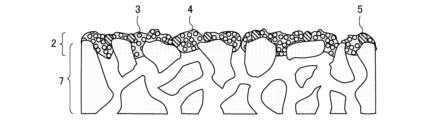
- Fig. 5 is a cross-sectional view showing the article after the oil 5 according to the second embodiment has penetrated into it.
- the second embodiment differs from the first embodiment in that the water-absorbent substrate 7 is porous.
- the same reference numerals are used to denote parts common to the first embodiment, and the description will be omitted, and the differences from the first embodiment will be mainly described.
- the oil 5 does not dissolve in the water- and oil-repellent resin 4 and forms oil droplets. Then, as shown in FIG. 5, when the oil 5 is absorbed into the water-absorbent substrate 7, the portion of the water-absorbent substrate 7 in contact with the water-repellent coating 2 contains the oil component 8.
- the coating composition contains inorganic nanoparticles 3, so that the coating composition forms the water-repellent coating 2 on the surface without penetrating into the porous surface during application.
- the effects of improving the water repellency of the water-repellent coating 2, improving moisture permeability, improving adhesion in contact with water or in a high humidity environment, and preventing moisture from penetrating into the water-absorbent substrate 7 can be obtained.
- Example 1 Silica nanoparticles hydrophobized with dimethyldichlorosilane (AEROSIL R 976, manufactured by Nippon Aerosil Co., Ltd., average particle size in solvent: 12 nm) were used as the inorganic nanoparticles 3, Fluorosurf FS1610TH (Fluoro Technology) was used as the water- and oil-repellent resin 4, and the fluorine-based solvent Asahiklin (manufactured by AGC Chemical Co., Ltd.) was used as the solvent.
- AEROSIL R 976 dimethyldichlorosilane
- the mass ratio of the inorganic nanoparticles 3 to the water- and oil-repellent resin 4 was 2:1, and the total of the inorganic nanoparticles 3 and the water- and oil-repellent resin 4 was adjusted to 2 mass% as the coating composition.
- Dimethyl silicone oil was added to this coating composition as the oil component 6 so that it was 0.5 mass% of the water- and oil-repellent resin 4.
- the coating composition was obtained by passing these through an atomization device.
- Example 2 The same procedure was followed as in Example 1, except that Oil 5 was added so that the ratio was 1 mass %.
- Example 3 The same procedure was followed as in Example 1, except that Oil 5 was added at a ratio of 5%.
- Example 4 The same procedure was followed as in Example 1, except that Oil 5 was added at a ratio of 10%.
- Example 5 The same procedure was followed as in Example 1, except that Oil 5 was added at a ratio of 20%.
- Example 6 The same procedure was followed as in Example 1, except that Oil 5 was added at a ratio of 50%.
- Example 7 The same procedure was followed as in Example 1, except that Oil 5 was added at a ratio of 80%.
- Example 8 To Example 1, hardened oil (boiled linseed oil) was added as oil 5 so as to account for 1% of the water- and oil-repellent resin 4 .
- Example 9 The same procedure was followed as in Example 1, except that the proportion of Oil 5 was 0%.
- Examples 1 to 9 were super-water-repellent with a water contact angle exceeding 140°.
- the water-repellency was evaluated by dropping 15 ⁇ L of water onto the coating surface using a micropipette, and measuring the tilt angle at which the water started to slide by tilting the substrate at 5° increments of 1°, 5°, 10°, and 15°, and averaging the three measurements to evaluate the sliding angle.
- the stain resistance was evaluated by observing dust adhesion using Kanto loam, a JIS test powder.
- the stain resistance of uncoated wood that had not absorbed water was rated as 5, and the direction with the most Kanto loam dust adhesion was rated as 6 to 9, and the direction with the least amount of Kanto loam dust adhesion was rated as 1 to 4, giving a rating of 10.
- Comparative Example 2 had worse stain resistance than uncoated wood both after application and after immersion in water. From Examples 1 to 7 and 9, it can be seen that the more oil component 6 there was, the better the water absorption. This is thought to be because Oil 5 is absorbed by the wood, preventing water from penetrating into the wood.
- Examples 1 to 9 of the present embodiment 1 can easily obtain a water-repellent coating 2 on a water-absorbent substrate 1 that is highly water-repellent, stain-resistant, and moisture-permeable.
- Water-absorbent substrate 2. Water-repellent coating, 3. Inorganic nanoparticles, 4. Water- and oil-repellent resin, 5. Oil, 6. Oil component, 7. Water-absorbent substrate, 8. Oil component.
Landscapes
- Chemical & Material Sciences (AREA)
- Engineering & Computer Science (AREA)
- Materials Engineering (AREA)
- Organic Chemistry (AREA)
- Life Sciences & Earth Sciences (AREA)
- Wood Science & Technology (AREA)
- Combustion & Propulsion (AREA)
- Inorganic Chemistry (AREA)
- Application Of Or Painting With Fluid Materials (AREA)
- Materials Applied To Surfaces To Minimize Adherence Of Mist Or Water (AREA)
- Paints Or Removers (AREA)
Priority Applications (2)
| Application Number | Priority Date | Filing Date | Title |
|---|---|---|---|
| JP2024514409A JPWO2024161574A1 (https=) | 2023-02-02 | 2023-02-02 | |
| PCT/JP2023/003322 WO2024161574A1 (ja) | 2023-02-02 | 2023-02-02 | 撥水性被膜、コーティング組成物及び吸水性材料 |
Applications Claiming Priority (1)
| Application Number | Priority Date | Filing Date | Title |
|---|---|---|---|
| PCT/JP2023/003322 WO2024161574A1 (ja) | 2023-02-02 | 2023-02-02 | 撥水性被膜、コーティング組成物及び吸水性材料 |
Publications (1)
| Publication Number | Publication Date |
|---|---|
| WO2024161574A1 true WO2024161574A1 (ja) | 2024-08-08 |
Family
ID=92145934
Family Applications (1)
| Application Number | Title | Priority Date | Filing Date |
|---|---|---|---|
| PCT/JP2023/003322 Ceased WO2024161574A1 (ja) | 2023-02-02 | 2023-02-02 | 撥水性被膜、コーティング組成物及び吸水性材料 |
Country Status (2)
| Country | Link |
|---|---|
| JP (1) | JPWO2024161574A1 (https=) |
| WO (1) | WO2024161574A1 (https=) |
Citations (7)
| Publication number | Priority date | Publication date | Assignee | Title |
|---|---|---|---|---|
| JPS6330571A (ja) * | 1986-07-23 | 1988-02-09 | Showa Highpolymer Co Ltd | 湿気硬化型塗料用樹脂組成物 |
| JPH04346873A (ja) * | 1991-05-23 | 1992-12-02 | Toagosei Chem Ind Co Ltd | 物品の塗装方法 |
| JPH10193528A (ja) * | 1997-01-13 | 1998-07-28 | Chuko Kasei Kogyo Kk | 含フッ素樹脂親水性建築用膜材およびその製造方法 |
| JPH11217540A (ja) * | 1998-02-03 | 1999-08-10 | Daikin Ind Ltd | 塗料用組成物 |
| JP2003192988A (ja) * | 2001-12-25 | 2003-07-09 | Akurosu Kk | 撥記録材料性塗料組成物 |
| JP2010116509A (ja) * | 2008-11-14 | 2010-05-27 | Nippon Polyurethane Ind Co Ltd | フッ素系ポリオール用ポリイソシアネート硬化剤組成物およびそれを用いた2液型塗料組成物 |
| JP2020002287A (ja) * | 2018-06-29 | 2020-01-09 | 株式会社コバヤシ | 剥離性コーティング組成物 |
Family Cites Families (13)
| Publication number | Priority date | Publication date | Assignee | Title |
|---|---|---|---|---|
| JPH05329805A (ja) * | 1992-06-02 | 1993-12-14 | Majitsuku Man Kk | 無色透明保護層を木材に含浸形成させる方法 |
| DE19649953A1 (de) * | 1996-12-03 | 1998-06-04 | Huels Chemische Werke Ag | Fluoralkyl-funktionelle Organopolysiloxan-haltige Zusammensetzungen auf Wasserbasis, Verfahren zu deren Herstellung sowie deren Verwendung |
| JPH1161040A (ja) * | 1997-08-08 | 1999-03-05 | Toshiba Silicone Co Ltd | 人造皮革用コーティング剤組成物及びコーティングの施された人造皮革 |
| JP4336974B2 (ja) * | 2003-06-23 | 2009-09-30 | 信越化学工業株式会社 | 水系撥水処理剤及び撥水処理方法 |
| JP3902620B2 (ja) * | 2004-09-21 | 2007-04-11 | 忠雄 雲雀 | 皮革用クリーム及びその製造方法 |
| ES2395161T3 (es) * | 2007-01-18 | 2013-02-08 | Mitsubishi Electric Corporation | Composición de revistimiento, método de revestimiento, intercabiador de calor y acondicionador de aire |
| JP5814771B2 (ja) * | 2011-12-13 | 2015-11-17 | 日華化学株式会社 | 撥水性コーティング膜の製造方法、それに用いる下地膜形成用組成物及び撥水性コーティング膜を備えた機能性材料 |
| JP5701441B1 (ja) * | 2014-09-01 | 2015-04-15 | エムケイテック株式会社 | 撥水剤組成物 |
| JP6666144B2 (ja) * | 2015-12-28 | 2020-03-13 | 東洋アルミエコープロダクツ株式会社 | 防汚シート |
| JP2017171701A (ja) * | 2016-03-18 | 2017-09-28 | 三菱マテリアル株式会社 | 被膜形成用組成物及びその製造方法、並びに被膜 |
| JP6832816B2 (ja) * | 2017-09-06 | 2021-02-24 | 日本アエロジル株式会社 | 撥水撥油性塗膜形成用複合粒子及びその製造方法並びに該複合粒子を用いた撥水撥油性塗膜の形成方法 |
| WO2020137902A1 (ja) * | 2018-12-28 | 2020-07-02 | ダイキン工業株式会社 | 撥水剤組成物 |
| JP7782958B2 (ja) * | 2020-03-30 | 2025-12-09 | 東洋アルミニウム株式会社 | 活性エネルギー線硬化型フッ素含有組成物 |
-
2023
- 2023-02-02 WO PCT/JP2023/003322 patent/WO2024161574A1/ja not_active Ceased
- 2023-02-02 JP JP2024514409A patent/JPWO2024161574A1/ja active Pending
Patent Citations (7)
| Publication number | Priority date | Publication date | Assignee | Title |
|---|---|---|---|---|
| JPS6330571A (ja) * | 1986-07-23 | 1988-02-09 | Showa Highpolymer Co Ltd | 湿気硬化型塗料用樹脂組成物 |
| JPH04346873A (ja) * | 1991-05-23 | 1992-12-02 | Toagosei Chem Ind Co Ltd | 物品の塗装方法 |
| JPH10193528A (ja) * | 1997-01-13 | 1998-07-28 | Chuko Kasei Kogyo Kk | 含フッ素樹脂親水性建築用膜材およびその製造方法 |
| JPH11217540A (ja) * | 1998-02-03 | 1999-08-10 | Daikin Ind Ltd | 塗料用組成物 |
| JP2003192988A (ja) * | 2001-12-25 | 2003-07-09 | Akurosu Kk | 撥記録材料性塗料組成物 |
| JP2010116509A (ja) * | 2008-11-14 | 2010-05-27 | Nippon Polyurethane Ind Co Ltd | フッ素系ポリオール用ポリイソシアネート硬化剤組成物およびそれを用いた2液型塗料組成物 |
| JP2020002287A (ja) * | 2018-06-29 | 2020-01-09 | 株式会社コバヤシ | 剥離性コーティング組成物 |
Also Published As
| Publication number | Publication date |
|---|---|
| JPWO2024161574A1 (https=) | 2024-08-08 |
Similar Documents
| Publication | Publication Date | Title |
|---|---|---|
| JP5004229B2 (ja) | コーティング剤 | |
| Hsieh et al. | Influence of surface roughness on water-and oil-repellent surfaces coated with nanoparticles | |
| JP3942648B2 (ja) | 鉱物質建築材料用含浸性エマルジヨン | |
| JP7127133B2 (ja) | 複合材料とその使用 | |
| HU223634B1 (hu) | Formázó- vagy burkolóanyag, és alkalmazása | |
| CN102212301A (zh) | 一种水性瓷砖翻新涂料及其制备方法 | |
| JP2009280716A (ja) | 無溶剤一液常温硬化型含浸材 | |
| CN107022080A (zh) | 一种新型硅烷类复合凝胶防水材料的制备方法 | |
| WO2024161574A1 (ja) | 撥水性被膜、コーティング組成物及び吸水性材料 | |
| Esposito Corcione et al. | Hydrophobic photopolymerizable nanostructured hybrid materials: An effective solution for the protection of porous stones | |
| CN1699290A (zh) | 一种混凝土保护养护剂 | |
| JPH11302561A (ja) | 撥水性複合粒子および撥水性塗膜 | |
| Pagliolico et al. | Characterization of a hybrid nano-silica waterborne polyurethane coating for clay bricks | |
| JP2016135824A (ja) | 無機多孔質材用封孔塗料および無機多孔質材の封孔方法 | |
| JP4958333B2 (ja) | 水性吸水防止材 | |
| JP7112180B2 (ja) | 建築材料 | |
| JP5701441B1 (ja) | 撥水剤組成物 | |
| JP5058999B2 (ja) | 建設材料を疎水化し且つ該材料のビーディング効果を改善するための方法 | |
| JP2013043799A (ja) | 軽量気泡コンクリート | |
| Yoon et al. | Synthesis of Hydrophobic Siloxane Copolymers for the Water Repellency of the Surface of Rammed Earth Walls | |
| MacMullen et al. | An investigation of hydroxyl end-terminated polydimethylsiloxane (PDMS) in exterior oil-in-water (O/W) emulsion treatments | |
| RU2779344C2 (ru) | Композитный материал и его применение | |
| JP2013249236A (ja) | コンクリート表面の被覆材膨れ防止方法及び膨れ防止型被覆材 | |
| Esposito Corcione et al. | Boehmite/methacrylic nano-composites as protective coatings for natural stones: Comparison between sunlight and UV photopolymerization cure reaction | |
| JP4877770B2 (ja) | 高撥水性表面の形成方法 |
Legal Events
| Date | Code | Title | Description |
|---|---|---|---|
| WWE | Wipo information: entry into national phase |
Ref document number: 2024514409 Country of ref document: JP |
|
| 121 | Ep: the epo has been informed by wipo that ep was designated in this application |
Ref document number: 23919712 Country of ref document: EP Kind code of ref document: A1 |
|
| NENP | Non-entry into the national phase |
Ref country code: DE |
|
| 122 | Ep: pct application non-entry in european phase |
Ref document number: 23919712 Country of ref document: EP Kind code of ref document: A1 |