WO2024161550A1 - 人材採用装置及び人材採用システム - Google Patents
人材採用装置及び人材採用システム Download PDFInfo
- Publication number
- WO2024161550A1 WO2024161550A1 PCT/JP2023/003225 JP2023003225W WO2024161550A1 WO 2024161550 A1 WO2024161550 A1 WO 2024161550A1 JP 2023003225 W JP2023003225 W JP 2023003225W WO 2024161550 A1 WO2024161550 A1 WO 2024161550A1
- Authority
- WO
- WIPO (PCT)
- Prior art keywords
- offer
- job seeker
- display
- recruitment
- job
- Prior art date
- Legal status (The legal status is an assumption and is not a legal conclusion. Google has not performed a legal analysis and makes no representation as to the accuracy of the status listed.)
- Ceased
Links
Images







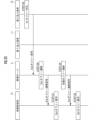


Classifications
-
- G—PHYSICS
- G06—COMPUTING OR CALCULATING; COUNTING
- G06Q—INFORMATION AND COMMUNICATION TECHNOLOGY [ICT] SPECIALLY ADAPTED FOR ADMINISTRATIVE, COMMERCIAL, FINANCIAL, MANAGERIAL OR SUPERVISORY PURPOSES; SYSTEMS OR METHODS SPECIALLY ADAPTED FOR ADMINISTRATIVE, COMMERCIAL, FINANCIAL, MANAGERIAL OR SUPERVISORY PURPOSES, NOT OTHERWISE PROVIDED FOR
- G06Q10/00—Administration; Management
- G06Q10/10—Office automation; Time management
- G06Q10/105—Human resources
- G06Q10/1053—Employment or hiring
Definitions
- the present invention relates to a personnel recruitment device that is used by employers to recruit job seekers.
- a conventional human resource recruitment system is described in Patent Document 1.
- This human resource recruitment system includes a recruiter terminal as a human resource recruitment device used by recruiters, a server, and a job seeker terminal used by job seekers.
- recruitment information from the recruiter terminal is registered in the server, and job seeker information from the job seeker terminal is registered in the server.
- a job seeker views the job information and likes it, a "like" signal indicating this is sent to the employer terminal of the employer who posted the job information.
- the employer views the job seeker's job seeker information, and if the employer likes the job seeker, it sends information indicating this to the job seeker terminal. This enables communication between the job seeker and employer thereafter.
- the conventional recruitment system described above has a mechanism for considering whether or not to employ a job seeker who has sent a favorable signal, which creates a problem in that the candidates that employers consider for employment are limited.
- the present invention has been made to solve the above problems, and aims to provide a personnel recruitment device that can expand the scope of candidates to be considered when recruiting personnel.
- the invention according to claim 1 is a recruiting device used when recruiting personnel, comprising an output interface for displaying images, an input interface for executing input operations, a first display processing unit for executing a first display process for displaying on the output interface a plurality of index images each representing the relationship between desired treatment and ability scores representing abilities of a plurality of job seekers, a second display processing unit for executing a second display process for displaying on the output interface, when any one of the plurality of index images displayed on the output interface is selected by an input operation on the input interface, predetermined information other than the desired treatment and ability score of the job seeker corresponding to any one of the index images, and an offer processing unit for executing an offer process for presenting an employment offer from a predetermined offer presenter to a first job seeker, who is one of the plurality of job seekers, in response to an input operation on the input interface.
- this recruitment device in the first display process, a number of index images each showing the relationship between the desired treatment and the ability score representing the ability of each of a number of job seekers are displayed on the output interface. This allows the user of the recruitment device to refer to the relationship between the desired treatment and the ability score representing the ability of a number of job seekers at once, thereby expanding the scope of candidates for consideration when recruiting.
- the specified information other than the desired treatment and ability score of the job seeker corresponding to that index image is displayed on the output interface. This allows the user of the recruitment device to refer to the specified information other than the desired treatment and ability score of each job seeker by selecting the index images in order, and to use this specified information as a reference when making a hiring decision for each job seeker.
- the offer processing unit executes offer processing for presenting an employment offer from a predetermined offeror to a first job seeker who is one of the multiple job seekers.
- This allows the predetermined offeror to present an employment offer to a job seeker for whom the hiring policy has been decided.
- the "predetermined offeror” refers to a person who uses the hiring device to present an employment offer to a job seeker, and corresponds to, for example, a corporate hiring manager or an agent who specializes in hiring personnel.
- the recruitment device of the present invention preferably further comprises an ability score calculation unit that uses an overall performance score representing the performance of each of a plurality of job seekers and an overall competency score representing the competency of each job seeker to calculate an overall overall score according to weights set by input operations on the input interface as an ability score for each job seeker.
- This recruitment device uses an overall performance score representing the performance of each of a number of job seekers and an overall competency score representing the competencies of each job seeker to calculate an overall score according to weights set by input operations on the input interface as the ability score for each job seeker. Therefore, by setting the weights appropriately, a user of the recruitment device can reflect the overall performance score and the overall competency score in the ability score based on his or her own values.
- an interest storage processing unit that executes an interest storage process in which one of a plurality of index images is selected by an input operation of the input interface, and that stores the fact that interest has been shown in a job seeker corresponding to one of the index images.
- an interest storage processing unit selects one of a plurality of index images, and executes an interest storage process that stores the fact that interest has been shown in a job seeker corresponding to that one index image. This allows the user of the personnel recruitment device to know which job seeker the user has shown interest in.
- the personnel recruitment device of the present invention in the interest storage process, when multiple index images are displayed on the output interface, and multiple index images located within a predetermined range centered on a point on the display screen of the output interface are selected by an input operation on the input interface, it is preferable that interest is shown in multiple job seekers corresponding to each of the selected multiple index images.
- this recruitment device in the interest storage process, when multiple index images are displayed on the output interface and multiple index images located within a predetermined range centered on a single point on the display screen of the output interface are selected by an input operation on the input interface, it is stored that interest has been shown in multiple job seekers corresponding to the selected multiple index images. In this way, it is possible to collectively select multiple index images that are centered on a single point and store that interest has been shown in multiple job seekers corresponding to the multiple index images. This allows the user of the recruitment device to show interest in multiple job seekers who have a similar relationship between desired treatment and ability score with a single operation, improving user convenience.
- the recruitment system according to claim 4 of the present invention comprises a plurality of recruitment devices including a first recruitment device which is the recruitment device according to claim 1, and each of the plurality of recruitment devices comprises an interest storage processing unit which executes an interest storage process for storing the fact that one of a plurality of index images is selected by an input operation of an input interface and that interest has been expressed in a job seeker corresponding to the one of the index images, and an offer processing unit, and when the first recruitment device executes an offer processing for the first job seeker, executes an offer notification process for notifying recruitment devices other than the first recruitment device among the plurality of recruitment devices which have executed the interest storage processing for the first job seeker that the offer processing for the first job seeker has been executed.
- an interest storage processing unit selects one of the multiple index images by input operation of the interface, and executes an interest storage processing to store the fact that interest has been expressed in the job seeker corresponding to the one of the index images
- an offer processing unit executes an offer processing to present an employment offer from a predetermined offerer to a first job seeker who is one of the multiple job seekers.
- an offer notification processing is executed to notify recruitment devices other than the first recruitment device among the multiple recruitment devices that have executed the interest storage processing for the first job seeker that the offer processing for the first job seeker has been executed.
- a user of a recruitment device that has executed the interest storage processing for the first job seeker other than the first recruitment device can know that an offer has been made from a user of another recruitment system to the first job seeker in whom the user expressed interest, and if the user wishes to employ the first job seeker, the user can issue an offer to the first job seeker by executing the offer processing by the offer processing unit.
- the first recruiting device notifies recruiting devices other than the first recruiting device that it has executed the offer process does not necessarily mean that the first recruiting device directly notifies the other recruiting devices that it has executed the offer process, but also includes notifying the other recruiting devices that it has executed the offer process via the other devices.
- the recruitment system according to claim 5 of the present invention comprises a plurality of recruitment devices including a first recruitment device which is the recruitment device according to claim 1, each of the plurality of recruitment devices comprises an interest storage processing unit which executes an interest storage process to store that one of the plurality of index images is selected by an input operation of an input interface and that interest is expressed in a job seeker corresponding to one of the index images, and a second recruitment device which is one of the plurality of recruitment devices executes an interest suggestion notification process to notify recruitment devices other than the second recruitment device in the plurality of recruitment devices that the interest storage process for the second job seeker has been executed when the interest storage process for a second job seeker who is one of the plurality of job seekers is executed, and in the recruitment devices other than the second recruitment device, when the first display process is executed, the plurality of index images are displayed on the output interface in different display modes according to the number of times the interest storage process has been executed.
- an interest storage processing unit selects one of the multiple target images through an input operation on the input interface, and executes an interest storage process that stores the fact that interest has been shown in a job seeker corresponding to one of the index images. Furthermore, in a second recruitment device that is one of the multiple recruitment devices, when an interest storage process is executed for a second job seeker that is one of the multiple job seekers, an interest suggestion notification process is executed that notifies recruitment devices other than the second recruitment device in the multiple recruitment devices that the interest storage process for the second job seeker has been executed.
- the multiple index images are displayed on the output interface in different display modes according to the number of times the interest storage process has been executed, so that users of the recruitment devices other than the second recruitment device can know which job seeker has been shown a high level of interest.
- the second recruiting device notifies recruiting devices other than the second recruiting device that it has executed the interest storage process for the second job seeker
- the second recruiting device does not necessarily mean that the second recruiting device directly notifies the other recruiting devices that it has executed the interest storage process for the second job seeker, but also includes notifying the other recruiting devices via the other devices that it has executed the interest storage process for the second job seeker.
- the human resource recruitment system comprises the human resource recruitment device according to claim 1 and a job seeker device used by a third job seeker who is one of the multiple job seekers, the human resource recruitment device comprising an index image transmission processing unit that executes an index image transmission process to transmit data of multiple index images to the job seeker device, and the job seeker device comprises a second output interface that displays images, a second input interface for executing input operations, an image display processing unit that executes an image display process to display the multiple index images on the second output interface when data of the multiple index images is received, an input processing unit that accepts input of the third job seeker's desired treatment through the second input interface, and a desired treatment transmission processing unit that transmits the input desired treatment of the third job seeker to the human resource recruitment device.
- the recruitment device executes an index image transmission process by an index image transmission processing unit that transmits data of multiple index images to the job seeker device. Then, when the job seeker device receives the data of multiple index images, it executes an image display process that displays the multiple index images on the second output interface, and the input processing unit accepts input of the third job seeker's desired treatment through the second input interface.
- the third job seeker can thereby determine whether his or her desired treatment is appropriate, and can change the desired treatment as necessary.
- the user of the recruitment device can confirm the newly input desired treatment by the third job seeker.
- the recruitment device transmits data of a plurality of index images to the job seeker device is not limited to the second recruitment device directly transmitting data of a plurality of index images to the job seeker device, but also includes transmitting data of a plurality of index images to the job seeker device via another device.
- the job seeker device transmits the desired treatment of the third job seeker to the recruitment device is not limited to the job seeker device directly transmitting data of the third job seeker to the recruitment device, but also includes transmitting the desired treatment of the third job seeker to the recruitment device via another device.
- FIG. 1 is a diagram illustrating a configuration of a talent recruitment system according to an embodiment of the present invention
- FIG. 2 is a block diagram showing a functional configuration of a first corporate terminal.
- 3 is a block diagram showing a functional configuration of a job seeker terminal.
- FIG. 11 is a sequence diagram showing a job seeker information transmission process and the like.
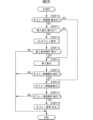
- 13 is a flowchart showing a personnel recruitment process. 13 is a flowchart showing a display control process. 13 is a flowchart showing a second display control process. 13 is a flowchart showing a third display control process.
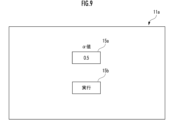
- FIG. 13 is a diagram showing an ⁇ input screen.
- FIG. 13 is a diagram showing a first calculation result screen.
- FIG. 2 is a diagram showing a first screen.
- FIG. 2 is a diagram showing a second screen.
- FIG. 13 shows an interviewee list screen.
- FIG. 13 is a diagram showing an offer screen.
- 13 is a sequence diagram showing a control operation when a calculation result signal is output from a first corporate terminal to a management server.
- FIG. FIG. 13 is a diagram showing a calculation result screen.
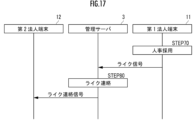
- 13 is a sequence diagram showing the control operation when a like signal is output from the first corporate terminal to the management server.
- 11 is a sequence diagram showing a control operation when an offer signal is output from a first corporate terminal to a management server.
- FIG. FIG. 13 is a diagram showing a first offer display screen on a job seeker terminal.
- FIG. 13 is a flowchart showing a first offer response process.
- a figure showing a first offer display screen on a corporate terminal. 13 is a sequence diagram showing a control operation when an offer signal is output from a second corporate terminal to a management server.
- FIG. 13 is a diagram showing a second offer display screen on a job seeker terminal.
- FIG. 13 is a diagram showing a third offer display screen on a job seeker terminal.
- FIG. 13 is a diagram showing a state in which a plurality of index images are displayed together in one place.
- FIG. 13 is a diagram showing a state in which a plurality of index images gathered in one place are simultaneously selected.
- FIG. 13 is a diagram showing a state in which a plurality of index images are displayed in different sizes according to the number of likes.
- the recruitment system 1 shown in FIG. 1 of this embodiment is used to exchange employment offers between multiple job seekers and recruiters from multiple corporations, as described below.
- the recruitment system 1 includes a management server 3, a first corporate terminal 11, a second corporate terminal 12, and a job seeker terminal 13. Although not shown, this recruitment system 1 also includes a number of corporate terminals configured similarly to the two corporate terminals 11, 12, and a number of job seeker terminals configured similarly to the job seeker terminal 13.
- the management server 3 and terminals 11 to 13 are configured to be able to communicate with each other via a network 5.
- This network 5 is configured from a wireless communication network, a wired communication network, etc.
- the management server 3 is used by the management entity (management corporation or administrator) to manage the human resource recruitment system 1, and is equipped with a control unit, a memory unit, and a communication unit (none of which are shown).
- the control unit is made up of a CPU, memory, an I/O interface, etc.
- the memory unit is made up of storage devices such as ROM, RAM, and HDD.
- the communication unit is made up of a communication circuit.
- job seeker information from a large number of job seeker terminals, including the job seeker terminal 13, is stored as a database.
- the job seeker information is that of a large number of job seekers who have taken a prescribed course for data scientists and wish to work as a data scientist.
- the job seeker information for each job seeker includes the minimum desired annual salary (desired benefits), overall performance score S1, overall competency score S2, and available interview dates.
- the overall performance score S1 is a score that comprehensively reflects the grades and academic performance of the job seeker when taking designated courses.
- the overall competency score S2 is a score indicating the personal characteristics and abilities of each job seeker, and is calculated using the method proposed by the applicant in Patent Publication No. 6589257.
- the first corporate terminal 11 is configured as a desktop computer, and is used by the recruiter M1 of the first corporation when carrying out various control processes such as the recruiting process described below.
- the first corporate terminal 11 is equipped with a display 11a, a device main body 11b, an input interface 11c, etc.
- the device main body 11b is equipped with storage such as a HDD, a processor, memory (RAM, E2PROM, ROM, etc.), an I/O interface circuit, etc. (none of which are shown).
- Application software for executing various control processes, which will be described later, is installed in the storage of this device main body 11b.
- the input interface 11c is composed of a keyboard and a mouse for operating the first corporate terminal 11.
- the first corporate terminal 11 corresponds to the recruitment device and the first recruitment device
- the display 11a corresponds to the output interface.
- the first corporate terminal 11 has the functions of a first display processing unit 11d, a second display processing unit 11e, an offer processing unit 11f, a capability score calculation unit 11g, an interest storage processing unit 11h, and an index image transmission processing unit 11i.
- corporate terminals (not shown) other than the first corporate terminal 11, including the second corporate terminal 12, also have these functions.
- this second corporate terminal 12 is configured as a desktop computer, and is used by the second corporation's recruiter M2 when carrying out various control processes described below.
- the second corporate terminal 12 corresponds to the corporate terminal.
- This second corporate terminal 12 like the first corporate terminal 11, is equipped with a display 12a, a device main body 12b, an input interface 12c, etc.
- These elements 12a to 12c are configured in the same way as the above-mentioned elements 11a to 11c of the first corporate terminal 11, so a detailed explanation will be omitted, but application software for executing various processes described below is installed in the storage of the device main body 12b.
- the two corporate terminals 11, 12 are configured as described above. Furthermore, the aforementioned corporate terminals other than corporate terminals 11, 12 are also configured similarly to corporate terminals 11, 12, and are used by personnel recruiters of corporations other than the first corporation and the second corporation. Note that the above corporate terminals 11, 12 are not limited to desktop computers, and tablet computers, notebook computers, smartphones, etc. may also be used as corporate terminals 11, 12.
- the job seeker terminal 13 is configured as a desktop computer, and is used when the job seeker M1 refers to employment offers made to him/her, as described below.
- the job seeker terminal 13 is equipped with a display 13a, a device main body 13b, an input interface 13c, etc.
- These elements 13a to 13c are configured in the same way as the above-mentioned elements 11a to 11c of the first corporate terminal 11, so a detailed explanation is omitted, but application software for executing various processes described below is installed in the storage of the device main body 13b.
- the job seeker terminal 13 corresponds to the job seeker device
- the display 13a corresponds to the second output interface
- the input interface 13c corresponds to the second input interface.
- the job seeker terminal 13 further includes functions as an image display processing unit 13d, an input processing unit 13e, and a desired treatment transmission processing unit 13f.
- Job seeker terminals (not shown) other than the job seeker terminal 13 also include these functions.
- the job seeker terminal 13 is configured as described above, and other job seeker terminals are configured in the same manner as the job seeker terminal 13. Note that the job seeker terminal 13 is not limited to a desktop computer, and a smartphone, tablet computer, notebook computer, or the like may also be used as the job seeker terminal 13.
- the job seeker information transmission process is executed in the management server 3 (FIG. 4/STEP 1).
- the job seeker information described above is transmitted from the management server 3 to multiple corporate terminals, including the two corporate terminals 11 and 12.
- a job seeker information storage process is executed in the first corporate terminal 11 (FIG. 4/STEP 2).
- the job seeker information is stored in the storage of the first corporate terminal 11.
- a job seeker information storage process is executed in the second corporate terminal 12 (FIG. 4/STEP 3). In this job seeker information storage process, the job seeker information is stored in the storage of the second corporate terminal 12.
- job seeker information storage process is also executed in corporate terminals other than the first corporate terminal 11 and the second corporate terminal 12.
- This recruitment process is executed at multiple corporate terminals, including the two corporate terminals 11 and 12, when, for example, recruiting a job seeker.
- This process is executed by a recruitment officer M1 of the first corporation (hereinafter referred to as "first officer M1") operating the first corporate terminal 11.
- first officer M1 a recruitment officer M1 of the first corporation
- the first officer M1 corresponds to a specified offer presenter.
- all calculation results in the following description are stored in the storage of the first corporate terminal 11.
- the new information includes the job seeker information described above, as well as information on the revised minimum desired annual salary contained in the revised information signal described below. If this determination is positive ( Figure 5/STEP 10...YES) and new information has been received, the process proceeds to STEP 13 described below.
- the ⁇ input screen displays an input field 15a for the weight ⁇ and an execute button 15b.
- the weight ⁇ is a value used in the primary calculation described below, and is configured so that it can be input as a value within the range of 0 ⁇ 1 by the first person in charge M1 operating the input interface 11c of the first corporate terminal 11.
- the execute button 15b is pressed by the first person in charge M1 via the input interface 11c of the first corporate terminal 11 in order to execute the primary calculation.
- the pressing of various buttons on the screen by the first person in charge M1 via the input interface 11c is simply referred to as "various buttons being pressed.”
- the primary calculation operation is executed, the primary calculation is executed (FIG. 5/STEP 15).
- the overall total score Sx (ability score) of each job seeker in the job seeker information is calculated by taking the weighted geometric mean of the performance total score S1 and the competency total score S2, as shown in the following formula (1).
- This calculation result signal includes the overall overall score Sx and the desired minimum annual income of all job seekers calculated as described above.
- the primary calculation result display process is executed (FIG. 5/STEP 17).
- the primary calculation result screen shown in FIG. 10 is displayed on the display 11a of the first corporate terminal 11.
- This primary calculation result screen displays a group of index images 16a, a filter condition input field 16b, and an execute button 16c.
- This group of index images 16a displays the combination of the overall total score Sx and the minimum desired annual income of all job seekers calculated as described above as a collection of circular, dot-like index images 16d that indicate the coordinate values of an orthogonal coordinate system with the overall total score Sx on the horizontal axis and the minimum desired annual income on the vertical axis.
- the filter condition input field 16b is for the first person in charge M1 to input filter conditions for the multiple coordinate values displayed as the index image group 16a
- FIG. 10 shows an example in which the overall overall score and the minimum desired annual income are input as filter conditions.
- the overall overall score alone or the minimum desired annual income alone may be used as the filter condition, or the overall overall score and the minimum desired annual income plus other conditions (e.g., academic performance) may be used as the filter condition.
- the execute button 16c is pressed when executing the filter process.
- FIG. 5/STEP 18 it is determined whether the filter conditions are met. In this case, if the filter conditions have already been entered in the filter condition input field 16b and the execute button 16c is pressed, it is determined that the filter conditions are met, and in any other case, it is determined that the filter conditions are not met.
- the data filtered from the coordinate value data described above using the filter conditions is selected as the first selection data.
- FIG. 5/STEP 20 This display control process is specifically executed as shown in FIG. 6. As shown in FIG. 6, first, it is determined whether or not the second display control, which will be described later, is being executed (FIG. 6/STEP 30).
- the first display process is executed (FIG. 6/STEP 33).
- the first screen shown in FIG. 11 is displayed on the display 11a of the first corporate terminal 11.
- this first screen displays an index image group 17a, an interviewee list button 17b, and an offerer list button 17c.
- This index image group 17a (multiple index images) is a display of the filtered first selection data as a collection of circular, dot-like index images 17d, as described above.
- the interviewee list button 17b is for displaying a list of job seekers who have been requested to meet for an interview (see FIG. 13 described below), and is configured so that when the interviewee list button 17b is pressed, a list of job seekers who have been requested to meet for an interview is displayed.
- the offerer list button 17c is for displaying a list of job seekers (not shown) to whom an employment offer has been presented, and is configured so that when the offerer list button 17c is pressed, a list of job seekers to whom an employment offer has been presented is displayed.
- This second display control process is specifically executed as shown in FIG. 7. As shown in FIG. 7, first, the second display process is executed (FIG. 7/STEP 40). In this second display process, the second screen shown in FIG. 12 is displayed on the display 11a of the first corporate terminal 11.
- This second screen displays the group of indicator images 17a, and the indicator image 17d selected as described above is displayed in a color different from the other indicator images. Furthermore, a job seeker information field 17e is displayed to the right of the group of indicator images 17a. This job seeker information field 17e displays specific information about the job seeker corresponding to the selected indicator image 17d. Specifically, the job seeker's name, date of birth, number of likes, and a brief appeal are displayed.
- a Like button 17f is used to execute a process that indicates that the first corporation is interested in the job seeker "Yamayama x Taro" displayed in the job seeker information column 17e.
- the interview button 17g is for executing a process to request an interview from the first corporation with the job seeker "Xyama x Taro" displayed in the job seeker information field 17e, as described below.
- the offer button 17h is for executing a process to present an employment offer from the first corporation to the job seeker "Xyama x Taro" displayed in the job seeker information field 17e, as described below.
- the offer update button 17i is used to execute a process to update and present an employment offer to the job seeker "Yama x Taro" displayed in the job seeker information column 17e when, after an employment offer from the first corporation has been made to the job seeker "Yama x Taro", another corporation makes an employment offer with better conditions than the first corporation.
- This "Like” action is an action that indicates that the first corporation is interested in the job seeker "Yama x Taro" displayed in the job seeker information column 17e.
- the indicator image 17d is selected as described above and the like button 17f is pressed, it is determined that a "Like” action has been performed, and in any other cases it is determined that a "Like” action has not been performed.
- a like link process is executed (FIG. 7/STEP 42).
- the number of likes is incremented by one for the job seeker information of job seeker "Yama x Taro", and the job seeker information is then linked and stored in the storage of the first corporate terminal 11.
- the above processes in STEPs 41 to 42 correspond to the interest storage process.
- an interview signal is output to the management server 3 (FIG. 7/STEP 46).
- This interview signal indicates the interview date and time that the first corporation wishes to interview the job seeker "Yama x Taro". After that, this process ends.
- FIG. 6 when the above-mentioned determination is negative (FIG. 6/STEP 34...NO) and the second display operation has not been performed, it is determined whether or not the third display operation has been performed (FIG. 6/STEP 35). In this case, when the interviewee list button 17b on the first screen described above is pressed, it is determined that the third display operation has been performed, and in any other case, it is determined that the third display operation has not been performed.
- This third display control process is specifically executed as shown in FIG. 8. As shown in FIG. 8, first, it is determined whether or not the offer screen described below is being displayed (FIG. 8/STEP 50). If this determination is positive (FIG. 8/STEP 50...YES), that is, the offer screen was displayed at the previous control timing, the process proceeds to STEP 56 described below.
- an interviewee list display process is executed (FIG. 8/STEP 52).
- the interviewee list screen shown in FIG. 13 is displayed on the display 11a.
- a list of job seekers who have received the aforementioned interview request from the first corporation is displayed in the interviewee display frame 18a.
- FIG. 8/STEP 53 it is determined whether or not an interviewee selection operation has been performed.
- the first person in charge M1 operates the input interface 11c to select one of the job seekers displayed in the interviewee display frame 18a, it is determined that the interviewee selection operation has been performed; otherwise, it is determined that the interviewee selection operation has not been performed.
- an interviewee screen similar to the second screen of FIG. 12 described above is displayed. That is, like the second screen, the interviewee screen displays the index image group 17a, job seeker information column 17e, Like button 17f, interview button 17g, Offer button 17h, and Offer update button 17i.
- the offer screen shown in FIG. 14 is displayed on the display 11a.
- the offer screen displays, from top to bottom, a box 19a displaying the name of the offeree, a box 19b for inputting offer conditions, a box 19c for inputting the offer response deadline, a box 19d for inputting upper limit offer conditions, and an offer execution button 19e.
- the offeree name display frame 19a displays the name of the job seeker selected in the interviewee selection operation described above.
- the offer conditions input frame 19b and offer response deadline input frame 19c are for inputting the benefits (annual salary) that the first corporation will offer to the job seeker and the response deadline.
- the upper limit offer conditions input frame 19d is for inputting the upper limit of benefits that the first corporation can offer to the job seeker via the input interface 11c.
- the compensation of "6.9 million yen/year" is input into the input box 19d for the upper limit offer condition.
- the corporate terminal in which the compensation is input into the input box 19d for the upper limit offer condition as described above is referred to as the "terminal with automatic offer setting.”
- the first corporate terminal 11 is the terminal with automatic offer setting.
- the Make Offer button 19e is pressed when presenting an offer to a job seeker.
- calculation result notification process (FIG. 15/STEP 71).
- this calculation result notification process first, an average overall score is calculated for each of the many job seekers, which is the average of the overall scores Sx in the many calculation results, based on the data of the many calculation result signals.
- job seeker information for all job seekers is created as data linking this average overall score with the minimum desired annual salary.
- a calculation result notification signal including the job seeker information of all job seekers is sent to the job seeker terminals (only job seeker terminal 13 is shown) of all job seekers stored as a database in management server 3.
- the calculation result notification process corresponds to the index image transmission process. Below, an example will be described in which this calculation result notification signal is sent to job seeker terminal 13.
- a calculation result display process is executed (FIG. 5/STEP 72).
- the calculation result screen shown in FIG. 16 is displayed on the display 13a of the job seeker terminal 13.
- the calculation result display process corresponds to the image display process.
- the calculation result screen displays a group of index images 20a, and the index image 20b of job seeker M3 is displayed in a color different from the other index images. This allows job seeker M3 to understand the relationship between his or her own minimum desired annual income and the overall overall score among all job seekers.
- a revised minimum desired annual income field 20c and an execute button 20d are displayed below the group of indicator images 20a. These revised minimum desired annual income field 20c and execute button 20d are for executing the following operation to correct the minimum desired annual income when job seeker M3 wishes to revise his/her own minimum desired annual income after referring to the group of indicator images 20a.
- job seeker M3 does not modify his/her own desired minimum annual income, the above-mentioned operation for modifying the desired minimum annual income is not executed.
- job seeker M3 modifies the desired minimum annual income on the job seeker terminal 13.
- a correction information output process is executed (FIG. 15/STEP 73).
- a correction information signal representing the corrected minimum desired annual income of job seeker M3 is sent to the management server 3.
- this correction information signal is received by the management server 3
- the management server 3 executes a correction information notification process (FIG. 15/STEP 74).
- a correction information notification signal indicating the corrected minimum desired annual income of job seeker M3 is sent to all corporate terminals including the first corporate terminal 11.
- this correction information notification signal is received by the first corporate terminal 11 as an example.
- the first corporate terminal 11 executes a correction information storage process (FIG. 15/STEP 75).
- the corrected minimum desired annual income of job seeker M3 is stored in the storage of the first corporate terminal 11 as new data of the minimum desired annual income of job seeker M3.
- the management server 3 executes a like contact process (FIG. 8/STEP 80).
- the like contact signal is sent to multiple corporate terminals other than the first corporate terminal 11.
- This like contact signal indicates that a like action has been performed on a job seeker.
- the like contact process corresponds to the interest suggestion notification process.
- the following describes an example in which the like contact signal is received by the second corporate terminal 12.
- the like contact signal is received by the second corporate terminal 12
- the like count link process (FIG. 6/STEP 32) of the recruitment process described above is executed in the second corporate terminal 12
- the number of likes will be added to the job seeker information of the job seeker for whom the like action was executed.
- the above points are the same even if the like contact signal is received by a corporate terminal other than the second corporate terminal 12.
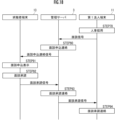
- an interview signal is output from the first corporate terminal 11 to the management server 3.
- an interview application contact process is executed (FIG. 18/STEP 90).
- interview application contact signal including interview request information (such as interview date and time) from the first corporation is sent from the management server 3 to the job seeker terminal 13.
- an interview application display process is executed (FIG. 18/STEP 91).
- an interview application screen (not shown) is displayed.
- a message indicating that the first corporation has requested an interview with job seeker M3, possible interview dates and times, an accept button, and a reject button are displayed (none of which are shown).
- job seeker M3 accepts the interview request, he/she operates input interface 13c to select the date and time when job seeker M3 is available for the interview, and then presses the accept button as an interview acceptance action.
- job seeker M3 if job seeker M3 does not accept the interview application, he/she presses the reject button by operating the input interface 13c. Below, we will explain an example in which job seeker M3 accepts the interview application on the job seeker terminal 13.
- the job seeker terminal 13 executes an interview acceptance process (FIG. 18/STEP 92).
- interview acceptance process an interview acceptance signal is sent from the job seeker terminal 13 to the management server 3.
- This interview acceptance signal indicates that the job seeker M3 has accepted the interview and the date and time when the job seeker M3 is available for the interview.
- the management server 3 executes an interview acceptance contact process (FIG. 18/STEP 93).
- an interview acceptance contact signal containing the same information as the interview acceptance signal is sent to the first corporate terminal 11.
- the first corporate terminal 11 executes an interview acceptance notification process (FIG. 18/STEP 94).
- interview acceptance notification process although not shown, a message indicating that job seeker M3 has accepted the interview and the date and time when job seeker M3 is available for an interview are displayed on the screen of the display 11a of the first corporate terminal 11. This allows the first person in charge M1 to recognize that the interview with job seeker M3 has been accepted.
- control operations are also executed in the same manner between a corporate terminal other than the first corporate terminal 11 and the job seeker terminal 13 or a job seeker terminal other than the job seeker terminal 13.
- the control operation when the offer signal described above is output from the first corporate terminal 11 to the management server 3 in the case where the recruitment process is executed at the first corporate terminal 11 as described above will be explained.
- the offer signal from the first corporate terminal 11 is the first offer signal (hereinafter referred to as the "1st offer signal") for job seeker M3.
- a first offer signal for job seeker M3 is output from the first corporate terminal 11 to the management server 3.
- a first offer contact process is executed (FIG. 19/STEP 100).
- a first offer contact signal is sent from the management server 3 to the job seeker terminal 13.
- This first offer contact signal contains the same information as the first offer signal from the first corporate terminal 11.
- a first offer notification signal is sent from the management server 3 to a corporate terminal other than the first corporate terminal 11 that has performed a like action on the job seeker M3.
- the first offer notification signal is sent to the second corporate terminal 12.
- the first offer notification signal from the management server 3 may be configured to be sent to all corporate terminals other than the first corporate terminal 11, regardless of whether a like action has been performed or not.
- a first offer display process is executed (FIG. 19/STEP 101).
- a first offer display screen shown in FIG. 20 is displayed.
- a first offer information display frame 22a is displayed at the top, and an OK button 23a, a hold button 23b, and an NG button 23c are displayed below it.
- This 1st offer information display frame 22a displays the message "The following offer has been received from the first corporation," the salary "6 million yen/year,” and the response deadline "2023/2/10.”
- the OK button 23a is pressed by the job seeker M3 when accepting the offer
- the Hold button 23b is pressed by the job seeker M3 when he or she wants to hold the offer.
- the NG button 23c is pressed by job seeker M3 when he or she wishes to decline the offer.
- that button is displayed in a different color from the other buttons.
- Figure 23 shows the Hold button 23b in the pressed state.
- the human resource recruitment system 1 of this embodiment if any of the three buttons 23a to 23c is not pressed within a specified period (e.g., three days) after the first offer contact signal is received by the job seeker terminal 13, the first offer to job seeker M3 is automatically withdrawn.
- a specified period e.g., three days
- the second corporate terminal 12 executes the first offer response process (FIG. 19/STEP 102).
- This first offer response process is specifically executed as shown in FIG. 21. Note that, here, an example will be described in which the second corporate terminal 12 is operated by the second person in charge M2.
- FIG. 21 first, it is determined whether or not the offer screen described below is being displayed (FIG. 21/STEP 110). If this determination is positive (FIG. 21/STEP 110...YES), and the offer screen was displayed at the previous control timing, the process proceeds to STEP 116 described below.
- a first offer display process is executed (FIG. 21/STEP 112).
- the first offer display screen shown in FIG. 22 is displayed on the display 12a of the second corporate terminal 12.
- the first offer display screen displays, from top to bottom, a name field 21a, an offer information field 21, and a job seeker information display button 21c.
- the job seeker information display button 21c is used to execute the second display process described above in order to refer to the job seeker information of the job seeker displayed in the name field 21a.
- This second display process is executed in the same manner as the second display process of FIG. 7 described above.
- a second screen similar to the second screen of FIG. 12 described above is displayed on the display 12a.
- an offer screen display process is executed (FIG. 21/STEP 116).
- This offer screen display process is executed in the same manner as the offer screen display process in FIG. 7 described above. That is, an offer screen similar to the offer screen in FIG. 14 is displayed on the display 12a.
- the offer signal output from the second corporate terminal 12 is the second offer signal, and therefore will be referred to as the "2nd offer signal" below.
- a 2nd offer signal for job seeker M3 is output from the second corporate terminal 12 to the management server 3.
- a second offer contact process is executed (FIG. 23/STEP 120).
- a second offer contact signal is sent from the management server 3 to the job seeker terminal 13.
- This second offer contact signal contains the same information as the second offer signal.
- the second offer display process is executed (FIG. 23/STEP 121).
- the second offer display screen shown in FIG. 24 is displayed.
- the above-mentioned first offer information display frame 22a is displayed in the upper left corner of this second offer display screen, and below that, the above-mentioned three buttons 23a to 23c are displayed.
- the second offer information display frame 22b is displayed in the upper left of the second offer display screen, and the three buttons 23a to 23c mentioned above are displayed below it.
- This second offer information display frame 22b displays the message "The following offer has been received from the second corporation," as well as the salary "6.2 million yen/year” and the response deadline "2023/2/14.”
- a second offer notification signal is sent from the management server 3 to corporate terminals that meet the following conditions. That is, among corporate terminals other than the second corporate terminal 12, the second offer notification signal is sent to corporate terminals other than terminals with automatic offers set and that have performed a like action on job seeker M3.
- the second offer notification signal from the management server 3 may be configured to be sent to corporate terminals other than the terminals with automatic offer settings, regardless of whether a like action has been performed.
- the management server 3 executes an automatic offer contact process (FIG. 23/STEP 122).
- this automatic offer contact process it is first determined whether the annual income amount of the offer condition included in the second offer signal is lower than the annual income amount of the upper limit offer condition set in the terminal with automatic offer setting by a predetermined amount (e.g., 100,000 yen) or more.
- a 3rd offer contact signal including the offer conditions and response deadline set as follows is sent to the job seeker terminal 13.
- a 2nd offer notification signal (not shown) is sent to the terminal for which an automatic offer has been set.
- the offer conditions in this third offer contact signal are set to an annual salary amount obtained by adding a predetermined amount to the annual salary amount in the offer conditions of the second offer signal, and the response deadline is set to a date that is a predetermined number of days (e.g., one day) later than the response deadline date of the second offer.
- the offer condition annual salary amount included in the 2nd offer signal is "6.2 million yen/year", which is 100,000 yen or more lower than the upper limit offer condition annual salary amount of "6.9 million yen/year”, and therefore a 3rd offer contact signal is sent to the job seeker terminal 13. Furthermore, the offer condition in the 3rd offer contact signal is set to "6.3 million yen/year” using the above method, and the response deadline is set to "2023/2/15".
- this third offer contact signal is received by the job seeker terminal 13
- the job seeker terminal 13 executes a third offer display process (FIG. 23/STEP 123).
- the third offer display process the third offer display screen shown in FIG. 25 is displayed.
- the above-mentioned second offer information display frame 22b is displayed in the upper left corner of this third offer display screen, and below that, the above-mentioned three buttons 23a to 23c are displayed.
- a third offer information display frame 22c is displayed to the right of the second offer information display frame 22b.
- This third offer information display frame 22c displays the message "The following offer has been received from the first corporation", the salary "6.3 million yen/year", and the response deadline "2023/2/15".
- a corporation terminal other than the second corporation terminal 12 that has performed a like action on the job seeker M3 may send a 2nd offer notification signal to the management server 3 by executing the 1st offer response process, in which case the offer content of the corporation other than the second corporation is displayed in the 2nd offer display process on the job seeker terminal 13.
- a 2nd offer signal for job seeker M3 is output from the second corporate terminal 12 to the management server 3.
- the management server 3 executes a second offer contact process (FIG. 26/STEP 130).
- the management server 3 transmits the aforementioned second offer contact signal to the job seeker terminal 13, and also transmits a second offer notification signal from the management server 3 to a corporate terminal other than the second corporate terminal 12 that has performed a like action on the job seeker M3.
- the second offer notification signal is also sent to the first corporate terminal 11.
- the control operation when the second offer notification signal is sent to the first corporate terminal 11 will be explained as an example.
- the second offer response process is executed (FIG. 26/STEP 131).
- a control process similar to the first offer response process described above is executed.
- the offer update button 17i is pressed instead of the offer button 17h.
- the following describes an example in which the second offer response process is executed on the first corporate terminal 11 and a third offer signal is output to the job seeker terminal 13.
- the offer conditions in this third offer signal are set to "6.3 million yen/year" and the response deadline is set to "2023/2/15".
- this third offer signal is received by the management server 3, the management server 3 executes a third offer contact process (FIG. 26/STEP 132).
- a third offer contact signal including the offer conditions and response deadline in the third offer signal is sent to the job seeker terminal 13.
- this third offer contact signal is received by the job seeker terminal 13
- the job seeker terminal 13 executes a third offer display process (FIG. 26/STEP 133).
- this third offer display process the third offer display screen shown in FIG. 25 described above is displayed.
- a 2nd offer response process may be executed in a corporate terminal other than the first corporate terminal 11 that has executed a like action on job seeker M3, causing a 3rd offer signal to be sent to the management server 3 from a corporate terminal other than the first corporate terminal 11 and the second corporate terminal 12.
- the 3rd offer display process is executed on the job seeker terminal 13
- the offer conditions and response deadlines from corporations other than the first and second corporations are displayed on the display 13a of the job seeker terminal 13.
- a group of index images 17a is displayed on the display 11a as shown in FIG. 11.
- This group of index images 17a is composed of a plurality of index images 17d each representing the relationship between the minimum desired annual income and the overall overall score of a plurality of job seekers.
- the job seeker information of the job seeker corresponding to this index image 17d (such as the job seeker's name, date of birth, number of likes, and a brief appeal) is displayed on the display 11a.
- This allows the first person in charge M1 to refer to the job seeker information for each job seeker by appropriately selecting the index images 17d, and to use this job seeker information as a reference for deciding whether to hire each job seeker.
- the overall total score Sx of each job seeker is calculated by calculating the weighted geometric mean of the overall performance score S1 and the overall competency score S2 of each job seeker using the weight ⁇ entered by the first person in charge M1 in the input field 15a. Therefore, by appropriately setting this weight ⁇ , the first person in charge M1 can reflect the overall performance score S1 and the overall competency score S2 in the overall total score Sx based on his or her own values.
- an offer signal is output to present the employment offer from the first person in charge M1 to the job seeker M3 (FIG. 8/STEP 58). This allows the first person in charge M1 to present the employment offer to the job seeker M3 who has been decided upon for employment.
- an offer notification signal notifying the same is sent to a corporate terminal that has performed a like action on the job seeker M3, such as the second corporate terminal 12.
- a corporate terminal that has performed a like action on the job seeker M3, such as the second corporate terminal 12.
- This allows the user of the corporate terminal, such as the second person in charge M2, to know that an employment offer has been made by the user of the human resources recruitment system 1 to the job seeker M3 in whom the user has expressed interest, and, if the user wishes to employ the job seeker M3, can make an employment offer to the job seeker M3 by outputting an offer signal.
- a calculation result display process is executed in the job seeker terminal 13 (FIG. 15/STEP 72).
- This allows the job seeker M3 to judge whether his/her desired treatment is appropriate or not by referring to the index image group 20a and his/her own index image 20b. Then, when the job seeker M3 executes an operation to correct the minimum desired annual income, a correction information notification signal representing the corrected minimum desired annual income is transmitted to the first corporate terminal 11, etc., and the user of the corporate terminal, such as the first person in charge M1, can check the newly input minimum desired annual income by the job seeker M3 via the index image 17d when executing the personnel recruitment process.
- the embodiment is an example in which it is determined that the like action has been performed when the like button 17f is pressed while one index image 17d is selected during execution of the second display process.
- it may be configured so that it is determined that the like action has been performed when the action described below is performed.
- an index image group 17x consisting of multiple index images may be displayed in a state where they are concentrated in one place.
- the first person M1 operates the input interface 11c to position the tip of the pointer 23 at the center part of the index image group 17x, as shown in FIG. 28, and performs a predetermined operation of the input interface 11c (for example, pressing the "Shift" key and left-clicking the mouse simultaneously).
- the group of index images 17x located within the range indicated by the circle in the figure, with the tip of the pointer 23 as the center, are simultaneously selected.
- the like button 17f described above it is determined that a like action has been performed on the job seekers corresponding to each of the index images in the group of index images 17x.
- the LikeLink process can be performed on multiple job seekers who have roughly the same minimum desired annual salary and overall score, improving convenience for users of corporate terminals.
- each index image 17d in the index image group 17a is displayed in the same state on the first screen in FIG. 11 and the second screen in FIG. 12, but each index image 17d in the index image group 17a may be configured to be displayed in a different state depending on the number of likes.
- each index image 17d in the index image group 17a may be configured to be displayed in a larger area the greater the number of likes. Furthermore, although not shown, each index image 17d in the index image group 17a may be configured to be displayed in a brighter state the greater the number of likes, and each index image 17d in the index image group 17a may be displayed in a different color depending on the number of likes.
- users of the corporate terminals can visually see which job seekers are showing high interest, improving convenience for users of the corporate terminals.
- the embodiment is an example using a management server 3
- the corporate terminals including the first corporate terminal 11 and the second corporate terminal 12 may also function as the management server 3
- the corporate terminals including the first corporate terminal 11 and the second corporate terminal 12 may be configured to directly communicate with job seeker terminals including the job seeker terminal 13, or with other corporate terminals.
- the desired treatment is the minimum desired annual salary, but the desired treatment may be conditions including the number of holidays per year and the number of paid holidays instead of or in addition to the minimum desired annual salary.
- the recruitment system may be configured to have a single corporate terminal.
- a single corporate terminal may be configured to have multiple accounts corresponding to multiple corporations, and one agent may log in to each of the multiple accounts to execute recruitment processing for the corporations corresponding to each account.
- the corporate terminal with multiple accounts set up corresponds to multiple recruitment devices.
- the index images 16d, 17d, and 20b are displayed as circular dots, but instead, the index images may be configured to be displayed as shapes other than circles, such as ellipses, polygons with more than two sides, and stars.
- the index image may also be one in which multiple lines intersect, or one in which three or more lines extend outward from a central point. In that case, the intersection of the multiple lines or the central point may be configured to represent the coordinate values of the minimum desired annual income and the overall score.
- the multiple indicator images are not limited to graphics, and the following may be used.
- the multiple indicator images may be created by creating a tabular image in which the names of multiple job seekers are each enclosed in a box, and each box in the table is arranged to correspond to a combination of a specified area for the minimum desired annual salary and a specified area for the overall overall score.
- the system may be configured so that when a box displaying the name of a job seeker is selected, the specified information for that job seeker is displayed.
- the embodiment is an example in which the input interface 11c consisting of a mouse and keyboard is used as the input interface, a touch pen or a touch panel may be used as the input interface instead.
- the displays 11a and 12a are used as output interfaces, but the output interface of the present invention is not limited to these and may be anything that can display an image.
- a device that displays a holographic image on a screen or the like via laser light may be used.
- the embodiment is an example in which the input interface 13c consisting of a mouse and keyboard is used as the second input interface, but instead, a touch pen or a touch panel may be used as the second input interface.
- a display 13a is used as the second output interface, but the output interface of the present invention is not limited to this and may be anything that can display an image.
- a device that displays a holographic image on a screen or the like via laser light may be used.
- the embodiment is an example in which the overall total score Sx of each job seeker is calculated by a weighted geometric mean calculation of the overall performance score S1 and the overall competency score S2 using the weight ⁇ input by the first person in charge M1 in the input field 15a, but the overall total score Sx of each job seeker may be configured to be calculated by a weighted average calculation of the overall performance score S1 and the overall competency score S2 using the weight ⁇ .
Landscapes
- Business, Economics & Management (AREA)
- Human Resources & Organizations (AREA)
- Engineering & Computer Science (AREA)
- Strategic Management (AREA)
- Entrepreneurship & Innovation (AREA)
- Operations Research (AREA)
- Economics (AREA)
- Marketing (AREA)
- Data Mining & Analysis (AREA)
- Quality & Reliability (AREA)
- Tourism & Hospitality (AREA)
- Physics & Mathematics (AREA)
- General Business, Economics & Management (AREA)
- General Physics & Mathematics (AREA)
- Theoretical Computer Science (AREA)
- Management, Administration, Business Operations System, And Electronic Commerce (AREA)
Priority Applications (2)
| Application Number | Priority Date | Filing Date | Title |
|---|---|---|---|
| JP2024574147A JP7792659B2 (ja) | 2023-02-01 | 2023-02-01 | 人材採用装置及び人材採用システム |
| PCT/JP2023/003225 WO2024161550A1 (ja) | 2023-02-01 | 2023-02-01 | 人材採用装置及び人材採用システム |
Applications Claiming Priority (1)
| Application Number | Priority Date | Filing Date | Title |
|---|---|---|---|
| PCT/JP2023/003225 WO2024161550A1 (ja) | 2023-02-01 | 2023-02-01 | 人材採用装置及び人材採用システム |
Publications (1)
| Publication Number | Publication Date |
|---|---|
| WO2024161550A1 true WO2024161550A1 (ja) | 2024-08-08 |
Family
ID=92146202
Family Applications (1)
| Application Number | Title | Priority Date | Filing Date |
|---|---|---|---|
| PCT/JP2023/003225 Ceased WO2024161550A1 (ja) | 2023-02-01 | 2023-02-01 | 人材採用装置及び人材採用システム |
Country Status (2)
| Country | Link |
|---|---|
| JP (1) | JP7792659B2 (https=) |
| WO (1) | WO2024161550A1 (https=) |
Citations (6)
| Publication number | Priority date | Publication date | Assignee | Title |
|---|---|---|---|---|
| US20080027747A1 (en) * | 2005-04-11 | 2008-01-31 | Mcgovern Robert | Method and apparatus for employment system distributed hiring and co-operative pooling |
| JP2010015289A (ja) * | 2008-07-02 | 2010-01-21 | Daicel Chem Ind Ltd | 人材採用支援システム及び人材採用支援プログラム |
| JP2016110530A (ja) * | 2014-12-10 | 2016-06-20 | ハッチ株式会社 | 採用支援装置、採用支援方法、およびプログラム |
| US20180158027A1 (en) * | 2015-11-27 | 2018-06-07 | Prasad Venigalla | System and method for evaluating a candidate curriculum vitae intelligent quotient (cviq) score |
| WO2020003355A1 (ja) * | 2018-06-25 | 2020-01-02 | 株式会社フォーラムエンジニアリング | マッチングスコア算出装置 |
| JP7147091B1 (ja) * | 2022-05-12 | 2022-10-04 | 株式会社ビズリーチ | 採用支援装置及び採用支援方法 |
Family Cites Families (2)
| Publication number | Priority date | Publication date | Assignee | Title |
|---|---|---|---|---|
| JP6807474B1 (ja) | 2020-03-06 | 2021-01-06 | 株式会社船井総研ホールディングス | プログラム、方法及び情報処理装置 |
| JP7602430B2 (ja) | 2021-05-25 | 2024-12-18 | ミイダス株式会社 | 求人者と求職者とのマッチング方法 |
-
2023
- 2023-02-01 WO PCT/JP2023/003225 patent/WO2024161550A1/ja not_active Ceased
- 2023-02-01 JP JP2024574147A patent/JP7792659B2/ja active Active
Patent Citations (6)
| Publication number | Priority date | Publication date | Assignee | Title |
|---|---|---|---|---|
| US20080027747A1 (en) * | 2005-04-11 | 2008-01-31 | Mcgovern Robert | Method and apparatus for employment system distributed hiring and co-operative pooling |
| JP2010015289A (ja) * | 2008-07-02 | 2010-01-21 | Daicel Chem Ind Ltd | 人材採用支援システム及び人材採用支援プログラム |
| JP2016110530A (ja) * | 2014-12-10 | 2016-06-20 | ハッチ株式会社 | 採用支援装置、採用支援方法、およびプログラム |
| US20180158027A1 (en) * | 2015-11-27 | 2018-06-07 | Prasad Venigalla | System and method for evaluating a candidate curriculum vitae intelligent quotient (cviq) score |
| WO2020003355A1 (ja) * | 2018-06-25 | 2020-01-02 | 株式会社フォーラムエンジニアリング | マッチングスコア算出装置 |
| JP7147091B1 (ja) * | 2022-05-12 | 2022-10-04 | 株式会社ビズリーチ | 採用支援装置及び採用支援方法 |
Also Published As
| Publication number | Publication date |
|---|---|
| JPWO2024161550A1 (https=) | 2024-08-08 |
| JP7792659B2 (ja) | 2025-12-26 |
Similar Documents
| Publication | Publication Date | Title |
|---|---|---|
| JP7803990B2 (ja) | 求人者と求職者とのマッチング方法 | |
| McAllister et al. | Glass ceilings in New Zealand universities | |
| Brown | Information systems for improved performance management | |
| JP7602430B2 (ja) | 求人者と求職者とのマッチング方法 | |
| JP2018109808A (ja) | 非財務情報の表示方法、情報処理装置およびプログラム | |
| WO2023209970A1 (ja) | 求人者と求職者とのマッチング方法 | |
| JP2024052707A (ja) | プログラム及び情報処理装置 | |
| JP7792659B2 (ja) | 人材採用装置及び人材採用システム | |
| US20160026963A1 (en) | Functioning of a computer system that facilitates distribution of work | |
| JP7088570B2 (ja) | 育成施策情報処理装置、育成施策情報処理方法および育成施策情報処理プログラム | |
| Cioffi | Managing project integration | |
| JP6403360B1 (ja) | 財務諸表解釈支援装置、コンピュータプログラム | |
| JP2017162249A (ja) | 在宅ワーカーグループ集中管理装置及び在宅ワーカーグループ集中管理方法 | |
| JP7667567B2 (ja) | イノベーション創出に適した組織の診断方法 | |
| JP2020160686A (ja) | 情報処理装置及びプログラム | |
| JP7483849B1 (ja) | 演算処理装置、演算処理方法及び演算処理プログラム | |
| JP7707458B1 (ja) | ユーザ間のカルチャーマッチングを測る方法 | |
| JP2009070028A (ja) | 投資契約支援装置、投資契約支援プログラム | |
| JP7704481B1 (ja) | 校務支援システム及びプログラム | |
| JP7171955B1 (ja) | 複数の金融商品及び/または制度を提案する方法 | |
| JP7550417B1 (ja) | 人材紹介支援装置、人材紹介支援方法、及び、プログラム | |
| JP2006302224A (ja) | スキル情報処理装置及びスキル情報処理方法 | |
| Angaw et al. | Institutional Development Trajectories and Architectural Mapping of the Civil Service System in Ethiopia | |
| Drnevich et al. | Assigning civil engineering students to capstone course teams | |
| JP7387943B1 (ja) | ユーザにマッチする助成金又は補助金制度を提案する方法 |
Legal Events
| Date | Code | Title | Description |
|---|---|---|---|
| 121 | Ep: the epo has been informed by wipo that ep was designated in this application |
Ref document number: 23919689 Country of ref document: EP Kind code of ref document: A1 |
|
| WWE | Wipo information: entry into national phase |
Ref document number: 2024574147 Country of ref document: JP |
|
| NENP | Non-entry into the national phase |
Ref country code: DE |
|
| 122 | Ep: pct application non-entry in european phase |
Ref document number: 23919689 Country of ref document: EP Kind code of ref document: A1 |