WO2024150797A1 - ラケットフレーム及びラケット - Google Patents
ラケットフレーム及びラケット Download PDFInfo
- Publication number
- WO2024150797A1 WO2024150797A1 PCT/JP2024/000475 JP2024000475W WO2024150797A1 WO 2024150797 A1 WO2024150797 A1 WO 2024150797A1 JP 2024000475 W JP2024000475 W JP 2024000475W WO 2024150797 A1 WO2024150797 A1 WO 2024150797A1
- Authority
- WO
- WIPO (PCT)
- Prior art keywords
- frame body
- strings
- cross
- common
- main
- Prior art date
- Legal status (The legal status is an assumption and is not a legal conclusion. Google has not performed a legal analysis and makes no representation as to the accuracy of the status listed.)
- Ceased
Links
Images


Classifications
-
- A—HUMAN NECESSITIES
- A63—SPORTS; GAMES; AMUSEMENTS
- A63B—APPARATUS FOR PHYSICAL TRAINING, GYMNASTICS, SWIMMING, CLIMBING, OR FENCING; BALL GAMES; TRAINING EQUIPMENT
- A63B49/00—Stringed rackets, e.g. for tennis
- A63B49/02—Frames
- A63B49/022—String guides on frames, e.g. grommets
-
- A—HUMAN NECESSITIES
- A63—SPORTS; GAMES; AMUSEMENTS
- A63B—APPARATUS FOR PHYSICAL TRAINING, GYMNASTICS, SWIMMING, CLIMBING, OR FENCING; BALL GAMES; TRAINING EQUIPMENT
- A63B49/00—Stringed rackets, e.g. for tennis
- A63B49/02—Frames
- A63B49/028—Means for achieving greater mobility of the string bed
-
- A—HUMAN NECESSITIES
- A63—SPORTS; GAMES; AMUSEMENTS
- A63B—APPARATUS FOR PHYSICAL TRAINING, GYMNASTICS, SWIMMING, CLIMBING, OR FENCING; BALL GAMES; TRAINING EQUIPMENT
- A63B2102/00—Application of clubs, bats, rackets or the like to the sporting activity ; particular sports involving the use of balls and clubs, bats, rackets, or the like
- A63B2102/02—Tennis
-
- A—HUMAN NECESSITIES
- A63—SPORTS; GAMES; AMUSEMENTS
- A63B—APPARATUS FOR PHYSICAL TRAINING, GYMNASTICS, SWIMMING, CLIMBING, OR FENCING; BALL GAMES; TRAINING EQUIPMENT
- A63B2102/00—Application of clubs, bats, rackets or the like to the sporting activity ; particular sports involving the use of balls and clubs, bats, rackets, or the like
- A63B2102/04—Badminton
-
- A—HUMAN NECESSITIES
- A63—SPORTS; GAMES; AMUSEMENTS
- A63B—APPARATUS FOR PHYSICAL TRAINING, GYMNASTICS, SWIMMING, CLIMBING, OR FENCING; BALL GAMES; TRAINING EQUIPMENT
- A63B2102/00—Application of clubs, bats, rackets or the like to the sporting activity ; particular sports involving the use of balls and clubs, bats, rackets, or the like
- A63B2102/06—Squash
Definitions
- the present invention relates to a racket frame on which strings are strung and a racket.
- tennis and other rackets have a frame formed in a loop shape, and strings are stretched inside the frame to form the hitting surface (face).
- the frame also has many holes at regular intervals through which the strings are inserted.
- strings are stretched on the frame, the string is passed from the inside of the frame through the holes to the outside of the frame, then folded back along the outer periphery of the frame and passed through the next hole, a process that is repeated.
- the holes located in both directions above and below the central region of the striking surface extend vertically parallel to the main strings, and the holes located in both directions to the left and right from the central part of the striking surface are through holes that extend horizontally parallel to the cross strings.
- the holes located in the upper right, upper left, lower left and lower right directions from the central region of the striking surface extend in a direction perpendicular to the tangent direction of the frame and are through holes that are inclined with respect to the main strings and cross strings.
- the present invention was made in consideration of these points, and aims to provide a racket frame and racket that can ensure a long effective length for the main strings and cross strings mentioned above.
- a racket frame is a racket frame having a loop-shaped frame body, the frame body being formed with a plurality of holes, through which main strings extend vertically and are arranged in a row in the left-right direction inside the frame body, and cross strings extend horizontally and are arranged vertically and are capable of being strung, the hole through which one of the plurality of main strings and one of the plurality of cross strings are inserted being a common hole, and the inner opening shape of the inner peripheral surface of the frame body at the common hole is formed such that the opening dimension in the circumferential direction of the frame body is larger than the opening dimension in the thickness direction of the frame body.
- the racket of one embodiment of the present invention is characterized by having the racket frame and a plurality of the main strings and a plurality of the cross strings stretched inside the frame body.
- the inner opening shape of the common hole is formed long in the circumferential direction of the frame body, so the main strings and cross strings can be left unfixed by reducing the angle at which they are bent at the inner opening of the common hole. This ensures that the effective length of the main strings and cross strings inserted into the common hole is long.
- FIG. 1 is a front view of a racket according to an embodiment.
- FIG. 2 is an enlarged front cross-sectional view of part A in FIG. 1 .
- FIG. 2 is a schematic perspective view of a common cylinder according to the embodiment.
- FIG. 3 is a view taken along the arrow B in FIG. 2 with the string omitted.
- FIG. 3 is a view taken along the arrow C in FIG. 2 with the string omitted.
- FIG. 6 is a diagram in which the grommet is omitted from FIG. 5 .
- FIG. 3 is a cross-sectional view similar to FIG. 2 of a racket according to a first comparative structure.
- FIG. 3 is a cross-sectional view similar to FIG. 2 of a racket according to a second comparative structure.
- the longitudinal direction of the racket frame 10 is the up-down direction
- the side where the frame body 11 is located is the upper side
- the side where the grip 12 is located is the lower side.
- the direction perpendicular to the up-down direction is the left-right direction
- the direction perpendicular to the ball-striking surface 24 is the thickness direction.
- the shaft 13 When viewed from the front and back, the shaft 13 has a throat 15 that branches into two from the grip 12 toward the frame body 11. A yoke 17 that forms part (the lower side) of the frame body 11 is formed between the left and right throats 15. Note that the shaft 13 is not limited to this, and may not branch into two.
- the racket 1 has strings 20 stretched on the frame body 11.
- the strings 20 are stretched inside the frame body 11 in the vertical and horizontal directions.
- the strings 20 are stretched in a serpentine manner as described below, forming main strings 21 and cross strings 22 inside the frame body 11.
- the main strings 21 extend in the vertical direction and are stretched in multiple rows in the horizontal direction.
- the cross strings 22 extend in the horizontal direction and are stretched in multiple rows in the vertical direction.
- the stretched main strings 21 and cross strings 22 form a hitting surface 24 on both sides in the thickness direction inside the frame body 11.
- the frame body 11 is a hollow cylinder made of, for example, fiber-reinforced resin, molded into an elliptical shape.
- the frame body 11 may not be hollow, but may be filled with foam material, or may be made of wood or metal.
- the outer peripheral surface 11a of the frame body 11 is provided with a groove 11b, which is recessed in the center in the thickness direction compared to both side portions.
- the groove 11b is provided continuously along the circumferential direction of the frame body 11.
- the frame body 11 also has a plurality of holes 18 formed along the circumferential direction. These multiple holes 18 are formed penetrating from the bottom side of the groove 11b of the frame body 11 to the inner peripheral surface 11c, and are formed into a cylindrical inner peripheral surface shape, except for four common holes 19 described below.
- grommets 31-34 are attached to the frame body 11 from its outer periphery, and the string 20 is stretched on the frame body 11 through these grommets 31-34.
- the upper grommet 31 is provided from approximately 10 o'clock to approximately 2 o'clock when viewed from the front of the frame body 11.
- the left and right grommets 32, 33 are provided from near the left and right ends of the upper grommet 31 to positions reaching the lowest hole 18 formed on the left and right sides of the frame body 11.
- the lower grommet 34 is provided on the yoke 17. Note that the length of each of the grommets 31-33, except for the lower grommet 34, along the circumferential direction of the frame body 11 may be changed depending on various conditions.
- the number of grommets attached to the frame body 11 is not limited to four, and may be a number other than four, such as seven to nine.
- Each of the grommets 31 to 34 can be, for example, a molded body obtained by injection molding a thermoplastic resin.
- Each of the grommets 31 to 34 has a band-shaped portion 36 that extends in the circumferential direction of the frame body 11, and a number of tubular portions 37 that protrude from the back surface, which is one side of the band-shaped portion 36. Except for the common tubular portions 39 formed in four places, which will be described later, the tubular portions 37 are formed in a generally cylindrical shape.
- the thickness of the band-shaped portion 36 in the left and right grommets 32, 33 is smaller than the thickness of the frame body 11.
- the thickness of the band-shaped portion 36 is approximately the same as the thickness of the frame body 11, and covers the upper outer peripheral surface 11a of the frame body 11.
- the area covering the outer peripheral surface 11a of the frame body 11 and the area connected to the tube portion 37 may be integrated, or may be formed as separate parts and then combined.
- the cylindrical portion 37 has a base end on the side of the band-shaped portion 36, and a tip end on the opposite side to the base end that is passed through the hole 18 from the outside of the frame body 11. This penetration allows the grommets 31-34 to be attached to the frame body 11, and in this state, the tip end of the cylindrical portion 37 is arranged to protrude inward from the inner peripheral surface 11c of the frame body 11.
- the string 20 When the string 20 is tensioned on the frame body 11, the string 20 is pulled out from the inside of the frame body 11 through the tube section 37 to the outside of the frame body 11, and then the procedure of folding back at the base of the tube section 37 and passing through the next tube section 37 is repeated. Therefore, the main string 21 is tensioned in a tensioning direction that extends vertically inside the frame body 11 while meandering left and right by inserting and folding back through the multiple tube sections 37.
- the cross strings 22 are tensioned in a tensioning direction that extends horizontally inside the frame body 11 while meandering up and down by inserting and folding back through the multiple tube sections 37.
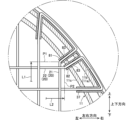
- Fig. 2 is an enlarged front cross-sectional view of part A in Fig. 1.
- Fig. 3 is a schematic perspective view of the common tube portion in this embodiment.
- Fig. 4 is a view seen from the arrow B in Fig. 2 with the strings omitted.
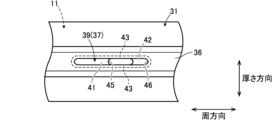
- Fig. 5 is a view seen from the arrow C in Fig. 2 with the strings omitted.
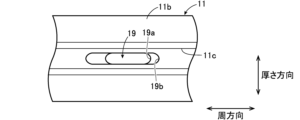
- Fig. 6 is a view with the grommets omitted from Fig. 5.
- common holes 19 of a different shape from the other holes are formed in four locations: the upper right, upper left, lower left, and lower right of the frame body 11 (shown by dotted lines in Figure 1).
- the tube portions 37 that are inserted through the four common holes 19 are referred to as common tube portions 39 (shown by dotted lines in Figure 1).
- the rightmost main string 21 and the topmost cross string 22 are inserted through the common hole 19 and common tube portion 39 in the upper right part of the frame body 11.
- the leftmost main string 21 and the topmost cross string 22 are inserted through the common hole 19 and common tube portion 39 in the upper left part of the frame body 11.
- the leftmost main string 21 and the bottommost cross string 22 are inserted through the common hole 19 and common tube portion 39 in the lower left part of the frame body 11.
- the rightmost main string 21 and the bottommost cross string 22 are inserted through the common hole 19 and common tube portion 39 in the lower right part of the frame body 11.
- the common hole 19 and common tube portion 39 in the upper right portion of the frame body 11 are generally symmetrical in left-right relation to the common hole 19 and common tube portion 39 in the upper left portion of the frame body 11.
- the common hole 19 and common tube portion 39 in the upper right and upper left portions of the frame body 11 are generally symmetrical in top-bottom relation to the common hole 19 and common tube portion 39 in the lower right and lower left portions of the frame body 11. Therefore, in the following, only the common hole 19 and common tube portion 39 in the upper right portion of the frame body 11 surrounded by the two-dot chain circle indicated by symbol A in Figure 1 will be illustrated and described, and detailed descriptions of the other common holes 19 and common tube portions 39 will be omitted.
- the common hole 19 in the upper right portion of the frame body 11 is formed in an inner circumferential shape along the outer circumferential surface of the common tube portion 39 that penetrates the inside.
- the common tube portion 39 has a first folded wall 41 that folds the main string 21 at the base end side (the belt portion 36 side) and a second folded wall 42 that folds the cross string 22 at the base end side.
- the common tube portion 39 also has a pair of side walls 43 (see FIG. 3, one of which is not shown in FIG. 2) that connect the first folded wall 41 and the second folded wall 42 on both sides in the thickness direction.
- the common tube portion 39 forms a tip side opening 45 and a base side opening 46.
- the tip side opening 45 and the base side opening 46 are formed in an elongated hole shape or an elliptical shape in which the opening dimension in the circumferential direction of the frame body 11 is larger than the opening dimension in the thickness direction of the frame body 11 (see FIGS. 4 and 5).
- the circumferential opening dimension of the frame body 11 is smaller at the distal opening 45 than at the proximal opening 46.
- the first folded wall 41 and the second folded wall 42 extend in a direction inclined with respect to the normal direction of the frame body 11.
- the first folded wall 41 and the second folded wall 42 are oriented in a direction approaching each other as they move from the base end to the tip.
- the first folded wall 41 contacts the main string 21 inserted inside the common tube portion 39 at a point or localized location on the inner circumferential surface of the base end side where the main string 21 gradually separates from the base end to the tip, and where the main string 21 is turned back.
- the second folded wall 42 contacts the cross string 22 inserted inside the common tube portion 39 at a point or localized location on the inner circumferential surface of the base end side where the cross string 22 gradually separates from the base end to the tip (similar).
- the directions of the first folded wall 41 and the second folded wall 42 with respect to the normal direction of the frame body 11 are not limited to the above-mentioned directions, and various modifications are possible.
- at least one of the first folded wall 41 and the second folded wall 42 may extend in a direction parallel to the normal direction of the frame body 11, or the first folded wall 41 and the second folded wall 42 may be oriented in directions that move away from each other as they move from the base end to the tip end.
- the main strings 21 and cross strings 22 that are inserted inside the common tubular portion 39 cross. Therefore, the main strings 21 and cross strings 22 cross at a position that includes the inside of the common hole 19 so that they fit inside the common hole 19 through which the common tubular portion 39 passes, or so that they straddle the inside and outside of the common hole 19.
- the common hole 19 forms an inner opening 19a on the inner peripheral surface 11c of the frame body 11, and an outer opening 19b in a groove portion 11b on the outer peripheral surface 11a of the frame body 11 (see FIG. 6).
- the common hole 19 is formed in an inner peripheral shape that follows the outer peripheral surface of the common cylindrical portion 39. Therefore, the inner opening 19a and the outer opening 19b are formed in an elongated hole shape or an elliptical shape in which the opening dimension in the circumferential direction of the frame body 11 is larger than the opening dimension in the thickness direction of the frame body 11. Also, the inner opening 19a is formed so that the opening dimension in the circumferential direction of the frame body 11 is larger than the outer opening 19b.
- the inner opening 19a of the common hole 19 and the tip opening 45 of the common tube portion 39 are shaped to extend in the circumferential direction of the frame body 11. This shape allows both the main strings 21 and the cross strings 22 to be inserted through a single common hole 19 (single common tube portion 39), with the main strings 21 oriented in a generally vertical direction and the cross strings 22 oriented in a generally horizontal direction within the common hole 19 (common tube portion 39). This allows the main strings 21 and cross strings 22 to be in an unfixed state near the tip opening 45 of the common tube portion 39.
- the effective length of the main string 21 is on the inner periphery of the base end of the first folded wall 41, indicated by reference character P1 in FIG. 2.
- the end of the effective length L2 of the cross string 22 is on the inner periphery of the base end of the second folded wall 42, indicated by reference character P2 in FIG. 2. This allows the ends P1 and P2 of each effective length L1 and L2 to be positioned closer to the outer periphery 11a of the frame body 11, ensuring long effective lengths L1 and L2 of the main strings 21 and cross strings 22.
- the common holes 19 and common tube portions 39 are provided in four locations on the upper right, upper left, lower left, and lower right portions of the frame body 11. This allows the effective lengths L1, L2 of the rightmost and leftmost main strings 21 and the uppermost and lowermost cross strings 22 in the frame body 11 to be long.
- the main strings 21 and cross strings 22 that have long effective lengths L1, L2 in this way are more likely to flex when hitting the ball, and the so-called sweet area of the hitting surface 24 can be expanded. As a result, the impact transmitted to the player when hitting the ball can be mitigated, improving the hitting feel, and making it possible to improve the controllability and flight performance of the racket 1.
- the inner opening 19a of the common hole 19 is formed with a smaller opening dimension in the circumferential direction of the frame body 11 than the outer opening 19b. This allows the inner opening 19a of the common hole 19 and the tip opening 45 of the common tubular portion 39 to be close to the main strings 21 and cross strings 22 in the circumferential direction without being too far apart, while ensuring a long effective length L1, L2 as described above.
- the main strings 21 and the cross strings 22 cross at a position that includes the inside of the common hole 19. This makes it easy to adopt a stringing pattern in which the tensioning range of the main strings 21 is expanded in the left-right direction inside the frame body 11, and the tensioning range of the cross strings 22 is expanded in the up-down direction.
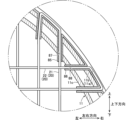
- Figure 7 is a cross-sectional view similar to Figure 2 of a racket relating to the first comparative structure.
- Figure 8 is a cross-sectional view similar to Figure 2 of a racket relating to the second comparative structure. Note that in each comparative structure, components similar to those of the above embodiment will be described with the same reference numerals.
- the first comparative structure in FIG. 7 has a configuration in which the main strings 21 and cross strings 22, which are inserted into the common tube portion 39 in the above embodiment, are inserted into two cylindrical tube portions 81, 82.
- the two cylindrical tube portions 81, 82 are configured similarly to the tube portion 37 in the above embodiment, and the direction in which they penetrate the frame body 11 is oriented in the normal direction of the frame body 11.
- two holes 83 through which the cylindrical tube portions 81, 82 penetrate are formed in the frame body 11, and the central axis directions of these two holes 83 are oriented in the normal direction of the frame body 11.
- the main strings 21 and cross strings 22 located inside the cylindrical tube portions 81, 82 are inserted in a direction inclined at approximately 45° with respect to the up-down and left-right directions. Therefore, the main strings 21 and cross strings 22 inserted into the cylindrical tube portions 81, 82 are bent at a large angle at the tips of the cylindrical tube portions 81, 82.
- the main strings 21 and cross strings 22 are fixed at the bending positions at the tips of the cylindrical tube portions 81 and 82.
- the bending positions become the ends P1 and P2 of the effective lengths L1 and L2 of the main strings 21 and cross strings 22, and the ends P1 and P2 are located near the inner circumferential surface 11c of the frame body 11.
- the effective lengths L1 and L2 of the first comparative structure are shorter than those of the above embodiment.
- by providing the common hole 19 and common tube portion 39 of the above embodiment it is possible to ensure that the effective lengths L1 and L2 of the main strings 21 and cross strings 22 to be tensioned are longer than those of the first comparative structure.
- the two cylindrical tubes 81, 82 and the two holes 83 are in close proximity to each other. This makes it difficult to insert the string 20 into the cylindrical tubes 81, 82 when tensioning the string 20.
- the common hole 19 and common tubular portion 39 in the above embodiment, it is possible to prevent the two tubular portions 37 from being in close proximity to each other, and to improve workability by eliminating the difficult tensioning work required in the first comparative structure. Furthermore, in the above embodiment, the common hole 19 and common tubular portion 39 have a shape that is long in the circumferential direction of the frame body 11, which makes it easier to insert the string 20 into the common tubular portion 39.
- the first comparative structure needs to be laid out so that the two cylindrical tube portions 81, 82 are spaced a specified distance apart and do not overlap. For this reason, the first comparative structure is subject to restrictions on the pattern and spacing of each string 21, 22, and is subject to restrictions that reduce the number of strings 21, 22 that can be strung.
- the above embodiment by inserting both the main strings 21 and the cross strings 22 into a single common tubular portion 39 (single common hole 19), it is possible to increase the degree of freedom in the position and shape of the common hole 19 and the common tubular portion 39. As a result, the above embodiment provides greater freedom in the pattern, spacing, and number of the strings 21, 22 to be strung compared to the first comparative structure.
- the second comparative structure in FIG. 8 has a configuration in which the main strings 21 and cross strings 22, which are inserted into the common tube portion 39 in the above embodiment, are inserted into two cylindrical tube portions 85 and 86.
- the two cylindrical tube portions 85 and 86 are configured similarly to the tube portion 37 in the above embodiment.
- the cylindrical tube portion 85 through which the main strings 21 are inserted and the hole 87 of the frame body 11 through which the cylindrical tube portion 85 passes are oriented parallel to the up-down direction.
- the cylindrical tube portion 86 through which the cross strings 22 are inserted and the hole 88 of the frame body 11 through which the cylindrical tube portion 86 passes are oriented parallel to the left-right direction. Therefore, the effective lengths (not shown) of the main strings 21 and cross strings 22 in the second comparative structure are approximate to the effective lengths L1 and L2 in the above embodiment.
- the central axis direction of holes 87, 88 is at a large angle different from the normal direction of frame body 11 and is closer to the tangential direction of frame body 11.
- the tip of the drill bit used to drill holes 87, 88 tends to slip on groove portion 11b and inner surface 11c of frame body 11, making it difficult to form holes 87, 88.
- the common hole 19 and the common tube portion 39 have a shape that is long in the circumferential direction of the frame body 11, so that the effective lengths L1, L2 can be ensured to be long even if the forming surface of the common hole 19 is brought closer to the normal direction of the frame body 11. Therefore, the above embodiment can achieve both easy machining of the common hole 19 and ensuring long effective lengths L1, L2.
- the two cylindrical tube portions 85, 86 and the two holes 87, 88 are in close proximity to each other on the inner peripheral surface 11c side of the frame body 11. Therefore, when comparing the second comparative structure with the above embodiment, the above embodiment is more advantageous for the same reasons as those stated in the comparison between the first comparative structure and the above embodiment.
- the present invention is not limited to the above-described embodiment, and can be modified in various ways.
- the size, shape, direction, etc. shown in the attached drawings are not limited to these, and can be modified as appropriate within the scope of the effects of the present invention.
- the present invention can be modified as appropriate without departing from the scope of its purpose.
- the grommets 31-34 are attached to the frame body 11, and the tubular portion 37 (including the common tubular portion 39) is attached to the multiple holes 18 (including the common hole 19), but this is not limited to the above.
- the tubular portion 37 may be omitted by subjecting the holes 18 to a predetermined machining process or inner surface treatment.
- the inner surface shape of the common tubular portion 39 in the above embodiment is formed as the inner surface shape of the common hole 19.
- the main strings 21 and cross strings 22 through which the common hole 19 and common tubular portion 39 are inserted are not limited to the above embodiment.
- the common hole 19 and common tubular portion 39 may be configured so that the second or subsequent cross strings 22 from the top or bottom are inserted therethrough, or so that the second or subsequent main strings 21 from the right or left are inserted therethrough.
- the common hole 19 and the common tube portion 39 are not limited to the above-mentioned four locations on the frame body 11, and the upper two or lower two of the four locations may be omitted. Furthermore, the common hole 19 and the common tube portion 39 are not limited to a single location at the above-mentioned four locations, and two or more may be formed.
- the main strings 21 and cross strings 22 intersect inside the common hole 19 and the common tube portion 39, but the intersection position may be inside the inner circumferential surface 11c of the frame body 11 (closer to the center of the ball-hitting surface 24).
- the holes 18 may be formed in a staggered arrangement so that they are alternately located with respect to the central position in the thickness direction, in addition to being formed at the center position in the thickness direction.
- holes through which the main strings 21 are inserted and holes through which the cross strings 22 are inserted are formed, which are staggered like the other holes 18.
- the holes through which the main strings 21 are inserted are oriented parallel to the vertical direction, and the holes through which the cross strings 22 are inserted are oriented parallel to the horizontal direction.
- the main strings 21 and cross strings 22 inserted into these holes are configured to cross inside the frame body 11 when viewed from the thickness direction. Therefore, the effective lengths of the main strings 21 and cross strings 22 are approximated to the effective lengths L1 and L2 of the above embodiment.
- the configuration of the present invention is exemplified by a racket 1 in which the strings 20 are strung inside the frame body 11, but the present invention is not limited to this and can also be applied to a racket frame 10 in which the strings 20 are not strung.
- the present invention relates to a racket frame and racket that can ensure long effective lengths of the main strings and cross strings.
Landscapes
- Health & Medical Sciences (AREA)
- General Health & Medical Sciences (AREA)
- Physical Education & Sports Medicine (AREA)
- Mutual Connection Of Rods And Tubes (AREA)
- Package Frames And Binding Bands (AREA)
- Moulding By Coating Moulds (AREA)
Priority Applications (4)
| Application Number | Priority Date | Filing Date | Title |
|---|---|---|---|
| EP24741569.8A EP4650012A1 (en) | 2023-01-12 | 2024-01-11 | Racket frame and racket |
| CN202480007265.6A CN120513122A (zh) | 2023-01-12 | 2024-01-11 | 球拍框架及球拍 |
| US19/144,551 US20260102660A1 (en) | 2023-01-12 | 2024-01-11 | Racket frame and racket |
| JP2024570218A JPWO2024150797A1 (https=) | 2023-01-12 | 2024-01-11 |
Applications Claiming Priority (2)
| Application Number | Priority Date | Filing Date | Title |
|---|---|---|---|
| JP2023-002763 | 2023-01-12 | ||
| JP2023002763 | 2023-01-12 |
Publications (1)
| Publication Number | Publication Date |
|---|---|
| WO2024150797A1 true WO2024150797A1 (ja) | 2024-07-18 |
Family
ID=91896934
Family Applications (1)
| Application Number | Title | Priority Date | Filing Date |
|---|---|---|---|
| PCT/JP2024/000475 Ceased WO2024150797A1 (ja) | 2023-01-12 | 2024-01-11 | ラケットフレーム及びラケット |
Country Status (6)
| Country | Link |
|---|---|
| US (1) | US20260102660A1 (https=) |
| EP (1) | EP4650012A1 (https=) |
| JP (1) | JPWO2024150797A1 (https=) |
| CN (1) | CN120513122A (https=) |
| TW (1) | TW202432208A (https=) |
| WO (1) | WO2024150797A1 (https=) |
Citations (8)
| Publication number | Priority date | Publication date | Assignee | Title |
|---|---|---|---|---|
| JPH06269514A (ja) | 1993-03-16 | 1994-09-27 | Sumitomo Rubber Ind Ltd | テニスラケット |
| JPH06292743A (ja) * | 1993-04-12 | 1994-10-21 | Sumitomo Rubber Ind Ltd | テニスラケットフレーム |
| JP2006519050A (ja) * | 2003-02-28 | 2006-08-24 | プリンス、スポーツ、インコーポレーテッド | フレーム開口付きスポーツラケット |
| CN2902359Y (zh) * | 2006-04-17 | 2007-05-23 | 厦门新凯复材科技有限公司 | 网球拍穿线结构 |
| JP2007144187A (ja) * | 2005-11-29 | 2007-06-14 | Prince Sports Inc | ストリングを固定するための挿入部材を有するスポーツラケット |
| WO2015177937A1 (ja) * | 2014-05-20 | 2015-11-26 | ヨネックス株式会社 | ラケット、および、グロメット |
| JP2016112260A (ja) * | 2014-12-16 | 2016-06-23 | ヨネックス株式会社 | バドミントンラケット |
| JP2023002763A (ja) | 2017-03-22 | 2023-01-10 | ジーディーエム エス.ピー.エー. | 吸収性パッドを形成するための装置および方法 |
-
2024
- 2024-01-11 JP JP2024570218A patent/JPWO2024150797A1/ja active Pending
- 2024-01-11 CN CN202480007265.6A patent/CN120513122A/zh active Pending
- 2024-01-11 WO PCT/JP2024/000475 patent/WO2024150797A1/ja not_active Ceased
- 2024-01-11 EP EP24741569.8A patent/EP4650012A1/en active Pending
- 2024-01-11 US US19/144,551 patent/US20260102660A1/en active Pending
- 2024-01-11 TW TW113101154A patent/TW202432208A/zh unknown
Patent Citations (8)
| Publication number | Priority date | Publication date | Assignee | Title |
|---|---|---|---|---|
| JPH06269514A (ja) | 1993-03-16 | 1994-09-27 | Sumitomo Rubber Ind Ltd | テニスラケット |
| JPH06292743A (ja) * | 1993-04-12 | 1994-10-21 | Sumitomo Rubber Ind Ltd | テニスラケットフレーム |
| JP2006519050A (ja) * | 2003-02-28 | 2006-08-24 | プリンス、スポーツ、インコーポレーテッド | フレーム開口付きスポーツラケット |
| JP2007144187A (ja) * | 2005-11-29 | 2007-06-14 | Prince Sports Inc | ストリングを固定するための挿入部材を有するスポーツラケット |
| CN2902359Y (zh) * | 2006-04-17 | 2007-05-23 | 厦门新凯复材科技有限公司 | 网球拍穿线结构 |
| WO2015177937A1 (ja) * | 2014-05-20 | 2015-11-26 | ヨネックス株式会社 | ラケット、および、グロメット |
| JP2016112260A (ja) * | 2014-12-16 | 2016-06-23 | ヨネックス株式会社 | バドミントンラケット |
| JP2023002763A (ja) | 2017-03-22 | 2023-01-10 | ジーディーエム エス.ピー.エー. | 吸収性パッドを形成するための装置および方法 |
Non-Patent Citations (1)
| Title |
|---|
| See also references of EP4650012A1 |
Also Published As
| Publication number | Publication date |
|---|---|
| JPWO2024150797A1 (https=) | 2024-07-18 |
| CN120513122A (zh) | 2025-08-19 |
| TW202432208A (zh) | 2024-08-16 |
| US20260102660A1 (en) | 2026-04-16 |
| EP4650012A1 (en) | 2025-11-19 |
Similar Documents
| Publication | Publication Date | Title |
|---|---|---|
| US9750989B2 (en) | Racket and grommet | |
| JP6782154B2 (ja) | グロメット及びラケット | |
| US10561907B2 (en) | Racket frame | |
| WO2017110327A1 (ja) | グロメット及びラケット | |
| JP6196786B2 (ja) | ラケット | |
| CN113543856B (zh) | 索环和球拍 | |
| WO2024150797A1 (ja) | ラケットフレーム及びラケット | |
| JP2023009181A (ja) | ラケット | |
| JP6525745B2 (ja) | ラケット | |
| JP2020151059A (ja) | ラケット | |
| JP7503005B2 (ja) | グロメット及びラケット | |
| JP6163324B2 (ja) | ラケット、及び、グロメット | |
| CN101687109A (zh) | 击球用具 | |
| CN104174144B (zh) | 球拍 | |
| JP6943608B2 (ja) | ラケット | |
| JP3247167U (ja) | テニスラケット | |
| WO2025134549A1 (ja) | バドミントンラケット | |
| JP2008017951A (ja) | ラケットフレームおよびラケット |
Legal Events
| Date | Code | Title | Description |
|---|---|---|---|
| 121 | Ep: the epo has been informed by wipo that ep was designated in this application |
Ref document number: 24741569 Country of ref document: EP Kind code of ref document: A1 |
|
| WWE | Wipo information: entry into national phase |
Ref document number: 2024570218 Country of ref document: JP |
|
| WWE | Wipo information: entry into national phase |
Ref document number: 202480007265.6 Country of ref document: CN |
|
| NENP | Non-entry into the national phase |
Ref country code: DE |
|
| WWP | Wipo information: published in national office |
Ref document number: 202480007265.6 Country of ref document: CN |
|
| WWP | Wipo information: published in national office |
Ref document number: 2024741569 Country of ref document: EP |