WO2024135049A1 - 情報処理装置、受信装置、情報処理方法及びプログラム - Google Patents
情報処理装置、受信装置、情報処理方法及びプログラム Download PDFInfo
- Publication number
- WO2024135049A1 WO2024135049A1 PCT/JP2023/036733 JP2023036733W WO2024135049A1 WO 2024135049 A1 WO2024135049 A1 WO 2024135049A1 JP 2023036733 W JP2023036733 W JP 2023036733W WO 2024135049 A1 WO2024135049 A1 WO 2024135049A1
- Authority
- WO
- WIPO (PCT)
- Prior art keywords
- user
- information
- identification information
- location
- identification
- Prior art date
- Legal status (The legal status is an assumption and is not a legal conclusion. Google has not performed a legal analysis and makes no representation as to the accuracy of the status listed.)
- Ceased
Links
Images





Classifications
-
- H—ELECTRICITY
- H04—ELECTRIC COMMUNICATION TECHNIQUE
- H04W—WIRELESS COMMUNICATION NETWORKS
- H04W4/00—Services specially adapted for wireless communication networks; Facilities therefor
- H04W4/02—Services making use of location information
- H04W4/029—Location-based management or tracking services
-
- G—PHYSICS
- G06—COMPUTING OR CALCULATING; COUNTING
- G06Q—INFORMATION AND COMMUNICATION TECHNOLOGY [ICT] SPECIALLY ADAPTED FOR ADMINISTRATIVE, COMMERCIAL, FINANCIAL, MANAGERIAL OR SUPERVISORY PURPOSES; SYSTEMS OR METHODS SPECIALLY ADAPTED FOR ADMINISTRATIVE, COMMERCIAL, FINANCIAL, MANAGERIAL OR SUPERVISORY PURPOSES, NOT OTHERWISE PROVIDED FOR
- G06Q50/00—Information and communication technology [ICT] specially adapted for implementation of business processes of specific business sectors, e.g. utilities or tourism
- G06Q50/10—Services
Definitions
- This disclosure relates to an information processing device, a receiving device, an information processing method, and a program.
- terminals that provide information about a destination and guide a user to a destination so that the user can easily reach the destination.
- Patent Document 1 discloses a technology that provides information that can be shared among multiple users heading to the same destination.
- the conventional technology disclosed in Patent Document 1 acquires information about the destinations of multiple users and matches multiple users who have a common destination. By sharing information between matched users, it is possible to provide information that may be of interest to the matched users. This allows users who do not know each other but are taking part in the same tour to share information, for example, which facilitates smooth communication between users.
- Non-limiting examples of the present disclosure contribute to providing an information processing device, information processing method, and program that can grasp the encounter situations of multiple users.
- An information processing device includes a first information acquisition unit that acquires first identification information including first location information indicating the location of a first transmitting device owned by a first user and first address information registered in the first transmitting device, a second information acquisition unit that acquires second identification information including second location information indicating the location of a second transmitting device owned by a second user and second address information registered in the second transmitting device, an encounter determination unit that determines whether the first user and the second user have encountered each other based on the first identification information and the second identification information, a user identification unit that identifies a third user based on the first address information and the second address information when the first user and the second user have encountered each other, and an information transmission unit that transmits at least one of the first identification information and the second identification information to a receiving device owned by the third user.
- a receiving device is a receiving device that receives information from an information processing device, and receives at least one of first identification information including first location information indicating a location of a first transmitting device owned by a first user and second identification information including second location information indicating a location of a second transmitting device owned by a second user from the information processing device; Information about the first user and the second user is displayed on a display unit based on at least one of the first identification information and the second identification information.
- An information processing method by an information processing device includes obtaining first identification information including first location information indicating the location of a first transmitting device owned by a first user and first address information registered in the first transmitting device, obtaining second identification information including second location information indicating the location of a second transmitting device owned by a second user and second address information registered in the second transmitting device, determining whether the first user and the second user have encountered each other based on the first identification information and the second identification information, and if the first user and the second user have encountered each other, identifying a third user based on the first address information and the second address information, and transmitting at least one of the first identification information and the second identification information to a receiving device owned by the third user.
- a program causes a computer to execute the following: obtain first identification information including first location information indicating the location of a first transmitting device owned by a first user and first address information registered in the first transmitting device; obtain second identification information including second location information indicating the location of a second transmitting device owned by a second user and second address information registered in the second transmitting device; determine whether the first user and the second user have encountered each other based on the first identification information and the second identification information; if the first user and the second user have encountered each other, identify a third user based on the first address information and the second address information; and transmit at least one of the first identification information and the second identification information to a receiving device owned by the third user.
- an information processing device it is possible to provide an information processing device, a receiving device, an information processing method, and a program that can grasp the encounter situations of multiple users.
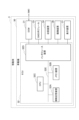
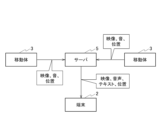
- FIG. 1 is a diagram illustrating an example of the configuration of an information processing system according to the first embodiment.
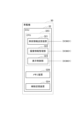
- FIG. 2 is a diagram illustrating an example of a hardware configuration of an ECU of the vehicle-mounted device.
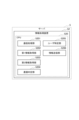
- FIG. 3 is a diagram showing an example of the functional configuration of the ECU of the vehicle-mounted device.
- FIG. 4 is a diagram showing an example of the hardware configuration and the functional configuration of an information processing device of the server.
- FIG. 5 is a flowchart for explaining the operation of the information processing system.
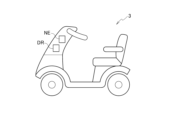
- FIG. 6 is an external view of the moving body 3.
- FIG. 7 is a diagram showing an example of information transmitted to the server and information transmitted to the user.
- FIG. 8 is a diagram showing an example of information displayed on the first and second client devices owned by the first and second users, respectively.
- FIG. 9 is a diagram showing an example of a map displayed on a third client device owned by a third user.
- FIG. 10 is a diagram showing an example of information displayed on a third client device owned by a third user.
- FIG. 11 is a diagram showing an example of a route guidance display provided to a third user.
- FIG. 12 is a diagram illustrating an example of the configuration of an information processing device according to the second embodiment.
- FIG. 13 is a diagram illustrating an example of the configuration of an information processing device according to the third embodiment.
- Fig. 1 is a diagram showing an example of the configuration of an information processing system according to a first embodiment.
- the information processing system 1 includes an on-board device 30 mounted on each of a plurality of moving objects 3, a plurality of terminals 2, and a server 5 capable of communicating with the on-board device 30 and the terminal 2.
- the on-board device 30 and the terminal 2 are also referred to as client devices.
- the type of client device may be only one of the on-board device 30 and the terminal 2.
- the information processing system 1 is composed of any client device from among the plurality of on-board devices 30 and the plurality of terminals 2, and the server 5.
- the moving object 3 may be a senior car, a passenger car, a freight vehicle, a motorcycle, etc.
- the moving object 3 may be simply referred to as a vehicle.
- the vehicle-mounted device 30 includes a DCM (Data Communication Module) 31, an ECU (Electronic Control Unit) 32, a GNSS (Global Navigation Satellite System) module 33, a sound pickup device 34, an imaging device 36, a display device 37, etc.
- DCM Data Communication Module
- ECU Electronic Control Unit
- GNSS Global Navigation Satellite System
- the DCM 31 is a communication device that communicates bidirectionally with external devices of the vehicle through a communication network NW.
- the communication network NW may be a mobile phone network with many base stations at its terminals, a satellite communication network using communication satellites, or the like.
- the DCM 31 is connected to the ECU 32 so as to be able to communicate with each other through a CAN (Controller Area Network) 38, which is an in-vehicle network.
- the DCM 31 transmits various information to the external devices of the vehicle in response to requests from the ECU 32, and also relays information transmitted from the external devices of the vehicle to the ECU 32.
- the external devices may be a server 5, a terminal 2, a V2X (Vehicle to Everything) communication device (not shown), or the like.
- V2X is a communication technology that connects cars to various things.
- V2X includes communications such as V2V (Vehicle to Vehicle), V2P (Vehicle to Pedestrian), V2I (Vehicle to Infrastructure), and V2N (Vehicle to Network).
- V2V Vehicle to Vehicle
- V2P Vehicle to Pedestrian
- V2I Vehicle to Infrastructure
- V2N Vehicle to Network
- the ECU 32 is an electronic control unit that performs various control processes related to specific functions in the vehicle, such as a motor ECU, a hybrid ECU, or an engine ECU.
- the ECU 32 collects vehicle information and inputs it to the DCM 31.
- the vehicle information includes vehicle position information, image information, sound information, and the like.
- the vehicle information can also include speed information, vehicle condition information, and the like.
- the vehicle position information is information indicating the current position of the vehicle, for example, information indicating the latitude and longitude where the vehicle is traveling.
- the vehicle position information is transmitted from the GNSS module 33 or the like.
- the GNSS module 33 receives GNSS signals transmitted from satellites and measures the position of the vehicle in which the GNSS module 33 is mounted.
- the GNSS module 33 is communicatively connected to the ECU 32 via the CAN 38, and the vehicle position information is transmitted to the ECU 32.
- the GNSS module 33 may include a module provided in a car navigation device, a module provided in a drive recorder, a module mounted on the vehicle body, a module provided in a terminal 2 owned by a user, and the like.
- the vehicle position information may be simply referred to as position information.
- the imaging information is information indicating the content of an image captured by the imaging device 36.
- the imaging information includes time information indicating the time when the image was generated.
- the imaging device 36 is a camera equipped with an imaging element such as a charge coupled device (CCD) or a complementary metal oxide semiconductor (CMOS).
- CCD charge coupled device
- CMOS complementary metal oxide semiconductor
- the imaging device 36 includes an internal imaging device that captures images of the inside of the vehicle, an external imaging device that captures images of the outside of the vehicle, etc.
- the imaging device 36 may also include a camera provided in a drive recorder, a camera mounted on the vehicle body, a camera provided in a terminal 2 owned by a user, etc.
- the internal imaging device is placed in a position where it can capture images of the faces of passengers, etc.
- the number of internal imaging devices is not limited to one, and multiple devices may be installed in the vehicle.
- the internal imaging device outputs imaging information that indicates the captured image of the interior of the vehicle.
- the external imaging device may be a front camera, rear camera, omnidirectional camera, panoramic camera, etc., that captures the scenery around the vehicle.
- the scenery around the vehicle may be, for example, the scenery in front of the vehicle, the scenery to the side of the vehicle (the driver's door side of the vehicle or the passenger door side of the vehicle), the scenery behind the vehicle, etc.
- the scenery may include, for example, the scenery at the destination of the user of terminal 2 (e.g., a meeting place, a park, etc.), the roadway on which the vehicle is traveling, objects on the roadway, the sidewalk facing the roadway, objects on the sidewalk, etc.
- the external imaging device is, for example, disposed in a position where it can capture the scenery outside the vehicle.
- the external imaging device outputs imaging information indicating the captured outside-vehicle image.
- the sound information may include the voice (audio) of the first user collected by the sound collection device 34, sounds around the first user, etc.
- the sound collection device 34 may include a microphone provided in a car navigation device, a microphone provided in a drive recorder, a microphone mounted on a vehicle body, a microphone provided in the terminal 2 owned by the user, etc.
- the display device 37 is a liquid crystal display or the like.
- the display device 37 may include a device provided in a car navigation device, a device provided in a drive recorder, a device mounted on the vehicle body, a device provided in a terminal 2 owned by a user, etc.
- Server 5 is a server that provides various services by collecting information from multiple vehicles and transmitting information (information distribution) to the occupants of the multiple vehicles.
- Server 5 can also be a server that provides various services by collecting information from terminals 2 held by the occupants of multiple vehicles or in-vehicle devices 30 mounted on multiple vehicles, and transmitting information (information distribution) to terminals 2 held by the occupants of other vehicles or in-vehicle devices 30 mounted on other vehicles.
- the various services include an information transfer service.
- the information transfer service may include, for example, transferring video data, audio data, location information, etc. collected by a specific terminal 2 or in-vehicle unit 30 to another terminal 2 or another in-vehicle unit 30.
- the various services are not limited to information transfer services, but may include car sharing services, authentication key services, trunk delivery services, B2C car sharing services, advertisement distribution services, etc.
- the server 5 includes a communication device 51 and an information processing device 52.
- the communication device 51 is a communication device that communicates bidirectionally with each of the multiple vehicle-mounted units 30 or multiple terminals 2 through the communication network NW under the control of the information processing device 52.
- the information processing device 52 executes various control processes in the server 5.
- the information processing device 52 is configured as a server computer including, for example, a CPU (Central Processing Unit), RAM (Random Access Memory), ROM (Read Only Memory), an auxiliary storage device, an input/output interface, etc.
- FIG. 2 is a diagram showing an example of the hardware configuration of the ECU 32 of the vehicle-mounted device 30.
- the ECU 32 includes an auxiliary storage device 32A, a memory device 32B, a CPU 32C, and an interface device 32D. These are connected to each other by a bus line 32E.
- the auxiliary storage device 32A is a hard disk drive (HDD) or flash memory that stores files and data necessary for processing by the ECU 32.
- the memory device 32B reads out and stores a program from the auxiliary storage device 32A when an instruction to start the program is received.
- the CPU 32C executes the program stored in the memory device 32B and realizes various functions of the ECU 32 in accordance with the program.
- the interface device 32D is, for example, an interface that connects the CPU 32C to the DCM 31 via the CAN 38 and also connects the imaging device 36 and the like to the DCM 31 via the CAN 38.
- FIG. 3 is a diagram showing an example of the functional configuration of the ECU 32 of the vehicle-mounted device 30.
- the CPU 32C of the ECU 32 includes a vehicle information transmission/reception unit 321, an image capture information management unit 322, and a display control unit 323.
- the vehicle information transmission/reception unit 321 has the function of transmitting the vehicle position information, image information, sound information, etc., described above, as vehicle information to the server 5, and the function of receiving information from the server 5.
- the imaging information management unit 322 inputs imaging information sent from the imaging device 36 for a certain period of time, and performs processing such as embedding time and vehicle position information in the imaging information.
- the display control unit 323 performs processing such as displaying a map including the current position of the vehicle on the display, and displaying the scenery outside the vehicle captured by the camera on the display.
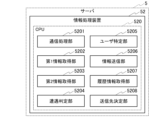
- FIG. 4 is a diagram showing an example of the hardware configuration and functional configuration of the server's information processing device.
- the information processing device 52 includes a CPU 520 and a storage unit (not shown).
- the CPU 520 includes a communication processing unit 5201, a first information acquisition unit 5202, a second information acquisition unit 5203, an encounter determination unit 5204, a user identification unit 5205, and an information transmission unit 5206.
- the communication processing unit 5201 transmits and receives signals between the multiple vehicle-mounted devices 30 and/or the multiple terminals 2. Specifically, the communication processing unit 5201 transmits and receives Protocol Data Units (PDUs) and Service Data Units (SDUs).
- PDUs Protocol Data Units
- SDUs Service Data Units
- the first information acquisition unit 5202 acquires, as the first information, first identification information that identifies the first user and first address information registered in the terminal 2 owned by the first user or the in-vehicle device 30 equipped in the vehicle in which the first user rides.
- the terminal 2 owned by the first user or the in-vehicle device 30 equipped in the vehicle in which the first user rides is also referred to as a first client device (first transmission device) owned by the first user.
- the first information acquisition unit 5202 may acquire the first address information stored in a storage unit (not shown) equipped in the server 5.
- the first information acquisition unit 5202 acquires first location information indicating the location of the first client device as the first identification information for identifying the first user.
- the first location information is information indicating the current location of the first client device, for example, information indicating the latitude and longitude at which the vehicle is traveling.
- the first location information is transmitted from the GNSS module 33 provided in the first client device.
- the first information acquisition unit 5202 also acquires sound data collected by the first client device as the first identification information for identifying the first user.
- the first information acquisition unit 5202 also acquires image data collected by the first client device as the first identification information for identifying the first user.
- the server 5 can identify the general location of the place where the first user is present, such as a meeting place where the first user is meeting a friend, or the venue of an event the first user is attending with a friend, and transmit the identified location to a terminal 2 owned by a specific user (e.g., a third user) who is an acquaintance of the first user, or to an in-vehicle device 30 in which the third user appears.
- a terminal 2 owned by the third user or the in-vehicle device 30 provided in the vehicle in which the third user is riding is also referred to as a third client device (receiving device) owned by the third user.
- the sound data includes the voice (audio) of the first user, sounds around the first user, etc.
- the sound data is not limited to data collected by the first client device of the first user, and may be data collected by a sound collection device other than a drive recorder or an onboard device 30 mounted on the vehicle body.
- the server 5 can transmit the voice of the first user, a conversation between the first user and his/her friend (e.g., a second user), sounds collected at the venue of an event in which the first user is participating, etc., to a third client device owned by a specific user (e.g., a third user) who is an acquaintance of the first user.
- the image data includes an image of the first user, a landscape image including the first user, a landscape image around the first user, etc.
- the image data is not limited to data collected by the first client device owned by the first user, but may be data collected by an imaging device other than a drive recorder provided in the vehicle in which the first user is riding or the in-vehicle device 30 mounted on the vehicle body.
- the first address information is information identifying one or more people (such as name, telephone number, address, etc.) that is recorded in an address book that is preregistered in the first client device owned by the first user.
- the first address information may be address information managed by the server 5 as information about the first user.
- the first address information may be, for example, address information that is preregistered by the first user, the second user, the third user, or any other third party and stored in a memory unit (not shown) provided in the server 5.
- the second information acquisition unit 5203 acquires, as the second information, second identification information that identifies the second user and second address information registered in the terminal 2 owned by the second user or the vehicle-mounted device 30 equipped in the vehicle in which the second user rides.
- the terminal 2 owned by the second user or the vehicle-mounted device 30 equipped in the vehicle in which the second user rides is also referred to as a second client device (second transmission device) owned by the second user.
- the second information acquisition unit 5203 may acquire the second address information stored in a storage unit (not shown) equipped in the server 5.
- the second information acquisition unit 5203 acquires, as second identification information for identifying the second user, second location information indicating the location of the second client device, sound data collected by the second client device, image data collected by the terminal 2, etc.
- the server 5 can identify the general location of the place where the second user is present, such as a meeting place where the second user is meeting a friend, or the venue of an event the second user is attending with a friend, and can notify the third client device of a specific user (e.g., a third user) who is an acquaintance of the second user, of the identified location.
- a specific user e.g., a third user
- the sound data includes the voice (audio) of the second user, sounds around the second user, etc.
- the sound data is not limited to data collected by a second client device owned by the second user, and may be data collected by a sound collection device other than the in-vehicle device 30 equipped in the vehicle in which the second user rides.
- the server 5 can notify a third client device owned by a specific user (e.g., a third user) who is an acquaintance of the second user of the voice of the second user, a conversation between the second user and his/her friend (e.g., the first user), sounds collected at the venue of an event in which the second user is participating, etc.
- the image data includes an image of the second user, a landscape image including the second user, a landscape image around the second user, etc.
- the image data is not limited to data collected by a second client device possessed by the second user, but may be data collected by an imaging device other than a drive recorder provided in a vehicle in which the second user is riding or an in-vehicle device 30 mounted on the vehicle body.
- the second address information is information identifying one or more people (such as name, telephone number, address, etc.) that is recorded in an address book that is preregistered in the second client device owned by the second user.
- the second address information may be address information managed by the server 5 as information about the second user.
- the second address information may be, for example, address information that is preregistered by the first user, the second user, the third user, or any other third party and stored in a memory unit (not shown) provided in the server 5.
- the encounter determination unit 5204 determines whether or not the first user and the second user have encountered each other, based on the first identification information and the second identification information.
- the encounter determination unit 5204 determines whether the distance from the position of the first user acquired by the first information acquisition unit 5202 to the position of the second user acquired by the second information acquisition unit 5203 is shorter than a specific distance based on first location information and second location information indicating the positions of the first client device and the second client device owned by the first user and the second user, respectively.
- the specific distance is, for example, 5 m, 10 m, 30 m, etc.
- the specific distance may be automatically set to a value appropriate to the location where the user is located, or may be set by the user to any value. If the encounter determination unit 5204 determines that the distance from the first user to the second user is shorter than the specific distance, it starts a timer and determines whether the distance is still shorter than the specific distance after a certain period of time has elapsed.
- the encounter determination unit 5204 determines that the first user and the second user have encountered each other at their common destination. This makes it possible to transmit specific information to the third user only when the first user and the second user are gathering at a specific destination with the same purpose, that is, excluding a situation where the first user happens to pass the second user on the road. Details of the specific information transmitted to the third user will be described later.
- the encounter determination unit 5204 determines that the first user and the second user have not encountered each other if the distance becomes longer than the specific distance before the timer has elapsed for a certain period of time. For example, if the first user and the second user meet by chance at a specific location, the first user may move away from the second user before the timer has elapsed for a certain period of time, and the distance from the first user to the second user may become longer than the specific distance. In this way, if the distance becomes longer than the specific distance before the timer has elapsed for a certain period of time, it is determined that the first user and the second user have not encountered each other at their common destination.
- the encounter determination unit 5204 may use sound data instead of the first location information and the second location information, or together with the first location information and the second location information. Specifically, the encounter determination unit 5204 analyzes the voice included in the sound data acquired by the first information acquisition unit 5202, and if the analyzed voice matches the voice of the second user registered in advance, determines that the second user is present around the first client device owned by the first user at the common destination of the first and second users. Note that the technology for analyzing voice and determining whether the voices match is publicly known, as disclosed in, for example, Japanese Patent Application Laid-Open No. 2001-338069.
- the encounter determination unit 5204 starts a timer as described above, and if the analyzed voice still matches the pre-registered voice of the second user after the timer has elapsed a certain period of time, it determines that the second user is present in the vicinity of the first client device owned by the first user, i.e., that the first and second users have encountered each other.
- the encounter determination unit 5204 determines that the first user and the second user have not encountered each other.
- the encounter determination unit 5204 can determine that the second user is present near the first client device, i.e., that there is a high possibility that the first user and the second user have encountered each other. In other words, this is particularly useful when the GNSS signal reception environment is poor. By using sound data and position information together, the reliability of the determination by the encounter determination unit 5204 can be improved.
- the encounter determination unit 5204 may use image data instead of the first location information and the second location information, or together with the first location information and the second location information. Specifically, the encounter determination unit 5204 analyzes the image data acquired by the first information acquisition unit 5202, and when the analyzed face image matches the face image of the second user registered in advance, it determines that the second user is present around the first client device owned by the first user. Note that the technology for analyzing an image and determining whether or not a face image matches is publicly known, for example, as disclosed in JP 2022-122098 A.
- the encounter determination unit 5204 starts a timer as described above, and if the second user is still present in the image captured by the first client device owned by the first user after the timer has elapsed a certain period of time, it determines that the first user and the second user have encountered each other.
- the encounter determination unit 5204 determines that the first user and the second user have not encountered each other.
- the encounter determination unit 5204 may determine whether the first user and the second user have encountered each other by combining at least two of the first and second location information, the sound data, and the image data.
- the user identification unit 5205 identifies the third user based on the first address information and the second address information.
- the user identification unit 5205 compares information identifying one or more people (e.g., names) contained in the first address information acquired by the first information acquisition unit 5202 with information identifying one or more people contained in the second address information acquired by the second information acquisition unit 5203.
- people e.g., names
- the person with that name is identified as a mutual friend or acquaintance (third user) of the first and second users, and address information of a third client device owned by the third user contained in the first address information or second address information is obtained. There may be one or more third users identified.
- the information transmitting unit 5206 transmits at least one of the first identification information and the second identification information to a third client device owned by a third user.
- the information transmission unit 5206 transmits at least one of the first location information or the second location information, the sound data collected by the first or second client device, and the image data collected by the first or second client device to the address of the third client device owned by the third user identified by the user identification unit 5205.
- the information transmission unit 5206 can inform the third client device owned by the third user of the locations where the first and second users are located. It is also possible to cause the third client device owned by the third user to display the route from the locations where the first and second users are located to the third user's location.
- the information transmission unit 5206 can cause the third client device owned by the third user to play sounds around the location where the first and second users are present, the voices of the first and second users, etc.
- the information transmission unit 5206 can display, on the third client device owned by the third user, an image of the surrounding area where the first and second users are present, the facial expressions of the first and second users, and the like.
- FIG. 5 is a flowchart for explaining the operation of the information processing system.
- FIG. 6 is an external view of a mobile object 3.
- FIG. 6 shows a drive recorder DR, a navigation device NE, etc. as examples of an in-vehicle device 30 mounted on the mobile object 3.
- FIG. 7 is a diagram showing an example of information sent to the server and information sent to the user.
- FIG. 7 shows information sent to the server 5 from the vehicle-mounted device 30 (first client device) equipped on the mobile body 3 in which the first user is riding.
- FIG. 7 also shows information sent to the server 5 from the vehicle-mounted device 30 (second client device) equipped on the mobile body 3 in which the second user is riding.
- FIG. 7 also shows information sent from the server 5 to the terminal 2 (third client device) of a third user.
- the information in question includes video of the facility in which the user is present, audio collected at the facility, text generated by transcribing the audio, and the location in which the user is present.
- step S1 an example of the operation when a first user and a second user on board a moving object 3 encounter each other and transmit information to a third client device owned by a third user will be described with reference to FIG. 5.
- the user of the moving object 3 uses specific application software installed on the client device to register his/her own information, such as his/her name and vehicle information, in advance (step S1).
- step S2 When the first user and the second user use the mobile unit 3 to move to a destination, video data, audio data, location information, etc. are transmitted from the first client device and the second client device owned by the first user and the second user to the server 5 (step S2). As a result, the server 5 acquires the video data, audio data, and location information acquired by the first client device and the second client device (step S3).
- FIG. 8 is a diagram showing an example of information displayed on a first client device and a second client device owned by a first user and a second user, respectively.
- Each user of the mobile object 3 can select users with whom they are allowed to share information by using specific application software installed on the client device.
- the first user when a first user wants to share information with a second user, the first user can allow the sharing of information with the second user by pressing an icon (allow/deny button) that is associated with an image that identifies the second user and is displayed on the screen.
- an icon allow/deny button
- the first user can also allow the sharing of information with the third user by pressing an icon (permit/deny button) that is associated with an image that identifies the third user and is displayed on the screen. This allows the first user to specify one or more users with whom to share information.
- step S4 If information sharing is not permitted (step S4: NO), the process of step S4 is repeated until it is permitted. If information sharing is permitted (step S4: YES), the process of step S5 is executed.
- step S5 If the second user does not encounter the first user who is permitted to share information (step S5: NO), the processing from step S3 onwards is repeated. If the second user encounters the first user who is permitted to share information (step S5: YES), the processing of step S6 is executed.
- step S6 If a common user among one or more users included in each of the first address information and the second address information has not been identified as a third user (step S6: NO), the processing from step S3 onwards is executed. If a common user has been identified as a third user (step S6: YES), the processing from step S7 is executed.
- the server 5 transmits to the third client device of the identified third user at least one of first location information indicating the location of the first client device of the first user, sound data collected by the first client device, and image data collected by the first client device (step S7). Note that instead of the first location information, second location information indicating the location of the second client device of the second user that encountered the first user may be transmitted.
- FIG. 9 is a diagram showing an example of a map displayed on a third client device of a third user.
- FIG. 9 shows a map displayed on a third client device owned by a third user who is permitted to share information.
- the map also shows icons identifying each user who is permitted to share information.
- Each user's icon is associated with the location where each user is located. If a user is using a mobile object 3, the client device may display a combination of the icon of the mobile object 3 and the user's icon.
- an icon identifying each user is displayed on the screen of each client device, superimposed on the map. This allows the user of each client device to easily check where each user is currently located.
- the server 5 transmits to the third client device owned by the third user, images of the inside of the facility where the first user is present when the second user encounters the first user.
- the third client device displays images of the facility.
- the server 5 may transmit images of the inside of the facility where the third user is present to the first client device owned by the first user, causing the first client device to display images of the facility.
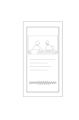
- FIG. 10 shows an example of a display on the screen of a third client device owned by a third user.
- the third client device displays video of the inside of the facility where the first and second users are present (top row of FIG. 10), text generated by transcribing audio collected at the facility (middle row of FIG. 10), and the like.
- the third client device also plays back audio collected at the facility.
- the third client device may also display an image showing the waveform of the sound being played (bottom row of FIG. 10).
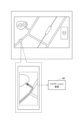
- FIG. 11 is a diagram showing an example of a route guidance display provided to a third user. After checking the video of the inside of the facility where the first and second users are present, the third user taps the icon of the first user displayed on the screen by an app installed on the third client device. This causes the third client device to automatically set a travel route from the third user's location to the first user's location.
- the set travel route may be transferred from the third client device to the navigation device. This allows the third user to easily travel to the location of the first user while checking the screen of the navigation device without having to check a smartphone or the like.
- the information processing device 52 of this embodiment is configured, when it determines that the first user and the second user have encountered each other based on the first identification information and the second identification information, to identify a third user who is a mutual friend of the first user and the second user, and to transmit at least one of the first identification information and the second identification information to a third client device owned by the third user.
- the conventional technology provides specific information to the third user a certain amount of time before the first and second users actually meet at the destination. Therefore, even if the specific information is provided at that time, if the first and second users' plans change thereafter, the third user may not be able to interact with the first and second users.
- the above configuration allows the third user to grasp the encounter situation between multiple users.
- the 23rd user can check the situation in which the first user and the second user actually encounter each other, and therefore may be more motivated to head to the destination to interact with the first user and others.
- opportunities to go out may be increased not only for elderly people living alone, but also for young people who are socially avoidant (recluses), and the like.
- the information processing device 52 of this embodiment when the first user and the second user encounter each other, information is automatically sent to the third user, so that the specific operation of the client device can be reduced.
- the specific operation is, for example, an operation in which either the first user or the second user inputs a message to invite the third user, or an operation to make a phone call. This makes it possible to reduce the burden on the first user and the second user. It also reduces the effort and labor required to explain the current location, etc. to the third user.
- Fig. 12 is a diagram showing an example of the configuration of an information processing device according to the second embodiment.
- the information processing device 52 according to the second embodiment includes a history information acquisition unit 5207 and a transmission destination determination unit 5208 in addition to the functions of the information processing device 52 according to the first embodiment.
- the history information acquisition unit 5207 acquires the out-of-home history of the third user identified by the user identification unit 5205. Specifically, the history information acquisition unit 5207 transmits an out-of-home history transmission request message to the third client device owned by the identified third user. As a result, the third client device extracts out-of-home history of the third user moving to a place other than his/her home from the history of location information recorded in the third client device, and transmits the out-of-home history to the server 5.
- the out-of-home history may include the third user's frequency of outings, out-of-home destinations, out-of-home dates and times, means of outing, etc.
- the out-of-home history may correspond to multiple third users.
- the destination determination unit 5208 identifies a third user who satisfies a specific condition from among a plurality of third users based on the outing history acquired by the history information acquisition unit 5207, and determines the receiving device owned by the identified third user as the destination of at least one of the first specific information and the second specific information.
- the destination determination unit 5208 also instructs the information transmission unit 5206 to transmit at least one of the first specific information and the second specific information to the determined destination.
- the destination determination unit 5208 refers to the outing history of each user and classifies the third users into those who satisfy a specific condition, for example, that the frequency of going out is less than a specific number of times, and those who do not satisfy the specific condition, that is, those who go out more than a specific number of times.
- the destination determination unit 5208 determines a third user who satisfies a specific condition as a destination for at least one of the first specific information and the second specific information for a certain period of time.
- the destination determination unit 5208 instructs the information transmission unit 5206 to transmit information to the determined destination (third user).
- the information transmission unit 5206 transmits the information to the determined destination (third user).
- users who do not often go out may lose motivation to go out if a lot of video is sent to them, so by only sending video for a certain period of time (i.e., enough to pique their interest), it is possible to effectively encourage them to go out.
- the destination determination unit 5208 may determine a third client device owned by a third user who satisfies a specific condition that the frequency of going out is equal to or greater than a specific number of times as a destination for at least one of the first specific information and the second specific information for a certain period of time. This allows users who go out frequently to have more opportunities to meet acquaintances.
- Third Embodiment Fig. 13 is a diagram showing an example of the configuration of an information processing device according to the third embodiment.
- the information processing device 52 according to the third embodiment includes a biometric information acquisition unit 5209 and a transmission destination determination unit 5210 in addition to the functions of the information processing device 52 according to the first embodiment.
- the biometric information acquisition unit 5209 acquires biometric information of the identified third user. Specifically, the biometric information acquisition unit 5209 receives biometric information transmitted (uploaded) from a third client device owned by the third user. The timing of receiving the biometric information may be at regular intervals or at a specific time.
- the third client device owned by the third user is, for example, a wearable terminal.
- the biometric information includes blood pressure, heart rate, body temperature, brain waves, voice, etc.
- the biometric information may be information that can identify the emotions, psychological state, etc. of the third user, and is not limited to these.
- the destination determination unit 5210 determines a third user who satisfies a specific condition as a destination for at least one of the first specific information and the second specific information based on the biometric information acquired by the biometric information acquisition unit 5209. The destination determination unit 5210 also instructs the information transmission unit 5206 to transmit at least one of the first specific information and the second specific information to the determined destination.
- the destination determination unit 5210 determines that the emotions of the third user who satisfies the specific condition are stable, and determines the third client device owned by the third user as the destination of at least one of the first specific information and the second specific information. The destination determination unit 5210 then transmits an instruction to the information transmission unit 5206 to permit the transmission of information to the third user.
- the transmission destination determination unit 5210 determines that the third user's emotions are unstable and excludes the third client device owned by the third user from the transmission destination of at least one of the first specific information and the second specific information. In this case, the transmission destination determination unit 5210 transmits an instruction to the information transmission unit 5206 to not allow the transmission of information to the third user.
- the destination determination unit 5210 may monitor whether the third user's blood pressure is below a threshold, whether the third user's body temperature is normal, etc., and use the results of the inference that the third user is in a state of irritation or impatience as a specific condition, and instruct whether or not to allow the transmission of information to the third user.
- the destination determination unit 5210 may also use as a specific condition the result of inferring the state of the autonomic nerves (whether the sympathetic nerves are dominant or the parasympathetic nerves are dominant) based on the third user's brain waves, etc.
- the destination determination unit 5210 may also use as a specific condition the result of inferring whether the third user is in an excited state, a neutral state, an irritated state, etc. based on the third user's facial expression, intonation of voice, etc.
- the information processing device 52 of the fourth embodiment in addition to the functions of the information processing device 52 of the first embodiment, includes a transmission confirmation unit that confirms with the first user or the second user whether it is OK to send information to a third user, and a transmission instruction unit that instructs the information sending unit 5206 to execute transmission when the first user or the second user allows the transmission in response to an inquiry from the transmission confirmation unit.
- the transmission confirmation unit may display a button such as "Send OK” or "Send NO" on the screen of the first client device owned by the first user or the second client device owned by the second user.
- the transmission instruction unit instructs the information transmission unit 5206 to execute transmission.
- the transmission instruction unit may also be configured to instruct the information transmission unit 5206 to execute transmission by voice operation such as "Send OK to third user.”
- the first user or the second user can set whether or not to allow transmission before the information transmission unit 5206 transmits information to the third user.
- the first user or the second user can limit the transmission targets.
- the functions of the server 5 shown in the first to fourth embodiments may be provided in either the terminal 2, which is a client device, or the vehicle-mounted device 30.
- the first to fourth embodiments may be combined with two or more of these.
- the information processing device, receiving device, information processing method, or program of the present embodiment may be configured as an information processing device, information processing method, or program shown in each of the following sections.
- An information processing device comprising: a first information acquisition unit that acquires first identification information including first location information indicating the location of a first transmitting device owned by a first user and first address information registered in the first transmitting device; a second information acquisition unit that acquires second identification information including second location information indicating the location of a second transmitting device owned by a second user and second address information registered in the second transmitting device; an encounter determination unit that determines whether the first user and the second user have encountered each other based on the first identification information and the second identification information; a user identification unit that identifies a third user based on the first address information and the second address information when the first user and the second user have encountered each other; and an information transmission unit that transmits at least one of the first identification information and the second identification information to a receiving device owned by the third user.
- An information processing device comprising: a history information acquisition unit that acquires the out-of-home history of the identified third user; and a transmission destination determination unit that identifies a third user who satisfies a specific condition from among a plurality of the third users based on the out-of-home history, and determines the receiving device owned by the identified third user as a transmission destination of at least one of the first identification information and the second identification information, wherein the transmission destination determination unit instructs the information transmission unit to transmit at least one of the first identification information and the second identification information to the determined transmission destination.
- An information processing device as described in clause 1 or 2, comprising a biometric information acquisition unit that acquires biometric information of the identified third user, and a destination determination unit that determines, based on the biometric information, the receiving device owned by the third user that satisfies a specific condition as a destination for at least one of the first identification information and the second identification information, and the destination determination unit instructs the information transmission unit to transmit at least one of the first identification information and the second identification information to the determined destination.
- a receiving device that receives information from an information processing device, and receives from the information processing device at least one of first identification information including first location information indicating the location of a first transmission device owned by a first user and second identification information including second location information indicating the location of a second transmission device owned by a second user, and displays information about the first user and the second user on a display unit based on at least one of the first identification information and the second identification information.
- An information processing method by an information processing device which acquires first identification information including first location information indicating the location of a first transmitting device owned by a first user and first address information registered in the first transmitting device, acquires second identification information including second location information indicating the location of a second transmitting device owned by a second user and second address information registered in the second transmitting device, determines whether the first user and the second user have encountered each other based on the first identification information and the second identification information, and if the first user and the second user have encountered each other, identifies a third user based on the first address information and the second address information, and transmits at least one of the first identification information and the second identification information to a resin device owned by the third user.
- a program that causes a computer to execute the following: acquiring first identification information including first location information indicating the location of a first transmitting device owned by a first user and first address information registered in the first transmitting device; acquiring second identification information including second location information indicating the location of a second transmitting device owned by a second user and second address information registered in the second transmitting device; determining whether the first user and the second user have encountered each other based on the first identification information and the second identification information; if the first user and the second user have encountered each other, identifying a third user based on the first address information and the second address information; and transmitting at least one of the first identification information and the second identification information to a receiving device owned by the third user.
Landscapes
- Engineering & Computer Science (AREA)
- Business, Economics & Management (AREA)
- Computer Networks & Wireless Communication (AREA)
- Signal Processing (AREA)
- Tourism & Hospitality (AREA)
- Human Resources & Organizations (AREA)
- Physics & Mathematics (AREA)
- General Health & Medical Sciences (AREA)
- Health & Medical Sciences (AREA)
- Marketing (AREA)
- Primary Health Care (AREA)
- Strategic Management (AREA)
- Economics (AREA)
- General Business, Economics & Management (AREA)
- General Physics & Mathematics (AREA)
- Theoretical Computer Science (AREA)
- Management, Administration, Business Operations System, And Electronic Commerce (AREA)
- Telephonic Communication Services (AREA)
- Two-Way Televisions, Distribution Of Moving Picture Or The Like (AREA)
Priority Applications (3)
| Application Number | Priority Date | Filing Date | Title |
|---|---|---|---|
| JP2024565619A JP7848895B2 (ja) | 2022-12-19 | 2023-10-10 | 情報処理装置、受信装置、情報処理方法及びプログラム |
| US19/241,823 US20250317711A1 (en) | 2022-12-19 | 2025-06-18 | Information processing device, reception device, information processing method, and non-transitory computer-readable storage medium |
| JP2025143371A JP2025172098A (ja) | 2022-12-19 | 2025-08-29 | 情報処理装置、情報処理方法及びプログラム |
Applications Claiming Priority (2)
| Application Number | Priority Date | Filing Date | Title |
|---|---|---|---|
| JP2022-202097 | 2022-12-19 | ||
| JP2022202097 | 2022-12-19 |
Related Child Applications (1)
| Application Number | Title | Priority Date | Filing Date |
|---|---|---|---|
| US19/241,823 Continuation US20250317711A1 (en) | 2022-12-19 | 2025-06-18 | Information processing device, reception device, information processing method, and non-transitory computer-readable storage medium |
Publications (1)
| Publication Number | Publication Date |
|---|---|
| WO2024135049A1 true WO2024135049A1 (ja) | 2024-06-27 |
Family
ID=91588301
Family Applications (1)
| Application Number | Title | Priority Date | Filing Date |
|---|---|---|---|
| PCT/JP2023/036733 Ceased WO2024135049A1 (ja) | 2022-12-19 | 2023-10-10 | 情報処理装置、受信装置、情報処理方法及びプログラム |
Country Status (3)
| Country | Link |
|---|---|
| US (1) | US20250317711A1 (https=) |
| JP (2) | JP7848895B2 (https=) |
| WO (1) | WO2024135049A1 (https=) |
Cited By (1)
| Publication number | Priority date | Publication date | Assignee | Title |
|---|---|---|---|---|
| JP2025110351A (ja) * | 2024-01-15 | 2025-07-28 | 株式会社ウフル | 地図情報提供システム、地図情報提供方法及び地図情報提供プログラム |
Citations (5)
| Publication number | Priority date | Publication date | Assignee | Title |
|---|---|---|---|---|
| JP2010021701A (ja) * | 2008-07-09 | 2010-01-28 | Oki Electric Ind Co Ltd | 会議参加者呼出システム、会議参加者呼出サーバ及び会議参加者呼出プログラム |
| JP2017006690A (ja) * | 2016-07-22 | 2017-01-12 | 株式会社セガゲームス | プログラム及び情報処理装置 |
| JP2018128744A (ja) * | 2017-02-06 | 2018-08-16 | Kddi株式会社 | 通知装置、通知方法及び通知プログラム |
| JP2019068153A (ja) * | 2017-09-29 | 2019-04-25 | パナソニックIpマネジメント株式会社 | 情報処理方法、情報処理装置及び情報処理プログラム |
| JP2020106907A (ja) * | 2018-12-26 | 2020-07-09 | Kddi株式会社 | 通知装置及び通知方法 |
Family Cites Families (1)
| Publication number | Priority date | Publication date | Assignee | Title |
|---|---|---|---|---|
| JP2010002170A (ja) | 2008-05-22 | 2010-01-07 | Panasonic Corp | 加熱調理器 |
-
2023
- 2023-10-10 JP JP2024565619A patent/JP7848895B2/ja active Active
- 2023-10-10 WO PCT/JP2023/036733 patent/WO2024135049A1/ja not_active Ceased
-
2025
- 2025-06-18 US US19/241,823 patent/US20250317711A1/en active Pending
- 2025-08-29 JP JP2025143371A patent/JP2025172098A/ja active Pending
Patent Citations (5)
| Publication number | Priority date | Publication date | Assignee | Title |
|---|---|---|---|---|
| JP2010021701A (ja) * | 2008-07-09 | 2010-01-28 | Oki Electric Ind Co Ltd | 会議参加者呼出システム、会議参加者呼出サーバ及び会議参加者呼出プログラム |
| JP2017006690A (ja) * | 2016-07-22 | 2017-01-12 | 株式会社セガゲームス | プログラム及び情報処理装置 |
| JP2018128744A (ja) * | 2017-02-06 | 2018-08-16 | Kddi株式会社 | 通知装置、通知方法及び通知プログラム |
| JP2019068153A (ja) * | 2017-09-29 | 2019-04-25 | パナソニックIpマネジメント株式会社 | 情報処理方法、情報処理装置及び情報処理プログラム |
| JP2020106907A (ja) * | 2018-12-26 | 2020-07-09 | Kddi株式会社 | 通知装置及び通知方法 |
Cited By (2)
| Publication number | Priority date | Publication date | Assignee | Title |
|---|---|---|---|---|
| JP2025110351A (ja) * | 2024-01-15 | 2025-07-28 | 株式会社ウフル | 地図情報提供システム、地図情報提供方法及び地図情報提供プログラム |
| JP7745687B2 (ja) | 2024-01-15 | 2025-09-29 | 株式会社ウフル | 地図情報提供システム、地図情報提供方法及び地図情報提供プログラム |
Also Published As
| Publication number | Publication date |
|---|---|
| JP2025172098A (ja) | 2025-11-20 |
| JP7848895B2 (ja) | 2026-04-21 |
| US20250317711A1 (en) | 2025-10-09 |
| JPWO2024135049A1 (https=) | 2024-06-27 |
Similar Documents
| Publication | Publication Date | Title |
|---|---|---|
| JP6862629B2 (ja) | 見守り送迎システムにおける車両管理サーバ、車載端末、見守り方法、及びプログラム | |
| CN110175686B (zh) | 监测车辆保养质量 | |
| US11225163B2 (en) | Electric vehicle charging platform | |
| CN101399886B (zh) | 用于与交通工具乘客进行电话会议的方法和系统 | |
| JP7059845B2 (ja) | 車載装置 | |
| JP6582328B2 (ja) | 情報出力システム、情報出力方法、及びプログラム | |
| JPWO2007080921A1 (ja) | 情報記録システム、情報記録装置、情報記録方法及び情報収集プログラム | |
| WO2020140773A1 (zh) | 网约车监控方法、装置及系统 | |
| JP2025172098A (ja) | 情報処理装置、情報処理方法及びプログラム | |
| JP2022129626A (ja) | 車載端末装置、電子会議システム、電子会議方法及びプログラム | |
| JP6753157B2 (ja) | 車両データ提供装置、車両データ提供システム及び車両データ提供方法 | |
| JP7737891B2 (ja) | 通信システム、通信装置、サーバ装置、通信方法、通信プログラム及び記憶媒体 | |
| CN115766929B (zh) | 车载座舱的变声通话方法、装置、系统、设备及介质 | |
| JP2002279588A (ja) | 自動車の配車システム、および自動車の配車方法 | |
| JP7662828B2 (ja) | 通信システム、通信装置、サーバ装置、通信方法、通信プログラム及び記憶媒体 | |
| JP7798560B2 (ja) | 通信システム、通信装置、サーバ装置、通信方法、通信プログラム及び記憶媒体 | |
| JP2022156122A (ja) | 立寄り提案装置 | |
| JP6884557B2 (ja) | 移動体を利用するユーザの対話型教師データ管理システム | |
| JP6980960B2 (ja) | 車両に積載され、車両に乗車しているユーザとコミュニケーションが可能な車載コミュニケーション装置、コミュニケーション方法及びプログラム | |
| JP7778815B2 (ja) | 通信システム、情報処理装置、情報処理方法、プログラム及び記録媒体 | |
| JP2022144462A (ja) | コンテンツ配信装置 | |
| CN113034727A (zh) | 移动体内图像提供系统及其方法、和其服务器、存储介质 | |
| CN116828419B (zh) | 紧急呼叫方法、装置、车辆、移动终端及存储介质 | |
| US12479294B2 (en) | System and method for managing a vehicle event mode | |
| JP2024104607A (ja) | 情報処理装置、情報処理方法、情報処理プログラム及び記憶媒体 |
Legal Events
| Date | Code | Title | Description |
|---|---|---|---|
| 121 | Ep: the epo has been informed by wipo that ep was designated in this application |
Ref document number: 23906424 Country of ref document: EP Kind code of ref document: A1 |
|
| WWE | Wipo information: entry into national phase |
Ref document number: 2024565619 Country of ref document: JP |
|
| NENP | Non-entry into the national phase |
Ref country code: DE |
|
| 122 | Ep: pct application non-entry in european phase |
Ref document number: 23906424 Country of ref document: EP Kind code of ref document: A1 |