WO2024122603A1 - 印刷凹版及びその製造方法、並びに印刷方法 - Google Patents
印刷凹版及びその製造方法、並びに印刷方法 Download PDFInfo
- Publication number
- WO2024122603A1 WO2024122603A1 PCT/JP2023/043776 JP2023043776W WO2024122603A1 WO 2024122603 A1 WO2024122603 A1 WO 2024122603A1 JP 2023043776 W JP2023043776 W JP 2023043776W WO 2024122603 A1 WO2024122603 A1 WO 2024122603A1
- Authority
- WO
- WIPO (PCT)
- Prior art keywords
- printing
- resin layer
- less
- intaglio
- mass
- Prior art date
- Legal status (The legal status is an assumption and is not a legal conclusion. Google has not performed a legal analysis and makes no representation as to the accuracy of the status listed.)
- Ceased
Links
Images






Classifications
-
- B—PERFORMING OPERATIONS; TRANSPORTING
- B41—PRINTING; LINING MACHINES; TYPEWRITERS; STAMPS
- B41C—PROCESSES FOR THE MANUFACTURE OR REPRODUCTION OF PRINTING SURFACES
- B41C1/00—Forme preparation
- B41C1/02—Engraving; Heads therefor
- B41C1/04—Engraving; Heads therefor using heads controlled by an electric information signal
- B41C1/05—Heat-generating engraving heads, e.g. laser beam, electron beam
-
- B—PERFORMING OPERATIONS; TRANSPORTING
- B23—MACHINE TOOLS; METAL-WORKING NOT OTHERWISE PROVIDED FOR
- B23K—SOLDERING OR UNSOLDERING; WELDING; CLADDING OR PLATING BY SOLDERING OR WELDING; CUTTING BY APPLYING HEAT LOCALLY, e.g. FLAME CUTTING; WORKING BY LASER BEAM
- B23K26/00—Working by laser beam, e.g. welding, cutting or boring
- B23K26/352—Working by laser beam, e.g. welding, cutting or boring for surface treatment
- B23K26/355—Texturing
-
- B—PERFORMING OPERATIONS; TRANSPORTING
- B41—PRINTING; LINING MACHINES; TYPEWRITERS; STAMPS
- B41C—PROCESSES FOR THE MANUFACTURE OR REPRODUCTION OF PRINTING SURFACES
- B41C1/00—Forme preparation
- B41C1/18—Curved printing formes or printing cylinders
-
- B—PERFORMING OPERATIONS; TRANSPORTING
- B41—PRINTING; LINING MACHINES; TYPEWRITERS; STAMPS
- B41M—PRINTING, DUPLICATING, MARKING, OR COPYING PROCESSES; COLOUR PRINTING
- B41M1/00—Inking and printing with a printer's forme
- B41M1/10—Intaglio printing ; Gravure printing
-
- B—PERFORMING OPERATIONS; TRANSPORTING
- B41—PRINTING; LINING MACHINES; TYPEWRITERS; STAMPS
- B41N—PRINTING PLATES OR FOILS; MATERIALS FOR SURFACES USED IN PRINTING MACHINES FOR PRINTING, INKING, DAMPING, OR THE LIKE; PREPARING SUCH SURFACES FOR USE AND CONSERVING THEM
- B41N1/00—Printing plates or foils; Materials therefor
- B41N1/12—Printing plates or foils; Materials therefor non-metallic other than stone, e.g. printing plates or foils comprising inorganic materials in an organic matrix
-
- B—PERFORMING OPERATIONS; TRANSPORTING
- B41—PRINTING; LINING MACHINES; TYPEWRITERS; STAMPS
- B41N—PRINTING PLATES OR FOILS; MATERIALS FOR SURFACES USED IN PRINTING MACHINES FOR PRINTING, INKING, DAMPING, OR THE LIKE; PREPARING SUCH SURFACES FOR USE AND CONSERVING THEM
- B41N1/00—Printing plates or foils; Materials therefor
- B41N1/16—Curved printing plates, especially cylinders
- B41N1/22—Curved printing plates, especially cylinders made of other substances
-
- B—PERFORMING OPERATIONS; TRANSPORTING
- B41—PRINTING; LINING MACHINES; TYPEWRITERS; STAMPS
- B41F—PRINTING MACHINES OR PRESSES
- B41F9/00—Rotary intaglio printing presses
Definitions
- the present invention relates to a printing intaglio plate, a method for producing the same, and a printing method.
- Gravure printing has traditionally been used to print high-quality photographs and other images.
- the commonly used gravure printing plates (gravure cylinders) use a hard copper plate for the plate cylinder, with recesses engraved into the surface of the copper plate using a diamond blade or similar, and the surface of the plate is then plated with a hard metal such as chrome.
- the depth of the recesses can be freely controlled. Recently, methods such as engraving with laser light or using photomechanical techniques to pattern photoresist and then etching the metal have been used to form the recesses. Ink is pooled in the recesses formed in this way and then transferred to the printed material, resulting in a high-quality print in which gradation is expressed by the thickness of the ink.
- the present invention was made in consideration of the above problems, and aims to provide a printing intaglio plate that achieves both improved ink transfer stability to highlight areas and improved ink coverage to solid areas, as well as a manufacturing method for the same and a printing method.
- the inventors conducted extensive research to solve the above problems. As a result, they discovered that the above problems could be solved by adjusting the Shore A hardness, surface free energy, and coefficient of variation of the cell volume of the resin layer in a resin gravure plate, which led to the invention.
- the present invention is as follows. [1] It has a resin layer that forms the plate surface, The Shore A hardness of the resin layer is 30 degrees or more and 90 degrees or less, The surface free energy of the resin layer is 10 mN/m or more and 35 mN/m or less, the resin layer has cells on the plate surface, and the coefficient of variation of the cell volume of the cells for printing with the same ink concentration is 0.200 or less; Printing intaglio. [2] The same ink density is 0.50 or less; The printing intaglio plate according to [1]. [3] The resin layer contains at least one resin selected from the group consisting of a photosensitive resin and a thermosetting resin. The printing intaglio plate according to [1] or [2].
- the resin layer contains a silicone compound in an amount of 0.10 parts by mass or more and 15.0 parts by mass or less based on the total amount of the silicone compound.
- the printing intaglio plate according to any one of [1] to [3].
- the depth of the cell is 0.10 ⁇ m or more and 100 ⁇ m or less.
- [6] Equipped with a cylinder, The cylindrical resin layer is disposed on the surface of the cylinder. The printing intaglio plate according to any one of [1] to [5].
- a support layer is provided between the cylinder and the cylindrical resin layer. The printing intaglio plate according to [6].
- the overlap rate of the laser is 50.0% or more and 99.9% or less.
- the spot diameter of the laser is 1.0 ⁇ m or more and 20 ⁇ m or less.
- the resin layer is directly irradiated with the laser.
- the processing step includes a step of forming a recess after disposing the resin layer on a cylinder, or a step of forming a recess in the resin layer in advance and then disposing the resin layer on the cylinder.
- the ink density in the solid area is 2.10 or more;
- the transfer rate in the highlight area is 90% or more,
- the ink density of the highlighted area is 0.50 or less.
- the present invention provides a printing intaglio plate that achieves both improved ink transfer stability to highlight areas and improved ink coverage to solid areas, as well as a method for producing the same and a printing method.
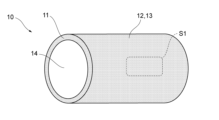
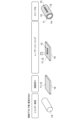
- FIG. 1 is a perspective view showing one embodiment of a printing intaglio plate according to the present embodiment.
- 1B is a cross-sectional view and a plan view showing one embodiment of the printing surface of region S1 in FIG. 1A.
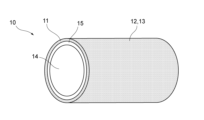
- FIG. 2 is a perspective view showing another aspect of the printing intaglio plate of the present embodiment.
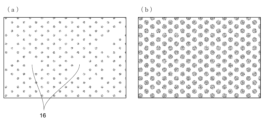
- FIG. 1A is an example of a plan view showing defects that may occur in a highlighted region;
- FIG. 1B is an example of a plan view in a non-highlighted region.
- FIG. 1 is a schematic diagram showing a conventional method for manufacturing a metal gravure plate.
- FIG. 1 is a schematic diagram showing one embodiment of a method for producing an intaglio printing plate according to the present embodiment.
- FIG. 1 is a schematic diagram showing one embodiment of a method for producing an intaglio printing plate according to the present embodiment.
- FIG. 1 is a schematic diagram showing one embodiment of a method for producing an intaglio printing plate according to the present embodiment.
- FIG. 1 is a schematic diagram showing one embodiment of a method for producing an intaglio printing plate according to the present embodiment.
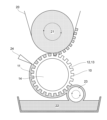
- FIG. 1 is a schematic diagram showing one embodiment of a printing method using the printing intaglio plate of the present embodiment.
- FIG. 2 is a schematic diagram showing a part of the manufacturing process of a printing intaglio plate in the examples.
- 1A and 1B are cross-sectional and plan views showing the cell shape of a printing intaglio plate in an embodiment.
- the present embodiment an embodiment of the present invention (hereinafter referred to as "the present embodiment") will be described in detail with reference to the drawings as necessary, but the present invention is not limited to this, and various modifications are possible without departing from the gist of the invention.
- the same elements are given the same reference numerals, and duplicated explanations will be omitted.
- positional relationships such as up, down, left, and right will be based on the positional relationships shown in the drawings.
- the dimensional ratios of the drawings are not limited to those shown in the drawings.
- the intaglio printing plate of this embodiment has a resin layer constituting a printing surface, the resin layer has a Shore A hardness of 30 degrees or more and 90 degrees or less, the resin layer has a surface free energy of 10 mN/m or more and 35 mN/m or less, the resin layer has cells on the printing surface, and the coefficient of variation of cell volume of the cells for printing with the same ink concentration is 0.200 or less.
- Resin Layer Fig. 1A is a perspective view showing one embodiment of the printing intaglio plate of this embodiment.
- the printing intaglio plate 10 of this embodiment has a resin layer 11 that constitutes a plate surface 12.
- the printing intaglio plate of this embodiment may be cylindrical as shown in Fig. 1A, flat, or may have other shapes.
- the printing intaglio plate of this embodiment is preferably a printing intaglio plate used for gravure printing.
- the resin layer 11 has cells 13 on the plate surface 12.
- the cells 13 are recesses formed in the resin layer 11.
- ink 22 is held in the cells 13, and printing is performed by transferring the ink 22 held in the cells 13 to a substrate 20 (see FIG. 3 ).
- FIG. 1B shows a cross-sectional view and a plan view illustrating one embodiment of a cell 13 formed in region S1 of FIG. 1A.
- the amount of ink held in the cell 13 varies depending on the volume of the cell 13.
- the amount of ink held in one cell 13 is related to the amount of ink per dot transferred to the substrate 20. Therefore, the larger the volume of the cell 13, the higher the ink concentration. In this way, gravure printing makes it possible to produce high-quality printed matter in which gradations are expressed by the ink film thickness.
- the "solid area” refers to an area on the surface (plate surface) of the resin layer where relatively large cells 13 are arranged.
- a "highlight area” is an area on the surface of the resin layer (printing surface) where relatively small cells are arranged.
- a highlight area is, for example, an area where the ink density represented by the above formula is 0.50 or less.
- the parts of the printing surface 12 other than the cells 13 are called banks 13a.
- the banks 13a do not hold the ink 22, and any ink 22 that adheres to the banks 13a is removed by a doctor blade 24 or the like.
- the ink 22 is transferred to the substrate 20, the banks 13a are pressed against the substrate 20, and the ink 22 held in the cells 13 is transferred to the substrate 20.
- the depth of the cells 13 is preferably 0.10 ⁇ m to 100 ⁇ m, 0.75 ⁇ m to 80 ⁇ m, 1.0 ⁇ m to 75 ⁇ m, or 2.5 ⁇ m to 50 ⁇ m.
- the depth of the cells 13 in the solid area is preferably 20 ⁇ m to 100 ⁇ m, 25 ⁇ m to 80 ⁇ m, or 30 ⁇ m to 60 ⁇ m.
- the depth of the cells 13 in the highlighted area is preferably 0.10 ⁇ m to less than 20 ⁇ m, 1.0 ⁇ m to 15 ⁇ m, or 2.5 ⁇ m to 10 ⁇ m.
- the long axis of the cells 13 when viewed in a planar view is preferably 5 ⁇ m to 500 ⁇ m, 15 ⁇ m to 400 ⁇ m, or 25 ⁇ m to 300 ⁇ m.
- the long axis of the cells 13 in the solid area when viewed in a planar view is preferably 100 ⁇ m to 500 ⁇ m, 125 ⁇ m to 400 ⁇ m, or 150 ⁇ m to 300 ⁇ m.
- the long axis of the cells 13 in the highlighted area when viewed in a planar view is preferably 5 ⁇ m to less than 100 ⁇ m, 15 ⁇ m to 90 ⁇ m, or 25 ⁇ m to 80 ⁇ m.
- the major axis refers to the major axis of an ellipse that circumscribes a cell of any shape.
- the shape of the cells 13 is not particularly limited, but examples include circular shapes such as circles and ellipses; and polygonal shapes such as triangles and rectangles.
- the thickness of the resin layer 11 is preferably 250 ⁇ m or more and 10,000 ⁇ m or less, 500 ⁇ m or more and 7,500 ⁇ m or less, or 1,000 ⁇ m or more and 5,000 ⁇ m or less.
- the Shore A hardness of the resin layer 11 is 30 degrees or more and 90 degrees or less, preferably 32 degrees or more and 85 degrees or less, 35 degrees or more and 80 degrees or less, 40 degrees or more and 80 degrees or less, 45 degrees or more and 80 degrees or less, or 50 degrees or more and 80 degrees or less.
- the Shore A hardness is 30 degrees or more, damage to the resin layer 11 is suppressed when removing excess ink 22 with the doctor blade 24.
- the product life of the printing intaglio plate 10 tends to be further improved.
- the Shore A hardness is 90 degrees or less
- the conformability of the printing intaglio plate 10 to the substrate 20 tends to be further improved. Therefore, in any cell such as a solid area or a highlight area, the transferability of the ink from the cell to the substrate tends to be further improved.
- the stability of ink transfer is further improved, particularly in highlighted areas, and the ink coverage is further improved in solid areas.
- the Shore A hardness of the resin layer 11 can be adjusted by selecting the type and amount of the components that make up the resin layer 11.
- the Shore A hardness may be adjusted by the type and amount of the thermoplastic elastomer and plasticizer described below.
- the Shore A hardness of the resin layer 11 can also be measured by the method described in the Examples.
- the surface free energy of the resin layer 11 is 10 mN/m or more and 35 mN/m or less, preferably 15 mN/m or more and 33 mN/m or less, 20 mN/m or more and 33 mN/m or less, and 25 mN/m or more and 33 mN/m or less.
- the surface free energy is 10 mN/m or more
- the affinity between the resin layer 11 and the ink 22 is further improved, the resin layer 11 becomes less likely to repel the ink 22, and the ink filling property into the cells 13 is further improved.
- the ink application is improved and the expression of gradation is further improved.
- the affinity between the resin layer 11 and the ink 22 is further reduced, and the resin layer 11 becomes more likely to repel the ink 22.
- the transferability of the ink from the cell to the substrate is further improved. In other words, ink 22 is less likely to remain partially in the cells 13, making it easier for ink 22 to be transferred to the substrate 20.
- the surface free energy of the resin layer 11 can be adjusted by selecting the types and amounts of the components that make up the resin layer 11.
- the surface free energy may be adjusted by the type and amount of a silicone compound, which will be described later.
- the surface free energy of the resin layer 11 can be measured by the contact angle method described in the examples.
- the cells 13 formed in the resin layer 11 can be formed to the size as designed.
- the size of the cells 13 can vary from the design value.
- the "coefficient of variation of the cell volume of the cells for printing with the same ink concentration" (hereinafter also simply referred to as the "coefficient of variation of the cell volume") is used.
- the coefficient of variation of the cell volume is 0.200 or less, and preferably 0.010 to 0.200, 0.010 to 0.180, or 0.010 to 0.150. By having the coefficient of variation of the cell volume be 0.200 or less, differences in ink reception and transfer between cells 13 are unlikely to occur, and "defects" (see Figure 1D) in areas where ink is not transferred, such as in highlighted areas, are unlikely to occur.
- the coefficient of variation of the cell volume can be adjusted by using an ultrashort pulsed laser in the manufacturing method described later.
- the coefficient of variation of the cell volume can be controlled to be small by controlling the oscillation wavelength, pulse width, pulse energy, overlap rate, and spot diameter of the pulsed laser.
- the coefficient of variation of the cell volume can be controlled by optimizing the composition of the resin layer.
- the coefficient of variation of the cell volume is defined by the following formula.
- a small coefficient of variation of the cell volume means that the cell is configured according to the design value. The specific measurement method can follow the method described in the examples.
- Coefficient of variation of cell volume Standard deviation of cell volume / Arithmetic mean of cell volume
- the same ink concentration that is the subject of calculation of the coefficient of variation of cell volume is preferably 0.50 or less, and may be 0.50.
- the resin layer may be a composition containing a thermoplastic resin, a composition containing a thermosetting resin, or a composition containing a photosensitive resin, and may also contain a cured product after photocuring or heat curing.
- the resin layer preferably contains a cured product after photocuring or heat curing, and more preferably contains a cured product obtained by curing a photosensitive resin with light such as ultraviolet light, or a cured product obtained by heat curing a thermosetting resin. This tends to suppress damage to the resin layer and make it easier to maintain the shape of the intaglio plate even if it comes into contact with a doctor blade during printing.
- the terms "photosensitive resin” and “thermosetting resin” can be distinguished as to whether they refer to resin before curing or resin after curing, depending on whether or not an operation that causes curing has been performed in the context. If they are used in a context that does not involve an operation that causes curing, there is no distinction between resin before curing and resin after curing, and they can be interpreted as meaning resin in an uncured state or resin in a cured state.
- the components of such a resin layer 11 are not particularly limited, but may include, for example, a polymer component, a monomer component, a polymerization initiator, a polymerization inhibitor, a plasticizer, and a silicone compound.
- the polymerizable monomer may be polymerized by a polymerization initiator.
- Polymer components include resins, elastomers, and rubbers that are solid at room temperature.
- Resins are not particularly limited, but examples include thermoplastic resins such as polyolefins, polyvinyl chloride, polystyrene polyurethane, acrylic resins, polyamides, polycarbonates, polyesters, and thermoplastic polyimides; thermosetting resins such as phenolic resins, epoxy resins, melamine resins, urea resins, unsaturated polyesters, polyurethanes, and thermosetting polyimides.
- the elastomer is not particularly limited, but examples include styrene-based thermoplastic elastomers such as styrene-butadiene block copolymers, styrene-isoprene block copolymers, and SEBS (polystyrene-polyethylene/polybutylene-polystyrene); olefin-based thermoplastic elastomers; urethane-based thermoplastic elastomers; ester-based thermoplastic elastomers; amide-based thermoplastic elastomers; silicone-based thermoplastic elastomers; and fluorine-based thermoplastic elastomers.
- styrene-based thermoplastic elastomers such as styrene-butadiene block copolymers, styrene-isoprene block copolymers, and SEBS (polystyrene-polyethylene/polybutylene-polyst
- elastomers are preferred as the polymer component, and styrene-based thermoplastic elastomers are more preferred.
- the use of such polymer components tends to improve the ink transfer stability to highlight areas and the ink coverage to solid areas.
- the content of the polymer component is preferably 40 parts by mass or more and 95 parts by mass or less, 50 parts by mass or more and 90 parts by mass or less, or 60 parts by mass or more and 85 parts by mass or less, relative to 100 parts by mass of the total amount of the resin layer 11.
- the number average molecular weight (Mn) of the polymer component is preferably 1.0 ⁇ 10 4 or more and 100 ⁇ 10 4 or less, 3.0 ⁇ 10 4 or more and 75 ⁇ 10 4 or less, and 5.0 ⁇ 10 4 or more and 50 ⁇ 10 4 or less.
- the number average molecular weight (Mn) can be measured by a known method such as gel permeation chromatography.
- Monomer components include, but are not limited to, olefins such as ethylene, propylene, styrene, and divinylbenzene; acetylenes; acrylics such as (meth)acrylic acid and (meth)acrylic acid esters; haloolefins; unsaturated nitriles such as acrylonitrile; (meth)acrylamide and its derivatives; allyl compounds such as allyl alcohol and allyl isocyanate; unsaturated dicarboxylic acids and their derivatives such as maleic anhydride, maleic acid, fumaric acid, and itaconic acid; vinyl acetates; N-vinylpyrrolidone; N-vinylcarbazole; cyanate esters, and the like.
- olefins such as ethylene, propylene, styrene, and divinylbenzene
- acetylenes such as (meth)acrylic acid and (meth)acrylic acid
- (Meth)acrylic acid esters are not particularly limited, but examples include (meth)acrylic acid esters containing an aromatic group, such as phenoxyethyl methacrylate; (meth)acrylic acid esters containing an alkylene glycol group, such as alkoxypolyalkylene glycol (meth)acrylate; and polyfunctional (meth)acrylates, such as alkylene diacrylates and trimethylolpropane trimethacrylate.
- aromatic group such as phenoxyethyl methacrylate
- alkylene glycol group such as alkoxypolyalkylene glycol (meth)acrylate
- polyfunctional (meth)acrylates such as alkylene diacrylates and trimethylolpropane trimethacrylate.
- acrylics are preferred, and polyfunctional (meth)acrylates are more preferred.
- the use of such monomer components tends to improve the ink transfer stability to highlight areas and the ink coverage to solid areas.
- the content of the monomer component is preferably 0.1 parts by mass or more and 10 parts by mass or less, 0.5 parts by mass or more and 7.5 parts by mass or less, or 1.0 parts by mass or more and 5 parts by mass or less, relative to 100 parts by mass of the total amount of the resin layer 11.
- Polymerization initiators include, but are not limited to, photoradical generators such as benzophenones, xanthenes, thioxanthones, anthraquinones, benzoin alkyl ethers, acetophenones, acyloxime esters, azo compounds, organic sulfur compounds, and diketones; thermal radical generators such as organic peroxides, inorganic peroxides, organic silicon peroxides, hydroperoxides, azo compounds, thiol compounds, phenolic resins, amino resins, halogen compounds, and aldehyde compounds; photoacid generators such as aromatic sulfonium salts, aromatic iodonium salts, aromatic phosphonium salts, and aromatic sulfoxonium salts; and photobase generators such as benzyl-type photodeprotection group-type compounds, amine imide-type compounds, urethane oxime-type compounds, alkyl oxime-type compounds, coumaric
- the content of the polymerization initiator is preferably 1.0 parts by mass or more and 15 parts by mass or less, 2.0 parts by mass or more and 10 parts by mass or less, or 3.0 parts by mass or more and 7.5 parts by mass or less, relative to 100 parts by mass of the total amount of the resin layer 11.
- Plasticizers are not particularly limited, but examples include liquid rubbers such as liquid butadiene rubber, liquid isoprene rubber, liquid styrene butadiene rubber, liquid acrylic rubber, and liquid nitrile rubber; liquid paraffin, etc.
- the content of the plasticizer is preferably 2.5 parts by mass or more and 40 parts by mass or less, 5.0 parts by mass or more and 30 parts by mass or less, or 7.5 parts by mass or more and 20 parts by mass or less, relative to 100 parts by mass of the total amount of the resin layer 11.
- Polymerization inhibitors include, but are not limited to, phenolic compounds such as hydroquinone and 2,6-di-t-butyl-p-cresol; thioether compounds such as phenothiazine and distearyl thiodipropionate; amine compounds such as p-phenylenediamine; and nitroso compounds such as N-nitrosodiphenylamine.
- the content of the polymerization inhibitor is preferably 0.10 parts by mass or more and 10 parts by mass or less, 0.25 parts by mass or more and 7.5 parts by mass or less, or 0.50 parts by mass or more and 3.0 parts by mass or less, relative to a total amount of 100 parts by mass of the resin layer 11.
- the resin layer 11 may contain a silicone compound. This tends to improve the ink transfer stability to the highlight areas and the ink coverage to the solid areas.
- Silicone compounds are not particularly limited, but examples include unmodified silicone oils such as dimethyl silicone oil and methylphenyl silicone oil; and modified silicone oils such as carbinol-modified silicone oil, amino-modified silicone oil, polyether-modified silicone, aralkyl-modified silicone, fluoroalkyl-modified silicone, and long-chain alkyl-modified silicone.
- unmodified silicone oils such as dimethyl silicone oil and methylphenyl silicone oil
- modified silicone oils such as carbinol-modified silicone oil, amino-modified silicone oil, polyether-modified silicone, aralkyl-modified silicone, fluoroalkyl-modified silicone, and long-chain alkyl-modified silicone.
- the content of the silicone compound is preferably 0.01 to 20.0 parts by mass, 0.01 to 15.0 parts by mass, 0.05 to 10.0 parts by mass, 0.10 to 5.0 parts by mass, or 0.10 to 3.0 parts by mass, relative to 100 parts by mass of the total amount of the resin layer 11.
- the content of the silicone compound is within the above range, the tackiness and surface friction resistance of the plate surface 12 tend to be reduced, and ink adhesion during printing tends to be further suppressed.
- the content of the silicone compound is within the above range, the ink transfer stability to the highlight areas and the ink coverage to the solid areas tend to be further improved.
- the content of the photosensitive resin-derived material is preferably 20 parts by mass or more and 99 parts by mass or less, 30 parts by mass or more and 99 parts by mass or less, or 35 parts by mass or more and 99 parts by mass or less, relative to 100 parts by mass of the total amount of the resin layer 11.
- Photosensitive resin-derived material refers to both the photosensitive resin before light irradiation and the photosensitive resin after light irradiation. This allows the gravure printing intaglio plate to be both easy to mold when manufacturing a sleeve or sheet and has the hardness required for a printing intaglio plate.
- the printing intaglio plate of this embodiment may further include a cylinder 14.
- a cylindrical resin layer 11 is disposed so as to cover the outer periphery of the cylinder 14.
- the cylinder 14 may be provided in the printing press.
- the material of the cylinder 14 is not particularly limited, but may be, for example, metals such as aluminum, nickel, and iron; resins such as polyester, polyimide, polyamide, polyphenylene ether, polyphenylene thioether, polysulfone, and epoxy resin; or rubbers such as EPDM, silicone, urethane, SB rubber, and fluororubber.
- the printing intaglio plate of this embodiment may include a support layer 15 between the cylinder 14 and the cylindrical resin layer 11.
- Fig. 1C shows an embodiment in which the support layer 15 is included.
- the material of the support layer 15 is not particularly limited, but examples include polyolefins such as polyethylene and polypropylene, polyhaloolefins such as polyvinyl chloride and polyvinylidene chloride, polystyrene, polyacrylonitrile, polyvinyl alcohol, polyvinyl acetate, polyvinyl acetal, polyacrylic acid, poly(meth)acrylic acid esters, poly(meth)acrylamide, polyvinyl ether, polyphenylene ether and other polyethers, polyphenylene thioether and other polythioethers, polyesters such as polyethylene terephthalate, polycarbonate, polyacetal, polyurethane, polyamide, polyurea, polyimide, etc.
- polyolefins such as polyethylene and polypropylene
- polyhaloolefins such as polyvinyl chloride and polyvinylidene chloride
- polystyrene polyacrylonitrile
- polyvinyl alcohol polyviny
- FIG. 2A shows a schematic diagram of a conventional manufacturing method of metal gravure plate.
- Gravure plates have been used for printing high-quality photographs and the like.
- a copper plating layer is formed on a cylinder, a photoresist layer is applied to the copper plating layer, a pattern is further formed on the photoresist layer, the copper plating layer is etched through the photoresist pattern to form cells, and then plating with a hard metal such as chromium is performed.
- a hard metal such as chromium
- the method for manufacturing the printing intaglio plate 10 of this embodiment includes a processing step of forming recesses in the resin layer using a laser. This makes it possible to obtain a printing intaglio plate with cells formed in the resin layer. This manufacturing method does not produce waste liquid containing large amounts of metal, and makes it possible to manufacture a printing intaglio plate using a relatively simple process. This makes it possible to reduce the environmental impact and manufacture printing intaglio plates for small-lot printing at low cost.
- the method for producing an intaglio printing plate of this embodiment may include a resin layer forming step of forming a resin layer before the processing step.
- the production methods shown in Figures 2B to 2D below are similar in the processing step of forming recesses (cells), but are different in the step of forming the resin layer 11.
- a resin composition is applied to the side surface of a cylinder 14 to form a resin layer 11. This allows the resin layer 11 to be formed relatively easily.
- a resin composition is poured into space 17a of mold 17 housing cylinder 14 to form resin layer 11. This makes it possible to prevent the resin layer from sagging before curing, as compared to methods such as FIG. 2B, and allows resin layer 11 to be formed with good moldability.
- a resin composition is applied onto the surface of the support layer 15 to form the resin layer 11. Then, a laminate of the support layer 15 and the resin layer 11 is formed into a sleeve and placed on the surface of the cylinder 14. This makes it possible to prevent the resin layer from sagging before curing, compared to the method of FIG. 2B, etc., and allows the resin layer 11 to be formed easily and with good formability.
- the method for producing an intaglio printing plate of this embodiment may further include a curing step of curing the resin composition by exposure to light or heat to form the resin layer 11.
- the curing step may also be carried out as post-curing after the processing step described below.
- the exposure curing method is not particularly limited, but for example, the photosensitive resin layer may be irradiated with light to crosslink the monomer components and the like to form a cured product. Alternatively, the resin composition may be crosslinked by light irradiation while being applied.
- the light source used for exposure curing is not particularly limited, but examples thereof include high pressure mercury lamps, ultra-high pressure mercury lamps, ultraviolet fluorescent lamps, germicidal lamps, carbon arc lamps, xenon lamps, and metal halide lamps.
- the light irradiated to the resin layer preferably has a wavelength of 200 nm to 400 nm.
- many hydrogen abstraction type photopolymerization initiators have strong light absorption in this wavelength region, so when the light has a wavelength of 200 nm to 400 nm, the curability of the surface of the photosensitive resin cured material layer can be sufficiently ensured.
- one type of light source may be used for photocuring, the curability of the resin may be improved by curing using two or more light sources with different wavelengths.
- the heat curing method is not particularly limited, but examples include infrared radiation, exposure to a heated atmosphere such as an oven, and contact with a heated object such as metal.
- the heating temperature may be selected according to the type of thermal polymerization initiator.
- the method for producing the printing intaglio plate 10 of this embodiment includes a processing step of forming recesses in the resin layer by a laser.
- Figures 2B to 2D show an embodiment in which recesses are formed in the cylindrical resin layer 11 by laser imaging.
- Figure 2E shows an embodiment in which recesses are formed in a laminate of a support layer 15 and a resin layer 11 in a flat state by a laser.
- the image to be formed is converted into digital data and a computer is used to operate the laser device, creating a relief image on the master plate.
- a computer is used to operate the laser device, creating a relief image on the master plate.
- Any laser can be used for laser engraving as long as it contains a wavelength that the master plate absorbs, but a high-output laser is desirable for high-speed engraving, and infrared or infrared-emitting solid-state lasers such as carbon dioxide lasers, YAG lasers, and semiconductor lasers are among the preferred lasers.
- second harmonics of YAG lasers with an oscillation wavelength in the visible light range copper vapor lasers, ultraviolet lasers with an oscillation wavelength in the ultraviolet range such as excimer lasers, and YAG lasers with wavelength converted to third or fourth harmonics are capable of ablation processing that breaks the bonds of organic molecules, and are suitable for microfabrication.
- the laser may be continuous or pulsed.
- Laser processing generally tends to cause heat damage to the workpiece (resin layer). Cells processed under such heat damage tend to have variations in shape.
- the resin layer may be irradiated with a laser directly or indirectly.
- direct irradiation means that the resin layer is irradiated with a laser without using a photomask or the like
- indirect irradiation means that the resin layer is irradiated with a laser through a photomask or the like.
- the laser oscillation wavelength is preferably 100 nm or more and 800 nm or less, 200 nm or more and 800 nm or less, 300 nm or more and 700 nm or less, or 300 nm or more and 600 nm or less.
- the laser oscillation wavelength is 100 nm or more, it tends to be easier to obtain an improvement in the efficiency of the ablation processing.
- the laser oscillation wavelength is 800 nm or less, it tends to be easier to obtain ablation processing quality with less thermal influence.
- the laser is preferably a pulsed laser. This reduces damage caused by heat. This tends to result in higher accuracy and precision in cell processing.
- the pulse width of the pulsed laser is preferably 1 fs to 1 ns, 10 fs to 500 ps, and more preferably 10 fs to 100 ps. With a pulse width in the above range, a high peak output can be obtained even if the average output of the laser is small, and a large amount of energy can be input in an extremely short time. This makes it easy to engrave the printing plate, has the effect of suppressing the effects of heat, and reduces the variation in the resulting pattern.
- the laser pulse energy is preferably 1.00 ⁇ J or more and 1.00 mJ or less, 1.00 ⁇ J or more and 500 ⁇ J or less, or 1.00 ⁇ J or more and 300 ⁇ J or less.
- the resin layer 11 can be easily laser engraved, and the edge shape of the resulting pattern tends to be clearer.
- the laser pulse energy is 1.00 mJ or less, the effect of heat on the resin layer 11 tends to be further reduced. This tends to result in a concave pattern with a width approximately equal to the laser beam diameter, without the resin layer 11 being excessively melted or removed.
- pulse energy refers to the energy per pulse of the ultrashort pulsed laser light used in the laser engraving process.
- the unit of energy per pulse of laser light, J is the average output (unit: W) divided by the repetition frequency (unit: pulses/second).
- the overlap rate of the laser in the processing step is preferably 50.0% or more and 99.9% or less, 60.0% or more and 99.0% or less, or 70.0% or more and 99.0% or less.
- a laser overlap rate of 50.0% or more tends to ensure sufficient laser irradiation intensity.
- a laser overlap rate of 99.0% or less tends to further reduce the effect of heat on the resin layer 11. This tends to make it possible to obtain a concave pattern with a width approximately equal to the laser beam diameter without the resin layer 11 being excessively melted or removed.
- the overlap rate of the laser light can be calculated by the overlapping area ratio or overlapping diameter ratio of the laser light irradiated onto the printing plate for each successive pulse.
- the laser spot diameter is preferably 1.0 ⁇ m or more and 20 ⁇ m or less. This allows for the accurate formation of a fine recessed pattern, for example, with a width of 1.0 ⁇ m or more and less than 500 ⁇ m, and a depth of 0.10 ⁇ m or more and less than 100 ⁇ m.
- the printing method of the present embodiment includes a coating step of filling the cells of the printing intaglio plate of the present embodiment with ink, and a transfer step of transferring the ink filled in the cells to the surface of a substrate to obtain a printed matter.
- the coating step is a step of filling the cells of the printing intaglio plate of this embodiment with ink. Specifically, ink 22 is applied to the plate surface 12 of the printing intaglio plate 10 via a furnisher 23. At this time, the ink 22 is applied to the cells 13 and the banks 13a. Next, the excess ink 22 applied to the banks 13a is removed by a doctor blade 24.
- the transfer process is a process for obtaining a printed matter by transferring the ink filled in the cells onto the surface of the substrate.
- the ink 22 filled in the cells 13 can be transferred onto the surface of the substrate 20 by pressing the plate surface 12 of the resin layer 11 and the substrate 20 with the cylinder 14 and the impression cylinder 21.
- the printed matter of this embodiment is a printed matter printed by the printing intaglio plate of this embodiment, and has an ink density of 2.10 or more in a solid area.
- the printed matter of this embodiment has a transfer rate of 90% or more in a highlighted area, and an ink density of 0.50 or less in the highlighted area.
- the ink density in solid areas is 2.10 or more, and preferably 2.20 or more and 10 or less.
- the transfer rate in highlighted areas is 90% or more, and preferably 95% or more and 100% or less.
- Measurement methods 1.1. Surface free energy A sample of a smooth resin layer without cells was prepared, and the contact angle was measured by the droplet method using a solid-liquid interface analyzer DropMaster 501 (manufactured by Kyowa Interface Science, product name). Specifically, the sample was left in a constant temperature and humidity room at a temperature of 23 degrees and a relative temperature of 50% for one day before measurement. After that, the contact angle of the sample surface was measured using purified water, ethylene glycol, and diiodomethane (manufactured by Kanto Chemical Co., Ltd.) as a probe solution.
- DropMaster 501 manufactured by Kyowa Interface Science, product name
- Shore hardness A sample of a smooth resin layer without cells was prepared. Specifically, the sample was left in a constant temperature and humidity room at a temperature of 23 degrees and a relative humidity of 50% for one day before measurement. Thereafter, using a Teclock automatic hardness tester (Shore A GS0719G), the sample was placed on a sample stage with a load of 1 kg, and the hardness tester was lowered to measure the value at 15 seconds as the Shore A hardness. Note that, for Comparative Example 3, the Shore A hardness value exceeded 90 degrees, so the Shore D hardness value was measured.
- Preparation Example 2.1. Printing plate 1 2.1.1. Preparation of Support 93 g of ethylene glycol, 374 g of neopentyl glycol, and 382 g of phthalic acid were subjected to a condensation reaction in an air atmosphere at a reaction temperature of 180° C. under a reduced pressure of 1,330 Pa for 6 hours. 125 g of diphenylene diisocyanate was added, and the mixture was further reacted at 80° C. for 5 hours to obtain a resin. A 10% aqueous solution of this resin was applied onto a polyethylene terephthalate film having a thickness of 125 ⁇ m, and the film was biaxially stretched after application to obtain a resin. A polyethylene terephthalate film having an undercoat layer was obtained. The thickness of the undercoat layer was 0.05 ⁇ m.
- the prepared urethane adhesive solution was applied onto the undercoat layer using a knife coater and dried at 80°C for 3 minutes to form an adhesive layer with a thickness of 10 ⁇ m.
- Resin Layer 1 85 parts by mass of a thermoplastic elastomer (styrene butadiene block copolymer, Kraton Polymer Japan, product name "KX-405", number average molecular weight (Mn) 10 x 10 4 , styrene content 24% by mass), 10 parts by mass of a liquid rubber elastomer as a plasticizer (liquid polybutadiene polymer, Kuraray, product name "LBR-352", number average molecular weight (Mn) 6200), 3 parts by mass of 1,9-nonan methylene diacrylate as a photopolymerizable monomer (Kyoeisha Chemical, product name "NMDA”), 5 parts by mass of 2,2-dimethoxy-2-phenylacetophenone as a photopolymerization initiator, 1 part by mass of 2,6-di-t-butyl-p-cresol as a polymerization inhibitor, and carbinol-modified silicone oil (Shin
- the photosensitive resin composition 1 was sandwiched between the support and a polyethylene terephthalate film (surface protection film) and molded to a total thickness of 1 mm.
- the surface protection film was then peeled off to obtain a laminate in which the pre-exposure resin layer 1 was formed on the support.
- the resin layer 1 before exposure was exposed to light at an exposure dose of 500 mJ/ cm2 from the support side and at a light dose of 8000 mJ/ cm2 from the printing surface side to obtain a laminate in which the exposed resin layer 1 was formed on the support.
- the size of the resin layer 1 was 150 mm x 400 mm.
- an AFP-1321EHQ platemaking machine manufactured by Asahi Kasei Corporation, product name
- an 80 W ultraviolet fluorescent lamp having a central wavelength region of 370 nm was used as the exposure device.
- the above exposure dose was calculated using a UV-35 filter (manufactured by Oak Manufacturing Co., Ltd., product name) of UV-MO2.
- the light irradiation intensity directly below the light source of the exposure device was 12.0 mW/ cm2 .
- Printing plate 2 In the preparation of the resin layer, a photosensitive resin composition 2 containing 2 parts by mass of carbinol-modified silicone oil (manufactured by Shin-Etsu Chemical Co., Ltd., product name "KF-6000") was used to form the resin layer 2 after exposure. Except for the above, the manufacturing method of printing plate blank 2 was the same as that of printing plate blank 1, and thus printing plate blank 2 was obtained.
- Printing plate 3 60 parts by mass of a thermoplastic elastomer (styrene butadiene block copolymer, Kraton Polymer Japan, product name "KX-405", number average molecular weight (Mn) 10 x 10 4 , styrene content 24% by mass), and a plasticizer 24 parts by mass of liquid paraffin (manufactured by MORESCO, product name "Sumoil P350P", number average molecular weight (Mn) 483), 24 parts by mass of liquid rubber elastomer (liquid polybutadiene polymer, manufactured by Kuraray, product name "LBR-352 ", number average molecular weight (Mn) 6,200) 5 parts by mass, 1 mass of 1,9-nonamethylene diacrylate (manufactured by Kyoeisha Chemical Co., Ltd., product name NMDA) as a photopolymerization monomer, and 2, 5 parts by mass of 2-dimethoxy-2-phenylacetophenone, 1 part
- photosensitive resin composition 3 was used instead of photosensitive resin composition 1 to form resin layer 3 after exposure, and printing plate 3 was obtained in the same manner as in the manufacturing method of printing plate 1.
- Printing plate 4 In the preparation of the resin layer, the resin layer 4 after exposure was formed using a photosensitive resin composition 4 in which the amount of amino-modified silicone oil (manufactured by Shin-Etsu Chemical Co., Ltd., product name "KF-8000") used was 1 part by mass. Except for the above, printing plate blank 4 was obtained in the same manner as in the manufacturing method of printing plate blank 3.
- a photosensitive resin composition 4 in which the amount of amino-modified silicone oil (manufactured by Shin-Etsu Chemical Co., Ltd., product name "KF-8000") used was 1 part by mass. Except for the above, printing plate blank 4 was obtained in the same manner as in the manufacturing method of printing plate blank 3.
- thermoplastic elastomer styrene-isoprene block copolymer, Kraton Polymer Japan, product name "D-1161", number average molecular weight (Mn) 18 x 10 4 , styrene content 15% by mass
- a mixture of 5 parts by mass of a liquid polybutadiene (manufactured by Nippon Soda under the trade name "B2000"), 3 parts by mass of 1,9-nonamethylene diacrylate as a photopolymerizable monomer, and 2,2-dimethoxy-2- 10 parts by mass of phenylacetophenone, 5 parts by mass of 2,6-di-t-butyl-p-cresol as a polymerization inhibitor, and 0.2 parts by mass of carbinol-modified silicone oil (manufactured by Shin-Etsu Chemical Co., Ltd., product name "KF-6000”)
- the parts by mass were uniformly kneaded using a
- photosensitive resin composition 5 was used instead of photosensitive resin composition 1 to form resin layer 5 after exposure, and printing plate 5 was obtained in the same manner as in the manufacturing method of printing plate 1.
- Printing plate 6 In the preparation of the resin layer, a photosensitive resin composition 6 containing 1 part by mass of carbinol-modified silicone oil (manufactured by Shin-Etsu Chemical Co., Ltd., product name "KF-6000") was used to form the resin layer 6 after exposure. Except for the above, the same production method as for printing plate blank 5 was used to obtain printing plate blank 6.
- Printing plate 7 Printing blank 7 was obtained in the same manner as in the manufacturing method of printing blank 1, except that in the preparation of the resin layer, exposure was not performed and the resin layer 1 before exposure (hereinafter referred to as "resin layer 7") was used. Ta.
- Printing plate 8 (3-mercaptopropyl)triethoxysilane (manufactured by Wako Pure Chemical Industries, Ltd.): 2 parts by mass, dipentaerythritol hexaacrylate (manufactured by Daicel-Cytec Co., Ltd.): 15 parts by mass, polyvinyl butyral (manufactured by Denki Kagaku Kogyo Co., Ltd.): (Wako Pure Chemical Industries, Ltd.): 28 parts by mass, bisbutoxyethyl adipate (Wako Pure Chemical Industries, Ltd.): 25 parts by mass, carbon black: 4 parts by mass, propylene glycol monomethyl ether acetate (Wako Pure Chemical Industries, Ltd.): 20 parts by weight of 1,2-dichlorophenyl ether (manufactured by Sigma-Aldrich Co., Ltd.) were placed in a three-neck flask equipped with a stirring blade and a cooling tube, and dissolved
- thermosetting resin composition 8 was applied using a doctor blade onto a cylindrical support made of glass fiber reinforced plastic with an inner diameter of 126.388 mm, a width of 150 mm, and a thickness of 2.00 mm.
- the applied material was then protected with a PET film to prevent leakage, and the applied material was placed in an oven and held at 90°C for 1 hour, and then further heated at 85°C for 3 hours to form a resin layer 8, thereby obtaining a printing master plate 8.
- Printing plate 9 (3-mercaptopropyl)trimethoxysilane (manufactured by Wako Pure Chemical Industries, Ltd.): 2 parts by mass, dipentaerythritol hexaacrylate (manufactured by Daicel-Cytec Co., Ltd.): 15 parts by mass, polyvinyl butyral (manufactured by Denki Kagaku Kogyo Co., Ltd.): (Wako Pure Chemical Industries, Ltd.): 28 parts by mass, bisbutoxyethyl adipate (Wako Pure Chemical Industries, Ltd.): 25 parts by mass, carbon black: 4 parts by mass, propylene glycol monomethyl ether acetate (Wako Pure Chemical Industries, Ltd.): 20 parts by mass of 1,2-dichlorophenyl ether (manufactured by Sigma-Aldrich Co., Ltd.) were placed in a three-neck flask equipped with a stirring blade and a cooling tube, and dissolved
- printing plate 9 was obtained by the same procedure as for printing plate 8, except that resin layer 9 was formed using the obtained thermosetting resin composition 9.
- Printing plate 10 2 parts by mass of 3-mercaptopropylmethyldimethoxysilane (manufactured by Wako Pure Chemical Industries, Ltd.), 15 parts by mass of dipentaerythritol hexaacrylate (manufactured by Daicel-Cytec Co., Ltd.), and polyvinyl butyral (manufactured by Denki Kagaku Kogyo Co., Ltd.).
- printing plate 10 was obtained by the same procedure as for printing plate 8, except that resin layer 10 was formed using the obtained thermosetting resin composition 10.
- Printing plate 11 4,4,13,13-tetraethoxy-3,14-dioxa-8,9-dithia-4,13-disilahexadecane (manufactured by Wako Pure Chemical Industries, Ltd.): 2 parts by mass, dipentaerythritol hexaacrylate (manufactured by Daicel-Cytec Co., Ltd.): 15 parts by mass, polyvinyl butyral (manufactured by Denki Kagaku Kogyo Co., Ltd.): 28 parts by mass, and bisbutoxyethyl adipate (manufactured by Wako Pure Chemical Industries, Ltd.): 25 parts by mass 4 parts by mass of carbon black and 20 parts by mass of propylene glycol monomethyl ether acetate (manufactured by Wako Pure Chemical Industries, Ltd.) were placed in a three-neck flask equipped with a stirring blade and a cooling tube, and the mixture was stirred.
- thermosetting resin composition 11 was prepared.
- thermosetting resin composition 11 was obtained by the same procedure as for printing plate 8, except that resin layer 11 was formed using the obtained thermosetting resin composition 11.
- Printing plate 12 85 parts by mass of a thermoplastic elastomer (styrene butadiene block copolymer, Kraton Polymer Japan, product name "KX-405", number average molecular weight (Mn) 10 x 10 4 , styrene content 24% by mass), and a plasticizer 10 parts by mass of a liquid rubber elastomer (liquid polybutadiene polymer, manufactured by Kuraray Co., Ltd., product name "LBR-352", number average molecular weight (Mn) 6,200) and 1,9-nonamethylene diacrylate ( 3 parts by mass of NMDA (manufactured by Kyoeisha Chemical Co., Ltd.), 5 parts by mass of 2,2-dimethoxy-2-phenylacetophenone as a photopolymerization initiator, and 2,6-di-t-butyl-p 1 part by mass of -cresol was uniformly kneaded using a kneader heated to 180° C
- the printing plate 12 was obtained in the same manner as in the manufacturing method of the printing plate 1, except that the photosensitive resin composition 12 was used instead of the photosensitive resin composition 1 to form the resin layer 12 after exposure.
- Printing plate 13 75 parts by mass of a thermoplastic elastomer (styrene butadiene block copolymer, Kraton Polymer Japan, product name "KX-405", number average molecular weight (Mn) 10 x 10 4 , styrene content 24% by mass), and a plasticizer A liquid rubber elastomer (manufactured by Kuraray Co., Ltd., product name "LBR-352", number average molecular weight (Mn) 6,200) which is a liquid polybutadiene polymer, and 9 parts by mass of 1,9-nonanemethylene diacrylate which is a photopolymerizable monomer (manufactured by Kyoeisha Chemical Co., Ltd., product name NMDA) 3 parts by mass, 2,2-dimethoxy-2-phenylacetophenone as a photopolymerization initiator 5 parts by mass, and 2,6-di-t-butyl- 1 part by mass of p-cresol
- the printing plate 13 was obtained in the same manner as in the manufacturing method of the printing plate 1, except that the photosensitive resin composition 13 was used instead of the photosensitive resin composition 1 to form the resin layer 13 after exposure.
- Photosensitive resin composition 14 was obtained by mixing 1.5 parts by mass of "Acetosiloxane AS", refractive index: 1.420, number average molecular weight: 750, liquid at 20°C), 7.7 parts by mass of porous fine powder silica (manufactured by Fuji Silysia Chemical Co., Ltd., trademark "Sylosphere C”)-1504 as an inorganic porous material, number average particle size 4.5 ⁇ m, specific surface area 520 m2/g, average pore size 12 nm, pore volume 1.5 ml/g, ignition loss 2.5 wt%, oil absorption 290 ml/100 g), 2.4 parts by mass of photopolymerization initiator (2,2-dimethoxy-2-phenylacetophenone 0.9 parts by mass, benzophenone 1.5 parts by mass), and 0.5 parts by mass of 2,6-di-t-butylacetophenone.
- photopolymerization initiator 2,2-dimethoxy-2-phenylacetophenone 0.9 parts by
- benzophenone (BP) was the hydrogen abstraction type photopolymerization initiator (d)
- DMPAP 2,2-dimethoxy-2-phenylacetophenone
- the photosensitive resin composition 14 was applied using a doctor blade onto a cylindrical support made of glass fiber reinforced plastic with an inner diameter of 126.388 mm, a width of 150 mm, and a thickness of 2.00 mm.
- the light coming out of the opening (opening dimensions: 40 mm x 310 mm) of a metal halide lamp manufactured by I-Graphics Co., Ltd., trademark "M056-L21" was irradiated onto the photosensitive resin composition 14 in the atmosphere to form a cured resin layer 14.
- the amount of irradiated energy was 4000 mJ/cm 2.
- the lamp illuminance on the irradiated surface was measured using a UV meter (manufactured by Oak Manufacturing Co., Ltd., trademark "UV-M02").
- the lamp illuminance measured using a UV-35-APR filter was 100 mW/cm 2
- the lamp illuminance measured using a UV-25 filter was 14 mW/cm 2.
- the thickness of the obtained photosensitive resin cured product layer was adjusted to approximately 1 mm, and the cylindrical printing blank was cut using a superhard cutting tool so that the circumference of the blank was 400 mm, roughly cut with a grinder, and then precisely polished using a film with a fine grindstone on the surface to produce the printing blank 14.
- each cell was as follows: The relationship between the width, length, and depth of the cell is shown in Figure 5.
- Highlight area Cell width 30 ⁇ m / length 60 ⁇ m / depth 6 ⁇ m
- Solid area Cell width 140 ⁇ m / length 185 ⁇ m / depth 35 ⁇ m
- Laser wavelength 515 nm Processing was performed using AMPHOS2000 (trademark, manufactured by AMPHOS Corporation) with a double wave of 515 nm.
- Laser wavelength 1064 nm Processing was performed using the 1064 nm fundamental wave "IceFyre 1064-50" (trademark, manufactured by Spectra-Physics), an end-pumped semiconductor laser-pumped Q-switched solid-state laser YAG laser.
- Laser wavelength 343 nm Processing was performed using a disk-type ultrashort pulse semiconductor laser "TruMicro5380” (trademark, manufactured by TRUMPF) with a tripled wavelength of 343 nm.
- Ink transfer rate is 95% or more 4: Ink transfer rate is 90% or more and less than 95% 3: Ink transfer rate is 85% or more and less than 90% 2: Ink transfer rate is 80% or more and less than 85% 1: Ink transfer rate is less than 80%
- the present invention has industrial applicability as a resin printing intaglio plate for use in gravure printing and the like.
- Reference Signs List 10 printing intaglio plate, 11: resin layer, 12: printing surface, 13: cell, 13a: bank, 14: cylinder, 15: support layer, 16: defect, 17: mold, 17a: space, 20: substrate, 21: impression cylinder, 22: ink, 23: furnisher, 24: doctor blade.
Landscapes
- Engineering & Computer Science (AREA)
- Physics & Mathematics (AREA)
- Optics & Photonics (AREA)
- Plasma & Fusion (AREA)
- Manufacturing & Machinery (AREA)
- Health & Medical Sciences (AREA)
- General Health & Medical Sciences (AREA)
- Toxicology (AREA)
- Mechanical Engineering (AREA)
- Printing Plates And Materials Therefor (AREA)
- Manufacture Or Reproduction Of Printing Formes (AREA)
Priority Applications (4)
| Application Number | Priority Date | Filing Date | Title |
|---|---|---|---|
| US19/135,949 US20260091612A1 (en) | 2022-12-07 | 2023-12-07 | Printing intaglio plate and production method thereof, and printing method |
| CN202380075756.XA CN120129611A (zh) | 2022-12-07 | 2023-12-07 | 印刷凹版及其制造方法、以及印刷方法 |
| EP23900715.6A EP4631736A4 (en) | 2022-12-07 | 2023-12-07 | Intaglio printing plate, its production process, and printing method |
| JP2024562985A JPWO2024122603A1 (https=) | 2022-12-07 | 2023-12-07 |
Applications Claiming Priority (2)
| Application Number | Priority Date | Filing Date | Title |
|---|---|---|---|
| JP2022-195670 | 2022-12-07 | ||
| JP2022195670 | 2022-12-07 |
Publications (1)
| Publication Number | Publication Date |
|---|---|
| WO2024122603A1 true WO2024122603A1 (ja) | 2024-06-13 |
Family
ID=91379029
Family Applications (1)
| Application Number | Title | Priority Date | Filing Date |
|---|---|---|---|
| PCT/JP2023/043776 Ceased WO2024122603A1 (ja) | 2022-12-07 | 2023-12-07 | 印刷凹版及びその製造方法、並びに印刷方法 |
Country Status (5)
| Country | Link |
|---|---|
| US (1) | US20260091612A1 (https=) |
| EP (1) | EP4631736A4 (https=) |
| JP (1) | JPWO2024122603A1 (https=) |
| CN (1) | CN120129611A (https=) |
| WO (1) | WO2024122603A1 (https=) |
Citations (6)
| Publication number | Priority date | Publication date | Assignee | Title |
|---|---|---|---|---|
| US4479432A (en) * | 1980-05-15 | 1984-10-30 | Toppan Printing Co., Ltd. | Thick film printing method |
| JPH02101460A (ja) * | 1988-10-11 | 1990-04-13 | Ookurashiyou Insatsu Kyokucho | 凹版版面及びその製版法 |
| JP2005254696A (ja) | 2004-03-12 | 2005-09-22 | Asahi Kasei Chemicals Corp | レーザー彫刻可能な円筒状印刷原版 |
| JP2010069836A (ja) * | 2008-09-22 | 2010-04-02 | Asahi Kasei E-Materials Corp | レーザー彫刻印刷原版の製造方法及びレーザー彫刻印刷版の製造方法 |
| JP2018185421A (ja) * | 2017-04-26 | 2018-11-22 | 旭化成株式会社 | 印刷版用感光性樹脂版の製造方法 |
| WO2021182504A1 (ja) * | 2020-03-11 | 2021-09-16 | 旭化成株式会社 | 積層体及び印刷版の製造方法 |
Family Cites Families (1)
| Publication number | Priority date | Publication date | Assignee | Title |
|---|---|---|---|---|
| WO2016160410A1 (en) * | 2015-04-02 | 2016-10-06 | E I Du Pont De Nemours And Company | Polymeric gravure printing form and process for preparing the same with curable composition having a multifunctional urethane |
-
2023
- 2023-12-07 JP JP2024562985A patent/JPWO2024122603A1/ja active Pending
- 2023-12-07 WO PCT/JP2023/043776 patent/WO2024122603A1/ja not_active Ceased
- 2023-12-07 CN CN202380075756.XA patent/CN120129611A/zh active Pending
- 2023-12-07 US US19/135,949 patent/US20260091612A1/en active Pending
- 2023-12-07 EP EP23900715.6A patent/EP4631736A4/en active Pending
Patent Citations (6)
| Publication number | Priority date | Publication date | Assignee | Title |
|---|---|---|---|---|
| US4479432A (en) * | 1980-05-15 | 1984-10-30 | Toppan Printing Co., Ltd. | Thick film printing method |
| JPH02101460A (ja) * | 1988-10-11 | 1990-04-13 | Ookurashiyou Insatsu Kyokucho | 凹版版面及びその製版法 |
| JP2005254696A (ja) | 2004-03-12 | 2005-09-22 | Asahi Kasei Chemicals Corp | レーザー彫刻可能な円筒状印刷原版 |
| JP2010069836A (ja) * | 2008-09-22 | 2010-04-02 | Asahi Kasei E-Materials Corp | レーザー彫刻印刷原版の製造方法及びレーザー彫刻印刷版の製造方法 |
| JP2018185421A (ja) * | 2017-04-26 | 2018-11-22 | 旭化成株式会社 | 印刷版用感光性樹脂版の製造方法 |
| WO2021182504A1 (ja) * | 2020-03-11 | 2021-09-16 | 旭化成株式会社 | 積層体及び印刷版の製造方法 |
Non-Patent Citations (1)
| Title |
|---|
| See also references of EP4631736A1 |
Also Published As
| Publication number | Publication date |
|---|---|
| JPWO2024122603A1 (https=) | 2024-06-13 |
| CN120129611A (zh) | 2025-06-10 |
| EP4631736A1 (en) | 2025-10-15 |
| US20260091612A1 (en) | 2026-04-02 |
| EP4631736A4 (en) | 2026-03-25 |
Similar Documents
| Publication | Publication Date | Title |
|---|---|---|
| JP4789275B2 (ja) | レーザー彫刻可能な印刷基材用感光性樹脂組成物 | |
| US8288080B2 (en) | Photopolymerizable flexographic printing elements and hard flexographic printing formes which are produced therefrom | |
| EP1710094A1 (en) | Process for producing laser engravable printing substrate | |
| JP2009288700A (ja) | フレキソ印刷版の製造方法 | |
| JP2010069836A (ja) | レーザー彫刻印刷原版の製造方法及びレーザー彫刻印刷版の製造方法 | |
| WO2009153932A1 (ja) | レーザー彫刻可能なフレキソ印刷原版 | |
| JP2009063873A (ja) | 感光性印刷版原版 | |
| WO2024122603A1 (ja) | 印刷凹版及びその製造方法、並びに印刷方法 | |
| JP4502367B2 (ja) | レーザー彫刻可能な円筒状フレキソ印刷原版の製造方法 | |
| CN115335238A (zh) | 层叠体和印刷版的制造方法 | |
| JP6844754B1 (ja) | フレキソ印刷版 | |
| JP2003043672A (ja) | 印刷品質が改良されたフレキソ印刷版 | |
| JP5171952B2 (ja) | レーザー彫刻用円筒状印刷原版の製造方法及び製造装置 | |
| JP4672396B2 (ja) | 中空円筒状印刷基材 | |
| JP2010064281A (ja) | シート状印刷原版、シート状印刷版および、印刷原版もしくは印刷版の装着方法 | |
| JP6418012B2 (ja) | レーザー彫刻用樹脂印刷版原版 | |
| JP6904484B1 (ja) | フレキソ印刷版 | |
| JP4942404B2 (ja) | シート状又は円筒状印刷基材の製造方法 | |
| JP5305587B2 (ja) | レーザー彫刻印刷原版 | |
| JP2010064450A (ja) | レーザー彫刻印刷版の製造方法 | |
| JP2009297981A (ja) | レーザー彫刻可能な印刷原版 | |
| JP5117344B2 (ja) | 円筒状印刷原版の製造方法 | |
| JP7713170B2 (ja) | 凹版用感光性樹脂印刷版の製造方法 | |
| JP2006001168A (ja) | 印刷版の製造方法およびレーザー彫刻カスの除去方法 | |
| JP2023049238A (ja) | 感光性フレキソ印刷版原版、それを用いたフレキソ印刷版および印刷物の製造方法 |
Legal Events
| Date | Code | Title | Description |
|---|---|---|---|
| 121 | Ep: the epo has been informed by wipo that ep was designated in this application |
Ref document number: 23900715 Country of ref document: EP Kind code of ref document: A1 |
|
| WWE | Wipo information: entry into national phase |
Ref document number: 2024562985 Country of ref document: JP |
|
| WWE | Wipo information: entry into national phase |
Ref document number: 202380075756.X Country of ref document: CN |
|
| WWP | Wipo information: published in national office |
Ref document number: 202380075756.X Country of ref document: CN |
|
| WWE | Wipo information: entry into national phase |
Ref document number: 2023900715 Country of ref document: EP |
|
| NENP | Non-entry into the national phase |
Ref country code: DE |
|
| ENP | Entry into the national phase |
Ref document number: 2023900715 Country of ref document: EP Effective date: 20250707 |
|
| WWP | Wipo information: published in national office |
Ref document number: 2023900715 Country of ref document: EP |