WO2024122582A1 - 液晶性樹脂組成物及びそれを用いたカメラモジュール - Google Patents
液晶性樹脂組成物及びそれを用いたカメラモジュール Download PDFInfo
- Publication number
- WO2024122582A1 WO2024122582A1 PCT/JP2023/043676 JP2023043676W WO2024122582A1 WO 2024122582 A1 WO2024122582 A1 WO 2024122582A1 JP 2023043676 W JP2023043676 W JP 2023043676W WO 2024122582 A1 WO2024122582 A1 WO 2024122582A1
- Authority
- WO
- WIPO (PCT)
- Prior art keywords
- liquid crystal
- resin composition
- crystal resin
- filler
- mass
- Prior art date
- Legal status (The legal status is an assumption and is not a legal conclusion. Google has not performed a legal analysis and makes no representation as to the accuracy of the status listed.)
- Ceased
Links
Images

Classifications
-
- C—CHEMISTRY; METALLURGY
- C08—ORGANIC MACROMOLECULAR COMPOUNDS; THEIR PREPARATION OR CHEMICAL WORKING-UP; COMPOSITIONS BASED THEREON
- C08L—COMPOSITIONS OF MACROMOLECULAR COMPOUNDS
- C08L77/00—Compositions of polyamides obtained by reactions forming a carboxylic amide link in the main chain; Compositions of derivatives of such polymers
- C08L77/12—Polyester-amides
-
- C—CHEMISTRY; METALLURGY
- C08—ORGANIC MACROMOLECULAR COMPOUNDS; THEIR PREPARATION OR CHEMICAL WORKING-UP; COMPOSITIONS BASED THEREON
- C08K—Use of inorganic or non-macromolecular organic substances as compounding ingredients
- C08K3/00—Use of inorganic substances as compounding ingredients
- C08K3/01—Use of inorganic substances as compounding ingredients characterized by their specific function
- C08K3/013—Fillers, pigments or reinforcing additives
-
- C—CHEMISTRY; METALLURGY
- C08—ORGANIC MACROMOLECULAR COMPOUNDS; THEIR PREPARATION OR CHEMICAL WORKING-UP; COMPOSITIONS BASED THEREON
- C08K—Use of inorganic or non-macromolecular organic substances as compounding ingredients
- C08K3/00—Use of inorganic substances as compounding ingredients
- C08K3/30—Sulfur-, selenium- or tellurium-containing compounds
-
- C—CHEMISTRY; METALLURGY
- C08—ORGANIC MACROMOLECULAR COMPOUNDS; THEIR PREPARATION OR CHEMICAL WORKING-UP; COMPOSITIONS BASED THEREON
- C08K—Use of inorganic or non-macromolecular organic substances as compounding ingredients
- C08K3/00—Use of inorganic substances as compounding ingredients
- C08K3/34—Silicon-containing compounds
- C08K3/36—Silica
-
- C—CHEMISTRY; METALLURGY
- C08—ORGANIC MACROMOLECULAR COMPOUNDS; THEIR PREPARATION OR CHEMICAL WORKING-UP; COMPOSITIONS BASED THEREON
- C08K—Use of inorganic or non-macromolecular organic substances as compounding ingredients
- C08K7/00—Use of ingredients characterised by shape
-
- C—CHEMISTRY; METALLURGY
- C08—ORGANIC MACROMOLECULAR COMPOUNDS; THEIR PREPARATION OR CHEMICAL WORKING-UP; COMPOSITIONS BASED THEREON
- C08K—Use of inorganic or non-macromolecular organic substances as compounding ingredients
- C08K7/00—Use of ingredients characterised by shape
- C08K7/02—Fibres or whiskers
- C08K7/04—Fibres or whiskers inorganic
-
- C—CHEMISTRY; METALLURGY
- C08—ORGANIC MACROMOLECULAR COMPOUNDS; THEIR PREPARATION OR CHEMICAL WORKING-UP; COMPOSITIONS BASED THEREON
- C08L—COMPOSITIONS OF MACROMOLECULAR COMPOUNDS
- C08L101/00—Compositions of unspecified macromolecular compounds
- C08L101/12—Compositions of unspecified macromolecular compounds characterised by physical features, e.g. anisotropy, viscosity or electrical conductivity
-
- C—CHEMISTRY; METALLURGY
- C08—ORGANIC MACROMOLECULAR COMPOUNDS; THEIR PREPARATION OR CHEMICAL WORKING-UP; COMPOSITIONS BASED THEREON
- C08L—COMPOSITIONS OF MACROMOLECULAR COMPOUNDS
- C08L23/00—Compositions of homopolymers or copolymers of unsaturated aliphatic hydrocarbons having only one carbon-to-carbon double bond; Compositions of derivatives of such polymers
- C08L23/02—Compositions of homopolymers or copolymers of unsaturated aliphatic hydrocarbons having only one carbon-to-carbon double bond; Compositions of derivatives of such polymers not modified by chemical after-treatment
- C08L23/04—Homopolymers or copolymers of ethene
- C08L23/08—Copolymers of ethene
- C08L23/0846—Copolymers of ethene with unsaturated hydrocarbons containing atoms other than carbon or hydrogen
- C08L23/0869—Copolymers of ethene with unsaturated hydrocarbons containing atoms other than carbon or hydrogen with unsaturated acids, e.g. [meth]acrylic acid; with unsaturated esters, e.g. [meth]acrylic acid esters
- C08L23/0884—Epoxide-containing esters
-
- C—CHEMISTRY; METALLURGY
- C08—ORGANIC MACROMOLECULAR COMPOUNDS; THEIR PREPARATION OR CHEMICAL WORKING-UP; COMPOSITIONS BASED THEREON
- C08L—COMPOSITIONS OF MACROMOLECULAR COMPOUNDS
- C08L63/00—Compositions of epoxy resins; Compositions of derivatives of epoxy resins
-
- C—CHEMISTRY; METALLURGY
- C08—ORGANIC MACROMOLECULAR COMPOUNDS; THEIR PREPARATION OR CHEMICAL WORKING-UP; COMPOSITIONS BASED THEREON
- C08L—COMPOSITIONS OF MACROMOLECULAR COMPOUNDS
- C08L67/00—Compositions of polyesters obtained by reactions forming a carboxylic ester link in the main chain; Compositions of derivatives of such polymers
- C08L67/04—Polyesters derived from hydroxycarboxylic acids, e.g. lactones
-
- G—PHYSICS
- G02—OPTICS
- G02B—OPTICAL ELEMENTS, SYSTEMS OR APPARATUS
- G02B7/00—Mountings, adjusting means, or light-tight connections, for optical elements
- G02B7/02—Mountings, adjusting means, or light-tight connections, for optical elements for lenses
Definitions
- the present invention relates to a liquid crystalline resin composition and a camera module using the same.
- Liquid crystal resins such as liquid crystal polyester resins, have a good balance of excellent mechanical strength, heat resistance, chemical resistance, and electrical properties, as well as excellent dimensional stability, and are therefore widely used as high-performance engineering plastics. Taking advantage of these characteristics, liquid crystal resins have recently begun to be used in precision equipment parts.
- Parts in which liquid crystalline resins are used include, for example, connectors such as FPC connectors; sockets such as memory card sockets; camera module parts such as lens holders; and relays. These parts are required to have excellent mechanical strength and low dust generation, and because they may be used in a form in which two or more members are in dynamic contact, they are also required to have reduced sliding wear (i.e., the ease of wear when two or more members are in dynamic contact).
- Patent Document 1 discloses a liquid crystalline resin composition containing a liquid crystalline resin and talc having a specific volume average particle size in a specific ratio, with the objective of providing a molded article made of a liquid crystalline resin composition that has excellent surface appearance and excellent sliding properties.
- the above-mentioned parts are subjected to an impact and a dent is formed in the part, this may cause a malfunction of the part. Therefore, the above-mentioned parts are also required to have excellent impact resistance.
- the liquid crystalline resin composition is required to have good fluidity.
- liquid crystalline resin compositions have insufficient fluidity, and molded articles containing such liquid crystalline resin compositions have room for improvement in terms of low dust generation, low sliding wear, impact resistance, or mechanical strength.
- the present invention has been made to solve the above problems, and its purpose is to provide a liquid crystalline resin composition with good fluidity that gives a molded product with a good balance of low dust generation, low sliding wear, impact resistance, and mechanical strength, and a camera module using the same.
- the present inventors have conducted extensive research to solve the above problems. As a result, they have found that the above problems can be solved by using a liquid crystalline resin composition that contains a liquid crystalline resin, a specified filler, and an olefin polymer in specific ratios, the olefin polymer including an epoxy group-containing olefin polymer, and the epoxy group content is within a specified range, and have completed the present invention. More specifically, the present invention provides the following.
- a liquid crystalline resin composition comprising:
- the (B) filler is at least one selected from the group consisting of (B1) fibrous fillers and (B2) non-fibrous fillers,
- the non-fibrous filler (B2) is at least one selected from the group consisting of a plate-like filler and a granular filler,
- the weight average fiber length of the fibrous filler (B1) is 5 to 200 ⁇ m,
- the median diameter of the plate-like filler and the median diameter of the granular filler are each 50 ⁇ m or less;
- the (C) olefin polymer includes an epoxy group-containing olefin polymer, With respect to the entire liquid crystal resin composition,
- the content of the (A) liquid crystal resin is 57 to 87% by mass
- the content of the (B) filler is 10 to 40 mass %
- the content of the olefin polymer (C) is 2.75
- liquid crystal resin composition according to (1) wherein the (A) liquid crystal resin is an aromatic polyester or aromatic polyester amide having a structural unit derived from an aromatic hydroxycarboxylic acid as a structural component.
- a molded article comprising a liquid crystal resin composition according to any one of (1) to (6).
- the liquid crystal resin composition of the present invention has good fluidity, and a molded article containing this liquid crystal resin composition has a good balance of low dust generation, low sliding wear, impact resistance, and mechanical strength.
- FIG. 1 is a cross-sectional view illustrating a typical camera module.
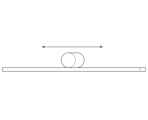
- FIG. 2 is a diagram for explaining a method for evaluating low sliding wear properties.
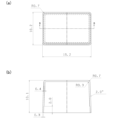
- Fig. 3(a) is a plan view showing a molded body molded for measuring the depth of a recess in the examples
- Fig. 3(b) is a partial vertical cross-sectional view showing the cross section BB of Fig. 3(a). Note that, unless otherwise specified, the unit of values in the figures is mm.
- the liquid crystal resin composition of the present invention contains (A) a liquid crystal resin, (B) a filler, and (C) an olefin polymer.
- the liquid crystal resin (A) used in the present invention refers to a melt-processable polymer having the property of being capable of forming an optically anisotropic molten phase.
- the property of the anisotropic molten phase can be confirmed by a conventional polarized light inspection method using crossed polarizers. More specifically, the anisotropic molten phase can be confirmed by observing a molten sample placed on a Leitz hot stage at a magnification of 40 times under a nitrogen atmosphere using a Leitz polarizing microscope.
- the liquid crystal polymer applicable to the present invention is inspected between crossed polarizers, it usually transmits polarized light even in a molten stationary state, and is optically anisotropic.
- the type of liquid crystal resin (A) as described above is not particularly limited, but is preferably an aromatic polyester and/or an aromatic polyester amide. Polyesters that partially contain aromatic polyesters and/or aromatic polyester amides in the same molecular chain are also included in this range.
- the liquid crystal resin (A) one that has an inherent viscosity (I.V.) of preferably at least about 2.0 dl/g, and more preferably 2.0 to 10.0 dl/g when dissolved in pentafluorophenol at a concentration of 0.1% by mass at 60°C is preferably used.
- the aromatic polyester or aromatic polyesteramide as the liquid crystal resin (A) applicable to the present invention is particularly preferably an aromatic polyester or aromatic polyesteramide having as a constituent component a constituent unit derived from at least one selected from the group consisting of aromatic hydroxycarboxylic acids and derivatives thereof.
- the content of the constituent units derived from at least one selected from the group consisting of aromatic hydroxycarboxylic acids and their derivatives is preferably 45 mol% or more, more preferably 50 mol% or more, even more preferably 55 mol% or more, even more preferably 60 mol% or more, and particularly preferably 62 mol% or more, based on all the constituent units, from the viewpoint of suppressing fluctuations in the molecular structure of (A) liquid crystal resin.
- the upper limit of the content is not particularly limited, and may be 100 mol% or less, 90 mol% or less, 80 mol% or less, 75 mol% or less, or 70 mol% or less, based on all the constituent units.
- aromatic hydroxycarboxylic acids such as 4-hydroxybenzoic acid and 6-hydroxy-2-naphthoic acid
- aromatic diols such as 2,6-dihydroxynaphthalene, 1,4-dihydroxynaphthalene, 4,4'-dihydroxybiphenyl, hydroquinone, resorcin, compounds represented by the following general formula (I) and compounds represented by the following general formula (II)
- aromatic dicarboxylic acids such as 1,4-phenylenedicarboxylic acid, 1,3-phenylenedicarboxylic acid, 4,4'-diphenyldicarboxylic acid, 2,6-naphthalenedicarboxylic acid and compounds represented by the following general formula (III); aromatic amines such as p-aminophenol, p-phenylenediamine and N-acetyl-p-aminophenol.
- aromatic hydroxycarboxylic acid and its derivatives 4-hydroxybenzoic acid, 6-hydroxy-2-naphthoic acid, or a combination thereof are preferred from the viewpoints of reactivity and stability of the molecular structure of the liquid crystal resin (A).
- X is a group selected from alkylene (C 1 to C 4 ), alkylidene, —O—, —SO—, —SO 2 —, —S—, and —CO—.
- the liquid crystal resin (A) used in the present invention can be prepared by a known method using direct polymerization or transesterification from the above monomer compound (or mixture of monomers). Usually, melt polymerization, solution polymerization, slurry polymerization, solid-phase polymerization, or a combination of two or more of these methods is used, and melt polymerization or a combination of melt polymerization and solid-phase polymerization is preferably used.
- melt polymerization, solution polymerization, slurry polymerization, solid-phase polymerization, or a combination of two or more of these methods is used, and melt polymerization or a combination of melt polymerization and solid-phase polymerization is preferably used.
- the above compounds having ester forming ability may be used in the polymerization in their original form, or may be modified from a precursor to a derivative having ester forming ability in a stage prior to polymerization.
- catalysts can be used in these polymerizations, and representative examples include metal salt catalysts such as potassium acetate, magnesium acetate, stannous acetate, tetrabutyl titanate, lead acetate, sodium acetate, antimony trioxide, and tris(2,4-pentanedionato)cobalt(III), and organic compound catalysts such as 1-methylimidazole and 4-dimethylaminopyridine.
- the amount of catalyst used is generally about 0.001 to 1 mass% relative to the total mass of the monomers, and preferably about 0.01 to 0.2 mass%. If necessary, the molecular weight of the polymers produced by these polymerization methods can be further increased by solid-state polymerization, which involves heating under reduced pressure or in an inert gas.
- the melt viscosity of the liquid crystal resin (A) obtained by the above method is not particularly limited.
- a resin having a melt viscosity at the molding temperature of 3 Pa ⁇ s to 500 Pa ⁇ s at a shear rate of 1000 sec -1 can be used.
- a resin having a viscosity that is too high is not preferred because it significantly deteriorates the flowability.
- the liquid crystal resin (A) may be a mixture of two or more kinds of liquid crystal resins.
- the content of the liquid crystal resin (A) is preferably 57 to 87% by mass, more preferably 65 to 85% by mass, and even more preferably 75 to 82% by mass. If the content of the component (A) is within the above range, it is preferable in terms of fluidity, heat resistance, etc.
- the liquid crystal resin composition according to the present invention contains a filler (B).
- a filler (B) When the liquid crystal resin composition according to the present invention contains a filler (B), the mechanical strength of the molded article is likely to be improved.
- the filler (B) can be used alone or in combination of two or more.
- the filler (B) is one or more selected from the group consisting of a fibrous filler (B1) and a non-fibrous filler (B2).
- (B1) Fibrous Filler When the liquid crystalline resin composition according to the present invention contains a fibrous filler (B1), the mechanical strength of a molded article containing the liquid crystalline resin composition is likely to be improved.
- the fibrous filler (B1) can be used alone or in combination of two or more.
- the average fiber length of the fibrous filler is 5 to 200 ⁇ m, preferably 6 to 170 ⁇ m, more preferably 7 to 140 ⁇ m, even more preferably 8 to 110 ⁇ m, and particularly preferably 9 to 80 ⁇ m.
- the weight average fiber length is within the above range, the liquid crystal resin composition tends to have good fluidity, and the molded body containing the liquid crystal resin composition tends to have improved mechanical strength.
- the average fiber length of the fibrous filler is determined by importing 10 stereomicroscope images of the fibrous filler from a CCD camera into a PC, and measuring the fiber length of 100 fibrous fillers per stereomicroscope image, i.e., a total of 1,000 fibrous fillers, using an image processing method with an image measuring device.
- the average fiber length of the fibrous filler in the liquid crystal resin composition is measured by applying the above method to the fibrous filler remaining after heating the liquid crystal resin composition at 600° C. for 2 hours to incinerate it.
- the average fiber length refers to the weight average fiber length.
- the fiber diameter of the fibrous filler is not particularly limited and may be, for example, 0.2 to 15 ⁇ m, or 0.25 to 10 ⁇ m.
- the fiber diameter of the fibrous filler is determined by observing the fibrous filler with a scanning electron microscope and measuring the fiber diameter of 30 pieces of fibrous filler.
- the fiber diameter of the fibrous filler in the liquid crystalline resin composition is measured by applying the above method to the fibrous filler remaining after heating the liquid crystalline resin composition at 600°C for 2 hours to incinerate it.
- any fiber can be used as component (B1) as long as it satisfies the above shape.
- (B1) fibrous fillers include inorganic fibrous materials such as glass fiber, milled glass fiber, carbon fiber, asbestos fiber, silica fiber, silica-alumina fiber, zirconia fiber, boron nitride fiber, silicon nitride fiber, boron fiber, potassium titanate fiber, calcium silicate fiber (wollastonite), and fibrous materials of metals such as stainless steel, aluminum, titanium, copper, and brass.
- the liquid crystal resin composition according to the present invention contains a non-fibrous filler (B2)
- the mechanical strength of a molded article containing the liquid crystal resin composition is likely to be improved.
- the non-fibrous filler (B2) can be used alone or in combination of two or more.
- the non-fibrous filler (B2) is one or more selected from the group consisting of plate-like fillers and granular fillers. In the present invention, from the viewpoint of the impact resistance of the molded article, it is preferable that the non-fibrous filler (B2) contains a granular filler.
- the median diameter of the plate-like filler is 50 ⁇ m or less. When the median diameter is within the above range, the liquid crystal resin composition is likely to have good fluidity, and the molded body containing the liquid crystal resin composition is likely to maintain mechanical strength.
- the lower limit of the median diameter may be more than 0 ⁇ m, and may be 1 ⁇ m or more, 2 ⁇ m or more, or 5 ⁇ m or more.
- the median diameter of the plate-like filler refers to the volume-based median value measured by a laser diffraction/scattering particle size distribution measurement method.
- the median diameter of the plate-like filler in the liquid crystal resin composition is measured by applying the above method to the plate-like filler remaining after heating the liquid crystal resin composition at 600 ° C. for 2 hours to incinerate it.
- the plate-like filler can be used alone or in combination of two or more types.
- the plate-like filler in the present invention may be talc, mica, glass flakes, various metal foils, etc.
- One or more types selected from the group consisting of talc and mica are preferred in that they suppress the anisotropy of the molded article obtained from the liquid crystalline resin composition without impairing the fluidity of the liquid crystalline resin composition.
- the talc usable in the present invention preferably has a total content of Fe2O3 , Al2O3 and CaO of 2.5 % by mass or less, a total content of Fe2O3 and Al2O3 of more than 1.0% by mass and 2.0 % by mass or less, and a CaO content of less than 0.5% by mass , relative to the total solid content of the talc. That is, the talc usable in the present invention may contain at least one of Fe2O3 , Al2O3 and CaO in addition to SiO2 and MgO as the main components, and each component may be contained within the above content range.
- the total content of Fe2O3 , Al2O3 and CaO is preferably 1.0 mass% or more and 2.0 mass% or less .
- talc having a total content of Fe2O3 and Al2O3 of more than 1.0% by mass is easily available.
- the total content of Fe2O3 and Al2O3 is 2.0% by mass or less, the moldability of the liquid crystal resin composition and the heat resistance of the molded body molded from the liquid crystal resin composition are not easily deteriorated. Therefore, the total content of Fe2O3 and Al2O3 is preferably more than 1.0% by mass and 1.7% by mass or less.
- the CaO content in the talc is less than 0.5% by mass, the moldability of the liquid crystal resin composition and the heat resistance of the molded body formed from the liquid crystal resin composition are unlikely to deteriorate. Therefore, the CaO content is preferably 0.01% by mass or more and 0.4% by mass or less.
- Mica is a pulverized silicate mineral containing aluminum, potassium, magnesium, sodium, iron, etc.
- Examples of mica that can be used in the present invention include muscovite, phlogopite, biotite, and artificial mica, among which muscovite is preferred because of its good hue and low cost.
- wet grinding and dry grinding are known as methods for grinding minerals.
- mica raw ore is coarsely ground in a dry grinder, water is added to the slurry, and the resulting material is then wet-ground and dehydrated.
- the dry grinding method is a common method with low cost, but the wet grinding method makes it easier to grind minerals thinly and finely.
- it is preferable to use thin and finely ground material because it can obtain mica having the above-mentioned median diameter and the preferred thickness described below. Therefore, in the present invention, it is preferable to use mica produced by the wet grinding method.
- flocculating sedimentation agents and sedimentation aids examples include polyaluminum chloride, aluminum sulfate, ferrous sulfate, ferric sulfate, copper chloride, polyferric sulfate, polyferric chloride, iron-silica inorganic polymer flocculant, ferric chloride-silica inorganic polymer flocculant, hydrated lime (Ca(OH) 2 ), caustic soda (NaOH), soda ash (Na 2 CO 3 ), etc.
- These flocculating sedimentation agents and sedimentation aids have an alkaline or acidic pH.
- the mica used in the present invention is preferably one that has not been treated with a flocculating sedimentation agent and/or a sedimentation aid during wet grinding.
- a flocculating sedimentation agent and/or a sedimentation aid When mica that has not been treated with a flocculating sedimentation agent and/or a sedimentation aid is used, decomposition of the polymer in the liquid crystal resin composition is unlikely to occur, and large amounts of gas generation and a decrease in the molecular weight of the polymer are unlikely to occur, so that it is easy to maintain the performance of the obtained molded body better.
- the thickness of the mica that can be used in the present invention is preferably 0.01 to 1 ⁇ m, and particularly preferably 0.03 to 0.3 ⁇ m, as measured by observation under an electron microscope. If the thickness of the mica is 0.01 ⁇ m or more, the mica is less likely to crack during melt processing of the liquid crystalline resin composition, which is preferable since it may be easier to improve the rigidity of the molded article. If the thickness of the mica is 1 ⁇ m or less, the effect of improving the rigidity of the molded article is likely to be sufficient, which is preferable.
- the mica that can be used in the present invention may be surface-treated with a silane coupling agent or the like, and/or may be granulated with a binder to form granules.
- the median diameter of the granular filler is 50 ⁇ m or less, preferably 0.3 to 8.0 ⁇ m, more preferably 0.4 to 7.5 ⁇ m, and even more preferably 0.5 to 7.0 ⁇ m.
- the median diameter of the granular filler refers to the volume-based median value measured by a laser diffraction/scattering particle size distribution measurement method.
- the median diameter of the granular filler in the liquid crystal resin composition is measured by applying the above method to the granular filler remaining after heating the liquid crystal resin composition at 600° C. for 2 hours to incinerate it.
- the granular filler may be used alone or in combination of two or more types.
- Granular fillers include, for example, metal oxides such as silica, quartz powder, glass beads, glass powder, potassium aluminum silicate, diatomaceous earth, iron oxide, titanium oxide, zinc oxide, and alumina; metal carbonates such as calcium carbonate and magnesium carbonate; metal sulfates such as calcium sulfate and barium sulfate; phosphates such as calcium pyrophosphate and anhydrous dicalcium phosphate; silicon carbide; silicon nitride; and boron nitride.
- metal oxides such as silica, quartz powder, glass beads, glass powder, potassium aluminum silicate, diatomaceous earth, iron oxide, titanium oxide, zinc oxide, and alumina
- metal carbonates such as calcium carbonate and magnesium carbonate
- metal sulfates such as calcium sulfate and barium sulfate
- phosphates such as calcium pyrophosphate and anhydrous dicalcium phosphate
- silicon carbide silicon nitride
- the present invention from the viewpoint of the fluidity of the liquid crystal resin composition and the mechanical strength of the molded product, it is preferable to use one or more types selected from the group consisting of silica and barium sulfate as the granular filler, and it is more preferable to use silica.
- non-fibrous fillers (B2) in the present invention, from the viewpoint of the fluidity of the liquid crystal resin composition and the mechanical properties of the molded product, it is preferable to use one or more types selected from the group consisting of silica and barium sulfate as the non-fibrous filler (B2), and it is more preferable to use silica.
- the content of component (B) in the liquid crystal resin composition of the present invention is 10 to 40% by mass, preferably 12 to 30% by mass, and more preferably 13 to 20% by mass.
- the content of component (B) is within the above range, the liquid crystal resin composition tends to have good fluidity, and a molded article containing the liquid crystal resin composition tends to maintain its mechanical strength.
- the liquid crystal resin composition of the present invention contains (C) an olefin-based polymer.
- the (C) olefin-based polymer may be used alone or in combination of two or more.
- the (C) olefin-based polymer is not particularly limited as long as it contains an epoxy group-containing olefin-based polymer, and may be an epoxy group-containing olefin-based polymer alone or a combination of an epoxy group-containing olefin-based polymer and an epoxy group-free olefin-based polymer.
- the (C) olefin-based polymer contributes to the fact that the liquid crystal resin composition of the present invention has good fluidity and that a molded article containing the liquid crystal resin composition of the present invention has a good balance of low dust generation, low sliding wear, impact resistance, and mechanical strength.
- the epoxy group-containing olefin polymer may be, for example, a copolymer composed of a repeating unit derived from an ⁇ -olefin and a repeating unit derived from a glycidyl ester of an ⁇ , ⁇ -unsaturated acid.
- the epoxy group-containing olefin polymer may be used alone or in combination of two or more kinds.
- the ⁇ -olefin is not particularly limited, and examples thereof include ethylene, propylene, butene, among which ethylene is preferably used.
- the glycidyl ester of an ⁇ , ⁇ -unsaturated acid is represented by the following general formula (IV).
- R' represents a hydrogen atom, an alkyl group having 1 to 5 carbon atoms, or a group represented by -R 1 -COOH, and R 1 represents an alkylene group having 1 to 5 carbon atoms.
- the glycidyl ester of an ⁇ , ⁇ -unsaturated acid is, for example, acrylic acid glycidyl ester, methacrylic acid glycidyl ester, ethacrylic acid glycidyl ester, itaconic acid glycidyl ester, etc., with methacrylic acid glycidyl ester being particularly preferred.
- the content of repeating units derived from ⁇ -olefin is preferably 87 to 98% by mass, and the content of repeating units derived from glycidyl ester of ⁇ , ⁇ -unsaturated acid is preferably 13 to 2% by mass.
- the epoxy group-containing olefin polymer may contain, in addition to the above two components, a third component of repeating units derived from one or more olefin-based unsaturated monomers such as acrylonitrile, acrylic acid esters, methacrylic acid esters, ⁇ -methylstyrene, maleic anhydride, etc., in an amount of 0 to 48 parts by mass per 100 parts by mass of the above two components, as long as it does not impair the present invention.
- a third component of repeating units derived from one or more olefin-based unsaturated monomers such as acrylonitrile, acrylic acid esters, methacrylic acid esters, ⁇ -methylstyrene, maleic anhydride, etc.
- Epoxy group-containing olefin polymers can be easily prepared by a normal radical polymerization method using monomers corresponding to each component and a radical polymerization catalyst. More specifically, they can usually be produced by a method in which an ⁇ -olefin and a glycidyl ester of an ⁇ , ⁇ -unsaturated acid are copolymerized in the presence of a radical generator at 500 to 4000 atmospheres and 100 to 300°C in the presence or absence of a suitable solvent or chain transfer agent.
- They can also be produced by a method in which an ⁇ -olefin, a glycidyl ester of an ⁇ , ⁇ -unsaturated acid, and a radical generator are mixed and melt-graft-copolymerized in an extruder.
- Epoxy group-free olefin polymer examples include polyethylene, polypropylene, polybutene, ethylene-propylene copolymer, ethylene-butene copolymer, ethylene-octene copolymer, polybutadiene, polyisoprene, polychloroprene, ethylene-propylene-butadiene copolymer, ethylene-propylene-isoprene copolymer, ethylene-propylene-chloroprene copolymer, ethylene-ethyl acrylate copolymer, and ethylene-vinyl acetate copolymer. From the viewpoints of the fluidity of the liquid crystal resin composition and the mechanical strength of the molded product, polyethylene is preferred.
- polyethylene examples include high-density polyethylene, low-density polyethylene, very-low-density polyethylene, linear low-density polyethylene, and ultra-high molecular weight polyethylene, with low-density polyethylene being preferred from the standpoint of the fluidity of the liquid crystal resin composition and the mechanical strength of the molded product.
- the epoxy group-free olefin polymer may contain repeating units derived from one or more of olefin-based unsaturated monomers such as acrylonitrile, acrylic acid esters, methacrylic acid esters, ⁇ -methylstyrene, and maleic anhydride, to the extent that the present invention is not impaired.
- the epoxy group-free olefin polymer may be used alone or in combination of two or more.
- the content of the (C) olefin polymer is 2.75 to 6.00 mass % relative to the total liquid crystal resin composition of the present invention, preferably 2.90 to 5.50 mass %, and more preferably 3.00 to 5.00 mass %.
- the content of the (C) component is within the above range, the liquid crystal resin composition tends to have good fluidity, and a molded article containing this liquid crystal resin composition tends to have a good balance of low dust generation, low sliding wear, impact resistance, and mechanical strength.
- the content of epoxy groups is 0.003% by mass or more and less than 0.048% by mass, preferably 0.010 to 0.046% by mass, and more preferably 0.018 to 0.045% by mass, based on the total liquid crystal resin composition.
- the content of epoxy groups is within the above range, the liquid crystal resin composition tends to have good fluidity, and a molded article containing this liquid crystal resin composition tends to have a good balance of low dust generation, low sliding wear, impact resistance, and mechanical strength.
- the content of the (C) olefin polymer and the content of the epoxy group in the liquid crystal resin composition can be adjusted to a desired range by appropriately increasing or decreasing the content of the epoxy group in the (C) olefin polymer, the content of the epoxy group-containing olefin polymer, and the content of the epoxy group-free olefin polymer.
- the carbon black (D) used as an optional component in the present invention is not particularly limited, so long as it is a commonly available carbon black used for resin coloring.
- carbon black (D) contains clumps formed by agglomeration of primary particles, but unless it contains a significantly large amount of clumps with a size of 50 ⁇ m or more, it is unlikely that many bumps (fine bumpy protrusions (fine irregularities) formed by agglomeration of carbon black) will occur on the surface of the molded product obtained by molding the resin composition of the present invention. If the content of particles with a particle size of 50 ⁇ m or more is 20 ppm or less, the effect of suppressing nap formation on the surface of the molded product is likely to be high. The preferred content is 5 ppm or less.
- the content of (D) carbon black in the liquid crystal resin composition is preferably in the range of 0.5 to 5 mass%. If the carbon black content is 0.5 mass% or more, the jet blackness of the resulting resin composition is unlikely to decrease, and concerns about light blocking properties are unlikely to arise. If the carbon black content is 5 mass% or less, it is unlikely to be uneconomical and lumps are unlikely to occur.
- the content of (D) carbon black is more preferably 1 to 4 mass%, and even more preferably 2 to 3 mass%.
- the liquid crystal resin composition of the present invention can also contain other polymers and known substances that are generally added to synthetic resins, such as stabilizers such as antioxidants and ultraviolet absorbers, antistatic agents, flame retardants, colorants such as dyes and pigments, lubricants, release agents, crystallization accelerators, crystal nucleating agents, etc., depending on the required performance, as long as they do not impair the effects of the present invention.
- stabilizers such as antioxidants and ultraviolet absorbers
- antistatic agents such as antioxidants and ultraviolet absorbers
- flame retardants such as dyes and pigments
- colorants such as dyes and pigments
- lubricants lubricants
- release agents such as crystallization accelerators, crystal nucleating agents, etc.
- epoxy group-containing styrene-based polymers examples include known epoxy group-containing styrene-based polymers, including copolymers composed of repeating units derived from styrenes and repeating units derived from glycidyl esters of ⁇ , ⁇ -unsaturated acids.
- the preparation of the resin composition of the present invention is not particularly limited.
- the above-mentioned (A) component, (B) component, (C) component, optionally (D) component, and optionally other components are mixed, and melt-kneaded using a single-screw or twin-screw extruder to prepare a liquid crystal resin composition.
- the melt viscosity of the liquid crystal resin composition of the present invention obtained as described above is preferably 50 Pa ⁇ sec or less, more preferably 48 Pa ⁇ sec or less, and even more preferably 45 Pa ⁇ sec or less, from the viewpoint of fluidity.
- the lower limit of the melt viscosity is not particularly limited, and may be 5 Pa ⁇ sec or more, 10 Pa ⁇ sec or more, or 20 Pa ⁇ sec or more.
- One of the features of the liquid crystal resin composition of the present invention is that it has high fluidity when melted and excellent moldability.
- the melt viscosity is a value obtained by a measurement method in accordance with ISO 11443 under the conditions of a cylinder temperature 10 to 30° C. higher than the melting point of the liquid crystal resin and a shear rate of 1000 sec ⁇ 1 .
- the liquid crystal resin composition can be used for camera module parts. More specifically, the liquid crystal resin composition can be used to manufacture camera module parts. That is, the liquid crystal resin composition can be used to manufacture camera module parts. If the resin composition of the present invention is used as a raw material, the surface of the camera module parts is less likely to be raised. Since the camera module parts are ultrasonically cleaned, it is required that the surface is less likely to be raised even after ultrasonic cleaning. If the resin composition of the present invention is used, even if the ultrasonic cleaning of the camera module parts is performed under stronger conditions, fallen objects that cause dust and the like are less likely to be generated.
- the molded body containing the liquid crystal resin composition of the present invention has excellent low sliding wear properties, fallen objects that cause dust and the like are less likely to be generated on the surface of the camera module parts manufactured using the liquid crystal resin composition when the members slide against each other. Therefore, after the camera module parts are incorporated into the finished product, the quality of the finished product is less likely to be affected by the dust generated by the surface of the camera module parts being raised or worn by sliding.
- the molded body can be obtained by molding the liquid crystal resin composition of the present invention.
- the molding method is not particularly limited, and for example, injection molding can be mentioned.
- FIG. 1 A camera module part made of a molded body containing the liquid crystalline resin composition of the present invention will now be described.
- FIG. 1 A cross section of a typical camera module is shown in FIG. 1.
- the camera module 1 comprises a substrate 10, an image sensor 11, lead wiring 12, a lens holder 13, a barrel 14, a lens 15, an IR filter 16, a guide 17, a base 18, a coil 19, a permanent magnet 20, a yoke 21, and a cover 22.
- the imaging element 11 is disposed on the substrate 10, and the imaging element 11 and the substrate 10 are electrically connected by lead wiring 12.
- the guide 17 is disposed on the substrate 10, the base 18 is disposed on the guide 17, the lens holder 13 is disposed on the base 18 so that it can move up and down, and a coil 19 is wound around the lens holder 13.
- An opening is formed at the top of the lens holder 13, and a spiral groove is formed in the wall of this opening.
- An opening is formed at the top of the guide 17, and an IR filter 16 is disposed on the guide 17 so as to close this opening.
- the guide 17 and the IR filter 16 cover the imaging element 11.
- a yoke 21 is disposed on the base 18, and a permanent magnet 20 is in contact with the inside of the yoke 21, and a cover 22 with an opening formed at the top is disposed on the yoke 21.
- the permanent magnet 20 is disposed around the coil 19.
- the barrel 14 is cylindrical, and the lens 15 is held inside the cylinder so that it is approximately horizontal.
- a spiral convex portion is formed on the side wall of one end of the cylinder, and this spiral convex portion screws into a spiral groove formed on the opening wall surface of the lens holder 13, connecting the barrel 14 to the lens holder 13.
- the IR filter 16 and the lens 15 are arranged approximately parallel.
- leaf springs (not shown) are connected between the top of the lens holder 13 and the top of the yoke 21, and between the bottom of the lens holder 13 and the top of the base 18, so that the lens holder 13 and the barrel 14, lens 15, and coil 19 are held within the camera module 1 via the lens holder 13.
- the lens holder 13 moves up and down on the base 18 due to the action of the magnetic force generated by the coil 19 wound around the lens holder 13 and the permanent magnets 20 arranged around the coil 19, thereby changing the distance between the lens 15 and the imaging element 11.
- the focus of the camera can be adjusted by adjusting this distance.
- the camera module components, lens holder 13, guide 17, and/or base 18, can be manufactured using the liquid crystal resin composition of the present invention as a raw material.
- General liquid crystal resin compositions are not suitable as raw materials for manufacturing these components. Manufacturing lens holder 13, guide 17, and/or base 18 using general liquid crystal resin compositions as raw materials results in the following problems.
- the molecular orientation of the polymer is particularly large at the surface, so the surface of the molded body is prone to becoming napped, and this nap causes small particles of dirt to form. If this small particle of dirt adheres to the lens 15, etc., the performance of the camera module will decrease.
- the camera module components such as the lens holder 13, guide 17, and base 18, are ultrasonically cleaned before being assembled into the camera module 1 in order to remove dust and small debris from the surfaces.
- the surfaces of molded bodies made from typical liquid crystalline resin compositions tend to become napped, so ultrasonic cleaning causes the surfaces to become fuzzy. Because of these problems, it is usually not possible to ultrasonically clean molded bodies made from liquid crystalline resin compositions.
- the focus adjustment is performed by moving the lens holder 13 up and down on the base 18 due to the action of the magnetic force generated by the coil 19 wound around the lens holder 13 and the permanent magnets 20 arranged around the coil.
- the surface of a molded product made from a typical liquid crystalline resin composition is prone to becoming napped as described above, there is a possibility that the surface will peel off and produce peeling material. This peeling material will turn into small particles and will likely adhere to the lens 15 etc., reducing the performance of the camera module.
- liquid crystalline resin composition of the present invention can be preferably used as a raw material for the lens holder 13, guide 17, and/or base 18.
- Liquid crystal polyesteramide resin Liquid crystal polyesteramide resin After the following raw materials were charged into a polymerization vessel, the temperature of the reaction system was raised to 140°C and reacted at 140°C for 1 hour. Thereafter, the temperature was further raised to 340°C over 4.5 hours, and the pressure was reduced to 10 Torr (i.e., 1330 Pa) over 15 minutes, and melt polymerization was carried out while distilling out acetic acid, excess acetic anhydride, and other low boiling points.
- 10 Torr i.e. 1330 Pa
- HBA 4-Hydroxybenzoic acid
- HNA 6-Hydroxy-2-naphthoic acid
- TA 1,4-phenylenedicarboxylic acid
- BP 4,4'-dihydroxybiphenyl
- APAP N-acetyl-p-aminophenol
- Metal catalyst potassium acetate catalyst: 110 mg Acylating agent (acetic anhydride): 1659 g
- Liquid crystal polyester resin After the following raw materials were charged into a polymerization vessel, the temperature of the reaction system was raised to 140°C and reacted at 140°C for 1 hour. Thereafter, the temperature was further raised to 330°C over 3.5 hours, and the pressure was reduced to 10 Torr (i.e., 1330 Pa) over 15 minutes, and melt polymerization was carried out while distilling out acetic acid, excess acetic anhydride, and other low boiling points. After the stirring torque reached a predetermined value, nitrogen was introduced to change from a reduced pressure state to a normal pressure state and then to a pressurized state, and the polymer was discharged from the bottom of the polymerization vessel, and the strands were pelletized to obtain the target polymer.
- 10 Torr i.e. 1330 Pa
- the melting point of the obtained polymer was 323°C, and the melt viscosity at 340°C was 38.3 Pa ⁇ s.
- the melt viscosity of the above polymer was measured in the same manner as the melt viscosity measurement method described below.
- 6-Hydroxy-2-naphthoic acid (HNA) 867 g (20 mol%)
- Metal catalyst (potassium acetate catalyst): 150 mg
- Acylating agent acetic anhydride
- Silica 1 Denka fused silica FB-5SDC (manufactured by Denka Co., Ltd., silica, median diameter 4.0 ⁇ m)
- Silica 2 ADMAFINE SO-C2 (manufactured by Admatechs Co., Ltd., silica, median diameter 0.5 ⁇ m)
- Potassium titanate fiber TISMO N-102 (manufactured by Otsuka Chemical Co., Ltd., potassium titanate fiber, fiber diameter 0.3 to 0.6 ⁇ m, average fiber length 10 to 20 ⁇ m)
- Carbon black VULCAN XC305 (manufactured by Cabot Japan Co., Ltd., median diameter 20 nm, proportion of particles with a particle diameter of 50 ⁇ m or more is 20 ppm or less)
- Epoxy group-containing olefin polymer 1 Bondfast BF-2C (manufactured by Sumitomo Chemical Co., Ltd., ethylene-glycid)
- melt viscosity of the liquid crystalline resin composition was measured in accordance with ISO11443 using a Capillograph 1B model manufactured by Toyo Seiki Seisakusho Co., Ltd. at a temperature 10 to 30°C higher than the melting point of the liquid crystalline resin, using an orifice with an inner diameter of 1 mm and a length of 20 mm, and at a shear rate of 1000/sec.
- the specific measurement temperatures were 350°C for the liquid crystalline resin composition containing the liquid crystalline polyesteramide resin, and 340°C for the liquid crystalline resin composition containing the liquid crystalline polyester resin. The results are shown in Tables 1 and 2.
- the test piece was subjected to an ultrasonic cleaner (output: 300 W, frequency: 45 kHz) in room temperature water (80 ml) for 3 minutes. Thereafter, the number of particles of 2 ⁇ m or more present in the water was measured using a particle counter (Liquid Particle Counter KL-11A (PARTICLE COUNTER) manufactured by RION Corporation), and the number of dust particles generated in 10 ml was calculated. The results are shown in Tables 1 and 2.
- ⁇ Low sliding wear> The pellets of the examples and comparative examples were molded under the following molding conditions using a molding machine (Sumitomo Heavy Industries, Ltd. "SE100DU") to obtain a measuring pin (diameter 10 mm, length 10 mm) and a measuring test piece (12.5 mm x 120 mm x 0.8 mm). As shown in Figure 2, a load was applied to the measuring pin on the measuring test piece, and a reciprocating sliding test was performed under the following reciprocating sliding conditions. The surface of the measuring test piece was then visually inspected to evaluate the low sliding wear of the molded body according to the following criteria. The results are shown in Tables 1 and 2. ⁇ (Good): The surface of the test piece for measurement was not worn or was partially worn.
- a shot die described later was placed on the top surface of the molded body, and a cylindrical metal block (bottom diameter: 30 mm, height: 30 mm) was placed on the shot die so that the bottom surface of the metal block was in contact with the shot die.
- a weight was dropped on the top surface of the metal block under the following conditions using a DuPont drop impact tester (Yasuda Seiki Seisakusho Co., Ltd.), and the depth of the dent left in the molded body was measured using a laser microscope (Keyence Corporation, VK-X3000, magnification: 10 times, mode: white light interference method). The depth of the dent was used as an index representing the impact resistance of the molded body.
- liquid crystalline resin compositions of the examples were confirmed to be capable of producing molded articles with a good balance of low dust generation, low sliding wear, impact resistance, and mechanical strength, and to have good fluidity.
Landscapes
- Chemical & Material Sciences (AREA)
- Health & Medical Sciences (AREA)
- Chemical Kinetics & Catalysis (AREA)
- Medicinal Chemistry (AREA)
- Polymers & Plastics (AREA)
- Organic Chemistry (AREA)
- Physics & Mathematics (AREA)
- General Physics & Mathematics (AREA)
- Optics & Photonics (AREA)
- Compositions Of Macromolecular Compounds (AREA)
- Lens Barrels (AREA)
Priority Applications (3)
| Application Number | Priority Date | Filing Date | Title |
|---|---|---|---|
| KR1020257022477A KR20250119622A (ko) | 2022-12-08 | 2023-12-06 | 액정성 수지 조성물 및 이를 이용한 카메라 모듈 |
| JP2024562972A JPWO2024122582A1 (https=) | 2022-12-08 | 2023-12-06 | |
| CN202380083703.2A CN120344620A (zh) | 2022-12-08 | 2023-12-06 | 液晶性树脂组合物和使用了其的照相机模块 |
Applications Claiming Priority (2)
| Application Number | Priority Date | Filing Date | Title |
|---|---|---|---|
| JP2022-196561 | 2022-12-08 | ||
| JP2022196561 | 2022-12-08 |
Publications (1)
| Publication Number | Publication Date |
|---|---|
| WO2024122582A1 true WO2024122582A1 (ja) | 2024-06-13 |
Family
ID=91379012
Family Applications (1)
| Application Number | Title | Priority Date | Filing Date |
|---|---|---|---|
| PCT/JP2023/043676 Ceased WO2024122582A1 (ja) | 2022-12-08 | 2023-12-06 | 液晶性樹脂組成物及びそれを用いたカメラモジュール |
Country Status (5)
| Country | Link |
|---|---|
| JP (1) | JPWO2024122582A1 (https=) |
| KR (1) | KR20250119622A (https=) |
| CN (1) | CN120344620A (https=) |
| TW (1) | TW202440883A (https=) |
| WO (1) | WO2024122582A1 (https=) |
Cited By (2)
| Publication number | Priority date | Publication date | Assignee | Title |
|---|---|---|---|---|
| WO2025070216A1 (ja) * | 2023-09-29 | 2025-04-03 | ポリプラスチックス株式会社 | 液晶性樹脂組成物及びそれを用いたカメラモジュール |
| WO2025074968A1 (ja) * | 2023-10-04 | 2025-04-10 | ポリプラスチックス株式会社 | 液晶性樹脂組成物及びそれを用いたカメラモジュール |
Citations (6)
| Publication number | Priority date | Publication date | Assignee | Title |
|---|---|---|---|---|
| WO2013129338A1 (ja) * | 2012-02-29 | 2013-09-06 | ポリプラスチックス株式会社 | カメラモジュール用液晶性樹脂組成物 |
| JP2015000949A (ja) * | 2013-06-17 | 2015-01-05 | ポリプラスチックス株式会社 | カメラモジュール用液晶性樹脂組成物 |
| JP2015021110A (ja) * | 2013-07-23 | 2015-02-02 | ポリプラスチックス株式会社 | カメラモジュール用液晶性樹脂組成物 |
| JP2015028181A (ja) * | 2012-11-19 | 2015-02-12 | 三井化学株式会社 | ポリエステル樹脂組成物およびそれを含むカメラモジュール |
| WO2019124256A1 (ja) * | 2017-12-18 | 2019-06-27 | 住友化学株式会社 | 液晶ポリエステル組成物および成形体 |
| JP2020007394A (ja) * | 2018-07-03 | 2020-01-16 | ポリプラスチックス株式会社 | 耐摺動摩耗部材用液晶性樹脂組成物及びそれを用いた耐摺動摩耗部材 |
-
2023
- 2023-12-06 WO PCT/JP2023/043676 patent/WO2024122582A1/ja not_active Ceased
- 2023-12-06 KR KR1020257022477A patent/KR20250119622A/ko active Pending
- 2023-12-06 CN CN202380083703.2A patent/CN120344620A/zh active Pending
- 2023-12-06 JP JP2024562972A patent/JPWO2024122582A1/ja active Pending
- 2023-12-07 TW TW112147618A patent/TW202440883A/zh unknown
Patent Citations (6)
| Publication number | Priority date | Publication date | Assignee | Title |
|---|---|---|---|---|
| WO2013129338A1 (ja) * | 2012-02-29 | 2013-09-06 | ポリプラスチックス株式会社 | カメラモジュール用液晶性樹脂組成物 |
| JP2015028181A (ja) * | 2012-11-19 | 2015-02-12 | 三井化学株式会社 | ポリエステル樹脂組成物およびそれを含むカメラモジュール |
| JP2015000949A (ja) * | 2013-06-17 | 2015-01-05 | ポリプラスチックス株式会社 | カメラモジュール用液晶性樹脂組成物 |
| JP2015021110A (ja) * | 2013-07-23 | 2015-02-02 | ポリプラスチックス株式会社 | カメラモジュール用液晶性樹脂組成物 |
| WO2019124256A1 (ja) * | 2017-12-18 | 2019-06-27 | 住友化学株式会社 | 液晶ポリエステル組成物および成形体 |
| JP2020007394A (ja) * | 2018-07-03 | 2020-01-16 | ポリプラスチックス株式会社 | 耐摺動摩耗部材用液晶性樹脂組成物及びそれを用いた耐摺動摩耗部材 |
Cited By (2)
| Publication number | Priority date | Publication date | Assignee | Title |
|---|---|---|---|---|
| WO2025070216A1 (ja) * | 2023-09-29 | 2025-04-03 | ポリプラスチックス株式会社 | 液晶性樹脂組成物及びそれを用いたカメラモジュール |
| WO2025074968A1 (ja) * | 2023-10-04 | 2025-04-10 | ポリプラスチックス株式会社 | 液晶性樹脂組成物及びそれを用いたカメラモジュール |
Also Published As
| Publication number | Publication date |
|---|---|
| KR20250119622A (ko) | 2025-08-07 |
| CN120344620A (zh) | 2025-07-18 |
| TW202440883A (zh) | 2024-10-16 |
| JPWO2024122582A1 (https=) | 2024-06-13 |
Similar Documents
| Publication | Publication Date | Title |
|---|---|---|
| KR101537109B1 (ko) | 카메라 모듈용 액정성 수지 조성물 | |
| KR102081231B1 (ko) | 카메라 모듈용 액정성 수지 조성물 및 그것을 이용한 카메라 모듈 | |
| KR101625009B1 (ko) | 카메라 모듈용 액정성 수지 조성물 및 이것을 이용한 카메라 모듈 | |
| KR102506289B1 (ko) | 내 볼베어링 접동 마모 부재용 액정성 수지 조성물 및 이를 이용한 내 볼베어링 접동 마모 부재 | |
| WO2024122582A1 (ja) | 液晶性樹脂組成物及びそれを用いたカメラモジュール | |
| JP7393590B1 (ja) | 平面状コネクター用液晶性樹脂組成物及びそれを用いた平面状コネクター | |
| TW201518401A (zh) | 相機模組用液晶性樹脂組合物 | |
| JP7200435B2 (ja) | 耐ボールベアリング摺動摩耗部材用液晶性樹脂組成物及びそれを用いた耐ボールベアリング摺動摩耗部材 | |
| JP2023123057A (ja) | カメラモジュール用液晶性樹脂組成物及びそれを用いたカメラモジュール | |
| WO2024204594A1 (ja) | 液晶性樹脂組成物及びそれを用いたカメラモジュール | |
| WO2025074968A1 (ja) | 液晶性樹脂組成物及びそれを用いたカメラモジュール | |
| WO2025070216A1 (ja) | 液晶性樹脂組成物及びそれを用いたカメラモジュール | |
| JP7026842B2 (ja) | 液晶性樹脂組成物及びそれを用いた成形体 | |
| WO2024143334A1 (ja) | 液晶性樹脂組成物及びそれを用いたコネクター | |
| WO2026029068A1 (ja) | 液晶性樹脂組成物及びそれを用いたコネクター | |
| JP2024158700A (ja) | 液晶性樹脂組成物 |
Legal Events
| Date | Code | Title | Description |
|---|---|---|---|
| 121 | Ep: the epo has been informed by wipo that ep was designated in this application |
Ref document number: 23900694 Country of ref document: EP Kind code of ref document: A1 |
|
| WWE | Wipo information: entry into national phase |
Ref document number: 202380083703.2 Country of ref document: CN |
|
| WWE | Wipo information: entry into national phase |
Ref document number: 2024562972 Country of ref document: JP |
|
| ENP | Entry into the national phase |
Ref document number: 1020257022477 Country of ref document: KR Free format text: ST27 STATUS EVENT CODE: A-0-1-A10-A15-NAP-PA0105 (AS PROVIDED BY THE NATIONAL OFFICE) |
|
| WWE | Wipo information: entry into national phase |
Ref document number: 1020257022477 Country of ref document: KR |
|
| NENP | Non-entry into the national phase |
Ref country code: DE |
|
| WWP | Wipo information: published in national office |
Ref document number: 202380083703.2 Country of ref document: CN |
|
| WWP | Wipo information: published in national office |
Ref document number: 1020257022477 Country of ref document: KR |
|
| 122 | Ep: pct application non-entry in european phase |
Ref document number: 23900694 Country of ref document: EP Kind code of ref document: A1 |