WO2024116320A1 - 医療デバイス、及び、医療デバイスの製造方法 - Google Patents
医療デバイス、及び、医療デバイスの製造方法 Download PDFInfo
- Publication number
- WO2024116320A1 WO2024116320A1 PCT/JP2022/044155 JP2022044155W WO2024116320A1 WO 2024116320 A1 WO2024116320 A1 WO 2024116320A1 JP 2022044155 W JP2022044155 W JP 2022044155W WO 2024116320 A1 WO2024116320 A1 WO 2024116320A1
- Authority
- WO
- WIPO (PCT)
- Prior art keywords
- medical device
- coating
- fixing member
- core shaft
- tip
- Prior art date
- Legal status (The legal status is an assumption and is not a legal conclusion. Google has not performed a legal analysis and makes no representation as to the accuracy of the status listed.)
- Ceased
Links
Images




Classifications
-
- A—HUMAN NECESSITIES
- A61—MEDICAL OR VETERINARY SCIENCE; HYGIENE
- A61L—METHODS OR APPARATUS FOR STERILISING MATERIALS OR OBJECTS IN GENERAL; DISINFECTION, STERILISATION OR DEODORISATION OF AIR; CHEMICAL ASPECTS OF BANDAGES, DRESSINGS, ABSORBENT PADS OR SURGICAL ARTICLES; MATERIALS FOR BANDAGES, DRESSINGS, ABSORBENT PADS OR SURGICAL ARTICLES
- A61L29/00—Materials for catheters, medical tubing, cannulae, or endoscopes or for coating catheters
- A61L29/02—Inorganic materials
-
- A—HUMAN NECESSITIES
- A61—MEDICAL OR VETERINARY SCIENCE; HYGIENE
- A61L—METHODS OR APPARATUS FOR STERILISING MATERIALS OR OBJECTS IN GENERAL; DISINFECTION, STERILISATION OR DEODORISATION OF AIR; CHEMICAL ASPECTS OF BANDAGES, DRESSINGS, ABSORBENT PADS OR SURGICAL ARTICLES; MATERIALS FOR BANDAGES, DRESSINGS, ABSORBENT PADS OR SURGICAL ARTICLES
- A61L29/00—Materials for catheters, medical tubing, cannulae, or endoscopes or for coating catheters
- A61L29/08—Materials for coatings
- A61L29/10—Inorganic materials
- A61L29/106—Inorganic materials other than carbon
-
- A—HUMAN NECESSITIES
- A61—MEDICAL OR VETERINARY SCIENCE; HYGIENE
- A61L—METHODS OR APPARATUS FOR STERILISING MATERIALS OR OBJECTS IN GENERAL; DISINFECTION, STERILISATION OR DEODORISATION OF AIR; CHEMICAL ASPECTS OF BANDAGES, DRESSINGS, ABSORBENT PADS OR SURGICAL ARTICLES; MATERIALS FOR BANDAGES, DRESSINGS, ABSORBENT PADS OR SURGICAL ARTICLES
- A61L29/00—Materials for catheters, medical tubing, cannulae, or endoscopes or for coating catheters
- A61L29/14—Materials characterised by their function or physical properties, e.g. lubricating compositions
-
- A—HUMAN NECESSITIES
- A61—MEDICAL OR VETERINARY SCIENCE; HYGIENE
- A61M—DEVICES FOR INTRODUCING MEDIA INTO, OR ONTO, THE BODY; DEVICES FOR TRANSDUCING BODY MEDIA OR FOR TAKING MEDIA FROM THE BODY; DEVICES FOR PRODUCING OR ENDING SLEEP OR STUPOR
- A61M25/00—Catheters; Hollow probes
- A61M25/01—Introducing, guiding, advancing, emplacing or holding catheters
- A61M25/09—Guide wires
-
- A—HUMAN NECESSITIES
- A61—MEDICAL OR VETERINARY SCIENCE; HYGIENE
- A61M—DEVICES FOR INTRODUCING MEDIA INTO, OR ONTO, THE BODY; DEVICES FOR TRANSDUCING BODY MEDIA OR FOR TAKING MEDIA FROM THE BODY; DEVICES FOR PRODUCING OR ENDING SLEEP OR STUPOR
- A61M25/00—Catheters; Hollow probes
- A61M25/01—Introducing, guiding, advancing, emplacing or holding catheters
- A61M25/09—Guide wires
- A61M2025/09058—Basic structures of guide wires
- A61M2025/09083—Basic structures of guide wires having a coil around a core
-
- A—HUMAN NECESSITIES
- A61—MEDICAL OR VETERINARY SCIENCE; HYGIENE
- A61M—DEVICES FOR INTRODUCING MEDIA INTO, OR ONTO, THE BODY; DEVICES FOR TRANSDUCING BODY MEDIA OR FOR TAKING MEDIA FROM THE BODY; DEVICES FOR PRODUCING OR ENDING SLEEP OR STUPOR
- A61M25/00—Catheters; Hollow probes
- A61M25/01—Introducing, guiding, advancing, emplacing or holding catheters
- A61M25/09—Guide wires
- A61M2025/09108—Methods for making a guide wire
-
- A—HUMAN NECESSITIES
- A61—MEDICAL OR VETERINARY SCIENCE; HYGIENE
- A61M—DEVICES FOR INTRODUCING MEDIA INTO, OR ONTO, THE BODY; DEVICES FOR TRANSDUCING BODY MEDIA OR FOR TAKING MEDIA FROM THE BODY; DEVICES FOR PRODUCING OR ENDING SLEEP OR STUPOR
- A61M25/00—Catheters; Hollow probes
- A61M25/01—Introducing, guiding, advancing, emplacing or holding catheters
- A61M25/09—Guide wires
- A61M2025/09175—Guide wires having specific characteristics at the distal tip
Definitions
- the present invention relates to a medical device and a method for manufacturing a medical device.
- Patent Document 1 discloses a guidewire that includes a metal core wire, a first coil and a second coil provided at the ends of the core wire, and a lubricating coating that covers them.
- both ends of the first coil and the second coil are fixed by brazing with soft solder.
- the present invention was made to solve at least some of the above problems, and aims to suppress corrosion of the components that make up medical devices.
- the present invention has been made to solve at least some of the problems described above, and can be realized in the following form.
- a medical device includes a first metal member having a first metal member body containing a first element and a coating formed on at least a portion of the surface of the first metal member body, a second metal member, and a fixing member that is different from the first element and contains a second element that is a D-block element, and that fixes the first metal member and the second metal member.
- the coating can suppress galvanic corrosion of the more susceptible of the first metal member body and the fixing member, both of which contain different elements. In other words, with this configuration, corrosion of the components that make up the medical device can be suppressed.
- the second element may be a transition element.
- the second element may be a precious metal element.
- the first element may be a base metal element.
- the first metal member body may be an alloy containing a third element
- the coating may contain a fourth element that is different from any of the first, second, and third elements and that belongs to Groups 10 to 15 and Periods 3 to 6.
- the fourth element may be at least one of tin, zinc, copper, bismuth, antimony, germanium, and aluminum.
- the fixing member may contain the fourth element.
- the coating may be an oxide coating.
- the first metal member may be a core shaft
- the first metal member body may be a core shaft body
- the tip of the coating may be located on the proximal side of the tip of the core shaft.
- the second metal member is a first hollow member that covers the core shaft
- the medical device further includes a second hollow member that covers the first hollow member
- the fixing member fixes the core shaft, the first hollow member, and the second hollow member, and may be joined to the core shaft at least on the distal side of the tip of the coating.
- the fixing member is joined to the core shaft at least on the distal side of the tip of the coating, so that the joining of the core shaft and the fixing member can be prevented from being hindered by the coating. In other words, the joining strength between the core shaft and the fixing member can be improved.
- the second metal member may have a second metal member body and a coating formed on at least a portion of the surface of the second metal member body. With this configuration, corrosion of the second metal member body is suppressed by the coating.
- a method for manufacturing a medical device comprising a forming step of forming a fixing member that fixes the first metal component body and the second metal component, and a coating on the first metal component body, by brazing a first metal component body containing a first element to a second metal component covering the first metal component body using a flux and a brazing material that contains a second element that is different from the first element and is a D block element.
- the first metal member body may be a core shaft body, the core shaft body and the coating form a core shaft, and the forming process may include forming the coating on each of a portion of the surface of the core shaft body adjacent to the fixing member on the distal side of the fixing member and a portion adjacent to the fixing member on the proximal side of the fixing member.
- the second metal member is a hollow member that covers the core shaft
- the fixing member is a member that fixes the distal end of the core shaft and the distal end of the hollow member
- the method for manufacturing a medical device may further include a removal step of removing at least a portion of the coating formed on the distal side of the fixing member.
- the method for manufacturing a medical device may further include a second forming step of performing brazing using a brazing material containing the second element to fix the core shaft, the first hollow member, and the second hollow member by forming a second fixing member in the portion of the core shaft body from which the coating was removed in the removing step.
- a second forming step of performing brazing using a brazing material containing the second element to fix the core shaft, the first hollow member, and the second hollow member by forming a second fixing member in the portion of the core shaft body from which the coating was removed in the removing step.
- the flux may contain at least one of tin, zinc, copper, bismuth, antimony, germanium, and aluminum.
- the present invention can be realized in various forms, such as medical devices, guidewires, and manufacturing methods thereof.
- FIG. 1 is an explanatory diagram illustrating the configuration of a guidewire as a medical device.
- 1 is an enlarged view of a portion of the distal end of the guidewire (FIG. 1: enclosed by the dashed line).
- 3 is an explanatory diagram illustrating a cross-sectional configuration taken along line AA in FIG. 2.
- 1A to 1C are explanatory diagrams showing a method for manufacturing a guidewire as a medical device.
- 1A to 1C are explanatory diagrams showing a method for manufacturing a guidewire as a medical device.
- 1A to 1C are explanatory diagrams showing a method for manufacturing a guidewire as a medical device.
- 13 is an enlarged view of a portion of a distal end side of a guide wire according to a second embodiment.
- FIG. 13 is an enlarged view of a portion of a distal end side of a guide wire according to a third embodiment.
- FIG. 13 is an explanatory diagram illustrating a cross-sectional configuration of the guide wire of the fourth embodiment taken along line AA (FIG. 1).
- FIG. 13 is an explanatory diagram illustrating a cross-sectional configuration of the guide wire of the fourth embodiment taken along line AA (FIG. 1).
- FIG. 1 is an explanatory diagram illustrating the configuration of a guidewire 1 as a medical device.
- Fig. 1 shows a longitudinal cross-sectional configuration of the guidewire 1.
- the guidewire 1 is a medical device to be inserted into a blood vessel or the like.
- the guidewire 1 includes a first inner coil 10, a second inner coil 20, an outer coil 30, a core shaft 40, an intermediate fixing member 50, a distal end fixing member 61, a proximal end fixing member 62, a first proximal end fixing member 72, a second distal end fixing member 73, and a second proximal end fixing member 74.
- the guidewire 1 can be inserted and used in a body lumen such as a lymphatic system, a biliary system, a urinary system, a respiratory system, a digestive system, a secretory gland, and a reproductive organ, in addition to the vascular system.
- a body lumen such as a lymphatic system, a biliary system, a urinary system, a respiratory system, a digestive system, a secretory gland, and a reproductive organ, in addition to the vascular system.
- FIG. 1 illustrates XYZ axes that are mutually perpendicular.
- the X axis corresponds to the longitudinal direction of the guidewire 1
- the Y axis corresponds to the height direction of the guidewire 1
- the Z axis corresponds to the width direction of the guidewire 1.
- the tip side of the guidewire 1 and each component
- the right side (+X axis direction) of FIG. 1 is called the “base side” of the guidewire 1 and each component.
- the tip side is inserted into the living body, and the base end side is operated by a surgeon such as a doctor.
- FIG. 2 is an enlarged view of a portion of the distal end of the guidewire 1 (inside the dashed frame in FIG. 1).
- FIG. 3 is an explanatory diagram illustrating the cross-sectional configuration along line A-A in FIG. 2.
- the core shaft 40 has an elongated outer shape extending along the axis O. From the tip to the base end, the core shaft 40 has a thin diameter section 41, a first tapered section 42, a second tapered section 43, a thick diameter section 44, a first tip coating 45a, a first base coating 45b, a second tip coating 46a, a second base coating 46b, a third coating 47, and a fourth coating 48.
- the parts constituting the main body of the core shaft 40 specifically, the thin diameter section 41, the first tapered section 42, the second tapered section 43, and the thick diameter section 44, are collectively referred to as the "core shaft main body 40a".
- the core shaft 40 corresponds to the "first metal member” or the "second metal member”.
- the core shaft main body 40a corresponds to the "first metal member main body”.
- the coatings provided on the core shaft body 40a specifically the first distal coating 45a, the first proximal coating 45b, the second distal coating 46a, the second proximal coating 46b, the third coating 47, and the fourth coating 48, are collectively referred to as "coatings.”
- the thin-diameter portion 41 is disposed at the most distal end of the core shaft 40.
- the thin-diameter portion 41 is elongated and extends coaxially with the axis O of the guide wire 1 (FIGS. 1 and 2), and is a cylindrical portion having a circular cross section as shown in FIG. 3.
- the tip of the thin-diameter portion 41 is fixed to the first inner coil 10 and the outer coil 30 by the tip fixing member 61.
- the first tapered portion 42 is connected to the base end of the thin-diameter portion 41.
- the outer diameter, length in the axis O direction, and cross-sectional shape of the thin-diameter portion 41 can be determined arbitrarily.
- the thin-diameter portion 41 may be a portion having a flat outer shape in which the length in the Y-axis direction is shorter than the length in the Z-axis direction in the cross section shown in FIG. 3.
- the thin-diameter portion 41 can also be called a "flat portion".
- the thin-diameter portion 41 does not have to be coaxial with the first tapered portion 42 and the thick-diameter portion 44. In this case, one side surface on the base end side of the thin-diameter section 41 and one side surface on the tip end side of the first tapered section 42 may be joined.
- the first tapered section 42 is disposed between the thin-diameter section 41 and the second tapered section 43.
- the first tapered section 42 is a generally truncated cone-shaped section whose outer diameter is tapered from the base end to the tip. As shown in FIG. 1, the thin-diameter section 41 is connected to the tip of the first tapered section 42, and the second tapered section 43 is connected to the base end of the first tapered section 42.
- the outer diameter, length in the direction of the axis O, and cross-sectional shape of the first tapered section 42 can be determined arbitrarily.
- the second tapered portion 43 is disposed between the first tapered portion 42 and the large diameter portion 44.
- the second tapered portion 43 is a generally truncated cone-shaped portion whose outer diameter is tapered from the base end to the tip. As shown in FIG. 1, the first tapered portion 42 is connected to the tip of the second tapered portion 43, and the large diameter portion 44 is connected to the base end of the second tapered portion 43.
- the outer diameter, length in the direction of the axis O, and cross-sectional shape of the second tapered portion 43 can be determined arbitrarily. In the illustrated example, the second tapered portion 43 has a longer length in the direction of the axis O than the first tapered portion 42, and a smaller taper angle than the first tapered portion 42.
- the thick-diameter portion 44 is disposed at the base end side of the core shaft 40.
- the thick-diameter portion 44 is a generally cylindrical portion having a generally constant outer diameter from the base end to the tip.
- the outer diameter of the thick-diameter portion 44 is the same as the thickest diameter portion of the second tapered portion 43. In this embodiment, “same” means roughly the same, and means that differences due to manufacturing errors and the like are allowed.
- the tip of the thick-diameter portion 44 is connected to the second tapered portion 43.
- the base end of the thick-diameter portion 44 is grasped and manipulated by the surgeon.
- the outer diameter, length in the direction of the axis O, and cross-sectional shape of the thick-diameter portion 44 can be determined arbitrarily.
- the first inner coil 10 covers the tip of the core shaft 40. Specifically, the first inner coil 10 is arranged to surround a portion of the base end side of the thin diameter portion 41, the first tapered portion 42, and a portion of the tip side of the second tapered portion 43.
- the tip of the first inner coil 10 is fixed to the core shaft 40 and the outer coil 30 by a tip fixing member 61.
- the base end of the first inner coil 10 is fixed to the core shaft 40 by a first base end fixing member 72.
- the average coil diameter of the first inner coil 10 (the average diameter of the outer diameter and the inner diameter of the first inner coil 10) and the length of the first inner coil 10 can be determined arbitrarily. In the guide wire 1 shown in FIG.
- the first inner coil 10 corresponds to the second metal member, the "hollow member", and the "first hollow member".
- the first inner coil 10 corresponds to the "second metal member”.
- the first inner coil 10 corresponds to the "first metal member.”
- the first inner coil 10 of this embodiment is a multi-strand coil in which eight strands of wire 11 are wound in multiple strands, and has a generally cylindrical shape with a certain outer diameter.
- the first inner coil 10 is a multi-strand coil formed, for example, by tightly twisting the eight strands of wire 11 around a core metal so that they are in contact with each other, then removing residual stress using a known heat treatment method, and removing the core metal. Any form can be adopted for the first inner coil 10, and for example, the number of strands of wire 11 constituting the first inner coil 10 is not limited to eight and can be determined arbitrarily.
- the first inner coil 10 is not limited to a multi-strand coil, and may be a single-strand coil formed by winding one strand of wire into a single strand, a single-strand stranded coil formed by winding a strand of wire obtained by twisting multiple strands of wire into a single strand, or a multi-strand stranded coil formed by using multiple strands of wire twisted together and winding each strand into multiple strands.
- the second inner coil 20 is disposed radially outward from the first inner coil 10, and covers a portion of the base end side of the first inner coil 10 and a portion of the core shaft 40 (a portion of the second tapered portion 43 in the illustrated example).
- the tip of the second inner coil 20 is located between the tip and base end of the first inner coil 10.
- the tip of the second inner coil 20 is fixed to the first inner coil 10 and the core shaft 40 by a second tip fixing member 73.
- the base end of the second inner coil 20 is located on the base end side of the base end of the first inner coil 10.
- the base end of the second inner coil 20 is fixed to the core shaft 40 by a second base end fixing member 74.
- the second inner coil 20 is a single-strand coil formed by winding one wire 21 into a single strand.
- the second inner coil 20 is not limited to a single-strand coil, and may be a multi-strand coil, a single-strand stranded coil, or a multi-strand stranded coil.
- the average coil diameter of the second inner coil 20 (average diameter of the outer diameter and inner diameter of the second inner coil 20) and the length of the second inner coil 20 can be determined arbitrarily.
- the outer coil 30 is disposed radially outward of the second inner coil 20, and covers the first inner coil 10, the second inner coil 20, and a portion of the core shaft 40 (a portion of the second tapered portion 43 in the illustrated example).
- the tip of the outer coil 30 is located at approximately the same position as the tip of the first inner coil 10.
- the tip of the outer coil 30 is fixed to the core shaft 40 and the first inner coil 10 by a tip fixing member 61.
- the base end of the outer coil 30 is located on the base end side of the base end of the second inner coil 20.
- the base end of the outer coil 30 is fixed to the core shaft 40 by a base end fixing member 62.
- the outer coil 30 corresponds to the "second hollow member".
- the outer coil 30 is a single-strand coil formed by winding a single wire into a single strand.
- the outer coil 30 is not limited to a single-strand coil, and may be a multi-strand coil, a single-strand stranded coil, or a multi-strand stranded coil.
- the average coil diameter of the outer coil 30 (the average diameter of the outer diameter and inner diameter of the outer coil 30) and the length of the outer coil 30 can be determined arbitrarily.
- the winding direction of the outer coil 30 is opposite to the winding direction of the first inner coil 10 and the second inner coil 20.
- the winding directions of the first inner coil 10, the second inner coil 20, and the outer coil 30 may be the same, or any one of them may be different from the other two.
- the outer peripheral surface of the first inner coil 10 and the inner peripheral surface of the second inner coil 20 are in contact, and the outer peripheral surface of the second inner coil 20 and the inner peripheral surface of the outer coil 30 are in contact.
- the outer peripheral surface of the first inner coil 10 and the inner peripheral surface of the second inner coil 20 may be separated, and the outer peripheral surface of the second inner coil 20 and the inner peripheral surface of the outer coil 30 may be separated.
- the intermediate fixing member 50 is disposed between the second tip fixing member 73 and the first base end fixing member 72 in the axial direction O, and fixes a part of the first inner coil 10, a part of the second inner coil 20, a part of the outer coil 30, and a part of the core shaft 40 (the tip of the second tapered portion 43).
- the tip fixing member 61 is disposed at the tip of the first inner coil 10 and the outer coil 30, and fixes the tip of the first inner coil 10 (hollow member), the tip of the outer coil 30, and the tip of the core shaft 40. As shown in FIG. 2, the tip fixing member 61 is joined to the core shaft 40 further distal than the tip P1 of the first tip coating 45a, which is the coating located at the most distal side.
- the tip fixing member 61 corresponds to the "fixing member”.
- the base end fixing member 62 is disposed at the base end of the outer coil 30 and fixes the base end of the outer coil 30 and a portion of the core shaft 40 (the base end of the second tapered portion 43).
- the first base end fixing member 72 is disposed at the base end of the first inner coil 10 and fixes the base end of the first inner coil 10 and a portion of the core shaft 40 (a portion of the second tapered portion 43).
- the second tip fixing member 73 is disposed at the tip of the second inner coil 20 and fixes the tip of the second inner coil 20, a portion of the first inner coil 10, and a portion of the core shaft 40 (a portion of the first tapered portion 42).
- the second base end fixing member 74 is disposed at the base end of the second inner coil 20 and fixes the base end of the second inner coil 20 and a portion of the core shaft 40 (a portion of the second tapered portion 43).
- the core shaft 40 has coatings (specifically, a first distal coating 45a, a first proximal coating 45b, a second distal coating 46a, a second proximal coating 46b, a third coating 47, and a fourth coating 48) formed on the surface of the core shaft body 40a.
- the first tip coating 45a is a film that covers the surface of the core shaft body 40a (thin diameter portion 41) located on the base end side of the tip fixing member 61.
- the first tip coating 45a is provided on the surface of the core shaft body 40a, on the base end side of the tip fixing member 61, and in a portion adjacent to the tip fixing member 61.
- the tip P1 of the first tip coating 45a is located on the base end side of the tip P2 of the core shaft 40.
- the first tip coating 45a is provided on the entire circumferential direction of the core shaft body 40a, and covers the entire surface of the core shaft body 40a.
- the first base end coating 45b is a film that covers the surface of the core shaft body 40a (second tapered portion 43) located on both sides of the first base end fixing member 72.
- the first base end coating 45b is provided on the surface of the core shaft body 40a, on a portion adjacent to the first base end fixing member 72 on the distal side of the first base end fixing member 72, and on a portion adjacent to the first base end fixing member 72 on the proximal side of the first base end fixing member 72.
- the first base end coating 45b like the first tip coating 45a, covers the entire surface of the core shaft body 40a.
- the second tip coating 46a is a film that covers the surface of the core shaft body 40a (thin diameter section 41 and first tapered section 42) located on both sides of the second tip fixing member 73.
- the second tip coating 46a is provided on the surface of the core shaft body 40a, on a portion adjacent to the second tip fixing member 73 on the tip side of the second tip fixing member 73, and on a portion adjacent to the second tip fixing member 73 on the base side of the second tip fixing member 73.
- the second base end coating 46b is a film that covers the surface of the core shaft body 40a (second tapered section 43) located on both sides of the second base end fixing member 74.
- the second base end coating 46b is provided on the surface of the core shaft body 40a, on a portion adjacent to the second base end fixing member 74 on the tip side of the second base end fixing member 74, and on a portion adjacent to the second base end fixing member 74 on the base side of the second base end fixing member 74.
- the second distal coating 46a and the second proximal coating 46b cover the entire surface of the core shaft body 40a.
- the third coating 47 is a film that covers the surface of the core shaft body 40a (second tapered portion 43) located on both sides of the base end fixing member 62.
- the third coating 47 is provided on the surface of the core shaft body 40a, on a portion adjacent to the base end fixing member 62 on the distal side of the base end fixing member 62, and on a portion adjacent to the base end fixing member 62 on the proximal side of the base end fixing member 62.
- the fourth coating 48 is a film that covers the surface of the core shaft body 40a (second tapered portion 43) located on both sides of the intermediate fixing member 50.
- the fourth coating 48 is provided on the surface of the core shaft body 40a, on a portion adjacent to the intermediate fixing member 50 on the distal side of the intermediate fixing member 50, and on a portion adjacent to the intermediate fixing member 50 on the proximal side of the intermediate fixing member 50.
- the third coating 47 and the fourth coating 48 cover the entire surface of the core shaft body 40a, similar to the first tip coating 45a.
- the core shaft body 40a (thin diameter section 41, first tapered section 42, second tapered section 43, and thick diameter section 44) of the core shaft 40 is formed of a superelastic alloy.
- superelastic alloys include NiTi alloys and iron-based superelastic alloys.
- the core shaft body 40a of this embodiment is an alloy containing a "first element" and a "third element". Either the first element or the third element is the element with the highest content among the elements contained in the core shaft body 40a. Either the first element or the third element is the element with the second highest content among the elements contained in the core shaft body 40a.
- the first element is a base metal element.
- the first element is a nickel element.
- the third element is a base metal element.
- the third element is a titanium element.
- the core shaft 40 may be formed of a material that is more easily plastically deformed than the superelastic alloy. Examples of materials that are more susceptible to plastic deformation than superelastic alloys include stainless steel alloys such as SUS304 and SUS316. Even in this case, the core shaft body 40a contains iron as the "first element,” which is a base metal element, and chromium or nickel as the "third element,” which is a base metal element.
- the coatings are formed in a manufacturing process using a flux containing at least one of tin chloride (II) (SnCl 2 ) and zinc chloride (ZnCl 2 ).
- the coatings are also formed on the surface of the first inner coil 10.
- the first inner coil 10 includes a first inner coil body and a coating formed on the surface of the first inner coil body. The longitudinal position of the coating formed on the surface of the first inner coil 10 is approximately the same as the longitudinal position of each coating formed on the core shaft 40.
- the coating of this embodiment contains at least one of tin element (Sn) and zinc element (Zn), which are metal elements different from any of the first, second, and third elements.
- tin element (Sn) and zinc element (Zn) are metal elements different from any of the first, second, and third elements.
- the coating when a coating is formed using a flux containing tin(II) chloride, the coating includes an oxide coating containing tin(II) oxide (SnO). That is, the coating of this embodiment is an oxide coating. The formation of the coating will be described later.
- the wire 11 constituting the first inner coil 10, the wire 21 constituting the second inner coil 20, and the wire 31 constituting the outer coil 30 can be made of any material.
- the wire 11, the wire 21, and the wire 31 are made of SUS316.
- the wire 11, the wire 21, and the wire 31 may be made of, for example, a stainless steel alloy such as SUS304, a superelastic alloy such as a NiTi alloy, a radiolucent alloy such as a piano wire, a nickel-chromium alloy, or a cobalt alloy, or a radiopaque alloy such as gold, platinum, tungsten, or an alloy containing these elements (for example, a platinum-nickel alloy).
- the wire 11, the wire 21, and the wire 31 may be made of the same material or different materials.
- the relationship between the outer diameters of the wire 11, the wire 21, and the wire 31 may also be determined arbitrarily.
- the first inner coil 10 is an alloy containing a first element and a third element. Either the first element or the third element is the element with the highest content among the elements contained in the first inner coil 10. Either the first element or the third element is the element with the second highest content among the elements contained in the first inner coil 10.
- the first element is a base metal element.
- the first element is an iron element.
- the third element is a base metal element.
- the third element is a chromium element.
- the intermediate fixing member 50, the tip fixing member 61, the base end fixing member 62, the first base end fixing member 72, the second tip fixing member 73, and the second base end fixing member 74 are all formed of gold-tin solder (SnAu) or silver-tin solder (SnAg).
- Silver-tin solder contains, for example, 96.5% Sn and 3.5% Ag.
- Gold-tin solder contains, for example, 20% Sn and 80% Au.
- the intermediate fixing member 50, the tip fixing member 61, the base end fixing member 62, the first base end fixing member 72, the second tip fixing member 73, and the second base end fixing member 74 of this embodiment are different from both the first element (nickel element) and the third element (titanium element), and contain gold element or silver element as a "second element” which is a D block element.
- the term "D block elements” refers to elements in Groups 3 to 12 of the periodic table (excluding lanthanide elements and actinide elements).
- the term “D block elements” refers to transition elements excluding lanthanide elements and actinide elements, and zinc group elements.
- the "second element” in this embodiment is a transition element and a noble metal element.
- the term "noble metal element” refers to the following eight elements: gold (Au), silver (Ag), platinum (Pt), palladium (Pd), rhodium (Rh), iridium (Ir), ruthenium (Ru), and osmium (Os).
- the intermediate fixing member 50, the tip fixing member 61, the base end fixing member 62, the first base end fixing member 72, the second tip fixing member 73, and the second base end fixing member 74 all contain a fourth element.
- the fourth element in this embodiment is tin.
- the core shaft body 40a contains a first element
- the tip fixing member 61 contains a second element that is different from the first element and is a D-block element
- coatings specifically, the first tip coating 45a, the first base end coating 45b, the second tip coating 46a, the second base end coating 46b, the third coating 47, and the fourth coating 48
- galvanic corrosion of the core shaft body 40a can be suppressed by the coatings.
- the second element contained in the tip fixing member 61 is a precious metal element, so corrosion of the tip fixing member 61 can be suppressed. Furthermore, by making the second element a metal element or a silver element, the melting point of the brazing material can be lowered.
- the core shaft body 40a contains base metal elements as the first and third elements and the tip fixing member 61 (fixing member) contains a precious metal element as the second element, the difference in ionization tendency is large, and galvanic corrosion is likely to progress.
- the guidewire 1 (medical device) of the first embodiment galvanic corrosion of the core shaft body 40a, which is more susceptible to corrosion, can be suppressed by the coating.
- the coating is an oxide coating, which further improves the effect of the coating in suppressing galvanic corrosion.
- the tip of the coating is located closer to the base end than the tip P2 of the core shaft 40 ( Figure 2). This prevents the first tip coating 45a (coating) from interfering with the joining of the core shaft 40 and the tip fixing member 61 (fixing member). In other words, the joining strength between the core shaft 40 and the tip fixing member 61 can be improved.
- the guidewire 1 (medical device) of the first embodiment further includes an outer coil 30 (second hollow member) that covers the first inner coil 10 (first hollow member).
- the tip fixing member 61 (fixing member) is joined to the core shaft 40 at least on the tip side of the tip P1 of the first tip coating 45a (coating) ( Figure 2). This prevents the first tip coating 45a from interfering with the joining of the core shaft 40 and the tip fixing member 61. In other words, the joining strength between the core shaft 40 and the tip fixing member 61 can be improved.
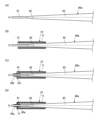
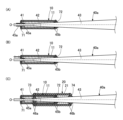
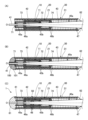
- Figures 4, 5, and 6 are explanatory diagrams showing a manufacturing method of a guidewire 1 as a medical device.
- Figure 4 (A) is a diagram showing a core shaft body 40a.
- Figure 4 (B) is a diagram showing how the first inner coil 10 is positioned.
- Figure 4 (C) is a diagram showing how the solder material 101 is positioned.
- Figure 4 (D) is a diagram showing how the first tip fixing member 71 is formed.
- a core shaft body 40a is prepared, which has a thin diameter section 41, a first tapered section 42, a second tapered section 43, and a thick diameter section 44.
- the core shaft body 40a is made of a NiTi alloy.
- the core shaft body 40a may also be made of a stainless steel alloy.
- the first inner coil 10 is placed on the core shaft body 40a so as to cover a portion of the tip side of the core shaft body 40a (specifically, a portion of the base end side of the thin diameter section 41, the first tapered section 42, and a portion of the tip side of the second tapered section 43).
- the first inner coil 10 corresponds to the "first metal member", the “hollow member”, and the "first hollow member”.
- flux 100 is applied to the surface of the core shaft body 40a at a position corresponding to the tip of the first inner coil 10.
- the flux 100 contains tin chloride (II) (SnCl 2 ).
- the flux 100 may contain zinc chloride (ZnCl 2 ).
- a brazing material 101 is placed at a position corresponding to the tip of the first inner coil 10.
- the brazing material 101 is silver-tin brazing (SnAg).
- the brazing material 101 may be gold-tin brazing (SnAu). After the brazing material 101 is placed, the portion where the brazing material 101 is placed is heated using a hand gun or the like.
- the first tip fixing member 71 is formed in the portion where the brazing material 101 is placed, and the first tip coating 45a is formed on the surface of the core shaft body 40a located on both sides of the first tip fixing member 71.
- the first tip coating 45a is formed on the surface of the core shaft body 40a, on a portion adjacent to the first tip fixing member 71 on the distal side of the first tip fixing member 71, and on a portion adjacent to the first tip fixing member 71 on the proximal side of the first tip fixing member 71.
- FIG. 5(A) is a diagram showing how the first base end fixing member 72 is formed.
- FIG. 5(B) is a diagram showing how the first tip coating 45a on the tip side is removed.
- FIG. 5(C) is a diagram showing how the second inner coil 20 is positioned and fixed.
- a brazing process is performed at a position corresponding to the base end of the first inner coil 10 to form the first base end fixing member 72 and the first base end coating 45b.
- the first tip coating 45a formed on the distal side of the first tip fixing member 71 (fixing member), in other words, the first tip coating 45a in the range indicated by the white arrow in FIG. 5(B) is removed.
- the first tip coating 45a formed on the distal side of the first tip fixing member 71 is removed, but in this case, it is sufficient to remove at least a portion of the first tip coating 45a formed on the distal side of the first tip fixing member 71.
- FIG. 5(B) corresponds to the "removal process.”
- the second inner coil 20 is positioned so as to cover the first inner coil 10. After that, a brazing process is performed on the position corresponding to the tip of the second inner coil 20 to form a second tip fixing member 73 and a second tip coating 46a. In addition, a brazing process is performed on the position corresponding to the base end of the second inner coil 20 to form a second base end fixing member 74 and a second base end coating 46b.
- FIG. 6(A) is a diagram showing how the outer coil 30 is positioned and fixed.
- FIG. 6(B) is a diagram showing how the solder material 101 is positioned.
- FIG. 6(C) is a diagram showing how the tip fixing member 61 is formed.
- the outer coil 30 is positioned so as to cover the first inner coil 10 and the second inner coil 20.
- the outer coil 30 is positioned so that the tip position of the outer coil 30 and the tip position of the first tip fixing member 71 are in the same position.
- a brazing process is performed on the position corresponding to the base end of the outer coil 30 to form the base end fixing member 62 and the third coating 47.
- the outer coil 30 corresponds to the "second hollow member.”
- flux 100 is applied to the portion of the surface of the core shaft body 40a from which the first tip coating 45a was removed in the removal step of FIG. 5(B).
- the brazing material 101 is placed at a position corresponding to the tip of the outer coil 30.
- the brazing material 101 is placed so as to encompass at least a portion of the first tip fixing member 71 (in the illustrated example, all but the base end surface).
- the portion where the brazing material 101 is placed is heated using a hand gun or the like.
- the tip fixing member 61 is formed in the portion where the brazing material 101 is placed by melting the brazing material 101 and the first tip fixing member 71 and then solidifying.
- FIGS. 6(B) and (C) correspond to the "second forming step”
- the tip fixing member 61 corresponds to the "second fixing member”.
- the coatings (specifically, the first tip coating 45a, the first base end coating 45b, the second tip coating 46a, the second base end coating 46b, the third coating 47, and the fourth coating 48) are formed will be described.
- the flux 100 is applied to the location where each fixing member is intended to be formed, the brazing material 101 is placed, and then heating is performed.
- nickel oxide (II) (NiO) formed on the surface of the core shaft body 40a is reduced by tin chloride (II) (SnCl 2 ) contained in the flux 100, and oxygen (O 2 ) is generated.
- tin chloride (II) (SnCl 2 ) contained in the flux 100 reacts with the generated oxygen (O 2 ) to generate tin oxide (SnO).
- tin (Sn) contained in the brazing material 101 also reacts with the generated oxygen (O 2 ), promoting the generation of tin oxide (SnO).
- the coating in this embodiment contains tin element, which is the fourth element.
- an oxide coating containing tin oxide (II) (SnO) (specifically, the first tip coating 45a, the first base end coating 45b, the second tip coating 46a, the second base end coating 46b, the third coating 47, and the fourth coating 48) is formed.
- the coating of the first inner coil 10 is also formed by a chemical reaction similar to the chemical reactions shown in formulas (1) to (3).
- the supply of O 2 shown in formula (1) is mainly derived from nickel oxide of the core shaft body 40a, and may also be derived from chromium oxide and iron oxide contained in the first inner coil 10. Also, when a flux 100 containing zinc chloride (ZnCl 2 ) is used, an oxide coating containing zinc oxide (ZnO) is formed by a similar reaction.
- the manufacturing method of the guidewire 1 (medical device) of the first embodiment includes a forming step of applying flux 100 to the core shaft body 40a containing a first element, and forming a first tip fixing member 71 (fixing member) and a first tip coating 45a (coating) of the core shaft body 40a by brazing using a brazing material 101 containing a second element that is different from the first element and is a D block element, as shown in Figures 4(C) and (D). Therefore, the coating can suppress galvanic corrosion of one of the core shaft body 40a, the first tip fixing member 71, and the tip fixing member 61, which are more susceptible to corrosion, which each contain different elements.
- the forming process shown in Figures 4 (C) and (D) includes forming a first tip coating 45a (coating) on each of the surface of the core shaft body 40a, a portion adjacent to the first tip fixing member 71 on the distal side of the first tip fixing member 71 (fixing member), and a portion adjacent to the first tip fixing member 71 on the proximal side of the first tip fixing member 71. This further improves the effect of suppressing galvanic corrosion by the coating.
- the first tip fixing member 71 is a member that fixes the tip of the core shaft 40 (specifically, the core shaft body 40a) and the tip of the first inner coil 10 (hollow member), and the manufacturing method of the guidewire 1 includes a removal step of removing at least a part of the first tip coating 45a (coating) formed on the tip side of the first tip fixing member 71, as shown in FIG. 5(B).
- the coating (specifically, the first tip coating 45a formed on the tip side of the first tip fixing member 71) that prevents the joining of the core shaft 40 (specifically, the core shaft body 40a) and the tip fixing member 61 (second fixing member).
- a second forming step is provided in which flux 100 is applied to the portion of the core shaft body 40a from which the first tip coating 45a (coating) was removed in the removing step, and a tip fixing member 61 (second fixing member) is formed by brazing using a brazing material 101 containing a second element.
- Second Embodiment 7 is an enlarged view of a portion of the distal end side of the guidewire 1A of the second embodiment.
- the guidewire 1A of the second embodiment does not include the second inner coil 20 in the configuration described in the first embodiment.
- the guidewire 1A does not include the second distal fixing member 73 and the second proximal fixing member 74 for fixing the second inner coil 20, the second distal coating 46a formed in conjunction with the formation of the second distal fixing member 73, and the second proximal coating 46b formed in conjunction with the formation of the second proximal fixing member 74.
- the configuration of the guidewire 1A can be modified in various ways, and the guidewire 1A may be configured without the second inner coil 20.
- the first inner coil 10 and the outer coil 30 are arranged apart from each other in the circumferential direction of the guidewire 1A, but the outer peripheral surface of the first inner coil 10 and the inner peripheral surface of the outer coil 30 may be in contact with each other.
- the outer coil 30, the base end fixing member 62 for fixing the outer coil 30, and the third coating 47 may be omitted.
- the intermediate fixing member 50 and the fourth coating 48 may be omitted.
- the guidewire 1A of the second embodiment can also achieve the same effects as the first embodiment described above.
- Third Embodiment 8 is an enlarged view of a portion of the distal end side of a guidewire 1B of the third embodiment.
- the guidewire 1B of the third embodiment does not include the first proximal fixing member 72 and the intermediate fixing member 50 in the configuration described in the first embodiment, and includes a second distal fixing member 73B instead of the second distal fixing member 73.
- the guidewire 1B does not include the first proximal coating 45b formed in conjunction with the formation of the first proximal fixing member 72 and the fourth coating 48 formed in conjunction with the formation of the intermediate fixing member 50, and further does not include the second distal coating 46a.
- the base end of the first inner coil 10 is not fixed to the core shaft 40.
- the second tip fixing member 73B fixes the tip of the second inner coil 20 and a part of the first inner coil 10, but is not joined to the core shaft 40.
- the second tip fixing member 73B as shown in FIG. 8 is formed.
- the configuration of the guidewire 1B can be modified in various ways, and the guidewire 1B may be constructed by omitting the first base end fixing member 72 and the intermediate fixing member 50. Furthermore, the second tip fixing member 73B does not need to be joined to the core shaft 40. Note that FIG. 8 is merely an example, and the second tip fixing member 73B and the second base end fixing member 74 may be omitted instead of the first base end fixing member 72, or may be omitted together with the first base end fixing member 72. Furthermore, the intermediate fixing member 50 may or may not be omitted. With the guidewire 1B of this third embodiment, the same effects as those of the first embodiment described above can be achieved.
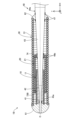
- Fourth Embodiment Fig. 9 is an explanatory diagram illustrating a cross-sectional configuration of a guidewire 1C of the fourth embodiment taken along line A-A (Fig. 1).
- the guidewire 1C of the fourth embodiment includes a first tip coating 45aC instead of the first tip coating 45a.
- the first tip coating 45aC is provided on a portion (approximately half in the illustrated example) of the circumferential direction of the core shaft body 40a, and covers a portion of the surface of the core shaft body 40a.
- the configuration of the coating can be modified in various ways, and it is sufficient that the coating covers at least a portion of the surface of the core shaft body 40a, and it is not necessary to cover the entire circumferential direction of the core shaft body 40a.
- the first distal coating 45a is illustrated, but this also applies to the other coatings other than the first distal coating 45a (specifically, the first proximal coating 45b, the second distal coating 46a, the second proximal coating 46b, the third coating 47, and the fourth coating 48).
- the guidewire 1C of this fourth embodiment the same effects as those of the first embodiment described above can be achieved.
- the core shaft body of the guidewire 1 may be appropriately provided with a thin diameter section, a thick diameter section, a flat section, a tapered section, etc., depending on the performance required of the guidewire 1, and may not include at least some of the above-mentioned thin diameter section 41, first tapered section 42, second tapered section 43, etc.
- the outer coil 30 may be configured to cover the entire core shaft 40, not just a portion of the tip side of the core shaft 40.
- the base end of the outer coil 30 may extend to the base end of the core shaft 40.
- one or more of the first inner coil 10, the second inner coil 20, and the outer coil 30 may be a tube having a substantially cylindrical shape instead of a coil in which a wire is wound in a spiral shape.
- the tube may have a slit penetrating the inside and outside of the tube, or may be a tubular shape without a slit.
- a reinforcing member made of wire woven in a mesh pattern or a coil-shaped reinforcing member may be embedded in the tube.
- each member may be formed of a material different from the above-mentioned materials.
- the core shaft body may contain an element different from a base metal element.
- at least a part of the brazing material 101, the first tip fixing member 71, the first base end fixing member 72, the second tip fixing member 73, the second base end fixing member 74, the tip fixing member 61, the base end fixing member 62, and the intermediate fixing member 50 may not contain a transition element (for example, may contain a zinc element), and may not contain a precious metal element (for example, may contain a copper element).
- the first tip coating 45a, the first base end coating 45b, the second tip coating 46a, the second base end coating 46b, the third coating 47, and the fourth coating 48 may not contain a metal element, and may not contain a tin element or a zinc element.
- at least a portion of the first distal coating 45a, the first proximal coating 45b, the second distal coating 46a, the second proximal coating 46b, the third coating 47, and the fourth coating 48 do not have to be an oxide coating.
- the medical device may be a catheter, a basket, a snare, a stent, etc.
- the method of forming the coating may be plating, thermal spraying, vapor deposition, etc.
- the fourth element contained in the coating may be at least one of copper, bismuth, antimony, germanium, and aluminum.
- the coating containing at least one of copper, bismuth, antimony, germanium, and aluminum may be derived from a flux, or may be formed by the above-mentioned plating, thermal spraying, vapor deposition, etc.
- the guidewires of the first to fourth embodiments and the configurations of the guidewires or medical devices of the above-mentioned modifications 1 to 4 may be combined as appropriate.
- the guidewires of the second and third embodiments may be configured to include the coating described in the fourth embodiment.
- the intermediate fixing member 50 and the fourth coating 48 may be omitted, and the first proximal end fixing member 72 and the first proximal end coating 45b may be omitted.
- Reference Signs List 1, 1A to 1C... Guide wire 10 ... First inner coil 11, 21, 31... Wire 20... Second inner coil 30... Outer coil 40... Core shaft 40a... Core shaft body 41... Thin diameter section 42... First tapered section 43... Second tapered section 44... Thick diameter section 45a, 45aC... First distal coating 45b... First proximal coating 46a... Second distal coating 46b... Second proximal coating 47... Third coating 48... Fourth coating 50... Intermediate fixing member 61... Distal fixing member 62... Proximal fixing member 71... First distal fixing member 72... First proximal fixing member 73, 73B... Second distal fixing member 74... Second proximal fixing member 100... Flux 101... Brazing material
Landscapes
- Health & Medical Sciences (AREA)
- Life Sciences & Earth Sciences (AREA)
- Animal Behavior & Ethology (AREA)
- Veterinary Medicine (AREA)
- Public Health (AREA)
- General Health & Medical Sciences (AREA)
- Epidemiology (AREA)
- Inorganic Chemistry (AREA)
- Chemical & Material Sciences (AREA)
- Engineering & Computer Science (AREA)
- Hematology (AREA)
- Heart & Thoracic Surgery (AREA)
- Biomedical Technology (AREA)
- Anesthesiology (AREA)
- Pulmonology (AREA)
- Biophysics (AREA)
- Media Introduction/Drainage Providing Device (AREA)
Priority Applications (3)
| Application Number | Priority Date | Filing Date | Title |
|---|---|---|---|
| JP2024561051A JPWO2024116320A1 (https=) | 2022-11-30 | 2022-11-30 | |
| PCT/JP2022/044155 WO2024116320A1 (ja) | 2022-11-30 | 2022-11-30 | 医療デバイス、及び、医療デバイスの製造方法 |
| US19/209,180 US20250269149A1 (en) | 2022-11-30 | 2025-05-15 | Medical device, and method for manufacturing medical device |
Applications Claiming Priority (1)
| Application Number | Priority Date | Filing Date | Title |
|---|---|---|---|
| PCT/JP2022/044155 WO2024116320A1 (ja) | 2022-11-30 | 2022-11-30 | 医療デバイス、及び、医療デバイスの製造方法 |
Related Child Applications (1)
| Application Number | Title | Priority Date | Filing Date |
|---|---|---|---|
| US19/209,180 Continuation US20250269149A1 (en) | 2022-11-30 | 2025-05-15 | Medical device, and method for manufacturing medical device |
Publications (1)
| Publication Number | Publication Date |
|---|---|
| WO2024116320A1 true WO2024116320A1 (ja) | 2024-06-06 |
Family
ID=91323105
Family Applications (1)
| Application Number | Title | Priority Date | Filing Date |
|---|---|---|---|
| PCT/JP2022/044155 Ceased WO2024116320A1 (ja) | 2022-11-30 | 2022-11-30 | 医療デバイス、及び、医療デバイスの製造方法 |
Country Status (3)
| Country | Link |
|---|---|
| US (1) | US20250269149A1 (https=) |
| JP (1) | JPWO2024116320A1 (https=) |
| WO (1) | WO2024116320A1 (https=) |
Cited By (1)
| Publication number | Priority date | Publication date | Assignee | Title |
|---|---|---|---|---|
| WO2025262735A1 (ja) * | 2024-06-17 | 2025-12-26 | 朝日インテック株式会社 | 医療デバイスおよび医療デバイスの製造方法 |
Citations (10)
| Publication number | Priority date | Publication date | Assignee | Title |
|---|---|---|---|---|
| JP2012034922A (ja) * | 2010-08-10 | 2012-02-23 | Asahi Intecc Co Ltd | ガイドワイヤ |
| JP2012070853A (ja) * | 2010-09-28 | 2012-04-12 | Asahi Intecc Co Ltd | ガイドワイヤ |
| JP2012115408A (ja) * | 2010-11-30 | 2012-06-21 | Patentstra Co Ltd | 医療用ガイドワイヤ、その製造方法、及び医療用ガイドワイヤとマイクロカテーテルとの組立体 |
| JP2013013449A (ja) * | 2011-06-30 | 2013-01-24 | Asahi Intecc Co Ltd | ガイドワイヤ |
| JP2013162920A (ja) * | 2012-02-13 | 2013-08-22 | Asahi Intecc Co Ltd | ガイドワイヤ |
| WO2016080155A1 (ja) * | 2014-11-17 | 2016-05-26 | 株式会社徳力本店 | 合金材およびそれを使用した医療器具 |
| WO2017221425A1 (ja) * | 2016-06-24 | 2017-12-28 | 朝日インテック株式会社 | ガイドワイヤ |
| WO2022092002A1 (ja) * | 2020-10-30 | 2022-05-05 | テルモ株式会社 | ガイドワイヤおよびガイドワイヤの製造方法 |
| WO2022092001A1 (ja) * | 2020-10-30 | 2022-05-05 | テルモ株式会社 | ガイドワイヤおよびガイドワイヤの製造方法 |
| JP2022078561A (ja) * | 2020-11-13 | 2022-05-25 | 朝日インテック株式会社 | ガイドワイヤ |
-
2022
- 2022-11-30 WO PCT/JP2022/044155 patent/WO2024116320A1/ja not_active Ceased
- 2022-11-30 JP JP2024561051A patent/JPWO2024116320A1/ja active Pending
-
2025
- 2025-05-15 US US19/209,180 patent/US20250269149A1/en active Pending
Patent Citations (10)
| Publication number | Priority date | Publication date | Assignee | Title |
|---|---|---|---|---|
| JP2012034922A (ja) * | 2010-08-10 | 2012-02-23 | Asahi Intecc Co Ltd | ガイドワイヤ |
| JP2012070853A (ja) * | 2010-09-28 | 2012-04-12 | Asahi Intecc Co Ltd | ガイドワイヤ |
| JP2012115408A (ja) * | 2010-11-30 | 2012-06-21 | Patentstra Co Ltd | 医療用ガイドワイヤ、その製造方法、及び医療用ガイドワイヤとマイクロカテーテルとの組立体 |
| JP2013013449A (ja) * | 2011-06-30 | 2013-01-24 | Asahi Intecc Co Ltd | ガイドワイヤ |
| JP2013162920A (ja) * | 2012-02-13 | 2013-08-22 | Asahi Intecc Co Ltd | ガイドワイヤ |
| WO2016080155A1 (ja) * | 2014-11-17 | 2016-05-26 | 株式会社徳力本店 | 合金材およびそれを使用した医療器具 |
| WO2017221425A1 (ja) * | 2016-06-24 | 2017-12-28 | 朝日インテック株式会社 | ガイドワイヤ |
| WO2022092002A1 (ja) * | 2020-10-30 | 2022-05-05 | テルモ株式会社 | ガイドワイヤおよびガイドワイヤの製造方法 |
| WO2022092001A1 (ja) * | 2020-10-30 | 2022-05-05 | テルモ株式会社 | ガイドワイヤおよびガイドワイヤの製造方法 |
| JP2022078561A (ja) * | 2020-11-13 | 2022-05-25 | 朝日インテック株式会社 | ガイドワイヤ |
Cited By (1)
| Publication number | Priority date | Publication date | Assignee | Title |
|---|---|---|---|---|
| WO2025262735A1 (ja) * | 2024-06-17 | 2025-12-26 | 朝日インテック株式会社 | 医療デバイスおよび医療デバイスの製造方法 |
Also Published As
| Publication number | Publication date |
|---|---|
| JPWO2024116320A1 (https=) | 2024-06-06 |
| US20250269149A1 (en) | 2025-08-28 |
Similar Documents
| Publication | Publication Date | Title |
|---|---|---|
| JP2013094343A (ja) | ガイドワイヤ | |
| JP5240948B2 (ja) | ガイドワイヤ | |
| JP2013013449A (ja) | ガイドワイヤ | |
| EP2921195A1 (en) | Guide wire | |
| US20250269149A1 (en) | Medical device, and method for manufacturing medical device | |
| JP2015208362A (ja) | ガイドワイヤ | |
| US20210128887A1 (en) | Guide wire, and guide wire manufacturing method | |
| JP7269934B2 (ja) | ガイドワイヤ | |
| JP3599772B2 (ja) | 医療用ガイドワイヤ | |
| JP2014100265A (ja) | ガイドワイヤ | |
| JP2015036090A (ja) | コイル体及びそのコイル体を用いたガイドワイヤ | |
| US20210093840A1 (en) | Guide wire | |
| US20230121231A1 (en) | Guide Wires | |
| JP2012254233A (ja) | ガイドワイヤ | |
| JP4497746B2 (ja) | ガイドワイヤ | |
| JP2015137428A (ja) | 撚線及びその撚線を用いたガイドワイヤ | |
| JP2003052831A (ja) | 医療用ガイドワイヤ及びその製造方法 | |
| WO2020161832A1 (ja) | ガイドワイヤ | |
| US11420028B2 (en) | Guide wire | |
| JP2017070803A (ja) | ガイドワイヤ | |
| JP7546454B2 (ja) | ガイドワイヤ | |
| JP7765278B2 (ja) | ガイドワイヤ、及び、ガイドワイヤの製造方法 | |
| EP4023280B1 (en) | Guide wire | |
| JPH0623543U (ja) | 医療用のガイドワイヤ | |
| JP7256582B2 (ja) | ガイドワイヤ |
Legal Events
| Date | Code | Title | Description |
|---|---|---|---|
| 121 | Ep: the epo has been informed by wipo that ep was designated in this application |
Ref document number: 22967153 Country of ref document: EP Kind code of ref document: A1 |
|
| WWE | Wipo information: entry into national phase |
Ref document number: 2024561051 Country of ref document: JP |
|
| NENP | Non-entry into the national phase |
Ref country code: DE |
|
| 122 | Ep: pct application non-entry in european phase |
Ref document number: 22967153 Country of ref document: EP Kind code of ref document: A1 |