WO2024106392A1 - 光ファイバカッタ - Google Patents
光ファイバカッタ Download PDFInfo
- Publication number
- WO2024106392A1 WO2024106392A1 PCT/JP2023/040800 JP2023040800W WO2024106392A1 WO 2024106392 A1 WO2024106392 A1 WO 2024106392A1 JP 2023040800 W JP2023040800 W JP 2023040800W WO 2024106392 A1 WO2024106392 A1 WO 2024106392A1
- Authority
- WO
- WIPO (PCT)
- Prior art keywords
- gear
- optical fiber
- rotates
- fiber cutter
- cutter according
- Prior art date
- Legal status (The legal status is an assumption and is not a legal conclusion. Google has not performed a legal analysis and makes no representation as to the accuracy of the status listed.)
- Ceased
Links
Images



Classifications
-
- G—PHYSICS
- G02—OPTICS
- G02B—OPTICAL ELEMENTS, SYSTEMS OR APPARATUS
- G02B6/00—Light guides; Structural details of arrangements comprising light guides and other optical elements, e.g. couplings
- G02B6/24—Coupling light guides
- G02B6/25—Preparing the ends of light guides for coupling, e.g. cutting
-
- B—PERFORMING OPERATIONS; TRANSPORTING
- B26—HAND CUTTING TOOLS; CUTTING; SEVERING
- B26D—CUTTING; DETAILS COMMON TO MACHINES FOR PERFORATING, PUNCHING, CUTTING-OUT, STAMPING-OUT OR SEVERING
- B26D3/00—Cutting work characterised by the nature of the cut made; Apparatus therefor
- B26D3/16—Cutting rods or tubes transversely
Definitions
- the present disclosure relates to optical fiber cutters.
- This application claims priority based on Japanese Application No. 2022-183481 filed on November 16, 2022, and incorporates by reference all of the contents of the above-mentioned Japanese application.
- Patent Document 1 describes an optical fiber cutter.
- the optical fiber cutter has a main body, a clamp that holds the bare optical fiber, a disk-shaped blade that scratches the bare optical fiber, and a scrap collection mechanism that collects scraps of the bare optical fiber.
- the scrap collection mechanism includes a case main body with an opening, an inner case housed in the case main body, an opening/closing lid that opens and closes the opening of the case main body, and an opening/closing lock lever that locks the opening/closing lid in the open position.
- the drive lever comprises a shaft, a flange attached to the left end of the shaft, and an arm protruding upward from the flange.
- the drive gear comprises a substantially cylindrical base, a pair of claws, a gear mounting portion, a gear portion, a ridge portion, and a protrusion.
- the driving force of the drive gear is transmitted to the lower roller via the drive lever.
- the base of the drive gear is separated from the flange of the drive lever, and the gear portion of the drive gear is not engaged with the idle gear. Therefore, the rotational motion of the drive gear is not transmitted to the lower roller, and the lower roller does not rotate.
- Patent Document 2 describes a one-way clutch.
- the one-way clutch has an outer race, which is an outer ring member, and an inner race, which is an inner ring member.
- a number of internal teeth are formed on the inner circumference of the outer race.
- a number of flexible ratchet pawls are provided on the outer circumference of the inner race. The outer race and the inner race are fitted together with the internal teeth of the outer race and the ratchet pawls of the inner race engaging with each other.
- Patent Document 3 describes a ratchet-type one-way clutch.
- the ratchet-type one-way clutch has an outer ring, an inner ring arranged radially inward of the outer ring, and a ratchet mechanism that transmits torque between the outer ring and the inner ring.
- the ratchet mechanism is composed of a notch formed in the inner ring, a first recess formed in the outer ring, and a pawl member held in the first recess.
- the optical fiber cutter according to the present disclosure has a cover and cuts an optical fiber as the cover rotates.
- the optical fiber cutter is equipped with a roller attached to a rotating shaft, which holds the optical fiber to be cut and rotates about the rotating shaft, a first gear attached to the rotating shaft and receives a driving force for rotating the rotating shaft, a second gear meshing with the first gear and rotating, an interlocking member interlocking with the rotation of the cover and having a rack for transmitting a driving force for rotating the second gear in response to the interlocking, and a third gear meshing with the rack and rotating.
- the third gear rotates in a first rotation direction when the interlocking member moves in a first direction, and rotates in a second rotation direction opposite to the first rotation direction when the interlocking member moves in a second direction different from the first direction.
- the second gear does not rotate when the third gear rotates in the first rotation direction, and rotates in the second rotation direction together with the third gear when the third gear rotates in the second rotation direction.
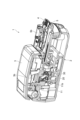
- FIG. 1 is a perspective view showing an optical fiber cutter according to an embodiment.
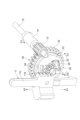
- FIG. 2 is a cross-sectional perspective view showing a cover, an interlocking member, a third gear, and a second gear of the optical fiber cutter of FIG.
- FIG. 3 is a perspective view showing an interlocking member, a third gear, a second gear, a first gear, and a roller of the optical fiber cutter of FIG.
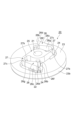
- FIG. 4 is a perspective view showing the second gear and the third gear of FIG.
- FIG. 5 is a perspective view showing the third gear of FIG.
- FIG. 6 is a front view showing the third gear of FIG.
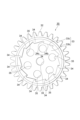
- FIG. 7 is a front view showing the second gear of FIG.
- a blade that scratches the optical fiber and a roller for moving the cut optical fiber to a collection device are arranged side by side.
- the roller is attached to a rotating shaft and can rotate around the rotating shaft.
- the roller rotates so that its top surface faces the blade, there is a possibility that optical fiber debris will come out towards the blade. Therefore, it is necessary to restrict the rotation of the roller in one direction.
- the present disclosure aims to provide an optical fiber cutter that can be simplified in configuration and can restrict the rotation of the rollers in one direction.
- the optical fiber cutter according to one embodiment is (1) an optical fiber cutter having a cover, which cuts an optical fiber as the cover rotates.
- the optical fiber cutter includes a roller attached to a rotating shaft, which holds the optical fiber to be cut and rotates about the rotating shaft, a first gear attached to the rotating shaft and receives a driving force for rotating the rotating shaft, a second gear meshing with the first gear and rotating, an interlocking member having a rack that interlocks with the rotation of the cover and transmits a driving force for rotating the second gear in response to the interlocking, and a third gear meshing with the rack and rotating.
- the third gear rotates in a first rotation direction when the interlocking member moves in a first direction, and rotates in a second rotation direction opposite to the first rotation direction when the interlocking member moves in a second direction different from the first direction.
- the second gear does not rotate when the third gear rotates in the first rotation direction, and rotates in the second rotation direction together with the third gear when the third gear rotates in the second rotation direction.
- This optical fiber cutter has a roller that holds the optical fiber to be cut, and the roller rotates around a rotation axis.
- the optical fiber cutter includes a first gear attached to the rotation axis, a second gear that rotates in mesh with the first gear, a third gear, and an interlocking member having a rack that rotates in mesh with the third gear.
- the third gear rotates in a first rotation direction when the interlocking member moves in a first direction, and rotates in a second rotation direction opposite to the first rotation direction when the interlocking member moves in a second direction.
- the second gear rotates in the second rotation direction together with the third gear when the third gear rotates in the second rotation direction.
- the first gear and the roller rotate in the first rotation direction.
- the second gear does not rotate when the third gear rotates in the first rotation direction. Therefore, the first gear and the roller do not rotate in the second rotation direction. Therefore, the rotation of the roller in one direction can be restricted, thereby reducing the possibility that optical fiber debris will come out toward the blade.
- the mechanism that rotates the rollers is made up of a first gear, a second gear, a third gear, and an interlocking member, making the configuration simple.
- the optical fiber cutter may include a fiber holding portion that holds the optical fiber, and the fiber holding portion may be movable upward and downward relative to the roller.
- the second gear may have a recess into which a part of the third gear fits, and the recess may be defined by a bottom surface facing the third gear and an inner peripheral surface.
- the third gear may be integrally molded.
- the configuration of the third gear can be simplified and the third gear can be easily manufactured.
- the interlocking member 11 has a rack 11b that transmits a driving force that rotates the third gear 20.
- the interlocking member 11 rotates the third gear 20 in accordance with the interlocking described above.
- the interlocking member 11 moves in a first direction A1 (the direction indicated by the arrow in FIG. 1), it rotates the third gear 20 in a first rotation direction D1 (the direction indicated by the arrow in FIG. 1).
- the interlocking member 11 moves in a second direction A2 different from the first direction A1, it rotates the third gear 20 in a second rotation direction D2 opposite to the first rotation direction D1.
- the first direction A1 is, for example, the direction in which the interlocking member 11 moves when the cover 3 is closed.
- the first direction A1 is a direction from above to below.
- the second direction A2 is, for example, the direction in which the interlocking member 11 moves when the cover 3 is opened.
- the second direction A2 is a direction from below to above.
- the roller 14 rotates in the first rotation direction D1 and the rotation of the roller 14 in the second rotation direction D2 is restricted by providing a third gear 20 described later.
- the configuration for realizing this function is described below.
- the third gear 20 and the second gear 30 rotate in the second rotation direction D2
- the first gear 13 rotates in the first rotation direction D1
- the third gear 20 rotates in the first rotation direction D1 but the second gear 30 does not rotate in the first rotation direction D1.
- the first gear 13, the rotating shaft 12, and the roller 14 do not rotate.
- FIG. 4 is an enlarged perspective view of the third gear 20.
- the third gear 20 has a shaft portion 21, teeth 22 formed to extend radially from the shaft portion 21 when viewed along the direction in which the shaft portion 21 extends (the direction extending vertically in FIG. 4, hereinafter sometimes referred to as the axial direction), and a base 23 on which the teeth 22 are formed.
- the shaft portion 21 protrudes from the tooth portion 22 to the opposite side to the base 23.
- the shaft portion 21 is cylindrical.
- the tooth portion 22 meshes with the rack 11b of the interlocking member 11.
- the third gear 20 converts the linear movement of the interlocking member 11 into the rotational movement of the third gear 20.
- the base 23 is, for example, disk-shaped.
- the base 23 has a contact portion 23b that contacts the second gear 30.
- the contact portion 23b is flange-shaped with an expanded diameter on the opposite side to the tooth portion 22 of the base 23. The contact of this flange-shaped contact portion 23b with the second gear 30 can make the rotation of the second gear 30 more stable.
- Figure 5 is a perspective view showing the surface of the base 23 opposite the tooth portion 22.
- Figure 6 is a view showing the surface of the base 23 on which the tooth portion 22 is formed.
- the base 23 has a hole 24 formed therein that penetrates the base 23 in the axial direction of the third gear 20.
- the third gear 20 has a claw portion 26 that is aligned with the hole 24 in the axial direction of the third gear 20.
- the claw portion 26 corresponds to the portion that abuts against the second gear 30 described below.
- the third gear 20 is made of resin.
- the third gear 20 is molded as a single piece.
- the tooth portion 22 is integrated with the claw portion 26.
- the claw portion 26 is formed on the surface of the base 23 opposite the tooth portion 22.
- the third gear 20 has, for example, a plurality of claw portions 26 (two, for example).
- the third gear 20 has a claw unit 25 including a plurality of claw portions 26.
- the arm portion 27 has an extension portion 27b that extends from a position adjacent to the shaft portion 21 toward the outer periphery of the third gear 20, and a bent portion 27c that is bent from the end of the extension portion 27b opposite the shaft portion 21.
- the bent portion 27c is bent, for example, 90 degrees relative to the extension portion 27b.
- the thickness of the arm portion 27 is constant when viewed along the axial direction of the third gear 20.
- the claw portion 26 has an abutment surface 26b extending along the radial direction of the third gear 20, an apex 26d located at the radial end of the abutment surface 26b, and an inclined surface 26c extending obliquely from the apex 26d to the abutment surface 26b so as to form an acute angle with the abutment surface 26b. Furthermore, the claw portion 26 has a constricted portion 26g extending from an end 26f opposite the apex 26d of the abutment surface 26b and approaching the inclined surface 26c as it moves away from the end 26f.
- the abutment surface 26b extends both radially and axially of the third gear 20.
- the inclined surface 26c extends from the apex 26d toward the arm portion 27 and also extends axially of the third gear 20.
- the abutment surface 26b and the inclined surface 26c are flat.
- the apex 26d and the end portion 26f are rounded.
- the thickness of the claw portion 26 becomes thinner the further away from the apex 26d. This gives the claw portion 26 a shape that is easily elastically deformed.
- FIG. 7 is a diagram showing the second gear 30.
- the second gear 30 has a protrusion 34 that protrudes from the inner circumferential surface 33c of the second gear 30, and the claw portion 26 of the third gear 20 contacts the protrusion 34.
- the second gear 30 has a recess 33 into which a part of the third gear 20 fits.
- the recess 33 is defined by a bottom surface 33b that faces the third gear 20 and the inner circumferential surface 33c.
- the bottom surface 33b extends, for example, in a direction perpendicular to the axial direction.
- the inner peripheral surface 33c extends from the outer edge of the bottom surface 33b along the axial direction of the second gear 30.
- a through hole 35 is formed in the bottom surface 33b, penetrating the second gear 30 in the axial direction of the second gear 30.
- the through hole 35 has a circular shape.
- the second gear 30 has a plurality of through holes 35 (seven as an example). For example, one of the plurality of through holes 35 is formed in the center of the second gear 30.
- the second gear 30 meshes with the first gear 13 described above.
- the second gear 30 has teeth 32 on the outer periphery of the second gear 30 that mesh with the first gear 13.
- the claws 26 of the third gear 20 enter the recesses 33 of the second gear 30 and come into contact with the protrusions 34.
- the second gear 30 has multiple protrusions 34.
- the multiple protrusions 34 are aligned along the rotational direction (circumferential direction) of the second gear 30.
- the protrusion 34 has a first protruding surface 34c that protrudes from the inner circumferential surface 33c along the radial direction of the second gear 30, and a second protruding surface 34b that extends from the protruding end of the first protruding surface 34c so as to form a right angle with the first protruding surface 34c when viewed along the axial direction of the second gear 30.
- the inclined surface 26c of the claw portion 26 abuts against the second protruding surface 34b when the third gear 20 rotates in the first rotation direction D1.
- the claw portion 26 elastically deforms, and the inclined surface 26c overcomes the second protruding surface 34b while the third gear 20 rotates in the first rotation direction D1, so that the second gear 30 does not rotate.
- the abutting surface 26b of the claw portion 26 abuts against the first protruding surface 34c when the third gear 20 rotates in the second rotation direction D2.
- the second gear 30 rotates together with the third gear 20 in the second rotation direction D2 with the abutment surface 26b abutting against the first protruding surface 34c.
- the third gear 20 rotates in the first rotational direction D1 when the interlocking member 11 moves in the first direction A1, and rotates in the second rotational direction D2 when the interlocking member 11 moves in the second direction A2.
- the second gear 30 does not rotate when the third gear 20 rotates in the first rotational direction D1, and rotates together with the third gear 20 in the second rotational direction D2 when the third gear 20 rotates in the second rotational direction D2.
- the optical fiber cutter 1 has a roller 14 that holds the optical fiber to be cut, and the roller 14 rotates around a rotation shaft 12.
- the optical fiber cutter 1 includes a first gear 13 attached to the rotation shaft 12, a second gear 30 that meshes with the first gear 13, a third gear 20, and an interlocking member 11 having a rack 11b that meshes with the third gear 20.
- the third gear 20 rotates in a first rotation direction D1 when the interlocking member 11 moves in the first direction A1, and rotates in a second rotation direction D2 opposite to the first rotation direction D1 when the interlocking member 11 moves in the second direction A2.
- the second gear 30 rotates together with the third gear 20 in the second rotation direction D2.
- the first gear 13 and the roller 14 rotate in the first rotation direction D1.
- the second gear 30 does not rotate when the third gear 20 rotates in the first rotation direction D1. Therefore, the first gear 13 and the roller 14 do not rotate in the second rotation direction D2. Therefore, the rotation of the roller 14 in one direction can be restricted, thereby reducing the possibility that optical fiber debris will come out toward the blade 6.
- the mechanism for rotating the roller 14 is composed of the first gear 13, the second gear 30, the third gear 20, and the interlocking member 11, the configuration can be simplified.
- the claw portion 26 may have an abutment surface 26b extending along the radial direction of the third gear 20, an apex 26d located at the radial end of the abutment surface 26b, and an inclined surface 26c extending obliquely from the apex 26d to the abutment surface 26b so as to form an acute angle with the abutment surface 26b.
- the inclined surface 26c passes over the convex portion 34 and does not rotate
- the abutment surface 26b abuts against the convex portion 34 and the second gear 30 rotates in the second rotation direction D2 together with the third gear 20.
- the claw portion 26 may have a constriction portion 26g that extends from an end portion 26f opposite the apex 26d of the abutment surface 26b and approaches the inclined surface 26c as it moves away from the end portion 26f.
- the inclined surface 26c overcomes the convex portion 34 and the second gear 30 does not rotate.
- the abutment surface 26b abuts against the convex portion 34 and the second gear 30 rotates together with the third gear 20 in the second rotation direction D2.
- the claw portion 26 of the third gear 20 having the inclined surface 26c and the abutment surface 26b has a narrowed portion 26g.
- the narrowed portion 26g extends from the end portion 26f opposite the apex 26d of the abutment surface 26b, and approaches the inclined surface 26c as it moves away from the end portion 26f.
- the thickness of the claw portion 26 becomes thinner as it moves away from the apex 26d. This makes it easier to deform the claw portion 26 when the third gear 20 rotates in the first rotation direction D1, which allows the third gear 20 to rotate smoothly in the first rotation direction D1.
- the third gear 20 has a tooth portion 22 that meshes with the rack 11b of the interlocking member 11, and the tooth portion 22 may be integral with the claw portion 26.
- the configuration of the third gear 20 can be simplified.
- the third gear 20 may have a base 23 on which the teeth 22 are formed.
- the base 23 may have a hole 24 formed therein that penetrates the base 23 in the axial direction of the third gear 20.
- the third gear 20 can be easily produced by molding.
- the third gear 20 may be integrally molded. In this case, the configuration of the third gear 20 can be simplified, and the third gear 20 can be easily manufactured.
- the third gear 20 is described as being integrally molded.
- the third gear does not have to be integrally molded, and may be configured by combining multiple parts.
- the third gear may be configured by connecting a tooth unit having a tooth portion 22 to a claw unit that is a separate part from the tooth unit. In this case, the hole 24 can be omitted.
- the third gear does not have to have the above-mentioned base 23, and may be a third gear in which the tooth portion 22 and the claw portion 26 are directly connected.
- the third gear 20 was made of resin.
- the material of the third gear is not limited to resin and can be changed as appropriate.
- the third gear 20 has two claw portions 26 and is equipped with a claw unit 25 consisting of two claw portions 26 and two arm portions 27.
- the claws of the third gear do not have to be made into a claw unit, and multiple claw portions 26 may be formed independently of each other (for example, at positions spaced apart from each other).
- the number of claw portions may be one or three or more, and is not particularly limited.
- the shape of the claw portion is not limited to the above-mentioned claw portion 26, and can be changed as appropriate within the scope of the above-mentioned gist.
Landscapes
- Physics & Mathematics (AREA)
- Life Sciences & Earth Sciences (AREA)
- Forests & Forestry (AREA)
- Engineering & Computer Science (AREA)
- Mechanical Engineering (AREA)
- General Physics & Mathematics (AREA)
- Optics & Photonics (AREA)
- Light Guides In General And Applications Therefor (AREA)
Priority Applications (4)
| Application Number | Priority Date | Filing Date | Title |
|---|---|---|---|
| KR1020257017930A KR20250093618A (ko) | 2022-11-16 | 2023-11-13 | 광 파이버 커터 |
| JP2024558869A JPWO2024106392A1 (https=) | 2022-11-16 | 2023-11-13 | |
| CN202380077529.0A CN120188083A (zh) | 2022-11-16 | 2023-11-13 | 光纤切割器 |
| EP23891539.1A EP4621456A4 (en) | 2022-11-16 | 2023-11-13 | FIBER OPTIC CUTTING DEVICE |
Applications Claiming Priority (2)
| Application Number | Priority Date | Filing Date | Title |
|---|---|---|---|
| JP2022183481 | 2022-11-16 | ||
| JP2022-183481 | 2022-11-16 |
Publications (1)
| Publication Number | Publication Date |
|---|---|
| WO2024106392A1 true WO2024106392A1 (ja) | 2024-05-23 |
Family
ID=91084699
Family Applications (1)
| Application Number | Title | Priority Date | Filing Date |
|---|---|---|---|
| PCT/JP2023/040800 Ceased WO2024106392A1 (ja) | 2022-11-16 | 2023-11-13 | 光ファイバカッタ |
Country Status (5)
| Country | Link |
|---|---|
| EP (1) | EP4621456A4 (https=) |
| JP (1) | JPWO2024106392A1 (https=) |
| KR (1) | KR20250093618A (https=) |
| CN (1) | CN120188083A (https=) |
| WO (1) | WO2024106392A1 (https=) |
Citations (11)
| Publication number | Priority date | Publication date | Assignee | Title |
|---|---|---|---|---|
| JP2009244403A (ja) * | 2008-03-28 | 2009-10-22 | Furukawa Electric Co Ltd:The | 光ファイバ切断装置 |
| JP2013137445A (ja) * | 2011-12-28 | 2013-07-11 | Fujikura Ltd | 光ファイバカッタ内蔵ケース |
| JP2013194796A (ja) | 2012-03-16 | 2013-09-30 | Canon Inc | ワンウェイクラッチ |
| JP2017156419A (ja) * | 2016-02-29 | 2017-09-07 | Seiオプティフロンティア株式会社 | 光ファイバカッタ |
| JP2019127989A (ja) | 2018-01-24 | 2019-08-01 | Nskワーナー株式会社 | ラチェット型ワンウェイクラッチ |
| US20200026004A1 (en) * | 2018-07-18 | 2020-01-23 | International Business Machines Corporation | Cleaving fibers of differing composition |
| CN110850525A (zh) * | 2019-12-19 | 2020-02-28 | 南通欧福维精密机电有限公司 | 一种线缆切割装置 |
| WO2022011848A1 (zh) * | 2020-07-17 | 2022-01-20 | 一诺仪器(中国)有限公司 | 一种光纤切割装置 |
| WO2022181766A1 (ja) | 2021-02-26 | 2022-09-01 | 住友電工オプティフロンティア株式会社 | 光ファイバカッタ |
| WO2022224801A1 (ja) * | 2021-04-19 | 2022-10-27 | 住友電工オプティフロンティア株式会社 | 光ファイバ切断装置 |
| JP2022183481A (ja) | 2021-05-31 | 2022-12-13 | ローム株式会社 | ガスセンサ |
Family Cites Families (1)
| Publication number | Priority date | Publication date | Assignee | Title |
|---|---|---|---|---|
| CN107962621B (zh) * | 2018-01-10 | 2024-04-16 | 一诺仪器(中国)有限公司 | 一种光纤切割刀用光纤回收装置及光纤切割刀 |
-
2023
- 2023-11-13 CN CN202380077529.0A patent/CN120188083A/zh active Pending
- 2023-11-13 JP JP2024558869A patent/JPWO2024106392A1/ja active Pending
- 2023-11-13 EP EP23891539.1A patent/EP4621456A4/en active Pending
- 2023-11-13 KR KR1020257017930A patent/KR20250093618A/ko active Pending
- 2023-11-13 WO PCT/JP2023/040800 patent/WO2024106392A1/ja not_active Ceased
Patent Citations (11)
| Publication number | Priority date | Publication date | Assignee | Title |
|---|---|---|---|---|
| JP2009244403A (ja) * | 2008-03-28 | 2009-10-22 | Furukawa Electric Co Ltd:The | 光ファイバ切断装置 |
| JP2013137445A (ja) * | 2011-12-28 | 2013-07-11 | Fujikura Ltd | 光ファイバカッタ内蔵ケース |
| JP2013194796A (ja) | 2012-03-16 | 2013-09-30 | Canon Inc | ワンウェイクラッチ |
| JP2017156419A (ja) * | 2016-02-29 | 2017-09-07 | Seiオプティフロンティア株式会社 | 光ファイバカッタ |
| JP2019127989A (ja) | 2018-01-24 | 2019-08-01 | Nskワーナー株式会社 | ラチェット型ワンウェイクラッチ |
| US20200026004A1 (en) * | 2018-07-18 | 2020-01-23 | International Business Machines Corporation | Cleaving fibers of differing composition |
| CN110850525A (zh) * | 2019-12-19 | 2020-02-28 | 南通欧福维精密机电有限公司 | 一种线缆切割装置 |
| WO2022011848A1 (zh) * | 2020-07-17 | 2022-01-20 | 一诺仪器(中国)有限公司 | 一种光纤切割装置 |
| WO2022181766A1 (ja) | 2021-02-26 | 2022-09-01 | 住友電工オプティフロンティア株式会社 | 光ファイバカッタ |
| WO2022224801A1 (ja) * | 2021-04-19 | 2022-10-27 | 住友電工オプティフロンティア株式会社 | 光ファイバ切断装置 |
| JP2022183481A (ja) | 2021-05-31 | 2022-12-13 | ローム株式会社 | ガスセンサ |
Non-Patent Citations (1)
| Title |
|---|
| See also references of EP4621456A1 |
Also Published As
| Publication number | Publication date |
|---|---|
| JPWO2024106392A1 (https=) | 2024-05-23 |
| CN120188083A (zh) | 2025-06-20 |
| EP4621456A4 (en) | 2026-04-01 |
| EP4621456A1 (en) | 2025-09-24 |
| KR20250093618A (ko) | 2025-06-24 |
Similar Documents
| Publication | Publication Date | Title |
|---|---|---|
| JP4948576B2 (ja) | からくり時計 | |
| CA2379753C (en) | Hand-operated device for transferring a film from a support strip to a substrate | |
| JP6648474B2 (ja) | 駆動装置 | |
| JP6003304B2 (ja) | 車両用ドアロック装置 | |
| GB2409248A (en) | One-way clutch with planet gears | |
| US11065778B2 (en) | Optical fiber cutter | |
| KR20010087271A (ko) | 광코넥터의 청소구 | |
| WO2024106392A1 (ja) | 光ファイバカッタ | |
| US11231665B2 (en) | Toner cartridge including detection gear, agitator gear, auger gear, and toner outlet | |
| EP2511105B1 (en) | Transfer tool | |
| JP7386924B2 (ja) | 可動インジケータを作動させるための機構を備える腕時計ケース | |
| JP3946971B2 (ja) | ギヤードモータ | |
| JP2024087037A (ja) | 回転操作装置、および電子鍵盤楽器 | |
| JP6273399B1 (ja) | 光ファイバ切断装置 | |
| JP7618477B2 (ja) | 連結装置 | |
| JP2002156007A (ja) | ギヤードモータ | |
| JP6514083B2 (ja) | 車両用ドアロック装置 | |
| JP2007138530A (ja) | 駆動装置及び車両用ドアクローザ装置 | |
| JP2003145996A (ja) | 塗膜転写具 | |
| CN109319569B (zh) | 涂膜转印具 | |
| JP2017182006A (ja) | トナーカートリッジ | |
| JPWO2024106392A5 (https=) | ||
| TW202431037A (zh) | 有機關的時鐘 | |
| JP4595790B2 (ja) | 車両用ドアクローザ装置 | |
| JP2000019589A (ja) | 回転検出機構 |
Legal Events
| Date | Code | Title | Description |
|---|---|---|---|
| 121 | Ep: the epo has been informed by wipo that ep was designated in this application |
Ref document number: 23891539 Country of ref document: EP Kind code of ref document: A1 |
|
| WWE | Wipo information: entry into national phase |
Ref document number: 2024558869 Country of ref document: JP |
|
| WWE | Wipo information: entry into national phase |
Ref document number: 202380077529.0 Country of ref document: CN |
|
| ENP | Entry into the national phase |
Ref document number: 20257017930 Country of ref document: KR Kind code of ref document: A |
|
| WWE | Wipo information: entry into national phase |
Ref document number: 2023891539 Country of ref document: EP |
|
| NENP | Non-entry into the national phase |
Ref country code: DE |
|
| WWP | Wipo information: published in national office |
Ref document number: 202380077529.0 Country of ref document: CN |
|
| ENP | Entry into the national phase |
Ref document number: 2023891539 Country of ref document: EP Effective date: 20250616 |
|
| WWP | Wipo information: published in national office |
Ref document number: 1020257017930 Country of ref document: KR |
|
| WWP | Wipo information: published in national office |
Ref document number: 2023891539 Country of ref document: EP |