WO2024100837A1 - モータ制御装置 - Google Patents
モータ制御装置 Download PDFInfo
- Publication number
- WO2024100837A1 WO2024100837A1 PCT/JP2022/041905 JP2022041905W WO2024100837A1 WO 2024100837 A1 WO2024100837 A1 WO 2024100837A1 JP 2022041905 W JP2022041905 W JP 2022041905W WO 2024100837 A1 WO2024100837 A1 WO 2024100837A1
- Authority
- WO
- WIPO (PCT)
- Prior art keywords
- case
- unit case
- opening
- control unit
- main circuit
- Prior art date
- Legal status (The legal status is an assumption and is not a legal conclusion. Google has not performed a legal analysis and makes no representation as to the accuracy of the status listed.)
- Ceased
Links
Images






Classifications
-
- H—ELECTRICITY
- H02—GENERATION; CONVERSION OR DISTRIBUTION OF ELECTRIC POWER
- H02K—DYNAMO-ELECTRIC MACHINES
- H02K11/00—Structural association of dynamo-electric machines with electric components or with devices for shielding, monitoring or protection
- H02K11/30—Structural association with control circuits or drive circuits
-
- H—ELECTRICITY
- H05—ELECTRIC TECHNIQUES NOT OTHERWISE PROVIDED FOR
- H05K—PRINTED CIRCUITS; CASINGS OR CONSTRUCTIONAL DETAILS OF ELECTRIC APPARATUS; MANUFACTURE OF ASSEMBLAGES OF ELECTRICAL COMPONENTS
- H05K5/00—Casings, cabinets or drawers for electric apparatus
- H05K5/02—Details
- H05K5/03—Covers
Definitions
- This disclosure relates to a motor control device that controls the drive of a motor.
- a motor control device is a device that supplies power to a motor, which is a driving device, and controls the motor's rotational speed and torque.
- a motor control device controls one motor
- cases where one motor control device controls multiple motors There are also cases where multiple motor control devices are used to simultaneously rotate multiple motors at different rotational speeds and torques.
- multiple motor control devices When multiple motor control devices are used, they may be installed within a single control panel. In this case, because space within the control panel is limited, the motor control devices or the motor control devices and other structures may be placed close to each other.
- the wiring cover is positioned and attached to the electronic device body by hooking the hooks on the body side and the cover side to each other (see, for example, Patent Document 1).
- the wiring cover needs to be removed when performing maintenance work on the electronic device body.
- the wiring cover is rotated around the contact point between the body-side hook claw and the cover-side hook claw. This makes it difficult to remove the wiring cover, especially when the upper end of the wiring cover on the cover-side hook claw side comes into contact with another structure (another motor control device or other structure) that is placed nearby. This results in the problem of difficult maintenance work.
- the present disclosure has been made to solve the above problems, and provides a motor control device that can easily perform maintenance work even when another structure is located nearby.
- the motor control device comprises a first case having an opening, a first board provided within the first case, a second case installed on the first case so as to close the opening, and a second board provided within the second case.
- the first case has an engagement portion
- the second case has a protrusion that engages with the engagement portion, and is capable of opening and closing the opening by rotating about the protrusion as an axis, and has an inclined portion on the side of the second case so that the cross-sectional area of the second case decreases as it moves away from the opening.
- the inclined portion is provided so that when the second case rotates in a direction to open the opening, the second case can rotate without protruding outside the outer periphery of the opening of the first case when viewed from a direction perpendicular to the opening.
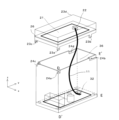
- FIG. 1 is a perspective view showing a motor control device according to a first embodiment
- 1 is an exploded perspective view showing a motor control device according to a first embodiment of the present invention
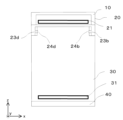
- This is a cross-sectional view of B-B' in Figure 1.
- This is a cross-sectional view of C-C' in Figure 1.
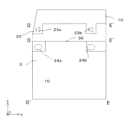
- This is a view of the D-D'-E-E' plane in Figure 2 as viewed from the positive x-axis direction toward the negative x-axis direction.
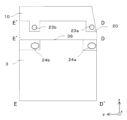
- This is a view of the D-D'-E-E' plane in Figure 2 as viewed from the negative x-axis direction toward the positive x-axis direction.
- 5 is a side view showing an operation of opening an opening of a main circuit case of the motor control device in embodiment 1.
- FIG. 2 is a plan view showing a motor control device installed in a control panel. This is a cross-sectional view taken along line A-A' of Figure 8.
- FIG. 11 is a perspective view showing a motor control device according to a second embodiment.
- FIG. 11 is an exploded perspective view showing a motor control device according to a second embodiment. This is a view of the F-F'-G-G' plane in Figure 11 viewed from the positive x-axis direction toward the negative x-axis direction.
- 13 is a side view showing the operation when opening the opening of the main circuit case of the motor control device in embodiment 2.
- FIG. 11 is a perspective view showing a motor control device according to a third embodiment.
- FIG. 11 is an exploded perspective view showing a motor control device according to a third embodiment.
- 13 is a side view showing the operation when opening the opening of the main circuit case of the motor control device in embodiment 3.
- FIG. 1 is a perspective view showing the motor control device 1 in embodiment 1.
- Figure 2 is an exploded perspective view showing the motor control device 1 in embodiment 1.
- the motor control device 1 includes a main circuit section 3 and a control section 2 provided on the positive z-axis side of the main circuit section 3.
- the main circuit section 3 is composed of a heat sink 40, a main circuit board 31 which is a first board arranged on the main surface of the heat sink 40, and a main circuit section case 30 which is a first case arranged on the periphery of the heat sink 40 and covers the outer periphery of the main circuit board 31.
- the main circuit case 30 has an opening at the top located in the positive direction of the z-axis, and this opening 36 has a shape having a pair of long sides and a pair of short sides. Wiring work for the purpose of maintenance of the main circuit board 31 can be performed through the opening 36.
- the main circuit case 30 has a pair of long side surfaces and a pair of short side surfaces, and holes 24a, 24b, 24c, and 24d, which are engagement parts, are formed near the ends of the long side surfaces of the main circuit case 30 in the positive direction of the z-axis.
- the holes 24a and 24b are formed on one long side surface, and the holes 24c and 24d are formed on the other long side surface.
- the holes 24a and 24c are formed near the ends of the pair of long side surfaces in the negative direction of the y-axis, and the holes 24b and 24d are formed near the ends of the pair of long side surfaces in the positive direction of the y-axis.
- the main circuit case 30 is made of a material that can be elastically deformed, such as resin.
- the main circuit board 31 is provided in the main circuit case 30 so that its main surface is parallel to the xy plane.
- Electronic components 33, a connector 32, and a terminal block 34 are mounted on the main surface of the main circuit board 31 on the positive z-axis side.
- the heat sink 40 is structurally connected to the main circuit board 31 via a power conversion element such as a semiconductor module (not shown) or a spacer.
- a power conversion element such as a semiconductor module (not shown) or a spacer.
- fixing holes 35 are formed in the four corners of the main surface of the heat sink 40 for mounting the motor control device 1 to a control panel.
- the control unit 2 is composed of a control board 21, which is a second board, a control unit case body 20 for fixing the control board 21, and a control unit case cover 10 that covers the outer periphery and top surface of the control board 21.
- the control unit case body 20 and the control unit case cover 10 form a second case.
- the control unit case body 20 is placed on the main circuit unit case 30 so as to cover the opening 36 of the main circuit unit case 30.
- the bottom surface of the control unit case body 20, i.e., the surface covering the opening 36 of the main circuit unit case 30, has the same shape as the opening 36 of the main circuit unit case 30.
- the control unit case body 20 has a pair of long side surfaces and a pair of short side surfaces, and protrusions 23a, 23b, 23c, and 23d are provided near the ends of the long side surfaces of the control unit case body 20 in the negative direction of the z axis.
- the protrusions 23a and 23b are formed on one of the long side surfaces, and the protrusions 23c and 23d are formed on the other long side surface.
- the protrusions 23a and 23c are formed near the ends of the pair of long side surfaces in the negative direction of the y axis, respectively, and the protrusions 23b and 23d are formed near the ends of the pair of long side surfaces in the positive direction of the y axis, respectively.
- the projections 23a, 23b, 23c, and 23d can engage with the holes 24a, 24b, 24c, and 24d, respectively.
- the control unit case body 20 is made of a material capable of elastic deformation, such as resin.
- the same shape as the opening 36 of the main circuit case 30 does not only mean the same shape as the opening 36 of the main circuit case 30 in the strict sense, but also includes shapes that can be said to be substantially the same shape, such as a shape that is slightly distorted from the shape of the opening 36 of the main circuit case 30, a shape that is slightly larger or smaller in area than the shape of the opening 36 of the main circuit case 30, and a shape that has a convex or concave part in the shape of the opening 36 of the main circuit case 30.
- the control unit case cover 10 is provided on the positive z-axis side of the control unit case body 20 and is joined to the control unit case body 20.
- the control unit case cover 10 has a pair of long side surfaces and a pair of short side surfaces, and the short side surface of the control unit case cover 10 that is on the negative y-axis side has an inclined portion 26 that is inclined in the positive y-axis direction with respect to the positive z-axis direction.
- the cross-sectional area of the surface of the control unit case cover 10 that is parallel to the x-y plane becomes smaller as it moves away from the opening 36 of the main circuit case 30 in the positive z-axis direction.
- the control board 21 is provided on the surface of the control unit case body 20 on the positive side of the z-axis, and the outer periphery and top surface of the control board 21 are covered by the control unit case cover 10. That is, the control board 21 is provided inside a second case consisting of the control unit case body 20 and the control unit case cover 10.
- the main surface of the control board 21 is installed so as to be parallel to the x-y plane.
- a connector 22 is mounted on the main surface of the control board 21 on the negative side of the z-axis.
- the surface of the control board 21 on which the connector 22 is mounted and the surface of the main circuit board 31 on which the connector 32 and the like are mounted face each other.
- the connector 32 of the main circuit board 31 and the connector 22 of the control board 21 are electrically connected to each other by the harness 11. That is, the main circuit board 31 and the control board 21 are electrically connected to each other.
- Figure 3 is a cross-sectional view taken along B-B' in Figure 1.
- Figure 4 is a cross-sectional view taken along C-C' in Figure 1.
- the protrusions 23a and 23c provided on a pair of long side surfaces of the control unit case main body 20 engage with the holes 24a and 24c formed on a pair of long side surfaces of the main circuit unit case 30.
- FIG. 5 is a view of the D-D'-E-E' plane of FIG. 2, viewed from the positive x-axis direction toward the negative x-axis direction.
- FIG. 6 is a view of the D-D'-E-E' plane of FIG. 2, viewed from the negative x-axis direction toward the positive x-axis direction.
- the protrusions 23a and 23b of the control unit case body 20 are engaged with the holes 24a and 24b of the main circuit unit case 30, respectively.
- the protrusions 23c and 23d are engaged with the holes 24c and 24d, respectively.
- control unit 2 can rotate in a circle in the y-z plane with the protrusions 23a and 23c as axes. This allows the opening 36 of the main circuit unit case 30 to be opened and closed.
- Figure 7 is a side view showing the operation of opening the opening 36 of the main circuit case 30 of the motor control device 1 in embodiment 1, with Figure 7(a) showing the opening 36 in a closed state and Figure 7(b) showing the opening 36 in an open state.
- the inclined portion 26 is provided on the short side of the control unit case cover 10, so that the control unit case body 20 and the control unit case cover 10 can rotate without protruding beyond the outer periphery of the opening 36 of the main circuit case 30 when viewed from a direction perpendicular to the opening 36 of the main circuit case 30. If the inclination of the inclined portion 26 is made larger, the range in which the control unit case body 20 and the control unit case cover 10 can rotate without protruding beyond the outer periphery of the opening 36 of the main circuit case 30 when viewed from a direction perpendicular to the opening 36 of the main circuit case 30 can be made larger.
- the length of the harness 11 is preferably designed to be longer than the distance between the connector 32 and the connector 22 when the opening 36 of the main circuit case 30 is opened so that the bottom surface of the control unit case body 20 is perpendicular to the x-y plane.
- the motor control device 1 in embodiment 1 comprises a main circuit case 30 having an opening 36, a main circuit board 31 provided within the main circuit case 30, a control unit case body 20 and a control unit case cover 10 installed on the main circuit case 30 so as to cover the opening 36 of the main circuit case 30, and a control board 21 provided within the control unit case body 20 and the control unit case cover 10.
- the main circuit case 30 has holes 24a, 24b, 24c, 24d
- the control unit case body 20 has protrusions 23a, 23b, 23c, 23d that engage with the holes 24a, 24b, 24c, 24d
- the control unit case body 20 and the control unit case cover 10 can open and close the opening 36 of the main circuit case 30 by rotating about the protrusions 23a, 23c.
- control unit case cover 10 has an inclined portion 26 on its side so that the cross-sectional area of the control unit case cover 10 decreases as it moves away from the opening 36 of the main circuit case 30.
- the inclined portion 26 is provided so that when the control unit case body 20 and the control unit case cover 10 rotate in a direction that opens the opening 36 of the main circuit case 30, the control unit case body 20 and the control unit case cover 10 can rotate without protruding outside the outer periphery of the opening 36 of the main circuit case 30 when viewed from a direction perpendicular to the opening 36 of the main circuit case 30.
- This configuration makes it easy to perform maintenance work on the motor control device even when another structure is placed nearby.
- FIG. 8 is a plan view showing multiple motor control devices 1a installed in a control panel.
- FIG. 9 is a cross-sectional view taken along the line A-A' in FIG. 8.
- the motor control device 1a differs from the motor control device 1 in embodiment 1 in that the side of the control unit case cover 10a does not have an inclined portion 26.
- the terminal block 34a of each motor control device 1a is connected to one end of the cable 4a, and the other end of the cable 4a is connected to the cable 4b in the wiring duct 5.
- the wiring duct 5 is installed close to the motor control device 1a on the negative y-axis side of the motor control device 1a.
- the control unit case body 20 and the control unit case cover 10 by providing an inclined portion 26 on the side of the control unit case cover 10, when the control unit case body 20 and the control unit case cover 10 rotate in a direction to open the opening 36 of the main circuit unit case 30, the control unit case body 20 and the control unit case cover 10 can rotate without protruding outside the outer periphery of the opening 36 of the main circuit unit case 30 when viewed from a direction perpendicular to the opening 36 of the main circuit unit case 30. Therefore, even when multiple motor control devices 1 are placed close to each other, the control unit case cover 10 can open the opening 36 of the main circuit unit case 30 without interfering with the wiring duct 5. This makes it easy to perform maintenance work on the components on the main circuit board 31.
- the motor control device 1a receives power from the outside through the terminal block 34a, converts the power on the main circuit board 31a, and supplies the power to the motor to control the rotation speed and torque of the motor.
- the terminal block 34a In order to supply power to the terminal block 34a, it is necessary to wire the cable 4a to the terminal block 34a.
- the terminal block 34a In order to ensure the reliability of the connection, the terminal block 34a is generally of a screw type that allows torque management. Therefore, when wiring the cable 4a to the terminal block 34a as part of maintenance, it is necessary to insert a tool such as a screwdriver into the main circuit case 30 from the positive z-axis side toward the negative z-axis side to perform wiring work to the terminal block 34a.
- the length of the control block case body 20a and the control block case cover 10a in the y-axis direction is made smaller than the length of the opening 36 of the main circuit block case 30a in the y-axis direction
- the length of the control board 21a in the y-axis direction is made smaller than the length of the main circuit board 31a in the y-axis direction, so that the control block case body 20a, the control block case cover 10a, and the control board 21a are not positioned above the terminal block 34a on the positive z-axis side.
- the area of the main surface of the control board 21a is smaller than the area of the main surface of the main circuit board 31a, and the number of components that can be mounted on the control board 21a is also reduced.
- the control unit case body 20 and the control unit case cover 10 can be rotated without interfering with the wiring duct 5, and the opening 36 of the main circuit case 30 can be opened.
- the control board 21 may be located above the terminal block 34 on the positive z-axis side, making it possible to increase the area of the main surface of the control board 21. In other words, more components can be mounted on the control board 21, and the control performance of the motor control device 1 can be expanded.
- the main circuit board 31 has a connector 32
- the control board 21 has a connector 22, and the connector 32 and the connector 22 are electrically connected to each other by the harness 11.
- the main circuit board 31 and the connector 32 are electrically connected to each other, and the control board 21 and the connector 22 are electrically connected to each other. That is, the main circuit board 31 and the control board 21 are electrically connected to each other.
- the protrusions 23a, 23b, 23c, and 23d are shown as being integral with the control unit case body 20, but the protrusions 23a, 23b, 23c, and 23d that are separate parts from the control unit case body 20 may be attached to the control unit case body 20.
- the shape of the protrusions 23a, 23b, 23c, and 23d is not limited to a shape that protrudes linearly from the side of the control unit case body 20, but may also be a curved shape, a shape that is a bent straight line, or a shape like a hook.
- holes 24a, 24b, 24c, and 24d that penetrate the side of the main circuit case 30 are shown as the engagement parts, but grooves that do not penetrate the side of the main circuit case 30 may also be used as the engagement parts. Also, a shape protruding from the side of the main circuit case 30 may be used as the engagement part, and this protruding part may be engaged with the projections 23a, 23b, 23c, and 23d.
- the main circuit board 31 and the control board 21 are electrically connected by the connector 32, the connector 22, and the harness 11, but the main circuit board 31 and the control board 21 may be electrically connected using a flex board instead of the connector 32, the connector 22, and the harness 11.
- the shape of the opening 36 of the main circuit case 30 has a pair of long sides and a pair of short sides, but it is not limited to this shape and may be a rectangle without a long side and a pair of short sides, a polygon other than a rectangle, a circle, an ellipse, or any other shape. The same applies to the shape of the surface of the control unit case body 20 that closes the opening 36 of the main circuit case 30.
- the wiring duct 5 is used as an example of another structure adjacent to the motor control device 1, but the other structure is not limited to the wiring duct 5.
- the same effect as in the first embodiment can be obtained even when another motor control device 1, a side wall of a control panel, or other structure is installed adjacent to the motor control device 1.
- an inclined portion 26 is provided on the short side of the control unit case cover 10, which is the side facing the negative direction of the y axis. Then, the protrusions 23b and 23d of the control unit case body 20 are removed from the holes 24b and 24d of the main circuit unit case 30, respectively, and the opening 36 of the main circuit unit case 30 is opened by rotating the control unit case body 20 and the control unit case cover 10 around the protrusions 23a and 23c as axes.
- the opening 36 of the main circuit unit case 30 may also be opened by providing an inclined portion 26 on the short side of the control unit case cover 10, which is the side facing the positive direction of the y axis, and removing the protrusions 23a and 23c of the control unit case body 20 from the holes 24a and 24c of the main circuit unit case 30, respectively, and rotating the control unit case body 20 and the control unit case cover 10 around the protrusions 23b and 23d as axes.
- Embodiment 2 The configuration of a motor control device 200 in embodiment 2 will be described. The same components as those in embodiment 1 are given the same reference numerals and their description will be omitted.
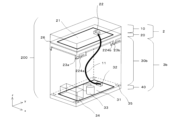
- Fig. 10 is a perspective view showing the motor control device 200 in embodiment 2.
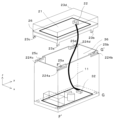
- Fig. 11 is an exploded perspective view showing the motor control device 200 in embodiment 2. As shown in Figs. 10 and 11, the motor control device 200 differs from embodiment 1 in that it includes a main circuit unit 3b instead of the main circuit unit 3, and includes a main circuit unit case 30b instead of the main circuit unit case 30.
- the main circuit case 30b has long holes 224a, 224b, 224c, and 224d, which are slide rails, instead of holes 24a, 24b, 24c, and 24d, as engagement parts.
- the long holes 224a, 224b, 224c, and 224d are provided on the long side surfaces of the main circuit case 30b and are provided to extend in the longitudinal direction, i.e., the y-axis direction.
- the protrusions 23a, 23b, 23c, and 23d of the control unit case body 20 engage with the long holes 224a, 224b, 224c, and 224d, respectively, allowing the control unit case body 20 and the control unit case cover 10 to slide in the longitudinal direction, i.e., the y-axis direction.
- the main circuit case 30b further has grooves 25a, 25b, 25c, and 25d that extend in the positive direction of the z-axis from the long holes 224a, 224b, 224c, and 224d. Since the protrusions 23a, 23b, 23c, and 23d can move in the z-axis direction along the grooves 25a, 25b, 25c, and 25d, respectively, the protrusions 23a, 23b, 23c, and 23d can be easily removed from the long holes 224a, 224b, 224c, and 224d.
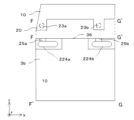
- FIG. 12 is a view of the F-F'-G-G' plane of FIG. 11 as viewed from the x-axis positive side toward the x-axis negative side.
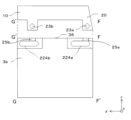
- FIG. 13 is a view of the F-F'-G-G' plane of FIG. 11 as viewed from the x-axis negative side toward the x-axis positive side.
- the protrusions 23a and 23b of the control unit case body 20 are engaged with the long holes 224a and 224b of the main circuit unit case 30b, respectively.
- the protrusions 23c and 23d are engaged with the long holes 224c and 224d, respectively.
- control unit case body 20 and the control unit case cover 10 can rotate in a circle in the y-z plane with the protrusions 23a and 23c as axes. This allows the opening 36 of the main circuit unit case 30b to be opened and closed.
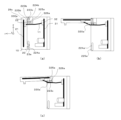
- Figure 14 is a side view showing the operation of opening the opening 36 of the main circuit case 30b of the motor control device 200 in embodiment 2.
- Figure 14(a) shows the opening 36 in a closed state
- Figure 14(b) shows the opening 36 in an open state
- Figure 14(c) shows the opening 36 in an open state until the bottom surface of the control unit case main body 20 is perpendicular to the x-y plane.
- the control unit case body 20 and the control unit case cover 10 can rotate without protruding outside the outer periphery of the opening 36 of the main circuit unit case 30b when viewed from a direction perpendicular to the opening 36 of the main circuit unit case 30b.
- the range within which the control unit case body 20 and the control unit case cover 10 can rotate without protruding outside the outer periphery of the opening 36 of the main circuit unit case 30b when viewed from a direction perpendicular to the opening 36 of the main circuit unit case 30b can be increased.
- the protrusions 23a and 23c engage with the long holes 224a and 224c, and can slide in the long holes 224a and 224c in the y-axis direction. That is, the control unit case body 20 and the control unit case cover 10 can slide in the y-axis direction along the long holes 224a and 224c. From the state shown in FIG.
- control unit case body 20 and the control unit case cover 10 rotate in a circle in the y-z plane around the protrusions 23a and 23c as axes while sliding in the positive y-axis direction, so that the control unit case body 20 and the control unit case cover 10 do not protrude beyond the outer periphery of the opening 36 of the main circuit case 30b when viewed from a direction perpendicular to the opening 36 of the main circuit case 30b, and the bottom surface of the control unit case body 20 can be opened perpendicular to the x-y plane, as shown in FIG. 14(c).
- the motor control device 200 described in embodiment 2 has long holes 224a, 224c through which the protrusions 23a, 24c can slide in the longitudinal direction of the main circuit case 30b, i.e., the y-axis direction.
- This allows the control unit case body 20 and the control unit case cover 10 to not protrude beyond the outer periphery of the opening 36 of the main circuit case 30b when viewed from a direction perpendicular to the opening 36 of the main circuit case 30b, and allows the opening 36 of the main circuit case 30b to be opened wider compared to the motor control device 1 described in embodiment 1. This makes it easier to perform maintenance work on the motor control device 200 even when another structure is placed nearby.
- the long holes 224a, 224b, 224c, and 224d that penetrate the side of the main circuit case 30b are shown as slide rails, which are an example of engagement parts.
- slide rails which are an example of engagement parts.
- grooves that do not penetrate the side of the main circuit case 30b may also be used as slide rails.
- a shape that protrudes from the side of the main circuit case 30b may be used as a slide rail, and this protruding part may be engaged with the projections 23a, 23b, 23c, and 23d.
- an inclined portion 26 is provided on the short side of the control unit case cover 10, which is the side facing the negative direction of the y axis. Then, the protrusions 23b and 23d of the control unit case body 20 are removed from the long holes 224b and 224d of the main circuit unit case 30b along the grooves 25b and 25d, respectively, and the control unit case body 20 and the control unit case cover 10 are rotated around the protrusions 23a and 23c to open the opening 36 of the main circuit unit case 30b.
- the opening 36 of the main circuit unit case 30b may also be opened by providing an inclined portion 26 on the short side of the control unit case cover 10, which is the side facing the positive direction of the y axis, and removing the protrusions 23a and 23c of the control unit case body 20 from the long holes 224a and 224c of the main circuit unit case 30 along the grooves 25a and 25c, respectively, and rotating the control unit case body 20 and the control unit case cover 10 around the protrusions 23b and 23d.
- the long holes 224a, 224c are formed to allow the protrusions 23a, 24c to slide in the longitudinal direction of the main circuit case 30b, i.e., in the y-axis direction.
- the direction in which the protrusions 23a, 24c slide does not necessarily have to be the longitudinal direction of the main circuit case 30b, and a certain effect can be obtained as long as they can slide in a direction intersecting the plane of the inclined portion 26. Therefore, the slide rail, which uses the long holes 224a, 224c as an example, can also be structured so that the protrusions 23a, 24c can slide in a direction intersecting the plane of the inclined portion 26.
- FIG. 15 is a perspective view showing the motor control device 300 in the third embodiment.
- FIG. 16 is an exploded perspective view showing the motor control device 300 in the third embodiment.
- the motor control device 300 differs from the second embodiment in that it includes a main circuit section 3c instead of the main circuit section 3b, a main circuit section case 30c instead of the main circuit section case 30b, a control section 2c instead of the control section 2, a control section case body 20c instead of the control section case body 20, and a control section case cover 10c instead of the control section case cover 10.
- Main circuit case 30c differs from embodiment 2 in that it additionally includes grooves 325a, 325b, holes 326a, 326b, and steps 330a, 330b.
- Hole 326a is provided on the negative z-axis side of long hole 224b
- hole 326b is provided on the negative z-axis side of long hole 224d.
- Groove 325a is provided between long hole 224b and hole 326a
- groove 325b is provided between long hole 224d and hole 326b.
- Step 330a is provided so that the side surface on the long side of main circuit case 30c is concave in the negative x-axis direction
- step 330b is provided so that the side surface on the long side of main circuit case 30c is concave in the positive x-axis direction. That is, the width of the opening 36 in the short direction in the portion of the main circuit case 30c where the step portions 330a, 330b are provided is narrower than the width of the opening 36 in the short direction in the portion where the step portions 330a, 330b are not provided.
- the control unit case body 20c differs from the second embodiment in that it has protrusions 223a, 223b, 223c, 223d, 223e, and 223f instead of protrusions 23a, 23b, 23c, and 23d.
- Protrusion 223a engages with long hole 224a
- protrusions 223b and 223c engage with long hole 224b
- protrusion 223d engages with long hole 224c
- protrusions 223e and 223f engage with long hole 224d.
- control unit case cover 10c differs from the second embodiment in that it has an inclined portion 26c instead of the inclined portion 26.
- the inclined portion 26c differs from the inclined portion 26 in that it is provided on the short side surface of the control unit case cover 10c, on the side surface on the positive y-axis direction.
- the specific structure of the inclined portion 26c is the same as that of the inclined portion 26.
- Figure 17 is a side view showing the operation when opening the opening 36 of the main circuit case 30c of the motor control device 300 in embodiment 3.
- Figure 17(a) is a diagram showing the state in which the opening 36 is closed
- Figure 17(b) is a diagram showing the state in which the opening 36 has been opened until the bottom surface of the control unit case main body 20c is perpendicular to the xy plane
- Figure 17(c) is a diagram showing the state in which the control unit case main body 20c and the control unit case cover 10c are fixed to the main circuit case 30c.
- the control unit case body 20c and the control unit case cover 10c rotate in a circular motion in the y-z plane around the projections 223c and 223f as axes and slide in the negative direction of the y axis, so that when viewed from a direction perpendicular to the opening 36 of the main circuit unit case 30c, the control unit case body 20c and the control unit case cover 10c do not extend beyond the outer periphery of the opening 36 of the main circuit unit case 30c, and the opening 36 can be opened until the bottom surface of the control unit case body 20c is perpendicular to the x-y plane, as shown in FIG. 17(b).
- the step portions 330a and 330b support the control unit case body 20c and the control unit case cover 10c.
- Steps 330a and 330b support control unit case body 20c and control unit case cover 10c, and protrusions 223c, 223f engage with holes 326a, 326b, fixing control unit case body 20c and control unit case cover 10c. This prevents control unit case body 20c and control unit case cover 10c from rotating in a direction that closes opening 36 of main circuit case 30c.
- the motor control device 300 described in the third embodiment has step portions 330a and 330b in which the width of the short side of the opening 36 is narrower than the other portions of the opening 36, and when the control unit case body 20c and the control unit case cover 10c rotate to open the opening 36, the control unit case body 20c and the control unit case cover 10c are supported by the step portions 330a and 330b, which prevents the control unit case body 20c and the control unit case cover 10c from rotating in the direction to close the opening 36. Therefore, the control unit case body 20c and the control unit case cover 10c can be fixed while the opening 36 of the main circuit unit case 30c is left wide open, making it possible to perform maintenance work using both hands.
- control unit case body 20c and the control unit case cover 10c can be fixed while the opening 36 is left wide open, the worker can simultaneously check the inside of the opening 36 of the main circuit unit case 30c of multiple motor control devices 300.
Landscapes
- Engineering & Computer Science (AREA)
- Power Engineering (AREA)
- Microelectronics & Electronic Packaging (AREA)
- Casings For Electric Apparatus (AREA)
- Motor Or Generator Frames (AREA)
Priority Applications (2)
| Application Number | Priority Date | Filing Date | Title |
|---|---|---|---|
| PCT/JP2022/041905 WO2024100837A1 (ja) | 2022-11-10 | 2022-11-10 | モータ制御装置 |
| JP2023549618A JP7471531B1 (ja) | 2022-11-10 | 2022-11-10 | モータ制御装置 |
Applications Claiming Priority (1)
| Application Number | Priority Date | Filing Date | Title |
|---|---|---|---|
| PCT/JP2022/041905 WO2024100837A1 (ja) | 2022-11-10 | 2022-11-10 | モータ制御装置 |
Publications (1)
| Publication Number | Publication Date |
|---|---|
| WO2024100837A1 true WO2024100837A1 (ja) | 2024-05-16 |
Family
ID=90716072
Family Applications (1)
| Application Number | Title | Priority Date | Filing Date |
|---|---|---|---|
| PCT/JP2022/041905 Ceased WO2024100837A1 (ja) | 2022-11-10 | 2022-11-10 | モータ制御装置 |
Country Status (2)
| Country | Link |
|---|---|
| JP (1) | JP7471531B1 (https=) |
| WO (1) | WO2024100837A1 (https=) |
Cited By (1)
| Publication number | Priority date | Publication date | Assignee | Title |
|---|---|---|---|---|
| JP7758247B1 (ja) * | 2024-11-08 | 2025-10-22 | 三菱電機株式会社 | 電力変換装置 |
Citations (3)
| Publication number | Priority date | Publication date | Assignee | Title |
|---|---|---|---|---|
| WO2013114503A1 (ja) * | 2012-02-03 | 2013-08-08 | ソニー株式会社 | 情報端末装置 |
| JP2016072318A (ja) * | 2014-09-29 | 2016-05-09 | Necエンベデッドプロダクツ株式会社 | 体表装着型携帯電子機器 |
| WO2018087929A1 (ja) * | 2016-11-14 | 2018-05-17 | 三菱電機株式会社 | 電子機器 |
-
2022
- 2022-11-10 WO PCT/JP2022/041905 patent/WO2024100837A1/ja not_active Ceased
- 2022-11-10 JP JP2023549618A patent/JP7471531B1/ja active Active
Patent Citations (3)
| Publication number | Priority date | Publication date | Assignee | Title |
|---|---|---|---|---|
| WO2013114503A1 (ja) * | 2012-02-03 | 2013-08-08 | ソニー株式会社 | 情報端末装置 |
| JP2016072318A (ja) * | 2014-09-29 | 2016-05-09 | Necエンベデッドプロダクツ株式会社 | 体表装着型携帯電子機器 |
| WO2018087929A1 (ja) * | 2016-11-14 | 2018-05-17 | 三菱電機株式会社 | 電子機器 |
Cited By (1)
| Publication number | Priority date | Publication date | Assignee | Title |
|---|---|---|---|---|
| JP7758247B1 (ja) * | 2024-11-08 | 2025-10-22 | 三菱電機株式会社 | 電力変換装置 |
Also Published As
| Publication number | Publication date |
|---|---|
| JP7471531B1 (ja) | 2024-04-19 |
| JPWO2024100837A1 (https=) | 2024-05-16 |
Similar Documents
| Publication | Publication Date | Title |
|---|---|---|
| CN109417068B (zh) | 半导体装置 | |
| JP7471531B1 (ja) | モータ制御装置 | |
| WO2007052386A1 (ja) | ケーブルの支持装置 | |
| CN1365144A (zh) | 电源半导体模块和容纳半导体模块的冷却元件 | |
| US20110149503A1 (en) | Multi-specification fixing module and motherboard with multi-specification fixing module | |
| CN110073588B (zh) | 电容器单元、电动压缩机 | |
| US10154600B1 (en) | Cover locking structure of electrical junction box | |
| JP2005534161A (ja) | プロフィル部品を支持レールに固定する機構および装置 | |
| EP3525336B1 (en) | Capacitor unit, and electric compressor | |
| CN110168904A (zh) | 汇流条单元以及电动机驱动装置 | |
| CN110267480B (zh) | 电气设备 | |
| JP7551608B2 (ja) | 電力変換装置 | |
| JP4429196B2 (ja) | 電極取付構造 | |
| CN105281473A (zh) | 机电一体化的驱动装置 | |
| CN117337540A (zh) | 电力转换装置 | |
| WO2018088298A1 (ja) | 電動圧縮機 | |
| EP3576502A1 (en) | Circuit board | |
| CN117177485A (zh) | 壳体 | |
| CN102246613B (zh) | 基板支撑结构 | |
| JP5200673B2 (ja) | 電子部品搭載構造 | |
| JP4440016B2 (ja) | 電子回路装置 | |
| DE112014003108B4 (de) | Schwingungsbeständiger Aufbau für einen Stromkreis in einem elektrisch-betriebenen Kompressor | |
| CN215336962U (zh) | 一种电控盒及空调器 | |
| KR20250120752A (ko) | 전자장치 | |
| JP2007123763A (ja) | 電子機器 |
Legal Events
| Date | Code | Title | Description |
|---|---|---|---|
| WWE | Wipo information: entry into national phase |
Ref document number: 2023549618 Country of ref document: JP |
|
| 121 | Ep: the epo has been informed by wipo that ep was designated in this application |
Ref document number: 22965162 Country of ref document: EP Kind code of ref document: A1 |
|
| NENP | Non-entry into the national phase |
Ref country code: DE |
|
| 122 | Ep: pct application non-entry in european phase |
Ref document number: 22965162 Country of ref document: EP Kind code of ref document: A1 |