WO2024096057A1 - 給湯装置、給湯システム及び成形システム - Google Patents
給湯装置、給湯システム及び成形システム Download PDFInfo
- Publication number
- WO2024096057A1 WO2024096057A1 PCT/JP2023/039416 JP2023039416W WO2024096057A1 WO 2024096057 A1 WO2024096057 A1 WO 2024096057A1 JP 2023039416 W JP2023039416 W JP 2023039416W WO 2024096057 A1 WO2024096057 A1 WO 2024096057A1
- Authority
- WO
- WIPO (PCT)
- Prior art keywords
- valve body
- molten metal
- measuring chamber
- hot water
- inlet
- Prior art date
- Legal status (The legal status is an assumption and is not a legal conclusion. Google has not performed a legal analysis and makes no representation as to the accuracy of the status listed.)
- Ceased
Links
Images




Classifications
-
- B—PERFORMING OPERATIONS; TRANSPORTING
- B22—CASTING; POWDER METALLURGY
- B22D—CASTING OF METALS; CASTING OF OTHER SUBSTANCES BY THE SAME PROCESSES OR DEVICES
- B22D17/00—Pressure die casting or injection die casting, i.e. casting in which the metal is forced into a mould under high pressure
- B22D17/20—Accessories: Details
- B22D17/30—Accessories for supplying molten metal, e.g. in rations
Definitions
- This disclosure relates to a water heater that supplies molten (liquid) metal material (sometimes called "molten metal”) to a molding machine such as a die-casting machine, and also to a water heater system that includes the water heater, and a molding system that includes the water heater.
- molten metal liquid metal material
- a die casting machine for example, has an injection sleeve that opens into the inside of the mold, and a plunger that pushes the molten metal supplied to the injection sleeve into the inside of the mold.
- a cold chamber machine in which the injection sleeve and plunger are not located inside the furnace that holds the molten metal, is known as such a die casting machine.
- a water supply device that supplies molten metal to the injection sleeve of a cold chamber machine generally pumps the molten metal from the furnace using a ladle, and pours the pumped molten metal from the ladle into the injection sleeve.
- Water supply devices that supply molten metal to the injection sleeve of a cold chamber machine (or similar machines) without using a ladle have also been proposed (for example, Patent Documents 1 to 6).
- the water heater disclosed in Patent Document 3 has a container that holds one shot of molten metal, and a valve body located within the container.
- the container has an inlet that connects to the inside of a furnace, a measuring chamber that holds the molten metal that flows in from the inlet, and an outlet that allows the molten metal in the measuring chamber to flow out to the injection sleeve.
- the valve body is interposed between the inlet, the measuring chamber, and the outlet. The valve body moves between an inlet position that connects the inlet and the measuring chamber and blocks the outlet from the inlet and the measuring chamber, and an outlet position that connects the measuring chamber and the outlet and blocks the inlet from the measuring chamber and the outlet.
- the valve body moves between the inlet position and the outlet position by translation.
- the direction of translation is perpendicular to the direction from the metering chamber to the valve body, the direction from the inlet to the valve body, and the direction from the outlet to the valve body.
- the valve body also has two flow paths (a first flow path and a second flow path) that pass through the valve body.
- a first flow path and a second flow path At the inlet position, one end of the first flow path is connected to the inlet and the other end of the first flow path is connected to the metering chamber, thereby communicating between the inlet and the metering chamber.
- At the outlet position one end of the second flow path is connected to the metering chamber and the other end of the second flow path is connected to the outlet, thereby communicating between the metering chamber and the outlet.
- the water heater has a container and a valve body.
- the container has an inlet through which molten metal flows from a furnace, a measuring chamber that contains the molten metal that has flowed into the inlet, and an outlet through which the molten metal in the measuring chamber flows out to an injection device.
- the valve body is interposed between the inlet, the measuring chamber, and the outlet, and is movable between an inlet position and an outlet position. At the inlet position, the valve body communicates the inlet with the measuring chamber and blocks the outlet from the inlet and the measuring chamber. At the outlet position, the valve body communicates the measuring chamber with the outlet and blocks the inlet from the measuring chamber and the outlet. The valve body moves between the inlet position and the outlet position by rotating relative to the container.
- a hot water supply system includes the hot water supply device and the furnace.
- the die-casting system includes the above-mentioned hot water supply device and a molding machine including the injection device.
- the molten metal from the furnace can be supplied to the injection sleeve using a new configuration without using a ladle.
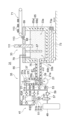
- FIG. 2 is a side view showing the configuration of a main part of the die casting machine according to the embodiment.
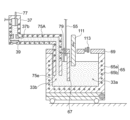
- 1 is a schematic cross-sectional view showing a configuration of a main part of a hot water supply system according to an embodiment.
- 3 is a schematic cross-sectional view showing the hot water supply system of FIG. 2 in a state different from that of FIG. 2 .
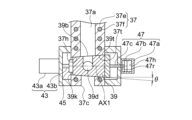
- 4 is a cross-sectional view taken along line IV-IV in FIG. 2 .
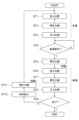
- 4 is a flowchart showing an example of a procedure of a process related to hot water supply.
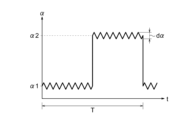
- 5A to 5C are schematic diagrams illustrating the operation of a valve body provided in the water heating device.
- 7( a ) and 7 ( b ) are schematic diagrams showing other examples of the gas pressure circuit of the water heater.
- FIG. 11 is a schematic diagram showing another example of a connecting pipe that connects a furnace and a water heater.
- FIG. 13 is a schematic diagram showing another example of a valve body and its surroundings provided
- FIG. 1 is a side view (partially including a cross-sectional view) showing a schematic configuration of a die casting machine 1 according to an embodiment of the present invention.
- the up-down direction along the surface of the drawing is the vertical direction.
- the die casting machine 1 produces a die cast product (a molded product in a broader sense) by filling the die 101 (space 107) with molten metal (not shown).
- the molten metal is filled into the space 107 by pushing out the molten metal in the sleeve 21, which communicates with the space 107, with the plunger 23.
- the molten metal is supplied into the sleeve 21 by pouring it into the molten metal supply port 21a that opens into the top surface of the sleeve 21.
- FIGS. 2 and 3 are cross-sectional views showing a schematic configuration of a hot water supply system 31 that supplies molten metal to the hot water supply port 21a.
- FIG. 2 shows the state before hot water supply
- FIG. 3 shows the state after hot water supply.
- the up-down direction along the paper surface of these figures is the vertical direction.
- the relationship between the left-right direction of the paper surface of FIG. 1 and the left-right direction of the paper surfaces of FIG. 2 and FIG. 3 is arbitrary.
- the cross section of the sleeve 21 is shown by a two-dot chain line, assuming a state in which the direction penetrating the paper surface of FIG. 2 and FIG. 3 roughly coincides with the left-right direction of the paper surface of FIG. 1.
- the molten metal supply system 31 has a furnace 33 that holds the molten metal Mt, and a molten metal supply device 35 to which the molten metal is supplied from the furnace 33. As shown in FIG. 2, the molten metal supply device 35 stores the molten metal for one molding cycle (one shot) in a container 37. Then, the molten metal supply device 35 pours the molten metal into the molten metal supply port 21a located below the container 37, as shown by the arrow a1 in FIG. 3.
- the water heater 35 has the above-mentioned container 37 and a valve body 39 that controls the flow of molten metal.
- the container 37 has an inlet 37b through which the molten metal flows from the furnace 33, a measuring chamber 37a that contains the molten metal that has flowed into the inlet 37b, and an outlet 37c that allows the molten metal in the measuring chamber 37a to flow out into the sleeve 21.
- the valve body 39 is interposed between the inlet 37b, the measuring chamber 37a, and the outlet 37c. The valve body 39 allows and prohibits flow between the inlet 37b, the measuring chamber 37a, and the outlet 37c.
- the valve body 39 can move between an inflow position ⁇ 1 shown in FIG. 2 and an outflow position ⁇ 2 shown in FIG. 3.
- the valve body 39 connects the inflow port 37b to the metering chamber 37a and blocks the outflow port 37c from the inflow port 37b and the metering chamber 37a. This allows the molten metal in the furnace 33 to be supplied to the metering chamber 37a and the molten metal for one shot to be held in the metering chamber 37a.
- the valve body 39 connects the metering chamber 37a to the outflow port 37c and blocks the inflow port 37b from the metering chamber 37a and the outflow port 37c.
- valve body 39 is inserted into a shaft support hole 37h that penetrates a container 37, as shown in FIG. 4, which is a cross-sectional view taken along line IV-IV in FIG. 2.
- the valve body 39 is rotatable around a rotation axis AX1 that is parallel to the direction of insertion into the shaft support hole 37h.
- the outer peripheral surface of the valve body 39 and the inner peripheral surface of the shaft support hole 37h that faces the outer peripheral surface are tapered.
- the gap between the outer circumferential surface of the valve body 39 and the inner circumferential surface of the shaft support hole 37h can be adjusted by adjusting the position of the valve body 39 in a direction parallel to the rotation axis AX1. And/or, the contact pressure between the outer circumferential surface of the valve body 39 and the inner circumferential surface of the shaft support hole 37h can be adjusted by adjusting the magnitude of the force applied to the valve body 39 in the direction from the larger diameter side to the smaller diameter side.
- the gap can be narrowed (and/or the contact pressure can be increased) to reduce the likelihood of the molten metal leaking.
- the contact pressure can be narrowed (and/or the gap can be increased) to reduce the likelihood of the sliding resistance of the valve body 39 becoming excessively large. From another perspective, it becomes easier to balance the trade-off between reducing the likelihood of leakage and reducing the sliding resistance.
- the first port 39a of the valve body 39 which was located at the inlet 37b at the inlet position ⁇ 1, can be positioned in the metering chamber 37a at the outlet position ⁇ 2.
- valve body 39d of valve body 39 used for the inflow of molten metal into measuring chamber 37a can be easily used for the outflow of molten metal from measuring chamber 37a as well.
- the molten metal remaining in flow path 39d is absorbed by the molten metal flowing into the measuring chamber 37a for the next molding cycle.
- the molten metal, including the remaining molten metal, is then measured in the measuring chamber 37a. As a result, the likelihood that the remaining molten metal will appear as an error is reduced.
- the hot water supply system 31 may have various other suitable configurations in addition to the configuration in which the valve body 39 rotates.
- the molten metal supply device 35 may have a gas pressure circuit 41 that supplies an inert gas (e.g., nitrogen or argon) to the measuring chamber 37a.
- Supplying the inert gas reduces oxidation of the molten metal, for example, and improves the quality of the molded product.
- the gas pressure circuit 41 may be used to suck in the inert gas in the measuring chamber 37a to raise the molten metal surface in the measuring chamber 37a, or to increase the pressure of the inert gas in the measuring chamber 37a to push out the molten metal in the measuring chamber 37a.
- the furnace 33 may be configured with a small capacity to sequentially melt a relatively small amount of metal material (e.g., an amount equivalent to one shot) as the molding cycle is repeated. This, for example, reduces the heat emitted from the furnace 33 and reduces the required energy.
- a relatively small amount of metal material e.g., an amount equivalent to one shot
- a combination of the die casting machine 1 and the molten metal supply system 31 or the molten metal supply device 35 may be referred to as a die casting system DS (reference numeral in FIG. 1 ).
- Die casting machine (Fig. 1) 2. Configuration of the hot water supply device 2.1. Container (Figs. 2 and 3) 2.2. Valve body 2.2.1. Basic structure (Figs. 2 and 3) 2.2.2. Tapered shape of the valve disc ( Figure 4) 2.3. Drive unit that rotates the valve disc ( Figure 4) 2.4.
- Mechanism for adjusting the relationship between the valve body and the shaft support hole ( Figure 4) 2.4.1. Adjustment mechanism of the illustrated example 2.4.2. Other examples of the adjustment mechanism 2.5.
- Gas pressure circuit (Figs. 2 and 3) 2.5.1. General gas pressure circuit 2.5.2. Components related to inert gas supply 2.5.3. Components related to inert gas suction 2.5.4. Other components of the gas pressure circuit 3.
- Furnace (Figs. 2 and 3) 4. Connection pipe between furnace and molten metal supply device 5. Method for measuring the amount of molten metal 6. Operation of molten metal supply system 6.1. Operation during molding cycle 6.2. Operation related to dither (Fig. 6) 7. Other examples of gas pressure circuits (FIGS. 7(a) and 7(b)) 8. Another example of the connecting pipe between the furnace and the water heater (Fig. 8) 9. Other examples of valve body and its surroundings ( Figure 9) 10. Summary of the embodiment
- the die casting machine 1 illustrated in FIG. 1 injects a liquid metal material (molten metal) into a die 101.
- the type of metal is arbitrary, for example, aluminum or an aluminum alloy.
- a cold chamber machine is treated as a separate configuration from a hot water supply system (a hot water supply device and a furnace).
- a hot water supply system a hot water supply device and a furnace.
- the mold 101 includes, for example, a fixed mold 103 and a movable mold 105.
- the main part of the space 107 in which the molten metal of the mold 101 is filled is formed between the fixed mold 103 and the movable mold 105.
- the fixed mold 103 is a mold that does not move.
- the movable mold 105 is a mold that moves in a direction opposite the fixed mold 103 (the mold opening and closing direction).
- the mold opening and closing direction is, for example, a horizontal direction.
- the cross section of the fixed mold 103 or the movable mold 105 is shown with one type of hatching, but these molds may be of the direct engraving type or of the nesting type.
- a core or the like may be combined with the fixed mold 103 and the movable mold 105.
- the die casting machine 1 may have various configurations, for example, may be similar to a known configuration. Note that descriptions of configurations and operations that may be known configurations and operations will be omitted as appropriate.
- the die-casting machine 1 has, for example, a machine body 3 that performs mechanical operations for molding, a controller 5 that controls the operation of the machine body 3, and an interface 13 that mediates between the controller 5 and an operator.
- the machine body 3 has, for example, a clamping device 7 that opens and closes and clamps the mold 101, an injection device 9 that injects molten metal into the clamped mold 101, and an extrusion device 11 that extrudes the die-cast product from the fixed mold 103 or the movable mold 105 (the movable mold 105 in FIG. 1).
- the clamping device 7 moves the movable mold 105 towards the fixed mold 103 to close the mold. Furthermore, the clamping device 7 applies a clamping force to the mold 101 according to the extension amount of the tie bar (reference number omitted) to clamp the mold.
- a space 107 is formed inside the clamped mold 101.
- the injection device 9 injects and fills the space 107 with molten metal.
- the molten metal in the space 107 is cooled and solidified as heat is absorbed by the mold 101. In other words, the molten metal becomes a molded product.
- the clamping device 7 then moves the movable mold 105 away from the fixed mold 103 to open the mold. At this time, or afterwards, the extrusion device 11 pushes out the molded product from the movable mold 105.
- the injection device 9 has the sleeve 21 and plunger 23 already described, and a drive unit 27 that drives the plunger 23.
- the sleeve 21 is, for example, a roughly tubular (e.g., cylindrical) member, and is fixedly provided to the fixed mold 103.
- the plunger 23 has a plunger tip 23a that slides inside the sleeve 21, and a plunger rod 23b whose front end is fixed to the plunger tip 23a.
- the drive unit 27 is, for example, connected to the rear end of the plunger rod 23b, and moves the plunger rod 23b forward (to the left in FIG. 1) and backward.
- the drive unit 27 may be of a hydraulic type or an electric type.
- the controller 5 may be configured to include, for example, a computer (not shown).
- the computer may be configured to include, for example, a central processing unit (CPU), a read only memory (ROM), a random access memory (RAM), and an auxiliary storage device (not shown).
- the CPU executes programs stored in the ROM and/or the auxiliary storage device to construct various functional units that perform various calculations (including control).
- the controller 5 may also include a logic circuit that executes a certain operation, may include a power supply circuit, or may be conceptualized to include a driver.
- the controller 5 may be provided, for example, in a control panel (not shown). A part of the controller 5 may also be configured by a part of the interface 13.
- the controller 5 may be integrated in one location in terms of hardware, or may be distributed across multiple locations.
- the controller 5 may be considered as a concept including all of the various controllers that control the die-casting system DS. Furthermore, when focusing on each device included in the die-casting system DS, the controller 5 may be considered as a controller for that device. For example, the controller 5 may be considered as a controller for the water heating device 35 or the water heating system 31. The same applies to the interface 13; for example, the interface 13 may be considered as a component of the die-casting system DS, the water heating device 35, or the water heating system 31.
- the interface 13 may be provided at an appropriate position, and in the illustrated example, it is provided on the fixed die plate (reference number omitted) of the mold clamping device 7.
- the interface 13 has an input device 15 that accepts input operations from the operator, and a display device 17 that displays images.
- the display device 17 is configured, for example, by a liquid crystal display or an organic EL display, and also configures the display section of a touch panel.
- the input device 15 is configured, for example, by a mechanical switch and the above-mentioned touch panel.
- Water heater 35 may also include a drive unit that rotates valve body 39, and a mechanism that adjusts the relationship (such as the gap and/or contact pressure) between valve body 39 and shaft support hole 37h.
- the container 37 holds one shot of molten metal.
- the amount of molten metal for one shot is determined according to the die 101. Therefore, the volume of the container 37 may be determined so as to be able to hold the expected maximum amount of molten metal for one shot, depending on the size of the die casting machine 1 to which the molten metal supply device 35 is to be applied, etc.
- the specific shape, structure (see the description of the container body 37e and heater 37f described below), material, dimensions, etc. of the container 37 are optional.
- the illustrated example is as follows.
- the inside (measuring chamber 37a, etc.) of container 37 is basically sealed (except for the openings for the inflow and outflow of molten metal and inert gas).
- Container 37 is generally cylindrical with its axial direction in the vertical direction.
- measuring chamber 37a is straight columnar with its axial direction in the vertical direction.
- the shape of a cross section perpendicular to the axis of container 37 and/or measuring chamber 37a is arbitrary, and is, for example, circular or polygonal.
- the axis (center line) of container 37 and/or measuring chamber 37a may be inclined relative to the vertical direction, and the shape and area of the cross section perpendicular to the axis may change depending on the position in the axial direction.
- Inlet 37b is located on the lower side of container 37 and opens on the side of container 37. From another perspective, the opening direction of inlet 37b is approximately horizontal.
- the lower end of inlet 37b (the lower end of the edge on the valve body 39 side and/or the lower end of the edge on the furnace 33 side) is located in the range from the lower surface to the upper surface of the bottom portion of container 37.
- the opening shape of inlet 37b (the shape viewed in the opening direction) is arbitrary, for example, circular or polygonal. When viewed parallel to the rotation axis of valve body 39, at least the part of inlet 37b on the valve body 39 side forms an arc shape centered on the rotation axis of valve body 39. However, such an arc shape does not have to be formed.
- the diameter of the inlet 37b may be larger than (if not in the same direction), equal to, or smaller than the diameter of the measuring chamber 37a (maximum diameter or specific horizontal diameter, etc.) (example shown).
- the outlet 37c opens at the bottom surface of the container 37. From another perspective, the opening direction of the outlet 37c is approximately vertical. When viewed in the vertical direction, the center of the outlet 37c approximately coincides with the center of the bottom surface of the container 37 (from another perspective, the center of the measuring chamber 37a).
- the opening shape of the outlet 37c is arbitrary, for example, circular or polygonal. When viewed parallel to the rotation axis of the valve body 39, at least the part of the outlet 37c on the valve body 39 side is in an arc shape centered on the rotation axis of the valve body 39. However, such an arc shape does not have to be formed.
- the diameter of the outlet 37c (maximum diameter or specific horizontal diameter, etc.) may be larger (when not the same direction diameter), equal to, or smaller than the diameter of the measuring chamber 37a (maximum diameter or specific horizontal diameter, etc.) (example shown in the figure).
- the measuring chamber 37a, the inlet 37b, and the outlet 37c can be considered to be located in different directions relative to the space between them (valve body 39).
- the measuring chamber 37a is located above the valve body 39, the inlet 37b is located horizontally, and the outlet 37c is located below.
- the measuring chamber 37a, the inlet 37b, and the outlet 37c open generally toward the rotation axis AX1.
- the opening directions of these elements are generally radial directions centered on the rotation axis AX1.
- the angular difference around the rotation axis AX1 between the positions (e.g., the center of the opening) of the metering chamber 37a, the inlet 37b, and the outlet 37c is arbitrary.
- the angular difference between the positions of the metering chamber 37a and the inlet 37b is 90°.
- the angular difference between the positions of the metering chamber 37a and the outlet 37c is 180°.
- the metering chamber 37a, the inlet 37b, and the outlet 37c do not have to be located in different directions relative to the valve body 39 when viewed in a specified direction (when the configuration of the valve body 39 is different from that of the illustrated example), and the angular difference does not have to be a multiple of 90°.
- the positions (e.g., the centers of the openings) of the measuring chamber 37a, the inlet 37b, and the outlet 37c are aligned.
- the diameters of the inlet 37b and the outlet 37c are smaller than the diameter of the measuring chamber 37a, the positions of the inlet 37b and the outlet 37c in the direction parallel to the rotation axis AX1 may be misaligned from each other.
- the outlet 37c faces the hot water supply port 21a of the sleeve 21 in the vertical direction with a gap therebetween.
- the container 37 and the sleeve 21 are separated from each other.
- the container 37 may be in contact with or fixed to the sleeve 21.
- the connection between the two may be substantially or completely sealed, or may not be sealed.
- the container 37 has a container body 37e which is the main body of the container 37, and a heater 37f for heating the molten metal in the container body 37e.
- the container body 37e may be integrally constructed of one type of material, or may be constructed of two or more types of materials and/or a combination of two or more parts. Examples of materials for the container body 37e include metal, ceramic, or a combination of these.
- the outer surface of the container body 37e may be constructed of an insulating layer made of a material with lower thermal conductivity than the inner material (e.g., the material that occupies the majority of the container body 37e).
- at least the surface of the container body 37e on which the valve body 39 slides may be constructed of a material with high wear resistance, high strength, a low linear expansion coefficient, and/or high wettability. Examples of such materials include sialon and silicon nitride.
- Heater 37f is composed of a coil of metal wire wound around the inside of container 37 (e.g., measuring chamber 37a), and heats the molten metal inside container 37 by induction heating.
- the coil may be embedded in container body 37e (as shown in the example), or may be located outside container body 37e.
- Heater 37f may have other configurations, such as being composed of an electric heating wire that transfers the generated heat to the molten metal.
- the measuring chamber 37a, the inlet 37b, and the outlet 37c open at different positions around the rotation axis AX1. Therefore, when the valve body 39 rotates, the area of the outer circumferential surface of the valve body 39 (the surface around the rotation axis AX1) that faces the measuring chamber 37a, the inlet 37b, and the outlet 37c is switched.
- the valve body 39 has the flow passage 39d that passes through the valve body 39.
- the flow passage 39d has a first port 39a, a second port 39b, and a third port 39c that open to the outer peripheral surface of the valve body 39.
- the first port 39a, the second port 39b, and the third port 39c are provided in correspondence with the positions of the measuring chamber 37a, the inlet 37b, and the outlet 37c.
- the first port 39a overlaps with the inlet 37b, and the second port 39b overlaps with the measuring chamber 37a.
- the third port 39c does not overlap with any of the measuring chamber 37a, the inlet 37b, or the outlet 37c (it overlaps with the inner surface of the vessel 37 and is blocked).
- the outlet 37c is blocked by the valve body 39. This connects the inlet 37b and the measuring chamber 37a to each other via the flow path 39d.
- the molten metal in the furnace 33 can flow into the measuring chamber 37a via the inlet 37b.
- the molten metal is prohibited from flowing out of the outlet 37c into the sleeve 21.
- the first port 39a overlaps with the measuring chamber 37a
- the third port 39c overlaps with the outlet 37c.
- the second port 39b does not overlap with any of the measuring chamber 37a, the inlet 37b, or the outlet 37c (it overlaps with the inner surface of the container 37 and is blocked).
- the inlet 37b is blocked by the valve body 39. This connects the measuring chamber 37a and the outlet 37c to each other via the flow path 39d.
- the molten metal in the measuring chamber 37a can flow out to the sleeve 21 via the outlet 37c. Furthermore, the flow of molten metal from the inlet 37b into the measuring chamber 37a is prohibited.
- the angle from the inlet 37b to the measuring chamber 37a, the angle from the first port 39a to the second port 39b, and the angle from the third port 39c to the outlet 37c at the inlet position ⁇ 1 are all the same with respect to the angle around the rotation axis AX1.
- the size of the angle can be any angle less than 180°, completely ignoring the effect of the diameter of the ports, etc., and is 90° in the illustrated example.
- the angle from the first port 39a to the second port 39b and the angle from the second port 39b to the third port 39c are all the same (specifically, 90°).
- the area of the container 37 that blocks the third port 39c at the inlet position ⁇ 1 and the area that blocks the second port 39b at the outlet position ⁇ 2 are the same area. However, the two may be different from each other.
- flow path 39d is roughly T-shaped. That is, although not specifically indicated by a reference number, flow path 39d has a first flow path that linearly connects first port 39a and third port 39c, and a second flow path that linearly connects a middle part (e.g., the center) of the first flow path and second port 39b. Since the first flow path is linear, the molten metal flows linearly (and vertically downward in the illustrated example) from measuring chamber 37a to outlet 37c. However, for example, part or all of flow path 39d may be curved.
- the shape of the cross section perpendicular to the flow direction of flow channel 39d may be any shape, for example, circular (see FIG. 4) or polygonal.
- the shape and/or dimensions of the cross section of flow channel 39d may be constant regardless of the position in the flow direction (as shown in the example), or may change depending on the position in the flow direction. From another point of view, the former aspect is an aspect in which the shape and dimensions of the cross section of flow channel 39d are the same as the shape and dimensions of the port of flow channel 39d.
- each port of flow path 39d are also arbitrary.
- the shape of each port may be circular (example in FIG. 4) or polygonal.
- the shapes and/or diameters of the three ports may be the same as each other (example shown) or different from each other.
- the diameter of each port may be larger than the diameter of the object it overlaps with among measuring chamber 37a, inlet 37b, and outlet 37c (within a range that does not overlap with two or more objects at the same time), or it may be the same or smaller (example shown).
- the flow path 39d is constituted by a through hole penetrating the valve body 39 from port to port.
- a part or all of the flow path 39d may be constituted by a recess (e.g., a groove) provided on the surface (e.g., outer peripheral surface) of the valve body 39.
- a groove from the inlet 37b to the measuring chamber 37a may be formed on the outer peripheral surface of the valve body 39.
- This groove may have a shape that extends along the outer peripheral surface of the valve body 39 with a certain depth, or may be a sector shape centered on the rotation axis AX1 in the cross section shown in FIG. 2. Then, a through hole may be provided that penetrates to the third port 39c at a position close to the rotation axis AX1 of the groove or from the position of the rotation axis AX1. Conversely to the above, a groove may be provided instead of a through hole from the second port 39b to the third port 39c.
- a groove may be provided on the outer circumferential surface of the valve body 39, extending from the inflow port 37b through the measuring chamber 37a to the opposite side of the inflow port 37b (a position corresponding to the position of the third port 39c) (a groove spanning 180° may be formed instead of a T-shaped through hole).
- the valve body 39 may be integrally formed of one type of material, or may be formed of a combination of two or more types of materials and/or two or more parts.
- Materials for the valve body 39 include metal, ceramic, or a combination of these.
- At least the surface of the valve body 39 that slides against the container 37 may be formed of a material that has high wear resistance, high strength, a low linear expansion coefficient, and/or high wettability. Examples of such materials include sialon and silicon nitride.
- valve body 39 is rotatably inserted into the shaft support hole 37h of the container 37, and the outer peripheral surface of the valve body 39 and the inner peripheral surface of the shaft support hole 37h, which face each other, are tapered.
- This makes it possible to adjust, for example, the gap and/or contact pressure between them by adjusting the position of the valve body 39 in the direction parallel to the rotation axis AX1 and/or the force applied to the valve body 39 in the direction from the large diameter side to the small diameter side. Specifically, this is as follows.
- the valve body 39 has a truncated cone-shaped portion (for convenience, the shape of the port of the flow passage 39d may be ignored; the same applies below) whose axis is the rotation axis AX1. That is, the valve body 39 has a portion whose diameter becomes smaller toward one side of the rotation axis AX1. In other words, the outer peripheral surface of the valve body 39 has a tapered surface 39t whose diameter becomes smaller toward one side of the rotation axis AX1.
- the truncated cone-shaped portion may constitute only a part of the valve body 39 in the direction parallel to the rotation axis AX1 (as shown in the example), or may constitute the entirety of the valve body 39. In the example shown, the ends on both sides of the valve body 39 in the direction parallel to the rotation axis AX1 do not constitute a truncated cone-shaped portion.
- the shaft support hole 37h penetrates the container 37 in a direction parallel to the rotation axis AX1. It is also possible to consider that shaft support holes are provided on both sides of the rotation axis AX1 for the measuring chamber 37a, but in the description of the embodiment, it is expressed as if one shaft support hole 37h is provided across the measuring chamber 37a.
- the shaft support hole 37h opens to the outside of the container 37 on both sides of the rotation axis AX1. However, it is also possible for the small diameter side of the shaft support hole 37h (and the large diameter side if the container body 37e is made up of multiple parts) to not open to the outside of the container 37.
- the shape of the shaft support hole 37h is roughly a truncated cone similar to the truncated cone part of the valve body 39.
- the inner peripheral surface of the shaft support hole 37h has a tapered surface 37t whose diameter becomes smaller toward one side of the rotation axis AX1.
- FIG. 4 only the portions of the tapered surface 37t located on both sides of the measuring chamber 37a in a direction parallel to the rotation axis AX1 are shown, but the inner surface of the measuring chamber 37a, which is the region on the back side of the paper in FIG. 4 and the region on the front side of the paper, also constitutes the tapered surface 37t.
- the tapered surface 37t constitutes the entire inner surface of the shaft support hole 37h, and from another perspective, it extends to the measuring chamber 37a and both sides thereof.
- the inner surface of the shaft support hole 37h near the outer surface of the container 37 may not constitute the tapered surface 37t, and may not contribute to supporting the valve body 39.
- the tapered surface 39t and the tapered surface 37t face each other.
- the taper angles of both (from another point of view, the inclination angle ⁇ relative to the axis) are, for example, the same as each other.
- the specific size of the inclination angle ⁇ is arbitrary, and may be, for example, less than 5°, 5° to 15°, or 15° or more.
- the size of the gap between the tapered surface 39t and the tapered surface 37t (the distance in the direction perpendicular to both) changes by a magnitude obtained by multiplying the relative displacement of the two tapered surfaces in the direction parallel to the rotation axis AX1 by sin ⁇ , assuming that the axes of the two tapered surfaces are coincident.
- the axis of the valve body 39 may be eccentric with respect to the axis of the shaft support hole 37h due to the weight of the valve body 39 and pressure from the molten metal, etc.
- the size of the gap is arbitrary.
- the maximum value of the gap (assuming that the axis of the valve body 39 and the axis of the shaft support hole 37h coincide) may be 0.1 mm or less, or may be greater than 0.1 mm.
- Valve body 39 and shaft support hole 37h may include parts that slide against each other in addition to tapered surface 37t and tapered surface 39t. In this case, however, the effect of providing tapered surface 37t and tapered surface 39t is basically reduced. Such parts may be located on the end side of valve body 39 in the direction parallel to rotation axis AX1, or on the center side.
- the rotation of the valve body 39 around the rotation axis AX1 may be realized by an actuator or by human power.
- the actuator may be of any suitable type, such as an electric type, a hydraulic type (e.g., a hydraulic type), or a gas pressure type (including those using air).
- the actuator may include a rotating drive source such as a rotary electric motor and a hydraulic motor, or may include a drive source that performs linear motion (translational motion) such as a linear motor and a hydraulic cylinder and convert the linear motion into rotational motion.
- An appropriate transmission mechanism may or may not be interposed between the drive source and the valve body 39. The operation of the actuator is controlled by the controller 5.
- the water heater 35 has a rotary electric motor 43 as an actuator that rotates the valve body 39.
- the electric motor 43 has, for example, a main body 43a and an output shaft 43b extending from the main body 43a.
- the electric motor 43 is arranged so as to be roughly coaxial with the valve body 39, and with the tip of the output shaft 43b facing the valve body 39.
- the main body 43a is fixed to the container 37 via an appropriate member (reference number omitted).
- the output shaft 43b is connected coaxially to the valve body 39. Then, the valve body 39 rotates relative to the container 37 as the output shaft 43b rotates relative to the main body 43a.
- the electric motor 43 is disposed on the small diameter side of the valve body 39 relative to the valve body 39. This is because, as will be described later, an adjustment mechanism (air cylinder 47) that pushes the valve body 39 from the large diameter side to the small diameter side is provided on the large diameter side of the valve body 39.
- the electric motor 43 may be disposed on the large diameter side by, for example, configuring the adjustment mechanism in a different manner from that shown in the figure.
- the specific configuration of the motor 43 may be various.
- the motor 43 may be a DC motor or an AC motor.
- the AC motor may be a synchronous motor or an induction motor.
- the main body 43a has a stator that constitutes one of the field magnet and the armature, and a rotor that constitutes the other of the field magnet and the armature.
- the stator is fixed to the container 37, and the rotor is fixed to the output shaft 43b.
- the shape and material of the member that fixes the stator to the container 37 are arbitrary.
- the output shaft 43b and the valve body 39 are connected so that they cannot rotate relative to each other.
- the specific configuration is arbitrary.
- the engaged portion 45 is fixed to the tip of the output shaft 43b.
- the valve body 39 is provided with an engagement recess 39k into which the engaged portion 45 is inserted in the direction of the rotation axis AX1.
- the cross-sectional shape of the engaged portion 45 perpendicular to the output shaft 43b and the cross-sectional shape of the engagement recess 39k perpendicular to the rotation axis AX1 are both non-circular, and the engaged portion 45 and the engagement recess 39k engage with each other in the direction around the axis. This transmits the rotation of the output shaft 43b to the valve body 39.
- the specific shape and dimensions of the cross section perpendicular to the axial direction of the engaged portion 45 and the engaging recess 39k are arbitrary.
- these cross-sectional shapes are rectangular shapes that are long in a predetermined direction perpendicular to the axial direction (the up-down direction in the rotation position of FIG. 4).
- the engaged portion 45 is generally fitted into the engaging recess 39k in a direction parallel to the short side, for example.
- the cross-sectional shape may be, for example, a polygonal shape, a gear shape, or a shape with a part of a circle cut off.
- the engaged portion 45 may be fitted into the engaging recess 39k over the entire circumference around the axis, or may be fitted only partially.
- the relative axial displacement that allows the engaged portion 45 and the engaging recess 39k to maintain an engaged state around the axis may be appropriately set to exceed the expected value of the axial position adjustment amount of the valve body 39 (for example, 1 mm or less or 5 mm or less).
- the cross section of the tip of the output shaft 43b may be made non-circular (e.g., a part of the circular cross section may be cut off) to form an engaged part corresponding to the engaged part 45.
- a gear mechanism may be interposed between the output shaft 43b and the valve body 39, and axial movement of the valve body 39 may be allowed by axial play between the gears.
- the output shaft 43b and the valve body 39 may be fixed, and axial movement of the valve body 39 may be allowed by axial play between the stator and rotor of the main body 43a.
- the size of the gap between the valve body 39 (tapered surface 39t) and the container 37 (tapered surface 37t of the shaft support hole 37h) can be adjusted by adjusting the position of the valve body 39 in a direction parallel to the rotation axis AX1. And/or, the contact pressure between the valve body 39 and the container 37 can be adjusted by adjusting the magnitude of the force applied to the valve body 39 in the direction from the larger diameter side to the smaller diameter side.
- the adjustment may be performed in various ways.
- the adjustment may be performed as a preparation before starting the repetition of the molding cycle, and/or may be performed while the molding cycle is being repeated.
- the adjustment may be such that the position and/or force varies with the progress of the hot water supply process in each molding cycle, and/or the position and/or force varies with the change in the situation (e.g., change in the environmental temperature) that accompanies the repetition of the molding cycle.
- the adjustment may be performed by human power, by the driving force of an actuator, and/or by the restoring force of an elastic member. The operation of the actuator is controlled by the controller 5.
- (2.4.1. Adjustment mechanism of illustrated example) 4 illustrates an embodiment in which the position and/or force can be adjusted by an actuator as the hot water supply process progresses.
- the water heater 35 has an air cylinder 47 as an actuator. Note that, following convention, the word "air” is used, but the gas used in the air cylinder 47 does not have to be air.
- the air cylinder 47 has a cylinder member 47a, a piston 47b housed within the cylinder member 47a, and a rod 47c fixed to the piston 47b and extending from the cylinder member 47a in the axial direction of the cylinder member 47a.
- the inside of the cylinder member 47a is partitioned by the piston 47b into a rod side chamber 47r on the side of the rod 47c and a head side chamber 47h on the opposite side.
- the air cylinder 47 is arranged, for example, so as to be generally coaxial with the valve body 39, with the tip of the rod 47c facing the valve body 39.
- the cylinder member 47a is fixed to the container 37 via an appropriate member (reference numerals omitted).
- the tip of the rod 47c can abut against the large-diameter end face of the valve body 39. Therefore, by applying a predetermined pressure to the head side chamber 47h, a desired pressing force can be applied to the valve body 39 via the piston 47b and rod 47c. This makes it possible to adjust the contact pressure of the valve body 39 against the container 37, etc.
- the rod 47c (and the piston 47b) may be fixed to the container 37, and the cylinder member 47a may be driven.
- the tip of the rod 47c (or, in a higher-level concept, the part that is driven by the actuator; the same applies below) is simply in contact with the valve body 39 in the direction from the large diameter side to the small diameter side. From another perspective, the tip of the rod 47c can be separated from the valve body 39.
- the valve body 39 rotates, the valve body 39 and the tip of the rod 47c, for example, slide against each other. A lubricant to reduce sliding resistance may be interposed between the two.
- the piston 47b fixed to the rod 47c may slide around the axis against the cylinder member 47a.
- the sliding resistance may be reduced by providing a bearing between the valve body 39 and the rod 47c, or by providing a bearing between the rod 47c and the piston 47b.
- the tip of the rod 47c may also be connected to the valve body 39 so that it cannot be separated from it.
- the configuration of the gas pressure circuit that supplies gas to the head side chamber 47h and exhausts gas from the head side chamber 47h is arbitrary, and may be the same as a general gas pressure circuit that drives an air cylinder.
- the gas pressure circuit may have a pressure source capable of delivering gas at a pressure higher than atmospheric pressure, a valve that allows and prohibits the flow of gas from the pressure source to the head side chamber 47h, a valve that allows and prohibits the flow of gas from the head side chamber 47h to the atmospheric pressure atmosphere, and a pressure sensor that detects the pressure of the head side chamber 47h.
- the pressure source may be, for example, a tank, an accumulator, or a pump.
- the controller 5 controls the operation of the air cylinder 47 by controlling the operation of the valves and the like of the gas pressure circuit.
- the rod side chamber 47r may be open to the atmosphere, or gas may be supplied from the gas pressure circuit. From another perspective, for example, the retraction movement of the rod 47c caused by supplying gas to the rod side chamber 47r may or may not be utilized. In a higher-level concept, the actuator may or may not generate a driving force in the direction from the small diameter side to the large diameter side of the valve body 39. When the retraction movement of the rod 47c is utilized, the tip of the rod 47c may simply abut against the valve body 39 (may be separable from the valve body 39), or may be connected so as not to be separable.
- the specific configuration of the air cylinder 47 is arbitrary.
- the stroke of the air cylinder 47 (maximum amount of movement of the piston 47b relative to the cylinder member 47a) may be appropriately set so as to exceed an assumed value for the amount of axial position adjustment of the valve body 39.
- the assumed value is, for example, 1 mm or less (but may of course be 1 mm or more). Therefore, the stroke of the air cylinder 47 may be relatively short.
- a packing (not shown) may be interposed between the cylinder member 47a and the piston 47b. Note that, even in this case, for convenience, it is expressed that the piston 47b slides relative to the cylinder member 47a (the same applies to the other cylinders).
- Adjustment mechanism may have various configurations other than those shown in the drawings. Although not specifically shown, the following examples are given.
- the actuator may be something other than an air cylinder.
- a linear motor or a hydraulic (e.g., hydraulic) cylinder may be used.
- a piezoelectric element may also be used as the actuator, and the expansion and contraction of the piezoelectric element in a direction parallel to the rotation axis AX1 may be transmitted to the valve body 39.
- the actuator may not only generate linear motion, but also generate rotational motion.
- the driving force of a rotary electric motor may be converted into linear motion by a cam and transmitted to the valve body 39.
- an elastic member may be used instead of (or in addition to) an actuator.
- a compressed elastic member may be disposed between the large diameter end face of the valve body 39 and a member fixed to the container 37 (see, for example, the member fixing the air cylinder 47 to the container 37 in FIG. 4). Then, the restoring force of the elastic member may press the valve body 39 against the inner surface of the shaft support hole 37h from the large diameter side to the small diameter side.
- the elastic member may have any configuration, and may be, for example, a spring such as a coil spring, disc spring, or leaf spring, or a plate- or sheet-like member (not having a spring shape) made of an elastic material.
- the restoring force of the elastic member (initial deformation from another perspective) may be adjustable or unadjustable.
- An example of the former embodiment is one in which the position of a member supporting the elastic member from the side opposite the valve body 39 in a direction parallel to the rotation axis AX1 can be adjusted by a bolt or the like.
- a fastener such as a bolt may be used.
- a bolt is screwed into the position where the rod 47c is inserted.
- the tip of the bolt like the tip of the rod 47c, can abut against the large diameter end face of the valve body 39.
- the axial position of the bolt is adjusted by rotating the bolt around its axis, thereby defining the travel limit of the large diameter side of the valve body 39.
- the actuator and elastic member can be said to be a mechanism that generates a force pressing the valve body 39 towards the container 37.
- the bolt that determines the travel limit on the large diameter side also generates a force pressing the valve body 39 against the container 37 with elastic deformation of the bolt when the set gap is small and part of the tapered surface 39t is in contact with part of the tapered surface 37t.
- the bolt is not considered to generate a pressing force.
- the adjustment mechanism may abut (apply force to) one or more positions away from the axis, or may abut against the valve body 39 over a relatively wide area.
- the adjustment mechanism may be located on the small diameter side of the valve body 39 and adjust the contact pressure by pulling the valve body 39.
- the gas pressure circuit 41 (FIGS. 2 and 3) supplies the inert gas to the measuring chamber 37a.
- the gas pressure circuit 41 directly supplies the inert gas to the measuring chamber 37a through a gas port 37d that communicates the measuring chamber 37a with the outside of the container 37.
- the position of the gas port 37d may be any position above the height of the molten metal surface in the measuring chamber 37a.
- the gas port 37d opens at a position above and away from the valve body 39.
- the gas port 37d is located at the top of the side surface of the measuring chamber 37a (a position adjacent to the upper surface of the measuring chamber 37a).
- the gas port 37d may open to the upper surface of the measuring chamber 37a or may open downward away from the upper surface.
- the gas pressure circuit 41 may indirectly supply the inert gas to the measuring chamber 37a.
- FIG. 7 of Patent Document 2 discloses a communication pipe that connects the upper part of the container with the furnace.
- the inert gas may be supplied to the measuring chamber by supplying the inert gas to the communication pipe.
- the gas pressure circuit 41 may have various configurations as long as it is capable of supplying inert gas to the measuring chamber 37a.
- the gas pressure circuit 41 may or may not be able to control the pressure in the measuring chamber 37a.
- the gas pressure circuit 41 may or may not be able to supply inert gas to the furnace 33.
- the specific configuration for achieving the above-mentioned operation is also arbitrary.
- the operation of the gas pressure circuit 41 is controlled by the controller 5, for example.
- the gas pressure circuit 41 has the configuration shown at the bottom of the figure (configuration including tank 49) for supplying inert gas to the measuring chamber 37a, and also has the configuration shown at the top of the figure (configuration including gas cylinder 51) for sucking inert gas from the measuring chamber 37a.
- the gas pressure circuit 41 also has a pressure sensor 53 that detects the pressure in the measuring chamber 37a.
- the gas pressure circuit 41 has an exhaust flow path 55 that supplies the inert gas sucked from the measuring chamber 37a to the furnace 33. Specific configurations of these are, for example, as follows:
- the gas pressure circuit 41 has a tank 49 that stores an inert gas in order to supply the inert gas to the metering chamber 37a.
- the tank 49 is connected to the metering chamber 37a (gas port 37d).
- the tank 49 is also used to increase the pressure in the metering chamber 37a by its pressure.
- the tank 49 is a sealed container made of metal or the like.
- the tank 49 is filled with an inert gas at a pressure higher than atmospheric pressure.
- the pressure of the tank 49 decreases as the inert gas is supplied to the measuring chamber 37a.
- the tank 49 is replaced with a new tank 49 at an appropriate time.
- the pressure of the tank 49 is arbitrary, and may be less than 1 MPa, 1 MPa or more, or 10 MPa or more and 15 MPa or less, before the start of use.
- the tank 49 may not be replaced, and may be filled with an inert gas by an appropriate device. In this case, the filling may be performed for each molding cycle, or may be performed for each multiple molding cycles.
- a mechanism may be provided to reduce the volume of the tank 49 and maintain the pressure of the tank 49.
- a valve for controlling the flow of gas may be appropriately provided in the flow path (reference number omitted) connecting the tank 49 and the measuring chamber 37a.
- a supply valve 57 for allowing and prohibiting the flow from the tank 49 to the measuring chamber 37a and an adjustment valve 59 for adjusting the pressure of the gas supplied from the tank 49 to the measuring chamber 37a are illustrated.
- the specific configuration of these is also arbitrary.
- supply valve 57 is configured as a two-port, two-position switching valve, which in the state (position) indicated by the upper rectangle in the figure blocks communication between tank 49 and measuring chamber 37a, and in the state (position) indicated by the lower rectangle in the figure connects tank 49 and measuring chamber 37a.
- Supply valve 57 is also set to the upper position in the figure by a spring, and to the lower position in the figure by a solenoid.
- Supply valve 57 may be configured as a switching valve or, for example, a pilot-operated check valve.
- the adjustment valve 59 is configured as a pressure reducing valve, which reduces the pressure on the tank 49 side (primary side) to a set pressure and applies it to the measuring chamber 37a side (secondary side).
- the set pressure is set, for example, by adjusting the deformation amount of a spring that applies a restoring force to the valve body by adjusting the position of a bolt.
- the pressure reducing valve may also be one in which the set pressure can be changed by a solenoid.
- the adjustment valve 59 may also be configured as a servo valve, which adjusts the pressure by controlling the opening degree based on the pressure in the measuring chamber 37a, etc.
- the gas pressure circuit 41 has a gas cylinder 51 for drawing inert gas from the metering chamber 37a.
- the gas cylinder 51 has a cylinder member 51a, a piston 51b housed in the cylinder member 51a, and a rod 51c fixed to the piston 51b and extending from the cylinder member 51a in the axial direction of the cylinder member 51a.
- the inside of the cylinder member 51a is divided by the piston 51b into a rod side chamber 51r on the side of the rod 51c and a head side chamber 51h on the opposite side.
- At least one (both in the illustrated example) of the two cylinder chambers (51r and 51h) of the gas cylinder 51 is connected to the metering chamber 37a (gas port 37d). Therefore, by applying an external force to the piston 51b to drive the piston 51b axially relative to the cylinder member 51a and expanding the volume of the cylinder chamber, inert gas can be sucked from the metering chamber 37a. As will be described later (Section 7), it is also possible to use the gas cylinder 51 to supply inert gas to the metering chamber 37a by reducing the volume of the cylinder chamber.
- the specific configuration of the gas cylinder 51 is arbitrary.
- the amount of change in the volume of the rod side chamber 51r or the head side chamber 51h when the piston 51b is moved at a full stroke to one side in the axial direction may be smaller, equal to, or larger than the volume of the metering chamber 37a.
- the ratio of the diameters of the piston 51b and the rod 51c is also not particularly limited.
- a packing (symbol omitted) may be interposed between the cylinder member 51a and the piston 51b.
- the position and orientation of the gas cylinder 51 relative to the container 37 are arbitrary.
- the orientation of the gas cylinder 51 relative to the vertical direction is also arbitrary.
- the drive mechanism for driving the gas cylinder 51 may have any configuration.
- the drive mechanism includes an electric motor 61.
- the electric motor 61 may be configured as a rotary motor, and transmit the drive force to the rod 51c via a conversion mechanism (e.g., a screw mechanism) that converts rotational motion into linear motion.
- a conversion mechanism e.g., a screw mechanism
- An appropriate transmission mechanism other than the conversion mechanism e.g., a pulley and belt mechanism or a gear mechanism
- the electric motor 61 may be configured as a linear motor, for example, and directly connected to the rod 51c.
- a hydraulic cylinder or hydraulic motor may be used instead of the electric motor 61, or human power may be used.
- the drive mechanism that drives (moves relative to) the piston 51b with respect to the cylinder member 51a may drive the cylinder member 51a rather than driving the piston 51b (rod 51c).
- the head side chamber 51h and the rod side chamber 51r each have a port (reference numeral omitted) that leads to the gas port 37d (or, from another point of view, the measuring chamber 37a) of the container 37.
- the two flow paths extending from the above-mentioned ports of the head side chamber 51h and the rod side chamber 51r join together and reach the gas port 37d.
- Each of the two flow paths before joining is provided with a check valve 63A or 63B that allows flow from the gas port 37d side to the gas cylinder 51 side and prohibits flow in the opposite direction.
- each of the head side chamber 51h and the rod side chamber 51r has a port (reference number omitted) that is connected to the exhaust flow path 55, in addition to the port that is connected to the gas port 37d.
- the two flow paths extending from the above-mentioned ports of the head side chamber 51h and the rod side chamber 51r join together and reach the exhaust flow path 55.
- Each of the two flow paths before joining is provided with check valves 63C and 63D that allow flow from the gas cylinder 51 side to the exhaust flow path 55 side and prohibit flow in the opposite direction.
- the gas flow when the gas cylinder 51 is driven is as follows.
- the gas cylinder 51 can suck gas from the metering chamber 37a through either the head side chamber 51h or the rod side chamber 51r. That is, the gas cylinder 51 does not use only one-way motion for suction, but uses reciprocating motion for suction. However, unlike the illustrated example, the gas cylinder 51 may use only one-way motion for suction.
- the rod side chamber 51r may be open to the atmosphere without being connected to the metering chamber 37a and the exhaust flow path 55.
- the tank 49 and the gas cylinder 51 both communicate with the metering chamber 37a, and therefore communicate with each other.
- the flow from the tank 49 to the gas cylinder 51 may be prohibited, for example, by an appropriate valve.
- the check valves 63A and 63B may be pilot-operated check valves that are closed when pilot pressure is introduced, or a switching valve may be arranged in the flow path in which the check valves 63A and 63B are arranged.
- the gas cylinder 51 draws in the inert gas in the metering chamber 37a, the flow from the tank 49 to the gas cylinder 51 may be prohibited, for example, by the supply valve 57.
- the specific configuration of the flow paths of the gas pressure circuit 41 is arbitrary.
- the flow paths extending from the head side chamber 51h, the rod side chamber 51r, and the tank 49 merge with each other and are connected to the same gas port 37d. However, these may be connected separately from each other to the metering chamber 37a.
- the flow paths may merge in a manner different from the illustrated example. Specifically, the flow path extending from the head side chamber 51h and the flow path extending from the rod side chamber 51r may merge with each other at a first junction to become a single first flow path, and then merge with the flow path extending from the tank 49 at a second junction to become a single second flow path, which then extends to the metering chamber 37a.
- a valve that controls the flow between the gas cylinder 51 and the tank 49 may be provided in the first flow path.
- the flow path extending from the head side chamber 51h, the flow path extending from the rod side chamber 51r, and the flow path extending from the tank 49 may join together at a first junction to form a single flow path, which then extends to the metering chamber.
- a valve may be provided at the first junction.
- the pressure sensor 53 detects the pressure of the inert gas supplied to the measuring chamber 37a.
- the position where the pressure is directly detected by the pressure sensor 53 is arbitrary, and may be, for example, a position in the flow path from the tank 49 to the measuring chamber 37a (as shown in the example), a position in the measuring chamber 37a, or another flow path (for example, a flow path connecting the measuring chamber 37a and the gas cylinder 51).
- the configuration of the pressure sensor 53 is arbitrary, and may be, for example, the same as a known configuration.
- the detection value of the pressure sensor 53 is, for example, input to the controller 5 and used for controlling the gas pressure circuit 41. It is not necessary to provide the pressure sensor 53.
- the exhaust flow path 55 is connected to the head side chamber 51h and the rod side chamber 51r.
- the inert gas is sucked from the measuring chamber 37a to the head side chamber 51h and the rod side chamber 51r, and exhausted from the head side chamber 51h and the rod side chamber 51r, and flows into the exhaust flow path 55.
- the end of the exhaust flow path 55 opposite the gas cylinder 51 is connected to the inside of the furnace 33, and the inert gas that flows into the exhaust flow path 55 is supplied to the furnace 33. This reduces, for example, the oxidation of the molten metal in the furnace 33.
- the exhaust flow path 55 does not have to be provided.
- the inert gas exhausted from the head side chamber 51h and the rod side chamber 51r may be released into the atmosphere.
- the position of the end of the exhaust flow passage 55 on the furnace 33 side is arbitrary.
- the end of the exhaust flow passage 55 is located in the temperature control area 33b described later.
- the exhaust flow passage 55 is inserted from above to below into the cover 69 of the furnace 33, and the end of the exhaust flow passage 55 opens above the molten metal surface.
- the end of the exhaust flow passage 55 may be located in the melting area 33a (described later) instead of the temperature control area 33b.
- the exhaust flow passage 55 may branch so that the end of the exhaust flow passage 55 is located in both the temperature control area 33b and the melting area 33a.
- the exhaust flow passage 55 may be inserted into the side of the furnace 33.
- the exhaust flow passage 55 may not be inserted into the furnace 33, but may be connected to a port provided in the furnace 33.
- the specific configuration of the various flow paths (such as exhaust flow path 55) included in the gas pressure circuit 41 may be any appropriate configuration.
- the flow paths may be configured with a pipe that can be considered a rigid body, or may be configured with a flexible hose.
- the material that configures the flow paths may be metal, ceramic, resin, or rubber.
- the furnace 33 may be a melting and holding furnace that also serves as a melting furnace for melting metal materials (as shown in the example), or may be a holding furnace (in the narrow sense) that does not have a melting function and only has a heat retention function.
- the melting and holding furnace may melt only the ingot 111, or may be configured to melt the return material 113 or other materials (e.g., chips) not shown (as shown in the example).
- the ingot 111 may be a new ingot and/or a recycled ingot.
- the return material 113 is composed of unnecessary parts that are generated in association with the product when molding is performed. The unnecessary parts are, for example, the part (biscuit) remaining in the sleeve 21 and the part solidified in the overflow of the mold 101.
- the furnace 33 has at least a vessel-shaped furnace body 65 for storing molten metal.
- the furnace body 65 may be expressed as a furnace.
- the specific configuration of the furnace body 65 may be various configurations, and may be the same as a known configuration.
- the furnace body 65 has a vessel-shaped base 65a and a heating section 65b for heating the inside of the base 65a. These specific configurations are also arbitrary.
- the furnace body 65 in a mode in which a required amount of material is melted as the molding cycle progresses, the furnace body 65 can be made smaller than a general size. This can reduce, for example, the amount of heat dissipated from the furnace 33, and thus the required energy can be reduced.
- the inside of the furnace body 65 may be divided into a melting area 33a and a temperature control area 33b by a partition 67.
- the melting area 33a is supplied with materials (111, 113, etc.) before melting and is used to melt the materials.
- the temperature control area 33b is connected to a container 37 of the water supply device 35 and is used to adjust the temperature of the molten metal to a temperature suitable for molding. Since Figs. 2 and 3 are schematic diagrams, the heating section 65b related to the melting area 33a and the heating section 65b related to the temperature control area 33b are illustrated in the same manner, but the two may have different configurations or be controllable separately from each other.
- the temperature control area 33b has, for example, a volume (and/or horizontal cross section) larger than the volume (and/or horizontal cross section) of the container 37.
- the melting area 33a has, for example, a volume (and/or horizontal cross section) larger than the volume (and/or horizontal cross section) of the temperature control area 33b.
- the opening above the furnace body 65 is closed by a lid 69.
- the space above the molten metal surface in the temperature control area 33b may be sealed by the lid 69, or may not be completely sealed and have the same pressure as atmospheric pressure. In the description of the embodiment, the latter may be taken as an example without special mention.
- the lid 69 has an opening above the melting area 33a for supplying the material before melting into the furnace body 65.
- the furnace 33 may be configured so that the opening can be closed, or it may not be configured so.
- the area above the molten metal surface in the melting area 33a may be connected to the area above the molten metal surface in the temperature control area 33b, or it may not be connected to the area above the molten metal surface in the temperature control area 33b.
- the specific configuration of the lid 69 may be the same as various configurations, for example, it may be the same as a known configuration. A part or all of the lid 69 may be configured integrally with the furnace body 65.
- the material supply unit 71 which supplies the material before melting to the furnace body 65, may have any configuration.
- the material supply unit 71 has a device (not shown) that holds a long ingot 111 vertically, and the device lowers the ingot 111 so that the lower part of the ingot 111 is immersed in the molten metal in the furnace body 65.
- the material supply unit 71 also transports the return material 113 using a belt conveyor (symbol omitted) and drops it into the furnace body 65.
- the operation of the material supply unit 71 is controlled by the controller 5.
- the material supply unit 71 may be regarded as a device separate from the furnace 33, or as part of the furnace 33.
- the furnace 33 may be movable (as shown in the illustrated example) or may not be movable.
- the furnace 33 is placed on a transport platform 73.
- the transport platform 73 has rollers or wheels (reference numbers omitted) and is movable in the horizontal direction.
- the transport platform 73 also has two parts (reference numbers omitted) that can rotate around a rotation axis 73a like a hinge, and is configured to allow the furnace body 65 to be tilted relative to the horizontal direction.
- Such horizontal movement and/or tilting contributes to, for example, facilitating maintenance of the hot water supply system 31.
- a connecting pipe 75 (its internal flow path; the same applies hereinafter unless otherwise specified, unless there is any contradiction) connecting the furnace body 65 of the furnace 33 and the container 37 of the water heater 35 has one end connected to an opening 65h provided on the side of the furnace body 65, and the other end connected to an inlet 37b of the container 37.
- the opening 65h and the inlet 37b are located below the molten metal surface in the furnace body 65. Therefore, the molten metal can flow from the furnace body 65 into the container 37 by its own weight.
- the opening 65h and the inlet 37b may be located at the same height as each other (as shown in the example), or one may be located higher than the other.
- the position of the opening 65h in the furnace body 65 is also arbitrary. For example, depending on the height of the bottom surface of the furnace body 65 relative to the sleeve 21, the opening 65h may be located above the bottom surface of the furnace body 65 (as shown in the example), adjacent to the bottom surface, or located at the bottom surface.
- the connecting pipe 75 extends, for example, linearly in the horizontal direction. However, as can be understood from the positional relationship between the opening 65h and the inlet 37b described above, the connecting pipe 75 may be inclined with respect to the horizontal direction.
- the connecting pipe 75 may also have a curved portion when viewed horizontally and/or vertically. For example, the flexibility of the position of the furnace 33 relative to the die casting machine 1 is improved by the connecting pipe 75 having a curved portion.
- the shape and diameter of the cross section of the flow path of the connecting pipe 75 are constant, for example, in the direction in which the flow path extends. However, the flow path of the connecting pipe 75 may have a portion where the diameter is reduced or increased.
- the shape of the cross section is arbitrary, for example, a circular or polygonal shape.
- the specific structure and materials of the connecting pipe 75 are arbitrary.
- the description of the structure of the container 37 (the description of the container body 37e and the heater 37f) may be used in the structure of the connecting pipe 75 to the extent that no contradictions arise.
- at least a part of the connecting pipe 75 on the container 37 side may be connected to at least a part of the inlet 37b side of the container 37 by a screw or the like, or may be fixed integrally (non-disassembleable).
- at least a part of the connecting pipe 75 on the furnace body 65 side may be connected to at least a part of the opening 65h side of the furnace body 65 by a screw or the like, or may be fixed integrally (non-disassembleable).
- the connecting pipe 75 may or may not have an electromagnetic pump that causes the molten metal in the furnace body 65 to flow to the container 37 (example shown in the figure). Also, the connecting pipe 75 may have a block-shaped part (a part that does not fit the concept of a "pipe"), or may have a part that is allowed to deform like a bellows or a flexible hose.
- connection pipe 75 is described as a separate part from the furnace 33 and the hot water supply device 35 for convenience. However, the connection pipe 75 may be regarded as part of the furnace 33 or as part of the hot water supply device 35.
- the amount of molten metal stored in the container 37 for molding one shot may be measured by various methods.
- the molten metal may be measured by adjusting the height of the molten metal surface in the measuring chamber 37a to a predetermined height.
- the height of the molten metal surface in the measuring chamber 37a may be the same as the height of the molten metal surface in the furnace body 65 (as shown in the example), or may be different.
- the height of the molten metal surface in the measuring chamber 37a may be adjusted by adjusting the height of the molten metal surface in the furnace body 65.
- the height of the molten metal surface in the measuring chamber 37a may be adjusted in a variety of ways. Any known method may be used.
- the height of the molten metal surface in the measuring chamber 37a may be adjusted by adjusting the height of the molten metal surface in the furnace body 65 by making the height of the molten metal surface in the measuring chamber 37a the same as that in the furnace body 65.
- the height of the molten metal surface in the furnace body 65 may be adjusted, for example, by the amount of pre-melted metal material supplied to the furnace body 65. More specifically, the molten metal surface may be adjusted, for example, by the amount of descent of the ingot 111.
- the space above the molten metal surface in the furnace body 65 (which may be the space above the molten metal surface in the temperature control area 33b) may be sealed, and the height of the molten metal surface may be adjusted by controlling the pressure of that space.
- the molten metal surface may be adjusted by immersing an unmelted member in the molten metal in the furnace body 65 and changing the volume of the member immersed in the molten metal by the rise and fall of the member.
- the valve body 39 may be set to a closed position (e.g., a position intermediate between the positions in Fig. 2 and Fig. 3) when the molten metal surface in the measuring chamber 37a reaches a predetermined height, thereby adjusting the molten metal surface in the measuring chamber 37a. Furthermore, for example, when the valve body 39 is located at the inflow position ⁇ 1 (Fig.
- the pressure in the space above the molten metal surface in the measuring chamber 37a may be adjusted by the gas pressure circuit 41, thereby adjusting the molten metal surface height in the measuring chamber 37a.
- Adjustment of the air pressure in the measuring chamber 37a and adjustment of the air pressure in the furnace body 65 may be used in combination.
- the height of the molten metal surface in the furnace body 65 and the height of the molten metal surface in the measuring chamber 37a may basically be the same, and the height of the molten metal surface in the measuring chamber 37a may be adjusted by adjusting the height of the molten metal surface in the furnace body 65.
- the height of the molten metal surface in the measuring chamber 37a may be fine-tuned by controlling the air pressure in the measuring chamber 37a.
- the space above the molten metal surface in the temperature control area 33b is not completely sealed and is at atmospheric pressure.
- the height of the molten metal surface in the temperature control area 33b is adjusted by the amount of metal material supplied to the melting area 33a before melting.
- the gas pressure circuit 41 also blocks the tank 49 from the measuring chamber 37a and allows exhaust from the measuring chamber 37a to the exhaust flow path 55 (or the atmosphere). As a result, the measuring chamber 37a is at approximately atmospheric pressure.
- the valve body 39 is set to the inflow position ⁇ 1 shown in FIG. 2.
- molten metal is supplied to the measuring chamber 37a until the height of the molten metal surface in the measuring chamber 37a becomes equal to the height of the molten metal surface in the temperature control area 33b.
- the gas pressure circuit 41 adjusts the air pressure in the measuring chamber 37a so that the height of the molten metal surface in the measuring chamber 37a becomes the desired height.
- suction may be performed using the gas cylinder 51, or inert gas may be supplied from the tank 49 to the measuring chamber 37a while a valve (not shown) is preventing gas from flowing into the gas cylinder 51.
- the hot water supply system 31 may have a hot water level sensor 77 that detects the height of the hot water level in the measuring chamber 37a, and/or a hot water level sensor 79 that detects the height of the hot water level in the furnace body 65.
- the detection values of the hot water level sensors 77 and/or 79 may be used, for example, by the controller 5 to adjust the hot water level as described above. Note that the hot water level may be estimated from the air pressure in the measuring chamber 37a, etc., without using the hot water level sensor.
- the molten metal level sensors 77 and 79 may have any configuration.
- a rod-shaped sensor having a pair of electrodes (not shown) that is energized by the molten metal reaching the bottom end is shown as an example.
- Other configurations of the molten metal level sensors 77 and 79 are not shown in the figures.
- the molten metal level sensor may have a float that floats on the molten metal and a linear encoder that is connected to the float and detects the upper and lower positions of the float.
- the molten metal level sensor may be a laser length measuring device that irradiates a laser beam toward the molten metal surface and receives the reflected light to measure the distance to the molten metal surface.
- the molten metal level sensor may detect the molten metal surface based on a change in capacitance or inductance according to the positional relationship with the molten metal.
- the molten metal level sensor may be a switch that detects when the molten metal surface has reached a predetermined height, or may be a sensor that can continuously detect various heights of the molten metal surface.
- Steps ST1 to ST3 show the process of supplying molten metal from the furnace 33 to the measuring chamber 37a and measuring one shot of molten metal, and correspond to FIG. 2.
- Steps ST6 to ST8 show the process of supplying molten metal from the measuring chamber 37a to the sleeve 21, and correspond to FIG. 3.
- the measuring process and the process of supplying molten metal are repeated unless a predetermined end condition is met in step ST9. Specifically, they are as follows.
- step ST1 the controller 5 controls the electric motor 43 to move the valve body 39 to the inflow position ⁇ 1 (FIG. 2). This allows the molten metal in the furnace 33 to flow into the measuring chamber 37a via the valve body 39.
- step ST2 the controller 5 controls the air cylinder 47 to increase the contact pressure of the valve body 39 against the container 37. This reduces the likelihood that the molten metal will flow into the gap between the valve body 39 and the container 37.
- step ST3 the controller 5 controls the gas pressure circuit 41 (such as the motor 61 that drives the gas cylinder 51) to suck in the inert gas from the measuring chamber 37a.
- the gas pressure circuit 41 such as the motor 61 that drives the gas cylinder 51
- the pressure in the measuring chamber 37a may or may not reach a pressure lower than atmospheric pressure.
- the gas cylinder 51 may only move one way, or may move back and forth.
- the controller 5 when the controller 5 detects that the molten metal level in the measuring chamber 37a has reached a predetermined height based on a signal from the molten metal level sensor 77, it stops the suction from the measuring chamber 37a by the gas cylinder 51, for example by stopping the electric motor 61. This makes the amount of molten metal in the measuring chamber 37a equivalent to one shot. In other words, metering is complete. After metering is complete, the controller 5 may control the gas pressure circuit 41 so that the molten metal level in the measuring chamber 37a is maintained at the desired height by suction and/or supply of inert gas.
- step ST4 the controller 5 determines whether or not a predetermined hot water supply condition is satisfied.
- the hot water supply condition includes, for example, that the die casting machine 1 is ready to perform injection. If the determination is positive, the controller 5 proceeds to step ST5, and if the determination is negative, the controller 5 repeats (stands by) step ST4.
- step ST5 the controller 5 controls the air cylinder 47 to lower the contact pressure of the valve body 39 against the container 37. This reduces the sliding resistance between the valve body 39 and the container 37.
- step ST6 the controller 5 controls the electric motor 43 to move the valve body 39 to the outflow position ⁇ 2 (FIG. 3). This allows the molten metal in the measuring chamber 37a to flow into the sleeve 21 via the valve body 39.
- step ST7 the controller 5 controls the air cylinder 47 to increase the contact pressure of the valve body 39 against the container 37. This reduces the likelihood that the molten metal will flow into the gap between the valve body 39 and the container 37.
- step ST8 the controller 5 controls the gas pressure circuit 41 (supply valve 57, etc.) to supply inert gas to the measuring chamber 37a. This allows the molten metal to be quickly supplied from the measuring chamber 37a to the sleeve 21. At this time, the pressure in the measuring chamber 37a may or may not reach a pressure higher than atmospheric pressure.
- step ST9 the controller 5 determines whether or not a predetermined end condition is satisfied.
- the end condition includes, for example, that the number of molding cycles set by the operator has been performed. If the determination is positive, the controller 5 ends the process shown in FIG. 5, and if the determination is negative, the controller 5 proceeds to step ST10.
- step ST10 the controller 5 controls the material supply unit 71 so that one shot of unmelted material is supplied to the furnace body 65.
- the height of the molten metal surface in the furnace body 65 becomes the same as the height of the molten metal surface before step ST1. Note that step ST10 may be performed at other times during the molding cycle.
- step ST11 the controller 5 controls the air cylinder 47 to lower the contact pressure of the valve body 39 against the container 37. This reduces the sliding resistance between the valve body 39 and the container 37. The controller 5 then returns to step ST1.
- steps ST2, ST5, ST7 and/or ST11 for adjusting the contact pressure may be omitted.
- steps ST3 and/or ST8 may be omitted.
- inert gas may be supplied to the measuring chamber 37a at a pressure slightly higher than atmospheric pressure throughout the entire molding cycle, and the excess may be exhausted to the exhaust passage 55.
- the order of the steps may be changed, or at least some of two or more steps may be performed simultaneously, within a range in which the intended effect is obtained.
- step ST3 may be started before step ST2 or immediately before step ST1.
- step ST6 when the supply of molten metal from the water heater 35 to the sleeve 21 is completed, the controller 5 advances the plunger 23 to perform injection.
- the controller 5 may detect the completion of the supply of molten metal based on appropriate information.
- the measuring chamber 37a communicates with the outside of the container 37 via the outlet 37c.
- the pressure in the measuring chamber 37a fluctuates instantaneously.
- the controller 5 may determine whether or not such a fluctuation has occurred based on the detection value of the pressure sensor 53, and when a fluctuation has occurred, determine that the supply of molten metal has been completed.
- This determination method can also be applied to a mode in which inert gas is not supplied to the measuring chamber 37a (for example, a mode in which the space above the molten metal surface in the measuring chamber 37a is open to the atmosphere via a relatively small diameter opening).
- the controller 5 may determine whether the supply of molten metal is complete based on whether a predetermined time has elapsed since the valve body 39 was set to the outflow position ⁇ 2.
- a contact or non-contact sensor that detects the presence or absence of molten metal may be provided between the outflow port 37c and the molten metal supply port 21a. The controller 5 may then determine whether the supply of molten metal is complete based on whether the molten metal is no longer detected by the sensor after the supply of molten metal has started.
- a molten metal level sensor that detects the height of the molten metal surface in the sleeve 21 may also be provided. The controller 5 may then determine that the supply of molten metal is complete when the height of the molten metal surface reaches a predetermined height.
- the valve element 39 may (or may not) be subjected to a relatively high frequency micro-vibration (hereinafter referred to as dither). This reduces the likelihood that the molten metal will adhere to the gap between the valve element 39 and the container 37.
- the specific frequency and amplitude of the dither are arbitrary.
- the frequency may be 10 Hz or more, 100 Hz or more, or 1 kHz or more.
- the amplitude may be less than 0.1 mm, 0.1 mm or more, or 1 mm or more.
- the actuator that generates the dither is also optional.
- the actuator that rotates the valve body 39 (electric motor 43 in the example of FIG. 4) and/or the actuator that presses the valve body 39 against the container 37 (air cylinder 47 in the example of FIG. 4) may also be used as the actuator that generates the dither.
- an actuator that generates the dither may be provided separately from these actuators.
- a piezoelectric element may be fixed to an area of the outer surface of the container 37 close to the valve body 39.
- FIG. 6 is a diagram showing the change over time in the position (rotational position) of the valve body 39 in a mode in which dithering is generated by the electric motor 43 that rotates the valve body 39.
- the horizontal axis indicates time t.
- the vertical axis indicates the position of the valve body 39.
- the vertical axis may also be considered as the current (drive signal) input to the electric motor 43.
- the period T indicates the period of the molding cycle.
- the position of the valve element 39 is the inflow position ⁇ 1 ( Figure 2).
- the position of the valve element 39 is switched to the outflow position ⁇ 2 ( Figure 3).
- the position of the valve element 39 is again set to the inflow position ⁇ 1. Note that the definitions of the start and end of the period T in Figure 6 are for convenience of explanation.
- the electric motor 43 reciprocates the valve body 39 at a rotation angle d ⁇ that is smaller than the rotation angle between the inflow position ⁇ 1 and the outflow position ⁇ 2.
- the rotation angle d ⁇ may be any value, and may be, for example, less than 1° or greater than 1°.
- Dithering may occur at any suitable time during the period T. In the illustrated example, dithering occurs throughout the entire period T, except for the time when the position of the valve body 39 is switched. Unlike the illustrated example, for example, dithering may occur throughout the entire period T, including the time when the position is switched, or dithering may occur only at the inflow position ⁇ 1 or the outflow position ⁇ 2.
- FIG. 7(a) and 7(b) are schematic diagrams showing another example of a gas pressure circuit (hereinafter referred to as gas pressure circuit 41A).
- Fig. 7(a) corresponds to a part of Fig. 2.
- Fig. 7(b) corresponds to a part of Fig. 3.
- gas pressure circuit 41A is also used to supply inert gas to metering chamber 37a, and that only one of the two cylinder chambers of gas cylinder 51 (head side chamber 51h in the illustrated example) is used. Specifically, it is as follows.
- the head side chamber 51h has a port (reference number omitted) that communicates with the metering chamber 37a (gas port 37d) and a port that communicates with the tank 49.
- a supply valve 57 and an adjustment valve 59 are provided in the flow path extending from the tank 49, similar to the gas pressure circuit 41.
- a check valve 63E is provided between the adjustment valve 59 and the head side chamber 51h. Contrary to the check valve 63C of the gas pressure circuit 41, the check valve 63E prohibits exhaust from the head side chamber 51h (flow to the tank 49) and allows flow in the opposite direction.
- the rod side chamber 51r may be open to the atmosphere, for example.
- the suction of the inert gas from the measuring chamber 37a by the gas cylinder 51 may be used, for example, when supplying molten metal from the furnace 33 to the measuring chamber 37a, similar to the gas pressure circuit 41 (step ST3).
- the supply of the inert gas from the gas cylinder 51 to the measuring chamber 37a may be used, for example, when supplying molten metal from the measuring chamber 37a to the sleeve 21, similar to the supply of inert gas from the tank 49 to the measuring chamber 37a in the gas pressure circuit 41 (step ST8).
- the supply valve 57 may be opened at an appropriate time to contribute to the supply of inert gas to the measuring chamber 37a.
- the supply valve 57 may be always open except for the period when the inert gas in the measuring chamber 37a is sucked by the gas cylinder 51 (the period when the molten metal is measured).
- the supply valve 57 may be always open, including the period when the above-mentioned measurement is being performed.
- the supply valve 57 may basically be closed and opened only when replenishment of inert gas is required.
- an exhaust valve 81 that allows and prohibits flow from the head side chamber 51h side to the exhaust flow path 55 side is provided.
- the exhaust valve 81 may be configured as desired, and in the illustrated example, a two-port, two-position switching valve similar to the supply valve 57 is illustrated.
- the exhaust valve 81 may be opened at an appropriate time. For example, depending on the configuration of the gas cylinder 51 and the container 37, when supplying molten metal from the furnace 33 to the measuring chamber 37a, a situation may occur in which the height of the molten metal surface in the measuring chamber 37a does not reach the desired height even though the piston 51b has reached the driving limit of the rod side chamber 51r. In such a case, the exhaust valve 81 may be opened. Thereafter, the exhaust valve 81 may be left open, and the height of the molten metal surface in the measuring chamber 37a may be made the same as the height of the molten metal surface under atmospheric pressure in the furnace 33, or may be made to an arbitrary height by adjusting the air pressure in the furnace 33.
- the exhaust valve 81 may be closed when the height of the molten metal surface in the measuring chamber 37a reaches the desired height.
- the supply valve 57 and the exhaust valve 81 may be used (however, the gas cylinder 51 may be used in addition to or instead of these valves).
- FIG. 8 is a schematic diagram showing another example of a connecting pipe (referred to as a connecting pipe 75A) for connecting the furnace 33 and the container 37, and corresponds to a part of FIG.
- One end of the connecting pipe 75A is connected to the inlet 37b of the container 37, similar to the connecting pipe 75.
- the other end (referred to as end 75e) of the connecting pipe 75A is inserted into the molten metal in the furnace body 65 from the surface of the molten metal, unlike the connecting pipe 75.
- the inlet 37b is located, for example, above the surface of the molten metal in the furnace 33.
- the specific configuration for inserting the connecting pipe 75A from the molten metal surface into the molten metal is arbitrary.
- the connecting pipe 75A has a portion that extends vertically to the end 75e, and the portion that extends vertically is inserted into the lid body 69.
- the connecting pipe 75A may have a portion that is inclined with respect to the vertical direction, a portion that extends horizontally, or a portion that is curved inside the furnace body 65 (above the molten metal surface and/or in the molten metal).
- the connecting pipe 75A may also penetrate the side of the furnace body 65 above the molten metal surface.
- the explanation of the connecting pipe 75 may be applied to the connecting pipe 75A, and may also be applied to the portion of the connecting pipe 75A located outside the furnace body 65, as long as no contradictions arise.
- the supply of molten metal to the measuring chamber 37a may be realized, for example, by an electromagnetic pump (not shown) provided on the connecting pipe 75A, and/or by a gas pressure circuit that applies pressure to the molten metal level in the furnace 33 (for example, the temperature control area 33b).
- the specific configurations of these may be various, and may be the same as known ones, for example.
- the suction of inert gas from the measuring chamber 37a may be used to supply molten metal to the measuring chamber 37a.
- the controller 5 may control the electromagnetic pump, the gas pressure circuit for the furnace, and/or the gas pressure circuit 41 (41A) based on the detection value of the molten metal level sensor 77 and/or 79, for example.
- the connecting pipe may have other configurations.
- the connecting pipe may connect the side of the furnace body 65 (below the molten metal surface, from another perspective) to the inlet 37b located above the molten metal surface in the furnace body 65.
- FIG. 9 is a schematic diagram showing another example of the valve body and its surrounding area, and corresponds to a part of FIG.
- the position of the outlet 37c of the container 37A and the shape of the flow path 39d-A of the valve body 39A differ from the position of the outlet 37c of the container 37 and the shape of the flow path 39d of the valve body 39 in the example shown in FIG. 2.
- the example shown in FIG. 9 also differs from the example shown in FIG. 2 in that a hot water supply pipe 83 is provided that extends from the outlet 37c to the hot water supply port 21a. More specifically, it is as follows.
- Outlet 37c opens on the side of container 37A, not on the bottom. More specifically, outlet 37c is located on the opposite side of valve body 39A from inlet 37b.
- the shape and dimensions of outlet 37c may be the same as those of inlet 37b, or may be different. In any case, the above explanation of inlet 37b and/or outlet 37c may be applied to outlet 37c in FIG. 9, unless a contradiction arises.
- flow path 39d-A has a shape in which a portion of flow path 39d has been removed. More specifically, flow path 39d-A is formed in a roughly L-shape when viewed from rotation axis AX1 (see FIG. 4), and has a first port 39a and a second port 39b, but does not have a third port 39c. Note that, like flow path 39d, flow path 39d-A may also be configured with a recess (groove) located on the outer circumferential surface of valve body 39A instead of a through hole.
- FIG. 9 shows the state in which the valve body 39A is located at the inflow position ⁇ 1.
- the first port 39a overlaps with the inlet 37b
- the second port 39b overlaps with the measuring chamber 37a. Therefore, the molten metal flows from the furnace 33 through the valve body 39 to the measuring chamber 37a.
- valve body 39A The outflow position of valve body 39A is a position rotated 90° counterclockwise from inflow position ⁇ 1 in the figure, similar to outflow position ⁇ 2 of valve body 39 in Figure 3. Therefore, first port 39a overlaps with measuring chamber 37a, similar to Figure 3. Second port 39b overlaps with outlet port 37c, unlike Figure 3. This allows the molten metal to flow from measuring chamber 37a through valve body 39A to outlet port 37c. The molten metal that has flowed to outlet port 37c flows into molten metal inlet 21a through supply pipe 83.
- the angle from the third port 39c to the outlet 37c at the inflow position ⁇ 1 in terms of angles around the rotation axis AX1 is the same as the angle from the inlet 37b to the measuring chamber 37a and the angle from the first port 39a to the second port 39b.
- the angle from the second port 39b to the outlet 37c at the inflow position ⁇ 1 is the same as the angle from the inlet 37b to the measuring chamber 37a and the angle from the first port 39a to the second port 39b.
- the angle from the inlet 37b to the measuring chamber 37a and the angle from the measuring chamber 37a to the outlet 37c are the same.
- the size can be any angle less than 180°, and in the illustrated example, it is 90°.
- the shape and dimensions of the hot water supply pipe 83 are arbitrary.
- the hot water supply pipe 83 extends from the outlet 37c in a direction inclined downward from the horizontal direction, and then extends vertically downward toward the hot water supply port 21a.
- the hot water supply pipe 83 extends, for example, in a straight line from the outlet 37c to the hot water supply port 21a.
- the position of the hot water supply port 21a may be the same as the position of the outlet 37c, or may be shifted to the front or rear of the paper.
- the hot water supply pipe 83 may be perpendicular to the rotation axis AX1, or may be inclined.
- the end of the hot water supply pipe 83 on the hot water supply port 21a side may be separated from the sleeve 21, or may be in contact with or fixed to the sleeve 21. In the latter case, the connection between the hot water supply pipe 83 and the sleeve 21 may be substantially or completely sealed, or may not be sealed.
- the hot water supply pipe 83 may be provided with the outlet 37c facing downward, as in the example of Figure 2.
- the hot water supply pipe 83 may be provided so that the outlet 37c is located directly above the hot water supply inlet 21a and extends in a straight line in the vertical direction, or the hot water supply pipe 83 may be provided so that the outlet 37c is not located directly above the hot water supply inlet 21a and has a portion that is inclined with respect to the vertical direction.
- the hot water supply device 35 has a container 37 and a valve body 39.
- the container 37 has an inlet 37b through which the molten metal from the furnace 33 flows, a measuring chamber 37a that accommodates the molten metal that has flowed into the inlet 37b, and an outlet 37c through which the molten metal in the measuring chamber 37a flows out to the injection device 9.
- the valve body 39 is interposed between the inlet 37b, the measuring chamber 37a, and the outlet 37c, and can move between an inlet position ⁇ 1 and an outlet position ⁇ 2.
- the inlet position ⁇ 1 is a position that connects the inlet 37b and the measuring chamber 37a, and blocks the outlet 37c from the inlet 37b and the measuring chamber 37a.
- the outlet position ⁇ 2 is a position that connects the measuring chamber 37a and the outlet 37c, and blocks the inlet 37b from the measuring chamber 37a and the outlet 37c.
- the valve body 39 moves between the inflow position ⁇ 1 and the outflow position ⁇ 2 by rotating relative to the container 37.
- the hot water supply system 31 has the hot water supply device 35 as described above and a furnace 33.
- the die casting system DS molding system according to the embodiment has the hot water supply device 35 as described above and a molding machine (die casting machine 1) including an injection device 9.
- the container 37 may have a shaft support hole 37h.
- the valve body 39 may be inserted into the shaft support hole 37h, and may allow the valve body to rotate around a rotation axis AX1 along the insertion direction.
- the valve body 39 may have a first tapered surface (tapered surface 39t) whose diameter decreases toward the first side (left side in FIG. 4), which is one side in a direction parallel to the rotation axis AX1.
- the shaft support hole 37h may have a diameter that decreases toward the first side, and may have a second tapered surface (tapered surface 37t) opposite the tapered surface 39t.
- the size of the gap between the valve body 39 and the container 37 can be adjusted by adjusting the position of the valve body 39 in a direction parallel to the rotation axis AX1, and/or the contact pressure of the valve body 39 with the container 37 can be adjusted by adjusting the magnitude of the force applied to the valve body 39 from the large diameter side to the small diameter side.
- the water heater 35 may have a pressing mechanism (e.g., an air cylinder 47 or a spring (not shown)) that generates a force pressing the valve body 39 toward the first side (smaller diameter side).
- a pressing mechanism e.g., an air cylinder 47 or a spring (not shown) that generates a force pressing the valve body 39 toward the first side (smaller diameter side).
- the pressing mechanism may include an actuator (e.g., an air cylinder 47) that can adjust the magnitude of the pressing force.
- an actuator e.g., an air cylinder 47
- the actuator (air cylinder 47) may apply a smaller pressing force when the valve body 39 rotates than the pressing force when the molten metal flows from the measuring chamber 37a through the valve body 39 to the outlet 37c.
- the sliding resistance of the valve body 39 against the container 37 when the valve body 39 rotates can be reduced, thereby reducing the burden on the actuator (electric motor 43) that rotates the valve body 39.
- the valve body 39 can be rotated quickly, improving the accuracy of the timing of supplying molten metal.
- the likelihood of leakage of molten metal when supplying molten metal to the sleeve 21 can be reduced.
- the operation illustrated in FIG. 5 is effective in achieving the above effects because not only is the molten metal in the measuring chamber 37a caused to fall by its own weight, but pressure is applied to the surface of the molten metal in the measuring chamber 37a by the gas pressure circuit 41.
- the measuring chamber 37a, the inlet 37b, and the outlet 37c may open toward the rotation axis AX1 at different positions around the rotation axis AX1 of the valve body 39.
- a valve body 39) is inserted upward from the bottom of the container and rotated around a rotation axis parallel to the vertical direction.
- the valve body in this configuration may be, for example, a truncated cone shape with the rotation axis as its axis.
- the flow path of the valve body may be a roughly L-shaped through hole with a port opening on the top surface and a port opening on the side, or a groove in place of the through hole.
- the valve body 39 may have a flow path 39d.
- the flow path 39d may be connected to the inlet 37b and the metering chamber 37a at the inlet position ⁇ 1, and may be connected to the metering chamber 37a and the outlet 37c at the outlet position ⁇ 2.
- valve body 39 it is possible to simplify the valve body 39 compared to an embodiment in which a flow path for the inflow of molten metal and a flow path for the outflow of molten metal are provided in the valve body, and it is possible to reduce the likelihood that molten metal remaining in the valve body 39 from the previous molding cycle will cause an error in the amount of molten metal in the current molding cycle.
- the water heater 35 may have an electric motor 43 that rotates the valve body 39 between the inflow position ⁇ 1 and the outflow position ⁇ 2.
- the electric motor 43 may reciprocate the valve body 39 at a rotation angle d ⁇ that is smaller than the rotation angle between the inflow position ⁇ 1 and the outflow position ⁇ 2, thereby generating a dither in the valve body 39.
- the likelihood that the molten metal will adhere to the valve body 39 and/or the container 37 in the gap between the valve body 39 and the container 37 is reduced.
- the operation of the valve body 39 is stabilized, and the accuracy of the molten metal supply is improved.
- the water heater 35 may have a gas pressure circuit 41 that supplies an inert gas to the measuring chamber 37a.
- the probability of oxidation of the molten metal can be reduced, improving product quality.
- the inlet 37b and the outlet 37c may be located below the measuring chamber 37a.
- the container 37 may have a gas port 37d that is located above and away from the valve body 39 and that connects to the gas pressure circuit 41.
- the inlet 37b and the outlet 37c are located above the measuring chamber 37a, and the pressure of the inert gas can be utilized more effectively than in a configuration in which the inert gas is supplied to the measuring chamber 37a from the inlet 37b and/or the outlet 37c (this configuration is also included in the technology related to this disclosure).
- the gas pressure circuit 41 may make the pressure in the measuring chamber 37a lower than atmospheric pressure by drawing in an inert gas from the gas port 37d.
- the molten metal can be made to flow quickly into the measuring chamber 37a.
- the gas pressure circuit 41 may supply an inert gas to the gas port 37d to make the pressure in the metering chamber 37a higher than atmospheric pressure.
- the molten metal can be quickly supplied to the sleeve 21.
- the gas pressure circuit 41 may have a cylinder member 51a and a piston 51b that can slide axially inside the cylinder member 51a.
- the cylinder chamber (head side chamber 51h and/or rod side chamber 51r) defined by the piston 51b inside the cylinder member 51a may be connected to the gas port 37d.
- the inert gas can be sucked from the gas port 37d and/or supplied to the gas port 37d.
- this mode is also included in the technology related to the present disclosure.
- fine adjustment of the pressure is also easy.
- the inert gas sucked from the metering chamber 37a can be supplied to the metering chamber 37a, so the required amount of inert gas is easily reduced.
- the drive amount of the gas cylinder 51 to obtain a predetermined pressure in the metering chamber 37a changes. It is also possible to determine the amount of wear of the valve body 39 and the container 37 based on this change in the drive amount.
- the gas pressure circuit 41 may have an exhaust passage 55 that connects the gas port 37d to the inside of the furnace 33 (furnace body 65).
- the inert gas pushed out of the measuring chamber 37a by the molten metal supplied to the measuring chamber 37a and/or the inert gas sucked from the measuring chamber 37a can be supplied to the furnace 33 and effectively utilized.
- the exhaust flow path 55 may be indirectly connected to the gas port 37d via a gas cylinder 51 or the like as in the example of FIG. 2, or may be directly connected to the gas port 37d as in the example of FIG. 7(a).
- the water heater 35 may have a pressure sensor 53 that detects the pressure of the gas in the measuring chamber 37a, and a controller 5 that determines when the supply of molten metal from the container 37 to the injection device 9 is complete based on the detection value of the pressure sensor 53.
- the completion of molten metal supply can be determined, for example, by a sensor (pressure sensor 53) that does not come into contact with the molten metal, making maintenance of the sensor easy.
- Pressure sensor 53 can also be used when adjusting the height of the molten metal surface in measuring chamber 37a.
- the completion of molten metal supply may be determined while there is still molten metal remaining in container 37, and plunger 23 may begin to move forward. In a configuration in which the completion of molten metal supply is determined based on pressure sensor 53, this probability is reduced.
- the hot water supply system 31 may have a connecting pipe 75 that connects the inlet 37b to an opening 65h on the side of the furnace 33 (furnace body 65).
- the molten metal in the furnace 33 can flow into the connecting pipe 75 by its own weight.
- the molten metal in the connecting pipe 75 can flow into the container 37 by its own weight.
- the weight of the molten metal in the connecting pipe 75 is applied to the valve body 39, which presses the valve body 39 against the container 37, reducing the likelihood of air entering through the outlet 37c.
- the hot water supply system 31 may have a connecting pipe 75A ( Figure 8) whose one end is connected to the inlet 37b and whose other end (end 75e) is inserted from above into the molten metal in the furnace 33.
- the configuration of the furnace body 65 may be the same as that of the conventional one, and it is easy to apply the technology according to the embodiment to existing equipment.
- the hot water supply system 31 may further include a material supply section 71 that supplies one shot of unmelted material to the furnace 33 (furnace body 65) for each shot.
- the furnace body 65 can be made smaller to reduce the amount of heat dissipation, and thus the required energy can be reduced.
- the upper part of the furnace body 65 is opened to allow the ladle to be inserted and removed. Therefore, the molten metal in the furnace body 65 is likely to dissipate heat upward.
- the temperature of the molten metal in the furnace body 65 is made relatively high, taking into consideration the cooling of the molten metal while being transported by the ladle. As a result, the temperature difference between the molten metal and the outside air temperature is enlarged, and heat dissipation is promoted.
- the furnace body 65 In order to stabilize the temperature of the molten metal regardless of such heat dissipation circumstances, the furnace body 65 is made relatively large. On the other hand, in the mode in which a ladle is not used, as in the embodiment, the increase in size of the furnace body 65 due to such circumstances can be avoided. Therefore, by combining the mode in which a ladle is not used with the mode in which one shot of unmelted material is put into the furnace body 65 for each shot, the limit value for reducing the capacity of the furnace body 65 can be lowered.
- the molten metal level in the furnace body 65 is raised by the amount of the drop in the molten metal level, so that the molten metal level in the furnace body 65 is maintained at a constant height.
- the die-casting machine 1 is an example of a molding machine.
- the die-casting system DS is an example of a molding system.
- the tapered surface 39t is an example of a first tapered surface.
- the tapered surface 37t is an example of a second tapered surface.
- the air cylinder 47 is an example of a pressing mechanism and an example of an actuator included in the pressing mechanism.
- the present invention is not limited to the above-mentioned embodiments, and may be implemented in various ways.
- the molding machine is not limited to a die-casting machine.
- the molding machine may be another type of metal molding machine.
- the molding machine is not limited to horizontal clamping and horizontal injection, and may be, for example, vertical clamping and vertical injection, vertical clamping and horizontal injection, or horizontal clamping and vertical injection.
- a pipe may be provided that connects the outlet of the container and an opening on the side of the sleeve, and after supplying hot water, the valve body may be moved to a position (for example, an inlet position) that prohibits backflow from the outlet to the measuring chamber before injection is started.
- the gas pressure circuit 41A shown in FIG. 7(a) may of course be provided in place of the gas pressure circuit 41 in the example of FIG. 2, and may be combined with the connecting pipe 75A in FIG. 8, or with the valve body 39A in FIG. 9.
- the valve body 39A in FIG. 9 may of course be provided in place of the valve body 39 in the example of FIG. 2, and may be combined with the connecting pipe 75A in FIG. 8.
- the space above the molten metal surface in the measuring chamber does not need to be supplied with inert gas.
- the space may be open to the atmosphere.
- the pressure may be any pressure, and may be, for example, approximately the same as atmospheric pressure throughout the entire molding cycle.
- inventions may be extracted that do not require the valve disc to rotate, that do not require the presence of a valve disc, or that do not require a container (measuring chamber).
- an invention may be extracted that draws in an inert gas from a measuring chamber and/or supplies an inert gas to a measuring chamber when molten metal flows into and/or out of the measuring chamber.
- a rotating valve body may not be required.
- the valve body may be one that moves in parallel as disclosed in Patent Document 3, or one that can be inserted into and removed from the outlet of the container.
- an invention may be extracted in which one shot of unmelted material is supplied to the furnace for each shot.
- a rotating valve body does not have to be required.
- a measuring chamber for storing one shot of molten metal does not have to be required.
- the molten metal may be supplied directly from the furnace to a sleeve outside the furnace, a ladle may be used, or the sleeve may be located inside the furnace.
Landscapes
- Engineering & Computer Science (AREA)
- Mechanical Engineering (AREA)
- Casting Support Devices, Ladles, And Melt Control Thereby (AREA)
- Injection Moulding Of Plastics Or The Like (AREA)
Priority Applications (2)
| Application Number | Priority Date | Filing Date | Title |
|---|---|---|---|
| CN202380075100.8A CN120112373A (zh) | 2022-11-01 | 2023-11-01 | 供液装置、供液系统以及成型系统 |
| MX2025004628A MX2025004628A (es) | 2022-11-01 | 2025-04-21 | Dispositivo de suministro de metal fundido, sistema de suministro de metal fundido y sistema de moldeo |
Applications Claiming Priority (2)
| Application Number | Priority Date | Filing Date | Title |
|---|---|---|---|
| JP2022-175386 | 2022-11-01 | ||
| JP2022175386A JP7630475B2 (ja) | 2022-11-01 | 2022-11-01 | 給湯装置、給湯システム及び成形システム |
Publications (1)
| Publication Number | Publication Date |
|---|---|
| WO2024096057A1 true WO2024096057A1 (ja) | 2024-05-10 |
Family
ID=90930623
Family Applications (1)
| Application Number | Title | Priority Date | Filing Date |
|---|---|---|---|
| PCT/JP2023/039416 Ceased WO2024096057A1 (ja) | 2022-11-01 | 2023-11-01 | 給湯装置、給湯システム及び成形システム |
Country Status (4)
| Country | Link |
|---|---|
| JP (1) | JP7630475B2 (cg-RX-API-DMAC7.html) |
| CN (1) | CN120112373A (cg-RX-API-DMAC7.html) |
| MX (1) | MX2025004628A (cg-RX-API-DMAC7.html) |
| WO (1) | WO2024096057A1 (cg-RX-API-DMAC7.html) |
Citations (4)
| Publication number | Priority date | Publication date | Assignee | Title |
|---|---|---|---|---|
| JPS48110465U (cg-RX-API-DMAC7.html) * | 1972-03-28 | 1973-12-19 | ||
| JPH06210428A (ja) * | 1993-01-12 | 1994-08-02 | Teisan Ind:Kk | マグネシウム合金給湯装置 |
| JP2001018053A (ja) * | 1999-07-02 | 2001-01-23 | Toshiba Mach Co Ltd | 鋳造機の給湯装置 |
| JP2018171832A (ja) * | 2017-03-31 | 2018-11-08 | 住友重機械工業株式会社 | 射出装置及び方向切替弁 |
-
2022
- 2022-11-01 JP JP2022175386A patent/JP7630475B2/ja active Active
-
2023
- 2023-11-01 WO PCT/JP2023/039416 patent/WO2024096057A1/ja not_active Ceased
- 2023-11-01 CN CN202380075100.8A patent/CN120112373A/zh active Pending
-
2025
- 2025-04-21 MX MX2025004628A patent/MX2025004628A/es unknown
Patent Citations (4)
| Publication number | Priority date | Publication date | Assignee | Title |
|---|---|---|---|---|
| JPS48110465U (cg-RX-API-DMAC7.html) * | 1972-03-28 | 1973-12-19 | ||
| JPH06210428A (ja) * | 1993-01-12 | 1994-08-02 | Teisan Ind:Kk | マグネシウム合金給湯装置 |
| JP2001018053A (ja) * | 1999-07-02 | 2001-01-23 | Toshiba Mach Co Ltd | 鋳造機の給湯装置 |
| JP2018171832A (ja) * | 2017-03-31 | 2018-11-08 | 住友重機械工業株式会社 | 射出装置及び方向切替弁 |
Also Published As
| Publication number | Publication date |
|---|---|
| JP2024066094A (ja) | 2024-05-15 |
| CN120112373A (zh) | 2025-06-06 |
| JP7630475B2 (ja) | 2025-02-17 |
| MX2025004628A (es) | 2025-06-02 |
Similar Documents
| Publication | Publication Date | Title |
|---|---|---|
| US20090242161A1 (en) | Injection device for die casting machine | |
| US12186801B2 (en) | Mold pump | |
| TWI630042B (zh) | Die casting machine and method for forming solid-liquid coexisting metal | |
| JP2011131225A (ja) | ダイカストマシンの射出装置および射出制御方法 | |
| JPH0647518A (ja) | 低圧鋳造装置及び低圧鋳造方法 | |
| JP7222751B2 (ja) | ダイカストマシン、金型付ダイカストマシン、ダイカストマシン用制御装置及びダイカスト方法 | |
| JP7630475B2 (ja) | 給湯装置、給湯システム及び成形システム | |
| JP2012240069A (ja) | ダイカストマシンにおける流量制御弁の異常検知方法 | |
| JP2007038235A (ja) | 溶融金属成形装置 | |
| JP2961218B2 (ja) | 加圧鋳造方法およびその装置 | |
| JP2016043356A (ja) | 鋳造装置 | |
| JP2009131868A (ja) | ダイカストマシンの昇圧アキュムレータ用ブースタ及び制御方法 | |
| JP5556108B2 (ja) | 半溶融金属の鋳造方法、及び半溶融金属の鋳造装置 | |
| JP5109314B2 (ja) | 制御性に優れたハイブリッド高速射出装置及び制御方法 | |
| JP2020168640A (ja) | 成形機及び給湯装置 | |
| JP2025158606A (ja) | 給湯装置、給湯システム及び成形システム | |
| JP2013075300A (ja) | 成形機の射出装置 | |
| US12076785B2 (en) | Dosing pump trigger system | |
| JP2002273564A (ja) | 溶湯供給装置 | |
| JP7139262B2 (ja) | 射出装置およびダイカストマシン | |
| JP2025158604A (ja) | 成形システム | |
| JPH10244353A (ja) | 溶融金属の給湯装置 | |
| JP7301563B2 (ja) | 給湯装置およびダイカストマシン | |
| KR20200002326A (ko) | 진공 원심 주조 장치 | |
| JPH11156522A (ja) | 溶融金属移送装置 |
Legal Events
| Date | Code | Title | Description |
|---|---|---|---|
| 121 | Ep: the epo has been informed by wipo that ep was designated in this application |
Ref document number: 23885811 Country of ref document: EP Kind code of ref document: A1 |
|
| WWE | Wipo information: entry into national phase |
Ref document number: MX/A/2025/004628 Country of ref document: MX |
|
| WWE | Wipo information: entry into national phase |
Ref document number: 202380075100.8 Country of ref document: CN |
|
| WWE | Wipo information: entry into national phase |
Ref document number: 202517052030 Country of ref document: IN |
|
| WWP | Wipo information: published in national office |
Ref document number: MX/A/2025/004628 Country of ref document: MX |
|
| NENP | Non-entry into the national phase |
Ref country code: DE |
|
| WWP | Wipo information: published in national office |
Ref document number: 202380075100.8 Country of ref document: CN |
|
| WWP | Wipo information: published in national office |
Ref document number: 202517052030 Country of ref document: IN |
|
| 122 | Ep: pct application non-entry in european phase |
Ref document number: 23885811 Country of ref document: EP Kind code of ref document: A1 |