WO2024090528A1 - 酸化物超電導線材、超電導コイルおよび超電導導体 - Google Patents
酸化物超電導線材、超電導コイルおよび超電導導体 Download PDFInfo
- Publication number
- WO2024090528A1 WO2024090528A1 PCT/JP2023/038746 JP2023038746W WO2024090528A1 WO 2024090528 A1 WO2024090528 A1 WO 2024090528A1 JP 2023038746 W JP2023038746 W JP 2023038746W WO 2024090528 A1 WO2024090528 A1 WO 2024090528A1
- Authority
- WO
- WIPO (PCT)
- Prior art keywords
- oxide superconducting
- metal substrate
- crystal grain
- grain size
- layer
- Prior art date
- Legal status (The legal status is an assumption and is not a legal conclusion. Google has not performed a legal analysis and makes no representation as to the accuracy of the status listed.)
- Ceased
Links
Images

Classifications
-
- H—ELECTRICITY
- H01—ELECTRIC ELEMENTS
- H01B—CABLES; CONDUCTORS; INSULATORS; SELECTION OF MATERIALS FOR THEIR CONDUCTIVE, INSULATING OR DIELECTRIC PROPERTIES
- H01B12/00—Superconductive or hyperconductive conductors, cables, or transmission lines
- H01B12/02—Superconductive or hyperconductive conductors, cables, or transmission lines characterised by their form
- H01B12/06—Films or wires on bases or cores
-
- H—ELECTRICITY
- H10—SEMICONDUCTOR DEVICES; ELECTRIC SOLID-STATE DEVICES NOT OTHERWISE PROVIDED FOR
- H10N—ELECTRIC SOLID-STATE DEVICES NOT OTHERWISE PROVIDED FOR
- H10N60/00—Superconducting devices
- H10N60/01—Manufacture or treatment
- H10N60/0268—Manufacture or treatment of devices comprising copper oxide
- H10N60/0296—Processes for depositing or forming copper oxide superconductor layers
- H10N60/0576—Processes for depositing or forming copper oxide superconductor layers characterised by the substrate
-
- H—ELECTRICITY
- H10—SEMICONDUCTOR DEVICES; ELECTRIC SOLID-STATE DEVICES NOT OTHERWISE PROVIDED FOR
- H10N—ELECTRIC SOLID-STATE DEVICES NOT OTHERWISE PROVIDED FOR
- H10N60/00—Superconducting devices
- H10N60/20—Permanent superconducting devices
- H10N60/203—Permanent superconducting devices comprising high-Tc ceramic materials
Definitions
- the present invention relates to an oxide superconducting wire, a superconducting coil, and a superconducting conductor.
- Patent Document 1 discloses an oxide superconducting wire that includes a tape-shaped metal substrate, an intermediate layer laminated on the metal substrate, and an oxide superconducting layer laminated on the intermediate layer.
- an oxide superconducting layer has a higher rigidity than a metal substrate and is less susceptible to elongation deformation. Therefore, when excessive tensile stress is applied to an oxide superconducting wire in the longitudinal direction, the oxide superconducting layer cannot withstand the elongation deformation of the metal substrate, and cracks may occur in the oxide superconducting layer. This causes a problem that the superconducting properties of the oxide superconducting layer are degraded because resistance increases in the areas where cracks occur.
- the present invention was made in consideration of these circumstances, and aims to provide oxide superconducting wire, superconducting coil, and superconducting conductor whose superconducting properties are not easily degraded even when tensile stress is applied.
- the oxide superconducting wire according to aspect 1 of the present invention comprises a tape-shaped metal substrate made of a nickel alloy, an intermediate layer laminated on the metal substrate, and an oxide superconducting layer laminated on the intermediate layer, and the average crystal grain size of the metal substrate is 3.08 ⁇ m or more and is equal to or less than the thickness of the metal substrate.
- an oxide superconducting wire having a high allowable strain in LN 2 that is, an oxide superconducting wire whose superconducting properties are not easily deteriorated even when a tensile stress is applied thereto.
- the standard deviation of the crystal grain size of the metal substrate is within the range of 2.32 to 14.66 ⁇ m.
- the average crystal grain size is the average value of the crystal grain size in a cross section along the longitudinal direction and thickness direction of the metal substrate.
- a fourth aspect of the present invention is the oxide superconducting wire according to any one of the first to third aspects, wherein the average crystal grain size is an average value of crystal grain sizes measured by a reflection EBSD method.
- a superconducting coil according to a fifth aspect of the present invention is formed by winding the oxide superconducting wire according to any one of the first to fourth aspects.
- a plurality of oxide superconducting wires according to any one of aspects 1 to 4 are assembled.
- the above aspects of the present invention provide oxide superconducting wires, superconducting coils, and superconducting conductors whose superconducting properties are unlikely to deteriorate even when tensile stress is applied.
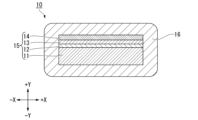
- FIG. 1 is a cross-sectional view showing an oxide superconducting wire according to an embodiment of the present invention.
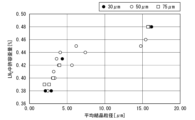
- FIG. 1 is a diagram showing the relationship between the average crystal grain size of a metal substrate and the allowable strain in LN2 .
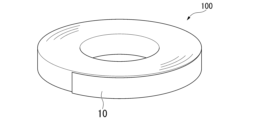
- FIG. 2 is a perspective view of a superconducting coil using the oxide superconducting wire of FIG. 1.
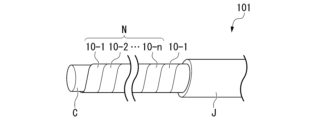
- FIG. 2 is a diagram showing a superconducting conductor using the oxide superconducting wire of FIG. 1.
- 2 is a diagram showing another example of a superconducting conductor using the oxide superconducting wire of FIG. 1.
- FIG. 2 is a diagram showing another example of a superconducting conductor using the oxide superconducting wire of FIG. 1.
- FIG. 1 is a cross-sectional view showing an oxide superconducting wire according to an embodiment of the present invention.
- FIG. 1 is a diagram showing the relationship between the average crystal grain size of a metal substrate and the allowable strain in LN2 .
- an oxide superconducting wire 10 includes a metal substrate 11, an intermediate layer 12, an oxide superconducting layer 13, a protective layer 14, and a stabilization layer 16.
- the metal substrate 11, the intermediate layer 12, the oxide superconducting layer 13, and the protective layer 14 may be collectively referred to as a "superconducting laminate 15.”
- the metal substrate 11, intermediate layer 12, oxide superconducting layer 13, and protective layer 14 are each formed in a tape shape.
- the metal substrate 11, intermediate layer 12, oxide superconducting layer 13, and protective layer 14 are laminated in this order in the thickness direction of the metal substrate 11 (thickness direction of the oxide superconducting wire 10).
- the stabilization layer 16 covers the outer periphery of the superconducting laminate 15.
- the oxide superconducting wire 10 is in the shape of a tape.
- the Z-axis direction (not shown) is a direction along the longitudinal direction of the oxide superconducting wire 10.
- the Y-axis direction is a direction perpendicular to the Z-axis direction and parallel to the thickness direction of the oxide superconducting wire 10.
- the Y-axis direction is also a direction in which the layers 11 to 14 of the superconducting laminate 15 are stacked.
- the X-axis direction is a direction perpendicular to both the Z-axis direction and the Y-axis direction and parallel to the width direction of the oxide superconducting wire 10.
- the X-axis direction may be referred to as the width direction X
- the Y-axis direction may be referred to as the thickness direction Y
- the Z-axis direction may be referred to as the longitudinal direction Z.
- the direction from the metal substrate 11 toward the oxide superconducting layer 13 along the thickness direction Y is referred to as the +Y direction or upward.
- the direction opposite to the +Y direction is referred to as the -Y direction or downward.
- One direction along the width direction X is referred to as the +X direction or rightward.
- the direction opposite to the +X direction is referred to as the -X direction or left.
- a specific example of the metal that constitutes the metal substrate 11 is a nickel alloy, such as Hastelloy (registered trademark).
- the thickness of the metal substrate 11 can be adjusted appropriately depending on the purpose, and is, for example, within the range of 10 to 1000 ⁇ m.
- the intermediate layer 12 is laminated on the metal substrate 11 (on the upper surface of the metal substrate 11).
- the configuration of the intermediate layer 12 is not limited to the example in FIG. 1.
- the intermediate layer 12 may have a multi-layer structure.
- the intermediate layer 12 may have a diffusion prevention layer, a bed layer, an orientation layer, a cap layer, etc., in that order in the direction from the metal substrate 11 toward the oxide superconducting layer 13. These layers are not necessarily provided one by one, and some layers may be omitted, or two or more layers of the same type may be repeatedly laminated.
- the intermediate layer 12 may be a metal oxide. By forming the oxide superconducting layer 13 on the upper surface of the intermediate layer 12 with excellent orientation, an oxide superconducting layer 13 with excellent orientation can be easily obtained.
- the oxide superconducting layer 13 is laminated on the intermediate layer 12 (on the upper surface of the intermediate layer 12).
- the oxide superconducting layer 13 is composed of an oxide superconductor.
- An example of the oxide superconductor constituting the oxide superconducting layer 13 is an RE-Ba-Cu-O-based oxide superconductor (REBCO-based oxide superconductor) represented by the general formula RE 1 Ba 2 Cu 3 O y (RE123).
- the rare earth element RE is one or more of Y, La, Ce, Pr, Nd, Sm, Eu, Gd, Tb, Dy, Ho, Er, Tm, Yb, and Lu.
- y is 7-x (oxygen deficiency amount x: about 0 to 1).
- the ratio of RE:Ba:Cu is not limited to 1:2:3, and may be non-stoichiometric.
- the oxide superconducting layer 13 has a thickness in the range of, for example, 0.5 to 5 ⁇ m.
- the oxide superconducting layer 13 can be formed by a PLD (pulsed laser ablation) film formation method or the like.
- Artificial pins made of different materials may be introduced as artificial crystal defects into the oxide superconducting layer 13.
- Examples of different materials used to introduce artificial pins into the oxide superconducting layer 13 include at least one material selected from the group consisting of BaSnO3 (BSO), BaZrO3 (BZO), BaHfO3 (BHO), BaTiO3 (BTO), SnO2 , TiO2 , ZrO2 , LaMnO3 , and ZnO.
- the protective layer 14 is laminated on the oxide superconducting layer 13 (on the upper surface of the oxide superconducting layer 13).
- the protective layer 14 has functions such as bypassing overcurrent that occurs in the event of an accident and suppressing chemical reactions that occur between the oxide superconducting layer 13 and a layer provided on the protective layer 14.
- Examples of materials for the protective layer 14 include silver (Ag), copper (Cu), gold (Au), gold-silver alloys, other silver alloys, copper alloys, and gold alloys.
- the thickness of the protective layer 14 is, for example, within the range of 1 to 30 ⁇ m.
- the protective layer 14 may be composed of two or more types of metals or two or more metal layers.
- the protective layer 14 can be formed by a deposition method, a sputtering method, or the like.
- the stabilization layer 16 is formed around the entire circumference of the superconducting laminate 15. In other words, the stabilization layer 16 covers the top surface, bottom surface, and both side surfaces of the superconducting laminate 15.
- the "top surface of the superconducting laminate 15" corresponds to the top surface of the protective layer 14
- the "bottom surface of the superconducting laminate 15" corresponds to the bottom surface of the metal substrate 11
- the "side surface of the superconducting laminate 15" corresponds to the side surfaces of each of the layers 11 to 14.
- the stabilization layer 16 has functions such as bypassing overcurrents that occur in the event of an accident and mechanically reinforcing the oxide superconducting layer 13 and the protective layer 14.
- the stabilization layer 16 is, for example, made of a copper (Cu) plating layer.
- the thickness of the stabilization layer 16 is not particularly limited, but is, for example, within the range of 1 to 300 ⁇ m.
- oxide superconducting layers have higher rigidity than metal substrates and are less susceptible to tensile deformation. Therefore, when excessive tensile stress is applied to the oxide superconducting wire along the longitudinal direction, the oxide superconducting layer may not be able to withstand the tensile deformation of the metal substrate, and cracks may occur in the oxide superconducting layer. This causes a problem in that the resistance increases in the areas where cracks occur, reducing the superconducting properties of the oxide superconducting layer.
- Oxide superconducting wires of Comparative Examples 1 to 6 and Examples 1 to 18 were produced. These oxide superconducting wires have a metal substrate 11 with a thickness of 30 ⁇ m, 50 ⁇ m, or 75 ⁇ m, and the average crystal grain size of the metal substrate 11 in each oxide superconducting wire is different from one another.
- the thickness and average crystal grain size of the metal substrate 11 of the oxide superconducting wire 10 are shown in Table 1. The conditions other than the thickness and average crystal grain size of the metal substrate 11 are common among the produced oxide superconducting wires 10, as listed below.
- the average crystal grain size of the metal substrate 11 can be adjusted by adjusting the conditions (temperature, crystal grain size of the substrate before rolling, etc.) when rolling the metal substrate 11 and the conditions (temperature, time, etc.) when forming the intermediate layer 12 and the oxide superconducting layer 13.
- Material of metal substrate 11 Hastelloy Width of metal substrate 11: 4 mm Material of oxide superconducting layer 13: EuBCO+BHO Thickness of oxide superconducting layer 13: 2 ⁇ m Method for forming oxide superconducting layer 13: PLD deposition Material for protective layer 14: Ag Thickness of protective layer 14: 2 ⁇ m Method for forming protective layer 14: Sputtering Material for stabilizing layer 16: Cu Thickness of stabilizing layer 16: 5 ⁇ m Method for forming the stabilizing layer 16: plating. As the intermediate layer 12, a commonly used one was used.
- Table 1 is a table summarizing the results of measuring the average crystal grain size of the metal substrate 11, the standard deviation of the crystal grain size of the metal substrate 11, and the allowable strain in LN 2 (details will be described later) for each of the oxide superconducting wires of Comparative Examples 1 to 6 and Examples 1 to 18.
- the tensile resistance is judged to be "pass” when the allowable strain in LN 2 is 0.40% or more, and the tensile resistance is judged to be “fail” when the allowable strain in LN 2 is less than 0.40%.
- Fig. 2 is a graph showing the relationship between the average crystal grain size of the metal substrate 11 and the allowable strain in LN 2 .
- the allowable strain in LN2 is a parameter indicating the resistance of the oxide superconducting wire to tensile stress.
- the allowable strain in LN2 is defined as the maximum strain amount among the strain amounts at which the characteristics (superconducting characteristics) of the oxide superconducting wire are maintained.
- the strain amount is a parameter indicating the elongation rate of the oxide superconducting wire, and is defined by the following formula, where L0 is the natural length of the oxide superconducting wire, and L1 is the length of the oxide superconducting wire in an elongated state.
- the average crystal grain size of the metal substrate 11 in the produced oxide superconducting wire was calculated as the average value of the crystal grain size measured by a reflection EBSD (electron backscatter diffraction) method.
- the observation conditions for the sample in the EBSD method are as follows: Acceleration voltage: 15 kV Irradiation current: 15 nA Sample tilt angle: 70° Number of sample observation points: any one point Interval: 150 nm/step
- the sample observation range was 45 ⁇ 45 ⁇ m for Comparative Examples 1 and 2 and Examples 1 to 12, in which the substrate thickness was 50 ⁇ m, 25 ⁇ 25 ⁇ m for Comparative Examples 3 and 4 and Examples 13 to 15, in which the substrate thickness was 30 ⁇ m, and 70 ⁇ 70 ⁇ m for Comparative Examples 5 and 6 and Examples 16 to 18, in which the substrate thickness was 75 ⁇ m.
- the crystal grain size was determined as the crystal grain size when the crystal orientation angle difference was 5° or more and the ⁇ 3 twin boundary was used as the grain boundary.
- regions with low reliability of the crystal orientation attribution of the reflection EBSD pattern were excluded, and regions with a reliability parameter CI (Confidence Index) value of 0.1 or more were adopted.
- CI Consfidence Index
- TFE-SEM thermal field emission scanning electron microscope
- the reason for judging whether the tensile resistance was "pass" or “fail” depending on whether the allowable strain in LN 2 was 0.40% or more is as follows.
- a tensile stress caused by the electromagnetic force of the superconducting coil is applied to the oxide superconducting wire. Even when the tensile stress caused by the electromagnetic force is applied to the oxide superconducting wire, it is required that the superconducting characteristics are not impaired.
- the inventors of the present application found that the occurrence of deterioration in characteristics is determined at the boundary of an allowable strain in LN 2 of 0.40%. Therefore, in this embodiment, the tensile resistance is judged to be "pass" or "fail” depending on whether the allowable strain in LN 2 is 0.40% or more.
- the smaller the average crystal grain size of a metal solid the smaller the amount of strain in the metal solid as a whole, and the larger the average crystal grain size, the greater the amount of strain in the metal solid as a whole.
- the smaller the average crystal grain size the greater the variation in the amount of strain within the metal solid in general, making it easier for specifically distorted areas to occur.
- the larger the average crystal grain size the smaller the variation in the amount of strain within the metal solid in general, making it harder for specifically distorted areas to occur.
- the amount of strain of the metal substrate 11 as a whole is small, but it is considered that a specifically large strained portion is easily generated. This is considered to be because, in the process of the crystal grain size being refined, a portion where a solute element is fixed to a mobile dislocation appears, and as a result, a portion where the amount of strain is small and a portion where the amount of strain is large are generated. Then, it is considered that a crack occurs in the oxide superconducting layer 13 at this significantly distorted portion, and the superconducting characteristics are deteriorated.
- the metal substrate 11 having a large average crystal grain size when tensile stress is applied, the amount of strain of the metal substrate 11 as a whole is large, but it is considered that a specifically large strained portion is unlikely to occur. Therefore, it is considered that cracks are unlikely to occur in the oxide superconducting layer 13, and the superconducting characteristics are secured. Therefore, it is concluded that the tensile resistance (allowable strain in LN 2 ) increases as the average crystal grain size of the metal substrate 11 increases. And, from the above considerations, it is expected that the allowable strain in LN 2 will also increase when the average crystal grain size of the metal substrate 11 is larger than 16.20 ⁇ m (Example 15).
- the metal substrate 11 in the process of forming the intermediate layer 12 or the oxide superconducting layer 13, high heat is applied to the metal substrate 11.
- This heat causes recrystallization of the metal contained in the metal substrate 11.
- the crystal grain size becomes small, so from the viewpoint of increasing the allowable strain in LN2 , it is desirable that the recrystallization does not proceed.
- the recrystallization is almost complete, most of the crystal grains present in the metal substrate 11 have a small diameter, so the standard deviation of the crystal grain size becomes small.
- the metal substrate 11 contains a mixture of crystal grains having a small diameter and crystal grains having a large diameter, so the standard deviation of the crystal grain size becomes large.
- a large standard deviation of the crystal grain size of the metal substrate 11 means that the recrystallization of the metal contained in the metal substrate 11 has not progressed much. That is, in Comparative Examples 1 to 6, the standard deviation of the crystal grain size of the metal substrate 11 is relatively small (less than 2.32 ⁇ m), so it is considered that recrystallization has almost progressed to the full extent and the average crystal grain size has become small. On the other hand, in Examples 1 to 18, the standard deviation of the crystal grain size of the metal substrate 11 is relatively large (2.32 ⁇ m or more), so it is considered that recrystallization has not progressed much and the average crystal grain size has become large.
- this embodiment proposes an oxide superconducting wire 10 comprising a tape-shaped metal substrate 11 made of a nickel alloy, an intermediate layer 12 laminated on the metal substrate 11, and an oxide superconducting layer 13 laminated on the intermediate layer 12, in which the average crystal grain size of the metal substrate 11 is 3.08 ⁇ m or more and is equal to or less than the thickness of the metal substrate.
- the upper limit of the average crystal grain size of the metal substrate 11 is based on the fact that the average crystal grain size of the metal substrate 11 does not exceed the thickness of the metal substrate 11.
- This configuration makes it possible to realize an oxide superconducting wire that has a high allowable strain in LN 2 , that is, whose superconducting properties are not easily deteriorated even when a tensile stress is applied.
- the standard deviation of the crystal grain size of the metal substrate 11 is within the range of 2.32 to 14.66 ⁇ m. This configuration allows for the realization of an oxide superconducting wire with high tensile resistance, having a metal substrate 11 in which recrystallization has not progressed significantly.
- the oxide superconducting wire 10 may not have a protective layer 14 or a stabilizing layer 16.
- a pancake-type multi-layered coil may be formed by winding and stacking a tape-shaped oxide superconducting wire 10 many times in the thickness direction.
- the superconducting coil 100 includes a laminate in which the oxide superconducting wires 10 and metal tapes are alternately laminated, and an impregnated resin layer.
- the impregnated resin layer impregnates the laminate and covers the outer surface of the laminate. Examples of the resin constituting the impregnated resin layer include epoxy resin, phenol resin, and the like.
- the superconducting coil 100 can be manufactured, for example, by winding together the oxide superconducting wire 10 coated with a resin (such as an epoxy resin) and a metal tape to form a coil, and then curing the resin by heating, etc.
- a resin such as an epoxy resin
- a method may be used in which the oxide superconducting wire 10 and a metal tape are wound together to form a coil, the coil is impregnated with the resin under reduced pressure, and the resin is cured by heating, etc.
- Such a superconducting coil 100 can be used in a superconducting magnet, a superconducting motor, or the like.
- superconducting conductors 101, 102, and 103 may be formed by assembling a plurality of tape-shaped oxide superconducting wires 10. Although it is possible for a current of several tens to several hundreds of amperes to flow through a single oxide superconducting wire 10, it is possible to flow a larger current by bundling a plurality of oxide superconducting wires 10 into superconducting conductors 101, 102, and 103. Furthermore, the superconducting conductors 101, 102, and 103 can be easily wound.
- a superconducting conductor there is a spiral-type superconducting conductor 101 in which N tape-shaped oxide superconducting wires 10-1 to 10-n are wound in a spiral shape around the outer periphery of a core material C, and a coating J is further provided around the outer periphery, as shown in FIG. 4A.
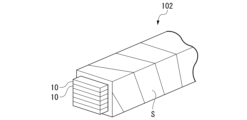
- Another example of the superconducting conductor is a laminated superconducting conductor 102 in which a plurality of oxide superconducting wires 10 are laminated and the outer periphery of the laminate is covered with a stabilizing material S, as shown in FIG. 4B.
- a superconducting conductor is a ROEBEL-type superconducting conductor 103 in which a plurality of oxide superconducting wires 10 bundled together at a bundling portion B are patterned into a meandering shape and twisted together, as shown in FIG. 4C.
- Oxide superconducting wire 11 Metal substrate 12: Intermediate layer 13: Oxide superconducting layer 100: Superconducting coil 101, 102, 103: Superconducting conductor
Landscapes
- Engineering & Computer Science (AREA)
- Manufacturing & Machinery (AREA)
- Chemical & Material Sciences (AREA)
- Ceramic Engineering (AREA)
- Superconductors And Manufacturing Methods Therefor (AREA)
Priority Applications (3)
| Application Number | Priority Date | Filing Date | Title |
|---|---|---|---|
| EP23882730.7A EP4611007A1 (en) | 2022-10-27 | 2023-10-26 | Oxide superconductor wire material, superconductor coil, and superconductor |
| JP2024553139A JPWO2024090528A1 (https=) | 2022-10-27 | 2023-10-26 | |
| CN202380070487.8A CN119998895A (zh) | 2022-10-27 | 2023-10-26 | 氧化物超导线材、超导线圈及超导体 |
Applications Claiming Priority (2)
| Application Number | Priority Date | Filing Date | Title |
|---|---|---|---|
| JP2022-172013 | 2022-10-27 | ||
| JP2022172013 | 2022-10-27 |
Publications (1)
| Publication Number | Publication Date |
|---|---|
| WO2024090528A1 true WO2024090528A1 (ja) | 2024-05-02 |
Family
ID=90830942
Family Applications (1)
| Application Number | Title | Priority Date | Filing Date |
|---|---|---|---|
| PCT/JP2023/038746 Ceased WO2024090528A1 (ja) | 2022-10-27 | 2023-10-26 | 酸化物超電導線材、超電導コイルおよび超電導導体 |
Country Status (4)
| Country | Link |
|---|---|
| EP (1) | EP4611007A1 (https=) |
| JP (1) | JPWO2024090528A1 (https=) |
| CN (1) | CN119998895A (https=) |
| WO (1) | WO2024090528A1 (https=) |
Citations (4)
| Publication number | Priority date | Publication date | Assignee | Title |
|---|---|---|---|---|
| JPH09161557A (ja) * | 1995-12-14 | 1997-06-20 | Hitachi Ltd | 酸化物超電導体、酸化物超電導線材及び線材の製造方法 |
| JP2009506512A (ja) * | 2005-08-30 | 2009-02-12 | エルエス ケーブル リミテッド | 超電導線材用基板及びその製造方法、並びに超電導線材 |
| JP2020166983A (ja) | 2019-03-28 | 2020-10-08 | 株式会社フジクラ | 酸化物超電導線材 |
| JP2022172013A (ja) | 2018-02-28 | 2022-11-11 | 株式会社三洋物産 | 遊技機 |
-
2023
- 2023-10-26 JP JP2024553139A patent/JPWO2024090528A1/ja active Pending
- 2023-10-26 CN CN202380070487.8A patent/CN119998895A/zh active Pending
- 2023-10-26 EP EP23882730.7A patent/EP4611007A1/en active Pending
- 2023-10-26 WO PCT/JP2023/038746 patent/WO2024090528A1/ja not_active Ceased
Patent Citations (4)
| Publication number | Priority date | Publication date | Assignee | Title |
|---|---|---|---|---|
| JPH09161557A (ja) * | 1995-12-14 | 1997-06-20 | Hitachi Ltd | 酸化物超電導体、酸化物超電導線材及び線材の製造方法 |
| JP2009506512A (ja) * | 2005-08-30 | 2009-02-12 | エルエス ケーブル リミテッド | 超電導線材用基板及びその製造方法、並びに超電導線材 |
| JP2022172013A (ja) | 2018-02-28 | 2022-11-11 | 株式会社三洋物産 | 遊技機 |
| JP2020166983A (ja) | 2019-03-28 | 2020-10-08 | 株式会社フジクラ | 酸化物超電導線材 |
Also Published As
| Publication number | Publication date |
|---|---|
| EP4611007A1 (en) | 2025-09-03 |
| JPWO2024090528A1 (https=) | 2024-05-02 |
| CN119998895A (zh) | 2025-05-13 |
Similar Documents
| Publication | Publication Date | Title |
|---|---|---|
| US5801124A (en) | Laminated superconducting ceramic composite conductors | |
| JP5501541B1 (ja) | 酸化物超電導線材および超電導コイル | |
| JP5841862B2 (ja) | 高温超電導線材および高温超電導コイル | |
| CN109923624B (zh) | 超导线材和超导线圈 | |
| WO2016021343A1 (ja) | 酸化物超電導線材、超電導機器及び酸化物超電導線材の製造方法 | |
| WO2014141777A1 (ja) | 超電導導体の製造方法及び超電導導体 | |
| US5006507A (en) | Nickel-based substrate for ceramic superconductor | |
| JP7074190B2 (ja) | 超電導線材、積層超電導線材、超電導コイル及び超電導ケーブル | |
| JP2011040176A (ja) | 超電導テープ線およびそれを用いた超電導コイル | |
| EP0458441A2 (en) | Nickel-based substrate for ceramic superconductor | |
| JP6688914B1 (ja) | 酸化物超電導線材及び超電導コイル | |
| RU2597211C1 (ru) | Провод из оксидного сверхпроводника | |
| WO2024090528A1 (ja) | 酸化物超電導線材、超電導コイルおよび超電導導体 | |
| DE102011083489A1 (de) | Bandförmiger Hochtemperatur-Supraleiter und Verfahren zur Herstellung eines bandförmigen Hochtemperatur-Supraleiters | |
| WO2025204142A1 (ja) | 酸化物超電導線材、超電導コイルおよび超電導導体 | |
| JP2015228357A (ja) | 酸化物超電導線材、超電導機器及び酸化物超電導線材の製造方法 | |
| WO2025204143A1 (ja) | 酸化物超電導線材、超電導コイルおよび超電導導体 | |
| RU2791030C1 (ru) | Оксидный сверхпроводящий провод и сверхпроводящая катушка | |
| JP2017152210A (ja) | 酸化物超電導線材及びその製造方法 | |
| CN110268484B (zh) | 超导线材和超导线圈 | |
| CN115362514B (zh) | 氧化物超导线材及超导线圈 | |
| JP6461776B2 (ja) | 超電導線材および超電導線材の製造方法 | |
| JP7516220B2 (ja) | 酸化物超電導線材および超電導ケーブル | |
| WO2025205269A1 (ja) | 酸化物超電導線材、超電導導体、および超電導コイル | |
| JP6652447B2 (ja) | 超電導線材の製造方法及び超電導コイルの製造方法 |
Legal Events
| Date | Code | Title | Description |
|---|---|---|---|
| 121 | Ep: the epo has been informed by wipo that ep was designated in this application |
Ref document number: 23882730 Country of ref document: EP Kind code of ref document: A1 |
|
| WWE | Wipo information: entry into national phase |
Ref document number: 2024553139 Country of ref document: JP Ref document number: 202380070487.8 Country of ref document: CN |
|
| WWP | Wipo information: published in national office |
Ref document number: 202380070487.8 Country of ref document: CN |
|
| WWE | Wipo information: entry into national phase |
Ref document number: 2023882730 Country of ref document: EP |
|
| NENP | Non-entry into the national phase |
Ref country code: DE |
|
| ENP | Entry into the national phase |
Ref document number: 2023882730 Country of ref document: EP Effective date: 20250527 |
|
| WWP | Wipo information: published in national office |
Ref document number: 2023882730 Country of ref document: EP |