WO2024070376A1 - 活性エネルギー線硬化型インキ組成物および印刷物 - Google Patents
活性エネルギー線硬化型インキ組成物および印刷物 Download PDFInfo
- Publication number
- WO2024070376A1 WO2024070376A1 PCT/JP2023/030720 JP2023030720W WO2024070376A1 WO 2024070376 A1 WO2024070376 A1 WO 2024070376A1 JP 2023030720 W JP2023030720 W JP 2023030720W WO 2024070376 A1 WO2024070376 A1 WO 2024070376A1
- Authority
- WO
- WIPO (PCT)
- Prior art keywords
- acrylate
- ink composition
- mass
- content
- meth
- Prior art date
- Legal status (The legal status is an assumption and is not a legal conclusion. Google has not performed a legal analysis and makes no representation as to the accuracy of the status listed.)
- Ceased
Links
Classifications
-
- B—PERFORMING OPERATIONS; TRANSPORTING
- B41—PRINTING; LINING MACHINES; TYPEWRITERS; STAMPS
- B41M—PRINTING, DUPLICATING, MARKING, OR COPYING PROCESSES; COLOUR PRINTING
- B41M1/00—Inking and printing with a printer's forme
- B41M1/26—Printing on other surfaces than ordinary paper
- B41M1/28—Printing on other surfaces than ordinary paper on metals
-
- C—CHEMISTRY; METALLURGY
- C08—ORGANIC MACROMOLECULAR COMPOUNDS; THEIR PREPARATION OR CHEMICAL WORKING-UP; COMPOSITIONS BASED THEREON
- C08G—MACROMOLECULAR COMPOUNDS OBTAINED OTHERWISE THAN BY REACTIONS ONLY INVOLVING UNSATURATED CARBON-TO-CARBON BONDS
- C08G63/00—Macromolecular compounds obtained by reactions forming a carboxylic ester link in the main chain of the macromolecule
- C08G63/02—Polyesters derived from hydroxycarboxylic acids or from polycarboxylic acids and polyhydroxy compounds
- C08G63/12—Polyesters derived from hydroxycarboxylic acids or from polycarboxylic acids and polyhydroxy compounds derived from polycarboxylic acids and polyhydroxy compounds
- C08G63/16—Dicarboxylic acids and dihydroxy compounds
- C08G63/18—Dicarboxylic acids and dihydroxy compounds the acids or hydroxy compounds containing carbocyclic rings
- C08G63/199—Acids or hydroxy compounds containing cycloaliphatic rings
-
- C—CHEMISTRY; METALLURGY
- C09—DYES; PAINTS; POLISHES; NATURAL RESINS; ADHESIVES; COMPOSITIONS NOT OTHERWISE PROVIDED FOR; APPLICATIONS OF MATERIALS NOT OTHERWISE PROVIDED FOR
- C09D—COATING COMPOSITIONS, e.g. PAINTS, VARNISHES OR LACQUERS; FILLING PASTES; CHEMICAL PAINT OR INK REMOVERS; INKS; CORRECTING FLUIDS; WOODSTAINS; PASTES OR SOLIDS FOR COLOURING OR PRINTING; USE OF MATERIALS THEREFOR
- C09D11/00—Inks
- C09D11/02—Printing inks
- C09D11/10—Printing inks based on artificial resins
- C09D11/101—Inks specially adapted for printing processes involving curing by wave energy or particle radiation, e.g. with UV-curing following the printing
-
- C—CHEMISTRY; METALLURGY
- C09—DYES; PAINTS; POLISHES; NATURAL RESINS; ADHESIVES; COMPOSITIONS NOT OTHERWISE PROVIDED FOR; APPLICATIONS OF MATERIALS NOT OTHERWISE PROVIDED FOR
- C09D—COATING COMPOSITIONS, e.g. PAINTS, VARNISHES OR LACQUERS; FILLING PASTES; CHEMICAL PAINT OR INK REMOVERS; INKS; CORRECTING FLUIDS; WOODSTAINS; PASTES OR SOLIDS FOR COLOURING OR PRINTING; USE OF MATERIALS THEREFOR
- C09D11/00—Inks
- C09D11/02—Printing inks
- C09D11/10—Printing inks based on artificial resins
- C09D11/102—Printing inks based on artificial resins containing macromolecular compounds obtained by reactions other than those only involving unsaturated carbon-to-carbon bonds
- C09D11/104—Polyesters
Definitions
- the present invention relates to an active energy ray-curable ink composition and a printed matter. More specifically, the present invention relates to an active energy ray-curable ink composition and a printed matter obtained by the same, which have excellent processability that allows them to be used in applications for drip cans, and which have blocking resistance that allows them to be stacked flat without the need for a varnish coating.
- Patent Document 1 proposes an active energy ray-curable printing ink composition that is less likely to whiten during retort treatment after printing.
- Dry cans are prone to cracking during punching.
- the cracks that occur become even larger during the subsequent retort treatment.
- conventional dry cans are prone to a loss of gloss.
- gloss decreases the luster of the can surface is lost and the commercial value is likely to decrease.
- ink compositions are required to have excellent processability so as not to cause cracks during punching.
- metal substrates on which indications and the like are printed may be stored flat without being coated with varnish before punching. In this case, the printed indications are transferred to the backside of other metal substrates.
- the backside of the metal substrate is the surface that comes into direct contact with food and the like. Therefore, from a hygienic standpoint, excellent blocking resistance is required to prevent offset.
- the active energy ray-curable printing ink composition described in Patent Document 1 does not achieve both processability and blocking resistance.
- the present invention has been made in consideration of these circumstances, and aims to provide an active energy ray-curable ink composition and printed matter that have excellent processability that allows the resulting printed matter to be used in drip can applications and have blocking resistance that allows the printed matter to be stacked flat without the need for a varnish coating.
- the active energy beam-curable ink composition of one embodiment of the present invention that solves the above problems includes a pigment, a polyester resin, an acrylate monomer, and a photopolymerization initiator
- the acrylate monomer includes an acrylate monomer having an isocyanurate ring, a bifunctional acrylate, and a monofunctional acrylate
- the content of the acrylate monomer having an isocyanurate ring is 25 to 50 mass% of the total amount of the acrylate monomer
- the content of the monofunctional acrylate is 8 to 30 mass% of the total amount of the acrylate monomer
- the sum of the content of the monofunctional acrylate and the content of the bifunctional acrylate is 30 to 75 mass% of the total amount of the acrylate monomer.
- one aspect of the present invention that solves the above problem is a printed matter in which the above-mentioned active energy ray-curable ink composition is printed on a substrate.
- An active energy ray curable ink composition (hereinafter also referred to as ink composition) according to one embodiment of the present invention contains a pigment, a polyester resin, an acrylate monomer, and a photopolymerization initiator.
- the acrylate monomer contains an acrylate monomer having an isocyanurate ring, a bifunctional acrylate, and a monofunctional acrylate.
- the content of the acrylate monomer having an isocyanurate ring is 25 to 50% by mass in the total amount of the acrylate monomer.
- the content of the monofunctional acrylate is 8 to 30% by mass in the total amount of the acrylate monomer.
- the sum of the content of the monofunctional acrylate and the content of the bifunctional acrylate is 30 to 75% by mass in the total amount of the acrylate monomer.
- the pigment is not particularly limited, and may be, for example, any of a variety of inorganic or organic pigments.
- the inorganic and organic pigments are preferably heat-resistant, light-resistant, and retort-resistant.
- Inorganic pigments include titanium oxide, silica, and carbon black.
- Organic pigments include phthalocyanine pigments, azo pigments, quinacridone pigments, diketopyrrolopyrrole pigments, and quinophthalone pigments.
- the pigment content is adjusted appropriately depending on the type and purpose.
- the pigment content in the ink composition is preferably 10% by mass or more.
- the pigment content in the ink composition is preferably 60% by mass or less.
- the polyester resin is a polyester composed of an acid component containing a polybasic acid and a polyhydric alcohol component.
- the acid component containing a polybasic acid is preferably a divalent acid
- the polyhydric alcohol component is preferably a divalent alcohol.
- the polybasic acid contained in the acid component is not particularly limited.
- the polybasic acid is a compound having multiple carboxy groups, and is a component for polycondensation with the polyhydric alcohol component to increase the molecular weight.
- Compounds such as aromatic polybasic acids, aliphatic polybasic acids, alicyclic polybasic acids, and ⁇ , ⁇ -unsaturated dicarboxylic acids can be used as the polybasic acid.
- the acid component containing the polybasic acid preferably contains at least one selected from the group consisting of alicyclic polybasic acids, anhydrides of alicyclic polybasic acids, aromatic polybasic acids, and anhydrides of aromatic polybasic acids.
- the compound having multiple carboxy groups has two or more carboxy groups, and may be an acid anhydride of these.
- an acid anhydride group is generated by dehydration from two carboxy groups, in this embodiment, one acid anhydride group corresponds to two carboxy groups.
- aromatic polybasic acids examples include orthophthalic acid, terephthalic acid, isophthalic acid, naphthalenedicarboxylic acid, trimellitic acid, pyromellitic acid, and biphenyldicarboxylic acid.
- aliphatic polybasic acids examples include succinic acid, azelaic acid, dodecanedioic acid, and dimer acid.
- alicyclic polybasic acids include 1,2,3,6-tetrahydrophthalic acid, hexahydrophthalic acid, 1,3-cyclohexanedicarboxylic acid, and 1,4-cyclohexanedicarboxylic acid.
- ⁇ , ⁇ -unsaturated dicarboxylic acids include fumaric acid, maleic acid, itaconic acid, and citraconic acid.
- Alkyl esters and acid anhydrides of these compounds can also be used.
- the acid component preferably contains at least one selected from the group consisting of alicyclic polybasic acids or their anhydrides, and aromatic polybasic acids or their anhydrides, more preferably contains at least one selected from the group consisting of tetrahydrophthalic anhydride, hexahydrophthalic anhydride, phthalic anhydride, and isophthalic acid, and more preferably contains at least one selected from the group consisting of tetrahydrophthalic anhydride and hexahydrophthalic anhydride. This gives the ink composition better hot water retort resistance.
- the polyhydric alcohol component is ethylene glycol, 1,4-butanediol, neopentyl glycol, diethylene glycol, dipropylene glycol, 1,6-hexanediol, 1,4-cyclohexanedimethanol, xylylene glycol, dimethylolpropionic acid, glycerin, trimethylolpropane, poly(ethyleneoxy)glycol, poly(tetramethyleneoxy)glycol, alkylene oxide adducts of bisphenol A, alkylene oxide adducts of hydrogenated bisphenol A, etc.
- the polyhydric alcohol component contains at least one selected from the group consisting of hydrogenated bisphenol A, 1,6-hexanediol, cyclohexanedimethanol, and diethylene glycol. This provides the ink composition with better hot water retort resistance.
- the weight average molecular weight of the polyester resin of this embodiment is preferably 1000 or more, and more preferably 1300 or more.
- the weight average molecular weight of the polyester resin is preferably 5000 or less, and more preferably 3000 or less.
- the weight average molecular weight of the polyester resin of this embodiment can be determined as a polystyrene-equivalent weight average molecular weight, for example, by gel permeation chromatography (GPC).
- the hydroxyl excess ratio of the polyester resin of this embodiment is preferably 1.0 or more, and more preferably 1.15 or more.
- the hydroxyl excess ratio is preferably 2.0 or less, and more preferably 1.90 or less. If the hydroxyl excess ratio is less than 1.0, the ink composition will produce a film with poor hot water retort resistance.
- the hydroxyl excess ratio (OH amount/COOH amount), which is the molar ratio of hydroxyl groups to carboxy groups, can be obtained by calculating the OH amount and the COOH amount according to the following formula based on the blending of the monomers used, and then calculating the OH amount/COOH amount.
- OH amount number of moles of each monomer used in the compounding
- COOH amount number of moles of each monomer used in the compounding ⁇ valence
- the acid value of the polyester resin is not particularly limited.
- the acid value of the polyester resin is preferably 0.1 mgKOH/g or more.
- the acid value of the polyester resin is preferably 35 mgKOH/g or less.
- the acid value can be calculated, for example, by neutralization titration.
- the content of the polyester resin in the ink composition is preferably 10% by mass or more.
- the content of the polyester resin in the ink composition is preferably 40% by mass or less.
- ink resins In addition to the polyester resins, conventional ink resins may be used in combination.
- ink resins include petroleum resins, epoxy resins, allyl resins, and ketone resins.
- the acrylate monomer includes an acrylate monomer having an isocyanurate ring, a difunctional acrylate, and a monofunctional acrylate.
- the acrylate monomer having an isocyanurate ring is not particularly limited.
- the acrylate monomer having an isocyanurate ring is an isocyanuric acid EO-modified triacrylate, an isocyanuric acid EO-modified diacrylate, an isocyanuric acid ⁇ -caprolactone-modified triacrylate, etc.
- the acrylate monomer having an isocyanurate ring is preferably an isocyanuric acid EO-modified triacrylate or an isocyanuric acid EO-modified diacrylate, in view of excellent blocking resistance of a printed matter obtained using the ink composition.
- the content of the acrylate monomer having an isocyanurate ring may be 25% by mass or more, and preferably 30% by mass or more, based on the total amount of acrylate monomers.
- the content of the acrylate monomer having an isocyanurate ring may be 50% by mass or less, and preferably 45% by mass or less, based on the total amount of acrylate monomers. If the content of the acrylate monomer having an isocyanurate ring is less than 25% by mass, the printed matter obtained using the ink composition will have poor processability when used for dry cartridge cans.
- the acrylate monomer having an isocyanurate ring if the content of the acrylate monomer having an isocyanurate ring is more than 50% by mass, the acrylate monomer having an isocyanurate ring will precipitate in the ink composition, making it unsuitable as an ink composition.
- Bifunctional acrylates are not particularly limited.
- Examples of bifunctional acrylates include 1,3-butylene glycol di(meth)acrylate, 1,4-butanediol di(meth)acrylate, 1,5-pentanediol di(meth)acrylate, 3-methyl-1,5-pentanediol di(meth)acrylate, 1,6-hexanediol di(meth)acrylate, neopentyl glycol di(meth)acrylate, 1,8-octanediol di(meth)acrylate, 1,9-nonanediol di(meth)acrylate, tricyclodecane dimethanol di(meth)acrylate, ethylene glycol di(meth)acrylate, polyethylene glycol di(meth)acrylate, propylene ...
- glycol di(meth)acrylate dipropylene glycol di(meth)acrylate, tripropylene glycol di(meth)acrylate, polypropylene glycol di(meth)acrylate, neopentyl glycol hydroxypivalic acid ester di(meth)acrylate, neopentyl glycol EO-modified di(meth)acrylate, neopentyl glycol PO-modified di(meth)acrylate, bisphenol A (EO-modified) di(meth)acrylate, bisphenol A (PO-modified) di(meth)acrylate, trimethylolpropane EO-modified di(meth)acrylate, trimethylolpropane PO-modified di(meth)acrylate, and the like.
- the content of the bifunctional acrylate is preferably 5% by mass or more, and more preferably 10% by mass or more, of the total amount of acrylate monomers.
- the content of the bifunctional acrylate is preferably 65% by mass or less, and more preferably 50% by mass or less, of the total amount of acrylate monomers.
- Monofunctional acrylates are not particularly limited. Examples of monofunctional acrylates include methyl (meth)acrylate, ethyl (meth)acrylate, propyl (meth)acrylate, butyl (meth)acrylate, amyl (meth)acrylate, 2-ethylhexyl (meth)acrylate, octyl (meth)acrylate, nonyl (meth)acrylate, dodecyl (meth)acrylate, hexadecyl (meth)acrylate, octadecyl (meth)acrylate, cyclohexyl (meth)acrylate, methoxyethyl (meth)acrylate, butoxyethyl (meth)acrylate, phenol EO modified (meth)acrylate, nonylphenol EO modified (meth)acrylate, glycidyl (meth)acrylate, dimethylaminoethyl ...
- acryloyloxyethyl (meth)acrylate isobornyl (meth)acrylate, dicyclopentanyl (meth)acrylate, dicyclopentenyl (meth)acrylate, dicyclopentenyloxyethyl (meth)acrylate, 2-hydroxy-3-phenoxypropyl (meth)acrylate, tetrahydrofurfuryl (meth)acrylate, 2-hydroxyethyl (meth)acrylate, benzyl (meth)acrylate, phenylbenzyl (meth)acrylate, mono(2-acryloyloxyethyl) succinate, N-[2-(acryloyloxy)ethyl]phthalimide, and N-[2-(acryloyloxy)ethyl]tetrahydrophthalimide.
- the content of the monofunctional acrylate may be 8% by mass or more, and preferably 10% by mass or more, based on the total amount of acrylate monomers.
- the content of the monofunctional acrylate may be 30% by mass or less, and preferably 25% by mass or less, based on the total amount of acrylate monomers. If the content of the monofunctional acrylate is less than 8% by mass, the printed matter obtained using the ink composition will have poor processability when used for dry cartridge cans. On the other hand, if the content of the monofunctional acrylate is more than 30% by mass, the printed matter obtained using the ink composition will have poor blocking resistance.
- the sum of the content of the monofunctional acrylate and the content of the bifunctional acrylate may be 30% by mass or more, preferably 40% by mass or more, of the total amount of the acrylate monomer.
- the sum of the content of the monofunctional acrylate and the content of the bifunctional acrylate may be 75% by mass or less, preferably 65% by mass or less, of the total amount of the acrylate monomer. If the sum of the content of the monofunctional acrylate and the content of the bifunctional acrylate is less than 30% by mass, the printed matter obtained using the ink composition has poor processability in DR can applications. On the other hand, if the sum of the content of the monofunctional acrylate and the content of the bifunctional acrylate exceeds 75% by mass, the printed matter obtained using the ink composition has poor blocking resistance.
- the acrylate monomer may include other acrylate monomers in addition to the above-mentioned acrylate monomer having an isocyanurate ring, bifunctional acrylate, and monofunctional acrylate.
- the other acrylate monomer is not particularly limited.
- the other acrylate monomer may be a trifunctional acrylate, a tetrafunctional acrylate, a pentafunctional acrylate, a hexafunctional acrylate, etc., a di(meth)acrylate monomer in which two hydroxyl groups of a diol compound are substituted with (meth)acryloyloxy groups, a di- or tri(meth)acrylate monomer in which two or three hydroxyl groups of a triol compound are substituted with (meth)acryloyloxy groups, etc.
- the trifunctional acrylate is not particularly limited.
- Examples of trifunctional acrylates include trimethylolpropane tri(meth)acrylate, glycerin tri(meth)acrylate, pentaerythritol tri(meth)acrylate, and EO- and PO-modified versions of these.
- the tetrafunctional acrylate is not particularly limited.
- Examples of the tetrafunctional acrylate include ditrimethylolpropane tetra(meth)acrylate and pentaerythritol tetra(meth)acrylate.
- the pentafunctional acrylate is not particularly limited.
- One example of the pentafunctional acrylate is dipentaerythritol penta(meth)acrylate.
- the hexafunctional acrylate is not particularly limited.
- One example of the hexafunctional acrylate is dipentaerythritol hexa(meth)acrylate.
- the polyfunctional acrylate may be a poly(meth)acrylate in which multiple hydroxyl groups of dipentaerythritol are substituted with (meth)acryloyloxy groups, such as dipentaerythritol hexa(meth)acrylate.
- the content of the acrylate monomer in the ink composition is preferably 15% by mass or more, and more preferably 20% by mass or more.
- the content of the acrylate monomer in the ink composition is preferably 55% by mass or less, and more preferably 50% by mass or less.
- the photopolymerization initiator is a component that generates radicals when irradiated with active energy rays, and is blended in order to cure the ink composition.
- the photopolymerization initiator is not particularly limited.
- photopolymerization initiators include benzophenone, diethylthioxanthone, 2-methyl-1-(4-methylthio)phenyl-2-morpholinopropan-1-one, 4-benzoyl-4'-methyldiphenyl sulfide, 1-chloro-4-propoxythioxanthone, isopropylthioxanthone, 2-hydroxy-2-methyl-1-phenylpropan-1-one, 1-hydroxycyclohexyl phenyl ketone, bis-2,6-dimethoxybenzoyl-2,4,4-trimethylpentylphosphine oxide, 1-[4-(2-hydroxyethoxy)-phenyl]-2-hydroxy-2-methyl-1-propan-1-one, 2,2-dimethyl-2-hydroxyacetophenone, 2,2-dimethoxy-2-phenylacetophenone, 2,4,6-trimethylbenzyl-diphenylphosphine oxide, and 2-benzy
- the content of the photopolymerization initiator is not particularly limited.
- the content of the photopolymerization initiator in the ink composition is preferably 1% by mass or more, and more preferably 2% by mass or more.
- the content of the photopolymerization initiator in the ink composition is preferably 20% by mass or less, and more preferably 15% by mass or less.
- the ink composition is sufficiently easy to cure.
- the ink composition of the present embodiment may contain optional components such as an extender pigment, a wax, a polymerization inhibitor, a dispersant, etc., in addition to the above-mentioned pigment, polyester resin, acrylate monomer, and photopolymerization initiator.
- the extender pigment is preferably included to impart viscoelasticity to the ink composition, adjust the flowability, prevent misting, etc.
- the extender pigment is not particularly limited.
- extender pigments include clay, talc, mica, kaolinite (kaolin), barium sulfate, magnesium sulfate, calcium carbonate, silicon oxide, aluminum oxide, bentonite, ground calcium carbonate, barium carbonate, zirconia, alumina, etc.
- the content of the extender pigment is not particularly limited.
- the content of the extender pigment in the ink composition is preferably greater than 0 mass%, and more preferably 1 mass% or more.
- the content of the extender pigment in the ink composition is preferably 30 mass% or less, and more preferably 15 mass% or less.
- the wax is not particularly limited.
- the wax may be a polyethylene wax, an olefin wax, a Fischer-Tropsch wax, or the like.
- the wax content is not particularly limited.
- the wax content in the ink composition is preferably greater than 0 mass%, and more preferably 1 mass% or more.
- the wax content in the ink composition is preferably 30 mass% or less, and more preferably 15 mass% or less.
- the polymerization inhibitor is not particularly limited.
- examples of the polymerization inhibitor include phenolic compounds such as butylhydroxytoluene, tocopherol acetate, nitrosamines, benzotriazoles, hindered amines, etc.
- the content of the polymerization inhibitor is not particularly limited.
- the content of the polymerization inhibitor in the ink composition is preferably greater than 0 mass%, and more preferably 0.1 mass% or more.
- the content of the polymerization inhibitor in the ink composition is preferably 10 mass% or less, and more preferably 5 mass% or less.
- the dispersant is not particularly limited.
- examples of the dispersant include carbodiimide-based dispersants, polyester amine-based dispersants, fatty acid amine-based dispersants, modified polyacrylate-based dispersants, modified polyurethane-based dispersants, multi-chain polymeric nonionic dispersants, polymeric ionic surfactants, etc.
- the content of the dispersant is not particularly limited.
- the content of the dispersant is preferably 1 to 200% by mass, assuming that the colorant is 100% by mass.
- the method for preparing the ink composition of this embodiment is not particularly limited.
- the ink composition can be prepared by a conventional method using a roll mill, a ball mill, a bead mill, or the like.
- a printed matter according to one embodiment of the present invention is a printed matter in which the active energy ray-curable ink composition according to the above embodiment is printed on a substrate.
- a printed matter consisting of a coating formed by printing the ink composition on a metal plate or a metal substrate provided with a base coat layer will be described.
- the ink composition of the above embodiment is printed on a substrate such as a metal substrate to form a film.
- the metal substrate is not particularly limited.
- the metal plate may be a metal substrate such as stainless steel, aluminum, tin-plated steel, or tin-free steel, or a metal base plate having a base coat (primer) layer provided on the metal substrate.
- a base coat composition such as a size paint or white coating that is commonly used in metal printing may be used to form the base coat layer.
- the metal substrate may also be laminated with a PET film.
- the method for printing the ink composition of this embodiment on a metal substrate is not particularly limited.
- the printing method is a normal printing method such as an offset method using dampening water or a dry offset method.
- the ink film may have a thickness of 0.1 to 6 ⁇ m.
- the conditions for curing the ink composition are not particularly limited.
- the active energy rays used in the active energy ray curing reaction are ultraviolet rays, electron beams, etc.
- ultraviolet light sources include xenon lamps, high-pressure mercury lamps, metal halide lamps, gallium lamps, ultraviolet light-emitting diodes (UV-LEDs), ultraviolet laser diodes (UV-LDs), etc., and ultraviolet irradiation devices having these light sources can be used.
- the light quantity, light source arrangement, transport speed, etc. can be adjusted as necessary.
- a high-pressure mercury lamp it is preferable to cure at a transport speed of about 2 to 100 m/min for one lamp with a light quantity of about 80 to 160 W/cm.
- electron beams it is preferable to cure at a transport speed of about 5 to 50 m/min using an electron beam accelerator with an acceleration voltage of about 10 to 300 kV.
- thermosetting topcoat varnish may be formed on the ink layer.
- the layer of thermosetting topcoat varnish may be any water-based or solvent-based thermosetting topcoat varnish.
- Commercially available solvent-based thermosetting topcoat varnishes include polyester/amino-based topcoat varnishes manufactured by Toyochem Co., Ltd.
- the printed matter of this embodiment is formed with a film made of the ink composition described above. Therefore, even if the printed matter is stacked flat without such a varnish layer, the film is unlikely to transfer onto the back of another printed matter, and blocking resistance is excellent.
- the method for forming the varnish layer is not particularly limited.
- the varnish layer is applied with a roll coater, and then heated and dried at 150°C to 250°C for 5 seconds to 15 minutes, forming a coating film that is excellent in appearance, hardness, processability, and retort resistance.
- the thickness of the varnish layer is not particularly limited.
- the thickness of the varnish layer is preferably 3 ⁇ m or more.
- the thickness of the varnish layer is preferably 10 ⁇ m or less.
- the ink composition of the above embodiment has excellent processability when producing drop-resistant cans, and is less likely to crack or turn white after hot water retort treatment. Therefore, it is suitable for printing on metal, and is particularly suitable for printing on metal on drop-resistant cans.
- the ink composition of this embodiment provides printed matter that has excellent processability that makes it suitable for use in drip cans, and has blocking resistance that allows it to be stacked flat without the need for a varnish coating.
- the above describes one embodiment of the present invention.
- the present invention is not particularly limited to the above embodiment.
- An active energy ray curable ink composition comprising a pigment, a polyester resin, an acrylate monomer, and a photopolymerization initiator, the acrylate monomer comprising an acrylate monomer having an isocyanurate ring, a bifunctional acrylate, and a monofunctional acrylate, the content of the acrylate monomer having an isocyanurate ring being 25-50% by mass in the total amount of the acrylate monomer, the content of the monofunctional acrylate being 8-30% by mass in the total amount of the acrylate monomer, and the sum of the content of the monofunctional acrylate and the content of the bifunctional acrylate being 30-75% by mass in the total amount of the acrylate monomer.
- the printed matter obtained using the active energy ray-curable ink composition has excellent processability that allows it to be used in drip can applications, and has blocking resistance that allows it to be stacked flat without the need for a varnish coating.
- the printed matter obtained using the active energy ray-curable ink composition has better hot water retort resistance.
- the resulting DR can is less susceptible to whitening and less prone to loss of gloss.
- printed matter obtained using the active energy ray-curable ink composition is particularly suitable for use in drip cans.
- the printed matter has excellent workability that allows it to be used for drip cans, and it has blocking resistance that allows it to be stacked flat even without being coated with varnish.
- the raw materials used are as follows: ⁇ Pigments> LIONOL BLUE FG-7351: Pigment Blue 15:3, manufactured by Toyo Color Co., Ltd. ⁇ Acid and alcohol for polyester resin synthesis> Tetrahydrophthalic anhydride: Rikacid TH, 152 g/mol, valence 2, manufactured by New Japan Chemical Co., Ltd. Hydrogenated bisphenol A: Rikabinol HB, 240 g/mol, valence 2, manufactured by New Japan Chemical Co., Ltd. 1,6 hexanediol: 1,6 hexanediol, 118 g/mol, valence 2, manufactured by UBE Co., Ltd.
- ARONIX M-408 ditrimethylolpropane tetraacrylate, tetrafunctional acrylate, manufactured by Toagosei Co., Ltd.
- OTA480 glycerin PO modified triacrylate, trifunctional acrylate, manufactured by Daicel Allnex Co., Ltd.
- Laromer LR 8863 trimethylolpropane EO modified triacrylate, trifunctional acrylate, manufactured by BASF Corporation
- MIRAMER M370 isocyanuric acid EO modified triacrylate (>99.9%), acrylate monomer having an isocyanurate ring, manufactured by MIWON SPECIALTY CHEMICAL Co., Ltd.
- ARONIX M-315 isocyanuric acid EO modified triacrylate and diacrylate (diacrylate ratio: 3 to 13%), acrylate monomer having an isocyanurate ring, MIRAMER manufactured by Toagosei Co., Ltd.
- M216 Neopentyl glycol PO modified diacrylate, bifunctional acrylate, manufactured by MIWON SPECIALTY CHEMICAL KAYARAD HX220: Caprolactone modified hydroxypivalic acid neopentyl glycol ester diacrylate, bifunctional acrylate, manufactured by Nippon Kayaku Co., Ltd.
- Iupimer UV SA-1002N Tricyclodecane dimethanol diacrylate, bifunctional acrylate, manufactured by Mitsubishi Chemical Co., Ltd.
- ARONIX M-101A Phenol EO modified acrylate, monofunctional acrylate, manufactured by Toagosei Co., Ltd.
- MIRAMER M1140 Isobornyl acrylate, monofunctional acrylate, manufactured by MIWON SPECIALTY CHEMICAL
- MIRAMER M150 Tetrahydrofurfuryl acrylate, monofunctional acrylate, manufactured by MIWON SPECIALTY CHEMICAL Co., Ltd.
- Omnirad 379 2-(dimethylamino)-2-[(4-methylphenyl)methyl]-1-[4-(4-morpholinyl)phenyl]-1-butanone, manufactured by IGM Resins Omnirad EMK: 4,4-bis(diethylamino)benzophenone, manufactured by IGM Resins Omnirad DETX: 2,4-diethylthioxanthone, manufactured by IGM Resins ⁇ Additives> SST-3T1-RC: Polytetrafluoroethylene, manufactured by Shamrock
- Example 1 The ink composition of Example 1 was prepared by mixing the components according to the recipe shown in Table 1 and milling and stirring them in a three-roll mill heated to 40° C. The ink composition obtained was evaluated for processability, blocking resistance, the presence or absence of precipitation, and the presence or absence of whitening by the following evaluation methods. The results are shown in Table 1.
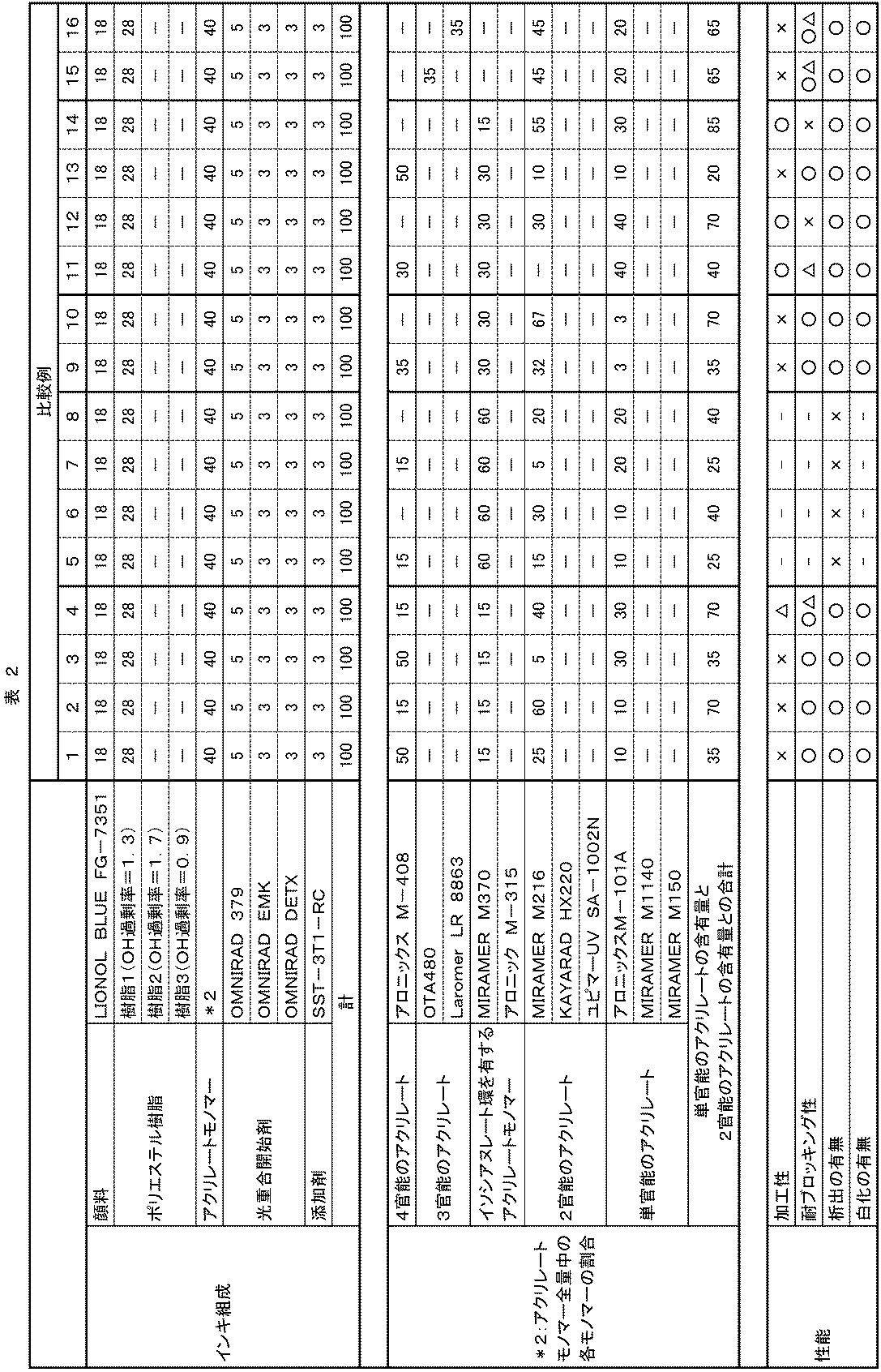
- Examples 2 to 16 Comparative Examples 1 to 16> Ink compositions were prepared and evaluated in the same manner as in Example 1, except that the formulations were changed as shown in Tables 1 and 2. The results are shown in Tables 1 and 2.
- the metal plate used for the evaluation was prepared by coating an electric tinplate (ET2.8/2.8 T2.5B manufactured by Nippon Steel & Sumitomo Metal Corporation) with a polyester/amino-based base coating (manufactured by Toyochem Co., Ltd.) in a coating amount of 140 mg/ 100 cm2 and baking at 180°C for 10 minutes to prepare a base coat layer.
- an electric tinplate E2.8/2.8 T2.5B manufactured by Nippon Steel & Sumitomo Metal Corporation
- a polyester/amino-based base coating manufactured by Toyochem Co., Ltd.
- the obtained ink was applied to the base coat layer of the metal plate using an RI tester (manufactured by Tester Sangyo Co., Ltd.) to a film thickness of 1.5 ⁇ m, and the ink was cured by irradiating the printed matter with ultraviolet light using a concentrating metal halide lamp (manufactured by Eye Graphics Co., Ltd., 120 W/cm) irradiation device at a distance of 11 cm from the printed matter and at a conveyor speed of 30 m/min, to prepare a test sample A.
- RI tester manufactured by Tester Sangyo Co., Ltd.
- a concentrating metal halide lamp manufactured by Eye Graphics Co., Ltd., 120 W/cm
- test sample B After printing twice under the same printing conditions, a polyester/amino-based top coating (manufactured by Toyochem Co., Ltd.) was applied in an amount of 70 mg/ 100 cm2 and baked at 180°C for 10 minutes to prepare test sample B. Using the obtained test samples A and B, evaluations were carried out by the following methods. Note that the RI tester is a test machine that spreads ink on a recording medium, and it is possible to adjust the amount of ink transferred and the printing pressure.
- Test sample B prepared by the above method was punched out into a cylindrical shape with a diameter of 80 mm and a height of 50 mm by pressing to obtain a processed product.
- the processed product was sterilized for 90 minutes while immersed in hot water at 125°C, and then the gloss loss on the side surface of the processed product was visually evaluated according to the following criteria. A or better was judged to be at a practical level. (Evaluation criteria) A: The decrease in gloss was very small. ⁇ : A decrease in gloss was observed, but some gloss remained. ⁇ : The gloss was significantly reduced. ⁇ : The gloss loss was very large. -: Precipitation occurred and evaluation was not possible.
- ⁇ Blocking resistance> The test sample A prepared by the above method was cut to 3 cm x 5 cm, and an electric tinplate cut to the same size was placed on the opposite side of the ink film, and the sample was left to stand in an electric oven at 40°C for 1 hour while applying a load of 3 kg/ cm2 using a blocking tester (manufactured by Tester Sangyo Co., Ltd.), and then removed.
- the ink was visually checked to see whether it had transferred to the opposite electric tinplate, and evaluated according to the following criteria. Good or bad was judged to be at a practical level. (Evaluation criteria) ⁇ : No bleeding occurred. ⁇ : Slight offset was observed. ⁇ : Clear offset was observed. ⁇ : Clear offset was observed, and peeling of the ink film was observed. -: Precipitation occurred and evaluation was not possible.
- Test sample B prepared by the above method was immersed in hot water at 125° C. for 90 minutes for sterilization, and then the degree of whitening of the coating surface was visually evaluated according to the following criteria. A or better was judged to be at a practical level. (Evaluation criteria) ⁇ : No whitening occurred. ⁇ : slight whitening was observed. ⁇ : Obvious whitening was observed. ⁇ : The entire coating film was completely whitened. -: Precipitation occurred and evaluation was not possible.
- the ink compositions of Examples 1 to 16 of the present invention did not cause precipitation.
- printed matter using the ink compositions had processability suitable for use in drop-dryer cans, and was less susceptible to whitening even when subjected to hot water retort treatment.
- the printed matter did not show through even when stacked flat, and had excellent blocking resistance.
Landscapes
- Chemical & Material Sciences (AREA)
- Organic Chemistry (AREA)
- Chemical Kinetics & Catalysis (AREA)
- Materials Engineering (AREA)
- Wood Science & Technology (AREA)
- Engineering & Computer Science (AREA)
- Life Sciences & Earth Sciences (AREA)
- Health & Medical Sciences (AREA)
- Medicinal Chemistry (AREA)
- Polymers & Plastics (AREA)
- Inks, Pencil-Leads, Or Crayons (AREA)
- Printing Methods (AREA)
- Polyesters Or Polycarbonates (AREA)
Abstract
得られる印刷物が、DR缶用途に使用可能な優れた加工性を有し、ニスを塗工しなくても、平積みすることのできる耐ブロッキング性を有する、活性エネルギー線硬化型インキ組成物および印刷物を提供する。顔料とポリエステル樹脂とアクリレートモノマーと光重合開始剤とを含み、アクリレートモノマーは、イソシアヌレート環を有するアクリレートモノマーと2官能のアクリレートと単官能のアクリレートとを含み、イソシアヌレート環を有するアクリレートモノマーの含有量は、アクリレートモノマー全量中、25~50質量%であり、単官能のアクリレートの含有量は、アクリレートモノマー全量中、8~30質量%であり、単官能のアクリレートの含有量と2官能のアクリレートの含有量との合計は、アクリレートモノマー全量中、30~75質量%である、活性エネルギー線硬化型インキ組成物。
Description
本発明は、活性エネルギー線硬化型インキ組成物および印刷物に関する。より詳細には、本発明は、得られる印刷物が、DR缶用途に使用可能な優れた加工性を有し、ニスを塗工しなくても、平積みすることのできる耐ブロッキング性を有する、活性エネルギー線硬化型インキ組成物および印刷物に関する。
食料缶などの金属容器の表面には、内容物の表示や装飾等が施されている。DR缶は、金属基材に表示等を印刷し、打ち抜き加工を行うことにより作製される。DR缶は、食品を入れて封がされた後、レトルト処理が行われる。特許文献1には、印刷後のレトルト処理において白化を生じにくい、活性エネルギー線硬化型印刷インキ組成物が提案されている。
DR缶は、打ち抜き加工時にクラックが発生しやすい。発生したクラックは、その後のレトルト処理によってさらに大きくなる。その結果、従来のDR缶は、グロスが低下しやすい。グロスが低下すると、缶表面の艶が失われ、商品価値が低下しやすい。そのため、インキ組成物は、打ち抜き加工時にクラックを発生しないように、優れた加工性が要求される。また、表示等が印刷された金属基材は、打ち抜き加工前に、ニスが塗工されることなく平積みで保管されることがある。この場合、印刷された表示が、他の金属基材の裏面に写る。DR缶において、金属基材の裏面は、食品等が直接接触する面である。そのため、衛生面からも、裏移りを防止する優れた耐ブロッキング性が要求される。特許文献1に記載の活性エネルギー線硬化型印刷インキ組成物は、これら加工性および耐ブロッキング性が両立できていない。
本発明は、このような事情に鑑みなされたものであり、得られる印刷物が、DR缶用途に使用可能な優れた加工性を有し、ニスを塗工しなくても、平積みすることのできる耐ブロッキング性を有する、活性エネルギー線硬化型インキ組成物および印刷物を提供することを目的とする。
上記課題を解決する本発明の一態様の活性エネルギー線硬化型インキ組成物は、顔料と、ポリエステル樹脂と、アクリレートモノマーと、光重合開始剤とを含み、前記アクリレートモノマーは、イソシアヌレート環を有するアクリレートモノマーと、2官能のアクリレートと、単官能のアクリレートとを含み、前記イソシアヌレート環を有するアクリレートモノマーの含有量は、アクリレートモノマー全量中、25~50質量%であり、前記単官能のアクリレートの含有量は、アクリレートモノマー全量中、8~30質量%であり、前記単官能のアクリレートの含有量と、前記2官能のアクリレートの含有量との合計は、アクリレートモノマー全量中、30~75質量%である、活性エネルギー線硬化型インキ組成物である。
また、上記課題を解決する本発明の一態様の印刷物は、上記活性エネルギー線硬化型インキ組成物が、基材に印刷された、印刷物である。
<活性エネルギー線硬化型インキ組成物>
本発明の一実施形態の活性エネルギー線硬化型インキ組成物(以下、インキ組成物ともいう)は、顔料と、ポリエステル樹脂と、アクリレートモノマーと、光重合開始剤とを含む。アクリレートモノマーは、イソシアヌレート環を有するアクリレートモノマーと、2官能のアクリレートと、単官能のアクリレートとを含む。イソシアヌレート環を有するアクリレートモノマーの含有量は、アクリレートモノマー全量中、25~50質量%である。単官能のアクリレートの含有量は、アクリレートモノマー全量中、8~30質量%である。単官能のアクリレートの含有量と、2官能のアクリレートの含有量との合計は、アクリレートモノマー全量中、30~75質量%である。以下、それぞれについて説明する。
本発明の一実施形態の活性エネルギー線硬化型インキ組成物(以下、インキ組成物ともいう)は、顔料と、ポリエステル樹脂と、アクリレートモノマーと、光重合開始剤とを含む。アクリレートモノマーは、イソシアヌレート環を有するアクリレートモノマーと、2官能のアクリレートと、単官能のアクリレートとを含む。イソシアヌレート環を有するアクリレートモノマーの含有量は、アクリレートモノマー全量中、25~50質量%である。単官能のアクリレートの含有量は、アクリレートモノマー全量中、8~30質量%である。単官能のアクリレートの含有量と、2官能のアクリレートの含有量との合計は、アクリレートモノマー全量中、30~75質量%である。以下、それぞれについて説明する。
(顔料)
顔料は特に限定されない。一例を挙げると、顔料は、各種無機顔料または有機顔料である。
顔料は特に限定されない。一例を挙げると、顔料は、各種無機顔料または有機顔料である。
無機顔料、有機顔料は、耐熱性、耐光性、レトルト耐性を有するものであることが好ましい。無機顔料は、酸化チタン、シリカ、カーボンブラック等である。有機顔料は、フタロシアニン系顔料、アゾ系顔料、キナクリドン系顔料、ジケトピロロピロール系顔料、キノフタロン系顔料等である。
顔料の含有量は、種類や目的によって適宜調整される。一例を挙げると、顔料の含有量は、インキ組成物中、10質量%以上であることが好ましい。また、顔料の含有量は、インキ組成物中、60質量%以下であることが好ましい。顔料の含有量が上記範囲内であることにより、インキ組成物は、分散安定性が優れ、皮膜物性においては、顔料濃度が高いことによる弊害を回避できる。
(ポリエステル樹脂)
ポリエステル樹脂は、多塩基酸を含む酸成分と多価アルコール成分とを構成成分とするポリエステルである。ポリエステル樹脂は、多塩基酸を含む酸成分が2価の酸であり、多価アルコール成分が2価のアルコールであることが好ましい。これにより、得られる皮膜は、熱水レトルト耐性が優れる。また、得られる皮膜は、金属基材に対する密着性および耐ブロッキング性がより優れる。
ポリエステル樹脂は、多塩基酸を含む酸成分と多価アルコール成分とを構成成分とするポリエステルである。ポリエステル樹脂は、多塩基酸を含む酸成分が2価の酸であり、多価アルコール成分が2価のアルコールであることが好ましい。これにより、得られる皮膜は、熱水レトルト耐性が優れる。また、得られる皮膜は、金属基材に対する密着性および耐ブロッキング性がより優れる。
酸成分に含まれる多塩基酸は特に限定されない。多塩基酸は、複数のカルボキシ基を有する化合物であり、多価アルコール成分と縮重合して高分子量化させるための成分である。多塩基酸としては芳香族多塩基酸、脂肪族多塩基酸、脂環式多塩基酸、α、β-不飽和ジカルボン酸等の化合物を使用できる。これらの中でも、多塩基酸を含む酸成分は、脂環式多塩基酸、脂環式多塩基酸の無水物、芳香族系多塩基酸および芳香族系多塩基酸の無水物からなる群から選択される少なくとも1種を含むことが好ましい。複数のカルボキシ基を有する化合物は、2または3以上のカルボキシ基を備えており、これらの酸無水物であってもよい。また、酸無水物基は、2つのカルボキシ基から脱水によって生成するものであるため、本実施形態においては、酸無水物基1個はカルボキシ基2個に相当するものとする。
芳香族多塩基酸としては、たとえば、オルソフタル酸、テレフタル酸、イソフタル酸、ナフタレンジカルボン酸、トリメリット酸、ピロメリット酸およびビフェニルジカルボン酸等が挙げられる。脂肪族多塩基酸としては、たとえばコハク酸、アゼライン酸、ドデカンジオン酸、およびダイマー酸等が挙げられる。脂環式多塩基酸としては、たとえば1,2,3,6-テトラヒドロフタル酸、ヘキサヒドロフタル酸、1,3-シクロヘキサンジカルボン酸、および1,4-シクロヘキサンジカルボン酸等が挙げられる。α、β-不飽和ジカルボン酸としては、たとえば、フマル酸、マレイン酸、イタコン酸、シトラコン酸等が挙げられる。なお、これらの化合物のアルキルエステル、および酸無水物も使用することができる。これらの中でも、酸成分は、脂環式多塩基酸またはその無水物、芳香族系多塩基酸またはその無水物からなる群から選択される少なくとも1種を含むことが好ましく、テトラヒドロ無水フタル酸、ヘキサヒドロ無水フタル酸、無水フタル酸、イソフタル酸からなる群から選択される少なくとも1種を含むことがより好ましく、テトラヒドロ無水フタル酸、ヘキサヒドロ無水フタル酸、からなる群から選択される少なくとも1種を含むことがより好ましい。これにより、インキ組成物は、より優れた熱水レトルト耐性を有する。
多価アルコール成分は、エチレングリコール、1,4-ブタンジオール、ネオペンチルグリコール、ジエチレングリコール、ジプロピレングリコール、1,6-ヘキサンジオール、1,4-シクロヘキサンジメタノール、キシリレングリコール、ジメチロールプロピオン酸、グリセリン、トリメチロールプロパン、ポリ(エチレンオキシ)グリコール、ポリ(テトラメチレンオキシ)グリコール、ビスフェノールAのアルキレンオキサイド付加物、水添ビスフェノールAのアルキレンオキサイド付加物等である。これらの中でも、多価アルコール成分は、水添ビスフェノールA、1,6-ヘキサンジオール、シクロヘキサンジメタノール、ジエチレングリコールからなる群から選択される少なくとも1種を含むことが好ましい。これにより、インキ組成物は、より優れた熱水レトルト耐性を有する。
本実施形態のポリエステル樹脂の重量平均分子量は、1000以上であることが好ましく、1300以上であることがより好ましい。また、ポリエステル樹脂の重量平均分子量は、5000以下であることが好ましく、3000以下であることがより好ましい。ポリエステル樹脂の重合平均分子量が上記範囲内であることにより、本実施形態のインキ組成物を用いて得られる皮膜は、より優れた金属基材に対する密着性および耐ブロッキング性を有する。なお、本実施形態のポリエステル樹脂の重量平均分子量は、たとえば、ゲル浸透クロマトグラフィー(GPC)法によって、ポリスチレン換算の重量平均分子量として求めることができる。
本実施形態のポリエステル樹脂の水酸基過剰率は、1.0以上であることが好ましく、1.15以上であることがより好ましい。また、水酸基過剰率は、2.0以下であることが好ましく、1.90以下であることがより好ましい。水酸基過剰率が1.0未満である場合、インキ組成物は、得られる皮膜の熱水レトルト耐性が劣る。
なお、本実施形態において、カルボキシ基に対する水酸基のモル比率である水酸基過剰率(OH量/COOH量)は、用いたモノマーの配合に基づき、以下の式によりOH量およびCOOH量を算出し、OH量/COOH量を算出することにより求め得る。
OH量=配合に使用した各モノマーのモル数×価数
COOH量=配合に使用した各モノマーのモル数×価数
OH量=配合に使用した各モノマーのモル数×価数
COOH量=配合に使用した各モノマーのモル数×価数
ポリエステル樹脂の酸価は特に限定されない。一例を挙げると、ポリエステル樹脂の酸価は、0.1mgKOH/g以上であることが好ましい。また、ポリエステル樹脂の酸価は、35mgKOH/g以下であることが好ましい。ポリエステル樹脂の酸価が上記範囲内であることにより、インキ組成物は、より優れた熱水レトルト耐性を有する。なお、本実施形態において、酸価は、たとえば、中和滴定法により算出することができる。
ポリエステル樹脂の含有量は、インキ組成物中、10質量%以上であることが好ましい。また、ポリエステル樹脂の含有量は、インキ組成物中、40質量%以下であることが好ましい。ポリエステル樹脂の含有量が上記範囲内であることにより、本実施形態のインキ組成物を用いて得られる皮膜は、より優れた金属基材に対する密着性および耐ブロッキング性を有する。
また、上記ポリエステル樹脂に加え、従来用いられるインキ用樹脂が併用されてもよい。インキ用樹脂は、石油樹脂、エポキシ樹脂、アリル樹脂、ケトン樹脂などである。
(アクリレートモノマー)
アクリレートモノマーは、イソシアヌレート環を有するアクリレートモノマーと、2官能のアクリレートと、単官能のアクリレートとを含む。
アクリレートモノマーは、イソシアヌレート環を有するアクリレートモノマーと、2官能のアクリレートと、単官能のアクリレートとを含む。
・イソシアヌレート環を有するアクリレートモノマー
イソシアヌレート環を有するアクリレートモノマーは特に限定されない。一例を挙げると、イソシアヌレート環を有するアクリレートモノマーは、イソシアヌル酸EO変性トリアクリレート、イソシアヌル酸EO変性ジアクリレート、イソシアヌル酸ε-カプロラクトン変性トリアクリレート等である。これらの中でも、イソシアヌレート環を有するアクリレートモノマーは、インキ組成物を用いて得られる印刷物の耐ブロッキング性が優れる点から、イソシアヌル酸EO変性トリアクリレート、イソシアヌル酸EO変性ジアクリレートであることが好ましい。
イソシアヌレート環を有するアクリレートモノマーは特に限定されない。一例を挙げると、イソシアヌレート環を有するアクリレートモノマーは、イソシアヌル酸EO変性トリアクリレート、イソシアヌル酸EO変性ジアクリレート、イソシアヌル酸ε-カプロラクトン変性トリアクリレート等である。これらの中でも、イソシアヌレート環を有するアクリレートモノマーは、インキ組成物を用いて得られる印刷物の耐ブロッキング性が優れる点から、イソシアヌル酸EO変性トリアクリレート、イソシアヌル酸EO変性ジアクリレートであることが好ましい。
イソシアヌレート環を有するアクリレートモノマーの含有量は、アクリレートモノマー全量中、25質量%以上であればよく、30質量%以上であることが好ましい。また、イソシアヌレート環を有するアクリレートモノマーの含有量は、アクリレートモノマー全量中、50質量%以下であればよく、45質量%以下であることが好ましい。イソシアヌレート環を有するアクリレートモノマーの含有量が25質量%未満である場合、インキ組成物を用いて得られる印刷物は、DR缶用途における加工性が劣る。一方、イソシアヌレート環を有するアクリレートモノマーの含有量が50質量%を超える場合、インキ組成物は、イソシアヌレート環を有するアクリレートモノマーが析出し、インキ組成物として不適である。
・2官能のアクリレート
2官能のアクリレートは特に限定されない。一例を挙げると、2官能のアクリレートは、1,3-ブチレングリコールジ(メタ)アクリレート、1,4-ブタンジオールジ(メタ)アクリレート、1,5-ペンタンジオールジ(メタ)アクリレート、3-メチル-1,5-ペンタンジオールジ(メタ)アクリレート、1,6-ヘキサンジオールジ(メタ)アクリレート、ネオペンチルグリコールジ(メタ)アクリレート、1,8-オクタンジオールジ(メタ)アクリレート、1,9-ノナンジオールジ(メタ)アクリレート、トリシクロデカンジメタノールジ(メタ)アクリレート、エチレングリコールジ(メタ)アクリレート、ポリエチレングリコールジ(メタ)アクリレート、プロピレングリコールジ(メタ)アクリレート、ジプロピレングリコールジ(メタ)アクリレート、トリプロピレングリコールジ(メタ)アクリレート、ポリプロピレングリコールジ(メタ)アクリレート、ネオペンチルグリコ-ルヒドロキシピバリン酸エステルジ(メタ)アクリレ-ト、ネオペンチルグリコールEO変性ジ(メタ)アクリレート、ネオペンチルグリコールPO変性ジ(メタ)アクリレート、ビスフェノールA(EO変性)ジ(メタ)アクリレート、ビスフェノールA(PO変性)ジ(メタ)アクリレート、トリメチロールプロパンEO変性ジ(メタ)アクリレート、トリメチロールプロパンPO変性ジ(メタ)アクリレート等である。
2官能のアクリレートは特に限定されない。一例を挙げると、2官能のアクリレートは、1,3-ブチレングリコールジ(メタ)アクリレート、1,4-ブタンジオールジ(メタ)アクリレート、1,5-ペンタンジオールジ(メタ)アクリレート、3-メチル-1,5-ペンタンジオールジ(メタ)アクリレート、1,6-ヘキサンジオールジ(メタ)アクリレート、ネオペンチルグリコールジ(メタ)アクリレート、1,8-オクタンジオールジ(メタ)アクリレート、1,9-ノナンジオールジ(メタ)アクリレート、トリシクロデカンジメタノールジ(メタ)アクリレート、エチレングリコールジ(メタ)アクリレート、ポリエチレングリコールジ(メタ)アクリレート、プロピレングリコールジ(メタ)アクリレート、ジプロピレングリコールジ(メタ)アクリレート、トリプロピレングリコールジ(メタ)アクリレート、ポリプロピレングリコールジ(メタ)アクリレート、ネオペンチルグリコ-ルヒドロキシピバリン酸エステルジ(メタ)アクリレ-ト、ネオペンチルグリコールEO変性ジ(メタ)アクリレート、ネオペンチルグリコールPO変性ジ(メタ)アクリレート、ビスフェノールA(EO変性)ジ(メタ)アクリレート、ビスフェノールA(PO変性)ジ(メタ)アクリレート、トリメチロールプロパンEO変性ジ(メタ)アクリレート、トリメチロールプロパンPO変性ジ(メタ)アクリレート等である。
2官能のアクリレートの含有量は、アクリレートモノマー全量中、5質量%以上であることが好ましく、10質量%以上であることがより好ましい。また、2官能のアクリレートの含有量は、アクリレートモノマー全量中、65質量%以下であることが好ましく、50質量%以下であることがより好ましい。2官能のアクリレートの含有量が上記範囲内であることにより、インキ組成物を用いて得られる印刷物は、加工性が優れる。
・単官能のアクリレート
単官能のアクリレートは特に限定されない。一例を挙げると、単官能のアクリレートは、メチル(メタ)アクリレート、エチル(メタ)アクリレート、プロピル(メタ)アクリレート、ブチル(メタ)アクリレート、アミル(メタ)アクリレート、2-エチルヘキシル(メタ)アクリレート、オクチル(メタ)アクリレート、ノニル(メタ)アクリレート、ドデシル(メタ)アクリレート、ヘキサデシル(メタ)アクリレート、オクタデシル(メタ)アクリレート、シクロヘキシル(メタ)アクリレート、メトキシエチル(メタ)アクリレート、ブトキシエチル(メタ)アクリレート、フェノールEO変性(メタ)アクリレート、ノニルフェノールEO変性(メタ)アクリレート、グリシジル(メタ)アクリレート、ジメチルアミノエチル(メタ)アクリレート、ジエチルアミノエチル(メタ)アクリレート、イソボルニル(メタ)アクリレート、ジシクロペンタニル(メタ)アクリレート、ジシクロペンテニル(メタ)アクリレート、ジシクロペンテニロキシエチル(メタ)アクリレート、2-ヒドロキシ-3-フェノキシプロピル(メタ)アクリレート、テトラヒドロフルフリル(メタ)アクリレート、2-ヒドロキシエチル(メタ)アクリレート、ベンジル(メタ)アクリレート、フェニルベンジル(メタ)アクリレート、コハク酸モノ(2-アクリロイルオキシエチル)、N-[2-(アクリロイルオキシ)エチル]フタルイミド、N-[2-(アクリロイルオキシ)エチル]テトラヒドロフタルイミド等である。
単官能のアクリレートは特に限定されない。一例を挙げると、単官能のアクリレートは、メチル(メタ)アクリレート、エチル(メタ)アクリレート、プロピル(メタ)アクリレート、ブチル(メタ)アクリレート、アミル(メタ)アクリレート、2-エチルヘキシル(メタ)アクリレート、オクチル(メタ)アクリレート、ノニル(メタ)アクリレート、ドデシル(メタ)アクリレート、ヘキサデシル(メタ)アクリレート、オクタデシル(メタ)アクリレート、シクロヘキシル(メタ)アクリレート、メトキシエチル(メタ)アクリレート、ブトキシエチル(メタ)アクリレート、フェノールEO変性(メタ)アクリレート、ノニルフェノールEO変性(メタ)アクリレート、グリシジル(メタ)アクリレート、ジメチルアミノエチル(メタ)アクリレート、ジエチルアミノエチル(メタ)アクリレート、イソボルニル(メタ)アクリレート、ジシクロペンタニル(メタ)アクリレート、ジシクロペンテニル(メタ)アクリレート、ジシクロペンテニロキシエチル(メタ)アクリレート、2-ヒドロキシ-3-フェノキシプロピル(メタ)アクリレート、テトラヒドロフルフリル(メタ)アクリレート、2-ヒドロキシエチル(メタ)アクリレート、ベンジル(メタ)アクリレート、フェニルベンジル(メタ)アクリレート、コハク酸モノ(2-アクリロイルオキシエチル)、N-[2-(アクリロイルオキシ)エチル]フタルイミド、N-[2-(アクリロイルオキシ)エチル]テトラヒドロフタルイミド等である。
単官能のアクリレートの含有量は、アクリレートモノマー全量中、8質量%以上であればよく、10質量%以上であることが好ましい。また、単官能のアクリレートの含有量は、アクリレートモノマー全量中、30質量%以下であればよく、25質量%以下であることが好ましい。単官能のアクリレートの含有量が8質量%未満である場合、インキ組成物を用いて得られる印刷物は、DR缶用途における加工性が劣る。一方、単官能のアクリレートの含有量が30質量%を超える場合、インキ組成物を用いて得られる印刷物は、耐ブロッキング性が劣る。
アクリレートモノマー全体の説明に戻り、単官能のアクリレートの含有量と2官能のアクリレートの含有量との合計は、アクリレートモノマー全量中、30質量%以上であればよく、40質量%以上であることが好ましい。また、単官能のアクリレートの含有量と2官能のアクリレートの含有量との合計は、アクリレートモノマー全量中、75質量%以下であればよく、65質量%以下であることが好ましい。単官能のアクリレートの含有量と2官能のアクリレートの含有量との合計が30質量%未満である場合、インキ組成物を用いて得られる印刷物は、DR缶用途における加工性が劣る。一方、単官能のアクリレートの含有量と2官能のアクリレートの含有量との合計が75質量%を超える場合、インキ組成物を用いて得られる印刷物は、耐ブロッキング性が劣る。
なお、アクリレートモノマーは、上記したイソシアヌレート環を有するアクリレートモノマー、2官能のアクリレートおよび単官能のアクリレートのほか、その他のアクリレートモノマーを含んでもよい。その他のアクリレートモノマーは特に限定されない。一例を挙げると、その他のアクリレートモノマーは、3官能アクリレート、4官能アクリレート、5官能アクリレート、6官能アクリレート等であってよく、ジオール化合物の2つの水酸基が(メタ)アクリロイルオキシ基によって置換されたジ(メタ)アクリレートモノマー、トリオール化合物の2つまたは3つの水酸基が(メタ)アクリロイルオキシ基によって置換されたジまたはトリ(メタ)アクリレートモノマー等であってもよい。
3官能アクリレートは特に限定されない。一例を挙げると、3官能アクリレートは、トリメチロールプロパントリ(メタ)アクリレート、グリセリントリ(メタ)アクリレート、ペンタエリスリトールトリ(メタ)アクリレート、また、それらのEO変性物およびPO変性物等である。
4官能アクリレートは特に限定されない。一例を挙げると、4官能アクリレートは、ジトリメチロールプロパンテトラ(メタ)アクリレート、ペンタエリスリトールテトラ(メタ)アクリレート等である。
5官能アクリレートは特に限定されない。一例を挙げると、5官能アクリレートは、ジペンタエリスリトールペンタ(メタ)アクリレート等である。
6官能アクリレートは特に限定されない。一例を挙げると、6官能アクリレートは、ジペンタエリスリトールヘキサ(メタ)アクリレート等である。
ほかにも、多官能アクリレートは、ジペンタエリスリトールヘキサ(メタ)アクリレート等のジペンタエリスリトールの複数の水酸基が(メタ)アクリロイルオキシ基によって置換されたポリ(メタ)アクリレートであってもよい。
アクリレートモノマーの含有量は、インキ組成物中、15質量%以上であることが好ましく、20質量%以上であることがより好ましい。また、アクリレートモノマーの含有量は、インキ組成物中、55質量%以下であることが好ましく、50質量%以下であることがより好ましい。アクリレートモノマーの含有量が上記範囲内であることにより、インキ組成物は、より優れた金属基材に対する密着性および耐ブロッキング性を有する。
(光重合開始剤)
光重合開始剤は、活性エネルギー線の照射を受けてラジカルを発生させる成分であり、インキ組成物を硬化させるために配合される。
光重合開始剤は、活性エネルギー線の照射を受けてラジカルを発生させる成分であり、インキ組成物を硬化させるために配合される。
光重合開始剤は特に限定されない。一例を挙げると、光重合開始剤は、ベンゾフェノン、ジエチルチオキサントン、2-メチル-1-(4-メチルチオ)フェニル-2-モルフォリノプロパン-1-オン、4-ベンゾイル-4’-メチルジフェニルサルファイド、1-クロロ-4-プロポキシチオキサントン、イソプロピルチオキサントン、2-ヒドロキシ-2-メチル-1-フェニルプロパン-1-オン、1-ヒドロキシシクロヘキシルフェニルケトン、ビス-2,6-ジメトキシベンゾイル-2,4,4-トリメチルペンチルフォスフィンオキサイド、1-[4-(2-ヒドロキシエトキシ)-フェニル]-2-ヒドロキシ-2-メチル-1-プロパン-1-オン、2,2-ジメチル-2-ヒドロキシアセトフェノン、2,2-ジメトキシ-2-フェニルアセトフェノン、2,4,6-トリメチルベンジル-ジフェニルフォスフィンオキサイド、2-ベンジル-2-ジメチルアミノ-1-(モルホリノフェニル)-ブタン-1-オン等である。
光重合開始剤の含有量は特に限定されない。一例を挙げると、光重合開始剤の含有量は、インキ組成物中、1質量%以上であることが好ましく、2質量%以上であることがより好ましい。また、光重合開始剤の含有量は、インキ組成物中、20質量%以下であることが好ましく、15質量%以下であることがより好ましい。光重合開始剤の含有量が上記範囲内であることにより、インキ組成物は、充分に硬化しやすい。
(任意成分)
本実施形態のインキ組成物は、上記した顔料、ポリエステル樹脂、アクリレートモノマーおよび光重合開始剤のほか、体質顔料、ワックス、重合禁止剤、分散剤等の任意成分を含んでもよい。
本実施形態のインキ組成物は、上記した顔料、ポリエステル樹脂、アクリレートモノマーおよび光重合開始剤のほか、体質顔料、ワックス、重合禁止剤、分散剤等の任意成分を含んでもよい。
体質顔料は、インキ組成物に粘弾性を付与したり、流動性を調整したり、ミスチングを防止する等のために、好適に含まれる。
体質顔料は特に限定されない。一例を挙げると、体質顔料は、クレー、タルク、マイカ、カオリナイト(カオリン)、硫酸バリウム、硫酸マグネシウム、炭酸カルシウム、酸化ケイ素、酸化アルミニウム、ベントナイト、重質炭酸カルシウム、炭酸バリウム、ジルコニア、アルミナ等である。
体質顔料が含まれる場合において、体質顔料の含有量は特に限定されない。一例を挙げると、体質顔料の含有量は、インキ組成物中、0質量%を超えることが好ましく、1質量%以上であることがより好ましい。また、体質顔料の含有量は、インキ組成物中、30質量%以下であることが好ましく、15質量%以下であることがより好ましい。体質顔料の含有量が上記範囲内であることにより、インキ組成物は、粘弾性、流動性が調整されやすく、ミスチングが防がれやすい。
ワックスは特に限定されない。一例を挙げると、ワックスは、ポリエチレン系ワックス、オレフィン系ワックス、フィッシャートロプシュワックス等のワックス類である。
ワックスが含まれる場合において、ワックスの含有量は特に限定されない。一例を挙げると、ワックスの含有量は、インキ組成物中、0質量%を超えることが好ましく、1質量%以上であることがより好ましい。また、ワックスの含有量は、インキ組成物中、30質量%以下であることが好ましく、15質量%以下であることがより好ましい。
重合禁止剤は特に限定されない。一例を挙げると、重合禁止剤は、ブチルヒドロキシトルエン等のフェノール化合物、酢酸トコフェロール、ニトロソアミン、ベンゾトリアゾール、ヒンダードアミン等である。
重合禁止剤が含まれる場合において、重合禁止剤の含有量は特に限定されない。一例を挙げると、重合禁止剤の含有量は、インキ組成物中、0質量%を超えることが好ましく、0.1質量%以上であることがより好ましい。また、重合禁止剤の含有量は、インキ組成物中、10質量%以下であることが好ましく、5質量%以下であることがより好ましい。
分散剤は特に限定されない。一例を挙げると、分散剤は、カルボジイミド系分散剤、ポリエステルアミン系分散剤、脂肪酸アミン系分散剤、変性ポリアクリレート系分散剤、変性ポリウレタン系分散剤、多鎖型高分子非イオン系分散剤、高分子イオン活性剤等である。
分散剤が含まれる場合において、分散剤の含有量は特に限定されない。一例を挙げると、分散剤の含有量は、着色剤を100質量%とした場合において、1~200質量%であることが好ましい。
本実施形態のインキ組成物の調製方法は特に限定されない。一例を挙げると、インキ組成物は、ロールミル、ボールミル、ビーズミルなどを用いて、常法によって調製することができる。
<印刷物>
本発明の一実施形態の印刷物は、上記実施形態の活性エネルギー線硬化型インキ組成物が、基材に印刷された、印刷物である。以下、一例として、金属板またはベースコート層を設けた金属基材に、上記したインキ組成物が印刷されて形成された皮膜とからなる印刷物について説明する。
本発明の一実施形態の印刷物は、上記実施形態の活性エネルギー線硬化型インキ組成物が、基材に印刷された、印刷物である。以下、一例として、金属板またはベースコート層を設けた金属基材に、上記したインキ組成物が印刷されて形成された皮膜とからなる印刷物について説明する。
上記実施形態のインキ組成物は、金属基材等の基材に印刷されて、皮膜を形成する。金属基材は特に限定されない。一例を挙げると、金属板は、ステンレススチール、アルミニウム、錫メッキ鋼板、ティンフリースチール等の金属基材、または、これらの金属基材上にベースコート(プライマー)層を設けた金属下地板等である。ベースコート層の形成には、たとえば金属印刷において一般的に用いられるサイズ塗料やホワイトコーティングなどのベースコート用組成物が用いられてもよい。また、金属基材は、PETフィルムがラミネート処理されていてもよい。
金属基材に本実施形態のインキ組成物を印刷する方法は特に限定されない。一例を挙げると、印刷方法は、湿し水を利用したオフセット方式、ドライオフセット方式等の通常の印刷方式である。
得られるインキ皮膜の膜厚は特に限定されない。一例を挙げると、インキ皮膜の膜厚は、0.1~6μmである。
インキ組成物を硬化する条件は特に限定されない。活性エネルギー線硬化反応に用いる活性エネルギー線は、紫外線や電子線等である。紫外線の光源は、キセノンランプ、高圧水銀灯、メタルハライドランプ、ガリウムランプ、紫外線発光ダイオード(UV-LED)、紫外線レーザーダイオード(UV-LD)などが挙げられ、これらの光源を有する紫外線照射装置などが利用できる。なお、光量や光源配置、搬送速度等は必要に応じて調整され得る。高圧水銀灯を使用する場合には、80~160W/cm程度の光量を有するランプ1灯に対して搬送速度2~100m/分程度で硬化させるのが好ましい。一方、電子線の場合には、10~300kV程度の加速電圧を有する電子線加速装置により、搬送速度5~50m/分程度の条件で硬化させるのが好ましい。
インキ層上には、熱硬化性トップコート用ニス層が形成されてもよい。熱硬化性トップコート用ニス層は、任意の水性型、溶剤型の熱硬化性トップコート用ニスが例示できる。市販で入手可能な溶剤型熱硬化性トップコート用ニスとしては、トーヨーケム(株)製のポリエステル/アミノ系トップコート用ニスなどがある。
本実施形態の印刷物は、上記したインキ組成物からなる皮膜が形成されている。そのため、このようなニス層が設けられることなく、平積みされる場合であっても、皮膜が、別の印刷物の裏面に写りにくく、耐ブロッキング性が優れる。
ニス層を形成する方法は特に限定されない。一例を挙げると、ニス層は、ロールコーター塗装された後、150℃~250℃で5秒~15分間加熱乾燥されることによって、外観、硬度、加工性、レトルト耐性に優れる塗膜を形成することができる。
ニス層が形成される場合、ニス層の厚みは特に限定されない。一例を挙げると、ニス層の厚みは、3μm以上であることが好ましい。また、ニス層の厚みは、10μm以下であることが好ましい。ニス層の厚みが上記範囲内であることにより、印刷物は、DR缶を作製する際の打ち抜き加工等において、クラックを生じにくく、レトルト処理後の白化が抑制される。
このように、上記実施形態のインキ組成物は、DR缶を作製する際の加工性が優れ、クラックや、熱水レトルト処理後の白化を生じにくい。そのため、金属印刷用として好適であり、特にDR缶への金属印刷用として好適である。
以上、本実施形態のインキ組成物によれば、得られる印刷物は、DR缶用途に使用可能な優れた加工性を有し、ニスを塗工しなくても、平積みすることのできる耐ブロッキング性を有する。
以上、本発明の一実施形態について説明した。本発明は、上記実施形態に格別限定されない。なお、上記した実施形態は、以下の構成を有する発明を主に説明するものである。
(1)顔料と、ポリエステル樹脂と、アクリレートモノマーと、光重合開始剤とを含み、前記アクリレートモノマーは、イソシアヌレート環を有するアクリレートモノマーと、2官能のアクリレートと、単官能のアクリレートとを含み、前記イソシアヌレート環を有するアクリレートモノマーの含有量は、アクリレートモノマー全量中、25~50質量%であり、前記単官能のアクリレートの含有量は、アクリレートモノマー全量中、8~30質量%であり、前記単官能のアクリレートの含有量と、前記2官能のアクリレートの含有量との合計は、アクリレートモノマー全量中、30~75質量%である、活性エネルギー線硬化型インキ組成物。
このような構成によれば、活性エネルギー線硬化型インキ組成物を用いて得られる印刷物は、DR缶用途に使用可能な優れた加工性を有し、ニスを塗工しなくても、平積みすることのできる耐ブロッキング性を有する。
(2)前記ポリエステル樹脂の水酸基過剰率は、1.0以上である、(1)記載の活性エネルギー線硬化型インキ組成物。
このような構成によれば、活性エネルギー線硬化型インキ組成物を用いて得られる印刷物は、熱水レトルト耐性がより優れる。その結果、得られるDR缶は、より白化を生じにくく、グロスの低下が起こりにくい。
(3)金属印刷用である、(1)または(2)記載の活性エネルギー線硬化型インキ組成物。
このような構成によれば、活性エネルギー線硬化型インキ組成物を用いて得られる印刷物は、DR缶用途において特に好適である。
(4)(1)~(3)のいずれかに記載の活性エネルギー線硬化型インキ組成物が、基材に印刷された、印刷物。
このような構成によれば、印刷物は、DR缶用途に使用可能な優れた加工性を有し、ニスを塗工しなくても、平積みすることのできる耐ブロッキング性を有する。
以下、実施例と比較例とにより本発明をより詳細に説明する。本発明は、これら実施例に限定されない。なお、表中の各数値は質量%基準によるものである。
使用した原料は、以下の通りである。
<顔料>
LIONOL BLUE FG-7351:Pigment Blue15:3、トーヨーカラー(株)製
<ポリエステル樹脂合成用の酸およびアルコール>
テトラヒドロ無水フタル酸:リカシッドTH、152g/mol、価数2、新日本理化(株)製
水添ビスフェノールA:リカビノールHB、240g/mol、価数2、新日本理化(株)製
1,6ヘキサンジオール:1,6ヘキサンジオール、118g/mol、価数2、UBE(株)製
<アクリレートモノマー>
アロニックス M-408:ジトリメチロールプロパンテトラアクリレート、4官能アクリレート、東亞合成(株)製
OTA480:グリセリンPO変性トリアクリレート、3官能アクリレート、ダイセル・オルネクス(株)製
Laromer LR 8863:トリメチロールプロパンEO変性トリアクリレート、3官能アクリレート、BASF社製
MIRAMER M370:イソシアヌル酸EO変性トリアクリレート(>99.9%)、イソシアヌレート環を有するアクリレートモノマー、MIWON SPECIALTY CHEMICAL社製
アロニックス M-315:イソシアヌル酸EO変性トリアクリレートおよびジアクリレート(ジアクリレート比率:3~13%)、イソシアヌレート環を有するアクリレートモノマー、東亞合成(株)製
MIRAMER M216:ネオペンチルグリコールPO変性ジアクリレート、2官能アクリレート、MIWON SPECIALTY CHEMICAL社製
KAYARAD HX220:カプロラクトン変性ヒドロキシピバリン酸ネオペンチルグリコールエステルジアクリレート、2官能アクリレート、日本化薬(株)製
ユピマーUV SA-1002N:トリシクロデカンジメタノールジアクリレート、2官能アクリレート、三菱化学(株)製
アロニックスM-101A:フェノールEO変性アクリレート、単官能アクリレート、東亞合成(株)製
MIRAMER M1140:イソボルニルアクリレート、単官能アクリレート、MIWON SPECIALTY CHEMICAL社製
MIRAMER M150:テトラヒドロフルフリルアクリレート、単官能アクリレート、MIWON SPECIALTY CHEMICAL社製
<光重合開始剤>
Omnirad 379:2-(ジメチルアミノ)-2-[(4-メチルフェニル)メチル]-1-[4-(4-モルホリニル)フェニル]-1-ブタノン、IGM Resins社製
Omnirad EMK:4,4-ビス(ジエチルアミノ)ベンゾフェノン、IGM Resins社製
Omnirad DETX:2,4-ジエチルチオキサントン、IGM Resins社製
<添加剤>
SST-3T1-RC:ポリテトラフルオロエチレン、Shamrock社製
<顔料>
LIONOL BLUE FG-7351:Pigment Blue15:3、トーヨーカラー(株)製
<ポリエステル樹脂合成用の酸およびアルコール>
テトラヒドロ無水フタル酸:リカシッドTH、152g/mol、価数2、新日本理化(株)製
水添ビスフェノールA:リカビノールHB、240g/mol、価数2、新日本理化(株)製
1,6ヘキサンジオール:1,6ヘキサンジオール、118g/mol、価数2、UBE(株)製
<アクリレートモノマー>
アロニックス M-408:ジトリメチロールプロパンテトラアクリレート、4官能アクリレート、東亞合成(株)製
OTA480:グリセリンPO変性トリアクリレート、3官能アクリレート、ダイセル・オルネクス(株)製
Laromer LR 8863:トリメチロールプロパンEO変性トリアクリレート、3官能アクリレート、BASF社製
MIRAMER M370:イソシアヌル酸EO変性トリアクリレート(>99.9%)、イソシアヌレート環を有するアクリレートモノマー、MIWON SPECIALTY CHEMICAL社製
アロニックス M-315:イソシアヌル酸EO変性トリアクリレートおよびジアクリレート(ジアクリレート比率:3~13%)、イソシアヌレート環を有するアクリレートモノマー、東亞合成(株)製
MIRAMER M216:ネオペンチルグリコールPO変性ジアクリレート、2官能アクリレート、MIWON SPECIALTY CHEMICAL社製
KAYARAD HX220:カプロラクトン変性ヒドロキシピバリン酸ネオペンチルグリコールエステルジアクリレート、2官能アクリレート、日本化薬(株)製
ユピマーUV SA-1002N:トリシクロデカンジメタノールジアクリレート、2官能アクリレート、三菱化学(株)製
アロニックスM-101A:フェノールEO変性アクリレート、単官能アクリレート、東亞合成(株)製
MIRAMER M1140:イソボルニルアクリレート、単官能アクリレート、MIWON SPECIALTY CHEMICAL社製
MIRAMER M150:テトラヒドロフルフリルアクリレート、単官能アクリレート、MIWON SPECIALTY CHEMICAL社製
<光重合開始剤>
Omnirad 379:2-(ジメチルアミノ)-2-[(4-メチルフェニル)メチル]-1-[4-(4-モルホリニル)フェニル]-1-ブタノン、IGM Resins社製
Omnirad EMK:4,4-ビス(ジエチルアミノ)ベンゾフェノン、IGM Resins社製
Omnirad DETX:2,4-ジエチルチオキサントン、IGM Resins社製
<添加剤>
SST-3T1-RC:ポリテトラフルオロエチレン、Shamrock社製
<樹脂1の調製>
攪拌機、水分離器付き還流冷却器、および温度計を備えた4つ口フラスコに、テトラヒドロ無水フタル酸:34.5質量%、水添ビスフェノールA:60.3質量%、1、6ヘキサンジオール:5.2質量%を仕込み、窒素ガスを吹き込みながら、220℃で常法にてエステル化し、酸価15.1、重量平均分子量1834のポリエステル樹脂(樹脂1)を得た。得られた樹脂1の水酸基過剰率は1.3であった。
<樹脂2の調製>
攪拌機、水分離器付き還流冷却器、および温度計を備えた4つ口フラスコに、テトラヒドロ無水フタル酸:28.7質量%、水添ビスフェノールA:65.6質量%、1、6ヘキサンジオール:5.7質量%を仕込み、窒素ガスを吹き込みながら、220℃で常法にてエステル化し、酸価12.5、重量平均分子量1069のポリエステル樹脂(樹脂2)を得た。得られた樹脂2の水酸基過剰率は1.7であった。
<樹脂3の調製>
攪拌機、水分離器付き還流冷却器、および温度計を備えた4つ口フラスコに、テトラヒドロ無水フタル酸:43.3質量%、水添ビスフェノールA:52.2質量%、1、6ヘキサンジオール:4.5質量%を仕込み、窒素ガスを吹き込みながら、220℃で常法にてエステル化し、酸価65.0、重量平均分子量2767のポリエステル樹脂(樹脂1)を得た。得られた樹脂3の水酸基過剰率は0.9であった。
攪拌機、水分離器付き還流冷却器、および温度計を備えた4つ口フラスコに、テトラヒドロ無水フタル酸:34.5質量%、水添ビスフェノールA:60.3質量%、1、6ヘキサンジオール:5.2質量%を仕込み、窒素ガスを吹き込みながら、220℃で常法にてエステル化し、酸価15.1、重量平均分子量1834のポリエステル樹脂(樹脂1)を得た。得られた樹脂1の水酸基過剰率は1.3であった。
<樹脂2の調製>
攪拌機、水分離器付き還流冷却器、および温度計を備えた4つ口フラスコに、テトラヒドロ無水フタル酸:28.7質量%、水添ビスフェノールA:65.6質量%、1、6ヘキサンジオール:5.7質量%を仕込み、窒素ガスを吹き込みながら、220℃で常法にてエステル化し、酸価12.5、重量平均分子量1069のポリエステル樹脂(樹脂2)を得た。得られた樹脂2の水酸基過剰率は1.7であった。
<樹脂3の調製>
攪拌機、水分離器付き還流冷却器、および温度計を備えた4つ口フラスコに、テトラヒドロ無水フタル酸:43.3質量%、水添ビスフェノールA:52.2質量%、1、6ヘキサンジオール:4.5質量%を仕込み、窒素ガスを吹き込みながら、220℃で常法にてエステル化し、酸価65.0、重量平均分子量2767のポリエステル樹脂(樹脂1)を得た。得られた樹脂3の水酸基過剰率は0.9であった。
<実施例1>
表1に記載の処方に従い、各成分を混合した後、40℃に加熱した3本ロールミルにて練肉攪拌することにより、実施例1のインキ組成物を調製した。得られたインキ組成物について、以下の評価方法により、加工性、耐ブロッキング性、析出の有無、白化の有無を評価した。結果を表1に示す。
表1に記載の処方に従い、各成分を混合した後、40℃に加熱した3本ロールミルにて練肉攪拌することにより、実施例1のインキ組成物を調製した。得られたインキ組成物について、以下の評価方法により、加工性、耐ブロッキング性、析出の有無、白化の有無を評価した。結果を表1に示す。
<実施例2~16、比較例1~16>
表1~表2に記載の処方に変更した以外は、実施例1と同様の方法により、インキ組成物を調製し、評価した。結果を表1~表2に示す。
表1~表2に記載の処方に変更した以外は、実施例1と同様の方法により、インキ組成物を調製し、評価した。結果を表1~表2に示す。

評価に使用する金属板として、電気ブリキ板(新日鉄住金(株)製のET2.8/2.8 T2.5B)に、ポリエステル/アミノ系ベースコーティング(トーヨーケム(株)製)を塗膜量140mg/100cm2で塗装し、180℃、10分間焼付けしたベースコート層を設けた金属板を作成した。得られたインキを、RIテスター(テスター産業(株)製)を用いて、上記金属板のベースコート層上に、膜厚1.5μmになるように展色し、集光型メタルハライドランプ(アイグラフィックス(株)製、120W/cm)照射装置を用いて、印刷物との距離11cm、コンベア速度30m/分で紫外線を印刷物に照射しインキを硬化させ、試験サンプルAとした。また、同様の印刷条件で2度刷りした後に、ポリエステル/アミノ系トップコーティング(トーヨーケム(株)製)を塗布量70mg/100cm2で塗装し、180℃、10分間焼付け、試験サンプルBを作成した。得られた試験サンプルA、およびBを用いて、以下の方法により評価を行なった。なお、RIテスターとは、被記録媒体にインキを展色させる試験機であり、インキの転移量や印圧を調整することができる。
<加工性>
上記方法で作成した試験サンプルBを、プレス加工により直径80mm、高さ50mmの円筒状に打ち抜き、加工品を得た。得られた加工品を125℃の熱水に浸漬したまま90分間滅菌処理を行い、その後、加工品側面の光沢低下を目視により以下の基準で評価した。○△以上を実用レベルと判断した。
(評価基準)
○:光沢低下が非常に小さかった。
○△:光沢低下は見られたが、ある程度光沢が残っていた。
△:光沢低下が大きかった。
×:光沢低下が非常に大きかった。
-:析出を生じたため、評価できなかった。
上記方法で作成した試験サンプルBを、プレス加工により直径80mm、高さ50mmの円筒状に打ち抜き、加工品を得た。得られた加工品を125℃の熱水に浸漬したまま90分間滅菌処理を行い、その後、加工品側面の光沢低下を目視により以下の基準で評価した。○△以上を実用レベルと判断した。
(評価基準)
○:光沢低下が非常に小さかった。
○△:光沢低下は見られたが、ある程度光沢が残っていた。
△:光沢低下が大きかった。
×:光沢低下が非常に大きかった。
-:析出を生じたため、評価できなかった。
<耐ブロッキング性>
上記方法で作成した試験サンプルAを3cm×5cmにカットし、インキ皮膜の対面に同じ大きさにカットした電気ブリキ板を重ね、ブロッキングテスター(テスター産業(株)製)にて3kg/cm2の荷重をかけたまま40℃の電気オーブンに1時間静置後取出し、対面の電気ブリキ板にインキが裏移りしているかどうかを目視により以下の基準で評価した。○△以上を実用レベルと判断した。
(評価基準)
○:裏移りしなかった。
○△:僅かに裏移りが確認できた。
△:明らかな裏移りが確認できた。
×:明らかな裏移りが確認でき、インキ皮膜の剥離が確認できた。
-:析出を生じたため、評価できなかった。
上記方法で作成した試験サンプルAを3cm×5cmにカットし、インキ皮膜の対面に同じ大きさにカットした電気ブリキ板を重ね、ブロッキングテスター(テスター産業(株)製)にて3kg/cm2の荷重をかけたまま40℃の電気オーブンに1時間静置後取出し、対面の電気ブリキ板にインキが裏移りしているかどうかを目視により以下の基準で評価した。○△以上を実用レベルと判断した。
(評価基準)
○:裏移りしなかった。
○△:僅かに裏移りが確認できた。
△:明らかな裏移りが確認できた。
×:明らかな裏移りが確認でき、インキ皮膜の剥離が確認できた。
-:析出を生じたため、評価できなかった。
<析出の有無>
作製したインキについて、10℃条件下にて240時間放置した後に、インキ中の析出物の有無を目視により以下の基準で評価した。
(評価基準)
○:析出物がなかった。
×:析出物があった。
作製したインキについて、10℃条件下にて240時間放置した後に、インキ中の析出物の有無を目視により以下の基準で評価した。
(評価基準)
○:析出物がなかった。
×:析出物があった。
<白化の有無>
上記方法で作成した試験サンプルBを125℃の熱水に浸漬したまま90分間滅菌処理を行い、その後、塗膜表面の白化度合いを目視により以下の基準で評価した。○△以上を実用レベルと判断した。
(評価基準)
○:白化がなかった。
○△:僅かに白化があった。
△:明らかな白化が確認できた。
×:塗膜全体が完全に白化した。
-:析出を生じたため、評価できなかった。
上記方法で作成した試験サンプルBを125℃の熱水に浸漬したまま90分間滅菌処理を行い、その後、塗膜表面の白化度合いを目視により以下の基準で評価した。○△以上を実用レベルと判断した。
(評価基準)
○:白化がなかった。
○△:僅かに白化があった。
△:明らかな白化が確認できた。
×:塗膜全体が完全に白化した。
-:析出を生じたため、評価できなかった。
表1~表2に記載のとおり、本発明の実施例1~16のインキ組成物は、析出を生じなかった。また、インキ組成物を用いた印刷物は、DR缶の用途に適した加工性を有し、熱水レトルト処理を行った場合であっても白化を生じにくかった。さらに、印刷物は、平積みした場合であっても裏写りがなく、耐ブロッキング性が優れた。
Claims (4)
- 顔料と、ポリエステル樹脂と、アクリレートモノマーと、光重合開始剤とを含み、
前記アクリレートモノマーは、イソシアヌレート環を有するアクリレートモノマーと、2官能のアクリレートと、単官能のアクリレートとを含み、
前記イソシアヌレート環を有するアクリレートモノマーの含有量は、アクリレートモノマー全量中、25~50質量%であり、
前記単官能のアクリレートの含有量は、アクリレートモノマー全量中、8~30質量%であり、
前記単官能のアクリレートの含有量と、前記2官能のアクリレートの含有量との合計は、アクリレートモノマー全量中、30~75質量%である、活性エネルギー線硬化型インキ組成物。 - 前記ポリエステル樹脂の水酸基過剰率は、1.0以上である、請求項1記載の活性エネルギー線硬化型インキ組成物。
- 金属印刷用である、請求項1または2記載の活性エネルギー線硬化型インキ組成物。
- 請求項1または2記載の活性エネルギー線硬化型インキ組成物が、基材に印刷された、印刷物。
Applications Claiming Priority (2)
| Application Number | Priority Date | Filing Date | Title |
|---|---|---|---|
| JP2022-155491 | 2022-09-28 | ||
| JP2022155491A JP7319506B1 (ja) | 2022-09-28 | 2022-09-28 | 活性エネルギー線硬化型インキ組成物および印刷物 |
Publications (1)
| Publication Number | Publication Date |
|---|---|
| WO2024070376A1 true WO2024070376A1 (ja) | 2024-04-04 |
Family
ID=87469599
Family Applications (1)
| Application Number | Title | Priority Date | Filing Date |
|---|---|---|---|
| PCT/JP2023/030720 Ceased WO2024070376A1 (ja) | 2022-09-28 | 2023-08-25 | 活性エネルギー線硬化型インキ組成物および印刷物 |
Country Status (2)
| Country | Link |
|---|---|
| JP (1) | JP7319506B1 (ja) |
| WO (1) | WO2024070376A1 (ja) |
Families Citing this family (1)
| Publication number | Priority date | Publication date | Assignee | Title |
|---|---|---|---|---|
| TW202513729A (zh) * | 2023-09-26 | 2025-04-01 | 日商Dic油墨股份有限公司 | 活性能量線硬化型膠印油墨、使用其的印刷物、及印刷物的製造方法 |
Citations (5)
| Publication number | Priority date | Publication date | Assignee | Title |
|---|---|---|---|---|
| JP2004514014A (ja) * | 2000-11-09 | 2004-05-13 | スリーエム イノベイティブ プロパティズ カンパニー | 屋外用途に特に適した耐候性でインクジェット可能な放射線硬化性流体組成物 |
| JP2010013528A (ja) * | 2008-07-02 | 2010-01-21 | Toyobo Co Ltd | ポリエステル樹脂、光硬化性・熱硬化性樹脂組成物、光硬化性・熱硬化性層、インキ、接着剤、及び、プリント回路基板 |
| JP2011127112A (ja) * | 2009-12-18 | 2011-06-30 | Xerox Corp | 硬化性のソリッドインクの組成物 |
| WO2015115600A1 (ja) * | 2014-01-31 | 2015-08-06 | 富士フイルム株式会社 | 建材印刷用インクジェットインク組成物、建材印刷用インクジェットインクセット、インクジェット記録方法、及び、加飾建材 |
| JP2020183463A (ja) * | 2019-04-26 | 2020-11-12 | Kjケミカルズ株式会社 | 活性エネルギー線硬化性樹脂組成物 |
-
2022
- 2022-09-28 JP JP2022155491A patent/JP7319506B1/ja active Active
-
2023
- 2023-08-25 WO PCT/JP2023/030720 patent/WO2024070376A1/ja not_active Ceased
Patent Citations (5)
| Publication number | Priority date | Publication date | Assignee | Title |
|---|---|---|---|---|
| JP2004514014A (ja) * | 2000-11-09 | 2004-05-13 | スリーエム イノベイティブ プロパティズ カンパニー | 屋外用途に特に適した耐候性でインクジェット可能な放射線硬化性流体組成物 |
| JP2010013528A (ja) * | 2008-07-02 | 2010-01-21 | Toyobo Co Ltd | ポリエステル樹脂、光硬化性・熱硬化性樹脂組成物、光硬化性・熱硬化性層、インキ、接着剤、及び、プリント回路基板 |
| JP2011127112A (ja) * | 2009-12-18 | 2011-06-30 | Xerox Corp | 硬化性のソリッドインクの組成物 |
| WO2015115600A1 (ja) * | 2014-01-31 | 2015-08-06 | 富士フイルム株式会社 | 建材印刷用インクジェットインク組成物、建材印刷用インクジェットインクセット、インクジェット記録方法、及び、加飾建材 |
| JP2020183463A (ja) * | 2019-04-26 | 2020-11-12 | Kjケミカルズ株式会社 | 活性エネルギー線硬化性樹脂組成物 |
Also Published As
| Publication number | Publication date |
|---|---|
| JP2024049184A (ja) | 2024-04-09 |
| JP7319506B1 (ja) | 2023-08-02 |
Similar Documents
| Publication | Publication Date | Title |
|---|---|---|
| ES2955712T3 (es) | Resina para tintas curables con rayos de energía activa, composición para tintas curables con rayos de energía activa, tinta curable con rayos de energía activa y película curada | |
| JP7341388B1 (ja) | 金属印刷用活性エネルギー線硬化型インキ組成物およびその積層体 | |
| JP7118373B2 (ja) | 活性エネルギー線硬化型印刷インキ組成物及びそれを用いた印刷方法 | |
| JP7289192B2 (ja) | 活性エネルギー線硬化型オフセットインキ組成物、これを用いたオフセット印刷インキ、及び印刷物 | |
| JP2020094136A (ja) | 活性エネルギー線硬化型オフセットインキ、及び印刷物 | |
| WO2015163184A1 (ja) | 活性エネルギー線硬化型オフセットインキの硬化方法 | |
| JP7319506B1 (ja) | 活性エネルギー線硬化型インキ組成物および印刷物 | |
| JP7368673B1 (ja) | 金属印刷用活性エネルギー線硬化型オフセットインキ組成物および積層体 | |
| JP6514836B2 (ja) | 活性エネルギー線硬化型印刷インキ組成物及びそれを用いた印刷方法 | |
| JP2021195502A (ja) | 平版オフセット印刷用活性エネルギー線硬化型インキ、インキ硬化物の製造方法及び印刷物 | |
| WO2025210999A1 (ja) | 活性エネルギー線硬化型組成物、活性エネルギー線硬化型インキ、活性エネルギー線硬化型塗料、及び物品 | |
| JP2022029119A (ja) | 平版オフセット印刷用活性エネルギー線硬化型インキ、及び印刷物 | |
| JP6794090B1 (ja) | 印刷物の製造方法 | |
| JP2020093430A (ja) | 印刷物の製造方法 | |
| JP6587208B2 (ja) | 紫外線硬化型インキのバインダー樹脂、活性エネルギー線硬化型樹脂組成物及び硬化物 | |
| ES2989927T3 (es) | Composiciones curables por radiación | |
| JP2023000194A (ja) | 平版オフセット印刷用活性エネルギー線硬化型インキ、その製造方法、インキ硬化物の製造方法及び印刷物 | |
| JP7559909B1 (ja) | 活性エネルギー線硬化型コーティング組成物 | |
| JP6160870B2 (ja) | 水酸基含有重合性共重合体及びその製造方法、並びに活性エネルギー線硬化型樹脂組成物及び硬化物 | |
| JP2025097433A (ja) | アンカーコート剤、積層体、およびその製造方法 | |
| JPH0479362B2 (ja) | ||
| JP2025019431A (ja) | 活性エネルギー線硬化型組成物及び積層体 | |
| JP2005125540A (ja) | 再剥離性情報シート | |
| JP2026065372A (ja) | 活性エネルギー線硬化型オフセット印刷インキ、及び印刷物の製造方法 | |
| JP2023137595A (ja) | 活性エネルギー線硬化型ニス組成物 |
Legal Events
| Date | Code | Title | Description |
|---|---|---|---|
| 121 | Ep: the epo has been informed by wipo that ep was designated in this application |
Ref document number: 23871617 Country of ref document: EP Kind code of ref document: A1 |
|
| NENP | Non-entry into the national phase |
Ref country code: DE |
|
| 122 | Ep: pct application non-entry in european phase |
Ref document number: 23871617 Country of ref document: EP Kind code of ref document: A1 |