WO2024069854A1 - 走査光学系 - Google Patents
走査光学系 Download PDFInfo
- Publication number
- WO2024069854A1 WO2024069854A1 PCT/JP2022/036445 JP2022036445W WO2024069854A1 WO 2024069854 A1 WO2024069854 A1 WO 2024069854A1 JP 2022036445 W JP2022036445 W JP 2022036445W WO 2024069854 A1 WO2024069854 A1 WO 2024069854A1
- Authority
- WO
- WIPO (PCT)
- Prior art keywords
- scanning
- axis
- scanning lens
- optical system
- lens
- Prior art date
- Legal status (The legal status is an assumption and is not a legal conclusion. Google has not performed a legal analysis and makes no representation as to the accuracy of the status listed.)
- Ceased
Links
Images



Classifications
-
- G—PHYSICS
- G02—OPTICS
- G02B—OPTICAL ELEMENTS, SYSTEMS OR APPARATUS
- G02B26/00—Optical devices or arrangements for the control of light using movable or deformable optical elements
- G02B26/08—Optical devices or arrangements for the control of light using movable or deformable optical elements for controlling the direction of light
- G02B26/10—Scanning systems
- G02B26/12—Scanning systems using multifaceted mirrors
- G02B26/123—Multibeam scanners, e.g. using multiple light sources or beam splitters
-
- G—PHYSICS
- G02—OPTICS
- G02B—OPTICAL ELEMENTS, SYSTEMS OR APPARATUS
- G02B26/00—Optical devices or arrangements for the control of light using movable or deformable optical elements
- G02B26/08—Optical devices or arrangements for the control of light using movable or deformable optical elements for controlling the direction of light
- G02B26/10—Scanning systems
- G02B26/105—Scanning systems with one or more pivoting mirrors or galvano-mirrors
-
- B—PERFORMING OPERATIONS; TRANSPORTING
- B41—PRINTING; LINING MACHINES; TYPEWRITERS; STAMPS
- B41J—TYPEWRITERS; SELECTIVE PRINTING MECHANISMS, i.e. MECHANISMS PRINTING OTHERWISE THAN FROM A FORME; CORRECTION OF TYPOGRAPHICAL ERRORS
- B41J2/00—Typewriters or selective printing mechanisms characterised by the printing or marking process for which they are designed
- B41J2/435—Typewriters or selective printing mechanisms characterised by the printing or marking process for which they are designed characterised by selective application of radiation to a printing material or impression-transfer material
- B41J2/47—Typewriters or selective printing mechanisms characterised by the printing or marking process for which they are designed characterised by selective application of radiation to a printing material or impression-transfer material using the combination of scanning and modulation of light
-
- G—PHYSICS
- G02—OPTICS
- G02B—OPTICAL ELEMENTS, SYSTEMS OR APPARATUS
- G02B26/00—Optical devices or arrangements for the control of light using movable or deformable optical elements
- G02B26/08—Optical devices or arrangements for the control of light using movable or deformable optical elements for controlling the direction of light
- G02B26/10—Scanning systems
-
- G—PHYSICS
- G02—OPTICS
- G02B—OPTICAL ELEMENTS, SYSTEMS OR APPARATUS
- G02B26/00—Optical devices or arrangements for the control of light using movable or deformable optical elements
- G02B26/08—Optical devices or arrangements for the control of light using movable or deformable optical elements for controlling the direction of light
- G02B26/10—Scanning systems
- G02B26/12—Scanning systems using multifaceted mirrors
-
- G—PHYSICS
- G02—OPTICS
- G02B—OPTICAL ELEMENTS, SYSTEMS OR APPARATUS
- G02B26/00—Optical devices or arrangements for the control of light using movable or deformable optical elements
- G02B26/08—Optical devices or arrangements for the control of light using movable or deformable optical elements for controlling the direction of light
- G02B26/10—Scanning systems
- G02B26/12—Scanning systems using multifaceted mirrors
- G02B26/124—Details of the optical system between the light source and the polygonal mirror
-
- G—PHYSICS
- G02—OPTICS
- G02B—OPTICAL ELEMENTS, SYSTEMS OR APPARATUS
- G02B26/00—Optical devices or arrangements for the control of light using movable or deformable optical elements
- G02B26/08—Optical devices or arrangements for the control of light using movable or deformable optical elements for controlling the direction of light
- G02B26/10—Scanning systems
- G02B26/12—Scanning systems using multifaceted mirrors
- G02B26/125—Details of the optical system between the polygonal mirror and the image plane
-
- G—PHYSICS
- G03—PHOTOGRAPHY; CINEMATOGRAPHY; ANALOGOUS TECHNIQUES USING WAVES OTHER THAN OPTICAL WAVES; ELECTROGRAPHY; HOLOGRAPHY
- G03G—ELECTROGRAPHY; ELECTROPHOTOGRAPHY; MAGNETOGRAPHY
- G03G15/00—Apparatus for electrographic processes using a charge pattern
- G03G15/04—Apparatus for electrographic processes using a charge pattern for exposing, i.e. imagewise exposure by optically projecting the original image on a photoconductive recording material
-
- G—PHYSICS
- G03—PHOTOGRAPHY; CINEMATOGRAPHY; ANALOGOUS TECHNIQUES USING WAVES OTHER THAN OPTICAL WAVES; ELECTROGRAPHY; HOLOGRAPHY
- G03G—ELECTROGRAPHY; ELECTROPHOTOGRAPHY; MAGNETOGRAPHY
- G03G15/00—Apparatus for electrographic processes using a charge pattern
- G03G15/04—Apparatus for electrographic processes using a charge pattern for exposing, i.e. imagewise exposure by optically projecting the original image on a photoconductive recording material
- G03G15/04036—Details of illuminating systems, e.g. lamps, reflectors
- G03G15/04045—Details of illuminating systems, e.g. lamps, reflectors for exposing image information provided otherwise than by directly projecting the original image onto the photoconductive recording material, e.g. digital copiers
- G03G15/04072—Details of illuminating systems, e.g. lamps, reflectors for exposing image information provided otherwise than by directly projecting the original image onto the photoconductive recording material, e.g. digital copiers by laser
-
- G—PHYSICS
- G03—PHOTOGRAPHY; CINEMATOGRAPHY; ANALOGOUS TECHNIQUES USING WAVES OTHER THAN OPTICAL WAVES; ELECTROGRAPHY; HOLOGRAPHY
- G03G—ELECTROGRAPHY; ELECTROPHOTOGRAPHY; MAGNETOGRAPHY
- G03G15/00—Apparatus for electrographic processes using a charge pattern
- G03G15/04—Apparatus for electrographic processes using a charge pattern for exposing, i.e. imagewise exposure by optically projecting the original image on a photoconductive recording material
- G03G15/0409—Details of projection optics
-
- H—ELECTRICITY
- H04—ELECTRIC COMMUNICATION TECHNIQUE
- H04N—PICTORIAL COMMUNICATION, e.g. TELEVISION
- H04N1/00—Scanning, transmission or reproduction of documents or the like, e.g. facsimile transmission; Details thereof
- H04N1/04—Scanning arrangements, i.e. arrangements for the displacement of active reading or reproducing elements relative to the original or reproducing medium, or vice versa
- H04N1/113—Scanning arrangements, i.e. arrangements for the displacement of active reading or reproducing elements relative to the original or reproducing medium, or vice versa using oscillating or rotating mirrors
-
- B—PERFORMING OPERATIONS; TRANSPORTING
- B41—PRINTING; LINING MACHINES; TYPEWRITERS; STAMPS
- B41J—TYPEWRITERS; SELECTIVE PRINTING MECHANISMS, i.e. MECHANISMS PRINTING OTHERWISE THAN FROM A FORME; CORRECTION OF TYPOGRAPHICAL ERRORS
- B41J2/00—Typewriters or selective printing mechanisms characterised by the printing or marking process for which they are designed
- B41J2/435—Typewriters or selective printing mechanisms characterised by the printing or marking process for which they are designed characterised by selective application of radiation to a printing material or impression-transfer material
- B41J2/447—Typewriters or selective printing mechanisms characterised by the printing or marking process for which they are designed characterised by selective application of radiation to a printing material or impression-transfer material using arrays of radiation sources
-
- B—PERFORMING OPERATIONS; TRANSPORTING
- B41—PRINTING; LINING MACHINES; TYPEWRITERS; STAMPS
- B41J—TYPEWRITERS; SELECTIVE PRINTING MECHANISMS, i.e. MECHANISMS PRINTING OTHERWISE THAN FROM A FORME; CORRECTION OF TYPOGRAPHICAL ERRORS
- B41J2/00—Typewriters or selective printing mechanisms characterised by the printing or marking process for which they are designed
- B41J2/435—Typewriters or selective printing mechanisms characterised by the printing or marking process for which they are designed characterised by selective application of radiation to a printing material or impression-transfer material
- B41J2/47—Typewriters or selective printing mechanisms characterised by the printing or marking process for which they are designed characterised by selective application of radiation to a printing material or impression-transfer material using the combination of scanning and modulation of light
- B41J2/471—Typewriters or selective printing mechanisms characterised by the printing or marking process for which they are designed characterised by selective application of radiation to a printing material or impression-transfer material using the combination of scanning and modulation of light using dot sequential main scanning by means of a light deflector, e.g. a rotating polygonal mirror
- B41J2/473—Typewriters or selective printing mechanisms characterised by the printing or marking process for which they are designed characterised by selective application of radiation to a printing material or impression-transfer material using the combination of scanning and modulation of light using dot sequential main scanning by means of a light deflector, e.g. a rotating polygonal mirror using multiple light beams, wavelengths or colours
-
- G—PHYSICS
- G03—PHOTOGRAPHY; CINEMATOGRAPHY; ANALOGOUS TECHNIQUES USING WAVES OTHER THAN OPTICAL WAVES; ELECTROGRAPHY; HOLOGRAPHY
- G03G—ELECTROGRAPHY; ELECTROPHOTOGRAPHY; MAGNETOGRAPHY
- G03G15/00—Apparatus for electrographic processes using a charge pattern
- G03G15/04—Apparatus for electrographic processes using a charge pattern for exposing, i.e. imagewise exposure by optically projecting the original image on a photoconductive recording material
- G03G15/04036—Details of illuminating systems, e.g. lamps, reflectors
-
- G—PHYSICS
- G03—PHOTOGRAPHY; CINEMATOGRAPHY; ANALOGOUS TECHNIQUES USING WAVES OTHER THAN OPTICAL WAVES; ELECTROGRAPHY; HOLOGRAPHY
- G03G—ELECTROGRAPHY; ELECTROPHOTOGRAPHY; MAGNETOGRAPHY
- G03G15/00—Apparatus for electrographic processes using a charge pattern
- G03G15/04—Apparatus for electrographic processes using a charge pattern for exposing, i.e. imagewise exposure by optically projecting the original image on a photoconductive recording material
- G03G15/043—Apparatus for electrographic processes using a charge pattern for exposing, i.e. imagewise exposure by optically projecting the original image on a photoconductive recording material with means for controlling illumination or exposure
- G03G15/0435—Apparatus for electrographic processes using a charge pattern for exposing, i.e. imagewise exposure by optically projecting the original image on a photoconductive recording material with means for controlling illumination or exposure by introducing an optical element in the optical path, e.g. a filter
Definitions
- the present invention relates to a scanning optical system that performs scanning on multiple scanning surfaces by directing multiple light beams onto a single polygon mirror.
- a scanning optical system that performs scanning on multiple scanning surfaces by making multiple light beams incident on a single polygon mirror.
- scanning lenses for focusing the light beams are arranged on both sides of the polygon mirror. For this reason, in such a scanning optical system, a part of one light beam is reflected by the scanning lens and enters as stray light from the scanning surface of that light beam onto another scanning surface arranged on the opposite side of the polygon mirror, causing streaks and other printing defects.
- a scanning optical system that includes a light-shielding member between the polygon mirror and the scanning lens to prevent stray light (Patent Document 1).
- the light-shielding member makes the configuration complicated and increases costs.
- the shape of the surface of the scanning lens that reflects the light beam must be convex toward the polygon mirror, which increases the lateral magnification in the sub-scanning direction, increasing the error sensitivity of the lens shape and installation position.
- the objective of the present invention is to provide a scanning optical system that is not complicated in configuration and has few restrictions on the surface of the scanning lens, and that allows multiple light beams to be incident on a single polygon mirror to perform scanning on multiple scanning surfaces.
- the scanning optical system of the present invention includes first and second light sources, a polygon mirror, and first to fourth scanning lenses, and is configured such that a light beam from the first light source is reflected by the polygon mirror and then passes through the first scanning lens and the third scanning lens, and a light beam from the second light source is reflected by the polygon mirror and then passes through the second scanning lens and the fourth scanning lens.
- the vertices of the incident side surfaces of the first and second scanning lenses are defined as A1 and A2, respectively, the midpoint of the line segment connecting points A1 and A2 is defined as point O, the x-axis is defined in the direction of the rotation axis of the polygon mirror, the y-axis is defined in the scanning direction of the light beam, and the z-axis is defined perpendicular to the x-axis and y-axis, the deflection reference points of the light beams from the first and second light sources are defined as P1 and P2, respectively, the distance in the z-axis direction between points P1 and A1 is defined as L1, the distance in the z-axis direction between points P2 and A2 is defined as L2, the distance in the z-axis direction between points P1 and P2 is defined as Lp12, the thickness in the x-axis direction of the first scanning lens is defined as h1, the thickness in the x-axis direction of the second scanning
- the first and second scanning lenses are arranged to satisfy predetermined conditions, so that the influence of the illuminance of stray light on other scanning surfaces arranged on the opposite side of the polygon mirror with respect to the light beams emitted from the first and second light sources is within an acceptable range, and streaks and other printing defects do not occur.
- the shape of the first scanning lens is the same as the shape of the second scanning lens
- the shape of the third scanning lens is the same as the shape of the fourth scanning lens
- the pair of the first scanning lens and the second scanning lens and the pair of the third scanning lens and the fourth scanning lens are parallel to the x-axis and y-axis, respectively, and are arranged symmetrically with respect to a plane including the point O.
- the third scanning lens and the fourth scanning lens are each a lens having two entrance surfaces and two exit surfaces stacked in the x-axis direction.
- the entrance surfaces of the first scanning lens and the second scanning lens are not concave surfaces in which the average absolute value of the radius of curvature of the xz cross section of the area where the light beam is reflected is 200 millimeters or less.
- the entrance surfaces of the first scanning lens and the second scanning lens are not concave surfaces with an average absolute value of the radius of curvature of the xz cross section of the area where the light beam is reflected being 200 millimeters or less, so that it is possible to prevent the illuminance of the light beam reflected at the entrance surfaces of the first scanning lens and the second scanning lens from increasing and the effect of stray light from increasing on other scanning surfaces arranged on the opposite side of the polygon mirror.
- a scanning optical system further includes a third and a fourth light source, and is configured such that a light beam from the third light source passes through the first scanning lens and the third scanning lens after being reflected by the polygon mirror, and a light beam from the fourth light source passes through the second scanning lens and the fourth scanning lens after being reflected by the polygon mirror, a deflection reference point of the light beam from the third light source coincides with the point P1, and a deflection reference point of the light beam from the fourth light source coincides with the point P2, and the acute angles formed by straight lines, which are obtained by projecting the principal rays of the light beams reaching the polygon mirror from the third and fourth light sources onto a plane including the x-axis and y-axis, and the y-axis are respectively defined as ⁇ 3 and ⁇ 4, is satisfied, the light beams emitted from the respective light sources are configured to be substantially focused at the respective deflection reference points in the x-axis direction when they reach the scanning surface
- the first and second scanning lenses are arranged to satisfy certain conditions, so that the light beams emitted from the third and fourth light sources have an effect on the illuminance of stray light on other scanning surfaces arranged on the opposite side of the polygon mirror that is within an acceptable range, and streaks and other printing defects do not occur.
- the effective scanning width on the scanning surface of each of the light beams from the first to fourth light sources is 230 millimeters or less.
- the scanning optical system of the sixth embodiment of the present invention further includes an incident optical system element between each light source and the polygon mirror, and is configured so that the light beams that pass through each incident optical system element become focused light beams in the y-axis direction when they reach the scanning surface.
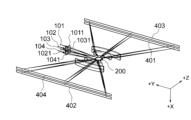
- FIG. 1 is a perspective view of a scanning optical system according to an embodiment of the present invention
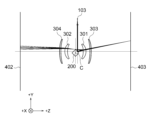
- 1 is a plan view of a scanning optical system according to an embodiment of the present invention
- FIG. 11 is a plan view of a path of a light beam emitted from a third light source in a scanning optical system of a comparative example, which will be described later.
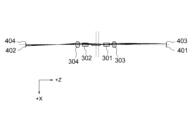
- 11 is a side view of the path of a light beam emitted from a third light source in a scanning optical system of a comparative example described later.
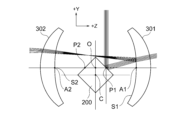
- FIG. 4 is an enlarged view of an area in FIG. 3 including a polygon mirror, a first scanning lens, and a second scanning lens.
- FIG. 1 is a diagram showing a path of a chief ray of a light beam emitted from a first light source projected onto a plane including the x-axis and y-axis.
- 1 is a diagram showing the passing positions of a light beam emitted from a first light source and a light beam emitted from a third light source in a cross section perpendicular to the z-axis including point A1.
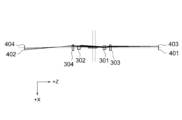
- FIG. FIG. 11 is a plan view of the path of a light beam emitted from a third light source in a scanning optical system of an embodiment described later.
- 1 is a side view of the path of a light beam emitted from a third light source 103 in a scanning optical system of an embodiment described later.
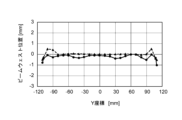
- 4A and 4B are diagrams showing beam waist positions in the main scanning direction (y-axis direction) and the sub-scanning direction (x-axis direction) of the scanning optical system of the embodiment.
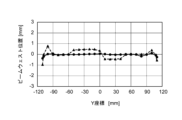
- 11A and 11B are diagrams illustrating beam waist positions in the main scanning direction (y-axis direction) and the sub-scanning direction (x-axis direction) of a scanning optical system of a comparative example.
- FIG. 1 is a perspective view of a scanning optical system according to one embodiment of the present invention.
- FIG. 2 is a plan view of a scanning optical system according to one embodiment of the present invention.
- the scanning optical system of the present invention performs scanning on multiple scanning surfaces by making multiple light beams incident on one polygon mirror.
- the first scanning optical system includes a first light source 101, a first aperture, a first incident optical system element 1011, a polygon mirror 200, a first scanning lens 301, and a third scanning lens 303.
- the second scanning optical system includes a second light source 102, a second aperture, a second incident optical system element 1021, a polygon mirror 200, a second scanning lens 302, and a fourth scanning lens 304.
- the third scanning optical system includes a third light source 103, a third aperture, a third incident optical system element 1031, a polygon mirror 200, a first scanning lens 301, and a third scanning lens 303.
- the fourth scanning optical system includes a fourth light source 104, a fourth aperture, a fourth incident optical system element 1041, a polygon mirror 200, a second scanning lens 302, and a fourth scanning lens 304. That is, the polygon mirror 200 is shared by the first to fourth scanning optical systems, the first scanning lens 301 and the third scanning lens 303 are shared by the first and third scanning optical systems, and the second scanning lens 302 and the fourth scanning lens 304 are shared by the second and fourth scanning optical systems.
- the x-axis is defined as the direction of the rotation axis of the polygon mirror 200
- the y-axis is defined as the scanning direction of the light beam
- the z-axis is defined as being perpendicular to the x-axis and y-axis.
- the directions of the x-axis, y-axis, and z-axis are as shown in Figures 1 and 2.
- the direction of the y-axis is also called the main scanning direction
- the direction of the x-axis is also called the sub-scanning direction.
- the light beam emitted from the first light source 101 passes through the first incident optical system element 1011 and the first aperture, is reflected by the surface of the polygon mirror 200, passes through the first scanning lens 301 and the third scanning lens 303, and is then focused on the scanning surface 401.
- the light beam emitted from the second light source 102 passes through the second incident optical system element 1021 and the second aperture, is reflected by the surface of the polygon mirror 200, passes through the second scanning lens 302 and the fourth scanning lens 304, and is then focused on the scanning surface 402.
- the light beam emitted from the third light source 103 passes through the third incident optical system element 1031 and the third aperture, is reflected by the surface of the polygon mirror 200, passes through the first scanning lens 301 and the third scanning lens 303, and is then focused on the scanning surface 403.
- the light beam emitted from the fourth light source 104 passes through the fourth incident optical system element 1041 and the fourth aperture, is reflected by the surface of the polygon mirror 200, passes through the second scanning lens 302 and the fourth scanning lens 304, and is then focused on the scanning surface 404.
- Each scanning optical system is configured so that the light beam emitted from the light source is almost focused at the reflection point on the surface of the polygon mirror 200 in the x-axis direction when it reaches the scanning surface, and becomes a focused light beam after passing through the incident optical system element in the y-axis direction when it reaches the scanning surface.
- the incident optical system element is an anamorphic element (anamorphic lens) whose focal length in the main scanning direction is different from that in the sub-scanning direction.
- the portion from the light source to the polygon mirror is called the incident optical system
- the portion from the polygon mirror to the scanning surface is called the imaging optical system.
- the cross section of the polygon mirror 200 perpendicular to the x-axis is a square, but in other embodiments, the cross section of the polygon mirror perpendicular to the x-axis may be a hexagon, octagon, etc.
- the present invention is applicable to compact scanning optical systems in which the lateral magnification in the sub-scanning direction from the reflection point of the polygon mirror to the scanning surface is in the range of 2 to 3, and the effective scanning width on the scanning surface is 230 millimeters or less.
- FIG. 3 is a plan view of the path of the light beam emitted from the third light source 103 of the scanning optical system of the comparative example described later.
- FIG. 3 shows a plane parallel to the y-axis and z-axis. Note that the reference numerals of the elements such as the light source of the comparative example are the same as those of the embodiment shown in FIGS. 1 and 2.
- FIG. 4 is a side view of the path of the light beam emitted from the third light source 103 of the scanning optical system of the comparative example described later.
- FIG. 4 shows a plane parallel to the x-axis and z-axis.
- the light beam emitted from the third light source 103 passes through the third incident optical element 1031, is reflected by the surface of the polygon mirror 200, and is focused on the scanning surface 401 after passing through the first scanning lens 301 and the third scanning lens 303.
- a part of the light beam is reflected at the incident surface of the first scanning lens 301, and reaches the scanning surface 402 as stray light after passing through the second scanning lens 302 and the fourth scanning lens 304.
- the entire light beam reflected at the incident surface of the first scanning lens 301 reaches the scanning surface 402 as stray light after passing through the second scanning lens 302 and the fourth scanning lens 304.
- FIG. 5 is an enlarged view of the area including the polygon mirror 200, the first scanning lens 301, and the second scanning lens 302 in FIG. 2.
- the vertex of the incident side of the first scanning lens 301 is A1
- the vertex of the incident side of the second scanning lens 302 is A2
- the midpoint of the line segment connecting points A1 and A2 is point O.
- the first scanning lens 301 and the second scanning lens 302 are arranged so that the straight line connecting points A1 and A2 is in the z-axis direction.
- the deflection reference point of the light beam from the first light source 101 is P1
- the deflection reference point of the light beam from the second light source 102 is P2.
- the deflection reference point refers to the reflection point when the straight line projected onto a plane including the y-axis and z-axis of the light beam after the main ray of the light beam reaching the deflector (polygon mirror) from the light source is reflected by the deflector is perpendicular to the y-axis.
- the deflection reference points P1 and P2 are configured to be located on the straight line connecting points A1 and A2.
- FIG. 6 is a diagram showing the path of the chief ray of the light beam emitted from the first light source 101 projected onto a plane including the x-axis and y-axis.
- the chief ray is depicted so that its direction of travel does not change due to reflection on the incident surface of the first scanning lens 301.
- the distance in the z-axis direction between points P1 and A1 is L1
- the distance in the z-axis direction between points P2 and A2 is L2
- the distance in the z-axis direction between points P1 and P2 is Lp12.
- the acute angle that the straight line formed with the y-axis when the chief ray of the light beam reaching the polygon mirror 200 from the first light source 101 is projected onto a plane including the x-axis and y-axis is ⁇ 1, and the thickness in the x-axis direction of the second scanning lens 302 is h2.
- the coordinates of the positions of the incident surfaces of the first scanning lens 301 and the second scanning lens 302 have a difference in y-coordinate from the coordinates of the positions of the incident surfaces on a line that passes through point O and is parallel to the z-axis. In FIG. 6, the difference is ignored.
- ⁇ 2 be the acute angle that a line formed by projecting the chief ray of the light beam reaching polygon mirror 200 from the second light source 102 onto a plane including the x-axis and y-axis and the y-axis
- ⁇ 3 be the acute angle that a line formed by projecting the chief ray of the light beam reaching polygon mirror 200 from the third light source 103 onto a plane including the x-axis and y-axis and the y-axis
- ⁇ 4 be the acute angle that a line formed by projecting the chief ray of the light beam reaching polygon mirror 200 from the fourth light source 104 onto the plane including the x-axis and y-axis and the y-axis
- h1 be the thickness in the x-axis direction
- FIG. 7 is a diagram showing the passing positions of the light beam emitted from the first light source 101 and the light beam emitted from the third light source 103 in a cross section perpendicular to the z-axis including point A1.
- the horizontal axis of FIG. 7 indicates the coordinate in the y-axis direction, and the vertical axis of FIG. 7 indicates the coordinate in the z-axis direction.
- the unit of length is millimeters.
- Three dashed lines indicate the passing positions of the light beam emitted from the first light source 101.
- Three dashed lines indicate the passing positions of the light beam emitted from the third light source 103.
- the three lines indicate the passing positions of the principal ray passing through the center of the aperture (aperture stop) and the two rays passing through the two vertices on the diagonal line of the aperture stop.
- the length in the x-axis direction of the smallest rectangle including all the passing positions is the effective diameter, which is represented by AX1.
- the margin amount on one side of the effective diameter is represented by B.
- the thickness h1 in the x-axis direction of the first scanning lens 301 can be expressed by the following formula. If the length in the x-axis direction of the smallest rectangle including all the passing positions is taken as the effective diameter and represented as AX2, the thickness h2 of the second scanning lens 302 in the x-axis direction can also be expressed by the following equation.
- the value of the margin B on one side of the effective diameter is preferably set to 2 millimeters or more, taking into consideration the inter-surface decentering amount of the scanning lens, the amount of installation position error, the installation adjustment range, and the like.
- the thickness h2 of the second scanning lens 302 in the x-axis direction is set to the above value, it is necessary to increase the distance L1 in the z-axis direction between points P1 and A1 and the distance L2 in the z-axis direction between points P2 and A2 to appropriate values so that equation (1) is satisfied.
- FIG. 8 is a plan view of the path of the light beam emitted from the third light source 103 in the scanning optical system of an embodiment described later.
- FIG. 8 shows a plane parallel to the y-axis and z-axis.
- FIG. 9 is a side view of the path of the light beam emitted from the third light source 103 in the scanning optical system of an embodiment described later.
- FIG. 9 shows a plane parallel to the x-axis and z-axis.
- a portion of the light beam reflected at the incident surface of the first scanning lens 301 does not enter the incident surface of the second scanning lens 302, but the rest enters the incident surface of the second scanning lens 302 and finally reaches the scanning surface 2.
- 56.4 percent of the light beam reflected at the incident surface of the first scanning lens 301 enters the incident surface of the second scanning lens 302.
- the incidence surface of the first scanning lens 301 is concave, and as the absolute value of the curvature increases (the absolute value of the radius of curvature decreases), the divergence of the light beam reflected at the incidence surface of the first scanning lens 301 decreases. As a result, the illuminance of the light beam at the scanning surface 2 increases, and the effect of stray light becomes greater. Therefore, when the incidence surfaces of the first scanning lens 301 and the second scanning lens 302 are concave, it is preferable that the absolute value of the radius of curvature is equal to or greater than a certain value.
- the incidence surfaces of the first scanning lens 301 and the second scanning lens 302 are not concave, with the average absolute value of the radius of curvature of the xz cross section of the area where the light beam is reflected being 200 millimeters or less.
- the influence of the illuminance of stray light on another scanning surface arranged on the opposite side of the polygon mirror will be within an acceptable range. If the following formula is not satisfied, the influence of the illuminance of stray light on the scanning surface will be large, and streaks and other printing defects may occur.
- the material of the scanning lens is polycycloolefin resin, and the refractive index is 1.503.
- the material of the incident optical system element is polycycloolefin resin, and the refractive index is 1.528.
- the first scanning lens 301 and the second scanning lens 302 have the same shape, and the first scanning lens 301 and the second scanning lens 302 are parallel to the x-axis and the y-axis of the optical system and are arranged symmetrically with respect to a plane including point O.
- the third scanning lens 303 and the fourth scanning lens 304 have the same shape, and the third scanning lens 303 and the fourth scanning lens 304 are parallel to the x-axis and the y-axis of the optical system and are arranged symmetrically with respect to a plane including point O.
- the first light source 101 and the second light source are parallel to the x-axis and the y-axis of the optical system and are arranged symmetrically with respect to a plane including point O
- the third light source 103 and the fourth light source 104 are parallel to the x-axis and the y-axis of the optical system and are arranged symmetrically with respect to a plane including point O.
- the light source is a laser diode.
- each surface of each scanning lens is explained below.
- the coordinates expressing each surface, when the first to fourth scanning lenses are arranged, are as follows: the straight line connecting points A1 and A2 is the z-axis, the intersection of the z-axis and each surface is the origin, the straight line passing through the origin and parallel to the x-axis of the optical system is the x-axis, and the straight line passing through the origin and parallel to the y-axis of the optical system is the y-axis.
- the direction of the z-axis is the direction in which light travels. Therefore, the z-coordinate of the concave entrance surface and convex exit surface is zero or negative, and the z-coordinate of the convex entrance surface and concave exit surface is zero or positive.
- the pair of lenses farther from point O in the embodiment and comparative example i.e., the third scanning lens and the fourth scanning lens, are lenses having two entrance surfaces and two exit surfaces stacked in the x-axis direction.
- the shapes of the entrance surface and the exit surface of the third scanning lens and the fourth scanning lens can be expressed by the following formulas. however, however, y: Main scanning direction coordinate x: Sub-scanning direction coordinate z: sag zm: Sag in the main scanning direction zs: Sub-scanning direction sag ky: Conic coefficient in the main scanning direction
- Ry Radius of curvature in main scanning section
- h Generatrix curvature function
- rx(y) Radius of curvature at the main scanning coordinate y of the cross section in the sub-scanning direction
- rx(0) Radius of curvature on the optical axis in the cross section in the sub-scanning direction
- Example Table 1 is a table showing the numerical data of the scanning optical system of the example.
- the effective scanning width W means the length of the scanning range on the scanning surface in the y-axis direction
- the system focal length f means the focal length of the optical system formed by the incident optical system element and two types of scanning lenses.
- ⁇ and ⁇ // mean the divergence angles in the direction perpendicular and parallel to the semiconductor stacking surface, respectively.
- ⁇ is arranged in the x-axis direction.
- the first and second scanning lenses are described as LensB
- the third and fourth scanning lenses are described as LensB.
- the deflector refers to a polygon mirror.
- the "center coordinates of the deflector” refers to the (Y, Z) coordinates of the central axis of the deflector (point C in FIG. 5) when the (Y, Z) coordinates of the deflection reference point (point A1 in FIG. 5) are used as a reference.
- the "principal angle of incidence to the deflector” refers to the acute angle formed by the straight line, which is obtained by projecting the principal ray of the light beam reaching the deflector from the light source onto a plane including the y-axis and the z-axis, with the z-axis.
- the "secondary angle of incidence to the deflector” refers to the acute angle formed by the straight line, which is obtained by projecting the principal ray of the light beam reaching the deflector from the light source onto a plane including the x-axis and the y-axis, with the y-axis.
- the "secondary angle of incidence ⁇ in to the deflector” corresponds to the above-mentioned ⁇ 1- ⁇ 4.
- Table 2 shows the coefficients of equation (3) that represent the shapes of the surfaces of the first scanning lens 301 and the second scanning lens 302.
- the unit of length in Table 2 is millimeters.
- Table 3 shows the coefficients of equation (4) that represent the shapes of the surfaces of the third scanning lens 303 and the fourth scanning lens 304.
- the unit of length in Table 3 is millimeters.
- the lateral magnification in the sub-scanning direction from the deflection reference point of the scanning optical system to the scanning surface is 2.90.
- the focal length of the incident optical element in the main scanning direction is 20.0 millimeters.
- the main scanning direction of the light beam means the main scanning direction (y-axis direction) when the light beam reaches the scanning surface.
- FIG. 10 is a diagram showing the beam waist position in the main scanning direction (y-axis direction) and sub-scanning direction (x-axis direction) of the scanning optical system of the embodiment.
- the beam waist position means the position where the diameter of the light beam is the smallest.
- the horizontal axis of FIG. 10 indicates the coordinate of the y-axis.
- the unit is millimeters.
- the right side is the light source side.
- the vertical axis of FIG. 10 indicates the beam waist position.
- the unit is millimeters. 0 on the vertical axis indicates that the beam waist position is on the scanning surface.
- -1 millimeter on the vertical axis indicates that the beam waist position is shifted 1 millimeter from the scanning surface toward the polygon mirror
- 1 millimeter on the vertical axis indicates that the beam waist position is shifted 1 millimeter from the scanning surface to the opposite side of the polygon mirror.
- the solid line in FIG. 10 indicates the beam waist position in the main scanning direction (y-axis direction), and the dashed line in FIG. 10 indicates the beam waist position in the sub-scanning direction (x-axis direction).
- the beam waist position is in the range of ⁇ 1 millimeter, and the light beam is focused near the scanning surface.
- Comparative Example Table 4 is a table showing numerical data of the scanning optical system of the comparative example.
- Table 5 shows the coefficients of equation (3) that represent the shapes of the surfaces of the first scanning lens 301 and the second scanning lens 302.
- the unit of length in Table 5 is millimeters.
- Table 6 shows the coefficients of equation (4) that represent the shapes of the surfaces of the third scanning lens 303 and the fourth scanning lens 304.
- the unit of length in Table 6 is millimeters.
- the lateral magnification in the sub-scanning direction from the deflection reference point of the scanning optical system to the scanning surface is 2.73.
- the focal length of the incident optical element in the main scanning direction is 20.0 millimeters.
- FIG. 11 is a diagram showing the beam waist positions in the main scanning direction (y-axis direction) and sub-scanning direction (x-axis direction) of the scanning optical system of the comparative example.
- the horizontal axis of FIG. 11 indicates the y-axis coordinate.
- the unit is millimeters.
- the right side is the light source side.
- the vertical axis of FIG. 11 indicates the beam waist position.
- the unit is millimeters. 0 on the vertical axis indicates that the beam waist position is on the scanning surface.
- -1 millimeter on the vertical axis indicates that the beam waist position is shifted 1 millimeter from the scanning surface toward the polygon mirror
- 1 millimeter on the vertical axis indicates that the beam waist position is shifted 1 millimeter from the scanning surface to the opposite side of the polygon mirror.
- the solid line in FIG. 11 indicates the beam waist position in the main scanning direction (y-axis direction), and the dashed line in FIG. 11 indicates the beam waist position in the sub-scanning direction (x-axis direction).
- the beam waist position is in the range of ⁇ 1 millimeter, and the light beam is focused near the scanning surface.
- formula (2)-(2)''' is satisfied, and the illuminance on the scanning surface of the light beam reflected at the entrance surfaces of the first and second scanning lenses is small and does not affect printing.
- formula (2)-(2)''' is not satisfied, and the illuminance on the scanning surface of the light beam reflected at the entrance surfaces of the first and second scanning lenses is large, and streaks and other printing defects may occur in the print.
Landscapes
- Physics & Mathematics (AREA)
- General Physics & Mathematics (AREA)
- Optics & Photonics (AREA)
- Engineering & Computer Science (AREA)
- Multimedia (AREA)
- Signal Processing (AREA)
- Mechanical Optical Scanning Systems (AREA)
- Facsimile Scanning Arrangements (AREA)
- Lenses (AREA)
Priority Applications (5)
| Application Number | Priority Date | Filing Date | Title |
|---|---|---|---|
| KR1020237038628A KR102869199B1 (ko) | 2022-09-29 | 2022-09-29 | 주사 광학계 |
| PCT/JP2022/036445 WO2024069854A1 (ja) | 2022-09-29 | 2022-09-29 | 走査光学系 |
| CN202280035098.7A CN118119873A (zh) | 2022-09-29 | 2022-09-29 | 扫描光学系统 |
| JP2023566860A JP7785379B2 (ja) | 2022-09-29 | 2022-09-29 | 走査光学系 |
| US19/018,511 US20250147304A1 (en) | 2022-09-29 | 2025-01-13 | Optical scanning system |
Applications Claiming Priority (1)
| Application Number | Priority Date | Filing Date | Title |
|---|---|---|---|
| PCT/JP2022/036445 WO2024069854A1 (ja) | 2022-09-29 | 2022-09-29 | 走査光学系 |
Related Child Applications (1)
| Application Number | Title | Priority Date | Filing Date |
|---|---|---|---|
| US19/018,511 Continuation US20250147304A1 (en) | 2022-09-29 | 2025-01-13 | Optical scanning system |
Publications (1)
| Publication Number | Publication Date |
|---|---|
| WO2024069854A1 true WO2024069854A1 (ja) | 2024-04-04 |
Family
ID=90476790
Family Applications (1)
| Application Number | Title | Priority Date | Filing Date |
|---|---|---|---|
| PCT/JP2022/036445 Ceased WO2024069854A1 (ja) | 2022-09-29 | 2022-09-29 | 走査光学系 |
Country Status (5)
| Country | Link |
|---|---|
| US (1) | US20250147304A1 (https=) |
| JP (1) | JP7785379B2 (https=) |
| KR (1) | KR102869199B1 (https=) |
| CN (1) | CN118119873A (https=) |
| WO (1) | WO2024069854A1 (https=) |
Citations (4)
| Publication number | Priority date | Publication date | Assignee | Title |
|---|---|---|---|---|
| JP2008209675A (ja) * | 2007-02-27 | 2008-09-11 | Ricoh Co Ltd | 光走査装置及び画像形成装置 |
| JP2013020045A (ja) * | 2011-07-11 | 2013-01-31 | Ricoh Co Ltd | 光走査装置および画像形成装置 |
| JP2014048313A (ja) * | 2012-08-29 | 2014-03-17 | Ricoh Co Ltd | 光走査装置及び画像形成装置 |
| JP2016085433A (ja) * | 2014-10-29 | 2016-05-19 | キヤノン株式会社 | 光走査装置及びそれを用いた画像形成装置 |
Family Cites Families (3)
| Publication number | Priority date | Publication date | Assignee | Title |
|---|---|---|---|---|
| JP6147067B2 (ja) | 2013-04-15 | 2017-06-14 | キヤノン株式会社 | 光走査装置及びそれを用いた画像形成装置 |
| JP6212528B2 (ja) * | 2015-11-06 | 2017-10-11 | キヤノン株式会社 | 光走査装置 |
| CN112236707B (zh) * | 2019-03-14 | 2022-06-21 | 纳卢克斯株式会社 | 扫描光学系统和扫描透镜 |
-
2022
- 2022-09-29 KR KR1020237038628A patent/KR102869199B1/ko active Active
- 2022-09-29 WO PCT/JP2022/036445 patent/WO2024069854A1/ja not_active Ceased
- 2022-09-29 JP JP2023566860A patent/JP7785379B2/ja active Active
- 2022-09-29 CN CN202280035098.7A patent/CN118119873A/zh active Pending
-
2025
- 2025-01-13 US US19/018,511 patent/US20250147304A1/en active Pending
Patent Citations (4)
| Publication number | Priority date | Publication date | Assignee | Title |
|---|---|---|---|---|
| JP2008209675A (ja) * | 2007-02-27 | 2008-09-11 | Ricoh Co Ltd | 光走査装置及び画像形成装置 |
| JP2013020045A (ja) * | 2011-07-11 | 2013-01-31 | Ricoh Co Ltd | 光走査装置および画像形成装置 |
| JP2014048313A (ja) * | 2012-08-29 | 2014-03-17 | Ricoh Co Ltd | 光走査装置及び画像形成装置 |
| JP2016085433A (ja) * | 2014-10-29 | 2016-05-19 | キヤノン株式会社 | 光走査装置及びそれを用いた画像形成装置 |
Also Published As
| Publication number | Publication date |
|---|---|
| KR102869199B1 (ko) | 2025-10-14 |
| US20250147304A1 (en) | 2025-05-08 |
| KR20240046420A (ko) | 2024-04-09 |
| JP7785379B2 (ja) | 2025-12-15 |
| CN118119873A (zh) | 2024-05-31 |
| JPWO2024069854A1 (https=) | 2024-04-04 |
Similar Documents
| Publication | Publication Date | Title |
|---|---|---|
| JP3072061B2 (ja) | 光走査装置 | |
| US6822671B2 (en) | Light scanning apparatus having stable performance with changes in temperature and wavelength | |
| KR20100009543A (ko) | 프로젝션 노광 장치 | |
| CN112219148B (zh) | 光学系统、以及包括该光学系统的成像装置和成像系统 | |
| JP2017090593A (ja) | 光走査装置 | |
| JP7785379B2 (ja) | 走査光学系 | |
| US10228548B2 (en) | Catadioptric photographic lens | |
| JP6199082B2 (ja) | 投射光学系 | |
| US8203774B2 (en) | Optical scanning device | |
| JP2007140418A (ja) | 走査装置及び走査光学系 | |
| US20080158518A1 (en) | Rear projector | |
| JP6986312B2 (ja) | 走査光学系及び走査レンズ | |
| JPWO2024069854A5 (https=) | ||
| JP6547101B2 (ja) | 走査光学系及び走査レンズ | |
| JP7629252B2 (ja) | 走査光学系 | |
| CN115685550A (zh) | 虚像显示装置 | |
| JP7773264B2 (ja) | 走査光学系 | |
| JPH1054952A (ja) | 走査光学系 | |
| US11860357B2 (en) | Method for manufacturing optical scanning systems | |
| JP2006284564A (ja) | 光電式エンコーダ | |
| JP3554421B2 (ja) | 走査光学系 | |
| WO2021038949A1 (ja) | 走査光学系の製造方法 | |
| JPH0634900A (ja) | 走査光学系 | |
| JP5499258B1 (ja) | 走査光学系 | |
| JPH05323222A (ja) | 走査光学系 |
Legal Events
| Date | Code | Title | Description |
|---|---|---|---|
| ENP | Entry into the national phase |
Ref document number: 2023566860 Country of ref document: JP Kind code of ref document: A |
|
| WWE | Wipo information: entry into national phase |
Ref document number: 202280035098.7 Country of ref document: CN |
|
| 121 | Ep: the epo has been informed by wipo that ep was designated in this application |
Ref document number: 22960914 Country of ref document: EP Kind code of ref document: A1 |
|
| NENP | Non-entry into the national phase |
Ref country code: DE |
|
| 122 | Ep: pct application non-entry in european phase |
Ref document number: 22960914 Country of ref document: EP Kind code of ref document: A1 |