WO2024062523A1 - 電動機の固定子 - Google Patents
電動機の固定子 Download PDFInfo
- Publication number
- WO2024062523A1 WO2024062523A1 PCT/JP2022/034981 JP2022034981W WO2024062523A1 WO 2024062523 A1 WO2024062523 A1 WO 2024062523A1 JP 2022034981 W JP2022034981 W JP 2022034981W WO 2024062523 A1 WO2024062523 A1 WO 2024062523A1
- Authority
- WO
- WIPO (PCT)
- Prior art keywords
- resin
- core
- stator
- housing
- coils
- Prior art date
- Legal status (The legal status is an assumption and is not a legal conclusion. Google has not performed a legal analysis and makes no representation as to the accuracy of the status listed.)
- Ceased
Links
Images




Classifications
-
- H—ELECTRICITY
- H02—GENERATION; CONVERSION OR DISTRIBUTION OF ELECTRIC POWER
- H02K—DYNAMO-ELECTRIC MACHINES
- H02K15/00—Processes or apparatus specially adapted for manufacturing, assembling, maintaining or repairing of dynamo-electric machines
- H02K15/12—Impregnating, moulding insulation, heating or drying of windings, stators, rotors or machines
- H02K15/121—Impregnating, moulding insulation, heating or drying of windings, stators, rotors or machines of cores
-
- H—ELECTRICITY
- H02—GENERATION; CONVERSION OR DISTRIBUTION OF ELECTRIC POWER
- H02K—DYNAMO-ELECTRIC MACHINES
- H02K5/00—Casings; Enclosures; Supports
- H02K5/04—Casings or enclosures characterised by the shape, form or construction thereof
- H02K5/08—Insulating casings
Definitions
- This disclosure relates to a stator for an electric motor.
- the stator of an electric motor is molded with resin for the purpose of waterproofing etc. (for example, Patent Document 1).
- Mold is a construction method in which resin is injected into the mold after the insert is loaded into the mold. That is, after the stator is loaded into the mold, resin is injected into the mold. As a result, the outside of the stator is covered with resin, and the area around the coil is filled with resin. In order to downsize the molded stator, it is necessary to reduce the thickness of the resin covering the outside of the stator.
- the stator of the present disclosure includes a housing including a core, a plurality of coils wound around the core, at least two struts that abut end faces of the core, and a bridge that connects the at least two struts to each other, and a core. , a plurality of coils and a resin covering the housing.
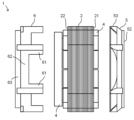
- FIG. 3 is a plan view of the stator before molding.
- FIG. 3 is an exploded plan view of the stator before molding.
- FIG. 3 is a right side view of the stator before molding.
- FIG. 3 is a left side view of the stator before molding.
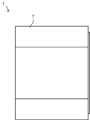
- FIG. 3 is a plan view of the stator after molding.
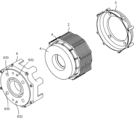
- FIG. 3 is an exploded perspective view of the core.
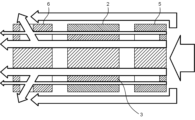
- FIG. It is a schematic diagram for explaining the flow of resin during molding.
- FIG. 13 is a perspective view of a stator according to another embodiment.
- FIG. 1A is a plan view of the stator before molding.
- FIG. 1B is an exploded plan view of the stator before molding.
- FIG. 1C is a right side view of the stator before molding.
- FIG. 1D is a left side view of the stator before molding.
- FIG. 2 is a plan view of the stator after molding.
- 3A and 3B are exploded perspective views of the core.
- the stator 1 is a member that constitutes an electric motor.
- the stator 1 generates magnetic force that rotates a rotor (not shown).
- the stator 1 includes a core 2, a plurality of coils 3, an insulating section 4, a first housing 5, a second housing 6, and a resin 7. Note that at least one of the first housing 5 and the second housing 6 corresponds to a housing described in the claims.
- the core 2 is a component that serves as a path for magnetic flux.
- the core 2 is manufactured by laminating a plurality of plate materials formed by press working or the like.
- the plate material is, for example, an electromagnetic steel plate.
- the core 2 has a core back (not shown) formed in a substantially cylindrical shape and teeth (not shown) extending toward the center from the core back.
- the core 2 has a first end surface 21 and a second end surface 22.
- the first end surface 21 is a surface that constitutes an end portion in a first direction along the central axis of the core 2 .
- the second end surface 22 is a surface that constitutes an end in the second direction along the central axis of the core 2 .
- the second direction is the opposite direction to the first direction. Note that at least one of the first end surface 21 and the second end surface 22 corresponds to an end surface described in the claims.
- the plurality of coils 3 are wound around the teeth of the core 2.
- the plurality of coils 3 are made of copper wire, for example.
- the insulating part 4 is a member interposed between the teeth and the coil 3 to insulate the teeth and the coil 3.
- the insulating section 4 is formed of a predetermined insulating material.
- a printed circuit board (not shown) may be embedded in the insulating section 4.
- a resin hole (not shown) is formed in the insulating part 4 parallel to the central axis of the core 2. may be done.
- the resin holes formed in the insulating part 4 are holes through which the resin 7 passes when the stator 1 is molded. Further, the resin holes formed in the insulating portion 4 are holes that are finally filled with the resin 7 when the stator 1 is molded.
- the first housing 5 is a member that covers at least a portion of the coil 3 wound around the core 2.
- the first housing 5 is attached to the first end surface 21 of the core 2 using, for example, screws or bolts and nuts.
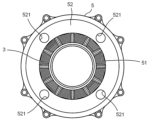
- a center hole 51 is formed in the first housing 5.
- the center hole 51 is a circular through hole centered on the central axis of the core 2 .
- the first housing 5 includes at least an end member 52 and an outer peripheral member 53.
- the end member 52 is a member perpendicular to the central axis of the core 2 .
- the outer peripheral member 53 is, for example, a member that is orthogonal to the end face member 52 and extends toward the first end face 21 of the core 2 .
- the first housing 5 is integrally formed by, for example, casting.
- One or more resin holes 521 are formed in the end member 52 in parallel to the central axis of the core 2.
- the resin hole 521 is a through hole.
- the resin hole 521 is a hole through which the resin 7 passes when the stator 1 is molded. Further, the resin hole 521 is a hole that is finally filled with the resin 7 when the stator 1 is molded.
- the resin holes 521 are formed at positions corresponding to the spaces between the coils 3. Spaces between the coils 3 are spaces between two coils wound around adjacent teeth. In other words, the resin holes 521 are formed so that the resin holes 521 and the spaces between the coils 3 are aligned in a straight line.
- the second housing 6 is a member that covers at least a portion of the coil 3 wound around the core 2.
- the second housing 6 is attached to the second end face 22 of the core 2 using, for example, screws or bolts and nuts.
- the second housing 6 has at least two struts 61, a bridge 62, and an end member 63. At least two struts 61, bridge 62, and end member 63 are integrally molded, for example, by casting.
- At least two struts 61 are members that come into contact with the second end surface 22 of the core 2.
- Each support column 61 extends parallel to the central axis of the core 2 .
- the cross section of each support column 61 may have any shape.
- the cross section is a cross section perpendicular to the central axis of the core 2.
- the bridge 62 is a member that connects at least two support columns 61 to each other. Bridge 62 connects one end of each support column 61 to each other. Here, one end of each support column 61 is an end located on the opposite side of the end that contacts the second end surface 22 of the core 2 .
- a gap is formed between the second end surface 22 of the core 2 and the bridge 62.
- a hole is formed at a position surrounded by the second end surface 22, the two pillars 61, and the bridge 62. This gap or hole allows the resin 7 to pass during molding, as will be described later. Further, this gap is finally filled with resin 7 by molding.
- the end member 63 is a member perpendicular to the central axis of the core 2.
- the end member 63 covers the coil 3 and the insulating section 4.
- a center hole 631 is formed in the end member 63.
- the center hole 631 is a circular through hole centered on the central axis of the core 2 .
- a component mounting hole 632 is formed in the end member 63 around the center hole 631.
- the component mounting hole 632 is, for example, a screw hole. After the stator 1 is molded, various parts are attached to the stator 1 using bolts and the like.
- One or more resin holes 633 are formed in the end member 63 in parallel to the central axis of the core 2.
- the resin hole 633 is a through hole.
- the resin hole 633 is a hole through which the resin 7 passes when the stator 1 is molded. Further, the resin hole 633 is a hole that is finally filled with the resin 7 when the stator 1 is molded.
- the resin 7 covers at least the core 2, coil 3, and housing. That is, the resin 7 covers the stator 1 by molding.
- FIG. 4 is a schematic diagram for explaining the flow of resin 7 during molding.
- the stator 1 is loaded into a mold and molded by an injection molding machine. Specifically, the resin 7 flowing from the injection port (not shown) of the resin 7 collides with the end face member 52 of the first housing 5, or without colliding with the end face member 52, the resin 7 flows out of the outer peripheral member 53. Flows along the sides.
- the resin 7 flowing from the injection port collides with the end face member 52 of the first housing 5, or without colliding with the end face member 52, the resin 7 flows from the center hole 51 of the first housing 5 into the first housing 5. flows towards the inside of the Further, the resin 7 flowing from the injection port flows toward the inside of the first housing 5 from the resin hole 521 formed in the end member 52 of the first housing 5 .
- the resin 7 flowing inside the first housing 5 passes between the coils 3 wound around the core 2.
- the coil 3 means the coil 3 wound around one tooth. Therefore, the space between the coils 3 means a gap that exists between the coils 3 wound around two adjacent teeth.
- a part of the resin 7 that has passed between the coils 3 flows out from the gap formed between the second end surface 22 of the core 2 and the bridge 62 of the second housing 6. Further, the remainder of the resin 7 that has passed between the coils 3 flows toward the inside of the second housing 6. The resin 7 that has flowed toward the inside of the second housing 6 flows out from the resin hole 633 formed in the end member 63 of the second housing 6 . Note that, since a mold is disposed at the center of the stator 1 into which the rotor is assembled, the resin 7 does not flow into this center.
- FIG. 5 is a perspective view of the stator 1 of another embodiment.
- the bridge 62 of the second housing 6 has an inclined surface 622 extending in a direction from an outer surface 621 of the bridge 62 toward the coil 3 .
- the outer surface 621 of the bridge 62 is a surface of the bridge 62 parallel to the central axis of the core 2.
- the inclined surface 622 along the direction toward the coil 3 is a surface formed by bending the outer surface 621 of the bridge 62 by a predetermined angle toward the central axis of the core 2.
- one end of the inclined surface 622 is arranged at the same height as the outer peripheral surface of the core 2. That is, the outer surface 621 of the bridge 62 is formed on the same plane as the outer peripheral surface of the core 2. Note that the same plane does not necessarily have to be exactly the same plane.
- the other end of the inclined surface 622 opposite to the one end is arranged inside the core 2 from the outer peripheral surface of the core 2 .
- the angle of inclination of the inclined surface 622 is, for example, in the range of 10° or more and 45° or less from the outer surface 621 of the bridge 62.
- the angle of the inclined surface 622 may be, for example, 30°.
- the inclined surface 622 formed on the bridge 62 may be a curved surface instead of a flat surface. That is, the inclined surface 622 may have any shape as long as the resin flows smoothly from the gap between the bridge 62 and the core 2 during molding.
- the support column 61 may have an inclined surface 612 extending in a direction from the outer surface 611 of the support column 61 toward the central axis of the core 2.
- the outer surface 611 of the support column 61 is a surface of the support column 61 that is formed on the same plane as the outer surface 621 of the bridge 62.
- the inclined surface 612 extending in the direction toward the central axis of the core 2 is a surface formed by bending the outer surface 611 of the support column 61 by a predetermined angle toward the central axis of the core 2 .
- the angle of inclination of the inclined surface 612 is, for example, in the range of 10° or more and 45° or less from the outer surface 611 of the support column 61.
- the angle of the inclined surface 612 may be, for example, 30°.
- the inclined surface 612 formed on the support column 61 may be a curved surface instead of a flat surface.
- the stator 1 connects a core 2, a plurality of coils 3 wound around the core 2, at least two struts 61 that contact the end surface of the core 2, and at least two struts 61 to each other. and a resin 7 that covers the core 2, the plurality of coils 3, and the housing.
- the resin 7 flows out from the gap formed between the end surface of the core 2 and the bridge 62. As a result, the flow of the resin 7 when the stator 1 is molded is improved. This can prevent molding defects from occurring.
- stator 1 in this embodiment solves such problems.
- a resin hole 633 is formed in the end face member 63 of the housing, and the resin hole 633 is filled with resin 7. That is, when molding the stator 1, the resin 7 passes through the resin holes 633. This further improves the flow of the resin 7 during molding. When the molding is completed, the resin holes 633 are filled with the resin 7.
- the bridge 62 has an inclined surface 622 extending in a direction from an outer surface 621 of the bridge 62 toward the coil 3.
- the support column 61 has an inclined surface 612 extending in a direction from an outer surface 611 of the support column 61 toward the central axis of the core 2 .
- one end of the inclined surface 622 and the inclined surface 612 is arranged at the same height as the outer peripheral surface of the core 2, and the other end opposite to the one end is arranged inside the outer peripheral surface of the core 2. Therefore, the resin 7 flowing out from the gap between the second end surface 22 of the core 2 and the bridge 62 smoothly merges with the resin 7 flowing along the outer peripheral surface of the core 2. In other words, the flow of the resin 7 during molding is improved.
- a housing comprising: a core; a plurality of coils wound around the core; at least two struts contacting end surfaces of the core; and a bridge connecting the at least two struts to each other;
- a stator comprising a coil and a resin covering the housing.
- Additional note [2] The stator according to appendix [1], wherein a resin hole is formed in an end surface of the housing, and the resin hole is filled with the resin.
- Additional note [3] The stator according to appendix [1] or [2], wherein the resin holes are formed at positions corresponding to between the coils of the plurality of coils.
- stator according to any one of appendixes [1] to [3], wherein the support column has an inclined surface extending in a direction from an outer surface of the support column toward a central axis of the core. Additional note [5] The stator according to any one of appendices [1] to [4], wherein the bridge has an inclined surface extending in a direction from an outer surface of the bridge toward the plurality of coils. Additional note [6] According to appendix [4] or [5], one end of the inclined surface is arranged at the same height as the outer peripheral surface of the core, and the other end opposite to the one end is arranged inside the outer peripheral surface of the core. Stator listed.
Landscapes
- Engineering & Computer Science (AREA)
- Power Engineering (AREA)
- Manufacturing & Machinery (AREA)
- Iron Core Of Rotating Electric Machines (AREA)
- Insulation, Fastening Of Motor, Generator Windings (AREA)
- Motor Or Generator Frames (AREA)
Priority Applications (4)
| Application Number | Priority Date | Filing Date | Title |
|---|---|---|---|
| CN202280100013.9A CN119866589A (zh) | 2022-09-20 | 2022-09-20 | 电动机的定子 |
| PCT/JP2022/034981 WO2024062523A1 (ja) | 2022-09-20 | 2022-09-20 | 電動機の固定子 |
| DE112022007425.6T DE112022007425T5 (de) | 2022-09-20 | 2022-09-20 | Stator für einen elektromotor |
| JP2024547966A JPWO2024062523A1 (https=) | 2022-09-20 | 2022-09-20 |
Applications Claiming Priority (1)
| Application Number | Priority Date | Filing Date | Title |
|---|---|---|---|
| PCT/JP2022/034981 WO2024062523A1 (ja) | 2022-09-20 | 2022-09-20 | 電動機の固定子 |
Publications (1)
| Publication Number | Publication Date |
|---|---|
| WO2024062523A1 true WO2024062523A1 (ja) | 2024-03-28 |
Family
ID=90453983
Family Applications (1)
| Application Number | Title | Priority Date | Filing Date |
|---|---|---|---|
| PCT/JP2022/034981 Ceased WO2024062523A1 (ja) | 2022-09-20 | 2022-09-20 | 電動機の固定子 |
Country Status (4)
| Country | Link |
|---|---|
| JP (1) | JPWO2024062523A1 (https=) |
| CN (1) | CN119866589A (https=) |
| DE (1) | DE112022007425T5 (https=) |
| WO (1) | WO2024062523A1 (https=) |
Citations (3)
| Publication number | Priority date | Publication date | Assignee | Title |
|---|---|---|---|---|
| JP2007228673A (ja) * | 2006-02-21 | 2007-09-06 | Nsk Ltd | 電動パワーステアリング装置 |
| JP2010104220A (ja) * | 2008-09-29 | 2010-05-06 | Sanyo Denki Co Ltd | モールドモータ |
| JP2017104011A (ja) * | 2017-02-10 | 2017-06-08 | 日本電産株式会社 | モータ |
-
2022
- 2022-09-20 JP JP2024547966A patent/JPWO2024062523A1/ja active Pending
- 2022-09-20 WO PCT/JP2022/034981 patent/WO2024062523A1/ja not_active Ceased
- 2022-09-20 DE DE112022007425.6T patent/DE112022007425T5/de active Pending
- 2022-09-20 CN CN202280100013.9A patent/CN119866589A/zh active Pending
Patent Citations (3)
| Publication number | Priority date | Publication date | Assignee | Title |
|---|---|---|---|---|
| JP2007228673A (ja) * | 2006-02-21 | 2007-09-06 | Nsk Ltd | 電動パワーステアリング装置 |
| JP2010104220A (ja) * | 2008-09-29 | 2010-05-06 | Sanyo Denki Co Ltd | モールドモータ |
| JP2017104011A (ja) * | 2017-02-10 | 2017-06-08 | 日本電産株式会社 | モータ |
Also Published As
| Publication number | Publication date |
|---|---|
| JPWO2024062523A1 (https=) | 2024-03-28 |
| CN119866589A (zh) | 2025-04-22 |
| DE112022007425T5 (de) | 2025-04-10 |
Similar Documents
| Publication | Publication Date | Title |
|---|---|---|
| JP5731338B2 (ja) | 回転電機 | |
| JP6063262B2 (ja) | 電動機、電動機を用いたポンプ装置およびステータ | |
| KR102644795B1 (ko) | 모터 | |
| TWI338431B (https=) | ||
| JP2006101614A (ja) | モータおよびブスバー | |
| JP6517595B2 (ja) | ポンプ装置 | |
| JP2010263675A (ja) | 電機子 | |
| JP6818900B2 (ja) | 回転電機の固定子および固定子の製造方法 | |
| JP5718396B2 (ja) | バッテリターミナル | |
| WO2024062523A1 (ja) | 電動機の固定子 | |
| JP5403007B2 (ja) | リニアモータの電機子およびリニアモータ | |
| JP5755890B2 (ja) | リニアモータ及びその製造方法 | |
| CN204481596U (zh) | 绝缘体及旋转电机 | |
| JP2007209178A (ja) | ロータユニット及びロータユニットの生産方法 | |
| US11201513B2 (en) | Rotor and motor | |
| US11108288B2 (en) | Rotor and motor | |
| JP6672838B2 (ja) | 電動機 | |
| KR101012576B1 (ko) | 편평형 로터 및 그 로터를 갖춘 모터 | |
| KR102694119B1 (ko) | 모터 | |
| JP5626159B2 (ja) | 車両用回転電機 | |
| WO2013027424A1 (ja) | 電流検出装置 | |
| CN110383646A (zh) | 供电单元和旋转电机 | |
| KR20210077405A (ko) | 모터 | |
| WO2021200051A1 (ja) | モータ | |
| JP6659169B2 (ja) | ロータおよび回転電機 |
Legal Events
| Date | Code | Title | Description |
|---|---|---|---|
| 121 | Ep: the epo has been informed by wipo that ep was designated in this application |
Ref document number: 22959487 Country of ref document: EP Kind code of ref document: A1 |
|
| WWE | Wipo information: entry into national phase |
Ref document number: 2024547966 Country of ref document: JP |
|
| WWE | Wipo information: entry into national phase |
Ref document number: 112022007425 Country of ref document: DE |
|
| WWE | Wipo information: entry into national phase |
Ref document number: 202280100013.9 Country of ref document: CN |
|
| WWP | Wipo information: published in national office |
Ref document number: 112022007425 Country of ref document: DE |
|
| WWP | Wipo information: published in national office |
Ref document number: 202280100013.9 Country of ref document: CN |
|
| 122 | Ep: pct application non-entry in european phase |
Ref document number: 22959487 Country of ref document: EP Kind code of ref document: A1 |