WO2024057977A1 - 木目調加飾フィルム - Google Patents
木目調加飾フィルム Download PDFInfo
- Publication number
- WO2024057977A1 WO2024057977A1 PCT/JP2023/032120 JP2023032120W WO2024057977A1 WO 2024057977 A1 WO2024057977 A1 WO 2024057977A1 JP 2023032120 W JP2023032120 W JP 2023032120W WO 2024057977 A1 WO2024057977 A1 WO 2024057977A1
- Authority
- WO
- WIPO (PCT)
- Prior art keywords
- printing
- film
- matte
- thermoplastic resin
- wood grain
- Prior art date
- Legal status (The legal status is an assumption and is not a legal conclusion. Google has not performed a legal analysis and makes no representation as to the accuracy of the status listed.)
- Ceased
Links
Images


Classifications
-
- B—PERFORMING OPERATIONS; TRANSPORTING
- B32—LAYERED PRODUCTS
- B32B—LAYERED PRODUCTS, i.e. PRODUCTS BUILT-UP OF STRATA OF FLAT OR NON-FLAT, e.g. CELLULAR OR HONEYCOMB, FORM
- B32B27/00—Layered products comprising a layer of synthetic resin
-
- B—PERFORMING OPERATIONS; TRANSPORTING
- B32—LAYERED PRODUCTS
- B32B—LAYERED PRODUCTS, i.e. PRODUCTS BUILT-UP OF STRATA OF FLAT OR NON-FLAT, e.g. CELLULAR OR HONEYCOMB, FORM
- B32B27/00—Layered products comprising a layer of synthetic resin
- B32B27/18—Layered products comprising a layer of synthetic resin characterised by the use of special additives
- B32B27/20—Layered products comprising a layer of synthetic resin characterised by the use of special additives using fillers, pigments, thixotroping agents
-
- B—PERFORMING OPERATIONS; TRANSPORTING
- B32—LAYERED PRODUCTS
- B32B—LAYERED PRODUCTS, i.e. PRODUCTS BUILT-UP OF STRATA OF FLAT OR NON-FLAT, e.g. CELLULAR OR HONEYCOMB, FORM
- B32B27/00—Layered products comprising a layer of synthetic resin
- B32B27/28—Layered products comprising a layer of synthetic resin comprising synthetic resins not wholly covered by any one of the sub-groups B32B27/30 - B32B27/42
-
- B—PERFORMING OPERATIONS; TRANSPORTING
- B32—LAYERED PRODUCTS
- B32B—LAYERED PRODUCTS, i.e. PRODUCTS BUILT-UP OF STRATA OF FLAT OR NON-FLAT, e.g. CELLULAR OR HONEYCOMB, FORM
- B32B27/00—Layered products comprising a layer of synthetic resin
- B32B27/30—Layered products comprising a layer of synthetic resin comprising vinyl (co)polymers; comprising acrylic (co)polymers
-
- B—PERFORMING OPERATIONS; TRANSPORTING
- B32—LAYERED PRODUCTS
- B32B—LAYERED PRODUCTS, i.e. PRODUCTS BUILT-UP OF STRATA OF FLAT OR NON-FLAT, e.g. CELLULAR OR HONEYCOMB, FORM
- B32B3/00—Layered products comprising a layer with external or internal discontinuities or unevennesses, or a layer of non-planar shape; Layered products comprising a layer having particular features of form
- B32B3/26—Layered products comprising a layer with external or internal discontinuities or unevennesses, or a layer of non-planar shape; Layered products comprising a layer having particular features of form characterised by a particular shape of the outline of the cross-section of a continuous layer; characterised by a layer with cavities or internal voids ; characterised by an apertured layer
- B32B3/28—Layered products comprising a layer with external or internal discontinuities or unevennesses, or a layer of non-planar shape; Layered products comprising a layer having particular features of form characterised by a particular shape of the outline of the cross-section of a continuous layer; characterised by a layer with cavities or internal voids ; characterised by an apertured layer characterised by a layer comprising a deformed thin sheet, i.e. the layer having its entire thickness deformed out of the plane, e.g. corrugated, crumpled
-
- B—PERFORMING OPERATIONS; TRANSPORTING
- B32—LAYERED PRODUCTS
- B32B—LAYERED PRODUCTS, i.e. PRODUCTS BUILT-UP OF STRATA OF FLAT OR NON-FLAT, e.g. CELLULAR OR HONEYCOMB, FORM
- B32B38/00—Ancillary operations in connection with laminating processes
- B32B38/06—Embossing
-
- B—PERFORMING OPERATIONS; TRANSPORTING
- B44—DECORATIVE ARTS
- B44C—PRODUCING DECORATIVE EFFECTS; MOSAICS; TARSIA WORK; PAPERHANGING
- B44C3/00—Processes, not specifically provided for elsewhere, for producing ornamental structures
- B44C3/02—Superimposing layers
-
- D—TEXTILES; PAPER
- D06—TREATMENT OF TEXTILES OR THE LIKE; LAUNDERING; FLEXIBLE MATERIALS NOT OTHERWISE PROVIDED FOR
- D06N—WALL, FLOOR, OR LIKE COVERING MATERIALS, e.g. LINOLEUM, OILCLOTH, ARTIFICIAL LEATHER, ROOFING FELT, CONSISTING OF A FIBROUS WEB COATED WITH A LAYER OF MACROMOLECULAR MATERIAL; FLEXIBLE SHEET MATERIAL NOT OTHERWISE PROVIDED FOR
- D06N7/00—Flexible sheet materials not otherwise provided for, e.g. textile threads, filaments, yarns or tow, glued on macromolecular material
- D06N7/0002—Wallpaper or wall covering on textile basis
Definitions
- the present disclosure relates to a wood grain decorative film.
- Patent Document 1 describes a transparent resin film having two main surfaces, a wood grain pattern section provided on the first main surface of the transparent resin film, and a wood grain pattern section provided on the first main surface of the transparent resin film.
- a wood decorative sheet having a colored base film layer laminated on a wood grain pattern, and a conduit pattern provided on a second main surface of the transparent resin film, the conduit pattern including matte beads.
- a wood decorative sheet is disclosed, which is formed using printing ink and is characterized in that the conduit pattern portion is embedded in the surface of the transparent resin film, but the surface thereof is exposed.
- the present inventors also considered expressing a three-dimensional effect by embossing the surface of the decorative film in order to express the grain of natural wood in the wood-grain decorative film. There was room for further consideration in order to express the wood grain.
- the present invention has been made in view of the above-mentioned current situation, and an object of the present invention is to provide a woodgrain decorative film that realizes a woodgrain pattern similar to natural wood, and particularly expresses the three-dimensional effect of the woodgrain.
- One embodiment of the present invention comprises, in this order, a surface matte printing layer, a first thermoplastic resin film, a back printing layer including a wood grain printing part, and a second thermoplastic resin film, and the above-mentioned
- the surface matte printing layer is arranged to overlap with the back printing layer, and includes a thin film printing part and a thick film thicker than the thin film printing part and arranged to overlap with the wood grain printing part in plan view.
- a printed portion, and the weight of the matte ink in the thick film printing portion is 3.0 g/m 2 or more greater than the weight of the matte ink in the thin film printing portion.
- An embodiment of the present invention is a woodgrain decorative film, in which, in addition to the configuration described in (1) above, the weight of the matte ink in the thin film printing portion is 2.65 g/m 2 or more.
- the surface matte printing layer is a woodgrain decorative film containing silica.
- the first thermoplastic resin film is a woodgrain decorative film that is a polyvinyl chloride film.
- the second thermoplastic resin film is a woodgrain decorative film that is a polyvinyl chloride film.
- the second thermoplastic resin film is a wood grain decorative film that is colored.
- an embossed shape is provided on the surface of the surface matte printing layer opposite to the second thermoplastic resin film. Wood grain decorative film.
- the second thermoplastic resin film has a wood grain that has an adhesive layer on the side opposite to the back printing layer. Decorative film.
- the present invention it is possible to provide a woodgrain decorative film that realizes a woodgrain pattern similar to natural wood and particularly expresses the three-dimensional effect of the woodgrain.
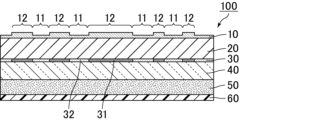
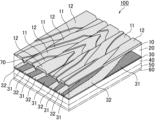
- FIG. 1 is a schematic cross-sectional view showing an example of a wood grain decorative film according to an embodiment.
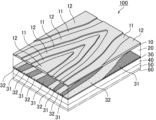
- FIG. 2 is a perspective view of the wood grain decorative film shown in FIG. 1.
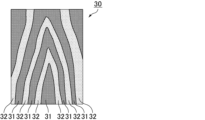
- FIG. FIG. 2 is a schematic plan view of the surface matte printing layer shown in FIG. 1.
- FIG. FIG. 2 is a schematic plan view of the back printing layer shown in FIG. 1.
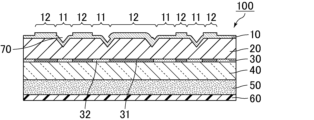
- FIG. FIG. 2 is a schematic cross-sectional view showing an example of an embossed woodgrain decorative film.
- 6 is a perspective view of the wood grain decorative film shown in FIG. 5.
- FIG. FIG. 2 is a schematic plan view showing an example of an embossed shape imitating wood fibers.
- 3 is a plan view of a wood grain decorative film of Example 3.
- FIG. FIG. 3 is a photographic view of the wood grain decorative film of Example 3 taken from an oblique direction.
- FIG. 1 is a schematic cross-sectional view showing an example of a wood grain decorative film according to an embodiment.
- FIG. 2 is a perspective view of the wood grain decorative film shown in FIG. 1.
- the woodgrain decorative film 100 according to the embodiment includes a surface matte printing layer 10, a first thermoplastic resin film 20, a back printing layer 30, and a second thermoplastic resin film 20. and the plastic resin film 40 in this order.
- the surface matte printing layer 10 is on the viewer's side (front side).
- FIG. 3 is a schematic plan view of the surface matte printing layer shown in FIG. 1.
- the surface matte printing layer 10 includes a thin film printing section 11 and a thick film printing section 12.
- the front matte printing layer 10 is arranged to overlap with the back printing layer.
- the surface matte printing layer 10 preferably overlaps at least a portion of a portion 32 other than the wood grain printing portion in addition to the wood grain printing portion 31 of the back printing layer 30 described below, and covers the entire surface of the back printing layer 30. More preferably, they are arranged so as to overlap with each other. Note that even if the front matte printing layer 10 is arranged so as to overlap the entire surface of the back printing layer 30, parts that are not visible to the observer when the woodgrain decorative film is used (such as the edges of the woodgrain decorative film) ) may not have a surface matte printing layer. In this specification, the case where the woodgrain decorative film is viewed from the viewer's side, which is the front side when in use, is referred to as a plan view.
- the surface matte printing layer 10 preferably contains a matting agent. By including the matting agent, the glossiness of the surface matte printing layer 10 can be reduced. It is more preferable that the surface matte printing layer 10 is formed of a matte ink containing a matting agent. The thickness of the thin film printed portion 11 and the thick film printed portion 12 can be adjusted by the weight of the matte ink. The greater the weight of the matte ink, the thicker the surface matte printing layer 10 becomes, and the lower the glossiness becomes.
- the thick film printing section 12 is thicker than the thin film printing section 11 and is arranged so as to overlap the wood grain printing section 31 in a plan view. Since the thick film printed part 12 is thicker than the thin film printed part 11, the glossiness is lower than that of the thin film printed part 11. Since conduits and the like appear as recesses on the grained or straight-grained surfaces of natural wood, by overlaying the thick film printing part 12 on the wood grain printing part 31 and lowering the gloss level, the wood grain printing part 31 can be made to appear recessed. I can show you.
- the thick film printing section 12 and the wood grain printing section 31 are synchronized to express a more realistic wood grain pattern. Can be done.
- the thick film printed portion 12 may overlap at least a portion of the wood grain printed portion 31 in a plan view, but it is preferable that the area where the thick film printed portion 12 and the wood grain printed portion 31 overlap is large.
- the thick film printing part 12 does not protrude from the wood grain printing part 31 in a plan view, and as shown in FIG. 3 and FIG. 4 described later, the thick film printing part 12 and the wood grain printing part 31 are It is more preferable that the shapes in plan view are the same.
- the thick film print section 12 may include a plurality of linear or curved line patterns extending in substantially the same direction, similar to the wood grain print section 31 .
- the weight of the matte ink in the thick film printing section 12 is greater than the weight of the matte ink in the thin film printing section 11 by 3.0 g/m 2 or more.
- the wood grain printed portion 31 appears to be recessed and the portion 32 other than the wood grain printed portion appears to be protruding, making it possible to express a three-dimensional effect.
- the difference between the weight of the matte ink in the thick film printing section 12 and the weight of the matte ink in the thin film printing section 11 (hereinafter also referred to as "matte ink weight difference") is less than 3.0 g/ m2 , the three-dimensional effect of the wood grain will be reduced. You won't be able to get it.
- the weight difference of the matte ink is preferably 3.52 g/m 2 or more, more preferably 5.0 g/m 2 or more.
- the upper limit of the weight of the matte ink in the thick film printing section 12 is not particularly limited as long as it is 3.0 g/ m2 or more greater than the weight of the matte ink in the thin film printing section 11.
- the surface matte printing layer 10 is performed by gravure printing, Considering the amount of matte ink that can be held on a printing plate, it is, for example, 23 g/m 2 . In this case, the upper limit of the matte ink weight difference is less than 23 g/m 2 .
- “matte ink weight” means the weight of matte ink after drying. The matte ink was dried at 60° C. for 1 minute.
- the weight of the matte ink in the thin film printing section 11 may be, for example, 0.1 g/m 2 or more.
- a preferable lower limit of the weight of the matte ink in the thin film printing section 11 is 0.5 g/m 2 , a more preferable lower limit is 0.9 g/m 2 , and an even more preferable lower limit is 2.0 g/m 2 .
- the above matte ink weight difference is 3.0 g/m 2 or more. It is particularly preferable that the matte ink weight of the thin film printing section 11 is 2.65 g/m 2 or more.
- the upper limit of the weight of the matte ink in the thin film printing section 11 is not particularly limited from the viewpoint of suppressing the glossiness of the entire woodgrain decorative film 100, and the upper limit of the weight of the matte ink in the thick film printing section 12 and the matte ink in the thin film printing section 11 is not particularly limited. It is sufficient if the difference from the weight is 3.0 g/m 2 or more.
- the matting agent examples include inorganic fillers such as silica (silicon dioxide) and calcium carbonate, and resin beads such as acrylic resin and urethane resin. Since inorganic fillers have high stability, they are more suitable as the matting agent used in this embodiment than resin beads. Among inorganic fillers, silica is preferred as a matting agent from the viewpoint of having a high matting effect.
- the surface matte printing layer 10 may contain silica.
- the content of silica contained in the matte ink is, for example, 18 to 53% by mass based on the entire matte ink.
- the matte ink may include a binder resin.
- the binder resin include acrylic resins and urethane resins.
- the surface matte printing layer 10 may or may not contain a colorant, but since the colorant may absorb heat, it may not contain a colorant from the viewpoint of heat resistance. .
- the first thermoplastic resin film 20 serves as a printing base for the back printing layer 30 and the front matte printing layer 10. It is preferable that the back printing layer 30 and the front matte printing layer 10 are printed on both sides of the first thermoplastic resin film 20.
- the first thermoplastic resin film 20 is preferably a transparent film so that the back printing layer 30 is visible when viewed from the observer side.
- the transparent film preferably has a total light transmittance of 80% or more, more preferably 90% or more. Note that in this specification, the total light transmittance is a value based on JIS K 7375.
- the first thermoplastic resin film 20 contains thermoplastic resin.
- the thermoplastic resin include polyolefins such as polyethylene and polypropylene, polyvinyl chloride (PVC), polymethyl methacrylate resin (PMMA), polyethylene terephthalate (PET), and acrylonitrile/butadiene/styrene copolymer (ABS resin). , polycarbonate, etc.
- PVC polyvinyl chloride
- PMMA polymethyl methacrylate resin
- PET polyethylene terephthalate
- ABS resin acrylonitrile/butadiene/styrene copolymer
- the first thermoplastic resin film 20 is a polyvinyl chloride film because it has good elongation and is difficult to break, and can maintain an embossed shape during molding.
- the polyvinyl chloride film may include polyvinyl chloride and a plasticizer.
- polyvinyl chloride examples include homopolymers of vinyl chloride and copolymers of vinyl chloride and other monomers copolymerizable with vinyl chloride.
- copolymerizable monomers include, for example, vinyl esters such as vinyl acetate and vinyl propionate; olefins such as ethylene, propylene, and styrene; methyl (meth)acrylate, ethyl (meth)acrylate, ( (meth)acrylic acid alkyl esters such as methyl meth)acrylate; maleic acid diesters such as dibutyl maleate and diethyl maleate; fumaric acid diesters such as dibutyl fumarate and diethyl fumarate; cyanide such as acrylonitrile and methacrylonitrile Vinyl; vinyl halides such as vinylidene chloride and vinyl bromide; vinyl ethers such as methyl vinyl ether and ethyl vinyl ether; and the like. These may be used alone or in combination
- the content of the other copolymerizable monomer in the copolymer is usually 50% by mass or less, preferably 10% by mass or less.
- vinyl chloride homopolymers are preferred because of their excellent dimensional stability.
- the average degree of polymerization of the polyvinyl chloride is preferably 700 to 1,300, more preferably 700 to 1,000.
- the average degree of polymerization of polyvinyl chloride means the average degree of polymerization measured in accordance with JIS K 6721 "Testing method for vinyl chloride resins.” If the average degree of polymerization exceeds 1300, the elongation of the polyvinyl chloride film may become insufficient.
- the polyvinyl chloride may include straight PVC and crosslinked PVC. By including crosslinked PVC, heat resistance and solvent resistance can be improved.
- the crosslinked PVC may be blended in an amount of 0 to 50 parts by weight based on a total of 100 parts by weight of the straight PVC and the crosslinked PVC.
- the content of the crosslinked PVC is 0 to 50 parts by mass based on the total of 100 parts by mass of the straight PVC and the crosslinked PVC, it is possible to improve heat resistance and solvent resistance while maintaining workability. can.
- Examples of the straight PVC include “Kane Vinyl S1008N” (average degree of polymerization: 800), “Kane Vinyl S1007” (average degree of polymerization: 700), “Kane Vinyl S1008” (average degree of polymerization: 800), manufactured by Kaneka Co., Ltd. "Kanevinyl S1001” (average degree of polymerization: 1050), “Kanevinyl S1001N” (average degree of polymerization: 1050), “Kanevinyl S1003” (average degree of polymerization: 1300), “Kanevinyl S1003N” (average degree of polymerization: 1300) ) etc.
- Examples of the crosslinked PVC include “Kane Vinyl K07S” (average degree of polymerization: 720), “Kane Vinyl K10S” (average degree of polymerization: 1030), “Kane Vinyl K10M” (average degree of polymerization: 1080), manufactured by Kaneka Co., Ltd.
- Examples include “Kanevinyl K13S” (average degree of polymerization: 1290) and “Kanevinyl K13M” (average degree of polymerization: 1100).
- the plasticizer is an additive that imparts flexibility to the polyvinyl chloride film.
- the plasticizer is not particularly limited, and examples thereof include di-2-ethylhexyl phthalate (DOP), dibutyl phthalate, dinonyl phthalate, diisononyl phthalate (DINP), and bis(2-ethylhexyl) terephthalate (DOTP).
- DOP di-2-ethylhexyl phthalate
- DIDP diisononyl phthalate
- DDP bis(2-ethylhexyl) terephthalate
- Examples include phthalic acid esters, adipic acid esters, and polyesters in which adipic acid and polyalcohol are combined.
- the content of the plasticizer is preferably 8 parts by mass or more and 30 parts by mass or less based on 100 parts by mass of the polyvinyl chloride.
- the first thermoplastic resin film 20 is used for the back printing layer 30 and the front matte printing layer 10. It is preferable to have printing resistance such as suppressing swelling due to the solvent contained in the ink.
- the film when printing and drying the ink, it is possible to suppress the film from stretching and misalignment of the back printing layer and/or the front matte printing layer.
- the content of the plasticizer is less than 8 parts by mass, the film may crack or tear during calender molding. If the content of the plasticizer exceeds 30 parts by mass, the film may stretch during printing of the back printing layer and the front matte printing layer, making printing processing difficult.
- the content of the plasticizer is more preferably 10 parts by mass or more and 20 parts by mass or less based on 100 parts by mass of the polyvinyl chloride.
- the first thermoplastic resin film 20 can use additives that are commonly added to polyvinyl chloride, and may also include stabilizers, ultraviolet absorbers, processing aids, antibacterial agents, etc. .
- stabilizers may be added to suppress deterioration during processing steps.
- stabilizers include phosphite-based antioxidants, thermal stabilizers containing magnesium, aluminum, etc., Ba--Zn-based stabilizers, and organic stabilizers containing ⁇ -diketone compounds.
- the thickness of the first thermoplastic resin film 20 is preferably 50 ⁇ m or more and 300 ⁇ m or less. Within the above range, the film itself can have strength and durability while having appropriate stiffness, making it easy to attach to a substrate.
- the thickness of the first thermoplastic resin film 20 is more preferably 70 ⁇ m or more and 250 ⁇ m or less. Considering that the back printing layer 30 and the front matte printing layer 10 are printed on both sides of the first thermoplastic resin film 20, the thickness of the first thermoplastic resin film 20 is equal to the thickness of the second thermoplastic resin film 20 described later. It may be thicker than the thickness of the thermoplastic resin film 40.
- FIG. 4 is a schematic plan view of the back printing layer shown in FIG. 1.
- the back printing layer 30 includes a wood grain printing section 31 .
- the wood grain printing portion 31 has a pattern imitating the grain pattern of natural wood.
- the above-mentioned wood grain pattern includes areas that appear darker than the surrounding area (look depressed), such as conduits, knots, radial fibers, and late wood areas that appear on the cut surface in the fiber direction of natural wood (straight grain surface or wood grain surface). But that's fine.
- the wood grain print portion 31 includes a plurality of straight or curved linear patterns extending in substantially the same direction.
- the wood grain pattern includes at least the wood grain printed portion 31, and may include a portion 32 other than the wood grain printed portion.
- the portion 32 other than the wood grain print portion may be, for example, a portion corresponding to early wood of natural wood.
- the wood grain printed portion 31 appears more concave than the portion 32 other than the wood grain printed portion, the wood grain printed portion 31 is printed in a color that is lower in brightness than the portion 32 other than the wood grain printed portion.
- the portion 32 other than the wood grain printing portion may or may not be printed.
- the wood grain decorative film expresses the three-dimensional effect of the wood grain by overlapping the thick film print part 12 on the wood grain print part 31, so both the wood grain print part 31 and the part 32 other than the wood grain print part are printed.
- the ink weight of the wood grain printed portion 31 and the ink weight of the portion 32 other than the wood grain printed portion are not particularly limited, and may be approximately the same.
- the weight of the ink in the wood grain printed portion 31 is greater than the weight of ink in the portion 32 other than the wood grain printed portion, the wood grain can be made to look more three-dimensional.
- "ink weight” means the weight of the ink after drying. The ink drying conditions were 60° C. for 1 minute.
- the second thermoplastic resin film 40 is disposed on the back side (opposite the viewer side) of the surface matte printing layer 10, the first thermoplastic resin film 20, and the back printing layer 30, and is a woodgrain decorative film. It has the role of a base film that supports 100.
- the second thermoplastic resin film 40 may have the same composition as the first thermoplastic resin film 20, or may have a different composition.
- the second thermoplastic resin film 40 may be a polyvinyl chloride film, and the polyvinyl chloride contained in the second thermoplastic resin film 40 is different from the first thermoplastic resin in terms of composition, average molecular weight, etc. It may be the same as or different from the polyvinyl chloride contained in the resin film 20. Further, the film may contain stabilizers, ultraviolet absorbers, processing aids, antibacterial agents, etc., as exemplified in the first thermoplastic resin film 20.
- the polyvinyl chloride film may contain a plasticizer.
- the content of the plasticizer contained in the second thermoplastic resin film 40 does not need to consider printing resistance like the first thermoplastic resin film 20; From the viewpoint of suppressing distortion after lamination with the thermoplastic resin film 40, it is preferable that the films have the same hardness (plasticizer content).
- the content of the plasticizer contained in the second thermoplastic resin film 40 is preferably 8 parts by mass or more and 30 parts by mass or less, and 10 parts by mass or more and 20 parts by mass, based on 100 parts by mass of polyvinyl chloride. It is more preferable that it is below.
- the thickness of the second thermoplastic resin film 40 is preferably 50 ⁇ m or more and 300 ⁇ m or less. Within the above range, the film itself can have strength and durability while having appropriate stiffness, making it easy to attach to a substrate.
- the thickness of the second thermoplastic resin film 40 is more preferably 70 ⁇ m or more and 250 ⁇ m or less.
- the second thermoplastic resin film 40 may be colored. For example, it may be colored brown.
- the colorant contained in the second thermoplastic resin film 40 is not particularly limited, and dyes and pigments commonly used in the field of vinyl chloride films can be used.
- FIG. 5 is a schematic cross-sectional view showing an example of an embossed wood grain decorative film.
- FIG. 6 is a perspective view of the wood grain decorative film shown in FIG. 5.
- the surface matte printing layer 10 may have an embossed shape 70 on the surface opposite to the first thermoplastic resin film 20. By having the embossed shape 70, the woodgrain decorative film 100 can have a feel like natural wood.
- the embossed shape 70 is as shown in FIGS. 5 and 6. , it is not necessary to synchronize with the planar shape of the wood grain printing section 31 and the thick film printing section 12.
- the embossed shape 70 may be a satin pattern or a pattern imitating wood fibers.
- FIG. 7 is a schematic plan view showing an example of an embossed shape imitating wood fibers.
- the embossed shape 70 imitating wood fibers may be provided with a plurality of linear recesses, and the plurality of linear recesses are arranged along the stretching direction of the wood grain printed portion 31 of the back printing layer. It is preferable that The embossed shape 70 imitating wood fibers preferably represents fibers that are finer than the wood grain pattern of the wood grain print section 31.
- the arithmetic mean roughness Ra of the surface of the woodgrain decorative film 100 when it has an embossed shape may be, for example, 7 to 30 ⁇ m, and the ten-point average roughness Rz may be, for example, 20 to 60 ⁇ m.
- the maximum height Ry may be, for example, 30 to 100 ⁇ m.
- the above Ra, Rz, and Ry are all values measured by a method based on JIS B 0601-1994.
- the height of the embossed irregularities may be greater than the thickness of the thick film printed portion 12.
- the thickness of the thick film printed portion 12 that can be realized using matte ink is about 1/100 of the height of the surface unevenness of the woodgrain decorative film 100 imparted by the embossed shape, and the embossed unevenness is Since it is sufficiently larger than the thickness of the printed part 12, the influence of the thickness of the thick film printed part 12 on the calculation of Ra, Rz, and Ry is small.
- the embossed shape 70 can be formed by pressing an embossing roll on which a desired pattern is formed on the surface of the surface matte printing layer 10 opposite to the first thermoplastic resin film 20.
- the woodgrain decorative film 100 may have an adhesive layer 50 on the side opposite to the back printing layer 30 of the second thermoplastic resin film 40.
- the thickness of the adhesive layer 50 is not particularly limited, but is preferably 10 to 60 ⁇ m, more preferably 20 to 50 ⁇ m.
- the adhesive layer 50 is not particularly limited as long as it has an adhesive function, and examples thereof include those containing adhesives such as acrylic adhesives, rubber adhesives, and silicone adhesives. Among these, acrylic pressure-sensitive adhesives are preferably used because they have excellent adhesiveness, processability, and heat resistance, and are relatively inexpensive.
- a separator 60 may be disposed on the opposite side of the adhesive layer 50 to the second thermoplastic resin film 40.
- the separator 60 is not particularly limited as long as it protects the surface of the adhesive layer 50 and can be peeled off during use, and any separator commonly used in the field of decorative films can be used.
- the wood grain decorative film 100 may have a primer layer between the second thermoplastic resin film 40 and the adhesive layer 50. Further, a metal film may be provided between the back printing layer 30 and the second thermoplastic resin film 40. Examples of the metal film include vapor-deposited films of metals such as aluminum and indium. The thickness of the metal film is, for example, 1 ⁇ m or less.
- the woodgrain decorative film 100 can provide a woodgrain design by being attached to the surface of a base material.
- the base material include decorative boards (wall covering materials) attached to walls, interior doors, closet and kitchen doors, furniture, flooring, and other interior materials.
- the material of the base material is not particularly limited, and examples include resins such as polycarbonate resin, acrylic resin, and styrene resin, acrylonitrile-butadiene-styrene copolymer (ABS resin); metals such as iron, copper, and aluminum. ;Alloys etc. are mentioned.
- the wood grain decorative film according to the embodiment can be manufactured, for example, by the following method.
- Another embodiment of the present invention is to print a back printing layer including a wood grain printing portion on the first surface of the first thermoplastic resin film, and to print a back printing layer including a wood grain printing portion on the first surface of the first thermoplastic resin film, a step of printing a surface matte printing layer on a second surface, and a step of laminating a second thermoplastic resin film on the surface of the back printing layer opposite to the first thermoplastic resin film,
- the surface matte printing layer includes a thin film printing part and a thick film printing part which is thicker than the thin film printing part and overlaps with the back printing layer in a plan view, and the thick film printing part is a flat film printing part.
- thermoplastic resin film 20 and the second thermoplastic resin film As a method for forming the first thermoplastic resin film 20 and the second thermoplastic resin film, conventionally known molding methods such as calendar molding, extrusion molding, and injection molding can be used. Calendar molding is suitable because it can be manufactured with excellent thickness accuracy even if
- the calender format used in the above calendering process is not particularly limited, and conventionally known formats such as an inverted L-shape, a Z-shape, an upright 2-shape type, an L-shape, and a slanted 3-shank type can be adopted.
- a back printing layer including a wood grain printing part is printed on the first surface of the first thermoplastic resin film, and a back printing layer including a wood grain printing part is printed on the first surface of the first thermoplastic resin film, and Print a surface matte printing layer on the surface. That is, a back printing layer and a front matte printing layer are printed on both sides of the first thermoplastic resin film.
- the process of printing the rear printing layer and the matte surface printing layer can be performed by inkjet printing, gravure printing, screen printing, rotary screen printing, flexographic printing, offset printing, electrostatic printing, etc., but gravure printing is preferred.
- the matte surface printing layer is preferably printed by gravure printing. This is because double-sided printing is possible, the surface of the gravure printing plate is smooth, and ink adhesion is good when printing on polyvinyl chloride film.
- Gravure printing is a printing method in which ink is filled into the recesses of a gravure printing plate, which has unevenness corresponding to the printing pattern on its surface, and the ink is transferred to a film.
- the step of printing the back printing layer and the front matte printing layer includes the step of printing the back printing layer on the first side of the first thermoplastic resin film, and the step of printing the back printing layer on the second side of the first thermoplastic resin film. and printing a matte printing layer.
- the printing order of the back printing layer and the front matte printing layer is not particularly limited.
- a front matte printing layer is printed after printing a back printing layer.
- a first thermoplastic resin film is sandwiched between a gravure printing plate and an impression cylinder, and the gravure printing plate is filled with the first surface of the first thermoplastic resin film by rotating the gravure printing plate and impression cylinder.
- the ink for wood grain printing is transferred and the wood grain pattern is printed.
- the gravure printing plate may be cylindrical.
- the first thermoplastic resin film is turned over, the first thermoplastic resin film is sandwiched between the gravure printing plate and the impression cylinder, and the gravure printing plate and the impression cylinder are rotated to form the first thermoplastic resin film.
- the matte ink filled in the gravure printing plate is transferred to the second side of the film to print a surface matte printing layer including a thin film printing part and a thick film printing part.
- the surface matte printing layer includes a thin film printing part and a thick film printing part which is thicker than the thin film printing part and overlaps with the back printing layer in plan view.
- the weight of the matte ink in the thick film printing section is 3.0 g/ m2 or more greater than the weight of the matte ink in the thin film printing section.
- the difference between the matte ink weight of the thick film printing part and the matte ink weight of the thin film printing part is preferably 3.52 g/m2 or more , and preferably 5.0 g/m2 or more. is more preferable.
- the upper limit of the weight of the matte ink in the thick film printing section is, for example, 23 g/m 2 .
- the weight of the matte ink in the thin film printing portion may be, for example, 0.1 g/m 2 or more.
- a preferable lower limit of the weight of the matte ink in the thin film printing part is 0.5 g/m 2 , a more preferable lower limit is 0.9 g/m 2 , and an even more preferable lower limit is 2.0 g/m 2 .
- the upper limit of the matte ink weight difference is less than 23 g/m 2 . It is particularly preferable that the weight difference of the matte ink is 3.0 g/m 2 or more, and the weight of the matte ink in the thin film printing part is 2.65 g/m 2 or more.
- the first thermoplastic resin film and the second thermoplastic resin film may be thermally laminated by, for example, being pressure-bonded through a pair of rolls heated to a predetermined temperature.
- the first thermoplastic resin film and the second thermoplastic resin film can be thermally laminated while embossing the surface of the surface matte printing layer on the observer side. can.
- the surface of the second thermoplastic resin film on the back side may also be embossed.
- the adhesive layer formed on the separator may be laminated on the side of the second thermoplastic resin film opposite to the back printing layer.
- Table 1 below shows the arithmetic mean roughness Ra, ten point mean roughness Rz, and maximum height Ry of the embossing rolls used in the Examples and Comparative Examples.
- Ra, Rz, and Ry were each measured using a surface roughness measuring machine under the following conditions in accordance with JIS B 0601-1994.
- Ra, Rz, and Ry in Table 1 are the average values measured three times.
- Emboss 1 and 2 are embossing rolls with satin pattern.
- Measuring device Mitutoyo's "Surf Test SJ-310" Cutoff value ⁇ c: 0.8mm Number of sections (number of sections to be measured out of measurement length): 5
- Example 1 As polyvinyl chloride, 70 parts by mass of straight PVC “Kanevinyl S1008N” (average degree of polymerization: 800) manufactured by Kaneka Corporation and crosslinked PVC “Kanevinyl K07S” (average degree of polymerization: 720) manufactured by Kaneka Corporation. 30 parts by mass were mixed to obtain polyvinyl chloride. To a total of 100 parts by mass of the polyvinyl chloride, 6 parts by mass of diisononyl phthalate (DINP) and 4 parts by mass of epoxidized soybean oil (“ADEKASIZER O-130P” manufactured by ADEKA) were blended as plasticizers.
- DINP diisononyl phthalate
- ADKASIZER O-130P epoxidized soybean oil
- Calendar molding was performed using the above polyvinyl chloride resin composition to produce a transparent vinyl chloride film with a thickness of 80 ⁇ m and a total light transmittance of 90% as a first thermoplastic resin film.
- calender molding was performed to produce a colored vinyl chloride film with a thickness of 70 ⁇ m as a second thermoplastic resin film.
- a wood grain pattern including a wood grain print area was printed by gravure printing as a back printing layer.
- thermoplastic resin film was turned over, and double-sided printing was performed by gravure printing using matte ink on the surface opposite to the surface on which the wood grain pattern was printed, thereby printing a surface matte printing layer.
- the matte ink was dried at 60° C. for 1 minute.
- a gravure printing plate one on which a pattern similar to that of the wood grain printing part was formed was used.
- the matte ink layer was printed so that the thick film printed part overlapped with the wood grain printed part and the thin film printed part overlapped with the parts other than the wood grain printed part.
- the depth of the recess formed in the gravure printing plate is expressed in 12 stages, the deepest scale 12 is the thick film printing part, and in Example 1, the thin film printing part is the gravure printing plate with the scale 9. , printed a surface matte printing layer.
- an acrylic urethane-based matte ink containing an acrylic urethane resin as a binder resin and silica (silicon dioxide) as a matting agent was used as the matte ink.
- the content of silica in the entire matte ink was 18 to 53% by mass.
- thermoplastic resin film is placed on the side of the first thermoplastic resin film on which the back printing layer is printed, and the film is passed between a pair of embossing rolls carved with a wood fiber pattern. Heat laminated.
- embossing roll of "Emboss 1" shown in Table 1 was used.
- a 40 ⁇ m thick adhesive layer was formed using an acrylic adhesive using a 120 ⁇ m thick release paper as a separator. Thereafter, the pressure-sensitive adhesive layer was attached to the surface of the second thermoplastic resin film opposite to the back printing layer, thereby producing the woodgrain decorative film according to Example 1.
- the wood grain decorative film according to Example 1 had, in order from the front side, a front matte printing layer, a first thermoplastic resin film, a back printing layer, a second thermoplastic resin film, an adhesive layer, and a release paper. However, the surface on the surface matte printing layer side had an embossed shape.
- Table 3 shows the scale of the thin film printing part of the gravure printing plate used for printing the surface matte printing layer and the type of embossing roll for thermally laminating the first thermoplastic resin film and the second thermoplastic resin film. Woodgrain decorative films according to Examples 2 to 18 and Comparative Examples 1 to 4 were produced in the same manner as in Example 1, except for the following.
- a portion of the surface matte printing layer of each sample was wiped off with alcohol, and a test piece was prepared by cutting out a portion with the surface matte printing layer removed and a portion having the same area without removing the surface matte printing layer.
- the weight of the matte ink was calculated for each scale from the difference in weight between the test piece from which the surface matte printing layer was removed and the test piece from which the surface matte printing layer was not removed.
- the method for cutting out the test piece is not particularly limited as long as test pieces with the same area can be produced, but in this study, a hole punch was used.
- a hole punch a circular sample with a diameter of 5 mm was prepared using rotary punch pliers (product number: 9070-220) manufactured by KNIPEX Co., Ltd. The above sample was punched out at a room temperature of 30° C., a humidity of 60%, and a pressure of 717 kN/m 2 .
- 79 test pieces from which the surface matte print layer was removed and 79 test pieces from which the surface matte print layer was not removed were prepared. The average value of each sample measured three times is shown in Table 2 below.
- the solvent for wiping off the surface matte printing layer may be appropriately selected depending on the type of matte ink, but in this study, isopropyl alcohol (IPA) was used. Specifically, the surface matte printing layer was wiped off by rubbing it 50 times with a cotton cloth impregnated with IPA at a pressure of 9.8 kN/m 2 . Thereafter, it was dried for 3 minutes at a room temperature of 30° C. and a humidity of 60%. The weight was measured using an electronic analytical balance (AEU-130 manufactured by Shimadzu Corporation).
- AEU-130 manufactured by Shimadzu Corporation
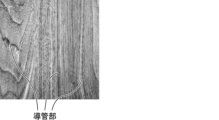
- FIG. 8 is a plan photograph of the wood grain decorative film of Example 3.
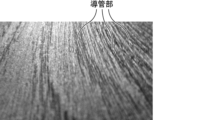
- FIG. 9 is a photographic view of the wood grain decorative film of Example 3 taken from an oblique direction.
- FIG. 9 corresponds to the case where the wood grain is observed at an incident angle of 45° and an observation angle of 60° in the evaluation of the three-dimensional effect of the wood grain.
- the conduit part included in the wood grain printing part is a part printed in black lines as shown in FIG. As shown in FIG. 9, when observed from an oblique direction under light, the portion corresponding to the conduit portion appeared depressed.
- Example 1 had the scale (depth) of the embossed printing plate corresponding to the thin-film printing area 7 or more, that is, the weight of the matte ink in the thin-film printing area was 2.65 g/m 2 or more. -6 were more matte overall than Examples 7-18, and both the three-dimensional effect of the wood grain and the overall matteness were achieved.
- the scale of the thick film printing part was fixed at 12 to make it easier to compare the effects, but even if the scale of the thick film printing part was changed, By setting the difference between the weight of the matte ink and the thin-film printing portion to 3.0 g/m 2 or more, it is possible to express the three-dimensional effect of the wood grain.
Landscapes
- Engineering & Computer Science (AREA)
- Textile Engineering (AREA)
- Laminated Bodies (AREA)
- Synthetic Leather, Interior Materials Or Flexible Sheet Materials (AREA)
Priority Applications (2)
| Application Number | Priority Date | Filing Date | Title |
|---|---|---|---|
| JP2023554375A JP7440709B1 (ja) | 2022-09-15 | 2023-09-01 | 木目調加飾フィルム及び木目調加飾フィルムの製造方法 |
| CN202380063360.3A CN119816415A (zh) | 2022-09-15 | 2023-09-01 | 木纹装饰膜 |
Applications Claiming Priority (2)
| Application Number | Priority Date | Filing Date | Title |
|---|---|---|---|
| JP2022-147151 | 2022-09-15 | ||
| JP2022147151 | 2022-09-15 |
Publications (1)
| Publication Number | Publication Date |
|---|---|
| WO2024057977A1 true WO2024057977A1 (ja) | 2024-03-21 |
Family
ID=90275126
Family Applications (1)
| Application Number | Title | Priority Date | Filing Date |
|---|---|---|---|
| PCT/JP2023/032120 Ceased WO2024057977A1 (ja) | 2022-09-15 | 2023-09-01 | 木目調加飾フィルム |
Country Status (4)
| Country | Link |
|---|---|
| JP (1) | JP7440709B1 (cg-RX-API-DMAC7.html) |
| CN (1) | CN119816415A (cg-RX-API-DMAC7.html) |
| TW (1) | TW202415548A (cg-RX-API-DMAC7.html) |
| WO (1) | WO2024057977A1 (cg-RX-API-DMAC7.html) |
Cited By (2)
| Publication number | Priority date | Publication date | Assignee | Title |
|---|---|---|---|---|
| WO2026146435A1 (en) | 2024-12-30 | 2026-07-09 | 3M Innovative Properties Company | Electrically debonding adhesive sheet, bonded article, and related methods |
| WO2026146436A1 (en) | 2024-12-30 | 2026-07-09 | 3M Innovative Properties Company | Double coated electrically debonding adhesive sheet and related methods |
Citations (7)
| Publication number | Priority date | Publication date | Assignee | Title |
|---|---|---|---|---|
| JP2004050827A (ja) * | 2002-05-30 | 2004-02-19 | Dainippon Printing Co Ltd | 化粧シートとその製造方法、及び化粧材 |
| JP2016068557A (ja) * | 2014-09-26 | 2016-05-09 | セーレン株式会社 | 積層シートおよび成形体、並びにそれらの製造方法 |
| JP2016190473A (ja) * | 2015-03-31 | 2016-11-10 | 大日本印刷株式会社 | 化粧シート |
| JP2020049677A (ja) * | 2018-09-25 | 2020-04-02 | 大日本印刷株式会社 | 化粧シート及び化粧板 |
| JP2020163829A (ja) * | 2019-03-28 | 2020-10-08 | 大日本印刷株式会社 | 化粧材 |
| WO2021201105A1 (ja) * | 2020-03-31 | 2021-10-07 | 大日本印刷株式会社 | 艶消物品及び艶消物品の製造方法 |
| JP2022055240A (ja) * | 2020-09-28 | 2022-04-07 | 大日本印刷株式会社 | 加飾シート及び加飾樹脂成形品 |
Family Cites Families (3)
| Publication number | Priority date | Publication date | Assignee | Title |
|---|---|---|---|---|
| WO2022054644A1 (ja) * | 2020-09-14 | 2022-03-17 | 大日本印刷株式会社 | 艶消物品 |
| US20230364640A1 (en) * | 2020-09-14 | 2023-11-16 | Dai Nippon Printing Co., Ltd. | Matte article |
| WO2022054646A1 (ja) * | 2020-09-14 | 2022-03-17 | 大日本印刷株式会社 | 艶消物品 |
-
2023
- 2023-09-01 WO PCT/JP2023/032120 patent/WO2024057977A1/ja not_active Ceased
- 2023-09-01 CN CN202380063360.3A patent/CN119816415A/zh active Pending
- 2023-09-01 JP JP2023554375A patent/JP7440709B1/ja active Active
- 2023-09-12 TW TW112134573A patent/TW202415548A/zh unknown
Patent Citations (7)
| Publication number | Priority date | Publication date | Assignee | Title |
|---|---|---|---|---|
| JP2004050827A (ja) * | 2002-05-30 | 2004-02-19 | Dainippon Printing Co Ltd | 化粧シートとその製造方法、及び化粧材 |
| JP2016068557A (ja) * | 2014-09-26 | 2016-05-09 | セーレン株式会社 | 積層シートおよび成形体、並びにそれらの製造方法 |
| JP2016190473A (ja) * | 2015-03-31 | 2016-11-10 | 大日本印刷株式会社 | 化粧シート |
| JP2020049677A (ja) * | 2018-09-25 | 2020-04-02 | 大日本印刷株式会社 | 化粧シート及び化粧板 |
| JP2020163829A (ja) * | 2019-03-28 | 2020-10-08 | 大日本印刷株式会社 | 化粧材 |
| WO2021201105A1 (ja) * | 2020-03-31 | 2021-10-07 | 大日本印刷株式会社 | 艶消物品及び艶消物品の製造方法 |
| JP2022055240A (ja) * | 2020-09-28 | 2022-04-07 | 大日本印刷株式会社 | 加飾シート及び加飾樹脂成形品 |
Cited By (2)
| Publication number | Priority date | Publication date | Assignee | Title |
|---|---|---|---|---|
| WO2026146435A1 (en) | 2024-12-30 | 2026-07-09 | 3M Innovative Properties Company | Electrically debonding adhesive sheet, bonded article, and related methods |
| WO2026146436A1 (en) | 2024-12-30 | 2026-07-09 | 3M Innovative Properties Company | Double coated electrically debonding adhesive sheet and related methods |
Also Published As
| Publication number | Publication date |
|---|---|
| TW202415548A (zh) | 2024-04-16 |
| CN119816415A (zh) | 2025-04-11 |
| JP7440709B1 (ja) | 2024-02-28 |
| JPWO2024057977A1 (cg-RX-API-DMAC7.html) | 2024-03-21 |
Similar Documents
| Publication | Publication Date | Title |
|---|---|---|
| JP7440709B1 (ja) | 木目調加飾フィルム及び木目調加飾フィルムの製造方法 | |
| JP7180743B2 (ja) | 化粧シート、化粧板及び加飾樹脂成形品 | |
| US6364992B1 (en) | Decorative sheet and process for producing the same | |
| JP7480542B2 (ja) | 化粧シート、及び、化粧材 | |
| WO2017168980A1 (ja) | 化粧シート | |
| CN101027184B (zh) | 低光泽金属光泽装饰板及对其叠层而成的叠层物 | |
| JP4070885B2 (ja) | 化粧用シートおよびその製造方法 | |
| JP2003266549A (ja) | 発泡化粧シート用原反と発泡化粧シートの製造方法 | |
| JP6956077B2 (ja) | 化粧シート | |
| JP2019181920A (ja) | 浮造調木目化粧材 | |
| JP7715073B2 (ja) | 真空成形用化粧シート、化粧材の製造方法、化粧材 | |
| JP2001334609A (ja) | 化粧シート及びそれを使用した絵付樹脂成形品 | |
| JP2020049677A (ja) | 化粧シート及び化粧板 | |
| JP2019038233A (ja) | 装飾シート、装飾シートを含む構造体及び装飾シートの製造方法 | |
| JP5119638B2 (ja) | 凹凸加飾射出成形品 | |
| JP2023093145A (ja) | 加飾フィルム及び加飾積層構造体 | |
| JP2005081676A (ja) | エンボス化粧シート | |
| JP2020006571A (ja) | 化粧シート及び化粧板 | |
| JP2007253506A (ja) | 化粧シート及びその印刷装置 | |
| CN118434565A (zh) | 装饰膜 | |
| JP5240358B2 (ja) | 凹凸加飾射出成形品 | |
| JP2023021061A (ja) | 化粧シート、及び、化粧板 | |
| JP7689247B2 (ja) | 積層フィルム及び加飾積層構造体 | |
| JPH09117992A (ja) | 化粧シート | |
| JP7040724B2 (ja) | 合成樹脂表皮材、合成樹脂表皮材の製造方法及び成形体 |
Legal Events
| Date | Code | Title | Description |
|---|---|---|---|
| ENP | Entry into the national phase |
Ref document number: 2023554375 Country of ref document: JP Kind code of ref document: A |
|
| 121 | Ep: the epo has been informed by wipo that ep was designated in this application |
Ref document number: 23865332 Country of ref document: EP Kind code of ref document: A1 |
|
| WWE | Wipo information: entry into national phase |
Ref document number: 202380063360.3 Country of ref document: CN |
|
| WWP | Wipo information: published in national office |
Ref document number: 202380063360.3 Country of ref document: CN |
|
| NENP | Non-entry into the national phase |
Ref country code: DE |
|
| 122 | Ep: pct application non-entry in european phase |
Ref document number: 23865332 Country of ref document: EP Kind code of ref document: A1 |