WO2024034159A1 - 化粧料及び美容方法 - Google Patents
化粧料及び美容方法 Download PDFInfo
- Publication number
- WO2024034159A1 WO2024034159A1 PCT/JP2023/005463 JP2023005463W WO2024034159A1 WO 2024034159 A1 WO2024034159 A1 WO 2024034159A1 JP 2023005463 W JP2023005463 W JP 2023005463W WO 2024034159 A1 WO2024034159 A1 WO 2024034159A1
- Authority
- WO
- WIPO (PCT)
- Prior art keywords
- hyaluronic acid
- skin
- cosmetic
- mass
- magnesium salt
- Prior art date
- Legal status (The legal status is an assumption and is not a legal conclusion. Google has not performed a legal analysis and makes no representation as to the accuracy of the status listed.)
- Ceased
Links
Classifications
-
- A—HUMAN NECESSITIES
- A61—MEDICAL OR VETERINARY SCIENCE; HYGIENE
- A61K—PREPARATIONS FOR MEDICAL, DENTAL OR TOILETRY PURPOSES
- A61K8/00—Cosmetics or similar toiletry preparations
- A61K8/18—Cosmetics or similar toiletry preparations characterised by the composition
- A61K8/19—Cosmetics or similar toiletry preparations characterised by the composition containing inorganic ingredients
-
- A—HUMAN NECESSITIES
- A61—MEDICAL OR VETERINARY SCIENCE; HYGIENE
- A61K—PREPARATIONS FOR MEDICAL, DENTAL OR TOILETRY PURPOSES
- A61K8/00—Cosmetics or similar toiletry preparations
- A61K8/18—Cosmetics or similar toiletry preparations characterised by the composition
- A61K8/72—Cosmetics or similar toiletry preparations characterised by the composition containing organic macromolecular compounds
- A61K8/73—Polysaccharides
-
- A—HUMAN NECESSITIES
- A61—MEDICAL OR VETERINARY SCIENCE; HYGIENE
- A61Q—SPECIFIC USE OF COSMETICS OR SIMILAR TOILETRY PREPARATIONS
- A61Q19/00—Preparations for care of the skin
-
- A—HUMAN NECESSITIES
- A61—MEDICAL OR VETERINARY SCIENCE; HYGIENE
- A61Q—SPECIFIC USE OF COSMETICS OR SIMILAR TOILETRY PREPARATIONS
- A61Q5/00—Preparations for care of the hair
Definitions
- the present disclosure relates to cosmetics and beauty methods.
- hyaluronic acid which has a moisturizing function, is used in fields such as cosmetics to moisturize the skin.
- Patent Document 1 includes hyaluronic acid-supported nanoparticles in which hyaluronic acid is supported on at least one of the inside or the surface of nanoparticles formed of polylactic acid, polyglycolic acid, or a lactic acid/glycolic acid copolymer. , cosmetics are disclosed.
- Patent Document 2 discloses an external skin preparation containing composite nanoparticles containing (A) hyaluronic acid and (B) an amphoteric compound and having a particle size of 100 nm or less.
- Patent Document 3 discloses a cosmetic that contains an aqueous medium and hyaluronic acid particles dispersed in the aqueous medium, and the average particle diameter of the hyaluronic acid particles is 200 nm or less.
- Hyaluronic acid has a negative charge due to the presence of carboxyl groups. Due to electrostatic repulsion based on this negative charge, hyaluronic acid generally spreads out in the form of threads.
- Compacted hyaluronic acid as described in Patent Documents 1 and 2 tends to stay in the grooves or pores of the skin, for example, compared to hyaluronic acid that has spread into threads.
- the content of hyaluronic acid in the particles described in Patent Document 1 is as low as about 3% by mass, and the content of hyaluronic acid in the particles described in Patent Document 2 also remains at 50% by mass or less. There were cases where moisture retention could not be ensured.
- hyaluronic acid is essentially compacted using sodium chloride, but a technology for compacting hyaluronic acid that can exhibit even better moisturizing properties than hyaluronic acid prepared in this way has been desired.
- the subject matter of the present disclosure is to provide a cosmetic that can exhibit superior skin permeability and moisturizing properties using compacted hyaluronic acid, and a beauty method using the cosmetic.
- ⁇ Aspect 1> Contains hyaluronic acid and magnesium salt, The magnesium salt is contained in a concentration with an ionic strength of 0.01 or more, and the mass ratio of the magnesium salt to the hyaluronic acid is 1.0 or more.
- ⁇ Aspect 3> The cosmetic according to aspect 1 or 2, wherein the magnesium salt is magnesium chloride.
- (a) is a photograph of a cross-section of human skin observed under a fluorescence microscope after applying a hyaluronic acid aqueous solution containing no magnesium salt to human skin
- (b) is a photograph of hyaluronic acid compacted using magnesium salt. This is a photograph of a cross-section of human skin observed under a fluorescence microscope after applying an aqueous solution containing the same to human skin.
- the cosmetic of the present disclosure contains hyaluronic acid and a magnesium salt, the magnesium salt is contained in a concentration with an ionic strength of 0.01 or more, and the mass ratio of the magnesium salt to hyaluronic acid is 1.0 or more. be.
- hyaluronic acid becomes compact, and it also becomes more compact than when using other salts such as sodium salt. It is believed that the principle of action that can provide excellent skin permeability and moisturizing properties is as follows.
- "compact” refers to a structure that is contracted compared to a structure in which one molecule of hyaluronic acid or a plurality of hyaluronic acid molecules are entangled without adding magnesium salt. do.
- a structure in which one molecule of hyaluronic acid or a plurality of hyaluronic acid molecules are entangled can be said to be contracted.
- Hyaluronic acid generally has a negative charge due to the presence of carboxyl groups. Due to electrostatic repulsion based on this negative charge, molecules of hyaluronic acid, for example, tend to spread into threads and are difficult to compact. Therefore, in order to shrink and compact the structure of hyaluronic acid molecules, a support material on the nanometer order that can support hyaluronic acid molecules is required, as in Patent Documents 1 and 2. As a result, restrictions have been imposed on the content ratio of hyaluronic acid in compacted structures.
- the electrostatic shielding effect of sodium chloride is used to apparently neutralize the negative charge of hyaluronic acid and make hydrogen bonds dominant, thereby preventing the spread of hyaluronic acid molecules. can be suppressed and compacted even when the hyaluronic acid molecule is alone. Since the compacted hyaluronic acid structure prepared by the technique of Patent Document 3 can be prepared without using the above-mentioned supporting material, the content ratio of hyaluronic acid in such a structure can be theoretically determined by It can be 100% by mass.
- Compacted hyaluronic acid prepared by the technology of Patent Document 3 has an average particle diameter of 200 nm or less, so it can penetrate the skin more easily than uncompacted hyaluronic acid, resulting in improved skin permeability and Moisturizing properties are improved.
- the present inventor found that using a magnesium salt among various salts as a salt to be used when compacting hyaluronic acid, compared to the case of sodium chloride used in Patent Document 3, resulted in better results. It has been found that it can exhibit skin permeability and moisturizing properties.
- sodium salt is a salt that is relatively easy to crystallize among salts
- magnesium salt is a salt that is less likely to crystallize than sodium salt because it has deliquescent properties. Therefore, in the case of cosmetics containing hyaluronic acid, sodium salts, and water, when such cosmetics are applied to the skin, as the water in the applied cosmetics dries, the sodium salts form a crystallized film on the skin surface. It is thought that it is formed. As a result, it is thought that at least a portion of the compacted hyaluronic acid is fixed in this crystallized film and cannot penetrate into the skin.
- the cosmetic of the present disclosure contains hyaluronic acid and a magnesium salt, the magnesium salt is contained in a concentration with an ionic strength of 0.01 or more, and the mass ratio of the magnesium salt to hyaluronic acid is 1.0 or more. be.
- the cosmetic of the present disclosure can provide excellent skin permeability and moisturizing properties, and can contribute to improving skin problems such as wrinkles.
- hyaluronic acid of the present disclosure is not particularly limited.
- hyaluronic acid refers to a linear polymer in which N-acetyl-D-glucosamine residues and D-glucuronic acid residues are bonded alternately; It can be obtained by isolation and extraction from tissues, or by fermentation using microorganisms such as Streptococcus.
- Hyaluronic acid may be a derivative thereof.
- hyaluronic acid salts specifically hyaluronic acid metal salts such as hyaluronate sodium salt, hyaluronate potassium salt, hyaluronate magnesium salt, hyaluronate calcium salt, hyaluronate aluminum salt, etc. are used.
- derivatives of hyaluronic acid or hyaluronate obtained by etherifying, esterifying, amidating, acetylating, acetalizing, or ketalizing the hydroxyl group, carboxyl group, etc. of hyaluronic acid. can be used.
- "hyaluronic acid” in the present disclosure may include the concept of hyaluronic acid and its derivatives.
- the weight average molecular weight of hyaluronic acid is not particularly limited and can be, for example, 10,000,000 or less. It is generally believed that low molecular weight drugs, including hyaluronic acid, are more likely to penetrate the skin. Low-molecular-weight hyaluronic acid does not easily stay inside the skin, and its water retention performance is inferior to that of high-molecular-weight hyaluronic acid, so it may be difficult to maintain the moisturizing effect inside the skin over a long period of time. Therefore, in order to maintain the moisturizing effect inside the skin for a long period of time, it is advantageous to use high molecular weight hyaluronic acid.
- the weight average molecular weight of hyaluronic acid is, for example, 500 or more, 1,000 or more, 5,000 or more, 10,000 or more, 50,000 or more. 100,000 or more, 300,000 or more, 500,000 or more, 800,000 or more, or 1,000,000 or more, and 10,000,000 or less, 8,000,000 or less , 5,000,000 or less, 3,000,000 or less, 2,000,000 or less, or 1,500,000 or less.
- the weight average molecular weight refers to the weight average molecular weight in terms of polystyrene in gel permeation chromatography measurement.
- hyaluronic acid and its derivatives can be used alone or in combination of two or more kinds. Furthermore, the molecular weights of the hyaluronic acid and its derivatives used may be the same or different.
- hyaluronic acid A commercially available hyaluronic acid may be used.
- Commercially available hyaluronic acids include, for example, hyaluronic acid HA-LQ (manufactured by Kewpie Corporation), hyaluronic acid FCH (manufactured by Kikkoman Biochemifa Corporation), hyaluronic acid IW120 (manufactured by Iwaki Corporation), and biosodium hyaluronate HA12N (manufactured by Iwaki Corporation). (manufactured by Shiseido Co., Ltd.).
- the hyaluronic acid of the present disclosure contracts due to the electrostatic shielding effect based on the magnesium salt and the action of hydrogen bonds, and forms a form in which a single hyaluronic acid molecule or a plurality of hyaluronic acid molecules are entangled and aggregated (this form is referred to as "hyaluronic acid").
- hyaluronic acid a form in which a single hyaluronic acid molecule or a plurality of hyaluronic acid molecules are entangled and aggregated
- agglomerated shrinkage products. Since such a form of hyaluronic acid can be prepared without using a supporting material as described in Patent Documents 1 and 2, the content ratio of hyaluronic acid in the hyaluronic acid agglomerated and contracted product can be theoretically determined by It can be 100% by mass. That is, the hyaluronic acid agglomerated and contracted product of the present disclosure can be composed of hyaluronic
- the hyaluronic acid agglomerated and contracted product of the present disclosure may contain other polymer components other than hyaluronic acid as long as they do not cause problems in skin permeability, moisturizing performance, etc.
- the content ratio of other polymer components is, for example, 20% by mass or less, 10% by mass or less, 5% by mass or less, 3% by mass or less, 1% by mass, based on the total amount of polymer contained in the hyaluronic acid aggregated contracted material. Below, it can be 0.5 mass% or less, 0.1 mass% or less, 0.05 mass% or less, or 0.01 mass% or less.
- hyaluronic acid agglomerated and contracted material can be intended to mean a product containing a hyaluronic acid component at a high concentration as described above. Particles with a proportion of less than 50% by mass are not included.
- the content ratio of hyaluronic acid in the hyaluronic acid agglomerated and contracted material can be measured using, for example, an ELISA method.
- the hyaluronic acid agglomerated and contracted material can be formed into a thread-like particle form that can be measured by dynamic light scattering (this form can be further referred to as "hyaluronic acid”) by adjusting, for example, the amount of magnesium salt added. (sometimes referred to as "acid particles").
- hyaluronic acid particles Penetration of hyaluronic acid particles into the skin or body hair varies from person to person and can vary depending on the condition of the stratum corneum, the condition of the hair, the number or size of pores, etc., but if the particles have an average particle size of 200 nm or less, , the particles can penetrate most skin or body hair.
- the average particle diameter of the hyaluronic acid particles is, for example, 150 nm or less, 120 nm or less, or 100 nm or less, from the viewpoint of permeability into the skin or body hair, ease of particle preparation, etc.
- the thickness can be 10 nm or more, 30 nm or more, or 50 nm or more.
- the average particle diameter is intended to be the Z-average particle diameter of hyaluronic acid particles optically measured by a dynamic light scattering method, assuming that the particle shape of the hyaluronic acid particles is spherical.
- Such an average particle diameter can be measured using, for example, a Zetasizer (manufactured by Malvern Panalytical) or a dynamic light scattering photometer DLS-8000 (manufactured by Otsuka Electronics). These measuring devices can be appropriately selected based on the overlap concentration of each hyaluronic acid. For example, if it is less than overlap concentration, a dynamic light scattering photometer DLS-8000 can be used, and if it is more than overlap concentration, Zetasizer can be used. Overlapping concentration can be calculated, for example, by confocal fluorescence recovery after photobleaching (Confocal-FRAP).
- Hyaluronic acid particles with an average particle size of 200 nm or less are easy to penetrate into the skin or body hair, but on the other hand, because the particle size is small, it is thought that it is difficult to stay inside the skin or body hair.
- the average particle diameter of hyaluronic acid particles can be made to exceed 200 nm by adjusting the blending amounts of hyaluronic acid and magnesium salt.
- Hyaluronic acid particles with an average particle size of more than 200 nm would normally be expected to have difficulty penetrating into the skin or body hair, but in the case of hyaluronic acid particles of this size prepared using magnesium salts, unexpected Surprisingly, the hyaluronic acid particles can be penetrated into the skin or body hair, and as shown in Figure 2, the penetrating hyaluronic acid particles tend to remain inside the skin or body hair, so that they can penetrate into the skin or body hair. The moisturizing effect can be maintained for a long period of time.
- the average particle diameter of such hyaluronic acid particles is more than 200 nm, 210 nm or more, 230 nm or more, 250 nm or more, 270 nm or more, or 280 nm from the viewpoint of permeability into the skin or body hair, ease of retention within the skin or body hair, etc. or more, and can also be 500 nm or less, 450 nm or less, 400 nm or less, 350 nm or less, or 300 nm or less.
- the hyaluronic acid of the present disclosure can take the form of thread-like particles.
- Such a form of hyaluronic acid prepared using a magnesium salt easily penetrates into the skin or body hair, for example, non-invasively into the inside of the skin through the stratum corneum or pores of the skin.
- hyaluronic acid having a relatively low molecular weight of less than 500 is considered to easily penetrate the skin or body hair without being made into fine particles.
- the hyaluronic acid particles of the present disclosure can be prepared using hyaluronic acid having a weight average molecular weight of 500 or more, and such hyaluronic acid can be contained in the particles at a high concentration. As a result, the obtained hyaluronic acid particles tend to remain inside the skin or body hair, and can maintain the moisturizing effect inside the skin or body hair for a long period of time.
- the content of hyaluronic acid in cosmetics is, for example, 0.005% by mass or more, 0.01% by mass or more, 0.05% by mass based on the total amount of cosmetics, from the viewpoints of compactness, moisturizing properties, cost, etc.
- Mass% or more 0.10 mass% or more, 0.15 mass% or more, 0.20 mass% or more, 0.25 mass% or more, 0.30 mass% or more, 0.35 mass% or more, 0.40 mass% % or more, or 0.45% by mass or more, and 5.0% or less, 4.0% or less, 3.0% or less, 2.0% or less, 1.0% by mass or less, 0 It can be .90 mass% or less, 0.80 mass% or less, 0.70 mass% or less, 0.60 mass% or less, 0.50 mass% or less, or 0.45 mass% or less.
- the hyaluronic acid contained in the cosmetics of the present disclosure is, for example, a high-molecular-weight hyaluronic acid that has a high content of hyaluronic acid in the hyaluronic acid aggregate and has excellent moisturizing properties. Therefore, even if the content of hyaluronic acid in the cosmetic is relatively low, it can exhibit a sufficient moisturizing effect.
- the cosmetic of the present disclosure contains a magnesium salt.
- the magnesium salt include magnesium salts composed of at least one selected from inorganic salts and organic acid salts.
- inorganic salt means a salt composed only of inorganic components, and can also be translated as a salt composed of ions generated from an inorganic acid and an inorganic base.
- organic acid salt means a salt formed by combining an organic acid and a metal ion. Note that salts generally exist in the form of salt-derived ions in cosmetics. Therefore, in the present disclosure, for example, "a cosmetic containing a magnesium salt” is intended to include a magnesium salt in the form of such an ion.
- magnesium salts in the form of inorganic salts include magnesium nitrate, magnesium sulfate, and magnesium chloride. These salts can be used alone or in combination of two or more.
- organic acid salts include citrate, acetate, lactate, tartrate, succinate, malate, glycolate, salicylate, and pyrrolidone carboxylate.
- magnesium salts in the form of organic acid salts include magnesium ions combined with organic acids such as citric acid, acetic acid, lactic acid, tartaric acid, succinic acid, malic acid, glycolic acid, salicylic acid, and pyrrolidone carboxylic acid. Salt can be mentioned. These salts can be used alone or in combination of two or more.
- magnesium salt in the form of an inorganic salt is preferable, and magnesium chloride is more preferable.
- the amount of magnesium salt added in cosmetics should be determined by considering, for example, the degree of compaction of hyaluronic acid, the balance between penetration into the body surface or body hair, and/or sustainability of the moisturizing effect, etc. 0.01% by mass or more, 0.05% by mass or more, 0.10% by mass or more, 0.15% by mass or more, 0.20% by mass or more, 0.25% by mass or more, 0.30% by mass or more , 0.35% by mass or more, 0.40% by mass or more, 0.45% by mass or more, 0.50% by mass or more, 0.55% by mass or more, 0.60% by mass or more, 0.65% by mass or more, or 0.70 mass% or more, and 5.0 mass% or less, 4.0 mass% or less, 3.0 mass% or less, 2.0 mass% or less, 1.9 mass% or less , 1.8% by mass or less, 1.7% by mass or less, 1.6% by mass or less, or 1.5% by mass or less.
- the magnesium salt is in the form of a
- the amount of magnesium salt blended in cosmetics can also be defined as the ionic strength of the magnesium salt.
- the ionic strength of the magnesium salt is, for example, 0.01 or more, 0.03, taking into account the degree of compaction of hyaluronic acid, the balance of permeability to the body surface or body hair, and/or the sustainability of the moisturizing effect. or more, 0.05 or more, 0.07 or more, 0.10 or more, more than 0.10, 0.12 or more, 0.15 or more, 0.17 or more, 0.20 or more, 0.22 or more, or 0. It is preferable that it is 25 or more.
- the upper limit of the ionic strength may be, for example, 5.0 or less, 4.0 or less, 3.0 or less, 2.0 or less, 1.0 or less, 0.70 or less, or 0.50 or less. can.
- the amount or ionic strength of the magnesium salt will depend on the composition of the magnesium salt contained in the buffer solution itself and the content of the magnesium salt in the buffer solution. Calculated based on all magnesium salt components including separately added magnesium salt components.
- the cosmetic of the present disclosure contains a magnesium salt at a concentration of the above ionic strength, and further contains a mass ratio of magnesium salt to hyaluronic acid of 1.0 or more.
- the cosmetic of the present disclosure does not contain other salts such as sodium chloride, as described in Patent Document 3.
- it is less likely to crystallize on the surface of the skin, etc., and can provide better skin permeability and moisturizing properties.
- the mass ratio of magnesium salt to hyaluronic acid is, for example, 1.0 or more, taking into account the degree of compaction of hyaluronic acid, the balance of permeability to the body surface or body hair, and/or the sustainability of the moisturizing effect, etc. 1.1 or more, 1.2 or more, 1.3 or more, 1.4 or more, 1.5 or more, 1.6 or more, 1.7 or more, 1.8 or more, 1.9 or more, or 2.0 or more It is preferable that The upper limit of this mass ratio is, for example, 10 or less, 9.0 or less, 8.0 or less, 7.0 or less, 6.0 or less, 5.0 or less, 4.0 or less, or 3.0 or less. can do.
- Cosmetics of the present disclosure may typically include an aqueous medium.
- the aqueous medium is not particularly limited, and any aqueous medium used in cosmetics, quasi-drugs, etc. can be used.
- ion exchange water, distilled water, ultrapure water, tap water, buffer solution, etc. can be used.
- the aqueous medium can be used alone or in combination of two or more.
- buffer examples include citrate buffer, lactic acid buffer, phosphate buffer, acetate buffer, tartrate buffer, borate buffer, and Tris buffer. From the viewpoint of high buffering capacity, citrate buffer, lactic acid buffer, and phosphate buffer are preferred, and citrate buffer is more preferred.
- the pH of the buffer solution can be 7.0 or less, 6.8 or less, or 6.5 or less.
- the lower limit of the pH of the buffer solution is not particularly limited, but is preferably 4.5 or more, 5.5 or more, or 6.0 or more, for example, from the viewpoint of skin irritation.
- the cosmetic composition of the present disclosure can contain various components as appropriate within a range that does not adversely affect the effects of the present invention.
- Such ingredients include, for example, salts other than magnesium salts, humectants, skin or hair nutrients, vitamins, pharmaceuticals, quasi-drugs, water-soluble drugs applicable to cosmetics, ultraviolet absorbers, and oxidants.
- surfactants e.g. anionic surfactants, cationic surfactants, nonionic surfactants, amphoteric surfactants
- pigments dyes, pigments , and fragrances.
- the optional components can be used alone or in combination of two or more.
- the cosmetic composition of the present disclosure may contain salts other than magnesium salts.
- the amount of other salts in the cosmetics is, for example, less than 0.50% by mass, 0.40% by mass or less, 0.30% by mass or less, 0.20% by mass or less, 0.10% by mass or less, 0. It can be less than .10% by weight, 0.05% by weight or less, or 0.01% by weight or less.
- salts other than magnesium salts are not included in the cosmetic.
- “other salts other than magnesium salt” in the present disclosure does not include ionic surfactants and hyaluronates.
- the cosmetic composition of the present disclosure may contain an amphoteric surfactant.
- the amount of the amphoteric surfactant in the cosmetic can be, for example, less than 0.01% by mass, 0.005% by mass or less, or 0.001% by mass or less. Amphoteric surfactants do not need to be incorporated into cosmetics.
- the dosage form of the cosmetic of the present disclosure is not particularly limited, and examples thereof include liquid, emulsion, cream, gel, mist, spray, aerosol, and mousse. These may be in the form of a single phase system, or may be in the form of a non-emulsifying or emulsifying, oil-in-water or water-in-oil two-phase system.
- the term "spray" can include mist-type sprays, aerosol-type sprays, and the like.
- the product form of the cosmetics of the present disclosure is not particularly limited, and examples include skin care cosmetics such as emulsions, creams, face oils, body oils, and serums; foundations, makeup bases, lipsticks, blushers, eye shadows, mascara, and mascara bases.
- Make-up cosmetics such as; sunscreen cosmetics; body cosmetics; aromatic cosmetics; skin cleansing products such as makeup removers, face washes, body shampoos; hair cosmetics such as hair sprays, hair creams, hair lotions, hair rinses, shampoos, etc. This includes fees.
- cosmetics it is advantageous to use it as a leave-on cosmetic that is used without rinsing off and focuses on the penetration of hyaluronic acid into the skin.
- the cosmetic of the present disclosure can be a solubilized or microemulsion cosmetic (eg, a beauty serum). Such cosmetics may exhibit a translucent to transparent appearance. Such appearance can be evaluated, for example, by the L value calculated from a color difference meter such as COLOR-EYE 7000A (manufactured by Gretag Macbeth). The closer the L value is to 100, the higher the transparency, and in some embodiments, the cosmetic of the present disclosure has an L value of 70 or more, 75 or more, 80 or more, 85 or more, 90 or more, 92 or more, or 95 or more. , 100 or less, or less than 100.
- a solubilized or microemulsion cosmetic eg, a beauty serum
- Such cosmetics may exhibit a translucent to transparent appearance. Such appearance can be evaluated, for example, by the L value calculated from a color difference meter such as COLOR-EYE 7000A (manufactured by Gretag Macbeth). The closer the L value is to 100, the higher the transparency
- the cosmetic composition of the present disclosure does not include a second agent containing a chelating agent, which is used to swell the hyaluronic acid described above after it is applied to the skin.
- the cosmetics of the present disclosure can be prepared, for example, using the following method. Note that the various materials described above can be used as the various materials such as hyaluronic acid, magnesium salt, water, and optional ingredients that can be used in the cosmetic preparation method.
- Cosmetics can be prepared by blending a magnesium salt with water or a buffer solution to prepare a solution, blending hyaluronic acid into this solution, and dissolving the hyaluronic acid while stirring and mixing.
- a cosmetic can be prepared by blending hyaluronic acid with water or a buffer solution, stirring and mixing to dissolve the hyaluronic acid, and then further blending a magnesium salt.
- the buffer solution itself exhibits the above-mentioned concentration or ionic strength of the magnesium salt due to the action of the magnesium salt contained in the buffer solution, the addition of the magnesium salt can be omitted.
- optional ingredients When the above-mentioned optional ingredients are blended, such optional ingredients may be blended before hyaluronic acid is compacted with magnesium salt. It is preferable to blend the hyaluronic acid after preparing it.
- the cosmetic of the present disclosure can be applied to any part of the body, for example, to any part of the skin surface (body surface) or body hair (hair).
- body surface skin surface
- hair hair
- the skin of the face lips, eyes, eyelids, cheeks, forehead, between the eyebrows, nose, etc.
- head head
- ears ears
- hands arms, neck, legs, feet, chest, abdomen, back, etc.
- body hair hair
- the skin includes nails and the like that have hardened due to changes in the keratin of the epidermis of the skin.
- body hair is synonymous with "hair” and includes any hair on the body.
- examples of body hair include hair, eyelashes, eyebrows, and beards.
- the cosmetic of the present disclosure can be suitably used as a cosmetic for body surface or body hair. Furthermore, since the cosmetic of the present disclosure can penetrate hyaluronic acid into the body surface or body hair, it can be suitably used as a cosmetic for hyaluronic acid penetration into the body surface or body hair.
- a beauty method using the cosmetic of the present disclosure includes applying the above-described cosmetic to the body surface or body hair.
- the term "beauty method” refers to a method of applying the cosmetics of the present disclosure to the body surface or body hair to beautifully condition and beautify the body surface or body hair. Or it is different from the method of diagnosis.
- the cosmetic of the present disclosure can suitably penetrate the compacted hyaluronic acid into the skin or body hair, and therefore can satisfactorily moisturize the skin or body hair.
- the production function of the skin's own moisturizing ingredients is improved, and poor turnover in the stratum corneum is also improved, or hair moisture is improved, resulting in rough skin or split ends.
- problems such as hair breakage are less likely to occur, and the beauty effect can be enhanced.
- the means for applying the cosmetic to the body surface or body hair can be applied by applying the cosmetic to the body surface or body hair.
- the cosmetic may be applied to the body surface or body hair using a spray container filled with the cosmetic, or a container without a spray function may be used.
- the cosmetic may be put into the container, and an appropriate amount of the cosmetic may be collected from the container onto the fingers or palm of the hand, and spread over the body surface or body hair.
- Cosmetics should be applied to the body surface or body hair for at least 2 days, at least 5 days, at least 7 days, at least 10 days, at least 15 days, at least 20 days, or at least 30 days in order to enhance the beauty effect. is preferred. From the perspective of further enhancing the beauty effect, cosmetics should be applied to the body surface or body hair for 2 or more days, 5 or more days, 7 or more days, 10 or more days, 15 or more days, 20 or more days, or 30 or more consecutive days. It is more preferable to carry out the test.
- continuous use may be referred to as "continuous use”.
- Permeability test 1 Evaluation of the amount of hyaluronic acid permeated into human skin
- the permeability of hyaluronic acid was evaluated from the amount of hyaluronic acid recovered from the stratum corneum peeled off with the tape of the D-squame (trademark) disc: (1) After setting human skin (60s) in the Diffusion Cell Array System (manufactured by Introtech Co., Ltd.), fill the receiver with degassed phosphate buffered saline (PBS) and hydrate the skin for 1 hour. I let it happen.
- PBS degassed phosphate buffered saline
- Hyaluronic acid that penetrated into the skin was directly observed according to the following steps (1) to (5): (1) After human skin (60s) was set in a diffusion cell array system (manufactured by Introtech Co., Ltd.), degassed PBS was filled into the receiver and the skin was hydrated for 1 hour. (2) After confirming that the surface temperature of the skin was 32° C., a test sample of the cosmetic was applied to the skin at 10 ⁇ L/cm 2 .
- fluoresceinamine (FA)-labeled hyaluronic acid (HA) to which the fluorescent group fluoresceinamine (FA) was applied was prepared as follows: After uniformly dispersing 10 g of Biohyalo 12 (manufactured by Shiseido Co., Ltd.) in 500 mL of methanol (manufactured by Nacalai Tesque Co., Ltd.), 500 mL of water was added to completely dissolve it.
- Permeability test 3 Evaluation of the amount of hyaluronic acid permeated into human skin
- the permeability of hyaluronic acid was evaluated from the amount of hyaluronic acid recovered from the stratum corneum peeled off with the tape of the D-squame (trademark) disc: (1) After human skin (47 years old, male) was set in the Diffusion Cell Array System (manufactured by Introtech Co., Ltd.), the receiver was filled with degassed PBS and the skin was hydrated for 1 hour. (2) After confirming that the surface temperature of the skin was 32° C., a test sample of the cosmetic was applied to the skin at 10 ⁇ L/cm 2 .
- Permeability test 4 Evaluation of the amount of hyaluronic acid permeated into human skin
- the permeability of hyaluronic acid was evaluated from the amount of hyaluronic acid that permeated from the simulated skin to the medium according to the steps (1) and (2) below: (1) A pseudo skin membrane (Melano Derm MEL-300 kit, Asian donor (MEL-300-A) , manufactured by MATTEK), and 25 ⁇ L of the test sample was applied to the upper surface of the simulated skin membrane, followed by culturing in a CO 2 incubator (37° C., 5% CO 2 , humidified) for 1 day. (2) 1 mL of the cultured medium was sampled and analyzed by ELISA to quantify the amount of hyaluronic acid in the medium.
- Permeability test 5 Evaluation of the amount of hyaluronic acid permeated into human skin after continuous use for 1 month
- the permeability of hyaluronic acid after one month of continuous use was evaluated from the amount of hyaluronic acid recovered from the stratum corneum peeled off with the tape of the D-squame (trademark) disc: (1) After washing the inner forearms of a panel of 12 healthy men in their 20s to 30s with soap, 1 mL of each cosmetic sample was applied to the washed skin. (2) After carrying out the operation in (1) once a day for one month, the stratum corneum of the skin to which the sample was applied was applied five times with D-square (trademark) disk tape.
- the third to fifth tapes were immersed in MilliQ (trademark) water containing 5% methanol, and then subjected to ultrasonication for 20 minutes to extract hyaluronic acid.
- MilliQ trademark
- the extract was analyzed by ELISA method to quantify the amount of hyaluronic acid in the extract.
- the average particle size of compacted hyaluronic acid in the test sample was evaluated according to the following procedures (1) and (2): (1) The test sample was filtered with a 1 ⁇ m membrane filter. (2) The Z-average particle diameter of the filtered sample was determined by dynamic light scattering using a Zetasizer (manufactured by Malvern Panalytical).
- Test Example 1 Effects of various salts>
- Test Example 1 based on the above-mentioned Penetration Test 1, the influence of various salts mixed with hyaluronic acid was investigated. The results are shown in Table 1 and FIG.
- Hyaluronic acid manufactured by Shiseido Co., Ltd., Biohyalo 12: weight average molecular weight 1.2 million
- Hyaluronic acid manufactured by Shiseido Co., Ltd., Biohyalo 12: weight average molecular weight 1.2 million
- sodium chloride weight average molecular weight (Mw): 58.4, manufactured by Junsei Kagaku Co., Ltd.
- concentration 0.14Eq
- Comparative Examples 2 to 4 and Example 1 Test samples of Comparative Examples 2 to 4 and Example 1 were prepared in the same manner as Comparative Example 1, except that the salts in Table 1 were used.
- Reference example 1 As a test sample (control sample) of Reference Example 1, Composition A of Comparative Example 1, which does not contain salt, was used.
- Test Example 2 Direct observation of hyaluronic acid penetrating into the skin>
- Test Example 2 based on the above-mentioned Permeability Test 2, the degree of penetration of hyaluronic acid into the skin when using a magnesium salt was investigated. The results are shown in FIG.
- Test sample The test samples of Reference Example 1 and Example 1 in Test Example 1 were used.
- ⁇ Test Example 3 Influence of the blending ratio of magnesium salt 1>
- Test Example 3 the influence of the blending ratio of magnesium salt was investigated based on the above-mentioned Permeability Test 3. The results are shown in Tables 2-4.
- Tables 2 to 4 “1 to 5", “6 to 10", and “11 to 15” refer to the 1st to 5th tapes, the 6th to 10th tapes, and the 11th to 15th tapes. It refers to the amount of hyaluronic acid collected with eye tape.
- MgCl 2 equivalent amount means the equivalent amount of magnesium chloride hexahydrate (MgCl 2 6H 2 0) excluding the water content of the hydrate
- MgCl 2 equivalent amount when “MgCl 2 equivalent amount” is described in the table, the total amount of the blended composition is the total amount of each component excluding the MgCl 2 equivalent amount.
- Reference Example 3 and Comparative Example 8 shown in Table 3 “human skin (47 years old, male)" in (1) of the above permeability test 3 and "6 hours” in (3) were replaced with “human skin” in (1) and "6 hours” in (3).
- Comparative Examples 6-7 and Examples 2-3 Test samples of Comparative Examples 6 and 7 and Examples 2 and 3 were prepared in the same manner as Comparative Example 5, except that the amount of MgCl 2 .6H 2 0 added was changed to the value shown in Table 2.
- Reference example 2 As a test sample (control sample) of Reference Example 2, Composition B of Comparative Example 5, which does not contain salt, was used.
- Hyaluronic acid manufactured by Shiseido Co., Ltd., Biohyalo 12: weight average molecular weight 1.2 million
- Hyaluronic acid was added to ion-exchanged water at a content of 0.10% by mass, and mixed by stirring with a vortex mixer to prepare composition B. did.
- 0.17% by mass of MgCl 2 .6H 2 0 was added to Composition B, and the mixture was stirred and mixed using a vortex mixer to prepare a test sample.
- Hyaluronic acid manufactured by Shiseido Co., Ltd., Biohyalo 12: weight average molecular weight 1.2 million
- ion-exchanged water a content of 0.10% by mass
- a vortex mixer a vortex mixer
- 1.00% by mass of MgCl 2 .6H 2 0 was added to Composition B, and the mixture was stirred and mixed using a vortex mixer to prepare a test sample.
- test sample (control sample) of Reference Example 4 As the test sample (control sample) of Reference Example 4, the test sample of Reference Example 3 was used.
- hyaluronic acid prepared using magnesium salt tends to remain near the stratum corneum after penetrating into the skin, and has the ability to enhance the moisturizing effect inside the skin. This result is also consistent with the result of Test Example 2.
- ⁇ Test Example 4 Effect of blending ratio of magnesium salt 2>
- Test Example 4 the influence of the blending ratio of magnesium salt was investigated based on the above-mentioned Permeability Test 4.
- the results are shown in Table 5.
- the numerical value of the amount of hyaluronic acid in Table 5 is the average value of data for 4 wells of a 12-well plate.
- the amount of hyaluronic acid blended in the test sample is low (for example, about 0.10% by mass), there is a possibility that the above-mentioned permeability test 3 cannot be evaluated. Therefore, when the amount of hyaluronic acid blended is low, it is preferable to evaluate by permeability test 4.
- MilliQTM water (ultra pure water) was used as the test sample.
- test sample was prepared by adding 0.34% by mass of MgCl 2 .6H 2 0 to ion-exchanged water and stirring and mixing with a vortex mixer to dissolve MgCl 2 .6H 2 0.
- Hyaluronic acid manufactured by Shiseido Co., Ltd., Biohyalo 12: weight average molecular weight 1.2 million
- ion-exchanged water at a content of 0.10% by mass
- a vortex mixer to dissolve the hyaluronic acid.
- a test sample was prepared.
- Hyaluronic acid manufactured by Shiseido Co., Ltd., Biohyalo 12: weight average molecular weight 1.2 million
- Hyaluronic acid was added to ion-exchanged water to a content of 0.10% by mass, and mixed with stirring using a vortex mixer to prepare composition C. did.
- 0.34% by mass of MgCl 2 .6H 2 0 was added to Composition C, and the mixture was stirred and mixed using a vortex mixer to prepare a test sample.
- Test Example 5 Skin penetration effect of hyaluronic acid when used continuously for one month>
- Test Example 5 based on the above-mentioned permeability test 5, the effect of hyaluronic acid permeation into the skin when used continuously for one month was investigated.
- the results are shown in Table 6 and FIG. 3. Note that the numerical value of the amount of hyaluronic acid is the average value of the results obtained by 12 panelists.
- Hyaluronic acid manufactured by Shiseido Co., Ltd., Biohyalo 12: weight average molecular weight 1.2 million
- Hyaluronic acid manufactured by Shiseido Co., Ltd., Biohyalo 12: weight average molecular weight 1.2 million
- a vortex mixer to prepare composition D.
- 0.50% by mass of phenoxyethanol and 1.00% by mass of ethanol were added to Composition D, and the mixture was stirred and mixed using a vortex mixer to prepare a test sample.
- Hyaluronic acid manufactured by Shiseido Co., Ltd., Biohyalo 12: weight average molecular weight 1.2 million
- Hyaluronic acid was added to ion-exchanged water to a content of 0.50% by mass, and mixed with stirring using a vortex mixer to prepare composition D.
- hyaluronic acid 1.42% by mass of MgCl2.6H20 , 0.50% by mass of phenoxyethanol , and 1.00% by mass of ethanol were added to composition D, and the mixture was stirred and mixed with a vortex mixer.
- a test sample was prepared.
- Table 6 and Figure 3 show that when a composition containing hyaluronic acid prepared using a predetermined amount of magnesium salt is continuously applied to the skin for a long period of time, hyaluronic acid can be properly penetrated into the skin. Ta.
- Hyaluronic acid manufactured by Shiseido Co., Ltd., Biohyalo 12: weight average molecular weight 1.2 million
- Hyaluronic acid was added to ion-exchanged water to a content of 0.50% by mass, and mixed with a vortex mixer to prepare composition E. did.
- sodium chloride was added to composition E so that the ionic strength was 0.20, and the mixture was stirred and mixed using a vortex mixer to prepare a test sample.
- Reference Example 9 A test sample of Reference Example 9 was prepared in the same manner as Reference Example 8 except that sodium chloride was replaced with MgCl 2 .6H 2 O.
- Example 11 The test sample of Example 5 (hyaluronic acid: 0.10% by mass, MgCl 2 .6H 2 0: 0.34% by mass) was used as the test sample of Reference Example 11.
- Reference Example 9 has the same configuration as Example 2 in Table 2. Conventionally, it has been said that when the average particle size of hyaluronic acid exceeds 200 nm, its permeability into the skin decreases, but from the results of Reference Example 9 and Example 2, it was determined that hyaluronic acid was prepared using a predetermined amount of magnesium salt. In the case of hyaluronic acid, it was found that even if the average particle diameter exceeds 200 nm, hyaluronic acid can be suitably penetrated into the skin.
Landscapes
- Health & Medical Sciences (AREA)
- Life Sciences & Earth Sciences (AREA)
- Animal Behavior & Ethology (AREA)
- General Health & Medical Sciences (AREA)
- Public Health (AREA)
- Veterinary Medicine (AREA)
- Birds (AREA)
- Epidemiology (AREA)
- Chemical & Material Sciences (AREA)
- Inorganic Chemistry (AREA)
- Dermatology (AREA)
- Cosmetics (AREA)
Abstract
Description
ヒアルロン酸、及びマグネシウム塩を含み、
前記マグネシウム塩が、0.01以上のイオン強度の濃度で含まれ、かつ、前記ヒアルロン酸に対する前記マグネシウム塩の質量比が、1.0以上である、
化粧料。
〈態様2〉
前記ヒアルロン酸が、前記化粧料の全量に対し、0.005質量%以上含まれている、態様1に記載の化粧料。
〈態様3〉
前記マグネシウム塩が、塩化マグネシウムである、態様1又は2に記載の化粧料。
〈態様4〉
前記ヒアルロン酸の重量平均分子量が、10,000,000以下である、態様1~3のいずれかに記載の化粧料。
〈態様5〉
前記化粧料が、リーブオン型の化粧料である、態様1~4のいずれかに記載の化粧料。
〈態様6〉
前記化粧料が、90以上のL値を呈する、態様1~5のいずれかに記載の化粧料。
〈態様7〉
ヒアルロン酸の体表又は体毛浸透用である、態様1~6のいずれかに記載の化粧料。
〈態様8〉
態様1~7のいずれかに記載の化粧料を体表又は体毛に適用することを含む、美容方法。
〈態様9〉
前記化粧料の体表又は体毛への適用が、2日以上実施される、態様8に記載の美容方法。
〈態様10〉
前記化粧料の体表又は体毛への適用が、2日以上連続して実施される、態様8に記載の美容方法。
本開示の化粧料は、ヒアルロン酸とマグネシウム塩とを含み、マグネシウム塩が、0.01以上のイオン強度の濃度で含まれ、かつ、ヒアルロン酸に対するマグネシウム塩の質量比が、1.0以上である。このような構成である結果、本開示の化粧料は、優れた皮膚浸透性及び保湿性を提供することができ、シワ等の皮膚トラブルの改善に貢献することができる。
本開示のヒアルロン酸としては特に制限はない。一般には、ヒアルロン酸は、N-アセチル-D-グルコサミン残基と、D-グルクロン酸残基が交互に結合した直鎖状高分子を意味し、かかるヒアルロン酸は、例えば、鶏冠若しくは他の動物組織からの単離抽出、又はストレプト・コッカス属などの微生物を用いた発酵法により得ることができる。
本開示の化粧料は、マグネシウム塩を含む。マグネシウム塩としては、無機塩及び有機酸塩から選択される少なくとも一種から構成されるマグネシウム塩を挙げることができる。化粧料としての使用を考慮した場合、無機塩及び有機酸塩の中でも、皮膚又は体毛に対して悪影響を及ぼしにくい塩であることが好ましい。ここで、「無機塩」とは、無機成分のみから構成される塩を意味し、無機酸と無機塩基より生じるイオンから構成される塩と言い換えることもできる。また、「有機酸塩」とは、有機酸と金属イオンが結合してできた塩を意味する。なお、塩は、化粧料中では、一般に、塩由来のイオンの形態で存在している。したがって、本開示において、例えば「マグネシウム塩を含む化粧料」とは、このようなイオンの形態でマグネシウム塩が含まれていることを意図する。
本開示の化粧料は、典型的には水性媒体を含み得る。かかる水性媒体としては特に制限はなく、化粧料、医薬部外品等に使用される水性媒体を使用することができる。例えば、イオン交換水、蒸留水、超純水、水道水、緩衝液等を使用することができる。水性媒体は単独で又は二種以上組み合わせて使用することができる。
本開示の化粧料は、本発明の効果に悪影響を及ぼさない範囲で、各種成分を適宜配合することができる。このような成分としては、例えば、マグネシウム塩以外の他の塩、保湿剤、皮膚又は毛髪栄養剤、ビタミン、医薬品、医薬部外品、化粧品等に適用可能な水溶性薬剤、紫外線吸収剤、酸化防止剤、防腐剤、酸化防止助剤、増粘剤、界面活性剤(例えばアニオン性界面活性剤、カチオン性界面活性剤、非イオン性界面活性剤、両性界面活性剤)、顔料、染料、色素、及び香料を挙げることができる。任意成分は単独で又は二種以上組み合わせて使用することができる。
本開示の化粧料は、マグネシウム塩以外の他の塩が含まれていてもよい。化粧料中の他の塩の配合量は、例えば、0.50質量%未満、0.40質量%以下、0.30質量%以下、0.20質量%以下、0.10質量%以下、0.10質量%未満、0.05質量%以下、又は0.01質量%以下とすることができる。体表又は体毛への浸透性、保湿効果の持続性等の観点から、マグネシウム塩以外の他の塩は、化粧料中に含まれないことが好ましい。ここで、本開示における「マグネシウム塩以外の他の塩」には、イオン性界面活性剤及びヒアルロン酸塩は包含されない。
本開示の化粧料は、両性界面活性剤が含まれていてもよい。化粧料中の両性界面活性剤の配合量は、例えば、0.01質量%未満、0.005質量%以下、又は0.001質量%以下とすることができる。両性界面活性剤は化粧料中に配合しなくてもよい。
本開示の化粧料の剤型は特に限定されず、例えば、液状、乳液状、クリーム状、ジェル状、ミスト、スプレー、エアゾール、ムース等が挙げられる。これらは、単相系の形態であってもよく、或いは、非乳化型若しくは乳化型で水中油型又は油中水型の二相系の形態であってもよい。ここで、本開示において「スプレー」とは、ミストタイプのスプレー、エアゾールタイプのスプレーなどを包含することができる。
本開示の化粧料は、例えば以下の方法を用いて調製することができる。なお、化粧料の調製方法で使用し得る、ヒアルロン酸、マグネシウム塩、水、任意成分等の各種材料については、上述した各種材料を使用することができる。
本開示の化粧料は、体のあらゆる部分に適用することができ、例えば、皮膚の表面(体表)上又は体毛(毛髪)上のいかなる箇所に適用することができる。具体的には、例えば、顔(唇、目元、瞼、頬、額、眉間、鼻など)、頭(頭皮)、耳、手、腕、首、脚、足、胸、腹、背中等の皮膚表面、又は髪の毛、まつ毛、眉毛、髭等の体毛に対して適宜適用することができる。ここで、皮膚には、皮膚の表皮の角質が変化して硬化した爪なども含まれる。また、本開示において「体毛」は「毛髪」と同義であり、体中のいかなる毛を包含する。具体的には、体毛(毛髪)として、例えば、髪の毛、まつ毛、眉毛、及び髭などを挙げることができる。
本開示の化粧料を用いた美容方法は、上述した化粧料を体表又は体毛に適用することを含む。なお、本開示において「美容方法」とは、本開示の化粧料を体表又は体毛に対して適用して体表又は体毛の状態を美しく整えて美化する方法を意味し、人間を手術、治療又は診断する方法とは相違する。
〈化粧料の評価〉
下記の製造方法により得た各化粧料の試験サンプルを用いて以下に示す各種評価を実施し、その結果を、表1~4及び図1~3にまとめる。なお、図中の「HA」は、ヒアルロン酸を意味する。
下記の(1)~(5)の手順に従い、D-squame(商標)ディスクのテープで剥離した角層からのヒアルロン酸回収量から、ヒアルロン酸の浸透性を評価した:
(1)ディフュージョンセルアレイシステム(株式会社イントロテック製)にヒト皮膚(60代)をセットした後、脱気したリン酸緩衝生理食塩水(PBS)をレシーバーに充填して、皮膚を1時間水和させた。
(2)皮膚の表面温度が32℃であることを確認した後、化粧料の試験サンプルを10μL/cm2で皮膚に塗布した。
(3)6時間後、皮膚の表面(角層)を、せっけん液を含ませた綿棒で5回、MilliQ(商標)水(超純水)を含ませた綿棒で5回ふき取り、角層を洗浄した。
(4)洗浄した角層をD-squame(商標)ディスクのテープで20回ずつ剥離し、6~10枚目のテープを、メタノールを5%配合したMilliQ(商標)水2.5mLに浸した後、超音波処理を20分行い、ヒアルロン酸を抽出した。
(5)Hyaluronan Quantification Kit(コスモ・バイオ株式会社製)を用い、抽出液をELISA法で分析し、抽出液中のヒアルロン酸量を定量した。
下記の(1)~(5)の手順に従い、皮膚内に浸透したヒアルロン酸を直接的に観察した:
(1)ディフュージョンセルアレイシステム(株式会社イントロテック製)にヒト皮膚(60代)をセットした後、脱気したPBSをレシーバーに充填して、皮膚を1時間水和させた。
(2)皮膚の表面温度が32℃であることを確認した後、化粧料の試験サンプルを10μL/cm2で皮膚に塗布した。
(3)6時間後、皮膚の表面(角層)を、MilliQ(商標)水(超純水)を含ませた綿棒でふき取った。
(4)皮膚を切り取り、O.C.T(Optimal Cutting Temperature)コンパウンドに切り取った皮膚を包埋し、クライオスタット(CM3050S、ライカ マイクロシステムズ株式会社製)で切片を作製した。
(5)作製した切片を蛍光顕微鏡(BX51、オリンパス株式会社製)で観察した。
10gのバイオヒアロ12(株式会社資生堂製)を、500mLのメタノール(ナカライテスク株式会社製)中に均一分散させた後、水を500mL添加して完全に溶解させた。そこに、5-アミノフルオレセイン(東京化成工業株式会社製)を100mg溶解させたメタノール溶液と、脱水縮合剤であるDMT-MM(国産化学株式会社製)を104mg溶解させたメタノール溶液を攪拌しながら添加し、FA標識HAを得た。得られたFA標識HAをさらに1週間精製水で透析した後、凍結乾燥を行い、精製したFA標識HA約6gを得た。分光蛍光光度計(日本分光株式会社製)を用いて測定したFA標識HAの極大吸収波長は494nmであり、極大蛍光波長は521nmであった。
下記の(1)~(5)の手順に従い、D-squame(商標)ディスクのテープで剥離した角層からのヒアルロン酸回収量から、ヒアルロン酸の浸透性を評価した:
(1)ディフュージョンセルアレイシステム(株式会社イントロテック製)にヒト皮膚(47歳、男性)をセットした後、脱気したPBSをレシーバーに充填して、皮膚を1時間水和させた。
(2)皮膚の表面温度が32℃であることを確認した後、化粧料の試験サンプルを10μL/cm2で皮膚に塗布した。
(3)6時間後、皮膚の表面(角層)を、せっけん液を含ませた綿棒で5回、MilliQ(商標)水(超純水)を含ませた綿棒で5回ふき取り、角層を洗浄した。
(4)洗浄した角層をD-squame(商標)ディスクのテープで20回ずつ剥離し、1~5枚目のテープ、6~10枚目のテープ、11~15枚目のテープをそれぞれ、メタノールを5%配合したMilliQ(商標)水2.5mLに浸した後、超音波処理を20分行い、ヒアルロン酸を抽出した。
(5)QnE Hyaluronic Acid(HA) ELISA Assay Kit(フナコシ株式会社製)を用い、抽出液をELISA法で分析し、抽出液中のヒアルロン酸量を定量した。
下記の(1)~(2)の手順に従い、疑似皮膚から培地まで浸透したヒアルロン酸量から、ヒアルロン酸の浸透性を評価した:
(1)37℃に温めた培地(EPI-100-LLMM、MATTEK社製)を5mL分注した12ウェルプレートに、疑似皮膚膜(Melano Derm MEL-300キット、Asian donor(MEL-300-A)、MATTEK社製)を移し、試験サンプルを疑似皮膚膜の上面に25μL適用した後、CO2インキュベーター(37℃、5%CO2、湿潤)で1日培養した。
(2)培養した培地を1mLサンプリングし、ELISA法で分析し、培地中のヒアルロン酸量を定量した。
下記の(1)~(3)の手順に従い、D-squame(商標)ディスクのテープで剥離した角層からのヒアルロン酸回収量から、1か月連用後のヒアルロン酸の浸透性を評価した:
(1)20~30代の健常な男性パネル12名の前腕内側を、石けんで洗浄した後、化粧料の各サンプルを洗浄した皮膚に1mL塗布した。
(2)(1)の操作を、1日に1回、1か月にわたって連続して実施した後、サンプルを適用した皮膚の角層を、D-squame(商標)ディスクのテープで5回ずつ剥離し、3~5枚目のテープを、メタノールを5%配合したMilliQ(商標)水中に浸した後、超音波処理を20分行い、ヒアルロン酸を抽出した。
(3)Hyaluronan Quantification Kit(コスモ・バイオ株式会社製)を用い、抽出液をELISA法で分析し、抽出液中のヒアルロン酸量を定量した。
下記の(1)~(2)の手順に従い、試験サンプル中のコンパクト化したヒアルロン酸の平均粒子径を評価した:
(1)試験サンプルを1μmのメンブレンフィルターでろ過した。
(2)濾過したサンプルを、ゼータサイザー(マルバーン・パナリティカル社製)を用い、動的光散乱法により、Z平均粒子径を求めた。
試験例1では、上記の浸透性試験1に基づき、ヒアルロン酸とともに配合する各種の塩の影響について検討した。その結果を表1及び図1に示す。
ヒアルロン酸(株式会社資生堂製、バイオヒアロ12:重量平均分子量120万)を、イオン交換水中に0.50質量%の含有量となるように添加し、ボルテックスミキサーで攪拌混合して組成物Aを調製した。ヒアルロン酸を溶解させた後、塩化ナトリウム(重量平均分子量(Mw):58.4、純正化学株式会社製)を、金属イオン当量が0.14Eqとなる濃度(0.82質量%)で組成物Aに添加し、ボルテックスミキサーで攪拌混合して試験サンプルを調製した。
表1の塩に変更したこと以外は、比較例1と同様にして比較例2~4及び実施例1の試験サンプルを各々調製した。
参考例1の試験サンプル(対照サンプル)として、塩を含まない比較例1の組成物Aを使用した。

表1及び図1から明らかなように、マグネシウム塩以外の他の塩を使用した場合であっても、塩を含まない参考例1に比べれば、ヒアルロン酸量が増加しているため、ヒアルロン酸の皮膚への浸透性は向上しているが、マグネシウム塩を使用した場合には、ヒアルロン酸の皮膚への浸透性は、他の塩を使用した場合に比べ、大幅に向上することが確認できた。
試験例2では、上記の浸透性試験2に基づき、マグネシウム塩を用いたときのヒアルロン酸の皮膚内部への浸透具合について検討した。その結果を図2に示す。
試験例1における参考例1及び実施例1の試験サンプルを使用した。
図2から分かるように、マグネシウム塩を使用しなかったヒアルロン酸含有水溶液を皮膚に適用したときよりも(図2(a))、マグネシウム塩を用いて調製したヒアルロン酸含有水溶液を皮膚に適用したときの方(図2(b))が、角層部(矢印部)に多くのヒアルロン酸が蓄積されていることが確認できた。この結果から、所定量のマグネシウム塩を用いて調製したヒアルロン酸は、皮膚の内部に浸透して角層付近にとどまりやすいため、皮膚内部における保湿効果を高め得ることが分かった。
試験例3では、上記の浸透性試験3に基づき、マグネシウム塩の配合割合の影響について検討した。その結果を表2~4に示す。ここで、表2~4における、「1~5」、「6~10」、及び「11~15」は、1~5枚目のテープ、6~10枚目のテープ、及び11~15枚目のテープで採取されたヒアルロン酸量を意味する。また、本開示において、「MgCl2換算量」とは、塩化マグネシウム・六水和物(MgCl2・6H20)の配合量から、水和物の水分量を除いた換算量を意味し、また、「MgCl2換算量」が表中に記載されているときの配合組成の合計量は、MgCl2換算量を除く、各成分の合計量である。なお、表3に示す参考例3及び比較例8においては、上記の浸透性試験3の(1)における「ヒト皮膚(47歳、男性)」及び(3)における「6時間」を、「ヒト皮膚(38歳、女性)」及び「4時間」に変更し、また、表4に示す参考例4及び実施例4においては、上記の浸透性試験3の(1)における「ヒト皮膚(47歳、男性)」及び(3)における「6時間」を、「ヒト皮膚(34歳、女性)」及び「4時間」に変更した。
ヒアルロン酸(株式会社資生堂製、バイオヒアロ12:重量平均分子量120万)を、イオン交換水中に0.50質量%の含有量となるように添加し、ボルテックスミキサーで攪拌混合して組成物Bを調製した。ヒアルロン酸を溶解させた後、組成物BにMgCl2・6H20を0.17質量%添加し、ボルテックスミキサーで攪拌混合して試験サンプルを調製した。
MgCl2・6H20の添加量を、表2に示す値に変更したこと以外は、比較例5と同様にして比較例6~7及び実施例2~3の試験サンプルを各々調製した。
参考例2の試験サンプル(対照サンプル)として、塩を含まない比較例5の組成物Bを使用した。
ヒアルロン酸(株式会社資生堂製、バイオヒアロ12:重量平均分子量120万)を、イオン交換水中に0.10質量%の含有量となるように添加し、ボルテックスミキサーで攪拌混合して組成物Bを調製した。ヒアルロン酸を溶解させた後、組成物BにMgCl2・6H20を0.17質量%添加し、ボルテックスミキサーで攪拌混合して試験サンプルを調製した。
参考例3の試験サンプル(対照サンプル)として、塩を含まない比較例8の組成物Bを使用した。
ヒアルロン酸(株式会社資生堂製、バイオヒアロ12:重量平均分子量120万)を、イオン交換水中に0.10質量%の含有量となるように添加し、ボルテックスミキサーで攪拌混合して組成物Bを調製した。ヒアルロン酸を溶解させた後、組成物BにMgCl2・6H20を1.00質量%添加し、ボルテックスミキサーで攪拌混合して試験サンプルを調製した。
参考例4の試験サンプル(対照サンプル)として、参考例3の試験サンプルを使用した。

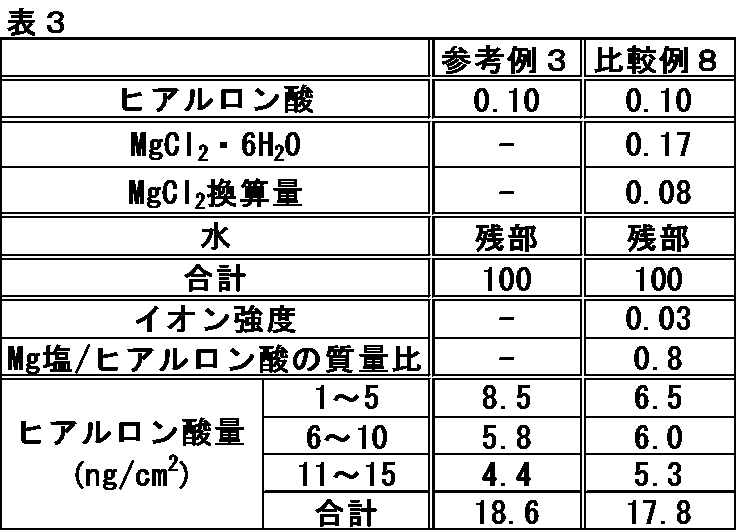
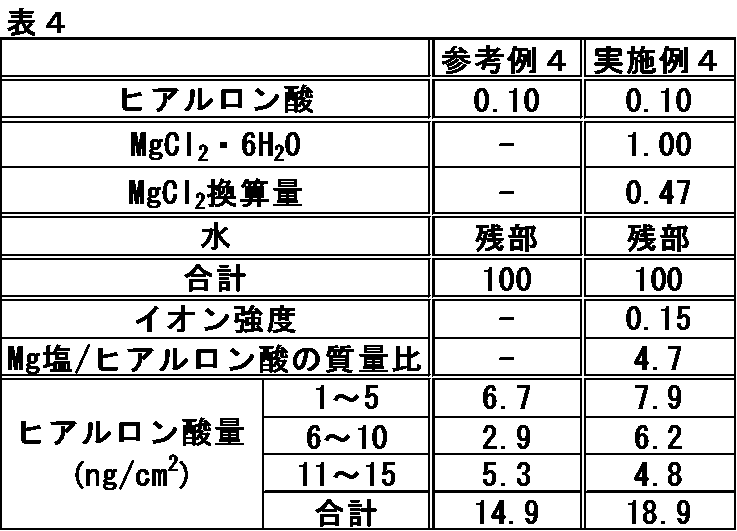
表2から明らかなように、参考例2及び比較例5~7に比べ、実施例2~3におけるヒアルロン酸量(合計量)が増加していることから、マグネシウム塩が所定の割合で含まれていると(すなわち、マグネシウム塩が0.01以上のイオン強度の濃度で含まれ、かつ、ヒアルロン酸に対するマグネシウム塩の質量比が1.0以上であると)、ヒアルロン酸の皮膚への浸透性が大幅に向上することが分かった。また、表3及び表4の結果より、この傾向は、ヒアルロン酸の配合量が低量であっても同様の傾向を示すことが確認できた。
試験例4では、上記の浸透性試験4に基づき、マグネシウム塩の配合割合の影響について検討した。その結果を表5に示す。なお、表5におけるヒアルロン酸量の数値は、12ウェルプレートによる4ウェル分のデータの平均値である。また、試験サンプル中のヒアルロン酸の配合量が低量(例えば0.10質量%程度)である場合、上記の浸透性試験3では評価できないおそれがある。したがって、ヒアルロン酸の配合量が低量の場合には、浸透性試験4で評価することが好ましい。
試験サンプルとして、MilliQ(商標)水(超純水)を使用した。
イオン交換水中にMgCl2・6H20を0.34質量%添加し、ボルテックスミキサーで攪拌混合し、MgCl2・6H20を溶解させて試験サンプルを調製した。
ヒアルロン酸(株式会社資生堂製、バイオヒアロ12:重量平均分子量120万)を、イオン交換水中に0.10質量%の含有量となるように添加し、ボルテックスミキサーで攪拌混合し、ヒアルロン酸を溶解させて試験サンプルを調製した。
ヒアルロン酸(株式会社資生堂製、バイオヒアロ12:重量平均分子量120万)を、イオン交換水中に0.10質量%の含有量となるように添加し、ボルテックスミキサーで攪拌混合して組成物Cを調製した。ヒアルロン酸を溶解させた後、組成物CにMgCl2・6H20を0.34質量%添加し、ボルテックスミキサーで攪拌混合して試験サンプルを調製した。
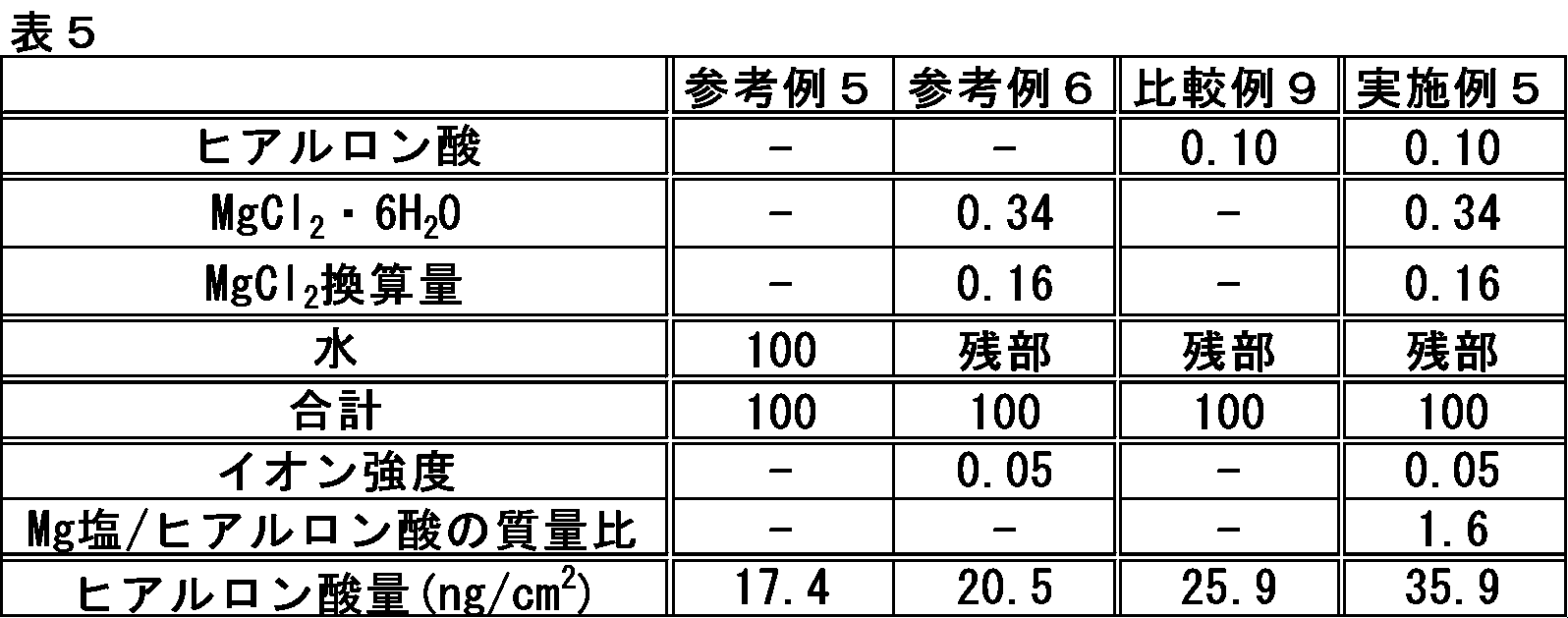
表5から分かるように、サンプル中のヒアルロン酸の配合量が低量であっても、マグネシウム塩が所定の割合で含まれていると(すなわち、マグネシウム塩が0.01以上のイオン強度の濃度で含まれ、かつ、ヒアルロン酸に対するマグネシウム塩の質量比が1.0以上であると)、ヒアルロン酸の皮膚への浸透性が向上することが分かった。
試験例5では、上記の浸透性試験5に基づき、1か月連用したときのヒアルロン酸の皮膚への浸透効果について検討した。その結果を表6及び図3に示す。なお、ヒアルロン酸量の数値は、パネル12名による結果の平均値である。
皮膚になにも適用しなかった部位におけるヒアルロン酸量を測定した。
ヒアルロン酸(株式会社資生堂製、バイオヒアロ12:重量平均分子量120万)を、イオン交換水中に0.50質量%の含有量となるように添加し、ボルテックスミキサーで攪拌混合して組成物Dを調製した。ヒアルロン酸を溶解させた後、組成物Dに、フェノキシエタノールを0.50質量%、エタノールを1.00質量%添加し、ボルテックスミキサーで攪拌混合して試験サンプルを調製した。
ヒアルロン酸(株式会社資生堂製、バイオヒアロ12:重量平均分子量120万)を、イオン交換水中に0.50質量%の含有量となるように添加し、ボルテックスミキサーで攪拌混合して組成物Dを調製した。ヒアルロン酸を溶解させた後、組成物Dに、MgCl2・6H20を1.42質量%、フェノキシエタノールを0.50質量%、エタノールを1.00質量%添加し、ボルテックスミキサーで攪拌混合して試験サンプルを調製した。

表6及び図3より、所定量のマグネシウム塩を用いて調製したヒアルロン酸を含む組成物を、皮膚に対して長期間連続して適用すると、ヒアルロン酸を好適に皮膚へ浸透させ得ることが分かった。
参考試験例1では、コンパクト化したヒアルロン酸の粒子径に及ぼす塩の種類及びヒアルロン酸濃度の影響について検討した。
ヒアルロン酸(株式会社資生堂製、バイオヒアロ12:重量平均分子量120万)を、イオン交換水中に0.50質量%の含有量となるように添加し、ボルテックスミキサーで攪拌混合して組成物Eを調製した。ヒアルロン酸を溶解させた後、組成物Eに塩化ナトリウムをイオン強度が0.20となるように添加し、ボルテックスミキサーで攪拌混合して試験サンプルを調製した。
塩化ナトリウムをMgCl2・6H20に代えたこと以外は、参考例8と同様にして参考例9の試験サンプルを調製した。
比較例9の試験サンプル(ヒアルロン酸:0.10質量%)を、参考例10の試験サンプルとして使用した。
実施例5の試験サンプル(ヒアルロン酸:0.10質量%、MgCl2・6H20:0.34質量%)を、参考例11の試験サンプルとして使用した。
参考例8及び9の結果より、0.50質量%のヒアルロン酸とナトリウム塩を用いて調製した場合、コンパクト化したヒアルロン酸の平均粒子径は、68.9nmであった。一方、0.50質量%のヒアルロン酸とマグネシウム塩を用いて調製した場合、コンパクト化したヒアルロン酸の平均粒子径は、295.9nmであった。
Claims (10)
- ヒアルロン酸、及びマグネシウム塩を含み、
前記マグネシウム塩が、0.01以上のイオン強度の濃度で含まれ、かつ、前記ヒアルロン酸に対する前記マグネシウム塩の質量比が、1.0以上である、
化粧料。 - 前記ヒアルロン酸が、前記化粧料の全量に対し、0.005質量%以上含まれている、請求項1に記載の化粧料。
- 前記マグネシウム塩が、塩化マグネシウムである、請求項1又は2に記載の化粧料。
- 前記ヒアルロン酸の重量平均分子量が、10,000,000以下である、請求項1又は2に記載の化粧料。
- 前記化粧料が、リーブオン型の化粧料である、請求項1又は2に記載の化粧料。
- 前記化粧料が、90以上のL値を呈する、請求項1又は2に記載の化粧料。
- ヒアルロン酸の体表又は体毛浸透用である、請求項1又は2に記載の化粧料。
- 請求項1又は2に記載の化粧料を体表又は体毛に適用することを含む、美容方法。
- 前記化粧料の体表又は体毛への適用が、2日以上実施される、請求項8に記載の美容方法。
- 前記化粧料の体表又は体毛への適用が、2日以上連続して実施される、請求項8に記載の美容方法。
Priority Applications (1)
| Application Number | Priority Date | Filing Date | Title |
|---|---|---|---|
| JP2024540244A JPWO2024034159A1 (ja) | 2022-08-09 | 2023-02-16 |
Applications Claiming Priority (2)
| Application Number | Priority Date | Filing Date | Title |
|---|---|---|---|
| JP2022127207 | 2022-08-09 | ||
| JP2022-127207 | 2022-08-09 |
Publications (1)
| Publication Number | Publication Date |
|---|---|
| WO2024034159A1 true WO2024034159A1 (ja) | 2024-02-15 |
Family
ID=89851304
Family Applications (1)
| Application Number | Title | Priority Date | Filing Date |
|---|---|---|---|
| PCT/JP2023/005463 Ceased WO2024034159A1 (ja) | 2022-08-09 | 2023-02-16 | 化粧料及び美容方法 |
Country Status (3)
| Country | Link |
|---|---|
| JP (1) | JPWO2024034159A1 (ja) |
| TW (1) | TW202406534A (ja) |
| WO (1) | WO2024034159A1 (ja) |
Citations (4)
| Publication number | Priority date | Publication date | Assignee | Title |
|---|---|---|---|---|
| JPH0840864A (ja) * | 1994-08-02 | 1996-02-13 | Kao Corp | 紫外線防御化粧料 |
| JP2007297460A (ja) * | 2006-04-28 | 2007-11-15 | Q P Corp | 新規なヒアルロン酸および/またはその塩、ならびにこれを用いた化粧料、医薬組成物、食品組成物、および化粧料キット |
| JP2021169433A (ja) * | 2020-04-16 | 2021-10-28 | ロート製薬株式会社 | 皮膚外用剤 |
| WO2022259901A1 (ja) * | 2021-06-11 | 2022-12-15 | 株式会社 資生堂 | ヒアルロン酸塩の皮膚浸透用化粧料 |
-
2023
- 2023-02-16 WO PCT/JP2023/005463 patent/WO2024034159A1/ja not_active Ceased
- 2023-02-16 JP JP2024540244A patent/JPWO2024034159A1/ja active Pending
- 2023-02-16 TW TW112105589A patent/TW202406534A/zh unknown
Patent Citations (4)
| Publication number | Priority date | Publication date | Assignee | Title |
|---|---|---|---|---|
| JPH0840864A (ja) * | 1994-08-02 | 1996-02-13 | Kao Corp | 紫外線防御化粧料 |
| JP2007297460A (ja) * | 2006-04-28 | 2007-11-15 | Q P Corp | 新規なヒアルロン酸および/またはその塩、ならびにこれを用いた化粧料、医薬組成物、食品組成物、および化粧料キット |
| JP2021169433A (ja) * | 2020-04-16 | 2021-10-28 | ロート製薬株式会社 | 皮膚外用剤 |
| WO2022259901A1 (ja) * | 2021-06-11 | 2022-12-15 | 株式会社 資生堂 | ヒアルロン酸塩の皮膚浸透用化粧料 |
Also Published As
| Publication number | Publication date |
|---|---|
| JPWO2024034159A1 (ja) | 2024-02-15 |
| TW202406534A (zh) | 2024-02-16 |
Similar Documents
| Publication | Publication Date | Title |
|---|---|---|
| JP4767914B2 (ja) | 皮膚をひきしめる効果のある化粧組成物 | |
| JP5032859B2 (ja) | 化粧料的に又は医薬的に活性な化合物を与えられている多孔性粒子 | |
| JPH05504757A (ja) | スキンケア製剤 | |
| US12364654B2 (en) | Method for manufacturing spicule coated with diamond and ingredients effective for skin improvement, and diamond spicule cosmetic composition including the same | |
| JP2002293718A (ja) | 化粧品または皮膚科用組成物中における抗刺激剤としての繊維の使用 | |
| KR102265497B1 (ko) | 클렌징 조성물 | |
| WO2021033725A1 (ja) | 化粧料 | |
| JP2983517B2 (ja) | 新規なサリチル酸誘導体及びその化粧用及び/または皮膚用組成物における使用 | |
| CN104519857B (zh) | 光彩组合物和使用方法 | |
| WO2015147137A1 (ja) | セラミド配合外用剤組成物 | |
| WO2022259901A1 (ja) | ヒアルロン酸塩の皮膚浸透用化粧料 | |
| JP2009234986A (ja) | 相乗効果水を含有する皮膚外用剤 | |
| US10959934B2 (en) | Micro- or nanoparticular vesicles comprising crosslinked hyaluronic acid, compositions comprising the same and method for their use in skin care | |
| CN120360880A (zh) | 活性肽组合物及其在制备抗衰除皱产品中的应用 | |
| TW202406534A (zh) | 化妝料及美容方法 | |
| KR20180111585A (ko) | 레티노이드의 활성을 개선하는 방법 | |
| JP7812810B2 (ja) | 化粧料 | |
| EP4628067A1 (en) | Composition | |
| US20190314649A1 (en) | Micro- or nanoparticular multilamellar vesicles, compositions comprising the same and method for their use in skin care | |
| JP2021514349A (ja) | 光散乱減少物質を含む肌の光学特性改善用の組成物 | |
| TWI807133B (zh) | 含接近飽和、飽和、或超飽和活性成分的溫和潔淨組合物及其製備方法 | |
| CA3013477C (en) | Moisturizing compositions and uses thereof | |
| JP4216866B2 (ja) | 皮膚化粧料 | |
| EP4108229A1 (en) | Mild cleansing composition containing nearly saturated, saturated or supersaturated active ingredients and preparation method therefor |
Legal Events
| Date | Code | Title | Description |
|---|---|---|---|
| 121 | Ep: the epo has been informed by wipo that ep was designated in this application |
Ref document number: 23852146 Country of ref document: EP Kind code of ref document: A1 |
|
| WWE | Wipo information: entry into national phase |
Ref document number: 2024540244 Country of ref document: JP Ref document number: 18992679 Country of ref document: US |
|
| NENP | Non-entry into the national phase |
Ref country code: DE |
|
| 122 | Ep: pct application non-entry in european phase |
Ref document number: 23852146 Country of ref document: EP Kind code of ref document: A1 |