WO2024024818A1 - 金属有機構造体の製造方法 - Google Patents
金属有機構造体の製造方法 Download PDFInfo
- Publication number
- WO2024024818A1 WO2024024818A1 PCT/JP2023/027321 JP2023027321W WO2024024818A1 WO 2024024818 A1 WO2024024818 A1 WO 2024024818A1 JP 2023027321 W JP2023027321 W JP 2023027321W WO 2024024818 A1 WO2024024818 A1 WO 2024024818A1
- Authority
- WO
- WIPO (PCT)
- Prior art keywords
- metal
- turbine
- stator
- stirrer
- solvent
- Prior art date
- Legal status (The legal status is an assumption and is not a legal conclusion. Google has not performed a legal analysis and makes no representation as to the accuracy of the status listed.)
- Ceased
Links
Images




Classifications
-
- C—CHEMISTRY; METALLURGY
- C08—ORGANIC MACROMOLECULAR COMPOUNDS; THEIR PREPARATION OR CHEMICAL WORKING-UP; COMPOSITIONS BASED THEREON
- C08G—MACROMOLECULAR COMPOUNDS OBTAINED OTHERWISE THAN BY REACTIONS ONLY INVOLVING UNSATURATED CARBON-TO-CARBON BONDS
- C08G83/00—Macromolecular compounds not provided for in groups C08G2/00 - C08G81/00
- C08G83/001—Macromolecular compounds containing organic and inorganic sequences, e.g. organic polymers grafted onto silica
-
- C—CHEMISTRY; METALLURGY
- C07—ORGANIC CHEMISTRY
- C07F—ACYCLIC, CARBOCYCLIC OR HETEROCYCLIC COMPOUNDS CONTAINING ELEMENTS OTHER THAN CARBON, HYDROGEN, HALOGEN, OXYGEN, NITROGEN, SULFUR, SELENIUM OR TELLURIUM
- C07F1/00—Compounds containing elements of Groups 1 or 11 of the Periodic Table
- C07F1/08—Copper compounds
-
- C—CHEMISTRY; METALLURGY
- C07—ORGANIC CHEMISTRY
- C07C—ACYCLIC OR CARBOCYCLIC COMPOUNDS
- C07C55/00—Saturated compounds having more than one carboxyl group bound to acyclic carbon atoms
- C07C55/02—Dicarboxylic acids
- C07C55/06—Oxalic acid
-
- C—CHEMISTRY; METALLURGY
- C07—ORGANIC CHEMISTRY
- C07C—ACYCLIC OR CARBOCYCLIC COMPOUNDS
- C07C57/00—Unsaturated compounds having carboxyl groups bound to acyclic carbon atoms
- C07C57/02—Unsaturated compounds having carboxyl groups bound to acyclic carbon atoms with only carbon-to-carbon double bonds as unsaturation
- C07C57/13—Dicarboxylic acids
- C07C57/15—Fumaric acid
-
- C—CHEMISTRY; METALLURGY
- C07—ORGANIC CHEMISTRY
- C07C—ACYCLIC OR CARBOCYCLIC COMPOUNDS
- C07C63/00—Compounds having carboxyl groups bound to a carbon atoms of six-membered aromatic rings
- C07C63/14—Monocyclic dicarboxylic acids
- C07C63/15—Monocyclic dicarboxylic acids all carboxyl groups bound to carbon atoms of the six-membered aromatic ring
- C07C63/24—1,3 - Benzenedicarboxylic acid
-
- C—CHEMISTRY; METALLURGY
- C07—ORGANIC CHEMISTRY
- C07C—ACYCLIC OR CARBOCYCLIC COMPOUNDS
- C07C63/00—Compounds having carboxyl groups bound to a carbon atoms of six-membered aromatic rings
- C07C63/307—Monocyclic tricarboxylic acids
-
- C—CHEMISTRY; METALLURGY
- C07—ORGANIC CHEMISTRY
- C07C—ACYCLIC OR CARBOCYCLIC COMPOUNDS
- C07C65/00—Compounds having carboxyl groups bound to carbon atoms of six—membered aromatic rings and containing any of the groups OH, O—metal, —CHO, keto, ether, groups, groups, or groups
- C07C65/01—Compounds having carboxyl groups bound to carbon atoms of six—membered aromatic rings and containing any of the groups OH, O—metal, —CHO, keto, ether, groups, groups, or groups containing hydroxy or O-metal groups
- C07C65/03—Compounds having carboxyl groups bound to carbon atoms of six—membered aromatic rings and containing any of the groups OH, O—metal, —CHO, keto, ether, groups, groups, or groups containing hydroxy or O-metal groups monocyclic and having all hydroxy or O-metal groups bound to the ring
-
- C—CHEMISTRY; METALLURGY
- C07—ORGANIC CHEMISTRY
- C07C—ACYCLIC OR CARBOCYCLIC COMPOUNDS
- C07C65/00—Compounds having carboxyl groups bound to carbon atoms of six—membered aromatic rings and containing any of the groups OH, O—metal, —CHO, keto, ether, groups, groups, or groups
- C07C65/01—Compounds having carboxyl groups bound to carbon atoms of six—membered aromatic rings and containing any of the groups OH, O—metal, —CHO, keto, ether, groups, groups, or groups containing hydroxy or O-metal groups
- C07C65/105—Compounds having carboxyl groups bound to carbon atoms of six—membered aromatic rings and containing any of the groups OH, O—metal, —CHO, keto, ether, groups, groups, or groups containing hydroxy or O-metal groups polycyclic
-
- C—CHEMISTRY; METALLURGY
- C07—ORGANIC CHEMISTRY
- C07F—ACYCLIC, CARBOCYCLIC OR HETEROCYCLIC COMPOUNDS CONTAINING ELEMENTS OTHER THAN CARBON, HYDROGEN, HALOGEN, OXYGEN, NITROGEN, SULFUR, SELENIUM OR TELLURIUM
- C07F1/00—Compounds containing elements of Groups 1 or 11 of the Periodic Table
- C07F1/005—Compounds containing elements of Groups 1 or 11 of the Periodic Table without C-Metal linkages
-
- C—CHEMISTRY; METALLURGY
- C07—ORGANIC CHEMISTRY
- C07F—ACYCLIC, CARBOCYCLIC OR HETEROCYCLIC COMPOUNDS CONTAINING ELEMENTS OTHER THAN CARBON, HYDROGEN, HALOGEN, OXYGEN, NITROGEN, SULFUR, SELENIUM OR TELLURIUM
- C07F11/00—Compounds containing elements of Groups 6 or 16 of the Periodic Table
- C07F11/005—Compounds containing elements of Groups 6 or 16 of the Periodic Table compounds without a metal-carbon linkage
-
- C—CHEMISTRY; METALLURGY
- C07—ORGANIC CHEMISTRY
- C07F—ACYCLIC, CARBOCYCLIC OR HETEROCYCLIC COMPOUNDS CONTAINING ELEMENTS OTHER THAN CARBON, HYDROGEN, HALOGEN, OXYGEN, NITROGEN, SULFUR, SELENIUM OR TELLURIUM
- C07F15/00—Compounds containing elements of Groups 8, 9, 10 or 18 of the Periodic Table
- C07F15/02—Iron compounds
- C07F15/025—Iron compounds without a metal-carbon linkage
-
- C—CHEMISTRY; METALLURGY
- C07—ORGANIC CHEMISTRY
- C07F—ACYCLIC, CARBOCYCLIC OR HETEROCYCLIC COMPOUNDS CONTAINING ELEMENTS OTHER THAN CARBON, HYDROGEN, HALOGEN, OXYGEN, NITROGEN, SULFUR, SELENIUM OR TELLURIUM
- C07F15/00—Compounds containing elements of Groups 8, 9, 10 or 18 of the Periodic Table
- C07F15/06—Cobalt compounds
- C07F15/065—Cobalt compounds without a metal-carbon linkage
-
- C—CHEMISTRY; METALLURGY
- C07—ORGANIC CHEMISTRY
- C07F—ACYCLIC, CARBOCYCLIC OR HETEROCYCLIC COMPOUNDS CONTAINING ELEMENTS OTHER THAN CARBON, HYDROGEN, HALOGEN, OXYGEN, NITROGEN, SULFUR, SELENIUM OR TELLURIUM
- C07F3/00—Compounds containing elements of Groups 2 or 12 of the Periodic Table
- C07F3/003—Compounds containing elements of Groups 2 or 12 of the Periodic Table without C-Metal linkages
-
- C—CHEMISTRY; METALLURGY
- C07—ORGANIC CHEMISTRY
- C07F—ACYCLIC, CARBOCYCLIC OR HETEROCYCLIC COMPOUNDS CONTAINING ELEMENTS OTHER THAN CARBON, HYDROGEN, HALOGEN, OXYGEN, NITROGEN, SULFUR, SELENIUM OR TELLURIUM
- C07F3/00—Compounds containing elements of Groups 2 or 12 of the Periodic Table
- C07F3/02—Magnesium compounds
-
- C—CHEMISTRY; METALLURGY
- C07—ORGANIC CHEMISTRY
- C07F—ACYCLIC, CARBOCYCLIC OR HETEROCYCLIC COMPOUNDS CONTAINING ELEMENTS OTHER THAN CARBON, HYDROGEN, HALOGEN, OXYGEN, NITROGEN, SULFUR, SELENIUM OR TELLURIUM
- C07F3/00—Compounds containing elements of Groups 2 or 12 of the Periodic Table
- C07F3/06—Zinc compounds
-
- C—CHEMISTRY; METALLURGY
- C07—ORGANIC CHEMISTRY
- C07F—ACYCLIC, CARBOCYCLIC OR HETEROCYCLIC COMPOUNDS CONTAINING ELEMENTS OTHER THAN CARBON, HYDROGEN, HALOGEN, OXYGEN, NITROGEN, SULFUR, SELENIUM OR TELLURIUM
- C07F5/00—Compounds containing elements of Groups 3 or 13 of the Periodic Table
- C07F5/06—Aluminium compounds
- C07F5/069—Aluminium compounds without C-aluminium linkages
-
- C—CHEMISTRY; METALLURGY
- C07—ORGANIC CHEMISTRY
- C07F—ACYCLIC, CARBOCYCLIC OR HETEROCYCLIC COMPOUNDS CONTAINING ELEMENTS OTHER THAN CARBON, HYDROGEN, HALOGEN, OXYGEN, NITROGEN, SULFUR, SELENIUM OR TELLURIUM
- C07F7/00—Compounds containing elements of Groups 4 or 14 of the Periodic Table
- C07F7/003—Compounds containing elements of Groups 4 or 14 of the Periodic Table without C-Metal linkages
Definitions
- the present invention relates to a method for producing a metal organic framework (MOF).
- MOF metal organic framework
- a metal-organic framework is a compound having a structure in which metal atoms are crosslinked with each other through organic ligands, and typically has porosity.
- a metal-organic framework having porosity is also called a porous coordination polymer (PCP).
- a liquid phase synthesis method such as a solution method, a hydrothermal method, a microwave method, and an ultrasonic method is used as a method for producing a metal-organic structure.
- a solid phase synthesis method using a mortar, a ball mill, etc. is sometimes used.
- a method for synthesizing metal-organic structures using a twin-screw kneading device called an extruder has also been reported.
- a metal-organic framework is formed by kneading a first reactant containing a specific metal ion donor and a second reactant containing a specific organic ligand under pressure and shear force. synthesized (Patent Document 1).
- Patent Document 2 This document mainly describes an embodiment in which a rotating thin film type high-speed stirrer (see Non-Patent Document 1) is applied to the production of a metal-organic structure. If such a method is adopted, it becomes possible to produce a high quality metal-organic structure in a short time.
- the present inventors have found that when employing the above method, it is necessary to use a device with a complicated configuration, and scale-up may be difficult.
- the aim of the present invention is to provide a simpler method for producing high quality metal-organic frameworks.
- the present inventors conducted extensive studies in order to solve the above problems. As a result, the present inventors discovered a new means of applying a turbine stator type high speed stirrer to material synthesis instead of a rotating thin film type high speed stirrer.
- the turbine stator type high-speed stirrer is a type of medialess disperser that has conventionally been used exclusively for dispersing and/or atomizing particles and droplets (see Non-Patent Document 1).
- aspects of the present invention are, for example, as follows.
- the solvent is a poor solvent for at least one of the metal ion donor and the polydentate ligand.
- the amount of the solvent is within the range of 25 to 2000% by weight based on the total amount of the metal ion donor and the polydentate ligand, according to any one of [1] to [3].
- manufacturing method [5] The manufacturing method according to any one of [1] to [4], which is carried out at a temperature below the normal boiling point of the solvent.
- the metal-organic framework is a porous coordination polymer.
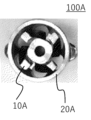
- FIG. 1A is a perspective view showing an example of a stirrer (homogen mixer) according to one embodiment of the present invention.
- FIG. 1B is a bottom view of the stirrer shown in FIG. 1A.
- FIG. 2 is a sectional view showing an example of use of the stirrer shown in FIGS. 1A and 1B.
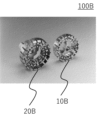
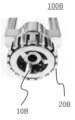
- FIG. 3A is an exploded perspective view showing an example of a stirrer (comb-teeth turbine stator) according to another aspect of the present invention.
- FIG. 3B is a bottom perspective view of the agitator shown in FIG. 3A in an assembled state.
- FIG. 4 is a sectional view showing an example of use of the stirrer shown in FIGS. 3A and 3B.
- FIG. 4 is a sectional view showing an example of use of the stirrer shown in FIGS. 3A and 3B.
- FIG. 4 is a sectional view showing an example of use of the stirrer shown in FIGS. 3A and 3B.
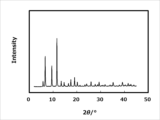
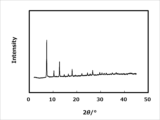
- FIG. 5A shows an XRD (X-ray diffraction) pattern of the metal organic framework (HKUST-1) synthesized under the conditions of Example 1.
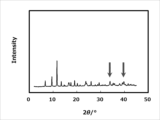
- FIG. 5B shows the XRD pattern of the metal-organic structure (HKUST-1) synthesized under the conditions of Comparative Example A2.
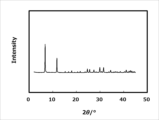
- FIG. 6A shows the XRD pattern of the metal-organic structure [MOF-74(Mg)] synthesized under the conditions of Example 7.
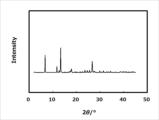
- FIG. 6B shows the XRD pattern of the metal-organic structure [MOF-74 (Mg)] synthesized under the conditions of Comparative Example A4.
- FIG. 5A shows an XRD (X-ray diffraction) pattern of the metal organic framework (HKUST-1) synthesized under the conditions of Example 1.
- FIG. 5B shows the XRD pattern of the metal-organic structure (HKUST-1) synthesized under the conditions of Comparative Example A2.
- FIG. 6A shows the XRD pattern of the metal-organic structure [MOF-74(
- FIG. 7A shows the XRD pattern of the metal-organic framework (ZIF-8) synthesized under the conditions of Example 12.
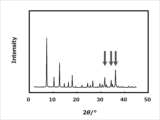
- FIG. 7B shows the XRD pattern of the metal-organic framework (ZIF-8) synthesized under the conditions of Comparative Example A13.
- FIG. 8A shows the XRD pattern of the metal-organic framework (ZIF-67) synthesized under the conditions of Example 26.
- FIG. 8B shows the XRD pattern of the metal-organic framework (ZIF-67) synthesized under the conditions of Comparative Example A32.
- a method for producing a metal-organic structure includes preparing a stirrer including a turbine and a stator surrounding the turbine; a metal ion donor, a polydentate ligand, and a solvent. preparing a composition comprising; in the agitator, rotating the turbine relative to the stator, thereby applying a shear force to the composition between the turbine and the stator; It includes adding and;
- This manufacturing method may include charging a separately prepared formulation into a reaction vessel. Alternatively, the manufacturing method may include forming the formulation within a reaction vessel by sequentially charging the components of the formulation into the reaction vessel.
- a high-speed stirrer known as a turbine/stator type stirrer can be used.
- the agitator includes a turbine and a stator surrounding the turbine. Further, in this stirrer, the turbine is configured to rotate relative to the stator. Thereby, the shearing force generated between the turbine and the stator can be strongly applied to the above-mentioned compound as a reactant.
- a homomixer or a comb-teeth type turbine stator can be used as the turbine/stator type stirrer.
- the agitator described above may be an in-line disperser or a combination agitator including a turbine/stator type agitator.
- the use of these stirrers as conventional medialess dispersers is described in detail in, for example, Non-Patent Document 1. Configuration examples of the homomixer and the comb-shaped turbine stator will be described below with reference to the drawings.
- FIG. 1A is a perspective view showing an example of a stirrer according to one embodiment of the present invention.
- FIG. 1B is a bottom view of the stirrer shown in FIG. 1A.
- the stirrer 100A illustrated in FIGS. 1A and 1B is a homomixer, and includes a turbine 10A and a stator 20A surrounding the turbine 10A.
- the turbine 10A is configured to be rotatable with respect to the stator 20A.
- FIG. 2 is a sectional view showing an example of the use of the stirrer shown in FIGS. 1A and 1B.
- the reaction apparatus 1A shown in FIG. 2 includes a stirrer 100A and a reaction container 200.
- Stirrer 100A includes a turbine 10A and a stator 20A.
- Turbine 10A and stator 20A are optionally connected to shaft 30A via bearing 40A.
- a commutation plate 50A is installed above the shaft 30A.
- the reaction apparatus 1A can have the same configuration as the case where the stirrer 100A is used as a medialess disperser, except that the contents of the formulation F described later are different.
- the turbine 10A, stator 20A, shaft 30A, and commutation plate 50A are typically made of an alloy such as stainless steel.
- the bearing 40A may be made of plastic such as Teflon (registered trademark), or may be made of an alloy such as stainless steel. In the former case, replacement when worn is easy. In the latter case, the possibility of contamination to the reaction system can be reduced.
- the compound F is introduced into the reaction vessel 200.
- the turbine 10A is rotated at high speed relative to the stator 20A.
- the mixture F is sucked from the lower part of the stator 20A, is ejected upward, collides with the commutator plate 50A, and flows into the reaction vessel. 200.
- a strong shearing force is applied to the compound F between the turbine 10A and the stator 20A.
- FIG. 3A is an exploded perspective view showing an example of a stirrer according to another aspect of the present invention.
- FIG. 3B is a bottom perspective view of the agitator shown in FIG. 3A in an assembled state.
- the stirrer 100B illustrated in FIGS. 3A and 3B is a comb-teeth turbine stator, and includes a turbine 10B and a stator 20B surrounding the turbine 10B.
- the turbine 10B is configured to be rotatable with respect to the stator 20B.
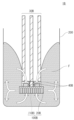
- FIG. 4 is a cross-sectional view (partial side view) showing an example of how the stirrer shown in FIGS. 3A and 3B is used.
- the reaction apparatus 1B shown in FIG. 4 includes a stirrer 100B and a reaction container 200.
- Stirrer 100B includes a turbine 10B (not shown) and a stator 20B.
- Turbine 10B and stator 20B are optionally connected to shaft 30B via bearing 40B.
- the reaction apparatus 1B can have the same configuration as the case where the stirrer 100B is used as a medialess dispersion machine, except that the content of the formulation F described later is different.
- the materials for the turbine 10B, stator 20B, shaft 30B, and bearing 40B may be the same as those previously described for the turbine 10A, stator 20A, shaft 30A, and bearing 40A, for example.
- the compound F is introduced into the reaction vessel 200.
- the turbine 10B is rotated at high speed relative to the stator 20B.
- the compound F is sucked from above and below the stator 20B, is ejected laterally from the comb-shaped slits, and is sprayed onto the wall surface of the reaction vessel 200. and circulates within the reaction vessel 200.
- a strong shearing force is applied to the compound F between the turbine 10B and the stator 20B. By applying such shear force, a desired metal-organic framework can be synthesized from Formulation F.
- the present inventors have also found that when the above-mentioned stirrer is used, scale-up is easier than when using, for example, a high-speed stirring blade or a stirrer.
- scaling up ie increasing the size of the reaction vessel
- the above-mentioned agitator when the above-mentioned agitator is used, the distance between the turbine and the stator (described later as "clearance") does not change even if the scale is increased. Therefore, when the above-mentioned stirrer is used, even when scaled up, it is possible to produce a high quality metal-organic structure in a high yield.
- Patent Document 2 also describes an embodiment in which a rotating thin film type high-speed stirrer is used in a continuous manner. In this case, scale-up is easier than when using this stirrer in a batch system.
- a rotating thin film type high-speed stirrer is used in a continuous manner.
- scale-up is easier than when using this stirrer in a batch system.
- embodiments of the invention using turbine/stator type agitators do not have such limitations. By keeping the amount of solvent low, it is possible to reduce the manufacturing cost of the metal-organic framework and the environmental impact caused by the synthesis.
- the shortest distance (clearance) between the turbine and the stator is, for example, within the range of 0.1 mm to 5 mm, preferably within the range of 0.3 mm to 1.5 mm. It is. If the clearance is too small, reactants will easily become clogged between the turbine and the stator. If the clearance is too large, the shear force applied to the reactants will be small, making it difficult to synthesize the metal-organic framework.
- turbine/stator type agitators examples include those shown in Table 1 below. These turbine/stator type agitators are commercially available for use in dispersing and/or atomizing particles and droplets. Note that these are merely examples, and other devices may be used as long as they include a turbine and a stator.
- the type of metal-organic structure produced there are no particular restrictions on the type of metal-organic structure produced.
- a metal-organic framework having a desired structure can be produced.
- the metal-organic framework may contain two or more types of metal elements and may contain two or more types of polydentate ligands.
- the metal-organic framework may further include monodentate ligands.
- the metal-organic framework may be porous. That is, the metal-organic framework may be a porous coordination polymer.
- metal-organic structures include those described in the following documents.
- Reference 1 Yabing He et al., Methane Storage in Metal-Organic Frameworks, Chem Soc Rev, 2014
- Reference 2 Jarad A. Mason et al., Evaluating metal-organic frameworks for natural gas storage, Chem. Sci., 2014, 5, 32-51
- Document 3 International Publication No. 2019/026872
- the compound used as a raw material for the metal-organic framework contains a metal ion donor, a polydentate ligand, and a solvent.
- a metal ion donor and the polydentate ligand any substance can be used as long as it is suitable as a combination for synthesizing the metal-organic framework.
- metal elements constituting the metal ion donor examples include any element belonging to alkali metals (Group 1), alkaline earth metals (Group 2), and transition metals (Groups 3 to 12). Can be mentioned.
- the metallic element is typically selected from the group consisting of magnesium, calcium, iron, aluminum, zinc, copper, nickel, cobalt, zirconium, and chromium.
- the metal ion donor may contain multiple metal elements. Alternatively, a plurality of metal ion donors containing different metal elements may be used together.
- a metal salt is typically used as the metal ion donor.
- the metal ion donor may be an organic salt or an inorganic salt.
- the metal ion donor is typically selected from the group consisting of hydroxide, carbonate, acetate, sulfate, nitrate and chloride salts.
- a plurality of metal ion donors containing the same metal element may be used together.
- the metal ion donor may be in the form of a so-called secondary building unit (SBU). As such a secondary structural unit, any one used in the synthesis of known metal-organic structures can be selected.
- SBU secondary building unit
- the polydentate ligand is typically an organic polydentate ligand, for example selected from the group consisting of carboxylic acid anions, amine compounds, sulfonic acid anions, phosphate anions, and heterocyclic compounds.
- carboxylic acid anion include dicarboxylic acid or tricarboxylic acid anions. Specific examples include anions of citric acid, malic acid, terephthalic acid, isophthalic acid, trimesic acid, and derivatives thereof.
- the heterocyclic compound include bipyridine, imidazole, adenine, and derivatives thereof. Multiple polydentate ligands may be used.
- the solvent is preferably a poor solvent for at least one of the metal ion donor and the polydentate ligand.
- the formulation does not become a complete solution, but becomes a semi-solid, typically a slurry, with some solids remaining. This makes it possible to apply shear force to the above-mentioned compound more effectively.
- solvents examples include, for example, water; alcohols such as methanol, ethanol, and isopropyl alcohol; carboxylic acids such as formic acid and acetic acid; N,N-dimethylformamide (DMF) and N,N-diethylformamide (DEF). ); and esters such as ethyl acetate. Mixtures of solvents may also be used.
- the above solvent has a Hildebrand solubility parameter of 9.0 or more.
- a Hildebrand solubility parameter of 9.0 or more.
- Table 2 is an example of Hildebrand solubility parameters for representative solvents. Note that when a mixed solvent is used, its Hildebrand solubility parameter is a weighted average value according to the mixing ratio.
- solvents with a Hildebrand solubility parameter of 9.0 or higher include tetrahydrofuran, chloroform, acetone, methylene chloride, ethylene dichloride, dioxane, isopropyl alcohol, ethanol, dimethylformamide, acetonitrile, acetic acid, dimethyl Includes sulfoxide, methanol, ethylene glycol, and water.
- the amount of the solvent is, for example, in the range of 25 to 2000% by weight, preferably in the range of 25 to 1000% by weight, based on the total amount of the metal ion donor and the polydentate ligand. If such a configuration is adopted, for example, the production efficiency of the metal-organic structure can be improved.
- embodiments of the invention that use a turbine/stator type agitator will have a lower amount of solvent (i.e., higher concentration of the formulation) compared to those that use a swirling thin film type high speed agitator.
- high quality metal-organic frameworks can be synthesized even when the amount of solvent is less than 100% by weight (eg, 25-100% by weight). By keeping the amount of solvent low, it is possible to reduce the manufacturing cost of the metal-organic framework and the environmental impact caused by the synthesis.
- the above formulations may further contain additional substances such as reaction accelerators.
- the reaction accelerator is, for example, a basic substance or an acidic substance, typically a basic substance.
- the basic substance include diethylamine, triethylamine, 2,6-lutidine, pyridine, imidazole, potassium hydroxide, and sodium hydroxide.
- acidic substances include formic acid, acetic acid, trifluoroacetic acid, sulfuric acid, nitric acid, hydrochloric acid, and phosphoric acid.
- a plurality of reaction accelerators may be used in combination as additional substances.
- reaction control agents may be added.
- the above production is preferably carried out while controlling the reaction temperature.
- the above mixing is preferably performed at a temperature below the normal boiling point of the solvent.
- the above mixing is performed at a temperature of, for example, 80°C or lower, preferably 60°C or lower. In this way, it becomes possible to produce a metal-organic structure with a suitable amount of the solvent remaining in the mixture.
- the rotation speed of the stirrer (that is, the rotation speed of the turbine) is, for example, 1000 to 20000 rpm, preferably 5000 to 15000 rpm.
- the number of rotations can be adjusted as appropriate depending on the concentration of the compound, etc. If the rotational speed is too low, insufficient shear force may be applied to the reactant formulation. If the rotation speed is excessively high, it may become difficult to control the temperature of the reaction system.
- Examples 1 to 30 Turbine/stator type high-speed stirrer
- the metal ion donor, polydentate ligand, solvent, and optionally reaction accelerator shown in Table 3 were placed in a batch-type reaction vessel.
- high-speed stirring was performed using a turbine/stator type high-speed stirrer (Homomixer MARKII 2.5 type: manufactured by Primix Co., Ltd., or Neokaiser (registered trademark): manufactured by Primix Co., Ltd.).
- a metal-organic structure was obtained.
- the Neo-Kaiser is a type of comb-shaped turbine stator described with reference to FIG.
- Comparative Examples A1 to A33 High-speed stirring blade or stirrer A metal ion donor, a polydentate ligand, a solvent, and optionally a reaction accelerator shown in Table 4 were placed in a batch-type reaction vessel. Next, high-speed stirring was performed under the reaction conditions shown in Table 4 using a high-speed stirring blade (Homo Disper: manufactured by Primix) or a commercially available stirrer.
- a high-speed stirring blade Homo Disper: manufactured by Primix
- a commercially available stirrer a commercially available stirrer.
- Comparative Examples B1 to B39 Rotating thin film type high speed stirrer
- the metal ion donor, polydentate ligand, solvent, and optionally reaction accelerator shown in Table 5 were mixed with a rotating thin film type high speed stirrer (Filmix (registered trademark)).
- Type 56-L manufactured by Primix Co., Ltd.
- high-speed stirring was performed under the reaction conditions shown in Table 5.
- the samples obtained by each of the above methods were dried under reduced pressure at room temperature for 24 hours using a vacuum desiccator (MVD-300; manufactured by As One Corporation).
- the dried sample was subjected to XRD (X-ray diffraction) measurement using an X-ray diffraction device (MiniFlex; manufactured by Rigaku Corporation).
- XRD X-ray diffraction
- MiniFlex manufactured by Rigaku Corporation
- BELPREP-vacIII gas adsorption pretreatment device
- BELSORP-miniX gas adsorption device
- the BET specific surface area (N 2 ; 77K) was measured using a truck (manufactured by Truck Bell).
- the quality of the obtained metal-organic structure was evaluated based on the presence or absence of a crystalline peak by XRD measurement and the size of the BET specific surface area S BET . These results are shown in Tables 3 to 5.
- BTC 1,3,5-benzenetricarboxylic acid (trimesic acid)
- 2,5-DHTP dihydroxyterephthalic acid
- 2-Mim or Mim 2-methylimidazole 1,3-BDC or iBDC: isophthalic acid
- DOBPDC 4,4'-dioxidobiphenyl-3,3'-dicarboxylic acid
- Im imidazole
- BIm benzimidazole 1,4-BDC or pBDC: terephthalic acid
- IPA isopropyl alcohol
- AcOH acetic acid
- TEA triethylamine
- DEA ditanolamine
- INA 4-pyridinecarboxylic acid
- ADC acetylene dicarboxylic acid
- DOT dihydroxyterephthalic acid
- BTC3Na 1, Trisodium 3,5-benzenetricarboxylate
- FIG. 5A shows the XRD pattern of the metal organic framework (HKUST-1) synthesized under the conditions of Example 1.
- FIG. 5B shows the XRD pattern of the metal-organic structure (HKUST-1) synthesized under the conditions of Comparative Example A2.
- the peak of copper (II) hydroxide indicated by two arrows, which is the raw material, remains.
- This result shows that a higher quality metal-organic structure (HKUST-1) is obtained when a homomixer is used than when a stirrer is used. This difference also appears as a difference in BET specific surface area.
- FIG. 6A shows the XRD pattern of the metal-organic framework [MOF-74(Mg)] synthesized under the conditions of Example 7.
- FIG. 6B shows the XRD pattern of the metal-organic structure [MOF-74 (Mg)] synthesized under the conditions of Comparative Example A4.
- a high-quality metal-organic framework was obtained under the former conditions, whereas under the latter conditions, a high-quality metal-organic structure was obtained. It can be seen that the metal-organic framework was not successfully synthesized under these conditions. This difference also appears as a difference in BET specific surface area.
- FIG. 7A shows the XRD pattern of the metal-organic framework (ZIF-8) synthesized under the conditions of Example 12.
- FIG. 7B shows the XRD pattern of the metal-organic framework (ZIF-8) synthesized under the conditions of Comparative Example A13.
- the peaks (indicated by three arrows) of zinc oxide, which is the raw material remain.
- This result shows that a metal-organic framework (ZIF-8) of higher quality is obtained when a homomixer is used compared to when a stirrer is used. This difference also appears as a difference in BET specific surface area.
- FIG. 8A shows the XRD pattern of the metal-organic framework (ZIF-67) synthesized under the conditions of Example 26.
- FIG. 8B shows the XRD pattern of the metal-organic framework (ZIF-67) synthesized under the conditions of Comparative Example A32.
- the peak of cobalt (II) hydroxide which is a raw material, remains (indicated by one arrow).
- This result shows that a metal-organic framework (ZIF-67) of higher quality is obtained when a homomixer is used than when a homodisper is used. This difference also appears as a difference in BET specific surface area.
Landscapes
- Chemical & Material Sciences (AREA)
- Organic Chemistry (AREA)
- Inorganic Chemistry (AREA)
- Health & Medical Sciences (AREA)
- Chemical Kinetics & Catalysis (AREA)
- Medicinal Chemistry (AREA)
- Polymers & Plastics (AREA)
- Mixers Of The Rotary Stirring Type (AREA)
Priority Applications (4)
| Application Number | Priority Date | Filing Date | Title |
|---|---|---|---|
| CN202380056845.XA CN119630635A (zh) | 2022-07-28 | 2023-07-26 | 制备金属有机框架的方法 |
| JP2024537772A JPWO2024024818A1 (cg-RX-API-DMAC7.html) | 2022-07-28 | 2023-07-26 | |
| EP23846548.8A EP4563567A4 (en) | 2022-07-28 | 2023-07-26 | PROCESS FOR PRODUCING AN ORGANOMETALLIC STRUCTURE |
| US18/998,132 US20260109718A1 (en) | 2022-07-28 | 2023-07-26 | Method for producing metal-organic structure |
Applications Claiming Priority (2)
| Application Number | Priority Date | Filing Date | Title |
|---|---|---|---|
| JP2022120380 | 2022-07-28 | ||
| JP2022-120380 | 2022-07-28 |
Publications (1)
| Publication Number | Publication Date |
|---|---|
| WO2024024818A1 true WO2024024818A1 (ja) | 2024-02-01 |
Family
ID=89706478
Family Applications (1)
| Application Number | Title | Priority Date | Filing Date |
|---|---|---|---|
| PCT/JP2023/027321 Ceased WO2024024818A1 (ja) | 2022-07-28 | 2023-07-26 | 金属有機構造体の製造方法 |
Country Status (5)
| Country | Link |
|---|---|
| US (1) | US20260109718A1 (cg-RX-API-DMAC7.html) |
| EP (1) | EP4563567A4 (cg-RX-API-DMAC7.html) |
| JP (1) | JPWO2024024818A1 (cg-RX-API-DMAC7.html) |
| CN (1) | CN119630635A (cg-RX-API-DMAC7.html) |
| WO (1) | WO2024024818A1 (cg-RX-API-DMAC7.html) |
Citations (6)
| Publication number | Priority date | Publication date | Assignee | Title |
|---|---|---|---|---|
| JP2016522834A (ja) * | 2013-05-27 | 2016-08-04 | ザ クイーンズ ユニバーシティ オブ ベルファスト | 有機金属化合物の製造方法 |
| CN106893109A (zh) * | 2017-02-17 | 2017-06-27 | 中国石油大学(华东) | 一种梯级孔结构的金属有机框架化合物的连续合成方法 |
| JP2018076243A (ja) * | 2016-11-08 | 2018-05-17 | コニカミノルタ株式会社 | 超分子金属錯体粒子、フィルム及び超分子金属錯体粒子の製造方法 |
| JP2018538284A (ja) * | 2015-11-27 | 2018-12-27 | ビーエーエスエフ ソシエタス・ヨーロピアBasf Se | 金属−有機骨格体の超高速高空時収量合成 |
| WO2019026872A1 (ja) | 2017-07-31 | 2019-02-07 | 株式会社Atomis | ガス貯蔵容器 |
| WO2020230820A1 (ja) * | 2019-05-14 | 2020-11-19 | 株式会社Atomis | 金属有機構造体の製造方法 |
Family Cites Families (2)
| Publication number | Priority date | Publication date | Assignee | Title |
|---|---|---|---|---|
| JPS5441985A (en) * | 1977-09-09 | 1979-04-03 | Mitsui Petrochem Ind Ltd | Polymerization or copolymerization of olefin |
| KR100967335B1 (ko) * | 2005-05-09 | 2010-07-05 | 후지필름 가부시키가이샤 | 유기 입자의 제조 방법 및 그에 사용되는 제조 장치 |
-
2023
- 2023-07-26 JP JP2024537772A patent/JPWO2024024818A1/ja active Pending
- 2023-07-26 WO PCT/JP2023/027321 patent/WO2024024818A1/ja not_active Ceased
- 2023-07-26 US US18/998,132 patent/US20260109718A1/en active Pending
- 2023-07-26 CN CN202380056845.XA patent/CN119630635A/zh active Pending
- 2023-07-26 EP EP23846548.8A patent/EP4563567A4/en active Pending
Patent Citations (7)
| Publication number | Priority date | Publication date | Assignee | Title |
|---|---|---|---|---|
| JP2016522834A (ja) * | 2013-05-27 | 2016-08-04 | ザ クイーンズ ユニバーシティ オブ ベルファスト | 有機金属化合物の製造方法 |
| US9815222B2 (en) | 2013-05-27 | 2017-11-14 | The Queen's University Of Belfast | Process for the preparation of a metal-organic compound |
| JP2018538284A (ja) * | 2015-11-27 | 2018-12-27 | ビーエーエスエフ ソシエタス・ヨーロピアBasf Se | 金属−有機骨格体の超高速高空時収量合成 |
| JP2018076243A (ja) * | 2016-11-08 | 2018-05-17 | コニカミノルタ株式会社 | 超分子金属錯体粒子、フィルム及び超分子金属錯体粒子の製造方法 |
| CN106893109A (zh) * | 2017-02-17 | 2017-06-27 | 中国石油大学(华东) | 一种梯级孔结构的金属有机框架化合物的连续合成方法 |
| WO2019026872A1 (ja) | 2017-07-31 | 2019-02-07 | 株式会社Atomis | ガス貯蔵容器 |
| WO2020230820A1 (ja) * | 2019-05-14 | 2020-11-19 | 株式会社Atomis | 金属有機構造体の製造方法 |
Non-Patent Citations (8)
| Title |
|---|
| ANONYMOUS: "Laboratory Mixers, High-speed pilot-scale disperser", SILVERSON, 15 September 2021 (2021-09-15), XP093133097, Retrieved from the Internet <URL:https://web.archive.org/web/20210916192626/https://www.silverson.co.jp/jp/products/laboratory-mixers/> [retrieved on 20240220] * |
| ANONYMOUS: "What is the new stirring technology filmix(R)? | Learning about stirring", PRIMIX, 1 December 2011 (2011-12-01), XP093133100, Retrieved from the Internet <URL:https://www.primix.jp/mixer_lecture/vol4/01.html> [retrieved on 20240220] * |
| HARUO SHIBUYA: "Media-less Dispersion Machines", J. JPN. SOC. COLOUR MATER, vol. 86, no. 7, 2013, pages 265 - 269, XP093133105 |
| JARAD A. MASON ET AL.: "Evaluating Metal-Organic Frameworks for natural gas storage", CHEM. SCI, vol. 5, 2014, pages 32 - 51, XP055193816, DOI: 10.1039/C3SC52633J |
| See also references of EP4563567A4 |
| SHIBUTANI HARUO: "The Media-Less Dispersion Machines", J. JPN. SOC. COLOUR MATER, vol. 86, no. 7, 1 January 2013 (2013-01-01), pages 265 - 269, XP093133105 * |
| YABING HE ET AL.: "Methane Storage in Metal-Organic Frameworks", CHEM SOC REV, 2014 |
| YICHANG PAN, YUNYANG LIU, GAOFENG ZENG, LAN ZHAO, ZHIPING LAI: "Rapid synthesis of zeolitic imidazolate framework-8 (ZIF-8) nanocrystals in an aqueous system", CHEMICAL COMMUNICATIONS, ROYAL SOCIETY OF CHEMISTRY, vol. 47, no. 7, 1 January 2011 (2011-01-01), pages 2071, XP055111932, ISSN: 13597345, DOI: 10.1039/c0cc05002d * |
Also Published As
| Publication number | Publication date |
|---|---|
| JPWO2024024818A1 (cg-RX-API-DMAC7.html) | 2024-02-01 |
| US20260109718A1 (en) | 2026-04-23 |
| EP4563567A4 (en) | 2026-07-29 |
| EP4563567A1 (en) | 2025-06-04 |
| CN119630635A (zh) | 2025-03-14 |
Similar Documents
| Publication | Publication Date | Title |
|---|---|---|
| CN113825738B (zh) | 用于生产金属有机骨架的方法 | |
| Ye et al. | Synthesis of Zn-based metal–organic frameworks in ionic liquid microemulsions at room temperature | |
| Ganta et al. | Nanoscale metallogel via self-assembly of self-assembled trinuclear coordination rings: multi-stimuli-responsive soft materials | |
| Elsaidi et al. | 3D printed MOF-based mixed matrix thin-film composite membranes | |
| CN106925772A (zh) | 微/纳米核壳结构复合材料的制备方法 | |
| EP3170927A1 (en) | Method for preparing single crystal zinc oxide nanoparticles | |
| CN112934271B (zh) | 一种金属-有机骨架的多孔纳米线及其制备方法和应用 | |
| KR20160011191A (ko) | 금속-유기 화합물의 제조 방법 | |
| CN108654696A (zh) | 四氧化三钴@hkust-1型核壳结构复合材料及制备方法 | |
| EP3012019B1 (en) | Particle production device and particle production method using same | |
| CN117843985A (zh) | 一种Co基MOF材料的绿色合成方法 | |
| Murillo et al. | Tin‐Carboxylate MOFs for Sugar Transformation into Methyl Lactate | |
| KR100204729B1 (ko) | 아크롤레인 부분산화용 촉매의 제조 방법 | |
| Salami et al. | Recent advances in liquid assisted grinding chemistry: towards sustainable synthesis | |
| CN112592491A (zh) | 一种基于离子液体微乳液的金属有机框架的制备方法 | |
| EP4563567A1 (en) | Method for producing metal-organic structure | |
| CN111363190A (zh) | 一种利用离子液体体系中微区调控mof材料孔性质的方法 | |
| KR20120022583A (ko) | 가수분해 세팅 조성물을 위한 조절된 입자형태를 가지는 폴리사카라이드 유도체 | |
| WO2019057050A1 (zh) | 一种多孔复合骨架材料的浆态合成方法 | |
| CN121108517A (zh) | 一种双形貌含硼Zn/Cu金属有机框架复合材料及其制备和应用 | |
| CN105834454A (zh) | 一种银纳米线的制备方法 | |
| JP2000313793A (ja) | ポリエステル樹脂水分散体及びそれから得られる被膜形成物 | |
| CN105582926A (zh) | 对苯二甲酸加氢催化剂 | |
| US9570754B2 (en) | Process for producing anode material for solid oxide fuel cell | |
| CN115286028B (zh) | 一种不使用添加剂合成高分散纳米碳酸钙制备方法及装置 |
Legal Events
| Date | Code | Title | Description |
|---|---|---|---|
| 121 | Ep: the epo has been informed by wipo that ep was designated in this application |
Ref document number: 23846548 Country of ref document: EP Kind code of ref document: A1 |
|
| WWE | Wipo information: entry into national phase |
Ref document number: 2024537772 Country of ref document: JP |
|
| WWE | Wipo information: entry into national phase |
Ref document number: 202380056845.X Country of ref document: CN |
|
| WWE | Wipo information: entry into national phase |
Ref document number: 2023846548 Country of ref document: EP |
|
| NENP | Non-entry into the national phase |
Ref country code: DE |
|
| ENP | Entry into the national phase |
Ref document number: 2023846548 Country of ref document: EP Effective date: 20250228 |
|
| WWP | Wipo information: published in national office |
Ref document number: 202380056845.X Country of ref document: CN |
|
| WWP | Wipo information: published in national office |
Ref document number: 2023846548 Country of ref document: EP |