WO2024024531A1 - タイヤ用ゴム積層体の加硫方法、及びリトレッドタイヤの製造方法 - Google Patents
タイヤ用ゴム積層体の加硫方法、及びリトレッドタイヤの製造方法 Download PDFInfo
- Publication number
- WO2024024531A1 WO2024024531A1 PCT/JP2023/025968 JP2023025968W WO2024024531A1 WO 2024024531 A1 WO2024024531 A1 WO 2024024531A1 JP 2023025968 W JP2023025968 W JP 2023025968W WO 2024024531 A1 WO2024024531 A1 WO 2024024531A1
- Authority
- WO
- WIPO (PCT)
- Prior art keywords
- rubber
- rubber layer
- tire
- laminate
- vulcanized
- Prior art date
- Legal status (The legal status is an assumption and is not a legal conclusion. Google has not performed a legal analysis and makes no representation as to the accuracy of the status listed.)
- Ceased
Links
Images
Classifications
-
- B—PERFORMING OPERATIONS; TRANSPORTING
- B29—WORKING OF PLASTICS; WORKING OF SUBSTANCES IN A PLASTIC STATE IN GENERAL
- B29D—PRODUCING PARTICULAR ARTICLES FROM PLASTICS OR FROM SUBSTANCES IN A PLASTIC STATE
- B29D30/00—Producing pneumatic or solid tyres or parts thereof
- B29D30/06—Pneumatic tyres or parts thereof (e.g. produced by casting, moulding, compression moulding, injection moulding, centrifugal casting)
- B29D30/52—Unvulcanised treads, e.g. on used tyres; Retreading
- B29D30/54—Retreading
- B29D30/56—Retreading with prevulcanised tread
-
- C—CHEMISTRY; METALLURGY
- C08—ORGANIC MACROMOLECULAR COMPOUNDS; THEIR PREPARATION OR CHEMICAL WORKING-UP; COMPOSITIONS BASED THEREON
- C08J—WORKING-UP; GENERAL PROCESSES OF COMPOUNDING; AFTER-TREATMENT NOT COVERED BY SUBCLASSES C08B, C08C, C08F, C08G or C08H
- C08J3/00—Processes of treating or compounding macromolecular substances
- C08J3/24—Crosslinking, e.g. vulcanising, of macromolecules
-
- C—CHEMISTRY; METALLURGY
- C08—ORGANIC MACROMOLECULAR COMPOUNDS; THEIR PREPARATION OR CHEMICAL WORKING-UP; COMPOSITIONS BASED THEREON
- C08J—WORKING-UP; GENERAL PROCESSES OF COMPOUNDING; AFTER-TREATMENT NOT COVERED BY SUBCLASSES C08B, C08C, C08F, C08G or C08H
- C08J3/00—Processes of treating or compounding macromolecular substances
- C08J3/28—Treatment by wave energy or particle radiation
Definitions
- the present invention relates to a method of vulcanizing a rubber laminate for tires and a method of manufacturing a retread tire.
- Patent Document 1 discloses that the total heating time can be shortened by using microwave energy for at least part of the thermal energy required in manufacturing a pneumatic tire.
- Patent Document 1 heating by microwave energy is finished before the start of the vulcanization reaction.
- the vulcanization reaction was performed by irradiating microwaves, it was extremely difficult to control the vulcanization reaction, and there were problems such as uneven vulcanization and local scorching. was there. Due to such problems of uneven vulcanization, rubber vulcanization using microwaves has not yet been fully put into practical use, and the use of microwaves is limited to preheating before vulcanization. There was a situation.
- a precure tread (vulcanized rubber layer) on which a tread pattern has already been formed is placed on a stand tire (the base part of a tire whose primary life has ended) and a cushion rubber (unvulcanized rubber layer)
- a cushion rubber unvulcanized rubber layer
- the cushion rubber is vulcanized and bonded by attaching the cushion rubber through a rubber cushion.
- precure manufacturing method there is also a need for a technique for efficiently and uniformly vulcanizing the cushion rubber to be vulcanized using microwaves.
- the present invention is capable of uniformly vulcanizing a tire rubber laminate in which an unvulcanized rubber layer and a vulcanized rubber layer are laminated by microwave irradiation, thereby improving the rubber strength.
- An object of the present invention is to provide a method for vulcanizing a rubber laminate for tires.
- Another object of the present invention is to provide a method for manufacturing a retread tire that makes it possible to obtain a uniformly vulcanized retread tire.
- the present inventors focused on the fact that carbon black can serve as a heating element with excellent microwave absorption characteristics, and conducted extensive studies. They have also discovered that when heating (vulcanizing) a rubber composition containing carbon black by microwave irradiation, uniform vulcanization can be achieved by sweeping the frequency of the microwave in a predetermined manner. Furthermore, based on this knowledge, when vulcanizing a laminate comprising an unvulcanized rubber layer and a vulcanized rubber layer, it has been found that by vulcanizing the laminate in a predetermined manner, efficient and uniform vulcanization can be achieved. This finding led to the present invention.
- the gist of the present invention for achieving the above object is as follows.
- a method for vulcanizing a rubber laminate for tires which vulcanizes a rubber laminate for tires in which an unvulcanized rubber layer and a vulcanized rubber layer are laminated by irradiating microwaves,
- the unvulcanized rubber layer contains diene rubber and carbon black
- the vulcanized rubber layer contains a diene rubber and silica, and the content of the silica in the vulcanized rubber layer is 10 parts by mass or more based on 100 parts by mass of the diene rubber
- the frequency of the microwave irradiated to the tire rubber laminate is changed every time a time interval selected from the range of more than 0 ⁇ sec and less than 100 ⁇ sec, and the frequency change width is selected from the range of more than 0 Hz and less than 1000 Hz.
- a method for vulcanizing a rubber laminate for tires characterized by changing the frequency.
- a method for manufacturing a retread tire including a step of attaching a precure tread, which is a vulcanized rubber layer, to a stand tire via a cushion rubber, which is an unvulcanized rubber layer, and vulcanizing and adhering the cushion rubber. And, A method for manufacturing a retread tire, characterized in that, in the step, the method for vulcanizing a rubber laminate for tires according to any one of [1] to [6] is used.
- a rubber laminate for a tire in which an unvulcanized rubber layer and a vulcanized rubber layer are laminated can be uniformly vulcanized by microwave irradiation, and the rubber strength can be improved.
- a method for vulcanizing a rubber laminate for tires can be provided. Further, according to the present invention, it is possible to provide a method for manufacturing a retread tire, which makes it possible to obtain a uniformly vulcanized retread tire.
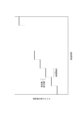
- FIG. 2 is a schematic diagram showing an example of a frequency sweep pattern of microwaves applied to a tire rubber laminate according to the present invention.
- a method for vulcanizing a rubber laminate for tires according to an embodiment of the present invention (hereinafter sometimes referred to as "vulcanization method according to the present embodiment") is a method for vulcanizing a rubber laminate for tires by irradiating microwaves. This is a method of vulcanization.
- the tire rubber laminate used in the vulcanization method of the present embodiment is formed by laminating an unvulcanized rubber layer and a vulcanized rubber layer, and the unvulcanized rubber layer contains diene rubber and carbon black.
- the vulcanized rubber layer contains diene rubber and silica, and the silica content in the vulcanized rubber layer is 10 parts by mass or more based on 100 parts by mass of the diene rubber.
- the frequency of the microwave irradiated to the tire rubber laminate is changed to a frequency of more than 0 Hz at every elapse of a time interval selected from a range of more than 0 ⁇ sec and less than or equal to 100 ⁇ sec.
- the frequency is changed by a frequency change width selected from a range of 1000 Hz or less.
- the vulcanization method of the present embodiment selectively and uniformly vulcanizes the unvulcanized rubber layer of the tire rubber laminate while maintaining the quality of other members (vulcanized rubber layer, etc.) This is based on the technical idea of
- microwave refers to electromagnetic waves with a frequency of 300 MHz to 300 GHz.
- unvulcanized rubber layer refers to a layered member made from a rubber composition and not subjected to vulcanization treatment
- vulcanized rubber layer refers to a layered member made from a rubber composition. This refers to a layered member that has been made from and has already been subjected to vulcanization treatment.
- FIG. 1 is a schematic diagram showing an example of a frequency sweep pattern of microwaves applied to a tire rubber laminate according to the vulcanization method of the present embodiment.
- the frequency of the microwave irradiated to the tire rubber laminate is increased by a certain frequency change width (F) every time a certain time interval (T) passes. .
- the present inventors think as follows about the mechanism by which a tire rubber laminate, particularly an unvulcanized rubber layer, can be uniformly vulcanized by the vulcanization method of the present embodiment.
- a rubber composition containing carbon black is irradiated with microwaves
- the rubber composition is directly irradiated with microwaves
- the rubber composition is irradiated with microwaves that are reflected at least once within a microwave generator.
- Interference effects occur due to the microwaves generated.
- the frequency of microwaves is constant, areas where interference is likely to occur and areas where interference is unlikely to occur will be fixedly unevenly distributed in the rubber composition, resulting in overheating in some areas and underheating in other areas.
- a situation may arise where: This situation becomes particularly noticeable at temperatures of 100° C. or higher, where crosslinking reactions occur, and is thought to result in non-uniform vulcanization.
- the frequency of the irradiated microwave is swept in a predetermined manner, so that local concentration of energy absorption in the rubber composition can be effectively avoided. ) is considered to be able to be made uniform.
- the vulcanization method of this embodiment it is not essential to move or rotate the object to be heated within the apparatus for the purpose of avoiding uneven heating (as in a turntable microwave oven).
- the vulcanized rubber layer in the rubber laminate for tires contains silica, and such silica has little effect on microwave irradiation, such as heat generation. Therefore, in the vulcanization method of this embodiment, the unvulcanized rubber layer can be uniformly vulcanized while the quality of the vulcanized rubber layer is sufficiently maintained.
- VFM variable frequency microwave generator
- the time interval (T) is the time between timings at which the frequency is changed, or in other words, the time at which microwaves of a constant frequency are irradiated.
- the time interval (T) is selected from a range of more than 0 ⁇ sec and less than 100 ⁇ sec. If the time interval (T) exceeds 100 ⁇ sec, there is a possibility that concentration of heat in some parts of the rubber composition cannot be sufficiently suppressed. Further, the lower limit of the time interval (T) may be more than 0 ⁇ sec, and may be adjusted as appropriate depending on the specifications of the device used.
- the time interval (T) is preferably 1 ⁇ sec or more from the viewpoint of efficiency of microwave irradiation. From the same viewpoint, the time interval (T) is preferably selected from the range of 3 to 50 ⁇ sec, more preferably selected from the range of 5 to 30 ⁇ sec, and more preferably selected from the range of 10 to 25 ⁇ sec. More preferred.
- the time interval (T) may be constant each time as shown in FIG. 1, or may be different each time. However, in the vulcanization method of this embodiment, it is preferable that the time interval (T) is constant each time from the viewpoint of achieving uniform vulcanization more effectively.
- the frequency change width (F) is selected from a range of more than 0 Hz and less than 1000 Hz. If the frequency does not change at all (if the frequency change width (F) is 0 Hz), heat will be concentrated in some parts of the rubber composition. Furthermore, if the frequency change width (F) exceeds 1000 Hz, the stability of microwave irradiation may deteriorate, which may adversely affect uniform vulcanization. From the same viewpoint, the frequency change width (F) is preferably selected from the range of 10 to 500 Hz, more preferably selected from the range of 50 to 350 Hz, and preferably selected from the range of 100 to 260 Hz. is even more preferable.
- the frequency change width (F) may be constant each time as shown in FIG. 1, or may be different each time. However, in the vulcanization method of this embodiment, it is preferable that the frequency change width (F) is constant each time from the viewpoint of achieving uniform vulcanization more effectively.
- the frequency change by the frequency change width (F) may be increased every time as shown in FIG. 1, or may be decreased every time. , the increase or decrease may be different each time. However, in the vulcanization method of this embodiment, it is preferable to increase the frequency by the frequency change width (F) each time.
- variable frequency microwave generators usually have upper and lower limits of variable frequency based on the device specifications. Therefore, if such a variable frequency microwave generator is used and the frequency is increased each time, the frequency may reach the upper limit of the variable frequency or its vicinity. In this case, once the frequency is switched to the lower limit of the variable frequency or around it, the frequency may be increased again each time. A similar method may be used when lowering the frequency each time.
- the frequency range of the microwave is not particularly limited, and may be selected as appropriate based on the specifications of the microwave generator used (in particular, the type of oscillator or amplifier). can.
- the duration of the operation of irradiating microwaves while sweeping the frequency in a predetermined manner is preferably 100 seconds or more, and preferably 200 seconds or more, although it is not particularly limited. More preferably, it is still more preferably 300 seconds or more. In this case, the degree of vulcanization of the rubber composition can be more fully increased.
- the temperature of the tire rubber laminate, particularly the unvulcanized rubber layer may be monitored while irradiating microwaves while sweeping the frequency in a predetermined manner, although this is not particularly limited. good.
- the rate of temperature increase of the tire rubber laminate, particularly the unvulcanized rubber layer may be controlled when irradiating with microwaves.
- the temperature increase rate can be controlled, for example, by finely adjusting the microwave irradiation output (W).
- W microwave irradiation output
- the control method for the temperature increase rate is not particularly limited, but may be PID control.
- the temperature increase rate can also be controlled by switching on/off the microwave irradiation.
- the temperature increase rate can be selected, for example, from a range of 0.05° C./second to 0.5° C./second.
- the highest temperature (so-called vulcanization temperature) when actually vulcanizing the tire rubber laminate is not particularly limited, and can be appropriately selected depending on the purpose.
- the temperature is preferably 140°C or higher, preferably 190°C or lower, and more preferably 160°C or lower.
- the vulcanization method of the present embodiment may be carried out with the tire rubber laminate to be vulcanized placed on an arbitrary member (for example, a stand tire, etc.).
- the tire rubber laminate to be vulcanized used in the vulcanization method of the present embodiment includes at least an unvulcanized rubber layer and a vulcanized rubber layer.
- the unvulcanized rubber layer may be a single layer, or may be two or more layers.
- the vulcanized rubber layer may be one layer alone, or may be two or more layers.
- the rubber laminate for a tire to be vulcanized may include other layered members (for example, a stand tire, etc.) in addition to the unvulcanized rubber layer and the vulcanized rubber layer. In that case, the unvulcanized rubber layer can be placed in contact with or closer to the other members.
- the other members may include metal parts (for example, steel cords, etc.).
- it is preferable that the unvulcanized rubber layer and the vulcanized rubber layer are in contact with each other.
- the unvulcanized rubber layer which is a part of the tire rubber laminate, contains at least diene rubber and carbon black. Further, the unvulcanized rubber layer may further contain a vulcanizing agent, a vulcanization accelerator, other components, etc., as necessary.
- diene rubber examples include natural rubber (NR), butadiene rubber (BR), isoprene rubber (IR), styrene-butadiene rubber (SBR), ethylene-propylene-diene rubber (EPDM), chloroprene rubber (CR), and halogen rubber.
- NR natural rubber
- BR butadiene rubber
- IR isoprene rubber
- SBR styrene-butadiene rubber
- EPDM ethylene-propylene-diene rubber
- CR chloroprene rubber
- halogen rubber butyl rubber, acrylonitributylene butadiene rubber (NBR), and the like.
- NBR acrylonitributylene butadiene rubber
- At least one of natural rubber, butadiene rubber, isoprene rubber, and styrene-butadiene rubber is used as the diene rubber. It is preferable to use
- Examples of the carbon black contained in the unvulcanized rubber layer include GPF, FEF, HAF, ISAF, and SAF grade carbon black. These carbon blacks may be used alone or in combination of two or more. Further, the carbon black in the unvulcanized rubber layer preferably includes carbon black A having a nitrogen adsorption specific surface area of 50 m 2 /g or more and 130 m 2 /g or less. In this case, uniform vulcanization can be achieved more effectively. Examples of the carbon black A include HAF, ISAF, and SAF grade carbon blacks. These carbon blacks A may be used alone or in combination of two or more.
- the carbon black A preferably has a nitrogen adsorption specific surface area of 70 m 2 /g or more and 120 m 2 /g or less.
- Examples of carbon black A having such a nitrogen adsorption specific surface area include HAF and ISAF grade carbon black. Note that the nitrogen adsorption specific surface area of carbon black is measured in accordance with JIS K 6217-2.
- the content of carbon black in the unvulcanized rubber layer is not particularly limited and can be selected as appropriate depending on the purpose, but it is possible to more reliably enjoy the effect of uniform vulcanization by the vulcanization method of this embodiment. From the viewpoint of this, the amount is preferably 20 parts by mass or more, more preferably 30 parts by mass or more, based on 100 parts by mass of the diene rubber. Further, the content of carbon black in the unvulcanized rubber layer is preferably 120 parts by mass or less, and 70 parts by mass based on 100 parts by mass of the diene rubber, from the viewpoint of maintaining the desired mechanical properties of the tire. It is more preferable that it is below.
- the unvulcanized rubber layer preferably contains a vulcanizing agent.
- vulcanizing agent include sulfur and sulfur-based vulcanizing agents such as morpholine disulfide; benzoyl peroxide, dicumyl peroxide, di-t-butyl peroxide, t-butylcumyl peroxide, methyl ethyl ketone peroxide, cumene hydro Peroxide, organic peroxides such as 2,5-dimethyl-2,5-di(t-butylperoxy)hexane; and the like.
- vulcanizing agent examples include hexamethylene bisthiosulfate disodium salt dihydrate, 1,3-bis(citraconimidomethyl)benzene, 4,4'-diphenylmethane bismaleimide, m-phenylene bismaleimide, etc. It will be done. These vulcanizing agents may be used alone or in combination of two or more.
- the content of the vulcanizing agent in the unvulcanized rubber layer is not particularly limited and can be appropriately selected depending on the purpose, for example, 0.1 parts by mass or more and 10 parts by mass based on 100 parts by mass of diene rubber. or less.
- the unvulcanized rubber layer can contain a vulcanization accelerator.
- a vulcanization accelerator examples include guanidines, thiazoles, and sulfenamides. These vulcanization accelerators may be used alone or in combination of two or more.
- vulcanization accelerators for guanidines include 1,3-diphenylguanidine, 1,3-di-o-tolylguanidine, 1-o-tolyl biguanide, di-o-tolylguanidine salt of dicatecholborate, , 3-di-o-cumenylguanidine, 1,3-di-o-biphenylguanidine, 1,3-di-o-cumenyl-2-propionylguanidine, and the like. These may be used alone or in combination of two or more.
- vulcanization accelerators for thiazoles include 2-mercaptobenzothiazole, di-2-benzothiazolyl disulfide, zinc salt of 2-mercaptobenzothiazole, cyclohexylamine salt of 2-mercaptobenzothiazole, and 2-( N,N-diethylthiocarbamoylthio)benzothiazole, 2-(4'-morpholinodithio)benzothiazole, 4-methyl-2-mercaptobenzothiazole, di-(4-methyl-2-benzothiazolyl) disulfide, 5-chloro -2-mercaptobenzothiazole, 2-mercaptobenzothiazole sodium, 2-mercapto-6-nitrobenzothiazole, 2-mercapto-naphtho[1,2-d]thiazole, 2-mercapto-5-methoxybenzothiazole, 6- Examples include amino-2-mercaptobenzothiazole. These may be used alone or in combination of two or more.
- vulcanization accelerators for sulfenamides include N-cyclohexyl-2-benzothiazolylsulfenamide, N,N-dicyclohexyl-2-benzothiazolylsulfenamide, and N-tert-butyl-2- Benzothiazolylsulfenamide, N-oxydiethylene-2-benzothiazolylsulfenamide, N-methyl-2-benzothiazolylsulfenamide, N-ethyl-2-benzothiazolylsulfenamide, N-propyl -2-Benzothiazolylsulfenamide, N-butyl-2-benzothiazolylsulfenamide, N-pentyl-2-benzothiazolylsulfenamide, N-hexyl-2-benzothiazolylsulfenamide, N -Octyl-2-benzothiazolylsulfenamide, N-2-ethylhex
- ingredients include fillers other than carbon black (such as silica), vulcanization aids such as stearic acid, vulcanization promotion aids such as zinc white, anti-aging agents, softeners, plasticizers, and processability improvers. These can be contained in appropriate amounts.
- the rubber composition constituting the unvulcanized rubber layer may be obtained by blending and kneading the above-mentioned components in accordance with a conventional method using a kneading machine such as a roll, an internal mixer, or a Banbury rotor. can do.
- a kneading machine such as a roll, an internal mixer, or a Banbury rotor. can do.
- the thickness of the unvulcanized rubber layer is not particularly limited, and can be, for example, 0.5 mm to 5 mm.
- metal parts for example, steel cords, etc.
- metal parts for example, steel cords, etc.
- the sweep mode of the frequency of the irradiated microwave is optimized, it is expected that problems such as arcing in metal parts can be suppressed.
- the vulcanized rubber layer which is a member of the rubber laminate for tires, is a layer that has already been vulcanized, and contains at least diene rubber and silica.
- the above vulcanization treatment is not particularly limited. Further, the vulcanized rubber layer may further contain a vulcanizing agent, other components, etc. as necessary.
- diene rubber vulcanizing agent
- vulcanization accelerator vulcanization accelerator
- silica examples include wet silica (hydrated silicic acid), dry silica (anhydrous silicic acid), colloidal silica, and the like. These silicas may be used alone or in combination of two or more.
- the content of silica in the vulcanized rubber layer needs to be 10 parts by mass or more based on 100 parts by mass of the diene rubber. If the silica content is less than 10 parts by mass, it will be necessary to increase the amount of carbon black in order to obtain the rubber strength of the vulcanized rubber laminate for tires, and as a result, microwave absorption will increase in the vulcanized rubber. There is a risk that the energy efficiency of microwaves will decrease.
- the content of silica in the vulcanized rubber layer is preferably 15 parts by mass or more, more preferably 20 parts by mass or more, based on 100 parts by mass of diene rubber. preferable.
- the content of silica in the vulcanized rubber layer is 90 parts by mass or less per 100 parts by mass of diene rubber, from the viewpoint of workability when manufacturing tires (rubber extrusion processability, roll baggability, etc.). It is preferable that
- the vulcanized rubber layer may or may not further contain carbon black.
- the total content of silica and carbon black in the vulcanized rubber layer is preferably 95 parts by mass or less based on 100 parts by mass of diene rubber.
- the general properties required for tires such as the mechanical properties and abrasion resistance of the vulcanized rubber layer, can be maintained well.
- the total content of silica and carbon black in the vulcanized rubber layer can typically be 50 parts by mass or more based on 100 parts by mass of the diene rubber.
- the thickness of the vulcanized rubber layer is not particularly limited, and can be, for example, 10 mm to 50 mm. Further, the vulcanized rubber layer may have an uneven structure (for example, a tread pattern) formed on one surface.
- the vulcanized rubber layer may contain metal parts (for example, steel cords, etc.).
- metal parts for example, steel cords, etc.
- a method for manufacturing a retread tire according to an embodiment of the present invention includes applying a precure tread, which is a vulcanized rubber layer, to a base tire in an unvulcanized state.
- a method for manufacturing a retread tire including a step of attaching a rubber layer through a cushion rubber, and vulcanizing and adhering the cushion rubber, the method using the above-described method of vulcanizing a rubber laminate for tires in the step. It is characterized by having been.
- the member including the cushion rubber and the precure tread corresponds to the tire rubber laminate in the vulcanization method of this embodiment. According to this manufacturing method, it is possible to obtain a uniformly vulcanized retread tire.
- a rubber composition was prepared by kneading according to a conventional method using the formulation shown in Table 1. This rubber composition was made into a sheet-like sample with a size of 80 mm x 80 mm x 2 mm thickness, and was vulcanized by irradiation with microwaves according to the following procedure.
- Example 1-7 a variable frequency microwave generator (manufactured by LAMBDA Technology, product name "VariWave (registered trademark)”) was used, and the data shown in Table 1 was set at each predetermined time interval shown in Table 1.
- the sheet-like sample was heated (vulcanized) by irradiation with the microwave while changing (increasing) the frequency of the microwave by a certain frequency change range shown in FIG. At that time, the sheet-like sample was sandwiched between plastic molds, the initial vulcanization pressure was set to 0.5 MPa, and the temperature of the sheet-like sample measured with an infrared thermometer was increased from about 30°C at a heating rate of 0.2°C/sec.
- the microwave irradiation output was PID-controlled so as to rise, and when it reached 140°C, it was held at that temperature for 30 minutes.
- the variable frequency microwave generator used has a variable frequency range of 5.8 to 6.6 GHz according to the device specifications. Therefore, the frequency of the microwave was increased each time, and when it reached 6.6 GHz, it was switched to 5.8 GHz, and thereafter, the frequency was restarted each time.
- Comparative Example 1-4 a sheet sample was heated (heated) by irradiation with microwaves at a fixed frequency (2.45 GHz) using a magnetron oscillator (a microwave synthesis reaction device manufactured by Milestone General Co., Ltd., "flexiWAVE”). sulfur). At that time, the initial vulcanization pressure and temperature control were the same as in the examples.
- Table 1 The results are shown in Table 1 as "vulcanization uniformity". The larger this ratio is, the higher the vulcanization uniformity is.
- the hardness is more than a predetermined value is based on the result that in the toluene immersion test of the sheet-like sample, if the hardness was more than the said predetermined value, it did not elute into toluene due to crosslinking.
- the vulcanization uniformity and rubber strength of the vulcanizate obtained by irradiating a rubber composition containing diene rubber and carbon black with microwaves while sweeping the frequency in a predetermined manner It can be seen that this is high. Therefore, it is considered that when the method for vulcanizing a rubber laminate for tires of the present invention is carried out, at least the unvulcanized rubber layer is uniformly vulcanized and the rubber strength can be improved.
- the microwave absorption characteristics of the vulcanized rubber composition that can constitute the vulcanized rubber layer were evaluated.
- a rubber composition was prepared by kneading according to a conventional method using the formulation shown in Table 2, and vulcanized by heating at 145° C. for 33 minutes to prepare a vulcanized rubber composition.
- the temperature is maintained by PID control of the microwave irradiation output using a variable frequency microwave generator (LAMBDA Technology, product name "VariWave (registered trademark)").
- LAMBDA Technology variable frequency microwave generator
- ⁇ ′′ dielectric loss tangent
- tan ⁇ dielectric loss tangent
- Table 2 the relative dielectric loss ( ⁇ '') and dielectric loss tangent ( tan ⁇ ) is shown in Table 2.
- the relative dielectric loss ( ⁇ '') is 2.0 or more and the dielectric loss tangent (tan ⁇ ) is 0.20 or more, it is recognized that there is a considerable amount of heat generation and microwave energy absorption. It will be done.
- the vulcanized rubber composition containing silica is difficult to generate heat at any temperature and microwave frequency, and is easy to transmit microwaves. Therefore, when the method of vulcanizing a rubber laminate for tires according to the present invention is carried out, the silica-containing vulcanized rubber layer has little effect on microwave irradiation, and the microwaves are transmitted through the unvulcanized rubber layer. It is believed that it is possible to reach the layers. Therefore, when the method for vulcanizing a rubber laminate for tires of the present invention is carried out, the rubber laminate for tires in which an unvulcanized rubber layer and a vulcanized rubber layer are laminated can be uniformly vulcanized by microwave irradiation. It is considered that the rubber strength can be improved.
- a rubber laminate for a tire in which an unvulcanized rubber layer and a vulcanized rubber layer are laminated can be uniformly vulcanized by microwave irradiation, and the rubber strength can be improved.
- a method for vulcanizing a rubber laminate for tires can be provided.
Landscapes
- Chemical & Material Sciences (AREA)
- Health & Medical Sciences (AREA)
- Chemical Kinetics & Catalysis (AREA)
- Medicinal Chemistry (AREA)
- Polymers & Plastics (AREA)
- Organic Chemistry (AREA)
- Engineering & Computer Science (AREA)
- Mechanical Engineering (AREA)
- Heating, Cooling, Or Curing Plastics Or The Like In General (AREA)
Priority Applications (1)
| Application Number | Priority Date | Filing Date | Title |
|---|---|---|---|
| JP2024536966A JPWO2024024531A1 (https=) | 2022-07-27 | 2023-07-13 |
Applications Claiming Priority (2)
| Application Number | Priority Date | Filing Date | Title |
|---|---|---|---|
| JP2022-119913 | 2022-07-27 | ||
| JP2022119913 | 2022-07-27 |
Publications (1)
| Publication Number | Publication Date |
|---|---|
| WO2024024531A1 true WO2024024531A1 (ja) | 2024-02-01 |
Family
ID=89706315
Family Applications (1)
| Application Number | Title | Priority Date | Filing Date |
|---|---|---|---|
| PCT/JP2023/025968 Ceased WO2024024531A1 (ja) | 2022-07-27 | 2023-07-13 | タイヤ用ゴム積層体の加硫方法、及びリトレッドタイヤの製造方法 |
Country Status (2)
| Country | Link |
|---|---|
| JP (1) | JPWO2024024531A1 (https=) |
| WO (1) | WO2024024531A1 (https=) |
Citations (8)
| Publication number | Priority date | Publication date | Assignee | Title |
|---|---|---|---|---|
| JPS5345387A (en) * | 1976-10-04 | 1978-04-24 | Regunmerinkusutekuniku Ab | Retreading of vihicle tire by utilizing micro wave heating |
| JPH05301232A (ja) * | 1992-04-24 | 1993-11-16 | Bridgestone Corp | 複層構造ゴム物品のマイクロ波加熱方法 |
| JPH06344510A (ja) * | 1993-06-04 | 1994-12-20 | Bridgestone Corp | 厚肉未加硫ゴム複合体の加硫成形方法 |
| US5721286A (en) * | 1991-11-14 | 1998-02-24 | Lockheed Martin Energy Systems, Inc. | Method for curing polymers using variable-frequency microwave heating |
| US20130284340A1 (en) * | 2007-05-14 | 2013-10-31 | Julia Takahashi | Vulcanization process of rubber tires with the use of microwaves |
| US20170136719A1 (en) * | 2015-11-17 | 2017-05-18 | Novation Iq Llc | System and method for molding complex three-dimensional articles |
| JP2021195544A (ja) * | 2020-06-12 | 2021-12-27 | 株式会社ブリヂストン | 加硫方法及びタイヤ用加硫ゴム組成物 |
| JP2021195543A (ja) * | 2020-06-12 | 2021-12-27 | 株式会社ブリヂストン | 加硫方法及び加硫ゴム組成物 |
-
2023
- 2023-07-13 JP JP2024536966A patent/JPWO2024024531A1/ja active Pending
- 2023-07-13 WO PCT/JP2023/025968 patent/WO2024024531A1/ja not_active Ceased
Patent Citations (8)
| Publication number | Priority date | Publication date | Assignee | Title |
|---|---|---|---|---|
| JPS5345387A (en) * | 1976-10-04 | 1978-04-24 | Regunmerinkusutekuniku Ab | Retreading of vihicle tire by utilizing micro wave heating |
| US5721286A (en) * | 1991-11-14 | 1998-02-24 | Lockheed Martin Energy Systems, Inc. | Method for curing polymers using variable-frequency microwave heating |
| JPH05301232A (ja) * | 1992-04-24 | 1993-11-16 | Bridgestone Corp | 複層構造ゴム物品のマイクロ波加熱方法 |
| JPH06344510A (ja) * | 1993-06-04 | 1994-12-20 | Bridgestone Corp | 厚肉未加硫ゴム複合体の加硫成形方法 |
| US20130284340A1 (en) * | 2007-05-14 | 2013-10-31 | Julia Takahashi | Vulcanization process of rubber tires with the use of microwaves |
| US20170136719A1 (en) * | 2015-11-17 | 2017-05-18 | Novation Iq Llc | System and method for molding complex three-dimensional articles |
| JP2021195544A (ja) * | 2020-06-12 | 2021-12-27 | 株式会社ブリヂストン | 加硫方法及びタイヤ用加硫ゴム組成物 |
| JP2021195543A (ja) * | 2020-06-12 | 2021-12-27 | 株式会社ブリヂストン | 加硫方法及び加硫ゴム組成物 |
Also Published As
| Publication number | Publication date |
|---|---|
| JPWO2024024531A1 (https=) | 2024-02-01 |
Similar Documents
| Publication | Publication Date | Title |
|---|---|---|
| JP7627620B2 (ja) | 加硫方法及びタイヤ用加硫ゴム組成物 | |
| JP7630129B2 (ja) | 加硫方法及び加硫ゴム組成物 | |
| JP4876581B2 (ja) | 耐候性が改良された熱可塑性樹脂エラストマー/ゴム積層体の製造方法及びそれを用いた空気入りタイヤ | |
| EP2589619A1 (en) | Method for using s-(3-aminopropyl)thiosulfuric acid and/or metal salt thereof | |
| JP6008479B2 (ja) | タイヤ及びその製造方法、並びに、該タイヤの製造方法に用いた補修用ゴム部材 | |
| Bhowmick et al. | Vulcanization and curing techniques | |
| WO2024024531A1 (ja) | タイヤ用ゴム積層体の加硫方法、及びリトレッドタイヤの製造方法 | |
| WO2024024487A1 (ja) | タイヤ用ゴム組成物の加硫方法、及びリトレッドタイヤの製造方法 | |
| JP2024017342A (ja) | タイヤ用ゴム組成物の加硫方法、及びリトレッドタイヤの製造方法 | |
| WO2024024486A1 (ja) | タイヤ用ゴム積層体の加硫方法、及びリトレッドタイヤの製造方法 | |
| CN112708151A (zh) | 热塑性聚氨弹性体膜及其制备方法 | |
| WO2024024496A1 (ja) | 加硫方法 | |
| WO2014129509A1 (ja) | ゴム組成物、それを用いたタイヤの製造方法、並びに、該ゴム組成物を用いたタイヤ用ゴム部材 | |
| CN117413008A (zh) | 反硫化添加剂、相关反硫化方法及反硫化产物 | |
| JP5263646B2 (ja) | ゴム製品の製造方法 | |
| JP3792011B2 (ja) | ゴム組成物およびタイヤ | |
| JP5401925B2 (ja) | 改質天然ゴムの製造方法 | |
| WO2015159934A1 (ja) | ゴム組成物 | |
| JP7408527B2 (ja) | 成形用部材およびその用途 | |
| JP2022097891A (ja) | 押出物の製造方法およびタイヤの製造方法 | |
| JP5172120B2 (ja) | 所定のコード被覆用ゴム組成物ならびにそれを用いたカーカスおよび/またはベルトを有するタイヤ | |
| CN103391855B (zh) | 轮胎,翻新轮胎用胎面,翻新轮胎用胎面的制造方法,具有翻新轮胎用胎面的翻新轮胎,和翻新轮胎的制造方法 | |
| KR100721712B1 (ko) | 고무탄화수소를 재생하여 천연고무유액을 처리한나노복합체의 제조방법 및 그 방법으로 제조된 나노복합체 | |
| Kumar et al. | Adhesion between Compounded Elastomers: A Critical Review | |
| JP2010274742A (ja) | タイヤ |
Legal Events
| Date | Code | Title | Description |
|---|---|---|---|
| 121 | Ep: the epo has been informed by wipo that ep was designated in this application |
Ref document number: 23846262 Country of ref document: EP Kind code of ref document: A1 |
|
| WWE | Wipo information: entry into national phase |
Ref document number: 2024536966 Country of ref document: JP |
|
| NENP | Non-entry into the national phase |
Ref country code: DE |
|
| 122 | Ep: pct application non-entry in european phase |
Ref document number: 23846262 Country of ref document: EP Kind code of ref document: A1 |