WO2024009992A1 - 伸縮積層シートの製造装置、伸縮積層シートの製造方法、及び伸縮積層シートを用いた着用物品 - Google Patents
伸縮積層シートの製造装置、伸縮積層シートの製造方法、及び伸縮積層シートを用いた着用物品 Download PDFInfo
- Publication number
- WO2024009992A1 WO2024009992A1 PCT/JP2023/024738 JP2023024738W WO2024009992A1 WO 2024009992 A1 WO2024009992 A1 WO 2024009992A1 JP 2023024738 W JP2023024738 W JP 2023024738W WO 2024009992 A1 WO2024009992 A1 WO 2024009992A1
- Authority
- WO
- WIPO (PCT)
- Prior art keywords
- laminated sheet
- stretchable
- stretchable laminated
- film
- section
- Prior art date
- Legal status (The legal status is an assumption and is not a legal conclusion. Google has not performed a legal analysis and makes no representation as to the accuracy of the status listed.)
- Ceased
Links
Images






Classifications
-
- A—HUMAN NECESSITIES
- A61—MEDICAL OR VETERINARY SCIENCE; HYGIENE
- A61F—FILTERS IMPLANTABLE INTO BLOOD VESSELS; PROSTHESES; DEVICES PROVIDING PATENCY TO, OR PREVENTING COLLAPSING OF, TUBULAR STRUCTURES OF THE BODY, e.g. STENTS; ORTHOPAEDIC, NURSING OR CONTRACEPTIVE DEVICES; FOMENTATION; TREATMENT OR PROTECTION OF EYES OR EARS; BANDAGES, DRESSINGS OR ABSORBENT PADS; FIRST-AID KITS
- A61F13/00—Bandages or dressings; Absorbent pads
- A61F13/15—Absorbent pads, e.g. sanitary towels, swabs or tampons for external or internal application to the body; Supporting or fastening means therefor; Tampon applicators
- A61F13/15577—Apparatus or processes for manufacturing
- A61F13/15585—Apparatus or processes for manufacturing of babies' napkins, e.g. diapers
- A61F13/15593—Apparatus or processes for manufacturing of babies' napkins, e.g. diapers having elastic ribbons fixed thereto; Devices for applying the ribbons
-
- A—HUMAN NECESSITIES
- A61—MEDICAL OR VETERINARY SCIENCE; HYGIENE
- A61F—FILTERS IMPLANTABLE INTO BLOOD VESSELS; PROSTHESES; DEVICES PROVIDING PATENCY TO, OR PREVENTING COLLAPSING OF, TUBULAR STRUCTURES OF THE BODY, e.g. STENTS; ORTHOPAEDIC, NURSING OR CONTRACEPTIVE DEVICES; FOMENTATION; TREATMENT OR PROTECTION OF EYES OR EARS; BANDAGES, DRESSINGS OR ABSORBENT PADS; FIRST-AID KITS
- A61F13/00—Bandages or dressings; Absorbent pads
- A61F13/15—Absorbent pads, e.g. sanitary towels, swabs or tampons for external or internal application to the body; Supporting or fastening means therefor; Tampon applicators
- A61F13/15577—Apparatus or processes for manufacturing
- A61F13/15699—Forming webs by bringing together several webs, e.g. by laminating or folding several webs, with or without additional treatment of the webs
-
- A—HUMAN NECESSITIES
- A61—MEDICAL OR VETERINARY SCIENCE; HYGIENE
- A61F—FILTERS IMPLANTABLE INTO BLOOD VESSELS; PROSTHESES; DEVICES PROVIDING PATENCY TO, OR PREVENTING COLLAPSING OF, TUBULAR STRUCTURES OF THE BODY, e.g. STENTS; ORTHOPAEDIC, NURSING OR CONTRACEPTIVE DEVICES; FOMENTATION; TREATMENT OR PROTECTION OF EYES OR EARS; BANDAGES, DRESSINGS OR ABSORBENT PADS; FIRST-AID KITS
- A61F13/00—Bandages or dressings; Absorbent pads
- A61F13/15—Absorbent pads, e.g. sanitary towels, swabs or tampons for external or internal application to the body; Supporting or fastening means therefor; Tampon applicators
- A61F13/45—Absorbent pads, e.g. sanitary towels, swabs or tampons for external or internal application to the body; Supporting or fastening means therefor; Tampon applicators characterised by the shape
- A61F13/49—Absorbent pads, e.g. sanitary towels, swabs or tampons for external or internal application to the body; Supporting or fastening means therefor; Tampon applicators characterised by the shape specially adapted to be worn around the waist, e.g. diapers, nappies
- A61F13/49007—Form-fitting, self-adjusting disposable diapers
- A61F13/49009—Form-fitting, self-adjusting disposable diapers with elastic means
- A61F13/49011—Form-fitting, self-adjusting disposable diapers with elastic means the elastic means is located at the waist region
-
- B—PERFORMING OPERATIONS; TRANSPORTING
- B29—WORKING OF PLASTICS; WORKING OF SUBSTANCES IN A PLASTIC STATE IN GENERAL
- B29C—SHAPING OR JOINING OF PLASTICS; SHAPING OF MATERIAL IN A PLASTIC STATE, NOT OTHERWISE PROVIDED FOR; AFTER-TREATMENT OF THE SHAPED PRODUCTS, e.g. REPAIRING
- B29C55/00—Shaping by stretching, e.g. drawing through a die; Apparatus therefor
- B29C55/02—Shaping by stretching, e.g. drawing through a die; Apparatus therefor of plates or sheets
- B29C55/04—Shaping by stretching, e.g. drawing through a die; Apparatus therefor of plates or sheets uniaxial, e.g. oblique
- B29C55/06—Shaping by stretching, e.g. drawing through a die; Apparatus therefor of plates or sheets uniaxial, e.g. oblique parallel with the direction of feed
-
- B—PERFORMING OPERATIONS; TRANSPORTING
- B29—WORKING OF PLASTICS; WORKING OF SUBSTANCES IN A PLASTIC STATE IN GENERAL
- B29C—SHAPING OR JOINING OF PLASTICS; SHAPING OF MATERIAL IN A PLASTIC STATE, NOT OTHERWISE PROVIDED FOR; AFTER-TREATMENT OF THE SHAPED PRODUCTS, e.g. REPAIRING
- B29C65/00—Joining or sealing of preformed parts, e.g. welding of plastics materials; Apparatus therefor
- B29C65/02—Joining or sealing of preformed parts, e.g. welding of plastics materials; Apparatus therefor by heating, with or without pressure
- B29C65/08—Joining or sealing of preformed parts, e.g. welding of plastics materials; Apparatus therefor by heating, with or without pressure using ultrasonic vibrations
- B29C65/083—Joining or sealing of preformed parts, e.g. welding of plastics materials; Apparatus therefor by heating, with or without pressure using ultrasonic vibrations using a rotary sonotrode or a rotary anvil
- B29C65/086—Joining or sealing of preformed parts, e.g. welding of plastics materials; Apparatus therefor by heating, with or without pressure using ultrasonic vibrations using a rotary sonotrode or a rotary anvil using a rotary anvil
-
- B—PERFORMING OPERATIONS; TRANSPORTING
- B29—WORKING OF PLASTICS; WORKING OF SUBSTANCES IN A PLASTIC STATE IN GENERAL
- B29C—SHAPING OR JOINING OF PLASTICS; SHAPING OF MATERIAL IN A PLASTIC STATE, NOT OTHERWISE PROVIDED FOR; AFTER-TREATMENT OF THE SHAPED PRODUCTS, e.g. REPAIRING
- B29C65/00—Joining or sealing of preformed parts, e.g. welding of plastics materials; Apparatus therefor
- B29C65/02—Joining or sealing of preformed parts, e.g. welding of plastics materials; Apparatus therefor by heating, with or without pressure
- B29C65/18—Joining or sealing of preformed parts, e.g. welding of plastics materials; Apparatus therefor by heating, with or without pressure using heated tools
-
- B—PERFORMING OPERATIONS; TRANSPORTING
- B29—WORKING OF PLASTICS; WORKING OF SUBSTANCES IN A PLASTIC STATE IN GENERAL
- B29C—SHAPING OR JOINING OF PLASTICS; SHAPING OF MATERIAL IN A PLASTIC STATE, NOT OTHERWISE PROVIDED FOR; AFTER-TREATMENT OF THE SHAPED PRODUCTS, e.g. REPAIRING
- B29C65/00—Joining or sealing of preformed parts, e.g. welding of plastics materials; Apparatus therefor
- B29C65/74—Joining or sealing of preformed parts, e.g. welding of plastics materials; Apparatus therefor by welding and severing, or by joining and severing, the severing being performed in the area to be joined, next to the area to be joined, in the joint area or next to the joint area
-
- B—PERFORMING OPERATIONS; TRANSPORTING
- B29—WORKING OF PLASTICS; WORKING OF SUBSTANCES IN A PLASTIC STATE IN GENERAL
- B29C—SHAPING OR JOINING OF PLASTICS; SHAPING OF MATERIAL IN A PLASTIC STATE, NOT OTHERWISE PROVIDED FOR; AFTER-TREATMENT OF THE SHAPED PRODUCTS, e.g. REPAIRING
- B29C65/00—Joining or sealing of preformed parts, e.g. welding of plastics materials; Apparatus therefor
- B29C65/78—Means for handling the parts to be joined, e.g. for making containers or hollow articles, e.g. means for handling sheets, plates, web-like materials, tubular articles, hollow articles or elements to be joined therewith; Means for discharging the joined articles from the joining apparatus
- B29C65/7858—Means for handling the parts to be joined, e.g. for making containers or hollow articles, e.g. means for handling sheets, plates, web-like materials, tubular articles, hollow articles or elements to be joined therewith; Means for discharging the joined articles from the joining apparatus characterised by the feeding movement of the parts to be joined
- B29C65/7888—Means for handling of moving sheets or webs
- B29C65/7894—Means for handling of moving sheets or webs of continuously moving sheets or webs
-
- B—PERFORMING OPERATIONS; TRANSPORTING
- B29—WORKING OF PLASTICS; WORKING OF SUBSTANCES IN A PLASTIC STATE IN GENERAL
- B29C—SHAPING OR JOINING OF PLASTICS; SHAPING OF MATERIAL IN A PLASTIC STATE, NOT OTHERWISE PROVIDED FOR; AFTER-TREATMENT OF THE SHAPED PRODUCTS, e.g. REPAIRING
- B29C66/00—General aspects of processes or apparatus for joining preformed parts
- B29C66/01—General aspects dealing with the joint area or with the area to be joined
- B29C66/03—After-treatments in the joint area
- B29C66/032—Mechanical after-treatments
-
- B—PERFORMING OPERATIONS; TRANSPORTING
- B29—WORKING OF PLASTICS; WORKING OF SUBSTANCES IN A PLASTIC STATE IN GENERAL
- B29C—SHAPING OR JOINING OF PLASTICS; SHAPING OF MATERIAL IN A PLASTIC STATE, NOT OTHERWISE PROVIDED FOR; AFTER-TREATMENT OF THE SHAPED PRODUCTS, e.g. REPAIRING
- B29C66/00—General aspects of processes or apparatus for joining preformed parts
- B29C66/01—General aspects dealing with the joint area or with the area to be joined
- B29C66/03—After-treatments in the joint area
- B29C66/032—Mechanical after-treatments
- B29C66/0324—Reforming or reshaping the joint, e.g. folding over
-
- B—PERFORMING OPERATIONS; TRANSPORTING
- B29—WORKING OF PLASTICS; WORKING OF SUBSTANCES IN A PLASTIC STATE IN GENERAL
- B29C—SHAPING OR JOINING OF PLASTICS; SHAPING OF MATERIAL IN A PLASTIC STATE, NOT OTHERWISE PROVIDED FOR; AFTER-TREATMENT OF THE SHAPED PRODUCTS, e.g. REPAIRING
- B29C66/00—General aspects of processes or apparatus for joining preformed parts
- B29C66/01—General aspects dealing with the joint area or with the area to be joined
- B29C66/03—After-treatments in the joint area
- B29C66/032—Mechanical after-treatments
- B29C66/0326—Cutting, e.g. by using waterjets, or perforating
-
- B—PERFORMING OPERATIONS; TRANSPORTING
- B29—WORKING OF PLASTICS; WORKING OF SUBSTANCES IN A PLASTIC STATE IN GENERAL
- B29C—SHAPING OR JOINING OF PLASTICS; SHAPING OF MATERIAL IN A PLASTIC STATE, NOT OTHERWISE PROVIDED FOR; AFTER-TREATMENT OF THE SHAPED PRODUCTS, e.g. REPAIRING
- B29C66/00—General aspects of processes or apparatus for joining preformed parts
- B29C66/01—General aspects dealing with the joint area or with the area to be joined
- B29C66/05—Particular design of joint configurations
- B29C66/10—Particular design of joint configurations particular design of the joint cross-sections
- B29C66/11—Joint cross-sections comprising a single joint-segment, i.e. one of the parts to be joined comprising a single joint-segment in the joint cross-section
- B29C66/112—Single lapped joints
- B29C66/1122—Single lap to lap joints, i.e. overlap joints
-
- B—PERFORMING OPERATIONS; TRANSPORTING
- B29—WORKING OF PLASTICS; WORKING OF SUBSTANCES IN A PLASTIC STATE IN GENERAL
- B29C—SHAPING OR JOINING OF PLASTICS; SHAPING OF MATERIAL IN A PLASTIC STATE, NOT OTHERWISE PROVIDED FOR; AFTER-TREATMENT OF THE SHAPED PRODUCTS, e.g. REPAIRING
- B29C66/00—General aspects of processes or apparatus for joining preformed parts
- B29C66/01—General aspects dealing with the joint area or with the area to be joined
- B29C66/05—Particular design of joint configurations
- B29C66/20—Particular design of joint configurations particular design of the joint lines, e.g. of the weld lines
- B29C66/21—Particular design of joint configurations particular design of the joint lines, e.g. of the weld lines said joint lines being formed by a single dot or dash or by several dots or dashes, i.e. spot joining or spot welding
-
- B—PERFORMING OPERATIONS; TRANSPORTING
- B29—WORKING OF PLASTICS; WORKING OF SUBSTANCES IN A PLASTIC STATE IN GENERAL
- B29C—SHAPING OR JOINING OF PLASTICS; SHAPING OF MATERIAL IN A PLASTIC STATE, NOT OTHERWISE PROVIDED FOR; AFTER-TREATMENT OF THE SHAPED PRODUCTS, e.g. REPAIRING
- B29C66/00—General aspects of processes or apparatus for joining preformed parts
- B29C66/01—General aspects dealing with the joint area or with the area to be joined
- B29C66/344—Stretching or tensioning the joint area during joining
-
- B—PERFORMING OPERATIONS; TRANSPORTING
- B29—WORKING OF PLASTICS; WORKING OF SUBSTANCES IN A PLASTIC STATE IN GENERAL
- B29C—SHAPING OR JOINING OF PLASTICS; SHAPING OF MATERIAL IN A PLASTIC STATE, NOT OTHERWISE PROVIDED FOR; AFTER-TREATMENT OF THE SHAPED PRODUCTS, e.g. REPAIRING
- B29C66/00—General aspects of processes or apparatus for joining preformed parts
- B29C66/40—General aspects of joining substantially flat articles, e.g. plates, sheets or web-like materials; Making flat seams in tubular or hollow articles; Joining single elements to substantially flat surfaces
- B29C66/41—Joining substantially flat articles ; Making flat seams in tubular or hollow articles
- B29C66/43—Joining a relatively small portion of the surface of said articles
-
- B—PERFORMING OPERATIONS; TRANSPORTING
- B29—WORKING OF PLASTICS; WORKING OF SUBSTANCES IN A PLASTIC STATE IN GENERAL
- B29C—SHAPING OR JOINING OF PLASTICS; SHAPING OF MATERIAL IN A PLASTIC STATE, NOT OTHERWISE PROVIDED FOR; AFTER-TREATMENT OF THE SHAPED PRODUCTS, e.g. REPAIRING
- B29C66/00—General aspects of processes or apparatus for joining preformed parts
- B29C66/70—General aspects of processes or apparatus for joining preformed parts characterised by the composition, physical properties or the structure of the material of the parts to be joined; Joining with non-plastics material
- B29C66/72—General aspects of processes or apparatus for joining preformed parts characterised by the composition, physical properties or the structure of the material of the parts to be joined; Joining with non-plastics material characterised by the structure of the material of the parts to be joined
- B29C66/729—Textile or other fibrous material made from plastics
- B29C66/7294—Non woven mats, e.g. felt
-
- B—PERFORMING OPERATIONS; TRANSPORTING
- B29—WORKING OF PLASTICS; WORKING OF SUBSTANCES IN A PLASTIC STATE IN GENERAL
- B29C—SHAPING OR JOINING OF PLASTICS; SHAPING OF MATERIAL IN A PLASTIC STATE, NOT OTHERWISE PROVIDED FOR; AFTER-TREATMENT OF THE SHAPED PRODUCTS, e.g. REPAIRING
- B29C66/00—General aspects of processes or apparatus for joining preformed parts
- B29C66/70—General aspects of processes or apparatus for joining preformed parts characterised by the composition, physical properties or the structure of the material of the parts to be joined; Joining with non-plastics material
- B29C66/73—General aspects of processes or apparatus for joining preformed parts characterised by the composition, physical properties or the structure of the material of the parts to be joined; Joining with non-plastics material characterised by the intensive physical properties of the material of the parts to be joined, by the optical properties of the material of the parts to be joined, by the extensive physical properties of the parts to be joined, by the state of the material of the parts to be joined or by the material of the parts to be joined being a thermoplastic or a thermoset
- B29C66/739—General aspects of processes or apparatus for joining preformed parts characterised by the composition, physical properties or the structure of the material of the parts to be joined; Joining with non-plastics material characterised by the intensive physical properties of the material of the parts to be joined, by the optical properties of the material of the parts to be joined, by the extensive physical properties of the parts to be joined, by the state of the material of the parts to be joined or by the material of the parts to be joined being a thermoplastic or a thermoset characterised by the material of the parts to be joined being a thermoplastic or a thermoset
- B29C66/7392—General aspects of processes or apparatus for joining preformed parts characterised by the composition, physical properties or the structure of the material of the parts to be joined; Joining with non-plastics material characterised by the intensive physical properties of the material of the parts to be joined, by the optical properties of the material of the parts to be joined, by the extensive physical properties of the parts to be joined, by the state of the material of the parts to be joined or by the material of the parts to be joined being a thermoplastic or a thermoset characterised by the material of the parts to be joined being a thermoplastic or a thermoset characterised by the material of at least one of the parts being a thermoplastic
-
- B—PERFORMING OPERATIONS; TRANSPORTING
- B29—WORKING OF PLASTICS; WORKING OF SUBSTANCES IN A PLASTIC STATE IN GENERAL
- B29C—SHAPING OR JOINING OF PLASTICS; SHAPING OF MATERIAL IN A PLASTIC STATE, NOT OTHERWISE PROVIDED FOR; AFTER-TREATMENT OF THE SHAPED PRODUCTS, e.g. REPAIRING
- B29C66/00—General aspects of processes or apparatus for joining preformed parts
- B29C66/70—General aspects of processes or apparatus for joining preformed parts characterised by the composition, physical properties or the structure of the material of the parts to be joined; Joining with non-plastics material
- B29C66/73—General aspects of processes or apparatus for joining preformed parts characterised by the composition, physical properties or the structure of the material of the parts to be joined; Joining with non-plastics material characterised by the intensive physical properties of the material of the parts to be joined, by the optical properties of the material of the parts to be joined, by the extensive physical properties of the parts to be joined, by the state of the material of the parts to be joined or by the material of the parts to be joined being a thermoplastic or a thermoset
- B29C66/739—General aspects of processes or apparatus for joining preformed parts characterised by the composition, physical properties or the structure of the material of the parts to be joined; Joining with non-plastics material characterised by the intensive physical properties of the material of the parts to be joined, by the optical properties of the material of the parts to be joined, by the extensive physical properties of the parts to be joined, by the state of the material of the parts to be joined or by the material of the parts to be joined being a thermoplastic or a thermoset characterised by the material of the parts to be joined being a thermoplastic or a thermoset
- B29C66/7392—General aspects of processes or apparatus for joining preformed parts characterised by the composition, physical properties or the structure of the material of the parts to be joined; Joining with non-plastics material characterised by the intensive physical properties of the material of the parts to be joined, by the optical properties of the material of the parts to be joined, by the extensive physical properties of the parts to be joined, by the state of the material of the parts to be joined or by the material of the parts to be joined being a thermoplastic or a thermoset characterised by the material of the parts to be joined being a thermoplastic or a thermoset characterised by the material of at least one of the parts being a thermoplastic
- B29C66/73921—General aspects of processes or apparatus for joining preformed parts characterised by the composition, physical properties or the structure of the material of the parts to be joined; Joining with non-plastics material characterised by the intensive physical properties of the material of the parts to be joined, by the optical properties of the material of the parts to be joined, by the extensive physical properties of the parts to be joined, by the state of the material of the parts to be joined or by the material of the parts to be joined being a thermoplastic or a thermoset characterised by the material of the parts to be joined being a thermoplastic or a thermoset characterised by the material of at least one of the parts being a thermoplastic characterised by the materials of both parts being thermoplastics
-
- B—PERFORMING OPERATIONS; TRANSPORTING
- B29—WORKING OF PLASTICS; WORKING OF SUBSTANCES IN A PLASTIC STATE IN GENERAL
- B29C—SHAPING OR JOINING OF PLASTICS; SHAPING OF MATERIAL IN A PLASTIC STATE, NOT OTHERWISE PROVIDED FOR; AFTER-TREATMENT OF THE SHAPED PRODUCTS, e.g. REPAIRING
- B29C66/00—General aspects of processes or apparatus for joining preformed parts
- B29C66/80—General aspects of machine operations or constructions and parts thereof
- B29C66/83—General aspects of machine operations or constructions and parts thereof characterised by the movement of the joining or pressing tools
- B29C66/834—General aspects of machine operations or constructions and parts thereof characterised by the movement of the joining or pressing tools moving with the parts to be joined
- B29C66/8341—Roller, cylinder or drum types; Band or belt types; Ball types
- B29C66/83411—Roller, cylinder or drum types
- B29C66/83413—Roller, cylinder or drum types cooperating rollers, cylinders or drums
-
- B—PERFORMING OPERATIONS; TRANSPORTING
- B29—WORKING OF PLASTICS; WORKING OF SUBSTANCES IN A PLASTIC STATE IN GENERAL
- B29C—SHAPING OR JOINING OF PLASTICS; SHAPING OF MATERIAL IN A PLASTIC STATE, NOT OTHERWISE PROVIDED FOR; AFTER-TREATMENT OF THE SHAPED PRODUCTS, e.g. REPAIRING
- B29C66/00—General aspects of processes or apparatus for joining preformed parts
- B29C66/80—General aspects of machine operations or constructions and parts thereof
- B29C66/83—General aspects of machine operations or constructions and parts thereof characterised by the movement of the joining or pressing tools
- B29C66/834—General aspects of machine operations or constructions and parts thereof characterised by the movement of the joining or pressing tools moving with the parts to be joined
- B29C66/8341—Roller, cylinder or drum types; Band or belt types; Ball types
- B29C66/83411—Roller, cylinder or drum types
- B29C66/83415—Roller, cylinder or drum types the contact angle between said rollers, cylinders or drums and said parts to be joined being a non-zero angle
-
- B—PERFORMING OPERATIONS; TRANSPORTING
- B32—LAYERED PRODUCTS
- B32B—LAYERED PRODUCTS, i.e. PRODUCTS BUILT-UP OF STRATA OF FLAT OR NON-FLAT, e.g. CELLULAR OR HONEYCOMB, FORM
- B32B27/00—Layered products comprising a layer of synthetic resin
- B32B27/12—Layered products comprising a layer of synthetic resin next to a fibrous or filamentary layer
-
- B—PERFORMING OPERATIONS; TRANSPORTING
- B32—LAYERED PRODUCTS
- B32B—LAYERED PRODUCTS, i.e. PRODUCTS BUILT-UP OF STRATA OF FLAT OR NON-FLAT, e.g. CELLULAR OR HONEYCOMB, FORM
- B32B3/00—Layered products comprising a layer with external or internal discontinuities or unevennesses, or a layer of non-planar shape; Layered products comprising a layer having particular features of form
- B32B3/26—Layered products comprising a layer with external or internal discontinuities or unevennesses, or a layer of non-planar shape; Layered products comprising a layer having particular features of form characterised by a particular shape of the outline of the cross-section of a continuous layer; characterised by a layer with cavities or internal voids ; characterised by an apertured layer
- B32B3/266—Layered products comprising a layer with external or internal discontinuities or unevennesses, or a layer of non-planar shape; Layered products comprising a layer having particular features of form characterised by a particular shape of the outline of the cross-section of a continuous layer; characterised by a layer with cavities or internal voids ; characterised by an apertured layer characterised by an apertured layer, the apertures going through the whole thickness of the layer, e.g. expanded metal, perforated layer, slit layer regular cells B32B3/12
-
- B—PERFORMING OPERATIONS; TRANSPORTING
- B32—LAYERED PRODUCTS
- B32B—LAYERED PRODUCTS, i.e. PRODUCTS BUILT-UP OF STRATA OF FLAT OR NON-FLAT, e.g. CELLULAR OR HONEYCOMB, FORM
- B32B37/00—Methods or apparatus for laminating, e.g. by curing or by ultrasonic bonding
- B32B37/14—Methods or apparatus for laminating, e.g. by curing or by ultrasonic bonding characterised by the properties of the layers
- B32B37/16—Methods or apparatus for laminating, e.g. by curing or by ultrasonic bonding characterised by the properties of the layers with all layers existing as coherent layers before laminating
- B32B37/20—Methods or apparatus for laminating, e.g. by curing or by ultrasonic bonding characterised by the properties of the layers with all layers existing as coherent layers before laminating involving the assembly of continuous webs only
- B32B37/203—One or more of the layers being plastic
- B32B37/206—Laminating a continuous layer between two continuous plastic layers
-
- B—PERFORMING OPERATIONS; TRANSPORTING
- B32—LAYERED PRODUCTS
- B32B—LAYERED PRODUCTS, i.e. PRODUCTS BUILT-UP OF STRATA OF FLAT OR NON-FLAT, e.g. CELLULAR OR HONEYCOMB, FORM
- B32B5/00—Layered products characterised by the non- homogeneity or physical structure, i.e. comprising a fibrous, filamentary, particulate or foam layer; Layered products characterised by having a layer differing constitutionally or physically in different parts
- B32B5/02—Layered products characterised by the non- homogeneity or physical structure, i.e. comprising a fibrous, filamentary, particulate or foam layer; Layered products characterised by having a layer differing constitutionally or physically in different parts characterised by structural features of a fibrous or filamentary layer
- B32B5/022—Non-woven fabric
-
- D—TEXTILES; PAPER
- D04—BRAIDING; LACE-MAKING; KNITTING; TRIMMINGS; NON-WOVEN FABRICS
- D04H—MAKING TEXTILE FABRICS, e.g. FROM FIBRES OR FILAMENTARY MATERIAL; FABRICS MADE BY SUCH PROCESSES OR APPARATUS, e.g. FELTS, NON-WOVEN FABRICS; COTTON-WOOL; WADDING ; NON-WOVEN FABRICS FROM STAPLE FIBRES, FILAMENTS OR YARNS, BONDED WITH AT LEAST ONE WEB-LIKE MATERIAL DURING THEIR CONSOLIDATION
- D04H1/00—Non-woven fabrics formed wholly or mainly of staple fibres or like relatively short fibres
- D04H1/40—Non-woven fabrics formed wholly or mainly of staple fibres or like relatively short fibres from fleeces or layers composed of fibres without existing or potential cohesive properties
- D04H1/42—Non-woven fabrics formed wholly or mainly of staple fibres or like relatively short fibres from fleeces or layers composed of fibres without existing or potential cohesive properties characterised by the use of certain kinds of fibres insofar as this use has no preponderant influence on the consolidation of the fleece
- D04H1/4374—Non-woven fabrics formed wholly or mainly of staple fibres or like relatively short fibres from fleeces or layers composed of fibres without existing or potential cohesive properties characterised by the use of certain kinds of fibres insofar as this use has no preponderant influence on the consolidation of the fleece using different kinds of webs, e.g. by layering webs
-
- B—PERFORMING OPERATIONS; TRANSPORTING
- B29—WORKING OF PLASTICS; WORKING OF SUBSTANCES IN A PLASTIC STATE IN GENERAL
- B29C—SHAPING OR JOINING OF PLASTICS; SHAPING OF MATERIAL IN A PLASTIC STATE, NOT OTHERWISE PROVIDED FOR; AFTER-TREATMENT OF THE SHAPED PRODUCTS, e.g. REPAIRING
- B29C66/00—General aspects of processes or apparatus for joining preformed parts
- B29C66/01—General aspects dealing with the joint area or with the area to be joined
- B29C66/32—Measures for keeping the burr form under control; Avoiding burr formation; Shaping the burr
- B29C66/328—Leaving the burrs unchanged for providing particular properties to the joint, e.g. as decorative effect
- B29C66/3284—Leaving the burrs unchanged for providing particular properties to the joint, e.g. as decorative effect for weakening the joint
-
- B—PERFORMING OPERATIONS; TRANSPORTING
- B29—WORKING OF PLASTICS; WORKING OF SUBSTANCES IN A PLASTIC STATE IN GENERAL
- B29C—SHAPING OR JOINING OF PLASTICS; SHAPING OF MATERIAL IN A PLASTIC STATE, NOT OTHERWISE PROVIDED FOR; AFTER-TREATMENT OF THE SHAPED PRODUCTS, e.g. REPAIRING
- B29C66/00—General aspects of processes or apparatus for joining preformed parts
- B29C66/70—General aspects of processes or apparatus for joining preformed parts characterised by the composition, physical properties or the structure of the material of the parts to be joined; Joining with non-plastics material
- B29C66/71—General aspects of processes or apparatus for joining preformed parts characterised by the composition, physical properties or the structure of the material of the parts to be joined; Joining with non-plastics material characterised by the composition of the plastics material of the parts to be joined
-
- B—PERFORMING OPERATIONS; TRANSPORTING
- B29—WORKING OF PLASTICS; WORKING OF SUBSTANCES IN A PLASTIC STATE IN GENERAL
- B29L—INDEXING SCHEME ASSOCIATED WITH SUBCLASS B29C, RELATING TO PARTICULAR ARTICLES
- B29L2031/00—Other particular articles
- B29L2031/48—Wearing apparel
- B29L2031/4871—Underwear
- B29L2031/4878—Diapers, napkins
-
- B—PERFORMING OPERATIONS; TRANSPORTING
- B32—LAYERED PRODUCTS
- B32B—LAYERED PRODUCTS, i.e. PRODUCTS BUILT-UP OF STRATA OF FLAT OR NON-FLAT, e.g. CELLULAR OR HONEYCOMB, FORM
- B32B38/00—Ancillary operations in connection with laminating processes
- B32B38/0012—Mechanical treatment, e.g. roughening, deforming, stretching
- B32B2038/0028—Stretching, elongating
-
- B—PERFORMING OPERATIONS; TRANSPORTING
- B32—LAYERED PRODUCTS
- B32B—LAYERED PRODUCTS, i.e. PRODUCTS BUILT-UP OF STRATA OF FLAT OR NON-FLAT, e.g. CELLULAR OR HONEYCOMB, FORM
- B32B2250/00—Layers arrangement
- B32B2250/03—3 layers
-
- B—PERFORMING OPERATIONS; TRANSPORTING
- B32—LAYERED PRODUCTS
- B32B—LAYERED PRODUCTS, i.e. PRODUCTS BUILT-UP OF STRATA OF FLAT OR NON-FLAT, e.g. CELLULAR OR HONEYCOMB, FORM
- B32B2310/00—Treatment by energy or chemical effects
- B32B2310/028—Treatment by energy or chemical effects using vibration, e.g. sonic or ultrasonic
-
- B—PERFORMING OPERATIONS; TRANSPORTING
- B32—LAYERED PRODUCTS
- B32B—LAYERED PRODUCTS, i.e. PRODUCTS BUILT-UP OF STRATA OF FLAT OR NON-FLAT, e.g. CELLULAR OR HONEYCOMB, FORM
- B32B2555/00—Personal care
- B32B2555/02—Diapers or napkins
-
- B—PERFORMING OPERATIONS; TRANSPORTING
- B32—LAYERED PRODUCTS
- B32B—LAYERED PRODUCTS, i.e. PRODUCTS BUILT-UP OF STRATA OF FLAT OR NON-FLAT, e.g. CELLULAR OR HONEYCOMB, FORM
- B32B39/00—Layout of apparatus or plants, e.g. modular laminating systems
-
- D—TEXTILES; PAPER
- D04—BRAIDING; LACE-MAKING; KNITTING; TRIMMINGS; NON-WOVEN FABRICS
- D04H—MAKING TEXTILE FABRICS, e.g. FROM FIBRES OR FILAMENTARY MATERIAL; FABRICS MADE BY SUCH PROCESSES OR APPARATUS, e.g. FELTS, NON-WOVEN FABRICS; COTTON-WOOL; WADDING ; NON-WOVEN FABRICS FROM STAPLE FIBRES, FILAMENTS OR YARNS, BONDED WITH AT LEAST ONE WEB-LIKE MATERIAL DURING THEIR CONSOLIDATION
- D04H1/00—Non-woven fabrics formed wholly or mainly of staple fibres or like relatively short fibres
- D04H1/40—Non-woven fabrics formed wholly or mainly of staple fibres or like relatively short fibres from fleeces or layers composed of fibres without existing or potential cohesive properties
- D04H1/54—Non-woven fabrics formed wholly or mainly of staple fibres or like relatively short fibres from fleeces or layers composed of fibres without existing or potential cohesive properties by welding together the fibres, e.g. by partially melting or dissolving
Definitions
- the present invention relates to an apparatus and method for manufacturing a stretchable laminated sheet used for wearing articles, and a wearing article using the stretchable laminated sheet.
- a manufacturing device and method for manufacturing a stretchable laminated sheet which is a layered nonwoven fabric sheet and a stretchable film and is used for wearable articles
- Patent Document 1 International Publication No. 2019/150801
- the stretchable laminated sheet is used, for example, in the torso of a wearing article and is attached to the torso of the wearer.
- nonwoven fabric sheets have breathability, but stretchable films do not. Therefore, when this stretchable laminated sheet is used for a wearable article, there is a risk that the wearable article may become stuffy when worn.
- An object of the present invention is to provide an apparatus and method for manufacturing a stretchable laminated sheet with good air permeability, and a wearing article using the stretchable laminated sheet with good air permeability.
- the stretchable laminated sheet manufacturing apparatus of the present invention is a stretchable laminated sheet manufacturing apparatus in which a base sheet and a stretchable film are placed one on top of the other, and the base sheet and the film are joined.
- An apparatus for manufacturing a stretchable laminated sheet includes a joining section and a stretching section.
- the joint portion includes a first joint member and a second joint member.
- the joint part is formed by sandwiching a laminate in which the base sheet and the stretched film are stacked between the first joint member and the second joint member, and thermally welding the base sheet and the film.
- the stretching section has a pair of gear rolls having unevenness on the circumferential surface. The stretching section stretches the stretchable laminated sheet that is conveyed through a pair of gear rolls.
- the method for producing a stretchable laminate sheet of the present invention is a method for producing a stretchable laminate sheet in which a base sheet and a stretchable film are placed one on top of the other, and the base sheet and the film are joined.
- the method for manufacturing a stretchable laminated sheet includes a welding step and a stretching step.
- the welding step the base sheet and the stretched film are thermally welded to form a stretchable laminated sheet.
- the stretching step the stretchable laminated sheet, which is conveyed by passing between a pair of gear rolls having irregularities on the circumferential surface, is stretched by the pair of gear rolls.
- a stretchable laminated sheet is formed by thermally welding a base sheet and a film, and then stretched using a gear roll having irregularities on the circumferential surface.
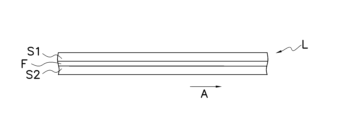
- FIG. 2 is a schematic cross-sectional view of a stretchable laminated sheet in which the film is in a stretched state.
- FIG. 2 is a schematic cross-sectional view of a stretchable laminated sheet in which the film is in a non-stretched state.
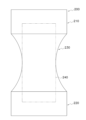
- 1 is a schematic diagram of a wearing article using a stretchable laminated sheet.
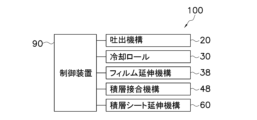
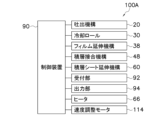
- FIG. 2 is a control block diagram of the expandable laminated sheet manufacturing apparatus shown in FIG. 1.
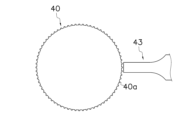
- FIG. FIG. 2 is a schematic enlarged view of a stretching roll and a horn of the stretchable laminated sheet manufacturing apparatus shown in FIG. 1.
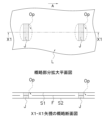
- FIG. 2 is a schematic partially enlarged plan view of the stretchable laminated sheet before gear stretching, and a schematic cross-sectional view taken along the line X1-X1 in the schematic partially enlarged plan view.
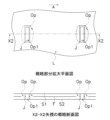
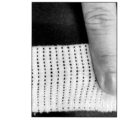
- FIG. 2 is a schematic partial enlarged plane view of the stretchable laminated sheet after gear stretching, and a schematic cross-sectional view taken along the line X2-X2 in the schematic partial enlarged plan view. It is a photograph of a stretchable laminated sheet before gear stretching. It is a photograph of a stretchable laminated sheet after gear stretching.
- FIG. 13 is a control block diagram of the stretchable laminated sheet manufacturing apparatus shown in FIG. 12.
- FIG. 12 is a schematic diagram showing the composition of a manufacturing device of a stretchable laminated sheet of modification 2, and the drawing of the molding part of the film is omitted.
- FIG. 15 is a control block diagram of the expandable laminated sheet manufacturing apparatus shown in FIG. 14; It is a figure which shows the example of the use location of the stretchable laminated sheet in the wearing article based on one example. It is a figure which shows the example of the use location of the elastic laminated sheet in the wearing article based on another example.
- FIG. 1 is a schematic diagram showing the overall configuration of an apparatus 100 for manufacturing a stretchable laminated sheet L.
- FIG. 2 is a sectional view of the stretchable laminated sheet L, in which the film F constituting the stretchable laminated sheet L is in a stretched state.
- FIG. 3 is a cross-sectional view of the stretchable laminated sheet L in which the film F is in a non-stretched state.
- FIG. 4 is a schematic diagram of a wearing article 200 using the stretchable laminated sheet L.
- the stretchable laminated sheet L is a stretchable sheet formed by laminating a plurality of sheets/films. As shown in FIGS. 2 and 3, the stretchable laminated sheet L includes an elastic (stretchable) film F, a first nonwoven fabric sheet S1 as an example of a base sheet, and a first nonwoven fabric sheet S1 as an example of a base sheet. a second nonwoven fabric sheet S2.
- the film F is arranged between the first nonwoven fabric sheet S1 and the second nonwoven fabric sheet S2.
- the nonwoven fabric sheet and the film F are arranged one on top of the other.
- the first nonwoven fabric sheet S1 and the film F are intermittently joined at the joint points J
- the second nonwoven fabric sheet S2 and the film F are intermittently joined at the joint points J.
- the stretchable laminated sheet is a structure in which four or more sheets/films are laminated. You can.
- the stretchable laminated sheet may have a two-layer structure of one of the first nonwoven fabric sheet S1 and the second nonwoven fabric sheet S2 and the film F.
- nonwoven fabric sheet is an example of a base sheet
- the base sheet may be a sheet other than the nonwoven fabric sheet.
- the first nonwoven fabric sheet S1, the film F, and the second The nonwoven fabric sheet S2 is in a mutually parallel state.
- the film F of the stretchable laminated sheet L is stretched along the conveyance direction A
- the first nonwoven fabric sheet S1, the film F, and the second nonwoven fabric sheet S2 are parallel to each other, as shown in FIG. is in a state of
- Such a stretchable laminated sheet L is used for wearing articles. Specifically, a sheet piece cut from the stretchable laminated sheet L along a direction perpendicular to the conveyance direction A is used for the wearable article. In addition, the sheet piece cut out from the elastic laminated sheet L is also simply called elastic laminated sheet L here.
- the type of wearing article for which the stretchable laminated sheet L is used is not limited, examples of the wearing article include disposable diapers, disposable medical gowns, and the like.
- the stretchable laminated sheet L can be used in worn articles, for example, as a waist member worn around the wearer's waist, or as a cuff worn around the wearer's wrists. It can be widely applied to members, hem opening members attached to the wearer's ankles, etc.
- a disposable diaper as a wearing article 200 in which the stretchable laminated sheet L is used will be described with reference to FIG. 4.
- the wearing article 200 includes a front body part 210, a rear body part 220, a crotch part 230, and an absorbent article 240.
- the front body part 210 and the rear body part 220 are spaced apart from each other.
- front body part 210 and rear body part 220 face each other.
- the crotch section 230 is connected to the front trunk section 210 and the rear trunk section 220.
- the front body part 210 and the rear body part 220 are connected via a crotch part 230.
- Absorbent article 240 is placed so as to straddle crotch area 230 .
- the wearable article 200 When the wearable article 200 is worn, the wearable article 200 is folded at the crotch region 230, and the front torso 210 is placed on the ventral side and the rear torso 220 is placed on the dorsal side. When the wearing article 200 is worn, the front body part 210 and the rear body part 220 are joined together by a fastening member such as a tape (not shown).
- a fastening member such as a tape
- the stretchable laminated sheet L is used for the front body part 210 and the rear body part 220.
- the stretchable laminated sheet L is used for the front body part 210 and the rear body part 220 in a state where the above-mentioned conveyance direction A and the waist direction coincide.
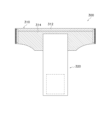
- the wearing article 300 illustrated in FIG. 16 is a disposable diaper that has a substantially T-shape when unfolded (before being worn). Wearing article 300 has a single waist member 310 and an absorbent body 320 attached to waist member 310.
- the waist member 310 is a member placed around the wearer's waist.
- the waist member 310 includes a waist circumference portion 312 (hatched portion with a straight line going upward to the right in FIG. 16) and a lower waist portion 314 (hatched portion with a straight line downward to the right in FIG. 16).
- the waist circumference part 312 is a part that is disposed at the upper end of the waist member 310 when worn, and is disposed around the wearer's waist (at a height near the hipbone) (covers the waist).
- the lower waist portion 314 is a portion disposed below the waist portion 312 when worn, and covers the wearer's torso below the waist.
- An absorbent body 320 is attached to a central portion of the lower waist portion 314 in the left-right direction (width direction) so as to be perpendicular to the lower waist portion 314 .
- waist circumference portion 312 and the lower waist circumference portion 314 may be separate members, and the waist circumference member 310 may be formed by joining them. Further, the waist circumference portion 312 and the lower waist circumference portion 314 may be integrally formed (of the same material).
- the absorbent body 320 is a member that is joined to the waist member 310 and placed in the wearer's crotch region when worn.
- the absorbent body 320 includes an absorbent article (not shown), and the absorbent article mainly absorbs body fluids such as urine and sweat.
- the stretchable laminated sheet L manufactured by the manufacturing method of the present disclosure is used for the waist circumference portion 312 and/or lower waist circumference portion 314 of the waist member 310 of the wearing article 300. Thereby, it is possible to realize the wearing article 300 with good air permeability also in the L portion of the stretchable laminated sheet.
- the stretchable laminated sheet L manufactured by the manufacturing method of the present disclosure an opening Op1 is formed not only around the joint J of the pair of nonwoven fabric sheets S1 and S2 and the film F but also at the joint J. Therefore, the stretchable laminated sheet L provided in the wearing article 300 has high breathability. Further, by providing sufficient openings in the stretchable laminated sheet L, a stretchable laminated sheet L having high stretchability can be obtained, and by using this, a wearing article 300 that easily fits the wearer can be realized. You can also get
- the wearing article 400 illustrated in FIG. 17 has a front trunk section 410, a rear trunk section 420, a crotch section 430, and an absorbent article 440, like the wearing article 200 shown in FIG.
- the crotch area 430 and the absorbent article 440 are examples of an absorbent body in the claims.
- the wearing article 400 includes a fastening tape 450 as an example of a coupling member.
- the front body part 410 and the rear body part 420 are each an example of a waist member placed around the wearer's waist.
- the front body part 410 and the rear body part 420 are spaced apart from each other.
- the front body part 410 and the rear body part 420 face each other.
- the front torso 410 and the rear torso 420 include waist circumference parts 412 and 422 (hatched parts drawn by straight lines upward to the right in FIG. 17) and lower waist parts 414 and 424 (hatched parts drawn by straight lines downward to the right in FIG. 17), respectively. ) and including.
- the waist surrounding portion 412 is a portion that is placed at the upper end of the front torso 410 when worn, and is placed around the waist of the wearer's front torso (at a height near the hip bone).
- the waist circumference portion 422 is a portion that is placed at the upper end of the rear torso 420 when worn, and is placed around the waist (near the hipbone) of the wearer's back torso.
- the lower waist portion 414 is a portion disposed below the waist portion 412 when worn, and covers the wearer's front torso below the waist.
- the lower waist portion 424 is a portion disposed below the waist portion 422 when worn, and covers the rear torso of the wearer below the waist.
- a crotch portion 430 is attached to the center portion of the lower waist portions 414, 424 in the left-right direction (width direction) so as to be perpendicular to the lower waist portions 414, 424 and to straddle the lower waist portions 414, 424. That is, the crotch section 430 is connected to the front trunk section 410 and the rear trunk section 420. In other words, the front trunk section 410 and the rear trunk section 420 are connected via the crotch section 430.
- the crotch region 430 is a member placed in the wearer's crotch region when worn.
- the absorbent article 440 is placed in the center of the crotch area 430 so as to overlap the crotch area 430, and is a member that is placed in the wearer's crotch area together with the crotch area 430 when the wearing article 400 is worn. .
- the crotch portion 430 may be a separate member from the front body portion 410 and the rear body portion 420, and the wearing article 400 may be formed by joining these parts. Moreover, the front body part 410, the rear body part 420, and the crotch part 430 may be integrally formed (of the same material).
- attachment portions 416 for the fastening tape 450, which are examples of coupling member attachment portions, are provided.
- the attachment part 416 here means the part which includes not only the part to which the fastening tape 450 is attached but also the periphery of the part to which the fastening tape 450 is attached.
- the fastening tape 450 has a hook portion 452 provided with a hook-shaped protrusion, and a connecting portion 454 (the cross-hatched portion in FIG. 17) that is attached to the attachment portion 416 on one end side and has the hook portion 452 provided on the other end side. ,including.
- the hook portions 452 of the fastening tape 450 are connected to loop portions (joint portions) provided near both ends of the rear body portion 420 in the width direction (left and right direction). 426 (hatched area with dots in FIG. 17).
- the loop portion 426 is provided with a large number of loop-shaped protrusions on which the hook-shaped protrusions of the hook portion 452 are caught.
- the loop portion 426 may be a separate member from the rear body portion 420, or may be formed by processing the rear body portion 420.
- the stretchable laminated sheet L manufactured by the manufacturing method of the present disclosure has a waist circumference 412 and/or a lower waist circumference 414 of the front body 410, and/or a waist circumference 422 of the rear body 420. and/or used for the lower waist portion 424.
- the elastic laminate sheet L includes an attachment part (joining member attachment part) 416 of the front body part 410 and/or a loop part (joint part) of the rear body part 420. )426.
- the stretchable laminated sheet L is used for the connecting portion 454 of the fastening tape 450.
- the stretchable laminated sheet L By using the stretchable laminated sheet L in this way, it is possible to realize the wearing article 400 with good breathability even in the stretchable laminated sheet L portion.
- an opening Op1 is formed not only around the joint J of the pair of nonwoven fabric sheets S1 and S2 and the film F but also at the joint J. Therefore, the stretchable laminated sheet L provided in the wearing article 400 has high breathability. Further, by providing sufficient openings in the stretchable laminated sheet L, a stretchable laminated sheet L having high stretchability can be obtained, and by using this, a wearing article 400 that easily fits the wearer can be realized. You can also get
- the manufacturing apparatus 100 manufactures a stretchable film F from raw materials.
- the manufacturing apparatus 100 conveys the manufactured film F in a stretched state. Then, the manufacturing apparatus 100 merges the pair of nonwoven fabric sheets S1 and S2 with the transported film F, and in a state where the stretched film F is arranged between the pair of nonwoven fabric sheets S1 and S2, the pair of nonwoven fabric sheets Sheets S1 and S2 and film F are thermally welded to form a stretchable laminated sheet L.
- the manufacturing apparatus 100 merges the nonwoven fabric sheets S1 and S2 with the transported film F, and in a state where the stretched film F and the nonwoven fabric sheets S1 and S2 are overlapped, the nonwoven fabric sheets S1 and S2 and the film F is thermally welded to form a stretchable laminated sheet L. Furthermore, in order to improve the air permeability of the elastic laminate sheet L (specifically, the air permeability of the film F of the elastic laminate sheet L), the manufacturing apparatus 100 stretches the elastic laminate sheet L using gear rolls 62 and 64 (gear stretching). do.
- FIG. 5 is a control block diagram of the manufacturing apparatus 100 for the stretchable laminated sheet L according to the first embodiment.
- the manufacturing apparatus 100 mainly includes a discharge mechanism 20, a cooling roll 30, a film stretching mechanism 38, a lamination joining mechanism 48, a laminated sheet stretching mechanism 60, and a control device 90. and has.
- the discharge mechanism 20 is a device that forms a film-like intermediate Fa from a raw material (resin material).
- the intermediate Fa is finally formed into a film F.
- the discharge mechanism 20 heats and melts the resin material to a temperature higher than a temperature range in which the resin material elastically deforms, and discharges the molten resin material in a film form from the discharge port 24 to form a film.
- An intermediate Fa of the form is formed.
- the intermediate material Fa on the film formed by the discharge mechanism 20 is conveyed to a cooling roll 30 arranged below the discharge mechanism 20 as shown in FIG.
- the resin material is, for example, a material whose main component is a thermoplastic elastic resin, and is a material that exhibits elasticity at room temperature.
- resin materials include those specified in JIS K 6418:2007 (ISO 18064:2003). Any thermoplastic elastomer may be used.
- the cooling roll 30 is a device that cools and solidifies the intermediate Fa to form an elastic (stretchable) film F.
- the cooling roll 30 is rotationally driven by a drive device such as a motor (not shown).
- a flow path (not shown) is formed inside the cooling roll 30, through which a fluid for cooling the intermediate Fa flows.
- the intermediate Fa discharged from the discharge mechanism 20 is supplied to the cooling roll 30.
- the intermediate material Fa discharged from the discharge port 24 of the discharge mechanism 20 is stretched in the first section 80 (see FIG. 1) until it reaches the cooling roll 30.
- the cooling roll 30 rotates at a circumferential speed higher than the feeding speed of the resin material when it is discharged from the discharge port 24 of the discharge mechanism 20, so that the thickness of the film-like intermediate Fa reaches a predetermined value.
- the intermediate Fa is stretched until it becomes .
- the cooling roll 30 is rotationally driven by a drive device, and conveys the intermediate Fa along the outer peripheral surface of the cooling roll 30.
- the cooling roll 30 cools and solidifies the intermediate Fa in a second section 82 where the intermediate Fa is in contact with the outer peripheral surface of the cooling roll 30 to a temperature range where the resin material forming the intermediate Fa is elastically deformed. .
- the intermediate Fa becomes a film F in the second section 82 and is pulled out from the cooling roll 30.
- the film F pulled out from the cooling roll 30 is sent to a film stretching mechanism 38 via a guide roll 32.
- the guide roll 32 may have a function of cooling the film F similarly to the cooling roll 30.
- the film F transported from the cooling roll 30 to the film stretching mechanism 38 is transported in a state where it is stretched by ⁇ % with respect to the natural length of the film F (the length of the film F in a state where no force is applied). be done.
- the film stretching mechanism 38 is a device that further stretches the stretched film F that is conveyed from the cooling roll 30.
- the film stretching mechanism 38 mainly includes a pull-out roll 34, a pinch roll 36, and a stretching roll 40.
- the pull-out roll 34 is rotationally driven by a drive device such as a motor (not shown).
- the elongating roll 40 is rotationally driven by a drive device such as a motor (not shown).
- the pull-out roll 34 and the pinch roll 36 are arranged adjacent to each other.
- the pull-out roll 34 and the pinch roll 36 sandwich the film F conveyed from the cooling roll 30 to the pull-out roll 34 so that the film F does not slip along the outer peripheral surface of the pull-out roll 34.
- the drawer roll 34 rotates in synchronization with the cooling roll 30.
- the film F is stretched by the film stretching mechanism 38 in a third section 84 from between the pull-out roll 34 and the pinch roll 36 until reaching the stretching roll 40.
- the stretching roll 40 rotates at a peripheral speed faster than the peripheral speed of the pull-out roll 34, and stretches the film F relative to the natural length of the film F (the length of the film F when no force is applied). , the state is expanded by ⁇ %. ⁇ % is a larger value than the above-mentioned ⁇ %.
- the film F, which has been stretched by ⁇ % with respect to the natural length of the film F, is conveyed along the outer peripheral surface of the stretching roll 40.
- the lamination joining mechanism 48 forms a laminate B in which the nonwoven fabric sheets S1 and S2 and the stretched film F are stacked.
- the lamination joining mechanism 48 forms a laminate B in which a stretched film F is placed between a pair of nonwoven fabric sheets S1 and S2.
- the laminate joining mechanism 48 functions as a joining section in the claims, and heat-welds the nonwoven fabric sheets S1, S2 and the film F in the laminate B to form a stretchable laminate sheet L.
- the lamination joining mechanism 48 functions as a joining section in the claims, and heat-welds the pair of nonwoven fabric sheets S1 and S2 and the film F disposed therebetween in the laminate B. to form a stretchable laminated sheet L.
- the stretching roll 40 which is part of the structure of the film stretching mechanism 38, also functions as part of the lamination and bonding mechanism 48. Further, the lamination bonding mechanism 48 includes an ultrasonic bonding device 42.
- a continuous first nonwoven fabric sheet S1 unwound from a raw roll (not shown) is supplied to the stretching roll 40 of the lamination and joining mechanism 48 via a guide roll 50. Further, a continuous second nonwoven fabric sheet S2 unwound from a raw roll (not shown) is supplied to the stretching roll 40 via guide rolls 52 and 54.
- the stretched film F conveyed along the stretching roll 40 is sandwiched between the first nonwoven fabric sheet S1 and the second nonwoven fabric sheet S2 conveyed to the stretching roll 40, and a pair of A laminate B is formed in which a stretched film F is arranged between the nonwoven fabric sheets S1 and S2.
- the stretchable laminated sheet L has a two-layer structure
- the continuous first nonwoven fabric sheet S1 which is unwound from a raw roll (not shown)
- the stretching roll 40 of the lamination joining mechanism 48 for example, by a guide roll. 50.
- a laminate B is formed in which the stretched film F conveyed along the stretching roll 40 is laminated with the first nonwoven fabric sheet S1 conveyed to the stretching roll 40.
- the laminate B moves with the rotation of the elongated roll 40 and passes between the elongated roll 40, which functions as an anvil roll, and the horn 43 of the ultrasonic bonding device 42.
- a plurality of convex portions 40a are provided on the surface of the elongation roll 40, which are arranged along the rotation axis direction of the elongation roll 40 and along the circumferential direction of the elongation roll 40 (see FIG. 6). .
- the convex portion 40a may have a rectangular shape or a shape that extends with the rotation axis direction of the elongation roll 40 as the longitudinal direction when the convex portion 40a is viewed in the radial direction toward the rotation axis of the elongation roll 40. , has a long elliptical shape.
- the shape of the convex portion 40a described here is only an example, and other shapes may be used.
- the elongating roll 40 and the horn 43 are examples of the first joining member and the second joining member in the claims.
- the horn 43 is vibrated by an ultrasonic oscillator (not shown) while the laminate B is sandwiched between the horn 43 and the elongated roll 40 (more specifically, between the convex portion 40a of the elongated roll 40).
- the nonwoven fabric sheets S1 and S2 (particularly the pair of nonwoven fabric sheets S1 and S2 here) and the film F are ultrasonically welded. Ultrasonic welding is one form of thermal welding.
- a stretchable laminated sheet L is formed in which the pair of nonwoven fabric sheets S1, S2 and the film F are intermittently joined at the joints J. , is pulled out from the lamination joining mechanism 48.
- joint portions J are locally arranged.
- the stretchable laminated sheet L pulled out from the lamination joining mechanism 48 is conveyed to the laminated sheet stretching mechanism 60 in a conveyance direction A along the stretching direction of the film F.
- the lamination joining mechanism 48 which is an example of a joining section, ultrasonically welds the nonwoven fabric sheets S1, S2 and the film F.
- the mode of thermal welding is not limited to ultrasonic welding.
- the laminate bonding mechanism 48 sandwiches the laminate B between two rollers each equipped with a heater inside, and heat-seals the nonwoven fabric sheets S1 and S2 and the film F in a manner as shown in FIG. 7, for example. It may be.
- the stretching roll 40 which is part of the structure of the film stretching mechanism 38, also functions as an anvil roll in the lamination joining mechanism 48.
- the lamination joining mechanism 48 may have an anvil roll separate from the elongation roll 40 that forms the laminate B.
- the laminated sheet stretching mechanism 60 is an example of a stretching section in the claims.
- the laminated sheet stretching mechanism 60 stretches the stretchable laminated sheet L using gear rolls 62 and 64 (gear stretching).
- the laminated sheet stretching mechanism 60 has a pair of gear rolls 62 and 64 that have unevenness on their peripheral surfaces. More specifically, the gear roll 62 is provided with a plurality of teeth 62a and troughs 62b alternately along the circumferential direction of the gear roll 62 like a spur gear. The gear roll 64 is also provided with a plurality of teeth 64a and troughs 64b alternately along the circumferential direction of the gear roll 64, like a spur gear.
- gear roll 62 and the gear roll 64 are rotated by a drive mechanism such as a motor (not shown), the teeth 62a of the gear roll 62 and the troughs 64b of the gear roll 64 are rotated, and the troughs 62b of the gear roll 62 and the teeth of the gear roll 64 are rotated.
- the portions 64a mesh with each other.
- the stretchable laminated sheet L conveyed along the conveyance direction A from the lamination joining mechanism 48 is supplied to the meshing portion between the gear rolls 62 and 64 and stretched.
- the stretchable laminated sheet L is stretched by the laminated sheet stretching mechanism 60, so that the film F is stretched by ⁇ % with respect to the natural length of the film F (the length of the film F when no force is applied). become.
- the elastic laminate sheet L stretched by the laminate sheet stretching mechanism 60 (the elastic laminate sheet L in which the film F constituting the elastic laminate sheet L is stretched by ⁇ % with respect to the natural length of the film F) is While maintaining the elongation rate, it is conveyed by the conveyance mechanism 70 on the downstream side, and is conveyed to the next process (the manufacturing process of the wearing article whose illustration and description are omitted).
- ⁇ % is a larger value than the aforementioned ⁇ %. That is, the film F (including the film F included in the stretchable laminated sheet L) is stretched to the natural length of the film F by the second section 82, the third section 84, and the laminated sheet stretching mechanism 60, respectively. It may be extended by an elongation rate of ⁇ %, ⁇ (> ⁇ )%, or ⁇ (> ⁇ )%.
- the laminated sheet stretching mechanism 60 stretches the film F to a relatively large extent compared to the natural length of the film F, but the film F here is reinforced by being joined to the nonwoven fabric sheets S1 and S2. Therefore, even if the film F is stretched to a relatively large extent, breakage of the film F is easily suppressed.
- a laminated sheet L can be manufactured.
- the film F is cut even at a part of the joint J of the stretchable laminated sheet L, resulting in an opening around the joint J as shown in FIG.
- the film F is cut also at the joint J (dotted part) of the stretchable laminated sheet L, and an opening Op1 is formed.
- the openings formed by stretching by the laminated sheet stretching mechanism 60 are not limited to the joints J, but are formed around the joints J (the openings Op are formed so as to be large). )In some cases.
- FIGS. 8 and 9 are merely drawings for explanation, and the shapes and dimensions of the openings Op and Op1 shown in FIGS. 8 and 9 do not limit the shape of the openings that are actually formed.
- the stretchable laminated sheet L when the stretchable laminated sheet L made of nonwoven fabric, thermoplastic elastic resin, etc. is sandwiched between the metal gear rolls 62 and 64, the stretchable laminated sheet L may be charged with static electricity. .
- the static electricity may have an adverse effect on the process of processing the elastic laminate sheet L to manufacture a wearing article. Therefore, it is preferable that the stretchable laminate sheet L is brought into contact with a conductor connected to the ground on the downstream side of the laminate sheet stretching mechanism 60 in the transport direction A of the stretchable laminate sheet L.
- the control device 90 includes a CPU (not shown), memories such as ROM and RAM, input/output devices, and various electrical and electronic components.
- control device 90 is electrically connected to the discharge mechanism 20, the cooling roll 30, the film stretching mechanism 38, the lamination joining mechanism 48, and the laminated sheet stretching mechanism 60.
- the control device 90 allows the CPU to operate the discharge mechanism 20, the cooling roll 30, the film stretching mechanism 38, the lamination joining mechanism 48, and the laminated sheet stretching mechanism 60 in cooperation with each other by executing a program stored in the memory. Control to operate.
- control device 90 may be realized by software, hardware (various electric circuits/electronic circuits), or software as long as it can perform the functions described here. It may also be realized by cooperation between and hardware.
- the discharge mechanism 20 for example, a resin material exhibiting elasticity at room temperature is heated and melted, and is discharged from the discharge port 24 as a film-like intermediate Fa. Thereafter, the intermediate Fa is cooled and solidified by the cooling roll 30, and an elastic (stretchable) film F is formed.
- the discharge mechanism 20 and the cooling roll 30 function as a molding section in the claims, and the film F is formed from a resin material as a raw material.
- the film F is stretched by ⁇ % with respect to the natural length of the film F (the length of the film F in a state where no force is applied).
- the film F which is pulled out from the cooling roll 30 and conveyed from the cooling roll 30 in a stretched state, is further stretched by the film stretching mechanism 38. Specifically, in the film stretching mechanism 38, the film F is stretched by ⁇ (> ⁇ )% with respect to the natural length of the film F.
- a laminate B is formed in which the nonwoven fabric sheets S1 and S2, which are unwound from a raw roll (not shown), and the stretched film F are stacked on top of each other.
- the lamination and joining mechanism 48 there is an elongated sheet between the first nonwoven fabric sheet S1, which is unwound from a raw roll (not shown), and the second nonwoven fabric sheet S2, which is unwound from a raw roll (not shown).
- a laminate B is formed in which the films F in the same state are arranged.
- the laminate bonding mechanism 48 sandwiches the laminate B between the stretching roll 40 and the horn 43 of the ultrasonic bonding device 42, and thermally welds the pair of nonwoven fabric sheets S1, S2 and the film F to form a stretchable laminate. Form into L.
- the laminated sheet stretching mechanism 60 stretches (gear stretching )do. Specifically, the laminated sheet stretching mechanism 60 stretches the film F so that it is stretched by ⁇ % relative to the natural length of the film F. For example, ⁇ % is a larger value than the aforementioned ⁇ %. As a result of the gear stretching, openings with a sufficient area are formed in the stretchable laminated sheet L at and/or around the heat-welded locations of the nonwoven fabric sheets S1, S2 and the film F.
- a manufacturing apparatus 100 for a stretchable laminated sheet L nonwoven fabric sheets S1 and S2 as an example of a base sheet and a stretchable film F are arranged one on top of the other, and the nonwoven fabric sheets S1 and S2 and the film F are joined.
- This is an apparatus 100 for manufacturing a stretchable laminated sheet L.
- the manufacturing apparatus 100 for the stretchable laminated sheet L includes a lamination joining mechanism 48 as an example of a joining part, and a laminated sheet stretching mechanism 60 as an example of a stretching part.
- the laminated bonding mechanism 48 includes an elongated roll 40 (anvil roll) and a horn 43 as an example of a first bonding member and a second bonding member.
- the lamination bonding mechanism 48 sandwiches the laminate B, in which the nonwoven fabric sheets S1, S2 and the stretched film F are stacked, between the stretching roll 40 and the horn 43, and connects the nonwoven fabric sheets S1, S2 and the film. F is thermally welded to form a stretchable laminated sheet L.
- the laminated sheet stretching mechanism 60 has a pair of gear rolls 62 and 64 having unevenness on their circumferential surfaces. The laminated sheet stretching mechanism 60 stretches the stretchable laminated sheet L that is conveyed through a pair of gear rolls 62 and 64.
- the stretchable laminated sheet L is formed by thermally welding the nonwoven fabric sheets S1 and S2 and the film F, and then stretched using gear rolls 62 and 64 having irregularities on the circumferential surface. In this way, openings with a sufficient area can be formed at and/or around the heat-welded parts of the nonwoven fabric sheets S1 and S2 and the film F, and a stretchable laminated sheet L with good air permeability can be manufactured.
- the manufacturing apparatus 100 for the stretchable laminated sheet L includes a discharge mechanism 20 and a cooling roll 30 that function as a forming section, and a film stretching mechanism 38 as an example of a film stretching section.
- the molding section molds the film F from the raw material (resin material).
- the film stretching mechanism 38 is disposed between the molding section and the lamination joining mechanism 48 in the transport direction A of the film F, and stretches the film F.
- the elongation rate of the film F transported between the film stretching mechanism 38 and the lamination joining mechanism 48 with respect to the natural length of the film F is equal to the natural length of the film F transported between the forming section and the film stretching mechanism 38. is larger than the elongation rate for film F.
- the elongation rate of the film F of the stretchable laminate sheet L relative to the natural length of the film F in the laminate sheet stretching mechanism 60 is determined by is larger than the elongation rate for film F.
- this manufacturing apparatus 100 for the stretchable laminated sheet L it is possible to reduce the thickness of the film F by stretching the film F in stages.
- this stretchable laminate sheet L manufacturing apparatus 100 after forming the stretchable laminate sheet L using the film F, the film F is further stretched, thereby reducing the film F to a low film thickness while suppressing breakage of the film F. It can be thickened.
- the method for manufacturing the stretchable laminated sheet L is a stretchable laminated sheet L in which nonwoven fabric sheets S1 and S2 as an example of a base sheet and a stretchable film F are arranged one on top of the other, and the nonwoven fabric sheets S1 and S2 and the film F are joined.
- This is a method for manufacturing sheet L.
- the method for manufacturing the stretchable laminated sheet L includes a welding step and a stretching step. In the welding step, the nonwoven fabric sheets S1 and S2 and the stretched film F are thermally welded to form a stretchable laminated sheet L. In the stretching step, the stretchable laminated sheet L, which is conveyed by passing between a pair of gear rolls 62 and 64 having irregularities on the circumferential surface, is stretched by the pair of gear rolls 62 and 64.
- the stretchable laminated sheet L is formed by thermally welding the nonwoven fabric sheets S1 and S2 and the film F, and then stretched using gear rolls 62 and 64 having irregularities on the circumferential surface. In this way, openings with a sufficient area can be formed at and/or around the heat-welded parts of the nonwoven fabric sheets S1 and S2 and the film F, and a stretchable laminated sheet L with good air permeability can be manufactured.
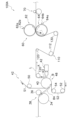
- FIG. 12 is a schematic diagram illustrating the configuration of an apparatus 100A for manufacturing a stretchable laminated sheet L, and the forming portions of the film F (discharge mechanism 20, cooling roll 30, etc.) are not shown.
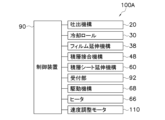
- FIG. 13 is an example of a control block diagram of the manufacturing apparatus 100A for the stretchable laminated sheet L.
- the manufacturing apparatus 100A of the second embodiment differs from the manufacturing apparatus 100 of the first embodiment mainly in the following configurations a to c. Note that the manufacturing apparatus 100A does not need to have all of the configurations a to c.
- the manufacturing apparatus 100A may have any one of configurations a to c, or two configurations among configurations a to c.
- - Configuration a In the conveyance path of the stretchable laminated sheet L, between the lamination joining mechanism 48 and the laminated sheet stretching mechanism 60, there is an adjustment section 110 that adjusts the conveyance speed of the stretchable laminated sheet L supplied to the laminated sheet stretching mechanism 60.
- the control device 90 functions as a speed control section that controls the operation of the adjustment section 110.
- - Configuration b A heater 66 that heats at least one of the pair of gear rolls 62 and 64 is provided (in this embodiment, at least the gear roll 64 is provided with the heater 66).
- - Configuration c The manufacturing apparatus 100A has a reception unit 92 that receives information regarding the size of the opening formed in the stretchable laminated sheet L by the laminated sheet stretching mechanism 60, and the control device 90 controls the laminated sheet based on this information. A point that determines the settings of the gear rolls 62 and 64 in the stretching mechanism 60.
- the stretchable laminate sheet L formed by the laminate joining mechanism 48 is gear-stretched by the laminate sheet stretching mechanism 60 to form openings.
- the size of the opening formed in the laminated sheet stretching mechanism 60 changes depending on how much the stretchable laminated sheet L is stretched by the laminated sheet stretching mechanism 60.
- the extent to which the stretchable laminated sheet L is stretched in the laminated sheet stretching mechanism 60 also changes depending on how much tension is acting on the stretchable laminated sheet L supplied to the laminated sheet stretching mechanism 60.
- the stretchable laminated sheet stretching mechanism 60 even if the operating conditions of the laminated sheet stretching mechanism 60 are not particularly changed, if a relatively large tension is applied to the stretchable laminated sheet L supplied to the laminated sheet stretching mechanism 60, the stretchable laminated sheet Relatively large openings are likely to be formed in the sheet L, and if only relatively small tension is acting on the stretchable laminated sheet L supplied to the laminated sheet stretching mechanism 60, only relatively small openings will be formed in the stretchable laminated sheet L. Not done.
- the tension acting on the stretchable laminate sheet L supplied to the laminate sheet stretching mechanism 60 is adjusted appropriately. It is preferable that the value be controlled to a certain value.
- the lamination bonding mechanism 48 and the lamination An adjustment section 110 is provided between the sheet stretching mechanism 60 and the adjusting section 110 that adjusts the conveyance speed of the stretchable laminated sheet L supplied to the laminated sheet stretching mechanism 60.
- the adjustment unit 110 mainly includes a speed adjustment roller 112 as an example of a second roller around which the elastic laminated sheet L is wound, and a speed adjustment motor 114 that rotationally drives the speed adjustment roller 112 (see FIGS. 12 and 12). (see 13).
- the speed adjustment motor 114 is electrically connected to the control device 90 , and the operation (start/stop, rotational speed, etc.) of the speed adjustment motor 114 is controlled by the control device 90 .
- the speed adjusting roller 112 is a roller having a high adhesiveness or a high coefficient of friction on the outer surface around which the stretchable laminated sheet L is wound.
- the tackiness or friction coefficient of the outer surface of the speed adjustment roller 112 is greater than the tackiness or friction coefficient of the outer surface of the guide roller 120, which is an example of the first roller, around which the stretchable laminated sheet L is wound.
- the guide roller 120 is a roller that is disposed between the lamination joining mechanism 48 and the adjustment section 110 on the conveyance path of the stretchable laminated sheet L, and guides the stretchable laminated sheet L that is wound around it.
- the roller is, for example, a rotatable roller.
- the adhesiveness of the outer surface of the speed adjusting roller 112 is achieved, for example, by pasting a sticky material such as rubber on the outer surface of the speed adjusting roller 112. Furthermore, the relatively large coefficient of friction on the outer surface of the speed adjusting roller 112 can be achieved by, for example, attaching a member with a large coefficient of friction to the outer surface of the speed adjusting roller 112, or roughening the outer surface of the speed adjusting roller 112. And it will be realized.
- the adjustment unit 110 changes the conveyance speed of the stretchable laminated sheet L in the adjustment unit 110 by changing the rotational speed of the speed adjustment roller 112 having an outer surface with relatively high adhesiveness or a coefficient of friction, and as a result, the lamination The conveyance speed of the stretchable laminated sheet L supplied to the sheet stretching mechanism 60 is changed.
- the adjustment unit 110 may not be configured to use a single speed adjustment roller 112, but may be configured to sandwich the elastic laminate sheet L between two rollers and adjust the conveyance speed of the elastic laminate sheet L.
- the conveyance mechanism 70 conveys the stretchable laminated sheet L at a conveyance speed V
- the adjustment section 110 also conveys the stretchable laminated sheet L at a conveyance speed V.
- the rotational speed of the speed adjustment motor 114 is decelerated and the rotational speed of the speed adjustment roller 112 is decelerated, without changing the conveyance speed V of the stretchable laminated sheet L by the conveyance mechanism 70.
- the adjustment section 110 conveys the stretchable laminated sheet L at a relatively low speed
- the conveyance mechanism 70 conveys the stretchable laminated sheet L at a relatively high speed.
- the tension acting on the stretchable laminated sheet L increases.
- the tension that acts on the stretchable laminate sheet L supplied to the laminate sheet stretching mechanism 60 becomes smaller than the tension that acts on the stretchable laminate sheet L that is conveyed from the laminate joining mechanism 48 to the adjustment section 110.
- the conveyance speed of the stretchable laminated sheet L by the conveyance mechanism 70 Assume that the rotation speed of the speed adjustment motor 114 is increased and the rotation speed of the speed adjustment roller 112 is increased without changing V.
- the adjustment section 110 conveys the stretchable laminated sheet L at a relatively high speed, and the conveyance mechanism 70 conveys the stretchable laminated sheet L at a relatively low speed.
- the tension acting on the stretchable laminated sheet L becomes smaller.
- the tension acting on the elastic laminate sheet L supplied to the laminate sheet stretching mechanism 60 becomes greater than the tension acting on the elastic laminate sheet L conveyed from the laminate joining mechanism 48 to the adjustment section 110.
- the conveyance speed of the film F and the stretchable laminated sheet L becomes slower than during steady operation. Note that during steady operation, a predetermined period of time has passed since the start of operation of the manufacturing apparatus 100A, and the conveyance speed of the film F and the stretchable laminated sheet L is at a constant speed. Therefore, at the start of operation when the manufacturing apparatus 100A starts operation, and at the time of stoppage when the manufacturing apparatus 100A stops operation, the tension acting on the stretchable laminated sheet L supplied to the laminated sheet stretching mechanism 60 becomes smaller, causing the stretchable laminated sheet L to expand and contract. There is a possibility that only relatively small openings are formed in the laminated sheet L.
- control device 90 as a speed control section controls the operation of the adjustment section 110 (more specifically, the operation of the speed adjustment motor 114) at the time of starting or stopping the operation, and controls the expansion and contraction lamination in the adjustment section 110.
- the tension acting on the stretchable laminated sheet L being conveyed from the lamination joining mechanism 48 to the adjustment section 110 is reduced to the stretchable laminated sheet L supplied to the laminated sheet stretching mechanism 60. It is preferable to increase the applied tension.
- the conveyance speed of the film F and the stretchable laminated sheet L is relatively high, so the tension acting on the stretchable laminated sheet L supplied to the laminated sheet stretching mechanism 60 becomes too large. There is a risk that the openings formed in the stretchable laminated sheet L may become too large or the stretchable laminated sheet L may be damaged.
- control device 90 as a speed control section controls the operation of the adjustment section 110 (more specifically, the operation of the speed adjustment motor 114) at the time of starting or stopping the operation, and controls the expansion and contraction lamination in the adjustment section 110.
- the tension acting on the stretchable laminated sheet L that is conveyed from the lamination joining mechanism 48 to the adjustment section 110 is reduced to the stretchable laminated sheet L that is supplied to the laminated sheet stretching mechanism 60. It is preferable to reduce the applied tension.
- control device 90 as a speed control section controls the operation of the adjustment section 110 (more specifically, the operation of the speed adjustment motor 114) to always supply the laminated sheet stretching mechanism 60. It is preferable that the tension acting on the stretchable laminated sheet L be constant.
- the thermoplastic film F etc. of the stretchable laminate sheet L may harden and become difficult to stretch.
- At least one of the pair of gear rolls 62, 64 (in this embodiment, at least the gear roll 64) is provided with a heater 66 that heats the gear rolls 62, 64 to a predetermined temperature.
- a heater 66 that heats the gear rolls 62, 64 to a predetermined temperature.
- the stretchable laminated sheet L In order to easily heat the stretchable laminated sheet L, after the stretchable laminated sheet L contacts the outer peripheral surface of one of the pair of gear rolls 62 and 64 (here, the gear roll 64) heated by the heater 66 for a predetermined length, Preferably, it is guided between a pair of gear rolls 62,64.
- the stretchable laminated sheet L is guided between the pair of gear rolls 62 and 64 after, for example, contacting the outer peripheral surface of the gear roll 64 by 5% or more of the outer peripheral length of the gear roll 64.
- the stretchable laminated sheet L conveyed from the adjustment section 110 is If 110 is not provided, the stretchable laminated sheet L conveyed from the laminated sheet stretching mechanism 60 is not directly guided between the gear rolls 62 and 64. Specifically, as shown in FIG.
- the stretchable laminated sheet L conveyed from the adjusting section 110 (if the adjusting section 110 is not provided, the stretchable laminated sheet L conveyed from the laminated sheet stretching mechanism 60) is Guided by the guide roller 130, the stretchable laminated sheet L is wound around the outer peripheral surface of the gear roll 64, and then guided between the gear rolls 62 and 64.
- the size of the opening required for the stretchable laminate sheet L is not always constant and may vary depending on the wearable article 200, 300, 400, etc. in which the stretchable laminate sheet L is used.
- a gear roll of the laminated sheet stretching mechanism 60 is used in order to change the size of the opening formed in the stretchable laminated sheet L by the laminated sheet stretching mechanism 60 according to the size of the opening required for such a stretchable laminated sheet L. It is preferable to change the settings of 62 and 64.
- the settings of the gear rolls 62 and 64 are, for example, the tooth depth of the gear rolls 62 and 64 (distance from the bottom of the tooth to the tip of the tooth, here the distance between the top of the tooth portion 62a and the trough portion 62b), and the gear roll 62. This is the distance between the axial center and the axial center of the gear roll 64.
- the tooth depth of the gear rolls 62 and 64 increases, the size of the opening formed in the stretchable laminated sheet L by the laminated sheet stretching mechanism 60 increases, and the distance between the axis of the gear roll 62 and the axis of the gear roll 64 decreases. For example, the size of the opening formed in the stretchable laminated sheet L by the laminated sheet stretching mechanism 60 becomes larger.
- the settings of the gear rolls 62 and 64 are not limited to those illustrated, and the characteristics of each gear roll 62 and 64 and the characteristics related to the correlation between the gear roll 62 and the gear roll 64 that change the amount of stretching by the stretchable laminated sheet L. It may be.
- the settings of the gear rolls 62 and 64 may be changed by trial and error by the operator of the manufacturing apparatus 100A, but in this case, it may take time to change the settings.
- control device 90 of the manufacturing apparatus 100A determines the settings of the gear rolls 62 and 64 in the laminated sheet stretching mechanism 60 based on the information regarding the size of the opening formed in the stretchable laminated sheet L by the laminated sheet stretching mechanism 60. is preferred. Therefore, the control device 90 of the manufacturing apparatus 100A has the above configuration c.
- the manufacturing apparatus 100A has a reception unit 92 that receives information regarding the size of the opening formed in the stretchable laminate sheet L by the laminate sheet stretching mechanism 60.
- the receiving unit 92 is, for example, a switch or a touch panel that receives information input by the operator of the manufacturing apparatus 100A.
- the reception unit 92 also receives information transmitted from a terminal operated by the operator of the manufacturing apparatus 100A (for example, a computer serving as a management device that manages the manufacturing apparatus 100A, or a mobile terminal carried by the operator) via a network such as the Internet.
- the communication device may also be a communication device that receives information that comes from the network.
- the information regarding the size of the opening formed in the stretchable laminate sheet L by the laminate sheet stretching mechanism 60 is, for example, when the laminate bonding mechanism 48 welds the nonwoven fabric sheets S1, S2 and the film F with the desired opening size. This is a numerical value indicating the ratio to the seal area. Further, the information regarding the size of the opening formed in the stretchable laminate sheet L by the laminate sheet stretching mechanism 60 may be, for example, the numerical value itself of the desired opening size. Furthermore, the information regarding the size of the opening formed in the stretchable laminate sheet L by the laminate sheet stretching mechanism 60 may be a relative value indicating the desired opening size, such as "large”, “medium”, or "small". It may also be an indicator.
- control device 90 of the manufacturing apparatus 100A functions as a determining section in the claims, and based on the information received by the receiving section 92 regarding the size of the opening formed in the stretchable laminated sheet L by the laminated sheet stretching mechanism 60. , the settings of the gear rolls 62 and 64 in the laminated sheet stretching mechanism 60 are determined.
- the memory of the control device 90 stores related information in which the size of the opening formed in the stretchable laminated sheet L by the laminated sheet stretching mechanism 60 and the settings of the gear rolls 62 and 64 are associated. ing. Related information is the test results obtained by performing gear stretching of the stretchable laminated sheet L while changing the settings of the gear rolls 62 and 64 using the testing device of the manufacturing device 100A, and measuring the openings formed by the gear stretching. The information is based on Further, the related information is information about the correlation between the settings of the gear rolls 62 and 64 and the opening formed by gear stretching, which is calculated from theory or obtained by computer simulation.
- the control device 90 refers to the related information and determines the settings of the gear rolls 62 and 64 that correspond to the information received by the reception unit 92 regarding the size of the opening formed in the stretchable laminated sheet L by the laminated sheet stretching mechanism 60.
- the manufacturing apparatus 100A has, for example, a display as the output section 94, and the control device 90 displays the settings of the gear rolls 62 and 64 determined by itself on the display as the output section 94.
- the manufacturing apparatus 100A includes, for example, a communication device as the output unit 94, and the control device 90 includes a terminal operated by an operator of the manufacturing apparatus 100A (for example, a computer as a management device that manages the manufacturing apparatus 100A).
- the settings of the gear rolls 62 and 64 determined by the operator may be transmitted to the operator (portable terminal carried by the operator).
- the operator of the manufacturing apparatus 100A can replace the gear rolls 62 and 64 used in the laminated sheet stretching mechanism 60 based on the settings of the gear rolls 62 and 64 that the control device 90 outputs from the output unit 94.
- the distance between the axial center of the gear roll 62 and the axial center of the gear roll 64 can be adjusted.
- the manufacturing apparatus 100A of the second embodiment has the following features in addition to the features described in (4) Features of the manufacturing apparatus 100 of the first embodiment.
- the manufacturing apparatus 100A for the stretchable laminated sheet L includes an adjustment section 110 and a control device 90 as a speed control section.
- the adjustment unit 110 is disposed between the laminate joining mechanism 48 and the laminate sheet stretching mechanism 60 on the transport path of the stretchable laminate sheet L, and adjusts the transport speed of the stretchable laminate sheet L supplied to the laminate sheet stretch mechanism 60.
- Control device 90 controls the operation of adjustment section 110.
- the transport speed of the stretchable laminated sheet L supplied to the laminated sheet stretching mechanism 60 is controlled, and as a result, the tension acting on the stretchable laminated sheet L supplied to the laminated sheet stretching mechanism 60 is controlled. is controlled. Therefore, excessive tension may act on the stretchable laminated sheet L in the laminated sheet stretching mechanism 60 and the stretchable laminated sheet L may be damaged, or the size of the opening formed in the stretchable laminated sheet L in the laminated sheet stretching mechanism 60 may not be the desired size. It is possible to suppress the occurrence of problems such as falling off.
- control device 90 controls the operation of the adjusting section 110 during steady operation, for example, to control the stretchable laminated sheet L conveyed from the lamination joining mechanism 48 to the adjusting section 110.
- the tension that acts on the stretchable laminated sheet L supplied to the laminated sheet stretching mechanism 60 is made smaller than the applied tension.
- the apparatus 100A for manufacturing the stretchable laminated sheet L during steady operation, it is possible to suppress the occurrence of a problem in which excessive tension is applied to the stretchable laminated sheet L in the laminated sheet stretching mechanism 60 and the stretchable laminated sheet L is damaged.
- control device 90 controls the operation of the adjustment section 110 at the time of starting or stopping the operation, and controls the expansion and contraction conveyed from the lamination joining mechanism 48 to the adjustment section 110.
- the tension that acts on the stretchable laminate sheet L supplied to the laminate sheet stretching mechanism 60 is increased relative to the tension that acts on the laminate sheet L.
- the tension acting on the stretchable laminated sheet L supplied to the laminated sheet stretching mechanism 60 is smaller than during steady operation, and the laminated sheet There is a possibility that the size of the opening formed in the stretchable laminated sheet L by the stretching mechanism 60 becomes smaller. If the openings are too small, the stretchable laminated sheet L will not have the desired breathability, so there is a risk that the stretchable laminated sheet L in which the openings are too small cannot be used for wearable articles (will be wasted).
- the elastic laminate sheet L manufacturing apparatus 100A controls the operation of the adjustment section 110 to increase the tension acting on the elastic laminate sheet L supplied to the laminate sheet stretching mechanism 60, so that the elastic laminate sheet L Openings of an appropriate size can be formed in the stretchable laminated sheet L in the laminated sheet stretching mechanism 60 even when the manufacturing apparatus 100A is started or stopped.
- control device 90 controls the operation of the adjustment section 110 to keep the tension acting on the stretchable laminated sheet L supplied to the laminated sheet stretching mechanism 60 constant.
- the tension acting on the stretchable laminate sheet L supplied to the laminate sheet stretching mechanism 60 is constant, so openings of approximately the same size are likely to be formed in the stretchable laminate sheet L at all times.
- the elastic laminate sheet L manufacturing apparatus 100A includes a guide roller 120 as an example of a first roller.
- the guide roller 120 is disposed between the lamination joining mechanism 48 and the adjustment section 110 on the conveyance path, and guides the stretchable laminated sheet L wound around the guide roller 120.
- the adjustment section 110 includes a speed adjustment roller 112 as an example of a second roller around which the elastic laminated sheet L is wound.
- the outer surface of the speed adjustment roller 112 has a greater tackiness or coefficient of friction than the outer surface of the guide roller 120.
- the elastic laminate sheet L is gripped by the outer surface of the speed adjustment roller 112 in the adjusting section 110, and the elastic laminate sheet L is supplied to the laminate sheet stretching mechanism 60 using a single roller.
- the conveyance speed can be adjusted.
- the adjustment unit 110 may not be configured to use a single speed adjustment roller 112, but may be configured to sandwich the stretchable laminated sheet L between two rollers and adjust the conveyance speed of the stretchable laminated sheet L.
- the stretchable laminated sheet L manufacturing apparatus 100A includes a heater 66 that heats at least one of the pair of gear rolls 62 and 64.
- the manufacturing apparatus 100A for the stretchable laminated sheet L includes at least a heater 66 that heats the gear roll 64.
- the stretchable laminated sheet L can be stretched after heating the stretchable laminated sheet L, so that the stretchable laminated sheet L is easily stretched in the laminated sheet stretching mechanism 60.
- the stretchable laminated sheet L contacts the outer peripheral surface of one of the pair of gear rolls 62 and 64 heated by the heater 66 for a predetermined length, and then is heated between the pair of gear rolls 62 and 64. You will be guided. In this embodiment, the stretchable laminated sheet L is guided between the pair of gear rolls 62 and 64 after contacting the outer peripheral surface of one of the gear rolls 64 heated by the heater 66 for a predetermined length.
- the elastic laminate sheet L manufacturing apparatus 100A the elastic laminate sheet L is easily heated sufficiently, and in the laminate sheet stretching mechanism 60, the elastic laminate sheet L is easily stretched sufficiently.
- the elastic laminate sheet L manufacturing apparatus 100A includes a reception section 92 and a control device 90.
- the reception unit 92 receives information regarding the size of the opening formed in the stretchable laminated sheet L by the laminated sheet stretching mechanism 60.
- the control device 90 determines the settings of the gear rolls 62 and 64 in the laminated sheet stretching mechanism 60 based on information regarding the size of the opening formed in the stretchable laminated sheet L by the laminated sheet stretching mechanism 60.
- the settings of the gear rolls 62 and 64 are determined according to the size of the opening provided in the stretchable laminated sheet L. Openings are likely to form.
- the manufacturing apparatus 100A may have the following configuration instead of the above configuration c.
- a method of changing the size of the opening formed in the stretchable laminated sheet L by the laminated sheet stretching mechanism 60 according to the size of the opening required for the stretchable laminated sheet L is to set the gear rolls 62 and 64 of the laminated sheet stretching mechanism 60.
- a method of controlling the operation of the adjustment section 110 to change the tension acting on the stretchable laminated sheet L supplied to the laminated sheet stretching mechanism 60 can also be considered.
- control device 90 may determine the control pattern of the adjustment section 110 instead of determining the settings of the gear rolls 62 and 64 according to the size of the opening required for the stretchable laminated sheet L.
- the manufacturing apparatus 100A of Modified Example 1 has a reception unit 92 that receives information regarding the size of the opening formed in the stretchable laminated sheet L by the laminated sheet stretching mechanism 60, as in the above embodiment.
- Information regarding the size of the opening formed in the stretchable laminate sheet L by the reception unit 92 and the laminate sheet stretching mechanism 60 has already been explained in the second embodiment, so the explanation will be omitted here.
- the control device 90 of the manufacturing apparatus 100A determines the control pattern of the adjustment unit 110 based on the information received by the reception unit 92 regarding the size of the opening formed in the stretchable laminated sheet L by the laminated sheet stretching mechanism 60.
- the memory of the control device 90 stores the size of the opening formed in the stretchable laminated sheet L by the laminated sheet stretching mechanism 60 and the control pattern of the adjustment section 110 (speed adjustment at the start of operation, at the time of stoppage of operation, and at the time of steady operation).
- Related information associated with a method for controlling the rotational speed of the motor 114 is stored.
- the relevant information here is obtained by performing gear stretching of the stretchable laminated sheet L while changing the control pattern of the adjustment section 110 using the test device of the manufacturing apparatus 100A, and measuring the openings formed by the gear stretching. This information is based on test results.
- the related information is information about the correlation between the control pattern of the adjustment section 110 and the opening formed by the gear extension, which is calculated from theory or obtained by computer simulation.
- the control device 90 refers to the related information and determines a control pattern for the adjustment unit 110 that corresponds to the information received by the reception unit 92 regarding the size of the opening formed in the stretchable laminated sheet L by the laminated sheet stretching mechanism 60.
- the manufacturing apparatus 100A may output, for example, the control pattern of the adjustment unit 110 determined by itself from the output unit 94 (description of the output unit 94 is omitted). Then, the operator of the manufacturing apparatus 100A may input the control pattern of the adjustment section 110 to the control device 90. Furthermore, the control device 90 may control the operation of the adjustment section 110 using the setting of the control pattern of the adjustment section 110 determined by itself while the manufacturing apparatus 100A is operating.
- the tension acting on the stretchable laminated sheet L supplied to the laminated sheet stretching mechanism 60 is controlled by the size of the opening formed in the stretchable laminated sheet L by the laminated sheet stretching mechanism 60. Changes according to information about.
- the manufacturing apparatus 100A may automatically change the settings of the gear rolls 62 and 64 according to the size of the opening required for the stretchable laminated sheet L.
- FIG. 14 is a schematic diagram showing the configuration of an apparatus 100A for manufacturing a stretchable laminated sheet L according to modification 2, and the forming portion of the film F is not shown.
- FIG. 15 is a control block diagram of a manufacturing apparatus 100A for a stretchable laminated sheet L according to modification 2.
- the setting of the gear rolls 62 and 64 is the setting of the distance between the axial center of the gear roll 62 and the axial center of the gear roll 64.
- the manufacturing apparatus 100A of Modification 2 includes a drive mechanism 68 that moves at least one of the axial center of the gear roll 62 and the axial center of the gear roll 64 toward and away from the other gear roll (see FIGS. 14 and 15).
- the manufacturing apparatus 100A of Modification 2 does not have the output section 94, as shown in FIG. 15.
- the present invention is not limited to this, and the manufacturing apparatus 100A may include an output section 94.
- the manufacturing apparatus 100A of the second modification uses a method similar to that of the manufacturing apparatus 100A of the second embodiment, based on the information regarding the size of the opening formed in the stretchable laminated sheet L by the laminated sheet stretching mechanism 60 received by the reception unit 92. Then, the settings of the gear rolls 62 and 64 in the laminated sheet stretching mechanism 60 (here, the distance between the axis of the gear roll 62 and the axis of the gear roll 64) are determined.
- the control device 90 controls the operation of the drive mechanism 68 to adjust the distance between the axis of the gear roll 62 and the axis of the gear roll 64. , adjust the distance between the axis of the gear roll 62 and the axis of the gear roll 64 determined by themselves.
- the stretchable laminated sheet manufacturing device is a stretchable laminated sheet manufacturing device in which a base sheet and a stretchable film are placed one on top of the other, and the base sheet and the film are joined.
- An apparatus for manufacturing a stretchable laminated sheet includes a joining section and a stretching section.
- the joint portion includes a first joint member and a second joint member.
- the joint part is formed by sandwiching a laminate in which the base sheet and the stretched film are stacked between the first joint member and the second joint member, and thermally welding the base sheet and the film.
- the stretching section has a pair of gear rolls having unevenness on the circumferential surface. The stretching section stretches the stretchable laminated sheet that is conveyed through a pair of gear rolls.
- a stretchable laminated sheet is formed by thermally welding a base sheet and a film, and then stretched using a gear roll having irregularities on the circumferential surface.
- the stretchable laminate sheet manufacturing apparatus is the stretchable laminate sheet manufacturing apparatus according to the first aspect, and includes a forming section and a film stretching section.
- the forming section forms a film from raw materials.
- the film stretching section is disposed between the forming section and the joining section in the film transport direction, and stretches the film.
- the elongation rate of the film transported between the film stretching section and the joining section relative to the natural length film is higher than the elongation percentage of the film transported between the forming section and the film stretching section relative to the natural length film. big.
- the elongation rate of the film of the stretchable laminated sheet relative to the natural length film in the stretching section is greater than the elongation percentage of the film conveyed between the film stretching section and the bonding section relative to the natural length film.
- the apparatus for manufacturing a stretchable laminated sheet according to the second aspect it is possible to reduce the thickness of the film by stretching the film in stages.
- this stretchable laminate sheet manufacturing apparatus by further stretching the film after forming a stretchable laminate sheet using a film, it is possible to reduce the thickness of the film while suppressing damage to the film.
- the stretchable laminated sheet manufacturing apparatus is the stretchable laminated sheet manufacturing apparatus according to the first aspect or the second aspect, and further includes an adjustment section and a speed control section.
- the adjustment section is disposed between the joining section and the stretching section on the conveying path of the stretchable laminated sheet, and adjusts the conveyance speed of the stretchable laminated sheet supplied to the stretching section.
- the speed control section controls the operation of the adjustment section.
- the conveyance speed of the stretchable laminated sheet supplied to the stretching section is controlled, and as a result, the tension acting on the stretchable laminated sheet supplied to the stretching section is controlled.
- This prevents the occurrence of problems such as excessive tension acting on the stretchable laminated sheet in the stretching section, causing damage to the stretchable laminated sheet, or the size of the openings formed in the stretchable laminated sheet deviating from the desired size in the stretching section. can.
- the stretchable laminated sheet manufacturing apparatus is the stretchable laminated sheet manufacturing apparatus according to the third aspect, in which the speed control section controls the operation of the adjustment section during steady operation to move the flow from the joint section to the adjustment section.
- the tension that acts on the stretchable laminate sheet that is supplied to the stretching section is made smaller than the tension that acts on the stretchable laminate sheet that is being conveyed.
- the stretchable laminated sheet manufacturing apparatus it is possible to suppress the occurrence of a problem in which excessive tension is applied to the stretchable laminated sheet in the stretching section and the stretchable laminated sheet is damaged during steady operation.
- the stretchable laminated sheet manufacturing apparatus is the stretchable laminated sheet manufacturing apparatus according to the third or fourth aspect, wherein the speed control section controls the operation of the adjustment section at the time of starting or stopping the operation. Then, the tension that acts on the stretchable laminated sheet supplied to the stretching section is made larger than the tension that acts on the stretchable laminated sheet that is conveyed from the joining section to the adjustment section.
- the tension acting on the stretchable laminated sheet supplied to the stretching section is smaller than during steady operation, and the stretchable laminated sheet is formed by the stretching section compared to during steady operation.
- the size of the aperture to be opened may become smaller. If the openings are too small, the stretchable laminated sheet will not be able to provide the desired breathability, so there is a risk that the stretchable laminated sheet in the portions where the openings are too small cannot be used for wearable articles (will be wasted).
- the stretchable laminated sheet manufacturing apparatus controls the operation of the adjustment section to increase the tension acting on the stretchable laminated sheet supplied to the stretching section. Openings of an appropriate size can be formed in the stretchable laminated sheet in the stretching section even when the operation is started or stopped.
- the stretchable laminated sheet manufacturing apparatus is the stretchable laminated sheet manufacturing apparatus according to the third aspect, in which the speed control section controls the operation of the adjustment section to control the stretchable laminated sheet supplied to the stretching section. Keep the applied tension constant.
- the elastic laminate sheet manufacturing apparatus is the elastic laminate sheet manufacturing apparatus according to any one of the third to sixth aspects, and further includes a first roller.
- the first roller is disposed between the joint section and the adjustment section on the conveyance path, and guides the stretchable laminated sheet wound around the first roller.
- the adjustment section includes a second roller around which the stretchable laminated sheet is wound. The outer surface of the second roller has a greater tackiness or coefficient of friction than the outer surface of the first roller.
- the adjusting section grips the stretchable laminated sheet with the outer surface of the second roller, and uses a single roller to adjust the conveyance speed of the stretchable laminated sheet supplied to the stretching section. can do.
- the elastic laminate sheet manufacturing apparatus is the elastic laminate sheet manufacturing apparatus according to any one of the first to seventh aspects, and further includes a heater that heats at least one of the pair of gear rolls.
- the stretchable laminated sheet can be stretched after heating the stretchable laminated sheet, the stretchable laminated sheet is easily stretched in the stretching section.
- the stretchable laminated sheet manufacturing apparatus is the stretchable laminated sheet manufacturing apparatus according to the eighth aspect, wherein the stretchable laminated sheet is in contact with the outer peripheral surface of one of a pair of gear rolls heated by a heater for a predetermined length. Afterwards, it is guided between a pair of gear rolls.
- the stretchable laminated sheet is easily heated sufficiently, and the stretchable laminated sheet is easily stretched sufficiently in the stretching section.
- the elastic laminate sheet manufacturing apparatus is the elastic laminate sheet manufacturing apparatus according to any one of the first to ninth aspects, and further includes a receiving section and a determining section.
- the reception section receives information regarding the size of the opening formed in the stretchable laminated sheet by the stretching section.
- the determination unit determines the settings of the gear rolls in the stretching unit based on information regarding the size of the opening that the stretching unit forms in the stretchable laminated sheet.
- the settings of the gear roll are determined according to the size of the openings provided in the stretchable laminated sheet, openings of a desired size are easily formed in the stretchable laminated sheet in the stretching section.
- the elastic laminate sheet manufacturing apparatus is the elastic laminate sheet manufacturing apparatus according to any one of the first to ninth aspects, and further includes a receiving section.
- the reception section receives information regarding the size of the opening formed in the stretchable laminated sheet by the stretching section.
- the tension acting on the stretchable laminate sheet supplied to the stretching section is changed depending on information regarding the size of the opening formed in the stretchable laminate sheet by the stretching section.
- the tension of the stretchable laminated sheet supplied to the stretching section is changed according to the size of the opening provided in the stretchable laminated sheet. size openings are likely to be formed.
- the method for producing a stretchable laminated sheet according to the twelfth aspect is a method for producing a stretchable laminated sheet in which a base sheet and a stretchable film are arranged one on top of the other, and a pair of base sheet and film are joined.
- the method for manufacturing a stretchable laminated sheet includes a welding step and a stretching step.
- the welding step the base sheet and the stretched film are thermally welded to form a stretchable laminated sheet.
- the stretching step the stretchable laminated sheet, which is conveyed by passing between a pair of gear rolls having irregularities on the circumferential surface, is stretched by the pair of gear rolls.
- a stretchable laminated sheet is formed by thermally welding a base sheet and a film, and then stretched using a gear roll having irregularities on the circumferential surface.
- a gear roll having irregularities on the circumferential surface.
- a wearing article includes a waist member and an absorbent body.
- the waist member is placed around the wearer's waist when worn.
- the absorbent body is joined to the waist member and placed in the wearer's crotch region when worn.
- the waistline member includes a waist circumference portion that is positioned at the upper end of the waistline member and is positioned around the wearer's waist when worn.
- a stretchable laminated sheet manufactured by the manufacturing method of the twelfth aspect is used around the waist.
- the wearing article according to the fourteenth aspect includes a waist member and an absorbent body.
- the waist member is placed around the wearer's waist when worn.
- the absorbent body is joined to the waist member and placed in the wearer's crotch region when worn.
- the waist member includes a waist region and a lower waist region.
- the waist circumference section is placed at the upper end of the waist member and placed around the wearer's waist when worn.
- the lower waist portion is placed below the waist elastic portion when worn.
- a stretchable laminated sheet manufactured by the manufacturing method of the twelfth aspect is used for the lower waist portion.
- the wearing article according to the fifteenth aspect includes a waist member, an absorbent body, and a coupling member.
- the waist member is placed around the wearer's waist when worn.
- the absorbent body is joined to the waist member and placed in the wearer's crotch region when worn.
- the coupling member is attached to a coupling member attachment portion provided on at least one of the left and right ends of the waist member.
- the coupling member is coupled to the coupled portion of the waist member when worn.
- a stretchable laminated sheet manufactured by the manufacturing method of the twelfth aspect is used for the joining member attachment part or the joined part.
- the wearing article according to the sixteenth aspect includes a waist member, an absorbent body, and a coupling member.
- the waist member is placed around the wearer's waist when worn.
- the absorbent body is joined to the waist member and placed in the wearer's crotch region when worn.
- the coupling member is attached to a coupling member attachment portion provided on at least one of the left and right ends of the waist member.
- the coupling member is coupled to the coupled portion of the waist member when worn.
- a stretchable laminated sheet manufactured by the manufacturing method of the twelfth aspect is used as the connecting member.
- the elastic laminated sheet realizes wearing articles with good air permeability.
- the wearing article according to the seventeenth aspect includes a waist member, an absorbent body, and a coupling member.
- the waist member is placed around the wearer's waist when worn.
- the absorbent body is joined to the waist member and placed in the wearer's crotch region when worn.
- the coupling member is attached to a coupling member attachment portion provided on at least one of the left and right ends of the waist member.
- the coupling member is coupled to the coupled portion of the waist member when worn.
- At least one of the girth member and the connecting member includes a stretchable laminated sheet in which a base sheet and a stretchable film are joined in an overlapping state, and an opening is formed at a joint location between the base sheet and the film. used.
- a stretchable laminated sheet in which openings are also formed at the joints between the base sheet and the film is used, so that a wearing article with good air permeability is realized.
- Discharge mechanism (molding section) 30 Cooling roll (forming section) 38 Film stretching mechanism (film stretching section) 48 Laminated joining mechanism (joint part) 60 Laminated sheet stretching mechanism (stretching section) 62, 64 Gear roll 66 Heater 68 Shaft drive mechanism 90 Control device (speed control section, determination section) 92 Reception section 94 Output section 100, 100A Expandable laminated sheet manufacturing device 110 Adjustment section 112 Speed adjustment roller (second roller) 120 Guide roller (first roller) 300 Wearing article 310 Waistline member 312 Waist circumference portion 314 Lower waistline portion 320 Absorbent body 400 Wearing article 410 Front body portion (waistline member) 412 Waist circumference part 414 Lower waist circumference part 416 Attachment part (coupling member attachment part) 420 Rear body part (waistline member) 422 Waist circumference portion 424 Lower waist circumference portion 426 Loop portion (joined portion) 430 Groin area (absorbent material) 440 Absorbent articles (absorbent) 450
Landscapes
- Engineering & Computer Science (AREA)
- Mechanical Engineering (AREA)
- Health & Medical Sciences (AREA)
- Textile Engineering (AREA)
- Life Sciences & Earth Sciences (AREA)
- Public Health (AREA)
- Heart & Thoracic Surgery (AREA)
- Vascular Medicine (AREA)
- Epidemiology (AREA)
- Animal Behavior & Ethology (AREA)
- General Health & Medical Sciences (AREA)
- Biomedical Technology (AREA)
- Veterinary Medicine (AREA)
- Manufacturing & Machinery (AREA)
- Laminated Bodies (AREA)
- Absorbent Articles And Supports Therefor (AREA)
- Lining Or Joining Of Plastics Or The Like (AREA)
- Nonwoven Fabrics (AREA)
Priority Applications (3)
| Application Number | Priority Date | Filing Date | Title |
|---|---|---|---|
| CN202380052050.1A CN119630526A (zh) | 2022-07-07 | 2023-07-04 | 伸缩层叠片体的制造装置、伸缩层叠片体的制造方法以及使用伸缩层叠片体的穿着物品 |
| JP2024532149A JPWO2024009992A1 (https=) | 2022-07-07 | 2023-07-04 | |
| EP23835524.2A EP4541555A4 (en) | 2022-07-07 | 2023-07-04 | STRETCHABLE LAMINATE SHEET PRODUCTION DEVICE, STRETCHABLE LAMINATE SHEET PRODUCTION METHOD, AND WEARABLE ARTICLE USING STRETCHABLE LAMINATE SHEET |
Applications Claiming Priority (4)
| Application Number | Priority Date | Filing Date | Title |
|---|---|---|---|
| JP2022109869 | 2022-07-07 | ||
| JP2022-109869 | 2022-07-07 | ||
| JP2022-212496 | 2022-12-28 | ||
| JP2022212496A JP7267498B1 (ja) | 2022-07-07 | 2022-12-28 | 伸縮積層シートの製造装置及び伸縮積層シートの製造方法 |
Publications (1)
| Publication Number | Publication Date |
|---|---|
| WO2024009992A1 true WO2024009992A1 (ja) | 2024-01-11 |
Family
ID=86239437
Family Applications (1)
| Application Number | Title | Priority Date | Filing Date |
|---|---|---|---|
| PCT/JP2023/024738 Ceased WO2024009992A1 (ja) | 2022-07-07 | 2023-07-04 | 伸縮積層シートの製造装置、伸縮積層シートの製造方法、及び伸縮積層シートを用いた着用物品 |
Country Status (4)
| Country | Link |
|---|---|
| EP (1) | EP4541555A4 (https=) |
| JP (2) | JP7267498B1 (https=) |
| CN (1) | CN119630526A (https=) |
| WO (1) | WO2024009992A1 (https=) |
Cited By (2)
| Publication number | Priority date | Publication date | Assignee | Title |
|---|---|---|---|---|
| CN119748836A (zh) * | 2025-03-06 | 2025-04-04 | 恒斌控股有限公司 | 一种编织袋智能拉丝装置 |
| WO2025187729A1 (ja) * | 2024-03-08 | 2025-09-12 | 株式会社瑞光 | 伸縮性シート及び伸縮性シートの製造方法 |
Families Citing this family (1)
| Publication number | Priority date | Publication date | Assignee | Title |
|---|---|---|---|---|
| WO2025150498A1 (ja) * | 2024-01-09 | 2025-07-17 | 株式会社瑞光 | 着用物品用の積層シート、着用物品用の積層シートの製造方法、及び、着用物品用の積層シートの製造システム |
Citations (4)
| Publication number | Priority date | Publication date | Assignee | Title |
|---|---|---|---|---|
| WO2002062559A1 (en) * | 2001-02-06 | 2002-08-15 | Mitsui Chemicals, Inc. | Porous film and process for producing the same |
| JP2003175558A (ja) * | 2001-09-07 | 2003-06-24 | Mitsui Chemicals Inc | 積層シートおよびその製造方法 |
| JP2017164997A (ja) * | 2016-03-16 | 2017-09-21 | シーアイ化成株式会社 | 伸縮フィルム、その製造方法、および複合シート |
| WO2019150801A1 (ja) | 2018-01-31 | 2019-08-08 | 株式会社瑞光 | 伸縮複合シートの製造方法及び製造装置 |
Family Cites Families (9)
| Publication number | Priority date | Publication date | Assignee | Title |
|---|---|---|---|---|
| MXPA02005484A (es) * | 1999-12-21 | 2002-11-29 | Procter & Gamble | Trama laminada que comprende una capa con aberturas y metodo para fabricar la misma. |
| AR037598A1 (es) | 2001-11-30 | 2004-11-17 | Tredegar Film Prod Corp | Compuesto suave y elastico |
| JP4912902B2 (ja) * | 2007-01-31 | 2012-04-11 | 大王製紙株式会社 | 使い捨て紙おむつ |
| JP5697790B1 (ja) * | 2014-10-21 | 2015-04-08 | ユニ・チャーム株式会社 | 使い捨ておむつ |
| EP3251645B1 (en) * | 2015-01-30 | 2020-04-15 | Daio Paper Corporation | Method for producing stretchable sheet |
| JP6052746B1 (ja) * | 2015-09-30 | 2016-12-27 | 大王製紙株式会社 | 使い捨ておむつ |
| EP3747636B1 (en) | 2018-01-31 | 2026-02-11 | Zuiko Corporation | Production method of elastic composite sheet, elastic composite sheet, and disposable wearable article using said elastic composite sheet |
| JP7092738B2 (ja) | 2019-12-13 | 2022-06-28 | 花王株式会社 | 伸縮性複合シートの製造方法 |
| JP7092954B1 (ja) * | 2020-11-13 | 2022-06-28 | 株式会社瑞光 | 伸縮積層シート、使い捨て着用物品、伸縮積層シートの製造方法および製造装置 |
-
2022
- 2022-12-28 JP JP2022212496A patent/JP7267498B1/ja active Active
-
2023
- 2023-07-04 WO PCT/JP2023/024738 patent/WO2024009992A1/ja not_active Ceased
- 2023-07-04 EP EP23835524.2A patent/EP4541555A4/en active Pending
- 2023-07-04 JP JP2024532149A patent/JPWO2024009992A1/ja active Pending
- 2023-07-04 CN CN202380052050.1A patent/CN119630526A/zh active Pending
Patent Citations (4)
| Publication number | Priority date | Publication date | Assignee | Title |
|---|---|---|---|---|
| WO2002062559A1 (en) * | 2001-02-06 | 2002-08-15 | Mitsui Chemicals, Inc. | Porous film and process for producing the same |
| JP2003175558A (ja) * | 2001-09-07 | 2003-06-24 | Mitsui Chemicals Inc | 積層シートおよびその製造方法 |
| JP2017164997A (ja) * | 2016-03-16 | 2017-09-21 | シーアイ化成株式会社 | 伸縮フィルム、その製造方法、および複合シート |
| WO2019150801A1 (ja) | 2018-01-31 | 2019-08-08 | 株式会社瑞光 | 伸縮複合シートの製造方法及び製造装置 |
Non-Patent Citations (1)
| Title |
|---|
| See also references of EP4541555A4 |
Cited By (3)
| Publication number | Priority date | Publication date | Assignee | Title |
|---|---|---|---|---|
| WO2025187729A1 (ja) * | 2024-03-08 | 2025-09-12 | 株式会社瑞光 | 伸縮性シート及び伸縮性シートの製造方法 |
| CN119748836A (zh) * | 2025-03-06 | 2025-04-04 | 恒斌控股有限公司 | 一种编织袋智能拉丝装置 |
| CN119748836B (zh) * | 2025-03-06 | 2025-05-02 | 恒斌控股有限公司 | 一种编织袋智能拉丝装置 |
Also Published As
| Publication number | Publication date |
|---|---|
| EP4541555A4 (en) | 2025-09-10 |
| JPWO2024009992A1 (https=) | 2024-01-11 |
| JP2024008797A (ja) | 2024-01-19 |
| CN119630526A (zh) | 2025-03-14 |
| EP4541555A1 (en) | 2025-04-23 |
| JP7267498B1 (ja) | 2023-05-01 |
Similar Documents
| Publication | Publication Date | Title |
|---|---|---|
| WO2024009992A1 (ja) | 伸縮積層シートの製造装置、伸縮積層シートの製造方法、及び伸縮積層シートを用いた着用物品 | |
| JP7290579B2 (ja) | 伸縮複合シートの製造方法、伸縮複合シート及び該伸縮複合シートを用いた使い捨て着用物品 | |
| JP4180605B2 (ja) | エラストマー性不織布積層体とその生産方法 | |
| CN103906490B (zh) | 伸缩性片材的制造方法 | |
| CN102525744B (zh) | 吸收性物品的制造方法 | |
| CN105636562A (zh) | 粘结设备和方法 | |
| CN101568314A (zh) | 裤型吸收物品以及制造裤型吸收物品的方法 | |
| JP2013529149A (ja) | シーム構造及びシームを作製する方法 | |
| JP6271170B2 (ja) | パンツ型着用物品及びその製造方法 | |
| JP5261606B2 (ja) | パンツ型着用物品の製造方法 | |
| CN105492187A (zh) | 片熔接体的制造方法和片接合装置 | |
| JP2015085090A (ja) | パンツ型着用物品及びその製造方法 | |
| WO2014208637A1 (ja) | パンツ型着用物品及びその製造方法 | |
| JP5857087B2 (ja) | 吸収性物品に係る複数のシートの固定装置、及び固定方法 | |
| CN102365068A (zh) | 用于制造吸收性物品的设备和方法 | |
| JP5760111B1 (ja) | 吸収性物品の製造装置、及び製造方法 | |
| JP4905932B2 (ja) | 伸縮性シートの搬送方法 | |
| JP7666894B2 (ja) | 伸縮複合シートの製造方法及び製造装置 | |
| JP4916303B2 (ja) | 着用物品の製造方法 | |
| JP6025327B2 (ja) | 吸収性物品の製造方法 | |
| JP2015008945A (ja) | パンツ型着用物品及びその製造方法 | |
| JP2011125638A (ja) | 伸縮性シートの製造方法 | |
| JP4573727B2 (ja) | パンツ型使い捨ておむつの製造方法 | |
| JP5830570B2 (ja) | 吸収性物品に係る複合シートの製造方法、及び製造装置 | |
| JP3707000B2 (ja) | 袋状物とその連続製造法及びその装置 |
Legal Events
| Date | Code | Title | Description |
|---|---|---|---|
| 121 | Ep: the epo has been informed by wipo that ep was designated in this application |
Ref document number: 23835524 Country of ref document: EP Kind code of ref document: A1 |
|
| WWE | Wipo information: entry into national phase |
Ref document number: 2024532149 Country of ref document: JP |
|
| WWE | Wipo information: entry into national phase |
Ref document number: 202380052050.1 Country of ref document: CN |
|
| WWE | Wipo information: entry into national phase |
Ref document number: 2023835524 Country of ref document: EP |
|
| ENP | Entry into the national phase |
Ref document number: 2023835524 Country of ref document: EP Effective date: 20250120 |
|
| WWE | Wipo information: entry into national phase |
Ref document number: 202527006460 Country of ref document: IN |
|
| NENP | Non-entry into the national phase |
Ref country code: DE |
|
| WWP | Wipo information: published in national office |
Ref document number: 202527006460 Country of ref document: IN |
|
| WWP | Wipo information: published in national office |
Ref document number: 202380052050.1 Country of ref document: CN |
|
| WWP | Wipo information: published in national office |
Ref document number: 2023835524 Country of ref document: EP |