WO2024005210A1 - 電気化学セル、電気化学セル装置、モジュールおよびモジュール収容装置 - Google Patents
電気化学セル、電気化学セル装置、モジュールおよびモジュール収容装置 Download PDFInfo
- Publication number
- WO2024005210A1 WO2024005210A1 PCT/JP2023/024523 JP2023024523W WO2024005210A1 WO 2024005210 A1 WO2024005210 A1 WO 2024005210A1 JP 2023024523 W JP2023024523 W JP 2023024523W WO 2024005210 A1 WO2024005210 A1 WO 2024005210A1
- Authority
- WO
- WIPO (PCT)
- Prior art keywords
- electrochemical cell
- oxide layer
- module
- electrode
- cell
- Prior art date
- Legal status (The legal status is an assumption and is not a legal conclusion. Google has not performed a legal analysis and makes no representation as to the accuracy of the status listed.)
- Ceased
Links
Images








Classifications
-
- H—ELECTRICITY
- H01—ELECTRIC ELEMENTS
- H01M—PROCESSES OR MEANS, e.g. BATTERIES, FOR THE DIRECT CONVERSION OF CHEMICAL ENERGY INTO ELECTRICAL ENERGY
- H01M8/00—Fuel cells; Manufacture thereof
- H01M8/10—Fuel cells with solid electrolytes
- H01M8/12—Fuel cells with solid electrolytes operating at high temperature, e.g. with stabilised ZrO2 electrolyte
- H01M8/1213—Fuel cells with solid electrolytes operating at high temperature, e.g. with stabilised ZrO2 electrolyte characterised by the electrode/electrolyte combination or the supporting material
- H01M8/1226—Fuel cells with solid electrolytes operating at high temperature, e.g. with stabilised ZrO2 electrolyte characterised by the electrode/electrolyte combination or the supporting material characterised by the supporting layer
-
- H—ELECTRICITY
- H01—ELECTRIC ELEMENTS
- H01M—PROCESSES OR MEANS, e.g. BATTERIES, FOR THE DIRECT CONVERSION OF CHEMICAL ENERGY INTO ELECTRICAL ENERGY
- H01M8/00—Fuel cells; Manufacture thereof
- H01M8/02—Details
- H01M8/0271—Sealing or supporting means around electrodes, matrices or membranes
- H01M8/0273—Sealing or supporting means around electrodes, matrices or membranes with sealing or supporting means in the form of a frame
-
- H—ELECTRICITY
- H01—ELECTRIC ELEMENTS
- H01M—PROCESSES OR MEANS, e.g. BATTERIES, FOR THE DIRECT CONVERSION OF CHEMICAL ENERGY INTO ELECTRICAL ENERGY
- H01M8/00—Fuel cells; Manufacture thereof
- H01M8/02—Details
- H01M8/0202—Collectors; Separators, e.g. bipolar separators; Interconnectors
- H01M8/0204—Non-porous and characterised by the material
- H01M8/0206—Metals or alloys
-
- H—ELECTRICITY
- H01—ELECTRIC ELEMENTS
- H01M—PROCESSES OR MEANS, e.g. BATTERIES, FOR THE DIRECT CONVERSION OF CHEMICAL ENERGY INTO ELECTRICAL ENERGY
- H01M8/00—Fuel cells; Manufacture thereof
- H01M8/02—Details
- H01M8/0202—Collectors; Separators, e.g. bipolar separators; Interconnectors
- H01M8/0204—Non-porous and characterised by the material
- H01M8/0215—Glass; Ceramic materials
- H01M8/0217—Complex oxides, optionally doped, of the type AMO3, A being an alkaline earth metal or rare earth metal and M being a metal, e.g. perovskites
- H01M8/0219—Chromium complex oxides
-
- H—ELECTRICITY
- H01—ELECTRIC ELEMENTS
- H01M—PROCESSES OR MEANS, e.g. BATTERIES, FOR THE DIRECT CONVERSION OF CHEMICAL ENERGY INTO ELECTRICAL ENERGY
- H01M8/00—Fuel cells; Manufacture thereof
- H01M8/02—Details
- H01M8/0202—Collectors; Separators, e.g. bipolar separators; Interconnectors
- H01M8/0204—Non-porous and characterised by the material
- H01M8/0223—Composites
- H01M8/0228—Composites in the form of layered or coated products
-
- H—ELECTRICITY
- H01—ELECTRIC ELEMENTS
- H01M—PROCESSES OR MEANS, e.g. BATTERIES, FOR THE DIRECT CONVERSION OF CHEMICAL ENERGY INTO ELECTRICAL ENERGY
- H01M8/00—Fuel cells; Manufacture thereof
- H01M8/10—Fuel cells with solid electrolytes
- H01M8/1097—Fuel cells applied on a support, e.g. miniature fuel cells deposited on silica supports
-
- H—ELECTRICITY
- H01—ELECTRIC ELEMENTS
- H01M—PROCESSES OR MEANS, e.g. BATTERIES, FOR THE DIRECT CONVERSION OF CHEMICAL ENERGY INTO ELECTRICAL ENERGY
- H01M8/00—Fuel cells; Manufacture thereof
- H01M8/10—Fuel cells with solid electrolytes
- H01M8/12—Fuel cells with solid electrolytes operating at high temperature, e.g. with stabilised ZrO2 electrolyte
-
- H—ELECTRICITY
- H01—ELECTRIC ELEMENTS
- H01M—PROCESSES OR MEANS, e.g. BATTERIES, FOR THE DIRECT CONVERSION OF CHEMICAL ENERGY INTO ELECTRICAL ENERGY
- H01M8/00—Fuel cells; Manufacture thereof
- H01M8/24—Grouping of fuel cells, e.g. stacking of fuel cells
- H01M8/241—Grouping of fuel cells, e.g. stacking of fuel cells with solid or matrix-supported electrolytes
- H01M8/2418—Grouping by arranging unit cells in a plane
-
- H—ELECTRICITY
- H01—ELECTRIC ELEMENTS
- H01M—PROCESSES OR MEANS, e.g. BATTERIES, FOR THE DIRECT CONVERSION OF CHEMICAL ENERGY INTO ELECTRICAL ENERGY
- H01M8/00—Fuel cells; Manufacture thereof
- H01M8/10—Fuel cells with solid electrolytes
- H01M8/12—Fuel cells with solid electrolytes operating at high temperature, e.g. with stabilised ZrO2 electrolyte
- H01M2008/1293—Fuel cells with solid oxide electrolytes
-
- Y—GENERAL TAGGING OF NEW TECHNOLOGICAL DEVELOPMENTS; GENERAL TAGGING OF CROSS-SECTIONAL TECHNOLOGIES SPANNING OVER SEVERAL SECTIONS OF THE IPC; TECHNICAL SUBJECTS COVERED BY FORMER USPC CROSS-REFERENCE ART COLLECTIONS [XRACs] AND DIGESTS
- Y02—TECHNOLOGIES OR APPLICATIONS FOR MITIGATION OR ADAPTATION AGAINST CLIMATE CHANGE
- Y02E—REDUCTION OF GREENHOUSE GAS [GHG] EMISSIONS, RELATED TO ENERGY GENERATION, TRANSMISSION OR DISTRIBUTION
- Y02E60/00—Enabling technologies; Technologies with a potential or indirect contribution to GHG emissions mitigation
- Y02E60/30—Hydrogen technology
- Y02E60/50—Fuel cells
Definitions
- the present disclosure relates to an electrochemical cell, an electrochemical cell device, a module, and a module housing device.
- a fuel cell is a type of electrochemical cell that can obtain electric power using a fuel gas such as a hydrogen-containing gas and an oxygen-containing gas such as air.
- An electrochemical cell includes an element portion, a metal support, and an oxide layer.
- the element section includes a solid electrolyte layer, and a first electrode and a second electrode located with the solid electrolyte layer in between.
- the support body contains chromium and supports the element portion.
- the oxide layer is located between the first electrode and the support and has a metal component.
- the oxide layer has a lower porosity than the first electrode.
- An electrochemical cell includes an element portion, a metal support, an adhesive layer, and an oxide layer.
- the support body contains chromium and supports the element portion.
- the adhesive layer is located between the element portion and the support.
- the oxide layer is located between the adhesive layer and the support and has a metal component.
- the oxide layer has a lower porosity than the adhesive layer.
- the electrochemical cell device of the present disclosure includes a cell stack including the electrochemical cell described above.
- a module of the present disclosure includes the electrochemical cell device described above and a storage container that houses the electrochemical cell device.
- the module housing device of the present disclosure includes the module described above, an auxiliary machine for operating the module, and an exterior case that houses the module and the auxiliary machine.
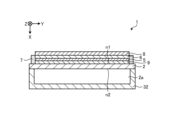
- FIG. 1A is a cross-sectional view showing an example of an electrochemical cell according to the first embodiment.
- FIG. 1B is a side view of an example of the electrochemical cell according to the first embodiment, viewed from the air electrode side.
- FIG. 1C is an enlarged cross-sectional view of region A shown in FIG. 1A.
- FIG. 1D is a sectional view showing another example of the electrochemical cell according to the first embodiment.
- FIG. 1E is a cross-sectional view showing another example of the electrochemical cell according to the first embodiment.
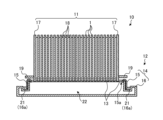
- FIG. 2A is a perspective view showing an example of the cell stack device according to the first embodiment.
- FIG. 2B is a cross-sectional view taken along line XX shown in FIG. 2A.
- FIG. 2C is a top view showing an example of the cell stack device according to the first embodiment.
- FIG. 3 is an external perspective view showing an example of the module according to the first embodiment.
- FIG. 4 is an exploded perspective view schematically showing an example of the module housing device according to the first embodiment.
- FIG. 5A is a perspective view showing an example of a flat plate electrochemical cell.
- FIG. 5B is a partial cross-sectional view of the electrochemical cell shown in FIG. 5A.
- FIG. 6 is a cross-sectional view showing another example of the electrochemical cell according to the first embodiment.
- FIG. 7 is a cross-sectional view showing an example of an electrochemical cell according to the second embodiment.
- FIG. 8A is a cross-sectional view showing another example of the electrochemical cell according to the second embodiment.
- FIG. 8B is a cross-sectional view showing another example of the electrochemical cell according to the second embodiment.
- FIG. 9A is a cross-sectional view showing an example of an electrochemical cell according to the third embodiment.
- FIG. 9B is a cross-sectional view showing another example of the electrochemical cell according to the third embodiment.
- the above-described fuel cell stack device had room for improvement in terms of improving cell performance.
- drawings are schematic and the dimensional relationship of each element, the ratio of each element, etc. may differ from reality. Furthermore, drawings may include portions with different dimensional relationships and ratios.
- the electrochemical cell device may include a cell stack having multiple electrochemical cells.
- An electrochemical cell device having multiple electrochemical cells is simply referred to as a cell stack device.
- FIG. 1A is a cross-sectional view showing an example of an electrochemical cell according to the first embodiment.
- FIG. 1B is a side view of an example of the electrochemical cell according to the first embodiment, viewed from the air electrode side.
- FIG. 1C is an enlarged cross-sectional view of region A shown in FIG. 1A. Note that FIGS. 1A to 1C show enlarged portions of each structure of the electrochemical cell.
- the electrochemical cell may be simply referred to as a cell.
- the cell 1 includes an element part 3 in which a fuel electrode 5 as a first electrode, a solid electrolyte layer 6, and an air electrode 8 as a second electrode are laminated, a support 2, It has an oxide layer 9.
- the support body 2 is a metal member containing chromium. Moreover, the support body 2 has electrical conductivity.
- the support 2 may be made of highly heat-resistant stainless steel, such as ferritic stainless steel or austenitic stainless steel.
- the support 2 may be made of, for example, a nickel-chromium alloy or an iron-chromium alloy.
- the support 2 may contain, for example, a metal oxide.
- the support body 2 may be composed of one or more metal plates, for example.
- the support body 2 electrically connects cells 1 adjacent to each other in the X-axis direction.
- the support body 2 has a first surface n1 and a second surface n2 located on the opposite side of the first surface n1.
- the support body 2 has an opening 2b located at a portion facing the element portion 3, specifically, a portion in contact with the oxide layer 9.
- the opening 2b penetrates between the first surface n1 and the second surface n2 in the X-axis direction.
- the support body 2 includes a member 32 located outside the gas flow path 2a extending in the Z-axis direction.
- the support body 2 allows the fuel gas flowing through the gas flow path 2 a to flow to the element section 3 .
- the diameter of the opening 2b may be, for example, 0.1 mm to 0.5 mm, particularly 0.3 mm to 0.4 mm.
- the aperture ratio in the region where the openings 2b are formed may be, for example, 10% or more.
- the support body 2 may have a base material 201 and a covering portion 202.
- Covering portion 202 is located on the surface of base material 201.
- the covering portion 202 has, for example, insulating properties.
- the covering portion 202 contains, for example, chromium oxide (Cr 2 O 3 ).
- the coating portion 202 may have a higher chromium content than the base material 201, for example. By having the covering portion 202 in this manner, the durability of the support body 2 is increased.
- the covering portion 202 may contain a metal component different from chromium, such as manganese. Note that the support body 2 may have a covering portion 202 partially. Moreover, the support body 2 may have a further laminated structure.
- the element portion 3 is located on the first surface n1 side of the support 2.
- the element portion 3 is fixed to the support body 2 via an oxide layer 9.
- the element section 3 includes a fuel electrode 5, a solid electrolyte layer 6, and an air electrode 8.
- the fuel electrode 5 is a first electrode that is in contact with fuel gas, which is a reducing gas.
- the fuel electrode 5 has gas permeability.
- the open porosity of the fuel electrode 5 may range, for example, from 30% to 50%, particularly from 35% to 45%.
- the open porosity of the fuel electrode 5 may also be referred to as the porosity or porosity of the fuel electrode 5.
- the fuel electrode 5 may be made of a porous conductive ceramic, such as a ceramic containing calcium oxide, magnesium oxide, or ZrO 2 in which a rare earth element oxide is dissolved as a solid solution, and Ni and/or NiO.
- This rare earth element oxide may include a plurality of rare earth elements selected from, for example, Sc, Y, La, Nd, Sm, Gd, Dy, and Yb.
- ZrO 2 containing calcium oxide, magnesium oxide, or rare earth element oxide as a solid solution is sometimes referred to as stabilized zirconia.
- Stabilized zirconia may include partially stabilized zirconia.
- the solid electrolyte layer 6 is an electrolyte and transfers ions between the fuel electrode 5 and the air electrode 8. At the same time, the solid electrolyte layer 6 has gas barrier properties, making it difficult for fuel gas and oxygen-containing gas to leak.
- the material of the solid electrolyte layer 6 may be, for example, ZrO 2 in which 3 mol % to 15 mol % of a rare earth element oxide is dissolved.
- the rare earth element oxide may contain one or more rare earth elements selected from, for example, Sc, Y, La, Nd, Sm, Gd, Dy, and Yb.
- the solid electrolyte layer 6 may include, for example, ZrO 2 in which Yb, Sc or Gd is dissolved in solid solution, CeO 2 in which La, Nd or Yb is dissolved in solid solution, BaZrO 3 in which Sc or Yb is dissolved in solid solution. It may also contain BaCeO 3 in which Sc or Yb is solidly dissolved.
- the air electrode 8 is a second electrode in contact with oxygen-containing gas.
- the air electrode 8 has gas permeability.
- the open porosity of the air electrode 8 may range, for example, from 20% to 50%, particularly from 30% to 50%.
- the material of the air electrode 8 is not particularly limited as long as it is commonly used for air electrodes.
- the material of the air electrode 8 may be, for example, a conductive ceramic such as a so-called ABO 3 perovskite oxide.
- the material of the air electrode 8 may be, for example, a composite oxide in which Sr (strontium) and La (lanthanum) coexist at the A site.
- composite oxides include La x Sr 1-x Co y Fe 1-y O 3 , La x Sr 1-x MnO 3 , La x Sr 1-x FeO 3 , La x Sr 1-x Examples include CoO3 . Note that x is 0 ⁇ x ⁇ 1, and y is 0 ⁇ y ⁇ 1.
- the element section 3 may include an intermediate layer located between the solid electrolyte layer 6 and the air electrode 8.
- the intermediate layer has a function as, for example, a diffusion suppressing layer.
- Sr Strontium
- SrZrO 3 a resistance layer of SrZrO 3 is formed in the solid electrolyte layer 6.
- the intermediate layer makes it difficult for Sr to diffuse, thereby making it difficult for SrZrO 3 to be formed.
- the material for the intermediate layer is not particularly limited as long as it generally makes it difficult for elements to diffuse between the air electrode 8 and the solid electrolyte layer 6.
- the material of the intermediate layer may include, for example, cerium oxide (CeO 2 ) in which a rare earth element other than Ce (cerium) is solidly dissolved.
- CeO 2 cerium oxide
- rare earth elements for example, Gd (gadolinium), Sm (samarium), etc. may be used.
- the oxide layer 9 is located between the support body 2 and the element portion 3.
- the oxide layer 9 is located between the first surface n1 of the support 2 and the fuel electrode 5, and joins the support 2 and the element portion 3 together.
- the oxide layer 9 has conductivity.
- the oxide layer 9 has a smaller porosity than the fuel electrode 5.
- the porosity of the oxide layer 9 may be in the range, for example, from 1% to 10%, in particular from 3% to 8%. Since the porosity of the oxide layer 9 is smaller than that of the fuel electrode 5, the interface strength between the oxide layer 9 and the fuel electrode 5, that is, the bonding strength at the boundary between the oxide layer 9 and the fuel electrode 5 is improved. and becomes difficult to peel off. This improves the durability of the cell 1, thereby improving cell performance.
- the porosity of the oxide layer 9, fuel electrode 5, etc. can be determined by, for example, observing a cross section of each portion using a SEM (scanning electron microscope) and taking a photograph at a magnification of, for example, 3000 times.
- the porosity can be determined by performing image processing on this photograph to determine the pores and calculating the total area of the pores relative to the area of the entire image.
- the porosity of the oxide layer 9 and the fuel electrode 5 may be compared, for example, by comparing the average porosity calculated from cross-sectional photographs of three arbitrary locations for each portion.
- the porosity of the oxide layer 9 may be less than 5%. If the porosity of the oxide layer 9 is less than 5%, metals such as Cr and Mn contained in the support 2 will be difficult to diffuse into the fuel electrode 5. This improves the durability of the fuel electrode 5. Furthermore, when the oxide layer 9 with a porosity of less than 5% is disposed on the support 2, Cr becomes difficult to evaporate from the support 2. This improves the durability of the cell 1.
- the oxide layer 9 has a metal component other than Cr.
- the oxide layer 9 includes, for example, an oxide of a first metal and a second metal different from the first metal.
- the first metal is, for example, Ti (titanium).
- the second metal is, for example, Ni (nickel).
- the second metal is dispersed inside the oxide layer 9.
- the second metal may be dispersed, for example, as metal particles or oxide particles.
- the first metal may be a metal other than Ti, such as Al (aluminum) or Si (silicon). The first metal does not easily change its volume even when exposed to a reducing atmosphere, and its porosity can be easily maintained at less than 5%.
- the second metal may be a metal other than Ni, such as Cu (copper), Co (cobalt), or Zn (zinc).
- the second metal has high electron conductivity and easily maintains electron conduction between the fuel electrode 5 and the support 2.
- Oxide layer 9 may contain a trace amount of Cr.
- the covering portion 202 of the support 2 may have the metal component that the oxide layer 9 has.
- a metal component may be, for example, a second metal. Since the covering portion 202 in contact with the oxide layer 9 has the same metal component as the oxide layer 9 in this manner, the interface strength between the oxide layer 9 and the support 2 is improved. This improves the durability of the cell 1, thereby improving cell performance. Furthermore, since the covering portion 202 includes the second metal that is included in the oxide layer 9 and has high electron conductivity, the insulation of the covering portion 202 can be lowered, and the insulation between the fuel electrode 5 and the support 2 can be reduced. Easy to maintain electronic conduction.
- the oxide layer 9 may be positioned so as to overlap the support 2 in plan view. That is, the portion of the support 2 facing the opening 2b may not have the oxide layer 9, but may have a through hole penetrating the oxide layer 9 in the thickness direction. Such a through hole communicates with the opening 2b, so that the fuel gas flowing through the gas flow path 2a can easily flow to the element section 3. Furthermore, since the oxide layer 9 is located on the surface of the covering portion 202, the covering portion 202 becomes difficult to grow. Furthermore, since Cr in the support 2 becomes difficult to diffuse, the durability of the cell 1 is improved. Thereby, cell performance can be improved.
- FIG. 1D and FIG. 1E are cross-sectional views showing other examples of the electrochemical cell according to the first embodiment.
- the side surfaces of the fuel electrode 5 and the side surfaces of the oxide layer 9 are covered with a solid electrolyte layer 6, thereby airtightly sealing the gas flow path 2a through which the fuel gas flows.
- the side surfaces of the fuel electrode 5 and the oxide layer 9 may be covered and sealed with a dense sealing material 7.
- the sealing material 7 that covers the side surface of the fuel electrode 5 and the side surface of the oxide layer 9 may have electrical insulation properties.
- the material of the sealing material 7 may be, for example, glass or ceramics.
- gas flow path 2a of the support body 2 may be formed of a member 32 having unevenness as shown in FIG. 1E.
- FIG. 2A is a perspective view showing an example of the electrochemical cell device according to the first embodiment.
- FIG. 2B is a cross-sectional view taken along line XX shown in FIG. 2A.
- FIG. 2C is a top view showing an example of the electrochemical cell device according to the first embodiment.
- the cell stack device 10 includes a cell stack 11 having a plurality of cells 1 arranged (stacked) in the thickness direction (X-axis direction) of the cells 1, and a fixing member 12.
- the fixing member 12 includes a fixing member 13 and a support member 14.
- the support member 14 supports the cell 1.
- the fixing member 13 fixes the cell 1 to the support member 14 .
- the support member 14 includes a support body 15 and a gas tank 16.
- the support body 15, which is the support member 14, and the gas tank 16 are made of metal and have electrical conductivity.
- the support body 15 has an insertion hole 15a into which the lower end portions of the plurality of cells 1 are inserted.
- the lower ends of the plurality of cells 1 and the inner wall of the insertion hole 15a are joined with a fixing material 13.
- the gas tank 16 has an opening for supplying reaction gas to the plurality of cells 1 through the insertion hole 15a, and a groove 16a located around the opening. An end of the outer periphery of the support body 15 is joined to the gas tank 16 by a joining material 21 filled in the groove 16a of the gas tank 16.
- fuel gas is stored in the internal space 22 formed by the support body 15, which is the support member 14, and the gas tank 16.
- a gas flow pipe 20 is connected to the gas tank 16.
- Fuel gas is supplied to the gas tank 16 through this gas distribution pipe 20, and from the gas tank 16 to the gas passage 2a (see FIG. 1A) inside the cell 1.
- the fuel gas supplied to the gas tank 16 is generated in a reformer 102 (see FIG. 3), which will be described later.
- Hydrogen-rich fuel gas can be produced by steam reforming raw fuel.
- fuel gas is generated by steam reforming, the fuel gas contains steam.
- FIG. 2A includes two rows of cell stacks 11, two supports 15, and a gas tank 16.
- the two rows of cell stacks 11 each have a plurality of cells 1.
- Each cell stack 11 is fixed to each support 15.
- the gas tank 16 has two through holes on its upper surface.
- Each support body 15 is arranged in each through hole.
- Internal space 22 is formed by one gas tank 16 and two supports 15.
- the shape of the insertion hole 15a is, for example, an ellipse when viewed from above.
- the length of the insertion hole 15a in the arrangement direction of the cells 1, that is, the thickness direction T is larger than the distance between the two end current collecting members 17 located at both ends of the cell stack 11.
- the width of the insertion hole 15a is, for example, larger than the length of the cell 1 in the width direction W (see FIG. 1A).
- the joint between the inner wall of the insertion hole 15a and the lower end of the cell 1 is filled with the fixing material 13 and solidified.
- the inner wall of the insertion hole 15a and the lower end portions of the plurality of cells 1 are respectively joined and fixed, and the lower end portions of the cells 1 are joined and fixed to each other.
- the gas flow path 2a of each cell 1 communicates with the internal space 22 of the support member 14 at its lower end.
- the fixing material 13 and the bonding material 21 materials with low conductivity such as glass can be used.
- materials with low conductivity such as glass
- specific materials for the fixing material 13 and the bonding material 21 amorphous glass or the like may be used, and in particular, crystallized glass or the like may be used.
- crystallized glass examples include SiO 2 -CaO system, MgO-B 2 O 3 system, La 2 O 3 -B 2 O 3 -MgO system, La 2 O 3 -B 2 O 3 -ZnO system, SiO 2 -CaO--ZnO-based materials may be used, and in particular, SiO 2 -MgO-based materials may be used.
- a conductive member 18 is interposed between adjacent cells 1 among the plurality of cells 1.
- the conductive member 18 electrically connects one adjacent cell 1 and the other adjacent cell 1 in series. More specifically, the conductive member 18 connects the fuel electrode 5 of one cell 1 and the air electrode 8 of the other cell 1.
- the end current collecting member 17 is electrically connected to the outermost cell 1 in the arrangement direction of the plurality of cells 1.
- the end current collecting member 17 is connected to a conductive portion 19 protruding to the outside of the cell stack 11 .
- the conductive part 19 collects electricity generated by the power generation of the cell 1 and draws it to the outside. Note that in FIG. 2A, illustration of the end current collecting member 17 is omitted.
- the cell stack device 10 may be one battery in which two cell stacks 11A and 11B are connected in series.
- the conductive portion 19 of the cell stack device 10 may include a positive terminal 19A, a negative terminal 19B, and a connection terminal 19C.
- the positive electrode terminal 19A is a positive electrode for outputting the electric power generated by the cell stack 11 to the outside, and is electrically connected to the end current collecting member 17 on the positive electrode side of the cell stack 11A.
- the negative electrode terminal 19B is a negative electrode for outputting the electric power generated by the cell stack 11 to the outside, and is electrically connected to the end current collecting member 17 on the negative electrode side of the cell stack 11B.
- connection terminal 19C electrically connects the negative end current collecting member 17 of the cell stack 11A and the positive end current collecting member 17 of the cell stack 11B.
- FIG. 3 is an external perspective view showing the module according to the first embodiment.
- FIG. 3 shows a state in which the front and rear surfaces, which are part of the storage container 101, are removed and the fuel cell cell stack device 10 housed inside is taken out rearward.
- the module 100 includes a storage container 101 and a cell stack device 10 housed within the storage container 101. Further, above the cell stack device 10, a reformer 102 is arranged.
- the reformer 102 generates fuel gas by reforming raw fuel such as natural gas or kerosene, and supplies the fuel gas to the cell 1.
- Raw fuel is supplied to the reformer 102 through a raw fuel supply pipe 103.
- the reformer 102 may include a vaporizing section 102a that vaporizes water, and a reforming section 102b.
- the reforming section 102b includes a reforming catalyst (not shown), and reformes the raw fuel into fuel gas.
- Such a reformer 102 can perform steam reforming, which is a highly efficient reforming reaction.
- the fuel gas generated in the reformer 102 is supplied to the gas flow path 2a of the cell 1 (see FIG. 1A) through the gas distribution pipe 20, the gas tank 16, and the support member 14.
- the temperature inside the module 100 during normal power generation is approximately 500° C. to 1000° C. due to combustion of gas and power generation in the cell 1.
- the module 100 by accommodating the cell stack device 10 that improves cell performance, the module 100 can have improved performance.
- FIG. 4 is an exploded perspective view showing an example of the module housing device according to the first embodiment.
- the module housing device 110 according to this embodiment includes an exterior case 111, the module 100 shown in FIG. 3, and an auxiliary device not shown.
- the auxiliary machine operates the module 100.
- the module 100 and auxiliary equipment are housed in an exterior case 111. Note that in FIG. 4, some configurations are omitted.
- the exterior case 111 of the module housing device 110 shown in FIG. 4 includes a support 112 and an exterior plate 113.
- the partition plate 114 divides the interior of the exterior case 111 into upper and lower sections.
- the space above the partition plate 114 in the exterior case 111 is a module storage chamber 115 that accommodates the module 100, and the space below the partition plate 114 in the exterior case 111 accommodates auxiliary equipment that operates the module 100.
- This is the auxiliary equipment storage chamber 116. Note that, in FIG. 4, the auxiliary equipment accommodated in the auxiliary equipment storage chamber 116 is omitted.
- the partition plate 114 has an air flow port 117 for flowing air from the auxiliary equipment storage chamber 116 to the module storage chamber 115 side.
- the exterior plate 113 configuring the module storage chamber 115 has an exhaust port 118 for exhausting the air inside the module storage chamber 115 .
- the module accommodating device 110 by providing the module accommodating chamber 115 with the module 100 whose cell performance is improved, the module accommodating device 110 can have improved performance.
- FIG. 5A and 5B show still another example of the electrochemical cell according to the first embodiment.
- FIG. 5A is a perspective view showing an example of a flat plate electrochemical cell.
- FIG. 5B is a partial cross-sectional view of the electrochemical cell shown in FIG. 5A.
- the cell 1 includes an element part 3 in which a fuel electrode 5, a solid electrolyte layer 6, and an air electrode 8 are laminated, a support 2, an oxide layer 9, a conductive member 91, 92.
- a plurality of cells 1 are electrically connected by conductive members 91 and 92, which are metal layers adjacent to each other.
- the conductive members 91 and 92 electrically connect adjacent cells 1 to each other and have flow paths for supplying gas to the fuel electrode 5 or the air electrode 8.
- the cell 1 has a sealing material that airtightly seals the fuel gas flow path 98 and the oxygen-containing gas flow path 97 of the flat cell stack.
- the sealing material is a fixing member 96 of the cell 1, and has a bonding material 93 and supporting members 94 and 95 that are frames.
- the bonding material 93 may be glass or a metal material such as silver solder.
- the support member 94 may be a so-called separator that partitions the fuel gas flow path 98 and the oxygen-containing gas flow path 97.
- the material of the supporting members 94 and 95 may be, for example, a conductive metal or an insulating ceramic. Both or one of the support members 94 and 95 may be made of an insulating material. If the support member 94 is made of metal, the support member 94 may be integrated with the conductive member 91. If the support member 95 is made of metal, the support member 95 may be integrated with the conductive member 92.
- One of the support members 94 and 95 is insulative, and electrically insulates the two conductive members 91 and 92 sandwiching the flat cell from each other.
- the oxide layer 9 is located between the support 2 and the element portion 3.
- the oxide layer 9 is located between the support 2 and the fuel electrode 5 and joins the support 2 and the element portion 3 together.
- the oxide layer 9 has conductivity.
- FIG. 6 is a cross-sectional view showing another example of the electrochemical cell according to the first embodiment.
- the fuel electrode 5 may have a portion 5a that protrudes into the oxide layer 9 toward the opening 2b.
- the bonding strength between the fuel electrode 5 and the oxide layer 9 is improved, and the durability of the cell 1 is improved.
- the fuel electrode 5 may have a portion 5b located apart from the opening 2b.
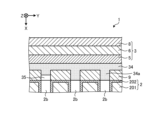
- FIG. 7 is a cross-sectional view showing an example of an electrochemical cell according to the second embodiment.
- the cell 1 according to this embodiment has an adhesive layer 34 located between the element section 3 and the oxide layer 9.
- the adhesive layer 34 adheres the element portion 3 and the oxide layer 9.
- the adhesive layer 34 has gas permeability, for example.
- the adhesive layer 34 may be electrically conductive, for example.
- the adhesive layer 34 is made of, for example, conductive particles such as Ni, Cu, Co, and Zn, TiO 2 , Al 2 O 3 , SiO 2 , rare earth element oxides (Y 2 O 3 , CeO 2 , etc.), and transition metals. It may also contain inorganic oxides such as oxides (Fe 2 O 3 , CuO, etc.).
- the adhesive layer 34 may also be located in the portion where the opening 2b is located, and the surface thereof may be exposed.
- the oxide layer 9 has a smaller porosity (open porosity) than the adhesive layer 34.
- the open porosity of the adhesive layer 34 may range, for example, from 20% to 40%, in particular from 25% to 35%. Since the porosity of the oxide layer 9 is smaller than that of the adhesive layer 34, the interfacial strength between the oxide layer 9 and the adhesive layer 34 is improved, and peeling becomes difficult. This improves the durability of the cell 1, thereby improving cell performance.
- the porosity of the oxide layer 9, the adhesive layer 34, etc. can be determined by, for example, observing a cross section of each portion with an SEM (scanning electron microscope) and taking a photograph at a magnification of, for example, 3000 times.
- the porosity can be determined by performing image processing on this photograph to determine the pores and calculating the total area of the pores relative to the area of the entire image.
- the porosity of the oxide layer 9 and the adhesive layer 34 may be compared, for example, by comparing the average porosity calculated from cross-sectional photographs of three arbitrary locations for each site.
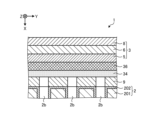
- FIGS. 8A and 8B are cross-sectional views showing other examples of the electrochemical cell according to the second embodiment.
- the adhesive layer 34 may have a portion 34a that protrudes into the oxide layer 9 toward the opening 2b.
- the bonding strength between the adhesive layer 34 and the oxide layer 9 is improved, and the durability of the cell 1 is further improved.
- the oxide layer 9 may have a space 35 located between the portion 34a and the opening 2b.
- the adhesive layer 34 may have a portion located apart from the opening 2b.
- the oxide layer 9 may have a portion 9a that protrudes into the inside of the opening 2b.
- a portion 9a for example, the bonding strength between the oxide layer 9 and the support body 2 is improved, and the durability of the cell 1 is further improved.
- portion 34a of the adhesive layer 34 may penetrate the oxide layer 9 and extend to the opening 2b.
- the tip portions of portion 34a and portion 9a may be located at approximately the same height (see, for example, portion P1), or portion 9a may protrude more than portion 34a (see, for example, portion P2).
- the portion 34a may protrude more than the portion 9a (for example, see portion P3).
- the oxide layer 9 and the adhesive layer 34 may be collectively regarded as a bonding layer located between the support body 2 and the element portion 3. In that case, the oxide layer 9 may be considered as a low porosity part of the bonding layer, and the adhesive layer 34 may be considered as a high porosity part of the bonding layer.
- FIG. 9A is a cross-sectional view showing an example of an electrochemical cell according to the third embodiment.
- FIG. 9B is a cross-sectional view showing another example of the electrochemical cell according to the third embodiment.
- the cell 1 according to the present embodiment has the above-mentioned constraint layer 36 located between the element part 3 and the oxide layer 9 or between the element part 3 and the adhesive layer 34. This is different from the electrochemical cell according to the embodiment.
- the material of the constraining layer 36 exhibits a shrinkage rate similar to that of the material of the solid electrolyte layer 6 during firing.
- the element portion 3 obtained by sandwiching the material of the fuel electrode 5 between the material of the solid electrolyte layer 6 and the material of the constraining layer 36 and firing the material has less warpage or deformation, and thus improves cell performance.
- a plurality of through holes penetrating the constraint layer 36 in the thickness direction (X-axis direction) are formed. It is best to position The position and shape of such a through hole may be the same as or different from the opening 2b.
- a fuel cell, a fuel cell stack device, a fuel cell module, and a fuel cell device are shown as examples of an “electrochemical cell,” an “electrochemical cell device,” a “module,” and a “module housing device.”
- an electrolytic cell has a hydrogen electrode as a first electrode and an oxygen electrode as a second electrode, and decomposes water vapor into hydrogen and oxygen or carbon dioxide into carbon monoxide and oxygen by supplying electric power.
- an oxide ion conductor or a hydrogen ion conductor is shown as an example of the electrolyte material of the electrochemical cell, but a hydroxide ion conductor may also be used. According to such an electrolytic cell, an electrolytic cell stack device, an electrolytic module, and an electrolytic device, performance can be improved.
- the electrochemical cell (cell 1) includes the element section 3, the metal support 2, and the oxide layer 9.
- the element section 3 includes a solid electrolyte layer 6, and a first electrode (fuel electrode 5) and a second electrode (air electrode 8) located with the solid electrolyte layer 6 in between.
- the support body 2 contains chromium and supports the element portion 3.
- the oxide layer 9 is located between the first electrode and the support 2 and has a metal component.
- the oxide layer 9 has a lower porosity than the first electrode. Thereby, the performance of the cell 1 can be improved.
- the electrochemical cell (cell 1) includes an element section 3, a metal support 2, an adhesive layer 34, and an oxide layer 9.
- the support body 2 contains chromium and supports the element portion 3.
- the adhesive layer 34 is located between the element section 3 and the support body 2.
- the oxide layer 9 is located between the adhesive layer 34 and the support 2 and has a metal component.
- the oxide layer 9 has a lower porosity than the adhesive layer 34. Thereby, the performance of the cell 1 can be improved.
- the electrochemical cell device (cell stack device 10) according to the embodiment includes a cell stack 11 including the electrochemical cell described above. Thereby, the performance of the cell stack device 10 can be improved.
- the module 100 includes the electrochemical cell device described above and a storage container 101 that houses the electrochemical cell device. Thereby, the performance of the module 100 can be improved.
- the module housing device 110 includes the module 100 described above, an auxiliary machine for operating the module 100, and an exterior case that houses the module 100 and the auxiliary machine. Thereby, the performance of the module accommodating device 110 can be improved.
Landscapes
- Chemical & Material Sciences (AREA)
- Engineering & Computer Science (AREA)
- Chemical Kinetics & Catalysis (AREA)
- Sustainable Development (AREA)
- Sustainable Energy (AREA)
- Manufacturing & Machinery (AREA)
- Life Sciences & Earth Sciences (AREA)
- Electrochemistry (AREA)
- General Chemical & Material Sciences (AREA)
- Fuel Cell (AREA)
- Composite Materials (AREA)
- Materials Engineering (AREA)
- Ceramic Engineering (AREA)
- Secondary Cells (AREA)
- Battery Electrode And Active Subsutance (AREA)
Priority Applications (5)
| Application Number | Priority Date | Filing Date | Title |
|---|---|---|---|
| CN202380048075.4A CN119343792A (zh) | 2022-06-30 | 2023-06-30 | 电化学电池、电化学电池装置、模块及模块收容装置 |
| JP2023565920A JP7453485B1 (ja) | 2022-06-30 | 2023-06-30 | 電気化学セル、電気化学セル装置、モジュールおよびモジュール収容装置 |
| US18/879,169 US20250385278A1 (en) | 2022-06-30 | 2023-06-30 | Electrochemical cell, electrochemical cell device, module, and module housing device |
| EP23831649.1A EP4525107A1 (en) | 2022-06-30 | 2023-06-30 | Electrochemical cell, electrochemical cell device, module, and module accommodating device |
| JP2024035412A JP2024063225A (ja) | 2022-06-30 | 2024-03-07 | 電気化学セル、電気化学セル装置、モジュールおよびモジュール収容装置 |
Applications Claiming Priority (2)
| Application Number | Priority Date | Filing Date | Title |
|---|---|---|---|
| JP2022-106388 | 2022-06-30 | ||
| JP2022106388 | 2022-06-30 |
Publications (1)
| Publication Number | Publication Date |
|---|---|
| WO2024005210A1 true WO2024005210A1 (ja) | 2024-01-04 |
Family
ID=89382551
Family Applications (1)
| Application Number | Title | Priority Date | Filing Date |
|---|---|---|---|
| PCT/JP2023/024523 Ceased WO2024005210A1 (ja) | 2022-06-30 | 2023-06-30 | 電気化学セル、電気化学セル装置、モジュールおよびモジュール収容装置 |
Country Status (5)
| Country | Link |
|---|---|
| US (1) | US20250385278A1 (https=) |
| EP (1) | EP4525107A1 (https=) |
| JP (2) | JP7453485B1 (https=) |
| CN (1) | CN119343792A (https=) |
| WO (1) | WO2024005210A1 (https=) |
Cited By (5)
| Publication number | Priority date | Publication date | Assignee | Title |
|---|---|---|---|---|
| WO2025164665A1 (ja) * | 2024-01-29 | 2025-08-07 | 京セラ株式会社 | 複合部材、電気化学セル、電気化学セル装置、モジュールおよびモジュール収容装置 |
| WO2025164668A1 (ja) * | 2024-01-30 | 2025-08-07 | 京セラ株式会社 | 複合部材、電気化学セル、電気化学セル装置、モジュールおよびモジュール収容装置 |
| WO2025181907A1 (ja) * | 2024-02-27 | 2025-09-04 | 日産自動車株式会社 | 固体酸化物形燃料電池 |
| WO2025249529A1 (ja) * | 2024-05-30 | 2025-12-04 | 京セラ株式会社 | 電気化学セル、電気化学セル装置、モジュールおよびモジュール収容装置 |
| WO2026048897A1 (ja) * | 2024-08-27 | 2026-03-05 | 京セラ株式会社 | 電気化学セル、電気化学セル装置、モジュールおよびモジュール収容装置 |
Families Citing this family (2)
| Publication number | Priority date | Publication date | Assignee | Title |
|---|---|---|---|---|
| EP4621891A4 (en) * | 2022-12-27 | 2026-04-29 | Kyocera Corp | ELECTROCHEMICAL CELL, ELECTROCHEMICAL CELL DEVICE, MODULE AND MODULE RECEIVER DEVICE |
| WO2025206231A1 (ja) * | 2024-03-28 | 2025-10-02 | 京セラ株式会社 | 電気化学セル、電気化学セル装置、モジュールおよびモジュール収容装置 |
Citations (5)
| Publication number | Priority date | Publication date | Assignee | Title |
|---|---|---|---|---|
| JP2015153467A (ja) * | 2014-02-10 | 2015-08-24 | 日産自動車株式会社 | 金属支持型固体酸化物形燃料電池 |
| JP2017033799A (ja) * | 2015-08-03 | 2017-02-09 | 株式会社日本触媒 | メタルサポートセル |
| JP2017059504A (ja) * | 2015-09-18 | 2017-03-23 | 大阪瓦斯株式会社 | 金属支持型電気化学素子、固体酸化物形燃料電池および金属支持型電気化学素子の製造方法 |
| WO2020218431A1 (ja) | 2019-04-24 | 2020-10-29 | 京セラ株式会社 | セル、セルスタック装置、モジュール及びモジュール収容装置 |
| JP2021002467A (ja) * | 2019-06-21 | 2021-01-07 | 株式会社デンソー | 燃料電池単セルおよび燃料電池セルスタック |
-
2023
- 2023-06-30 US US18/879,169 patent/US20250385278A1/en active Pending
- 2023-06-30 JP JP2023565920A patent/JP7453485B1/ja active Active
- 2023-06-30 CN CN202380048075.4A patent/CN119343792A/zh active Pending
- 2023-06-30 EP EP23831649.1A patent/EP4525107A1/en not_active Withdrawn
- 2023-06-30 WO PCT/JP2023/024523 patent/WO2024005210A1/ja not_active Ceased
-
2024
- 2024-03-07 JP JP2024035412A patent/JP2024063225A/ja active Pending
Patent Citations (5)
| Publication number | Priority date | Publication date | Assignee | Title |
|---|---|---|---|---|
| JP2015153467A (ja) * | 2014-02-10 | 2015-08-24 | 日産自動車株式会社 | 金属支持型固体酸化物形燃料電池 |
| JP2017033799A (ja) * | 2015-08-03 | 2017-02-09 | 株式会社日本触媒 | メタルサポートセル |
| JP2017059504A (ja) * | 2015-09-18 | 2017-03-23 | 大阪瓦斯株式会社 | 金属支持型電気化学素子、固体酸化物形燃料電池および金属支持型電気化学素子の製造方法 |
| WO2020218431A1 (ja) | 2019-04-24 | 2020-10-29 | 京セラ株式会社 | セル、セルスタック装置、モジュール及びモジュール収容装置 |
| JP2021002467A (ja) * | 2019-06-21 | 2021-01-07 | 株式会社デンソー | 燃料電池単セルおよび燃料電池セルスタック |
Cited By (5)
| Publication number | Priority date | Publication date | Assignee | Title |
|---|---|---|---|---|
| WO2025164665A1 (ja) * | 2024-01-29 | 2025-08-07 | 京セラ株式会社 | 複合部材、電気化学セル、電気化学セル装置、モジュールおよびモジュール収容装置 |
| WO2025164668A1 (ja) * | 2024-01-30 | 2025-08-07 | 京セラ株式会社 | 複合部材、電気化学セル、電気化学セル装置、モジュールおよびモジュール収容装置 |
| WO2025181907A1 (ja) * | 2024-02-27 | 2025-09-04 | 日産自動車株式会社 | 固体酸化物形燃料電池 |
| WO2025249529A1 (ja) * | 2024-05-30 | 2025-12-04 | 京セラ株式会社 | 電気化学セル、電気化学セル装置、モジュールおよびモジュール収容装置 |
| WO2026048897A1 (ja) * | 2024-08-27 | 2026-03-05 | 京セラ株式会社 | 電気化学セル、電気化学セル装置、モジュールおよびモジュール収容装置 |
Also Published As
| Publication number | Publication date |
|---|---|
| EP4525107A1 (en) | 2025-03-19 |
| JP2024063225A (ja) | 2024-05-10 |
| US20250385278A1 (en) | 2025-12-18 |
| JP7453485B1 (ja) | 2024-03-19 |
| JPWO2024005210A1 (https=) | 2024-01-04 |
| CN119343792A (zh) | 2025-01-21 |
Similar Documents
| Publication | Publication Date | Title |
|---|---|---|
| JP7453485B1 (ja) | 電気化学セル、電気化学セル装置、モジュールおよびモジュール収容装置 | |
| JP7284355B1 (ja) | 電気化学セル、電気化学セル装置、モジュールおよびモジュール収容装置 | |
| JP7753364B2 (ja) | 電気化学セル、電気化学セル装置、モジュールおよびモジュール収容装置 | |
| JP2024013791A (ja) | 電気化学セル装置、モジュールおよびモジュール収容装置 | |
| JP2025148535A (ja) | 電気化学セル、電気化学セル装置、モジュールおよびモジュール収容装置 | |
| JP7543601B1 (ja) | 導電部材、電気化学セル装置、モジュールおよびモジュール収容装置 | |
| JP7794994B2 (ja) | 電気化学セル、電気化学セル装置、モジュールおよびモジュール収容装置 | |
| JP7657386B1 (ja) | 固体電解質層、電気化学セル、電気化学セル装置、モジュールおよびモジュール収容装置 | |
| JP7736802B2 (ja) | 導電部材、電気化学セル、電気化学セル装置、モジュールおよびモジュール収容装置 | |
| JP7583227B2 (ja) | 電気化学セル、電気化学セル装置、モジュールおよびモジュール収容装置 | |
| JP7736801B2 (ja) | 電気化学セル、電気化学セル装置、モジュールおよびモジュール収容装置 | |
| WO2026048889A1 (ja) | 電気化学セル、電気化学セル装置、モジュールおよびモジュール収容装置 | |
| WO2024117052A1 (ja) | 複合部材、電気化学セル、電気化学セル装置、モジュールおよびモジュール収容装置 | |
| WO2025094956A1 (ja) | 電気化学セル、電気化学セル装置、モジュールおよびモジュール収容装置 | |
| WO2024150829A1 (ja) | 電気化学セル、電気化学セル装置、モジュールおよびモジュール収容装置 | |
| WO2025070717A1 (ja) | 電気化学セル、電気化学セル装置、モジュールおよびモジュール収容装置 | |
| WO2026029158A1 (ja) | 電気化学セル、電気化学セル装置、モジュールおよびモジュール収容装置 | |
| WO2023195520A1 (ja) | 電気化学セル、電気化学セル装置、モジュールおよびモジュール収容装置 | |
| JP2026008859A (ja) | 電気化学セル、電気化学セル装置、モジュールおよびモジュール収容装置 | |
| WO2024004361A1 (ja) | 導電部材、電気化学セル、電気化学セル装置、モジュールおよびモジュール収容装置 | |
| WO2024247989A1 (ja) | 電気化学セル、電気化学セル装置、モジュールおよびモジュール収容装置 | |
| JP2025132638A (ja) | 電気化学セル、電気化学セル装置、モジュールおよびモジュール収容装置 | |
| JP2024048859A (ja) | 電気化学セル装置、モジュールおよびモジュール収容装置 | |
| WO2024143355A1 (ja) | 電気化学セル、電気化学セル装置、モジュールおよびモジュール収容装置 | |
| WO2025183149A1 (ja) | 電気化学セル、電気化学セル装置、モジュールおよびモジュール収容装置 |
Legal Events
| Date | Code | Title | Description |
|---|---|---|---|
| ENP | Entry into the national phase |
Ref document number: 2023565920 Country of ref document: JP Kind code of ref document: A |
|
| 121 | Ep: the epo has been informed by wipo that ep was designated in this application |
Ref document number: 23831649 Country of ref document: EP Kind code of ref document: A1 |
|
| WWE | Wipo information: entry into national phase |
Ref document number: 2023831649 Country of ref document: EP |
|
| ENP | Entry into the national phase |
Ref document number: 2023831649 Country of ref document: EP Effective date: 20241210 |
|
| WWE | Wipo information: entry into national phase |
Ref document number: 202380048075.4 Country of ref document: CN |
|
| WWE | Wipo information: entry into national phase |
Ref document number: 18879169 Country of ref document: US |
|
| WWP | Wipo information: published in national office |
Ref document number: 202380048075.4 Country of ref document: CN |
|
| NENP | Non-entry into the national phase |
Ref country code: DE |
|
| WWP | Wipo information: published in national office |
Ref document number: 18879169 Country of ref document: US |
|
| WWW | Wipo information: withdrawn in national office |
Ref document number: 2023831649 Country of ref document: EP |