WO2024005196A1 - 共重合ポリエステル、シート状接着剤、積層フィルムおよび成形体 - Google Patents
共重合ポリエステル、シート状接着剤、積層フィルムおよび成形体 Download PDFInfo
- Publication number
- WO2024005196A1 WO2024005196A1 PCT/JP2023/024428 JP2023024428W WO2024005196A1 WO 2024005196 A1 WO2024005196 A1 WO 2024005196A1 JP 2023024428 W JP2023024428 W JP 2023024428W WO 2024005196 A1 WO2024005196 A1 WO 2024005196A1
- Authority
- WO
- WIPO (PCT)
- Prior art keywords
- copolymerized polyester
- adhesive
- sheet
- mass
- acid
- Prior art date
- Legal status (The legal status is an assumption and is not a legal conclusion. Google has not performed a legal analysis and makes no representation as to the accuracy of the status listed.)
- Ceased
Links
Classifications
-
- C—CHEMISTRY; METALLURGY
- C08—ORGANIC MACROMOLECULAR COMPOUNDS; THEIR PREPARATION OR CHEMICAL WORKING-UP; COMPOSITIONS BASED THEREON
- C08G—MACROMOLECULAR COMPOUNDS OBTAINED OTHERWISE THAN BY REACTIONS ONLY INVOLVING UNSATURATED CARBON-TO-CARBON BONDS
- C08G63/00—Macromolecular compounds obtained by reactions forming a carboxylic ester link in the main chain of the macromolecule
-
- C—CHEMISTRY; METALLURGY
- C09—DYES; PAINTS; POLISHES; NATURAL RESINS; ADHESIVES; COMPOSITIONS NOT OTHERWISE PROVIDED FOR; APPLICATIONS OF MATERIALS NOT OTHERWISE PROVIDED FOR
- C09J—ADHESIVES; NON-MECHANICAL ASPECTS OF ADHESIVE PROCESSES IN GENERAL; ADHESIVE PROCESSES NOT PROVIDED FOR ELSEWHERE; USE OF MATERIALS AS ADHESIVES
- C09J167/00—Adhesives based on polyesters obtained by reactions forming a carboxylic ester link in the main chain; Adhesives based on derivatives of such polymers
-
- C—CHEMISTRY; METALLURGY
- C09—DYES; PAINTS; POLISHES; NATURAL RESINS; ADHESIVES; COMPOSITIONS NOT OTHERWISE PROVIDED FOR; APPLICATIONS OF MATERIALS NOT OTHERWISE PROVIDED FOR
- C09J—ADHESIVES; NON-MECHANICAL ASPECTS OF ADHESIVE PROCESSES IN GENERAL; ADHESIVE PROCESSES NOT PROVIDED FOR ELSEWHERE; USE OF MATERIALS AS ADHESIVES
- C09J7/00—Adhesives in the form of films or foils
- C09J7/30—Adhesives in the form of films or foils characterised by the adhesive composition
Definitions
- the present invention relates to copolymerized polyester. More specifically, the present invention relates to a copolymerized polyester, a sheet adhesive containing the copolyester, and a laminated film and molded article using the sheet adhesive.
- Patent Document 2 discloses a molding laminate having a silicone adhesive layer and an acrylic adhesive layer as a decorative molding laminate applied to TOM molding.
- Adhesives that are sticky at room temperature have had the problem of poor handling when removing the release film. For example, if the adhesive layers touch each other, it may be difficult to remove them, or even if they can be removed, the surface of the adhesive layer may be disturbed and the appearance of the film may deteriorate during molding. Therefore, it has been difficult to mass-produce decorative molded products using a TOM molding machine or the like. Furthermore, when applying an adhesive layer to a decorative film, it is necessary to apply and dry the adhesive using a solvent or the like, which imposes an environmental burden. Furthermore, in three-dimensional thermoforming typified by TOM molding, from the viewpoint of improving work efficiency, there is a demand for adhesives that can be bonded together by heating in a short time. An object of the present invention is to provide a copolymerized polyester suitable for an adhesive suitable for three-dimensional thermoforming, which has excellent handling properties and low environmental impact.
- the present inventors have found that a copolymerized polyester having the following properties has been developed as a sheet adhesive that has good handling properties and adhesion during three-dimensional thermoforming of decorative films.
- the present invention was completed based on the discovery that it can be formed. That is, the present invention consists of the following configuration.
- a copolymerized polyester The aromatic group concentration in the copolymerized polyester is 5 to 25% by mass, The glass transition temperature is -80 to 10°C, A copolymerized polyester with a melting point of 70 to 130°C.
- the copolyester according to [1] above which has a heat of crystal fusion of 0.5 J/g or more and 20 J/g or less.
- the copolymerized polyester of the present invention has excellent handling properties, good adhesion during three-dimensional thermoforming, and can be bonded to a base material with a small amount of heat, so it has a low environmental burden. Therefore, it is suitable as an adhesive for three-dimensional thermoforming, and can also be applied to sheet adhesives using it.
- the copolyester of the present invention contains a structural unit having an aromatic group, and the concentration of the aromatic group in the copolyester is 5 to 25% by mass.
- the aromatic group concentration is preferably 7% by mass or more, more preferably 9% by mass or more, even more preferably 11% by mass or more, and preferably 22% by mass or less, more preferably 20% by mass or less, and 18% by mass or less. It is more preferably less than % by mass.
- the aromatic group concentration herein refers to the mass proportion of aromatic rings excluding substituents in the copolymerized polyester.
- polyethylene terephthalate contains one benzene ring for each ethylene terephthalate unit with a molecular weight of 192.2 (62.1 (molecular weight of ethylene glycol) + 166.1 (molecular weight of terephthalic acid) - 18 x 2). Therefore, since the molecular weight of benzene is 78.1, the aromatic group concentration is 40.6% by mass.
- the structural unit having an aromatic group constituting the copolymerized polyester means that the polyhydric carboxylic acid component, the polyol component, or both of them constituting the copolymerized polyester have an aromatic group.
- the number of aromatic groups contained in each of the polyhydric carboxylic acid component or the polyol component is not particularly limited, but is preferably 1 to 2.
- the aromatic group is preferably an aromatic hydrocarbon having 6 to 12 carbon atoms, such as benzene and naphthalene.
- the structural units having an aromatic group constituting the copolymerized polyester of the present invention are not particularly limited, but include aromatic polycarboxylic acids such as terephthalic acid, isophthalic acid, naphthalene dicarboxylic acid, orthophthalic acid, and trimellitic acid.
- aromatic polycarboxylic acids such as terephthalic acid, isophthalic acid, naphthalene dicarboxylic acid, orthophthalic acid, and trimellitic acid.
- Examples include structural units derived from aromatic polyols such as bisphenol A ethylene oxide adducts and bisphenol A propylene oxide adducts.
- the structural unit having an aromatic group constituting the copolymerized polyester is preferably a structural unit derived from an aromatic polyhydric carboxylic acid, and includes terephthalic acid, and further includes isophthalic acid, naphthalene dicarboxylic acid, orthophthalic acid, and It is more preferable that at least one kind selected from trimellitic acid is included.
- the copolymerized polyester of the present invention preferably has a heat of crystal fusion of 20 J/g or less. More preferably it is 15 J/g or less. Moreover, it is preferably 0.5 J/g or more, more preferably 1 J/g or more, and even more preferably 4 J/g or more.
- the heat of crystal fusion is within the above range, good adhesion to the base material is exhibited in three-dimensional thermoforming such as TOM molding, even when molding needs to be performed at low temperature and in a short time. Further, from the viewpoint of heat resistance, it is preferable that the heat of crystal fusion is high. On the other hand, from the viewpoint of TOM formability, it is preferable that the heat of crystal fusion is low.
- the copolyester has terephthalic acid as the polycarboxylic acid constituting the copolyester, and further contains an ortho-substituted aromatic dicarboxylic acid such as phthalic acid, It can be adjusted by having a combination of meta-substituted aromatic dicarboxylic acids such as isophthalic acid, alicyclic dicarboxylic acids such as 1,4-cyclohexanedicarboxylic acid, aliphatic dicarboxylic acids such as dimer acid, sebacic acid, adipic acid, etc.
- terephthalic acid in combination with one or more selected from the group consisting of meta-substituted aromatic dicarboxylic acids, alicyclic dicarboxylic acids, and aliphatic dicarboxylic acids; More preferably, a combination of dicarboxylic acids is used.
- a combination of dicarboxylic acids is used.
- Polyol components constituting the copolymerized polyester include ethylene glycol, propylene glycol, 1,3-propanediol, 2-methyl-1,3-propanediol, 1,4 -Butanediol, diethylene glycol, 2,2-dimethyl-1,3-propanediol, 1,4-pentanediol, 1,5-pentanediol, 1,3-pentanediol, 3-methyl-1,5-pentanediol , triethylene glycol, 1,6-hexanediol, 1,8-octanediol and other aliphatic glycols; 1,4-cyclohexanedimethanol, 1,3-cyclohexanedimethanol, 1,2-cyclohexanedimethanol, 2- Examples include alicyclic glycols such as butyl-2-ethyl-1,3-propanediol
- ethylene glycol diethylene glycol, 2-methyl-1,3-propanediol, 1,4-butanediol, 2,2-dimethyl-1,3-propanediol (neopentyl glycol), 1,6-hexanediol and Polytetramethylene glycol is preferred.
- the copolymerized polyester of the present invention has a glass transition temperature of -80 to 10°C. More preferably -70 to 0°C, still more preferably -65 to -10°C. If the glass transition temperature exceeds the upper limit, the film may peel off due to shrinkage stress after molding. Moreover, if it is less than the above-mentioned lower limit, the anti-blocking property may be lowered and the handling property may be poor. Note that the glass transition temperature is a value measured by the method described in Examples.
- the copolymerized polyester of the present invention has a melting point of 70 to 130°C.
- the temperature is more preferably 80°C or higher, still more preferably 90°C or higher, even more preferably 100°C or higher. Further, the temperature is preferably 125°C or lower, more preferably 120°C or lower. If the copolymerized polyester does not have a melting point or has a melting point below the above lower limit, blocking resistance will be reduced and handling properties will be poor. Moreover, when the above upper limit is exceeded, adhesiveness becomes poor and low-temperature moldability is poor. Further, from the viewpoint of heat resistance, a higher melting point is preferable. On the other hand, from the viewpoint of TOM moldability, a lower melting point is preferable. Note that the melting point is a value measured by the method described in Examples.
- the copolymerized polyester of the present invention preferably has a breaking elongation measured at 25°C of 500% or more, more preferably 600% or more, and still more preferably 700% or more.
- a breaking elongation measured at 25°C 500% or more, more preferably 600% or more, and still more preferably 700% or more.
- the upper limit of the elongation at break measured at 25° C. is not particularly limited, but is usually 1000% or less.
- the constituent units of the copolyester must be long chains without substituents (for example, hydrocarbon groups and/or ether groups are combined between reactive groups). It is preferable to have an aliphatic monomer (containing 5 or more in series), and such aliphatic monomers include linear aliphatic dicarboxylic acids such as adipic acid and sebacic acid, 1,6-hexanediol, 1,8- Examples include linear aliphatic glycols such as octanediol, linear polyalkylene glycols such as diethylene glycol, polyethylene glycol, and polytetramethylene glycol.
- the elongation at break can be measured by the measuring method described in Examples.
- the copolymerized polyester of the present invention preferably has a storage modulus at 0°C of 150 MPa or less, more preferably 120 MPa or less, and still more preferably 100 MPa or less. If the storage modulus at 0° C. exceeds the above value, poor appearance may occur during three-dimensional thermoforming or adhesiveness may decrease.
- the lower limit of the storage modulus at 0° C. is not particularly limited, but is usually 1 MPa or more, preferably 10 MPa or more.
- long chains for example, hydrocarbon groups and/or ether groups are combined between reactive groups
- an aliphatic monomer having 5 or more
- such aliphatic monomers include aliphatic dicarboxylic acids such as adipic acid, sebacic acid, and dimer acid, 1,6-hexanediol, and 1,8-octane.
- aliphatic glycols such as diol, 3-methyl-1,5-pentanediol, and dimer diol
- polyalkylene glycols such as diethylene glycol, polyethylene glycol, and polytetramethylene glycol.
- the copolymerized polyester of the present invention preferably has a tensile modulus of 10 to 80 MPa when measured at 25°C. If the tensile modulus measured at 25°C is within the above range, moldability will be good in three-dimensional thermoforming at 120°C. In order to make the tensile modulus of the copolyester measured at 25°C within the above range, for example, the copolyester has terephthalic acid as a polyhydric carboxylic acid constituting the copolyester, and further contains phthalic acid, etc.
- ortho-substituted aromatic dicarboxylic acids such as isophthalic acid, alicyclic dicarboxylic acids such as 1,4-cyclohexanedicarboxylic acid, aliphatic dicarboxylic acids such as dimer acid, sebacic acid, adipic acid, etc. It can be adjusted by having it. Among these, it is preferable to use terephthalic acid in combination with one or more selected from the group consisting of meta-substituted aromatic dicarboxylic acids, alicyclic dicarboxylic acids, and aliphatic dicarboxylic acids; Preference is given to using dicarboxylic acids in combination.
- the peak top temperature of loss tangent (tan ⁇ ) measured with a dynamic viscoelasticity measuring device is preferably 40°C or lower, more preferably 15°C or lower, and even more preferably 0°C or lower. If tan ⁇ exceeds the above value, poor appearance may occur during three-dimensional thermoforming or adhesiveness may decrease.
- the lower limit of the peak top temperature of loss tangent (tan ⁇ ) is not particularly limited, but is usually -70°C or higher.
- long chains for example, hydrocarbon groups and/or ether groups are combined between reactive groups
- an aliphatic monomer having 5 or more
- such aliphatic monomers include aliphatic dicarboxylic acids such as adipic acid, sebacic acid, and dimer acid, 1,6-hexanediol, 1,8-octanediol
- aliphatic glycols such as 3-methyl-1,5-pentanediol and dimer diol
- polyalkylene glycols such as diethylene glycol, polyethylene glycol and polytetramethylene glycol.
- the reduced viscosity of the copolymerized polyester of the present invention is preferably 0.5 dl/g or more. More preferably it is 0.7 dl/g or more, still more preferably 0.9 dl/g or more.
- the reduced viscosity is at least the above value, the elongation at break of the copolymerized polyester is improved, and as a result, the elongation of the base material can be followed during three-dimensional thermoforming, and the adhesiveness is improved. Further, it is preferably less than 2.5 dl/g, more preferably 2.0 dl/g or less, even more preferably 1.7 dl/g, even more preferably 1.3 dl/g or less. If it exceeds 2.5 dl/g, the wettability to the adherend may become insufficient.
- the sheet-like adhesive of the present invention contains the above copolymerized polyester, has excellent handling properties and adhesive properties, and can be suitably used as an adhesive for three-dimensional thermoforming.
- additives can be added to the sheet adhesive of the present invention.
- additives those widely used as additives to thermoplastic adhesives such as resins other than the copolymerized polyester of the present invention, antioxidants, inorganic fillers, stabilizers, ultraviolet absorbers, and anti-aging agents can be used. It can be added within a range that does not impair the characteristics of the present invention.
- antioxidant for example, as hindered phenols, 1,3,5-tris(3,5-di-t-butyl-4-hydroxybenzyl)isocyanurate, 1,1,3-tri(4-hydroxy-2-methyl- 5-t-butylphenyl)butane, 1,1-bis(3-t-butyl-6-methyl-4-hydroxyphenyl)butane, 3,5-bis(1,1-dimethylethyl)-4-hydroxy- Benzenepropanoic acid, pentaerythritol tetrakis (3,5-di-t-butyl-4-hydroxyphenyl)propionate, 3-(1,1-dimethylethyl)-4-hydroxy-5-methyl-benzenepropanoic Acid, 3,9-bis[1,1-dimethyl-2-[(3-t-butyl-4-hydroxy-5-methylpheny
- the amount added is preferably 0.1% by mass or more and 5% by mass or less based on the solid content of the sheet adhesive. If it is less than 0.1% by mass, the effect of preventing thermal deterioration may be poor. If it exceeds 5% by mass, it may adversely affect adhesion and the like.
- resins other than the copolymerized polyester of the present invention include polyester resins other than the copolymerized polyester of the present invention, thermoplastic resins such as epoxy resins, polyolefin resins, styrene resins, and polyurethane resins, as well as phenolic resins, phenoxy resins, and petroleum resins. , rosin, modified rosin, etc. can be added.
- the sheet adhesive of the present invention may contain an epoxy resin as described above.
- the epoxy resin used in the present invention is not particularly limited, and includes glycidyl ether types such as bisphenol A diglycidyl ether, bisphenol S diglycidyl ether, novolac glycidyl ether, brominated bisphenol A diglycidyl ether, hexahydrophthalic acid glycidyl ester, Glycidyl ester types such as dimer acid glycidyl ester, triglycidyl isocyanurate, glycidyl hindantoin, tetraglycidyl diaminodiphenylmethane, triglycidyl para-aminophenol, triglycidyl meta-aminophenol, diglycidyl aniline, diglycidyl toluidine, tetraglycidyl metaxylene diamine, Examples include glycidylamines such as diglycidyl
- the number average molecular weight of the epoxy resin is preferably 450 to 40,000. If it is less than 450, the sheet adhesive will be extremely susceptible to softening and its mechanical properties will be poor; if it is more than 40,000, the compatibility with the copolyester will be extremely poor, and the effect on adhesive properties may be impaired.
- the content is preferably 10 parts by mass or less based on 100 parts by mass of the copolyester.
- the copolymerized polyester can be appropriately plasticized, and by restricting crystallization of the copolymerized polyester or suppressing enthalpy relaxation, stress generation at the adhesive interface over time is prevented. be able to. Further, the adhesion to the metal surface can be improved.
- the sheet adhesive of the present invention may contain a polyolefin resin as described above.
- the polyolefin resin used in the present invention is not particularly limited, and includes ultra-low density polyethylene, linear low-density polyethylene, ethylene propylene elastomer, ethylene-vinyl acetate copolymer, ethylene-ethyl acrylate copolymer, ethylene-acetic acid Vinyl-maleic anhydride terpolymer, ethylene-ethyl acrylate-maleic anhydride terpolymer, ethylene-glycidyl methacrylate copolymer, ethylene-vinyl acetate-glycidyl methacrylate terpolymer, ethylene -Methyl acrylate-glycidyl methacrylate terpolymer and the like.
- the blending amount of the polyolefin resin used in the present invention is preferably 15 parts by mass or less based on 100 parts by mass of the copolyester.
- Inorganic filler As inorganic fillers, talc, calcium carbonate, zinc oxide, titanium oxide, clay, bentonant, fumed silica, silica powder, mica, etc. are preferably blended in an amount of 40 parts by mass or less per 100 parts by mass of the copolyester.
- additives include crystal nucleating agents such as various metal salts, coloring pigments, inorganic and organic fillers, tackiness improvers, quenchers, metal deactivators, UV absorbers, stabilizers such as HALS, etc. It is also possible to add additives, silane coupling agents, flame retardants, etc.
- the laminated film of the present invention can be obtained by laminating the sheet-like adhesive and a base material. If a decorative film is used as a base material, a decorative sheet can be obtained as a laminated film. Moreover, the molded article can be decorated using the sheet adhesive or the laminated film. When decorating a three-dimensional molded object, for example, the adhesive layer of a sheet adhesive or a laminated film is pressed against the surface of the adhered molded object so that it faces the surface of the adhered molded object. A decorated molded article can be obtained. Examples of molding methods under vacuum conditions or reduced pressure conditions include TOM molding, and the sheet adhesive and laminated film of the present invention are particularly preferably used in molding methods such as TOM molding.
- the TOM (Threee Dimension Overlay Method) method is preferably used as the method for manufacturing the molded article of the present invention.
- the TOM method for example, uses a vacuum pump or the like to suck air into both spaces of the device divided by a decorative sheet fixed to a fixed frame, thereby evacuating the inside of the device.
- the decorative sheet is heated with an infrared heater until it reaches a predetermined temperature at which it softens, and at the timing when the decorative sheet is heated and softened, air is introduced into only one side of the interior of the device, creating a vacuum atmosphere.
- the decorative sheet is tightly adhered to the three-dimensional shape of the molded object, which is the adherend.
- pressurized air pressing from the silicone rubber sheet side may be used in combination.
- the silicone rubber sheet is released from the decorative sheet, and then the molded decorative sheet is removed from the fixed frame to obtain a decorated molded body.
- Vacuum forming is usually carried out at about 80 to 150°C, preferably about 100 to 140°C.
- the molded product obtained by the present invention is not particularly limited, but may be used, for example, in automobile exterior parts such as bumpers, front under spoilers, rear under spoilers, side underskirts, side garnishes, and door mirrors, instrument panels, center consoles, door switch panels, etc.
- automobile exterior parts such as bumpers, front under spoilers, rear under spoilers, side underskirts, side garnishes, and door mirrors, instrument panels, center consoles, door switch panels, etc.
- Examples include automobile interior parts, mobile phones and audio products, housings of home appliances such as refrigerators, fan heaters, and lighting equipment, and washstands.
- the measurement sample (copolymerized polyester) was dissolved in deuterated chloroform, and 1H-NMR analysis was performed using a nuclear magnetic resonance (NMR) device 400-MR manufactured by VARIAN. The molar ratio was determined from the integral value ratio. Further, the aromatic group concentration (mass %) was calculated from the obtained resin composition results.
- NMR nuclear magnetic resonance
- Reduced viscosity 0.10 g of a sufficiently dried measurement sample (copolymerized polyester) was dissolved in 25 ml of a mixed solvent of phenol/tetrachloroethane (mass ratio 6/4) and measured at 30° C. using an Ubbelohde viscometer.
- the adhesive (copolyester layer) was applied to the copolyester onto a release film (38 ⁇ m thick release-treated PET film) through a T-die at a temperature of 160°C using an extruder with a screw diameter of 40mm ⁇ . The adhesive was extruded to a thickness of 30 ⁇ m to obtain a sheet adhesive.
- the obtained sheet adhesive was molded onto a decorative film (Takiron C.I. MLE901-80, made of polyvinyl chloride) using a vacuum heating press machine (HH46 manufactured by TRM) at a molding temperature of 135°C, a pressure of 20 MPa, and vacuum heating for 20 seconds. Pressing was performed to create a laminated film provided with a sheet-like adhesive.
- a decorative film Teakiron C.I. MLE901-80, made of polyvinyl chloride
- HH46 manufactured by TRM vacuum heating press machine
- Manufacture of molded bodies A rectangular jig measuring 9 cm long, 5 cm wide, and 5 cm high is placed on a vertical lift table installed in the lower box of a double-sided vacuum forming device (product name NGF-T-0203, manufactured by Fuse Vacuum Co., Ltd.) consisting of an upper and lower box. was installed, and an ABS adhered molded body measuring 9 cm in length, 5 cm in width, and 0.2 cm in height was set on the top surface. Thereafter, the release film of the obtained laminated film was peeled off and set in the sheet clamp frame in the upper box of the double-sided vacuum forming apparatus so that the adhesive layer of the laminated film and the adherend molded body in the lower box faced each other.
- a double-sided vacuum forming device product name NGF-T-0203, manufactured by Fuse Vacuum Co., Ltd.
- the pressure in the upper and lower boxes was reduced to 1.0 kPa, and the laminated film was heated using a near-infrared heater until the temperature of the laminated film reached 120°C.
- the molded body and the laminated film were pressed together, and then compressed air of 300 kPa was introduced only into the upper box and held for 4 seconds.
- the upper and lower boxes were opened to atmospheric pressure to obtain a molded product in which the laminated film was vacuum-pressed.
- Tensile modulus The release film was peeled off from the sheet-like adhesive obtained as described above, and a tensile test was conducted at a tensile rate of 100 mm/min in an atmosphere of 25°C using Shimadzu Autograph AG-XPlus to obtain a stress strain curve. Ta. The tensile modulus of elasticity was calculated from the slope of the obtained stress-strain curve in the range of tensile loads of 0.1 to 1.5 N.
- Breaking elongation The release film was peeled off from the sheet-like adhesive obtained as described above, and a tensile test was performed using Shimadzu Autograph AG-XPlus at a tensile speed of 100 mm/min in an atmosphere of 25°C to measure the elongation at break. did.
- Measurement of storage modulus and loss tangent (tan ⁇ ) The release film was peeled off from the sheet-like adhesive obtained as described above, and a strip-shaped test piece was prepared. The length of the test piece was 15 mm and the width was 4 mm. The dynamic viscoelasticity of the strip-shaped test piece was measured in the range of -100°C to 130°C at a frequency of 10Hz and a heating rate of 4°C/min using a dynamic viscoelasticity measuring device DVA-220 manufactured by IT Keizai Control Co., Ltd. Temperature dispersion measurement was performed to determine storage modulus and loss tangent (tan ⁇ ).
- Adhesion evaluation Using Shimadzu Autograph AG-XPlus, the molded product obtained as described above was subjected to a tensile test in an atmosphere of 25°C, and the 180° peel adhesion strength (unit: N/25 mm) was measured at a tensile speed of 50 mm/min. did.
- Heat resistance evaluation The molded product obtained as described above was left to stand in an air blower constant temperature incubator (trade name: DNF84, manufactured by Yamato Scientific Co., Ltd.) set at 100° C., and the appearance of the molded product was checked after 500 hours had elapsed.
- (Evaluation criteria) Good The film was not peeled off from the ABS adhered molded article. ⁇ : A portion of the film was peeled off from the ABS adhered molded article, leaving a portion of the adhered molded article exposed. ⁇ : The film was peeled off from the ABS adhered molded article. -: The heat resistance test could not be conducted because the adhesiveness after molding was 0N/25mm.
- Example 1 Production example of copolymerized polyester (a1)
- a reaction vessel equipped with a stirrer, a thermometer, and a distillation cooler 83 parts by mass of terephthalic acid, 73 parts by mass of adipic acid, 180 parts by mass of 1,4-butanediol, and tetra 0.1 part by mass of butyl titanate was added, and an esterification reaction was carried out at 170 to 220°C for 2 hours. After the esterification reaction was completed, the temperature was raised to 255°C, while the pressure inside the system was slowly reduced, and a polycondensation reaction was carried out at 250°C over 60 minutes to obtain a copolymerized polyester (a1).
- Table 1 The composition and physical property values are shown in Table 1. Further, the obtained copolymerized polyester (a1) was processed into the above-mentioned sheet adhesive, and its performance was evaluated. The results are shown in Table 2.
- Example 2 Production example of copolymerized polyester (a2) In a reaction vessel equipped with a stirrer, a thermometer, and a distillation cooler, 108 parts by mass of terephthalic acid, 58 parts by mass of isophthalic acid, 180 parts by mass of 1,4-butanediol, and tetra 0.4 parts by mass of butyl titanate was added, and an esterification reaction was carried out at 170 to 220°C for 2 hours.
- the copolymerized polyesters of Examples had good handling properties and adhesive properties.
- copolymerized polyesters (a1) to (a3) had higher melting points and crystal fusion heat values than copolymerized polyester (a4), and therefore had excellent heat resistance.
- the copolymerized polyester of Comparative Example 1 had a high aromatic group concentration and did not exhibit adhesive properties.
- the copolymerized polyester of Comparative Example 2 had a high melting point and did not exhibit adhesive properties.
- the copolymerized polyester of Comparative Example 3 did not have a melting point and was poor in blocking resistance (handling properties).
- the copolymerized polyester of Comparative Example 4 had a low aromatic group concentration and did not exhibit adhesive properties.
- Comparative Example 5 used an acrylic adhesive and had poor blocking resistance (handling properties).
- the copolymerized polyester of the present invention has excellent handling properties, good adhesion during three-dimensional thermoforming, and can be bonded to a base material even with a small amount of heat, making it suitable as an adhesive for three-dimensional thermoforming such as TOM molding. Can be used.
Landscapes
- Chemical & Material Sciences (AREA)
- Organic Chemistry (AREA)
- Chemical Kinetics & Catalysis (AREA)
- Health & Medical Sciences (AREA)
- Medicinal Chemistry (AREA)
- Polymers & Plastics (AREA)
- Laminated Bodies (AREA)
- Polyesters Or Polycarbonates (AREA)
- Adhesives Or Adhesive Processes (AREA)
Abstract
本発明の課題は、ハンドリング性に優れ、環境負荷の少ない、立体熱成形に適した接着剤に好適な共重合ポリエステルを提供することにある。 本発明は、共重合ポリエステルであって、前記共重合ポリエステル中の芳香族基濃度が5~25質量%であり、ガラス転移温度が-80~10℃であり、融点が70~130℃である、共重合ポリエステルに関するものである。
Description
本発明は共重合ポリエステルに関する。より詳しくは共重合ポリエステルと、それを含んでなるシート状接着剤、ならびにシート状接着剤を用いた積層フィルムおよび成形体に関するものである。
従来、家庭用電化製品、自動車内装品、および雑貨品等の様々な分野において、被着体である成形体の表面に、白、黒、およびカラーインキにより文字や絵柄を加飾することにより、高い機能性や意匠性を発現させてきた。特に、三次元曲面などの複雑な表面形状を有する成形体の加飾には、三次元曲面を有する物品の表面に加飾シートをラミネートして装飾した加飾品が各種用途で使用されている。加飾シートをラミネートする加飾法として、特許文献1に開示されている成形装置内に加飾シートを導入後、加飾シートを加熱により軟化させ、軟化した加飾シートを三次元成形体の表面に貼り付けることにより加飾を行う真空・圧空成形を用いた方法(TOM成形)などが知られている。
TOM成形に用いられる加飾シ-トとしては、加飾層(表面層もしくは表面保護層)と粘接着剤層等を有する加飾シ-トが知られている。加飾層と粘接着剤層を有する加飾シ-トを用いる場合は、粘接着剤層等の粘接着力を利用して、加飾シ-トと成形体を接着接合させる。特許文献2では、TOM成形に適用する加飾成形用積層体として、シリコーン系粘着剤層とアクリル系粘着剤層とを有する成形用積層体が開示されている。
常温で粘着性を示す粘着剤は、離形フィルムをはがす際のハンドリング性に劣るという課題を有していた。例えば、粘着剤層同士が触れてしまった場合、はがすことが困難であることや、はがすことができても粘着剤層表面が乱れ、成形時にフィルム外観が悪化する場合があった。そのためTOM成形機などを用いて加飾成形品を大量に生産することが難しかった。また、加飾フィルムへ粘着剤層を付与する際に溶剤などを用いて粘着剤を塗工・乾燥する必要があり、環境負荷がかかっていた。さらに、TOM成型に代表される立体熱成形においては、作業の効率化の観点から、短時間での加熱により貼り合わせが可能な接着剤が求められている。本発明の課題は、ハンドリング性に優れ、環境負荷の少ない、立体熱成形に適した接着剤に好適な共重合ポリエステルを提供することにある。
本発明者らは、かかる課題を解決するために鋭意検討した結果、以下の特性を有する共重合ポリエステルが、ハンドリング性と加飾フィルムの立体熱成形時の接着性が良好なシート状接着剤を形成できることを見出し、本発明を完成した。すなわち、本発明は以下の構成からなる。
[1]
共重合ポリエステルであって、
前記共重合ポリエステル中の芳香族基濃度が5~25質量%であり、
ガラス転移温度が-80~10℃であり、
融点が70~130℃である、共重合ポリエステル。
[2]
結晶融解熱量が0.5J/g以上、20J/g以下である前記[1]に記載の共重合ポリエステル。
[3]
25℃で測定した破断伸度が500%以上である、前記[1]または[2]に記載の共重合ポリエステル。
[4]
0℃での貯蔵弾性率が150MPa以下である、前記[1]~[3]のいずれか1つに記載の共重合ポリエステル。
[5]
25℃で測定した引張弾性率が10~80MPaである、前記[1]~[4]のいずれか1つに記載の共重合ポリエステル。
[6]
前記[1]~[5]のいずれか1つに記載の共重合ポリエステルを含んでなる、シート状接着剤。
[7]
立体熱成形用である、前記[6]に記載のシート状接着剤。
[8]
前記[6]に記載のシート状接着剤を積層した積層フィルム。
[9]
前記[6]に記載のシート状接着剤を積層した成形体。
共重合ポリエステルであって、
前記共重合ポリエステル中の芳香族基濃度が5~25質量%であり、
ガラス転移温度が-80~10℃であり、
融点が70~130℃である、共重合ポリエステル。
[2]
結晶融解熱量が0.5J/g以上、20J/g以下である前記[1]に記載の共重合ポリエステル。
[3]
25℃で測定した破断伸度が500%以上である、前記[1]または[2]に記載の共重合ポリエステル。
[4]
0℃での貯蔵弾性率が150MPa以下である、前記[1]~[3]のいずれか1つに記載の共重合ポリエステル。
[5]
25℃で測定した引張弾性率が10~80MPaである、前記[1]~[4]のいずれか1つに記載の共重合ポリエステル。
[6]
前記[1]~[5]のいずれか1つに記載の共重合ポリエステルを含んでなる、シート状接着剤。
[7]
立体熱成形用である、前記[6]に記載のシート状接着剤。
[8]
前記[6]に記載のシート状接着剤を積層した積層フィルム。
[9]
前記[6]に記載のシート状接着剤を積層した成形体。
本発明の共重合ポリエステルはハンドリング性に優れ、立体熱成形時の接着性が良好であり、少ない熱量でも基材に接着できるため環境負荷も少ない。そのため、立体熱成形での接着剤として好適であり、それを用いたシート状接着剤にも適用できる。
以下、本発明の実施の一形態について以下に詳述する。ただし、本発明はこれに限定されるものではなく、既述した範囲内で種々の変形を加えた態様で実施できる。
<共重合ポリエステル>
本発明の共重合ポリエステルは、芳香族基を有する構成単位を含み、共重合ポリエステル中の芳香族基濃度が5~25質量%である。芳香族基濃度は好ましくは7質量%以上、より好ましくは9質量%以上、さらに好ましくは11質量%以上であり、また22質量%以下であることが好ましく、20質量%以下がより好ましく、18質量%以下がさらに好ましい。芳香族基濃度が前記範囲内であることで、成形後の収縮応力が抑制され、共重合ポリエステルが良好な接着性を有することができる。
ここで芳香族基濃度とは、共重合ポリエステル中の、置換基を除いた芳香環が占める質量の割合を表す。例えば、ポリエチレンテレフタレートでは、エチレンテレフタレートユニットの分子量192.2(62.1(エチレングリコールの分子量)+166.1(テレフタル酸の分子量)-18×2)に対してベンゼン環が1つ含まれているため、ベンゼンの分子量78.1から芳香族基濃度は40.6質量%である。また2種以上の多価カルボン酸成分及び/又は2種以上のポリオール成分からなるポリエステルにおいては、例えば、実施例に示すa1の場合(テレフタル酸:50モル%、アジピン酸:50モル%、1,4-ブタンジオール:100モル%)、構成ユニット1モルの分子量は、166.1×0.5+146.1×0.5+90.1×1-18×2=210.2と計算される。また構成ユニット1モル中の芳香族基の分子量は78.1×0.5=39.1と計算される。よってa1の芳香族基濃度は39.1/210.2で約19質量%(18.6質量%)となる。
また共重合ポリエステルが、後述するポリテトラメチレングリコールなどの高分子量成分を構成単位に含む場合には、分子量として数平均分子量を使用して計算することもできる。
本発明の共重合ポリエステルは、芳香族基を有する構成単位を含み、共重合ポリエステル中の芳香族基濃度が5~25質量%である。芳香族基濃度は好ましくは7質量%以上、より好ましくは9質量%以上、さらに好ましくは11質量%以上であり、また22質量%以下であることが好ましく、20質量%以下がより好ましく、18質量%以下がさらに好ましい。芳香族基濃度が前記範囲内であることで、成形後の収縮応力が抑制され、共重合ポリエステルが良好な接着性を有することができる。
ここで芳香族基濃度とは、共重合ポリエステル中の、置換基を除いた芳香環が占める質量の割合を表す。例えば、ポリエチレンテレフタレートでは、エチレンテレフタレートユニットの分子量192.2(62.1(エチレングリコールの分子量)+166.1(テレフタル酸の分子量)-18×2)に対してベンゼン環が1つ含まれているため、ベンゼンの分子量78.1から芳香族基濃度は40.6質量%である。また2種以上の多価カルボン酸成分及び/又は2種以上のポリオール成分からなるポリエステルにおいては、例えば、実施例に示すa1の場合(テレフタル酸:50モル%、アジピン酸:50モル%、1,4-ブタンジオール:100モル%)、構成ユニット1モルの分子量は、166.1×0.5+146.1×0.5+90.1×1-18×2=210.2と計算される。また構成ユニット1モル中の芳香族基の分子量は78.1×0.5=39.1と計算される。よってa1の芳香族基濃度は39.1/210.2で約19質量%(18.6質量%)となる。
また共重合ポリエステルが、後述するポリテトラメチレングリコールなどの高分子量成分を構成単位に含む場合には、分子量として数平均分子量を使用して計算することもできる。
本発明において共重合ポリエステルを構成する芳香族基を有する構成単位とは、共重合ポリエステルを構成する多価カルボン酸成分、ポリオール成分、またはこれらの両方が芳香族基を有することをいう。前記多価カルボン酸成分または前記ポリオール成分のそれぞれに含まれる芳香族基の個数は特に限定されないが1~2個が好ましい。前記芳香族としては炭素数6~12の芳香族炭化水素が好ましく、例えば、ベンゼン、ナフタレン等が好ましい。そして本発明の共重合ポリエステルを構成する芳香族基を有する構成単位としては特に限定されないが、例えばテレフタル酸、イソフタル酸、ナフタレンジカルボン酸、オルトフタル酸、トリメリット酸等の芳香族多価カルボン酸に由来する構成単位や、ビスフェノールAエチレンオキサイド付加物、ビスフェノールAプロピレンオキシド付加物等の芳香族ポリオールに由来する構成単位等が挙げられる。なかでも共重合ポリエステルを構成する芳香族基を有する構成単位は、芳香族多価カルボン酸に由来する構成単位であることが好ましく、テレフタル酸を含み、さらにイソフタル酸、ナフタレンジカルボン酸、オルトフタル酸及びトリメリット酸から選択される少なくとも1種以上を含むことがより好ましい。
本発明の共重合ポリエステルは、結晶融解熱量が20J/g以下であることが好ましい。より好ましくは15J/g以下である。また、0.5J/g以上であることが好ましく、より好ましくは1J/g以上であり、さらに好ましくは4J/g以上である。結晶融解熱量が前記範囲内であることでTOM成形などの立体熱成形において、低温短時間で成形を行う必要がある場合でも基材への良好な接着性を示す。また耐熱性の観点からは、結晶融解熱量は高い方が好ましい。一方、TOM成形性の観点からは、結晶融解熱量は低い方が好ましい。
結晶融解熱量を前記範囲内に調整するためには、例えば、共重合ポリエステルが、共重合ポリエステルを構成する多価カルボン酸としてテレフタル酸を有し、さらにフタル酸等のオルト置換芳香族ジカルボン酸、イソフタル酸等のメタ置換芳香族ジカルボン酸、1,4-シクロヘキサンジカルボン酸等の脂環族ジカルボン酸、ダイマー酸、セバシン酸、アジピン酸等の脂肪族ジカルボン酸等を組み合わせて有することで調整できる。なかでも、テレフタル酸と、メタ置換芳香族ジカルボン酸、脂環族ジカルボン酸、及び脂肪族ジカルボン酸からなる群より選択される1種以上を組み合わせて使用することが好ましく、テレフタル酸と脂環族ジカルボン酸を組み合わせて使用することがより好ましい。特に脂環族ジカルボン酸を組み合わせることで、融点又は結晶融解熱量が上がりすぎることを抑制でき、これらを所望の範囲に調整することが容易となる。
結晶融解熱量を前記範囲内に調整するためには、例えば、共重合ポリエステルが、共重合ポリエステルを構成する多価カルボン酸としてテレフタル酸を有し、さらにフタル酸等のオルト置換芳香族ジカルボン酸、イソフタル酸等のメタ置換芳香族ジカルボン酸、1,4-シクロヘキサンジカルボン酸等の脂環族ジカルボン酸、ダイマー酸、セバシン酸、アジピン酸等の脂肪族ジカルボン酸等を組み合わせて有することで調整できる。なかでも、テレフタル酸と、メタ置換芳香族ジカルボン酸、脂環族ジカルボン酸、及び脂肪族ジカルボン酸からなる群より選択される1種以上を組み合わせて使用することが好ましく、テレフタル酸と脂環族ジカルボン酸を組み合わせて使用することがより好ましい。特に脂環族ジカルボン酸を組み合わせることで、融点又は結晶融解熱量が上がりすぎることを抑制でき、これらを所望の範囲に調整することが容易となる。
共重合ポリエステルを構成するポリオール成分(ただし芳香族基を有するポリオール成分を除く)としては、エチレングリコール、プロピレングリコール、1,3-プロパンジオール、2-メチル-1,3-プロパンジオール、1,4-ブタンジオール、ジエチレングリコール、2,2-ジメチル-1,3-プロパンジオール、1,4-ペンタンジオール、1,5-ペンタンジオール、1,3-ペンタンジオール、3-メチル-1,5-ペンタンジオール、トリエチレングリコール、1,6-ヘキサンジオール、1,8-オクタンジオール等の脂肪族グリコール;1,4-シクロヘキサンジメタノール、1,3-シクロヘキサンジメタノール、1,2-シクロヘキサンジメタノール、2-ブチル-2-エチル-1,3-プロパンジオール、トリシクロデカングリコール等の脂環族グリコール;ジエチレングリコール、ポリエチレングリコール、ポリテトラメチレングリコール等の直鎖ポリアルキレングリコールが挙げられる。これらは1種又は2種以上を組み合わせて使用することができる。中でも、エチレングリコール、ジエチレングリコール、2-メチル-1,3-プロパンジオール、1,4-ブタンジオール、2,2-ジメチル-1,3-プロパンジオール(ネオペンチルグリコール)、1,6-ヘキサンジオール及びポリテトラメチレングリコールが好ましい。
本発明の共重合ポリエステルは、ガラス転移温度が-80~10℃である。より好ましくは-70~0℃であり、さらに好ましくは-65~-10℃である。ガラス転移温度が前記上限値を超えると、成形後の収縮応力により、フィルムに剥がれを生じる場合がある。また、前記下限値を下回ると耐ブロッキング性が低下し、ハンドリング性に劣ることがある。なおガラス転移温度は、実施例に記載の方法により測定される値である。
本発明の共重合ポリエステルは、融点が70~130℃である。より好ましくは80℃以上であり、さらに好ましくは90℃以上であり、よりさらに好ましくは100℃以上である。また、125℃以下が好ましく、さらに好ましくは120℃以下である。共重合ポリエステルが融点を有していない或いは融点が前記下限値未満であると、耐ブロッキング性が低下し、ハンドリング性に劣る。また前記上限値を超えると、接着性が不良となり、低温成形性に劣る。また耐熱性の観点からは、融点は高い方が好ましい。一方、TOM成形性の観点からは、融点は低い方が好ましい。なお融点は、実施例に記載の方法により測定される値である。
本発明の共重合ポリエステルは、25℃で測定した破断伸度が500%以上であることが好ましく、より好ましくは600%以上であり、さらに好ましくは700%以上である。25℃で測定した破断伸度が前記の値以上であることで、立体熱成形時の延伸される部分においても基材の伸びに追従することができ、基材に良好に密着できる。25℃で測定した破断伸度の上限は特に限定されないが、通常1000%以下である。共重合ポリエステルの破断伸度を良好とするためには、例えば、共重合ポリエステルの構成単位として、置換基を有さない長鎖(例えば反応性基間に炭化水素基および/またはエーテル基を合わせて連続して5以上有する)脂肪族モノマーを有することが好ましく、このような脂肪族モノマーとしてはアジピン酸、セバシン酸などの直鎖脂肪族ジカルボン酸、1,6-ヘキサンジオール、1,8-オクタンジオールなどの直鎖脂肪族グリコール、ジエチレングリコール、ポリエチレングリコール、ポリテトラメチレングリコールなどの直鎖ポリアルキレングリコールなどが挙げられる。破断伸度は、実施例に記載した測定方法で測定できる。
本発明の共重合ポリエステルは、0℃での貯蔵弾性率が150MPa以下であることが好ましく、より好ましくは120MPa以下であり、さらに好ましくは100MPa以下である。0℃での貯蔵弾性率が前記の値を超えると、立体熱成形時に外観不良を起こしたり、接着性が低下する場合がある。0℃での貯蔵弾性率の下限は特に限定されないが、通常1MPa以上であり、好ましくは10MPa以上である。共重合ポリエステルの0℃での貯蔵弾性率を前記範囲内とするためには、例えば共重合ポリエステルの構成単位として長鎖(例えば反応性基間に炭化水素基および/またはエーテル基を合わせて連続して5以上有する)脂肪族モノマーを有することが好ましく、このような脂肪族モノマーとしてはアジピン酸、セバシン酸、ダイマー酸などの脂肪族ジカルボン酸、1,6-ヘキサンジオール、1,8-オクタンジオール、3-メチル-1,5-ペンタンジオール、ダイマージオールなどの脂肪族グリコール、ジエチレングリコール、ポリエチレングリコール、ポリテトラメチレングリコールなどのポリアルキレングリコールなどが挙げられる。
本発明の共重合ポリエステルは、25℃で測定した引張弾性率が10~80MPaであることが好ましい。25℃で測定した引張弾性率が前記範囲内であると、120℃での立体熱成形において成形性が良好となる。共重合ポリエステルとして25℃で測定した引張弾性率を前記範囲内とするためには、例えば、共重合ポリエステルが、共重合ポリエステルを構成する多価カルボン酸としてテレフタル酸を有し、さらにフタル酸等のオルト置換芳香族ジカルボン酸、イソフタル酸等のメタ置換芳香族ジカルボン酸、1,4-シクロヘキサンジカルボン酸等の脂環族ジカルボン酸、ダイマー酸、セバシン酸、アジピン酸等の脂肪族ジカルボン酸等を有することで調整できる。なかでも、テレフタル酸と、メタ置換芳香族ジカルボン酸、脂環族ジカルボン酸、及び脂肪族ジカルボン酸からなる群より選択される1種以上を組み合わせて使用することが好ましく、テレフタル酸と脂環族ジカルボン酸を組み合わせて使用することが好ましい。
本発明の共重合ポリエステルは、動的粘弾性測定装置で測定した損失正接(tanδ)のピークトップ温度は40℃以下であることが好ましく、15℃以下がより好ましく、0℃以下がさらに好ましい。tanδが前記の値を超えると、立体熱成形時に外観不良を起こしたり、接着性が低下する場合がある。損失正接(tanδ)のピークトップ温度の下限は特に限定されないが、通常-70℃以上である。損失正接(tanδ)のピークトップ温度を前記範囲内とするためには、例えば共重合ポリエステルの構成単位として長鎖(例えば反応性基間に炭化水素基および/またはエーテル基を合わせて連続して5以上有する)脂肪族モノマーを有することが好ましく、このような脂肪族モノマーとしてはアジピン酸、セバシン酸、ダイマー酸などの脂肪族ジカルボン酸、1,6-ヘキサンジオール、1,8-オクタンジオール、3-メチル-1,5-ペンタンジオール、ダイマージオールなどの脂肪族グリコール、ジエチレングリコール、ポリエチレングリコール、ポリテトラメチレングリコールなどのポリアルキレングリコールなどが挙げられる。
本発明の共重合ポリエステルの還元粘度は0.5dl/g以上であることが好ましい。より好ましくは0.7dl/g以上、さらに好ましくは0.9dl/g以上である。還元粘度が前記の値以上であることで、共重合ポリエステルの破断伸度が向上し、結果として立体熱成形時に基材の伸びに追従でき、接着性が向上する。また、2.5dl/g未満であることが好ましく、より好ましくは2.0dl/g以下、さらに好ましくは1.7dl/g以下であり、よりさらに好ましくは1.3dl/g以下である。2.5dl/gを超えると、被着体への濡れ性が不十分になる可能性がある。
<シート状接着剤>
本発明のシート状接着剤は、前記共重合ポリエステルを含んでなるものであり、ハンドリング性、密着性に優れ、立体熱成形用の接着剤として好適に使用できる。
本発明のシート状接着剤は、前記共重合ポリエステルを含んでなるものであり、ハンドリング性、密着性に優れ、立体熱成形用の接着剤として好適に使用できる。
本発明のシート状接着剤には、前記共重合ポリエステル以外に、その他各種の添加剤を配合することができる。添加剤としては、本発明の共重合ポリエステル以外の樹脂、酸化防止剤、無機フィラー、安定剤、紫外線吸収剤、老化防止剤等の熱可塑性接着剤への添加剤として広く用いられているものを本発明の特徴を損なわない範囲で添加することができる。
<酸化防止剤>
本発明のシート状接着剤に高温長期間の耐久性を必要とする場合は、酸化防止剤を添加することが好ましい。例えば、ヒンダードフェノール系として、1,3,5-トリス(3,5-ジ-t-ブチル-4-ヒドロキシベンジル)イソシアヌレート、1,1,3-トリ(4-ヒドロキシ-2-メチル-5-t-ブチルフェニル)ブタン、1,1-ビス(3-t-ブチル-6-メチル-4-ヒドロキシフェニル)ブタン、3,5-ビス(1,1-ジメチルエチル)-4-ヒドロキシ-ベンゼンプロパノイック酸、ペンタエリトリトールテトラキス(3,5-ジ-t-ブチル-4-ヒドロキシフェニル)プロピオネート、3-(1,1-ジメチルエチル)-4-ヒドロキシ-5-メチル-ベンゼンプロパノイック酸、3,9-ビス[1,1-ジメチル-2-[(3-t-ブチル-4-ヒドロキシ-5-メチルフェニル)プロピオニロキシ]エチル]-2,4,8,10-テトラオキサスピロ[5.5]ウンデカン、1,3,5-トリメチル-2,4,6-トリス(3’,5’-ジ-t-ブチル-4’-ヒドロキシベンジル)ベンゼン等が挙げられ、また、燐系として、3,9-ビス(p-ノニルフェノキシ) -2,4,8,10-テトラオキサ-3,9-ジフォスファスピロ[5.5]ウンデカン、3,9-ビス(オクタデシロキシ)-2,4,8,10-テトラオキサ-3,9-ジフォスファスピロ[5.5]ウンデカン、トリ(モノノニルフェニル)フォスファイト、トリフェノキシフォスフィン、イソデシルフォスファイト、イソデシルフェニルフォスファイト、ジフェニル2-エチルヘキシルフォスファイト、ジノニルフェニルビス(ノニルフェニル)エステルフォスフォラス酸、1,1,3-トリス(2-メチル-4-ジトリデシルフォスファイト-5-t-ブチルフェニル)ブタン、トリス(2,4-ジ-t-ブチルフェニル)フォスファイト、ペンタエリスリトールビス(2,4-ジ-t-ブチルフェニルフォスファイト)、2,2’-メチレンビス(4,6-ジ-t-ブチルフェニル)2-エチルヘキシルフォスファイト、ビス(2,6-ジ-t-ブチル-4-メチルフェニル)ペンタエリスリトールジフォスファイト等、チオエーテル系として、4,4’-チオビス[2-t-ブチル-5-メチルフェノール]ビス[3-(ドデシルチオ)プロピオネート]、チオビス[2-(1,1-ジメチルエチル)-5-メチル-4,1-フェニレン]ビス[3-(テトラデシルチオ)-プロピオネート]、ペンタエリスリトールテトラキス(3-n-ドデシルチオプロピオネート)、ビス(トリデシル) チオジプロピオネートが挙げられる。これらを単独に、または複合して使用できる。添加量はシート状接着剤の固形分中、0.1質量%以上5質量%以下が好ましい。0.1質量%未満だと熱劣化防止効果に乏しくなることがある。5質量%を超えると、密着性等に悪影響を与える場合がある。
本発明のシート状接着剤に高温長期間の耐久性を必要とする場合は、酸化防止剤を添加することが好ましい。例えば、ヒンダードフェノール系として、1,3,5-トリス(3,5-ジ-t-ブチル-4-ヒドロキシベンジル)イソシアヌレート、1,1,3-トリ(4-ヒドロキシ-2-メチル-5-t-ブチルフェニル)ブタン、1,1-ビス(3-t-ブチル-6-メチル-4-ヒドロキシフェニル)ブタン、3,5-ビス(1,1-ジメチルエチル)-4-ヒドロキシ-ベンゼンプロパノイック酸、ペンタエリトリトールテトラキス(3,5-ジ-t-ブチル-4-ヒドロキシフェニル)プロピオネート、3-(1,1-ジメチルエチル)-4-ヒドロキシ-5-メチル-ベンゼンプロパノイック酸、3,9-ビス[1,1-ジメチル-2-[(3-t-ブチル-4-ヒドロキシ-5-メチルフェニル)プロピオニロキシ]エチル]-2,4,8,10-テトラオキサスピロ[5.5]ウンデカン、1,3,5-トリメチル-2,4,6-トリス(3’,5’-ジ-t-ブチル-4’-ヒドロキシベンジル)ベンゼン等が挙げられ、また、燐系として、3,9-ビス(p-ノニルフェノキシ) -2,4,8,10-テトラオキサ-3,9-ジフォスファスピロ[5.5]ウンデカン、3,9-ビス(オクタデシロキシ)-2,4,8,10-テトラオキサ-3,9-ジフォスファスピロ[5.5]ウンデカン、トリ(モノノニルフェニル)フォスファイト、トリフェノキシフォスフィン、イソデシルフォスファイト、イソデシルフェニルフォスファイト、ジフェニル2-エチルヘキシルフォスファイト、ジノニルフェニルビス(ノニルフェニル)エステルフォスフォラス酸、1,1,3-トリス(2-メチル-4-ジトリデシルフォスファイト-5-t-ブチルフェニル)ブタン、トリス(2,4-ジ-t-ブチルフェニル)フォスファイト、ペンタエリスリトールビス(2,4-ジ-t-ブチルフェニルフォスファイト)、2,2’-メチレンビス(4,6-ジ-t-ブチルフェニル)2-エチルヘキシルフォスファイト、ビス(2,6-ジ-t-ブチル-4-メチルフェニル)ペンタエリスリトールジフォスファイト等、チオエーテル系として、4,4’-チオビス[2-t-ブチル-5-メチルフェノール]ビス[3-(ドデシルチオ)プロピオネート]、チオビス[2-(1,1-ジメチルエチル)-5-メチル-4,1-フェニレン]ビス[3-(テトラデシルチオ)-プロピオネート]、ペンタエリスリトールテトラキス(3-n-ドデシルチオプロピオネート)、ビス(トリデシル) チオジプロピオネートが挙げられる。これらを単独に、または複合して使用できる。添加量はシート状接着剤の固形分中、0.1質量%以上5質量%以下が好ましい。0.1質量%未満だと熱劣化防止効果に乏しくなることがある。5質量%を超えると、密着性等に悪影響を与える場合がある。
前記本発明の共重合ポリエステル以外の樹脂としては、本発明の共重合ポリエステル以外のポリエステル樹脂、エポキシ樹脂、ポリオレフィン樹脂、スチレン樹脂、ポリウレタン樹脂等の熱可塑性樹脂、さらにフェノール樹脂、フェノキシ樹脂、石油樹脂、ロジン、および変性ロジン等を添加することができる。
<エポキシ樹脂>
本発明のシート状接着剤は、前記の通りエポキシ樹脂を含有してもよい。本発明に用いられるエポキシ樹脂としては特に限定されず、ビスフェノールAジグリシジルエーテル、ビスフェノールSジグリシジルエーテル、ノボラックグリシジルエーテル、ブロム化ビスフェノールAジグリシジルエーテル等のグリシジルエーテルタイプ、ヘキサヒドロフタル酸グリシジルエステル、ダイマー酸グリシジルエステル等のグリシジルエステルタイプ、トリグリシジルイソシアヌレート、グリシジルヒンダントイン、テトラグリシジルジアミノジフェニルメタン、トリグリシジルパラアミノフェノール、トリグリシジルメタアミノフェノール、ジグリシジルアニリン、ジグリシジルトルイジン、テトラグリシジルメタキシレンジアミン、ジグリシジルトリブロムアニリン、テトラグリシジルビスアミノメチルシクロヘキサン等のグリシジルアミン、あるいは3,4-エポキシシクロヘキシルメチルカルボキシレート、エポキシ化ポリブタジエン、エポキシ化大豆油等の脂環族あるいは脂肪族エポキサイドなどが挙げられる。ここでエポキシ樹脂の数平均分子量は、450~40000が好ましい。450未満ではシート状接着剤が極めて軟化し易く、機械的物性が劣り、40000以上では、共重合ポリエステルとの相溶性が極めて不良となり、接着性への効果が損なわれることがある。
本発明のシート状接着剤は、前記の通りエポキシ樹脂を含有してもよい。本発明に用いられるエポキシ樹脂としては特に限定されず、ビスフェノールAジグリシジルエーテル、ビスフェノールSジグリシジルエーテル、ノボラックグリシジルエーテル、ブロム化ビスフェノールAジグリシジルエーテル等のグリシジルエーテルタイプ、ヘキサヒドロフタル酸グリシジルエステル、ダイマー酸グリシジルエステル等のグリシジルエステルタイプ、トリグリシジルイソシアヌレート、グリシジルヒンダントイン、テトラグリシジルジアミノジフェニルメタン、トリグリシジルパラアミノフェノール、トリグリシジルメタアミノフェノール、ジグリシジルアニリン、ジグリシジルトルイジン、テトラグリシジルメタキシレンジアミン、ジグリシジルトリブロムアニリン、テトラグリシジルビスアミノメチルシクロヘキサン等のグリシジルアミン、あるいは3,4-エポキシシクロヘキシルメチルカルボキシレート、エポキシ化ポリブタジエン、エポキシ化大豆油等の脂環族あるいは脂肪族エポキサイドなどが挙げられる。ここでエポキシ樹脂の数平均分子量は、450~40000が好ましい。450未満ではシート状接着剤が極めて軟化し易く、機械的物性が劣り、40000以上では、共重合ポリエステルとの相溶性が極めて不良となり、接着性への効果が損なわれることがある。
本発明のシート状接着剤にエポキシ樹脂を含有する場合、含有量は共重合ポリエステル100質量部に対し、10質量部以下であることが好ましい。前記範囲内であることで共重合ポリエステルを適度に可塑化することができ、共重合ポリエステルの結晶化を制限し、またはエンタルピー緩和を抑制することで、経時的な接着界面での応力発生を防ぐことができる。また、金属表面との密着性を向上させることができる。
<ポリオレフィン樹脂>
本発明のシート状接着剤は、前記の通りポリオレフィン樹脂を含有してもよい。本発明に用いられるポリオレフィン樹脂としては特に限定されず、超低密度ポリエチレン、直鎖状低密度ポリエチレン、エチレンプロピレンエラストマー、エチレン-酢酸ビニル共重合体、エチレン-アクリル酸エチル共重合体、エチレン-酢酸ビニル-無水マレイン酸三元共重合体、エチレン-アクリル酸エチル-無水マレイン酸三元共重合体、エチレン-メタクリル酸グリシジル共重合体、エチレン-酢酸ビニル-メタクリル酸グリシジル三元共重合体、エチレン-アクリル酸メチル-メタクリル酸グリシジル三元共重合体等が挙げられる。
本発明のシート状接着剤は、前記の通りポリオレフィン樹脂を含有してもよい。本発明に用いられるポリオレフィン樹脂としては特に限定されず、超低密度ポリエチレン、直鎖状低密度ポリエチレン、エチレンプロピレンエラストマー、エチレン-酢酸ビニル共重合体、エチレン-アクリル酸エチル共重合体、エチレン-酢酸ビニル-無水マレイン酸三元共重合体、エチレン-アクリル酸エチル-無水マレイン酸三元共重合体、エチレン-メタクリル酸グリシジル共重合体、エチレン-酢酸ビニル-メタクリル酸グリシジル三元共重合体、エチレン-アクリル酸メチル-メタクリル酸グリシジル三元共重合体等が挙げられる。
本発明に用いられるポリオレフィン樹脂の配合量は、共重合ポリエステル100質量部に対して、15質量部以下であることが好ましい。前記範囲内であることで共重合ポリエステルの結晶化やエンタルピー緩和によるひずみエネルギーを緩和することができ、接着強度の経時劣化を抑制することができる。
<無機フィラー>
無機フィラーとしては、タルク、炭酸カルシウム、酸化亜鉛、酸化チタン、クレー、ベントナント、フュ-ムドシリカ、シリカ粉末、雲母等を共重合ポリエステル100質量部に対して40質量部以下配合することが好ましい。
無機フィラーとしては、タルク、炭酸カルシウム、酸化亜鉛、酸化チタン、クレー、ベントナント、フュ-ムドシリカ、シリカ粉末、雲母等を共重合ポリエステル100質量部に対して40質量部以下配合することが好ましい。
また、その他の添加剤として、各種金属塩等の結晶核剤、着色顔料、無機、有機系の充填剤、タック性向上剤、クエンチャー、金属不活性化剤、UV吸収剤、HALS等の安定剤、シランカップリング剤、難燃剤等を添加することもできる。
<積層フィルム、成形体>
本発明の積層フィルムは、前記シート状接着剤と、基材とを積層することにより得ることができる。基材として加飾フィルムを用いれば、積層フィルムとして加飾シートを得ることができる。また、前記シート状接着剤や積層フィルムを用いて成形体を加飾することができる。三次元成形体を加飾する場合には、例えば、シート状接着剤や積層フィルムの接着層が被着成形体表面に面するようにして、被着成形体表面に密着するように圧着させて加飾された成形体を得ることができる。真空条件下または減圧条件下での成形方法としては、例えばTOM成形法等が挙げられ、本発明のシート状接着剤および積層フィルムはTOM成形等の成形方法において特に好ましく用いられる。
本発明の積層フィルムは、前記シート状接着剤と、基材とを積層することにより得ることができる。基材として加飾フィルムを用いれば、積層フィルムとして加飾シートを得ることができる。また、前記シート状接着剤や積層フィルムを用いて成形体を加飾することができる。三次元成形体を加飾する場合には、例えば、シート状接着剤や積層フィルムの接着層が被着成形体表面に面するようにして、被着成形体表面に密着するように圧着させて加飾された成形体を得ることができる。真空条件下または減圧条件下での成形方法としては、例えばTOM成形法等が挙げられ、本発明のシート状接着剤および積層フィルムはTOM成形等の成形方法において特に好ましく用いられる。
前述のとおり、本発明の成形体の製造方法としては、TOM(Three dimension Overlay Method)工法が好ましく用いられる。TOM工法とは、例えば、固定枠に固定した加飾シ-トが分断する装置内を両空間とも真空ポンプ等で空気を吸引し、装置内を真空引きする。同時に、加飾シ-トが軟化する所定の温度になるまで赤外線ヒーターで加熱し、加飾シ-トが加熱され軟化したタイミングで、装置内空間の片側のみに大気を送り込むことにより、真空雰囲気下の、被着体である成形体の立体形状に、加飾シ-トをしっかりと密着させる。必要に応じ、さらに適宜シリコーンゴムシート側からの圧空押付けを併用してもよい。加飾シ-トが成形体に密着した後、シリコーンゴムシートを加飾シ-トより放した後、固定枠から成形された加飾シ-トをはずして加飾された成形体を得る。真空成形は、通常80~150℃、好ましくは100~140℃程度で行われる。
本発明により得られる成形体は、特に限定されないが、例えば、バンパー、フロントアンダースポイラー、リヤーアンダースポイラー、サイドアンダースカート、サイドガーニッシュ、ドアミラー等の自動車外装部品、インパネ、センターコンソール、ドアスイッチパネル等の自動車内装部品、携帯電話やオーディオ製品、冷蔵庫、ファンヒータ、照明器具等の家電製品の筐体、洗面化粧台等を挙げることができる。
本願は、2022年7月1日に出願された日本国特許出願第2022-106839号に基づく優先権の利益を主張するものである。2022年7月1日に出願された日本国特許出願第2022-106839号の明細書の全内容が、本願に参考のため援用される。
本発明をさらに詳細に説明するために以下に実施例を挙げるが、本発明は実施例によってなんら限定されるものではない。尚、実施例に記載された各測定値は次の方法によって測定したものである。
樹脂組成の測定:
測定試料(共重合ポリエステル)を、重クロロホルムに溶解し、VARIAN社製 核磁気共鳴(NMR)装置400-MRを用いて、1H-NMR分析を行った。その積分値比より、モル比を求めた。また、得られた樹脂組成結果より、芳香族基濃度(質量%)を算出した。
測定試料(共重合ポリエステル)を、重クロロホルムに溶解し、VARIAN社製 核磁気共鳴(NMR)装置400-MRを用いて、1H-NMR分析を行った。その積分値比より、モル比を求めた。また、得られた樹脂組成結果より、芳香族基濃度(質量%)を算出した。
融点、ガラス転移温度、結晶融解熱量:
セイコー電子工業株式会社製の示差走査熱量分析計「DSC220型」にて、測定試料(共重合ポリエステル)5mgをアルミパンに入れ、蓋を押さえて密封し、一度250℃で5分ホールドして試料を完全に溶融させた後、液体窒素で急冷して、その後-150℃から250℃まで、20℃/minの昇温速度で測定した。この過程にて得られる吸熱曲線において、吸熱ピークが出る前のベースラインと、吸熱ピークに向かう接線との交点の温度をもって、ガラス転移温度(Tg、単位:℃)とした。また融解熱の最大ピーク温度を融点(Tm、単位:℃)とし、吸熱曲線の面積を結晶融解熱量(ΔH、単位:J/g)とした。
セイコー電子工業株式会社製の示差走査熱量分析計「DSC220型」にて、測定試料(共重合ポリエステル)5mgをアルミパンに入れ、蓋を押さえて密封し、一度250℃で5分ホールドして試料を完全に溶融させた後、液体窒素で急冷して、その後-150℃から250℃まで、20℃/minの昇温速度で測定した。この過程にて得られる吸熱曲線において、吸熱ピークが出る前のベースラインと、吸熱ピークに向かう接線との交点の温度をもって、ガラス転移温度(Tg、単位:℃)とした。また融解熱の最大ピーク温度を融点(Tm、単位:℃)とし、吸熱曲線の面積を結晶融解熱量(ΔH、単位:J/g)とした。
還元粘度:
充分乾燥した測定試料(共重合ポリエステル)0.10gをフェノール/テトラクロロエタン(質量比6/4)の混合溶媒25mlに溶解し、ウベローデ粘度計にて30℃で測定した。
充分乾燥した測定試料(共重合ポリエステル)0.10gをフェノール/テトラクロロエタン(質量比6/4)の混合溶媒25mlに溶解し、ウベローデ粘度計にて30℃で測定した。
シート状接着剤の作成:
共重合ポリエステルを離形フィルム(厚さ38μmの離型処理されたPETフィルム)の上に、スクリュー径40mmφの押し出し機を用いて、160℃の温度でTダイを通して接着剤(共重合ポリエステル層)の厚さが30μmとなるように押し出し、シート状接着剤を得た。
共重合ポリエステルを離形フィルム(厚さ38μmの離型処理されたPETフィルム)の上に、スクリュー径40mmφの押し出し機を用いて、160℃の温度でTダイを通して接着剤(共重合ポリエステル層)の厚さが30μmとなるように押し出し、シート状接着剤を得た。
積層フィルムの作成:
得られたシート状接着剤を真空加熱プレス機(TRM社製HH46)を用いて加飾フィルム(タキロンシーアイ製MLE901-80、ポリ塩化ビニル製)に成形温度135℃、圧力20MPa、20秒間真空加熱プレスを行い、シート状接着剤を具備した積層フィルムを作成した。
得られたシート状接着剤を真空加熱プレス機(TRM社製HH46)を用いて加飾フィルム(タキロンシーアイ製MLE901-80、ポリ塩化ビニル製)に成形温度135℃、圧力20MPa、20秒間真空加熱プレスを行い、シート状接着剤を具備した積層フィルムを作成した。
成形体の製造:
上下ボックスからなる両面真空成形装置(商品名NGF-T-0203、布施真空社製)内の下部ボックスに装備された上下昇降テーブル上に、縦9cm、横5cm、高さ5cmの長方形型治具を設置し、天面に縦9cm、横5cm、高さ0.2cmのABS製被着成形体をセットした。
その後、上記両面真空成形装置の上部ボックスにあるシートクランプ枠に、得られた積層フィルムの離型フィルムを剥がし、積層フィルムの接着層と下部ボックスにある被着成形体とが向き合うようセットした。続いて、上下ボックス内の真空度が1.0kPaになるように減圧し、近赤外線ヒータを用いて積層フィルムの温度が120℃になるまで加熱し、被着成形体を上昇させて、被着成形体と積層フィルムとを圧着、その後、上ボックスにのみ300kPaの圧縮空気を導入し、4秒間保持した。上下ボックスを大気圧に開放し、積層フィルムを真空圧着させた成形体を得た。
上下ボックスからなる両面真空成形装置(商品名NGF-T-0203、布施真空社製)内の下部ボックスに装備された上下昇降テーブル上に、縦9cm、横5cm、高さ5cmの長方形型治具を設置し、天面に縦9cm、横5cm、高さ0.2cmのABS製被着成形体をセットした。
その後、上記両面真空成形装置の上部ボックスにあるシートクランプ枠に、得られた積層フィルムの離型フィルムを剥がし、積層フィルムの接着層と下部ボックスにある被着成形体とが向き合うようセットした。続いて、上下ボックス内の真空度が1.0kPaになるように減圧し、近赤外線ヒータを用いて積層フィルムの温度が120℃になるまで加熱し、被着成形体を上昇させて、被着成形体と積層フィルムとを圧着、その後、上ボックスにのみ300kPaの圧縮空気を導入し、4秒間保持した。上下ボックスを大気圧に開放し、積層フィルムを真空圧着させた成形体を得た。
引張弾性率:
上記のようにして得たシート状接着剤から離型フィルムを剥がし、島津オートグラフAG-XPlusを用いて、25℃雰囲気下で100mm/minの引っ張り速度で引っ張り試験を行い、応力ひずみ曲線を得た。得られた応力ひずみ曲線の立ち上がりの内、引張荷重0.1~1.5Nの範囲の傾きから引張弾性率を算出した。
上記のようにして得たシート状接着剤から離型フィルムを剥がし、島津オートグラフAG-XPlusを用いて、25℃雰囲気下で100mm/minの引っ張り速度で引っ張り試験を行い、応力ひずみ曲線を得た。得られた応力ひずみ曲線の立ち上がりの内、引張荷重0.1~1.5Nの範囲の傾きから引張弾性率を算出した。
破断伸度:
上記のようにして得たシート状接着剤から離型フィルムを剥がし、島津オートグラフAG-XPlusを用いて、25℃雰囲気下で100mm/minの引っ張り速度で引っ張り試験を行い、破断伸度を測定した。
上記のようにして得たシート状接着剤から離型フィルムを剥がし、島津オートグラフAG-XPlusを用いて、25℃雰囲気下で100mm/minの引っ張り速度で引っ張り試験を行い、破断伸度を測定した。
貯蔵弾性率、損失正接(tanδ)の測定:
上記のようにして得たシート状接着剤から離型フィルムを剥がし、短冊状の試験片を作製した。試験片の長さは15mm、幅は4mmとした。アイテイ計測制御社製動的粘弾性測定装置DVA-220を用いて、周波数10Hz、4℃/minの昇温速度で-100℃から130℃の範囲で前記短冊状試験片の動的粘弾性の温度分散測定を行い、貯蔵弾性率、損失正接(tanδ)を求めた。
上記のようにして得たシート状接着剤から離型フィルムを剥がし、短冊状の試験片を作製した。試験片の長さは15mm、幅は4mmとした。アイテイ計測制御社製動的粘弾性測定装置DVA-220を用いて、周波数10Hz、4℃/minの昇温速度で-100℃から130℃の範囲で前記短冊状試験片の動的粘弾性の温度分散測定を行い、貯蔵弾性率、損失正接(tanδ)を求めた。
ハンドリング性の評価:
シート状接着剤より3×3cmの試験片を2枚切り出し、接着剤面同士を2枚重ねた状態で2kgの荷重をかけ、25℃雰囲気下で72時間静置した。その後、重ね合わせたシート状接着剤を剥離し、表面状態を評価した。
(評価基準)
〇:剥離可能であり、剥離した面の表面に傷が入らなかった。
△:剥離可能であるが、剥離した面の表面外観が悪化した。
×:剥離できなかった。
シート状接着剤より3×3cmの試験片を2枚切り出し、接着剤面同士を2枚重ねた状態で2kgの荷重をかけ、25℃雰囲気下で72時間静置した。その後、重ね合わせたシート状接着剤を剥離し、表面状態を評価した。
(評価基準)
〇:剥離可能であり、剥離した面の表面に傷が入らなかった。
△:剥離可能であるが、剥離した面の表面外観が悪化した。
×:剥離できなかった。
接着性の評価:
上記のようにして得た成形体について島津オートグラフAG-XPlusを用いて、25℃雰囲気下で引っ張り試験を行い、50mm/minの引っ張り速度で180°剥離接着力(単位N/25mm)を測定した。
上記のようにして得た成形体について島津オートグラフAG-XPlusを用いて、25℃雰囲気下で引っ張り試験を行い、50mm/minの引っ張り速度で180°剥離接着力(単位N/25mm)を測定した。
耐熱性の評価:
上記のようにして得た成形体について、100℃に設定した送風定温恒温器(商品名:DNF84、ヤマト科学社製)に静置し、500時間経過後の成型体外観を確認した。
(評価基準)
〇:ABS製被着成形体からフィルムがはがれることがなかった。
△:ABS製被着成形体からフィルムが一部剥がれ、被着成形体が一部露出した状態となった。
×:ABS製被着成形体からフィルムがはがれた。
-:成形後の接着性が0N/25mmであるため、耐熱性試験を行えなかった。
上記のようにして得た成形体について、100℃に設定した送風定温恒温器(商品名:DNF84、ヤマト科学社製)に静置し、500時間経過後の成型体外観を確認した。
(評価基準)
〇:ABS製被着成形体からフィルムがはがれることがなかった。
△:ABS製被着成形体からフィルムが一部剥がれ、被着成形体が一部露出した状態となった。
×:ABS製被着成形体からフィルムがはがれた。
-:成形後の接着性が0N/25mmであるため、耐熱性試験を行えなかった。
<実施例1>
共重合ポリエステル(a1)の製造例
撹拌機、温度計、溜出用冷却器を装備した反応缶内にテレフタル酸83質量部、アジピン酸73質量部、1,4-ブタンジオール180質量部、テトラブチルチタネート0.1質量部を加え、170~220℃で2時間エステル化反応を行った。エステル化反応終了後、255℃まで昇温する一方、系内をゆっくり減圧にしてゆき、60分かけて250℃で重縮合反応を行い、共重合ポリエステル(a1)を得た。組成および物性値を表1に示す。また、得られた共重合ポリエステル(a1)を前記したシート状接着剤に加工し、性能を評価した。結果を表2に示す。
共重合ポリエステル(a1)の製造例
撹拌機、温度計、溜出用冷却器を装備した反応缶内にテレフタル酸83質量部、アジピン酸73質量部、1,4-ブタンジオール180質量部、テトラブチルチタネート0.1質量部を加え、170~220℃で2時間エステル化反応を行った。エステル化反応終了後、255℃まで昇温する一方、系内をゆっくり減圧にしてゆき、60分かけて250℃で重縮合反応を行い、共重合ポリエステル(a1)を得た。組成および物性値を表1に示す。また、得られた共重合ポリエステル(a1)を前記したシート状接着剤に加工し、性能を評価した。結果を表2に示す。
<実施例2>
共重合ポリエステル(a2)の製造例
撹拌機、温度計、溜出用冷却器を装備した反応缶内にテレフタル酸108質量部、イソフタル酸58質量部、1,4-ブタンジオール180質量部、テトラブチルチタネート0.4質量部を加え、170~220℃で2時間エステル化反応を行った。エステル化反応終了後、数平均分子量1000のポリテトラメチレングリコール「PTMG1000」(三菱ケミカル社製、密度0.98g/cm3)を170質量部とヒンダードフェノール系酸化防止剤「イルガノックス1330」(チバガイギー社製)を0.8質量部投入し、255℃まで昇温する一方、系内をゆっくり減圧にしてゆき、60分かけて255℃で重縮合反応を行い、共重合ポリエステル(a2)を得た。組成および物性値を表1に示す。また、性能評価結果を表2に示す。
共重合ポリエステル(a2)の製造例
撹拌機、温度計、溜出用冷却器を装備した反応缶内にテレフタル酸108質量部、イソフタル酸58質量部、1,4-ブタンジオール180質量部、テトラブチルチタネート0.4質量部を加え、170~220℃で2時間エステル化反応を行った。エステル化反応終了後、数平均分子量1000のポリテトラメチレングリコール「PTMG1000」(三菱ケミカル社製、密度0.98g/cm3)を170質量部とヒンダードフェノール系酸化防止剤「イルガノックス1330」(チバガイギー社製)を0.8質量部投入し、255℃まで昇温する一方、系内をゆっくり減圧にしてゆき、60分かけて255℃で重縮合反応を行い、共重合ポリエステル(a2)を得た。組成および物性値を表1に示す。また、性能評価結果を表2に示す。
<実施例3~4、比較例1~4>
共重合ポリエステル(a3)~(a8)の製造例
共重合ポリエステル(a3)および(a6)は共重合ポリエステル(a2)と同様な方法、共重合ポリエステル(a4)、(a5)、(a7)および(a8)は共重合ポリエステル(a1)と同様な方法により、それぞれ表1に示す樹脂組成となるように各成分の種類および量を変更し、共重合ポリエステル(a3)~(a8)を合成した。それぞれの組成および物性値を表1に示す。また、それぞれの性能評価結果を表2に示す。
共重合ポリエステル(a3)~(a8)の製造例
共重合ポリエステル(a3)および(a6)は共重合ポリエステル(a2)と同様な方法、共重合ポリエステル(a4)、(a5)、(a7)および(a8)は共重合ポリエステル(a1)と同様な方法により、それぞれ表1に示す樹脂組成となるように各成分の種類および量を変更し、共重合ポリエステル(a3)~(a8)を合成した。それぞれの組成および物性値を表1に示す。また、それぞれの性能評価結果を表2に示す。
<比較例5>
共重合ポリエステルに代えてアクリル粘着剤(b1)(日榮新化製 モールドフィット50)を使用し、同様に性能評価を行った。性能評価結果を表2に示す。
共重合ポリエステルに代えてアクリル粘着剤(b1)(日榮新化製 モールドフィット50)を使用し、同様に性能評価を行った。性能評価結果を表2に示す。

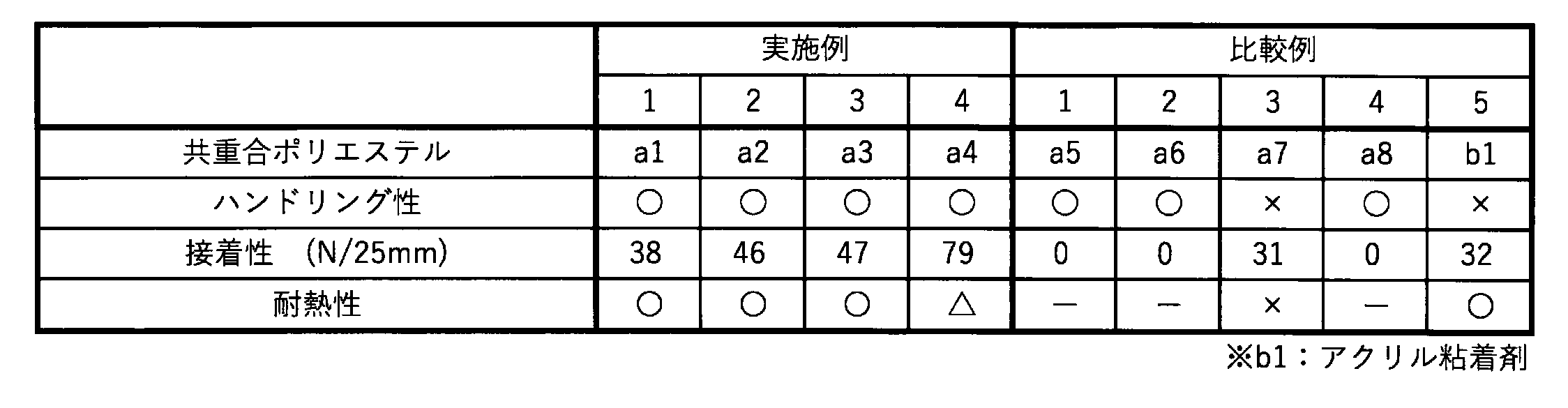
表2からわかるように、実施例の共重合ポリエステルは、ハンドリング性および接着性がいずれも良好であった。特に共重合ポリエステル(a1)~(a3)は、融点及び結晶融解熱量が共重合ポリエステル(a4)のものに比べて高いため、耐熱性にも優れるものであった。一方、比較例1の共重合ポリエステルは芳香族基濃度が高く、接着性が発現しなかった。比較例2の共重合ポリエステルは融点が高く、接着性が発現しなかった。比較例3の共重合ポリエステルは融点を有しておらず、耐ブロッキング性(ハンドリング性)に劣った。比較例4の共重合ポリエステルは芳香族基濃度が低く、接着性が発現しなかった。比較例5ではアクリル粘着剤を用いており、耐ブロッキング性(ハンドリング性)に劣った。
本発明の共重合ポリエステルはハンドリング性に優れ、立体熱成形時の接着性が良好であり、少ない熱量でも基材に接着できることから、TOM成形に代表される立体熱成形での接着剤として好適に用いることができる。
Claims (9)
- 共重合ポリエステルであって、
前記共重合ポリエステル中の芳香族基濃度が5~25質量%であり、
ガラス転移温度が-80~10℃であり、
融点が70~130℃である、共重合ポリエステル。 - 結晶融解熱量が0.5J/g以上、20J/g以下である請求項1に記載の共重合ポリエステル。
- 25℃で測定した破断伸度が500%以上である、請求項1または2に記載の共重合ポリエステル。
- 0℃での貯蔵弾性率が150MPa以下である、請求項1または2に記載の共重合ポリエステル。
- 25℃で測定した引張弾性率が10~80MPaである、請求項1または2に記載の共重合ポリエステル。
- 請求項1または2に記載の共重合ポリエステルを含んでなる、シート状接着剤。
- 立体熱成形用である、請求項6に記載のシート状接着剤。
- 請求項6に記載のシート状接着剤を積層した積層フィルム。
- 請求項6に記載のシート状接着剤を積層した成形体。
Priority Applications (1)
| Application Number | Priority Date | Filing Date | Title |
|---|---|---|---|
| JP2023565980A JPWO2024005196A1 (ja) | 2022-07-01 | 2023-06-30 |
Applications Claiming Priority (2)
| Application Number | Priority Date | Filing Date | Title |
|---|---|---|---|
| JP2022106839 | 2022-07-01 | ||
| JP2022-106839 | 2022-07-01 |
Publications (1)
| Publication Number | Publication Date |
|---|---|
| WO2024005196A1 true WO2024005196A1 (ja) | 2024-01-04 |
Family
ID=89380750
Family Applications (1)
| Application Number | Title | Priority Date | Filing Date |
|---|---|---|---|
| PCT/JP2023/024428 Ceased WO2024005196A1 (ja) | 2022-07-01 | 2023-06-30 | 共重合ポリエステル、シート状接着剤、積層フィルムおよび成形体 |
Country Status (3)
| Country | Link |
|---|---|
| JP (1) | JPWO2024005196A1 (ja) |
| TW (1) | TW202409138A (ja) |
| WO (1) | WO2024005196A1 (ja) |
Citations (5)
| Publication number | Priority date | Publication date | Assignee | Title |
|---|---|---|---|---|
| JP2009062453A (ja) * | 2007-09-06 | 2009-03-26 | Unitika Ltd | 共重合ポリエステル樹脂およびそれよりなる共重合ポリエステルフィルム状接着材料 |
| JP2010516847A (ja) * | 2007-01-26 | 2010-05-20 | エボニック デグサ ゲーエムベーハー | 非ハロゲン化溶剤中での良好な溶解性を有する結晶性のコポリエステル及びその使用 |
| JP2010241861A (ja) * | 2009-04-01 | 2010-10-28 | Unitika Ltd | 共重合ポリエステル樹脂およびその製造方法、ならびに接着剤 |
| WO2017159650A1 (ja) * | 2016-03-15 | 2017-09-21 | 東亞合成株式会社 | ポリエステル系樹脂組成物 |
| WO2019131471A1 (ja) * | 2017-12-26 | 2019-07-04 | ユニチカ株式会社 | ポリエステル樹脂組成物、接着剤および積層体 |
-
2023
- 2023-06-30 WO PCT/JP2023/024428 patent/WO2024005196A1/ja not_active Ceased
- 2023-06-30 TW TW112124623A patent/TW202409138A/zh unknown
- 2023-06-30 JP JP2023565980A patent/JPWO2024005196A1/ja active Pending
Patent Citations (5)
| Publication number | Priority date | Publication date | Assignee | Title |
|---|---|---|---|---|
| JP2010516847A (ja) * | 2007-01-26 | 2010-05-20 | エボニック デグサ ゲーエムベーハー | 非ハロゲン化溶剤中での良好な溶解性を有する結晶性のコポリエステル及びその使用 |
| JP2009062453A (ja) * | 2007-09-06 | 2009-03-26 | Unitika Ltd | 共重合ポリエステル樹脂およびそれよりなる共重合ポリエステルフィルム状接着材料 |
| JP2010241861A (ja) * | 2009-04-01 | 2010-10-28 | Unitika Ltd | 共重合ポリエステル樹脂およびその製造方法、ならびに接着剤 |
| WO2017159650A1 (ja) * | 2016-03-15 | 2017-09-21 | 東亞合成株式会社 | ポリエステル系樹脂組成物 |
| WO2019131471A1 (ja) * | 2017-12-26 | 2019-07-04 | ユニチカ株式会社 | ポリエステル樹脂組成物、接着剤および積層体 |
Also Published As
| Publication number | Publication date |
|---|---|
| JPWO2024005196A1 (ja) | 2024-01-04 |
| TW202409138A (zh) | 2024-03-01 |
Similar Documents
| Publication | Publication Date | Title |
|---|---|---|
| KR20210072065A (ko) | 수지 배합물로부터 제조된 결정화가능한 수축성 필름 및 열성형성 시트 | |
| CN105593297B (zh) | 聚酯树脂组合物及含有它的粘接剂 | |
| JPH06500809A (ja) | 耐熱性コポリエステルのフィルム及び容器 | |
| JP3553559B2 (ja) | モールディング用ポリエステル樹脂組成物及びそれを用いた成型品 | |
| JP7319919B2 (ja) | 耐熱性mdo熱収縮フィルム | |
| WO2011016373A1 (ja) | ポリエステル樹脂組成物 | |
| KR960005630B1 (ko) | 열가소성 수지 조성물, 이를 사용하여 제조한 열성형화된 박판 제품 및 이의 제조방법 | |
| JP7784070B2 (ja) | 接着剤樹脂組成物 | |
| JP5786715B2 (ja) | 樹脂組成物、及びそれを用いてなる金属被覆体、並びに接着剤 | |
| CN1795227B (zh) | 脱模薄膜 | |
| CN119192795A (zh) | 可结晶可收缩膜和由树脂共混物制成的可热成型片材 | |
| JP7585842B2 (ja) | 二軸延伸フィルム及び積層フィルム | |
| JP3598474B2 (ja) | 樹脂組成物、その製造方法、およびそれからなるホットメルト接着剤 | |
| JP7737637B2 (ja) | 接着剤樹脂組成物 | |
| TW202409138A (zh) | 共聚聚酯、片狀黏接劑、疊層薄膜及成形體 | |
| TW201400545A (zh) | 電氣電子零件封裝用樹脂組成物、電氣電子零件封裝體之製造方法、及電氣電子零件封裝體 | |
| JP2004083918A (ja) | モールディング用ポリエステル樹脂、樹脂組成物及びそれを用いた成型品 | |
| JP2001151908A (ja) | 熱収縮性ポリエステルフィルム | |
| TWI772426B (zh) | 密封用樹脂組成物 | |
| JP2004269654A (ja) | 樹脂組成物及び接着剤 | |
| WO2022202570A1 (ja) | ホットメルト接着剤組成物及び積層体 | |
| JP2023144932A (ja) | 樹脂組成物およびホットメルト接着剤組成物 | |
| JP2021091901A (ja) | 封止用樹脂組成物 | |
| WO2022158384A1 (ja) | 樹脂組成物および電気電子部品封止体 | |
| HK40099141A (zh) | 热熔黏接剂组合物及层叠体 |
Legal Events
| Date | Code | Title | Description |
|---|---|---|---|
| ENP | Entry into the national phase |
Ref document number: 2023565980 Country of ref document: JP Kind code of ref document: A |
|
| 121 | Ep: the epo has been informed by wipo that ep was designated in this application |
Ref document number: 23831635 Country of ref document: EP Kind code of ref document: A1 |
|
| NENP | Non-entry into the national phase |
Ref country code: DE |
|
| 122 | Ep: pct application non-entry in european phase |
Ref document number: 23831635 Country of ref document: EP Kind code of ref document: A1 |