WO2024005012A1 - コンデンサモジュール - Google Patents
コンデンサモジュール Download PDFInfo
- Publication number
- WO2024005012A1 WO2024005012A1 PCT/JP2023/023791 JP2023023791W WO2024005012A1 WO 2024005012 A1 WO2024005012 A1 WO 2024005012A1 JP 2023023791 W JP2023023791 W JP 2023023791W WO 2024005012 A1 WO2024005012 A1 WO 2024005012A1
- Authority
- WO
- WIPO (PCT)
- Prior art keywords
- terminal
- terminal portion
- electrode contact
- case
- bus bar
- Prior art date
- Legal status (The legal status is an assumption and is not a legal conclusion. Google has not performed a legal analysis and makes no representation as to the accuracy of the status listed.)
- Ceased
Links
Images



Classifications
-
- H—ELECTRICITY
- H01—ELECTRIC ELEMENTS
- H01G—CAPACITORS; CAPACITORS, RECTIFIERS, DETECTORS, SWITCHING DEVICES, LIGHT-SENSITIVE OR TEMPERATURE-SENSITIVE DEVICES OF THE ELECTROLYTIC TYPE
- H01G2/00—Details of capacitors not covered by a single one of groups H01G4/00-H01G11/00
- H01G2/02—Mountings
-
- H—ELECTRICITY
- H01—ELECTRIC ELEMENTS
- H01G—CAPACITORS; CAPACITORS, RECTIFIERS, DETECTORS, SWITCHING DEVICES, LIGHT-SENSITIVE OR TEMPERATURE-SENSITIVE DEVICES OF THE ELECTROLYTIC TYPE
- H01G2/00—Details of capacitors not covered by a single one of groups H01G4/00-H01G11/00
- H01G2/10—Housing; Encapsulation
-
- H—ELECTRICITY
- H01—ELECTRIC ELEMENTS
- H01G—CAPACITORS; CAPACITORS, RECTIFIERS, DETECTORS, SWITCHING DEVICES, LIGHT-SENSITIVE OR TEMPERATURE-SENSITIVE DEVICES OF THE ELECTROLYTIC TYPE
- H01G4/00—Fixed capacitors; Processes of their manufacture
- H01G4/002—Details
- H01G4/228—Terminals
-
- H—ELECTRICITY
- H01—ELECTRIC ELEMENTS
- H01G—CAPACITORS; CAPACITORS, RECTIFIERS, DETECTORS, SWITCHING DEVICES, LIGHT-SENSITIVE OR TEMPERATURE-SENSITIVE DEVICES OF THE ELECTROLYTIC TYPE
- H01G4/00—Fixed capacitors; Processes of their manufacture
- H01G4/32—Wound capacitors
Definitions
- the present invention relates to a capacitor module.
- a capacitor module in which a first bus bar is connected to the first electrode of a capacitor element, and a second bus bar is also connected to the second electrode.
- Patent Document 1 describes a first bus bar electrically connected to one of a pair of electrodes of a capacitor element having a pair of electrodes, a second bus bar electrically connected to the other of the pair of electrodes, A capacitor module is described.
- the capacitor module described in Patent Document 1 still has room for improvement in terms of reducing ESL.
- the present invention provides a capacitor module that can reduce ESL.
- a capacitor module includes: a capacitor element having a first end electrode, a second end electrode, and a side surface connecting the first end electrode and the second end electrode; a case accommodating the capacitor element; a first electrode contact portion connected to the first end electrode of the capacitor element and disposed along the first end electrode within the case; and a first electrode contact portion extending from a terminal exposed surface of the case toward the outside of the case.
- a plate-shaped first bus bar having a first terminal portion; a second electrode contact portion connected to the second end electrode of the capacitor element and disposed along the second end electrode within the case; a plate-shaped second bus bar having a second terminal portion that extends and overlaps the first terminal portion in a plan view; a first surface disposed between the first terminal section and the second terminal section, insulating the first terminal section and the second terminal section, and contacting one main surface of the first terminal section; and a second surface that contacts one main surface of the second terminal portion; a sealing resin filled in the case; Equipped with.
- FIG. 1 A perspective view showing a capacitor module according to Embodiment 1 A view of the capacitor module in Figure 1A from another direction.
- Top view of the capacitor module in Figure 1 A perspective view of the capacitor module in Figure 1 with the case and sealing resin omitted.
- Exploded perspective view of the capacitor module in Figure 3 A perspective view showing the capacitor element of the capacitor module in FIG. 3
- Top view of the capacitor element in Figure 5A A-A sectional view of the capacitor module in Figure 3
- Capacitor modules are sometimes used, for example, in inverter circuits for vehicles such as hybrid vehicles.
- the drive frequency of the inverter circuit corresponds to a high frequency, so if the ESL (equivalent series inductance) of the capacitor module is large, the surge voltage generated in the inverter circuit becomes large. There is the issue of putting it away. Therefore, it is a challenge to reduce ESL in capacitor modules.
- the capacitor module according to the first aspect of the present invention is a capacitor element having a first end electrode, a second end electrode, and a side surface connecting the first end electrode and the second end electrode; a case accommodating the capacitor element; a first electrode contact portion connected to the first end electrode of the capacitor element and disposed along the first end electrode within the case; and a first electrode contact portion extending from a terminal exposed surface of the case toward the outside of the case.
- a plate-shaped first bus bar having a first terminal portion; a second electrode contact portion connected to the second end electrode of the capacitor element and disposed along the second end electrode within the case; a plate-shaped second bus bar having a second terminal portion that extends and overlaps the first terminal portion in a plan view; a first surface disposed between the first terminal section and the second terminal section, insulating the first terminal section and the second terminal section, and contacting one main surface of the first terminal section; and a second surface that contacts one main surface of the second terminal portion; a sealing resin filled in the case; Equipped with.
- the capacitor element is composed of a laminate of dielectric films,
- the dielectric film may have a glass transition point of 120° C. or higher.
- the heat resistance of the capacitor module can be improved. Therefore, it is possible to provide a capacitor module that can withstand the temperature increase caused by overlapping the first terminal section and the second terminal section.
- the side surface of the capacitor element has a pair of flat parts and a pair of curved parts connecting the pair of flat parts
- the first bus bar may include a first extension part that connects the first electrode contact part and the first terminal part and is arranged along the flat part.
- the side surface of the capacitor element and the first bus bar can be brought close to each other, so that the ESL can be further reduced.
- the second bus bar may include a second extension part that connects the second electrode contact part and the second terminal part and is arranged along the flat part.
- the side surface of the capacitor element and the first bus bar can be brought close to each other, so that the ESL can be further reduced.
- the first bus bar has a third terminal portion extending from the first electrode contact portion and exposed from a surface different from the terminal exposed surface of the case
- the second bus bar has a fourth terminal portion extending from the second electrode contact portion and exposed from a surface different from the terminal exposed surface of the case
- the first terminal portion and the second terminal portion may function as output terminals
- the third terminal portion and the fourth terminal portion may function as input terminals.
- the capacitor module can be provided with a charging terminal.
- the first terminal portion and the second terminal portion may be AC terminals, and the third terminal portion and the fourth terminal portion may be DC terminals.
- the capacitor module can be provided with a charging terminal.
- the third terminal portion and the fourth terminal portion may not overlap in plan view.
- a first through hole penetrating in the thickness direction is formed in the first electrode contact part, and the outer shape of the first through hole is a part of the first electrode contact part toward the inside of the first through hole. constitutes a first mounting portion having a protruding shape, and an end portion of the first mounting portion in a direction approaching the terminal exposed surface is connected to the first electrode contact portion,
- a second through hole penetrating in the thickness direction is formed in the second electrode contact portion, and the outer shape of the second through hole is a portion of the second electrode contact portion toward the inside of the second through hole.
- a first stud for electrically connecting the capacitor element to an external device is arranged in the first terminal portion
- a second stud for electrically connecting the capacitor element to an external device is disposed in the second terminal portion
- the first stud and the second stud may protrude in opposite directions.
- the capacitor module can be easily connected to an external device.
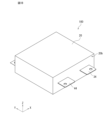
- FIG. 1A is a perspective view showing a capacitor module according to the first embodiment.
- FIG. 1B is a view of the capacitor module of FIG. 1A from another direction.
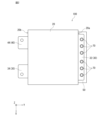
- FIG. 2 is a top view of the capacitor module of FIG. 1A.
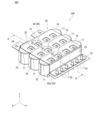
- FIG. 3 is a perspective view of the capacitor module of FIG. 1A with the case and sealing resin omitted.
- FIG. 4 is an exploded perspective view of the capacitor module of FIG. 3. Note that the X, Y, and Z directions in the figure indicate the horizontal direction, vertical direction, and height direction of the capacitor module 100, respectively.
- the capacitor module 100 includes a capacitor element 10, a case 20, a first bus bar 30, a second bus bar 40, an insulator 50, and a sealing resin 60.
- the capacitor element 10 , a portion of the first bus bar 30 , and a portion of the second bus bar 40 are housed in the case 20 and sealed with a sealing resin 60 .
- FIG. 5A is a perspective view showing a capacitor element of the capacitor module of FIG. 3.
- FIG. 5B is a top view of the capacitor element of FIG. 5A.
- the capacitor element 10 will be described with reference to FIGS. 5A and 5B.
- the capacitor element 10 has a first end electrode 11 , a second end electrode 12 , and a side surface 13 that connects the first end electrode 11 and the second end electrode 12 . Further, in this embodiment, the side surface 13 of the capacitor element 10 includes a pair of flat portions 13a facing each other and a pair of curved portions 13b connecting the pair of flat portions 13a.
- the capacitor element 10 is a film capacitor composed of a laminate of dielectric films. More specifically, the capacitor element 10 is formed by stacking dielectric films each having a metal vapor deposited film formed on its surface and then winding the films. In this embodiment, the capacitor element 10 is formed into a columnar shape having an oval cross section by pressing a rolled body of dielectric film into a flat shape.
- the dielectric film for example, a dielectric film formed from a mixed resin solution containing phenoxy resin and MDI (diphenylmethane diisocyanate) can be used.
- a dielectric film formed from a mixed resin solution containing polyvinyl acetoacetal (PVAA) and ethyl acetate may be used.
- PVAA polyvinyl acetoacetal
- ethyl acetate ethyl acetate
- the glass transition point of the dielectric film can be set to 120° C. or higher, and the heat resistance of the capacitor module can be improved.
- metals such as Al and Zn can be used as the metal vapor deposition film formed on the surface of the dielectric film.
- a first end surface electrode 11 is formed at one end of the wound body of dielectric film, and a second end surface electrode 12 is formed at the other end.
- the first end electrode 11 and the second end electrode 12 can be formed, for example, by thermal spraying Zn or the like.
- Case 20 is a case for accommodating capacitor element 10.
- the case 20 has a rectangular parallelepiped shape, as shown in FIGS. 1 and 2, and has an opening that exposes a portion of the first bus bar 30 and the second bus bar 40.
- the case 20 accommodates six capacitor elements 10 shown in FIGS. 3 and 4. Further, a portion of the first bus bar 30 and the second bus bar 40 are also housed within the case 20.
- the case 20 has a first terminal exposed surface 20a and a second terminal exposed surface 20b different from the first terminal exposed surface 20a.
- the first terminal exposed surface 20a exposes a first terminal portion 32 of a first bus bar 30 and a second terminal portion 42 of a second bus bar 40 (see FIGS. 7 and 8), which will be described later.
- the first terminal portion 32 and the second terminal portion 42 are exposed from the first terminal exposed surface 20a of the case 20, and the third terminal portion 34 and the fourth terminal portion 44, which will be described later, are exposed from the second terminal exposed surface 20b. is exposed.
- the case 20 is made of, for example, synthetic resin such as polyphenylene sulfide (PPS resin) and polybutylene terephthalate (PBT resin).
- synthetic resin such as polyphenylene sulfide (PPS resin) and polybutylene terephthalate (PBT resin).
- the first bus bar 30 is a terminal for electrically connecting the first end electrode 11 of the capacitor element 10 and a terminal of an external device (not shown).
- the first bus bar 30 is formed of a conductive member such as a plate-shaped metal.
- the first bus bar 30 has a first electrode contact portion 31 and a first terminal portion 32, as shown in FIGS. 3 and 4.
- the first electrode contact portion 31 is connected to the first end electrode 11 of the capacitor element 10 and is arranged along the first end electrode 11 inside the case 20 .
- the first electrode contact portion 31 is arranged to spread out in the XY plane so as to contact the first end electrodes 11 of all the capacitor elements 10 of the capacitor module 100.
- the first terminal portion 32 extends from the first terminal exposed surface 20a of the case 20 toward the outside of the case 20.
- the first bus bar 30 has a first extending portion 33 that connects the first electrode contact portion 31 and the first terminal portion 32.
- the first bus bar 30 further includes a third terminal portion 34 that extends from the first electrode contact portion 31 and is exposed from the second terminal exposed surface 20b of the case 20.
- the third terminal portion 34 is provided on the opposite side of the first electrode contact portion 31 from the first terminal portion 32 .
- FIG. 6 is a cross-sectional view taken along line AA of the capacitor module in FIG. 3.
- the first electrode contact portion 31 is arranged to contact the first end electrode 11 of each capacitor element 10.
- a first extending portion 33 extends from one end of the first electrode contact portion 31 along the flat portion 13a of the capacitor element 10, and a first terminal portion 32 extends from an end of the first extending portion 33.
- a third terminal portion 34 extends from the other end of the first electrode contact portion 31 .
- the first terminal portion 32 and the third terminal portion 34 of the first bus bar 30 are exposed from the case 20 and arranged.
- the ESL of the capacitor module 100 can be reduced.
- the first terminal portion 32 functions as an output terminal of the capacitor module 100, and an alternating current flows through the first terminal portion 32.
- the third terminal section 34 functions as an input terminal of the capacitor module 100, and a direct current flows through the third terminal section 34.
- the third terminal portion 34 can be used as a charging terminal for the capacitor module 100.
- the first electrode contact portion 31 is formed with a first through hole 35 that penetrates the first bus bar 30 in the thickness direction.
- the outer shape of the first through hole 35 constitutes a first mounting section 36 in which a part of the first electrode contact section 31 protrudes toward the inside of the first through hole 35. is formed integrally with the first electrode contact portion 31.
- first through holes 35 and a first mounting part 36 are formed in the first electrode contact part 31, and in plan view, 12 first through holes 35 and a first mounting part 36 are formed in the first electrode contact part 31.
- Two first mounting sections 36 are arranged. That is, each capacitor element 10 is connected by solder using two first mounting parts 36, respectively.
- the number of first through holes 35 and first mounting portions 36 is not limited to twelve, but may be any number that can electrically connect each capacitor element 10 and first bus bar 30.
- FIG. 7 is a perspective view of the capacitor module of FIG. 3 viewed from another angle.
- FIG. 8 is a BB sectional view of the capacitor module of FIG. 7.
- the second bus bar 40 is a terminal for electrically connecting the second end electrode 12 of the capacitor element 10 and a terminal of an external device (not shown). Note that the basic configuration of the second bus bar 40 is the same as that of the first bus bar 30, so a description thereof will be omitted as appropriate.
- the second bus bar 40 has a second electrode contact part 41 and a second terminal part 42, as shown in FIGS. 4 and 7.
- the second electrode contact portion 41 is connected to the second end electrode 12 of the capacitor element 10 and is arranged along the second end electrode 12 inside the case 20 .
- the second terminal portion 42 extends toward the first terminal exposed surface 20a of the case 20.
- the second bus bar 40 has a second extending portion 43 that connects the second electrode contact portion 41 and the second terminal portion 42.
- the second bus bar 40 further includes a fourth terminal portion 44 that extends from the second electrode contact portion 41 and is exposed from the second terminal exposed surface 20b of the case 20.
- the fourth terminal portion 44 is provided on the opposite side of the second electrode contact portion 41 from the second terminal portion 42 .
- the second electrode contact portion 41 is arranged to contact the second end surface electrode 12 of each capacitor element 10.
- a second extending portion 43 extends from one end of the second electrode contact portion 41 along the flat portion 13a of the capacitor element 10, and a second terminal portion 42 extends from an end of the second extending portion 43.
- the second extending portion 43 is arranged along the flat portion 13 a of the capacitor element 10 in line with the first extending portion 33 of the first bus bar 30 .
- a fourth terminal portion 44 extends from the other end of the second electrode contact portion 41 .
- the second terminal portion 2 and the fourth terminal portion 44 of the second bus bar 40 are exposed from the case 20 and arranged.
- the ESL of the capacitor module 100 can be reduced.
- the second terminal portion 42 functions as an output terminal of the capacitor module 100, and an alternating current flows through the second terminal portion 42.
- the fourth terminal section 44 functions as an input terminal of the capacitor module 100, and a direct current flows through the fourth terminal section 44.
- the fourth terminal portion 44 can be used as a charging terminal for the capacitor module 100.
- the second electrode contact portion 41 is formed with a second through hole 45 that penetrates the second bus bar 40 in the thickness direction.
- the outer shape of the second through hole 45 constitutes a second mounting section 46 in which a part of the second electrode contact section 41 protrudes toward the inside of the second through hole 45. is formed integrally with the second electrode contact portion 41.
- 12 second through holes 45 and second mounting portions 46 are formed in the second electrode contact portion 41, and in plan view, 12 second through holes 45 and a second mounting portion 46 are formed in the second electrode contact portion 41, and in a plan view, Two second mounting sections 46 are arranged. That is, each capacitor element 10 is connected by solder using two second mounting parts 46, respectively.
- the number of second through holes 45 and second mounting portions 46 is not limited to twelve, but may be any number that can electrically connect each capacitor element 10 and second bus bar 40.
- the first terminal portion 32 of the first bus bar 30 and the second terminal portion 42 of the second bus bar 40 are arranged to overlap in the Z direction in a plan view. . Since the insulator 50 is disposed between the first terminal section 32 and the second terminal section 42, the first terminal section 32 and the second terminal section 42 are electrically insulated.
- the third terminal portion 34 and the fourth terminal portion 44 do not overlap in plan view.
- the third terminal section 34 and the fourth terminal section 44 are arranged at shifted positions in the XY direction.
- the insulator 50 is a sheet-like member that is disposed between the first terminal section 32 and the second terminal section 42 and insulates the first terminal section 32 and the second terminal section 42 from each other. By arranging the insulator 50 between the first terminal portion 32 and the second terminal portion 42, short circuit between the terminal portions can be prevented.
- the insulator 50 is made of, for example, insulating paper or insulating resin.
- the insulator 50 has a first surface 50a and a second surface 50b, as shown in FIGS. 6 and 8.
- the first surface 50 a of the insulator 50 contacts one main surface of the first terminal section 32
- the second surface 50 b of the insulator 50 contacts one main surface of the second terminal section 42 .
- the thickness of the insulator 50 is as thin as possible within a range that can sufficiently insulate the first terminal part 32 and the second terminal part 42. .
- the sealing resin 60 is filled in the case 20 to seal the six capacitor elements 10 housed in the case 20 and a portion of the first bus bar 30 and the second bus bar 40.
- the sealing resin 60 is made of, for example, a thermosetting resin such as epoxy resin or urethane resin.
- a thermosetting resin such as epoxy resin or urethane resin.
- the material of the sealing resin 60 it is preferable to use a material with high fluidity and adhesiveness.
- a first stud 70 for connecting the first end electrode 11 of the capacitor element 10 to an external device is arranged at the first terminal portion 32 of the first bus bar 30.
- a second stud 80 for connecting the second end face electrode 12 of the capacitor element 10 to an external device is arranged at the second terminal portion 42 of the second bus bar 40.
- the first stud 70 and the second stud 80 protrude in opposite directions in the Z direction.
- the first stud 70 and the second stud 80 can be configured by, for example, a self-clinching stud that is press-fitted into the terminal portion.
- a self-clinching stud that is press-fitted into the terminal portion.
- the first terminal section 32 and the second terminal section 42 can be arranged parallel to each other, so that the ESL of the capacitor module 100 can be improved. It can be further reduced.
- the first stud 70 and the second stud 80 may be constituted by screws or the like.
- first studs 70 and six second studs 80 are arranged, but the number of studs is not limited to this, and is used to connect external devices. It is sufficient if an appropriate number are placed.
- the capacitor module 100 by arranging the first terminal section 32 and the second terminal section 42 in an overlapping manner in the Z direction, when voltages of different polarities are applied to the first bus bar 30 and the second bus bar 40, Currents flow in opposite directions to the first terminal portion 32 and the second terminal portion 42 .
- the magnetic field due to the current flowing through the first terminal portion 32 and the magnetic field due to the current flowing through the second terminal portion 42 cancel each other out, so that the ESL of the capacitor module 100 can be reduced.
- current concentrates on the first terminal portion 32 and the second terminal portion 42 because they are current entry and exit ports. Therefore, the effect of reducing ESL by overlapping the first terminal portion 32 and the second terminal portion 42 is large.
- the heat conductivity of the capacitor module 100 increases, and the first terminal section 32 and the second terminal section 42 tend to generate heat when current flows. . Furthermore, since both the first extending portion 33 and the second extending portion 43 are arranged along the side surface of the capacitor element 10, the center temperature of the capacitor element 10 tends to rise. In this embodiment, since a film having a glass transition point of 120° C. or higher is used as the dielectric film constituting the capacitor element 10, the heat resistance can be higher than that of conventional capacitor elements. Therefore, the capacitor module 100 has heat resistance against increases in the center temperature of the capacitor element 10.
- the first extending portion 33 and the second extending portion 43 have different lengths in the Z direction. Specifically, the first extending portion 33 is formed longer than the second extending portion 43. Since the lengths of the first stretched portion 33 and the second stretched portion 43 do not easily affect the ESL reduction of the capacitor module 100, for example, even if the second stretched portion 43 is longer than the first stretched portion 33, Alternatively, the first extending portion 33 and the second extending portion 43 may have the same length. Alternatively, the extending portion may be formed only on either one of the first bus bar 30 and the second bus bar 40.
- the end of the first mounting portion 36 in the direction approaching the first terminal exposed surface 20a of the case 20 is connected to the first electrode contact portion 31.
- the first mounting portion 36 is connected to the first electrode contact portion 31 in a direction approaching the first terminal exposed surface 20a, thereby shortening the distance through which current flows between the capacitor element 10 and the first terminal portion 32. This contributes to reducing the ESL of the capacitor module 100.
- the end of the second mounting portion 46 in the direction approaching the first terminal exposed surface 20a of the case 20 is connected to the second electrode contact portion 41.
- the second mounting portion 46 is connected to the second electrode contact portion 41 in a direction approaching the first terminal exposed surface 20a, thereby shortening the distance through which current flows between the capacitor element 10 and the second terminal portion 42. This contributes to reducing the ESL of the capacitor module 100.
- the third terminal portion 34 and the fourth terminal portion 44 are arranged without overlapping.
- the third terminal section 34 and the fourth terminal section 44 are terminals used for charging the capacitor module 100, and direct current flows therethrough. Therefore, even when the third terminal section 34 and the fourth terminal section 44 do not overlap, the ESL reduction of the capacitor module 100 is less affected.
- the capacitor module 100 includes a capacitor element 10, a case 20, a first bus bar 30, a second bus bar 40, an insulator 50, and a sealing resin 60.
- the capacitor element 10 has a first end electrode 11 , a second end electrode 12 , and a side surface 13 connecting the first end electrode 11 and the second end electrode 12 .
- Case 20 houses capacitor element 10 .
- the first bus bar 30 is connected to the first end electrode 11 of the capacitor element 10 and includes a first electrode contact portion 31 disposed along the first end electrode 11 inside the case 20 and a first terminal exposed surface of the case 20. It has a first terminal portion 32 extending toward 20a.
- the second bus bar 40 includes a second electrode contact portion 41 connected to the second end electrode 12 of the capacitor element 10 and arranged along the second end electrode 12 inside the case 20, and a first terminal exposed surface of the case 20. It has a second terminal part 42 that extends toward 20a and overlaps the first terminal part 32 in plan view.
- the insulator 50 is disposed between the first terminal portion 32 and the second terminal portion 42 to insulate the first terminal portion 32 and the second terminal portion 42, and is provided on one main surface of the first terminal portion 32. It has a first surface 50a that contacts, and a second surface 50b that contacts one main surface of the second terminal portion 42.
- the case 20 is filled with the sealing resin 60 .
- the ESL of the capacitor module 100 can be reduced.
- the capacitor element 10 is composed of a laminate of dielectric films, and the glass transition point of the dielectric film is 120° C. or higher.
- a capacitor module with high heat resistance can be provided.
- the first terminal section 32 and the second terminal section 42 are arranged in an overlapping manner, heat transferability is increased and heat is easily transmitted between the terminals, leading to an increase in the temperature of the capacitor module 100.
- the capacitor element 10 made of a laminate of highly heat-resistant dielectric films with a glass transition point of 120° C. or higher it is possible to provide a capacitor module with improved heat resistance while reducing ESL.
- the side surface 13 of the capacitor element 10 has a pair of flat parts 13a and a pair of curved parts 13b connecting the pair of flat parts 13a.
- the first bus bar 30 connects the first electrode contact portion 31 and the first terminal portion 32 and has a first extending portion 33 arranged along the flat portion 13a.
- the side surface 13 of the capacitor element 10 and the first bus bar 30 can be brought close to each other, so that the ESL of the capacitor module 100 can be further reduced.
- the second bus bar 40 connects the second electrode contact portion 41 and the second terminal portion 42 and has a second extension portion 43 arranged along the flat portion 13a.
- the side surface 13 of the capacitor element 10 and the first bus bar 30 can be brought close to each other, so that the ESL of the capacitor module 100 can be further reduced.
- the first bus bar 30 has a third terminal portion 34 that extends from the first electrode contact portion 31 and is exposed from a surface different from the first terminal exposed surface 20a of the case 20.
- the second bus bar 40 has a fourth terminal portion 44 that extends from the second electrode contact portion 41 and is exposed from a surface different from the first terminal exposed surface 20a of the case 20.
- the first terminal section 32 and the second terminal section 42 function as output terminals, and the third terminal section 34 and the fourth terminal section 44 function as input terminals.
- the capacitor module 100 can be provided with a charging terminal.
- the first terminal part 32 and the second terminal part 42 are AC terminals, and the third terminal part 34 and the fourth terminal part 44 are DC terminals.
- the capacitor module 100 can be provided with a charging terminal.
- the third terminal portion 34 and the fourth terminal portion 44 do not overlap in plan view.
- the degree of freedom in designing the capacitor module 100 can be improved.
- a first through hole 35 penetrating in the thickness direction is formed in the first electrode contact portion 31 , and the outer shape of the first through hole 35 is the same as that of the first electrode contact portion 31 toward the inside of the first through hole 35 .
- the first mounting portion 36 has a protruding portion. The first mounting portion 36 is connected to the first electrode contact portion 31 at its end in the direction approaching the first terminal exposed surface 20a.
- a second through hole 45 penetrating in the thickness direction is formed in the second electrode contact portion 41 , and the outer shape of the second through hole 45 is the same as that of the second electrode contact portion 41 toward the inside of the second through hole 45 .
- the second mounting portion 46 has a protruding portion. The end of the second mounting portion 46 in the direction approaching the first terminal exposed surface 20a is connected to the second electrode contact portion 41.
- the distance through which current flows from the first end surface electrode 11 to the first terminal section 32 and from the second end surface electrode 12 to the second terminal section 42 can be shortened. Therefore, the ESL of the capacitor module 100 can be further reduced.
- a first stud 70 for electrically connecting the capacitor element 10 to an external device is arranged in the first terminal part 32, and a first stud 70 for electrically connecting the capacitor element 10 to an external device is arranged in the second terminal part 42.
- a second stud 80 is arranged for this purpose.
- the capacitor module 100 can be easily connected to an external device.
- the first bus bar 30 has the first extending part 33 and the third terminal part 34
- the second bus bar 40 has the second extending part 43 and the fourth terminal part 44.
- the first bus bar 30 and the second bus bar 40 do not need to have an extending portion.
- the first bus bar 30 and the second bus bar 40 do not need to have the third terminal section 34 and the fourth terminal section 44.
- the capacitor element 10 is formed in a columnar shape having an elliptical cross section, but the present invention is not limited thereto.
- the capacitor element 10 may be formed in, for example, a cylindrical shape or a polygonal prism shape such as a quadrangular prism.
- the insulator 50 is disposed between the first terminal section 32 and the second terminal section 42, but the present invention is not limited to this.
- the insulator 50 at least one of one main surface of the first terminal section 32 and one main surface of the second terminal section 42 may be coated with an insulating coating.
- the capacitor module of the present invention includes a capacitor element having a first end electrode, a second end electrode, a side surface connecting the first end electrode and the second end electrode, and a case housing the capacitor element. a first electrode contact portion connected to the first end electrode of the capacitor element and disposed along the first end electrode within the case; and a first terminal portion extending from the terminal exposed surface of the case toward the outside of the case. and a second electrode contact portion connected to the second end electrode of the capacitor element and disposed along the second end electrode within the case; A plate-shaped second bus bar having a second terminal portion that extends toward the outside of the case and overlaps the first terminal portion in a plan view, and is disposed between the first terminal portion and the second terminal portion.
- first surface that insulates the first terminal portion and the second terminal portion, and that contacts one main surface of the first terminal portion, and a second surface that contacts one main surface of the second terminal portion. It includes an insulator and a sealing resin filled in the case.
- the capacitor element is constituted by a laminate of dielectric films, and the dielectric film may have a glass transition point of 120° C. or higher.
- the side surface of the capacitor element has a pair of flat parts and a pair of curved parts connecting the pair of flat parts
- the first bus bar has a first
- the electrode contact portion and the first terminal portion may be connected to each other, and a first extending portion may be provided along the flat portion.
- the second bus bar connects the second electrode contact part and the second terminal part, and the second extending part is arranged along the flat part. , may have.
- the first bus bar has a third terminal portion that extends from the first electrode contact portion and is exposed from a surface different from the terminal exposed surface of the case.
- the second bus bar has a fourth terminal portion that extends from the second electrode contact portion and is exposed from a surface different from the terminal exposed surface of the case, and the first terminal portion and the second terminal portion function as output terminals.
- the third terminal section and the fourth terminal section may function as input terminals.
- the first terminal portion and the second terminal portion may be AC terminals, and the third terminal portion and the fourth terminal portion may be DC terminals.
- the third terminal portion and the fourth terminal portion do not need to overlap in plan view.
- a first through hole penetrating in the thickness direction is formed in the first electrode contact portion, and the outer shape of the first through hole is the same as the first through hole.
- the first mounting part has a shape in which a part of the first electrode contact part protrudes toward the inside of the through hole, and the end of the first mounting part in the direction approaching the terminal exposed surface is the first electrode contact part.
- a second through hole penetrating in the thickness direction is formed in the second electrode contact portion, and the outer shape of the second through hole is a part of the second electrode contact portion toward the inside of the second through hole. constitutes a second mounting portion having a protruding shape, and the end portion of the second mounting portion in the direction approaching the terminal exposed surface may be connected to the second electrode contact portion.
- a first stud for electrically connecting the capacitor element to an external device is disposed in the first terminal part, and a first stud for electrically connecting the capacitor element to an external device is disposed in the first terminal part.
- a second stud for electrically connecting the capacitor element to an external device is disposed on the capacitor element, and the first stud and the second stud may protrude in opposite directions.
- the present invention is useful for film capacitors used in various electronic devices, electrical devices, industrial devices, vehicle devices, etc.
Landscapes
- Engineering & Computer Science (AREA)
- Power Engineering (AREA)
- Microelectronics & Electronic Packaging (AREA)
- Manufacturing & Machinery (AREA)
- Fixed Capacitors And Capacitor Manufacturing Machines (AREA)
Priority Applications (1)
| Application Number | Priority Date | Filing Date | Title |
|---|---|---|---|
| JP2024530879A JPWO2024005012A1 (https=) | 2022-06-29 | 2023-06-27 |
Applications Claiming Priority (2)
| Application Number | Priority Date | Filing Date | Title |
|---|---|---|---|
| JP2022-104690 | 2022-06-29 | ||
| JP2022104690 | 2022-06-29 |
Publications (1)
| Publication Number | Publication Date |
|---|---|
| WO2024005012A1 true WO2024005012A1 (ja) | 2024-01-04 |
Family
ID=89383131
Family Applications (1)
| Application Number | Title | Priority Date | Filing Date |
|---|---|---|---|
| PCT/JP2023/023791 Ceased WO2024005012A1 (ja) | 2022-06-29 | 2023-06-27 | コンデンサモジュール |
Country Status (2)
| Country | Link |
|---|---|
| JP (1) | JPWO2024005012A1 (https=) |
| WO (1) | WO2024005012A1 (https=) |
Citations (3)
| Publication number | Priority date | Publication date | Assignee | Title |
|---|---|---|---|---|
| JP2007324311A (ja) * | 2006-05-31 | 2007-12-13 | Shizuki Electric Co Inc | ケース入りコンデンサ |
| JP2020031117A (ja) * | 2018-08-21 | 2020-02-27 | パナソニックIpマネジメント株式会社 | コンデンサ |
| WO2021005822A1 (ja) * | 2019-07-09 | 2021-01-14 | 株式会社村田製作所 | フィルムコンデンサ、及び、フィルムコンデンサ用フィルム |
Family Cites Families (5)
| Publication number | Priority date | Publication date | Assignee | Title |
|---|---|---|---|---|
| JP3805507B2 (ja) * | 1997-11-19 | 2006-08-02 | 株式会社指月電機製作所 | コンデンサ |
| JP4426873B2 (ja) * | 2004-02-27 | 2010-03-03 | 日本ドライブイット株式会社 | スタッド及びその製造方法 |
| JP5897918B2 (ja) * | 2012-02-02 | 2016-04-06 | 株式会社指月電機製作所 | コンデンサ |
| JP2014096412A (ja) * | 2012-11-07 | 2014-05-22 | Toyota Motor Corp | 半導体モジュール |
| JP7344099B2 (ja) * | 2019-11-25 | 2023-09-13 | 株式会社指月電機製作所 | 樹脂封止電気部品 |
-
2023
- 2023-06-27 WO PCT/JP2023/023791 patent/WO2024005012A1/ja not_active Ceased
- 2023-06-27 JP JP2024530879A patent/JPWO2024005012A1/ja active Pending
Patent Citations (3)
| Publication number | Priority date | Publication date | Assignee | Title |
|---|---|---|---|---|
| JP2007324311A (ja) * | 2006-05-31 | 2007-12-13 | Shizuki Electric Co Inc | ケース入りコンデンサ |
| JP2020031117A (ja) * | 2018-08-21 | 2020-02-27 | パナソニックIpマネジメント株式会社 | コンデンサ |
| WO2021005822A1 (ja) * | 2019-07-09 | 2021-01-14 | 株式会社村田製作所 | フィルムコンデンサ、及び、フィルムコンデンサ用フィルム |
Also Published As
| Publication number | Publication date |
|---|---|
| JPWO2024005012A1 (https=) | 2024-01-04 |
Similar Documents
| Publication | Publication Date | Title |
|---|---|---|
| JP5391797B2 (ja) | ケースモールド型コンデンサ | |
| US10285286B2 (en) | Electronic control device and method of manufacturing same, and electric power steering control device | |
| JP6326038B2 (ja) | 電気回路装置 | |
| JP5239989B2 (ja) | ケースモールド型コンデンサ | |
| JP6305731B2 (ja) | ケースモールド型コンデンサおよびその製造方法 | |
| JP2001168550A (ja) | 電気接続箱 | |
| JP5484268B2 (ja) | コンデンサ | |
| WO2024005012A1 (ja) | コンデンサモジュール | |
| JP2001351829A (ja) | インバータ用コンデンサモジュール、インバータ | |
| US20250201484A1 (en) | Capacitor | |
| JP5093044B2 (ja) | 積層コンデンサ | |
| JP7461531B2 (ja) | 複合コンデンサ | |
| JP2017208531A (ja) | コンデンサモジュール | |
| US12340943B2 (en) | Electronic device | |
| JP4600561B2 (ja) | 積層コンデンサ | |
| JP2024056186A (ja) | コンデンサ | |
| JP2023113185A (ja) | コンデンサモジュールおよびコンデンサ | |
| WO2026063027A1 (ja) | コンデンサモジュール | |
| TW201340145A (zh) | 電容模組 | |
| WO2025022775A1 (ja) | コンデンサモジュール | |
| US20170330691A1 (en) | Capacitor Module | |
| US20090168300A1 (en) | High-voltage capacitor | |
| JP2017050335A (ja) | スナバモジュール | |
| US20250157740A1 (en) | Capacitor, method of manufacturing thereof and use thereof | |
| CN113936913B (zh) | 一种直流支撑电容器以及一种电机控制器 |
Legal Events
| Date | Code | Title | Description |
|---|---|---|---|
| 121 | Ep: the epo has been informed by wipo that ep was designated in this application |
Ref document number: 23831452 Country of ref document: EP Kind code of ref document: A1 |
|
| WWE | Wipo information: entry into national phase |
Ref document number: 2024530879 Country of ref document: JP |
|
| NENP | Non-entry into the national phase |
Ref country code: DE |
|
| 122 | Ep: pct application non-entry in european phase |
Ref document number: 23831452 Country of ref document: EP Kind code of ref document: A1 |