WO2024004665A1 - 防湿紙及び包装体 - Google Patents
防湿紙及び包装体 Download PDFInfo
- Publication number
- WO2024004665A1 WO2024004665A1 PCT/JP2023/022185 JP2023022185W WO2024004665A1 WO 2024004665 A1 WO2024004665 A1 WO 2024004665A1 JP 2023022185 W JP2023022185 W JP 2023022185W WO 2024004665 A1 WO2024004665 A1 WO 2024004665A1
- Authority
- WO
- WIPO (PCT)
- Prior art keywords
- moisture
- paper
- proof
- meth
- acrylate
- Prior art date
- Legal status (The legal status is an assumption and is not a legal conclusion. Google has not performed a legal analysis and makes no representation as to the accuracy of the status listed.)
- Ceased
Links
Images

Classifications
-
- B—PERFORMING OPERATIONS; TRANSPORTING
- B32—LAYERED PRODUCTS
- B32B—LAYERED PRODUCTS, i.e. PRODUCTS BUILT-UP OF STRATA OF FLAT OR NON-FLAT, e.g. CELLULAR OR HONEYCOMB, FORM
- B32B27/00—Layered products comprising a layer of synthetic resin
- B32B27/06—Layered products comprising a layer of synthetic resin as the main or only constituent of a layer, which is next to another layer of the same or of a different material
- B32B27/10—Layered products comprising a layer of synthetic resin as the main or only constituent of a layer, which is next to another layer of the same or of a different material of paper or cardboard
-
- B—PERFORMING OPERATIONS; TRANSPORTING
- B65—CONVEYING; PACKING; STORING; HANDLING THIN OR FILAMENTARY MATERIAL
- B65D—CONTAINERS FOR STORAGE OR TRANSPORT OF ARTICLES OR MATERIALS, e.g. BAGS, BARRELS, BOTTLES, BOXES, CANS, CARTONS, CRATES, DRUMS, JARS, TANKS, HOPPERS, FORWARDING CONTAINERS; ACCESSORIES, CLOSURES, OR FITTINGS THEREFOR; PACKAGING ELEMENTS; PACKAGES
- B65D65/00—Wrappers or flexible covers; Packaging materials of special type or form
- B65D65/38—Packaging materials of special type or form
- B65D65/40—Applications of laminates for particular packaging purposes
-
- B—PERFORMING OPERATIONS; TRANSPORTING
- B65—CONVEYING; PACKING; STORING; HANDLING THIN OR FILAMENTARY MATERIAL
- B65D—CONTAINERS FOR STORAGE OR TRANSPORT OF ARTICLES OR MATERIALS, e.g. BAGS, BARRELS, BOTTLES, BOXES, CANS, CARTONS, CRATES, DRUMS, JARS, TANKS, HOPPERS, FORWARDING CONTAINERS; ACCESSORIES, CLOSURES, OR FITTINGS THEREFOR; PACKAGING ELEMENTS; PACKAGES
- B65D81/00—Containers, packaging elements, or packages, for contents presenting particular transport or storage problems, or adapted to be used for non-packaging purposes after removal of contents
- B65D81/24—Adaptations for preventing deterioration or decay of contents; Applications to the container or packaging material of food preservatives, fungicides, pesticides or animal repellants
-
- D—TEXTILES; PAPER
- D21—PAPER-MAKING; PRODUCTION OF CELLULOSE
- D21H—PULP COMPOSITIONS; PREPARATION THEREOF NOT COVERED BY SUBCLASSES D21C OR D21D; IMPREGNATING OR COATING OF PAPER; TREATMENT OF FINISHED PAPER NOT COVERED BY CLASS B31 OR SUBCLASS D21G; PAPER NOT OTHERWISE PROVIDED FOR
- D21H19/00—Coated paper; Coating material
- D21H19/10—Coatings without pigments
- D21H19/14—Coatings without pigments applied in a form other than the aqueous solution defined in group D21H19/12
- D21H19/18—Coatings without pigments applied in a form other than the aqueous solution defined in group D21H19/12 comprising waxes
-
- D—TEXTILES; PAPER
- D21—PAPER-MAKING; PRODUCTION OF CELLULOSE
- D21H—PULP COMPOSITIONS; PREPARATION THEREOF NOT COVERED BY SUBCLASSES D21C OR D21D; IMPREGNATING OR COATING OF PAPER; TREATMENT OF FINISHED PAPER NOT COVERED BY CLASS B31 OR SUBCLASS D21G; PAPER NOT OTHERWISE PROVIDED FOR
- D21H19/00—Coated paper; Coating material
- D21H19/10—Coatings without pigments
- D21H19/14—Coatings without pigments applied in a form other than the aqueous solution defined in group D21H19/12
- D21H19/20—Coatings without pigments applied in a form other than the aqueous solution defined in group D21H19/12 comprising macromolecular compounds obtained by reactions only involving carbon-to-carbon unsaturated bonds
-
- D—TEXTILES; PAPER
- D21—PAPER-MAKING; PRODUCTION OF CELLULOSE
- D21H—PULP COMPOSITIONS; PREPARATION THEREOF NOT COVERED BY SUBCLASSES D21C OR D21D; IMPREGNATING OR COATING OF PAPER; TREATMENT OF FINISHED PAPER NOT COVERED BY CLASS B31 OR SUBCLASS D21G; PAPER NOT OTHERWISE PROVIDED FOR
- D21H19/00—Coated paper; Coating material
- D21H19/10—Coatings without pigments
- D21H19/14—Coatings without pigments applied in a form other than the aqueous solution defined in group D21H19/12
- D21H19/20—Coatings without pigments applied in a form other than the aqueous solution defined in group D21H19/12 comprising macromolecular compounds obtained by reactions only involving carbon-to-carbon unsaturated bonds
- D21H19/22—Polyalkenes, e.g. polystyrene
Definitions
- the present invention relates to moisture-proof paper and packaging.
- Patent Document 1 describes waterproof paper.
- This waterproof paper has a paper base material, a water-resistant coat layer provided on at least a portion of the paper base material, and a heat-sealable coat layer provided on a portion different from the portion having the water-resistant coat layer.
- This waterproof paper is used, for example, as various packages and containers.
- Patent Document 1 discloses that in paper containers using polyethylene film, the polyethylene film does not dissolve in the alkaline solution used in the paper recycling process during paper recycling, so it must be physically removed, leading to a problem that leads to a decrease in recycling efficiency. It has been pointed out.
- Patent Document 2 describes a tobacco product package formed from paper material with a moisture barrier coating.
- the paper material of the package includes a base substrate, a first polymer coating, a second polymer coating, and a third polymer coating.
- the first polymer coating, the second polymer coating, and the third polymer coating provide a barrier to moisture and air exchange through the paper material.
- Patent Document 2 states that almost all commercially available cigarette packages are enclosed in a plastic film that prevents moisture loss from inside the pack to the outside, but the plastic film is not biodegradable; , the problem of not providing humidity control after being opened by the customer has been pointed out.
- moisture-proof paper and water-resistant paper that have moisture resistance and water resistance that suppress the permeation of moisture are used as various packages and containers. be done.
- moisture-proof paper is required not to contain materials, such as plastic films, that may impede paper recycling or are difficult to decompose in the environment.
- the packaging is required to have moisture resistance even after opening.
- currently available moisture-proof papers do not fully meet these requirements.
- the present invention was made in view of the above circumstances, and its purpose is to improve the moisture resistance of the package while ensuring recyclability, and to maintain the moisture resistance even after the package is opened.
- An object of the present invention is to provide a moisture-proof paper and a package made of this moisture-proof paper.
- the moisture-proof paper according to the present invention for achieving the above object is a moisture-proof layer laminated on the paper base material,
- the moisture-proof layer contains a styrene-acrylic copolymer in which a copolymer of styrene and (meth)acrylate forms a core-shell structure.
- the package according to the present invention for achieving the above object is It is formed using the above-mentioned moisture-proof paper.
- the moisture-proof paper according to the present invention When used as a package, it can increase the moisture-proof property of the package while ensuring recyclability, and maintain the moisture-proof property even after the package is opened.
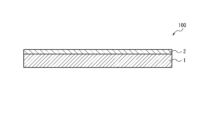
- FIG. 2 is a conceptual diagram illustrating the cross-sectional structure of the moisture-proof paper according to the present embodiment.
- FIG. 3 is a conceptual diagram illustrating the cross-sectional structure of another moisture-proof paper according to the present embodiment.
- FIG. 1 shows a moisture-proof paper 100 according to this embodiment. Note that FIG. 1 conceptually explains the cross-sectional structure of the moisture-proof paper 100, and the thickness ratios are not accurate.
- the moisture-proof paper 100 includes a paper base material 1 and a moisture-proof layer 2 laminated on the paper base material 1.
- the moisture-proof layer 2 contains a styrene-acrylic copolymer in which a copolymer of styrenes and (meth)acrylate forms a core-shell structure.
- the moisture-proof paper 100 When the moisture-proof paper 100 is formed into a predetermined shape (for example, a box shape) and used as a package, it increases the moisture-proof property of the package while ensuring recyclability, and also maintains the moisture-proof property even after the package is opened. can maintain sex.
- a predetermined shape for example, a box shape
- the moisture-proof paper 100 may further include an undercoat layer 3 disposed between the paper base material 1 and the moisture-proof layer 2, as shown in FIG. Note that FIG. 2 conceptually explains the cross-sectional structure of the moisture-proof paper 100, and the thickness ratios are not accurate.
- the moisture-proof paper 100 may further include a printed layer 4 disposed between the paper base material 1 and the moisture-proof layer 2.
- the moisture-proof paper 100 may include a paper base 1, an undercoat layer 3, a printed layer 4, and a moisture-proof layer 2 in this order.
- the undercoat layer 3, the printed layer 4, and the moisture-proof layer 2 may be formed in this order on the board surface of the paper base material 1 by coating, printing, or the like.
- the undercoat layer 3, the printed layer 4, and the moisture-proof layer 2 may be formed only on one side of the paper base material 1, or may be formed on both sides.
- the layer structure may be different between one side (for example, the front side) and the other side (the back side) of the moisture-proof paper 100.
- one side of the paper base material 1 has an undercoat layer 3, a printed layer 4, and a moisture-proof layer 2, and the other side has only the moisture-proof layer 2 formed thereon.
- the paper base material 1 is a sheet-like paper layer.
- the paper base material 1 is a layer that serves as a base or base material on which the moisture-proof layer 2 and the like are coated in the moisture-proof paper 100 .
- the paper base material 1 can be used without any particular limitation as long as it is manufactured by a paper machine by adhering natural fibers for paper making such as wood pulp and other fibers.
- the paper base material 1 is, for example, Western paper such as Kent paper, kraft paper, or high-quality paper. Note that the paper base material 1 does not contain materials that may pose an obstacle to recycling, such as laminated with a resin film such as a polyethylene film.
- the basis weight of the paper base material 1 can be 30 g/m 2 or more and 250 g/m 2 or less.
- the basis weight of the paper base material 1 is preferably 50 g/m 2 or more and 150 g/m 2 or less, more preferably 80 g/m 2 from the viewpoint of ease of folding , strength, and feeling of use. 2 or more and 130 g/m 2 or less, more preferably 90 to 120 g/m 2 .
- a to B may be written as A to B, etc.
- 50 g/m 2 or more and 250 g/m 2 is written as 50 to 250 g/m 2 .
- Natural fibers for papermaking include wood pulps such as softwood pulp and hardwood pulp, non-wood pulps such as Manila hemp pulp, sisal pulp, and flax pulp, and pulps obtained by chemically modifying these pulps.
- wood pulps such as softwood pulp and hardwood pulp
- non-wood pulps such as Manila hemp pulp, sisal pulp, and flax pulp
- pulps obtained by chemically modifying these pulps As for the type of pulp, chemical pulp produced by sulfate cooking method, acidic/neutral/alkaline sulfite cooking method, soda salt cooking method, etc., ground pulp, chemical ground pulp, thermomechanical pulp, etc. can be used.
- various types of commercially available high-quality paper, coated paper, lined paper, impregnated paper, cardboard, paperboard, etc. can also be used.
- the moisture-proof layer 2 is a functional layer that imparts functionality related to moisture-proofing or water resistance (hereinafter simply referred to as moisture-proofing) to the paper base material 1.
- moisture-proofing refers to the function of suppressing the permeation of water vapor or water in the moisture-proof paper 100. That is, the moisture-proof paper 100 is provided with the moisture-proof layer 2, thereby suppressing permeation of water vapor or water.
- the moisture-proof layer 2 may be provided on the entire surface of the paper base material 1 or the undercoat layer 3 or print layer 4 described below, or may be provided on a portion thereof.
- the moisture-proof layer 2 can be formed by coating on the paper base material 1, as described later.
- the thickness of the moisture-proof layer 2 depends on the application, but when used as a package for tobacco, food, or medicine, it can be used at a coating weight of, for example, 1 g/m 2 or more and 10 g/m 2 or less.
- the coating weight of the moisture-proof layer 2 is preferably in the range of 3 g/m 2 or more and 8 g/m 2 , especially when used as a cigarette package. Within this range, sufficient moisture resistance can be obtained without excessive coating.
- the moisture-proof layer 2 maintains a contact angle of 70 degrees or more 30 minutes after dropping water, preferably 75 degrees or more, and more preferably 80 degrees or more.
- the water-resistant coating layer of this embodiment maintains a contact angle of 50 degrees or more 40 minutes after dropping water, preferably 60 degrees or more, preferably 70 degrees or more, more preferably 75 degrees. It is preferable that it is above.
- the contact angle can be easily measured using a known contact angle measuring device (for example, an automatic contact angle measuring device manufactured by Kyowa Interface Science Co., Ltd.).
- the moisture-proof layer 2 preferably has a water vapor permeation amount of 500 g/m 2 ⁇ day or less, and 300 g/m 2 ⁇ day or less when maintained for 7 days under the conditions of a temperature of 25 ° C. and a relative humidity of 50% RH. It is preferably 250 g/m 2 ⁇ day or less, and preferably 200 g/m 2 ⁇ day or less. Further, the amount of water vapor permeation when maintained for 7 days at a temperature of 40 degrees is preferably 1000 g/m 2 ⁇ day or less, preferably 600 g/m 2 ⁇ day or less, and 500 g/m 2 -day or less is preferable, and it is preferable that it is 400 g/m 2 ⁇ day or less.
- the moisture-proof layer 2 contains a styrene-acrylic copolymer in which a copolymer of styrene and (meth)acrylate forms a core-shell structure.
- the styrene-acrylic copolymer may be a copolymer of styrenes, (meth)acrylate, and (meth)acrylic acid.
- the styrene-acrylic copolymer may contain other known polymerizable compounds other than styrenes, (meth)acrylates, and (meth)acrylic acid.
- (meth)acrylate represents a general term for acrylate and methacrylate
- (meth)acrylic acid represents a general term for acrylic acid and methacrylic acid.
- the moisture-proof layer 2 may contain a styrene-acrylic copolymer consisting of a copolymer of styrenes and (meth)acrylate, and a copolymer of styrenes, (meth)acrylate, and (meth)acrylic acid. preferable.
- the moisture-proof layer 2 further contains a wax described below.
- the moisture-proof layer 2 contains wax, water resistance can be improved.
- the moisture-proof layer 2 contains wax, it is preferable that the moisture-proof layer 2 contains wax in a styrene-acrylic copolymer.
- the moisture-proof layer 2 contains wax in the styrene-acrylic copolymer, water resistance can be further improved.
- the moisture-proof layer 2 contains wax in the styrene-acrylic copolymer
- this wax is preferably present in the core-shell structure of the styrene-acrylic copolymer.
- water resistance can be further improved.
- the wax may exist on the core portion, the shell portion, or the surface of the shell portion in the core-shell structure of the styrene-acrylic copolymer.
- the moisture-proof layer 2 is a styrene-acrylic copolymer (A) containing a copolymer of styrene, ⁇ -methylstyrene, and (meth)acrylate, or a copolymer of styrenes, (meth)acrylate, and (meth)acrylic acid. May contain.
- the moisture-proof layer 2 is formed, for example, from a coating composition (CS) containing an emulsion containing the styrene-acrylic copolymer (A) and an aqueous solvent.
- the moisture-proof layer 2 may contain wax as described above, but in this case, the coating composition (CS) may contain wax (W1).
- aqueous solvent water, a water-soluble organic solvent that dissolves in water, etc. can be used.
- water pure water such as ion-exchanged water, ultrafiltrated water, reverse osmosis water, distilled water, or ultrapure water can be used.
- water that has been sterilized by ultraviolet irradiation or hydrogen peroxide addition to prevent the growth of mold or bacteria when storing aqueous pigment dispersions or inks using them for long periods of time. This is suitable because it can be done.
- water-soluble organic solvents include glycols such as ethylene glycol, diethylene glycol, triethylene glycol, tetraethylene glycol, propylene glycol, polyethylene glycol, and polypropylene glycol; diols such as butanediol, pentanediol, and hexanediol; propylene laurate; Glycol esters such as glycol; diethylene glycol ethers such as diethylene glycol monoethyl, diethylene glycol monobutyl, diethylene glycol monohexyl, carbitol; glycol ethers such as cellosolve, including propylene glycol ether, dipropylene glycol ether, and triethylene glycol ether; methanol Alcohols such as , ethanol, isopropyl alcohol, 1-propanol, 2-propanol, 1-butanol, 2-butanol, butyl alcohol, pentyl alcohol; lactones such as sulfolane, ester
- the styrene-acrylic copolymer (A) preferably includes a copolymer of styrenes and (meth)acrylate forming a core-shell structure, and a copolymer of styrenes and (meth)acrylate, and a copolymer of styrene and (meth)acrylate. More preferably, a copolymer of (meth)acrylate and (meth)acrylic acid forms a core-shell structure.
- Styrenes used as constituent components of the styrene-acrylic copolymer (A) include styrene, ⁇ -methylstyrene (or a mixture of o-methylstyrene, m-methylstyrene, and p-methylstyrene), styrene dimer, and styrene trimer. It is a polymerizable compound having a styrene skeleton such as , styrene derivatives (p-dimethylsilylstyrene, p-tert-butyldimethylsiloxystyrene, p-tert-butylstyrene).
- the number of styrenes may be one or two or more. Among them, it is preferable to use styrene, and when two or more types of styrenes are used, it is preferable to use styrene as the main component, such as by increasing the mass percentage of styrene among all styrenes.
- the (meth)acrylate used as a component of the styrene-acrylic copolymer (A) is not particularly limited, and examples thereof include methyl (meth)acrylate, ethyl (meth)acrylate, iso-propyl (meth)acrylate, Allyl (meth)acrylate, n-butyl (meth)acrylate, iso-butyl (meth)acrylate, sec-butyl (meth)acrylate, tert-butyl (meth)acrylate, n-(meth)acrylate amyl, iso-amyl (meth)acrylate, n-hexyl (meth)acrylate, n-octyl (meth)acrylate, 2-ethylhexyl (meth)acrylate, n-lauryl (meth)acrylate, (meth) n-Tridecyl acrylate, n-stearyl (meth)acrylate, phenyl (me
- homopolymers containing acrylates are preferred because they exhibit a lower glass transition temperature, and homopolymers containing acrylates having an alkyl group having 1 to 20 carbon atoms as the main component are preferred; It is preferable that the main component is an acrylate having the following properties.
- acrylates having an alkyl group having 1 to 12 carbon atoms include methyl acrylate, ethyl acrylate, iso-propyl acrylate, allyl acrylate, n-butyl acrylate, iso-butyl acrylate, ( sec-butyl acrylate, tert-butyl acrylate, n-amyl acrylate, iso-amyl acrylate, n-hexyl acrylate, n-octyl acrylate, 2-ethylhexyl acrylate, n-(meth)acrylate - Examples include lauryl.
- the number of (meth)acrylates used as a constituent component of the styrene-acrylic copolymer (A) of this embodiment may be one or two or more.
- the styrene-acrylic copolymer (A) may contain other known polymerizable compounds other than styrenes, (meth)acrylate, and (meth)acrylic acid.
- the core-shell structure of the styrene-acrylic copolymer (A) consists of a region in which a large amount of "a copolymer of styrenes and (meth)acrylate” exists, and a region in which "a copolymer of styrenes, (meth)acrylate, and (meth)acrylic acid” is present. It forms a core-shell structure by having a region in which a large amount of "copolymer” is present.
- a ⁇ copolymer of styrenes, (meth)acrylate, and (meth)acrylic acid'' is present in a region where a large amount of ⁇ a copolymer of styrenes and (meth)acrylates'' exists.
- these copolymers may be polymerized with each other.
- the shell component be a ⁇ copolymer of styrenes, (meth)acrylate, and (meth)acrylic acid'' having acidic groups; A part of the "copolymer of (meth)acrylate and (meth)acrylic acid" may be present in the core portion.
- the styrene-acrylic copolymer (A) may contain a wax (W1), which will be described later. By containing the wax (W1) in the styrene-acrylic copolymer (A), water resistance can be further improved.
- the wax (W1) may be present in the core portion or in the shell portion. It may be present on the surface of the styrene-acrylic copolymer (A).
- the ratio of "copolymer of styrenes and (meth)acrylate” to "copolymer of styrenes, (meth)acrylate, and (meth)acrylic acid” is The ratio is preferably in the range of 20:80 to 95:5, more preferably 30:70 to 92:8, and most preferably 40:60 to 90:10.
- the ratio of styrenes to (meth)acrylates is preferably in the range of 20:80 to 80:20 in terms of mass ratio, and preferably in the range of 30:70 to 70:30. More preferably, the range is from 40:60 to 60:40.
- the proportion of styrenes is preferably 10 to 90% by mass, more preferably 20 to 80% by mass, and 30 to 80% by mass. Most preferably, it is 70% by mass. Furthermore, in the copolymer of styrenes, (meth)acrylate, and (meth)acrylic acid, the proportion of (meth)acrylate is preferably 10 to 80% by mass, more preferably 15 to 70% by mass. It is preferably 20 to 60% by weight, and most preferably 20 to 60% by weight.
- the proportion of (meth)acrylic acid is preferably 10 to 70% by mass, and preferably 15 to 60% by mass. More preferably, it is 20 to 50% by mass.
- the styrene-acrylic copolymer (A) contains a known polymerizable compound other than styrenes, (meth)acrylate, or (meth)acrylic acid, other polymers in the styrene-acrylic copolymer (A) may be added.
- the proportion of the sexual compound is preferably 10% by mass or less, and preferably 5% by mass or less.
- the glass transition temperature (hereinafter sometimes referred to as Tg) of the styrene-acrylic copolymer (A) is in the range of -30 to 10°C, preferably in the range of -25 to 5°C, more preferably in the range of -20 to 5°C. It is in the range of ⁇ 0°C.
- the glass transition temperature is obtained by measurement using a differential scanning calorimeter.
- the styrene-acrylic copolymer (A) can be produced by a known method.
- step (i) provides a monomer mixture forming a shell polymer and polymerizes the monomer mixture in the presence of an initiator to form a shell polymer; and polymerizing this monomer mixture in the presence of an initiator to form a shell on the core polymer.
- step (1) of supplying a monomer mixture forming a core polymer and polymerizing this monomer mixture in the presence of an initiator to form a core polymer and step (1) supplying a monomer mixture forming a shell polymer. is supplied to the core polymer, and the monomer mixture is polymerized in the presence of an initiator to form a shell in the core polymer.
- the initiator is not particularly limited, and peroxides, persulfates, azo compounds, redox compounds, or mixtures thereof used in emulsion polymerization methods may be used.
- Peroxides include, for example, hydrogen peroxide, ammonium peroxide, sodium or potassium peroxide, t-butyl peroxide, t-butyl hydroperoxide, cumene hydroperoxide, and benzene peroxide.
- persulfates include ammonium persulfate, sodium persulfate, and potassium persulfate.
- the azo compound include 2,2-azobisisobutyronitrile and 4,4'-(4-cyanovaleric acid).
- redox systems consist of an oxidizing agent and a reducing agent.
- the oxidizing agent include one of the above-mentioned peroxides, persulfates, or azo compounds, or sodium chloride or potassium chloride, or sodium bromide or Examples include potassium bromide.
- Reducing agents include, for example, ascorbic acid, glucose, or ammonium, sodium or potassium hydrogen sulfate, sodium or potassium hydrogen sulfite, sodium or potassium thiosulfate, or sodium or potassium sulfide, or iron (II). ) ammonium sulfate.
- persulfates more preferably ammonium persulfates, are preferred.
- the polymerization of the monomer mixture described above can be carried out in the presence of additives such as a surfactant, a chain transfer agent, a chelating agent, etc., for example, in the presence of a surfactant and a chain transfer agent.
- additives such as a surfactant, a chain transfer agent, a chelating agent, etc.
- a surfactant and a chain transfer agent for example, in the presence of a surfactant and a chain transfer agent.
- additives may be added in advance to the aqueous medium used in step (i) and/or step (ii), step (1) and/or step (2), or may be added in advance to the aqueous medium used in step (i) and/or step (ii). Alternatively, it may be mixed with the monomer mixture supplied in step (ii), step (1) and/or step (2).
- the monomer mixture is polymerized in the presence of the wax (W1).
- the wax (W1) may be added in advance to the aqueous medium used in step (i) and/or step (ii), step (1) and/or step (2), or /or a state in which the wax (W1) is incorporated into the styrene-acrylic copolymer (A) by mixing it with the monomer mixture supplied in step (ii), step (1) and/or step (2); A core-shell structure can be formed.
- the surfactant is not particularly limited, but includes, for example, disodium dodecyl diphenyl oxide, disulfonate, and the like.
- Chain transfer agents are also not particularly limited, but include, for example, ⁇ -methylstyrene dimer, thioglycolic acid, sodium hydrogen phosphite, 2-mercaptoethanol, N-dodecylmercaptan, and t-dodecylmercaptan.
- the chelating agent is not particularly limited, but includes, for example, ethylenediaminetetraacetic acid.
- bases such as ammonia, triethylamine, aminomethylpropanol, monoethanolamine, diethylaminoethanol, sodium hydroxide, potassium hydroxide, etc. can be used as a neutralizing agent.
- the coating composition (CS) can further improve water resistance by containing the wax (W1).
- the wax (W1) is preferably at least one wax selected from paraffin wax, microcrystalline wax, oxidized polyethylene wax, and amide wax, and more preferably paraffin wax or microcrystalline wax. These may be used alone or in combination.
- the melting point of the wax (W1) is preferably in the range of 30 to 130°C, more preferably in the range of 50 to 100°C.
- the amount of wax (W1) to be blended is preferably 0.5 to 20% by mass, and preferably 1 to 15% by mass, based on 100% by mass of the styrene-acrylic copolymer (A).
- the wax (W1) only needs to be present dispersedly in the waterproof coating layer, but as described above, by being present in the core part and/or shell part of the styrene-acrylic copolymer (A), Preferably, it exists integrated with the acrylic copolymer (A).
- wax (W1) exists in a form included in the styrene-acrylic copolymer (A) and in a form not contained in the styrene-acrylic copolymer (A). You can leave it there.
- the wax (W1) may be directly added to the emulsion containing the styrene-acrylic copolymer (A) and mixed and dispersed, or a dispersion of the wax (W1) may be prepared and then mixed with the emulsion.
- a dispersion method a known method is used, for example, as a dispersion device using media, a paint shaker, ball mill, attritor, basket mill, sand mill, sand grinder, dyno mill, dispermat, SC mill, spike mill, agitator mill, etc. are used. It can be dispersed using an ultrasonic homogenizer, a high-pressure homogenizer, a nanomizer, a dissolver, a disperser, a high-speed impeller disperser, etc. without using a media.
- kneading When using powdered wax, in order to uniformly disperse the wax, it is preferable to perform kneading using media or to perform blending after preparing a wax dispersion.
- the kneading method can be performed by a known method.
- the multiple types of waxes may be added at the same time or may be added in multiple steps.
- the wax (W1) is included in the styrene-acrylic copolymer (A), as described above, the monomer mixture constituting the styrene-acrylic copolymer (A) is polymerized in the presence of the wax (W1). It can be carried out.
- the coating composition (CS) further contains silica, alumina, wax, antifoaming agent, leveling agent, tackifier, preservative, antibacterial agent, Additives such as rust preventive agents may be added. Further, resins other than the styrene-acrylic copolymer (A) may be blended.
- a leveling agent and/or wax is further blended.
- the wax that is further blended is a wax (W2) that is added separately from the above-mentioned wax (W1).
- W2 wax
- waxes such as fatty acid amide wax, carnauba wax, polyolefin wax, paraffin wax, Fischer-Tropsch wax, beeswax, microcrystalline wax, oxidized polyethylene wax, and amide wax can be mentioned, and these waxes may be used alone. It may be used separately or in combination.
- fatty acid amide wax carnauba wax, Fischer-Tropsch wax, polyolefin wax, and paraffin wax
- carnauba wax, polyolefin wax, and paraffin wax it is preferable to use carnauba wax, polyolefin wax, and paraffin wax.
- fatty acid amide wax include pelargonic acid amide, capric acid amide, undecylic acid amide, lauric acid amide, tridecylic acid amide, myristic acid amide, pentadecyl acid amide, palmitic acid amide, heptadecylic acid amide, and stearic acid amide.
- carnauba wax examples include MICROKLEAR 418 (manufactured by Micro Powders, Inc.), purified carnauba wax No. 1 powder (Nippon Wax Co., Ltd.), and the like.
- olefin wax examples include polyethylene wax and polypropylene wax, such as MPP-635VF (MicroPowders, Inc.), MP-620VF XF (Micro Powders, Inc.), and Chemipearl W-400. (manufactured by Mitsui Chemicals, Inc.), etc.
- the amount of wax (W2) to be blended is preferably such that the total amount of wax (W2) is 0.3 to 10% by mass based on the total solid content of 100% by mass in the composition of the present embodiment. If the total amount of wax (W2) is 0.3% by mass or more based on the 100% total solid content in the composition of this embodiment, blocking resistance tends to be maintained, and more preferably 0.5% by mass or more. It is. In addition, if the total amount of wax (W2) is 10% by mass or less based on the 100% total solid content of the water-based heat sealant, the sliding angle will not become too large, which tends to maintain good workability. , preferably 5% by mass or less, more preferably 3% by mass or less. Further, the melting point of the wax (W2) is preferably in the range of 80 to 130°C from the viewpoint of oil resistance and heat resistance.
- the wax (W2) may be directly added to the emulsion of the resin containing the styrene-acrylic copolymer (A) and mixed and dispersed, or it may be mixed with the emulsion after preparing a wax dispersion.
- the wax (W2) is not incorporated into the styrene-acrylic copolymer (A), but is dispersed so that it also exists near the surface of the water-resistant coating layer. is preferred.
- the type of leveling agent is not particularly limited, it is preferable to use an acetylene surfactant.
- the acetylene surfactants include 2,5-dimethyl-3-hexyne-2,5-diol, 3,6-dimethyl-4-octyne-3,6-diol, 2,4,7,9 -tetramethyl-5-decyne-4,7-diol, 3,5-dimethyl-1-hexyn-3-ol, 3-methyl-1-butyn-3-ol, 3-methyl-1-pentyne-3- Examples include ol, 3-hexyne-2,5-diol, 2-butyne-1,4-diol, and the like.
- alkylene oxide non-modified acetylene glycol surfactants such as Surfynol 61, 82, and 104 (all manufactured by Air Products), [0037] Surfynol 420, 440, 465, 485, TG, 2502, Dynor 60 4, 607 (all manufactured by Air Products), Surfynol SE, MD-20, Olfine E1004, E1010, PD-004, EXP4300, PD-501, PD-502, SPC (all manufactured by Nissin Chemical Industries) Examples include alkylene oxide-modified acetylene glycol surfactants such as Acetylenol EH, E40, E60, E81, E100, and E200 (all manufactured by Kawaken Fine Chemicals).
- the amount of the leveling agent added is preferably 0.01 to 0.1% by weight based on the total amount of the paper overcoating composition.
- Moisture-proof layer 2 contains a polymer antifoaming agent, a silicone antifoaming agent, and a fluorine antifoaming agent in order to prevent the coating composition (CS) from foaming when it is coated on paper. It is preferable that As these antifoaming agents, both emulsifying and dispersing type and solubilizing type can be used. Among these, polymer antifoaming agents are preferred. The amount of the antifoaming agent added is preferably 0.005% to 0.1% by weight based on the total amount of the paper coating composition.
- the undercoat layer 3 controls the water absorption of the paper base material 1 to prevent the printing ink forming the printing layer 4 described later from bleeding, and also to improve the coating properties of the printing ink forming the printing layer 4. This is the functional layer of The undercoat layer 3 is a so-called primer layer or anchor layer.
- a surface treatment agent or a surface sizing agent that covers the surface of the paper base material 1 can also be used.
- these surface treating agents or surface sizing agents general-purpose ones can be used as surface treating agents and surface sizing agents for paper, and mixtures thereof can also be used.
- the type of binder used in the surface treatment agent is not particularly limited, but raw starch, oxidized starch, esterified starch, cationized starch, starch such as modified starch made from acetylated tapioca starch, aldehyde starch, hydroxyethyl Modified starch such as modified starch, cellulose derivatives such as carboxymethylcellulose, hydroxyethylcellulose, methylcellulose, cellulose nanofiber, polyacrylamide, denatured alcohol such as carboxyl-modified polyvinyl alcohol, acetoacetylated polyvinyl alcohol, styrene-butadiene copolymer, polyester, etc. Vinyl acetate, vinyl chloride-vinyl acetate copolymers, polyvinyl chloride, polyvinylidene chloride, polyacrylic esters, and the like can be used alone or in combination.
- the surface sizing agent is not particularly limited as long as it can hydrophobize the paper (cellulose) surface and suppress the penetration of water, oil, etc.
- styrene-based sizing agents olefin-based sizing agents, acrylic sizing agents, etc.
- sizing agent styrene-acrylic sizing agent
- styrene-maleic acid sizing agent cationic sizing agent
- rosin sizing agent AKD (alkyl ketene dimer) emulsion type sizing agent
- ASA alkenyl succinic anhydride
- the surface sizing agent is preferably used in combination with a surface treatment agent, and when used in combination, the solid content concentration in the surface treatment agent is preferably 0.05 to 5% by weight, more preferably 0.05 to 1% by weight.
- the printing layer 4 is, for example, a printing ink layer formed by printing printing ink on the paper base material 1 or the undercoat layer 3 formed on the paper base material 1. Note that the undercoat layer 3 will be described later.
- the printing layer 4 includes letters, numbers, pictures, figures, symbols, patterns, etc. for decoration, display of contents, display of expiration date, display of manufacturer, seller, etc., and for imparting aesthetic appearance. This layer forms any desired printed pattern.
- the printing layer 4 may be provided on the entire surface of the paper base material 1 or the undercoat layer 3 formed on the paper base material 1, or may be provided on a portion thereof.
- the printing layer 4 As the material for forming the printing layer 4, known materials such as ink for gravure printing and ink for flexographic printing can be used.
- the printing layer 4 may be a single layer of printing ink, or may be a layer of printing ink in which multiple layers are laminated. By forming the printing layer 4 with a plurality of layers, it may be possible to print in a plurality of colors and improve the design.
- the printing layer 4 can be formed using conventionally known pigments and dyes, and the forming method is not particularly limited and can be appropriately selected depending on the purpose.
- the printing ink layer is preferably a layer formed of a printing ink containing, for example, a binder resin, a pigment, a solvent, and optionally additives.
- Binder resins that make up the printing ink include, but are not limited to, acrylic resins, polyamide resins, urethane resins, cellulose resins, vinyl chloride-vinyl acetate copolymer resins, and chlorinated polypropylene resins.
- ethylene-vinyl acetate copolymer resin vinyl acetate resin
- vinyl chloride resin such as polyvinyl chloride resin, polyester resin, alkyd resin, rosin resin, rosin-modified maleic acid resin, ketone resin, cyclized rubber, chlorinated rubber , butyral, petroleum resin, etc. are preferable.
- the moisture-proof layer 2, the undercoat layer 3, and the printed layer 4 can be formed by coating (coating or printing) a coating liquid or ink for forming these layers on the paper base material 1.
- Equipment that realizes the application of these coating solutions include comma coater, roll coater, reverse roll coater, direct gravure coater, reverse gravure coater, offset gravure coater, roll kiss coater, reverse kiss coater, kiss gravure coater, and reverse kiss.
- Gravure coater air doctor coater, knife coater, bar coater, wire bar coater, die coater, lip coater, dip coater, blade coater, brush coater, curtain coater, die slot coater, flexo coater, impregnation coater, cast coater, spray coater , offset printing machines, and screen printing machines. These devices may be used in combination of two or more.
- the moisture-proof layer 2 and the undercoat layer 3 may be formed by coating on the paper base material 1 by impregnating the paper base material 1 with a coating liquid for forming these layers. Further, a drying step in an oven or the like may be provided after coating. In particular, it is preferable to form the printed layer 4 using a printing machine such as an offset printing machine or a screen printing machine.
- the moisture-proof layer 2, undercoat layer 3, and printing layer 4 are preferably formed on the paper base material 1 in the following order.
- the undercoat layer 3 is formed on a part or all of at least one surface of the paper base material 1.
- a printing layer 4 is formed on part or all of the undercoat layer 3.
- the moisture-proof layer 2 is formed on the printed layer 4.
- the moisture-proof paper 100 can be formed.
- the undercoat layer 3 or the printing layer 4 may be omitted.
- the moisture-proof paper 100 can be used not only as a package for cigarettes, foods, or medicines as exemplified above, but also as a package for other products.
- packaging bodies include paper boxes, paper bags, cardboard, wrappers, envelopes, cup sleeves, lids, and the like. There are no restrictions on the shape or folding method of the package using the moisture-proof paper 100.
- Contents suitable for packaging in a package made of moisture-proof paper 100 include foods that require moisture-proof properties in the package and whose flavor changes due to humidity (e.g., chocolate) and luxury goods (e.g., Packaging bodies with high barrier properties against moisture are required for products such as tobacco products (tobacco) and drugs (such as pharmaceutical products) that deteriorate due to deterioration in functionality.
- foods that require moisture-proof properties in the package and whose flavor changes due to humidity e.g., chocolate
- luxury goods e.g., Packaging bodies with high barrier properties against moisture are required for products such as tobacco products (tobacco) and drugs (such as pharmaceutical products) that deteriorate due to deterioration in functionality.
- Foods suitable for packaging in a package formed of moisture-proof paper 100 include pet foods other than those for human consumption. Food also includes food additives, spices, and seasonings. Further, medicines suitable for packaging in a package formed of the moisture-proof paper 100 may include, in addition to so-called pharmaceuticals, vitamin preparations, so-called supplements, and those treated as functional foods.
- items suitable for packaging with a package made of moisture-proof paper 100 include items such as the above-mentioned cigarettes, where migration and volatilization of components such as aroma and flavor should be suppressed, especially those that are affected by moisture and steam. Here are some things that are easy to accept.
- Examples 1 to 3 A moisture-proof paper according to Examples 1 to 3 is formed by laminating a moisture-proof layer containing a styrene-acrylic copolymer in which a core-shell structure is formed by a copolymer of styrene and methacrylate produced by the following procedure on a paper base material. did.
- “part” represents “part by mass”
- “%” represents “% by mass”.
- paraffin wax paraffin wax 155, manufactured by Nippon Seiro Co., Ltd.
- a wax dispersion 10 parts by mass of paraffin wax (paraffin wax 155, manufactured by Nippon Seiro Co., Ltd.) as a wax was added to the water-soluble resin obtained above and stirred to prepare a wax dispersion.
- 10 parts of ion-exchanged water was added to the wax dispersion in a reaction flask, and the temperature was raised to 80-82°C.
- 2 parts of potassium persulfate was added, and 30 parts of styrene and 24 parts of 2-ethylhexyl acrylate were added.
- the mixture was added dropwise over 2 hours. After the dropwise addition was completed, 0.2 part of potassium persulfate was added, and the mixture was reacted for 2 hours.
- the solid content of the aqueous dispersion of styrene-acrylic copolymer thus obtained was 35%, and the glass transition point was -10°
- the paper sheets of Examples 1, 2, and 3 were produced by drying at 150° C. for 20 seconds using a machine to form a moisture-proof layer.
- the above-mentioned coating amount is the mass of the moisture-proof layer after drying.
- the paper of each of the above examples does not use a water-insoluble plastic film or the like, so that there is no problem in recycling the paper.
- Example 1 In place of the aqueous dispersion of styrene-acrylic copolymer in Examples 1 to 3, an aqueous solution of an aqueous acrylic resin with a solid content of 35% was used, and the coating liquid for forming a moisture-proof layer was prepared in the same manner as in the example. It was adjusted.
- This coating solution was applied to the same paper base material as in Examples 1 to 3 at a coating amount of 3 g/m 2 and dried at 150°C for 20 seconds using a dryer to form a moisture-proof layer. was formed to produce the paper of Comparative Example 1.
- the above-mentioned coating amount is the mass of the moisture-proof layer after drying.
- Comparative example 2 A paper of Comparative Example 2 was prepared in the same manner as Comparative Example 1 except that the coating amount was 5 g/m 2 .
- Comparative example 3 A paper of Comparative Example 3 was prepared in the same manner as Comparative Example 1 except that the coating amount was 7 g/m 2 .
- Example 4 The high-quality paper used in Example 1 was used as the paper of Comparative Example 4.
- Comparative example 5 A paper of Comparative Example 5 was prepared in the same manner as Comparative Example 1 except that the coating amount was 1 g/m 2 .
- the paper of the above-mentioned comparative example does not use a water-insoluble plastic film or the like, and is said to cause no problems in paper recycling.
- Table 1 shows a list of the basis weight of the paper base material, the formulation of the moisture-proof layer, and the coating amount of the moisture-proof layer in each Example and Comparative Example.
- Moisture vapor transmission rate (MVTR) and water absorption were evaluated for the moisture-proof papers of Examples 1 to 3 and the papers of Comparative Examples 1 to 4.
- Water vapor transmission rate was measured as follows. First, a stainless steel cup was prepared, and 7 g of water was poured into the cup. Next, the mouth of the cup was covered with evaluation paper, and the paper was further adhered to the mouth with beeswax to seal the mouth. Then, the portion of the paper that protruded from the cup was cut off to create a sample bottle. The initial weight of the sample bottle was measured, and the weight of the sample after 24 hours (1 day) of storage under conditions of a temperature of 40° C. and a humidity of 50% Rh was measured, and the amount of water evaporated (g) was calculated. Then, the water vapor permeability per unit area (g/m 2 ⁇ day) was determined by dividing the amount of evaporated water by the opening area of the mouth of the cup.
- the water absorption was determined by contacting 100 ml of distilled water with the moisture-proof layer of the paper (for the paper of Comparative Example 4, the surface of the paper) for 120 seconds in accordance with the water absorption test method based on the Cobb method specified in JIS P 8140. The weight of water absorbed per unit area of paper was measured (with a contact time of 120 seconds).
- the paper of each Example has a water vapor transmission rate suppressed to about 1/3 to 1/2 as compared to the paper of each Comparative Example. Furthermore, the water absorption of the paper of each Example was suppressed to less than 4% compared to the paper of each Comparative Example. Since the paper (moisture-proof paper) of each example has high moisture-proof properties, when used as a package, it can ensure recyclability, increase the moisture-proof property of the package, and make it easier to open the package. It is thought that moisture resistance can be maintained even after the application.
- "maintaining moisture resistance even after opening the package” means that the moisture resistance of the package itself will not change even if the lid of the package is opened and closed because the package has high moisture resistance. do.
- the moisture resistance of the package decreases due to the tear in the resin film.
- the packaging formed from the paper of each example has sufficient moisture resistance even without being wrapped in a resin film, it is natural that even after opening the packaging, it will maintain the same moisture resistance as before opening. It is thought that it will be maintained.
- Table 3 shows the results of the storage test.
- the change in color of the cigarette paper was evaluated by the area ratio of the part of the surface of the cigarette paper that was discolored (turned brown) due to eugenol migration.
- the evaluation was made on a 10-point scale based on the area ratio. Specifically, 10 points (good) are given when the area ratio of the discolored part is 0% or more and less than 10%, and 9 points are given when the area ratio of the discolored part is 10% or more and less than 20%. One point was deducted for each 10% increase in the number of points, and 0 points (bad) were given when the area ratio of the discolored portion was 90% or more and 100% or less. Note that the discolored portion on the surface of the cigarette paper was confirmed by visual inspection.
- the 10-level evaluation values shown in Table 3 are the average values of 12 cigarettes. In Table 3, one day means 24 hours.
- Example 3 As shown in Table 3, it can be seen that the packages of Examples 1 and 2 can prevent discoloration (migration) more effectively than the package of Comparative Example 5. In the examples, it can be seen that as the coating amount increases (Example 2 compared to Example 1), the effect of preventing discoloration increases.
- a moisture-proof paper and a package formed from this moisture-proof paper are provided which can enhance the moisture-proof property of the package while ensuring recyclability and can maintain the moisture-proof property even after opening the package. You can donate your body.
- the present invention can be applied to moisture-proof paper and packaging.
Landscapes
- Engineering & Computer Science (AREA)
- Mechanical Engineering (AREA)
- Chemical & Material Sciences (AREA)
- Chemical Kinetics & Catalysis (AREA)
- Food Science & Technology (AREA)
- Paper (AREA)
Priority Applications (1)
| Application Number | Priority Date | Filing Date | Title |
|---|---|---|---|
| JP2024505594A JPWO2024004665A1 (https=) | 2022-06-27 | 2023-06-15 |
Applications Claiming Priority (2)
| Application Number | Priority Date | Filing Date | Title |
|---|---|---|---|
| JP2022-103042 | 2022-06-27 | ||
| JP2022103042 | 2022-06-27 |
Publications (1)
| Publication Number | Publication Date |
|---|---|
| WO2024004665A1 true WO2024004665A1 (ja) | 2024-01-04 |
Family
ID=89382097
Family Applications (1)
| Application Number | Title | Priority Date | Filing Date |
|---|---|---|---|
| PCT/JP2023/022185 Ceased WO2024004665A1 (ja) | 2022-06-27 | 2023-06-15 | 防湿紙及び包装体 |
Country Status (2)
| Country | Link |
|---|---|
| JP (1) | JPWO2024004665A1 (https=) |
| WO (1) | WO2024004665A1 (https=) |
Citations (4)
| Publication number | Priority date | Publication date | Assignee | Title |
|---|---|---|---|---|
| JPH10226991A (ja) * | 1997-02-14 | 1998-08-25 | Lintec Corp | 防湿紙 |
| JP2002138394A (ja) * | 2000-11-01 | 2002-05-14 | Gantsu Kasei Kk | 防湿性紙塗工用共重合体エマルジョン |
| JP2019183370A (ja) * | 2018-03-30 | 2019-10-24 | 日本製紙株式会社 | 紙製バリア材料 |
| WO2022071261A1 (ja) * | 2020-10-01 | 2022-04-07 | Dicグラフィックス株式会社 | 耐水紙、及び該耐水紙を用いた包装紙又は容器 |
Family Cites Families (3)
| Publication number | Priority date | Publication date | Assignee | Title |
|---|---|---|---|---|
| JPS56128397A (en) * | 1980-03-14 | 1981-10-07 | Ito Sadami | Adhesion of vapor deposited film |
| JP2004115054A (ja) * | 2002-09-26 | 2004-04-15 | Toppan Printing Co Ltd | 絞り成形紙製容器およびその製造方法 |
| JP5503456B2 (ja) * | 2010-08-20 | 2014-05-28 | 北越紀州製紙株式会社 | 臭気が少ない防湿紙及びその製造方法並びにそれを包装材として使用する方法 |
-
2023
- 2023-06-15 WO PCT/JP2023/022185 patent/WO2024004665A1/ja not_active Ceased
- 2023-06-15 JP JP2024505594A patent/JPWO2024004665A1/ja active Pending
Patent Citations (4)
| Publication number | Priority date | Publication date | Assignee | Title |
|---|---|---|---|---|
| JPH10226991A (ja) * | 1997-02-14 | 1998-08-25 | Lintec Corp | 防湿紙 |
| JP2002138394A (ja) * | 2000-11-01 | 2002-05-14 | Gantsu Kasei Kk | 防湿性紙塗工用共重合体エマルジョン |
| JP2019183370A (ja) * | 2018-03-30 | 2019-10-24 | 日本製紙株式会社 | 紙製バリア材料 |
| WO2022071261A1 (ja) * | 2020-10-01 | 2022-04-07 | Dicグラフィックス株式会社 | 耐水紙、及び該耐水紙を用いた包装紙又は容器 |
Also Published As
| Publication number | Publication date |
|---|---|
| JPWO2024004665A1 (https=) | 2024-01-04 |
Similar Documents
| Publication | Publication Date | Title |
|---|---|---|
| CN113597372B (zh) | 纸用外涂用和粘接剂用组合物、以及使用该组合物的涂覆物、耐水耐油纸层叠体、纸吸管及纸制餐具 | |
| CN110073056B (zh) | 抗油脂、抗油且抗水的涂料组合物 | |
| CN110678606A (zh) | 可热封的屏障涂料 | |
| JP7608144B2 (ja) | 水性リキッドインキ及び該水性リキッドインキを印刷した印刷物並びに耐油紙 | |
| CN116134193B (zh) | 耐水纸、以及使用了该耐水纸的包装纸或容器 | |
| CN103547735B (zh) | 具有阻隔涂层的纸和卡纸板包装 | |
| JP2013087139A (ja) | インクジェット用インク、インクジェット記録方法、及びインクジェット記録装置 | |
| TW201326515A (zh) | 食品用包裝紙 | |
| WO2007002896A2 (en) | Packaging material for food items containing permeating oils | |
| US11697742B2 (en) | High opacity white ink | |
| JP2013241716A (ja) | 食品包装紙用コート剤および食品包装用コート紙 | |
| JP7317262B2 (ja) | 積層体、及び該積層体を用いた包装紙又は容器 | |
| CN105385235A (zh) | 一种用于凹版印刷的水性触感光油及其制备方法 | |
| JP7557097B1 (ja) | プラスチック基材塗工用の水性液状組成物、水性ニス、水性メジウム、水性プライマー、水性インキ、積層体、ラベル及び包装材 | |
| JP2018053220A (ja) | 再剥離性シート | |
| WO2024004665A1 (ja) | 防湿紙及び包装体 | |
| JP2023085741A (ja) | 紙用ニス、該紙用ニスを塗工した塗工紙及び包装体 | |
| JP2021070819A (ja) | 特に基体にコーティング又は印刷を施すための水性のインク又はラッカー組成物 | |
| JP5336327B2 (ja) | 圧着用紙の原紙、その製造方法、及びその製造方法に使用される感圧接着剤組成物塗料 | |
| US20030226648A1 (en) | Multiple ply paperboard material having improved oil and grease resistance and stain masking properties and method for forming same | |
| JP6496436B1 (ja) | 受理溶液、この受理溶液を含有するインクセット及びインクセットを用いた印刷物の製造方法 | |
| JP2023091508A (ja) | 塗工紙、及び該塗工紙を用いた包装体又は容器 | |
| JP2023096902A (ja) | 塗工紙、及び該塗工紙を用いた包装体又は容器 | |
| JP7160698B2 (ja) | カラー印刷段ボールシートの製造方法及びカラー印刷段ボールシート | |
| JP7649413B1 (ja) | 紙基材塗工用の水性液状組成物、水性ニス、水性メジウム、水性プライマー、水性インキ、積層体、ラベル及び包装材 |
Legal Events
| Date | Code | Title | Description |
|---|---|---|---|
| ENP | Entry into the national phase |
Ref document number: 2024505594 Country of ref document: JP Kind code of ref document: A |
|
| 121 | Ep: the epo has been informed by wipo that ep was designated in this application |
Ref document number: 23831113 Country of ref document: EP Kind code of ref document: A1 |
|
| NENP | Non-entry into the national phase |
Ref country code: DE |
|
| 122 | Ep: pct application non-entry in european phase |
Ref document number: 23831113 Country of ref document: EP Kind code of ref document: A1 |