WO2023276702A1 - エポキシ樹脂改質剤、これを含有するエポキシ樹脂組成物、エポキシ樹脂組成物からなる接着剤、およびエポキシ樹脂組成物を硬化してなる樹脂硬化物 - Google Patents
エポキシ樹脂改質剤、これを含有するエポキシ樹脂組成物、エポキシ樹脂組成物からなる接着剤、およびエポキシ樹脂組成物を硬化してなる樹脂硬化物 Download PDFInfo
- Publication number
- WO2023276702A1 WO2023276702A1 PCT/JP2022/024142 JP2022024142W WO2023276702A1 WO 2023276702 A1 WO2023276702 A1 WO 2023276702A1 JP 2022024142 W JP2022024142 W JP 2022024142W WO 2023276702 A1 WO2023276702 A1 WO 2023276702A1
- Authority
- WO
- WIPO (PCT)
- Prior art keywords
- epoxy resin
- block
- mass
- group
- meth
- Prior art date
- Legal status (The legal status is an assumption and is not a legal conclusion. Google has not performed a legal analysis and makes no representation as to the accuracy of the status listed.)
- Ceased
Links
Images


Classifications
-
- C—CHEMISTRY; METALLURGY
- C08—ORGANIC MACROMOLECULAR COMPOUNDS; THEIR PREPARATION OR CHEMICAL WORKING-UP; COMPOSITIONS BASED THEREON
- C08F—MACROMOLECULAR COMPOUNDS OBTAINED BY REACTIONS ONLY INVOLVING CARBON-TO-CARBON UNSATURATED BONDS
- C08F293/00—Macromolecular compounds obtained by polymerisation on to a macromolecule having groups capable of inducing the formation of new polymer chains bound exclusively at one or both ends of the starting macromolecule
- C08F293/005—Macromolecular compounds obtained by polymerisation on to a macromolecule having groups capable of inducing the formation of new polymer chains bound exclusively at one or both ends of the starting macromolecule using free radical "living" or "controlled" polymerisation, e.g. using a complexing agent
-
- C—CHEMISTRY; METALLURGY
- C09—DYES; PAINTS; POLISHES; NATURAL RESINS; ADHESIVES; COMPOSITIONS NOT OTHERWISE PROVIDED FOR; APPLICATIONS OF MATERIALS NOT OTHERWISE PROVIDED FOR
- C09J—ADHESIVES; NON-MECHANICAL ASPECTS OF ADHESIVE PROCESSES IN GENERAL; ADHESIVE PROCESSES NOT PROVIDED FOR ELSEWHERE; USE OF MATERIALS AS ADHESIVES
- C09J163/00—Adhesives based on epoxy resins; Adhesives based on derivatives of epoxy resins
-
- C—CHEMISTRY; METALLURGY
- C08—ORGANIC MACROMOLECULAR COMPOUNDS; THEIR PREPARATION OR CHEMICAL WORKING-UP; COMPOSITIONS BASED THEREON
- C08F—MACROMOLECULAR COMPOUNDS OBTAINED BY REACTIONS ONLY INVOLVING CARBON-TO-CARBON UNSATURATED BONDS
- C08F2/00—Processes of polymerisation
- C08F2/44—Polymerisation in the presence of compounding ingredients, e.g. plasticisers, dyestuffs, fillers
-
- C—CHEMISTRY; METALLURGY
- C08—ORGANIC MACROMOLECULAR COMPOUNDS; THEIR PREPARATION OR CHEMICAL WORKING-UP; COMPOSITIONS BASED THEREON
- C08F—MACROMOLECULAR COMPOUNDS OBTAINED BY REACTIONS ONLY INVOLVING CARBON-TO-CARBON UNSATURATED BONDS
- C08F220/00—Copolymers of compounds having one or more unsaturated aliphatic radicals, each having only one carbon-to-carbon double bond, and only one being terminated by only one carboxyl radical or a salt, anhydride ester, amide, imide or nitrile thereof
- C08F220/02—Monocarboxylic acids having less than ten carbon atoms; Derivatives thereof
- C08F220/10—Esters
- C08F220/12—Esters of monohydric alcohols or phenols
- C08F220/16—Esters of monohydric alcohols or phenols of phenols or of alcohols containing two or more carbon atoms
- C08F220/18—Esters of monohydric alcohols or phenols of phenols or of alcohols containing two or more carbon atoms with acrylic or methacrylic acids
- C08F220/1804—C4-(meth)acrylate, e.g. butyl (meth)acrylate, isobutyl (meth)acrylate or tert-butyl (meth)acrylate
-
- C—CHEMISTRY; METALLURGY
- C08—ORGANIC MACROMOLECULAR COMPOUNDS; THEIR PREPARATION OR CHEMICAL WORKING-UP; COMPOSITIONS BASED THEREON
- C08F—MACROMOLECULAR COMPOUNDS OBTAINED BY REACTIONS ONLY INVOLVING CARBON-TO-CARBON UNSATURATED BONDS
- C08F220/00—Copolymers of compounds having one or more unsaturated aliphatic radicals, each having only one carbon-to-carbon double bond, and only one being terminated by only one carboxyl radical or a salt, anhydride ester, amide, imide or nitrile thereof
- C08F220/02—Monocarboxylic acids having less than ten carbon atoms; Derivatives thereof
- C08F220/10—Esters
- C08F220/26—Esters containing oxygen in addition to the carboxy oxygen
- C08F220/28—Esters containing oxygen in addition to the carboxy oxygen containing no aromatic rings in the alcohol moiety
- C08F220/281—Esters containing oxygen in addition to the carboxy oxygen containing no aromatic rings in the alcohol moiety and containing only one oxygen, e.g. furfuryl (meth)acrylate or 2-methoxyethyl (meth)acrylate
-
- C—CHEMISTRY; METALLURGY
- C08—ORGANIC MACROMOLECULAR COMPOUNDS; THEIR PREPARATION OR CHEMICAL WORKING-UP; COMPOSITIONS BASED THEREON
- C08F—MACROMOLECULAR COMPOUNDS OBTAINED BY REACTIONS ONLY INVOLVING CARBON-TO-CARBON UNSATURATED BONDS
- C08F293/00—Macromolecular compounds obtained by polymerisation on to a macromolecule having groups capable of inducing the formation of new polymer chains bound exclusively at one or both ends of the starting macromolecule
-
- C—CHEMISTRY; METALLURGY
- C08—ORGANIC MACROMOLECULAR COMPOUNDS; THEIR PREPARATION OR CHEMICAL WORKING-UP; COMPOSITIONS BASED THEREON
- C08F—MACROMOLECULAR COMPOUNDS OBTAINED BY REACTIONS ONLY INVOLVING CARBON-TO-CARBON UNSATURATED BONDS
- C08F297/00—Macromolecular compounds obtained by successively polymerising different monomer systems using a catalyst of the ionic or coordination type without deactivating the intermediate polymer
- C08F297/02—Macromolecular compounds obtained by successively polymerising different monomer systems using a catalyst of the ionic or coordination type without deactivating the intermediate polymer using a catalyst of the anionic type
- C08F297/026—Macromolecular compounds obtained by successively polymerising different monomer systems using a catalyst of the ionic or coordination type without deactivating the intermediate polymer using a catalyst of the anionic type polymerising acrylic acid, methacrylic acid or derivatives thereof
-
- C—CHEMISTRY; METALLURGY
- C08—ORGANIC MACROMOLECULAR COMPOUNDS; THEIR PREPARATION OR CHEMICAL WORKING-UP; COMPOSITIONS BASED THEREON
- C08K—Use of inorganic or non-macromolecular organic substances as compounding ingredients
- C08K5/00—Use of organic ingredients
- C08K5/36—Sulfur-, selenium-, or tellurium-containing compounds
- C08K5/48—Selenium- or tellurium-containing compounds
-
- C—CHEMISTRY; METALLURGY
- C08—ORGANIC MACROMOLECULAR COMPOUNDS; THEIR PREPARATION OR CHEMICAL WORKING-UP; COMPOSITIONS BASED THEREON
- C08L—COMPOSITIONS OF MACROMOLECULAR COMPOUNDS
- C08L53/00—Compositions of block copolymers containing at least one sequence of a polymer obtained by reactions only involving carbon-to-carbon unsaturated bonds; Compositions of derivatives of such polymers
-
- C—CHEMISTRY; METALLURGY
- C08—ORGANIC MACROMOLECULAR COMPOUNDS; THEIR PREPARATION OR CHEMICAL WORKING-UP; COMPOSITIONS BASED THEREON
- C08L—COMPOSITIONS OF MACROMOLECULAR COMPOUNDS
- C08L63/00—Compositions of epoxy resins; Compositions of derivatives of epoxy resins
-
- C—CHEMISTRY; METALLURGY
- C09—DYES; PAINTS; POLISHES; NATURAL RESINS; ADHESIVES; COMPOSITIONS NOT OTHERWISE PROVIDED FOR; APPLICATIONS OF MATERIALS NOT OTHERWISE PROVIDED FOR
- C09J—ADHESIVES; NON-MECHANICAL ASPECTS OF ADHESIVE PROCESSES IN GENERAL; ADHESIVE PROCESSES NOT PROVIDED FOR ELSEWHERE; USE OF MATERIALS AS ADHESIVES
- C09J11/00—Features of adhesives not provided for in group C09J9/00, e.g. additives
- C09J11/08—Macromolecular additives
-
- H—ELECTRICITY
- H10—SEMICONDUCTOR DEVICES; ELECTRIC SOLID-STATE DEVICES NOT OTHERWISE PROVIDED FOR
- H10W—GENERIC PACKAGES, INTERCONNECTIONS, CONNECTORS OR OTHER CONSTRUCTIONAL DETAILS OF DEVICES COVERED BY CLASS H10
- H10W74/00—Encapsulations, e.g. protective coatings
- H10W74/40—Encapsulations, e.g. protective coatings characterised by their materials
- H10W74/47—Encapsulations, e.g. protective coatings characterised by their materials comprising organic materials, e.g. plastics or resins
-
- C—CHEMISTRY; METALLURGY
- C09—DYES; PAINTS; POLISHES; NATURAL RESINS; ADHESIVES; COMPOSITIONS NOT OTHERWISE PROVIDED FOR; APPLICATIONS OF MATERIALS NOT OTHERWISE PROVIDED FOR
- C09J—ADHESIVES; NON-MECHANICAL ASPECTS OF ADHESIVE PROCESSES IN GENERAL; ADHESIVE PROCESSES NOT PROVIDED FOR ELSEWHERE; USE OF MATERIALS AS ADHESIVES
- C09J2203/00—Applications of adhesives in processes or use of adhesives in the form of films or foils
- C09J2203/326—Applications of adhesives in processes or use of adhesives in the form of films or foils for bonding electronic components such as wafers, chips or semiconductors
-
- C—CHEMISTRY; METALLURGY
- C09—DYES; PAINTS; POLISHES; NATURAL RESINS; ADHESIVES; COMPOSITIONS NOT OTHERWISE PROVIDED FOR; APPLICATIONS OF MATERIALS NOT OTHERWISE PROVIDED FOR
- C09J—ADHESIVES; NON-MECHANICAL ASPECTS OF ADHESIVE PROCESSES IN GENERAL; ADHESIVE PROCESSES NOT PROVIDED FOR ELSEWHERE; USE OF MATERIALS AS ADHESIVES
- C09J2433/00—Presence of (meth)acrylic polymer
-
- C—CHEMISTRY; METALLURGY
- C09—DYES; PAINTS; POLISHES; NATURAL RESINS; ADHESIVES; COMPOSITIONS NOT OTHERWISE PROVIDED FOR; APPLICATIONS OF MATERIALS NOT OTHERWISE PROVIDED FOR
- C09J—ADHESIVES; NON-MECHANICAL ASPECTS OF ADHESIVE PROCESSES IN GENERAL; ADHESIVE PROCESSES NOT PROVIDED FOR ELSEWHERE; USE OF MATERIALS AS ADHESIVES
- C09J2453/00—Presence of block copolymer
-
- C—CHEMISTRY; METALLURGY
- C09—DYES; PAINTS; POLISHES; NATURAL RESINS; ADHESIVES; COMPOSITIONS NOT OTHERWISE PROVIDED FOR; APPLICATIONS OF MATERIALS NOT OTHERWISE PROVIDED FOR
- C09J—ADHESIVES; NON-MECHANICAL ASPECTS OF ADHESIVE PROCESSES IN GENERAL; ADHESIVE PROCESSES NOT PROVIDED FOR ELSEWHERE; USE OF MATERIALS AS ADHESIVES
- C09J2463/00—Presence of epoxy resin
Definitions
- the present invention relates to an epoxy resin modifier, an epoxy resin composition containing the same, an adhesive made of the epoxy resin composition, an underfill material, and a resin cured product obtained by curing the epoxy resin composition.
- Epoxy resin is a general term for thermosetting resins obtained by mixing epoxy resins (main agent) with epoxy groups and amines, acid anhydrides, etc. (curing agents) and performing heat curing. In addition to having a high modulus of elasticity, epoxy resins also have excellent tensile strength, solvent resistance, and electrical properties. materials (potting materials, underfill materials), composite materials for aircraft, composite materials for sporting goods, etc. For example, when a semiconductor circuit is subjected to a heat cycle test, excessive mechanical stress is applied to the solder bumps due to the difference in coefficient of linear expansion between the circuit board and the semiconductor chip, cracks occur in the solder bumps, etc. The connection reliability of the circuit may be impaired. To solve this problem, the space between the circuit board and the semiconductor chip is filled with an underfill material made of epoxy resin.
- epoxy resin has a high elastic modulus, it also has the characteristic that microcracks in the resin tend to develop. Therefore, fracture toughness and peel adhesive strength are weak, and improvement thereof is required. Therefore, many attempts have been made to improve the toughness and peel adhesive strength of epoxy resins.
- an epoxy resin has an A block having a structural unit derived from a (meth)acrylate having a 4- to 6-membered cyclic ether group or cyclic thioether group, and a chain alkyl group or cyclic It is disclosed that toughness is improved by blending a block copolymer having a B block having a structural unit derived from a (meth)acrylate having an alkyl group.
- Patent Document 3 in an epoxy resin, a block consisting of a polymer block (a) made of a (meth)acrylic polymer and a polymer block (b) made of an acrylic polymer different from the polymer block (a) It is disclosed that the inclusion of a copolymer improves toughness and stiffness.
- Patent Document 4 one or more polymer blocks A mainly composed of structural units derived from alkyl methacrylate and polymer blocks B mainly composed of structural units derived from alkyl acrylate are added to an epoxy resin. It is disclosed that the fracture toughness and peel adhesive strength are improved by blending a block copolymer having one or more.
- epoxy resins used in these are also required to have higher performance. content in the epoxy resin must be increased.
- epoxy resins containing a large proportion of the modifier have weak properties inherent to epoxy resins, such as tensile strength and solvent resistance, and cannot be applied to materials that require such properties.
- the transparency of the resin is also lost, it cannot be applied to materials that require transparency.
- the present invention provides an epoxy resin modifier capable of imparting excellent fracture toughness and peel adhesion while maintaining high transparency when compounded into an epoxy resin to form a cured product, and an epoxy resin composition containing the same. It is also an object of the present invention to provide an adhesive comprising this epoxy resin composition, an underfill material comprising this epoxy resin, and a cured product obtained by curing this epoxy resin composition.
- the epoxy resin modifier of the present invention which was able to solve the above problems, contains a block copolymer, and the block copolymer is a structural unit represented by the following general formula (1) (a-1) and an A block having a structural unit (a-2) derived from a (meth)acrylate having a chain alkyl group, a (meth)acrylate having a chain alkyl group, and a cyclic alkyl group (Meth) is an ABA type triblock copolymer having a B block having a structural unit (b) derived from at least one vinyl monomer selected from the group consisting of acrylates, and in each A block
- the content of the structural unit (a-1) represented by the general formula (1) is 85% by mass or more and less than 100% by mass in 100% by mass of the A block, and has the chain alkyl group (meta )
- the content of the structural unit (a-2) derived from acrylate is more than 0% by mass and 15% by mass or less in 100% by mass of the A
- R 1 is a hydrogen atom or a methyl group. 0 ⁇ n ⁇ 10, Q is a 4- to 6-membered cyclic ether group or cyclic thioether group. ]
- the block copolymer contained in the epoxy resin modifier of the present invention is an A- It is a BA type triblock copolymer.
- the highly compatible A block includes a structural unit (a-1) having a high affinity with the epoxy resin and a structural unit (a-1) having a lower affinity with the epoxy resin than the structural unit (a-1). 2).
- the content of the structural unit (a-1) having a high affinity with the epoxy resin is 85% by mass or more and less than 100% by mass in 100% by mass of each A block, and the structural unit (a -2) content in 100% by mass of each A block is more than 0% by mass and 15% by mass or less, so that the affinity of the A block for the epoxy resin is neither too high nor too low. It is considered that
- the B block does not substantially contain the structural unit (a-1), it is considered to have a lower affinity with the epoxy resin than the A block and low compatibility with the epoxy resin.
- the island portion composed of the B block becomes a more uniform nano-sized cord-like dispersed state that can disperse the crack extension energy most efficiently in the epoxy resin.
- the resulting cured product of the epoxy resin composition has improved fracture toughness and peel adhesive strength while maintaining high transparency.
- the present invention includes an epoxy resin composition containing an epoxy resin, a curing agent, and the epoxy resin modifier. Further, the present invention includes an adhesive comprising the epoxy resin composition, an underfill material comprising the epoxy resin composition, and a resin cured product obtained by curing the epoxy resin composition.
- an epoxy resin modifier that can provide excellent fracture toughness and peel adhesive strength while maintaining high transparency when compounded with an epoxy resin to form a cured product.
- the cured product of the epoxy resin composition of the present invention has high transparency and excellent fracture toughness and peel adhesive strength.
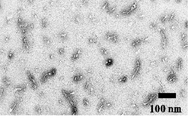
- Epoxy resin composition No. 2 is a drawing-substituting photograph showing the phase separation state of the cured product of No. 2.
- FIG. Epoxy resin composition No. 10 is a drawing-substituting photograph showing the phase separation state of the cured product of No. 10.
- FIG. Epoxy resin composition No. 6 is a drawing-substituting photograph showing the phase separation state of the cured product of No. 6.
- the epoxy resin modifier of the present invention contains a block copolymer.
- the block copolymer contained in the epoxy resin modifier of the present invention has a structure derived from a (meth)acrylate having a structural unit (a-1) and a chain alkyl group represented by general formula (1) described later. Derived from at least one vinyl monomer selected from the group consisting of an A block having a unit (a-2), a (meth)acrylate having a chain alkyl group, and a (meth)acrylate having a cyclic alkyl group It is an ABA type triblock copolymer having a B block having a structural unit (b).
- the content of the structural unit (a-1) represented by the general formula (1) in each A block is 85% by mass or more and less than 100% by mass in 100% by mass of the A block, and the chain-like
- the content of the structural unit (a-2) derived from (meth)acrylate having an alkyl group is more than 0% by mass and 15% by mass or less in 100% by mass of the A block.
- the copolymer is preferably a (meth)acrylate copolymer.
- the (meth)acrylate copolymer may be a copolymer having a structural unit derived from (meth)acrylate as a main component (50% by mass or more), and is derived from a vinyl monomer other than (meth)acrylate. It can contain structural units.
- the content of structural units derived from (meth)acrylate in the copolymer is preferably 80% by mass or more, more preferably 90% by mass or more, based on 100% by mass of the entire copolymer.
- a block can be rephrased as “A segment”
- B block can be rephrased as “B segment”.
- vinyl monomer refers to a monomer having a radically polymerizable carbon-carbon double bond in the molecule.
- a “structural unit derived from a vinyl monomer” refers to a structural unit in which a radically polymerizable carbon-carbon double bond of a vinyl monomer is polymerized to form a carbon-carbon single bond.
- (Meth)acrylic refers to "at least one of acrylic and methacrylic”
- (meth)acrylate refers to "at least one of acrylate and methacrylate”.
- a (meth)acrylate having a chain alkyl group is a (meth)acrylate having an acyclic alkyl group.
- "(meth)acrylate having a chain alkyl group” can be rephrased as "(meth)acrylic acid chain alkyl ester” or "(meth)acrylic acid chain alkyl ester”
- "a cyclic alkyl group (Meth)acrylate” can be rephrased as "(meth)acrylic acid cyclic alkyl ester” or "(meth)acrylic acid cyclic alkyl”.
- the A block is a polymer block having a structural unit (a-1) represented by the following general formula (1) and a structural unit (a-2) derived from a (meth)acrylate having a chain alkyl group.
- R 1 is a hydrogen atom or a methyl group. 0 ⁇ n ⁇ 10, Q is a 4- to 6-membered cyclic ether group or cyclic thioether group. ] n in formula (1) is preferably an integer of 0 to 10, more preferably an integer of 0 to 5, and even more preferably an integer of 0 to 3.
- the carbon atoms constituting the 4- to 6-membered hydrocarbon ring is substituted with an oxygen atom or a sulfur atom.
- the bonds forming the 4- to 6-membered ring may be saturated or unsaturated.
- a hydrogen atom directly bonded to an atom constituting the ring may be substituted with a substituent.
- the substituent include a hydrocarbon group.
- the group represented by Q is not preferable to be a cyclic acid anhydride group that easily opens the ring because it has a cyclic ether structure or a cyclic thioether structure and is considered to have high compatibility with epoxy resins.
- Specific examples of the 4- to 6-membered cyclic ether group represented by Q include, for example, carbon atoms constituting a 4- to 6-membered ring substituted with at least one oxygen atom.
- Cyclic ether groups include oxetanyl group (4), furanyl group (furyl group, 5), tetrahydrofurfuryl group (6), pyranyl group (7a, 7b), dihydropyranyl group (8a, 8b), tetrahydropyranyl group (9), dioxolanyl group (10), dioxanyl group (11); cyclic ether group in which carbon atoms constituting a 4- to 6-membered ring are substituted with oxygen and nitrogen atoms, oxazole group (12), oxazinyl groups (13a to 13h), morpholino group (14); a cyclic thioether group in which carbon atoms constituting a 4- to 6-membered ring are substituted with sulfur atoms,
- the position where the (meth)acrylic acid skeleton bonds to the ring structure of Q is shown as a representative example, but it is not limited to this. That is, the (meth)acrylic acid skeleton can be bonded to any atom constituting the Q ring structure.
- Q preferably has no unsaturated bond, for example, oxetanyl group (4), tetrahydrofurfuryl group (6), thietanyl group (15), tedrahydropyranyl group (9), dioxolanyl group (10 ), dioxanyl group (11), oxathiolanyl group (18), morpholino group (14) and the like are preferred.
- vinyl monomers forming the structural unit (a-1) represented by general formula (1) include tetrahydrofurfuryl (meth)acrylate, morpholino (meth)acrylate, morpholinoethyl (meth)acrylate, (3 -ethyloxetan-3-yl)methyl (meth)acrylate, (2-methyl-2-ethyl-1,3-dioxolan-4-yl)methyl (meth)acrylate, cyclic trimethylolpropane formal (meth)acrylate, 2 -[(2-tetrahydropyranyl)oxy]ethyl (meth)acrylate, 1,3-dioxane-(meth)acrylate and the like.
- a block may have only one type of structural unit (a-1) represented by general formula (1), or a structural unit (a-1) represented by general formula (1) You may have 2 or more types.
- the structural unit (a-1) represented by general formula (1) has a cyclic ether group or cyclic thioether group that has a high affinity for epoxy resins, and enhances the compatibility of the A block with epoxy resins.
- the content of the structural unit (a-1) represented by general formula (1) in each A block is 85% by mass or more, preferably 87% by mass or more, and 88% by mass in 100% by mass of each A block. It is more preferably 89% by mass or more, more preferably 89% by mass or more, less than 100% by mass, preferably 99% by mass or less, more preferably 98% by mass or less, and even more preferably 97% by mass or less.
- the content of the structural unit (a-1) in each A block is the content in each of the A block at one end and the A block at the other end of the block copolymer.
- the A block has, in addition to the structural unit (a-1) represented by the above general formula (1), a structural unit (a-2) derived from a (meth)acrylate having a chain alkyl group.
- the structural unit (a-2) has a lower affinity for epoxy resins than the structural unit (a-1).
- Examples of the chain alkyl group possessed by the (meth)acrylate having a chain alkyl group that constitutes the structural unit (a-2) include a straight chain alkyl group and a branched chain alkyl group.
- Examples of the linear alkyl group include methyl group, ethyl group, n-propyl group, n-butyl group, n-pentyl group, n-hexyl group, n-heptyl group, n-octyl group, n-nonyl group, n-decyl group and the like.
- Examples of the branched alkyl group include isopropyl group, isobutyl group, sec-butyl group, tert-butyl group, isopentyl group, sec-pentyl group, tert-pentyl group, neopentyl group, isohexyl group, sec-hexyl group and tert. -hexyl group, 2-ethylhexyl group, isoheptyl group, isooctyl group, isononyl group, isodecyl group and the like.
- a chain alkyl group having 1 to 10 carbon atoms is preferable, a straight chain alkyl group having 1 to 10 carbon atoms and/or a branched alkyl group having 3 to 10 carbon atoms are more preferable, and 3 to 10 carbon atoms. 10 branched alkyl groups are more preferred.
- a (meth)acrylate having such a chain alkyl group while the A block has good compatibility with the epoxy resin, the affinity with the A block epoxy resin tends to be in an appropriate range. is.
- the A block may have only one type of structural unit (a-2), or may have two or more types of structural units (a-2).
- the content of the structural unit (a-2) in each A block is more than 0% by mass, preferably 1% by mass or more, more preferably 2% by mass or more, and 3% by mass in 100% by mass of each A block. % or more, preferably 15% by mass or less, preferably 13% by mass or less, more preferably 12% by mass or less, and even more preferably 11% by mass or less.
- the A block has an appropriate affinity with the epoxy resin
- the B block is dispersed in the epoxy resin in a nano-sized string-like dispersion state. Therefore, the cured product of the resulting epoxy resin composition is excellent in fracture toughness and peel adhesive strength.
- the content of the structural unit (a-2) in each A block is the content in each of the A block at one end and the A block at the other end of the block copolymer.
- the A block may be composed only of the structural units (a-1) and (a-2) described above, or other structural units (a -3) may be included.
- Other structural units (a-3) that can be contained in the A block are vinyl monomers that form the structural unit (a-1) represented by the general formula (1), chains that form the structural unit (a-2) There is no particular limitation as long as it is formed from a (meth)acrylate having a linear alkyl group and a vinyl monomer that can be copolymerized with a vinyl monomer that forms the B block described later.
- vinyl monomers capable of forming another structural unit (a-3) of the A block include aromatic vinyl monomers, vinyl monomers having a hydroxy group, vinyl monomers having a carboxy group, and vinyl monomers having a sulfonic acid group.
- a vinyl monomer having a phosphoric acid group examples include ⁇ -olefins, dienes, (meth)acrylic monomers, and the like.
- aromatic vinyl monomers examples include styrene, ⁇ -methylstyrene, 4-methylstyrene, 2-methylstyrene, 3-methylstyrene, 4-methoxystyrene, 2-hydroxymethylstyrene, 1-vinylnaphthalene and the like.
- vinyl monomers having a hydroxy group examples include hydroxyalkyl (meth)acrylates.
- vinyl monomers having a carboxyl group examples include monomers obtained by reacting the vinyl monomers having a hydroxy group with acid anhydrides such as maleic anhydride, succinic anhydride and phthalic anhydride, crotonic acid, maleic acid, itaconic acid, (meth ) acrylic acid and the like.
- acid anhydrides such as maleic anhydride, succinic anhydride and phthalic anhydride, crotonic acid, maleic acid, itaconic acid, (meth ) acrylic acid and the like.
- Vinyl monomers having a sulfonic acid group include vinylsulfonic acid, styrenesulfonic acid, ethyl disulfonate (meth)acrylate, methylpropylsulfonate (meth)acrylamide, and ethyl sulfonate (meth)acrylamide.
- vinyl monomers having a phosphate group examples include methacryloyloxyethyl phosphate.
- Vinyl monomers containing tertiary amines include N,N-dimethylaminopropyl(meth)acrylamide, N,N-dimethylaminoethyl(meth)acrylamide, 2-(dimethylamino)ethyl(meth)acrylate, N,N - dimethylaminopropyl (meth)acrylate and the like.
- Vinyl monomers containing quaternary ammonium bases include N-2-hydroxy-3-acryloyloxypropyl-N,N,N-trimethylammonium chloride, N-methacryloylaminoethyl-N,N,N-dimethylbenzylammonium chloride etc.
- vinyl monomers containing heterocycles examples include 2-vinylthiophene, N-methyl-2-vinylpyrrole, 1-vinyl-2-pyrrolidone, 2-vinylpyridine, 4-vinylpyridine and the like.
- vinylamides examples include N-vinylformamide, N-vinylacetamide, N-vinyl- ⁇ -caprolactam, and the like.
- vinyl monomers containing epoxy groups include glycidyl (meth)acrylate.
- Examples of vinyl carboxylate include vinyl acetate, vinyl pivalate, and vinyl benzoate.
- ⁇ -olefins include 1-hexene, 1-octene, 1-decene and the like.
- Examples of dienes include butadiene, isoprene, 4-methyl-1,4-hexadiene, 7-methyl-1,6-octadiene and the like.
- (Meth)acrylic monomers include (meth)acrylates having a cyclic alkyl group, (meth)acrylates having a hydroxy group, (meth)acrylates having an alkoxy group, (meth)acrylates having a sulfonic acid group, and tertiary amines.
- (Meth)acrylates having a cyclic alkyl group include cyclohexyl (meth)acrylate, methylcyclohexyl (meth)acrylate, cyclododecyl (meth)acrylate, and the like.
- (Meth)acrylates having a hydroxy group include hydroxyalkyls such as 2-hydroxyethyl (meth)acrylate, 3-hydroxypropyl (meth)acrylate, 2-hydroxypropyl (meth)acrylate, and 4-hydroxybutyl (meth)acrylate. (Meth)acrylates are mentioned.
- (Meth)acrylates having an alkoxy group include methoxyethyl (meth)acrylate and ethoxyethyl (meth)acrylate.
- Examples of (meth)acrylates having a sulfonic acid group include ethyl disulfonate (meth)acrylate.
- tertiary amine-containing (meth)acrylates examples include 2-(dimethylamino)ethyl (meth)acrylate and N,N-dimethylaminopropyl (meth)acrylate.
- Examples of (meth)acrylates containing epoxy groups include glycidyl (meth)acrylates.
- Examples of (meth)acrylates having a polyethylene glycol structural unit include diethylene glycol mono(meth)acrylate, triethylene glycol mono(meth)acrylate, tetraethylene glycol mono(meth)acrylate, polyethylene glycol mono(meth)acrylate, methoxydiethylene glycol (meth)acrylate. ) acrylate, methoxytriethylene glycol (meth)acrylate, methoxytetraethyleneglycol (meth)acrylate, methoxypolyethylene glycol (meth)acrylate and the like.
- (Meth)acrylates having an aromatic ring group include benzyl (meth)acrylate, phenyl (meth)acrylate, phenoxyethyl (meth)acrylate, and the like.
- (Meth)acrylamide includes (meth)acrylamide, N-methyl(meth)acrylamide, N-isopropyl(meth)acrylamide, N,N-dimethyl(meth)acrylamide and the like.
- the vinyl monomer capable of forming the structural unit (a-3) may be used alone, or two or more of them may be used in combination.
- the content of the structural unit (a-3) in each A block is preferably 10% by mass or less, preferably 8% by mass, in 100% by mass of each A block.
- the following is more preferable, 6% by mass or less is even more preferable, and 5% by mass or less is particularly preferable.
- the lower limit of the content of the structural unit (a-3) is 0% by mass.
- the content of the structural unit (a-3) in each A block is the content in each of the A block at one end and the A block at the other end of the block copolymer.
- the A block preferably does not substantially contain the structural unit (b) of the B block. That is, in the A block, the content of the structural unit (b) in the B block is preferably 10% by mass or less, more preferably 8% by mass or less, and 5% by mass or less in 100% by mass of each A block. More preferably, 2% by mass or less is particularly preferable. In addition, the lower limit of the said content rate is 0 mass %.
- the various structural units contained in the A block may be contained in any form of random copolymerization, block copolymerization, or the like in the A block. , it is preferably contained in the form of random copolymerization from the viewpoint of uniformity.
- the A block may be formed by a copolymer of a block consisting of (a-1) structural units and a block consisting of (a-2) structural units.
- the B block is a polymer having a structural unit (b) derived from at least one vinyl monomer selected from the group consisting of (meth)acrylates having a chain alkyl group and (meth)acrylates having a cyclic alkyl group. is a block. Since the B block does not substantially contain the structural unit (a-1) derived from the vinyl monomer, it is considered to have lower compatibility with epoxy resins than the A block.
- (Meth)acrylates having a chain alkyl group include dodecyl (meth)acrylate (lauryl (meth)acrylate), tridecyl (meth)acrylate, tetradecyl (meth)acrylate, pentadecyl (meth)acrylate, hexadecyl (meth)acrylate, Heptadecyl (meth)acrylate, octadecyl (meth)acrylate (stearyl (meth)acrylate), nonadecyl (meth)acrylate and the like.
- (meth)acrylates having a chain alkyl group with 11 to 20 carbon atoms are preferred.
- the chain alkyl group may be either a straight chain alkyl group or a branched chain alkyl group, but is preferably a straight chain alkyl group.
- Examples of (meth)acrylates having a cyclic alkyl group include cyclohexyl (meth)acrylate, methylcyclohexyl (meth)acrylate, ethylcyclohexyl (meth)acrylate, butylcyclohexyl (meth)acrylate, pentylcyclohexyl (meth)acrylate, cyclododecyl (meth)acrylate, and cyclododecyl (meth)acrylate. ) acrylates and the like. Among these, (meth)acrylates having a cyclic alkyl group having 6 to 15 carbon atoms (especially a monocyclic alkyl group) are preferred.
- the vinyl monomers may be used alone, or two or more of them may be used in combination.
- the vinyl monomer forming the structural unit (b) it is particularly preferable to use a (meth)acrylate having a chain alkyl group, and a (meth)acrylate having a chain alkyl group having 11 to 20 carbon atoms is used. It is more preferable to use a (meth)acrylate having a linear alkyl group having 11 to 20 carbon atoms, and it is more preferable to use a (meth)acrylate having a linear alkyl group having 11 to 15 carbon atoms. Especially preferred.
- the B block becomes flexible and the energy dispersion effect during crack extension is improved. This is because a cured product of the epoxy resin composition having improved fracture toughness and peel adhesive strength can be obtained.
- the content of the structural unit (b) is preferably 80% by mass or more, more preferably 90% by mass or more, still more preferably 95% by mass or more, and particularly preferably 98% by mass or more in 100% by mass of the entire B block.
- the upper limit of the content of the structural unit (b) is 100% by mass.
- the B block may be composed only of the structural unit (b), or may contain other structural units as long as the low compatibility of the B block with the epoxy resin can be maintained. Moreover, it is preferable that the B block does not substantially contain the structural units (a-1) and (a-2) of the A block. That is, in the B block, the content of each of the structural units (a-1) and (a-2) in the A block is preferably 10% by mass or less in 100% by mass of the B block, and 8% by mass or less. More preferably, it is 5% by mass or less, and particularly preferably 2% by mass or less. In addition, the lower limit of the said content rate is 0 mass %.
- vinyl monomers that can form other structural units of the B block include aromatic vinyl monomers, vinyl monomers having a hydroxy group, vinyl monomers having a carboxy group, vinyl monomers having a sulfonic acid group, and phosphoric acid groups.
- (Meth)acrylic monomers include (meth)acrylates having a hydroxy group, (meth)acrylates having an alkoxy group, (meth)acrylates having a sulfonic acid group, (meth)acrylates containing a tertiary amine, and epoxy groups. (Meth)acrylates containing, (meth)acrylates having a polyethylene glycol structural unit, (meth)acrylates having an aromatic ring group, and (meth)acrylamides are included.
- vinyl monomer examples are the same as those given as specific examples of the vinyl monomer capable of forming the other structural unit (a-3) of the A block.
- One or more of the vinyl monomers used in the B block can be used.
- the content of other structural units in the B block is preferably 20% by mass or less, more preferably 10% by mass or less, and even more preferably 5% by mass or less in 100% by mass of the entire B block.
- the lower limit of the content of other structural units in the B block is 0% by mass.
- the various structural units contained in the B block may be contained in any manner such as random copolymerization or block copolymerization in the B block. , it is preferably contained in the form of random copolymerization from the viewpoint of uniformity.
- the block copolymer contained in the epoxy resin modifier of the present invention is an ABA type triblock copolymer (A represents "A block” and B represents “B block”).
- A represents "A block”
- B represents "B block”
- the B block can be dispersed in the epoxy resin in a more uniform string-like form, so that high peel adhesive strength and fracture toughness can be achieved.
- the type and content of each structural unit of the A block at one end may be the same as or different from the type and content of each structural unit of the A block at the other end. good.
- the structural unit (a-1) when the content of the structural unit (a-1) differs between the A block at one end and the A block at the other end, the structural unit (a-1) A block having a high content of the structural unit (a-1) is defined as an A1 block, and a block having a low content of the structural unit (a-1) is defined as an A2 block.
- the mass ratio of the A1 block to the A2 block is not particularly limited, but is preferably 0.8 or more, more preferably 0.85 or more, preferably 1.2 or less, and 1.15 or less. It is more preferable, and 1.1 or less is even more preferable.
- the mass ratio of the A1 block to the A2 block (A1 block/A2 block) within the above range, the island portions composed of the B block can be dispersed in the epoxy resin in a more uniform nano-size, thereby improving the transparency. It is possible to obtain a cured product of the epoxy resin composition having improved peel adhesive strength and fracture toughness while maintaining the same.
- the content of the A block (that is, the total content of the A1 block and the A2 block) is preferably 30% by mass or more, more preferably 35% by mass or more, and 40% by mass in 100% by mass of the entire block copolymer. 45% by mass or more is particularly preferable, 70% by mass or less is preferable, 65% by mass or less is more preferable, 60% by mass or less is even more preferable, and 55% by mass or less is particularly preferable.
- a block copolymer having the intended function can be prepared.
- the content of the B block is preferably 30% by mass or more, more preferably 35% by mass or more, still more preferably 40% by mass or more, particularly preferably 45% by mass or more, in 100% by mass of the entire block copolymer. % by mass or less is preferable, 65% by mass or less is more preferable, 60% by mass or less is even more preferable, and 55% by mass or less is particularly preferable.
- the weight average molecular weight (Mw) of the block copolymer is preferably 10,000 or more, more preferably 20,000 or more, still more preferably 30,000 or more, particularly preferably 35,000 or more, and less than 200,000. Preferably, less than 100,000 is more preferable, less than 80,000 is even more preferable, and less than 50,000 is particularly preferable. If the weight-average molecular weight is below the lower limit, the peel adhesive strength and fracture toughness imparting properties are insufficient, and if it is above the upper limit, the solubility in the epoxy resin is reduced. It is possible to obtain a cured product of the epoxy resin composition with improved peel adhesive strength and fracture toughness while maintaining transparency.
- the molecular weight distribution (Mw/Mn) of the block copolymer is preferably 2.0 or less, more preferably 1.6 or less, and even more preferably 1.5 or less.
- the molecular weight distribution (Mw/Mn) is determined by (weight average molecular weight (Mw) of block copolymer)/(number average molecular weight (Mn) of block copolymer). The smaller Mw/Mn is, the narrower the width of the molecular weight distribution is and the copolymer has a uniform molecular weight. When the value is 1.0, the width of the molecular weight distribution is the narrowest.
- the molecular weight distribution (Mw/Mv) of the block copolymer exceeds 2.0, it includes those with small molecular weights and those with large molecular weights. If the molecular weight is small, the peel adhesive strength and fracture toughness imparting properties will be insufficient, and if the molecular weight is large, the solubility in the epoxy resin will decrease, so the transparency will not be maintained and the mechanical strength may decrease. be.
- the weight average molecular weight and number average molecular weight are measured by gel permeation chromatography (hereinafter referred to as "GPC").
- the 1st A block (for example, A1 block) is first produced by the polymerization reaction of vinyl monomers, the 1st A block is polymerized with the B block monomer, and the B block is further polymerized.
- the monomers of the 2A block (e.g., A2 block) may be polymerized; or the first A block (e.g., A1 block), the second A block (e.g., A2 block) and the B block may be prepared separately before the first A A block, a B block, and a second A block may be coupled.
- a radical polymerization method comprising a step of synthesizing a block and a step of synthesizing the second A block by polymerizing a vinyl monomer constituting the second A block (for example, the A2 block) to the synthesized B block.
- the polymerization method is not particularly limited, living radical polymerization is preferred. That is, the block copolymer is preferably polymerized by living radical polymerization.
- living radical polymerization not only initiation reaction and propagation reaction but also termination reaction and chain transfer reaction cause deactivation of propagating terminal, and tend to result in a mixture of polymers with various molecular weights and non-uniform compositions.
- termination reaction and chain transfer are less likely to occur, and growing terminals grow without deactivation. This is preferable in that it facilitates production of a polymer having a uniform composition.
- the living radical polymerization method there is a method using a compound capable of generating a nitroxide radical (nitroxide method (NMP method)), depending on the method of stabilizing the polymerization growth terminal;
- NMP method nitroxide method
- a halogenated compound as a polymerization initiation compound, a method of living polymerization from the polymerization initiation compound (ATRP method); a method of using a dithiocarboxylic acid ester or a xanthate compound (RAFT method); a method of using an organic tellurium compound (TERP method).
- a method using an organic iodine compound (ITP method); A method using an iodine compound as a polymerization initiator compound and an organic compound such as a phosphorus compound, a nitrogen compound, an oxygen compound, or a hydrocarbon as a catalyst (reversible transfer catalyst polymerization (RTCP method ), reversible catalyst-mediated polymerization (RCMP method)), and the like.
- RTCP method reversible transfer catalyst polymerization
- RCMP method reversible catalyst-mediated polymerization
- the living radical polymerization method is preferable because the polymer chains polymerize while uniformly reacting with the monomer, the composition of all polymers approaches uniformity, and the probability of forming pseudo-crosslinks increases.
- the TERP method is a method of polymerizing a radically polymerizable compound (vinyl monomer) using an organic tellurium compound as a polymerization initiator. 2004/072126 and the method described in WO 2004/096870.
- Specific polymerization methods for the TERP method include the following (a) to (d).
- R 3 represents an alkyl group having 1 to 8 carbon atoms, an aryl group or an aromatic heterocyclic group.
- R 4 and R 5 each independently represent a hydrogen atom or an alkyl group having 1 to 8 carbon atoms.
- R6 represents an alkyl group having 1 to 8 carbon atoms, an aryl group, a substituted aryl group, an aromatic heterocyclic group, an alkoxy group, an acyl group, an amido group, an oxycarbonyl group, a cyano group, an allyl group or a propargyl group.
- R 7 represents an alkyl group having 1 to 8 carbon atoms, an aryl group or an aromatic heterocyclic group.
- the group represented by R 3 is an alkyl group having 1 to 8 carbon atoms, an aryl group or an aromatic heterocyclic group, and specific examples are as follows.
- alkyl groups having 1 to 8 carbon atoms include methyl group, ethyl group, n-propyl group, isopropyl group, n-butyl group, isobutyl group, sec-butyl group, tert-butyl group, pentyl group, hexyl group and heptyl.
- linear or branched alkyl groups such as radicals, octyl groups, and cyclic alkyl groups such as cyclohexyl groups.
- a linear or branched alkyl group having 1 to 4 carbon atoms is preferable, and a methyl group or an ethyl group is more preferable.
- a phenyl group, a naphthyl group, etc. can be mentioned as an aryl group.
- a pyridyl group, a furyl group, a thienyl group, etc. can be mentioned as an aromatic heterocyclic group.
- the groups represented by R 4 and R 5 are each independently a hydrogen atom or an alkyl group having 1 to 8 carbon atoms, and specific examples of each group are as follows.
- alkyl groups having 1 to 8 carbon atoms include methyl group, ethyl group, n-propyl group, isopropyl group, n-butyl group, isobutyl group, sec-butyl group, tert-butyl group, pentyl group, hexyl group and heptyl.
- linear or branched alkyl groups such as radicals, octyl groups, and cyclic alkyl groups such as cyclohexyl groups.
- a linear or branched alkyl group having 1 to 4 carbon atoms is preferable, and a methyl group or an ethyl group is more preferable.
- the group represented by R 6 is an alkyl group having 1 to 8 carbon atoms, an aryl group, a substituted aryl group, an aromatic heterocyclic group, an alkoxy group, an acyl group, an amide group, an oxycarbonyl group, a cyano group, an allyl group, or It is a propargyl group, specifically as follows.
- alkyl groups having 1 to 8 carbon atoms include methyl group, ethyl group, n-propyl group, isopropyl group, n-butyl group, isobutyl group, sec-butyl group, tert-butyl group, pentyl group, hexyl group and heptyl.
- linear or branched alkyl groups such as octyl groups, cyclic alkyl groups such as cyclohexyl groups, and the like.
- a linear or branched alkyl group having 1 to 4 carbon atoms is preferable, and a methyl group or an ethyl group is more preferable.
- aryl group examples include a phenyl group and a naphthyl group.
- a phenyl group is preferred.
- Examples of the substituted aryl group include a phenyl group having a substituent, a naphthyl group having a substituent, and the like.
- Substituents of the aryl group having a substituent include, for example, a halogen atom, a hydroxyl group, an alkoxy group, an amino group, a nitro group, a cyano group, and a carbonyl-containing group represented by —COR 61 (R 61 has 1 carbon atom 8 alkyl group, aryl group, alkoxy group or aryloxy group having 1 to 8 carbon atoms), sulfonyl group, trifluoromethyl group and the like. Moreover, it is preferable that one or two of these substituents are substituted.
- aromatic heterocyclic groups examples include pyridyl groups, furyl groups, thienyl groups, and the like.
- the alkoxy group is preferably a group in which an alkyl group having 1 to 8 carbon atoms is bonded to an oxygen atom. butoxy group, pentyloxy group, hexyloxy group, heptyloxy group, octyloxy group and the like.
- Acyl groups include acetyl, propionyl, and benzoyl groups.
- amide groups include -CONR 621 R 622 (R 621 and R 622 are each independently a hydrogen atom, an alkyl group having 1 to 8 carbon atoms, or an aryl group).
- the oxycarbonyl group is preferably a group represented by —COOR 63 (R 63 is a hydrogen atom, an alkyl group having 1 to 8 carbon atoms or an aryl group), such as a carboxy group, a methoxycarbonyl group, an ethoxycarbonyl group, a propoxycarbonyl group. group, n-butoxycarbonyl group, sec-butoxycarbonyl group, ter-butoxycarbonyl group, n-pentoxycarbonyl group, phenoxycarbonyl group and the like.
- Preferred oxycarbonyl groups include methoxycarbonyl and ethoxycarbonyl groups.
- R 641 and R 642 are each independently a hydrogen atom or an alkyl group having 1 to 8 carbon atoms
- R 643 , R 644 and R 645 are , each independently a hydrogen atom, an alkyl group having 1 to 8 carbon atoms, or an aryl group, and each substituent may be connected in a cyclic structure).
- the propargyl group includes —CR 651 R 652 —C ⁇ CR 653 (R 651 and R 652 are a hydrogen atom or an alkyl group having 1 to 8 carbon atoms, R 653 is a hydrogen atom or an alkyl group having 1 to 8 carbon atoms , an aryl group or a silyl group).
- organic All tellurium compounds can be exemplified.
- the group represented by R 7 is an alkyl group having 1 to 8 carbon atoms, an aryl group or an aromatic heterocyclic group, and specific examples are as follows.
- alkyl groups having 1 to 8 carbon atoms include methyl group, ethyl group, n-propyl group, isopropyl group, n-butyl group, isobutyl group, sec-butyl group, tert-butyl group, pentyl group, hexyl group and heptyl.
- linear or branched alkyl groups such as radicals, octyl groups, and cyclic alkyl groups such as cyclohexyl groups.
- a linear or branched alkyl group having 1 to 4 carbon atoms is preferable, and a methyl group or an ethyl group is more preferable.
- a phenyl group, a naphthyl group, etc. can be mentioned as an aryl group.
- a pyridyl group, a furyl group, a thienyl group, etc. can be mentioned as an aromatic heterocyclic group.
- the organic ditelluride compound represented by the general formula (3) includes dimethyl ditelluride, diethyl ditelluride, di-n-propyl ditelluride, diisopropyl ditelluride, dicyclopropyl ditelluride, di-n-butyl ditelluride, di-s-butyl ditelluride, di-t-butyl ditelluride, dicyclobutyl ditelluride, diphenyl ditelluride, bis-(p-methoxyphenyl) ditelluride, bis-(p-aminophenyl) ditelluride, Examples include bis-(p-nitrophenyl)ditelluride, bis-(p-cyanophenyl)ditelluride, bis-(p-sulfonylphenyl)ditelluride, dinaphthylditelluride, dipyridylditelluride and the like.
- any azo polymerization initiator used in normal radical polymerization can be used without any particular limitation.
- the amount of the vinyl monomer used may be appropriately adjusted depending on the physical properties of the desired copolymer. ) is preferably 5 mol to 10,000 mol of the vinyl monomer per 1 mol of the organic tellurium compound.
- the amount of the azo polymerization initiator used is usually the organic tellurium of general formula (2) It is preferable to use 0.01 mol to 10 mol of the azo polymerization initiator per 1 mol of the compound.
- the amount of the organic ditellurium compound of general formula (3) to be used is usually: It is preferable to use 0.01 mol to 100 mol of the organic ditellurium compound of general formula (3) per 1 mol of the organic tellurium compound of general formula (2).
- the amount of the azo polymerization initiator to be used is Generally, the amount of the azo polymerization initiator is preferably 0.01 mol to 100 mol per 1 mol of the organic tellurium compound of general formula (2) and the organic ditellurium compound of general formula (3).
- the polymerization reaction can be carried out without a solvent, it may be carried out by using an aprotic or protic solvent generally used in radical polymerization and stirring the mixture.
- Aprotic solvents that can be used are, for example, benzene, toluene, anisole, N,N-dimethylformamide (DMF), dimethylsulfoxide (DMSO), acetone, acetonitrile, 2-butanone (methyl ethyl ketone), dioxane, hexafluoroisopropaol.
- protic solvents include water, methanol, ethanol, isopropanol, n-butanol, ethyl cellosolve, butyl cellosolve, 1-methoxy-2-propanol and diacetone alcohol.
- the amount of the solvent to be used may be adjusted as appropriate. For example, it is usually in the range of 0.01 ml to 50 ml, preferably 0.05 ml to 10 ml, more preferably 0.05 ml to 10 ml per 1 g of the vinyl monomer. It ranges from 1 ml to 1 ml.
- the reaction temperature and reaction time may be appropriately adjusted depending on the molecular weight or molecular weight distribution of the resulting copolymer, but the mixture is usually stirred at 0°C to 150°C for 1 minute to 100 hours.
- the TERP method can obtain high yields and precise molecular weight distributions even at low polymerization temperatures and short polymerization times.
- the target copolymer can be separated from the resulting reaction mixture by ordinary separation and purification means.
- the growing terminal of the copolymer obtained by the polymerization reaction is in the form of —TeR 3 (wherein R 3 is the same as described above) derived from the tellurium compound, and is deactivated by an operation in air after the completion of the polymerization reaction.
- TeR 3 (wherein R 3 is the same as described above) derived from the tellurium compound
- tellurium atoms may remain. Since a copolymer having a tellurium atom remaining at the end thereof is colored or has poor thermal stability, it is preferable to remove the tellurium atom.
- Methods for removing tellurium atoms include radical reduction methods using tributylstannane or thiol compounds; adsorption methods using activated carbon, silica gel, activated alumina, activated clay, molecular sieves, polymer adsorbents, etc.; ion exchange resins, etc.
- Method of adsorbing metals Hydrogen peroxide solution or peroxides such as benzoyl peroxide are added, air or oxygen is blown into the system to oxidize and decompose the tellurium atoms at the ends of the copolymer, washing with water or appropriate
- a liquid-liquid extraction method or solid-liquid extraction method that removes residual tellurium compounds by combining solvents; a purification method in a solution state such as ultrafiltration that extracts and removes only those with a specific molecular weight or less; , or a combination of these methods can be used.
- the epoxy resin modifier of the present invention contains the ABA type triblock copolymer, and is used by blending with the epoxy resin.
- the epoxy resin modifier of the present invention may contain only the ABA type triblock copolymer, and may further contain other components.
- Other components that can be contained in the epoxy resin modifier of the present invention include various known additives such as organic solvents, stabilizers, plasticizers, flame retardants, flame retardant aids, antioxidants, and antistatic agents. mentioned.
- organic solvent examples include, but are not limited to, xylene, toluene, butanol, ethyl acetate, butyl acetate, N,N-dimethylformamide, methyl ethyl ketone, methyl isobutyl ketone, propylene glycol monomethyl ether acetate, ethyl ethoxy propionate, cyclohexanone and the like.
- the epoxy resin composition of the present invention contains an epoxy resin, a curing agent, and the epoxy resin modifier of the present invention described above.
- any conventionally known epoxy resin can be used as the epoxy resin used in the present invention.
- Specific examples thereof include bisphenol-type epoxy resins, phenol novolac-type epoxy resins, ortho-cresol novolac-type epoxy resins, biphenyl-type epoxy resins, dicyclopentadiene-type epoxy resins, diphenylfluorene-type epoxy resins, and halogens, amino groups, or alkyl groups thereof.
- aromatic ring/aliphatic ring-containing epoxy resins such as glycidyl ester type epoxy resins, naphthalene type epoxy resins, heterocyclic epoxy resins, isocyanate modified epoxy resins, diarylsulfone type epoxy resins, hydroquinone type epoxy resins, hydantoin type epoxy resin, resorcinol diglycidyl ether, triglycidyl-p-aminophenol, m-aminophenol triglycidyl ether, tetraglycidylmethylene dianiline, (trihydroxyphenyl)methane triglycidyl ether, tetraphenylethane tetraglycidyl ether, etc.
- Epoxy resins (polyepoxy compounds) containing two or more epoxy groups can be mentioned. One or two or more of the epoxy resins may be used.
- the epoxy resin is preferably liquid even at room temperature (25° C.) from the viewpoint of handleability and composition adjustment.
- Epoxy resins that are liquid at room temperature usually have a weight average molecular weight of 300 to 1000 and an epoxy equivalent of 150 g. /eq to 600 g/eq, preferably 150 g/eq to 200 g/eq.
- bisphenol-type epoxy resins are preferably used from the viewpoints of handleability and processability of the curable resin composition, heat resistance of the cured resin, fracture toughness, peel adhesive strength, and the like.
- bisphenol type epoxy resins include bisphenol A type epoxy resin obtained by reaction of bisphenol A and epichlorohydrin, bisphenol F type epoxy resin obtained by reaction of bisphenol F and epichlorohydrin, bisphenol S and epichlorohydrin.
- Bisphenol S-type epoxy resins obtained by reaction of chlorohydrin, bisphenol AD-type epoxy resins obtained by reaction of bisphenol AD and epichlorohydrin, halogen- or alkyl-substituted products thereof, and the like can be mentioned.
- bisphenol A type epoxy resins are more preferably used from the viewpoint that the curable resin composition has better handleability and processability as well as the heat resistance of the cured resin.
- bisphenol A type diglycidyl ether is more preferably used.
- the type of curing agent used in the present invention is not particularly limited, and any conventionally used curing agent for epoxy resins can be used.
- the curing agent include acid anhydride-based curing agents, amine-based curing agents, and phenol-based curing agents. Among these, acid anhydride-based curing agents and amine-based curing agents are preferred, and acid anhydride-based curing agents are more preferred.
- the acid anhydride-based curing agent is a curing agent having one or more carboxylic anhydride groups per molecule, and the epoxy resin composition is cured by a polycondensation reaction between the epoxy group of the epoxy resin and the carboxylic acid anhydride group. .
- Acid anhydride-based curing agents include, for example, cyclic aliphatic acid anhydrides, aromatic acid anhydrides, aliphatic acid anhydrides, etc. Specific examples include maleic anhydride, succinic anhydride, and phthalic anhydride. , 4-methylphthalic anhydride, 4-methylcyclohexanedicarboxylic anhydride, trimellitic anhydride, pyromellitic anhydride, tetrahydrophthalic anhydride and the like.
- An amine-based curing agent is a curing agent having one or more amine groups in one molecule, and cures an epoxy resin composition by a polycondensation reaction between an epoxy group such as an epoxy resin and an amine group.
- amine-based curing agents examples include cycloaliphatic amines, aromatic amines, and aliphatic amines. and diphenyl sulfone.
- phenol-based curing agent examples include phenol novolak resins. These curing agents may be used alone or in combination of two or more.
- the content of the curing agent is not particularly limited, it is preferably 5 parts by mass or more, more preferably 25 parts by mass or more, still more preferably 50 parts by mass or more, and particularly preferably 70 parts by mass with respect to 100 parts by mass of the epoxy resin. or more, preferably 250 parts by mass or less, more preferably 200 parts by mass or less, and even more preferably 150 parts by mass or less.
- the curing agent is preferably 0.5 to 2.5 equivalents, more preferably 0.5 to 1.5 equivalents, relative to the epoxy groups in the epoxy resin composition. This is because when the content of the curing agent is within the above range, the mechanical properties of the cured epoxy resin composition are improved.
- the epoxy resin composition of the present invention preferably further contains a curing accelerator.
- curing accelerators include benzyldimethylamine, cyclohexyldimethylamine, pyridine, triethanolamine, 2-(dimethylaminomethyl)phenol, dimethylpiperazine, 1,8-diazabicyclo[5,4,0]undec -7-ene (DBU), 1,5-diazabicyclo[4.3.0]non-5-ene (DBN), 1,4-diazabicyclo[2.2.2]octane (DABCO), 2,4, Tertiary amine compounds such as 6-tris(dimethylaminomethyl)phenol; 2-methylimidazole, 2-ethylimidazole, 2-n-heptylimidazole, 2-n-undecylimidazole, 2-phenylimidazole, 2-phenyl -4-methylimidazole, 1-benzyl-2-methylimidazole, 1-benzyl-2-phenylim
- phosphine compounds such as triphenylphosphine, tetraphenylphosphonium, tetraphenylbore phosphonium salts such as phosphate; metal compounds such as tin octylate; and microcapsule-type curing accelerators. These may be used alone or in combination of two or more.
- the content of the curing accelerator is not particularly limited, but it is preferably 0.1 to 5 parts by mass, more preferably 0.2 to 2 parts by mass, with respect to 100 parts by mass of the epoxy resin. More preferably, it is 0.5 parts by mass to 1.5 parts by mass. This is because if the content of the curing accelerator is within the above range, the mechanical properties of the cured epoxy resin composition are improved.
- the content of the epoxy resin modifier of the present invention in terms of the amount of the ABA type triblock copolymer, is 100 parts by mass of the total amount of the epoxy resin and the curing agent.
- 1 part by mass or more is preferable, 3 parts by mass or more is more preferable, 5 parts by mass or more is more preferable, 25 parts by mass or less is preferable, 20 parts by mass or less is more preferable, 15 parts by mass or less is more preferable, and 10 parts by mass or less is preferable. Part by mass or less is particularly preferred.
- the content of the epoxy resin modifier is 1 part by mass or more, a cured product of the epoxy resin composition having excellent fracture toughness and peel adhesive strength can be obtained.
- the content of the epoxy resin modifier is 25 parts by mass or less, the functional deterioration of the epoxy resin (tensile strength, solvent resistance, etc.) due to the addition of a large amount of the epoxy resin modifier is reduced while maintaining high transparency. ) can be suppressed.
- the epoxy resin composition of the present invention may optionally include other may contain additives.
- additives include n-butanol glycidyl ether, butyl glycidyl ether, butylphenyl glycidyl ether, hexyl glycidyl ether, 2-ethylhexyl glycidyl ether, allyl glycidyl ether, tetrahydrofurfuryl glycidyl ether, furfuryl glycidyl ether, trimethoxysilyl glycidyl ether, and other higher glycidyl ethers.
- the epoxy resin composition of the present invention preferably contains a reactive diluent.
- a reactive diluent 1,6-hexanediol diglycidyl ether and butyl glycidyl ether are preferable.
- the content of the reactive diluent in the epoxy resin composition is preferably 0.1% by mass or more, more preferably 1% by mass or more, preferably 10% by mass or less, and more preferably 7% by mass or less. When the content of the reactive diluent is within the above range, the viscosity of the epoxy resin composition can be lowered while maintaining excellent fracture toughness.
- the method for producing the epoxy resin composition of the present invention is not particularly limited, and the method can uniformly mix the epoxy resin, the curing agent, the epoxy resin modifier of the present invention, and, if necessary, the curing accelerator and other additives.
- the method can uniformly mix the epoxy resin, the curing agent, the epoxy resin modifier of the present invention, and, if necessary, the curing accelerator and other additives.
- an epoxy resin is introduced into a reactor, and if the epoxy resin is solid, it is heated at an appropriate temperature to make it liquid, an epoxy resin modifier is added thereto to dissolve it, and a curing agent or curing agent is added thereto.
- a method of producing an epoxy resin composition by adding an accelerator, uniformly mixing it in a liquid state, and optionally defoaming it, (2) using a mixer or the like to add an epoxy resin, a curing agent, and a curing accelerator.
- the epoxy resin composition of the present invention is produced by adopting a method of producing a varnish-like epoxy resin composition by dissolving a curing accelerator and an epoxy resin modifier in a solvent such as methyl ethyl ketone, acetone, or toluene. can do.
- the epoxy resin composition of the present invention is useful as an adhesive because it can provide excellent peel adhesive strength.
- Applications of the adhesive of the present invention include, for example, vehicle structures such as automobiles, civil engineering and construction, electronic materials, general office, medical, and industrial uses.
- semiconductor chips are mounted by connecting components such as substrates and semiconductor chips and semiconductor chips and semiconductor chips with solder bumps or the like.
- a sealing material (underfill material) is used to fill the gaps between components. Since the epoxy resin composition of the present invention can provide excellent peel adhesive strength and fracture toughness, it is also useful as such an underfill material.
- Applications of the underfill material of the present invention include semiconductor chip mounting and the like. More specifically, it can be suitably used for filling a gap between a semiconductor chip and a substrate connected by solder bumps or the like or a gap between semiconductor chips.
- the underfill material of the present invention is preferably liquid at room temperature (25°C).
- the viscosity of the underfill material of the present invention at room temperature (25° C.) is preferably 500 mPa ⁇ s or more, more preferably 1500 mPa ⁇ s or more, further preferably 2500 mPa ⁇ s or more, and 6000 mPa. ⁇ s or less, more preferably 4500 mPa ⁇ s or less, and even more preferably 3000 mPa ⁇ s or less. If the viscosity of the underfill material is within the above range, the resin can easily penetrate between the substrate and the semiconductor chip quickly and without gaps, and the resin can be prevented from diffusing during the period from penetration to curing. is. The viscosity is measured by the method described later.
- the resin cured product of the present invention is obtained by curing the epoxy resin composition of the present invention described above.
- any of the curing methods for epoxy resin compositions that have been conventionally employed can be employed.
- any of a heat curing method, an energy beam curing method (electron beam curing method, ultraviolet curing method, etc.), and a moisture curing method can be employed, and among them, the heat curing method is preferable from the viewpoint of dispersion of the block copolymer.
- the epoxy resin composition of the present invention is solid at room temperature (25° C.), for example, after pulverization and tableting, the resin is cured by curing and molding by a conventional molding method such as transfer molding, compression molding, or injection molding. Objects (cured moldings) can be produced.
- the epoxy resin composition of the present invention when the epoxy resin composition of the present invention exhibits a liquid state or a varnish state at room temperature (25° C.), for example, the epoxy resin composition of the present invention may be poured into a mold (molding) or poured into a container (potting). etc.), applying it on a base material (lamination), impregnating fibers (filaments) etc. (filament winding etc.), etc., and then applying it by an appropriate method such as heating and curing to obtain each application etc. It is possible to obtain a resin cured product according to.
- the curing temperature and curing time for curing the epoxy resin composition of the present invention may vary depending on the type of epoxy resin and curing agent. conditions, etc. are adopted.
- the light transmittance of the resin cured product of the present invention is preferably 30% or more when the light transmittance of the cured product of the epoxy resin composition that does not contain the epoxy resin modifier of the present invention is taken as 100%. It is more preferably 35% or more, and even more preferably 40% or more. This is because a cured resin having excellent transparency can be obtained by setting the light transmittance to 30% or more.
- the peel adhesive strength (N/25 mm) of the cured resin product of the present invention is preferably 3.5 or more, more preferably 5.0 or more, and even more preferably 10.0 or more. This is because when the peel adhesive strength (N/25 mm) is 3.5 or more, a cured resin product having excellent peel adhesiveness can be obtained.
- the fracture toughness (MPa ⁇ m 1/2 ) of the cured resin of the present invention is preferably 0.7 or more, more preferably 0.8 or more, and even more preferably 0.9 or more. . This is because a cured resin having excellent fracture toughness can be obtained by setting the fracture toughness (MPa ⁇ m 1/2 ) to 0.7 or more.
- the coefficient of linear expansion with respect to the peel adhesive strength of the cured resin of the present invention is preferably 0.6 or more, more preferably 0.8 or more, and 1 or more. It is more preferably 15 or less, more preferably 10 or less, and even more preferably 5 or less. This is because if the linear expansion coefficient with respect to the peel adhesive strength is within the above range, the temperature cycle resistance is improved.
- the light transmittance, peel adhesive strength, fracture toughness, linear expansion coefficient ⁇ 1, etc. of the resin cured product of the present invention are measured by the methods described later.
- the cured resin product of the present invention can be used in a wide variety of applications where conventional epoxy resin cured products are used. In addition, because of its high transparency, it can also be used in applications where transparency is required. Furthermore, since it has a high peel adhesive strength and a small coefficient of linear expansion with respect to the peel adhesive strength, it can be used as an adhesive for automobile structural adhesion and as an underfill material for semiconductor chip mounting, and has excellent fracture resistance. Since it has a toughness value, it can be applied to aviation materials and sports applications, which are susceptible to impacts.
- DBDT dibutyl ditelluride
- AIBN 2,2'-azobis(isobutyronitrile)
- THFMA Tetrahydrofurfuryl methacrylate
- IBMA Isobutyl methacrylate
- MMA Methyl methacrylate
- LMA Dodecyl methacrylate
- the measurement conditions were a column temperature of 40° C., a sample concentration of 5 mg/mL, a sample injection volume of 10 ⁇ L, and a flow rate of 0.35 mL/min.
- Polystyrene molecular weight 2,890,000, 1,090,000, 706,000, 427,000, 190,000, 96,400, 37,900, 10,200, 2,630, 440 was used as a standard Then, a calibration curve (calibration curve) was prepared, and the weight average molecular weight (Mw) and number average molecular weight (Mn) were measured. A molecular weight distribution (Mw/Mn) was calculated from these measured values.
- Viscosity of epoxy resin composition The viscosity of the epoxy resin composition (before curing) was measured at room temperature (25° C.) using an E-type viscometer (trade name: TVE-22L, manufactured by Toki Sangyo Co., Ltd.). The cone rotor was adjusted to the measured viscosity (1°34′ ⁇ 24 for less than 1500 mPa ⁇ s, 3° ⁇ R14 for 1500 mPa ⁇ s or more), the rotor speed was 5 rpm, and the measurement range was 5.
- Epoxy resin composition No. 14 and No. 15 is comparable to that of the epoxy resin composition No. 1 containing no block copolymer. It is an indexed value with the light transmittance of the cured product of No. 16 as 100%.
- the light transmittance of the cured products of No. 17 and No. 18 is similar to that of the epoxy resin composition No. 1 containing no block copolymer. It is an indexed value with the light transmittance of the cured product of No. 19 as 100%. The larger the indexed value, the more excellent the transparency of the cured epoxy resin composition. When the light transmittance was less than 2%, it was defined as "white turbidity".
- the epoxy resin composition was poured into a mold having dimensions of 6 ⁇ 12 ⁇ 25 mm and cured by heating at 120° C. for 90 minutes.
- the resulting cured product was subjected to a fracture toughness test according to ASTM D5045-93 using a mechanical tester Autograph AGS-J manufactured by Shimadzu Corporation. The measurement was performed 10 times, and the average value of 10 times was taken as the value of fracture toughness.
- the fracture toughness K1c means resistance to crack progression, and the larger the value, the higher the fracture toughness.
- the epoxy resin composition was poured into a mold having the size of a No. 3 tensile dumbbell test piece, and cured by heating at 120° C. for 90 minutes.
- the obtained cured product was subjected to a tensile test according to JIS K 6251 using a mechanical tester Autograph AGS-J manufactured by Shimadzu Corporation.
- the tensile strength was defined as the stress at break of the dumbbell test piece.
- the measurement was performed 10 times, and the average value of 10 times was taken as the value of tensile strength.
- Block copolymer No. 1 24.38 g of THFMA, 0.63 g of IBMA, 0.74 g of BTEE, 0.41 g of DBDT, 0.0825 g of AIBN, and 25.03 g of toluene, which had been previously purged with nitrogen, were introduced into a 300 mL reactor equipped with a stirrer and purged with nitrogen. for 18.25 hours to polymerize the A1 block (first-stage polymerization reaction). The polymerization rate was 97.7%.
- Block copolymer Nos. 2 to 11 Except that the polymerization reaction was carried out under the raw material usage amounts and reaction conditions shown in Table 1, Block Copolymer No. Block copolymer No. 1 was prepared in the same manner as in Example 1. 2-11 were produced. Block copolymer no. 6, 8, and 10 were AB type diblock copolymers obtained without performing the third-stage polymerization reaction.
- Table 1 shows the raw material monomers, organic tellurium compounds, organic ditellurium compounds, azo polymerization initiators, solvents, reaction conditions, and polymerization rates used.
- Table 2 shows the composition, Mw, and Mw/Mn of the block copolymer. The content of each structural unit in the block copolymer was calculated from the ratio of the monomers used in the polymerization reaction and the polymerization rate.
- epoxy resin composition Nos. 1-3, 5-12 Bisphenol A type epoxy resin (trade name: jER (registered trademark) 828, epoxy equivalent 194 g/eq, weight average molecular weight 370, manufactured by Mitsubishi Chemical Corporation) 49.77% by mass, 4-methylcyclohexane-1 as a curing agent, 45.28% by weight of 2-dicarboxylic anhydride (2.0 equivalents relative to the epoxy resin), 0.47% by weight of 2-ethyl-4-methylimidazole as a curing accelerator, and the weight percentages listed in Table 3
- the block copolymer obtained above as an epoxy resin modifier is mixed, and the mixture is stirred and defoamed for 22 minutes with a stirring and defoaming machine (AR-250, manufactured by Thinky Co., Ltd.) to obtain an epoxy resin.
- Composition no. 1-12 were obtained.
- Epoxy resin composition No. 4 Bisphenol A type epoxy resin (trade name: jER (registered trademark) 828, epoxy equivalent 194 g/eq, weight average molecular weight 370, manufactured by Mitsubishi Chemical Corporation) 47.57% by mass, 4-methylcyclohexane-1 as a curing agent, 43.28% by weight of 2-dicarboxylic anhydride (2.0 equivalents relative to the epoxy resin), 0.45% by weight of 2-ethyl-4-methylimidazole as a curing accelerator, and the weight percentages listed in Table 3
- the block copolymer obtained above as an epoxy resin modifier is mixed, and the mixture is stirred and defoamed for 22 minutes with a stirring and defoaming machine (AR-250, manufactured by Thinky Co., Ltd.) to obtain an epoxy resin.
- Epoxy resin composition No. 13 Bisphenol A type epoxy resin (trade name: jER (registered trademark) 828, epoxy equivalent 194 g/eq, weight average molecular weight 370, manufactured by Mitsubishi Chemical Corporation) 52.23% by mass, 4-methylcyclohexane-1 as a curing agent, 47.27% by mass of 2-dicarboxylic anhydride (2.1 equivalents relative to the epoxy resin) and 0.49% by mass of 2-ethyl-4-methylimidazole as a curing accelerator were mixed, and the mixture was stirred and degassed. Stirring and defoaming were performed for 22 minutes with a foaming machine (AR-250, manufactured by Thinky Co., Ltd.), and epoxy resin composition No. 13 was obtained.
- jER registered trademark 828, epoxy equivalent 194 g/eq, weight average molecular weight 370, manufactured by Mitsubishi Chemical Corporation
- Epoxy resin composition No. 14-15 Bisphenol F type epoxy resin (trade name: jER (registered trademark) 807, epoxy equivalent 168 g/eq, weight average molecular weight 336, manufactured by Mitsubishi Chemical Corporation) 47.48% by mass, 4-methylcyclohexane-1,2 as a curing agent - 47.57% by weight of dicarboxylic anhydride (2.0 equivalents relative to the epoxy resin), 0.48% by weight of 2-ethyl-4-methylimidazole as a curing accelerator, and the above obtained as an epoxy resin modifier.
- block copolymer no. 2 or No. 4 was mixed in the mass % shown in Table 4, and the mixture was stirred and defoamed for 22 minutes with a stirring and defoaming machine (AR-250, manufactured by Thinky Co., Ltd.). 14-15 were obtained.
- Epoxy resin composition No. 16 Bisphenol F type epoxy resin (trade name: jER (registered trademark) 807, epoxy equivalent 168 g/eq, weight average molecular weight 336, manufactured by Mitsubishi Chemical Corporation) 49.70% by mass, 4-methylcyclohexane-1,2 as a curing agent - 49.80% by mass of dicarboxylic anhydride (2.0 equivalents relative to the epoxy resin) and 0.50% by mass of 2-ethyl-4-methylimidazole as a curing accelerator are mixed, and the mixture is stirred and deaerated. (AR-250, manufactured by Thinky Co., Ltd.) for 22 minutes with stirring and defoaming. 16 was obtained.
- jER registered trademark 807, epoxy equivalent 168 g/eq, weight average molecular weight 336, manufactured by Mitsubishi Chemical Corporation
- Epoxy resin composition No. 17-18 Bisphenol A type epoxy resin (trade name: jER (registered trademark) 828, epoxy equivalent 194 g/eq, weight average molecular weight 370, manufactured by Mitsubishi Chemical Corporation) 75.65% by mass, diaminodiphenylmethane 19.87% by mass as a curing agent ( 1.0 equivalent with respect to the epoxy resin), and block copolymer No. 1 obtained above as an epoxy resin modifier. 2 or No. 5 was mixed in the mass % shown in Table 4, and the mixture was stirred and degassed for 22 minutes with a stirring deaerator (AR-250, manufactured by Thinky Co., Ltd.). 17-18 were obtained.
- jER registered trademark 828, epoxy equivalent 194 g/eq, weight average molecular weight 370, manufactured by Mitsubishi Chemical Corporation
- Epoxy resin composition No. 19 Bisphenol A type epoxy resin (trade name: jER (registered trademark) 828, epoxy equivalent 194 g/eq, weight average molecular weight 370, manufactured by Mitsubishi Chemical Corporation) 79.2% by mass, and diaminodiphenylmethane 20.8% by mass as a curing agent (1.0 equivalent with respect to the epoxy resin) was mixed, and the mixture was stirred and defoamed for 22 minutes with a stirring and defoaming machine (AR-250, manufactured by Thinky Co., Ltd.). 19 was obtained.
- Epoxy resin composition No. 20 Bisphenol A type epoxy resin (trade name: jER (registered trademark) 828, epoxy equivalent 194 g/eq, weight average molecular weight 370, manufactured by Mitsubishi Chemical Corporation) 47.51% by mass, 4-methylcyclohexane-1 as a curing agent, 43.22% by mass of 2-dicarboxylic anhydride (2.0 equivalents relative to the epoxy resin), 0.45% by mass of 2-ethyl-4-methylimidazole as a curing accelerator, the mass% shown in Table 5
- the block copolymer obtained above as an epoxy resin modifier and a reactive diluent are mixed, and the mixture is stirred and defoamed for 22 minutes with a stirring and defoaming machine (AR-250, manufactured by Thinky Co., Ltd.).
- Epoxy resin composition No. Got 20 Bisphenol A type epoxy resin (trade name: jER (registered trademark) 828, epoxy equivalent 194 g/eq, weight average molecular weight 370, manufactured by Mitsubishi
- Epoxy resin composition No. 21 Bisphenol A type epoxy resin (trade name: jER (registered trademark) 828, epoxy equivalent 194 g/eq, weight average molecular weight 370, manufactured by Mitsubishi Chemical Corporation) 48.36% by mass, 4-methylcyclohexane-1 as a curing agent, 44.00% by mass of 2-dicarboxylic anhydride (2.0 equivalents relative to the epoxy resin), 0.46% by mass of 2-ethyl-4-methylimidazole as a curing accelerator, the mass% shown in Table 5
- the block copolymer obtained above as an epoxy resin modifier and a reactive diluent are mixed, and the mixture is stirred and defoamed for 22 minutes with a stirring and defoaming machine (AR-250, manufactured by Thinky Co., Ltd.).
- Epoxy resin composition No. 21 was obtained.
- Tables 3 to 5 show the viscosity of the epoxy resin composition and the evaluation results of the cured product obtained by curing the epoxy resin composition. Also, epoxy resin composition No. The tensile strength of the cured product of No. 2 was 36.02 MPa. Tensile strength of the cured product of No. 8 was 36.78 MPa, epoxy resin composition No. The tensile strength of the cured product of No. 13 was 36.99 MPa.
- FIGS. 1 to 3 show the results of electron microscopic observation of the state of dispersion of the low-compatible component in the cured products of the epoxy resin compositions (Nos. 2, 10, and 6).
- FIG. 1 shows epoxy resin composition No. 2 shows a field emission transmission electron microscope image (FE-TEM image) of the cured product of No. 2 (black parts are low compatibility components).
- epoxy resin composition No. 2 shows a field emission transmission electron microscope image (FE-TEM image) of the cured product of No. 2 (black parts are low compatibility components).
- FIG. 2 shows epoxy resin composition No. An FE-TEM image of the cured product of No. 10 (black parts are low compatibility components) is shown. As shown in FIG. 2, epoxy resin composition No. In the cured product of No. 10, a part of the low compatibility component is string-like, but most of it is dispersed in a spherical shape with a diameter of about 10 nm. Therefore, it is considered that the area where the stress can be relaxed is small.
- FIG. 3 shows epoxy resin composition No. 6 shows a field emission scanning electron microscope image (FE-SEM image) of the cured product of No. 6 (white portions are low compatibility components).
- epoxy resin composition No. 6 shows a field emission scanning electron microscope image (FE-SEM image) of the cured product of No. 6 (white portions are low compatibility components).
- FE-SEM image field emission scanning electron microscope image
- FIG. 3 shows epoxy resin composition No. In the cured product of No. 6, the low compatibility component is dispersed in a macroscopic size while entrapping the epoxy resin matrix. Therefore, it is considered that cavitation is less likely to occur in the cured product during crack extension.
- the epoxy resin modifier of the present invention is used by blending with the epoxy resin.
- By blending the epoxy resin modifier of the present invention with an epoxy resin it is possible to increase the fracture toughness and peel adhesive strength of the epoxy resin while maintaining the high transparency of the epoxy resin.
- An epoxy resin composition containing the epoxy resin modifier of the present invention can be used in a wide variety of applications where conventional epoxy resins are used.
- because of its high transparency it can also be used in applications where transparency is required.
- due to its high peel adhesive strength it can be used as an adhesive for automotive structural bonding and as an underfill material for semiconductor chip mounting. It can also be applied to materials and sports applications.
- a preferred embodiment 1 of the present invention is an epoxy resin modifier containing a block copolymer, wherein the block copolymer comprises a structural unit (a-1) represented by the following general formula (1) and a chain A group consisting of an A block having a structural unit (a-2) derived from a (meth)acrylate having a linear alkyl group, a (meth)acrylate having a chain alkyl group, and a (meth)acrylate having a cyclic alkyl group
- the content of the structural unit (a-1) represented by the general formula (1) in each A block is 85% by mass or more and less than 100% by mass in 100% by mass of the A block, and the chain alkyl group
- the content of the structural unit (a-2) derived from a (meth)acrylate having is more than 0% by mass and 15% by mass or less in 100% by mass of the A
- a preferred aspect 2 of the present invention is the epoxy resin modifier according to the aspect 1, wherein the structural unit (a-2) of the A block is a structural unit derived from a (meth)acrylate having a branched alkyl group. is.
- the structural unit (a-1) of the A block is tetrahydrofurfuryl (meth)acrylate, morpholino (meth)acrylate, morpholinoethyl (meth)acrylate, (3-ethyloxetane-3- yl) methyl (meth) acrylate, (2-methyl-2-ethyl-1,3-dioxolan-4-yl) methyl (meth) acrylate, cyclic trimethylolpropane formal (meth) acrylate, 2-[(2-tetrahydro Pyranyl)oxy]ethyl (meth)acrylate, modified epoxy resin according to aspect 1 or 2, wherein the structural unit is derived from at least one selected from the group consisting of 1,3-dioxane-(meth)acrylate is an agent.
- the A block having a high content of the structural unit (a-1) is the A1 block
- the structural unit (a-1) Any one of the aspects 1 to 3, wherein the mass ratio of the A1 block to the A2 block (A1 block/A2 block) is 0.8 to 1.2 when the A block having a low content is the A2 block. It is an epoxy resin modifier described in.
- a preferred aspect 5 of the present invention is the epoxy according to any one of aspects 1 to 4, wherein the content of the A block is 30% by mass to 70% by mass in 100% by mass of the entire block copolymer. It is a resin modifier.
- a preferred aspect 6 of the present invention is any one of aspects 1 to 5, wherein the structural unit (b) of the B block is a structural unit derived from a (meth)acrylate having a chain alkyl group having 11 to 20 carbon atoms. Item is an epoxy resin modifier.
- a preferred embodiment 7 of the present invention is any one of the embodiments 1 to 6, wherein the content of the structural unit (b) in the B block is 80% by mass or more and 100% by mass or less in 100% by mass of the B block.
- Epoxy resin modifier as described.
- a preferred embodiment 8 of the present invention is the epoxy according to any one of the above embodiments 1 to 7, wherein the content of the B block is 30% by mass to 70% by mass in 100% by mass of the entire block copolymer. It is a resin modifier.
- a preferred aspect 9 of the present invention is the modified epoxy resin according to any one of the aspects 1 to 8, wherein the block copolymer has a weight average molecular weight (Mw) of 10,000 or more and less than 200,000. is an agent.
- Mw weight average molecular weight
- a tenth preferred embodiment of the present invention is the epoxy resin modifier according to any one of the above 1 to 9, wherein the block copolymer has a molecular weight distribution (Mw/Mn) of 2.0 or less.
- a preferred embodiment 11 of the present invention is the epoxy resin modifier according to any one of the embodiments 1 to 10, wherein the block copolymer is polymerized by living radical polymerization.
- a preferred aspect 12 of the present invention is an epoxy resin composition containing an epoxy resin, a curing agent, and the epoxy resin modifier according to any one of aspects 1 to 11.
- the content of the epoxy resin modifier is, in terms of the ABA type triblock copolymer, per 100 parts by mass of the total amount of the epoxy resin and the curing agent. , 1 part by mass to 25 parts by mass of the epoxy resin composition according to aspect 12.
- a preferred aspect 14 of the present invention is an adhesive comprising the epoxy resin composition according to aspect 12 or 13 above.
- a preferred aspect 15 of the present invention is an underfill material made of the epoxy resin composition according to aspect 12 or 13 above.
- a preferred aspect 16 of the present invention is a cured resin obtained by curing the epoxy resin composition according to the aspect 12 or 13 above.
Landscapes
- Chemical & Material Sciences (AREA)
- Organic Chemistry (AREA)
- Health & Medical Sciences (AREA)
- Chemical Kinetics & Catalysis (AREA)
- Medicinal Chemistry (AREA)
- Polymers & Plastics (AREA)
- Inorganic Chemistry (AREA)
- Graft Or Block Polymers (AREA)
- Compositions Of Macromolecular Compounds (AREA)
- Epoxy Resins (AREA)
- Addition Polymer Or Copolymer, Post-Treatments, Or Chemical Modifications (AREA)
Abstract
Description
そこで、エポキシ樹脂の靭性や剥離接着力を向上する試みが数多くなされている。
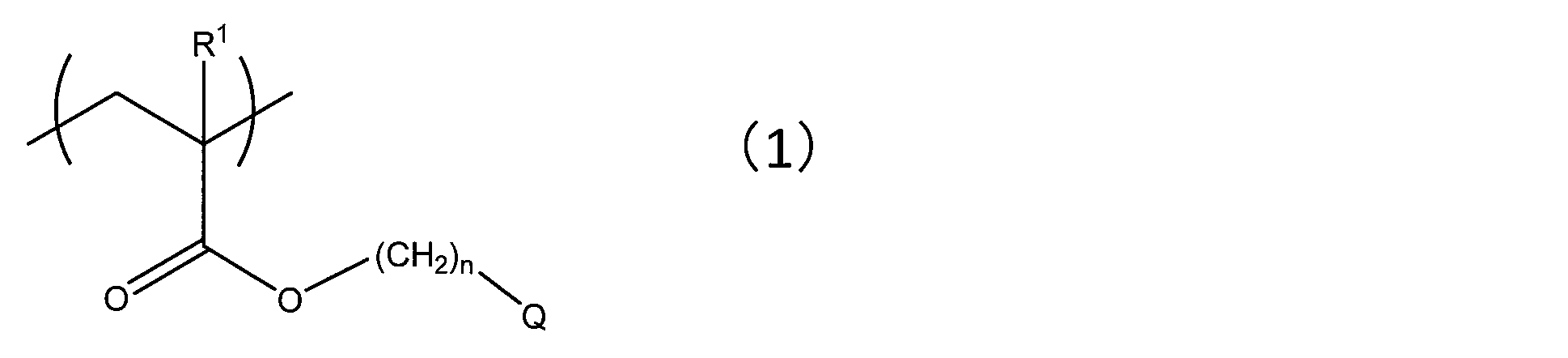
本発明のエポキシ樹脂改質剤が含有するブロック共重合体は、後述する一般式(1)で表される構造単位(a-1)および鎖状アルキル基を有する(メタ)アクリレートに由来する構造単位(a-2)を有するAブロックと、鎖状アルキル基を有する(メタ)アクリレート、および、環状アルキル基を有する(メタ)アクリレートよりなる群から選択される少なくとも1種のビニルモノマーに由来する構造単位(b)を有するBブロックとを有するA-B-A型トリブロック共重合体である。そして、各Aブロックにおける前記一般式(1)で表される構造単位(a-1)の含有率は、Aブロック100質量%中において85質量%以上、100質量%未満であり、前記鎖状アルキル基を有する(メタ)アクリレートに由来する構造単位(a-2)の含有率は、Aブロック100質量%中において0質量%超、15質量%以下である。
Aブロックは、下記一般式(1)で表される構造単位(a-1)および鎖状アルキル基を有する(メタ)アクリレートに由来する構造単位(a-2)を有するポリマーブロックである。

式(1)のnは、0~10の整数であることが好ましく、0~5の整数であることがより好ましく、0~3の整数であることがさらに好ましい。
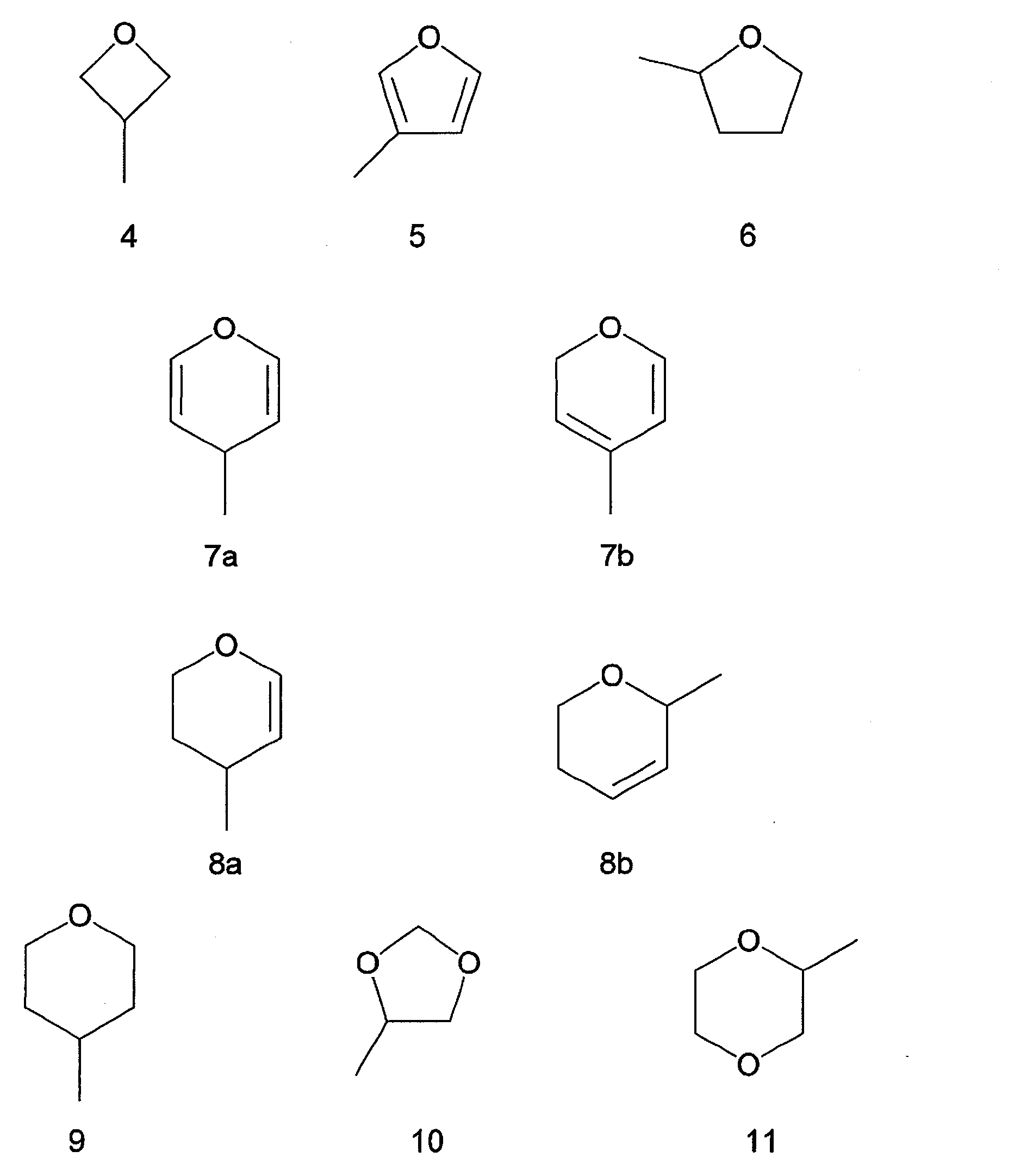


Bブロックは、鎖状アルキル基を有する(メタ)アクリレート、および、環状アルキル基を有する(メタ)アクリレートよりなる群から選択される少なくとも1種のビニルモノマーに由来する構造単位(b)を有するポリマーブロックである。Bブロックは、前記ビニルモノマーに由来する構造単位(a-1)を実質的に含有しないことから、Aブロックに比べてエポキシ樹脂に対する相溶性が低いと考えられる。
本発明のエポキシ樹脂改質剤が含有するブロック共重合体は、A-B-A型トリブロック共重合体(Aは「Aブロック」を表し、Bは「Bブロック」を表す)である。A-B-A型トリブロック共重合体とすることで、Bブロックがより均一な紐状でエポキシ樹脂に分散することができるため、高い剥離接着力および破壊靭性を達成することができる。
前記ブロック共重合体の製造方法としては、ビニルモノマーの重合反応によって、第1Aブロック(例えば、A1ブロック)を先に製造し、第1AブロックにBブロックのモノマーを重合し、さらにBブロックに第2Aブロック(例えば、A2ブロック)のモノマーを重合してもよく;又は第1Aブロック(例えば、A1ブロック)と第2Aブロック(例えば、A2ブロック)とBブロックとを別々に製造した後、第1AブロックとBブロックと第2Aブロックとをカップリングさせてもよい。
(a)ビニルモノマーを、一般式(2)で表される有機テルル化合物を用いて重合する方法。
(b)ビニルモノマーを、一般式(2)で表される有機テルル化合物とアゾ系重合開始剤との混合物を用いて重合する方法。
(c)ビニルモノマーを、一般式(2)で表される有機テルル化合物と一般式(3)で表される有機ジテルル化合物との混合物を用いて重合する方法。
(d)ビニルモノマーを、一般式(2)で表される有機テルル化合物とアゾ系重合開始剤と一般式(3)で表される有機ジテルル化合物との混合物を用いて重合する方法。
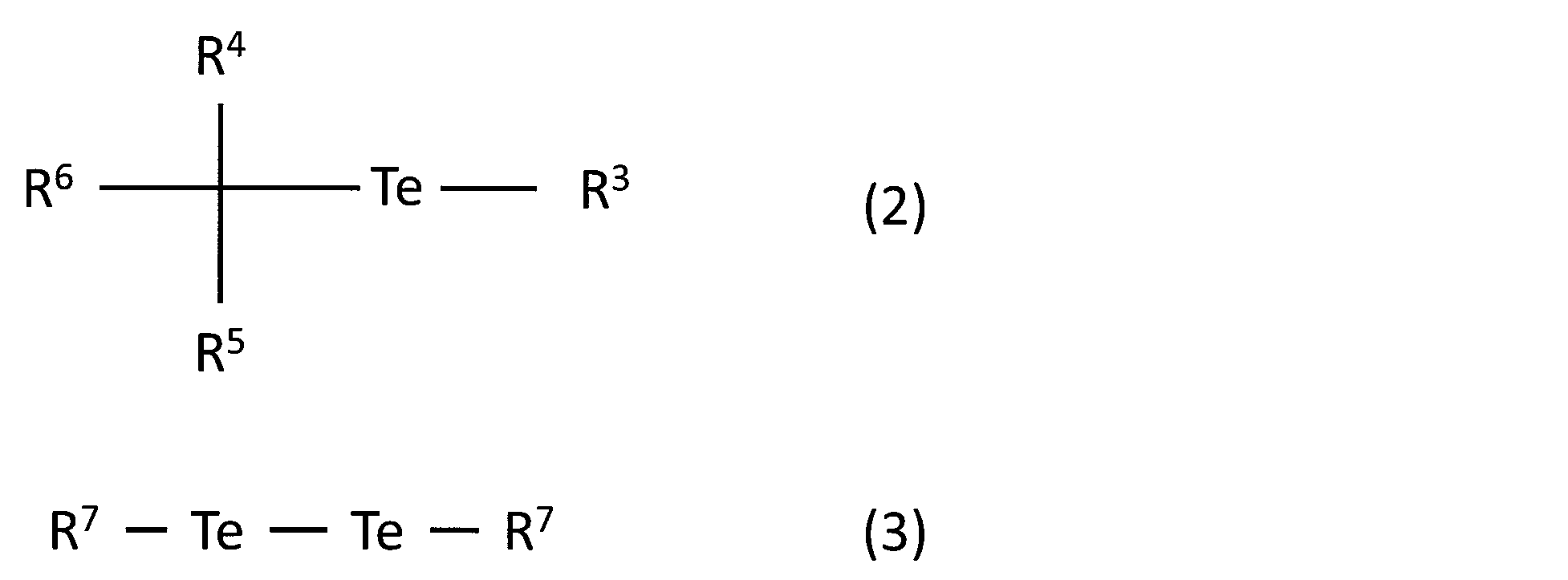
〔一般式(3)において、R7は、炭素数1~8のアルキル基、アリール基又は芳香族ヘテロ環基を示す。〕
炭素数1~8のアルキル基としては、メチル基、エチル基、n-プロピル基、イソプロピル基、n-ブチル基、イソブチル基、sec-ブチル基、tert-ブチル基、ペンチル基、ヘキシル基、ヘプチル基、オクチル基等の直鎖または分岐鎖アルキル基や、シクロヘキシル基等の環状アルキル基等を挙げることができる。好ましくは炭素数1~4の直鎖または分岐鎖アルキル基であり、さらに好ましくはメチル基またはエチル基である。アリール基としては、フェニル基、ナフチル基等を挙げることができる。芳香族ヘテロ環基としては、ピリジル基、フリル基、チエニル基等を挙げることができる。
本発明のエポキシ樹脂改質剤は、前記A-B-A型トリブロック共重合体を含有するものであり、エポキシ樹脂に配合して使用される。
本発明のエポキシ樹脂組成物は、エポキシ樹脂、硬化剤、および、上述の本発明のエポキシ樹脂改質剤を含有する。
本発明のエポキシ樹脂組成物は、優れた剥離接着力を与えることができることから、接着剤として有用である。本発明の接着剤の用途としては、例えば、自動車等の車両の構造用、土木・建築用、電子材料用、一般事務用、医療用、工業用等が挙げられる。
半導体装置などの電子装置の製造では、基板と半導体チップ、半導体チップと半導体チップなどの構成要素同士を半田バンプ等により接続する半導体チップ実装がなされている。この半導体チップ実装において、構成要素同士間の空隙を充填する封止材(アンダーフィル材)が使用されている。本発明のエポキシ樹脂組成物は、優れた剥離接着力や破壊靭性を与えることができることから、このようなアンダーフィル材としても有用である。本発明のアンダーフィル材の用途としては、半導体チップ実装用等が挙げられる。より具体的に、半田バンプ等で接続された半導体チップと基板の間の空隙や半導体チップ同士間の空隙を充填する用途に好適に用いることができる。
本発明の樹脂硬化物は、前述した本発明のエポキシ樹脂組成物を硬化してなるものである。
BTEE:エチル=2-メチル-2-n-ブチルテラニル-プロピオネート
DBDT:ジブチルジテルリド
AIBN:2,2’-アゾビス(イソブチロニトリル)
THFMA:テトラヒドロフルフリルメタクレート
IBMA:イソブチルメタクリレート
MMA:メチルメタクリレート
LMA:ドデシルメタクリレート
(重合率)
核磁気共鳴(NMR)測定装置(ブルカー・バイオスピン社製、型式:AVANCE500(周波数500MHz))を用いて、1H-NMRを測定(溶媒:重水素化クロロホルム(CDCl3)、内部標準:テトラメチルシラン(TMS))した。得られたNMRスペクトルについて、モノマー由来のビニル基と、ポリマー由来のエステル側鎖のピークの積分比を求め、モノマーの重合率を算出した。
高速液体クロマトグラフ(東ソー社製、型式:HLC-8320GPC)を用いて、ゲル浸透クロマトグラフィー(GPC)により求めた。カラムはTSKgel SuperMultipore HZ-H(Φ4.6mm×150mm)(東ソー社製)を2本、移動相にテトラヒドロフラン、検出器に示差屈折率検出器を使用した。測定条件は、カラム温度を40℃、試料濃度を5mg/mL、試料注入量を10μL、流速を0.35mL/minとした。標準物質としてポリスチレン(分子量2,890,000、1,090,000、706,000、427,000、190,000、96,400、37,900、10,200、2,630、440)を使用して検量線(校正曲線)を作成し、重量平均分子量(Mw)、数平均分子量(Mn)を測定した。これらの測定値から分子量分布(Mw/Mn)を算出した。
エポキシ樹脂組成物(硬化前)の粘度は、室温(25℃)で、E型粘度計(商品名:TVE-22L、東機産業社製)を用いて測定した。コーンローターは測定粘度に合わせたもの(1500mPa・s未満は1°34‘x24、1500mPa・s以上は3°xR14)を使用し、ローター回転速度は5rpm、測定レンジは5とした。
エポキシ樹脂組成物を120℃で90分間加熱硬化することで得られた硬化物について、6mm当たりの600nm光透過度を、分光光度計U-3900(日立ハイテクサイエンス社製)を用いて測定した。測定は10回実施し、10回の平均値を光透過度の値とした。表3および表5における各エポキシ樹脂組成物の硬化物の光透過度は、ブロック共重合体を配合しなかったエポキシ樹脂組成物No.13の硬化物の光透過度を100%として指数化された値である。表4におけるエポキシ樹脂組成物No.14~15の硬化物の光透過度は、ブロック共重合体を配合しなかったエポキシ樹脂組成物No.16の硬化物の光透過度を100%として指数化された値である。表4におけるエポキシ樹脂組成物No.17~18の硬化物の光透過度は、ブロック共重合体を配合しなかったエポキシ樹脂組成物No.19の硬化物の光透過度を100%として指数化された値である。指数化された値が大きいほど、エポキシ樹脂組成物の硬化物が透明性に優れていることを示す。光透過度が2%未満である場合は「白濁」とした。
剥離接着力試験は、JIS K6854-3に基づいて行った。具体的には、2枚のアルミ板(A1050P、0.5mmx25mmx200mm)を150mmのところで90°に曲げて、150mmの部分にエポキシ樹脂組成物を塗布して、T字状になるように貼り合わせた。接着層には、0.2mmのスペーサーを挟んだ。塗布後、120℃で90分間加熱し、エポキシ樹脂組成物を硬化させた。常温に戻した後、島津製作所社製力学試験機オートグラフAGS-Jを用いて、100mm/分のヘッドスピードでT型剥離試験を行った。測定は5回実施し、5回の平均値を剥離接着力の値とした。
エポキシ樹脂組成物を寸法6x12x25mmの型に流し込み、120℃で90分間加熱硬化させた。得られた硬化物について、ASTM D5045-93に準じて島津製作所社製力学試験機オートグラフAGS-Jを用いて破壊靭性試験を行った。測定は10回実施し、10回の平均値を破壊靭性の値とした。破壊靭性K1cは、亀裂進行抵抗を意味するものであり、値が大きくなるほど破壊靭性が高いことを意味する。
エポキシ樹脂組成物を引張3号型ダンベル試験片のサイズの型に流し込み、120℃で90分間加熱硬化させた。得られた硬化物について、JIS K 6251に準じて島津製作所社製力学試験機オートグラフAGS-Jを用いて引張試験を行った。ダンベル試験片の破断時応力を引張強度とした。測定は10回実施し、10回の平均値を引張強度の値とした。
エポキシ樹脂組成物を120℃で90分間加熱硬化することで得られた硬化物について、熱機械分析装置(日立ハイテクサイエンス社製)を用い、30℃から300℃まで、10℃/分の速度で昇温させ、得られたチャートの50℃~80℃における接線の傾きを線膨張係数α1(ppm/℃)とした。また、線膨張係数α1と前記剥離接着力試験にて測定した剥離接着力から、下記式により、剥離接着力に対する線膨張係数を算出した。
剥離接着力に対する線膨張係数=線膨張係数α1(ppm/℃)/剥離接着力(N/25mm)
ミクロトーム(ULTROTOME(商標登録)V、LKB BROMMA製)を用いてエポキシ樹脂組成物(No.2、10、6)の硬化物を60nm厚に切削した。酸化ルテニウム(VIII)(0.5%水溶液)を用いて切削切片中の低相溶性成分をRu染色した後、電界放出型透過電子顕微鏡(JEM-2100F、日本電子株式会社製)または電界放出型走査電子顕微鏡(S-4800、株式会社日立ハイテクノロジーズ製)を用いて低相溶性成分の分散状態を観察し、電界放出型透過電子顕微鏡像(FE-TEM像)または電界放出型走査電子顕微鏡像(FE-SEM像)を取得した。
(ブロック共重合体No.1)
窒素置換した撹拌機付き300mL反応器中に、予め窒素置換したTHFMA 24.38g、IBMA 0.63g、BTEE 0.74g、DBDT 0.41g、AIBN 0.0825g、トルエン 25.03gを仕込み、60℃で18.25時間反応させA1ブロックを重合した(第一段目の重合反応)。重合率は、97.7%であった。
表1に示した原料使用量と反応条件で重合反応を行った以外、ブロック共重合体No.1と同様にして、ブロック共重合体No.2~11を製造した。ブロック共重合体No.6、8、10は、第三段目の重合反応を行われず得られたA-B型ジブロック共重合体であった。
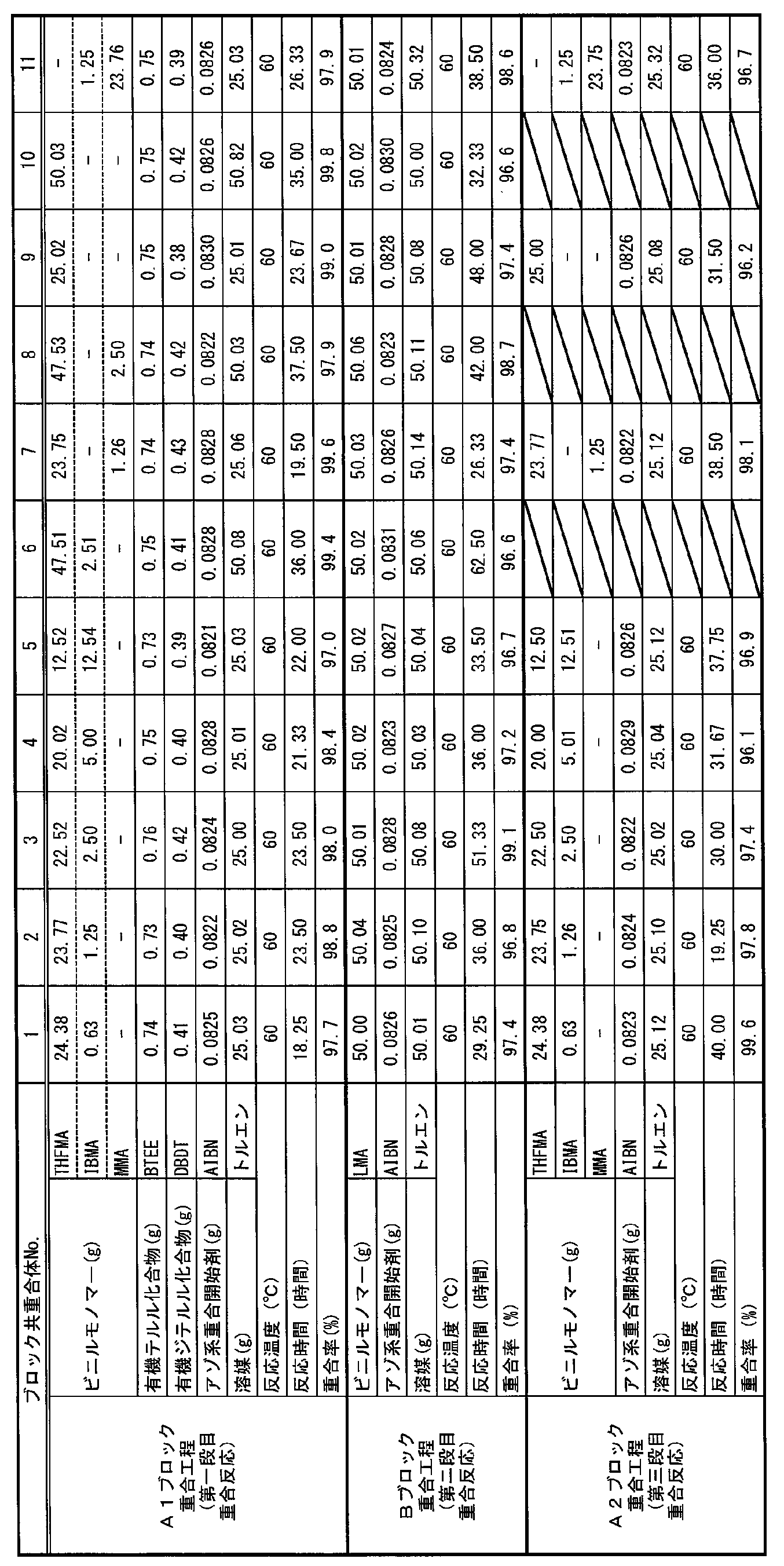
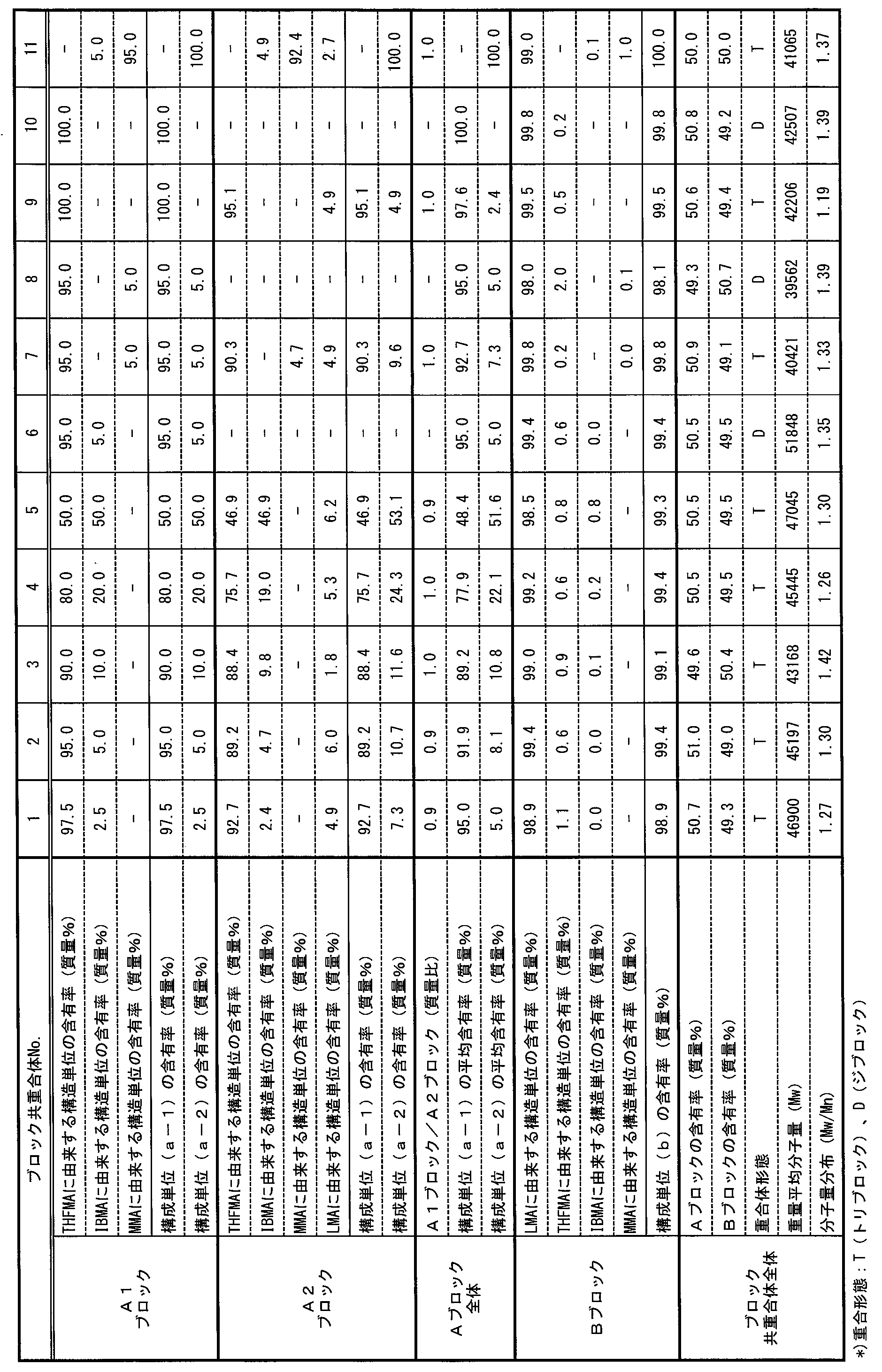
(エポキシ樹脂組成物No.1~3、5~12)
ビスフェノールA型エポキシ樹脂(商品名:jER(商標登録)828、エポキシ当量194g/eq、重量平均分子量370、三菱ケミカル株式会社製)49.77質量%、硬化剤としての4-メチルシクロヘキサン-1,2-ジカルボン酸無水物45.28質量%(エポキシ樹脂に対して2.0当量)、硬化促進剤としての2-エチル-4-メチルイミダゾール0.47質量%、および表3に記載の質量%のエポキシ樹脂改質剤としての前記で得られたブロック共重合体を混合し、混合物を撹拌脱泡機(AR-250、株式会社シンキー製)にて22分間撹拌および脱泡を行い、エポキシ樹脂組成物No.1~12を得た。
ビスフェノールA型エポキシ樹脂(商品名:jER(商標登録)828、エポキシ当量194g/eq、重量平均分子量370、三菱ケミカル株式会社製)47.57質量%、硬化剤としての4-メチルシクロヘキサン-1,2-ジカルボン酸無水物43.28質量%(エポキシ樹脂に対して2.0当量)、硬化促進剤としての2-エチル-4-メチルイミダゾール0.45質量%、および表3に記載の質量%のエポキシ樹脂改質剤としての前記で得られたブロック共重合体を混合し、混合物を撹拌脱泡機(AR-250、株式会社シンキー製)にて22分間撹拌および脱泡を行い、エポキシ樹脂組成物No.4を得た。
ビスフェノールA型エポキシ樹脂(商品名:jER(商標登録)828、エポキシ当量194g/eq、重量平均分子量370、三菱ケミカル株式会社製)52.23質量%、硬化剤としての4-メチルシクロヘキサン-1,2-ジカルボン酸無水物47.27質量%(エポキシ樹脂に対して2.1当量)、および硬化促進剤としての2-エチル-4-メチルイミダゾール0.49質量%を混合し、混合物を撹拌脱泡機(AR-250、株式会社シンキー製)にて22分間撹拌および脱泡を行い、エポキシ樹脂組成物No.13を得た。
ビスフェノールF型エポキシ樹脂(商品名:jER(商標登録)807、エポキシ当量168g/eq、重量平均分子量336、三菱ケミカル株式会社製)47.48質量%、硬化剤として4-メチルシクロヘキサン-1,2-ジカルボン酸無水物47.57質量%(エポキシ樹脂に対して2.0当量)、硬化促進剤として2-エチル-4-メチルイミダゾール0.48質量%、およびエポキシ樹脂改質剤として前記で得られたブロック共重合体No.2またはNo.4を表4に記載の質量%混合し、混合物を撹拌脱泡機(AR-250、株式会社シンキー製)にて22分間撹拌および脱泡を行い、エポキシ樹脂組成物No.14~15を得た。
ビスフェノールF型エポキシ樹脂(商品名:jER(商標登録)807、エポキシ当量168g/eq、重量平均分子量336、三菱ケミカル株式会社製)49.70質量%、硬化剤として4-メチルシクロヘキサン-1,2-ジカルボン酸無水物49.80質量%(エポキシ樹脂に対して2.0当量)、および硬化促進剤として2-エチル-4-メチルイミダゾール0.50質量%を混合し、混合物を撹拌脱泡機(AR-250、株式会社シンキー製)にて22分間撹拌および脱泡を行い、エポキシ樹脂組成物No.16を得た。
ビスフェノールA型エポキシ樹脂(商品名:jER(商標登録)828、エポキシ当量194g/eq、重量平均分子量370、三菱ケミカル株式会社製)75.65質量%、硬化剤としてジアミノジフェニルメタン19.87質量%(エポキシ樹脂に対して1.0当量)、およびエポキシ樹脂改質剤として前記で得られたブロック共重合体No.2またはNo.5を表4に記載の質量%混合し、混合物を撹拌脱泡機(AR-250、株式会社シンキー製)にて22分間撹拌および脱泡を行い、エポキシ樹脂組成物No.17~18を得た。
ビスフェノールA型エポキシ樹脂(商品名:jER(商標登録)828、エポキシ当量194g/eq、重量平均分子量370、三菱ケミカル株式会社製)79.2質量%、および硬化剤としてジアミノジフェニルメタン20.8質量%(エポキシ樹脂に対して1.0当量)を混合し、混合物を撹拌脱泡機(AR-250、株式会社シンキー製)にて22分間撹拌および脱泡を行い、エポキシ樹脂組成物No.19を得た。
ビスフェノールA型エポキシ樹脂(商品名:jER(商標登録)828、エポキシ当量194g/eq、重量平均分子量370、三菱ケミカル株式会社製)47.51質量%、硬化剤としての4-メチルシクロヘキサン-1,2-ジカルボン酸無水物43.22質量%(エポキシ樹脂に対して2.0当量)、硬化促進剤としての2-エチル-4-メチルイミダゾール0.45質量%、表5に記載の質量%のエポキシ樹脂改質剤としての前記で得られたブロック共重合体および反応性希釈剤を混合し、混合物を撹拌脱泡機(AR-250、株式会社シンキー製)にて22分間撹拌および脱泡を行い、エポキシ樹脂組成物No.20を得た。
ビスフェノールA型エポキシ樹脂(商品名:jER(商標登録)828、エポキシ当量194g/eq、重量平均分子量370、三菱ケミカル株式会社製)48.36質量%、硬化剤としての4-メチルシクロヘキサン-1,2-ジカルボン酸無水物44.00質量%(エポキシ樹脂に対して2.0当量)、硬化促進剤としての2-エチル-4-メチルイミダゾール0.46質量%、表5に記載の質量%のエポキシ樹脂改質剤としての前記で得られたブロック共重合体および反応性希釈剤を混合し、混合物を撹拌脱泡機(AR-250、株式会社シンキー製)にて22分間撹拌および脱泡を行い、エポキシ樹脂組成物No.21を得た。

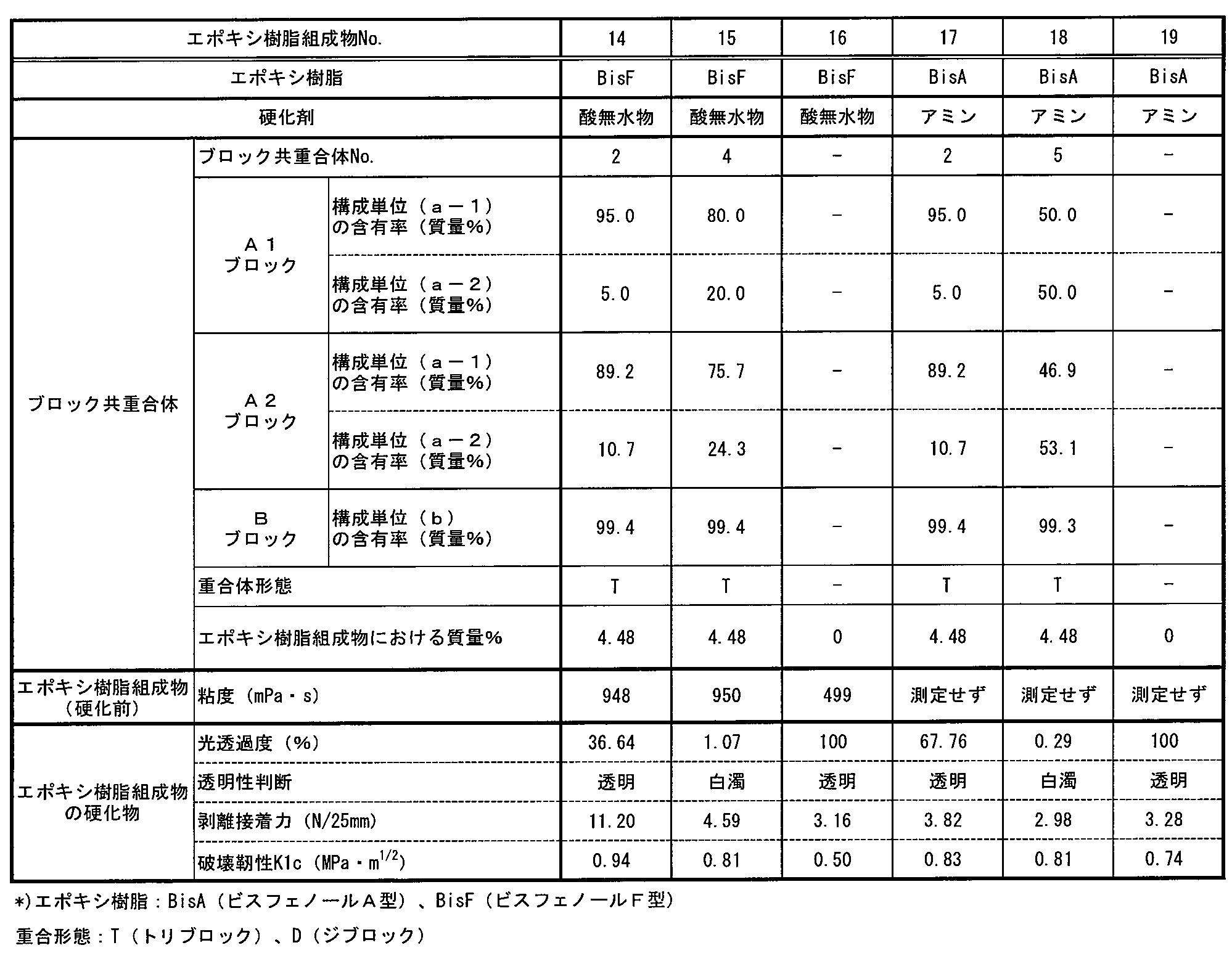
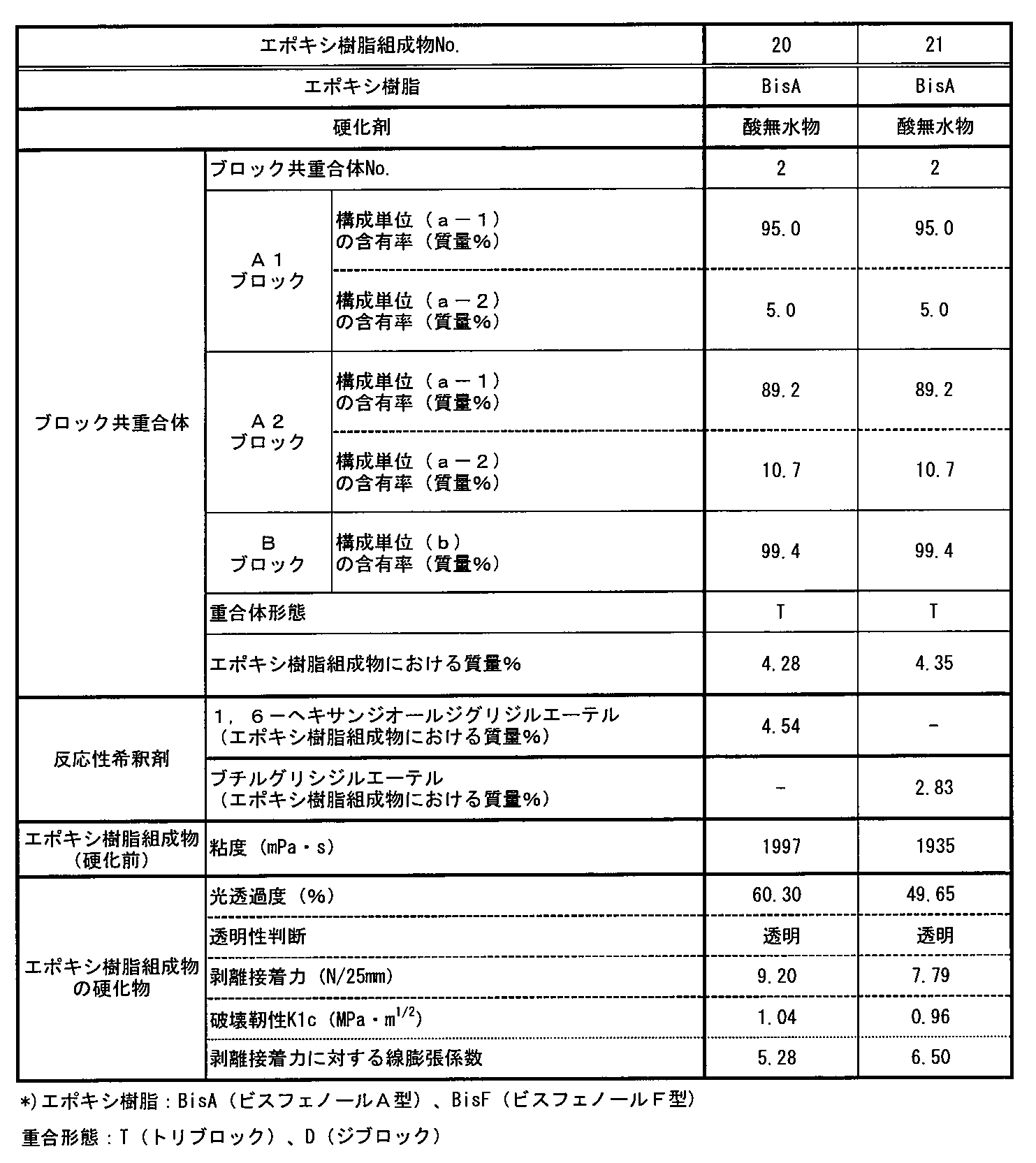
各Aブロックにおける前記一般式(1)で表される構造単位(a-1)の含有率が、Aブロック100質量%中において85質量%以上、100質量%未満であり、前記鎖状アルキル基を有する(メタ)アクリレートに由来する構造単位(a-2)の含有率が、Aブロック100質量%中において0質量%超、15質量%以下であることを特徴とする。

Claims (16)
- ブロック共重合体を含有するエポキシ樹脂改質剤であって、
前記ブロック共重合体が、下記一般式(1)で表される構造単位(a-1)および鎖状アルキル基を有する(メタ)アクリレートに由来する構造単位(a-2)を有するAブロックと、鎖状アルキル基を有する(メタ)アクリレート、および、環状アルキル基を有する(メタ)アクリレートよりなる群から選択される少なくとも1種のビニルモノマーに由来する構造単位(b)を有するBブロックとを有するA-B-A型トリブロック共重合体であり、
各Aブロックにおける前記一般式(1)で表される構造単位(a-1)の含有率が、Aブロック100質量%中において85質量%以上、100質量%未満であり、前記鎖状アルキル基を有する(メタ)アクリレートに由来する構造単位(a-2)の含有率が、Aブロック100質量%中において0質量%超、15質量%以下であることを特徴とするエポキシ樹脂改質剤。

- 前記Aブロックの構造単位(a-2)が、分岐鎖状アルキル基を有する(メタ)アクリレートに由来する構造単位である請求項1に記載のエポキシ樹脂改質剤。
- 前記Aブロックの構造単位(a-1)が、テトラヒドロフルフリル(メタ)アクリレート、モルホリノ(メタ)アクリレート、モルホリノエチル(メタ)アクリレート、(3-エチルオキセタン-3-イル)メチル(メタ)アクリレート、(2-メチル-2-エチル-1,3-ジオキソラン-4-イル)メチル(メタ)アクリレート、環状トリメチロールプロパンホルマール(メタ)アクリレート、2-〔(2-テトラヒドロピラニル)オキシ〕エチル(メタ)アクリレート、1,3-ジオキサン-(メタ)アクリレートよりなる群から選択される少なくとも1種に由来する構造単位である請求項1に記載のエポキシ樹脂改質剤。
- 前記ブロック共重合体を構成する2つのAブロックのうち、構造単位(a-1)の含有率が高いAブロックをA1ブロックとし、構造単位(a-1)の含有率が低いAブロックをA2ブロックとしたときに、A2ブロックに対するA1ブロックの質量比(A1ブロック/A2ブロック)が、0.8~1.2である請求項1に記載のエポキシ樹脂改質剤。
- 前記Aブロックの含有率が、前記ブロック共重合体全体100質量%中において30質量%~70質量%である請求項1に記載のエポキシ樹脂改質剤。
- 前記Bブロックの構造単位(b)が、炭素数11~20の鎖状アルキル基を有する(メタ)アクリレートに由来する構造単位である請求項1に記載のエポキシ樹脂改質剤。
- 前記Bブロックの構造単位(b)の含有率が、Bブロック100質量%中において80質量%以上、100質量%以下である請求項1に記載のエポキシ樹脂改質剤。
- 前記Bブロックの含有率が、前記ブロック共重合体全体100質量%中において30質量%~70質量%である請求項1に記載のエポキシ樹脂改質剤。
- 前記ブロック共重合体の重量平均分子量(Mw)が、10,000以上、200,000未満である請求項1に記載のエポキシ樹脂改質剤。
- 前記ブロック共重合体の分子量分布(Mw/Mn)が、2.0以下である請求項1に記載のエポキシ樹脂改質剤。
- 前記ブロック共重合体が、リビングラジカル重合により重合されたものである請求項1に記載のエポキシ樹脂改質剤。
- エポキシ樹脂、硬化剤、および、請求項1~11のいずれか一項に記載のエポキシ樹脂改質剤を含有するエポキシ樹脂組成物。
- 前記エポキシ樹脂改質剤の含有量が、前記A-B-A型トリブロック共重合体の換算量で、エポキシ樹脂および硬化剤の合計量100質量部に対して、1質量部~25質量部である請求項12に記載のエポキシ樹脂組成物。
- 請求項12に記載のエポキシ樹脂組成物からなる接着剤。
- 請求項12に記載のエポキシ樹脂組成物からなるアンダーフィル材。
- 請求項12に記載のエポキシ樹脂組成物を硬化してなる樹脂硬化物。
Priority Applications (4)
| Application Number | Priority Date | Filing Date | Title |
|---|---|---|---|
| US18/563,617 US20240240059A1 (en) | 2021-06-29 | 2022-06-16 | Epoxy resin modifier, epoxy resin composition containing same, adhesive composed of epoxy resin composition, and resin cured product obtained by curing epoxy resin composition |
| JP2023531790A JPWO2023276702A1 (ja) | 2021-06-29 | 2022-06-16 | |
| KR1020237038379A KR20240023502A (ko) | 2021-06-29 | 2022-06-16 | 에폭시 수지 개질제, 이것을 함유하는 에폭시 수지 조성물, 에폭시 수지 조성물로 이루어지는 접착제, 및 에폭시 수지 조성물을 경화하여 이루어지는 수지 경화물 |
| CN202280034383.7A CN117279966A (zh) | 2021-06-29 | 2022-06-16 | 环氧树脂改性剂、含有其的环氧树脂组合物、由环氧树脂组合物构成的接合剂以及固化环氧树脂组合物而成的树脂固化物 |
Applications Claiming Priority (2)
| Application Number | Priority Date | Filing Date | Title |
|---|---|---|---|
| JP2021107829 | 2021-06-29 | ||
| JP2021-107829 | 2021-06-29 |
Publications (1)
| Publication Number | Publication Date |
|---|---|
| WO2023276702A1 true WO2023276702A1 (ja) | 2023-01-05 |
Family
ID=84692341
Family Applications (1)
| Application Number | Title | Priority Date | Filing Date |
|---|---|---|---|
| PCT/JP2022/024142 Ceased WO2023276702A1 (ja) | 2021-06-29 | 2022-06-16 | エポキシ樹脂改質剤、これを含有するエポキシ樹脂組成物、エポキシ樹脂組成物からなる接着剤、およびエポキシ樹脂組成物を硬化してなる樹脂硬化物 |
Country Status (5)
| Country | Link |
|---|---|
| US (1) | US20240240059A1 (ja) |
| JP (1) | JPWO2023276702A1 (ja) |
| KR (1) | KR20240023502A (ja) |
| CN (1) | CN117279966A (ja) |
| WO (1) | WO2023276702A1 (ja) |
Families Citing this family (1)
| Publication number | Priority date | Publication date | Assignee | Title |
|---|---|---|---|---|
| CN119432279B (zh) * | 2024-11-01 | 2025-06-03 | 洛瑞卡新材料科技(江苏)有限公司 | 一种耐候性透明胶黏剂、制备方法及在耐候耐磨透明膜和彩涂板粘接上的应用 |
Citations (5)
| Publication number | Priority date | Publication date | Assignee | Title |
|---|---|---|---|---|
| WO2009101961A1 (ja) * | 2008-02-15 | 2009-08-20 | Kuraray Co., Ltd. | 硬化性樹脂組成物および樹脂硬化物 |
| JP2018035266A (ja) * | 2016-08-31 | 2018-03-08 | 大塚化学株式会社 | ブロック共重合体、および、これを含有する樹脂改質剤、エポキシ樹脂組成物 |
| JP2018087910A (ja) * | 2016-11-29 | 2018-06-07 | 大塚化学株式会社 | 着色感放射線性組成物およびカラーフィルタ |
| JP2018104558A (ja) * | 2016-12-27 | 2018-07-05 | 大塚化学株式会社 | アルカリ可溶性樹脂および感光性樹脂組成物 |
| JP2020189946A (ja) * | 2019-05-23 | 2020-11-26 | 大塚化学株式会社 | (メタ)アクリル系樹脂組成物 |
Family Cites Families (3)
| Publication number | Priority date | Publication date | Assignee | Title |
|---|---|---|---|---|
| JPH0925393A (ja) | 1995-05-09 | 1997-01-28 | Toray Ind Inc | 繊維強化複合材料用エポキシ樹脂組成物、プリプレグおよび繊維強化複合材料 |
| WO2008088008A1 (ja) | 2007-01-17 | 2008-07-24 | Meiji Dairies Corporation | 消化管機能異常症予防及び/又は治療剤 |
| KR102045282B1 (ko) | 2013-06-03 | 2019-11-15 | 삼성전자주식회사 | 통화 중인 상대방의 정보를 검출하는 전자 장치 및 방법 |
-
2022
- 2022-06-16 JP JP2023531790A patent/JPWO2023276702A1/ja active Pending
- 2022-06-16 KR KR1020237038379A patent/KR20240023502A/ko active Pending
- 2022-06-16 WO PCT/JP2022/024142 patent/WO2023276702A1/ja not_active Ceased
- 2022-06-16 CN CN202280034383.7A patent/CN117279966A/zh active Pending
- 2022-06-16 US US18/563,617 patent/US20240240059A1/en active Pending
Patent Citations (5)
| Publication number | Priority date | Publication date | Assignee | Title |
|---|---|---|---|---|
| WO2009101961A1 (ja) * | 2008-02-15 | 2009-08-20 | Kuraray Co., Ltd. | 硬化性樹脂組成物および樹脂硬化物 |
| JP2018035266A (ja) * | 2016-08-31 | 2018-03-08 | 大塚化学株式会社 | ブロック共重合体、および、これを含有する樹脂改質剤、エポキシ樹脂組成物 |
| JP2018087910A (ja) * | 2016-11-29 | 2018-06-07 | 大塚化学株式会社 | 着色感放射線性組成物およびカラーフィルタ |
| JP2018104558A (ja) * | 2016-12-27 | 2018-07-05 | 大塚化学株式会社 | アルカリ可溶性樹脂および感光性樹脂組成物 |
| JP2020189946A (ja) * | 2019-05-23 | 2020-11-26 | 大塚化学株式会社 | (メタ)アクリル系樹脂組成物 |
Also Published As
| Publication number | Publication date |
|---|---|
| CN117279966A (zh) | 2023-12-22 |
| KR20240023502A (ko) | 2024-02-22 |
| JPWO2023276702A1 (ja) | 2023-01-05 |
| US20240240059A1 (en) | 2024-07-18 |
| TW202309184A (zh) | 2023-03-01 |
Similar Documents
| Publication | Publication Date | Title |
|---|---|---|
| RU2387683C2 (ru) | Эпоксидные смолы, упрочненные амфифильным блок-сополимером | |
| EP2231729B1 (en) | Acrylic-based rubber modified thermoset composition | |
| KR101538193B1 (ko) | 경화성 수지 조성물 및 수지 경화물 | |
| CN111065685B (zh) | 大分子单体共聚物、环氧树脂组合物、粘接剂、成型材料和固化物 | |
| JP6596006B2 (ja) | 注型用エポキシ樹脂組成物 | |
| US7767757B2 (en) | Thermoset materials with improved impact resistance | |
| KR101792448B1 (ko) | 중합체 및 그의 제조 방법, 및 성형체 | |
| CN107459612B (zh) | 一种增强增韧剂、增韧环氧树脂复合材料及其制备方法 | |
| JP7163688B2 (ja) | マクロモノマー共重合体及びこれを含むエポキシ樹脂組成物 | |
| EP2439218A1 (en) | Process for producing hydrogenated block copolymer, hydrogenated block copolymer obtained by the process, and comosition thereof | |
| WO2023276702A1 (ja) | エポキシ樹脂改質剤、これを含有するエポキシ樹脂組成物、エポキシ樹脂組成物からなる接着剤、およびエポキシ樹脂組成物を硬化してなる樹脂硬化物 | |
| TWI922696B (zh) | 環氧樹脂改質劑、含有其之環氧樹脂組成物、由環氧樹脂組成物構成的黏著劑、以及將環氧樹脂組成物硬化而成的樹脂硬化物 | |
| WO2020213642A1 (ja) | エポキシ樹脂組成物、硬化性樹脂組成物、硬化物、接着剤 | |
| JP7318883B2 (ja) | (メタ)アクリル系樹脂組成物 | |
| JP6813996B2 (ja) | ブロック共重合体、および、これを含有する樹脂改質剤、エポキシ樹脂組成物 | |
| JP2024080951A (ja) | ブロック共重合体、エポキシ樹脂改質剤、および、これを含有するエポキシ樹脂組成物 | |
| TWI707913B (zh) | 環氧樹脂組合物 | |
| JP7683265B2 (ja) | 樹脂組成物及び樹脂硬化物 | |
| TW200938581A (en) | Elastomeric flexibilizer for thermosets | |
| JP7496731B2 (ja) | 硬化性樹脂組成物 | |
| JP6025019B2 (ja) | 反応性重合体溶液の製造方法 | |
| JP2008024894A (ja) | 熱硬化性樹脂組成物、及び電子機器 | |
| KR100886600B1 (ko) | 열경화성 수지로부터의 대상물의 제조 방법 | |
| CN105153358A (zh) | 一种用于增韧环氧树酯的双亲性丙烯酸酯无规共聚物及其制备方法 | |
| WO2025069712A1 (ja) | 硬化性組成物、硬化物および熱伝導材 |
Legal Events
| Date | Code | Title | Description |
|---|---|---|---|
| 121 | Ep: the epo has been informed by wipo that ep was designated in this application |
Ref document number: 22832852 Country of ref document: EP Kind code of ref document: A1 |
|
| ENP | Entry into the national phase |
Ref document number: 2023531790 Country of ref document: JP Kind code of ref document: A |
|
| WWE | Wipo information: entry into national phase |
Ref document number: 202280034383.7 Country of ref document: CN |
|
| WWE | Wipo information: entry into national phase |
Ref document number: 18563617 Country of ref document: US |
|
| NENP | Non-entry into the national phase |
Ref country code: DE |
|
| 122 | Ep: pct application non-entry in european phase |
Ref document number: 22832852 Country of ref document: EP Kind code of ref document: A1 |