WO2023234305A1 - エッチング方法 - Google Patents
エッチング方法 Download PDFInfo
- Publication number
- WO2023234305A1 WO2023234305A1 PCT/JP2023/020126 JP2023020126W WO2023234305A1 WO 2023234305 A1 WO2023234305 A1 WO 2023234305A1 JP 2023020126 W JP2023020126 W JP 2023020126W WO 2023234305 A1 WO2023234305 A1 WO 2023234305A1
- Authority
- WO
- WIPO (PCT)
- Prior art keywords
- etching
- gas
- etched
- fluorodithiethane
- compound
- Prior art date
- Legal status (The legal status is an assumption and is not a legal conclusion. Google has not performed a legal analysis and makes no representation as to the accuracy of the status listed.)
- Ceased
Links
Images




Classifications
-
- H—ELECTRICITY
- H10—SEMICONDUCTOR DEVICES; ELECTRIC SOLID-STATE DEVICES NOT OTHERWISE PROVIDED FOR
- H10P—GENERIC PROCESSES OR APPARATUS FOR THE MANUFACTURE OR TREATMENT OF DEVICES COVERED BY CLASS H10
- H10P50/00—Etching of wafers, substrates or parts of devices
- H10P50/20—Dry etching; Plasma etching; Reactive-ion etching
- H10P50/28—Dry etching; Plasma etching; Reactive-ion etching of insulating materials
- H10P50/282—Dry etching; Plasma etching; Reactive-ion etching of insulating materials of inorganic materials
- H10P50/283—Dry etching; Plasma etching; Reactive-ion etching of insulating materials of inorganic materials by chemical means
-
- C—CHEMISTRY; METALLURGY
- C09—DYES; PAINTS; POLISHES; NATURAL RESINS; ADHESIVES; COMPOSITIONS NOT OTHERWISE PROVIDED FOR; APPLICATIONS OF MATERIALS NOT OTHERWISE PROVIDED FOR
- C09K—MATERIALS FOR MISCELLANEOUS APPLICATIONS, NOT PROVIDED FOR ELSEWHERE
- C09K13/00—Etching, surface-brightening or pickling compositions
- C09K13/04—Etching, surface-brightening or pickling compositions containing an inorganic acid
- C09K13/08—Etching, surface-brightening or pickling compositions containing an inorganic acid containing a fluorine compound
-
- H—ELECTRICITY
- H01—ELECTRIC ELEMENTS
- H01J—ELECTRIC DISCHARGE TUBES OR DISCHARGE LAMPS
- H01J37/00—Discharge tubes with provision for introducing objects or material to be exposed to the discharge, e.g. for the purpose of examination or processing thereof
- H01J37/32—Gas-filled discharge tubes
- H01J37/32431—Constructional details of the reactor
- H01J37/3244—Gas supply means
- H01J37/32449—Gas control, e.g. control of the gas flow
-
- H—ELECTRICITY
- H10—SEMICONDUCTOR DEVICES; ELECTRIC SOLID-STATE DEVICES NOT OTHERWISE PROVIDED FOR
- H10P—GENERIC PROCESSES OR APPARATUS FOR THE MANUFACTURE OR TREATMENT OF DEVICES COVERED BY CLASS H10
- H10P50/00—Etching of wafers, substrates or parts of devices
-
- H—ELECTRICITY
- H10—SEMICONDUCTOR DEVICES; ELECTRIC SOLID-STATE DEVICES NOT OTHERWISE PROVIDED FOR
- H10P—GENERIC PROCESSES OR APPARATUS FOR THE MANUFACTURE OR TREATMENT OF DEVICES COVERED BY CLASS H10
- H10P50/00—Etching of wafers, substrates or parts of devices
- H10P50/20—Dry etching; Plasma etching; Reactive-ion etching
- H10P50/24—Dry etching; Plasma etching; Reactive-ion etching of semiconductor materials
- H10P50/242—Dry etching; Plasma etching; Reactive-ion etching of semiconductor materials of Group IV materials
-
- H—ELECTRICITY
- H01—ELECTRIC ELEMENTS
- H01J—ELECTRIC DISCHARGE TUBES OR DISCHARGE LAMPS
- H01J2237/00—Discharge tubes exposing object to beam, e.g. for analysis treatment, etching, imaging
- H01J2237/32—Processing objects by plasma generation
- H01J2237/33—Processing objects by plasma generation characterised by the type of processing
- H01J2237/334—Etching
Definitions
- the present invention relates to an etching method.
- Patent Documents 1 and 2 disclose dry etching methods for etching carbon materials such as amorphous carbon using an etching gas containing a sulfur-containing compound as an etching compound.
- a polymer that is resistant to etching is generated from an etching compound, and a protective film made of the polymer is formed. Formed on the side wall of the hole.
- etching of the side wall surface of the hole is suppressed, so that bowing is less likely to occur.
- the side wall surface at the middle part in the depth direction (etching direction) of the hole is etched in the radial direction of the hole (direction perpendicular to the depth direction of the hole), so that the side wall surface has a barrel shape instead of a cylindrical shape. Phenomena that result in shape are less likely to occur.
- An object of the present invention is to provide an etching method in which bowing is less likely to occur on the side wall surface of a hole when the hole is formed by etching.
- one aspect of the present invention is as follows [1] to [7]. [1] Bringing an etching gas containing an etching compound into contact with an etched member having an etched object to be etched by the etching gas, plasma etching the etched object, and forming a hole in the etched object.
- the object to be etched includes a carbon material
- the etching compound is fluorodithiethane represented by the chemical formula C x F y S 2 , where x in the chemical formula is 2 or more and 6 or less, and y is 4 or more and 12 or less
- the etching gas contains or does not contain at least one metal selected from sodium, magnesium, aluminum, potassium, calcium, chromium, manganese, iron, cobalt, nickel, copper, and molybdenum, and contains the above metal. If so, an etching method in which the total concentration of all the metals contained is 100 mass ppb or less.
- the fluorodithiethane is 2,2,4,4-tetrafluoro-1,3-dithiethane, 1,1,2,2,3,3,4,4-octafluoro-1,3-dithiethane , 2,2,4-trifluoro-4-trifluoromethyl-1,3-dithiethane, 2,4-difluoro-2,4-bis(trifluoromethyl)-1,3-dithiethane, and 2,2,
- the etching method according to [1] comprising at least one of 4,4-tetrakis(trifluoromethyl)-1,3-dithiethane.
- bowing is less likely to occur on the side wall surface of the hole when the hole is formed by etching.
- FIG. 1 is a schematic diagram showing an example of an etching apparatus for explaining an embodiment of an etching method according to the present invention.
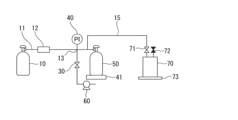
- FIG. 1 is a schematic diagram showing an example of a purification apparatus for purifying fluorodithiethane.
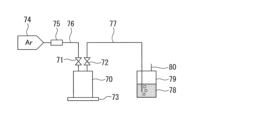
- FIG. 2 is a schematic diagram showing an example of a preparation device for preparing an aqueous nitric acid solution used for measuring the concentration of metals in fluorodithiethane.
- FIG. 3 is a cross-sectional view showing an example of a member to be etched before etching.
- FIG. 3 is a plan view showing the shape of an opening in an antireflection film layer formed on a member to be etched after etching.
- FIG. 1 is a schematic diagram showing an example of an etching apparatus for explaining an embodiment of an etching method according to the present invention.
- FIG. 1 is a schematic diagram showing an example of a purification apparatus for purifying fluorodithiethane.
- FIG. 2 is
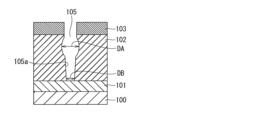
- FIG. 3 is a cross-sectional view showing the shape of a hole formed in the member to be etched after etching.
- FIG. 3 is a plan view showing the shape of an opening in an antireflection film layer formed on a member to be etched after etching.
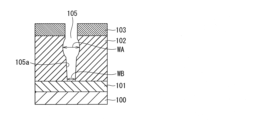
- FIG. 3 is a cross-sectional view showing the shape of a hole formed in the member to be etched after etching.
- an etching gas containing an etching compound is brought into contact with a member to be etched having an etching object to be etched by the etching gas, plasma etching is performed on the etching object, and the etching object is etched by plasma etching.
- An etching process is included to form holes in the wafer.
- the object to be etched includes a carbon material.
- the etching compound is fluorodithiethane represented by the chemical formula C x F y S 2 .
- x is 2 or more and 6 or less
- y is 4 or more and 12 or less.
- the etching gas contains sodium (Na), magnesium (Mg), aluminum (Al), potassium (K), calcium (Ca), chromium (Cr), manganese (Mn), iron (Fe), and cobalt (Co). , nickel (Ni), copper (Cu), and molybdenum (Mo), or if the metal is contained, the concentration of all the metals contained. The total sum is 100 mass ppb or less.
- the carbon material that is the object to be etched reacts with the etching compound in the etching gas, so that etching of the carbon material progresses. Therefore, according to the etching method according to this embodiment, holes can be formed in the object to be etched by plasma etching. Furthermore, as described above, in the etching method according to the present embodiment, since etching is performed using an etching gas that does not contain metal or contains a very small amount of metal, the side wall surface of the hole is etched. It is possible to suppress the occurrence of boeing.
- the etching method according to this embodiment can be used for manufacturing semiconductor devices. For example, if the etching method according to this embodiment is applied to a semiconductor substrate having a thin film made of carbon material, and plasma etching is performed to form holes in the thin film made of carbon material, three-dimensionally integrated semiconductors can be formed. devices can be manufactured.
- the hole in the present invention is a hole that opens in the surface of the object to be etched and extends in a direction perpendicular to the surface of the object to be etched.
- the hole may be a through hole that penetrates the object to be etched, or may be a hole with a bottom that does not penetrate.
- Examples of the planar shape of the hole (shape of the opening) include a circle, an ellipse, a polygon (for example, a rectangle), a free closed curve shape, and a linear shape (for example, a slit shape).
- etching in the present invention means to form a hole by removing a part of the object to be etched from the member to be etched, and to form a hole by removing part of the object to be etched from the member to be etched. It may further include processing into a predetermined shape (e.g., three-dimensional shape) (e.g., processing a film-like object to be etched made of a carbon material, which is included in the member to be etched, into a predetermined film thickness). good.
- a predetermined shape e.g., three-dimensional shape
- metal in "metal concentration” in the present invention includes metal atoms and metal ions.
- the etching method according to this embodiment uses plasma etching using plasma.
- plasma etching include reactive ion etching (RIE), inductively coupled plasma (ICP) etching, and capacitively coupled plasma (CCP) etching.
- ECR electron cyclotron resonance
- plasma may be generated in a chamber in which the member to be etched is installed, or the plasma generation chamber and the chamber in which the member to be etched is installed may be separated (i.e., using remote plasma). ).
- the etching compound contained in the etching gas is a compound that allows etching of the carbon material to progress in an etching gas environment that has been turned into plasma.
- the etching compound is fluorodithiethane represented by the chemical formula C x F y S 2 , in which x is 2 or more and 6 or less and y is 4 or more and 12 or less. From the viewpoint of stability, fluorodithiethane in which x in the chemical formula is 2 or more and 4 or less and y is 4 or more and 12 or less is preferable.
- Etching compounds may be used alone or in combination of two or more.
- fluorodithiethane represented by the chemical formula C It can be used as an etching compound in an etching method according to the present invention.
- fluorodithiethane having a 1,3-dithiethane structure is preferred, and fluorodithiethane having a 1,3-dithiethane structure and having no unsaturated bond is more preferred.
- etching is performed using the etching gas containing fluorodithiethane
- a film of a compound having a carbon-sulfur bond is formed on the surface of the carbon material.
- Films of this compound have relatively high resistance to active species effective in etching carbon materials. Therefore, this compound film has the effect of suppressing etching of the carbon material.
- a film of the above compound is formed on the side wall surface of the hole.
- etching of the side wall surface of the hole is suppressed, so that bowing is less likely to occur on the side wall surface of the hole when forming the hole.
- the fluorodithiethane has a fluorine atom in its molecule
- the etching gas containing the fluorodithiethane has an excellent effect of etching the carbon material in the vertical direction. That is, the performance of forming holes in the etching object that extend in a direction perpendicular to the surface of the etching object is excellent.
- fluorodithiethane having a 1,3-dithiethane structure and having no unsaturated bond is 2,2,4,4-tetrafluoro-1,3-dithiethane (C 2 F 4 S 2 , chemical formula 1).
- fluorodithiethanes include 2,2,4,4-tetrafluoro-1,3-dithiethane, 1,1,2,2,3, 3,4,4-octafluoro-1,3-dithiethane, 2,2,4-trifluoro-4-trifluoromethyl-1,3-dithiethane, 2,4-difluoro-2,4-bis(trifluoro methyl)-1,3-dithiethane and 2,2,4,4-tetrakis(trifluoromethyl)-1,3-dithiethane are more preferable, and 2,2,4, 4-tetrafluoro-1,3-dithiethane is more preferred.
- the etching gas is a gas containing an etching compound (fluorodithiethane), but it may also be a gas consisting only of the etching compound, or a mixed gas containing the etching compound and another type of gas other than the etching compound. There may be.
- the concentration of the etching compound contained in the etching gas is particularly limited as long as it is a concentration that allows processing of carbon materials. Instead, it can be, for example, more than 0 volume % and less than 100 volume %.
- the concentration of the etching compound contained in the etching gas may be adjusted as appropriate depending on the type of etching process in the etching method according to the present embodiment.
- the concentration of the etching compound contained in the etching gas may be changed as appropriate depending on whether the etching process in the etching method according to the present embodiment is a non-alternating process or an alternating process.
- the non-alternating process is one in which the etching of the carbon material to increase the depth of the hole and the formation of a protective film made of a polymer produced from fluorodithiethane on the side wall surface of the hole are simultaneously carried out, and the etching process is performed simultaneously.
- This is an etching process that continues to generate plasma from the start to the end of etching.
- the alternating process is a process in which etching is performed to increase the depth of the hole (hereinafter referred to as the "deep-drilling process"), and a protective film made of a polymer produced from fluorodithiethane is deposited on the side wall surface of the hole.
- This is an etching process in which a process (hereinafter referred to as a “side wall surface protection process”) that mainly performs the following steps is repeated alternately.
- a process hereinafter referred to as a "side wall surface protection process”
- Etching that increases the depth of the hole progresses even in the sidewall surface protection process, although the degree of increase in the depth of the hole is small compared to the deep drilling process.
- generation of plasma is stopped when switching between the deep drilling process and the sidewall surface protection process.
- the concentration of the etching compound contained in the etching gas may be relatively low, for example 0.1% by volume, in order to suppress excessive deposition of the protective film on the sidewalls of the holes. It is preferably 40 volume% or less, more preferably 0.5 volume% or more and 20 volume% or less, and even more preferably 1 volume% or more and 10 volume% or less.
- the etching gas used in the deep drilling process and the etching gas used in the sidewall protection process may have the same or different concentrations of etching compounds;
- the concentration of the etching compound is preferably lower than that of the etching gas used in the sidewall protection process.
- the etching gas may not contain an etching compound or the concentration of the etching compound in the etching gas may be low, e.g. It is preferably less than or equal to 0 volume %, and more preferably more than 0 volume % and 5 volume % or less.
- the concentration of the etching compound in the etching gas may be relatively high, for example, preferably 20 volume % or more and 100 volume % or less, and 35 volume % or more. More preferably, it is 90% by volume or less.
- the concentration of the etching compound in the etching gas is within the above numerical range and the etching gas does not contain the metal or the sum of the concentrations of all the metals that do contain it is 100 mass ppb or less, a good shape can be obtained.
- holes are likely to be formed. In other words, since etching of the side wall surface of the hole is suppressed, bowing is less likely to occur on the side wall surface of the hole when the hole is formed, and the side wall surface of the intermediate portion in the depth direction (etching direction) of the hole is not barrel-shaped. It tends to have a cylindrical shape.
- the ratio DA/DB (see FIG. 6) tends to be a small value, for example, 1.5 or less.
- the mask that is laminated on the surface of the carbon material to form holes has a pattern of holes to be transferred to the carbon material, but if the concentration of the etching compound in the etching gas is within the above numerical range and , if the etching gas does not contain the metal or the total concentration of all the metals it contains is 100 mass ppb or less, the ratio of the major axis LD to the minor axis SD of the opening of the pattern formed in the mask. LD/SD (see FIG. 5) tends to be 1.10 or less even after etching is completed.
- the etching method according to this embodiment is an etching method that can transfer a pattern formed on a mask to a carbon material with high precision to form a hole.
- planar shape (shape of the opening) of the hole formed in the object to be etched includes a circle, an ellipse, a polygon (for example, a rectangle), a free closed curve shape, a linear shape (for example, a slit shape), and the like.
- gases other than the etching compound contained in the etching gas include a second etching compound and an inert gas.
- the etching gas may contain either the second etching compound or the inert gas, or may contain both.
- the etching characteristics may be improved.
- improvements in etching characteristics include improved accuracy in vertical processability, improved etching rate of carbon materials, improved etching selectivity, and improved uniformity of etching rate distribution within the wafer surface.
- the etching selection ratio is the ratio of the etching rate of a non-etching target (for example, a silicon material) that is not an etching target with the etching gas to the etching rate of the etching target that is the target of etching with the etching gas.
- the second etching compound is a compound capable of etching a carbon material and is a compound other than the fluorodithiethane. Further, the second etching compound is a compound having at least one of an oxygen atom (O), a nitrogen atom (N), and a fluorine atom (F) in its molecule.
- a second etching compound may be added to the etching gas for the purpose of adjusting etching characteristics such as etching rate and etching selectivity to arbitrary values.
- second etching compounds include oxygen gas (O 2 ), ozone (O 3 ), nitrogen gas (N 2 ), nitrous oxide (N 2 O), nitric oxide (NO), nitrogen dioxide (NO 2 ), nitrosyl fluoride (NOF), carbonyl sulfide (COS), sulfur dioxide (SO 2 ), sulfur trioxide (SO 3 ), fluorine gas (F 2 ), oxygen difluoride (OF 2 ), trifluoride Chlorine (ClF 3 ), bromine trifluoride (BrF 3 ), bromine pentafluoride (BrF 5 ), iodine pentafluoride (IF 5 ), iodine heptafluoride (IF 7 ), nitrogen trifluoride (NF 3 ) , sulfur hexafluoride (SF 6 ), and fluorocarbons.
- the second etching compound may be used alone or in combination of two or more.
- a fluorocarbon is a compound in which some or all of the hydrogen atoms (H) of a hydrocarbon are replaced with fluorine atoms.
- fluorocarbons from the viewpoint of easy availability, those having carbon numbers of 1 to 7 are preferred, those having 1 to 5 carbon atoms are more preferred, and those having 1 to 4 carbon atoms are even more preferred.
- fluorocarbons may have atoms other than carbon atoms (C) and fluorine atoms, such as hydrogen atoms, nitrogen atoms, oxygen atoms, sulfur atoms (S), chlorine atoms (Cl), bromine atoms ( Br), iodine atom (I), and the like.
- fluorocarbons include tetrafluoromethane (CF 4 ), trifluoromethane (CHF 3 ), difluoromethane (CH 2 F 2 ), fluoromethane (CH 3 F), hexafluoroethane (C 2 F 6 ), and octafluoromethane.
- the concentration of the second etching compound contained in the etching gas is not particularly limited.
- the concentration of the second etching compound contained in the etching gas is preferably 80 volume% or more and less than 100 volume%, and preferably 90 volume% or more and 99 volume% or less. More preferably, it is 95 volume % or more and 99 volume % or less.
- the concentration of the second etching compound contained in the etching gas can be set to more than 0 volume % and 100 volume % or less, but the etching rate of the carbon material is increased. From the viewpoint that the content can be reduced, it is preferably 50 volume % or more and 100 volume % or less, and more preferably 80 volume % or more and 100 volume % or less.
- the concentration of the second etching compound contained in the etching gas may be greater than 0 volume % and less than 100 volume %, but may be greater than 0 volume % and less than 50 volume %. It is preferable to set it as volume% or less, and it is more preferable to set it as more than 0 volume% and 40 volume% or less. If the concentration of the second etching compound contained in the etching gas is within the above numerical range, the effect of suppressing excessive deposition of the protective film on the side wall surface of the hole and the etching rate of the carbon material can be achieved. It is easy to achieve effects such as speeding up the process.
- inert gas is not particularly limited as long as it hardly reacts with fluorodithiethane or the second etching compound under conditions where plasma is not generated.
- inert gases include rare gases such as helium (He), neon (Ne), argon (Ar), krypton (Kr), and xenon (Xe).
- rare gases such as helium (He), neon (Ne), argon (Ar), krypton (Kr), and xenon (Xe).
- helium and argon are preferred, and argon is more preferred.
- One type of inert gas may be used alone, or two or more types may be used in combination.
- the concentration of the inert gas contained in the etching gas can be 0 volume% or more and less than 100 volume%, but preferably more than 0 volume% and 90 volume% or less, and 1 volume% or more and 70 volume% or less. More preferably, the content is 3% by volume or more and 50% by volume or less. If the concentration of the inert gas is within the above range, the effect of suppressing excessive deposition of the protective film on the side wall surface of the hole and the effect of improving the ignitability of plasma are likely to be achieved.
- Etching gas can be obtained by mixing multiple components (etching compound, second etching compound, inert gas, etc.) constituting the etching gas. You can do it either inside or outside. That is, a plurality of components constituting an etching gas may be introduced into a chamber independently and mixed within the chamber, or a plurality of components constituting an etching gas may be mixed to obtain an etching gas. The etching gas may be introduced into the chamber.
- the etching gas may contain impurities.
- the impurity is a component of the etching gas that is different from the etching compound and the other gases.
- impurities that may be contained in the etching gas include hydrogen gas (H 2 ), carbon dioxide (CO 2 ), water (H 2 O), hydrogen fluoride (HF), hydrogen chloride (HCl), and hydrogen sulfide (H 2 O).
- impurity gases such as 2S ), sulfur dioxide ( SO2 ), and methane ( CH4 ), and metals. Metals will be explained in detail later.
- the impurity gases water, hydrogen fluoride, hydrogen chloride, and sulfur dioxide may corrode the gas piping that supplies the gas, the chamber where etching is performed, the fluorodithiethane storage container, and the like. Therefore, it is preferable to remove the impurity gas from the etching gas as much as possible. In this way, the reproducibility of etching tends to be high.
- the concentration of impurity gas in the etching gas is preferably at most 1% by volume, more preferably at most 1000 ppm by volume, even more preferably at most 100 ppm by volume.
- a metal is present in the etching gas, the metal may remain on the surface of the carbon material and bond with the sulfur atoms derived from fluorodithiethane.
- the bond between the carbon atom on the surface of the carbon material and the sulfur atom derived from fluorodithiethane may not be sufficiently formed, or the proportion of active species generated from fluorodithiethane may decrease. There is a risk that it may change.
- the concentration of metal in the etching gas is preferably as low as possible, and if the etching gas or etching compound contains metal, it is preferable to remove it as much as possible by purification.
- general purification methods such as distillation, sublimation, filtration, membrane separation, adsorption, recrystallization, and chromatography can be used.
- the types of metals whose concentration should be lowered include metal elements in periods 3 to 6 of the periodic table, such as sodium, magnesium, aluminum, potassium, calcium, chromium, manganese, iron, cobalt, nickel, Examples include copper, zinc (Zn), antimony (Sb), molybdenum, and tungsten (W).
- etching gas e.g., metal piping, storage containers. Because it is often mixed with etching gas, it is easy to get mixed in with the etching gas.
- the etching gas contains or does not contain at least one metal among sodium, magnesium, aluminum, potassium, calcium, chromium, manganese, iron, cobalt, nickel, copper, and molybdenum as an impurity,
- the etching gas contains the metal, the total concentration of all the metals contained must be 100 mass ppb or less. By doing so, it is possible to suppress bowing from occurring on the side wall surface of the hole when the hole is formed by etching.
- a metal compound means a compound containing a metal element and a non-metal element, and includes, for example, metal oxide, metal nitride, metal oxynitride, metal chloride, metal bromide, metal iodide, metal sulfide, etc. .
- the concentration of metal in the etching gas can be determined using an inductively coupled plasma mass spectrometer (ICP-MS).
- ICP-MS inductively coupled plasma mass spectrometer
- not containing metal means that it cannot be quantitatively determined by an inductively coupled plasma mass spectrometer.
- the total concentration of all the metals contained in the etching gas is preferably 1 mass ppb or more and 100 mass ppb or less, more preferably 1 mass ppb or more and 80 mass ppb or less, and 2 mass ppb or less. More preferably, the amount is 50 mass ppb or less.
- the member to be etched that is etched by the etching method according to the present embodiment is a member that is processed into an arbitrary shape in the etching process, and has an etching target to be etched with an etching gas.
- the object to be etched includes a carbon material.
- the member to be etched to be etched by the etching method according to the present embodiment may include a non-etching target that is not a target to be etched by the etching gas, as well as an etching target. Further, the member to be etched may include other objects than the etched object and the non-etched object.
- the member to be etched may be a member having a part formed by the object to be etched and a part to be formed by the object not to be etched;
- the member may be formed of a mixture of the target material and the non-etchable material.
- the shape of the member to be etched is not particularly limited, and may be, for example, plate-like, foil-like, film-like, powder-like, or lump-like.
- An example of the member to be etched is the aforementioned semiconductor substrate.
- the object to be etched includes a carbon material, but may be formed only of carbon material, or may have a portion formed only of carbon material and a portion formed of other materials. It may be made of a mixture of carbon material and other materials. Further, the shape of the object to be etched is not particularly limited, and may be, for example, plate-like, foil-like, film-like, powder-like, or lump-like.
- a carbon material refers to a material having carbon (C) of 20% by mass or more and 100% by mass or less, preferably 50% by mass or more and less than 100% by mass, and 70% by mass or more and less than 100% by mass of carbon. It is more preferable to have the following.
- Specific examples of carbon materials include amorphous carbon, carbon-doped silicon oxide (SiOC), photoresist materials, and the like.
- One type of carbon material may be used alone, or two or more types may be used in combination.
- carbon-doped silicon oxide is a compound containing a carbon atom, an oxygen atom, and a silicon atom.
- the carbon-doped silicon oxide may further contain atoms other than carbon atoms, oxygen atoms, and silicon atoms, for example, may further contain hydrogen atoms.
- the method for forming an etching object having a carbon material on an etched member is not particularly limited, and a method generally used for forming a film of carbon materials can be adopted.
- a method generally used for forming a film of carbon materials can be adopted.
- spray coating, spin coating, thermal deposition method (CVD), plasma deposition method (PECVD), etc. can be used.
- Hydrocarbon precursors are generally used for film formation of carbon materials using the PECVD method, but there are no particular restrictions on the type of hydrocarbon precursor, and any of alkanes, alkenes, and alkynes can be used.
- Specific examples of hydrocarbon precursors include methane (CH 4 ), ethane (C 4 H 6 ), ethylene (C 2 H 4 ), propylene (C 3 H 6 ), propyne (C 3 H 4 ), propane ( C 3 H 8 ), butane (C 4 H 10 ), butene (C 4 H 8 , including isomers), butadiene (C 4 H 6 ), acetylene (C 2 H 2 ), toluene (C 7 H 8 ) , and mixtures thereof.
- Non-etched object Since the non-etching target material does not substantially react with the above-mentioned etching compound or reacts with the above-mentioned etching compound very slowly, even if it is etched by the etching method according to the present embodiment, etching hardly progresses. It's something you don't do.
- the non-etched object has a substance that does not substantially react with the above-mentioned etching compound or reacts extremely slowly with the above-mentioned etching compound, even if it is formed only of such a substance. It may have parts made of only the above substance and parts made of other materials, or it may be made of a mixture of the above substances and other materials. Good too. Further, the shape of the non-etching object is not particularly limited, and may be, for example, plate-like, foil-like, film-like, powder-like, or block-like.
- the non-etching object can be used as a resist or mask for suppressing etching of the etching object by the etching gas. Therefore, the etching method according to the present embodiment utilizes a patterned non-etching object as a transfer layer (resist or mask) to transfer the pattern of the non-etching object onto the etching object, and moves the etching object into a predetermined shape. Since it can be used in methods such as patterning (for example, forming holes) in the shape of , it can be suitably used for manufacturing semiconductor devices. In addition, since the non-etched objects are hardly etched, it is possible to suppress etching of parts of the semiconductor element that should not be etched, and it is possible to prevent the characteristics of the semiconductor element from being lost due to etching. can.
- the above substance contained in the non-etching object preferably has a low carbon content, preferably less than 20% by mass, more preferably 10% by mass or less, and 5% by mass or less. It is more preferable that it is, and it is especially preferable that it is 3 mass % or less.
- silicon oxide examples include polysilicon, silicon oxide, silicon nitride, silicon oxynitride, antireflective coatings, metal nitrides, metal oxides, metal silicides, and the like. These substances may be used alone or in combination of two or more.
- An example of silicon oxide is silicon dioxide (SiO 2 ).
- silicon nitride refers to a compound containing silicon and nitrogen in any proportion, and an example thereof is Si 3 N 4 .
- the purity of silicon nitride is not particularly limited, but is preferably 30% by mass or more, more preferably 60% by mass or more, and still more preferably 90% by mass or more.
- the anti-reflective film refers to those commonly used as a bottom anti-reflective coating (BARC) layer, and specific examples include resins such as polysulfone and polyamide.
- the resin preferably has a carbon content of less than 20% by mass, more preferably 10% by mass or less, and even more preferably 5% by mass or less.
- metal contained in the metal nitride, metal oxide, and metal silicide those commonly used as hard masks in semiconductor manufacturing can be used.
- examples include titanium (Ti), tin (Sn), zirconium (Zr), hafnium (Hf), lanthanum (La), tungsten, copper, cobalt, and nickel.
- the patterning method of the transfer layer is not particularly limited as long as it is possible to pattern the transfer layer into a desired shape, but for example, patterning methods such as selective deposition, photolithography, and etching may be used. can be used.
- the temperature conditions of the etching step in the etching method according to the present embodiment are not particularly limited, it is preferable that the temperature of the member to be etched during etching is -60°C or higher and 100°C or lower, and -20°C or higher and 60°C or higher.
- the temperature is more preferably at most 0.degree. C. and even more preferably at least 0.degree. C. and no more than 40.degree. If etching is performed with the temperature of the member to be etched within the above range, bowing is less likely to occur on the side wall surface of the hole when the hole is formed.
- the pressure in the chamber where etching is performed is preferably 0.1 Pa or more and 100 Pa or less, and 0.1 Pa or more and 5 Pa or less. More preferably, the pressure is 1 Pa or more and 5 Pa or less. If the pressure conditions are within the above range, the plasma will be easily stabilized and uniform plasma will be easily obtained.
- the amount of etching gas used in the etching method according to the present embodiment depends on the internal volume of the chamber and the exhaust equipment for reducing the pressure inside the chamber. It may be adjusted as appropriate depending on the capacity, pressure in the chamber, etc.
- the etching apparatus shown in FIG. 1 is a plasma etching apparatus that performs etching using capacitively coupled plasma as a plasma source. First, the etching apparatus shown in FIG. 1 will be explained.
- the etching apparatus 200 in FIG. 1 includes a chamber 210 in which plasma etching is performed, an upper electrode 220 that forms an electric field and a magnetic field in the chamber 210 for turning etching gas into plasma, and an etched member 400 to be plasma etched.
- a lower electrode 221 that supports the inside of the chamber 210, a vacuum pump 230 that reduces the pressure inside the chamber 210, and a pressure gauge 240 that measures the pressure inside the chamber 210.
- a high frequency power source 260 that generates high frequency is connected to the upper electrode 220 and the lower electrode 221. Further, the lower electrode 221 and the high frequency power source 260 are connected via a matching box 261.
- the matching box 261 has a circuit for matching the output impedance of the high frequency power supply 260 and the impedances of the upper electrode 220 and the lower electrode 221. Note that high frequency power sources having different frequencies may be connected to the upper electrode 220 and the lower electrode 221, respectively. In that case, it is preferable that the connections between the upper electrode 220 and the lower electrode 221 and the high frequency power source be made through a matching box.
- the etching apparatus 200 in FIG. 1 includes an etching gas supply section that supplies etching gas into the chamber 210.
- This etching gas supply section includes a fluorodithiethane gas supply section 300 that supplies a fluorodithiethane gas, an inert gas supply section 310 that supplies an inert gas, and a second etching gas supply section that supplies a second etching compound gas.
- It has an active gas supply piping 311 and a second etching compound gas supply piping 321 that connects a second etching compound gas supply section 320 to an intermediate portion of the etching gas supply piping 330.
- fluorodithiethane gas When fluorodithiethane gas is supplied to the chamber 210 as an etching gas, the fluorodithiethane gas is sent from the fluorodithiethane gas supply section 300 to the etching gas supply piping 330. Fluorodithiethane gas is supplied to the chamber 210 via 330 .
- the pressure in the chamber 210 before the etching gas is supplied is not particularly limited as long as it is less than or equal to the etching gas supply pressure or lower than the etching gas supply pressure, but is, for example, 10 -5 Pa or more. It is preferably less than 100 kPa, and more preferably 1 Pa or more and 80 kPa or less.
- the fluorodithiethane gas is sent from the fluorodithiethane gas supply section 300 to the etching gas supply piping 330, and , inert gas is sent from the inert gas supply section 310 to the middle part of the etching gas supply pipe 330 via the inert gas supply pipe 311 .
- the fluorodithiethane gas and the inert gas are mixed in the middle part of the etching gas supply pipe 330 to form a mixed gas, and this mixed gas is supplied to the chamber 210 via the etching gas supply pipe 330. It has become.
- a mixed gas of fluorodithiethane gas and a second etching compound gas, or a mixture of fluorodithiethane gas, a second etching compound gas, and an inert gas is obtained.
- a gas may be supplied to chamber 210 as an etching gas.
- the fluorodithiethane gas supply section 300 may be heated with an external heater (not shown), or the etching gas containing fluorodithiethane may be liquefied within the pipe.
- the inert gas supply pipe 311, the second etching compound gas supply pipe 321, and the etching gas supply pipe 330 may be heated with an external heater (not shown) or the like.
- the member to be etched 400 is placed on the lower electrode 221 arranged inside the chamber 210, and the inside of the chamber 210 is depressurized by the vacuum pump 230. After that, an etching gas is supplied into the chamber 210 by an etching gas supply section. Then, when high-frequency power is applied to the upper electrode 220 and the lower electrode 221 by the high-frequency power supply 260, an electric field and a magnetic field are formed inside the chamber 210, which accelerates electrons, and these accelerated electrons New ions and electrons are generated by collision with dithiethane, etc., and as a result, discharge occurs and plasma is formed.
- the member to be etched 400 is etched.
- the amount of etching gas supplied to the chamber 210 and the concentration of fluorodithiethane in the etching gas (mixed gas) are determined by the etching gas supply piping 330, the second etching compound gas supply piping 321, and the inert gas supply piping 330.
- the flow rates of the fluorodithiethane gas, the second etching compound gas, and the inert gas can be controlled by mass flow controllers (not shown) installed in the pipes 311, respectively.
- Fluorodithiethane was purified using the purification apparatus shown in FIG.
- a raw material container 10 made of manganese steel, capacity 3 L
- a gas filter 12 Entegris Co., Ltd.
- the raw material container 10 is equipped with a main stopper.
- the outlet side of the gas filter 12 is connected to one branch pipe of a cross-shaped branch pipe 13 made of SUS316.
- the other three branch pipes of the branch pipe 13 are connected to a vacuum pump 60, a vacuum gauge 40, and a receiving container 50 (made of manganese steel, capacity 3 L), respectively.
- the raw material container 10, the piping 11, and the branch piping 13 can be heated to any temperature by an external heater (not shown).
- a vacuum pump line valve 30 is provided in the middle of the branch pipe to which the vacuum pump 60 is connected.
- the receiving container 50 is a container that contains fluorodithiethane purified by passing it through the gas filter 12, and is installed on a receiving container mass meter 41 that measures the mass of the receiving container 50. Further, the receiving container 50 is equipped with a main stopper.
- a branch pipe 15 extends from the middle of the branch pipe to which the receiving container 50 is connected, and is connected to a vaporizer 70 (made of manganese steel, capacity 30 mL).
- the vaporizer 70 is a container that contains fluorodithiethane purified by passing it through the gas filter 12, and is installed on a vaporizer mass meter 73 that measures the mass of the vaporizer 70.
- the vaporizer 70 is equipped with an inlet vaporizer valve 71 and an outlet vaporizer valve 72, the inlet vaporizer valve 71 is connected to the branch pipe 15, and the outlet vaporizer valve 72 is normally closed.
- the raw material container 10 was heated to 70° C., the piping 11, the branch piping 13, and the branch piping 15 were heated to 100° C., the main valve of the raw material container 10 was closed, and the main valve of the receiving container 50 and the inlet vaporizer valve 71 were opened. Then, the vacuum pump line valve 30 was opened, and the pressure inside the pipe 11, branch pipe 13, branch pipe 15, receiving container 50, and vaporizer 70 was reduced to 10 Pa or less using the vacuum pump 60.
- the concentration (M) of metal contained in Sample 1-2 and Sample 1-3 was determined as follows. First, a mixed solution of fluorodithiethane and an aqueous nitric acid solution was prepared using the preparation apparatus shown in FIG. The method for preparing the mixed liquid will be explained below.
- the vaporizer 70 filled with purified fluorodithiethane was removed from the purification apparatus of FIG. 2 and attached to the preparation apparatus of FIG. 3. That is, an inlet vaporizer valve 71 of the vaporizer 70 is connected to a mass flow controller 75 and an argon supply section 74 via an argon pipe 76, and an outlet vaporizer valve 72 is connected to a nitric acid container 79 via a connecting pipe 77. It is connected to the.
- the nitric acid container 79 contains 40 g of a nitric acid aqueous solution 78 having a concentration of 1% by mass, and the tip of the connecting pipe 77 is placed in the nitric acid aqueous solution 78 . Further, the nitric acid container 79 is provided with an exhaust port 80.
- the vaporizer 70 was heated to 80°C with an external heater (not shown), and the connecting pipe 77 was heated to 100°C with an external heater (not shown). Then, fluorodithiethane in the vaporizer 70 was bubbled into the nitric acid aqueous solution 78 in the nitric acid container 79 by supplying argon at a flow rate of 40 mL/min from the argon supply section 74 to the vaporizer 70 via the argon pipe 76.
- the mass of the vaporizer 70 was measured with a vaporizer mass meter 73 after bubbling was completed, it was found to be 10 g (A) lower than before bubbling. Therefore, it is considered that the entire amount of fluorodithiethane in the vaporizer 70 was vaporized and supplied to the nitric acid aqueous solution 78 in the nitric acid container 79.
- an aqueous nitric acid solution having a concentration of 1% by mass was added so that the mass of the contents in the nitric acid container 79 was 50 g (B) to obtain a mixed solution of fluorodithiethane and an aqueous nitric acid solution.
- 1 g of the aqueous layer of this mixed solution was extracted and analyzed for metals using an inductively coupled plasma mass spectrometer. The signal intensities of cobalt, nickel, copper, and molybdenum were each measured (y). Then, the concentration of each metal was calculated from the signal intensity using a calibration curve, and the total concentration of the metals was determined by summing them.
- the calibration curve used was created as follows. That is, nitric acid standard solutions with metal concentrations of 0 mass ppb (contains no metal), 10 mass ppb, 100 mass ppb, 300 mass ppb, 700 mass ppb, and 1200 mass ppb are prepared, and the solutions are subjected to an inductively coupled plasma mass spectrometer. The analysis was performed using Then, a calibration curve was created in which the concentration of metal was plotted on the horizontal axis and the signal intensity was plotted on the vertical axis, and its slope (a) and intercept (b) were determined. Similar operations were performed for sodium, magnesium, aluminum, potassium, calcium, chromium, manganese, iron, cobalt, nickel, copper, and molybdenum, and calibration curves for each metal were created.
- the fluorodithiethane of Preparation Example 2 is 1,1,2,2,3,3,4,4-octafluoro-1,3-dithiethane, and the unpurified product is Sample 2-1 and the purified product is Sample 2- Set it to 2.
- the fluorodithiethane of Preparation Example 3 is 2,2,4-trifluoro-4-trifluoromethyl-1,3-dithiethane, and the unpurified product is designated as Sample 3-1 and the purified product is designated as Sample 3-2.
- the fluorodithiethane of Preparation Example 4 is 2,4-difluoro-2,4-bis(trifluoromethyl)-1,3-dithiethane, and the unpurified product is called Sample 4-1 and the purified product is called Sample 4-2. do.
- the fluorodithiethane of Preparation Example 5 is 2,2,4,4-tetrakis(trifluoromethyl)-1,3-dithiethane, and the unpurified product is designated as Sample 5-1 and the purified product is designated as Sample 5-2.
- Example 1-1 This example is an example of the non-alternating process described above.
- Plasma etching of the etching test specimen was performed using a capacitively coupled plasma etching apparatus RIE-10NR manufactured by Samco Corporation.
- the etching test specimen had the structure shown in FIG. That is, an etch stop layer 101 with a thickness of 100 nm is formed on a square silicon substrate 100 with sides of 2 cm, a carbon layer 102 with a thickness of 500 nm is formed on the etch stop layer 101, and a carbon layer 102 with a thickness of 500 nm is formed on the etch stop layer 101.
- An anti-reflection film layer 103 with a thickness of 40 nm is formed as a transfer layer on 102 .
- the etch stop layer 101 is made of silicon oxynitride
- the carbon layer 102 is made of amorphous carbon
- the antireflection film layer 103 is made of antireflection coating material ARC (registered trademark) for lithography manufactured by Nissan Chemical Co., Ltd. It is formed.
- the carbon content in the amorphous carbon is 77% by mass
- the carbon content in ARC (registered trademark) is 3% by mass.
- a hole pattern is formed in the antireflection film layer 103. That is, as shown in FIG. 4, a plurality of through holes 103a are formed in the antireflection film layer 103.
- the planar shape (shape of the opening) of this through hole 103a is circular, and its diameter is 100 nm.
- the hole pattern of the antireflection film layer 103 was formed by the following procedure.
- a 250 nm thick photoresist layer (not shown) was formed on the antireflection film layer 103, and then the photoresist was exposed to light through a photomask (not shown) on which a predetermined pattern was drawn. Then, patterning was performed by removing the exposed portions of the photoresist layer with a solvent.
- the antireflection film layer 103 was etched using the patterned photoresist layer as a mask, and the pattern of the photoresist layer was transferred to the antireflection film layer 103, thereby forming a through hole 103a in the antireflection film layer 103.
- TARF registered trademark manufactured by Tokyo Ohka Kogyo Co., Ltd. was used as the photoresist.
- the etching gas is a mixed gas of 2,2,4,4-tetrafluoro-1,3-dithiethane of Sample 1-3 and oxygen gas, which is the second etching compound.
- Total concentration of each metal in the etching gas at this time was calculated using the following formula.
- Total concentration of each metal in the etching gas (M 1 ⁇ V 1 ⁇ X 1 +M 3 ⁇ V 3 ⁇ X 3 )/(M 1 ⁇ V 1 +M 2 ⁇ V 2 +M 3 ⁇ V 3 )
- M 1 is the molecular weight of fluorodithiethane
- M 2 is the atomic weight of the inert gas (argon)
- M 3 is the molecular weight of the second etching compound
- V 1 is the flow rate of the fluorodithiethane gas
- V 2 is the inertness.
- V3 is the flow rate of the second etching compound
- X1 is the sum of the concentrations of each metal contained in the fluorodithiethane
- X3 is the sum of the concentrations of each metal contained in the second etching compound.
- Plasma etching was performed while constantly monitoring the gas flow rate, oxygen gas flow rate, pressure, RF power, and temperature of the etching specimen, and confirming that there were no differences between the set values and the actual values.
- the etching test piece was taken out from the chamber, and the through hole 103a of the antireflection film layer 103 of the etching test piece was observed using a scanning microscope JSM-7900F manufactured by JEOL Ltd. That is, the through-hole 103a of the anti-reflection film layer 103 was observed from above in the direction perpendicular to the surface of the anti-reflection film layer 103, and the long axis LD and short axis SD of the opening of the through-hole 103a were measured (FIG. 5 ). Then, the ratio of the long axis LD to the short axis SD (long axis LD/short axis SD) was calculated. The results are shown in Table 2.
- the etched specimen was taken out from the chamber and cut, and its cross section was observed using a scanning microscope. That is, the etching specimen is cut so that the cross section that appears when cut is a plane perpendicular to the surface of the antireflection film layer 103 and passes through the center of the through hole 103a, and the pattern of the antireflection film layer 103 is transferred. The cross section of the hole 105 formed in the carbon layer 102 was observed.
- the diameter DA (hereinafter referred to as "bowing") of the part of the side wall surface 105a of the hole 105 where bowing has occurred is etched the largest in the radial direction of the hole 105 (direction perpendicular to the depth direction of the hole 105).
- the diameter DB (hereinafter also referred to as "bottom diameter DB") of the bottom of the hole 105 was measured (see FIG. 6).
- the shape of the side wall surface 105a of the hole 105 was analyzed by calculating the ratio (DA/DB) between the bowing diameter DA and the bottom diameter DB. The results are shown in Table 2.
- the bottom of the hole 105 refers to the portion of the side wall surface 105a of the hole 105 near the boundary between the carbon layer 102 and the layer that exists directly below the carbon layer 102 (the etch stop layer 101 in this example). means.
- Table 2 shows the use of the fluorodithiethane shown in Table 2, the use of the second etching compound shown in Table 2, and the flow rates of the fluorodithiethane gas and the second etching compound gas.
- the etching test specimen was etched by performing the same operations as in Example 1-1, except that the etching conditions such as the temperature of the etching test specimen were as shown in Table 2. I did it. Note that in Examples 1-7, 1-8, and 1-9, two types of second etching compounds were used in combination, as shown in Table 2.
- the major axis LD and minor axis SD of the opening of the through hole 103a are measured, and the ratio of the major axis LD to the minor axis SD (major axis LD/minor axis SD) is calculated.
- the bowing diameter DA and bottom diameter DB of the hole 105 were measured, and the ratio (DA/DB) between the bowing diameter DA and the bottom diameter DB was calculated. The results are shown in Table 2.
- Table 2 shows that the etching gas is a mixed gas of 2,2,4,4-tetrafluoro-1,3-dithiethane of sample 1-3, oxygen gas, and argon, and the flow rates of these three gases are shown in Table 2.
- the etching test specimen was etched in the same manner as in Example 1-1 except for the following points. Then, as in Example 1-1, the major axis LD and minor axis SD were measured and the ratio thereof was calculated, and the bowing diameter DA and the bottom diameter DB were measured and the ratio thereof was calculated. The results are shown in Table 2.
- Example 1-6 Same procedure as in Example 1-1 except that unpurified carbonyl sulfide (sample 6-1) or purified carbonyl sulfide (sample 6-2) was used instead of fluorodithiethane in sample 1-3.
- the etching test specimen was etched by the following operations. Then, as in Example 1-1, the major axis LD and minor axis SD were measured and the ratio thereof was calculated, and the bowing diameter DA and the bottom diameter DB were measured and the ratio thereof was calculated. The results are shown in Table 2.
- Example 1-8 The etching test specimen was etched in the same manner as in Example 1-1, except that the etching gas was oxygen gas. Then, as in Example 1-1, the major axis LD and minor axis SD were measured and the ratio thereof was calculated, and the bowing diameter DA and the bottom diameter DB were measured and the ratio thereof was calculated. The results are shown in Table 2.
- Example 2-1 This example is an example of the alternating process described above. Etching was performed in the same manner as in Example 1-1 except for the points described below. An etching test piece similar to the etching test piece used in Example 1-1 was etched using the alternating process described above. First, a deep drilling process was performed, followed by a side wall protection process. This was regarded as one cycle, and a total of 5 cycles were performed.
- Oxygen gas which is the second etching compound, was used as the etching gas for the deep drilling process.
- the etching conditions were: oxygen gas flow rate of 100 mL/min, RF power of 400 W, chamber internal pressure of 1 Pa, etching test specimen temperature of 20° C., and etching time of 40 seconds.
- etching gas for the sidewall protection process a mixed gas of 2,2,4,4-tetrafluoro-1,3-dithiethane from Sample 1-3 and oxygen gas, which is the second etching compound, was used.
- the etching conditions were a flow rate of sample 1-3 of 20 mL/min, a flow rate of oxygen gas of 30 mL/min, an RF power of 400 W, an internal pressure of the chamber of 1 Pa, a temperature of the etching specimen of 20° C., and a gas flow time of 20 seconds.
- Example 2-2 to 2-6 and Comparative Example 2-1 The operation was the same as in Example 2-1, except that the types and flow rates of the etching gas for the deep drilling process and the etching gas for the side wall surface protection process, and the temperature of the etching test specimen were as shown in Table 3.
- the etching test specimen was etched. Then, as in Example 1-1, the major axis LD and minor axis SD were measured and the ratio thereof was calculated, and the bowing diameter DA and the bottom diameter DB were measured and the ratio thereof was calculated. The results are shown in Table 3.
- Example 3-1 The etch stop layer 101 is made of silicon nitride, the carbon layer 102 is made of carbon-doped silicon oxide, the diameter of the through hole 103a of the antireflection film layer 103 is 50 nm, and the second The etching test specimen was etched in the same manner as in Example 1-17, except that hexafluoro-1,3-butadiene and oxygen gas were used as the etching compound.
- the carbon-doped silicon oxide is Black Diamond-3 (registered trademark) manufactured by Applied Materials, and the carbon content in Black Diamond-3 (registered trademark) is 27% by mass.
- the major axis LD and minor axis SD were measured and the ratio thereof was calculated, and the bowing diameter DA and the bottom diameter DB were measured and the ratio thereof was calculated. The results are shown in Table 4.
- Example 4 (Examples 3-2 to 3-7, 3-9 to 3-16 and Comparative Examples 3-1 to 3-5)
- the points shown in Table 4 were used as fluorodithiethane
- the points shown in Table 4 were used as the second etching compound
- the flow rates of the fluorodithiethane gas and the second etching compound gas were as shown in Table 4.
- the etching test specimen was etched by performing the same operations as in Example 3-1, except that the etching conditions such as the temperature of the etching specimen were as shown in Table 4. I did it.
- the major axis LD and minor axis SD were measured and the ratio thereof was calculated
- the bowing diameter DA and the bottom diameter DB were measured and the ratio thereof was calculated.
- the results are shown in Table 4.
- the etching gas is a mixed gas of 2,2,4,4-tetrafluoro-1,3-dithiethane, oxygen gas, hexafluoro-1,3-butadiene, and argon of sample 1-3, and these four types.
- the etching test specimen was etched in the same manner as in Example 3-1, except that the gas flow rate was as shown in Table 4. Then, as in Example 1-1, the major axis LD and minor axis SD were measured and the ratio thereof was calculated, and the bowing diameter DA and the bottom diameter DB were measured and the ratio thereof was calculated. The results are shown in Table 4.
- Example 3-6 Same procedure as in Example 3-1 except that unpurified carbonyl sulfide (sample 6-1) or purified carbonyl sulfide (sample 6-2) was used instead of fluorodithiethane in sample 1-3.
- the etching test specimen was etched by the following operations. Then, as in Example 1-1, the major axis LD and minor axis SD were measured and the ratio thereof was calculated, and the bowing diameter DA and the bottom diameter DB were measured and the ratio thereof was calculated. The results are shown in Table 4.
- Example 3-8 The etching test specimen was etched in the same manner as in Example 3-1, except that the etching gas was a mixed gas of oxygen gas and hexafluoro-1,3-butadiene. Then, as in Example 1-1, the major axis LD and minor axis SD were measured and the ratio thereof was calculated, and the bowing diameter DA and the bottom diameter DB were measured and the ratio thereof was calculated. The results are shown in Table 4.
- Example 4-1 This example is an example of the alternating process described above.
- the same etching test specimen as that used in Example 3-1 was used, hexafluoro-1,3-butadiene and oxygen gas were used as the second etching compound in the deep drilling process, and fluorodithiethane
- the etching test specimen was etched in the same manner as in Example 2-1, except that the flow rates of the gas and the gas of the second etching compound were as shown in Table 5.
- the major axis LD and minor axis SD were measured and the ratio thereof was calculated, and the bowing diameter DA and the bottom diameter DB were measured and the ratio thereof was calculated.
- the results are shown in Table 5.
- Examples 4-2 to 4-7 and Comparative Example 4-1 The operation was the same as in Example 4-1, except that the types and flow rates of the etching gas for the deep drilling process and the etching gas for the side wall surface protection process, and the temperature of the etching test specimen were as shown in Table 5.
- the etching test specimen was etched. Then, as in Example 1-1, the major axis LD and minor axis SD were measured and the ratio thereof was calculated, and the bowing diameter DA and the bottom diameter DB were measured and the ratio thereof was calculated. The results are shown in Table 5.
- Example 5-1 The etching test specimen was prepared in the same manner as in Example 1-1, except that the planar shape of the through hole 103a formed in the antireflection film layer 103 of the etching test specimen was linear (see FIG. 7). I did the etching. As can be seen from FIG. 7, the antireflection film layer 103 is divided into a plurality of linear parts by the through holes 103a, the width of the linear parts is 400 nm, and the width of the linear through holes 103a is It is 200 nm.
- the through holes 103a of the antireflection film layer 103 of the etched specimen were observed in the same manner as in Example 1-1. That is, the through-holes 103a of the anti-reflection film layer 103 were observed from above in the direction perpendicular to the surface of the anti-reflection film layer 103, and the maximum width SW of the opening of the linear through-holes 103a was measured (FIG. 7 ). The results are shown in Table 6.
- the etched test specimen was cut and its cross section was observed. That is, so that the cross section that appears by cutting is a plane perpendicular to the surface of the antireflection film layer 103 and a plane perpendicular to the stretching direction of the linear portion of the antireflection film layer 103 that extends linearly.
- the etched test specimen was cut, and the cross section of the hole 105 formed in the carbon layer 102 to which the pattern of the antireflection film layer 103 was transferred was observed.
- the width WA of the portion that is etched the largest in the width direction of the hole 105 (hereinafter also referred to as “bowing portion width WA") is measured.
- the width WB of the bottom of the hole 105 (hereinafter also referred to as “bottom width WB”) was measured (see FIG. 8).
- the shape of the side wall surface 105a of the hole 105 was analyzed by calculating the ratio (WA/WB) between the bowing width WA and the bottom width WB. The results are shown in Table 6.
- Examples 5-2 to 5-10, 5-12 to 5-20 and Comparative Examples 5-1 to 5-5) The points shown in Table 6 were used as fluorodithiethane, the points shown in Table 6 were used as the second etching compound, and the flow rates of the fluorodithiethane gas and the second etching compound gas were as shown in Table 6.
- the etching test specimen was etched by performing the same operations as in Example 5-1, except that the etching conditions such as the temperature of the etching specimen were as shown in Table 6. I did it. Note that in Examples 5-7, 5-8, and 5-9, two types of second etching compounds were used in combination, as shown in Table 6.
- Example 5-20 as shown in Table 6, a mixture of Sample 1-1 and Sample 1-3 was used as the fluorodithiethane. Then, as in the case of Example 5-1, the maximum width SW of the opening of the linear through-hole 103a is measured, and the bowing portion width WA and bottom width WB are measured. The ratio to the width WB (WA/WB) was calculated. The results are shown in Table 6.
- Example 5-11 Table 6 shows that the etching gas is a mixed gas of 2,2,4,4-tetrafluoro-1,3-dithiethane of sample 1-3, oxygen gas, and argon, and the flow rates of these three gases are shown in Table 6.
- the etching test specimen was etched in the same manner as in Example 5-1 except for the following points. Then, as in the case of Example 5-1, the maximum width SW of the opening of the linear through-hole 103a is measured, and the bowing portion width WA and bottom width WB are measured. The ratio to the width WB (WA/WB) was calculated. The results are shown in Table 6.
- Example 5-6 Same procedure as in Example 5-1 except that unpurified carbonyl sulfide (sample 6-1) or purified carbonyl sulfide (sample 6-2) was used instead of fluorodithiethane in sample 1-3.
- the etching test specimen was etched by the following operations. Then, as in the case of Example 5-1, the maximum width SW of the opening of the linear through-hole 103a is measured, and the bowing portion width WA and bottom width WB are measured. The ratio to the width WB (WA/WB) was calculated. The results are shown in Table 6.
- Example 5-8 The etching test specimen was etched in the same manner as in Example 5-1 except that the etching gas was oxygen gas. Then, as in the case of Example 5-1, the maximum width SW of the opening of the linear through-hole 103a is measured, and the bowing portion width WA and bottom width WB are measured. The ratio to the width WB (WA/WB) was calculated. The results are shown in Table 6.
- Example 6-1 This example is an example of the alternating process described above. Etching was performed in the same manner as in Example 2-1, except that the etching test specimen used in Example 5-1 was used. After the etching is completed, as in the case of Example 5-1, measure the maximum width SW of the opening of the linear through hole 103a, measure the bowing portion width WA and the bottom width WB, and measure the bowing portion width. The ratio of WA to bottom width WB (WA/WB) was calculated. The results are shown in Table 7.
- Examples 6-2 to 6-6 and Comparative Example 6-1 The operation was the same as in Example 6-1, except that the types and flow rates of the etching gas for the deep drilling process and the etching gas for the side wall surface protection process, and the temperature of the etching test specimen were as shown in Table 7.
- the etching test specimen was etched. Then, as in the case of Example 5-1, the maximum width SW of the opening of the linear through-hole 103a is measured, and the bowing portion width WA and bottom width WB are measured. The ratio to the width WB (WA/WB) was calculated. The results are shown in Table 7.
- Examples 1-1 to 1-5 and 1-19 reveal the following. That is, it can be seen that by using a mixed gas of fluorodithiethane and oxygen gas as an etching gas, the carbon layer directly under the opening of the antireflection film layer was etched until the etch stop layer was exposed. At this time, the ratio (LD/SD) of the long axis LD to the short axis SD of the opening of the antireflection film layer after etching is 1.04 to 1.07, the long axis LD is 100 to 106 nm, and the short axis SD is 95 nm. It was ⁇ 100 nm. Furthermore, since the ratio of the bowing diameter DA to the bottom diameter DB (DA/DB) was 1.2 to 1.4, it can be seen that the pattern of the antireflection film layer was transferred to the carbon layer without any problem.
- DA/DB bowing diameter
- Examples 1-6 to 1-10 reveal the following. That is, even if nitrogen gas, a mixed gas of nitrogen gas and oxygen gas, a mixed gas of tetrafluoromethane and oxygen gas, a mixed gas of octafluorocyclobutane and oxygen gas, or tetrafluoromethane is used as the second etching compound, etching will not occur. It can be seen that the process proceeded without any problems, and the pattern of the antireflection film layer was transferred to the carbon layer without any problems.
- Examples 1-16 show that even when the pressure was 5 Pa, the pattern of the antireflection film layer was transferred to the carbon layer without any problems. From the results of Examples 1-17 and 1-18, it can be seen that even when the flow rate ratio of fluorodithiethane and oxygen gas was changed, the pattern of the antireflection film layer was transferred to the carbon layer without any problem.
- Example 2-1 From the results of Example 2-1, it can be seen that the pattern of the antireflection film layer was transferred to the carbon layer without any problems even when etching was performed in an alternating process.
- the results of Example 2-2 show that the pattern of the antireflection film layer was transferred to the carbon layer without any problem even if the etching gas used in the sidewall protection process did not contain oxygen gas.
- the results of Example 2-3 show that the pattern of the antireflection film layer was transferred to the carbon layer without any problems even if the etching gas contained argon.
- the diameter of the through hole in the pattern formed in the antireflection film layer is 50 nm. It can be seen that the pattern of the anti-reflection film layer was transferred to the carbon layer without any problem even in the case of the anti-reflection layer. From the results of Examples 3-6 to 3-14, it was found that the pattern of the antireflection film layer was transferred to the carbon layer without any problem even if various etching conditions such as the temperature of the etching test specimen and RF power were changed. I understand.
- Examples 5-1 to 5-5 and 5-19 reveal the following. That is, it can be seen that by using a mixed gas of fluorodithiethane and oxygen gas as an etching gas, the carbon layer directly under the opening of the antireflection film layer was etched until the etch stop layer was exposed. At this time, the maximum width SW of the opening of the linear through hole 103a in the antireflection film layer after etching was 200 to 207 nm. Further, since the ratio of the bowing portion width WA to the bottom width WB (WA/WB) is 1.1 to 1.3, it can be seen that the pattern of the antireflection film layer was transferred to the carbon layer without any problem.
- a mixed gas of fluorodithiethane and oxygen gas as an etching gas
- Examples 5-6 to 5-10 reveal the following. That is, even if nitrogen gas, a mixed gas of nitrogen gas and oxygen gas, a mixed gas of tetrafluoromethane and oxygen gas, a mixed gas of octafluorocyclobutane and oxygen gas, or tetrafluoromethane is used as the second etching compound, etching will not occur. It can be seen that the process proceeded without any problems, and the pattern of the antireflection film layer was transferred to the carbon layer without any problems.
- Examples 5-11 show that etching proceeds without problems even when argon is added as a diluent gas to the etching gas. From the results of Examples 5-12 and 5-13, it can be seen that the pattern of the antireflection film layer was transferred to the carbon layer without any problem even when the temperature of the etching test specimen was 0° C. or 60° C. Furthermore, as the temperature rose, the ratio of the bowing width WA to the bottom width WB (WA/WB) tended to approach 1.
- Examples 5-16 show that even when the pressure was 5 Pa, the pattern of the antireflection film layer was transferred to the carbon layer without any problems.
- the results of Examples 5-17 and 5-18 show that even when the flow rate ratio of fluorodithiethane and oxygen gas was changed, the pattern of the antireflection film layer was transferred to the carbon layer without any problem.
- Example 6-2 show that the pattern of the antireflection film layer was transferred to the carbon layer without any problems even if the etching gas used in the sidewall protection process did not contain oxygen gas.
- Example 6-3 show that the pattern of the antireflection film layer was transferred to the carbon layer without any problem even if the etching gas contained argon.
Landscapes
- Chemical & Material Sciences (AREA)
- Engineering & Computer Science (AREA)
- Physics & Mathematics (AREA)
- Plasma & Fusion (AREA)
- Analytical Chemistry (AREA)
- Inorganic Chemistry (AREA)
- Materials Engineering (AREA)
- Organic Chemistry (AREA)
- Drying Of Semiconductors (AREA)
Priority Applications (3)
| Application Number | Priority Date | Filing Date | Title |
|---|---|---|---|
| JP2024524878A JPWO2023234305A1 (https=) | 2022-05-31 | 2023-05-30 | |
| US18/868,552 US20250329516A1 (en) | 2022-05-31 | 2023-05-30 | Etching method |
| KR1020247038319A KR20250016115A (ko) | 2022-05-31 | 2023-05-30 | 에칭 방법 |
Applications Claiming Priority (2)
| Application Number | Priority Date | Filing Date | Title |
|---|---|---|---|
| JP2022089058 | 2022-05-31 | ||
| JP2022-089058 | 2022-05-31 |
Publications (1)
| Publication Number | Publication Date |
|---|---|
| WO2023234305A1 true WO2023234305A1 (ja) | 2023-12-07 |
Family
ID=89024875
Family Applications (1)
| Application Number | Title | Priority Date | Filing Date |
|---|---|---|---|
| PCT/JP2023/020126 Ceased WO2023234305A1 (ja) | 2022-05-31 | 2023-05-30 | エッチング方法 |
Country Status (5)
| Country | Link |
|---|---|
| US (1) | US20250329516A1 (https=) |
| JP (1) | JPWO2023234305A1 (https=) |
| KR (1) | KR20250016115A (https=) |
| TW (1) | TW202407801A (https=) |
| WO (1) | WO2023234305A1 (https=) |
Families Citing this family (1)
| Publication number | Priority date | Publication date | Assignee | Title |
|---|---|---|---|---|
| CN118679554A (zh) * | 2022-02-16 | 2024-09-20 | 株式会社力森诺科 | 蚀刻方法 |
Citations (4)
| Publication number | Priority date | Publication date | Assignee | Title |
|---|---|---|---|---|
| JP2009200459A (ja) * | 2008-02-21 | 2009-09-03 | Applied Materials Inc | 硫黄系エッチャントを用いた炭素質層のプラズマエッチング |
| JP2016529740A (ja) * | 2013-09-09 | 2016-09-23 | レール・リキード−ソシエテ・アノニム・プール・レテュード・エ・レクスプロワタシオン・デ・プロセデ・ジョルジュ・クロード | エッチングガスを用いて半導体構造をエッチングする方法 |
| JP2016197713A (ja) * | 2015-04-06 | 2016-11-24 | セントラル硝子株式会社 | ドライエッチングガスおよびドライエッチング方法 |
| JP2017059822A (ja) * | 2015-09-18 | 2017-03-23 | セントラル硝子株式会社 | ドライエッチング方法及びドライエッチング剤 |
-
2023
- 2023-05-30 JP JP2024524878A patent/JPWO2023234305A1/ja active Pending
- 2023-05-30 US US18/868,552 patent/US20250329516A1/en active Pending
- 2023-05-30 WO PCT/JP2023/020126 patent/WO2023234305A1/ja not_active Ceased
- 2023-05-30 KR KR1020247038319A patent/KR20250016115A/ko active Pending
- 2023-05-31 TW TW112120325A patent/TW202407801A/zh unknown
Patent Citations (4)
| Publication number | Priority date | Publication date | Assignee | Title |
|---|---|---|---|---|
| JP2009200459A (ja) * | 2008-02-21 | 2009-09-03 | Applied Materials Inc | 硫黄系エッチャントを用いた炭素質層のプラズマエッチング |
| JP2016529740A (ja) * | 2013-09-09 | 2016-09-23 | レール・リキード−ソシエテ・アノニム・プール・レテュード・エ・レクスプロワタシオン・デ・プロセデ・ジョルジュ・クロード | エッチングガスを用いて半導体構造をエッチングする方法 |
| JP2016197713A (ja) * | 2015-04-06 | 2016-11-24 | セントラル硝子株式会社 | ドライエッチングガスおよびドライエッチング方法 |
| JP2017059822A (ja) * | 2015-09-18 | 2017-03-23 | セントラル硝子株式会社 | ドライエッチング方法及びドライエッチング剤 |
Also Published As
| Publication number | Publication date |
|---|---|
| KR20250016115A (ko) | 2025-02-03 |
| US20250329516A1 (en) | 2025-10-23 |
| JPWO2023234305A1 (https=) | 2023-12-07 |
| TW202407801A (zh) | 2024-02-16 |
Similar Documents
| Publication | Publication Date | Title |
|---|---|---|
| JP7470834B2 (ja) | 半導体構造エッチング用ヨウ素含有化合物 | |
| JP6997237B2 (ja) | 3d nandフラッシュメモリを製造する方法 | |
| US11075084B2 (en) | Chemistries for etching multi-stacked layers | |
| US10529581B2 (en) | SiN selective etch to SiO2 with non-plasma dry process for 3D NAND device applications | |
| WO2014070838A1 (en) | Fluorocarbon molecules for high aspect ratio oxide etch | |
| TWI636121B (zh) | 乾式蝕刻方法及乾式蝕刻劑 | |
| CN118679554A (zh) | 蚀刻方法 | |
| WO2023234305A1 (ja) | エッチング方法 | |
| KR102846487B1 (ko) | 드라이 에칭 방법, 드라이 에칭제, 및 그 보존 용기 | |
| CN118679553A (zh) | 蚀刻方法 | |
| WO2023234304A1 (ja) | エッチング方法 | |
| JP7652190B2 (ja) | プラズマエッチング方法及び半導体素子の製造方法 |
Legal Events
| Date | Code | Title | Description |
|---|---|---|---|
| 121 | Ep: the epo has been informed by wipo that ep was designated in this application |
Ref document number: 23816062 Country of ref document: EP Kind code of ref document: A1 |
|
| ENP | Entry into the national phase |
Ref document number: 2024524878 Country of ref document: JP Kind code of ref document: A |
|
| WWE | Wipo information: entry into national phase |
Ref document number: 18868552 Country of ref document: US |
|
| WWE | Wipo information: entry into national phase |
Ref document number: 11202408296S Country of ref document: SG |
|
| NENP | Non-entry into the national phase |
Ref country code: DE |
|
| WWP | Wipo information: published in national office |
Ref document number: 1020247038319 Country of ref document: KR |
|
| 122 | Ep: pct application non-entry in european phase |
Ref document number: 23816062 Country of ref document: EP Kind code of ref document: A1 |
|
| WWP | Wipo information: published in national office |
Ref document number: 18868552 Country of ref document: US |