WO2023233831A1 - モータ、送風機及び移動体 - Google Patents
モータ、送風機及び移動体 Download PDFInfo
- Publication number
- WO2023233831A1 WO2023233831A1 PCT/JP2023/014990 JP2023014990W WO2023233831A1 WO 2023233831 A1 WO2023233831 A1 WO 2023233831A1 JP 2023014990 W JP2023014990 W JP 2023014990W WO 2023233831 A1 WO2023233831 A1 WO 2023233831A1
- Authority
- WO
- WIPO (PCT)
- Prior art keywords
- rotating shaft
- motor
- yoke
- recess
- blower
- Prior art date
- Legal status (The legal status is an assumption and is not a legal conclusion. Google has not performed a legal analysis and makes no representation as to the accuracy of the status listed.)
- Ceased
Links
Images


Classifications
-
- H—ELECTRICITY
- H02—GENERATION; CONVERSION OR DISTRIBUTION OF ELECTRIC POWER
- H02K—DYNAMO-ELECTRIC MACHINES
- H02K11/00—Structural association of dynamo-electric machines with electric components or with devices for shielding, monitoring or protection
-
- H—ELECTRICITY
- H02—GENERATION; CONVERSION OR DISTRIBUTION OF ELECTRIC POWER
- H02K—DYNAMO-ELECTRIC MACHINES
- H02K7/00—Arrangements for handling mechanical energy structurally associated with dynamo-electric machines, e.g. structural association with mechanical driving motors or auxiliary dynamo-electric machines
- H02K7/08—Structural association with bearings
-
- H—ELECTRICITY
- H02—GENERATION; CONVERSION OR DISTRIBUTION OF ELECTRIC POWER
- H02K—DYNAMO-ELECTRIC MACHINES
- H02K7/00—Arrangements for handling mechanical energy structurally associated with dynamo-electric machines, e.g. structural association with mechanical driving motors or auxiliary dynamo-electric machines
- H02K7/14—Structural association with mechanical loads, e.g. with hand-held machine tools or fans
Definitions
- the present disclosure relates to a motor, a blower, and a moving object, and specifically relates to an inner rotor type motor, a blower including the motor, and a moving object including the blower.
- Patent Document 1 An inner rotor type motor that can be used as a drive source for a blower or the like is conventionally known (see Patent Document 1).
- This type of motor includes a rotor, a stator, and a bearing.
- the rotor includes a rotating shaft and a yoke coupled to the rotating shaft.
- the stator is located outside the rotor.
- the bearing rotatably supports the rotating shaft.
- the motor further includes a circuit board, and electronic components are mounted on the circuit board.
- An object of the present disclosure is to provide a motor with a reduced height, and a blower and a moving body equipped with the motor.
- a motor includes a rotor including a rotating shaft, a stator disposed outside the rotor when viewed from the rotating shaft, a bearing rotatably supporting the rotating shaft, and at least one electronic component. and a circuit board on which is mounted.
- the rotor further includes a yoke coupled to the rotating shaft. When viewed in a direction perpendicular to the central axis of the rotating shaft, the yoke is provided to overlap the bearing and the at least one electronic component.
- a blower according to another aspect of the present disclosure includes the motor and a blade coupled to the rotating shaft of the motor.
- a moving object includes the blower and a vehicle body that houses the blower.
- the motor, blower, and moving body of the present disclosure have the effect that the height of the motor can be reduced.
- FIG. 1 is a plan view of a blower according to one embodiment.
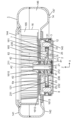
- FIG. 2 is a sectional view taken along the line II--II in FIG.
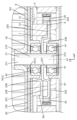
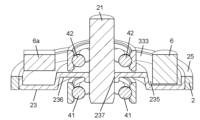
- FIG. 3 is an enlarged view of the main part of FIG. 2.
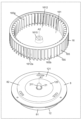
- FIG. 4 is a perspective view showing the motor and blades of the blower separated from each other.
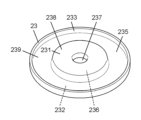
- FIG. 5 is a perspective view of a yoke included in the motor same as the above.
- FIG. 6 is a perspective view showing a main part of the motor same as the above in a broken state.
- FIG. 7 is a schematic diagram showing a moving body equipped with the same blower.
- blower of one embodiment is suitably mounted on a moving object such as an automobile, but may also be mounted on other equipment such as home appliances.
- FIG. 1 is a plan view of a blower 1 according to an embodiment of the present disclosure.
- FIG. 2 is a sectional view taken along line II-II of the blower 1 shown in FIG.
- FIG. 3 is an enlarged view of essential parts of the blower 1 shown in FIG. 2.
- an XZ orthogonal coordinate system is provided, with the direction parallel to the central axis A1 being the Z direction and the direction perpendicular to the central axis A1 being the X direction.
- the positive direction of the Z-axis is defined as “upward or upward”
- the negative direction of the Z-axis is defined as “downward or downward.” Note that “above or upward” and “downward or downward” are relative terms, and do not necessarily mean “above or upward” or “down or downward” in the vertical direction.
- the direction perpendicular to the central axis A1 is sometimes referred to as the "radial direction.”
- an area located in a direction perpendicular to the central axis A1 when viewed from a certain location and closer to the central axis A1 than the relevant location is referred to as an "inner”, “inward”, or “inner peripheral” area.
- an area that is perpendicular to the central axis A1 when viewed from a certain place and is further away from the central axis A1 compared to the place is referred to as an "outside", “outer”, or “outer periphery” area.
- the blower 1 of one embodiment includes a motor 12, a case 14 for blowing air attached to the motor 12, and blades 16 rotatably attached to the case 14. Equipped with.
- the blower 1 of one embodiment is a centrifugal blower.
- the blower 1 takes in air along the central axis A2 of the blades 16, and exhausts air in a direction intersecting the central axis A2 (in one embodiment, in a direction perpendicular to the central axis A2, in FIG. 2, in the X-axis direction). It is configured.
- the central axis A2 of the blade 16 coincides with the central axis A1 of the rotating shaft 21 of the motor 12.
- the direction in which the blower 1 takes in air matches the direction in which the motor 12 is positioned with respect to the blades 16.
- a first end 211 of the rotating shaft 21 in the direction along the central axis A1 is coupled to the blade 16.
- the blade 16 is driven to rotate integrally with the rotating shaft 21 of the motor 12.
- (1-2) Case The case 14 includes an inlet 144 for sucking in outside air, an outlet 145 for discharging air toward the outside space, and a flow path 146 connecting the inlet 144 and the outlet 145. has.
- the intake port 144 is circular.
- the discharge port 145 has a rectangular shape, for example.
- the case 14 includes a first member 141 forming one half of the case 14 and a second member 142 forming another half of the case 14.
- the case 14 is configured by fitting the first member 141 and the second member 142 together.
- the intake port 144 is included in the first member 141.
- the discharge port 145 is formed when the first member 141 and the second member 142 are fitted together.
- the flow path 146 forms a spiral surrounding the vane 16.
- the flow path 146 is formed when the first member 141 and the second member 142 are fitted together.
- the case 14 further has an opening 140 for connecting the motor 12. Opening 140 is included in second member 142 .
- the opening 140 included in the second member 142 is located opposite to the intake port 144 included in the first member 141.
- the opening 140 is a circular opening.
- the central axis A2 of the blade 16 is set to pass through the center of the opening 140.
- the opening 140 is an opening for inserting the part 121 of the motor 12 into the case 14 for blowing air.
- a portion 121 of the motor 12 is disposed above the lower surface 147 of the ventilation case 14, that is, at a positive position in the Z direction than the lower surface 147.
- FIG. 4 is a perspective view showing separately the motor 12 and the vane 16 included in the blower 1 of one embodiment.
- the blade 16 includes a flat hub 161 connected to the rotating shaft 21 and a plurality of blade plates 165 connected to the hub 161.
- the hub 161 has a flat plate shape.
- the hub 161 has a pair of flat surfaces 1612 and 1613 facing oppositely to each other.
- the hub 161 includes a connecting portion 1615 that constitutes the center of the hub 161.
- the connecting portion 1615 is a cylindrical portion into which the first end portion 211 of the rotating shaft 21 is fitted.
- the first end portion 211 of the rotary shaft 21 is fitted into the connecting portion 1615 of the blade 16, so that the rotary shaft 21 and the blade 16 are coupled to be rotatable together.
- the central axis A2 of the blade 16 passes through the center of the hub 161 (in other words, the connecting portion 1615).
- the plurality of vanes 165 protrude outward from the peripheral edge 1612a of the flat surface 1612 of the hub 161 when viewed from the central axis A2.
- the plurality of blade plates 165 are arranged at equal intervals in the circumferential direction surrounding the central axis A2 of the blade 16.
- the plurality of blade plates 165 are provided integrally with the hub 161.
- Each blade plate 165 has an arcuate outer shape in plan view.
- Each blade plate 165 includes an inner peripheral end 165a close to the central axis A2 of the blade 16 and an outer peripheral end 165b far from the central axis A2 of the blade 16.
- the motor 12 is a so-called inner rotor type brushless motor.
- the motor 12 includes a rotor 2, a stator 3, two bearings, that is, a first bearing 41 and a second bearing 42, a circuit board 7, and a motor case 8 that houses them. Equipped with.
- Rotor The rotor 2 includes, in addition to the rotating shaft 21, a yoke 23 in which at least one magnet 25 is arranged.
- FIG. 5 is a perspective view of the yoke 23 included in the motor 12.
- the yoke 23 has a through hole 237 into which the rotating shaft 21 is inserted.
- the through hole 237 is provided in the center of the yoke 23.
- the yoke 23 and the rotating shaft 21 are coupled to be able to rotate together.
- the yoke 23 has two surfaces, a first surface 231 and a second surface 232, that face opposite to each other in the direction in which the through hole 237 passes through, that is, in the Z direction.
- the first surface 231 faces the circuit board 7.
- the second surface 232 faces the first bearing 41 .
- the first surface 231 is an annular surface as a whole.
- the first surface 231 includes a portion close to the through hole 237 and a portion remote from the through hole 237, and the first recess 235 is provided in the portion remote from the through hole 237. In FIG. 3, the first recess 235 is recessed downward.
- the second surface 232 is an annular surface as a whole.
- the second surface 232 includes a portion close to the through hole 237 and a portion away from the through hole 237, and the second recess 236 is provided in the portion close to the through hole 237.
- the second recess 236 is recessed upward.
- the first recess 235 is an annular recess provided so as to surround the through hole 237 (in other words, to surround the rotating shaft 21 coupled to the yoke 23).
- the first recess 235 is annular. As will be described later, a part of the electronic component 6 is inserted into this annular first recess 235.
- the second recess 236 is an annular recess provided so as to surround the through hole 237 (in other words, to surround the rotating shaft 21 coupled to the yoke 23). In one embodiment, the second recess 236 is annular.
- the volume of the second recess 236 is smaller than the volume of the first recess 235.
- the area of the annular bottom surface of the second recess 236 is smaller than the area of the annular bottom surface of the first recess 235 .
- the second recess 236 When viewed in the penetrating direction of the through hole 237 (in other words, when viewed in the direction along the central axis A1 of the rotating shaft 21 coupled to the yoke 23), the second recess 236 is located inside the first recess 235. . As will be described later, a portion of the first bearing 41 is inserted into this annular second recess 236.
- the yoke 23 is a disc-shaped member formed by bending a metal plate, and has high rigidity by having a bent portion.
- the yoke 23 includes an inner half 238 that is close to the through hole 237 and an outer half 239 that is remote from the through hole 237.
- the inner half 238 is a part close to the rotating shaft 21 coupled to the yoke 23, and the outer half 239 is a part remote from the rotating shaft 21 coupled to the yoke 23.
- the inner half 238 and the outer half 239 are connected in series.
- the inner half 238 and the outer half 239 are recessed in opposite directions along the central axis A1, that is, the Z direction.
- the inner half 238 is provided with a second annular recess 236 having a relatively small diameter
- the outer half 239 is provided with a first annular recess 235 having a relatively large diameter.
- the direction in which the first recess 235 is recessed and the direction in which the second recess 236 is recessed are opposite to each other.
- At least one magnet 25 is arranged on the outer peripheral surface of the yoke 23.
- Each magnet 25 is a permanent magnet.
- the yoke 23 further includes an outer peripheral edge 233 (see FIGS. 3 and 5). At least one magnet 25 is arranged on the outer peripheral surface of the outer peripheral edge 233.
- the outer peripheral edge 233 forms a wall at the outer periphery of the first recess 235 .
- the outer peripheral edge portion 233 has a shape that protrudes from the bottom of the first recess 235 toward the circuit board 7 .
- stator 3 (1-4-2) Stator
- the stator 3 is arranged outside the rotor 2 when viewed from the central axis A1.
- the stator 3 includes a stator core 31 and a winding section 33 made up of a plurality of windings wound around the stator core 31.
- the stator 3 is configured to supply magnetic force to rotate the rotor 2.
- the rotational force of the rotor 2, which is located surrounded by the stator 3, is output to the outside of the motor 12 through the rotating shaft 21.
- stator core 31 The outer circumferential surface of the stator core 31 is in contact with the inner circumferential surface of the motor case 8 in a thermally conductive manner.
- Stator 3 and motor case 8 are thermally coupled.
- Motor case 8 and stator 3 may be thermally coupled through direct contact, or may be thermally coupled via a thermally conductive member.
- FIG. 6 is a perspective view showing a main part of the motor 12 according to one embodiment in a cutaway manner.
- the first bearing 41 and the second bearing 42 are assembled to the inner surface of the motor case 8 in order to rotatably support the rotating shaft 21.
- the first bearing 41 supports a part of the rotating shaft 21 so as to be rotatable around the central axis A1.
- the second bearing 42 supports another part of the rotating shaft 21 so as to be rotatable around the central axis A1.
- the part of the rotating shaft 21 supported by the first bearing 41 is the second end 212 in the direction along the central axis A1 of the rotating shaft 21.
- the first end 211 and the second end 212 are located in opposite directions.
- Another part of the rotating shaft 21 supported by the second bearing 42 is a portion 215 between the first end 211 and the second end 212 of the rotating shaft 21.
- a part of the first bearing 41 is inserted into the second recess 236.
- a portion of the first bearing 41 is inserted into the second recess 236 through a clearance to maintain non-contact.
- the part of the first bearing 41 that is inserted into the second recess 236 is the part of the first bearing 41 that is closer to the circuit board 7.
- Circuit Board 7 is configured to control the supply of electricity to the stator 3.
- the direction in which the circuit board 7 is positioned with respect to the rotor 2 and the stator 3 matches the direction in which the rotating shaft 21 protrudes from the motor case 8.
- the direction in which the circuit board 7 is positioned with respect to the rotor 2 and the stator 3 matches the direction in which the blades 16 are positioned with respect to the motor 12.
- At least one tall electronic component 6 is mounted on the circuit board 7.
- At least one electronic component 6 includes, for example, one or both of an electrolytic capacitor and a choke coil.
- the at least one electronic component 6 is one electronic component 6.
- This electronic component 6 is, for example, an electrolytic capacitor or a choke coil. A part of this electronic component 6 is inserted into the first recess 235 (see, for example, FIGS. 3 and 6). A part of the electronic component 6 is inserted into the first recess 235 through a clearance to maintain non-contact.
- a portion of the electronic component 6 inserted into the first recess 235 is a portion of the electronic component 6 that is remote from the circuit board 7.
- another electronic component 6a that is shorter than the electronic component 6 is further mounted on the circuit board 7.
- the electronic component 6a is located at a distance from the first recess 235. In other words, this electronic component 6a is an electronic component that will not be inserted into the first recess 235.
- the circuit board 7 has a mounting surface 71 on which these electronic components 6 and 6a are mounted.
- the direction of the mounting surface 71 is the direction in which the rotor 2 is positioned with respect to the circuit board 7, or in other words, the direction in which the motor 12 is positioned with respect to the blades 16.
- the circuit board 7 further has a surface 72 facing away from the mounting surface 71.
- the direction of this surface 72 is the direction in which the circuit board 7 is positioned with respect to the rotor 2, or in other words, the direction in which the blade 16 is positioned with respect to the motor 12.
- the circuit board 7 and the motor case 8 are thermally coupled via a thermally conductive member 51 (see FIG. 3).
- the heat generated by the electronic components 6 and 6a is conducted to a part of the motor case 8 (that is, a part 121 of the motor 12) through the circuit board 7 and the member 51.
- the motor case 8 is constructed by fitting a first member 81 and a second member 82 together.
- the first bearing 41 is arranged on the first member 81, and the second bearing 42 is arranged on the second member 82.
- the part 121 of the motor 12 that is inserted above the lower surface 147 of the case 14 through the opening 140 is made up of a part of the second member 82 of the motor case 8 .
- a flat surface 125 is included on the outer surface of a portion 121 of the motor 12 (that is, a portion of the second member 82).
- the heat generated by the electronic components 6 and 6a is conducted to a part of the motor case 8 exposed inside the case 14 through the circuit board 7 and the member 51, and is efficiently dissipated inside the case 14. be done.
- the yoke 23 is , are provided so as to overlap the tall electronic components 6 mounted on the circuit board 7.
- first recess 235 is an annular recess surrounding the rotating shaft 21, it is provided so that the electronic component 6 and the yoke 23 remain out of contact even when the rotor 2 including the yoke 23 rotates.
- the yoke 23 is provided so as to overlap the first bearing 41 when viewed in a direction orthogonal to the central axis A1 of the rotating shaft 21.
- the second recess 236 is an annular recess surrounding the rotating shaft 21, it is provided so that the first bearing 41 and the yoke 23 remain out of contact even when the rotor 2 including the yoke 23 rotates.
- the circuit board 7 is located between the rotor 2 and the blades 16 in the direction along the central axis A1 of the rotating shaft 21.
- FIG. 7 is a diagram schematically showing a mobile body 9 including the blower 1 of one embodiment.
- the moving body 9 further includes a battery 92, a control device 94, a cable 96, and a vehicle body 98.
- the mobile object 9 is a four-wheeled hybrid vehicle in which an engine and a driving battery 92 are mounted on a vehicle body 98.
- the moving body 9 is not limited to a hybrid vehicle, and may be an electric vehicle, for example.
- the battery 92 is comprised of, for example, a lithium ion battery, a nickel metal hydride battery, or the like, and supplies power to the motor 12, a drive motor for driving the moving object 9, and the like.
- the control device 94 is electrically connected to the blower 1 by a cable 96 and controls the motor 12 of the blower 1 .
- control device 94 controls the battery 92. More specifically, the control device 94 controls power supply from the battery 92 to the motor 12, drive motor, and the like.
- a blower 1, a battery 92, a control device 94, and a cable 96 are mounted on the vehicle body 98.
- the blower 1 mounted on the moving body 9 functions as a cooling fan system to suppress the temperature rise of the battery 92.
- the motor 12 in the blower 1 is driven to rotate, the blades 16 are rotated, and wind is sent to the battery 92 .
- the battery 92 is air-cooled, and a rise in temperature of the battery 92 is suppressed.
- the yoke 23 of the rotor 2 has a bent shape so as to include a first recess 235 and a second recess 236, but the shape of the yoke 23 is not limited to this.
- the yoke 23 may have an inclined shape such that it is located farther away from the circuit board 7 as it goes outward as viewed from the central axis A1.
- the yoke 23 can be provided so as to overlap the electronic component 6 when viewed in the radial direction of the rotating shaft 21. Further, the yoke 23 can be provided so as to overlap the first bearing 41 when viewed in the radial direction of the rotating shaft 21.
- the yoke 23 includes only one of the first recess 235 and the second recess 236. Even in this case, it is possible to provide the yoke 23 so as to overlap both the electronic component 6 and the first bearing 41 when viewed in the radial direction of the rotating shaft 21.
- the motor 12 of one embodiment includes a first bearing 41 that overlaps the yoke 23 and a second bearing 42 that does not overlap the yoke 23. It is also possible to provide the rotary shaft 21 so as to overlap both the first bearing 41 and the second bearing 42 when viewed in the radial direction of the rotating shaft 21. It is also possible that the motor 12 does not include the second bearing 42.
- the direction in which the circuit board 7 is positioned with respect to the rotor 2 and stator 3 corresponds to the direction in which the rotating shaft 21 protrudes from the motor case 8, but this positional relationship may be reversed. That is, the direction in which the circuit board 7 is positioned with respect to the rotor 2 and the stator 3 may be opposite to the direction in which the rotating shaft 21 protrudes from the motor case 8. In this case, the direction of the mounting surface 71 of the circuit board 7 matches the direction in which the blades 16 are positioned with respect to the motor 12.
- one electronic component 6 is inserted into the first recess 235, but a plurality of electronic components 6 may be inserted into the first recess 235. In this case, each of the plurality of electronic components 6 overlaps the yoke 23 when viewed in the radial direction of the rotating shaft 21.
- the hub 161 included in the blade 16 has a flat plate shape, but the shape of the hub 161 is not limited to this.
- the central portion of the hub 161 may have a bulged shape in the direction in which the rotating shaft 21 protrudes from the motor case 8.
- the motor (12) includes a rotor (2) including a rotating shaft (21), and a rotor (2) including a rotating shaft (21). It includes an arranged stator (3), a bearing (41) that rotatably supports a rotating shaft (21), and a circuit board (7) on which at least one electronic component (6) is mounted.
- the rotor (2) further includes a yoke (23) connected to the rotating shaft (21). When viewed in a direction perpendicular to the central axis (A1) of the rotating shaft (21), the yoke (23) overlaps the bearing (41) and at least one electronic component (6). It is set up like this.
- the height of the motor (12) can be reduced in the direction along the central axis (A1) of the rotating shaft (21) of the motor (12).
- the yoke (23) has a surface (231) facing the circuit board (7), and this surface (231) has at least It includes a recess (235) into which a part of one electronic component (6) is inserted.
- At least one electronic component (6) and the yoke (23) can be effectively overlapped by using the recess (235) of the yoke (23).
- the recess (235) is an annular recess provided so as to surround the rotating shaft (21).
- At least one electronic component (6) and the yoke (23) can be effectively overlapped by using the annular recess (235) provided in the yoke (23). .
- the yoke (23) has a surface (232) facing the bearing (41).
- This surface (232) includes a recess (236) into which a portion of the bearing (41) is inserted.
- the bearing (41) and the yoke (23) can be effectively overlapped by using the recess (236) of the yoke (23).
- the recess (236) is an annular recess provided so as to surround the rotating shaft (21).
- the bearing (41) and the yoke (23) can be effectively overlapped by using the annular recess (236) provided in the yoke (23).
- the yoke (23) has a first surface (231) facing the circuit board (7), and a first surface (231) that is opposite to the circuit board (7). and a second surface (232) facing the opposite direction.
- the first surface (231) includes a first recess (235) into which a portion of at least one electronic component (6) is inserted.
- the second surface (232) includes a second recess (236) into which a portion of the bearing (41) is inserted.
- At least one electronic component (6) and the yoke (23) can be effectively overlapped using the first recess (235) of the yoke (23), and the bearing (41) and the yoke (23) can be effectively overlapped by using the second recess (236) of the yoke (23).
- the yoke (23) in addition to the sixth aspect, includes an inner half portion (238) that is a portion of the yoke (23) near the rotating shaft (21);
- the yoke (23) includes an outer half (239) that is a portion of the yoke (23) that is remote from the rotating shaft (21).
- the first recess (235) is provided in the outer half (239).
- a second recess (236) is provided in the inner half (238).
- At least one electronic component (6) and the yoke (23) can be effectively connected by using the first recess (235) provided in the outer half (239) of the yoke (23).
- the bearing (41) and the yoke (23) can be overlapped by using the second recess (236) provided in the inner half (238) of the yoke (23). It can be wrapped.
- a blower (1) according to an eighth aspect includes the motor (12) according to any one of the first to seventh aspects, and a blade (16) coupled to a rotating shaft (21) of the motor (12). Be prepared.
- the blade (16) is connected to a flat hub (161) coupled to the rotating shaft (21) and the hub (161). and a plurality of slats (165).
- the hub (161) of the blade (16) is flat, it is possible to reduce noise during operation. Note that by reducing the height of the motor (12), it becomes easy to provide a flat hub (161) of the blade (16) coupled to the motor (12).
- the circuit board (7) is arranged in the rotor (2) in the direction along the central axis (A1) of the rotating shaft (21). ) and the blade (16).
- the heat generated by the electronic components (6) etc. mounted on the circuit board (7) can be conducted to a part close to the blade (16) and efficiently dissipated by air cooling in this part. can.
- a moving body (9) according to an eleventh aspect includes the blower (1) according to any one of the eighth to tenth aspects, and a vehicle body (98) that accommodates the blower (1).
- the motor can be made low in profile, and the low profile motor allows the blower to be made low in profile, making it possible to easily mount the blower on the moving body. In this way, the motor, blower, and moving body of the present disclosure are industrially useful.
Landscapes
- Engineering & Computer Science (AREA)
- Power Engineering (AREA)
- Connection Of Motors, Electrical Generators, Mechanical Devices, And The Like (AREA)
Priority Applications (2)
| Application Number | Priority Date | Filing Date | Title |
|---|---|---|---|
| JP2024524217A JPWO2023233831A1 (https=) | 2022-05-31 | 2023-04-13 | |
| CN202380041611.8A CN119301850A (zh) | 2022-05-31 | 2023-04-13 | 电动机、风机和移动体 |
Applications Claiming Priority (2)
| Application Number | Priority Date | Filing Date | Title |
|---|---|---|---|
| JP2022089252 | 2022-05-31 | ||
| JP2022-089252 | 2022-05-31 |
Publications (1)
| Publication Number | Publication Date |
|---|---|
| WO2023233831A1 true WO2023233831A1 (ja) | 2023-12-07 |
Family
ID=89026241
Family Applications (1)
| Application Number | Title | Priority Date | Filing Date |
|---|---|---|---|
| PCT/JP2023/014990 Ceased WO2023233831A1 (ja) | 2022-05-31 | 2023-04-13 | モータ、送風機及び移動体 |
Country Status (3)
| Country | Link |
|---|---|
| JP (1) | JPWO2023233831A1 (https=) |
| CN (1) | CN119301850A (https=) |
| WO (1) | WO2023233831A1 (https=) |
Citations (4)
| Publication number | Priority date | Publication date | Assignee | Title |
|---|---|---|---|---|
| JP2009142027A (ja) * | 2007-12-05 | 2009-06-25 | Shinano Kenshi Co Ltd | インナーロータ型ブラシレスモータ |
| JP2013158069A (ja) * | 2012-01-26 | 2013-08-15 | Asmo Co Ltd | モータ |
| JP2020076330A (ja) * | 2018-11-05 | 2020-05-21 | 日本電産株式会社 | 送風装置 |
| JP2020153275A (ja) * | 2019-03-19 | 2020-09-24 | ミネベアミツミ株式会社 | 遠心ファン |
-
2023
- 2023-04-13 JP JP2024524217A patent/JPWO2023233831A1/ja active Pending
- 2023-04-13 CN CN202380041611.8A patent/CN119301850A/zh active Pending
- 2023-04-13 WO PCT/JP2023/014990 patent/WO2023233831A1/ja not_active Ceased
Patent Citations (4)
| Publication number | Priority date | Publication date | Assignee | Title |
|---|---|---|---|---|
| JP2009142027A (ja) * | 2007-12-05 | 2009-06-25 | Shinano Kenshi Co Ltd | インナーロータ型ブラシレスモータ |
| JP2013158069A (ja) * | 2012-01-26 | 2013-08-15 | Asmo Co Ltd | モータ |
| JP2020076330A (ja) * | 2018-11-05 | 2020-05-21 | 日本電産株式会社 | 送風装置 |
| JP2020153275A (ja) * | 2019-03-19 | 2020-09-24 | ミネベアミツミ株式会社 | 遠心ファン |
Also Published As
| Publication number | Publication date |
|---|---|
| CN119301850A (zh) | 2025-01-10 |
| JPWO2023233831A1 (https=) | 2023-12-07 |
Similar Documents
| Publication | Publication Date | Title |
|---|---|---|
| US7976293B2 (en) | Centrifugal fan | |
| JP5286689B2 (ja) | 冷却ファンユニット | |
| CN107196460B (zh) | 电动力单元 | |
| CN107204675B (zh) | 电动力单元 | |
| KR101539321B1 (ko) | 지붕 배기팬 설치형 발전기 | |
| JP3242350U (ja) | ヘアドライヤ用高速モータ | |
| US10113551B2 (en) | Axial flow fan | |
| JP2008082328A (ja) | 遠心ファン | |
| CN102684394A (zh) | 马达组件 | |
| US11009032B2 (en) | Centrifugal fan | |
| JP2015113781A (ja) | 軸流ファンおよび直列型軸流ファン | |
| JP2016046849A (ja) | 回転電機 | |
| JP2006325315A (ja) | ファンモータ | |
| CN109904971B (zh) | 马达以及具有该马达的送风装置 | |
| WO2023233831A1 (ja) | モータ、送風機及び移動体 | |
| KR102154048B1 (ko) | 일체형 임펠러와 벨 마우스가 적용된 모터 | |
| CN118922632A (zh) | 风机及移动体 | |
| JP2011247275A (ja) | 遠心ファン | |
| JP2019100314A (ja) | 送風装置 | |
| JP2018182839A (ja) | 回転電機 | |
| JP2000224821A (ja) | レギュレータ付きアウターロータ型磁石発電機 | |
| JP2005163757A (ja) | 電動送風機 | |
| CN222915823U (zh) | 一种带散热的外转子电机 | |
| CN120569884A (zh) | 马达单元、风机以及移动体 | |
| KR101836184B1 (ko) | 배터리 냉각장치 |
Legal Events
| Date | Code | Title | Description |
|---|---|---|---|
| 121 | Ep: the epo has been informed by wipo that ep was designated in this application |
Ref document number: 23815593 Country of ref document: EP Kind code of ref document: A1 |
|
| WWE | Wipo information: entry into national phase |
Ref document number: 2024524217 Country of ref document: JP Ref document number: 202380041611.8 Country of ref document: CN |
|
| NENP | Non-entry into the national phase |
Ref country code: DE |
|
| WWP | Wipo information: published in national office |
Ref document number: 202380041611.8 Country of ref document: CN |
|
| 122 | Ep: pct application non-entry in european phase |
Ref document number: 23815593 Country of ref document: EP Kind code of ref document: A1 |
|
| 122 | Ep: pct application non-entry in european phase |
Ref document number: 23815593 Country of ref document: EP Kind code of ref document: A1 |