WO2023224065A1 - ウェットペットフード用嗜好性向上剤及びウェットペットフード - Google Patents
ウェットペットフード用嗜好性向上剤及びウェットペットフード Download PDFInfo
- Publication number
- WO2023224065A1 WO2023224065A1 PCT/JP2023/018440 JP2023018440W WO2023224065A1 WO 2023224065 A1 WO2023224065 A1 WO 2023224065A1 JP 2023018440 W JP2023018440 W JP 2023018440W WO 2023224065 A1 WO2023224065 A1 WO 2023224065A1
- Authority
- WO
- WIPO (PCT)
- Prior art keywords
- pet food
- palatability
- wet
- wet pet
- food
- Prior art date
- Legal status (The legal status is an assumption and is not a legal conclusion. Google has not performed a legal analysis and makes no representation as to the accuracy of the status listed.)
- Ceased
Links
Classifications
-
- A—HUMAN NECESSITIES
- A23—FOODS OR FOODSTUFFS; TREATMENT THEREOF, NOT COVERED BY OTHER CLASSES
- A23K—FODDER
- A23K50/00—Feeding-stuffs specially adapted for particular animals
- A23K50/40—Feeding-stuffs specially adapted for particular animals for carnivorous animals, e.g. cats or dogs
- A23K50/48—Moist feed
-
- A—HUMAN NECESSITIES
- A23—FOODS OR FOODSTUFFS; TREATMENT THEREOF, NOT COVERED BY OTHER CLASSES
- A23K—FODDER
- A23K20/00—Accessory food factors for animal feeding-stuffs
- A23K20/10—Organic substances
- A23K20/142—Amino acids; Derivatives thereof
- A23K20/147—Polymeric derivatives, e.g. peptides or proteins
-
- A—HUMAN NECESSITIES
- A23—FOODS OR FOODSTUFFS; TREATMENT THEREOF, NOT COVERED BY OTHER CLASSES
- A23K—FODDER
- A23K10/00—Animal feeding-stuffs
- A23K10/10—Animal feeding-stuffs obtained by microbiological or biochemical processes
- A23K10/16—Addition of microorganisms or extracts thereof, e.g. single-cell proteins, to feeding-stuff compositions
-
- A—HUMAN NECESSITIES
- A23—FOODS OR FOODSTUFFS; TREATMENT THEREOF, NOT COVERED BY OTHER CLASSES
- A23K—FODDER
- A23K10/00—Animal feeding-stuffs
- A23K10/20—Animal feeding-stuffs from material of animal origin
-
- A—HUMAN NECESSITIES
- A23—FOODS OR FOODSTUFFS; TREATMENT THEREOF, NOT COVERED BY OTHER CLASSES
- A23K—FODDER
- A23K20/00—Accessory food factors for animal feeding-stuffs
- A23K20/10—Organic substances
- A23K20/142—Amino acids; Derivatives thereof
-
- A—HUMAN NECESSITIES
- A23—FOODS OR FOODSTUFFS; TREATMENT THEREOF, NOT COVERED BY OTHER CLASSES
- A23K—FODDER
- A23K20/00—Accessory food factors for animal feeding-stuffs
- A23K20/10—Organic substances
- A23K20/163—Sugars; Polysaccharides
-
- A—HUMAN NECESSITIES
- A23—FOODS OR FOODSTUFFS; TREATMENT THEREOF, NOT COVERED BY OTHER CLASSES
- A23K—FODDER
- A23K20/00—Accessory food factors for animal feeding-stuffs
- A23K20/20—Inorganic substances, e.g. oligoelements
- A23K20/26—Compounds containing phosphorus
-
- A—HUMAN NECESSITIES
- A23—FOODS OR FOODSTUFFS; TREATMENT THEREOF, NOT COVERED BY OTHER CLASSES
- A23K—FODDER
- A23K50/00—Feeding-stuffs specially adapted for particular animals
- A23K50/40—Feeding-stuffs specially adapted for particular animals for carnivorous animals, e.g. cats or dogs
-
- A—HUMAN NECESSITIES
- A23—FOODS OR FOODSTUFFS; TREATMENT THEREOF, NOT COVERED BY OTHER CLASSES
- A23K—FODDER
- A23K50/00—Feeding-stuffs specially adapted for particular animals
- A23K50/40—Feeding-stuffs specially adapted for particular animals for carnivorous animals, e.g. cats or dogs
- A23K50/42—Dry feed
Definitions
- the present invention relates to a palatability improver for wet pet food and a wet pet food.
- This application claims priority based on Japanese Patent Application No. 2022-081251, filed in Japan on May 18, 2022, the contents of which are incorporated herein.
- palatability enhancers have been added to pet foods to improve palatability.
- Many palatability improvers contain phosphates from the viewpoint of palatability and storage performance (for example, see Patent Document 1).
- Patent Document 2 describes a Maillard reaction product produced by adding a predetermined amount of reducing sugar to a peptide-containing material and heat-treating the peptide-containing material.
- a palatability enhancer containing a residual peptide and a residual peptide has been proposed.
- phosphates can cause kidney function decline and kidney disease due to high phosphorus diet.
- the amount of phosphorus derived from sodium tripolyphosphate (STPP) is up to 1.0 g/1000 kcal as the NOAEL (no adverse effect level), which is the amount that does not change GFR, which is a primary indicator of renal function. has been done. Therefore, in order to reduce the burden on the pet's kidneys, a palatability enhancer with a low phosphate content is desired.
- the palatability improver described in Patent Document 2 contains a Maillard reaction product. Therefore, when the palatability improver is added to wet food, the Maillard reaction may occur again during the retort process of the wet food, and the color of the final product may become darker. In addition, caramelization is likely to occur due to the Maillard reaction again, and there is a risk that the final product will have a bitter taste.
- the present invention was made in view of the above circumstances, and provides a wet pet food that has a reduced phosphorus content, has good palatability, is easy to adjust the color of the wet food, and is resistant to bitterness.
- An object of the present invention is to provide a palatability improver and a wet pet food to which the wet pet food palatability improver is applied.
- the present invention has the following aspects.
- (1) Contains at least one palatability agent component selected from the group consisting of protein hydrolyzate and yeast extract, free glycine and reducing sugar, has a phosphorus content of 1% or less on a dry matter basis, and has a Maillard A palatability enhancer for wet pet food that does not contain reaction products.
- (2) The palatability improver for wet pet food according to (1) above, wherein the content of the free glycine is equal to or more than the content of the reducing sugar.
- (3) The palatability improver for wet pet food according to (1) or (2) above, wherein the ratio of the free glycine to the reducing sugar is 1:1 to 4:1.
- the wet pet food palatability improver of the present embodiment even if the content of phosphate is low, the Maillard reaction between glycine and reducing sugar and the Maillard reaction between protein decomposition products and reducing sugar result in the reaction of both. Things are produced and palatability improves.
- the palatability improver is pre-Maillard reaction
- the palatability improver is added to wet pet food and subjected to the retort process, the color becomes darker. Bitterness due to caramelization etc. does not occur.
- pet refers to an animal kept by a person. In a narrower sense, a pet is an animal that is cherished by its owner. Moreover, “pet food” refers to feed for pets.
- palatability is an indicator of whether or not a pet likes to eat it, and it is caused by texture, taste, smell, etc.
- the water content (% by weight) of pet food is determined by a normal pressure heating drying method.
- the moisture content determined by this method includes the moisture in the ingredients.
- the weight (W1 gram) of the aluminum weighing can is measured in advance as a constant weight value.
- a sample is placed in this aluminum weighing can and its weight (W2 grams) is measured.
- the sample is dried at 135° C. for 2 hours using a forced circulation hot air dryer. After cooling in a dry atmosphere (in a silica gel desiccator), the weight (W3 grams) is measured.
- the moisture content is determined from each weight obtained using the following formula.
- Moisture content (unit: weight %) (W2-W3) ⁇ (W2-W1) x 100
- the palatability improver for wet pet food contains at least one palatability agent component selected from the group consisting of protein hydrolyzate and yeast extract, free glycine, and reducing sugar.
- the Maillard reaction between glycine and reducing sugar can be carried out even if the content of phosphate is small.
- the Maillard reaction between the proteolytic product and the reducing sugar generates a reaction product between the two, improving palatability.
- the palatability improver for wet pet food of this embodiment has a phosphorus content of 1% or less based on the total amount of the palatability improver for wet pet food in terms of dry matter. When the phosphorus content is 1% or less, it is expected that the burden on the pet's kidneys will be reduced.
- the content of phosphorus in the palatability improver for wet pet food is preferably 1% or less, more preferably 0.5% or less, and more preferably 0.05% or less based on the total amount of the palatability improver for wet pet food in terms of dry matter. % or less is more preferable.
- the phosphorus content is within the above-mentioned preferred range, it is expected that the burden on the pet's kidneys will be further reduced.
- the wet pet food palatability improver of this embodiment does not contain Maillard reaction products. That is, the wet pet food palatability improver of this embodiment is not subjected to the Maillard reaction.
- the color can be easily adjusted and bitterness caused by caramelization etc. can be prevented. .
- the palatability component is not particularly limited as long as it contains at least one selected from the group consisting of protein hydrolyzate and yeast extract.
- Protein hydrolysates are animal or vegetable raw materials, and decomposition methods include enzymatic decomposition, acid decomposition, and autolysis.
- animal raw materials include decomposed products derived from chicken, pig, cow, sheep, dairy products, seafood, and the like.
- the vegetable raw materials include raw materials derived from plants other than those mentioned above, such as beans, potatoes, grains, fruits, seeds, vegetables, and seaweeds.
- yeast extract examples include decomposition products using raw materials derived from yeast such as brewer's yeast, baker's yeast, and Torula yeast, and decomposition methods include enzymatic decomposition, acid decomposition, autolysis, and the like.
- the at least one palatability agent component is a protein hydrolyzate using a chicken-derived raw material and/or a decomposition product using a yeast-derived raw material. is preferred.
- the at least one taste agent component preferably contains protein in an amount of 12% or more, more preferably 25% or more, and even more preferably 40% or more on a dry matter basis.
- the protein content of the at least one palatability agent component is within the above-mentioned preferred range, the Maillard reaction is likely to occur when the palatability improver for wet pet food is added to the wet food and subjected to the retort process, easily improves palatability.
- the content of the at least one palatability agent component is not particularly limited, but is preferably 30 to 90%, more preferably 40 to 80%, based on the total amount of the palatability improver for wet pet food. , 50 to 70% is more preferable.
- the amount of the wet pet food palatability improver added to the wet pet food in the first period is not particularly limited, but it is preferably 0.1 to 6%, and 0.2 to 5% based on the total amount of the pet food. is more preferable, and even more preferably 0.5 to 4%.
- free glycine does not originate from the at least one taste agent component, but refers to one that is blended as a component different from the at least one taste agent component.
- the content of free glycine is preferably 0.8% to 30%, more preferably 10 to 30%, and even more preferably 20 to 30%, based on the total amount of the wet pet food palatability improver. preferable.
- the content of free glycine is within the above preferred range, when the wet pet food palatability improver is added to the wet food and subjected to the retort process, the reaction product between glycine and sugar is more reliably produced by the Maillard reaction. Since it becomes easier to produce, palatability tends to improve.
- reducing sugars are not particularly limited, and include xylose, glucose, fructose, lactose, maltose, etc., and one or more types may be mixed. Among these, maltose, xylose and glucose are preferable as the reducing sugar, and glucose and xylose are more preferable.
- the content of reducing sugar is preferably 0.2% to 30%, more preferably 10 to 30%, and still more preferably 10 to 20%, based on the total amount of the wet pet food palatability improver. preferable.
- the content of reducing sugar is within the above-mentioned preferred range, the Maillard reaction is likely to occur when the wet pet food palatability improver is added to the wet food and subjected to the retort process, and the palatability is likely to be improved.
- the content of free glycine is equal to or greater than the content of the reducing sugar. Since the free glycine content is equal to or more than the reducing sugar content, after adding the wet pet food palatability improver to the wet food and subjecting it to a retort process to cause a Maillard reaction, Free glycine tends to remain in wet food. Therefore, since both the Maillard reaction product and the unreacted free glycine are present in the wet food, palatability tends to improve.
- the ratio of the free glycine to the reducing sugar is preferably 1:1 to 4:1, more preferably 1:1 to 3:1, and even more preferably 1:1 to 2:1.
- the Maillard reaction occurs efficiently when the wet pet food palatability improver is added to the wet food and subjected to the retort process. Almost improves palatability.
- the palatability improver for wet pet food of this embodiment is added to wet food and subjected to a retort process to cause a Maillard reaction, and then the reducing sugar content in the wet food is 0.05% or less ( (detection limit amount or less) is preferable.
- the reducing sugar content in the wet food is 0.05% or less (below the detection limit) is preferable.
- the wet pet food palatability improver of the present embodiment preferably has a Na content of 1% or less.
- the Na content is within the above-mentioned preferred range, it becomes easier to adjust the Na nutritional component of the entire wet food while improving palatability.
- Other sodium salts can also be used in wet foods.
- the wet pet food of this embodiment contains the Maillard reaction product of the palatability improver for wet pet food. That is, the wet pet food of this embodiment is obtained by adding a wet pet food palatability improver to wet food and subjecting it to a retort process to cause a Maillard reaction.
- At least one palatability agent component selected from the group consisting of protein hydrolyzate and yeast extract, free glycine, and reducing sugar are separately and independently added to the wet food, and then added to the wet food in the retort process. It may also be obtained by subjecting it to a Maillard reaction.
- the wet pet food of this embodiment is not particularly limited as long as it contains the Maillard reaction product of the palatability improver for wet pet food, and any known wet food can be used.
- wet food refers to pet food that contains more water than dry food that has been subjected to drying treatment as the final market offering form.
- the moisture content of the pet food is usually 50% by mass or more, preferably 60% by mass or more, more preferably 65% by mass or more, particularly 70% by mass or more based on the total mass of the pet food. preferable.
- Wet food typically includes a base portion and may further include chunk portions and/or flakes.
- chunk refers to a portion of the raw material solidified into small pieces, and the chunk portion refers to a collection of chunks.
- chunk refers to finely chopped fish or meat.
- base portion refers to the wet portion of the pet food other than the chunk portion and flake portion.
- the proportion of chunks and/or flakes contained in the wet food is not particularly limited, and is preferably 0 to 50% by mass, more preferably 0 to 40% by mass, based on the mass of the entire pet food. .
- the wet food palatability improver is contained in the base portion or the chunk portion.
- the shape of the chunks is not particularly limited, and examples thereof include shapes formed into pellets (grains) such as spherical, polygonal, columnar, donut-shaped, plate-like, or go-stone shapes.
- the size of such a pellet is not particularly limited, but for example, when the pellet placed on a horizontal table is viewed from above, the short and long diameters are 1 to 25 mm, and the size of the pellet on the horizontal table is from the bottom surface (lower end) to the top surface ( It is preferable that the thickness to the upper end is 1 to 20 mm, it is more preferable that the short axis and long axis are 3 to 11 mm, and the thickness is 3 to 9 mm, and the short axis and long axis are 5 to 9 mm, and the thickness is 5 to 8 mm.
- the form of the base portion is not particularly limited, and may be in a liquid state, a gel state, a solid state, or a combination thereof. Further, when the base portion contains a solid, the shape is not particularly limited, but may be similar to the shape of the chunk described above.
- the pet food product according to this embodiment is particularly preferably for cats and dogs.
- the raw materials constituting the wet food are not particularly limited except for the palatability improver for wet food, and raw materials used in conventional pet foods can be used.
- raw materials used in conventional pet foods can be used.
- protein components carbohydrate components, vitamins, minerals, salts, fats, oils, etc. may be added.
- a thickener may be added as a raw material when preparing wet food.
- the thickener include polysaccharides such as guar gum, starch, carrageenan, xanthan gum, and locust bean gum.
- raw materials When using fish such as tuna, sardines, and bonito, or livestock such as cows, pigs, and chickens as protein components contained in raw materials for wet food, these raw materials may be heated or cooked in advance by known methods. I do not care.
- Wet food can be produced, for example, by mixing a protein component and water, and adding a thickener if necessary.
- the mixing method is not particularly limited, and a known method using a mixer or mincer can be applied, and it is preferable to adopt a method that allows uniform mixing.
- pre-mixing processing
- the protein component into a minced form and then mixing it with other raw materials
- each raw material can be mixed more uniformly. It does not matter if the pet food becomes a paste after mixing.
- lump-like (solid) ingredients may be dispersed in the paste-like pet food. Because the ingredients in the pet food are uniformly mixed or the pet food is in paste form, it is possible to prevent the pet from eating only a portion of the pet food or only some of the ingredients, thereby increasing the complete eating rate. can be improved.
- the time and temperature for mixing the raw materials can be set as appropriate. By adjusting the mixing time, the viscosity of the pet food can be adjusted. Furthermore, by adjusting the amount of water to be mixed, the viscosity and water content of the pet food can be adjusted. The viscosity of pet food can also be adjusted by the amount of thickener added.
- wet food usually does not have solid ingredients and liquid soup separated, but only paste ingredients with the above-mentioned specific viscosity and moisture content, or paste ingredients and solid ingredients. It has a form in which the materials are intertwined.
- the wet food preferably has at least a part of the paste-like form (components) having the above-mentioned viscosity and water content, rather than having a form in which the soup component and solid ingredients are separated.
- solid ingredients may also be included. In this case, the solid ingredients are intertwined with the paste-like ingredients, so the solid ingredients are delivered to the pet's mouth together with the paste-like ingredients. The complete consumption rate of wet food can be improved.
- the chunk part and the base part can be manufactured using the following raw materials.
- the raw materials contained in the base part of the wet food are not particularly limited, but protein raw materials can be used as the main raw material in the base part.
- the protein raw material for the base portion include plant-derived proteins, animal-derived proteins, and mixtures thereof.
- examples of the plant-derived proteins include gluten, wheat protein, soybean protein, rice protein, and corn protein.
- examples of the animal-derived proteins include proteins from muscles and organs of cows, pigs, chickens, and seafood, milk proteins, and mixtures thereof.
- oils and fats the aforementioned palatability improver for wet food, a thickener, water, etc. can be added.
- a protein raw material can be used in the chunk portion of the pet food.
- the protein raw material for the chunk portion the same protein raw material as that used for the base portion can be used.
- grains may be added to the chunk portion of the pet food.
- Preferred examples of grains include corn, wheat, barley, oats, rice, and soybeans. These grains can contain protein, ash, minerals, vitamins, etc. in addition to carbohydrates, so they can be used as a nutritional source. Furthermore, by adding grains, it becomes easy to adjust (mainly lower) the blending ratio of amino acids in the entire pet food. As raw materials other than those mentioned above for the chunk portion, the wet food palatability improver, a binder, water, etc. can be added.
- the retort process is not particularly limited, and conventionally known methods can be applied. Specifically, at least one palatability enhancer for wet pet food or at least one palatability agent selected from the group consisting of protein hydrolyzate and yeast extract, free glycine, and reducing sugar are added to the wet food, and the mixture is packaged in a pouch container. After filling with pet food, retort sterilization is performed by known heat treatment or pressure treatment. The retort sterilization step is not particularly limited as long as it can sufficiently sterilize the pet food, but it is preferably under conditions that the flavor of the pet food does not deteriorate after the sterilization treatment.
- Retort sterilization may be performed by heat treatment at a temperature of, for example, 110 to 130°C for about 5 to 50 minutes.
- the container is not limited to a pouch container, and any known wet food container can be used as appropriate. For example, it may be a can or a cup container.
- Examples 1 to 6, Comparative Example 1 The raw materials constituting the palatability improver for wet pet food were mixed in the formulation shown in Table 1 to obtain the palatability improver for wet pet food of each example.
- the wet pet food palatability improver of each example was added to a wet food prepared by mixing fish meat, a thickener, and water, and retorted at 121° C. to obtain a wet pet food product.
- the blending amount (%) of each raw material of the palatability improver is a percentage of the total amount of the palatability improver.
- the phosphorus content (%) in the palatability improver is a percentage of the total amount of the palatability improver.
- the palatability improver content (%) in the product is a percentage of the total amount of wet food and palatability improver.
- the wet pet foods of Examples 1 to 6 are different from the wet pet food of Comparative Example 1, which contains a phosphate palatability improver, although they do not contain a phosphate palatability improver. It was confirmed that the same or higher palatability could be obtained. Furthermore, from the results shown in Table 1, it was confirmed that palatability is particularly improved when a protein hydrolyzate using chicken-derived raw materials and/or a decomposition product using yeast-derived raw materials is used as a palatability agent component. It was done.
- the palatability when added to wet food is improved, the color of the wet food can be easily adjusted, and bitterness is less likely to occur.
Landscapes
- Life Sciences & Earth Sciences (AREA)
- Chemical & Material Sciences (AREA)
- Polymers & Plastics (AREA)
- Engineering & Computer Science (AREA)
- Animal Husbandry (AREA)
- Zoology (AREA)
- Food Science & Technology (AREA)
- Proteomics, Peptides & Aminoacids (AREA)
- Biotechnology (AREA)
- Health & Medical Sciences (AREA)
- Biomedical Technology (AREA)
- Molecular Biology (AREA)
- Physiology (AREA)
- Microbiology (AREA)
- Birds (AREA)
- Biochemistry (AREA)
- Inorganic Chemistry (AREA)
- Fodder In General (AREA)
- Feed For Specific Animals (AREA)
Abstract
Description
本願は、2022年5月18日に日本に出願された、特願2022-081251号に基づき優先権主張し、その内容をここに援用する。
(1)タンパク加水分解物及び酵母エキスからなる群より選ばれる少なくとも1種の嗜好剤成分、遊離グリシン並びに還元糖を含有し、リンの含有量が、乾物換算で、1%以下であり、メイラード反応生成物を含有しないウェットペットフード用嗜好性向上剤。
(2)前記遊離グリシンの含有量が、前記還元糖の含有量と同量以上である、前記(1)に記載のウェットペットフード用嗜好性向上剤。
(3)前記遊離グリシン:前記還元糖の割合が、1:1~4:1である、前記(1)又は(2)に記載のウェットペットフード用嗜好性向上剤。
(4)前記遊離グリシンの含有量が、0.8%~30%である、前記(1)~(3)のいずれか一つに記載のウェットペットフード用嗜好性向上剤。
(5)前記還元糖の含有量が、0.2%~30%を含有する、前記(1)~(4)のいずれか一つに記載のウェットペットフード用嗜好性向上剤。
(6)前記少なくとも1種の嗜好剤成分が、タンパク質を乾物換算で12%以上含有する、前記(1)~(5)のいずれか一つに記載のウェットペットフード用嗜好性向上剤。
(7)前記少なくとも1種の嗜好剤成分が、チキン由来の原料を用いたタンパク加水分解物及び/又は酵母由来の原料を用いた分解物である、前記(1)~(6)のいずれか一つに記載のウェットペットフード用嗜好性向上剤。
(8)メイラード反応後の前記還元糖の含有量が、ペットフード全量に対して0.05%以下である、前記(1)~(7)のいずれか一つに記載のウェットペットフード用嗜好性向上剤。
(9)前記(1)~(8)のいずれか一項に記載のウェットペットフード用嗜好性向上剤のメイラード反応生成物を含有するウェットペットフード。
(常圧加熱乾燥法)
アルミ秤量缶の重量(W1グラム)を恒量値として予め測定する。このアルミ秤量缶に試料を入れて重量(W2グラム)を秤量する。つぎに強制循環式の温風乾燥器を使用して、135℃、2時間の条件で試料を乾燥させる。乾燥雰囲気中(シリカゲルデシケーター中)で放冷した後、重量(W3グラム)を秤量する。得られた各重量から下記式を用いて水分含有率を求める。
水分含有率(単位:重量%)=(W2-W3)÷(W2-W1)×100
本実施形態にかかるウェットペットフード用嗜好性向上剤は、タンパク加水分解物及び酵母エキスからなる群より選ばれる少なくとも1種の嗜好剤成分、遊離グリシン並びに還元糖を含有する。
タンパク加水分解物及び酵母エキスからなる群より選ばれる少なくとも1種の嗜好剤成分、遊離グリシン並びに還元糖を含有することにより、リン酸塩の含有量が少なくても、グリシンと還元糖によるメイラード反応と、タンパク分解物と還元糖によるメイラード反応による両者の反応生成物が生成し、嗜好性が向上する。
リンの含有量が1%以下であると、ペットの腎臓への負担軽減が期待される。
リンの含有量が上記の好ましい範囲以内であると、ペットの腎臓への負担軽減がより期待される。
メイラード反応生成物を含有しないことにより、ウェットペットフード用嗜好性向上剤をウェットペットフードに添加してレトルト工程に付す際に、色味を調整しやすく、カラメル化等による苦みが生じること防止できる。
本実施形態において、嗜好性成分はタンパク加水分解物及び酵母エキスからなる群より選ばれる少なくとも1種を含有すれば特に限定されない。
タンパク加水分解物としては、動物性・植物性の原料で、分解方法は酵素分解または酸分解、自己消化などがあげられる。
動物性原料としては、鶏・豚・牛・羊、乳製品、魚介類由来等の分解物が挙げられる。 植物性原料としては、上記以外の豆類やイモ類、穀類、果実類、種子類、野菜類、海藻類等の植物由来の原料が挙げられる。
酵母エキスとしては、ビール酵母、パン酵母、トルラ酵母等の酵母由来の原料を用いた分解物が挙げられ、分解方法は酵素分解または酸分解、自己消化等があげられる。
前記少なくとも1種の嗜好剤成分のタンパク質の含有量が上記の好ましい範囲内であると、ウェットペットフード用嗜好性向上剤をウェットフードに添加してレトルト工程に付す際にメイラード反応が起こりやすく、嗜好性が向上しやすい。
本実施形態において、遊離グリシンは、前記少なくとも1種の嗜好剤成分由来ではなく、前記少なくとも1種の嗜好剤成分とは異なる成分として配合されたものを意味する。
遊離グリシンの含有量が上記の好ましい範囲内であると、ウェットペットフード用嗜好性向上剤をウェットフードに添加してレトルト工程に付す際にメイラード反応でより確実にグリシンと糖との反応物が生成しやすくなるので、嗜好性が向上しやすい。
本実施形態において、還元糖は特に限定されないが、キシロース、グルコース、フルクトース、ラクトース、マルトースなどが挙げられ1種または複数種を混合してもよい。なかでも、還元糖としては、マルトース、キシロースやグルコースが好ましく、グルコース、キシロースがより好ましい。
還元糖の含有量が上記の好ましい範囲内であると、ウェットペットフード用嗜好性向上剤をウェットフードに添加してレトルト工程に付す際にメイラード反応が起こりやすくなり、嗜好性が向上しやすい。
遊離グリシン含有量が、前記還元糖の含有量と同量以上であることにより、ウェットペットフード用嗜好性向上剤をウェットフードに添加してレトルト工程に付してメイラード反応を生じさせた後に、ウェットフード中に遊離グリシンが残存しやすい。そのため、ウェットフード中にメイラード反応生成物と、反応されずに残った遊離グリシンのいずれも存在するので、嗜好性が向上しやすい。
前記遊離グリシン:前記還元糖の割合が、上記の好ましい範囲内であると、ウェットペットフード用嗜好性向上剤をウェットフードに添加してレトルト工程に付した際にメイラード反応が効率良く起こるので、嗜好性が向上しやすい。
メイラード反応後のウェットフード中の還元糖の含有量が0.05%以下(検出限界量以下)であることにより、嗜好性を向上しつつ、ペット(特に猫)の健康を担保しやすくなる。
Naの含有量が上記の好ましい範囲内であると、嗜好性を向上しつつ、ウェットフード全体のNa栄養成分として調整しやすくなる。また、ウェットフードに他のナトリウム塩を使用できる。
本実施形態のウェットペットフードは、前記ウェットペットフード用嗜好性向上剤のメイラード反応生成物を含有する。すなわち、本実施形態のウェットペットフードは、ウェットペットフード用嗜好性向上剤をウェットフードに添加してレトルト工程に付してメイラード反応を生じさせて得られたものである。
本実施形態において、ウェットフードとは、最終的な市場提供形態として、乾燥処理が施されたドライフードと比べ、水分を多く含むペットフードを云う。前記ペットフードの水分含有率は、前記ペットフード全体の質量に対して通常50質量%以上であり、60質量%以上であることが好ましく、65質量%以上がより好ましく、70質量%以上が特に好ましい。
前記ベース部の様態は特に制限されず、液体状、ゲル状、固体状等の様態又はそれらの組み合わせが挙げられる。また、前記ベース部に固体を含有させる場合、形状は特に制限されないが、上記のチャンクの形状と同様のものが挙げられる。
ウェットフードを構成する原材料は、前記ウェットフード用嗜好性向上剤以外は特に制限されず、従来のペットフードに使用されている原材料を適用することができる。例えばタンパク質成分の他に、炭水化物成分、ビタミン類、ミネラル類、塩類、脂肪、油等を添加しても構わない。
前記増粘剤としては、例えば、グアーガム、澱粉、カラギーナン、キサンタンガム、ローカストビーンガム等の多糖類が挙げられる。
前記ウェットフードのベース部に含まれる原材料は特に制限されないが、ベース部にはタンパク質原材料を主な原材料として用いることができる。前記ベース部のタンパク質原材料としては、植物由来の蛋白質、動物由来の蛋白質又はこれらの混合物が例示できる。具体的には、前記植物由来の蛋白質は、例えばグルテン、小麦蛋白質、大豆蛋白質、米蛋白質、とうもろこし蛋白質等が挙げられる。前記動物由来の蛋白質としては、例えば牛、豚、鶏及び魚介類の筋肉、臓器などの蛋白質、乳の蛋白質又はこれらの混合物が例示できる。
ベース部の前記以外の原材料として、油脂、前記ウェットフード用嗜好性向上剤、増粘剤及び水等を加えることができる。
前記ペットフードのチャンク部には、タンパク質原材料を用いることができる。前記チャンク部のタンパク質原材料としては、上記のベース部に用いたものと同様のタンパク質原材料を用いることができる。
チャンク部の前記以外の原材料として、前記ウェットフード用嗜好性向上剤、結着剤及び水等を加えることができる。
レトルト工程は特に限定されず、従来公知の方法が適用できる。具体的には、ウェットフードにウェットペットフード用嗜好性向上剤もしくはタンパク加水分解物及び酵母エキスからなる群より選ばれる少なくとも1種の嗜好剤成分、遊離グリシン並びに還元糖を添加してパウチ容器にペットフードを充填後、公知の加熱処理又は加圧処理によってレトルト殺菌を行う。レトルト殺菌工程はペットフードに対して十分な殺菌が行なえる条件であれば特に制限されないが、殺菌処理後にペットフードの風味が劣化しない条件であることが好ましい。レトルト殺菌は、例えば110~130℃の温度で、5分~50分程度の加熱処理を行ってもよい。
容器はパウチ容器に限らず、公知のウェットフードの容器を適宜用いることができる。例えば缶やカップ容器でもよい。
表1に示す配合で、ウェットペットフード用嗜好性向上剤を構成する原料を混合し、各例のウェットペットフード用嗜好性向上剤を得た。各例のウェットペットフード用嗜好性向上剤を、魚肉類、増粘剤及び水を混合して調製したウェットフードに添加し、121℃でレトルト処理してウェットペットフード製品を得た。
表1中、嗜好性向上剤の各原料の配合量(%)は、嗜好性向上剤全量に対する百分率である。
また、表1中、嗜好性向上剤中のリン含有量(%)は、嗜好性向上剤全量に対する百分率である。
また、表1中、製品中の嗜好性向上剤含有割合(%)は、ウェットフードと嗜好性向上剤の合計量に対する百分率である。
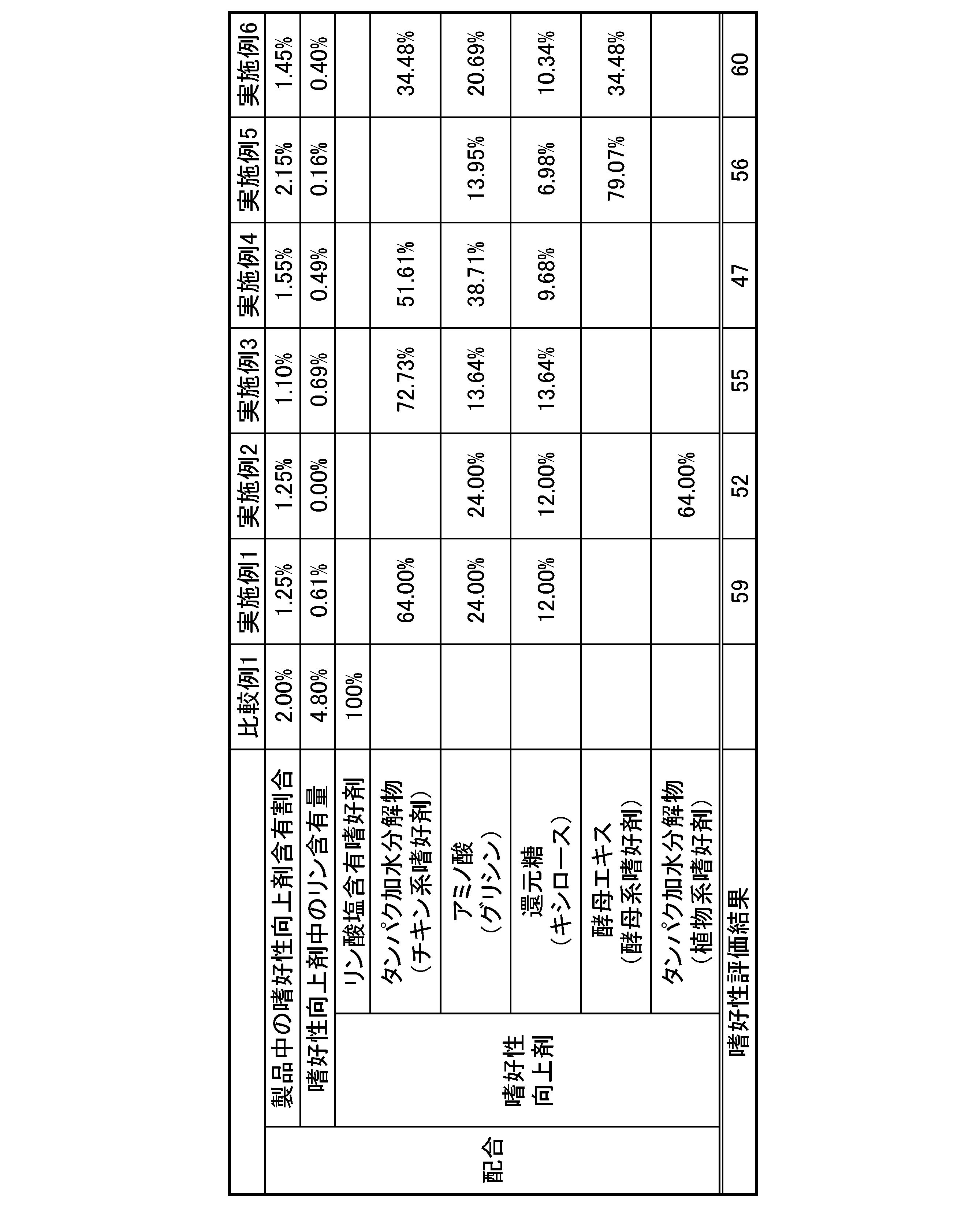
<嗜好性の評価>
実施例1~6の各ペットフードPと、比較例1のペットフードQに対して、摂食量を比較する方法で嗜好性を評価した。20頭の猫をモニターとして2日間でテストを行った。 第1日は、ペットフードPおよびQのうち、一方を左から、他方を右から、猫1頭に対して所定の給餌量で同時に与え、猫がどちらか一方を完食した時点で又は30分後に、猫が食べたペットフード量を測定した。
該猫1頭が第1日に食べた合計のペットフードの質量に対して、ペットフードQの摂食量とペットフードPの摂食量の比率(P:Q、P+Q=100%)を百分率で求めた。モニターとした猫の数に基づいて、得られた百分率を平均して、第1日の結果とした。
第2日は、ペットフードPおよびQのうち、第1日とは反対に、一方を右から、他方を左から同時に与えた。猫1頭に対して第1日と同量の給餌量で与え、猫がどちらか一方を完食した時点で又は1時間後に、猫が食べたペットフード量を測定した。第1日と同様の算出方法で第2日の結果を得た。
最後に、第1日と第2日の結果を平均して、最終結果であるペットフードP:ペットフードQの摂食量の比「P:Q」を求めた。結果を表1に示す。
嗜好性は、下記の基準にしたがって評価した。
Pが45~55:ペットフードPの嗜好性が、ペットフードQの嗜好性と同等。
Pが56以上:ペットフードPの嗜好性が、ペットフードQの嗜好性より高い。
Claims (9)
- タンパク加水分解物及び酵母エキスからなる群より選ばれる少なくとも1種の嗜好剤成分、遊離グリシン並びに還元糖を含有し、
リンの含有量が、乾物換算で、1%以下であり、
メイラード反応生成物を含有しない
ウェットペットフード用嗜好性向上剤。 - 前記遊離グリシンの含有量が、前記還元糖の含有量と同量以上である、請求項1に記載のウェットペットフード用嗜好性向上剤。
- 前記遊離グリシン:前記還元糖の割合が、1:1~4:1である、請求項1に記載のウェットペットフード用嗜好性向上剤。
- 前記遊離グリシンの含有量が、0.8%~30%である、請求項1に記載のウェットペットフード用嗜好性向上剤。
- 前記還元糖の含有量が、0.2%~30%を含有する、請求項1に記載のウェットペットフード用嗜好性向上剤。
- 前記少なくとも1種の嗜好剤成分が、タンパク質を乾物換算で12%以上含有する、請求項1に記載のウェットペットフード用嗜好性向上剤。
- 前記少なくとも1種の嗜好剤成分が、チキン由来の原料を用いたタンパク加水分解物及び/又は酵母由来の原料を用いた分解物である、請求項1に記載のウェットペットフード用嗜好性向上剤。
- メイラード反応後の前記還元糖の含有量が、ペットフード全量に対して0.05%以下である、請求項1に記載のウェットペットフード用嗜好性向上剤。
- 請求項1~8のいずれか一項に記載のウェットペットフード用嗜好性向上剤のメイラード反応生成物を含有するウェットペットフード。
Priority Applications (3)
| Application Number | Priority Date | Filing Date | Title |
|---|---|---|---|
| CN202380040672.2A CN119212566A (zh) | 2022-05-18 | 2023-05-17 | 湿宠物食品用适口性改善剂及湿宠物食品 |
| AU2023270780A AU2023270780A1 (en) | 2022-05-18 | 2023-05-17 | Wet pet food palatability enhancer, and wet pet food |
| US18/949,794 US20250072456A1 (en) | 2022-05-18 | 2024-11-15 | Wet pet food palatability enhancer, and wet pet food |
Applications Claiming Priority (2)
| Application Number | Priority Date | Filing Date | Title |
|---|---|---|---|
| JP2022-081251 | 2022-05-18 | ||
| JP2022081251A JP2023169918A (ja) | 2022-05-18 | 2022-05-18 | ウェットペットフード用嗜好性向上剤及びウェットペットフード |
Related Child Applications (1)
| Application Number | Title | Priority Date | Filing Date |
|---|---|---|---|
| US18/949,794 Continuation US20250072456A1 (en) | 2022-05-18 | 2024-11-15 | Wet pet food palatability enhancer, and wet pet food |
Publications (1)
| Publication Number | Publication Date |
|---|---|
| WO2023224065A1 true WO2023224065A1 (ja) | 2023-11-23 |
Family
ID=88835588
Family Applications (1)
| Application Number | Title | Priority Date | Filing Date |
|---|---|---|---|
| PCT/JP2023/018440 Ceased WO2023224065A1 (ja) | 2022-05-18 | 2023-05-17 | ウェットペットフード用嗜好性向上剤及びウェットペットフード |
Country Status (6)
| Country | Link |
|---|---|
| US (1) | US20250072456A1 (ja) |
| JP (1) | JP2023169918A (ja) |
| CN (1) | CN119212566A (ja) |
| AU (1) | AU2023270780A1 (ja) |
| TW (1) | TW202410817A (ja) |
| WO (1) | WO2023224065A1 (ja) |
Families Citing this family (1)
| Publication number | Priority date | Publication date | Assignee | Title |
|---|---|---|---|---|
| JP2026048428A (ja) * | 2024-09-05 | 2026-03-17 | ユニ・チャーム株式会社 | ペットフード製品の製造方法 |
Citations (5)
| Publication number | Priority date | Publication date | Assignee | Title |
|---|---|---|---|---|
| WO2014092158A1 (ja) * | 2012-12-13 | 2014-06-19 | ユニ・チャーム株式会社 | ペットフード |
| JP2018086014A (ja) * | 2012-12-19 | 2018-06-07 | ユニ・チャーム株式会社 | ペットフード |
| JP2018519794A (ja) * | 2015-04-28 | 2018-07-26 | マース インコーポレーテッドMars Incorporated | 殺菌されたウェットタイプのペットフード製品を調製する方法 |
| JP2019187255A (ja) * | 2018-04-20 | 2019-10-31 | 日本製粉株式会社 | 嗜好性向上剤 |
| JP2021508237A (ja) * | 2017-12-21 | 2021-03-04 | マース インコーポレーテッドMars Incorporated | ペットフード製品 |
Family Cites Families (2)
| Publication number | Priority date | Publication date | Assignee | Title |
|---|---|---|---|---|
| TW200744473A (en) * | 2006-04-19 | 2007-12-16 | Specialites Pet Food | Use of inorganic phosphate compounds as palatability enhancers of flavours generated by thermal reactions in wet pet foodstuffs |
| US20140227386A1 (en) * | 2011-07-12 | 2014-08-14 | Specialites Pet Food | Palatability enhancers comprising free amino acids for use in pet foods |
-
2022
- 2022-05-18 JP JP2022081251A patent/JP2023169918A/ja active Pending
-
2023
- 2023-05-17 TW TW112118252A patent/TW202410817A/zh unknown
- 2023-05-17 WO PCT/JP2023/018440 patent/WO2023224065A1/ja not_active Ceased
- 2023-05-17 AU AU2023270780A patent/AU2023270780A1/en active Pending
- 2023-05-17 CN CN202380040672.2A patent/CN119212566A/zh active Pending
-
2024
- 2024-11-15 US US18/949,794 patent/US20250072456A1/en active Pending
Patent Citations (5)
| Publication number | Priority date | Publication date | Assignee | Title |
|---|---|---|---|---|
| WO2014092158A1 (ja) * | 2012-12-13 | 2014-06-19 | ユニ・チャーム株式会社 | ペットフード |
| JP2018086014A (ja) * | 2012-12-19 | 2018-06-07 | ユニ・チャーム株式会社 | ペットフード |
| JP2018519794A (ja) * | 2015-04-28 | 2018-07-26 | マース インコーポレーテッドMars Incorporated | 殺菌されたウェットタイプのペットフード製品を調製する方法 |
| JP2021508237A (ja) * | 2017-12-21 | 2021-03-04 | マース インコーポレーテッドMars Incorporated | ペットフード製品 |
| JP2019187255A (ja) * | 2018-04-20 | 2019-10-31 | 日本製粉株式会社 | 嗜好性向上剤 |
Also Published As
| Publication number | Publication date |
|---|---|
| AU2023270780A1 (en) | 2024-12-05 |
| JP2023169918A (ja) | 2023-12-01 |
| TW202410817A (zh) | 2024-03-16 |
| CN119212566A (zh) | 2024-12-27 |
| US20250072456A1 (en) | 2025-03-06 |
Similar Documents
| Publication | Publication Date | Title |
|---|---|---|
| RU2476082C2 (ru) | Способ усиления вкусовой привлекательности корма для животных | |
| EP1802273B1 (en) | Hypoallergenic food composition | |
| JP6871172B2 (ja) | 複合肉製品を含むウェットタイプのペットフード製品 | |
| JP2019510493A (ja) | 改良されたテクスチャーを有するタンパク質性肉類似物を含む湿性ペットフード | |
| EP3288394A1 (en) | Process of preparing a sterilized wet pet food product | |
| EP3045050B1 (en) | Pet food production method and pet food | |
| RU2471365C1 (ru) | Способ прекоагуляции, прегидратации и прежелатинизации для композиции корма для домашних животных | |
| US20250072456A1 (en) | Wet pet food palatability enhancer, and wet pet food | |
| CN105611843A (zh) | 宠物食品 | |
| CN109310114A (zh) | 仔猪用饲料 | |
| JPH11127797A (ja) | 伴侶動物用飼料及びその製造方法 | |
| JP4896888B2 (ja) | トリポリリン酸ペットフードの嗜好促進剤 | |
| EA014382B1 (ru) | Сухой экструдированный корм для домашних животных и способ производства корма | |
| WO2018147737A1 (en) | Pelleting process for making an animal feed pellet | |
| JP5258390B2 (ja) | 小麦全粒粉を配合したペットフード | |
| US12137707B2 (en) | Pet food | |
| Autin | Commercial aquafeed manufacture and production | |
| JPH06261692A (ja) | 動物用飼料の製造法 | |
| JP3032970B2 (ja) | ペット用喫食性向上剤 | |
| US20250081993A1 (en) | Dry pet food | |
| JP7080634B2 (ja) | 粉末プルランを結着剤として含有する造粒物の製造方法 | |
| EP1738655A1 (en) | Feed for animals | |
| CN119677415A (zh) | 具有由菠菜或番茄中的至少一种提供的增强的适口性或减少的糖中的至少一种的湿宠物食物 | |
| NZ192299A (en) | Foodstuff containing milk product powder and fatty substance |
Legal Events
| Date | Code | Title | Description |
|---|---|---|---|
| 121 | Ep: the epo has been informed by wipo that ep was designated in this application |
Ref document number: 23807666 Country of ref document: EP Kind code of ref document: A1 |
|
| WWE | Wipo information: entry into national phase |
Ref document number: 2401007443 Country of ref document: TH |
|
| WWE | Wipo information: entry into national phase |
Ref document number: 202417087960 Country of ref document: IN |
|
| WWE | Wipo information: entry into national phase |
Ref document number: AU2023270780 Country of ref document: AU Ref document number: 202380040672.2 Country of ref document: CN |
|
| ENP | Entry into the national phase |
Ref document number: 2023270780 Country of ref document: AU Date of ref document: 20230517 Kind code of ref document: A |
|
| NENP | Non-entry into the national phase |
Ref country code: DE |
|
| WWP | Wipo information: published in national office |
Ref document number: 202380040672.2 Country of ref document: CN |
|
| 122 | Ep: pct application non-entry in european phase |
Ref document number: 23807666 Country of ref document: EP Kind code of ref document: A1 |