WO2023223881A1 - 電子装置 - Google Patents
電子装置 Download PDFInfo
- Publication number
- WO2023223881A1 WO2023223881A1 PCT/JP2023/017376 JP2023017376W WO2023223881A1 WO 2023223881 A1 WO2023223881 A1 WO 2023223881A1 JP 2023017376 W JP2023017376 W JP 2023017376W WO 2023223881 A1 WO2023223881 A1 WO 2023223881A1
- Authority
- WO
- WIPO (PCT)
- Prior art keywords
- electronic component
- electronic device
- thickness direction
- electronic
- mounting
- Prior art date
- Legal status (The legal status is an assumption and is not a legal conclusion. Google has not performed a legal analysis and makes no representation as to the accuracy of the status listed.)
- Ceased
Links
Images














Classifications
-
- H—ELECTRICITY
- H10—SEMICONDUCTOR DEVICES; ELECTRIC SOLID-STATE DEVICES NOT OTHERWISE PROVIDED FOR
- H10W—GENERIC PACKAGES, INTERCONNECTIONS, CONNECTORS OR OTHER CONSTRUCTIONAL DETAILS OF DEVICES COVERED BY CLASS H10
- H10W70/00—Package substrates; Interposers; Redistribution layers [RDL]
- H10W70/60—Insulating or insulated package substrates; Interposers; Redistribution layers
-
- H—ELECTRICITY
- H10—SEMICONDUCTOR DEVICES; ELECTRIC SOLID-STATE DEVICES NOT OTHERWISE PROVIDED FOR
- H10W—GENERIC PACKAGES, INTERCONNECTIONS, CONNECTORS OR OTHER CONSTRUCTIONAL DETAILS OF DEVICES COVERED BY CLASS H10
- H10W72/00—Interconnections or connectors in packages
-
- H—ELECTRICITY
- H10—SEMICONDUCTOR DEVICES; ELECTRIC SOLID-STATE DEVICES NOT OTHERWISE PROVIDED FOR
- H10W—GENERIC PACKAGES, INTERCONNECTIONS, CONNECTORS OR OTHER CONSTRUCTIONAL DETAILS OF DEVICES COVERED BY CLASS H10
- H10W90/00—Package configurations
Definitions
- the present disclosure relates to electronic devices.
- Patent Document 1 discloses a semiconductor device (electronic device) including a semiconductor element as an electronic component.
- the semiconductor device described in Patent Document 1 includes a semiconductor element, leads, a bonding material, and a sealing resin.
- the semiconductor element is, for example, a MOSFET (Metal Oxide Semiconductor Field Effect Transistor) chip.
- the semiconductor element is bonded to the lead using a bonding material.
- the lead mounts the semiconductor element and is electrically connected to the semiconductor element.
- the bonding material is interposed between the semiconductor element and the lead to bond them together.
- the sealing resin covers part of the lead, the semiconductor element, and the bonding material.
- An object of the present disclosure is to provide an electronic device that is improved over conventional electronic devices.
- An electronic device includes a first electronic component having a functional section, a mounting section on which the first electronic component is mounted, and a joint that joins the first electronic component and the mounting section. material and.
- the mounting portion has a back surface facing one side in the thickness direction of the first electronic component, and a first surface and a second surface facing the other side in the thickness direction and to which the first electronic component is bonded. , has.
- the second surface is located on the other side of the first surface in the thickness direction.
- the first surface overlaps at least a portion of the outer periphery of the first electronic component when viewed in the thickness direction.
- the second surface overlaps the functional section when viewed in the thickness direction.
- FIG. 1 is a perspective view showing an electronic device according to a first embodiment.
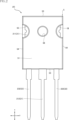
- FIG. 2 is a plan view showing the electronic device according to the first embodiment.
- FIG. 3 is a plan view of essential parts of the electronic device according to the first embodiment.
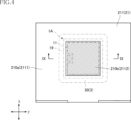
- FIG. 4 is an enlarged view of a part of FIG. 3 showing the electronic components and the bonding material.
- FIG. 5 is a bottom view of the electronic device according to the first embodiment.
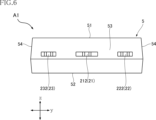
- FIG. 6 is a front view showing the electronic device according to the first embodiment.
- FIG. 7 is a sectional view taken along line VII-VII in FIG. 3.
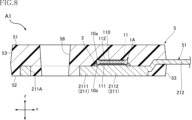
- FIG. 8 is a cross-sectional view taken along line VIII-VIII in FIG. 3.
- FIG. 9 is a sectional view taken along line IX-IX in FIG. 4.
- FIG. 7 is a sectional view taken along line VII-VII in FIG. 3.
- FIG. 8 is a cross-sectional view taken along line VIII-VIII in FIG. 3.
- FIG. 9 is a section
- FIG. 10 is an enlarged cross-sectional view of essential parts of an electronic device according to a first modification of the first embodiment, and corresponds to the cross-section of FIG. 9 .
- FIG. 11 is an enlarged plan view of essential parts of an electronic device according to a second modification of the first embodiment, and corresponds to FIG. 4.
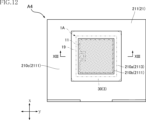
- FIG. 12 is an enlarged plan view of a main part of an electronic device according to a third modification of the first embodiment, and corresponds to FIG. 4 .
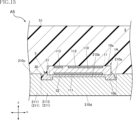
- FIG. 13 is an enlarged sectional view of a main part of an electronic device according to a third modification of the first embodiment, and is a sectional view taken along line XIII-XIII in FIG. 12.
- FIG. 14 is an enlarged plan view of essential parts of an electronic device according to a fourth modification of the first embodiment, and corresponds to FIG. 4.
- FIG. 15 is an enlarged sectional view of a main part of an electronic device according to a fourth modification of the first embodiment, and is a sectional view taken along line XV-XV in FIG. 14.
- FIG. 16 is an enlarged plan view of essential parts of an electronic device according to a fifth modification of the first embodiment, and corresponds to FIG. 4.
- FIG. FIG. 17 is a perspective view showing an electronic device according to a second embodiment.
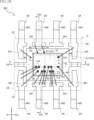
- FIG. 18 is a plan view showing the electronic device according to the second embodiment, and is a view through a resin member.
- FIG. 19 is a partially enlarged view of FIG.
- FIG. 20 is a cross-sectional view taken along line XX-XX in FIG. 18.
- FIG. 21 is a cross-sectional view taken along line XXI-XXI in FIG. 18.
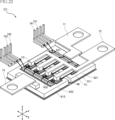
- FIG. 22 is a perspective view showing the electronic device according to the third embodiment, with the resin member omitted.
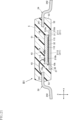
- FIG. 23 is a plan view showing the electronic device according to the third embodiment, and is a view through a resin member.
- FIG. 24 is a diagram in which one of the two input terminals is further transparent in the plan view of FIG. 23.
- FIG. 25 is an enlarged view of a part of FIG. 24 showing a plurality of electronic components and a bonding material.
- FIG. 26 is a cross-sectional view taken along line XXVI-XXVI in FIG. 23.
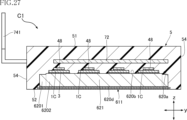
- FIG. 27 is a cross-sectional view taken along line XXVII-XXVII in FIG. 23.
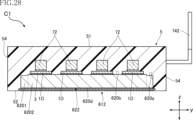
- FIG. 28 is a sectional view taken along line XXVIII-XXVIII in FIG. 23.
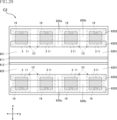
- FIG. 29 is an enlarged plan view of essential parts of an electronic device according to a modification of the third embodiment, and corresponds to FIG. 25.
- a thing A is formed on a thing B" and "a thing A is formed on a thing B” mean “a thing A is formed on a thing B" unless otherwise specified.
- A is formed directly on something B
- a thing A is formed on something B, with another thing interposed between them.” including.
- "a certain thing A is placed on a certain thing B” and "a certain thing A is placed on a certain thing B” are used as "a certain thing A is placed on a certain thing B” unless otherwise specified.
- ⁇ It is placed directly on something B,'' and ⁇ A thing A is placed on something B, with another thing interposed between them.'' include.
- an object A is located on an object B
- an object A is in contact with an object B, and an object A is located on an object B.
- an object A overlaps an object B when viewed in a certain direction means, unless otherwise specified, “an object A overlaps all of an object B" and "a certain object A overlaps an object B".
- a certain thing A (constituent material) includes a certain material C means "a case where a certain thing A (constituent material) consists of a certain material C" and "a certain thing A (constituent material) includes a certain material C”. Including cases where the main component of is a certain material C.
- First embodiment: 1 to 9 show an electronic device A1 according to the first embodiment.
- the electronic device A1 is used in electronic equipment including a power conversion circuit, such as a DC-DC converter.
- the electronic device A1 includes an electronic component 1A, a first lead 21, a second lead 22, a third lead 23, a bonding material 3, a plurality of conductive members 4, and a resin member 5.
- the resin member 5 is shown as an imaginary line (two-dot chain line).
- the electronic component 1A and the bonding material 3 are transparent, and each is shown by an imaginary line. Further, in FIG. 4, each conductive member 4 and resin member 5 are omitted.
- the thickness direction of the electronic device A1 will be referred to as the "thickness direction z.”
- one side of the thickness direction z may be referred to as the lower side, and the other side may be referred to as the upper side.
- descriptions such as “upper”, “lower”, “upper”, “lower”, “upper surface”, and “lower surface” indicate the relative positional relationship of each component etc. in the thickness direction z, and do not necessarily mean It is not a term that defines the relationship with the direction of gravity.
- plane view refers to when viewed in the thickness direction z.
- first direction x is the vertical direction in the plan view of the electronic device A1 (see FIGS. 2 and 3).
- second direction y A direction perpendicular to the thickness direction z and the first direction x is referred to as a "second direction y.”
- the second direction y is the left-right direction in the plan view of the electronic device A1 (see FIGS. 2 and 3).
- the electronic component 1A is the functional center of the electronic device A1.
- the electronic component 1A is mounted on the first lead 21.
- the electronic component 1A has a main surface 10a and a back surface 10b.
- the main surface 10a and the back surface 10b are spaced apart from each other in the thickness direction z.
- the main surface 10a faces upward in the thickness direction z
- the back surface 10b faces downward in the thickness direction z.
- the back surface 10b faces the first lead 21.
- the dimension of the electronic component 1A in the thickness direction z (the distance between the main surface 10a and the back surface 10b along the thickness direction z) is not limited at all, but is, for example, 50 ⁇ m or more and 200 ⁇ m or less.
- the electronic component 1A includes a functional section 11.
- the functional unit 11 is, for example, a power transistor.
- the power transistor is, for example, a vertical MOSFET (Metal-Oxide-Semiconductor Field-Effect Transistor).
- the functional unit 11 is not limited to a MOSFET, and may be another transistor such as an IGBT (Insulated Gate Bipolar Transistor), an LSI, or a diode.
- the functional unit 11 becomes a heat source when the electronic device A1 is energized. For convenience of understanding, a dot pattern is drawn on the functional section 11 in FIG.
- the functional section 11 includes a semiconductor layer 110, a first electrode 111, a second electrode 112, and a third electrode 113.
- Semiconductor layer 110 includes a semiconductor material.
- the semiconductor material is silicon carbide (SiC), for example.
- silicon (Si), GaN (gallium nitride), or the like may be used as the semiconductor material.
- a current corresponding to the electric power converted by the functional unit 11 flows through the first electrode 111 .
- a current corresponding to the power before being converted by the functional unit 11 flows through the second electrode 112 .
- a drive signal for driving the functional unit 11 is input to the third electrode 113 .
- the first electrode 111 is a drain
- the second electrode 112 is a source
- the third electrode 113 is a gate.
- the first electrode 111 is arranged on the back surface 10b.
- the second electrode 112 and the third electrode 113 are arranged on the main surface 10a.
- the first lead 21 is mounted with the electronic component 1A and forms part of a conductive path between the electronic component 1A and a circuit board (not shown) on which the electronic device A1 is mounted.
- the first lead 21 includes a mounting portion 211 and a terminal portion 212.
- the mounting portion 211 and the terminal portion 212 are integrally formed.
- the mounting portion 211 is covered with the resin member 5.
- the electronic component 1A described above is mounted on the mounting section 211.
- the mounting portion 211 is electrically connected to the first electrode 111 of the electronic component 1A via the bonding material 3.
- the mounting portion 211 has a first surface 210a, a second surface 210b, and a back surface 210d.
- Each of the first surface 210a and the second surface 210b is located below the electronic component 1A in the thickness direction z.
- Each of the first surface 210a and the second surface 210b faces upward in the thickness direction z.
- the electronic component 1A is bonded to the first surface 210a and the second surface 210b so as to straddle them.
- the first surface 210a is arranged so as to surround the second surface 210b in plan view.
- the first surface 210a is, for example, flat and extends along a plane (xy plane) orthogonal to the thickness direction z. In the illustrated example, the first surface 210a overlaps the entire outer periphery 19 of the electronic component 1A in plan view.
- the second surface 210b is located above the first surface 210a in the thickness direction z. That is, the second surface 210b is located closer to the electronic component 1A than the first surface 210a in the thickness direction z.
- the second surface 210b is, for example, flat and extends along the xy plane. In this embodiment, the second surface 210b is located inside the electronic component 1A in plan view. Further, the second surface 210b overlaps all of the functional section 11 in plan view.
- the second surface 210b has a rectangular shape in plan view.
- the back surface 210d faces downward in the thickness direction z. That is, the back surface 210d faces the opposite side to the first surface 210a and the second surface 210b in the thickness direction z.
- the back surface 210d is, for example, flat and extends along the xy plane. In the illustrated example, the back surface 210d is exposed from the resin member 5. In plan view, the back surface 210d overlaps the first surface 210a and the second surface 210b.
- the mounting portion 211 includes a base portion 2111 and a protruding portion 2112.
- the base 2111 surrounds the protrusion 2112 in plan view.
- the protrusion 2112 protrudes higher than the base 2111 in the thickness direction z.
- the thickness of the protrusion 2112 (dimension in the thickness direction z) is larger than the thickness (dimension in the thickness direction z) of the base 2111.
- the lower surface of the base 2111 and the lower surface of the protrusion 2112 are flush with each other.
- the first surface 210a described above is the upper surface of the base 2111.
- the second surface 210b described above is the upper surface of the protrusion 2112.
- the back surface 210d described above is the lower surface of the base 2111 and the lower surface of the protrusion 2112.
- the protrusion dimension of the protrusion 2112 with respect to the base 2111 is not limited at all, but is, for example, 20 ⁇ m or more and 50 ⁇ m or less.
- the mounting portion 211 has a through hole 211A formed in the base portion 2111.
- the through hole 211A penetrates the base portion 2111 (mounting portion 211) in the z direction.
- the through hole 211A has a circular shape in plan view.
- the terminal portion 212 extends along the first direction x from the edge of the mounting portion 211 on the other side in the first direction x.
- the terminal portion 212 includes a portion covered with the resin member 5 and a portion exposed from the resin member 5.
- the portion of the terminal portion 212 covered with the resin member 5 is bent.
- the surface of the terminal portion 212 exposed from the resin member 5 may be plated (for example, tin plating).
- a portion of the terminal portion 212 exposed from the resin member 5 is electrically connected to a circuit board (not shown) on which the electronic device A1 is mounted.
- the second lead 22 is separated from the first lead 21.
- the second lead 22 is electrically connected to the second electrode 112 of the electronic component 1A via the conductive member 4.
- the second lead 22 includes a pad portion 221 and a terminal portion 222.
- the pad portion 221 is covered with the resin member 5.
- the conductive member 4 is joined to the pad portion 221 .
- the surface of the pad portion 221 to which the conductive member 4 is bonded may be plated with silver or tin, for example.
- the terminal section 222 is connected to the pad section 221.
- the terminal portion 222 includes a portion covered with the resin member 5 and a portion exposed from the resin member 5.
- the terminal portion 222 extends, for example, in parallel with the terminal portion 212 in the first direction x.
- the surface of the terminal portion 222 exposed from the resin member 5 may be plated (for example, tin plated).
- a portion of the terminal portion 222 exposed from the resin member 5 is electrically connected to a circuit board (not shown) on which the electronic device A1 is mounted.
- the third lead 23 is separated from the first lead 21 and is located on the opposite side of the second lead 22 with the first lead 21 in between in the second direction y.
- the third lead 23 is electrically connected to the third electrode 113 of the electronic component 1A via the conductive member 4.
- the third lead 23 includes a pad portion 231 and a terminal portion 232.
- the pad portion 231 is covered with the resin member 5.
- the conductive member 4 is joined to the pad portion 231 .
- the surface of the pad portion 231 to which the conductive member 4 is bonded may be plated with silver, tin, or the like.
- the terminal section 232 is connected to the pad section 231.
- the terminal portion 232 includes a portion covered with the resin member 5 and a portion exposed from the resin member 5.
- the terminal portion 232 extends, for example, in parallel with the terminal portion 212 in the first direction x.
- the surface of the terminal portion 232 exposed from the resin member 5 may be plated (for example, tin plating).
- a portion of the terminal portion 232 exposed from the resin member 5 is electrically connected to a circuit board (not shown) on which the electronic device A1 is mounted.
- the bonding material 3 bonds the electronic component 1A and the mounting portion 211 (first lead 21).
- the bonding material 3 includes a conductive material, such as solder, metal paste material, or sintered metal.
- the bonding material 3 includes a first bonding portion 31, a second bonding portion 32, and a fillet portion 30.
- the first joint portion 31 is interposed between the first surface 210a and the back surface 10b. That is, the first joint portion 31 is interposed between the base portion 2111 and the electronic component 1A.
- the second joint portion 32 is interposed between the second surface 210b and the back surface 10b. That is, the second joint portion 32 is interposed between the protrusion portion 2112 and the electronic component 1A.
- the fillet portion 30 protrudes from the electronic component 1A in plan view.
- the fillet portion 30 partially covers each side surface of the electronic component 1A. Note that the bonding material 3 does not need to include the fillet portion 30.
- the plurality of conductive members 4 are electrically connected to the electronic component 1A, the second lead 22, and the third lead 23. This establishes mutual conduction between the electronic component 1A, the second lead 22, and the third lead 23.
- the plurality of conductive members 4 include a first member 41 and a second member 42.
- the first member 41 is joined to the second electrode 112 of the electronic component 1A and the pad portion 221 of the second lead 22, making them conductive.
- the composition of the first member 41 includes copper.
- the first member 41 is a metal clip.
- the first member 41 is conductively bonded to the second electrode 112 and the pad portion 221 via a conductive bonding material 49 .
- the second member 42 is joined to the third electrode 113 of the electronic component 1A and the pad portion 231 of the third lead 23, making them conductive.
- the second member 42 is a metal wire and is formed by wire bonding.
- the composition of the second member 42 includes gold, aluminum, or copper.
- the resin member 5 includes the electronic component 1A, a part of the first lead 21, a part of the second lead 22, a part of the third lead 23, and a bonding member. material 3 and a plurality of conductive members 4.
- the resin member 5 has electrical insulation properties.
- the constituent material of the resin member 5 includes, for example, black epoxy resin.
- the resin member 5 has a resin main surface 51, a resin back surface 52, a pair of resin side surfaces 53, a pair of resin side surfaces 54, a pair of openings 55, and a mounting hole 56.
- the resin main surface 51 and the resin back surface 52 are spaced apart from each other in the thickness direction z.
- the main resin surface 51 faces upward in the thickness direction z. That is, the main resin surface 51 faces the same side as the first surface 210a and the second surface 210b in the thickness direction z.
- the resin back surface 52 faces downward in the thickness direction z. That is, the resin back surface 52 faces the same side as the second surface 210b in the thickness direction z.
- the back surface 210d is exposed from the resin back surface 52.
- the resin back surface 52 and the back surface 210d are flush with each other.
- the pair of resin side surfaces 53 are spaced apart from each other in the first direction x.
- a pair of resin side surfaces 53 are connected to the resin main surface 51 and the resin back surface 52.
- the terminal portion 212 of the first lead 21, the terminal portion 222 of the second lead 22, and the terminal portion 232 of the third lead 23 are connected. sticks out.
- the pair of resin side surfaces 54 are spaced apart from each other in the second direction y.
- a pair of resin side surfaces 54 are connected to the resin main surface 51 and the resin back surface 52.
- the pair of openings 55 are spaced apart from each other in the second direction y.
- Each of the pair of openings 55 is recessed inward from the resin member 5 from either the resin main surface 51 or the pair of resin side surfaces 54 .
- a portion of the upper surface of the mounting portion 211 of the first lead 21 is exposed through the pair of openings 55 .
- the attachment hole 56 penetrates the resin member 5 from the main resin surface 51 to the resin back surface 52 in the thickness direction z.
- the attachment hole 56 is included in the through hole 211A of the mounting portion 211.
- the inner peripheral surface of the mounting portion 211 that defines the through hole 211A is covered with the resin member 5.
- the maximum dimension of the attachment hole 56 is smaller than the dimension of the through hole 211A.
- the mounting portion 211 has a first surface 210a and a second surface 210b to which the electronic component 1A is bonded.
- the first surface 210a and the second surface 210b each face upward (on the other side) in the thickness direction z.
- the first surface 210a overlaps at least a portion of the outer periphery 19 of the electronic component 1A when viewed in the thickness direction z.
- the second surface 210b is located above (on the other side) in the thickness direction z than the first surface 210a, and overlaps the functional section 11 when viewed in the thickness direction z.
- the distance along the thickness direction z between the mounting section 211 and the electronic component 1A is small due to the second surface 210b below (on one side) in the thickness direction z of the functional section 11 which is a heat generation source. , it becomes possible to improve thermal conductivity from the electronic component 1A (functional section 11) to the mounting section 211. In other words, it is possible to improve the heat dissipation performance for the heat generated by the electronic component 1A. Furthermore, due to the first surface 210a, the distance between the mounting portion 211 and the electronic component 1A along the thickness direction z is large in a part of the outer periphery 19 of the electronic component 1A, so that the distance between the mounting portion 211 and the electronic component 1A is large.
- the bonding material 3 first bonding portion 31.
- the bonding strength of the electronic component 1A to the mounting portion 211 can be ensured appropriately, and the mounting reliability of the electronic component 1A can be improved. Therefore, the electronic device A1 can improve the heat dissipation of the heat generated by the electronic component 1A (functional section 11) while ensuring the mounting reliability of the electronic component 1A on the mounting section 211.
- the first surface 210a overlaps the four corners of the electronic component 1A when viewed in the thickness direction z. According to this configuration, an appropriate thickness of the bonding material 3 can be ensured at the four corners of the electronic component 1A in plan view.
- thermal stress is applied to the bonding material 3. If the electronic component 1A were to peel off from the mounting portion 211 due to this thermal stress, it would likely occur from the outer periphery 19 (particularly at the four corners) of the electronic component 1A.
- the bonding material 3 is appropriately thick at the four corners of the electronic component 1A in plan view, peeling of the electronic component 1A from the mounting portion 211 is suppressed.
- the reliability of mounting the electronic component 1A on the mounting portion 211 can be improved more than when the first surface 210a does not overlap the four corners of the electronic component 1A when viewed in the thickness direction z.
- the first surface 210a overlaps the entire outer periphery 19 of the electronic component 1A when viewed in the thickness direction z.
- an appropriate thickness of the bonding material 3 can be ensured along the outer periphery 19 of the electronic component 1A in plan view. Therefore, the electronic device A1 can further improve the mounting reliability of the electronic component 1A on the mounting section 211.
- the second surface 210b overlaps all of the functional parts 11 when viewed in the thickness direction z. According to this configuration, the electronic device A1 has better heat dissipation performance for the heat generated by the electronic component 1A (functional unit 11) than when the second surface 210b overlaps only a part of the functional unit 11 when viewed in the thickness direction z. You can improve.
- the thickness of the electronic component 1A is 50 ⁇ m or more and 200 ⁇ m or less. According to the research of the inventor of the present application, when the thickness of the electronic component 1A is within this range (50 ⁇ m or more and 200 ⁇ m or less), the heat from the functional part 11 is more It has been found that the particles are not dispersed inside (for example, the semiconductor layer 110). In other words, it has been found that when the thickness of the electronic component 1A is within the above-mentioned range, a thermal gradient can occur within the electronic component 1A.
- the electronic device A1 reduces the heat generation of the electronic component 1A (functional section 11) by reducing the distance along the thickness direction z between the electronic component 1A and the mounting section 211 below the functional section 11, which is a heat generation source. Appropriate heat dissipation can be ensured.
- FIG. 10 shows an electronic device A2 according to a first modification of the first embodiment.
- the electronic device A2 differs from the electronic device A1 in the following points. That is, the bonding material 3 of the electronic device A2 does not include the second bonding portion 32.
- the bonding material 3 does not include the second bonding portion 32, and the protruding portion 2112 is in contact with the main surface 10a. That is, the first electrode 111 is in contact with the protrusion 2112 and is directly electrically connected.
- the electronic device A2 heat dissipation can be improved while ensuring mounting reliability. Further, in the electronic device A2, the electronic component 1A is in contact with the mounting section 211. Therefore, the thermal conductivity from the electronic component 1A to the mounting portion 211 is higher in the electronic device A2 than in the electronic device A1. In other words, the electronic device A2 can improve heat dissipation compared to the electronic device A1.
- FIG. 11 shows an electronic device A3 according to a second modification of the first embodiment.
- the electronic device A3 differs from the electronic device A1 in the following points. That is, the shape of the protrusion 2112 of the electronic device A3 in plan view is different from the shape of the protrusion 2112 of the electronic device A1 in plan view.
- the protruding portion 2112 of the electronic device A3 has a shape in which a strip-shaped portion extending along the first direction x and a strip-shaped portion extending along the second direction y intersect in plan view.
- the upper surface of the protrusion 2112 that is, the second surface 210b overlaps a part of the functional section 11 in a plan view.
- the upper surface of the base 2111 that is, the first surface 210a, overlaps a part of the outer periphery 19 of the electronic component 1A in plan view, and overlaps at least the four corners of the electronic component 1A.
- the electronic device A3 heat dissipation can be improved while ensuring mounting reliability. Furthermore, in the electronic device A3, the first surface 210a overlaps the four corners of the electronic component 1A in plan view. Therefore, like the electronic device A1, the electronic device A3 has higher mounting reliability of the electronic component 1A on the mounting portion 211 than when the first surface 210a does not overlap the four corners of the electronic component 1A when viewed in the thickness direction z. You can improve.
- FIGS. 12 and 13 show an electronic device A4 according to a third modification of the first embodiment.
- the electronic device A4 differs from the electronic device A1 in the following points.
- the mounting portion 211 of the electronic device A4 includes a groove portion 2113 instead of the protrusion portion 2112.
- the mounting portion 211 of the electronic device A4 further has a third surface 210c.
- the groove portion 2113 is recessed from the base portion 2111 in the thickness direction z.
- the thickness of the groove portion 2113 (dimension in the thickness direction z) is smaller than the thickness of the base portion 2111 (dimension in the thickness direction z).
- the lower surface of the base portion 2111 and the lower surface of the groove portion 2113 are flush with each other.
- the groove portion 2113 is formed in a rectangular ring shape when viewed from above.
- the base 2111 has a region surrounding the groove 2113 and a region surrounded by the groove 2113 in plan view.
- the mounting portion 211 has a first surface 210a, a second surface 210b, a third surface 210c, and a back surface 210d.
- the third surface 210c is located above the first surface 210a in the thickness direction z.
- the third surface 210c is at the same position as the second surface 210b in the thickness direction z.
- the first surface 210a is the upper surface of the groove portion 2113.
- the second surface 210b is the upper surface of the portion of the base 2111 surrounded by the groove 2113 in plan view.
- the third surface 210c is the upper surface of the portion of the base 2111 that surrounds the groove 2113 in a plan view.
- the back surface 210d is the lower surface of the base portion 2111 and the lower surface of the groove portion 2113.
- the second surface 210b reduces the distance along the thickness direction z between the mounting portion 211 and the electronic component 1A below the functional portion 11, which is a heat generation source, in the thickness direction z. can be made smaller. Therefore, it is possible to improve the thermal conductivity from the electronic component 1A (functional section 11) to the mounting section 211.
- the distance along the thickness direction z between the mounting portion 211 and the electronic component 1A can be increased in at least a portion of the outer periphery 19 of the electronic component 1A by the first surface 210a. That is, like the electronic device A1, the electronic device A4 can improve the heat dissipation of the heat generated by the electronic component 1A (functional section 11) while ensuring the mounting reliability of the electronic component 1A on the mounting section 211.
- the first surface 210a is the upper surface of the groove portion 2113 that is recessed below the base portion 2111 in the thickness direction z. According to this configuration, the spread of the bonding material 3 to the outside of the groove 2113 is suppressed due to the difference in level between the groove 2113 and the base 2111 located outside the groove 2113. In other words, the electronic device A4 can prevent the thickness of the bonding material 3 from becoming unintentionally small in the outer periphery 19 portion of the electronic component 1A in plan view.
- FIGS. 14 and 15 show an electronic device A5 according to a fourth modification of the first embodiment.
- Electronic device A5 differs from electronic device A4 in the following points. That is, the second surface 210b of the electronic device A5 is arranged not in the base 2111 but in the groove 2113.
- the groove portion 2113 includes a deep bottom portion and a shallow bottom portion.
- the deep bottom portion is more depressed from the base 2111 than the shallow bottom portion.
- the shallow bottom portion has a rectangular shape in plan view, and the deep bottom portion has a rectangular annular shape surrounding the shallow bottom portion.
- the shallow bottom portion overlaps the functional section 11 in plan view.
- the first surface 210a is the top surface of the deep bottom portion
- the second surface 210b is the top surface of the shallow bottom portion.
- the second surface 210b is located below the third surface 210c in the thickness direction z.
- a part of the electronic component 1A is accommodated in the groove 2113.
- heat dissipation can be improved while ensuring mounting reliability.
- the spread of the bonding material 3 outward of the groove portion 2113 can be suppressed, similarly to the electronic device A4. Thereby, it is possible to prevent the thickness of the bonding material 3 of the electronic device A5 from becoming unintentionally small in the outer periphery 19 portion of the electronic component 1A in plan view.
- FIG. 16 shows an electronic device A6 according to a fifth modification of the first embodiment.
- Electronic device A6 differs from electronic device A4 in the following points. That is, the shape of the groove 2113 of the electronic device A6 in plan view is different from the shape of the groove 2113 of the electronic device A4 in plan view.
- the second surface 210b has a portion extending from the outside of the electronic component 1A to the electronic component 1A in plan view. This extended portion overlaps the functional section 11 in plan view. Further, the first surface 210a overlaps the four corners of the electronic component 1A in a plan view.
- the electronic device A6 like the electronic device A4, at least a portion of the second surface 210b overlaps the functional section 11 in a plan view. Therefore, electronic device A6 can improve heat dissipation similarly to electronic device A4. Furthermore, in the electronic device A6, the first surface 210a overlaps the four corners of the electronic component 1A in a plan view, so that the mounting reliability of the electronic component 1A on the mounting portion 211 can be improved. From the above, the electronic device A6, like the electronic device A4, can improve heat dissipation while ensuring mounting reliability.
- Second embodiment show an electronic device B1 according to the second embodiment.
- the electronic device B1 differs from the electronic device A1 mainly in the following points.
- the electronic device B1 includes an electronic component 1B instead of the electronic component 1A.
- the electronic device B1 has a different package structure from the electronic device A1.
- the electronic device B1 has an SOP (Small Outline Package) type package structure.
- the electronic device B1 includes an electronic component 1B, a first lead 21, a plurality of leads 24, a bonding material 3, a plurality of conductive members 43, 44, 45, and a resin member 5.
- the electronic component 1B has a functional section 11 and a control section 12.
- the functional section 11 of the electronic component 1B is a power transistor like the functional section 11 of the electronic component 1A.
- the control unit 12 controls the functional unit 11 (power transistor).
- the control unit 12 includes a gate drive circuit as its functional element.
- other circuits such as a protection circuit or an active clamp circuit may be included.
- the gate drive circuit generates a drive signal that controls the drive of the functional section 11 (switching operation of the power transistor) based on a control signal input from the outside.
- the electronic component 1B has a plurality of electrodes 114, 115, and 121.
- the plurality of electrodes 114 are arranged on the main surface 10a and are electrically connected to the functional section 11.
- the electrode 115 is arranged on the back surface 10b and is electrically connected to the functional section 11.
- the electrode 115 is electrically connected to the mounting portion 211 via the bonding material 3.
- the plurality of electrodes 121 are arranged on the main surface 10a and are electrically connected to the control section 12.
- the plurality of leads 24 are each separated from the first lead 21, as shown in FIG.
- the plurality of leads 24 are electrically connected to the electronic component 1B via the plurality of conductive members 43, 44, and 45.
- one of the plurality of leads 24 is not connected to any of the plurality of conductive members 43, 44, and 45, and is not electrically connected to the electronic component 1B.
- the plurality of leads 24 are arranged around the first lead 21 (mounting part 211), and in the illustrated example, one is arranged on one side of the first lead 21 in the first direction x, and the other is arranged on one side of the first lead 21 in the first direction There is one placed on the other side of one direction x.
- the plurality of leads 24 those arranged on one side in the first direction x with respect to the first lead 21 protrude from the resin side surface 53 on one side in the first direction x.
- those arranged on the other side in the first direction x with respect to the first lead 21 protrude from the resin side surface 53 on the other side in the first direction x.
- the plurality of leads 24 are spaced apart from each other in the second direction y on one side in the first direction x and on the other side in the second direction y.
- Each of the plurality of leads 24 includes a pad portion 241 and a terminal portion 242.
- the pad portion 241 is covered with the resin member 5.
- the pad portion 241 is connected to any one of the plurality of conductive members 43, 44, and 45.
- the terminal portion 242 includes a portion covered with the resin member 5 and a portion exposed from the resin member 5.
- the terminal portion 242 extends outward from the pad portion 241 in the first direction x.
- the terminal portion 242 is bent in a gullwing shape when viewed along the second direction y.
- the terminal section 242 is used as an external terminal of the electronic device B1.
- Each of the plurality of conductive members 43, 44, and 45 is, for example, a metal wire, and is formed by wire bonding.
- the composition of each of the plurality of conductive members 43, 44, and 45 includes gold, aluminum, or copper.
- Each of the plurality of conductive members 43 is joined to one of the plurality of electrodes 114 and one of the plurality of pad sections 241.
- Each of the plurality of conductive members 44 is joined to one of the plurality of electrodes 121 and one of the plurality of pad sections 241.
- Each of the plurality of conductive members 45 is joined to the mounting section 211 and one of the plurality of pad sections 241.
- the plurality of leads 24 include one conductive to the electrode 114, one conductive to the electrode 115, and one conductive to the electrode 121 through the plurality of conductive members 43, 44, and 45.
- the electronic device B1 has the same functions and effects as the electronic device A1 as follows. That is, the mounting portion 211 of the electronic device B1 has a first surface 210a and a second surface 210b to which the electronic component 1B is bonded. The first surface 210a and the second surface 210b each face the other side (upward) in the thickness direction z. The first surface 210a overlaps at least a portion of the outer periphery 19 of the electronic component 1B when viewed in the thickness direction z. The second surface 210b is located above the first surface 210a in the thickness direction z, and overlaps the functional section 11 when viewed in the thickness direction z.
- the electronic device B1 similarly to the electronic device A1, the electronic device B1 has a second surface 210b that extends along the thickness direction z between the mounting portion 211 and the electronic component 1B below the functional portion 11 that is a heat generation source in the thickness direction z. Since the distance is small, it is possible to improve thermal conductivity from the electronic component 1B (functional section 11) to the mounting section 211. In other words, it is possible to improve the heat dissipation performance for the heat generated by the electronic component 1B. Further, in the electronic device B1, like the electronic device A1, the distance along the thickness direction z between the mounting portion 211 and the electronic component 1B is large in a part of the outer periphery 19 of the electronic component 1B due to the first surface 210a.
- the electronic device B1 can improve the heat dissipation of the heat generated by the electronic component 1B (functional section 11) while ensuring the mounting reliability of the electronic component 1B on the mounting section 211.
- the electronic device B1 has the same configuration as each of the electronic devices A1 to A6, and thus achieves the same effects as each of the electronic devices A1 to A6.
- the second surface 210b is formed to have a similar shape to the outer shape of the functional unit 11 when viewed from above, but unlike this configuration, the second surface 210b is , it may be formed to have a similar shape to the outer shape (outer periphery 19) of the electronic component 1B.
- the second surface 210b that is, the protruding portions 2112 are evenly arranged with respect to the electronic component 1B, it is possible to suppress the posture of the electronic component 1B from tilting.
- the mounting portion 211 includes the base portion 2111 and the protruding portion 2112, but unlike this configuration, the mounting portion 211 is similar to the electronic devices A4 to A6 described above.
- the structure may include a base portion 2111 and a groove portion 2113.
- the electronic device B1 is not limited to the SOP type package structure, and may adopt other package structures.
- the electronic device B1 may have a terminal insertion type package structure similar to the electronic device A1, or may have a leadless type package structure.
- leadless package structures include BGA (Ball Grid Array), LGA (Land Grid Array), DFN (Dual Flatpack No-leaded), and QFN (Quad Flat No-leaded). That is, the package structure of the electronic device of the present disclosure is not limited at all.
- Third embodiment: 22 to 28 show an electronic device C1 according to the third embodiment.
- the electronic device C1 differs from the electronic device A1 mainly in the following points.
- the electronic device C1 includes a plurality of electronic components 1C and 1D instead of the electronic component 1A.
- the electronic device C1 has a different package structure from the electronic device A1.
- the electronic device C1 includes a plurality of electronic components 1C and 1D, a pair of support boards 611 and 612, a pair of mounting parts 621 and 622, a pair of wiring boards 631 and 632, two input terminals 71 and 72, an output terminal 73, and a pair of support boards 611 and 612.
- Each of the plurality of electronic components 1C and 1D is configured similarly to the electronic component 1A described above. That is, the plurality of electronic components 1C and 1D include a functional section 11 in which a power transistor is formed. For convenience of understanding, in FIG. 25, a dot pattern is drawn on each functional section 11 of the plurality of electronic components 1C and 1D. Further, each of the plurality of electronic components 1C and 1D has a main surface 10a, a back surface 10b, a first electrode 111, a second electrode 112, and a third electrode 113, similarly to the electronic component 1A.
- the plurality of electronic components 1C are electrically connected in parallel. That is, the first electrodes 111 of the plurality of electronic components 1C are electrically connected to each other, and the second electrodes 112 of the plurality of electronic components 1C are electrically connected to each other. Further, the plurality of electronic components 1D are electrically connected in parallel. That is, the first electrodes 111 of the plurality of electronic components 1D are electrically connected to each other, and the second electrodes 112 of the plurality of electronic components 1D are electrically connected to each other.
- a pair of support substrates 611 and 612 support a plurality of electronic components 1C and 1D via a pair of mounting parts 621 and 622.
- Each of the pair of support substrates 611 and 612 is, for example, a DBC (Direct Bonded Copper) substrate.
- the pair of mounting parts 621 and 622 are joined to the pair of support substrates 611 and 612, respectively.
- Each composition of the pair of mounting parts 621 and 622 includes copper.
- a plurality of electronic components 1C are bonded to the mounting portion 621.
- the first electrodes 111 of the plurality of electronic components 1C are electrically connected to each other via the mounting portion 621.
- a plurality of electronic components 1D are bonded to the mounting portion 622.
- the first electrodes 111 of the plurality of electronic components 1D are electrically connected to each other via the mounting portion 622.
- the pair of mounting parts 621 and 622 each have a first surface 620a, a second surface 620b, and a back surface 620d.
- a first surface 620a, a second surface 620b, and a back surface 620d described below are common to each mounting portion 621, 622 unless otherwise specified.
- the first surface 620a is arranged so as to surround the second surface 620b in plan view.
- the first surface 620a is, for example, flat and extends along the xy plane.
- the first surface 620a of the mounting portion 621 overlaps the four corners of each electronic component 1C in plan view.
- the first surface 620a of the mounting section 622 overlaps the four corners of each electronic component 1D.
- the second surface 620b is located above the first surface 620a in the thickness direction z.
- the second surface 620b is, for example, flat and extends along the xy plane.
- the second surface 620b has a band shape extending in the second direction y when viewed from above.
- the second surface 620b of the mounting section 621 is formed across the plurality of electronic components 1C, and overlaps with the functional section 11 of each electronic component 1C.
- the second surface 620b of the mounting section 622 is formed across the plurality of electronic components 1D, and overlaps with the functional section 11 of each electronic component 1D.
- the back surface 620d faces downward in the thickness direction z. That is, the back surface 620d faces the opposite side to the first surface 620a and the second surface 620b in the thickness direction z.
- the back surface 620d is, for example, flat and extends along the xy plane.
- a back surface 620d of the mounting portion 621 is joined to the support substrate 611, and a back surface 620d of the mounting portion 622 is joined to the support substrate 612.
- the pair of mounting parts 621 and 622 each include a base part 6201 and a protrusion part 6202.
- a base portion 6201 and a protrusion portion 6202, which will be described below, are common to each of the mounting portions 621 and 622, respectively.
- the base 6201 surrounds the protrusion 6202 in plan view.
- the thickness of the protrusion 6202 (dimension in the thickness direction z) is larger than the thickness of the base 6201 (dimension in the thickness direction z).
- the protrusion 6202 protrudes higher than the base 6201 in the thickness direction z.
- the first surface 620a described above is the upper surface of the base 6201.
- the second surface 620b described above is the upper surface of the protrusion 6202.
- the above-mentioned back surface 620d is the lower surface of the base 6201 and the lower surface of the protrusion 6202.
- the pair of wiring boards 631 and 632 are joined to the pair of mounting parts 621 and 622, respectively.
- the pair of wiring boards 631 and 632 are configured of DBC boards, for example, like the support boards 611 and 612.
- the wiring board 631 transmits drive signals and detection signals for each electronic component 1C.
- the wiring board 632 transmits drive signals and detection signals for each electronic component 1D.
- the two input terminals 71 and 72, the output terminal 73, and the plurality of signal terminals 741, 742, 751, and 752 each include a portion covered with the resin member 5 and a portion exposed from the resin member 5.
- the input terminal 71 is electrically connected to the first electrode 111 of the plurality of electronic components 1C.
- the input terminal 72 is electrically connected to the second electrode 112 of the plurality of electronic components 1D.
- the output terminal 73 is electrically connected to the second electrode 112 of the plurality of electronic components 1C and the first electrode 111 of the plurality of electronic components 1D.
- the signal terminal 741 is electrically connected to the third electrode 113 of the plurality of electronic components 1C via the wiring board 631.
- the signal terminal 742 is electrically connected to the third electrode 113 of the plurality of electronic components 1D via the wiring board 632.
- the signal terminal 751 is electrically connected to the second electrode 112 of the plurality of electronic components 1C via the wiring board 631.
- the signal terminal 752 is electrically connected to the second electrode 112 of the plurality of electronic components 1D via the wiring board 632.
- Each of the plurality of conductive members 46 and 47 is, for example, a metal wire, and is formed by wire bonding.
- the composition of each of the plurality of conductive members 46 and 47 includes gold, aluminum, or copper.
- Each of the plurality of conductive members 46 is joined to one of the plurality of electronic components 1C, 1D and one of the pair of wiring boards 631, 632.
- the plurality of conductive members 46 include one that connects the third electrode 113 of the electronic component 1C and the wiring board 631, one that connects the second electrode 112 of the electronic component 1C and the wiring board 631, and a third conductive member of the electronic component 1D.
- the plurality of conductive members 47 are joined to either one of the pair of wiring boards 631, 632 and one of the plurality of signal terminals 741, 742, 751, 752.
- the plurality of conductive members 47 include one that connects the wiring board 631 and the signal terminal 741, one that connects the wiring board 631 and the signal terminal 751, one that connects the wiring board 632 and the signal terminal 742, and one that connects the wiring board 631 and the signal terminal 742.
- the circuit board 632 and the signal terminal 752 are electrically connected to each other.
- Each of the plurality of conductive members 48 is, for example, a metal clip.
- the composition of each of the plurality of conductive members 48 includes, for example, copper.
- Each of the plurality of conductive members 48 is bonded to one of the second electrodes 112 of the plurality of electronic components 1C and the mounting portion 622 via a conductive bonding material. Therefore, the second electrodes 112 of the plurality of electronic components 1C and the mounting portions 622 are electrically connected via the plurality of conductive members 48.
- the electronic device C1 has the same functions and effects as the electronic devices A1 and B1, as follows. That is, the mounting portion 621 of the electronic device C1 has a first surface 620a and a second surface 620b to which each electronic component 1C is bonded. Each of the first surface 620a and the second surface 620b faces the other side (upward) in the thickness direction z. The first surface 620a overlaps at least a portion of the outer periphery 19 of each electronic component 1C when viewed in the thickness direction z. The second surface 620b is located on the other side (upper side) in the thickness direction z than the first surface 620a, and overlaps with the functional section 11 when viewed in the thickness direction z.
- the second surface 620b allows the electronic device C1 to connect the mounting portion 621 and the electronic component 1B in the thickness direction below the functional portion 11, which is a heat generation source, in the thickness direction z. Since the distance along z is small, it is possible to improve thermal conductivity from each electronic component 1C (functional section 11) to the mounting section 621. In other words, it is possible to improve the heat dissipation performance for the heat generated by each electronic component 1C. Further, like each of the electronic devices A1 and B1, the electronic device C1 has a first surface 620a that extends in the thickness direction z between the mounting portion 621 and each electronic component 1C at a part of the outer periphery 19 of each electronic component 1C.
- the electronic device C1 can improve the heat dissipation of heat generated by each electronic component 1C (functional unit 11) while ensuring the mounting reliability of each electronic component 1C on the mounting section 621. This also applies to the relationship between each electronic component 1D and the mounting section 622. In other words, the electronic device C1 can improve the heat dissipation of heat generated by each electronic component 1D (functional unit 11) while ensuring the mounting reliability of each electronic component 1D on the mounting section 622.
- the electronic device C1 has the same configuration as each of the electronic devices A1 to A6, B1, and thus achieves the same effects as each of the electronic devices A1 to A6, B1.
- the protrusion 2112 is formed across a plurality of electronic components 1C, but unlike this example, one protrusion 2112 is provided for each electronic component 1C. It's okay.
- each protrusion 2112 is configured similarly to the protrusion 2112 of the electronic devices A1 to A3. This also applies to the protrusions 2112 for the plurality of electronic components 1D.
- FIG. 29 shows an electronic device C2 according to a first modification of the third embodiment.
- the electronic device C2 differs from the electronic device C1 in the following points. That is, each mounting section 621, 622 of the electronic device C2 includes a groove section 6203 instead of the protrusion section 6202.
- the groove portion 6203 is depressed from the base portion 6201 in the thickness direction z.
- the thickness of the groove portion 6203 (dimension in the thickness direction z) is smaller than the thickness of the base portion 6201 (dimension in the thickness direction z).
- the lower surface of the base 6201 and the lower surface of the groove 6203 are flush with each other.
- the groove portion 6203 is formed in a band shape extending in the second direction y when viewed from above.
- the groove portion 6203 has two portions spaced apart in the first direction x.
- One of these two parts straddles the corner of the plurality of electronic components 1C (1D) in the first direction x one side, and the other of the two parts extends in the first direction x of the plurality of electronic components 1C (1D).
- x straddles the corner on the other side.
- the second surface 620b allows the mounting portion 621 and each electronic component 1C to be connected to each other in the thickness direction z below the functional portion 11 of each electronic component 1C, which is a heat generation source.
- the distance along the thickness direction z can be reduced. Therefore, it is possible to improve the thermal conductivity from each electronic component 1C (functional section 11) to the mounting section 621.
- the distance along the thickness direction z between the mounting portion 621 and each electronic component 1C can be increased in at least a portion of the outer periphery 19 of each electronic component 1C by the first surface 620a.
- the electronic device C2 improves the heat dissipation of heat generated by each electronic component 1C (functional section 11) while ensuring the mounting reliability of each electronic component 1C on the mounting section 621. can do.
- This also applies to the relationship between each electronic component 1D of the electronic device C2 and the mounting section 622.
- the electronic device C2 can improve the heat dissipation of heat generated by each electronic component 1D (functional unit 11) while ensuring the mounting reliability of each electronic component 1D on the mounting section 622.
- the electronic device C2 has the same configuration as the electronic device C1, and has the same effects as the electronic device C1.
- the electronic device according to the present disclosure is not limited to the embodiments described above.
- the specific configuration of each part of the electronic device of the present disclosure can be modified in various ways.
- the present disclosure includes the embodiments described in the appendix below. Additional note 1.
- a first electronic component having a functional section; a mounting section on which the first electronic component is mounted; a bonding material for bonding the first electronic component and the mounting section; Equipped with The mounting portion has a back surface facing one side in the thickness direction of the first electronic component, and a first surface and a second surface facing the other side in the thickness direction and to which the first electronic component is bonded.
- the second surface is located on the other side in the thickness direction than the first surface, The first surface overlaps at least a portion of the outer periphery of the first electronic component when viewed in the thickness direction, The second surface overlaps the functional section when viewed in the thickness direction of the electronic device.
- Appendix 2. The first electronic component has a rectangular shape when viewed in the thickness direction, The electronic device according to supplementary note 1, wherein the second surface does not overlap any of the four corners of the first electronic component.
- Appendix 3. When viewed in the thickness direction, all of the second surface overlaps the first electronic component, The electronic device according to appendix 1 or 2, wherein the first surface overlaps the entire outer periphery of the first electronic component when viewed in the thickness direction.
- the mounting portion includes a base and a protrusion protruding from the base to the other side in the thickness direction, The base has the first surface, The electronic device according to any one of Supplementary Notes 1 to 4, wherein the protruding portion has the second surface.
- the mounting portion includes a base and a groove recessed from the base to one side in the thickness direction, The groove portion has the first surface,
- Appendix 7. The electronic device according to appendix 6, wherein the groove portion has the second surface.
- Appendix 8. The second surface is located on one side of the third surface in the thickness direction, The electronic device according to appendix 7, wherein a part of the first electronic component is accommodated in the groove.
- Appendix 9. The electronic device according to any one of attachments 1 to 8, wherein the functional unit is a power transistor.
- Appendix 11. further comprising a resin member covering the first electronic component, The electronic device according to any one of Supplementary notes 1 to 10, wherein the resin member covers a part of the mounting section. Appendix 12. The electronic device according to appendix 11, wherein the back surface is exposed from the resin member. Appendix 13. further comprising a lead electrically connected to the first electronic component, The electronic device according to attachment 11 or attachment 12, wherein the lead includes a portion covered with the resin member and a portion exposed from the resin member. Appendix 14. The electronic device according to any one of Supplementary Notes 1 to 13, wherein the first electronic component and the mounting portion are electrically connected via the bonding material.
- A1 to A6, B1, C1, C2 Electronic devices 1A, 1B, 1C, 1D: Electronic component 3: Bonding material 4: Conductive member 5: Resin member 10a: Main surface 10b: Back surface 11: Functional section 12: Control section 19 : Outer circumference 21: First lead 22: Second lead 23: Third lead 24: Lead 30: Fillet part 31: First joint part 32: Second joint part 41: First member 42: Second member 43-48: Conductive member 49: Conductive bonding material 51: Resin main surface 52: Resin back surface 53, 54: Resin side surface 55: Opening 56: Mounting holes 71, 72: Input terminal 73: Output terminal 110: Semiconductor layer 111: First electrode 112 : Second electrode 113: Third electrode 114, 115, 121: Electrode 210a: First surface 210b: Second surface 210c: Third surface 210d: Back surface 211: Mounting section 211A: Through hole 212: Terminal section 221: Pad section 222: Terminal section 231: Pad section 232:
Landscapes
- Structures For Mounting Electric Components On Printed Circuit Boards (AREA)
Priority Applications (1)
| Application Number | Priority Date | Filing Date | Title |
|---|---|---|---|
| JP2024521683A JPWO2023223881A1 (https=) | 2022-05-18 | 2023-05-09 |
Applications Claiming Priority (2)
| Application Number | Priority Date | Filing Date | Title |
|---|---|---|---|
| JP2022081582 | 2022-05-18 | ||
| JP2022-081582 | 2022-05-18 |
Publications (1)
| Publication Number | Publication Date |
|---|---|
| WO2023223881A1 true WO2023223881A1 (ja) | 2023-11-23 |
Family
ID=88835220
Family Applications (1)
| Application Number | Title | Priority Date | Filing Date |
|---|---|---|---|
| PCT/JP2023/017376 Ceased WO2023223881A1 (ja) | 2022-05-18 | 2023-05-09 | 電子装置 |
Country Status (2)
| Country | Link |
|---|---|
| JP (1) | JPWO2023223881A1 (https=) |
| WO (1) | WO2023223881A1 (https=) |
Citations (3)
| Publication number | Priority date | Publication date | Assignee | Title |
|---|---|---|---|---|
| JP2012074648A (ja) * | 2010-09-30 | 2012-04-12 | Hitachi Automotive Systems Ltd | パワー半導体モジュール及びその製造方法 |
| JP2015128154A (ja) * | 2013-11-29 | 2015-07-09 | 株式会社神戸製鋼所 | ベース板及びベース板を備えた半導体装置 |
| JP2021093473A (ja) * | 2019-12-12 | 2021-06-17 | ローム株式会社 | 半導体装置および半導体装置の製造方法 |
-
2023
- 2023-05-09 JP JP2024521683A patent/JPWO2023223881A1/ja active Pending
- 2023-05-09 WO PCT/JP2023/017376 patent/WO2023223881A1/ja not_active Ceased
Patent Citations (3)
| Publication number | Priority date | Publication date | Assignee | Title |
|---|---|---|---|---|
| JP2012074648A (ja) * | 2010-09-30 | 2012-04-12 | Hitachi Automotive Systems Ltd | パワー半導体モジュール及びその製造方法 |
| JP2015128154A (ja) * | 2013-11-29 | 2015-07-09 | 株式会社神戸製鋼所 | ベース板及びベース板を備えた半導体装置 |
| JP2021093473A (ja) * | 2019-12-12 | 2021-06-17 | ローム株式会社 | 半導体装置および半導体装置の製造方法 |
Also Published As
| Publication number | Publication date |
|---|---|
| JPWO2023223881A1 (https=) | 2023-11-23 |
Similar Documents
| Publication | Publication Date | Title |
|---|---|---|
| US8466548B2 (en) | Semiconductor device including excess solder | |
| US10366957B2 (en) | Semiconductor device | |
| KR100307465B1 (ko) | 파워모듈 | |
| US20130049204A1 (en) | Semiconductor device including diffusion soldered layer on sintered silver layer | |
| JP5558714B2 (ja) | 半導体パッケージ | |
| US8198712B2 (en) | Hermetically sealed semiconductor device module | |
| US20150214138A1 (en) | Semiconductor device | |
| US12100688B2 (en) | Semiconductor device | |
| CN102593081A (zh) | 包括散热器的半导体器件 | |
| CN103972277B (zh) | 半导体装置及其制造方法 | |
| WO2020241239A1 (ja) | 半導体装置 | |
| JP7540248B2 (ja) | 半導体モジュール | |
| WO2023112662A1 (ja) | 半導体モジュールおよび半導体装置 | |
| EP1531494A2 (en) | Double-sided multi-chip circuit component | |
| WO2023223881A1 (ja) | 電子装置 | |
| US11450623B2 (en) | Semiconductor device | |
| JP2023174214A (ja) | 半導体装置 | |
| JP7154202B2 (ja) | 非絶縁型パワーモジュール | |
| JP7661796B2 (ja) | 半導体装置 | |
| US20230402334A1 (en) | Semiconductor device | |
| KR102410257B1 (ko) | 양면냉각형 전력반도체 디스크리트 패키지 | |
| US20260068693A1 (en) | Power semiconductor device package | |
| JP2006294729A (ja) | 半導体装置 | |
| JP2025179912A (ja) | 半導体装置 | |
| WO2025158868A1 (ja) | 半導体装置 |
Legal Events
| Date | Code | Title | Description |
|---|---|---|---|
| 121 | Ep: the epo has been informed by wipo that ep was designated in this application |
Ref document number: 23807485 Country of ref document: EP Kind code of ref document: A1 |
|
| WWE | Wipo information: entry into national phase |
Ref document number: 2024521683 Country of ref document: JP |
|
| NENP | Non-entry into the national phase |
Ref country code: DE |
|
| 122 | Ep: pct application non-entry in european phase |
Ref document number: 23807485 Country of ref document: EP Kind code of ref document: A1 |