WO2023190507A1 - 熱交換器 - Google Patents
熱交換器 Download PDFInfo
- Publication number
- WO2023190507A1 WO2023190507A1 PCT/JP2023/012496 JP2023012496W WO2023190507A1 WO 2023190507 A1 WO2023190507 A1 WO 2023190507A1 JP 2023012496 W JP2023012496 W JP 2023012496W WO 2023190507 A1 WO2023190507 A1 WO 2023190507A1
- Authority
- WO
- WIPO (PCT)
- Prior art keywords
- adhesive
- heat exchanger
- bonded
- tube
- filler
- Prior art date
- Legal status (The legal status is an assumption and is not a legal conclusion. Google has not performed a legal analysis and makes no representation as to the accuracy of the status listed.)
- Ceased
Links
Images



Classifications
-
- F—MECHANICAL ENGINEERING; LIGHTING; HEATING; WEAPONS; BLASTING
- F28—HEAT EXCHANGE IN GENERAL
- F28F—DETAILS OF HEAT-EXCHANGE AND HEAT-TRANSFER APPARATUS, OF GENERAL APPLICATION
- F28F19/00—Preventing the formation of deposits or corrosion, e.g. by using filters or scrapers
- F28F19/02—Preventing the formation of deposits or corrosion, e.g. by using filters or scrapers by using coatings, e.g. vitreous or enamel coatings
-
- F—MECHANICAL ENGINEERING; LIGHTING; HEATING; WEAPONS; BLASTING
- F28—HEAT EXCHANGE IN GENERAL
- F28D—HEAT-EXCHANGE APPARATUS, NOT PROVIDED FOR IN ANOTHER SUBCLASS, IN WHICH THE HEAT-EXCHANGE MEDIA DO NOT COME INTO DIRECT CONTACT
- F28D1/00—Heat-exchange apparatus having stationary conduit assemblies for one heat-exchange medium only, the media being in contact with different sides of the conduit wall, in which the other heat-exchange medium is a large body of fluid, e.g. domestic or motor car radiators
- F28D1/02—Heat-exchange apparatus having stationary conduit assemblies for one heat-exchange medium only, the media being in contact with different sides of the conduit wall, in which the other heat-exchange medium is a large body of fluid, e.g. domestic or motor car radiators with heat-exchange conduits immersed in the body of fluid
- F28D1/04—Heat-exchange apparatus having stationary conduit assemblies for one heat-exchange medium only, the media being in contact with different sides of the conduit wall, in which the other heat-exchange medium is a large body of fluid, e.g. domestic or motor car radiators with heat-exchange conduits immersed in the body of fluid with tubular conduits
- F28D1/053—Heat-exchange apparatus having stationary conduit assemblies for one heat-exchange medium only, the media being in contact with different sides of the conduit wall, in which the other heat-exchange medium is a large body of fluid, e.g. domestic or motor car radiators with heat-exchange conduits immersed in the body of fluid with tubular conduits the conduits being straight
- F28D1/0535—Heat-exchange apparatus having stationary conduit assemblies for one heat-exchange medium only, the media being in contact with different sides of the conduit wall, in which the other heat-exchange medium is a large body of fluid, e.g. domestic or motor car radiators with heat-exchange conduits immersed in the body of fluid with tubular conduits the conduits being straight the conduits having a non-circular cross-section
- F28D1/05366—Assemblies of conduits connected to common headers, e.g. core type radiators
-
- F—MECHANICAL ENGINEERING; LIGHTING; HEATING; WEAPONS; BLASTING
- F28—HEAT EXCHANGE IN GENERAL
- F28D—HEAT-EXCHANGE APPARATUS, NOT PROVIDED FOR IN ANOTHER SUBCLASS, IN WHICH THE HEAT-EXCHANGE MEDIA DO NOT COME INTO DIRECT CONTACT
- F28D9/00—Heat-exchange apparatus having stationary plate-like or laminated conduit assemblies for both heat-exchange media, the media being in contact with different sides of a conduit wall
- F28D9/0031—Heat-exchange apparatus having stationary plate-like or laminated conduit assemblies for both heat-exchange media, the media being in contact with different sides of a conduit wall the conduits for one heat-exchange medium being formed by paired plates touching each other
- F28D9/0043—Heat-exchange apparatus having stationary plate-like or laminated conduit assemblies for both heat-exchange media, the media being in contact with different sides of a conduit wall the conduits for one heat-exchange medium being formed by paired plates touching each other the plates having openings therein for circulation of at least one heat-exchange medium from one conduit to another
- F28D9/005—Heat-exchange apparatus having stationary plate-like or laminated conduit assemblies for both heat-exchange media, the media being in contact with different sides of a conduit wall the conduits for one heat-exchange medium being formed by paired plates touching each other the plates having openings therein for circulation of at least one heat-exchange medium from one conduit to another the plates having openings therein for both heat-exchange media
-
- F—MECHANICAL ENGINEERING; LIGHTING; HEATING; WEAPONS; BLASTING
- F28—HEAT EXCHANGE IN GENERAL
- F28F—DETAILS OF HEAT-EXCHANGE AND HEAT-TRANSFER APPARATUS, OF GENERAL APPLICATION
- F28F1/00—Tubular elements; Assemblies of tubular elements
- F28F1/10—Tubular elements and assemblies thereof with means for increasing heat-transfer area, e.g. with fins, with projections, with recesses
- F28F1/12—Tubular elements and assemblies thereof with means for increasing heat-transfer area, e.g. with fins, with projections, with recesses the means being only outside the tubular element
- F28F1/126—Tubular elements and assemblies thereof with means for increasing heat-transfer area, e.g. with fins, with projections, with recesses the means being only outside the tubular element consisting of zig-zag shaped fins
-
- F—MECHANICAL ENGINEERING; LIGHTING; HEATING; WEAPONS; BLASTING
- F28—HEAT EXCHANGE IN GENERAL
- F28F—DETAILS OF HEAT-EXCHANGE AND HEAT-TRANSFER APPARATUS, OF GENERAL APPLICATION
- F28F2245/00—Coatings; Surface treatments
- F28F2245/02—Coatings; Surface treatments hydrophilic
-
- F—MECHANICAL ENGINEERING; LIGHTING; HEATING; WEAPONS; BLASTING
- F28—HEAT EXCHANGE IN GENERAL
- F28F—DETAILS OF HEAT-EXCHANGE AND HEAT-TRANSFER APPARATUS, OF GENERAL APPLICATION
- F28F2275/00—Fastening; Joining
- F28F2275/02—Fastening; Joining by using bonding materials; by embedding elements in particular materials
- F28F2275/025—Fastening; Joining by using bonding materials; by embedding elements in particular materials by using adhesives
-
- F—MECHANICAL ENGINEERING; LIGHTING; HEATING; WEAPONS; BLASTING
- F28—HEAT EXCHANGE IN GENERAL
- F28F—DETAILS OF HEAT-EXCHANGE AND HEAT-TRANSFER APPARATUS, OF GENERAL APPLICATION
- F28F3/00—Plate-like or laminated elements; Assemblies of plate-like or laminated elements
- F28F3/02—Elements or assemblies thereof with means for increasing heat-transfer area, e.g. with fins, with recesses, with corrugations
- F28F3/025—Elements or assemblies thereof with means for increasing heat-transfer area, e.g. with fins, with recesses, with corrugations the means being corrugated, plate-like elements
Definitions
- the present disclosure relates to a heat exchanger.
- heat exchangers used in vehicle air conditioners and the like require high heat exchange performance, so aluminum is often used as the material.
- studies have been underway to manufacture heat exchangers using aluminum, which is a recycled material.
- Recycled aluminum often contains magnesium element as an impurity.
- magnesium element reacts with the flux used during brazing and inhibits the function of the flux. For this reason, when manufacturing a heat exchanger using recycled aluminum, it is difficult to join the members together by brazing. Therefore, as described in Patent Document 1 below, it is conceivable to join the members using an adhesive instead of brazing.
- Adhesives have significantly lower thermal conductivity than metal materials such as brazing filler metals. In order to ensure the performance of the heat exchanger, it is necessary to increase the thermal conductivity of a joint between a tube and a fin by some method, for example, among a plurality of joints joined with an adhesive.
- An object of the present disclosure is to provide a heat exchanger with high performance even though at least a portion of the bonding is performed by a method other than brazing.
- the heat exchanger includes a flow path member (300) that defines a flow path through which a fluid flows, and fins (400) bonded to the flow path member with an adhesive (610).
- a film layer (301, 401) for promoting covalent bonding with the adhesive is formed on at least one adhered surface of the flow path member and the fin.
- FIG. 1 is a diagram showing the overall configuration of a heat exchanger according to a first embodiment.
- FIG. 2 is a diagram showing the configuration of tubes and fins in the heat exchanger according to the first embodiment.
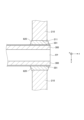
- FIG. 3 is a cross-sectional view showing the configuration at the joint between the tube and the fin.
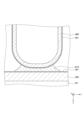
- FIG. 4 is a sectional view showing the configuration at the joint between the tube and the header plate.
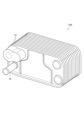
- FIG. 5 is a diagram showing the appearance of a heat exchanger according to the second embodiment.
- FIG. 6 is a diagram showing the internal configuration of the heat exchanger of FIG. 5.
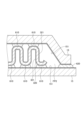
- FIG. 7 is a cross-sectional view showing the structure of a joint inside the heat exchanger of FIG. 5.
- FIG. 1 is a diagram showing the overall configuration of a heat exchanger according to a first embodiment.
- FIG. 2 is a diagram showing the configuration of tubes and fins in the heat exchanger according to the first embodiment.
- FIG. 3 is a cross-sectional view showing the configuration at the joint between the tube
- the heat exchanger 10 is a heat exchanger for exchanging heat between air and a heat medium fluid, and is configured as a so-called "heater core" provided in a vehicle air conditioner.
- the heat exchanger 10 high-temperature cooling water supplied from the outside is used as the heat medium fluid, and air is heated by heat exchange with the cooling water.
- the heat exchanger 10 includes an inlet tank 100, an outlet tank 200, tubes 300, and fins 400.
- the inlet side tank 100 is a container that receives cooling water supplied from the outside and distributes and supplies it to each tube 300.
- the inlet side tank 100 is formed as an elongated container having a substantially cylindrical shape, and is arranged with its longitudinal direction parallel to the horizontal direction.
- the inlet tank 100 includes a header plate 110, a tank plate 120, and a joint portion 130.
- the header plate 110 is a generally flat plate-shaped member. Header plate 110 is made of metal. A plurality of through holes are formed in the header plate 110, and the lower end of each tube 300 is inserted into each through hole from above. The edge portion of the through hole in the header plate 110 and the outer circumferential surface of the tube 300 are watertightly joined over the entire circumference.
- the tank plate 120 is a member for dividing a space in which cooling water is stored.
- Tank plate 120 is arranged to cover header plate 110 from the lower side, that is, from the side opposite to tube 300.
- Tank plate 120 is made of metal.
- Tank plate 120 and header plate 110 are joined watertightly. This prevents cooling water from leaking to the outside from between the two.
- the joint portion 130 receives cooling water supplied from the outside and guides it to the space inside the inlet side tank 100.
- a pipe (not shown) for supplying cooling water to the heat exchanger 10 is connected to the joint portion 130 .
- the joint portion 130 is provided at a position along the longitudinal direction of the inlet side tank 100.
- An opening 131 which is an inlet for cooling water, is formed at an end of the joint portion 130 along the same direction. Cooling water supplied from the outside to the joint portion 130 through the opening 131 is distributed to each tube 300 while flowing inside the inlet tank 100 along the longitudinal direction.
- the outlet tank 200 is a container for receiving the cooling water that has passed through each tube 300 and discharging it to the outside.
- the outlet side tank 200 is arranged at a position vertically above the inlet side tank 100.
- the outlet side tank 200 has a header plate 210, a tank plate 220, and a joint portion 230.
- the header plate 210 is a generally flat plate-shaped member. Header plate 210 is made of metal. The shape of header plate 210 is generally the same as the shape of header plate 110. A plurality of through holes are formed in the header plate 210, and the upper end portion of each tube 300 is inserted into each through hole from below. The edge portion of the through hole of the header plate 210 and the outer circumferential surface of the tube 300 are watertightly joined over the entire circumference.
- the tank plate 220 is a member for dividing a space in which cooling water is stored.
- Tank plate 220 is arranged to cover header plate 210 from above, that is, from the side opposite to tube 300.
- Tank plate 220 is made of metal.
- Tank plate 220 and header plate 210 are joined watertightly. This prevents cooling water from leaking to the outside from between the two.
- the joint portion 230 is a portion configured as an outlet for discharging the cooling water stored inside the outlet side tank 200 to the outside.
- a pipe (not shown) for discharging cooling water from the heat exchanger 10 is connected to the joint portion 230 .
- the joint portion 230 is provided at a position along the longitudinal direction of the outlet side tank 200.
- An opening 231, which is an outlet for cooling water, is formed at an end of the joint portion 230 along the same direction.
- the cooling water supplied into the outlet side tank 200 through each tube 300 flows inside the outlet side tank 200 along the above-mentioned longitudinal direction, and then is discharged from the joint part 230 to the outside.
- the tube 300 is a tubular member in which a flow path for cooling water is formed. In other words, the tube 300 partitions the flow path.
- the tube 300 corresponds to the "flow path member" in this embodiment.
- a plurality of tubes 300 are provided in the heat exchanger 10. Each tube 300 is arranged at a position between the inlet side tank 100 and the outlet side tank 200, with its longitudinal direction aligned in the up-down direction.
- the respective tubes 300 are stacked together with fins 400, which will be described later, and are arranged along the longitudinal direction of the inlet tank 100 and the outlet tank 200. Therefore, the direction in which the plurality of stacked tubes 300 are lined up will also be referred to as the "stacking direction" below.
- the stacking direction is the left-right direction in FIG.
- the lower end of the tube 300 is connected to the header plate 110 of the inlet side tank 100, and the upper end of the tube 300 is connected to the header plate 210 of the outlet side tank 200.
- the internal space of the inlet side tank 100 and the internal space of the outlet side tank 200 are communicated through a flow path formed in the tube 300.
- the fin 400 is a corrugated fin formed by bending a metal plate into a wave shape.
- a plurality of fins 400 are provided in the heat exchanger 10 and are arranged between the respective tubes 300.
- the fin 400 is in contact with and joined to each of the pair of tubes 300 arranged on both sides thereof.
- the portion of the heat exchanger 10 where the tubes 300 and fins 400 are alternately stacked as described above exchanges heat between the cooling water passing through the inside of the tube 300 and the air passing through the outside of the tube 300. This is the part where heat exchange is performed, and is the so-called "heat exchange core part.”
- Side plates 11 and 12 are arranged at the left and right end portions of the heat exchange core portion in FIG. 1 .
- the side plates 11 and 12 are plate-like members formed by bending metal plates, and are arranged so as to extend in the same direction as the longitudinal direction of the tube 300.
- the side plate 11 is disposed at the end of the heat exchange core portion closest to the joint portion 130 along the stacking direction.
- the side plate 12 is disposed at a position of the heat exchange core section that is the end closest to the joint section 130 along the stacking direction.
- the side plates 11 and 12 sandwich the heat exchange core portion from both sides along the stacking direction. This increases the rigidity of the heat exchange core.
- high-temperature cooling water that has passed through an internal combustion engine (not shown) is supplied into the inlet side tank 100 from the opening 131 of the joint portion 130.
- the cooling water is supplied to each tube 300 while flowing inside the inlet side tank 100 along the stacking direction.
- the cooling water flows upward inside each tube 300 and is supplied to the inside of the outlet side tank 200.
- a fan (not shown) is provided near the heat exchanger 10 to send air through the heat exchange core.
- the direction in which air is sent out by the fan is from the front side to the back side of the page in FIG.
- the cooling water flows through the flow path formed in the tube 300 as described above, it is cooled by air.
- the air that is, the air sent out by the fan, is heated by the cooling water as it passes around the tube 300, increasing its temperature.
- the air is blown into the vehicle interior as, for example, air conditioned air for heating.
- the cooling water supplied into the outlet side tank 200 through each tube 300 is discharged to the outside from the joint portion 230, as described above.
- the x-axis shown in FIG. 1 is a horizontal direction, and is an axis set along the direction from the front side to the back side of the page.
- the y-axis is an axis perpendicular to the above-mentioned axis, is a horizontal direction, and is set along a direction from the joint part 130 to the inside of the inlet tank 100.
- the z-axis is an axis perpendicular to both the x-axis and y-axis, and is set along the direction from the inlet tank 100 to the outlet tank 200.
- the x-axis, y-axis, and z-axis defined as above are shown for reference.
- FIG. 2 shows a perspective view of one of the plurality of tubes 300 and one fin 400 joined to the tube 300.
- a plurality of louvers 410 are formed in a portion of each fin 400 that extends generally along the y-axis.
- the louver 410 is formed by cutting and raising a part of the fin 400.
- louver 410 is formed by rotating it around. By forming the louvers 410, it is possible to more efficiently exchange heat with the passing air. Note that since a conventional shape can be adopted as the shape of such a louver 410, detailed illustration thereof will be omitted.
- Recycled aluminum is used as the material for each member constituting the heat exchanger 10.
- recycled aluminum often contains magnesium element as an impurity, making it difficult to join parts together by brazing. This is because the magnesium element reacts with the flux used during brazing and inhibits the function of the flux. Therefore, in the heat exchanger 10 according to the present embodiment, the members are joined using an adhesive.
- the adhesive for example, a thermosetting epoxy adhesive is used, but other adhesives such as thermoplastic resin may also be used.
- the thermal conductivity of a bonded joint is lower than that of a brazed joint. Therefore, in the heat exchanger 10 according to the present embodiment, deterioration in the performance of the heat exchanger 10 is suppressed by devising the configuration of the portion where high thermal conductivity is required.
- FIG. 3 shows a cross section at the joint between the tube 300 and the fin 400 as an example of the above-mentioned "portion where high thermal conductivity is required.”
- the tube 300 and the fin 400 are bonded together with an adhesive 610.
- “FP” shown in the figure is a flow path formed inside the tube 300.
- thermosetting epoxy adhesive is used as described above.
- the adhesive 610 may contain any one of epoxy, silicone, urethane, and acrylic.
- the adhesive 610 contains a filler (not shown).
- the "filler” herein refers to a plurality of particles for promoting heat conduction, and is contained in a predetermined proportion (wt%) of the adhesive 610.
- the filler it is preferable to use particles made of a material with as high a thermal conductivity as possible. Furthermore, considering that the heat exchanger 10 will be recycled, it is preferable to use particles made of a material that can be easily removed when melting the aluminum material.
- the filler may be formed of any material, such as any element contained in the tube 300 or fin 400 to be bonded, an oxide of the element, or a nitride of the element, or carbon. It is preferable that the
- any element contained in the tube 300 or fin 400 to be bonded includes, for example, Al, Si, Fe, Cu, Mn, Mg, Cr, Zn, Ti, and the like.
- alumina particles are used as the filler.
- the adhesive 610 containing filler corresponds to the "first adhesive" in this embodiment.
- carbon nanotubes it is preferable to use carbon nanotubes whose orientation is controlled along the thickness direction.
- the adhesive 610 contains the filler as described above, its thermal conductivity is relatively high. By using such an adhesive 610, the thermal conductivity at the joint between the tube 300 and the fin 400 is increased.
- a film layer 301 is formed on a portion of the surface of the tube 300 that is bonded with the adhesive 610 (that is, the surface to be bonded).
- a film layer 401 is formed on a portion of the surface of the fin 400 that is bonded with the adhesive 610 (that is, the bonded surface). Both film layers 301 and 401 are formed as layers for promoting covalent bonding with adhesive 610.
- the film layers 301 and 401 have OH groups, which are hydrophilic groups, on their surfaces.
- Examples of such film layers 301 and 401 include layers containing aluminosilicate or aluminum hydroxide.
- an aluminum material may be immersed in sodium silicate and then its surface may be dried. Alternatively, after spraying sodium silicate onto the surface of the aluminum material, the surface may be dried.
- superheated steam may be sprayed onto the surface of an aluminum material, and then the member may be dried.
- the process of forming the film layers 301 and 401 on each aluminum material is performed after the forming (pressing, etc.) of the aluminum material is completed.
- the film layers 301 and 401 in advance before molding, in this case, part of the film layers 301 and 401 may be damaged or deteriorated due to impact or distortion during molding. This is because there is a possibility that
- the film layers 301 and 401 are formed on the surfaces to be bonded, in the joint shown in FIG.
- the percentage is high. This reduces the thermal resistance at the interface between the adhesive 610 and the film layers 301 and 401, and further increases the thermal conductivity between the tube 300 and the fins 400.
- the effect of increasing the bonding strength at the interface can also be obtained. Furthermore, the effect of suppressing the permeation of fluid (cooling water in this embodiment) along the interface can also be obtained.
- a film layer 301 is formed on the entire surface of the tube 300, including the surface to be adhered.
- the film layer 301 may be locally formed only on the surface of the tube 300 to be adhered and its vicinity.
- the film layer 401 may be locally formed only on the surface of the fin 4000 to be adhered and its vicinity.
- the film layers 301 and 401 may be formed only on the surface to be joined of either the tube 300 or the fin 400.
- the film layer 301 may be formed on the surface of the tube 300, while the film layer 401 may not be formed on the surface of the fin 400.
- aluminum which is not a recycled material, may be used, for example, and the members may be joined by brazing.
- FIG. 4 shows a cross section at the joint between the tube 300 and the header plate 210, as an example of the aforementioned "portion where high thermal conductivity is not required.”
- a through hole 211 is formed in the header plate 210.
- the tube 300 is bonded to the edge of the through hole 211 with an adhesive 620, with its tip inserted into the through hole 211.
- the flow path FP of the tube 300 may be provided with an inner fin.
- the adhesive 620 the same epoxy adhesive as the adhesive 610 is used. However, the adhesive 620 does not contain the filler described above. This is because in the joint shown in FIG. 4, there is no need to increase the thermal conductivity between the members.
- the adhesive 620 that does not contain filler corresponds to the "second adhesive" in this embodiment. In the portion bonded with the adhesive 620, since no filler is present, the amount of resin material serving as a matrix is relatively large, and sufficient adhesive strength is ensured.
- the adhesive 620 may contain any one of epoxy, silicone, urethane, and acrylic.
- Adhesive 620 may be the same adhesive as adhesive 610, except that it does not include a filler, or may be a different adhesive from adhesive 610. For example, an additive for increasing bonding strength may be included only in the adhesive 620.
- a film layer 301 is formed on the entire surface of the tube 300. For this reason, a film layer 301 is also formed on the surface of the tube 300 to be adhered with the adhesive 620. However, in the joint shown in FIG. 4, the coating layer 301 is not necessarily required.
- a film layer 301 is formed on the surface of the tube 300 at the joint shown in FIG. . Further, a film layer similar to the film layer 301 may be formed on the edge of the through hole 211 or in the vicinity thereof.
- the heat exchanger 10 has a plurality of joints where two members are bonded to each other.
- the plurality of joints are bonded with a first adhesive 610 (first adhesive) and an adhesive 620 (second adhesive) whose thermal conductivity is lower than that of the adhesive 610.
- a second adhesive portion is included.
- all members constituting the heat exchanger 10 are made of recycled material, that is, an aluminum alloy containing the element magnesium.
- a part of the heat exchanger 10 may be made of an ordinary aluminum material that is not a recycled material. If at least one of the tube 300 and the fins 400 is formed of an aluminum alloy containing the element magnesium, the effect of applying the above-described structure of the adhesive portion is particularly large.
- the heat exchanger 10A is configured as a plate-type heat exchanger formed by stacking a plurality of plates 15.
- the heat exchanger 10A is provided, for example, in a vehicle air conditioner, and is a heat exchanger that exchanges heat between cooling water and a refrigerant.
- a first flow path FP1 through which the cooling water flows and a second flow path FP2 through which the refrigerant flows are formed so as to be arranged alternately.
- Each plate 15 that partitions the first flow path FP1 and the second flow path FP2 corresponds to a "flow path member" in this embodiment. It should be noted that since a known configuration can be adopted as the configuration of such a fin-plate type heat exchanger 10A, explanations of detailed configurations other than those shown in the drawings will be omitted.
- An inner fin 310 is provided in the first flow path FP1, and an inner fin 320 is provided in the second flow path FP2. Both inner fins 310 and 320 are joined to adjacent plates 15.
- FIG. 7 a pair of plates 15 that partition the second flow path FP2 and an inner fin 320 provided inside the second flow path FP2 are illustrated as a schematic cross-sectional view.
- a film layer 151 is formed on the surface of the plate 15 facing the inner fin 320. Further, a film layer 321 is formed on the entire surface of the inner fin 320 facing the plate 15 (the entire surface in this embodiment).
- the film layers 151 and 321 are both the same films as the film layer 301 and the like in the first embodiment, and are layers containing aluminosilicate or aluminum hydroxide, which are O--H groups. The method of forming it is the same as described above.
- the plate 15 and the inner fin 320 are bonded together using the same adhesive 610 as in the first embodiment. As a result, the thermal conductivity between the plate 15 and the inner fin 320 is relatively high. Furthermore, a pair of adjacent plates 15 are bonded together using the same adhesive 620 as in the first embodiment. This ensures sufficient adhesive strength between the plates 15.
- the plurality of joints included in the heat exchanger 10A include a first adhesive portion that is bonded with the adhesive 610 (first adhesive), and an adhesive 620 that has a lower thermal conductivity than the adhesive 610. (second adhesive). Even with such a configuration, the same effects as those described in the first embodiment can be achieved.
- the adhesive portion between the plate 15 and the inner fin 310 can also be a first adhesive portion using adhesive 610 (first adhesive).
- first adhesive first adhesive
- the film layer 151 may be formed on both the front and back surfaces of the plate 15. Further, a film layer similar to the film layer 321 may be formed on the entire surface of the inner fin 310.
- the bond between the inlet pipe 16 and the plate 15, which is the inlet of the cooling water, and other bond parts that do not require high thermal conductivity are also bonded with a second bond using adhesive 620 (second adhesive). can do.
- Additional notes 1 to 13 below can be arbitrarily combined as long as there is no technical contradiction.
- the first adhesive includes a filler for promoting heat conduction, The heat exchanger according to appendix 5 or 6, wherein the second adhesive has a smaller content of the filler than the first adhesive.
- the first adhesive includes a filler for promoting heat conduction, The heat exchanger according to appendix 7, wherein the second adhesive does not contain the filler.
- Supplementary note 9 Supplementary note 7 or 8, wherein the filler is formed of any material of any element, oxide of the element, or nitride of the element contained in the channel member or the fin to be bonded. Heat exchanger described in.
Landscapes
- Engineering & Computer Science (AREA)
- Physics & Mathematics (AREA)
- Thermal Sciences (AREA)
- Mechanical Engineering (AREA)
- General Engineering & Computer Science (AREA)
- Heat-Exchange Devices With Radiators And Conduit Assemblies (AREA)
Priority Applications (3)
| Application Number | Priority Date | Filing Date | Title |
|---|---|---|---|
| JP2024512560A JP7736172B2 (ja) | 2022-03-29 | 2023-03-28 | 熱交換器 |
| DE112023001630.5T DE112023001630T5 (de) | 2022-03-29 | 2023-03-28 | Wärmetauscher |
| CN202380022584.XA CN118715412A (zh) | 2022-03-29 | 2023-03-28 | 热交换器 |
Applications Claiming Priority (2)
| Application Number | Priority Date | Filing Date | Title |
|---|---|---|---|
| JP2022-053060 | 2022-03-29 | ||
| JP2022053060 | 2022-03-29 |
Publications (1)
| Publication Number | Publication Date |
|---|---|
| WO2023190507A1 true WO2023190507A1 (ja) | 2023-10-05 |
Family
ID=88202493
Family Applications (1)
| Application Number | Title | Priority Date | Filing Date |
|---|---|---|---|
| PCT/JP2023/012496 Ceased WO2023190507A1 (ja) | 2022-03-29 | 2023-03-28 | 熱交換器 |
Country Status (4)
| Country | Link |
|---|---|
| JP (1) | JP7736172B2 (https=) |
| CN (1) | CN118715412A (https=) |
| DE (1) | DE112023001630T5 (https=) |
| WO (1) | WO2023190507A1 (https=) |
Citations (4)
| Publication number | Priority date | Publication date | Assignee | Title |
|---|---|---|---|---|
| JPS58127092A (ja) * | 1982-01-25 | 1983-07-28 | Nippon Denso Co Ltd | 熱交換器及びその製法 |
| JP2016044841A (ja) * | 2014-08-20 | 2016-04-04 | 日本軽金属株式会社 | フィン・アンド・チューブ型熱交換器及びその製造方法 |
| WO2020144928A1 (ja) * | 2019-01-09 | 2020-07-16 | 株式会社デンソー | 接合構造体およびその製造方法 |
| WO2020262434A1 (ja) * | 2019-06-28 | 2020-12-30 | 株式会社デンソー | 熱交換器 |
-
2023
- 2023-03-28 JP JP2024512560A patent/JP7736172B2/ja active Active
- 2023-03-28 CN CN202380022584.XA patent/CN118715412A/zh active Pending
- 2023-03-28 DE DE112023001630.5T patent/DE112023001630T5/de active Pending
- 2023-03-28 WO PCT/JP2023/012496 patent/WO2023190507A1/ja not_active Ceased
Patent Citations (4)
| Publication number | Priority date | Publication date | Assignee | Title |
|---|---|---|---|---|
| JPS58127092A (ja) * | 1982-01-25 | 1983-07-28 | Nippon Denso Co Ltd | 熱交換器及びその製法 |
| JP2016044841A (ja) * | 2014-08-20 | 2016-04-04 | 日本軽金属株式会社 | フィン・アンド・チューブ型熱交換器及びその製造方法 |
| WO2020144928A1 (ja) * | 2019-01-09 | 2020-07-16 | 株式会社デンソー | 接合構造体およびその製造方法 |
| WO2020262434A1 (ja) * | 2019-06-28 | 2020-12-30 | 株式会社デンソー | 熱交換器 |
Also Published As
| Publication number | Publication date |
|---|---|
| DE112023001630T5 (de) | 2025-04-03 |
| CN118715412A (zh) | 2024-09-27 |
| JP7736172B2 (ja) | 2025-09-09 |
| JPWO2023190507A1 (https=) | 2023-10-05 |
Similar Documents
| Publication | Publication Date | Title |
|---|---|---|
| JP4379967B2 (ja) | 複式熱交換器 | |
| US8037930B2 (en) | Heat exchanger | |
| US6988539B2 (en) | Heat exchanger | |
| US6513582B2 (en) | Heat exchanger and fluid pipe therefor | |
| JPH0315117B2 (https=) | ||
| WO1995008089A1 (en) | Aluminum heat exchanger | |
| JP6439454B2 (ja) | 熱交換器 | |
| CN101410688A (zh) | 制造基于泡沫金属的热交换器的方法 | |
| JP4560902B2 (ja) | 熱交換器およびその製造方法 | |
| JP2004340441A (ja) | 複合型熱交換器 | |
| JP4122670B2 (ja) | 熱交換器 | |
| US7077193B2 (en) | Compound type heat exchanger | |
| JP7314655B2 (ja) | 熱交換器 | |
| JP6806212B2 (ja) | インタークーラ | |
| WO2023190507A1 (ja) | 熱交換器 | |
| JP5884484B2 (ja) | 熱交換器 | |
| US11137211B2 (en) | Heat exchanger | |
| US20020134535A1 (en) | Heat exchanger | |
| JP2014034037A (ja) | 蓄冷熱交換器およびその製造方法 | |
| JP2023146070A (ja) | 熱交換器 | |
| JP2019015492A (ja) | 熱交換器 | |
| JP2536294B2 (ja) | 積層型熱交換器 | |
| JP2003185365A (ja) | 熱交換器 | |
| JP6182876B2 (ja) | 熱交換器用チューブおよび熱交換器の製造方法 | |
| JP2005127676A (ja) | 熱交換器および熱交換の製造方法 |
Legal Events
| Date | Code | Title | Description |
|---|---|---|---|
| 121 | Ep: the epo has been informed by wipo that ep was designated in this application |
Ref document number: 23780516 Country of ref document: EP Kind code of ref document: A1 |
|
| ENP | Entry into the national phase |
Ref document number: 2024512560 Country of ref document: JP Kind code of ref document: A |
|
| WWE | Wipo information: entry into national phase |
Ref document number: 202380022584.X Country of ref document: CN |
|
| WWE | Wipo information: entry into national phase |
Ref document number: 112023001630 Country of ref document: DE |
|
| 122 | Ep: pct application non-entry in european phase |
Ref document number: 23780516 Country of ref document: EP Kind code of ref document: A1 |
|
| WWP | Wipo information: published in national office |
Ref document number: 112023001630 Country of ref document: DE |