WO2023188410A1 - 分析装置 - Google Patents
分析装置 Download PDFInfo
- Publication number
- WO2023188410A1 WO2023188410A1 PCT/JP2022/016938 JP2022016938W WO2023188410A1 WO 2023188410 A1 WO2023188410 A1 WO 2023188410A1 JP 2022016938 W JP2022016938 W JP 2022016938W WO 2023188410 A1 WO2023188410 A1 WO 2023188410A1
- Authority
- WO
- WIPO (PCT)
- Prior art keywords
- pore
- vacuum
- plug hole
- sealing plug
- plug
- Prior art date
- Legal status (The legal status is an assumption and is not a legal conclusion. Google has not performed a legal analysis and makes no representation as to the accuracy of the status listed.)
- Ceased
Links
Images


Classifications
-
- H—ELECTRICITY
- H01—ELECTRIC ELEMENTS
- H01J—ELECTRIC DISCHARGE TUBES OR DISCHARGE LAMPS
- H01J37/00—Discharge tubes with provision for introducing objects or material to be exposed to the discharge, e.g. for the purpose of examination or processing thereof
- H01J37/02—Details
- H01J37/18—Vacuum locks ; Means for obtaining or maintaining the desired pressure within the vessel
-
- H—ELECTRICITY
- H01—ELECTRIC ELEMENTS
- H01J—ELECTRIC DISCHARGE TUBES OR DISCHARGE LAMPS
- H01J49/00—Particle spectrometers or separator tubes
- H01J49/02—Details
- H01J49/04—Arrangements for introducing or extracting samples to be analysed, e.g. vacuum locks; Arrangements for external adjustment of electron- or ion-optical components
- H01J49/0495—Vacuum locks; Valves
-
- H—ELECTRICITY
- H01—ELECTRIC ELEMENTS
- H01J—ELECTRIC DISCHARGE TUBES OR DISCHARGE LAMPS
- H01J49/00—Particle spectrometers or separator tubes
- H01J49/02—Details
- H01J49/10—Ion sources; Ion guns
- H01J49/16—Ion sources; Ion guns using surface ionisation, e.g. field-, thermionic- or photo-emission
- H01J49/165—Electrospray ionisation
- H01J49/167—Capillaries and nozzles specially adapted therefor
-
- H—ELECTRICITY
- H01—ELECTRIC ELEMENTS
- H01J—ELECTRIC DISCHARGE TUBES OR DISCHARGE LAMPS
- H01J49/00—Particle spectrometers or separator tubes
- H01J49/02—Details
- H01J49/24—Vacuum systems, e.g. maintaining desired pressures
-
- H—ELECTRICITY
- H01—ELECTRIC ELEMENTS
- H01J—ELECTRIC DISCHARGE TUBES OR DISCHARGE LAMPS
- H01J49/00—Particle spectrometers or separator tubes
- H01J49/26—Mass spectrometers or separator tubes
- H01J49/34—Dynamic spectrometers
- H01J49/42—Stability-of-path spectrometers, e.g. monopole, quadrupole, multipole, farvitrons
- H01J49/4205—Device types
- H01J49/421—Mass filters, i.e. deviating unwanted ions without trapping
-
- H—ELECTRICITY
- H01—ELECTRIC ELEMENTS
- H01J—ELECTRIC DISCHARGE TUBES OR DISCHARGE LAMPS
- H01J2237/00—Discharge tubes exposing object to beam, e.g. for analysis treatment, etching, imaging
- H01J2237/18—Vacuum control means
- H01J2237/188—Differential pressure
-
- H—ELECTRICITY
- H01—ELECTRIC ELEMENTS
- H01J—ELECTRIC DISCHARGE TUBES OR DISCHARGE LAMPS
- H01J49/00—Particle spectrometers or separator tubes
- H01J49/02—Details
- H01J49/04—Arrangements for introducing or extracting samples to be analysed, e.g. vacuum locks; Arrangements for external adjustment of electron- or ion-optical components
- H01J49/0404—Capillaries used for transferring samples or ions
Definitions
- the present invention relates to an analysis device such as a mass spectrometer.
- a mass spectrometer includes an ion source that ionizes a sample, a separation section that separates ions according to mass, a measurement section that measures the separated ions, and the like. Components contained in the sample are ionized into electromagnetically separable ions and then introduced into the separation section.
- the separation section is composed of a vacuum chamber to ensure a range of ions, and separates ions according to their mass-to-charge ratio. In the measuring section, the intensity of ions separated by mass is detected using an electron multiplier or the like.
- the vacuum chamber is divided into multiple rooms, and each room is differentially pumped.
- a separation section is housed in the vacuum chamber on the front stage side, and a dry pump for rough evacuation is connected thereto.
- the vacuum chamber on the latter stage houses a separation section and a measurement section, and is connected to a turbo-molecular pump for main suction.
- An iontophoresis electrode is provided between the container containing the ion source and the vacuum chamber.
- the iontophoresis electrode is provided with a counter plate that generates an electric field on the side of the container housing the ion source. Further, a pore is formed so as to pass through the iontophoresis electrode and communicate between the container in which the ion source is housed and the vacuum chamber. Ions generated from the sample by the ion source are introduced into the vacuum chamber through the pores due to the potential difference between the ion source and the counter plate and the pressure difference between the container containing the ion source and the vacuum chamber.
- the sensitivity of ion detection is improved by increasing the amount of ions introduced into the measurement section housed in the vacuum chamber.
- the pores formed in the iontophoresis electrode have high flow path resistance. Enlarging the diameter of the pores is expected to suppress flow path resistance and thereby increase the amount of ions introduced. However, if the diameter of the pores is enlarged, the amount of gas flowing in will also increase, resulting in a decrease in the degree of vacuum in the vacuum chamber.
- a high degree of vacuum can be achieved by a vacuum pump with a high pumping speed.
- a vacuum pump with a high pumping speed requires a large device and is expensive. Recently, such problems have been addressed by increasing the diameter of the pores and increasing the number of vacuum pumps.
- Patent Document 1 discloses a vacuum pump cutoff valve equipped with a pilot valve.
- the pilot valve is closed when the backing pump is started, isolating the vacuum pump isolation valve from the discharge/exhaust side of the backing pump (see paragraph 0030).
- the backing pump loses power, it becomes open, exposing the vacuum pump isolation valve on the discharge/exhaust side of the backing pump (see paragraph 0031).
- Patent Document 2 discloses an atmospheric pressure ionization mass spectrometer in which a leak valve is provided in an intermediate pressure section.
- the leak valve opens and inert gas is introduced into the intermediate pressure section.
- the leak valve is provided in place of the vacuum holding valve provided in the second pore electrode section or the butterfly valve provided in the upper part of the turbo molecular pump.
- Patent Document 3 discloses a vacuum device that includes a valve that is opened and closed with an interlock to prevent the vacuum pump from being damaged.
- the turbomolecular pump is protected by a hard interlock that instantly closes the exhaust and intake valves when the dry pump stops while the turbomolecular pump is rotating.
- Patent Document 4 discloses an exhaust device equipped with a turbo-molecular pump and an electric valve.
- the electric valve provided between the roughing pump and the exhaust port of the turbo-molecular pump and the electric valve provided between the turbo-molecular pump and the chamber are closed when a power outage occurs.
- the power supply to the vacuum pump will stop and it will no longer be driven by electricity.
- the rotor blades of the vacuum pump continue to rotate for a while due to inertia. Until the rotor stops, gas continues to flow into the intake side of the vacuum pump. The pressure on the suction side of the vacuum pump increases, and excessive pressure is applied to the rotor blades of the vacuum pump, resulting in damage to the vacuum pump.
- the service life of the vacuum pump may be shortened, or the rotor blades of the vacuum pump may be damaged or broken.
- Turbomolecular pumps have a limited operating pressure range, and are generally used in conjunction with vacuum pumps for rough pumping. When a power outage occurs, the roughing vacuum pump also stops exhausting the exhaust side of the turbomolecular pump, which increases the load on the rotor blades of the vacuum pump.
- Patent Document 1 since a pressure difference occurs with the pilot valve as a boundary, it is possible to suppress a sudden decrease in the degree of vacuum in the vacuum chamber.
- a pilot valve is provided between the backing pump and the vacuum pump. With such a structure, the flow path resistance increases due to the pilot valve, so the pumping speed by the vacuum pump becomes slow, and the degree of vacuum in the vacuum chamber becomes low.
- a vacuum pump with a high pumping speed is required, which increases the size of the entire device and increases equipment costs.
- Patent Document 2 can prevent a decrease in the gain of a multiplier or the like that is an ion detector.
- providing a vacuum holding valve in the second pore electrode part not only causes problems such as the pores of the second pore electrode being blocked by dirt and costs, but also causes problems such as disturbance of the electric field. arise.
- the problem of pores being blocked is likely to occur due to dirt being removed due to the operation of the vacuum holding valve. Maintenance work to remove contamination is required, interfering with mass spectrometry work.
- disturbances in the electric field occur, there is a possibility that the trajectories of charged particles are affected and the ion permeability in the separation section becomes low.
- valves that are opened and closed by interlocking are provided on the intake side and the exhaust side of the turbomolecular pump.
- the piping on the intake side and exhaust side of a turbomolecular pump is provided with a relatively large inner diameter.
- the pumping speed of the turbomolecular pump if a valve is provided at such a location, the flow path resistance becomes large enough to not be ignored.
- the effective pumping speed becomes low when the composite conductance takes the valve into account. Further, the operation of the valve itself increases power consumption, and the overall size of the device increases.
- an object of the present invention is to provide an analysis device that can reduce the amount of gas flowing into the vacuum pump with a simple structure when power supply to the vacuum pump is stopped.
- an analyzer includes a charged particle generation source that generates charged particles, a vacuum chamber whose interior is evacuated, and a vacuum chamber in which the charged particles are transferred from the charged particle generation source to the vacuum chamber.
- an analyzer equipped with a pore for introducing into the vacuum chamber, and a vacuum pump connected to the vacuum chamber, including a sealing plug capable of sealing the pore; When the current supply is stopped, the pores are sealed.
- the present invention it is possible to provide an analysis device that can reduce the amount of gas flowing into the vacuum pump with a simple structure when power supply to the vacuum pump is stopped.
- FIG. 1 is a diagram showing the configuration of an analysis device according to an embodiment of the present invention.
- FIG. 3 is a diagram showing the operation of a pressure-type sealing plug in the analyzer.
- FIG. 3 is a diagram showing the operation of a pressure-type sealing plug in the analyzer. It is a figure explaining the formation method of the plug hole in an analyzer.
- FIG. 3 is a diagram showing an example of the structure of a plug hole in an analyzer.
- FIG. 3 is a diagram showing an example of the structure of a plug hole in an analyzer.
- FIG. 3 is a diagram showing an example of the structure of a plug hole in an analyzer.
- FIG. 3 is a diagram showing an example of the structure of a plug hole in an analyzer.
- FIG. 3 is a diagram showing the operation of an electromagnetic sealing plug in the analyzer.
- FIG. 3 is a diagram showing the operation of an electromagnetic sealing plug in the analyzer.
- FIG. 1 is a diagram showing the configuration of an analysis device according to an embodiment of the present invention.
- the analyzer 100 includes an ion source (charged particle generation source) 2 that generates ions (charged particles), vacuum chambers 16, 19, and 28 whose insides are evacuated. , vacuum pumps 18, 22, etc.
- the analyzer 100 includes a sealing plug 41 capable of sealing the first pore 7 (introduction hole) through which ions generated by the ion source 2 are introduced into the vacuum chamber 16 from the ion source 2 .
- the analyzer 100 is a mass spectrometer equipped with an ion source 2 using electrospray ionization (ESI).
- ESI electrospray ionization
- components contained in the sample solution 1 are subjected to mass spectrometry.
- the sealing plug 41 is of a pressure type that operates based on an air pressure difference and its own weight.
- the ion source 2 ionizes the sample contained in the sample solution 1 to generate ions. Ions 4 generated by the ion source 2 are emitted into the ion source container 9.
- the ion source 2 is fixed to an ion source container 9.
- the ion source container 9 is made of metal such as aluminum alloy or stainless steel, for example.
- the ion source container 9 is placed in an atmospheric pressure atmosphere during ESI.
- the vacuum chambers 16, 19, and 28 are divided into multiple rooms.
- the vacuum chambers 16, 19, and 28 are composed of a first differential pumping chamber 16, a second differential pumping chamber 19, and an analysis chamber 28.
- the ion source container 9 and the first differential pumping chamber 16 are separated by the ion introduction electrode 6.
- a first pore 7 is formed in the iontophoresis electrode 6 so as to penetrate through the center.
- the ion source container 9 and the first differential pumping chamber 16 communicate with each other through the first pore 7.
- the first differential pumping chamber 16 and the second differential pumping chamber 19 are separated by the first pore electrode 15.
- a second pore is formed in the first pore electrode 15 so as to penetrate through the center.
- the first differential exhaust chamber 16 and the second differential exhaust chamber 19 communicate with each other through the second pore.
- the second differential pumping chamber 19 and the analysis chamber 28 are separated by a second pore electrode 20.
- a third pore is formed in the second pore electrode 20 so as to penetrate through the center.
- the second differential pumping chamber 19 and the analysis chamber 28 communicate with each other through the third pore.
- Vacuum pumps 18 and 22 are connected to the vacuum chambers 16, 19, and 28.
- the intake side of the turbo molecular pump 22 is connected to the second differential pumping chamber 19 and the analysis chamber 28 .
- the intake side of the dry pump 18 is connected to the first differential exhaust chamber 16 and the exhaust side of the turbo molecular pump 22 .
- the turbo molecular pump 22 is a pump that causes rotary blades to collide with gas molecules to repel the gas molecules and exhaust gas. Under atmospheric pressure with many gas molecules, a heavy load is placed on the rotor blades, so the exhaust side is evacuated by the dry pump 18.
- the ion guide 11 is housed in the first differential pumping chamber 16.
- the ion thermalizer 17 is housed in the second differential pumping chamber 19 .
- the analysis chamber 28 accommodates a mass filter 24 .
- the ion guide 11, the ion thermalizer 17, and the mass filter 24 constitute an ion analysis section that separates ions.
- the analysis chamber 28 houses a conversion dynode 30, a scintillator 31, and a photomultiplier tube 32.
- the conversion dynode 30, scintillator 31, and photomultiplier tube 32 constitute an ion detection section that detects ions.
- the ion source 2 is equipped with an ESI ion source that ionizes a sample by electrospray ionization (ESI).
- the ion source 2 includes a capillary 3, a sample introduction tube (not shown), a power source, and the like.
- the sample introduction tube forms a passage for the sample solution 1 from the outside of the ion source container 9 to the inside of the ion source 2.
- the capillary 3 forms a passage for the sample solution 1 from the inside of the ion source 2 to the inside of the ion source container 9.
- the capillary 3 injects droplets of the sample solution 1 into the ion source container 9.
- the inner diameter of the tip of the capillary 3 is set to, for example, several tens to several hundred ⁇ m.
- the capillary 3 is electrically connected to a power source (not shown). A positive or negative voltage of several kV is applied to the capillary 3 from a power source.
- the sample solution 1 enters the capillary 3 after being introduced into the sample introduction tube by a syringe pump (not shown) or the like.
- the ion source is then injected into the ion source container 9 while a high voltage is applied by the capillary 3 .
- the ion source 2 can be provided with a nebulizer tube (not shown).
- the nebulizer tube can be arranged concentrically with the capillary 3 so as to surround the periphery of the capillary 3.
- the nebulizer tube injects an inert gas such as nitrogen gas or argon gas.
- an inert gas such as nitrogen gas or argon gas.
- the ion source 2 can be provided with an auxiliary heating gas pipe (not shown).
- the auxiliary heating gas tube can be placed concentrically with the nebulizer tube so as to surround the periphery of the nebulizer tube.
- the auxiliary heating gas pipe injects heated inert gas such as nitrogen gas.
- inert gas heated to several hundred degrees Celsius by a heater is injected from an auxiliary heating gas pipe to assist in ionization and miniaturization of droplets.
- the sample solution 1 is injected as droplets from the tip of the capillary 3 toward the inside of the ion source container 9. Evaporation of the solvent and collision of the droplets of the sample solution 1 are promoted by the injection of inert gas. As the droplets become smaller due to solvent evaporation and collisions, the electric field on the surface of the droplet increases. When the repulsive force between the charges exceeds the surface tension of the droplet, the droplet breaks up. The ejected droplets repeatedly split and become finer, and finally ions 4 at a single molecule level are generated.
- the ion source 2 is equipped with an ESI ion source using electrospray ionization (ESI). According to ESI, positive and negative ions contained in trace amounts of liquid can be detected. It is possible to perform mass spectrometry on macromolecules without causing fragmentation. However, the ion source 2 may be equipped with a device using other ionization methods.
- ESI electrospray ionization
- the ion source 2 may include an ECR (Electron Cyclotron Resonance) plasma ion source using microwaves, an ICP (Inductively Coupled Plasma) ion source, a Penning ion source, a laser ion source, etc. .
- ECR Electro Cyclotron Resonance
- ICP Inductively Coupled Plasma
- An ion introduction electrode 6 is provided between the ion source container 9 and the first differential pumping chamber 16.
- the iontophoresis electrode 6 has a conical shape on the upstream side and a cylindrical shape on the downstream side.
- a first pore 7 is formed near the central axis of the iontophoresis electrode 6 .
- the first pore 7 communicates the ion source container 9 and the first differential pumping chamber 16 .
- the upstream side of the iontophoresis electrode 6 is covered by a counter plate 5.
- the counter plate 5 is provided in a conical shape. An opening with a diameter of several mm is formed in the counter plate 5 so as to pass through the center. The opening of the counter plate 5 forms a passage for the ions 4 together with the first pore 7 .
- the counter plate 5 is electrically connected to a power source (not shown). A positive voltage or a negative voltage is applied to the counter plate 5 from a power source.
- the atomized gas generated by the ion source 2 contains ions 4 resulting from ionization of the sample, neutral particles other than ions, and droplets of the sample solution 1 that have not been vaporized. These components are transferred from the ion source container 9 to the first pore 7 due to the electric field formed between the capillary 3 and the counter plate 5 and the pressure difference between the ion source container 9 and the first differential pumping chamber 16. be introduced.
- a gas flow path is formed between the counter plate 5 and the iontophoresis electrode 6.
- a counter gas 8 is flowed through the gas flow path from the entrance side of the first pore 7 toward the inside of the ion source container 9 .
- the counter gas 8 include inert gas such as nitrogen gas.
- the counter plate 5 and the iontophoresis electrode 6 are heated to a high temperature by a heater (not shown). For example, it is heated to about 200°C.
- a heater not shown
- droplets of the sample solution 1 that come close to them can be vaporized. Since the amount of sample solution 1 adhering to counter plate 5 and iontophoresis electrode 6 is reduced, measurement errors due to dirt carryover can be reduced.
- the ions 4 and the like generated by the ion source 2 are transferred to the first differential pumping chamber 16 through the first pore 7 and the axis shift section 10 provided downstream of the first pore 7 due to the electric field and pressure difference.
- the first pore 7 is provided, for example, as a through hole having a circular cross section.
- the diameter of the first pores 7 can be set to approximately 0.5 mm or more and 1.5 mm or less.
- the length of the first pore 7 can be set to several tens of mm.
- the axis-shifting section 10 includes a pore that communicates the first pore 7 and the first differential exhaust chamber 16.
- the central axis of the pore of the axis-shifting portion 10 is eccentric with respect to the central axis of the first pore 7 . Due to the eccentricity, a collision wall is formed at a position intersecting the central axis of the first pore 7 .
- the pores of the axis-shifting portion 10 are opened offset from the collision wall.
- heavy components such as droplets of the sample solution 1 can be separated from light components such as ions. The heavy components collide with the collision wall and cannot pass through the shaft offset section 10, while the light components can pass through the shaft offset section 10 and flow into the first differential exhaust chamber 16.
- the first differential pumping chamber 16 is evacuated by the dry pump 18.
- the first differential pumping chamber 16 is maintained at a vacuum level of approximately several hundred Pa when the dry pump 18 is operating.
- the ion guide 11 is housed in the first differential pumping chamber 16 .
- the ion guide 11 is composed of multipole electrodes and the like, and transmits the ions 4 while converging them.
- the multipolar electrode is formed by a round bar made of metal, ceramic, or the like. High frequency voltages of opposite polarity are applied between adjacent electrode rods. The ions 4 pass through the space surrounded by the electrode rods, are focused by the electric field, and unnecessary components are removed.
- the ion guide 11 can be configured, for example, with an octupole on the upstream side and a quadrupole on the downstream side.
- the central axis of the upstream electrode group and the central axis of the downstream electrode group can be eccentric in a direction perpendicular to the direction of ion travel. By providing an offset of about several mm, neutral particles other than ions can be efficiently removed while allowing certain ions 4 to pass through.
- the ions 4 and the like focused in the first differential pumping chamber 16 are introduced into the second differential pumping chamber 19 through the second pores due to the electric field and pressure difference.
- the second pore is provided, for example, as a through hole that penetrates the first pore electrode 15 provided in a flat plate shape.
- the diameter of the second pore can be set to several mm.
- the thickness of the first pore electrode 15 can be set to several mm.
- the second differential pumping chamber 19 is evacuated by the turbo molecular pump 22.
- the exhaust side of the turbomolecular pump 22 is exhausted by the dry pump 18.
- the second differential pumping chamber 19 is maintained at a vacuum level of about several Pa when the turbo molecular pump 22 is in operation.
- the ion thermalizer 17 is housed in the second differential pumping chamber 19 .
- the ion thermalizer 17 is composed of multipole electrodes and the like, and attenuates the kinetic energy of the ions 4 while converging them.
- the multipolar electrode is formed by a round bar made of metal, ceramic, or the like. High frequency voltages of opposite polarity are applied between adjacent electrode rods. Also, a neutral gas such as helium or nitrogen is introduced.
- the ions 4 pass through the space surrounded by the electrode rods, collide with neutral gas molecules, and are focused by the electric field. Since the kinetic energy of the ions 4 is reduced by collision with neutral gas molecules, noise due to spectral interference is reduced and the sensitivity of low mass number components is improved.
- the ions 4 and the like focused in the second differential pumping chamber 19 are introduced into the analysis chamber 28 through the third pore due to the electric field and pressure difference.
- the third pore is provided, for example, as a through hole that penetrates the second pore electrode 20 provided in a flat plate shape.
- the pore diameter of the third pore can be set to several mm.
- the thickness of the second pore electrode 20 can be set to several mm.
- the analysis chamber 28 is evacuated by the turbomolecular pump 22.
- the exhaust side of the turbomolecular pump 22 is exhausted by the dry pump 18.
- the analysis chamber 28 is maintained at a degree of vacuum of about 10 ⁇ 3 Pa when the turbomolecular pump 22 is in operation.
- the analysis chamber 28 houses a mass filter 24, a conversion dynode 30, a scintillator 31, and a photomultiplier tube 32.
- the mass filter 24 is composed of a first mass filter 25, a collision chamber 26, and a second mass filter 27.
- the first mass filter 25 and the second mass filter 27 are composed of multipole electrodes, and the high frequency voltage and DC voltage are controlled.
- the collision chamber 26 is composed of a cell containing multipole electrodes, and a neutral gas such as helium or nitrogen is introduced into the collision chamber 26 .
- the first mass filter 25 allows only precursor ions having a specific mass-to-charge ratio (m/Z) to pass through by controlling the voltage.
- Collision chamber 26 causes precursor ions to collide with neutral gas molecules.
- the precursor ion is cleaved at a weak chemical bond site by collision-induced dissociation, and a predetermined product ion is dissociated.
- the second mass filter 27 allows only product ions having a specific mass-to-charge ratio (m/Z) to pass through by controlling the voltage.
- the multiple mass filter 24 only specific product ions dissociated from precursor ions are separated. Since the influence of non-detection target ions with similar masses can be eliminated, highly sensitive quantitative analysis of the detection target product ions is possible.
- the product ions separated by the mass filter 24 enter the conversion dynode 30.
- the conversion dynode 30 is composed of a secondary electron multiplier electrode.
- the secondary electron multiplier electrode is placed in a vacuum atmosphere, and a high voltage with a polarity different from that of the ions to be detected is applied.
- a secondary electron multiplier electrode produces secondary electrons when ions collide with it. According to the conversion dynode 30, secondary electrons can be generated from product ions with high efficiency.
- the scintillator 31 converts electrons into light. Electrons generated by the conversion dynode 30 are converted into light by reverse photoelectron spectroscopy by the scintillator 31. According to the scintillator 31, the detection signal of product ions is converted from secondary electrons to light. By performing optical conversion, it is possible to reduce the influence of ions, etc. that are not to be detected and exist inside the analysis chamber 28.
- the photomultiplier tube 32 converts light into electrons and amplifies the electrons.
- the light converted by the scintillator 31 is converted into electrons by the photoelectric effect in the photomultiplier tube 32, and then amplified in a cascade by a plurality of electron multiplier electrodes.
- the amplified electronic analog signal is converted into a digital signal by an analog/digital converter 33.
- the detection results of ions detected by the ion detection section are displayed on the monitor 34 as a mass spectrum or the like.
- the mass spectrum includes information such as the mass-to-charge ratio (m/Z) of ions separated from the sample solution 1 and the detected intensity of the ions.
- the iontophoresis electrode 6 is provided with a plug hole 40 so as to be connected to the intermediate portion of the first pore 7.
- One end of the plug hole 40 opens into the middle part of the first pore 7 .
- the other end of the plug hole 40 opens above the iontophoresis electrode 6.
- a sealing plug 41 capable of sealing the first pore 7 is inserted into the plug hole 40 .
- the other end of the plug hole 40 is connected to a bypass pipe 43 via a vacuum joint 42 above the iontophoresis electrode 6.
- the other end of the bypass piping 43 is connected to the analysis chamber 28 via a vacuum joint 42.
- As the bypass piping 43 a resin pipe or a metal pipe whose pressure resistance and flexibility are compatible with vacuum can be used.
- a vacuum valve 44 is provided in the middle of the bypass pipe 43.
- the sealing plug 41 is of a pressure type that opens and closes depending on the pressure difference formed through the bypass pipe 43 and its own weight. A pressure difference is created between the first pore 7 and the analysis chamber 28 through the bypass pipe 43. The pressure in the first pore 7 is intermediate between that in the ion source container 9 and the first differential pumping chamber 16, which are in an atmospheric pressure atmosphere, regardless of whether or not the vacuum pumps 18 and 22 are energized.
- the analysis chamber 28 is maintained at the highest degree of vacuum among the vacuum chambers 16, 19, and 28.
- the sealing plug 41 falls from the inside of the plug hole 40 into the first pore 7 due to its own weight and closes the first pore 7.
- the vacuum pumps 18 and 22 are energized, the sealing plug 41 floats from the first pore 7 into the plug hole 40 due to the pressure difference formed through the bypass piping 43, and 7 is released.
- the turbo molecular pump 22 has a limited operating pressure range, and is used together with the dry pump 18 for rough pumping.
- the exhaust side of the turbomolecular pump 22 is evacuated by the dry pump 18.
- exhaust by the dry pump 18 is also stopped, so the load on the rotor blades of the turbomolecular pump 22 tends to increase.
- the rotor blades will be significantly damaged.
- the service life of the vacuum pumps 18, 22 may be shortened, or the rotor blades of the vacuum pumps 18, 22 may be damaged or broken.
- the sealing plug 41 is provided, the first pore 7 can be sealed without power when the power supply to the vacuum pumps 18 and 22 is stopped. 16 can be significantly reduced.
- the amount of gas flowing into the vacuum pumps 18, 22 can be reduced by a simple structure. Even if the power supply to the vacuum pumps 18, 22 is stopped, the load on the rotary blades can be reduced, so damage to the vacuum pumps 18, 22 can be reduced and their service life can be extended.
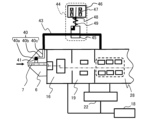
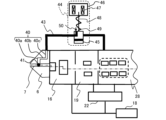
- FIGS. 2A and 2B are diagrams showing the operation of the pressure-type sealing plug in the analyzer.
- FIG. 2A shows a state in which the vacuum pumps 18 and 22 are energized while power is being supplied to the analyzer 100.
- FIG. 2B shows a state during a power outage of the vacuum pumps 18 and 22 when the power supply to the analyzer 100 is stopped.
- the pressure-type sealing plug 41 can be operated by switching the pressure difference formed through the bypass piping 43 using a vacuum valve 44.
- the plug hole 40 is provided in an L-shaped bent structure.
- the plug hole 40 has a section 40a extending upward from the middle part of the first pore 7, a section 40b extending horizontally at an intermediate height, and a section 40b extending horizontally from an intermediate height. It has a section 40c extending upward.
- the section 40a and the section 40b communicate with each other at an L-shaped bent portion.
- the section 40b and the section 40c communicate with each other at a portion bent in an inverted L shape.
- the diameter of the section 40a extending upward from the middle part of the first pore 7 is set to be equal to the outer diameter of the sealing plug 41.
- the pore diameter of the section 40b extending horizontally at an intermediate height is smaller than the pore diameter of the section 40a extending upward from the intermediate portion of the first pore 7 and the outer diameter of the sealing plug 41.
- the pore diameter of the section 40c extending upward from an intermediate height is set to such an extent that gas flow is not obstructed.
- the sealing plug 41 is placed in a section 40a extending upward from the middle part of the first pore 7. According to such a structure, in the section 40a extending upward from the middle part of the first pore 7, the sealing plug 41 can be moved up and down by the pressure difference and its own weight. In the structure and arrangement of the existing iontophoresis electrode 6, the plug hole 40 can be opened to the intermediate portion of the first pore 7 while ensuring the connection of the bypass pipe 43 to the plug hole 40.
- the vacuum valve 44 has a function of switching the flow path of the bypass piping 43 by stopping energization when a power outage occurs.
- the vacuum valve 44 includes a valve body 45, a coil housing 46, a solenoid coil 47, a movable magnetic member 48, and a spring 49.
- the valve body 45 is movably provided and includes a plurality of ports and a flow path that communicates the ports with each other.
- the coil housing 46 houses a solenoid coil 47.
- the solenoid coil 47 is connected to a power source (not shown), and generates electromagnetic force when energized.
- the movable magnetic member 48 has magnetism and is movable by electromagnetic force.
- the tip of the movable magnetic member 48 supports the valve body 45 .
- the base end of the movable magnetic member 48 is inserted into the inside of the solenoid coil 47 so as to be freely movable forward and backward.
- the spring 49 elastically connects the valve body 45 and the coil housing 46.
- the spring 49 biases the valve body 45 toward the coil housing 46 so that the valve body 45 is in a communication position where the bypass pipe 43 is communicated with the valve body 45 .
- the vacuum valve 44 is provided to be able to switch the connection between the plug hole 40 and the analysis chamber 28 and the connection between the plug hole 40 and the space in the atmospheric pressure environment with respect to the flow path of the bypass piping 43.
- the valve body 46 is provided with two inlet ports and two outlet ports.
- One inlet port is switched between opening and closing for the section of the bypass piping 43 on the analysis chamber 28 side.
- the other inlet port is switched open and closed to the atmospheric environment space.
- One outlet port communicates with one inlet port within the valve body 45, and the section of the bypass piping 43 on the plug hole 40 side is switched between opening and closing.
- the other outlet port communicates with the other inlet port within the valve body 45, and the section of the bypass piping 43 on the plug hole 40 side is switched between opening and closing.
- the solenoid coil 47 when power is being supplied to the analyzer 100, the solenoid coil 47 is energized.
- the solenoid coil 47 generates electromagnetic force when energized, and attracts and pulls up the movable magnetic member 48 with the electromagnetic force.
- the valve body 45 supported by the movable magnetic member 48 is maintained in a communication position where the bypass pipe 43 is communicated with the valve body 45 against the biasing force of the spring 49 .
- the plug hole 40 and the analysis chamber 28 communicate with each other through the bypass piping 43.
- the pressure in the first pore 7 is intermediate between that in the ion source container 9 and the first differential pumping chamber 16 .
- the analysis chamber 28 is maintained at a higher degree of vacuum than the first differential pumping chamber 16. Therefore, in the plug hole 40, the area below the sealing plug 41 has a low degree of vacuum close to atmospheric pressure, and the area above the sealing plug 41 has a high degree of vacuum.
- the plug hole 40 and the analysis chamber 28 do not communicate with each other through the bypass piping 43, and the plug hole 40 is opened to the space in the atmospheric pressure environment.
- the pressure in the first pore 7 is intermediate between that in the ion source container 9 and the first differential pumping chamber 16 .
- air 50 flows into the plug hole 40 from a space in an atmospheric pressure environment. Therefore, in the stopper hole 40, the area below the sealing plug 41 has a low degree of vacuum close to atmospheric pressure, and the area above the sealing plug 41 has a pressure close to atmospheric pressure.
- the power supply to the solenoid coil 47 is also stopped.
- the first pores 7 can be closed with this. Since the first pore 7 is closed, gas can be prevented from flowing into the suction side of the vacuum pumps 18, 22. Note that even if the first pore 7 is not completely blocked, when the sealing plug 41 enters the first pore 7, the gas inflow speed is made smaller than the allowable inflow speed when the turbo molecular pump 22 is decelerated. It is possible to do so. Therefore, the load on the rotary blades of the vacuum pumps 18, 22 can be reduced and the vacuum pumps 18, 22 can be protected.
- the sealing plug 41 is configured to operate due to the pressure difference between the ion source container 9 and the analysis chamber 28.
- the analysis chamber 28 is a space maintained at the highest degree of vacuum among the vacuum chambers 16, 19, and 28. Therefore, when the bypass piping 43 is connected between the plug hole 40 and the analysis chamber 28, the sealing plug 41 can be easily floated by the pressure difference.
- the sealing plug 41 may be configured to operate based on the pressure difference between the ion source container 9 and the second differential exhaust chamber 19, as long as the pressure difference necessary for operation is ensured, or 9 and the first differential exhaust chamber 16 may be used.
- the bypass piping 43 is provided between the plug hole 40 and the second differential exhaust chamber 19 or between the plug hole 40 and the first differential exhaust chamber 16 instead of between the plug hole 40 and the analysis chamber 28. May be connected.
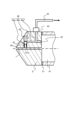
- FIG. 3 is a diagram illustrating a method of forming a plug hole in an analyzer.
- the plug hole 40 can be formed by drilling a hole in the iontophoresis electrode 6. By combining straight through holes, sections 40a, 40b, and 40c that communicate with each other at bent portions can be formed.
- the iontophoresis electrode 6 includes a through hole corresponding to a section 40a extending upward from the middle part of the first pore 7, a through hole corresponding to a section 40b extending horizontally at an intermediate height, and a through hole corresponding to a section 40b extending horizontally from the middle part of the first pore 7.
- a through hole corresponding to the section 40c extending upward from a certain height is formed by lathe processing or the like.
- a sealing plug 41 is placed in a section 40a extending upward from the middle part of the first pore 7. When the closing member 52 is press-fitted into each through-hole, a plug hole 40 is formed.
- an appropriate material such as carbon steel or stainless steel can be used as long as it has heat resistance to high temperatures of about 200° C. and strength to withstand press-fitting.
- the iontophoresis electrode 6 can be made of, for example, stainless steel.
- the space between the iontophoresis electrode 6 and the first differential exhaust chamber 16 is hermetically sealed by an O-ring 51.
- the sealing plug 41 can be made of metal such as carbon steel or stainless steel, or ceramics such as silicon nitride.
- the sealing plug 41 may have an appropriate shape such as spherical, cylindrical, or conical, as long as the gas inflow speed through the first pore 7 can be made smaller than the allowable inflow speed when the vacuum pumps 18 and 22 are decelerated. It can be provided in the shape of However, the sealing plug 41 needs to be provided in consideration of its own weight, buoyancy due to the pressure difference formed through the bypass pipe 43, frictional force with the inner wall of the plug hole 40, etc.
- the buoyant force F2 acting on the sealing plug 41 is F2 ⁇ 15.7 gf, assuming that the degree of vacuum below the sealing plug 41 at the time of a power outage is half the atmospheric pressure.
- the frictional force F3 acting on the sealing plug 41 is F3 ⁇ 0.016 gf, assuming that the friction coefficient ⁇ between the sealing plug 41 and the inner wall of the plug hole 40 is 0.5. It is known that the coefficient of friction ⁇ increases even when dissimilar metals are in contact with each other at a high degree of vacuum.
- the sealing plug 41 floats up due to the pressure difference between the first pore 7 and the analysis chamber 28 at the time of a power outage under the assumed friction coefficient ⁇ with the inner wall of the plug hole 40, and It can be provided so that it falls under its own weight due to the pressure difference between the pore 7 and the atmospheric pressure.
- a minute gap may be formed between the sealing plug 41 and the inner wall of the plug hole 40.
- gas flows out from the first pore 7 toward the analysis chamber 28 .
- the gap between the sealing plug 41 and the inner wall of the plug hole 40 is about 10 ⁇ m or less, the amount of gas flowing out can be made small enough to be ignored. If it is about 10 ⁇ m or less, the sealing plug 41 can be floated due to the pressure difference when power is being supplied to the analyzer 100.
- the coefficient of thermal expansion of carbon steel is approximately 12 ⁇ 10 ⁇ 6 /K.
- the coefficient of thermal expansion of stainless steel is approximately 17 ⁇ 10 ⁇ 6 /K.
- the diameter of the plug hole 40 becomes larger by about 1.8 ⁇ m than the diameter of the carbon steel ball, compared to when the temperature is 20° C., which is room temperature.
- the difference between the diameter of the plug hole 40 and the diameter of the sealing plug 41 becomes smaller during thermal expansion than at room temperature.
- the average gap during thermal expansion is approximately 12.3 ⁇ m (10.5 ⁇ m+1.8 ⁇ m).
- the ratio of the average gap during thermal expansion to the diameter of the plug hole 40 is approximately 163:1, which allows the gap ratio to be sufficiently small.
- the opening of the plug hole 40 on the first pore 7 side be provided in the middle part of the first pore 7 on the upstream side where the ion source container 9 is located.
- the pressure in the first pore 7 becomes closer to atmospheric pressure as the ion source container 9 is located upstream.
- the degree of vacuum increases toward the downstream side where the first differential pumping chamber 16 is located.
- the pressure difference formed through the bypass piping 43 becomes larger as the plug hole 40 opens upstream of the first pore 7, so it becomes easier to ensure the buoyancy of the sealing plug 41.
- the sealing plug 41 and the iontophoresis electrode 6 can also be formed of the same kind of metal, such as stainless steel.
- metal such as stainless steel.
- the sealing plug 41 and the iontophoresis electrode 6 are made of the same material, the difference in thermal elongation is suppressed, so that such gas leakage can be prevented.
- the friction coefficient ⁇ increases, so it is preferable to lubricate them.
- the inner wall of the plug hole 40 that comes into contact with the sealing plug 41 may be coated with a liquid lubricant or a solid lubricant may be formed as a film, if necessary.
- a liquid lubricant a type having a low vapor pressure is preferable.
- perfluoropolyether such as Fomblin
- fluorine-based lubricant such as polytetrafluoroethylene, etc.
- solid lubricant molybdenum disulfide, tungsten disulfide, boron nitride, boric acid, polytetrafluoroethylene, chromium, silver, lead alloy, etc. can be used.
- the solid lubricant can be formed into a film by sputtering, ion plating, plating, etc.
- the inner wall of the plug hole 40 that comes into contact with the sealing plug 41 may be given a mirror finish to reduce surface roughness, if necessary.
- the inner wall of the plug hole 40 can be subjected to mechanical polishing, electrolytic polishing, chemical polishing, or the like.
- the coefficient of friction ⁇ with respect to the sealing plug 41 is reduced, and it becomes difficult for dirt to adhere to it, reducing carryover.
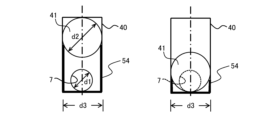
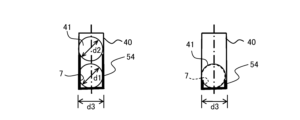
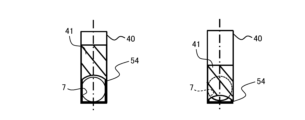
- FIG. 4, FIG. 5, and FIG. 6 are diagrams showing structural examples of plug holes in the analyzer. 4, 5, and 6 correspond to the sectional views taken along the line II in FIG. 3.
- d1 indicates the diameter of the first pore 7
- d2 indicates the diameter of the sealing plug 41
- d3 indicates the diameter of the plug hole 40.
- FIG. 5, and FIG. 6, the left diagram shows a state in which the sealing plug 41 is floating, and the right diagram shows a state in which the sealing plug 41 has fallen.
- the diameter d2 of the sealing plug 41 can be set larger than the pore diameter d1 of the first pore 7. That is, the pore diameter d3 of the plug hole 40 can be set larger than the pore diameter d1 of the first pore 7. Further, the height of the lower end of the sealing plug 41 can be set higher than the height of the upper end of the first pore 7 when the sealing plug 41 is in a floating state.
- the plug hole 40 can form a step-shaped wall around the first pore 7 with respect to the traveling direction of ions, etc. passing through the first pore 7.
- the foreign matter 54 may be ions 4 obtained by ionizing the sample, or may be neutral particles other than ions.
- the foreign matter 54 differs for each sample solution 1 and for each ion to be analyzed, and becomes a cause of cross-contamination.
- the sealing plug 41 operates, the foreign matter 54 is rubbed and peeled off from the inner wall of the plug hole 40 .
- the peeled foreign matter 54 reaches the detection section and becomes noise in the mass spectrum, which may deteriorate analysis accuracy.
- the amount of such foreign matter 54 attached increases as the surface area of the inner wall of the plug hole 40 becomes larger below the sealing plug 41.
- the diameter d2 of the sealing plug 41 is slightly larger than the pore diameter d1 of the first pore 7. That is, it is preferable that the pore diameter d3 of the plug hole 40 be slightly larger than the pore diameter d1 of the first pore 7.
- the difference between the diameter d2 of the sealing plug 41 and the pore diameter d1 of the first pore 7 is preferably 1 mm or less, more preferably 500 ⁇ m or less, and even more preferably 100 ⁇ m or less.
- the diameter d2 of the sealing plug 41 is preferably set to a length that does not allow the sealing plug 41 to enter the first pore 7 at room temperature and during thermal expansion.
- the height of the lower end of the sealing plug 41 is preferably close to the height of the upper end of the first pore 7 when the sealing plug 41 is in a floating state.
- the difference between the height of the lower end of the sealing plug 41 and the height of the upper end of the first pore 7 is preferably 5 mm or less, more preferably 1 mm or less.
- the amount of foreign matter 54 adhering to the inner wall of the plug hole 40 can be reduced. Therefore, high analysis accuracy can be ensured. Even when the sealing plug 41 operates, a large amount of foreign matter 54 does not come off from the inner wall of the plug hole 40, so not only when restarting analysis after a power outage occurs, but also when power is being supplied to the analyzer 100. , carryover can be suppressed.
- the sealing plug 41 may be provided in a shape in which the lower surface of the sealing plug 41 and the upper surface of the first pore 7 are substantially flush with each other in the floating state.
- the sealing plug 41 is provided in a cylindrical shape with a concave cutout at the bottom.
- the lower part of the sealing plug 41 is cut out in an arc shape having the same curvature as the first pore 7 in cross-sectional view.
- the amount of foreign matter 54 adhering to the inner wall of the plug hole 40 can be reduced when the sealing plug 41 is in a floating state.
- the first pores 7 cannot be completely blocked, but the inflow of gas can be suppressed to the extent that damage to the turbomolecular pump 22 can be prevented.
- the bottom of the plug hole 40 may be provided with a counterbore or may not be provided with a counterbore. From the viewpoint of making it difficult for the flow of ions etc. to stagnate, it is preferable not to provide a counterbore.
- the bottom of the plug hole 40 has a rectangular shape in FIGS. 4, 5, and 6, the bottom of the plug hole 40 can also be made to coincide with the bottom surface of the first pore 7. It is also possible to provide a structure in which the sealing plug 41 lands on the bottom surface of the first pore 7 as long as the buoyancy acting on the fallen sealing plug 41 can be ensured when analysis is restarted after a power outage occurs.
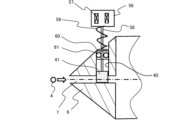
- FIGS. 7A and 7B are diagrams showing the operation of the electromagnetic sealing stopper in the analyzer.
- FIG. 7A shows a state in which the vacuum pumps 18 and 22 are energized while power is being supplied to the analyzer 100.
- FIG. 7B shows a state during a power outage of the vacuum pumps 18 and 22 when the power supply to the analyzer 100 is stopped.
- the sealing plug 41 provided in the analyzer 100 may be provided in an electromagnetic manner driven by an electromagnetic actuator 55.
- the iontophoresis electrode 6 is provided with a straight plug hole 40 so as to be connected to the first pore 7.
- One end of the plug hole 40 opens into the middle part of the first pore 7 .
- the other end of the plug hole 40 opens above the iontophoresis electrode 6.
- a sealing plug 41 supported by an electromagnetic actuator 55 is inserted into the straight plug hole 40 .
- the electromagnetic actuator 55 has a function of closing the first pore 7 with the sealing plug 41 by stopping the power supply when a power outage occurs.
- the electromagnetic actuator 55 includes a coil housing 56, a solenoid coil 57, a movable magnetic member 58, a spring 59, a shaft sealing member 60, and an O-ring 61.
- the sealing plug 41 is fixed to one end of the movable magnetic member 58.
- the sealing plug 41 supported by the electromagnetic actuator 55 can be provided in an appropriate shape such as spherical, cylindrical, or conical.
- the coil housing 56 houses a solenoid coil 57.
- the solenoid coil 57 is connected to a power source (not shown), and generates electromagnetic force when energized.
- the movable magnetic member 58 has magnetism and is movable by electromagnetic force.
- the tip of the movable magnetic member 58 is inserted into the plug hole 40 and supports the sealing plug 41.
- the base end of the movable magnetic member 48 is inserted into the inside of the solenoid coil 57 so that it can move forward and backward.
- the spring 59 elastically connects the coil housing 56 and the movable magnetic member 58.
- the spring 59 urges the movable magnetic member 58 toward the first pore 7 so that a reaction force against the electromagnetic force is applied to the movable magnetic member 58 .
- the shaft sealing member 60 is provided in an opening above the plug hole 40.
- the shaft sealing member 60 seals the plug hole 40 into which the movable magnetic member 58 is inserted in a state in which the movable magnetic member 58 can move forward and backward.
- the O-ring 61 is housed in the shaft sealing member 60.
- the O-ring 61 hermetically seals the sliding portion with the movable magnetic member 58.
- the shaft sealing member 60 and the O-ring 61 prevent gas from leaking through the plug hole 40.
- the sealing plug 41 supported by the electromagnetic actuator 55 closes the first pore 7 when power to the vacuum pumps 18 and 22 is stopped in the event of a power outage.
- the sealing plug 41 supported by the electromagnetic actuator 55 is pulled up from the first pore 7 into the plug hole 40 by the electromagnetic force of the electromagnetic actuator 55.
- the first pore 7 is opened.
- the solenoid coil 57 when power is being supplied to the analyzer 100, the solenoid coil 57 is energized.
- the solenoid coil 57 generates electromagnetic force when energized, and attracts and pulls up the movable magnetic member 58 with the electromagnetic force.
- the sealing plug 41 supported by the movable magnetic member 58 is pulled up from the first pore 7 and held inside the plug hole 40, thereby opening the first pore 7.
- the electromagnetic actuator 55 is preferably provided with heat resistance when the iontophoresis electrode 6 is heated to a high temperature.
- a perfluoropolyether rubber such as Viton or a fluorine-based elastomer such as polyvinylidene fluoride copolymer rubber can be used.
- the movable magnetic member 58, the adjacent portion between the movable magnetic member 58 and the coil housing 56, and the joint portion between the movable magnetic member 58 and the spring 59 be provided in a structure with high thermal resistance.
- a heat-resistant material with high thermal conductivity such as ceramics or heat-resistant resin may be used in the middle part of the movable magnetic member 58, between the movable magnetic member 58 and the coil housing 56, or between the movable magnetic member 58 and the spring 59. It can be provided in between.
- the electromagnetic sealing plug 41 when the power supply to the analyzer 100 is stopped and the power supply to the vacuum pumps 18 and 22 is stopped, the power supply to the solenoid coil 57 is also stopped.
- the first pores 7 can be closed with this. Since the first pore 7 is closed, gas can be prevented from flowing into the suction side of the vacuum pumps 18, 22.
- the electromagnetic sealing plug 41 has restrictions on the arrangement and structure of the electromagnetic actuator 55, but the degree of freedom in designing the sealing plug 41 and the plug hole 40 is expanded. Ru.
- the present invention is not limited to the above-described embodiments, and various changes can be made without departing from the spirit of the present invention.
- the present invention is not necessarily limited to having all the configurations of the embodiments described above. Replacing part of the configuration of one embodiment with another configuration, adding part of the configuration of one embodiment to another form, or omitting part of the configuration of one embodiment I can do it.
- the analyzer 100 described above is a mass spectrometer.
- an analyzer equipped with a sealing plug capable of sealing a pore that introduces charged particles from a charged particle source into a vacuum chamber is a device that is equipped with a sealing plug that can seal the pore that introduces charged particles from a charged particle source into a vacuum chamber.
- the present invention may be applied to other analytical devices as long as it includes a pore for introducing charged particles from a charged particle generation source into a vacuum chamber, and a vacuum pump connected to the vacuum chamber.
- Other analysis devices include a scanning electron microscope (SEM), a transmission electron microscope (TEM), a focused ion beam (FIB) device, and the like.
Landscapes
- Chemical & Material Sciences (AREA)
- Analytical Chemistry (AREA)
- Physics & Mathematics (AREA)
- Engineering & Computer Science (AREA)
- Plasma & Fusion (AREA)
- Other Investigation Or Analysis Of Materials By Electrical Means (AREA)
Priority Applications (5)
| Application Number | Priority Date | Filing Date | Title |
|---|---|---|---|
| US18/850,757 US20250226197A1 (en) | 2022-03-31 | 2022-03-31 | Analyzer |
| JP2024511142A JP7693099B2 (ja) | 2022-03-31 | 2022-03-31 | 分析装置 |
| CN202280093727.1A CN118922911A (zh) | 2022-03-31 | 2022-03-31 | 分析装置 |
| EP22933891.8A EP4503089A4 (en) | 2022-03-31 | 2022-03-31 | ANALYSIS DEVICE |
| PCT/JP2022/016938 WO2023188410A1 (ja) | 2022-03-31 | 2022-03-31 | 分析装置 |
Applications Claiming Priority (1)
| Application Number | Priority Date | Filing Date | Title |
|---|---|---|---|
| PCT/JP2022/016938 WO2023188410A1 (ja) | 2022-03-31 | 2022-03-31 | 分析装置 |
Publications (1)
| Publication Number | Publication Date |
|---|---|
| WO2023188410A1 true WO2023188410A1 (ja) | 2023-10-05 |
Family
ID=88200489
Family Applications (1)
| Application Number | Title | Priority Date | Filing Date |
|---|---|---|---|
| PCT/JP2022/016938 Ceased WO2023188410A1 (ja) | 2022-03-31 | 2022-03-31 | 分析装置 |
Country Status (5)
| Country | Link |
|---|---|
| US (1) | US20250226197A1 (https=) |
| EP (1) | EP4503089A4 (https=) |
| JP (1) | JP7693099B2 (https=) |
| CN (1) | CN118922911A (https=) |
| WO (1) | WO2023188410A1 (https=) |
Citations (4)
| Publication number | Priority date | Publication date | Assignee | Title |
|---|---|---|---|---|
| JPS60113551U (ja) * | 1983-12-30 | 1985-08-01 | 株式会社島津製作所 | ガラス製ジエツト型分子セパレ−タ |
| JPH09210965A (ja) * | 1996-01-31 | 1997-08-15 | Shimadzu Corp | 液体クロマトグラフ質量分析装置 |
| JP2011512639A (ja) * | 2008-02-20 | 2011-04-21 | バリアン・インコーポレイテッド | 真空システム用のシャッタおよびゲートバルブアセンブリ |
| WO2017010163A1 (ja) * | 2015-07-13 | 2017-01-19 | 株式会社島津製作所 | シャッター |
Family Cites Families (3)
| Publication number | Priority date | Publication date | Assignee | Title |
|---|---|---|---|---|
| GB1497436A (en) * | 1975-03-11 | 1978-01-12 | Pye Ltd | Apparatus for the detection of volatile organic substance |
| JPH0668843A (ja) * | 1992-08-21 | 1994-03-11 | Hitachi Ltd | 大気圧イオン化質量分析計 |
| GB2590351B (en) * | 2019-11-08 | 2024-01-03 | Thermo Fisher Scient Bremen Gmbh | Atmospheric pressure ion source interface |
-
2022
- 2022-03-31 CN CN202280093727.1A patent/CN118922911A/zh active Pending
- 2022-03-31 EP EP22933891.8A patent/EP4503089A4/en active Pending
- 2022-03-31 JP JP2024511142A patent/JP7693099B2/ja active Active
- 2022-03-31 WO PCT/JP2022/016938 patent/WO2023188410A1/ja not_active Ceased
- 2022-03-31 US US18/850,757 patent/US20250226197A1/en active Pending
Patent Citations (4)
| Publication number | Priority date | Publication date | Assignee | Title |
|---|---|---|---|---|
| JPS60113551U (ja) * | 1983-12-30 | 1985-08-01 | 株式会社島津製作所 | ガラス製ジエツト型分子セパレ−タ |
| JPH09210965A (ja) * | 1996-01-31 | 1997-08-15 | Shimadzu Corp | 液体クロマトグラフ質量分析装置 |
| JP2011512639A (ja) * | 2008-02-20 | 2011-04-21 | バリアン・インコーポレイテッド | 真空システム用のシャッタおよびゲートバルブアセンブリ |
| WO2017010163A1 (ja) * | 2015-07-13 | 2017-01-19 | 株式会社島津製作所 | シャッター |
Non-Patent Citations (1)
| Title |
|---|
| See also references of EP4503089A4 * |
Also Published As
| Publication number | Publication date |
|---|---|
| JPWO2023188410A1 (https=) | 2023-10-05 |
| JP7693099B2 (ja) | 2025-06-16 |
| CN118922911A (zh) | 2024-11-08 |
| US20250226197A1 (en) | 2025-07-10 |
| EP4503089A4 (en) | 2026-01-28 |
| EP4503089A1 (en) | 2025-02-05 |
Similar Documents
| Publication | Publication Date | Title |
|---|---|---|
| US11434913B2 (en) | Multiple port vacuum pump system | |
| MX2008010498A (es) | Espectrometro de masa para deteccion de fuga de gas traza con supresion de iones no deseados. | |
| JP2012138354A (ja) | 小型質量分析計システム | |
| US10103014B2 (en) | Ion transfer device for mass spectrometry | |
| GB2459233A (en) | Vacuum pump or vacuum apparatus having a vacuum pump | |
| US9666404B2 (en) | Charged particle source arrangement for a charged particle beam device, charged particle beam device for sample inspection, and method for providing a primary charged particle beam for sample inspection in a charged particle beam | |
| JP5056597B2 (ja) | 大気圧イオン化質量分析装置 | |
| US20110260048A1 (en) | Ion Transfer Tube for a Mass Spectrometer Having a Resistive Tube Member and a Conductive Tube Member | |
| CN112020760B (zh) | Imr-ms设备 | |
| US7230234B2 (en) | Orthogonal acceleration time-of-flight mass spectrometer | |
| JP7693099B2 (ja) | 分析装置 | |
| US10455683B2 (en) | Ion throughput pump and method | |
| JP4172561B2 (ja) | ガス分析装置 | |
| WO2005027175A1 (en) | Chamber with low electron stimulated desorption | |
| US12173712B2 (en) | Vacuum pumping system having a plurality of positive displacement vacuum pumps and method for operating the same | |
| JP2010027622A (ja) | 質量分析装置 | |
| US20250125114A1 (en) | Dry electron source environment | |
| KR102587356B1 (ko) | 차동 진공 이온화 원 | |
| Koops | A miniaturized Orbitron pump for MEMS applications | |
| CN223218260U (zh) | 一种超高气压进样用质谱离子源 | |
| JP7780410B2 (ja) | イオン源、質量分析計、及び、イオン源製造方法 | |
| CN121075897A (zh) | 离子透镜组件、离子源、质谱仪以及质谱系统 | |
| Koops | Proposal of a miniaturized Orbitron pump for MEMS applications | |
| RU2298247C1 (ru) | Электрическая развязка газового тракта катода плазменного ускорителя | |
| JPH11162397A (ja) | イオンビーム照射装置 |
Legal Events
| Date | Code | Title | Description |
|---|---|---|---|
| 121 | Ep: the epo has been informed by wipo that ep was designated in this application |
Ref document number: 22933891 Country of ref document: EP Kind code of ref document: A1 |
|
| ENP | Entry into the national phase |
Ref document number: 2024511142 Country of ref document: JP Kind code of ref document: A |
|
| WWE | Wipo information: entry into national phase |
Ref document number: 202280093727.1 Country of ref document: CN |
|
| WWE | Wipo information: entry into national phase |
Ref document number: 18850757 Country of ref document: US |
|
| WWE | Wipo information: entry into national phase |
Ref document number: 2022933891 Country of ref document: EP |
|
| ENP | Entry into the national phase |
Ref document number: 2022933891 Country of ref document: EP Effective date: 20241031 |
|
| NENP | Non-entry into the national phase |
Ref country code: DE |
|
| WWP | Wipo information: published in national office |
Ref document number: 18850757 Country of ref document: US |