WO2023182500A1 - 窓材及び透光性屋根材 - Google Patents
窓材及び透光性屋根材 Download PDFInfo
- Publication number
- WO2023182500A1 WO2023182500A1 PCT/JP2023/011834 JP2023011834W WO2023182500A1 WO 2023182500 A1 WO2023182500 A1 WO 2023182500A1 JP 2023011834 W JP2023011834 W JP 2023011834W WO 2023182500 A1 WO2023182500 A1 WO 2023182500A1
- Authority
- WO
- WIPO (PCT)
- Prior art keywords
- temperature
- sensitive
- adhesive
- mass
- fine particles
- Prior art date
- Legal status (The legal status is an assumption and is not a legal conclusion. Google has not performed a legal analysis and makes no representation as to the accuracy of the status listed.)
- Ceased
Links
Images




Classifications
-
- C—CHEMISTRY; METALLURGY
- C09—DYES; PAINTS; POLISHES; NATURAL RESINS; ADHESIVES; COMPOSITIONS NOT OTHERWISE PROVIDED FOR; APPLICATIONS OF MATERIALS NOT OTHERWISE PROVIDED FOR
- C09J—ADHESIVES; NON-MECHANICAL ASPECTS OF ADHESIVE PROCESSES IN GENERAL; ADHESIVE PROCESSES NOT PROVIDED FOR ELSEWHERE; USE OF MATERIALS AS ADHESIVES
- C09J7/00—Adhesives in the form of films or foils
- C09J7/30—Adhesives in the form of films or foils characterised by the adhesive composition
- C09J7/35—Heat-activated
-
- B—PERFORMING OPERATIONS; TRANSPORTING
- B32—LAYERED PRODUCTS
- B32B—LAYERED PRODUCTS, i.e. PRODUCTS BUILT-UP OF STRATA OF FLAT OR NON-FLAT, e.g. CELLULAR OR HONEYCOMB, FORM
- B32B27/00—Layered products comprising a layer of synthetic resin
- B32B27/18—Layered products comprising a layer of synthetic resin characterised by the use of special additives
-
- B—PERFORMING OPERATIONS; TRANSPORTING
- B32—LAYERED PRODUCTS
- B32B—LAYERED PRODUCTS, i.e. PRODUCTS BUILT-UP OF STRATA OF FLAT OR NON-FLAT, e.g. CELLULAR OR HONEYCOMB, FORM
- B32B17/00—Layered products essentially comprising sheet glass, or glass, slag, or like fibres
- B32B17/06—Layered products essentially comprising sheet glass, or glass, slag, or like fibres comprising glass as the main or only constituent of a layer, next to another layer of a specific material
- B32B17/10—Layered products essentially comprising sheet glass, or glass, slag, or like fibres comprising glass as the main or only constituent of a layer, next to another layer of a specific material of synthetic resin
- B32B17/10005—Layered products essentially comprising sheet glass, or glass, slag, or like fibres comprising glass as the main or only constituent of a layer, next to another layer of a specific material of synthetic resin laminated safety glass or glazing
- B32B17/10165—Functional features of the laminated safety glass or glazing
- B32B17/10431—Specific parts for the modulation of light incorporated into the laminated safety glass or glazing
- B32B17/10467—Variable transmission
-
- B—PERFORMING OPERATIONS; TRANSPORTING
- B32—LAYERED PRODUCTS
- B32B—LAYERED PRODUCTS, i.e. PRODUCTS BUILT-UP OF STRATA OF FLAT OR NON-FLAT, e.g. CELLULAR OR HONEYCOMB, FORM
- B32B17/00—Layered products essentially comprising sheet glass, or glass, slag, or like fibres
- B32B17/06—Layered products essentially comprising sheet glass, or glass, slag, or like fibres comprising glass as the main or only constituent of a layer, next to another layer of a specific material
- B32B17/10—Layered products essentially comprising sheet glass, or glass, slag, or like fibres comprising glass as the main or only constituent of a layer, next to another layer of a specific material of synthetic resin
- B32B17/10005—Layered products essentially comprising sheet glass, or glass, slag, or like fibres comprising glass as the main or only constituent of a layer, next to another layer of a specific material of synthetic resin laminated safety glass or glazing
- B32B17/10165—Functional features of the laminated safety glass or glazing
- B32B17/10431—Specific parts for the modulation of light incorporated into the laminated safety glass or glazing
- B32B17/10467—Variable transmission
- B32B17/10477—Variable transmission thermochromic
-
- B—PERFORMING OPERATIONS; TRANSPORTING
- B32—LAYERED PRODUCTS
- B32B—LAYERED PRODUCTS, i.e. PRODUCTS BUILT-UP OF STRATA OF FLAT OR NON-FLAT, e.g. CELLULAR OR HONEYCOMB, FORM
- B32B17/00—Layered products essentially comprising sheet glass, or glass, slag, or like fibres
- B32B17/06—Layered products essentially comprising sheet glass, or glass, slag, or like fibres comprising glass as the main or only constituent of a layer, next to another layer of a specific material
- B32B17/10—Layered products essentially comprising sheet glass, or glass, slag, or like fibres comprising glass as the main or only constituent of a layer, next to another layer of a specific material of synthetic resin
- B32B17/10005—Layered products essentially comprising sheet glass, or glass, slag, or like fibres comprising glass as the main or only constituent of a layer, next to another layer of a specific material of synthetic resin laminated safety glass or glazing
- B32B17/1055—Layered products essentially comprising sheet glass, or glass, slag, or like fibres comprising glass as the main or only constituent of a layer, next to another layer of a specific material of synthetic resin laminated safety glass or glazing characterized by the resin layer, i.e. interlayer
-
- B—PERFORMING OPERATIONS; TRANSPORTING
- B32—LAYERED PRODUCTS
- B32B—LAYERED PRODUCTS, i.e. PRODUCTS BUILT-UP OF STRATA OF FLAT OR NON-FLAT, e.g. CELLULAR OR HONEYCOMB, FORM
- B32B17/00—Layered products essentially comprising sheet glass, or glass, slag, or like fibres
- B32B17/06—Layered products essentially comprising sheet glass, or glass, slag, or like fibres comprising glass as the main or only constituent of a layer, next to another layer of a specific material
- B32B17/10—Layered products essentially comprising sheet glass, or glass, slag, or like fibres comprising glass as the main or only constituent of a layer, next to another layer of a specific material of synthetic resin
- B32B17/10005—Layered products essentially comprising sheet glass, or glass, slag, or like fibres comprising glass as the main or only constituent of a layer, next to another layer of a specific material of synthetic resin laminated safety glass or glazing
- B32B17/1055—Layered products essentially comprising sheet glass, or glass, slag, or like fibres comprising glass as the main or only constituent of a layer, next to another layer of a specific material of synthetic resin laminated safety glass or glazing characterized by the resin layer, i.e. interlayer
- B32B17/10614—Layered products essentially comprising sheet glass, or glass, slag, or like fibres comprising glass as the main or only constituent of a layer, next to another layer of a specific material of synthetic resin laminated safety glass or glazing characterized by the resin layer, i.e. interlayer comprising particles for purposes other than dyeing
-
- B—PERFORMING OPERATIONS; TRANSPORTING
- B32—LAYERED PRODUCTS
- B32B—LAYERED PRODUCTS, i.e. PRODUCTS BUILT-UP OF STRATA OF FLAT OR NON-FLAT, e.g. CELLULAR OR HONEYCOMB, FORM
- B32B27/00—Layered products comprising a layer of synthetic resin
-
- B—PERFORMING OPERATIONS; TRANSPORTING
- B32—LAYERED PRODUCTS
- B32B—LAYERED PRODUCTS, i.e. PRODUCTS BUILT-UP OF STRATA OF FLAT OR NON-FLAT, e.g. CELLULAR OR HONEYCOMB, FORM
- B32B27/00—Layered products comprising a layer of synthetic resin
- B32B27/06—Layered products comprising a layer of synthetic resin as the main or only constituent of a layer, which is next to another layer of the same or of a different material
- B32B27/08—Layered products comprising a layer of synthetic resin as the main or only constituent of a layer, which is next to another layer of the same or of a different material of synthetic resin
-
- B—PERFORMING OPERATIONS; TRANSPORTING
- B32—LAYERED PRODUCTS
- B32B—LAYERED PRODUCTS, i.e. PRODUCTS BUILT-UP OF STRATA OF FLAT OR NON-FLAT, e.g. CELLULAR OR HONEYCOMB, FORM
- B32B27/00—Layered products comprising a layer of synthetic resin
- B32B27/30—Layered products comprising a layer of synthetic resin comprising vinyl (co)polymers; comprising acrylic (co)polymers
-
- B—PERFORMING OPERATIONS; TRANSPORTING
- B32—LAYERED PRODUCTS
- B32B—LAYERED PRODUCTS, i.e. PRODUCTS BUILT-UP OF STRATA OF FLAT OR NON-FLAT, e.g. CELLULAR OR HONEYCOMB, FORM
- B32B7/00—Layered products characterised by the relation between layers; Layered products characterised by the relative orientation of features between layers, or by the relative values of a measurable parameter between layers, i.e. products comprising layers having different physical, chemical or physicochemical properties; Layered products characterised by the interconnection of layers
- B32B7/02—Physical, chemical or physicochemical properties
- B32B7/023—Optical properties
-
- B—PERFORMING OPERATIONS; TRANSPORTING
- B32—LAYERED PRODUCTS
- B32B—LAYERED PRODUCTS, i.e. PRODUCTS BUILT-UP OF STRATA OF FLAT OR NON-FLAT, e.g. CELLULAR OR HONEYCOMB, FORM
- B32B7/00—Layered products characterised by the relation between layers; Layered products characterised by the relative orientation of features between layers, or by the relative values of a measurable parameter between layers, i.e. products comprising layers having different physical, chemical or physicochemical properties; Layered products characterised by the interconnection of layers
- B32B7/02—Physical, chemical or physicochemical properties
- B32B7/027—Thermal properties
-
- B—PERFORMING OPERATIONS; TRANSPORTING
- B32—LAYERED PRODUCTS
- B32B—LAYERED PRODUCTS, i.e. PRODUCTS BUILT-UP OF STRATA OF FLAT OR NON-FLAT, e.g. CELLULAR OR HONEYCOMB, FORM
- B32B7/00—Layered products characterised by the relation between layers; Layered products characterised by the relative orientation of features between layers, or by the relative values of a measurable parameter between layers, i.e. products comprising layers having different physical, chemical or physicochemical properties; Layered products characterised by the interconnection of layers
- B32B7/04—Interconnection of layers
- B32B7/12—Interconnection of layers using interposed adhesives or interposed materials with bonding properties
-
- B—PERFORMING OPERATIONS; TRANSPORTING
- B60—VEHICLES IN GENERAL
- B60J—WINDOWS, WINDSCREENS, NON-FIXED ROOFS, DOORS, OR SIMILAR DEVICES FOR VEHICLES; REMOVABLE EXTERNAL PROTECTIVE COVERINGS SPECIALLY ADAPTED FOR VEHICLES
- B60J3/00—Antiglare equipment associated with windows or windscreens; Sun visors for vehicles
- B60J3/04—Antiglare equipment associated with windows or windscreens; Sun visors for vehicles adjustable in transparency
-
- B—PERFORMING OPERATIONS; TRANSPORTING
- B64—AIRCRAFT; AVIATION; COSMONAUTICS
- B64C—AEROPLANES; HELICOPTERS
- B64C1/00—Fuselages; Constructional features common to fuselages, wings, stabilising surfaces or the like
- B64C1/14—Windows; Doors; Hatch covers or access panels; Surrounding frame structures; Canopies; Windscreens accessories therefor, e.g. pressure sensors, water deflectors, hinges, seals, handles, latches, windscreen wipers
- B64C1/1476—Canopies; Windscreens or similar transparent elements
- B64C1/1484—Windows
-
- C—CHEMISTRY; METALLURGY
- C03—GLASS; MINERAL OR SLAG WOOL
- C03C—CHEMICAL COMPOSITION OF GLASSES, GLAZES OR VITREOUS ENAMELS; SURFACE TREATMENT OF GLASS; SURFACE TREATMENT OF FIBRES OR FILAMENTS MADE FROM GLASS, MINERALS OR SLAGS; JOINING GLASS TO GLASS OR OTHER MATERIALS
- C03C17/00—Surface treatment of glass, not in the form of fibres or filaments, by coating
- C03C17/34—Surface treatment of glass, not in the form of fibres or filaments, by coating with at least two coatings having different compositions
- C03C17/42—Surface treatment of glass, not in the form of fibres or filaments, by coating with at least two coatings having different compositions at least one coating of an organic material and at least one non-metal coating
-
- C—CHEMISTRY; METALLURGY
- C03—GLASS; MINERAL OR SLAG WOOL
- C03C—CHEMICAL COMPOSITION OF GLASSES, GLAZES OR VITREOUS ENAMELS; SURFACE TREATMENT OF GLASS; SURFACE TREATMENT OF FIBRES OR FILAMENTS MADE FROM GLASS, MINERALS OR SLAGS; JOINING GLASS TO GLASS OR OTHER MATERIALS
- C03C27/00—Joining pieces of glass to pieces of other inorganic material; Joining glass to glass other than by fusing
- C03C27/06—Joining glass to glass by processes other than fusing
- C03C27/10—Joining glass to glass by processes other than fusing with the aid of adhesive specially adapted for that purpose
-
- C—CHEMISTRY; METALLURGY
- C09—DYES; PAINTS; POLISHES; NATURAL RESINS; ADHESIVES; COMPOSITIONS NOT OTHERWISE PROVIDED FOR; APPLICATIONS OF MATERIALS NOT OTHERWISE PROVIDED FOR
- C09J—ADHESIVES; NON-MECHANICAL ASPECTS OF ADHESIVE PROCESSES IN GENERAL; ADHESIVE PROCESSES NOT PROVIDED FOR ELSEWHERE; USE OF MATERIALS AS ADHESIVES
- C09J11/00—Features of adhesives not provided for in group C09J9/00, e.g. additives
- C09J11/02—Non-macromolecular additives
- C09J11/04—Non-macromolecular additives inorganic
-
- C—CHEMISTRY; METALLURGY
- C09—DYES; PAINTS; POLISHES; NATURAL RESINS; ADHESIVES; COMPOSITIONS NOT OTHERWISE PROVIDED FOR; APPLICATIONS OF MATERIALS NOT OTHERWISE PROVIDED FOR
- C09J—ADHESIVES; NON-MECHANICAL ASPECTS OF ADHESIVE PROCESSES IN GENERAL; ADHESIVE PROCESSES NOT PROVIDED FOR ELSEWHERE; USE OF MATERIALS AS ADHESIVES
- C09J11/00—Features of adhesives not provided for in group C09J9/00, e.g. additives
- C09J11/08—Macromolecular additives
-
- C—CHEMISTRY; METALLURGY
- C09—DYES; PAINTS; POLISHES; NATURAL RESINS; ADHESIVES; COMPOSITIONS NOT OTHERWISE PROVIDED FOR; APPLICATIONS OF MATERIALS NOT OTHERWISE PROVIDED FOR
- C09J—ADHESIVES; NON-MECHANICAL ASPECTS OF ADHESIVE PROCESSES IN GENERAL; ADHESIVE PROCESSES NOT PROVIDED FOR ELSEWHERE; USE OF MATERIALS AS ADHESIVES
- C09J133/00—Adhesives based on homopolymers or copolymers of compounds having one or more unsaturated aliphatic radicals, each having only one carbon-to-carbon double bond, and at least one being terminated by only one carboxyl radical, or of salts, anhydrides, esters, amides, imides, or nitriles thereof; Adhesives based on derivatives of such polymers
- C09J133/04—Homopolymers or copolymers of esters
- C09J133/06—Homopolymers or copolymers of esters of esters containing only carbon, hydrogen and oxygen, the oxygen atom being present only as part of the carboxyl radical
- C09J133/08—Homopolymers or copolymers of acrylic acid esters
-
- C—CHEMISTRY; METALLURGY
- C09—DYES; PAINTS; POLISHES; NATURAL RESINS; ADHESIVES; COMPOSITIONS NOT OTHERWISE PROVIDED FOR; APPLICATIONS OF MATERIALS NOT OTHERWISE PROVIDED FOR
- C09J—ADHESIVES; NON-MECHANICAL ASPECTS OF ADHESIVE PROCESSES IN GENERAL; ADHESIVE PROCESSES NOT PROVIDED FOR ELSEWHERE; USE OF MATERIALS AS ADHESIVES
- C09J7/00—Adhesives in the form of films or foils
- C09J7/20—Adhesives in the form of films or foils characterised by their carriers
- C09J7/29—Laminated material
-
- C—CHEMISTRY; METALLURGY
- C09—DYES; PAINTS; POLISHES; NATURAL RESINS; ADHESIVES; COMPOSITIONS NOT OTHERWISE PROVIDED FOR; APPLICATIONS OF MATERIALS NOT OTHERWISE PROVIDED FOR
- C09J—ADHESIVES; NON-MECHANICAL ASPECTS OF ADHESIVE PROCESSES IN GENERAL; ADHESIVE PROCESSES NOT PROVIDED FOR ELSEWHERE; USE OF MATERIALS AS ADHESIVES
- C09J7/00—Adhesives in the form of films or foils
- C09J7/30—Adhesives in the form of films or foils characterised by the adhesive composition
-
- C—CHEMISTRY; METALLURGY
- C09—DYES; PAINTS; POLISHES; NATURAL RESINS; ADHESIVES; COMPOSITIONS NOT OTHERWISE PROVIDED FOR; APPLICATIONS OF MATERIALS NOT OTHERWISE PROVIDED FOR
- C09J—ADHESIVES; NON-MECHANICAL ASPECTS OF ADHESIVE PROCESSES IN GENERAL; ADHESIVE PROCESSES NOT PROVIDED FOR ELSEWHERE; USE OF MATERIALS AS ADHESIVES
- C09J7/00—Adhesives in the form of films or foils
- C09J7/30—Adhesives in the form of films or foils characterised by the adhesive composition
- C09J7/38—Pressure-sensitive adhesives [PSA]
-
- E—FIXED CONSTRUCTIONS
- E04—BUILDING
- E04B—GENERAL BUILDING CONSTRUCTIONS; WALLS, e.g. PARTITIONS; ROOFS; FLOORS; CEILINGS; INSULATION OR OTHER PROTECTION OF BUILDINGS
- E04B1/00—Constructions in general; Structures which are not restricted either to walls, e.g. partitions, or floors or ceilings or roofs
- E04B1/62—Insulation or other protection; Elements or use of specified material therefor
- E04B1/74—Heat, sound or noise insulation, absorption, or reflection; Other building methods affording favourable thermal or acoustical conditions, e.g. accumulating of heat within walls
- E04B1/76—Heat, sound or noise insulation, absorption, or reflection; Other building methods affording favourable thermal or acoustical conditions, e.g. accumulating of heat within walls specifically with respect to heat only
-
- E—FIXED CONSTRUCTIONS
- E04—BUILDING
- E04C—STRUCTURAL ELEMENTS; BUILDING MATERIALS
- E04C2/00—Building elements of relatively thin form for the construction of parts of buildings, e.g. sheet materials, slabs, or panels
- E04C2/02—Building elements of relatively thin form for the construction of parts of buildings, e.g. sheet materials, slabs, or panels characterised by specified materials
- E04C2/10—Building elements of relatively thin form for the construction of parts of buildings, e.g. sheet materials, slabs, or panels characterised by specified materials of wood, fibres, chips, vegetable stems, or the like; of plastics; of foamed products
- E04C2/24—Building elements of relatively thin form for the construction of parts of buildings, e.g. sheet materials, slabs, or panels characterised by specified materials of wood, fibres, chips, vegetable stems, or the like; of plastics; of foamed products laminated and composed of materials covered by two or more of groups E04C2/12, E04C2/16, E04C2/20
-
- E—FIXED CONSTRUCTIONS
- E04—BUILDING
- E04C—STRUCTURAL ELEMENTS; BUILDING MATERIALS
- E04C2/00—Building elements of relatively thin form for the construction of parts of buildings, e.g. sheet materials, slabs, or panels
- E04C2/54—Slab-like translucent elements
-
- E—FIXED CONSTRUCTIONS
- E04—BUILDING
- E04D—ROOF COVERINGS; SKY-LIGHTS; GUTTERS; ROOF-WORKING TOOLS
- E04D3/00—Roof covering by making use of flat or curved slabs or stiff sheets
- E04D3/02—Roof covering by making use of flat or curved slabs or stiff sheets of plane slabs, slates, or sheets, or in which the cross-section is unimportant
- E04D3/06—Roof covering by making use of flat or curved slabs or stiff sheets of plane slabs, slates, or sheets, or in which the cross-section is unimportant of glass or other translucent material; Fixing means therefor
-
- E—FIXED CONSTRUCTIONS
- E04—BUILDING
- E04D—ROOF COVERINGS; SKY-LIGHTS; GUTTERS; ROOF-WORKING TOOLS
- E04D5/00—Roof covering by making use of flexible material, e.g. supplied in roll form
- E04D5/12—Roof covering by making use of flexible material, e.g. supplied in roll form specially modified, e.g. perforated, with granulated surface, with attached pads
-
- E—FIXED CONSTRUCTIONS
- E06—DOORS, WINDOWS, SHUTTERS, OR ROLLER BLINDS IN GENERAL; LADDERS
- E06B—FIXED OR MOVABLE CLOSURES FOR OPENINGS IN BUILDINGS, VEHICLES, FENCES OR LIKE ENCLOSURES IN GENERAL, e.g. DOORS, WINDOWS, BLINDS, GATES
- E06B9/00—Screening or protective devices for wall or similar openings, with or without operating or securing mechanisms; Closures of similar construction
- E06B9/24—Screens or other constructions affording protection against light, especially against sunshine; Similar screens for privacy or appearance; Slat blinds
-
- G—PHYSICS
- G02—OPTICS
- G02B—OPTICAL ELEMENTS, SYSTEMS OR APPARATUS
- G02B5/00—Optical elements other than lenses
- G02B5/02—Diffusing elements; Afocal elements
- G02B5/0205—Diffusing elements; Afocal elements characterised by the diffusing properties
- G02B5/0236—Diffusing elements; Afocal elements characterised by the diffusing properties the diffusion taking place within the volume of the element
- G02B5/0242—Diffusing elements; Afocal elements characterised by the diffusing properties the diffusion taking place within the volume of the element by means of dispersed particles
-
- B—PERFORMING OPERATIONS; TRANSPORTING
- B32—LAYERED PRODUCTS
- B32B—LAYERED PRODUCTS, i.e. PRODUCTS BUILT-UP OF STRATA OF FLAT OR NON-FLAT, e.g. CELLULAR OR HONEYCOMB, FORM
- B32B1/00—Layered products having a non-planar shape
-
- B—PERFORMING OPERATIONS; TRANSPORTING
- B32—LAYERED PRODUCTS
- B32B—LAYERED PRODUCTS, i.e. PRODUCTS BUILT-UP OF STRATA OF FLAT OR NON-FLAT, e.g. CELLULAR OR HONEYCOMB, FORM
- B32B17/00—Layered products essentially comprising sheet glass, or glass, slag, or like fibres
- B32B17/06—Layered products essentially comprising sheet glass, or glass, slag, or like fibres comprising glass as the main or only constituent of a layer, next to another layer of a specific material
- B32B17/10—Layered products essentially comprising sheet glass, or glass, slag, or like fibres comprising glass as the main or only constituent of a layer, next to another layer of a specific material of synthetic resin
- B32B17/10005—Layered products essentially comprising sheet glass, or glass, slag, or like fibres comprising glass as the main or only constituent of a layer, next to another layer of a specific material of synthetic resin laminated safety glass or glazing
-
- B—PERFORMING OPERATIONS; TRANSPORTING
- B32—LAYERED PRODUCTS
- B32B—LAYERED PRODUCTS, i.e. PRODUCTS BUILT-UP OF STRATA OF FLAT OR NON-FLAT, e.g. CELLULAR OR HONEYCOMB, FORM
- B32B17/00—Layered products essentially comprising sheet glass, or glass, slag, or like fibres
- B32B17/06—Layered products essentially comprising sheet glass, or glass, slag, or like fibres comprising glass as the main or only constituent of a layer, next to another layer of a specific material
- B32B17/10—Layered products essentially comprising sheet glass, or glass, slag, or like fibres comprising glass as the main or only constituent of a layer, next to another layer of a specific material of synthetic resin
- B32B17/10005—Layered products essentially comprising sheet glass, or glass, slag, or like fibres comprising glass as the main or only constituent of a layer, next to another layer of a specific material of synthetic resin laminated safety glass or glazing
- B32B17/10009—Layered products essentially comprising sheet glass, or glass, slag, or like fibres comprising glass as the main or only constituent of a layer, next to another layer of a specific material of synthetic resin laminated safety glass or glazing characterized by the number, the constitution or treatment of glass sheets
- B32B17/10036—Layered products essentially comprising sheet glass, or glass, slag, or like fibres comprising glass as the main or only constituent of a layer, next to another layer of a specific material of synthetic resin laminated safety glass or glazing characterized by the number, the constitution or treatment of glass sheets comprising two outer glass sheets
-
- B—PERFORMING OPERATIONS; TRANSPORTING
- B32—LAYERED PRODUCTS
- B32B—LAYERED PRODUCTS, i.e. PRODUCTS BUILT-UP OF STRATA OF FLAT OR NON-FLAT, e.g. CELLULAR OR HONEYCOMB, FORM
- B32B17/00—Layered products essentially comprising sheet glass, or glass, slag, or like fibres
- B32B17/06—Layered products essentially comprising sheet glass, or glass, slag, or like fibres comprising glass as the main or only constituent of a layer, next to another layer of a specific material
- B32B17/10—Layered products essentially comprising sheet glass, or glass, slag, or like fibres comprising glass as the main or only constituent of a layer, next to another layer of a specific material of synthetic resin
- B32B17/10005—Layered products essentially comprising sheet glass, or glass, slag, or like fibres comprising glass as the main or only constituent of a layer, next to another layer of a specific material of synthetic resin laminated safety glass or glazing
- B32B17/10009—Layered products essentially comprising sheet glass, or glass, slag, or like fibres comprising glass as the main or only constituent of a layer, next to another layer of a specific material of synthetic resin laminated safety glass or glazing characterized by the number, the constitution or treatment of glass sheets
- B32B17/10082—Properties of the bulk of a glass sheet
- B32B17/10119—Properties of the bulk of a glass sheet having a composition deviating from the basic composition of soda-lime glass, e.g. borosilicate
-
- B—PERFORMING OPERATIONS; TRANSPORTING
- B32—LAYERED PRODUCTS
- B32B—LAYERED PRODUCTS, i.e. PRODUCTS BUILT-UP OF STRATA OF FLAT OR NON-FLAT, e.g. CELLULAR OR HONEYCOMB, FORM
- B32B2307/00—Properties of the layers or laminate
- B32B2307/30—Properties of the layers or laminate having particular thermal properties
-
- B—PERFORMING OPERATIONS; TRANSPORTING
- B32—LAYERED PRODUCTS
- B32B—LAYERED PRODUCTS, i.e. PRODUCTS BUILT-UP OF STRATA OF FLAT OR NON-FLAT, e.g. CELLULAR OR HONEYCOMB, FORM
- B32B2307/00—Properties of the layers or laminate
- B32B2307/40—Properties of the layers or laminate having particular optical properties
- B32B2307/418—Refractive
-
- B—PERFORMING OPERATIONS; TRANSPORTING
- B32—LAYERED PRODUCTS
- B32B—LAYERED PRODUCTS, i.e. PRODUCTS BUILT-UP OF STRATA OF FLAT OR NON-FLAT, e.g. CELLULAR OR HONEYCOMB, FORM
- B32B2367/00—Polyesters, e.g. PET, i.e. polyethylene terephthalate
-
- B—PERFORMING OPERATIONS; TRANSPORTING
- B32—LAYERED PRODUCTS
- B32B—LAYERED PRODUCTS, i.e. PRODUCTS BUILT-UP OF STRATA OF FLAT OR NON-FLAT, e.g. CELLULAR OR HONEYCOMB, FORM
- B32B2379/00—Other polymers having nitrogen, with or without oxygen or carbon only, in the main chain
- B32B2379/08—Polyimides
-
- B—PERFORMING OPERATIONS; TRANSPORTING
- B32—LAYERED PRODUCTS
- B32B—LAYERED PRODUCTS, i.e. PRODUCTS BUILT-UP OF STRATA OF FLAT OR NON-FLAT, e.g. CELLULAR OR HONEYCOMB, FORM
- B32B2419/00—Buildings or parts thereof
-
- B—PERFORMING OPERATIONS; TRANSPORTING
- B32—LAYERED PRODUCTS
- B32B—LAYERED PRODUCTS, i.e. PRODUCTS BUILT-UP OF STRATA OF FLAT OR NON-FLAT, e.g. CELLULAR OR HONEYCOMB, FORM
- B32B2551/00—Optical elements
-
- B—PERFORMING OPERATIONS; TRANSPORTING
- B32—LAYERED PRODUCTS
- B32B—LAYERED PRODUCTS, i.e. PRODUCTS BUILT-UP OF STRATA OF FLAT OR NON-FLAT, e.g. CELLULAR OR HONEYCOMB, FORM
- B32B2605/00—Vehicles
-
- B—PERFORMING OPERATIONS; TRANSPORTING
- B32—LAYERED PRODUCTS
- B32B—LAYERED PRODUCTS, i.e. PRODUCTS BUILT-UP OF STRATA OF FLAT OR NON-FLAT, e.g. CELLULAR OR HONEYCOMB, FORM
- B32B2605/00—Vehicles
- B32B2605/12—Ships
-
- B—PERFORMING OPERATIONS; TRANSPORTING
- B32—LAYERED PRODUCTS
- B32B—LAYERED PRODUCTS, i.e. PRODUCTS BUILT-UP OF STRATA OF FLAT OR NON-FLAT, e.g. CELLULAR OR HONEYCOMB, FORM
- B32B2605/00—Vehicles
- B32B2605/18—Aircraft
-
- B—PERFORMING OPERATIONS; TRANSPORTING
- B32—LAYERED PRODUCTS
- B32B—LAYERED PRODUCTS, i.e. PRODUCTS BUILT-UP OF STRATA OF FLAT OR NON-FLAT, e.g. CELLULAR OR HONEYCOMB, FORM
- B32B27/00—Layered products comprising a layer of synthetic resin
- B32B27/28—Layered products comprising a layer of synthetic resin comprising synthetic resins not wholly covered by any one of the sub-groups B32B27/30 - B32B27/42
- B32B27/281—Layered products comprising a layer of synthetic resin comprising synthetic resins not wholly covered by any one of the sub-groups B32B27/30 - B32B27/42 comprising polyimides
-
- B—PERFORMING OPERATIONS; TRANSPORTING
- B32—LAYERED PRODUCTS
- B32B—LAYERED PRODUCTS, i.e. PRODUCTS BUILT-UP OF STRATA OF FLAT OR NON-FLAT, e.g. CELLULAR OR HONEYCOMB, FORM
- B32B27/00—Layered products comprising a layer of synthetic resin
- B32B27/36—Layered products comprising a layer of synthetic resin comprising polyesters
-
- B—PERFORMING OPERATIONS; TRANSPORTING
- B62—LAND VEHICLES FOR TRAVELLING OTHERWISE THAN ON RAILS
- B62D—MOTOR VEHICLES; TRAILERS
- B62D25/00—Superstructure or monocoque structure sub-units; Parts or details thereof not otherwise provided for
- B62D25/06—Fixed roofs
-
- B—PERFORMING OPERATIONS; TRANSPORTING
- B63—SHIPS OR OTHER WATERBORNE VESSELS; RELATED EQUIPMENT
- B63B—SHIPS OR OTHER WATERBORNE VESSELS; EQUIPMENT FOR SHIPPING
- B63B19/00—Arrangements or adaptations of ports, doors, windows, port-holes, or other openings or covers
- B63B2019/0007—Ship's windows
-
- C—CHEMISTRY; METALLURGY
- C03—GLASS; MINERAL OR SLAG WOOL
- C03C—CHEMICAL COMPOSITION OF GLASSES, GLAZES OR VITREOUS ENAMELS; SURFACE TREATMENT OF GLASS; SURFACE TREATMENT OF FIBRES OR FILAMENTS MADE FROM GLASS, MINERALS OR SLAGS; JOINING GLASS TO GLASS OR OTHER MATERIALS
- C03C2217/00—Coatings on glass
- C03C2217/90—Other aspects of coatings
- C03C2217/94—Transparent conductive oxide layers [TCO] being part of a multilayer coating
- C03C2217/948—Layers comprising indium tin oxide [ITO]
-
- C—CHEMISTRY; METALLURGY
- C08—ORGANIC MACROMOLECULAR COMPOUNDS; THEIR PREPARATION OR CHEMICAL WORKING-UP; COMPOSITIONS BASED THEREON
- C08K—Use of inorganic or non-macromolecular organic substances as compounding ingredients
- C08K2201/00—Specific properties of additives
- C08K2201/002—Physical properties
-
- C—CHEMISTRY; METALLURGY
- C08—ORGANIC MACROMOLECULAR COMPOUNDS; THEIR PREPARATION OR CHEMICAL WORKING-UP; COMPOSITIONS BASED THEREON
- C08L—COMPOSITIONS OF MACROMOLECULAR COMPOUNDS
- C08L2205/00—Polymer mixtures characterised by other features
- C08L2205/22—Mixtures comprising a continuous polymer matrix in which are dispersed crosslinked particles of another polymer
-
- C—CHEMISTRY; METALLURGY
- C09—DYES; PAINTS; POLISHES; NATURAL RESINS; ADHESIVES; COMPOSITIONS NOT OTHERWISE PROVIDED FOR; APPLICATIONS OF MATERIALS NOT OTHERWISE PROVIDED FOR
- C09J—ADHESIVES; NON-MECHANICAL ASPECTS OF ADHESIVE PROCESSES IN GENERAL; ADHESIVE PROCESSES NOT PROVIDED FOR ELSEWHERE; USE OF MATERIALS AS ADHESIVES
- C09J2203/00—Applications of adhesives in processes or use of adhesives in the form of films or foils
- C09J2203/346—Applications of adhesives in processes or use of adhesives in the form of films or foils for building applications e.g. wrap foil
-
- C—CHEMISTRY; METALLURGY
- C09—DYES; PAINTS; POLISHES; NATURAL RESINS; ADHESIVES; COMPOSITIONS NOT OTHERWISE PROVIDED FOR; APPLICATIONS OF MATERIALS NOT OTHERWISE PROVIDED FOR
- C09J—ADHESIVES; NON-MECHANICAL ASPECTS OF ADHESIVE PROCESSES IN GENERAL; ADHESIVE PROCESSES NOT PROVIDED FOR ELSEWHERE; USE OF MATERIALS AS ADHESIVES
- C09J2301/00—Additional features of adhesives in the form of films or foils
- C09J2301/30—Additional features of adhesives in the form of films or foils characterized by the chemical, physicochemical or physical properties of the adhesive or the carrier
-
- C—CHEMISTRY; METALLURGY
- C09—DYES; PAINTS; POLISHES; NATURAL RESINS; ADHESIVES; COMPOSITIONS NOT OTHERWISE PROVIDED FOR; APPLICATIONS OF MATERIALS NOT OTHERWISE PROVIDED FOR
- C09J—ADHESIVES; NON-MECHANICAL ASPECTS OF ADHESIVE PROCESSES IN GENERAL; ADHESIVE PROCESSES NOT PROVIDED FOR ELSEWHERE; USE OF MATERIALS AS ADHESIVES
- C09J2301/00—Additional features of adhesives in the form of films or foils
- C09J2301/30—Additional features of adhesives in the form of films or foils characterized by the chemical, physicochemical or physical properties of the adhesive or the carrier
- C09J2301/304—Additional features of adhesives in the form of films or foils characterized by the chemical, physicochemical or physical properties of the adhesive or the carrier the adhesive being heat-activatable, i.e. not tacky at temperatures inferior to 30°C
-
- C—CHEMISTRY; METALLURGY
- C09—DYES; PAINTS; POLISHES; NATURAL RESINS; ADHESIVES; COMPOSITIONS NOT OTHERWISE PROVIDED FOR; APPLICATIONS OF MATERIALS NOT OTHERWISE PROVIDED FOR
- C09J—ADHESIVES; NON-MECHANICAL ASPECTS OF ADHESIVE PROCESSES IN GENERAL; ADHESIVE PROCESSES NOT PROVIDED FOR ELSEWHERE; USE OF MATERIALS AS ADHESIVES
- C09J2301/00—Additional features of adhesives in the form of films or foils
- C09J2301/40—Additional features of adhesives in the form of films or foils characterized by the presence of essential components
- C09J2301/408—Additional features of adhesives in the form of films or foils characterized by the presence of essential components additives as essential feature of the adhesive layer
-
- C—CHEMISTRY; METALLURGY
- C09—DYES; PAINTS; POLISHES; NATURAL RESINS; ADHESIVES; COMPOSITIONS NOT OTHERWISE PROVIDED FOR; APPLICATIONS OF MATERIALS NOT OTHERWISE PROVIDED FOR
- C09J—ADHESIVES; NON-MECHANICAL ASPECTS OF ADHESIVE PROCESSES IN GENERAL; ADHESIVE PROCESSES NOT PROVIDED FOR ELSEWHERE; USE OF MATERIALS AS ADHESIVES
- C09J2301/00—Additional features of adhesives in the form of films or foils
- C09J2301/40—Additional features of adhesives in the form of films or foils characterized by the presence of essential components
- C09J2301/414—Additional features of adhesives in the form of films or foils characterized by the presence of essential components presence of a copolymer
-
- C—CHEMISTRY; METALLURGY
- C09—DYES; PAINTS; POLISHES; NATURAL RESINS; ADHESIVES; COMPOSITIONS NOT OTHERWISE PROVIDED FOR; APPLICATIONS OF MATERIALS NOT OTHERWISE PROVIDED FOR
- C09J—ADHESIVES; NON-MECHANICAL ASPECTS OF ADHESIVE PROCESSES IN GENERAL; ADHESIVE PROCESSES NOT PROVIDED FOR ELSEWHERE; USE OF MATERIALS AS ADHESIVES
- C09J2433/00—Presence of (meth)acrylic polymer
-
- E—FIXED CONSTRUCTIONS
- E04—BUILDING
- E04D—ROOF COVERINGS; SKY-LIGHTS; GUTTERS; ROOF-WORKING TOOLS
- E04D13/00—Special arrangements or devices in connection with roof coverings; Protection against birds; Roof drainage ; Sky-lights
- E04D13/03—Sky-lights; Domes; Ventilating sky-lights
- E04D13/033—Sky-lights; Domes; Ventilating sky-lights provided with means for controlling the light-transmission or the heat-reflection, (e.g. shields, reflectors, cleaning devices)
-
- E—FIXED CONSTRUCTIONS
- E06—DOORS, WINDOWS, SHUTTERS, OR ROLLER BLINDS IN GENERAL; LADDERS
- E06B—FIXED OR MOVABLE CLOSURES FOR OPENINGS IN BUILDINGS, VEHICLES, FENCES OR LIKE ENCLOSURES IN GENERAL, e.g. DOORS, WINDOWS, BLINDS, GATES
- E06B9/00—Screening or protective devices for wall or similar openings, with or without operating or securing mechanisms; Closures of similar construction
- E06B9/24—Screens or other constructions affording protection against light, especially against sunshine; Similar screens for privacy or appearance; Slat blinds
- E06B2009/2417—Light path control; means to control reflection
-
- G—PHYSICS
- G02—OPTICS
- G02B—OPTICAL ELEMENTS, SYSTEMS OR APPARATUS
- G02B5/00—Optical elements other than lenses
- G02B5/02—Diffusing elements; Afocal elements
- G02B5/0273—Diffusing elements; Afocal elements characterized by the use
- G02B5/0278—Diffusing elements; Afocal elements characterized by the use used in transmission
-
- G—PHYSICS
- G02—OPTICS
- G02B—OPTICAL ELEMENTS, SYSTEMS OR APPARATUS
- G02B5/00—Optical elements other than lenses
- G02B5/02—Diffusing elements; Afocal elements
- G02B5/0273—Diffusing elements; Afocal elements characterized by the use
- G02B5/0294—Diffusing elements; Afocal elements characterized by the use adapted to provide an additional optical effect, e.g. anti-reflection or filter
Definitions
- the present invention relates to window materials and translucent roofing materials.
- the present invention also relates to buildings, vehicles, ships, or aircrafts equipped with the window materials and/or translucent roof materials.
- Patent Document 1 a temperature-sensitive dimming liquid laminate whose white turbidity changes autonomously in response to temperature stimulation has been proposed as a structure to be provided in a window.
- the present invention was made in view of the above problems, and the present invention is a window material or a translucent roofing material that can autonomously change its white turbidity depending on temperature, has a simple structure, and is easy to manufacture.
- the object of the present invention is to provide a building, a vehicle, a ship, or an aircraft equipped with the window material and/or translucent roof material.
- the first aspect of the present invention is comprising at least one transparent base material layer and at least one adhesive layer
- the adhesive layer is made of an adhesive composition containing 1 to 20 parts by mass of a temperature-sensitive non-crosslinked polymer and 1 to 100 parts by mass of temperature-sensitive crosslinked fine particles, based on 100 parts by mass of the adhesive,
- the refractive index of the temperature-sensitive crosslinked fine particles decreases as the temperature increases, and
- the refractive index reduction rate of the temperature-sensitive crosslinked fine particles, which is the amount of decrease in the refractive index per 1°C, is in a temperature range other than the vicinity of the melting point of the temperature-sensitive crosslinked fine particles in the vicinity of the melting point of the temperature-sensitive crosslinked fine particles.
- the adhesive strength of the adhesive composition decreases as the temperature increases, and
- the rate of decrease in adhesive strength of the adhesive composition which is the amount of decrease in adhesive strength per 1°C, is greater in the vicinity of the melting point of the temperature-sensitive non-crosslinked polymer than in the temperature range other than the vicinity of the melting point of the temperature-sensitive non-crosslinked polymer. , It is a window material.
- the second aspect of the invention is comprising at least one transparent base material layer and at least one adhesive layer
- the adhesive layer is made of an adhesive composition containing 1 to 20 parts by mass of a temperature-sensitive non-crosslinked polymer and 1 to 100 parts by mass of temperature-sensitive crosslinked fine particles, based on 100 parts by mass of the adhesive,
- the refractive index of the temperature-sensitive crosslinked fine particles decreases as the temperature increases, and
- the refractive index reduction rate of the temperature-sensitive crosslinked fine particles, which is the amount of decrease in the refractive index per 1°C, is in a temperature range other than the vicinity of the melting point of the temperature-sensitive crosslinked fine particles in the vicinity of the melting point of the temperature-sensitive crosslinked fine particles.
- the adhesive strength of the adhesive composition decreases as the temperature increases, and
- the rate of decrease in adhesive strength of the adhesive composition which is the amount of decrease in adhesive strength per 1°C, is greater in the vicinity of the melting point of the temperature-sensitive non-crosslinked polymer than in the temperature range other than the vicinity of the melting point of the temperature-sensitive non-crosslinked polymer.
- It is a translucent roofing material.
- a third aspect of the present invention is a building comprising the window material according to the first aspect and/or the translucent roofing material according to the second aspect.
- a fourth aspect of the present invention is a vehicle, a ship, or an aircraft that includes the window material according to the first aspect and/or the translucent roof material according to the second aspect.
- the fifth aspect of the present invention is An adhesive composition containing 1 to 20 parts by mass of a temperature-sensitive non-crosslinked polymer and 1 to 100 parts by mass of temperature-sensitive crosslinked fine particles per 100 parts by mass of the adhesive,
- the refractive index of the temperature-sensitive crosslinked fine particles decreases as the temperature increases, and
- the refractive index reduction rate of the temperature-sensitive crosslinked fine particles, which is the amount of decrease in the refractive index per 1°C, is in a temperature range other than the vicinity of the melting point of the temperature-sensitive crosslinked fine particles in the vicinity of the melting point of the temperature-sensitive crosslinked fine particles.
- the adhesive strength of the adhesive composition decreases as the temperature increases, and
- the rate of decrease in adhesive strength of the adhesive composition which is the amount of decrease in adhesive strength per 1°C, is greater in the vicinity of the melting point of the temperature-sensitive non-crosslinked polymer than in the temperature range other than the vicinity of the melting point of the temperature-sensitive non-crosslinked polymer. , It is an adhesive composition.
- the sixth aspect of the present invention is This is a pressure-sensitive adhesive sheet including a pressure-sensitive adhesive layer made of the pressure-sensitive adhesive composition according to the fifth aspect.
- a window material and a translucent roofing material that can autonomously change white turbidity depending on temperature, have a simple structure and are easy to manufacture, and a window material and/or a translucent roofing material. Buildings, as well as vehicles, ships, or aircraft, can be provided with flexible roofing materials.
- FIG. 2 is a schematic explanatory diagram showing a heat shielding property evaluation test method in Examples. It is a photograph which shows the evaluation test method of the heat shielding property in an Example. It is a photograph which shows the evaluation test method of the heat shielding property in an Example.
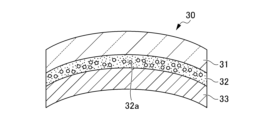
- FIG. 1 shows a cross-sectional view of a first window material 10 as an example of a window material.
- a translucent base layer 11 As shown in FIG. 1, in the first window material 10, a translucent base layer 11, an adhesive layer 12, and a base sheet 13 are laminated in this order.
- the adhesive layer 12 is composed of an adhesive composition containing an adhesive, a temperature-sensitive non-crosslinked polymer, and temperature-sensitive crosslinked fine particles 12a.
- FIG. 2 shows a cross-sectional view of a second window material 20 as another example of the window material.
- an adhesive layer 22 is arranged between two transparent base material layers 21a and 21b.
- the adhesive layer 22 is composed of an adhesive composition containing an adhesive, a temperature-sensitive non-crosslinked polymer, and temperature-sensitive crosslinked fine particles 22a.
- the temperature-sensitive crosslinked fine particles 12a and 22a have a refractive index that decreases as the temperature rises, and that the refractive index decrease rate, which is the amount of decrease in the refractive index per 1°C, is near the melting point. is higher than the temperature range other than the vicinity of the melting point. Therefore, when the temperature of the adhesive layers 12 and 22 increases due to solar radiation or air temperature, the difference in refractive index between the temperature-sensitive crosslinked fine particles 12a and 22a and the adhesive increases, and the haze value increases.
- the difference in refractive index between the temperature-sensitive crosslinked fine particles 12a and 22a and the adhesive becomes smaller, resulting in a lower haze value.
- This allows the white turbidity to change autonomously depending on the temperature, softening direct sunlight during high temperatures in the summer, and allowing sunlight to enter during low temperatures in the winter.
- it can also be designed so that the difference in refractive index between the temperature-sensitive crosslinked fine particles 12a and 22a and the adhesive becomes smaller as the temperature rises.
- the window material when the temperature is relatively low and the amount of sunlight is low, such as in the morning or at night, the window material functions as frosted glass, but when the temperature rises during the day as the amount of sunlight increases, the window material functions as frosted glass.
- the material is transparent, allowing efficient lighting into the room.
- the above window materials when installed in a location where they are exposed to the outside air, they become cloudy or transparent as the outside temperature rises, making it difficult for people living in air-conditioned rooms to see. It also has a function to make you aware of the rise in outside temperature.
- the adhesive strength of the adhesive compositions constituting the adhesive layers 12 and 22 decreases as the temperature increases, and the adhesive strength decrease rate, which is the amount of decrease in adhesive strength per 1°C, is lower than that of the adhesive composition.
- the temperature near the melting point of the temperature-sensitive non-crosslinked polymer inside is higher than the temperature range other than the melting point. Therefore, even if air bubbles are trapped or wrinkles occur when placing the adhesive layers 12 and 22, by increasing the temperature of the adhesive layers 12 and 22, the adhesive layers 12 and 22 can be peeled off and placed again. is possible. Thereby, manufacturing of the window material can be made easier.
- the light-transmitting base material constituting the light-transmitting base material layer is not particularly limited as long as it is a base material that can be used as a window material for buildings, vehicles, ships, and aircraft; for example, a glass plate. or a resin plate can be used.
- the material for the glass plate include soda lime glass, borosilicate glass, and high silica glass.
- the material for the resin plate include polyalkyl methacrylates such as polymethyl methacrylate, polyalkyl acrylates, polycarbonates, polymethylstyrene, acrylonitrile-styrene copolymers, and the like.
- the thickness of the transparent base material layer is not particularly limited, but is, for example, 0.1 mm or more and 10 mm or less.
- Examples of the shape of the light-transmitting base material layer include a planar shape like the first window material 10 and the second window material 20, a curved shape, and the like.
- the translucent base material layer is composed of at least one layer, and may be composed of a single layer like the first window material 10, or two or more layers like the second window material 20. It may be composed of. When composed of two or more layers, each layer may be composed of the same type of base material or may be composed of different types of base materials. Moreover, each layer may have the same thickness or may have different thicknesses.
- the adhesive layer is a layer made of an adhesive composition containing 1 to 20 parts by mass of a temperature-sensitive non-crosslinked polymer and 1 to 100 parts by mass of temperature-sensitive crosslinked fine particles to 100 parts by mass of the adhesive. It has the function of autonomously changing the white turbidity and adhesive strength according to the situation.
- the thickness of the adhesive layer is not particularly limited, but is preferably 5 ⁇ m or more and 1 mm or less, more preferably 10 ⁇ m or more and 100 ⁇ m or less.
- the thicker the adhesive layer is the more the dimming function tends to be exhibited by adding a small amount of temperature-sensitive crosslinked fine particles.
- the thinner the thickness the more temperature-sensitive crosslinked fine particles tend to need to be added in order to exhibit the light control function.
- the adhesive layer is composed of at least one layer.
- the adhesive layer may be composed of a single layer like the first window material 10 and the second window material 20, or may be composed of two or more layers.
- the arrangement of the adhesive layer with respect to the transparent base material layer is not particularly limited.
- the adhesive layer may be placed on the side of the transparent base material layer where sunlight enters, or may be placed on the opposite side.
- an adhesive layer may be disposed between the translucent base material layers like the second window material 20.
- the adhesive layer may cover the entire surface of the surface where the adhesive layer and the transparent base material layer are in contact with each other, or may cover a part of the surface.
- the adhesive layer When the adhesive layer covers a part of the surface where the adhesive layer and the transparent base layer are in contact with each other, characters, symbols, patterns, figures, pictures, etc. may be drawn on the transparent base layer by the adhesive layer. It's okay. In this case, the adhesive layer may form letters or patterns, or the area surrounded by the adhesive layer may form letters or patterns.
- Such window materials have excellent design properties when haze appears or disappears at high temperatures.
- the adhesive layer may have a plurality of types of regions having different haze values at high temperatures or low temperatures.
- the haze value of the adhesive layer can be changed by changing the type of adhesive or temperature-sensitive crosslinked fine particles, or by changing the amount of temperature-sensitive crosslinked fine particles used. For example, by continuously forming a plurality of adhesive layers having different haze values at high or low temperatures on a transparent substrate, a gradation of haze can be achieved at high or low temperatures. We can provide window materials with excellent design.
- the difference between the haze value at 23°C and the haze value at 60°C of the adhesive layer is preferably 10% or more.
- the haze value of the adhesive layer at 60°C is 10% or more higher than the haze value at 23°C. This tends to make it easier to visually recognize changes in white turbidity depending on temperature.
- the haze value of the adhesive layer is a value measured by the method described in Examples below.
- the haze value of the adhesive layer at 23°C is preferably 10% or less.
- the lower limit of the haze value at 23°C is not particularly limited.
- the haze value of the adhesive layer at 60° C. is preferably 12% or more, more preferably 20% or more, and still more preferably 30% or more.
- the upper limit of the haze value at 60° C. is not particularly limited, but is, for example, 70% or less and 50% or less.
- the difference between the solar transmittance at 23°C and the solar transmittance at 60°C of the adhesive layer is preferably 10% or more.
- the solar transmittance of the adhesive layer at 60°C is preferably 10% or more lower than the solar transmittance at 23°C.
- the solar radiation transmittance of an adhesive layer is the value measured by the method described in the below-mentioned Example.
- the solar transmittance of the adhesive layer at 23° C. is preferably 50% or more, more preferably 70% or more, and still more preferably 80% or more.
- the upper limit of the solar transmittance at 23° C. is not particularly limited, but is, for example, 99% or less, 95% or less.
- the solar transmittance of the adhesive layer at 60° C. is preferably 80% or less, more preferably 70% or less, and still more preferably 60% or less.
- the lower limit of the solar transmittance at 60° C. is not particularly limited.
- FIG. 4 is a graph showing changes in refractive index with respect to temperature changes in temperature-sensitive crosslinked fine particles (melting point: 33° C.) produced in Examples described below.
- the refractive index of the thermosensitive crosslinked fine particles decreases as the temperature rises, and the refractive index decrease rate, which is the amount of decrease in the refractive index per 1°C, is near the melting point. It is larger than the temperature range other than the vicinity of the melting point.
- the refractive index of the temperature-sensitive crosslinked fine particles at 60°C is preferably 0.02 or more lower than the refractive index of the temperature-sensitive crosslinked fine particles at 23°C. This tends to make it easier to visually recognize changes in white turbidity depending on temperature. Note that in this specification, the refractive index is a value measured by the method described in Examples below.
- the melting point of the temperature-sensitive crosslinked fine particles is preferably 20°C or higher, more preferably 25°C or higher. Further, the melting point is preferably 100°C or lower, more preferably 60°C or lower, and still more preferably 40°C or lower. In this specification, the melting point of the temperature-sensitive crosslinked fine particles is a value measured by the method described in Examples below.
- the melting point of the temperature-sensitive crosslinked fine particles can be adjusted by, for example, changing the composition of the monomer component constituting the side chain crystalline polymer A contained in the temperature-sensitive crosslinked fine particles. For example, by changing the length of the side chain in the side chain crystalline polymer A, the melting point can be adjusted. When the length of the side chain is long, the temperature-sensitive crosslinked fine particles tend to have a high melting point.
- the average particle diameter of the temperature-sensitive crosslinked fine particles is preferably 1 ⁇ m or more, more preferably 3 ⁇ m or more. Further, the average particle diameter is preferably 100 ⁇ m or less, more preferably 30 ⁇ m or less. In particular, from the viewpoint of easily increasing haze, the average particle diameter is more preferably 3 ⁇ m or more and 10 ⁇ m or less, and most preferably 3 ⁇ m or more and 6 ⁇ m or less. Easy to suppress solar radiation transmission. From the standpoint of easily blocking heat, the average particle diameter is more preferably 6 ⁇ m or more and 25 ⁇ m or less, and most preferably 10 ⁇ m or more and 25 ⁇ m or less.
- the D90 particle diameter of the temperature-sensitive crosslinked fine particles is preferably equal to or less than the thickness of the adhesive layer, and is, for example, 1 ⁇ m or more and 1000 ⁇ m or less, 3 ⁇ m or more and 100 ⁇ m or less.
- the average particle diameter and D90 particle diameter of the temperature-sensitive crosslinked fine particles are values measured by the method described in Examples below.
- the temperature-sensitive crosslinked fine particles contain side chain crystalline polymer A.
- the side chain crystalline polymer A preferably contains a structural unit derived from a (meth)acrylic monomer having a linear alkyl group having 14 or more carbon atoms.
- the structural unit derived from a (meth)acrylic monomer having a linear alkyl group having 14 or more carbon atoms is a side chain crystalline moiety in the side chain crystalline polymer A, in which the linear alkyl group having 14 or more carbon atoms is functions as That is, the side chain crystalline polymer A is, for example, a comb-shaped polymer having a linear alkyl group having 14 or more carbon atoms in the side chain.
- the side chain crystalline polymer A is crystallized by aligning the side chains into an ordered arrangement by intermolecular forces or the like.
- the above-mentioned (meth)acrylic monomer is an acrylic monomer or a methacrylic monomer.
- the upper limit of the number of carbon atoms in the linear alkyl group is preferably 50 or less, more preferably 30 or less.
- Examples of the (meth)acrylic monomer having a linear alkyl group having 14 or more carbon atoms include cetyl (meth)acrylate, stearyl (meth)acrylate, eicosyl (meth)acrylate, and behenyl (meth)acrylate. . These may be used alone or in combination of two or more.
- the ratio of the mass of the structural unit derived from the (meth)acrylic monomer having a linear alkyl group having 14 or more carbon atoms to the mass of the side chain crystalline polymer A is preferably 70% by mass or more, and more preferably is 80% by mass or more, more preferably 90% by mass or more. The above ratio may be 100% by mass, but is preferably 95% by mass or less.
- the side chain crystalline polymer A may include a structural unit derived from another monomer copolymerizable with a (meth)acrylic monomer having a linear alkyl group having 14 or more carbon atoms.
- examples of other monomers include monofunctional monomers, polyfunctional monomers, and refractive index adjusting monomers. That is, the side chain crystalline polymer A may include a structural unit derived from a monofunctional monomer, a polyfunctional monomer, or a refractive index adjusting monomer.
- Examples of monofunctional monomers include methyl (meth)acrylate, ethyl (meth)acrylate, butyl (meth)acrylate, hexyl (meth)acrylate, lauryl (meth)acrylate, and 2-ethylhexyl acrylate having 1 or more carbon atoms.
- Examples include (meth)acrylic monomers having 12 alkyl groups. These may be used alone or in combination of two or more. If you want to add some function in addition to temperature sensitivity, you can use any monomer as long as it can be copolymerized with a (meth)acrylic monomer having a linear alkyl group with 14 or more carbon atoms and has that function. can be copolymerized.
- the ratio of the mass of the structural unit derived from the monofunctional monomer to the mass of the side chain crystalline polymer A is preferably 0.1% by mass or more, more preferably 1% by mass or more. Moreover, the said ratio becomes like this. Preferably it is 20 mass % or less, More preferably, it is 10 mass % or less.
- the polyfunctional monomer can crosslink multiple molecular chains contained in the side chain crystalline polymer A. From the viewpoint of maintaining the dispersion state of the temperature-sensitive crosslinked fine particles during use, suppressing deformation, and maintaining repeatability of functions, it is preferable that the side chain crystalline polymer A contains a structural unit derived from a polyfunctional monomer. That is, the temperature-sensitive crosslinked fine particles and the side chain crystalline polymer A are preferably crosslinked.
- the polyfunctional monomer has two or more, preferably 2 to 4, radically polymerizable double bonds in the molecule. Examples of the polyfunctional monomer include bifunctional (meth)acrylate, trifunctional (meth)acrylate, and tetrafunctional (meth)acrylate.
- Specific examples include 1,6-hexanediol di(meth)acrylate, 1,9-nonanediol di(meth)acrylate, trimethylolpropane tri(meth)acrylate, pentaerythritol tetra(meth)acrylate, and polyethylene glycol 200 di(meth)acrylate.
- the polyfunctional monomer may be at least one selected from bifunctional (meth)acrylates, trifunctional (meth)acrylates, and tetrafunctional (meth)acrylates.
- the ratio of the mass of the structural unit derived from the polyfunctional monomer to the mass of the side chain crystalline polymer A is preferably 0.1% by mass or more, more preferably 1% by mass or more. Moreover, the said ratio becomes like this. Preferably it is 20 mass % or less, More preferably, it is 10 mass % or less.
- the refractive index adjusting monomer may be a monomer having a refractive index of 1.300 to 1.600.
- the refractive index adjusting monomer include 2-(O-phenylphenoxy)ethyl acrylate (refractive index: 1.577), 2-propenoic acid (3-phenoxyphenyl) methyl ester (refractive index: 1.566), 1 - Naphthyl acrylate (refractive index: 1.595), acrylamide (refractive index: 1.515), hydroxyacrylamide (refractive index: 1.515), EO-modified bisphenol A diacrylate (refractive index: 1.537), acrylamide ( Refractive index: 1.515), 2,2,2-trifluoroethyl acrylate (refractive index: 1.348), methacryl-modified polydimethylsiloxane (refractive index: 1.408), and the like. These may be used alone or in combination of two or more.
- the ratio of the mass of the structural unit derived from the refractive index adjusting monomer to the mass of the side chain crystalline polymer A is preferably 0.1% by mass or more, more preferably 1% by mass or more. Further, the above ratio is preferably 30% by mass or less, more preferably 20% by mass or less, and even more preferably 10% by mass or less.
- the temperature-sensitive crosslinked fine particles do not contain a structural unit derived from a reactive emulsifier, since they tend to have good dispersibility in adhesives.
- a reactive emulsifier is an emulsifier having a polymerizable unsaturated bond such as a vinyl group in its molecule.
- the reactive emulsifier is a polymerizable monomer that has an emulsifying function and has a polymerizable group having an unsaturated bond such as a vinyl group in its molecule, and a hydrophilic group.
- the content of the temperature-sensitive crosslinked fine particles is 1 part by mass or more and 100 parts by mass or less with respect to 100 parts by mass of the adhesive.
- the content is preferably 5 parts by mass or more, more preferably 20 parts by mass or more. Further, the content is preferably 70 parts by mass or less, more preferably 40 parts by mass or less.
- thermosensitive crosslinked fine particles are not particularly limited, and they can be obtained by conventionally known polymerization methods such as miniemulsion polymerization and suspension polymerization.
- Temperature-sensitive non-crosslinked polymers have a melting point.
- the temperature-sensitive non-crosslinked polymer crystallizes at temperatures below the melting point, and undergoes a phase transition and exhibits fluidity at temperatures above the melting point.
- the adhesive strength of an adhesive composition containing an adhesive and a temperature-sensitive non-crosslinked polymer decreases as the temperature rises, and the adhesive strength reduction rate, which is the amount of decrease in adhesive strength per 1°C, It is higher in the vicinity of the melting point of the temperature-sensitive non-crosslinked polymer in the composition than in the temperature range other than the vicinity of the melting point.
- the adhesive force of an adhesive composition means the peel strength with respect to stainless steel (SUS), and is a value measured by the method described in the below-mentioned Example.
- the peel strength of the adhesive composition against stainless steel (SUS) at 23° C. is preferably 1.0 N/25 mm or more.
- the upper limit of the peel strength is not particularly limited.
- the peel strength of the adhesive composition against stainless steel (SUS) at 60° C. is preferably 0.1 N/25 mm or less.
- the lower limit of the above peel strength is not particularly limited.
- the melting point of the temperature-sensitive non-crosslinked polymer is preferably 20°C or higher, more preferably 30°C or higher, and still more preferably 40°C or higher. Further, the melting point is preferably 100°C or lower, more preferably 80°C or lower, and even more preferably 60°C or lower. Note that in this specification, the melting point of the temperature-sensitive non-crosslinked polymer is a value measured by the method described in the Examples below.
- the melting point of the temperature-sensitive non-crosslinked polymer is preferably 5° C. or more higher than the melting point of the temperature-sensitive crosslinked fine particles. This allows the adhesive layer to be peeled off and repositioned by raising the temperature to a higher temperature while autonomously changing the white turbidity depending on the temperature.
- the melting point of the temperature-sensitive non-crosslinked polymer can be adjusted, for example, by changing the composition of the monomer components constituting the side chain crystalline polymer B contained in the temperature-sensitive non-crosslinked polymer. For example, by changing the length of the side chain in the side chain crystalline polymer B, the melting point can be adjusted. When the length of the side chain is long, the temperature-sensitive crosslinked fine particles tend to have a high melting point.
- the temperature-sensitive non-crosslinked polymer contains a side chain crystalline polymer B.
- the side chain crystalline polymer B preferably contains a structural unit derived from a (meth)acrylic monomer having a linear alkyl group having 14 or more carbon atoms.
- the structural unit derived from a (meth)acrylic monomer having a linear alkyl group having 14 or more carbon atoms is a side chain crystalline site in the side chain crystalline polymer B, in which the linear alkyl group having 14 or more carbon atoms is functions as That is, the side chain crystalline polymer B is, for example, a comb-shaped polymer having a linear alkyl group having 14 or more carbon atoms in the side chain.
- the side chain crystalline polymer B is crystallized by aligning the side chains into an ordered arrangement by intermolecular forces or the like.
- the above-mentioned (meth)acrylic monomer is an acrylic monomer or a methacrylic monomer.
- the upper limit of the number of carbon atoms in the linear alkyl group is preferably 50 or less, more preferably 30 or less.
- Examples of the (meth)acrylic monomer having a linear alkyl group having 14 or more carbon atoms include cetyl (meth)acrylate, stearyl (meth)acrylate, eicosyl (meth)acrylate, and behenyl (meth)acrylate. . These may be used alone or in combination of two or more.
- the ratio of the mass of the structural unit derived from the (meth)acrylic monomer having a linear alkyl group having 14 or more carbon atoms to the mass of the side chain crystalline polymer B is preferably 70% by mass or more.
- the above ratio may be 100% by mass, but is preferably 90% by mass or less, more preferably 80% by mass or less.
- the side chain crystalline polymer B may include a structural unit derived from another monomer copolymerizable with a (meth)acrylic monomer having a linear alkyl group having 14 or more carbon atoms.
- examples of other monomers include compatible monomers. That is, the side chain crystalline polymer B may include a structural unit derived from a compatible monomer.
- compatible monomers include (meth)acrylates having an alkyl group having 1 to 12 carbon atoms, such as ethylhexyl (meth)acrylate, methyl (meth)acrylate, ethyl (meth)acrylate, butyl (meth)acrylate; (meth)acrylates having an ethylene glycol group such as 2-ethylhexyl-diglycol (meth)acrylate, methoxyethyl (meth)acrylate, methoxypolyethylene glycol mono(meth)acrylate, and ethoxy-diethylene glycol (meth)acrylate; (Meth)acrylates with hydroxyalkyl groups such as meth)acrylate, hydroxypropyl (meth)acrylate, and hydroxyhexyl (meth)acrylate; carboxyl groups such as acrylic acid, methacrylic acid, crotonic acid, itaconic acid, maleic acid, fumaric acid, etc.
- the ratio of the mass of the structural unit derived from the compatible monomer to the mass of the side chain crystalline polymer B is preferably 0.1% by mass or more, more preferably 1% by mass or more.
- the above ratio is preferably 90% by mass or less, more preferably 80% by mass or less.
- the side chain crystalline polymer B may contain the same structural units as those contained in the polymer constituting the adhesive. As a result, the non-crosslinked polymer in the adhesive composition has good dispersibility, and the adhesive strength tends to decrease during heating.
- the weight average molecular weight of the temperature-sensitive non-crosslinked polymer is preferably 1000 or more, more preferably 5000 or more.
- the weight average molecular weight is preferably 100,000 or less, more preferably 10,000 or less. If it is 100,000 or less, the effect on the haze value when adding the temperature-sensitive non-crosslinked polymer tends to be suppressed. If it is 10,000 or less, the adhesive strength tends to decrease during heating.
- the weight average molecular weight of a temperature-sensitive non-crosslinked polymer is a value measured by the method described in the below-mentioned Examples.
- the weight average molecular weight of the temperature-sensitive non-crosslinked polymer can be adjusted, for example, by using a chain transfer agent during polymerization.
- chain transfer agent include thiol compounds such as dodecylmercaptan, mercaptopropionic acid, mercaptosuccinic acid, ethylhexylmercaptoacetate, mercaptoethanol, and cyclohexanethiol. These may be used alone or in combination of two or more.
- the content of the temperature-sensitive non-crosslinked polymer is 1 part by mass or more and 20 parts by mass or less with respect to 100 parts by mass of the adhesive.
- the above content is preferably 3 parts by mass or more.
- the above content is preferably 10 parts by mass or less.
- the method for producing the temperature-sensitive non-crosslinked polymer is not particularly limited, and it can be obtained by conventionally known polymerization methods such as solution polymerization and UV polymerization.
- the adhesive is not particularly limited, and conventionally known adhesives such as acrylic adhesives, natural rubber adhesives, synthetic rubber adhesives, silicone adhesives, and urethane adhesives can be used, but among them, Acrylic adhesives are preferred.
- the polymer constituting the adhesive preferably contains a structural unit derived from an adhesive monomer that contributes to adhesiveness and a structural unit derived from a functional monomer for crosslinking.
- the polymer constituting the adhesive may contain structural units derived from other monomers copolymerizable with these monomers. Examples of other monomers include refractive index adjusting monomers. That is, the polymer constituting the adhesive may include a structural unit derived from a refractive index adjusting monomer.
- adhesive monomers include (meth)acrylates having an alkyl group having 1 to 12 carbon atoms, such as ethylhexyl (meth)acrylate, methyl (meth)acrylate, ethyl (meth)acrylate, butyl (meth)acrylate; (meth)acrylates with ethylene glycol groups such as 2-ethylhexyl-diglycol (meth)acrylate, methoxyethyl (meth)acrylate, methoxypolyethylene glycol mono(meth)acrylate, ethoxy-diethylene glycol (meth)acrylate; styrene, vinyl acetate ethylenically unsaturated monomers such as; and the like. These may be used alone or in combination of two or more. Among these, (meth)acrylates having an alkyl group having 1 to 12 carbon atoms are preferred.
- the ratio of the mass of the structural unit derived from the adhesive monomer to the mass of the polymer constituting the adhesive is preferably 50% by mass or more, more preferably 70% by mass or more. Moreover, the said ratio becomes like this. Preferably it is 99.9 mass % or less, More preferably, it is 95 mass % or less.
- Examples of functional group monomers include (meth)acrylates having a hydroxyalkyl group such as hydroxyethyl (meth)acrylate, hydroxypropyl (meth)acrylate, and hydroxyhexyl (meth)acrylate; acrylic acid, methacrylic acid, crotonic acid, itaconic acid, Examples include ethylenically unsaturated monomers having a carboxyl group such as maleic acid and fumaric acid. Only one type may be used, or two or more types may be used in combination.
- the ratio of the mass of the structural unit derived from the functional monomer to the mass of the polymer constituting the adhesive is preferably 0.1% by mass or more, more preferably 1% by mass or more. Further, the above ratio is preferably 30% by mass or less, more preferably 20% by mass or less, still more preferably 10% by mass or less. When the content is 0.1% by mass or more, shape retention tends to be good. When it is 30% by mass or less, the viscosity is not excessively high and coating properties tend to be good.
- the refractive index adjusting monomer may be a monomer having a refractive index of 1.300 to 1.600.
- the refractive index adjusting monomer include 2-(O-phenylphenoxy)ethyl acrylate (refractive index: 1.577), 2-propenoic acid (3-phenoxyphenyl) methyl ester (refractive index: 1.566), 1 - Naphthyl acrylate (refractive index: 1.595), acrylamide (refractive index: 1.515), hydroxyacrylamide (refractive index: 1.515), EO-modified bisphenol A diacrylate (refractive index: 1.537), acrylamide ( Refractive index: 1.515), 2,2,2-trifluoroethyl acrylate (refractive index: 1.348), methacryl-modified polydimethylsiloxane (refractive index: 1.408), and the like. These may be used alone or in combination of two or more.
- the ratio of the mass of the structural unit derived from the refractive index adjusting monomer to the mass of the polymer constituting the adhesive is preferably 0.1% by mass or more, more preferably 1% by mass or more, and even more preferably 10% by mass or more. be. Moreover, the said ratio becomes like this. Preferably it is 30 mass % or less.
- the weight average molecular weight of the adhesive is preferably 200,000 or more, more preferably 300,000 or more.
- the weight average molecular weight is preferably 2,000,000 or less, more preferably 1,000,000 or less, still more preferably 600,000 or less. When it is 200,000 or more, shape retention tends to be good. When it is 2,000,000 or less, the viscosity is not excessively high and coating properties tend to be good.
- the weight average molecular weight of an adhesive is a value measured by the method described in the below-mentioned Examples.
- the glass transition temperature (Tg) of the adhesive is preferably 25° C. or lower, since it tends to exhibit high adhesive strength.
- the glass transition temperature is a value measured by the method described in Examples below.
- the difference in refractive index at 23° C. between the adhesive and the thermosensitive crosslinked fine particles is preferably less than 0.015, more preferably less than 0.010. Further, the refractive index difference at 60° C. is preferably 0.015 or more.
- the upper limit of the refractive index difference at 60° C. is not particularly limited, but is, for example, 0.1.
- the adhesive layer exhibits high translucency in a warm atmosphere where humans and pets can spend time comfortably, and in high-temperature atmospheres such as summer, the adhesive layer exhibits haze. Translucency decreases.
- the refractive index difference between the adhesive and the temperature-sensitive crosslinked fine particles at 23°C is 0.015 or more
- the refractive index difference at 60°C is It can also be designed to be less than 0.015.
- the window glass will function as frosted glass under conditions of relatively low temperature and low sunlight, such as in the morning or at night, but as the amount of sunlight increases during the day.
- the window glass becomes transparent, allowing more light to enter the room. In this way, it is possible to easily let light into the room only during the daytime without opening or closing the curtains.
- the ratio of the mass of the adhesive to the mass of the solid content of the adhesive composition is not particularly limited, but is, for example, 50% by mass or more and 95% by mass or less.
- the solid content of an adhesive composition means all the components except a solvent, such as an aqueous solvent and an organic solvent, from the adhesive composition.
- the method for producing the adhesive is not particularly limited, and it can be obtained by conventionally known polymerization methods such as solution polymerization and UV polymerization.
- the adhesive composition may contain a crosslinking agent for crosslinking the adhesive. That is, the adhesive may be crosslinked.
- crosslinking agents include aziridine crosslinking agents, metal chelate crosslinking agents, epoxy crosslinking agents, and isocyanate crosslinking agents.
- the content of the crosslinking agent is not particularly limited, but is, for example, 0.1 parts by mass or more and 10 parts by mass or less with respect to 100 parts by mass of the adhesive.
- the amount is 0.1 parts by mass or more, shape retention tends to be less likely to decrease. Further, when the amount is 10 parts by mass or less, high adhesive strength tends to be easily exhibited.
- the adhesive composition includes a solvent such as an organic solvent, an inhibitor that suppresses the progress of crosslinking, a tackifying resin (tackifier), an ultraviolet (UV) absorber, a light stabilizer (HALS), an antioxidant, an infrared absorber, Other additives such as dyes and pigments may also be included.
- a solvent such as an organic solvent, an inhibitor that suppresses the progress of crosslinking, a tackifying resin (tackifier), an ultraviolet (UV) absorber, a light stabilizer (HALS), an antioxidant, an infrared absorber, Other additives such as dyes and pigments may also be included.
- the above-mentioned adhesive composition is not limited in the manner in which it is used.
- the mode of use of the above-mentioned adhesive composition can be appropriately selected depending on the purpose.
- the above adhesive composition can autonomously change its white turbidity depending on the temperature. If the adhesive composition is designed to produce haze at high temperatures, it can soften direct sunlight during high temperatures in summer and allow sunlight to enter during low temperatures in winter. It can be suitably used for. On the other hand, if the adhesive composition is designed to produce haze at low temperatures, for example, when the adhesive composition is applied to window glass, the temperature is relatively low and the amount of sunlight is low, such as in the morning or at night.
- the window glass functions as frosted glass, but when the amount of sunlight increases and the temperature rises during the day, the window glass becomes transparent, allowing efficient daylight to enter the room.
- the above-mentioned adhesive composition develops or disappears haze due to heat sources such as lighting, sunlight, or high temperatures, designs such as letters, symbols, patterns, figures, and pictures appear or disappear. It becomes possible to impart excellent display properties (designs such as letters, symbols, etc.) and decorative properties (designs such as patterns, figures, pictures, etc.) to the object provided with the adhesive layer. Therefore, it can be used, for example, to decorate light covers, to decorate transparent substrates such as window materials and transparent roofing materials, and to display transparent substrates such as window materials and transparent roofing materials. It can be used suitably.
- the above window material may or may not be provided with a base sheet.
- the base sheet has a function as a support when laminating the adhesive layer on the transparent base layer, and a function as a protective layer for the adhesive layer.
- the base material constituting the base sheet is not particularly limited as long as it is a translucent base material.
- a base material for example, PET such as corona treated PET, untreated PET, highly transparent PET, annealed PET, UV cut PET, heat shielding PET, anti-fog PET, hard coat PET, blasted PET; transparent PI etc. are used. can.
- the method for manufacturing the above window material is not particularly limited, and examples include a method in which an adhesive composition is applied to a base sheet to produce an adhesive sheet, and then the adhesive sheet is laminated to a translucent base material. It will be done.
- the adhesive layer may be formed by applying the adhesive composition directly to the transparent substrate. In this case, it is preferable to cover the exposed surface of the adhesive layer formed on the translucent base material with a base sheet so that the tacky surface of the adhesive layer is not exposed indoors or outdoors.
- the light-transmitting base material layer is comprised of two or more layers like the 2nd window material 20, the method of arranging an adhesive layer between the light-transmitting base material layers, etc. are also mentioned.
- another base material layer may be bonded to the exposed surface of the adhesive layer.
- two laminates are prepared in which one translucent base material layer and one adhesive layer are laminated so that they are in contact with each other, and the two laminates are bonded together with the exposed surface of the adhesive layer.
- the second window material 20 having an adhesive layer between the light-transmitting substrates can also be manufactured by this method.
- window material described above can be appropriately selected depending on the purpose.
- the window material described above can be suitably used, for example, in buildings such as houses, buildings, warehouses, and arcades, as well as in vehicles, ships, and aircraft.
- FIG. 3 is a sectional view showing an example of a translucent roofing material.
- a translucent base material layer 31 As shown in FIG. 3, in the translucent roof material 30, a translucent base material layer 31, an adhesive layer 32, and a base material sheet 33 are laminated in this order.
- the adhesive layer 32 is composed of an adhesive composition containing an adhesive, a temperature-sensitive non-crosslinked polymer, and temperature-sensitive crosslinked fine particles 32a.
- the temperature-sensitive crosslinked fine particles 32a have a refractive index that decreases as the temperature increases, and that the refractive index decrease rate, which is the amount of decrease in the refractive index per 1° C., decreases in the vicinity of the melting point. It is larger than other temperature ranges. Therefore, when the temperature of the adhesive layer 32 increases due to solar radiation or air temperature, the difference in refractive index between the temperature-sensitive crosslinked fine particles 32a and the adhesive increases, and the haze value increases. On the other hand, when the temperature of the adhesive layer 32 decreases, the haze value decreases due to a decrease in the refractive index difference between the temperature-sensitive crosslinked fine particles 32a and the adhesive.
- the adhesive strength of the adhesive composition constituting the adhesive layer 32 decreases as the temperature rises, and the adhesive strength reduction rate, which is the amount of decrease in adhesive strength per 1°C, is lower than that of the adhesive composition. It is higher in the vicinity of the melting point of the temperature-sensitive non-crosslinked polymer than in the temperature range other than the vicinity of the melting point. Therefore, even if bubbles or wrinkles occur when the adhesive layer 32 is placed, the adhesive layer 32 can be peeled off and placed again by increasing the temperature of the adhesive layer 32. Thereby, manufacturing of the window material can be made easier.
- the translucent base material layer, adhesive layer, base sheet, manufacturing method, and usage are the same as each layer, manufacturing method, and usage of the window material.
- the adhesive composition contains 1 to 20 parts by weight of a temperature-sensitive non-crosslinked polymer and 1 to 100 parts by weight of temperature-sensitive crosslinked fine particles to 100 parts by weight of the adhesive.
- the refractive index of the thermosensitive crosslinked fine particles decreases as the temperature rises, and the refractive index decrease rate, which is the amount of decrease in the refractive index per 1°C, is lower in the vicinity of the melting point than in the temperature range other than the vicinity of the melting point. It's also big.
- each refractive index is adjusted so that the difference in refractive index between the temperature-sensitive crosslinked fine particles and the adhesive at low temperatures is small, when the temperature of the adhesive layer formed from the adhesive composition increases due to sunlight, air temperature, or heating, The difference in refractive index between the temperature-sensitive crosslinked fine particles and the adhesive becomes large, resulting in a high haze value.
- the adhesive composition has adhesive strength that decreases as the temperature increases, and the adhesive strength reduction rate, which is the amount of decrease in adhesive strength per 1°C, is close to the melting point of the temperature-sensitive non-crosslinked polymer in the adhesive composition. is higher than the temperature range other than the vicinity of the melting point. Therefore, even if air bubbles or wrinkles occur when the adhesive layer is placed, the adhesive layer can be peeled off and placed again by increasing the temperature of the adhesive layer. In addition, it is possible to firmly temporarily fix the workpieces and the like in the manufacturing process and to peel them off without destroying the workpieces.
- thermosensitive crosslinked fine particles The refractive index of the thermosensitive crosslinked fine particles decreases as the temperature rises, and the refractive index decrease rate, which is the amount of decrease in the refractive index per 1°C, is lower in the vicinity of the melting point than in the temperature range other than the vicinity of the melting point. It's also big.
- the refractive index of the temperature-sensitive crosslinked fine particles at 60°C is preferably 0.02 or more lower than the refractive index of the temperature-sensitive crosslinked fine particles at 23°C. This tends to make it easier to visually recognize changes in white turbidity depending on temperature.
- the melting point of the temperature-sensitive crosslinked fine particles is preferably 20°C or higher, more preferably 25°C or higher. Further, the melting point is preferably 100°C or lower, more preferably 60°C or lower, and still more preferably 40°C or lower.
- the melting point of the temperature-sensitive crosslinked fine particles can be adjusted by, for example, changing the composition of the monomer component constituting the side chain crystalline polymer A contained in the temperature-sensitive crosslinked fine particles. For example, by changing the length of the side chain in the side chain crystalline polymer A, the melting point can be adjusted. When the length of the side chain is long, the temperature-sensitive crosslinked fine particles tend to have a high melting point.
- the average particle diameter of the temperature-sensitive crosslinked fine particles is preferably 1 ⁇ m or more, more preferably 3 ⁇ m or more. Further, the average particle diameter is preferably 100 ⁇ m or less, more preferably 30 ⁇ m or less. In particular, from the viewpoint of easily increasing haze, the average particle diameter is more preferably 3 ⁇ m or more and 10 ⁇ m or less, and most preferably 3 ⁇ m or more and 6 ⁇ m or less. Easy to suppress solar radiation transmission. From the standpoint of easily blocking heat, the average particle diameter is more preferably 6 ⁇ m or more and 25 ⁇ m or less, and most preferably 10 ⁇ m or more and 25 ⁇ m or less.
- the D90 particle diameter of the temperature-sensitive crosslinked fine particles is preferably equal to or less than the thickness of the adhesive layer, and is, for example, 1 ⁇ m or more and 1000 ⁇ m or less, 3 ⁇ m or more and 100 ⁇ m or less.
- the D90 particle size is less than or equal to the thickness of the adhesive layer, the surface of the adhesive layer becomes uniform and the adhesive strength tends to be less likely to be impaired.
- the temperature-sensitive crosslinked fine particles contain side chain crystalline polymer A.
- the side chain crystalline polymer A preferably contains a structural unit derived from a (meth)acrylic monomer having a linear alkyl group having 14 or more carbon atoms.
- the structural unit derived from a (meth)acrylic monomer having a linear alkyl group having 14 or more carbon atoms is a side chain crystalline moiety in the side chain crystalline polymer A, in which the linear alkyl group having 14 or more carbon atoms is functions as That is, the side chain crystalline polymer A is, for example, a comb-shaped polymer having a linear alkyl group having 14 or more carbon atoms in the side chain.
- the side chain crystalline polymer A is crystallized by aligning the side chains into an ordered arrangement by intermolecular forces or the like.
- the above-mentioned (meth)acrylic monomer is an acrylic monomer or a methacrylic monomer.
- the upper limit of the number of carbon atoms in the linear alkyl group is preferably 50 or less, more preferably 30 or less.
- Examples of the (meth)acrylic monomer having a linear alkyl group having 14 or more carbon atoms include cetyl (meth)acrylate, stearyl (meth)acrylate, eicosyl (meth)acrylate, and behenyl (meth)acrylate. . These may be used alone or in combination of two or more.
- the ratio of the mass of the structural unit derived from the (meth)acrylic monomer having a linear alkyl group having 14 or more carbon atoms to the mass of the side chain crystalline polymer A is preferably 70% by mass or more, and more preferably is 80% by mass or more, more preferably 90% by mass or more. The above ratio may be 100% by mass, but is preferably 95% by mass or less.
- the side chain crystalline polymer A may include a structural unit derived from another monomer copolymerizable with a (meth)acrylic monomer having a linear alkyl group having 14 or more carbon atoms.
- examples of other monomers include monofunctional monomers, polyfunctional monomers, and refractive index adjusting monomers. That is, the side chain crystalline polymer A may include a structural unit derived from a monofunctional monomer, a polyfunctional monomer, or a refractive index adjusting monomer.
- Examples of monofunctional monomers include methyl (meth)acrylate, ethyl (meth)acrylate, butyl (meth)acrylate, hexyl (meth)acrylate, lauryl (meth)acrylate, and 2-ethylhexyl acrylate having 1 or more carbon atoms.
- Examples include (meth)acrylic monomers having 12 alkyl groups. These may be used alone or in combination of two or more. If you want to add some function in addition to temperature sensitivity, you can use any monomer as long as it can be copolymerized with a (meth)acrylic monomer having a linear alkyl group with 14 or more carbon atoms and has that function. can be copolymerized.
- the ratio of the mass of the structural unit derived from the monofunctional monomer to the mass of the side chain crystalline polymer A is preferably 0.1% by mass or more, more preferably 1% by mass or more. Moreover, the said ratio becomes like this. Preferably it is 20 mass % or less, More preferably, it is 10 mass % or less.
- the polyfunctional monomer can crosslink multiple molecular chains contained in the side chain crystalline polymer A. From the viewpoint of maintaining the dispersion state of the temperature-sensitive crosslinked fine particles during use, suppressing deformation, and maintaining repeatability of functions, it is preferable that the side chain crystalline polymer A contains a structural unit derived from a polyfunctional monomer. That is, the temperature-sensitive crosslinked fine particles and the side chain crystalline polymer A are preferably crosslinked.
- the polyfunctional monomer has two or more, preferably 2 to 4, radically polymerizable double bonds in the molecule. Examples of the polyfunctional monomer include bifunctional (meth)acrylate, trifunctional (meth)acrylate, and tetrafunctional (meth)acrylate.
- Specific examples include 1,6-hexanediol di(meth)acrylate, 1,9-nonanediol di(meth)acrylate, trimethylolpropane tri(meth)acrylate, pentaerythritol tetra(meth)acrylate, and polyethylene glycol 200 di(meth)acrylate.
- the polyfunctional monomer may be at least one selected from bifunctional (meth)acrylates, trifunctional (meth)acrylates, and tetrafunctional (meth)acrylates.
- the ratio of the mass of the structural unit derived from the polyfunctional monomer to the mass of the side chain crystalline polymer A is preferably 0.1% by mass or more, more preferably 1% by mass or more. Moreover, the said ratio becomes like this. Preferably it is 20 mass % or less, More preferably, it is 10 mass % or less.
- the refractive index adjusting monomer may be a monomer having a refractive index of 1.300 to 1.600.
- the refractive index adjusting monomer include 2-(O-phenylphenoxy)ethyl acrylate (refractive index: 1.577), 2-propenoic acid (3-phenoxyphenyl) methyl ester (refractive index: 1.566), 1 - Naphthyl acrylate (refractive index: 1.595), acrylamide (refractive index: 1.515), hydroxyacrylamide (refractive index: 1.515), EO-modified bisphenol A diacrylate (refractive index: 1.537), acrylamide ( Refractive index: 1.515), 2,2,2-trifluoroethyl acrylate (refractive index: 1.348), methacryl-modified polydimethylsiloxane (refractive index: 1.408), and the like. These may be used alone or in combination of two or more.
- the ratio of the mass of the structural unit derived from the refractive index adjusting monomer to the mass of the side chain crystalline polymer A is preferably 0.1% by mass or more, more preferably 1% by mass or more. Further, the above ratio is preferably 30% by mass or less, more preferably 20% by mass or less, and even more preferably 10% by mass or less.
- the temperature-sensitive crosslinked fine particles do not contain a structural unit derived from a reactive emulsifier, since they tend to have good dispersibility in adhesives.
- a reactive emulsifier is an emulsifier having a polymerizable unsaturated bond such as a vinyl group in its molecule.
- the reactive emulsifier is a polymerizable monomer that has an emulsifying function and has a polymerizable group having an unsaturated bond such as a vinyl group in its molecule, and a hydrophilic group.
- the content of the temperature-sensitive crosslinked fine particles is 1 part by mass or more and 100 parts by mass or less with respect to 100 parts by mass of the adhesive.
- the content is preferably 5 parts by mass or more, more preferably 20 parts by mass or more. Further, the content is preferably 70 parts by mass or less, more preferably 40 parts by mass or less.
- thermosensitive crosslinked fine particles are not particularly limited, and they can be obtained by conventionally known polymerization methods such as miniemulsion polymerization and suspension polymerization.
- Temperature-sensitive non-crosslinked polymers have a melting point.
- the temperature-sensitive non-crosslinked polymer crystallizes at temperatures below the melting point, and undergoes a phase transition and exhibits fluidity at temperatures above the melting point.
- the adhesive strength of an adhesive composition containing an adhesive and a temperature-sensitive non-crosslinked polymer decreases as the temperature rises, and the adhesive strength reduction rate, which is the amount of decrease in adhesive strength per 1°C, It is higher in the vicinity of the melting point of the temperature-sensitive non-crosslinked polymer in the composition than in the temperature range other than the vicinity of the melting point.
- the peel strength of the adhesive composition against stainless steel (SUS) at 23° C. is preferably 1.0 N/25 mm or more.
- the upper limit of the peel strength is not particularly limited.
- the peel strength of the adhesive composition against stainless steel (SUS) at 60° C. is preferably 0.1 N/25 mm or less.
- the lower limit of the above peel strength is not particularly limited.
- the melting point of the temperature-sensitive non-crosslinked polymer is preferably 20°C or higher, more preferably 30°C or higher, and still more preferably 40°C or higher. Further, the melting point is preferably 100°C or lower, more preferably 80°C or lower, and even more preferably 60°C or lower.
- the melting point of the temperature-sensitive non-crosslinked polymer is preferably 5° C. or more higher than the melting point of the temperature-sensitive crosslinked fine particles. This allows the white turbidity to change autonomously depending on the temperature, and even if air bubbles or wrinkles occur when the adhesive layer is placed, the adhesive layer can be peeled off by increasing the temperature of the adhesive layer. It is possible to reposition it.
- the melting point of the temperature-sensitive non-crosslinked polymer is preferably lower than the melting point of the temperature-sensitive crosslinked fine particles by 5°C. This allows the white turbidity to change autonomously depending on the temperature, making it possible to visually check changes in adhesive strength even in situations where a tactile thermometer is not available.
- the melting point of the temperature-sensitive non-crosslinked polymer can be adjusted, for example, by changing the composition of the monomer components constituting the side chain crystalline polymer B contained in the temperature-sensitive non-crosslinked polymer. For example, by changing the length of the side chain in the side chain crystalline polymer B, the melting point can be adjusted. When the length of the side chain is long, the temperature-sensitive crosslinked fine particles tend to have a high melting point.
- the temperature-sensitive non-crosslinked polymer contains a side chain crystalline polymer B.
- the side chain crystalline polymer B preferably contains a structural unit derived from a (meth)acrylic monomer having a linear alkyl group having 14 or more carbon atoms.
- the structural unit derived from a (meth)acrylic monomer having a linear alkyl group having 14 or more carbon atoms is a side chain crystalline site in the side chain crystalline polymer B, in which the linear alkyl group having 14 or more carbon atoms is functions as That is, the side chain crystalline polymer B is, for example, a comb-shaped polymer having a linear alkyl group having 14 or more carbon atoms in the side chain.
- the side chain crystalline polymer B is crystallized by aligning the side chains into an ordered arrangement by intermolecular forces or the like.
- the above-mentioned (meth)acrylic monomer is an acrylic monomer or a methacrylic monomer.
- the upper limit of the number of carbon atoms in the linear alkyl group is preferably 50 or less, more preferably 30 or less.
- Examples of the (meth)acrylic monomer having a linear alkyl group having 14 or more carbon atoms include cetyl (meth)acrylate, stearyl (meth)acrylate, eicosyl (meth)acrylate, and behenyl (meth)acrylate. . These may be used alone or in combination of two or more.
- the ratio of the mass of the structural unit derived from the (meth)acrylic monomer having a linear alkyl group having 14 or more carbon atoms to the mass of the side chain crystalline polymer B is preferably 70% by mass or more.
- the above ratio may be 100% by mass, but is preferably 90% by mass or less, more preferably 80% by mass or less.
- the side chain crystalline polymer B may include a structural unit derived from another monomer copolymerizable with a (meth)acrylic monomer having a linear alkyl group having 14 or more carbon atoms.
- examples of other monomers include compatible monomers. That is, the side chain crystalline polymer B may include a structural unit derived from a compatible monomer.
- compatible monomers include (meth)acrylates having an alkyl group having 1 to 12 carbon atoms, such as ethylhexyl (meth)acrylate, methyl (meth)acrylate, ethyl (meth)acrylate, butyl (meth)acrylate; (meth)acrylates having an ethylene glycol group such as 2-ethylhexyl-diglycol (meth)acrylate, methoxyethyl (meth)acrylate, methoxypolyethylene glycol mono(meth)acrylate, and ethoxy-diethylene glycol (meth)acrylate; (Meth)acrylates with hydroxyalkyl groups such as meth)acrylate, hydroxypropyl (meth)acrylate, and hydroxyhexyl (meth)acrylate; carboxyl groups such as acrylic acid, methacrylic acid, crotonic acid, itaconic acid, maleic acid, fumaric acid, etc.
- the ratio of the mass of the structural unit derived from the compatible monomer to the mass of the side chain crystalline polymer B is preferably 0.1% by mass or more, more preferably 1% by mass or more.
- the above ratio is preferably 90% by mass or less, more preferably 80% by mass or less.
- the side chain crystalline polymer B may contain the same structural units as those contained in the polymer constituting the adhesive. As a result, the non-crosslinked polymer in the adhesive composition has good dispersibility, and the adhesive strength tends to decrease during heating.
- the weight average molecular weight of the temperature-sensitive non-crosslinked polymer is preferably 1000 or more, more preferably 5000 or more.
- the weight average molecular weight is preferably 100,000 or less, more preferably 10,000 or less. If it is 100,000 or less, the effect on the haze value when adding the temperature-sensitive non-crosslinked polymer tends to be suppressed. If it is 10,000 or less, the adhesive strength tends to decrease during heating.
- the weight average molecular weight of the temperature-sensitive non-crosslinked polymer can be adjusted, for example, by using a chain transfer agent during polymerization.
- chain transfer agent include thiol compounds such as dodecylmercaptan, mercaptopropionic acid, mercaptosuccinic acid, ethylhexylmercaptoacetate, mercaptoethanol, and cyclohexanethiol. These may be used alone or in combination of two or more.
- the content of the temperature-sensitive non-crosslinked polymer is 1 part by mass or more and 20 parts by mass or less with respect to 100 parts by mass of the adhesive.
- the above content is preferably 3 parts by mass or more.
- the above content is preferably 10 parts by mass or less.
- the method for producing the temperature-sensitive non-crosslinked polymer is not particularly limited, and it can be obtained by conventionally known polymerization methods such as solution polymerization and UV polymerization.
- the adhesive is not particularly limited, and conventionally known adhesives such as acrylic adhesives, natural rubber adhesives, synthetic rubber adhesives, silicone adhesives, and urethane adhesives can be used, but among them, Acrylic adhesives are preferred.
- the polymer constituting the adhesive preferably contains a structural unit derived from an adhesive monomer that contributes to adhesiveness and a structural unit derived from a functional monomer for crosslinking.
- the polymer constituting the adhesive may contain structural units derived from other monomers copolymerizable with these monomers. Examples of other monomers include refractive index adjusting monomers. That is, the polymer constituting the adhesive may include a structural unit derived from a refractive index adjusting monomer.
- adhesive monomers include (meth)acrylates having an alkyl group having 1 to 12 carbon atoms, such as ethylhexyl (meth)acrylate, methyl (meth)acrylate, ethyl (meth)acrylate, butyl (meth)acrylate; (meth)acrylates with ethylene glycol groups such as 2-ethylhexyl-diglycol (meth)acrylate, methoxyethyl (meth)acrylate, methoxypolyethylene glycol mono(meth)acrylate, ethoxy-diethylene glycol (meth)acrylate; styrene, vinyl acetate ethylenically unsaturated monomers such as; and the like. These may be used alone or in combination of two or more. Among these, (meth)acrylates having an alkyl group having 1 to 12 carbon atoms are preferred.
- the ratio of the mass of the structural unit derived from the adhesive monomer to the mass of the polymer constituting the adhesive is preferably 50% by mass or more, more preferably 70% by mass or more. Moreover, the said ratio becomes like this. Preferably it is 99.9 mass % or less, More preferably, it is 90 mass % or less.
- Examples of functional group monomers include (meth)acrylates having a hydroxyalkyl group such as hydroxyethyl (meth)acrylate, hydroxypropyl (meth)acrylate, and hydroxyhexyl (meth)acrylate; acrylic acid, methacrylic acid, crotonic acid, itaconic acid, Examples include ethylenically unsaturated monomers having a carboxyl group such as maleic acid and fumaric acid. Only one type may be used, or two or more types may be used in combination.
- the ratio of the mass of the structural unit derived from the functional monomer to the mass of the polymer constituting the adhesive is preferably 0.1% by mass or more, more preferably 1% by mass or more. Further, the above ratio is preferably 30% by mass or less, more preferably 20% by mass or less, still more preferably 10% by mass or less. When the content is 0.1% by mass or more, shape retention tends to be good. When it is 30% by mass or less, the viscosity is not excessively high and coating properties tend to be good.
- the refractive index adjusting monomer may be a monomer having a refractive index of 1.300 to 1.600.
- the refractive index adjusting monomer include 2-(O-phenylphenoxy)ethyl acrylate (refractive index: 1.577), 2-propenoic acid (3-phenoxyphenyl) methyl ester (refractive index: 1.566), 1 - Naphthyl acrylate (refractive index: 1.595), acrylamide (refractive index: 1.515), hydroxyacrylamide (refractive index: 1.515), EO-modified bisphenol A diacrylate (refractive index: 1.537), acrylamide ( Refractive index: 1.515), 2,2,2-trifluoroethyl acrylate (refractive index: 1.348), methacryl-modified polydimethylsiloxane (refractive index: 1.408), and the like. These may be used alone or in combination of two or more.
- the ratio of the mass of the structural unit derived from the refractive index adjusting monomer to the mass of the polymer constituting the adhesive is preferably 0.1% by mass or more, more preferably 1% by mass or more, and even more preferably 10% by mass or more. be. Moreover, the said ratio becomes like this. Preferably it is 30 mass % or less.
- the weight average molecular weight of the adhesive is preferably 200,000 or more, more preferably 300,000 or more.
- the weight average molecular weight is preferably 2,000,000 or less, more preferably 1,000,000 or less, still more preferably 600,000 or less. When it is 200,000 or more, shape retention tends to be good. When it is 2,000,000 or less, the viscosity is not excessively high and coating properties tend to be good.
- the glass transition temperature (Tg) of the adhesive is preferably 25° C. or lower, since it tends to exhibit high adhesive strength.
- the difference in refractive index at 23°C between the adhesive and the thermosensitive crosslinked fine particles is preferably less than 0.015, more preferably less than 0.010. Further, the refractive index difference at 60° C. is preferably 0.015 or more.
- the upper limit of the refractive index difference at 60° C. is not particularly limited, but is, for example, 0.1.
- the ratio of the mass of the adhesive to the mass of the solid content of the adhesive composition is not particularly limited, but is, for example, 50% by mass or more and 95% by mass or less.
- the solid content of an adhesive composition means all the components except a solvent, such as an aqueous solvent and an organic solvent, from the adhesive composition.
- the method for producing the adhesive is not particularly limited, and it can be obtained by conventionally known polymerization methods such as solution polymerization and UV polymerization.
- the adhesive composition may contain a crosslinking agent for crosslinking the adhesive. That is, the adhesive may be crosslinked.
- crosslinking agents include aziridine crosslinking agents, metal chelate crosslinking agents, epoxy crosslinking agents, and isocyanate crosslinking agents.
- the content of the crosslinking agent is not particularly limited, but is, for example, 0.1 parts by mass or more and 10 parts by mass or less with respect to 100 parts by mass of the adhesive.
- the amount is 0.1 parts by mass or more, shape retention tends to be less likely to decrease. Further, when the amount is 10 parts by mass or less, high adhesive strength tends to be easily exhibited.
- the adhesive composition includes a solvent such as an organic solvent, an inhibitor that suppresses the progress of crosslinking, a tackifying resin (tackifier), an ultraviolet (UV) absorber, a light stabilizer (HALS), an antioxidant, an infrared absorber, Other additives such as dyes and pigments may also be included.
- a solvent such as an organic solvent, an inhibitor that suppresses the progress of crosslinking, a tackifying resin (tackifier), an ultraviolet (UV) absorber, a light stabilizer (HALS), an antioxidant, an infrared absorber, Other additives such as dyes and pigments may also be included.
- the adhesive sheet includes an adhesive layer made of an adhesive composition.
- the temperature-sensitive light control liquid laminate of Patent Document 1 requires a dedicated structure for maintaining the shape of the temperature-sensitive light control liquid. Therefore, when installing it later on existing windows or roofs, large-scale construction work such as replacing the entire window is required, which poses a problem that it is difficult to introduce.
- Adhesive sheets do not require a special structure to maintain their shape, and can be easily installed by simply pasting them onto existing windows or roofs, and can autonomously change their white turbidity depending on the temperature. It has the advantage that it can be easily provided with the function of
- the thickness of the adhesive layer is not particularly limited, but is preferably 5 ⁇ m or more and 1 mm or less, more preferably 10 ⁇ m or more and 100 ⁇ m or less.
- the thicker the adhesive layer is the more the dimming function tends to be exhibited by adding a small amount of temperature-sensitive crosslinked fine particles.
- the thinner the thickness the more temperature-sensitive crosslinked fine particles tend to need to be added in order to exhibit the light control function.
- the difference between the haze value at 23°C and the haze value at 60°C of the adhesive layer is preferably 10% or more.
- the haze value of the adhesive layer at 60°C is 10% or more higher than the haze value at 23°C. This tends to make it easier to visually recognize changes in white turbidity depending on temperature.
- the haze value of the adhesive layer at 23°C is preferably 10% or less.
- the lower limit of the haze value at 23°C is not particularly limited.
- the haze value of the adhesive layer at 60° C. is preferably 12% or more, more preferably 20% or more, and still more preferably 30% or more.
- the upper limit of the haze value at 60° C. is not particularly limited, but is, for example, 70% or less and 50% or less.
- the difference between the solar transmittance at 23°C and the solar transmittance at 60°C of the adhesive layer is preferably 10% or more.
- the solar transmittance of the adhesive layer at 60°C is preferably 10% or more lower than the solar transmittance at 23°C.
- the solar transmittance of the adhesive layer at 23° C. is preferably 50% or more, more preferably 70% or more, and still more preferably 80% or more.
- the upper limit of the solar transmittance at 23° C. is not particularly limited, but is, for example, 99% or less, 95% or less.
- the solar transmittance of the adhesive layer at 60° C. is preferably 80% or less, more preferably 70% or less, and still more preferably 60% or less.
- the lower limit of the solar transmittance at 60° C. is not particularly limited.
- the adhesive sheet may include a base sheet.
- the base material constituting the base sheet is not particularly limited as long as it is a translucent base material.
- PET such as corona treated PET, untreated PET, highly transparent PET, annealed PET, UV cut PET, heat shielding PET, anti-fog PET, hard coat PET, blasted PET; transparent PI etc. are used. can.
- the adhesive layer may be formed only on one side of the base sheet, or may be formed on both sides. Alternatively, an adhesive layer may be formed on one side of the base sheet, and an adhesive layer other than the adhesive layer described above may be formed on the other side.
- a release sheet may be laminated on the surface of the adhesive layer in the same way as the base sheet.
- a pressure-sensitive adhesive sheet can be produced by a conventional method using the pressure-sensitive adhesive composition described above.
- a method may be used in which a coating solution prepared by adding a solvent and a crosslinking agent to an adhesive composition as necessary is applied to a base sheet using a coater or the like, and then dried by heating or the like to form an adhesive layer.
- coater examples include a knife coater, roll coater, calendar coater, comma coater, and the like. Further, depending on the coating thickness and the viscosity of the coating liquid, gravure coaters, rod coaters, etc. may also be used.
- SA Blenmar SA (stearyl acrylate) manufactured by NOF Corporation
- CA Blenmar CA (cetyl acrylate) manufactured by NOF Corporation
- VA Blenmar VA (behenyl acrylate) manufactured by NOF Corporation
- A-HD-N A-HD-N (1,6-hexanediol diacrylate) manufactured by Shin-Nakamura Chemical Industry Co., Ltd.
- EHA 2-ethylhexyl acrylate C1A manufactured by Toagosei Co., Ltd.: Methyl acrylate AA manufactured by Nippon Shokubai Co., Ltd.: Acrylic acid A-LEN-10 manufactured by Nippon Shokubai Co., Ltd.: Manufactured by Shin Nakamura Chemical Industry Co., Ltd. A-LEN-10 (2-(O-phenylphenoxy)ethyl acrylate) HEA: 2-hydroxyethyl acrylate NF-13 manufactured by Nippon Shokubai Co., Ltd.: Hitenol NF-13 manufactured by Daiichi Kogyo Seiyaku Co., Ltd.
- Perloyl L Perloil L (dilauroyl peroxide) manufactured by NOF Corporation Perbutyl ND: Perbutyl ND (t-butyl peroxyneodecanoate) manufactured by NOF Corporation Perhexyl PV: Perhexyl PV (t-hexyl peroxypivalate) manufactured by NOF Corporation L45: Coronate L-45 (isocyanate crosslinking agent) manufactured by Tosoh Corporation
- a side chain crystalline monomer, a polyfunctional monomer, and an initiator were added to the reaction vessel in the proportions shown in Table 1.
- the mixture in the reaction vessel was stirred with a spatula to ensure uniform mixing.
- an aqueous medium and an emulsifier in the proportions shown in Table 1 were added to the reaction vessel to obtain a mixed solution.
- Water was used as the aqueous medium.
- the aqueous medium was added so that the ratio of the mass of the side chain crystalline monomer to the total mass of the side chain crystalline monomer and the mass of the aqueous medium in the mixed liquid was 40% by mass.
- the mixed solution was stirred for 5 minutes at 7500 rpm using a homogenizer manufactured by IKA (main unit: T 25 digital ULTRA-TURRAX, shaft generator: S25N-25F) to form monomer components into particles.
- a homogenizer manufactured by IKA main unit: T 25 digital ULTRA-TURRAX, shaft generator: S25N-25F
- nitrogen was introduced and bubbled into the mixed liquid to remove air (oxygen) from the mixed liquid, and the monomer components were polymerized by heating and stirring at 67°C for 2 hours and at 80°C for 2 hours, respectively.
- the aqueous medium was removed from the generated fine particles by suction filtration and vacuum drying to obtain thermosensitive crosslinked fine particles 1.
- Temperature-sensitive crosslinked fine particles 2 were obtained in the same manner as in the manufacturing method of temperature-sensitive crosslinked fine particles 1, except that the mixed liquid was stirred for 5 minutes at 14,000 rpm using a homogenizer.
- Temperature-sensitive crosslinked fine particles 3 were obtained in the same manner as in the manufacturing method of temperature-sensitive crosslinked fine particles 1, except that the mixed liquid was stirred for 3 minutes at 5600 rpm using a homogenizer.
- Temperature-sensitive crosslinked fine particles 4 were obtained in the same manner as in the manufacturing method of temperature-sensitive crosslinked fine particles 1, except that the mixed liquid was stirred for 5 minutes at 4200 rpm using a homogenizer.
- the particle size distribution of the temperature-sensitive crosslinked fine particles was measured using a laser diffraction particle size distribution meter "Mastersizer 3000" manufactured by Malvern.
- the particle diameter corresponding to a cumulative volume frequency of 50% calculated from the smaller particle diameter of the thermosensitive crosslinked fine particles is defined as the "average particle diameter”
- the particle diameter corresponding to a cumulative volume frequency of 90% is defined as the "average particle diameter”. It was defined as "D90 particle size”.
- the results are shown in Table 1.
- Temperature-sensitive crosslinked fine particles were determined from the temperature at the top of the endothermic peak when measuring in the range of -30 to 100°C at a sweep rate of 10°C/min using a DSC (differential scanning calorimeter) manufactured by Seiko Instruments Inc. The melting point was measured. The results are shown in Table 1.
- thermosensitive non-crosslinked polymer Weight average molecular weight of thermosensitive non-crosslinked polymer It was measured by the same method as the weight average molecular weight of the adhesive. The results are shown in Table 3.
- thermosensitive crosslinked fine particles and adhesive The refractive index at 23° C. and 60° C. of the obtained thermosensitive crosslinked fine particles and adhesive was measured using an automatic refractometer “Abbemat 350” manufactured by Anton Paar. The results are shown in Tables 4-6.
- the 180° peel strength against stainless steel (SUS) at 23° C. and 60° C. was measured in accordance with JIS Z0237. Specifically, the adhesive sheet was bonded to SUS, left to stand for 20 minutes, and then peeled off at 180° at a speed of 300 mm/min using a load cell. As the SUS, plate-shaped SUS304 was used. The adhesive sheet was attached to the SUS by moving a 2 kg roller back and forth 5 times on the adhesive sheet. The results are shown in Tables 4-6.
- the peel strength of the pressure-sensitive adhesive sheets was also measured at temperatures between 23°C and 60°C, and changes in the rate of decrease in adhesive strength, which is the amount of decrease in adhesive strength per 1°C of the pressure-sensitive adhesive sheets, were confirmed. As a result, it was confirmed that the rate of decrease in adhesive strength near 49° C., which is the melting point of the thermosensitive non-crosslinked polymer, was greater than in the temperature range other than the melting point of the thermosensitive non-crosslinked polymer.
- the solar transmittance of the obtained adhesive sheet was measured at 23°C, 40°C, and 60°C using a spectrophotometer "V770DS" manufactured by JASCO Corporation in accordance with JIS A5759: 6.5 of 2016. did. However, since the measurement was performed by heating to 40° C. and 60° C., 1.1 mm thick ITO glass (“GMT-100-12” manufactured by Geomatec) was used as the object to which the adhesive sheet was attached. Specifically, a test piece was prepared by pasting an adhesive sheet on one side of ITO glass.
- the spectral transmittance of each wavelength from 300 to 2500 nm was measured using a spectrophotometer with the glass surface of the test piece facing the light source. It was measured. The solar transmittance was calculated based on the relative spectral distribution of solar radiation as specified in JIS A5759:2016. The results are shown in Tables 5 and 6.
- thermometer (thermocouple) 3 was installed at a position 10 mm below the glass surface.
- the sides and bottom of the wooden frame 4 were covered with polyethylene sheets as a windbreak.
- the wooden frame 4 on which the test piece was placed was placed on a metal rack 5 so that the height from the ground 6 was 1000 mm.
- thermocouple 3 The temperature rise value of thermocouple 3 was recorded during solar radiation (solar radiation time: about 360 minutes, average temperature: 32°C). A glass plate to which no adhesive sheet was attached was used as a blank test piece, and the temperature rise value was recorded in the same manner. The difference from the temperature rise value of the blank was calculated. The results are shown in Tables 5 and 6.
- the adhesive layers of Examples 1 and 2 having the above-mentioned predetermined configuration autonomously change the white turbidity depending on the temperature. I know that I can do it. It can also be seen that the adhesive strength decreases as the temperature increases. Therefore, from Examples 1 and 2, window materials and translucent roofing materials equipped with the adhesive layer can autonomously change their white turbidity depending on the temperature, and the adhesive layer can be peeled off and repositioned. It can be seen that manufacturing is easy because it is possible to
- First window material 11 Transparent base material layer 12 Adhesive layer 12a Temperature-sensitive crosslinked fine particles 13 Base sheet 20 Second window material 21a, 21b Transparent base material layer 22 Adhesive layer 22a Temperature-sensitive crosslinked fine particles 30 Transparent roofing material 31 Transparent base material layer 32 Adhesive layer 32a Temperature-sensitive crosslinked fine particles 33 Base material sheet
Landscapes
- Engineering & Computer Science (AREA)
- Chemical & Material Sciences (AREA)
- Architecture (AREA)
- Structural Engineering (AREA)
- Civil Engineering (AREA)
- Organic Chemistry (AREA)
- Physics & Mathematics (AREA)
- Mechanical Engineering (AREA)
- Life Sciences & Earth Sciences (AREA)
- Chemical Kinetics & Catalysis (AREA)
- Materials Engineering (AREA)
- Aviation & Aerospace Engineering (AREA)
- Geochemistry & Mineralogy (AREA)
- General Chemical & Material Sciences (AREA)
- Inorganic Chemistry (AREA)
- Acoustics & Sound (AREA)
- Electromagnetism (AREA)
- Wood Science & Technology (AREA)
- Dispersion Chemistry (AREA)
- Optics & Photonics (AREA)
- Ceramic Engineering (AREA)
- Combustion & Propulsion (AREA)
- Transportation (AREA)
- General Physics & Mathematics (AREA)
- Thermal Sciences (AREA)
- Adhesives Or Adhesive Processes (AREA)
Priority Applications (5)
| Application Number | Priority Date | Filing Date | Title |
|---|---|---|---|
| JP2024509262A JPWO2023182500A1 (https=) | 2022-03-24 | 2023-03-24 | |
| EP23775093.0A EP4502334A4 (en) | 2022-03-24 | 2023-03-24 | TRANSLUCENT WINDOW MATERIAL AND ROOF MATERIAL |
| CN202380029678.XA CN118946709A (zh) | 2022-03-24 | 2023-03-24 | 窗材料和透光性屋顶材料 |
| KR1020247033476A KR20240167658A (ko) | 2022-03-24 | 2023-03-24 | 창재 및 투광성 지붕재 |
| US18/849,267 US20250257245A1 (en) | 2022-03-24 | 2023-03-24 | Window material and light-transparent roof material |
Applications Claiming Priority (2)
| Application Number | Priority Date | Filing Date | Title |
|---|---|---|---|
| JP2022048302 | 2022-03-24 | ||
| JP2022-048302 | 2022-03-24 |
Publications (1)
| Publication Number | Publication Date |
|---|---|
| WO2023182500A1 true WO2023182500A1 (ja) | 2023-09-28 |
Family
ID=88101672
Family Applications (1)
| Application Number | Title | Priority Date | Filing Date |
|---|---|---|---|
| PCT/JP2023/011834 Ceased WO2023182500A1 (ja) | 2022-03-24 | 2023-03-24 | 窓材及び透光性屋根材 |
Country Status (7)
| Country | Link |
|---|---|
| US (1) | US20250257245A1 (https=) |
| EP (1) | EP4502334A4 (https=) |
| JP (1) | JPWO2023182500A1 (https=) |
| KR (1) | KR20240167658A (https=) |
| CN (1) | CN118946709A (https=) |
| TW (1) | TW202348438A (https=) |
| WO (1) | WO2023182500A1 (https=) |
Families Citing this family (2)
| Publication number | Priority date | Publication date | Assignee | Title |
|---|---|---|---|---|
| JPWO2023182499A1 (https=) * | 2022-03-24 | 2023-09-28 | ||
| US20250382508A1 (en) * | 2022-06-30 | 2025-12-18 | Nitta Corporation | Window material and light-transparent roof material |
Citations (5)
| Publication number | Priority date | Publication date | Assignee | Title |
|---|---|---|---|---|
| JP3337810B2 (ja) | 1993-03-01 | 2002-10-28 | アフィニティー株式会社 | 自律応答積層体、その製法およびそれを使用した窓 |
| JP2007025276A (ja) * | 2005-07-15 | 2007-02-01 | Nitta Ind Corp | 熱収縮易剥離ラベル |
| JP2019044089A (ja) * | 2017-09-04 | 2019-03-22 | ニッタ株式会社 | 感温性粘着剤、感温性粘着シートおよび感温性粘着テープ |
| JP2019143065A (ja) * | 2018-02-22 | 2019-08-29 | ニッタ株式会社 | 感温性粘着剤、感温性粘着シートおよび感温性粘着テープ |
| JP2021113310A (ja) * | 2020-01-16 | 2021-08-05 | ニッタ株式会社 | 感温性微粒子 |
Family Cites Families (6)
| Publication number | Priority date | Publication date | Assignee | Title |
|---|---|---|---|---|
| US5889118A (en) * | 1996-06-03 | 1999-03-30 | Minnesota Mining And Manufacturing Company | Thermomorphic "smart" pressure sensitive adhesives |
| JP5908337B2 (ja) * | 2011-06-13 | 2016-04-26 | 日東電工株式会社 | 冷却剥離粘着シート |
| DE102012007438A1 (de) * | 2012-04-13 | 2013-10-17 | Fraunhofer-Gesellschaft zur Förderung der angewandten Forschung e.V. | Thermotrope Partikel, Verfahren zu deren Herstellung und deren Verwendung sowie diese enthaltende dotierte Polymere |
| JP2018178060A (ja) * | 2017-04-21 | 2018-11-15 | ニッタ株式会社 | 感温性粘着剤 |
| EP4039719A4 (en) * | 2019-09-30 | 2023-10-25 | Nitta Corporation | ADDITIVE FOR LIGHT CONTROL FILMS AND HEAT SENSITIVE LIGHT CONTROL LAYER |
| WO2022011340A1 (en) * | 2020-07-10 | 2022-01-13 | The Regents Of The University Of California | A phase-changing polymer film for thermochromic smart windows applications |
-
2023
- 2023-03-24 US US18/849,267 patent/US20250257245A1/en active Pending
- 2023-03-24 JP JP2024509262A patent/JPWO2023182500A1/ja active Pending
- 2023-03-24 KR KR1020247033476A patent/KR20240167658A/ko active Pending
- 2023-03-24 TW TW112111248A patent/TW202348438A/zh unknown
- 2023-03-24 EP EP23775093.0A patent/EP4502334A4/en active Pending
- 2023-03-24 CN CN202380029678.XA patent/CN118946709A/zh active Pending
- 2023-03-24 WO PCT/JP2023/011834 patent/WO2023182500A1/ja not_active Ceased
Patent Citations (5)
| Publication number | Priority date | Publication date | Assignee | Title |
|---|---|---|---|---|
| JP3337810B2 (ja) | 1993-03-01 | 2002-10-28 | アフィニティー株式会社 | 自律応答積層体、その製法およびそれを使用した窓 |
| JP2007025276A (ja) * | 2005-07-15 | 2007-02-01 | Nitta Ind Corp | 熱収縮易剥離ラベル |
| JP2019044089A (ja) * | 2017-09-04 | 2019-03-22 | ニッタ株式会社 | 感温性粘着剤、感温性粘着シートおよび感温性粘着テープ |
| JP2019143065A (ja) * | 2018-02-22 | 2019-08-29 | ニッタ株式会社 | 感温性粘着剤、感温性粘着シートおよび感温性粘着テープ |
| JP2021113310A (ja) * | 2020-01-16 | 2021-08-05 | ニッタ株式会社 | 感温性微粒子 |
Non-Patent Citations (1)
| Title |
|---|
| See also references of EP4502334A4 |
Also Published As
| Publication number | Publication date |
|---|---|
| EP4502334A4 (en) | 2025-08-06 |
| KR20240167658A (ko) | 2024-11-27 |
| JPWO2023182500A1 (https=) | 2023-09-28 |
| CN118946709A (zh) | 2024-11-12 |
| US20250257245A1 (en) | 2025-08-14 |
| EP4502334A1 (en) | 2025-02-05 |
| TW202348438A (zh) | 2023-12-16 |
Similar Documents
| Publication | Publication Date | Title |
|---|---|---|
| TWI582207B (zh) | Sided adhesive sheet and portable electronic machine | |
| CN101676343A (zh) | 用于太阳能电池板的压敏胶带 | |
| WO2023182500A1 (ja) | 窓材及び透光性屋根材 | |
| KR20160111425A (ko) | 자가-습윤 접착제 에멀젼 조성물 | |
| TW201529781A (zh) | 黏著劑樹脂組合物 | |
| TW201026509A (en) | Cloud point-resistant adhesives and laminates | |
| US9822286B2 (en) | Self-wetting adhesive composition | |
| TWI783973B (zh) | 自潤濕黏著劑組成物 | |
| US20250382508A1 (en) | Window material and light-transparent roof material | |
| JP2022016080A (ja) | 水封止性装飾用接着フィルム | |
| US20250206997A1 (en) | Window material and light-transparent roof material | |
| KR102429401B1 (ko) | 수분산형 수지 조성물, 용이접착 필름 및 수분산형 수지 조성물의 제조 방법 | |
| JP2020044658A (ja) | インク受容層、レセプタフィルム、グラフィックフィルム、ライセンスプレート及びその製造方法 | |
| JP7063667B2 (ja) | 装飾シート | |
| AU2018220192B2 (en) | Self-wetting adhesive composition | |
| KR102532647B1 (ko) | 재박리형 폴리에틸렌 보호필름 | |
| JPH11140394A (ja) | 装飾用粘着シート | |
| KR101176423B1 (ko) | 칼라 점착제 조성물 | |
| JP2002129120A (ja) | リサイクル型水性接着剤組成物 | |
| CN119529713A (zh) | 一种兼具抗气泡和耐黄变性能的光学透明粘合剂层及其应用 | |
| JP2023149729A (ja) | 粘着シート、積層体及び粘着シートの使用方法 |
Legal Events
| Date | Code | Title | Description |
|---|---|---|---|
| 121 | Ep: the epo has been informed by wipo that ep was designated in this application |
Ref document number: 23775093 Country of ref document: EP Kind code of ref document: A1 |
|
| WWE | Wipo information: entry into national phase |
Ref document number: 18849267 Country of ref document: US |
|
| WWE | Wipo information: entry into national phase |
Ref document number: 202380029678.X Country of ref document: CN |
|
| ENP | Entry into the national phase |
Ref document number: 2024509262 Country of ref document: JP Kind code of ref document: A |
|
| ENP | Entry into the national phase |
Ref document number: 20247033476 Country of ref document: KR Kind code of ref document: A |
|
| WWE | Wipo information: entry into national phase |
Ref document number: 1020247033476 Country of ref document: KR |
|
| WWE | Wipo information: entry into national phase |
Ref document number: 2023775093 Country of ref document: EP |
|
| NENP | Non-entry into the national phase |
Ref country code: DE |
|
| ENP | Entry into the national phase |
Ref document number: 2023775093 Country of ref document: EP Effective date: 20241024 |
|
| WWP | Wipo information: published in national office |
Ref document number: 18849267 Country of ref document: US |