WO2023182497A1 - 電極活物質とその製造方法、電極合剤、電極とその製造方法、及び電気二重層キャパシタ - Google Patents
電極活物質とその製造方法、電極合剤、電極とその製造方法、及び電気二重層キャパシタ Download PDFInfo
- Publication number
- WO2023182497A1 WO2023182497A1 PCT/JP2023/011819 JP2023011819W WO2023182497A1 WO 2023182497 A1 WO2023182497 A1 WO 2023182497A1 JP 2023011819 W JP2023011819 W JP 2023011819W WO 2023182497 A1 WO2023182497 A1 WO 2023182497A1
- Authority
- WO
- WIPO (PCT)
- Prior art keywords
- active material
- electrode active
- electrode
- material layer
- sintered body
- Prior art date
- Legal status (The legal status is an assumption and is not a legal conclusion. Google has not performed a legal analysis and makes no representation as to the accuracy of the status listed.)
- Ceased
Links
Images
Classifications
-
- H—ELECTRICITY
- H01—ELECTRIC ELEMENTS
- H01G—CAPACITORS; CAPACITORS, RECTIFIERS, DETECTORS, SWITCHING DEVICES, LIGHT-SENSITIVE OR TEMPERATURE-SENSITIVE DEVICES OF THE ELECTROLYTIC TYPE
- H01G11/00—Hybrid capacitors, i.e. capacitors having different positive and negative electrodes; Electric double-layer [EDL] capacitors; Processes for the manufacture thereof or of parts thereof
- H01G11/22—Electrodes
- H01G11/24—Electrodes characterised by structural features of the materials making up or comprised in the electrodes, e.g. form, surface area or porosity; characterised by the structural features of powders or particles used therefor
-
- H—ELECTRICITY
- H01—ELECTRIC ELEMENTS
- H01G—CAPACITORS; CAPACITORS, RECTIFIERS, DETECTORS, SWITCHING DEVICES, LIGHT-SENSITIVE OR TEMPERATURE-SENSITIVE DEVICES OF THE ELECTROLYTIC TYPE
- H01G11/00—Hybrid capacitors, i.e. capacitors having different positive and negative electrodes; Electric double-layer [EDL] capacitors; Processes for the manufacture thereof or of parts thereof
- H01G11/22—Electrodes
- H01G11/30—Electrodes characterised by their material
- H01G11/32—Carbon-based
- H01G11/42—Powders or particles, e.g. composition thereof
-
- H—ELECTRICITY
- H01—ELECTRIC ELEMENTS
- H01G—CAPACITORS; CAPACITORS, RECTIFIERS, DETECTORS, SWITCHING DEVICES, LIGHT-SENSITIVE OR TEMPERATURE-SENSITIVE DEVICES OF THE ELECTROLYTIC TYPE
- H01G11/00—Hybrid capacitors, i.e. capacitors having different positive and negative electrodes; Electric double-layer [EDL] capacitors; Processes for the manufacture thereof or of parts thereof
- H01G11/22—Electrodes
- H01G11/30—Electrodes characterised by their material
- H01G11/48—Conductive polymers
-
- H—ELECTRICITY
- H01—ELECTRIC ELEMENTS
- H01G—CAPACITORS; CAPACITORS, RECTIFIERS, DETECTORS, SWITCHING DEVICES, LIGHT-SENSITIVE OR TEMPERATURE-SENSITIVE DEVICES OF THE ELECTROLYTIC TYPE
- H01G11/00—Hybrid capacitors, i.e. capacitors having different positive and negative electrodes; Electric double-layer [EDL] capacitors; Processes for the manufacture thereof or of parts thereof
- H01G11/84—Processes for the manufacture of hybrid or EDL capacitors, or components thereof
- H01G11/86—Processes for the manufacture of hybrid or EDL capacitors, or components thereof specially adapted for electrodes
-
- H—ELECTRICITY
- H01—ELECTRIC ELEMENTS
- H01M—PROCESSES OR MEANS, e.g. BATTERIES, FOR THE DIRECT CONVERSION OF CHEMICAL ENERGY INTO ELECTRICAL ENERGY
- H01M4/00—Electrodes
- H01M4/02—Electrodes composed of, or comprising, active material
-
- H—ELECTRICITY
- H01—ELECTRIC ELEMENTS
- H01M—PROCESSES OR MEANS, e.g. BATTERIES, FOR THE DIRECT CONVERSION OF CHEMICAL ENERGY INTO ELECTRICAL ENERGY
- H01M4/00—Electrodes
- H01M4/02—Electrodes composed of, or comprising, active material
- H01M4/04—Processes of manufacture in general
-
- H—ELECTRICITY
- H01—ELECTRIC ELEMENTS
- H01M—PROCESSES OR MEANS, e.g. BATTERIES, FOR THE DIRECT CONVERSION OF CHEMICAL ENERGY INTO ELECTRICAL ENERGY
- H01M4/00—Electrodes
- H01M4/02—Electrodes composed of, or comprising, active material
- H01M4/36—Selection of substances as active materials, active masses, active liquids
- H01M4/58—Selection of substances as active materials, active masses, active liquids of inorganic compounds other than oxides or hydroxides, e.g. sulfides, selenides, tellurides, halogenides or LiCoFy; of polyanionic structures, e.g. phosphates, silicates or borates
- H01M4/583—Carbonaceous material, e.g. graphite-intercalation compounds or CFx
Definitions
- the present invention relates to an electrode active material and its manufacturing method, an electrode and its manufacturing method, and an electric double layer capacitor.
- An electric double layer capacitor includes a separator, a pair of electrodes facing each other with the separator in between, and an electrolytic solution filled between the pair of electrodes.
- Activated carbon is usually used as an electrode active material for electrodes used in electric double layer capacitors.
- the activated carbon generally used has a large particle diameter of several microns and has many fine diameters (micropores). Activated carbon with a large particle size is advantageous in terms of suppressing the amount of binder components that do not have conductivity and increasing conductivity.
- Patent Document 1 describes that an electrode was obtained by mixing activated carbon with an average particle size of 5 ⁇ m and a specific surface area of 2500 m 2 /g with a resin binder, etc., and then coating the mixture on a current collector. ing.
- the electrode of Patent Document 1 since the particle size of the activated carbon is large, the ions in the electrolyte must penetrate deep into the pores of the particles, which tends to increase the diffusion resistance.
- Patent Document 2 it is proposed that a solution in which porous carbon powder with a particle size of less than 100 ⁇ m and fibrous carbon are dispersed is applied onto a current collector to form an electrode.
- the electrode of Patent Document 2 is made of carbon powder that has been made porous and has an extremely small diameter, the distance to the deep part of the pores of the particles is short and ions in the electrolyte can easily move, making it possible to reduce the diffusion resistance. It is said that it is possible.
- the present invention provides an electrode active material, a method for manufacturing the same, and an electrode active material that can lower diffusion resistance because ions in an electrolytic solution can easily move, and can be manufactured easily and inexpensively.
- the present invention provides a manufacturing method thereof, and an electric double layer capacitor.
- the present invention is as follows.
- An electrode active material comprising a sintered body of porous carbon powders sintered together, wherein the porous carbon powders have an average primary particle diameter of 900 nm or less.
- [1]-(1) The electrode active material according to [1], wherein the average primary particle diameter is 15 nm or more and 150 nm or less.
- [1]-(2) The electrode active material according to [1], wherein the average primary particle diameter is 50 nm or more and 100 nm or less.
- [1]-(3) The electrode active material according to [1], wherein the average primary particle diameter is 60 nm or more and 80 nm or less.
- [1]-(4) The electrode active material according to [1], wherein the average primary particle diameter is 65 nm or more and 75 nm or less.
- the average of the longest diameters of all particles having a longest diameter equal to or larger than the 90% cumulative value is 12 ⁇ m or more, [1] ([1] -(1) to [1]-(4)).
- [2]-(1) The electrode active material according to [2], wherein the average of the longest diameters is 14 ⁇ m or more.
- [2]-(2) The electrode active material according to [2], wherein the average of the longest diameters is 20 ⁇ m or more.
- the volume ratio of mesopores is 12 to 80%, [1] (including [1]-(1) to [1]-(4)) or [2] ([2]-( 1) to [2]-(2)). [4] The ratio of the volume of micropores to the volume of mesopores is more than 10% and less than 150%, [1] to [3] ([1]-(1) to [1]-(4), and [2] (including [2]-(1) to [2]-(2)).
- the sintered body is a sintered body obtained by firing an organic material containing a metal-organic structure, [1] to [4] ([1]-(1) to [1]-( 4), and the electrode active material according to any one of [2] (including [2]-(1) to [2]-(2)).
- [5]-(1) The electrode active material according to [5], wherein the metal-organic framework is ZIF (Zeolitic imidazolate framework).
- [6] [1] to [5] ([1]-(1) to [1]-(4), [2] ([2]-(1) to [2]-(2), and [5 ]-(1)) the method comprises firing an organic material containing a metal-organic structure.
- [7] The method for producing an electrode active material according to [6], wherein the organic material containing the metal-organic structure is crushed before firing.
- [8] The method for producing an electrode active material according to [6] or [7], wherein the organic material containing the metal-organic structure is fired and then classified. [9] [1] to [5] ([1]-(1) to [1]-(4), [2] ([2]-(1) to [2]-(2), and [5 ]-(1))).
- the electrode active material layer has [1] to [5] ([1]-(1) to [1]-(4), [2]([2]-(1) to [2]-(2) , and [5]-(1)).
- the average of the longest diameters of all particles having a longest diameter equal to or larger than the longest diameter of 90% cumulative value is The electrode according to [10], which has a thickness of 20% or more and 60% or less of the thickness of the electrode.
- a method for producing an electrode comprising applying the electrode mixture according to [9] to a current collector to form an electrode active material layer.
- the average of the longest diameters of the total particles having a longest diameter equal to or larger than the longest diameter of the 90% cumulative value is the average of the longest diameter of the electrode active material layer. 20% or more of the thickness of the electrode active material layer, and in the particle size distribution based on the longest diameter of the sintered body, the longest diameter of the 99.9% cumulative value is 140% or less of the thickness of the electrode active material layer, [12] Method of manufacturing the described electrode.
- ions in the electrolyte can move easily, so that the diffusion resistance can be lowered and the manufacturing process is easy. Easy and inexpensive to manufacture.
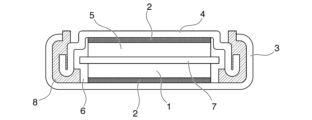
- FIG. 1 is a cross-sectional view of an electric double layer capacitor according to one embodiment of the present invention.
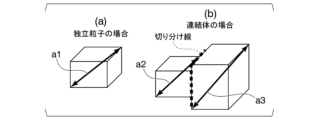
- FIG. 3 is an explanatory diagram of how to determine the average primary particle diameter.
- (a) is a photograph showing the coating properties of Example 1
- (b) is a photograph showing the coating properties of Example 2.
- the electrode active material of this embodiment is a sintered body in which porous carbon powders are sintered together, and the average primary particle diameter of the porous carbon powders is 900 nm or less.
- the average primary particle diameter of the porous carbon powder is preferably 300 nm or less, more preferably 150 nm or less, and even more preferably 100 nm or less.
- the average primary particle size of the porous carbon powder is 900 nm or less, the distance to the deep part of the pores of the particles is short and ions in the electrolyte can easily move, so that the diffusion resistance can be lowered.
- the average primary particle diameter of the porous carbon powder is preferably 5 nm or more, more preferably 15 nm or more, and even more preferably 50 nm or more.
- the upper limit and lower limit of the average primary particle diameter can be arbitrarily combined.
- the average primary particle diameter is preferably 5 nm or more and 900 nm or less, more preferably 5 nm or more and 300 nm or less, more preferably 15 nm or more and 150 nm or less, and even more preferably 50 nm or more and 100 nm or less. preferable.
- the average primary particle diameter may be 60 nm or more and 80 nm or less, or 65 nm or more and 75 nm or less.
- the average primary particle size of porous carbon powder is measured by the following method.
- An image of the surface of the electrode active material is obtained using a scanning electron microscope (SEM) or a scanning transmission electron microscope (STEM).
- SEM scanning electron microscope
- STEM scanning transmission electron microscope
- the magnification at this time is such that the number of porous carbon powders (primary particles) present in the field of view is 10,000 to 100,000.
- a diagonal line is drawn from the upper left to the lower right of the obtained visual field, and the average value of the particle diameters of the primary particles touching this diagonal line is defined as the average primary particle diameter.
- the particle size of each primary particle is the longest diameter in the viewing plane (a1 in FIG. 2(a)). Note that since the electrode active material of this embodiment is a sintered body, the primary particles become a connected body and may not be observed in a completely independent state in some cases. In that case, draw a dividing line at the connected part based on the observable outline, and for each divided primary particle, the longest diameter in the viewing plane is taken as the particle size of each primary particle (a2 in Figure 2 (b) , a3).
- the electrode active material of this embodiment has a maximum diameter of 90% cumulative value (hereinafter also referred to as "D90") or more in a particle size distribution based on the longest diameter of the sintered bodies that are secondary particles, tertiary particles, etc.
- the average length of the longest diameter of the total particles (hereinafter also referred to as " ⁇ D90") is preferably 12 ⁇ m or more, more preferably 14 ⁇ m or more, and even more preferably 20 ⁇ m or more.
- ⁇ D90 is a preferable lower limit or more, the amount of binder for binding each secondary particle and tertiary particle can be reduced, so that conductivity can be improved and the resistance of the battery can be lowered.
- tertiary particles may be used in this specification, but this is a term for convenience to express particles of granulated powder in which a large number of secondary particles are aggregated, and is only a definition. The above are included in the category of "secondary particles”.
- the particle size distribution of the powdered sintered body is measured by the following method. First, a sintered body is placed on a glass substrate, excess is removed with a duster, and an observation sample is prepared. The prepared observation sample is observed using a digital microscope VHX-2000 manufactured by Keyence Corporation, and an image is taken at approximately 70% illuminance, 300x magnification, and transmission mode to obtain a particle image.
- the obtained particle images were binarized using Nippon Steel Technology's particle analysis (Ver. 3.0) with a threshold value of 128, and then the particles were counted. After obtaining all the data for the longest diameter (the same applies hereinafter) and sorting them in ascending order of power, numbers are assigned to each type of data using integers, and the distribution of the number of particles with respect to the longest diameter is obtained as a particle size distribution.
- the longest diameter of the 90% cumulative value is defined as "D90”
- the average of the longest diameters of all particles having a longest diameter of "D90” or more is calculated as " ⁇ D90”.
- the longest diameter of the 99.9% cumulative value of the distribution is defined as "D99.9”.
- the preferable ranges of " ⁇ D90” and “D99.9” also depend on the thickness d of the electrode active material layer of the electrode using the electrode active material of this embodiment, as detailed in the explanation of the electrode and the method for manufacturing the electrode. Dependent.
- the electrode active material of this embodiment has micropores, mesopores, and macropores.
- micropores are pores with a pore size smaller than 2 nm
- mesopores are pores with a pore size of 2 nm or more and 50 nm or less
- macropores are pores with a pore size larger than 50 nm and 400 nm or less.
- the ratio of the volume of mesopores to the total pore volume (hereinafter also referred to as "mesopore volume ratio”) is preferably 12 to 80%, more preferably 30 to 75%, and 40 to 73%. % is more preferable.
- mesopore volume fraction is at least the preferable lower limit, ion diffusivity is improved and resistance is reduced.
- mesopore volume fraction is less than or equal to the preferable upper limit, the bulk density is improved and the volume density is improved.
- the ratio of the volume of micropores to the volume of mesopores is preferably more than 10% and less than 150%, more preferably more than 20% and less than 120%, more preferably more than 30%. More preferably, it is 100% or less.
- the ratio of the volume of micropores to the volume of mesopores is at least the lower limit, the volume density is improved, and when it is at most the upper limit, it is possible to obtain an advantageous resistance reduction effect due to the mesopores.
- the ratio of the volume of micropores to the volume of mesopores described above can also be replaced by the ratio of the volume of micropores to the volume of mesopores (volume of micropores/volume of mesopores). That is, this ratio is preferably greater than 0.1 and less than or equal to 1.5, more preferably greater than 0.2 and less than or equal to 1.2, and more preferably greater than 0.3 and less than or equal to 1. More preferred.
- the total pore volume, the micropore volume, and the mesopore volume are each measured by nitrogen adsorption and desorption using a gas adsorption method, and calculated from the obtained nitrogen adsorption isotherm using the BJH method.
- the volume of macropores is calculated by subtracting the sum of the volume of micropores and the volume of mesopores from the total pore volume.
- the total pore volume is preferably 0.5 to 5.0 cm 3 /g, more preferably 1.0 to 5.0 cm 3 /g, even more preferably 1.1 to 5.0 cm 3 /g. If the total pore volume is at least the above-mentioned preferable lower limit, the diffusivity of the substance will be better, and if it is below the above-mentioned preferable upper limit, the specific surface area can be increased.
- the electrode active material of this embodiment has a micropore region (region with a pore diameter of less than 2 nm), a mesopore region (a region with a pore diameter of 2 nm or more and 50 nm or less), and a macropore region (a region with a pore diameter of more than 50 nm) in the Log differential pore volume distribution. It is preferable to have a peak in each region (a region of 400 nm or less). If each region has a peak, the diffusivity will be better.
- the Log differential pore volume distribution is a distribution curve in which the pore diameter is plotted on the horizontal axis and the Log differential pore volume is plotted on the vertical axis, based on the measurement results by the gas adsorption method.
- the Log differential pore volume is a value (dV/d (logD)) obtained by dividing the differential pore volume dV by the logarithmic difference value d (logD) of the pore diameter.
- the peak top pore diameter of the mesopore region is preferably 2 to 50 nm, more preferably 5 to 30 nm.
- the electric double layer capacity (electrostatic capacity) of a capacitor is developed by adsorption and desorption of electrolyte ions to and from an active material.
- the size of the solvated electrolyte ions is often 1.6 to 2.0 nm.
- TEA-BF4 tetraethyl ammonium tetrafluoroborate
- the size of the cation is 1.96 nm
- the size of the anion is 1.71 nm. It is. If the pore diameter at the peak top of the mesopore region is within the above range, there will be many mesopores that can adsorb and desorb electrolyte ions, and the capacitance will improve.
- the peak top pore diameter of the macropore region is preferably 50 to 200 nm, more preferably 50 to 100 nm. If the pore diameter at the peak top of the macropore region is equal to or greater than the above lower limit, the diffusivity of the substance will be better, and if it is equal to or less than the above upper limit, the specific surface area can be increased.
- the difference between the peak top pore diameter in the mesopore region and the peak top pore diameter in the macropore region is preferably 10 to 200 nm, more preferably 30 to 100 nm. If the difference between the pore diameters is at least the above lower limit, the mixture permeability will be better, and if it is less than the above upper limit, the selectivity of the substance will be better.
- the method for producing the electrode active material of this embodiment is a method of producing the electrode active material of the above embodiment by firing an organic material containing a metal-organic framework (hereinafter also referred to as "MOF"). be.
- MOF metal-organic framework
- MOF organic material containing MOF means only MOF or a mixture of MOF and other organic substances.
- MOF is a structure in which metal ions and organic bridging ligands (polydentate ligands having two or more coordinating functional groups) are continuously bonded, and is a porous structure with multiple pores inside. It is the body.
- MOFs are known to include a plurality of metals, metal oxides, metal clusters, or metal oxide cluster structural units, but are not limited to any of these.
- metal atoms constituting the MOF examples include zinc, cobalt, niobium, zirconium, cadmium, copper, nickel, chromium, vanadium, titanium, molybdenum, magnesium, iron, and aluminum.
- the metal atoms constituting the MOF are not limited to these.
- the number of metal atoms constituting the MOF may be one or two or more.
- complexes having metal ions such as Zn 2+ , Cu 2+ , Ni 2+ , Co 2+ and metal-containing secondary structural units (SBU) are suitable.
- the coordinating functional group of the organic crosslinking ligand may be any functional group capable of coordinating to a metal atom, such as a carboxyl group, an imidazole group, a hydroxyl group, a sulfonic acid group, a pyridine group, a tertiary amine group, an amide group, Examples include thioamide group. Among these, a carboxy group is preferred.
- the two or more coordinating functional groups possessed by the organic crosslinking ligand may be the same or different.
- the organic bridging ligand one typically used is one in which two or more coordinating functional groups are substituted on a skeleton having a rigid structure (for example, an aromatic ring, an unsaturated bond, etc.).
- organic crosslinking ligands are listed below, but the present invention is not limited thereto.
- BB 1,3,5-tris(4-carboxyphenyl)benzene
- BDC 1,4-benzenedicarboxylic acid
- DOBDC 2,5-dihydroxy-1,4-benzenedicarboxylic acid
- CB BDC 4-benzenedicarboxylic acid
- H2N BDC 2-amino-1,4-benzenedicarboxylic acid
- HPDC terphenyldicarboxylic acid
- TPDC 2,6 - Naphthalenedicarboxylic acid (2,6-NDC)
- BPDC biphenyldicarboxylic acid
- any dicarboxylic acid with a phenyl compound 3,3',5,5'- Biphenyltetracarbox
- MOF-177 represented by Zn 4 O (1,3,5-benzene tribenzoate) 2 ; MOF represented by Zn 4 O (1,4-benzenedicarboxylate) 3 , also known as IRMOF-I -5; MOF-74 (Mg) represented by Mg 2 (2,5-dihydroxy-1,4-benzenedicarboxylate); Zn 2 (2,5-dihydroxy-1,4-benzenedicarboxylate) MOF-74 (Zn) represented by; MOF-505 represented by Cu 2 (3,3',5,5'-biphenyltetracarboxylate); Zn 4 O (cyclobutyl-1,4-benzenedicarboxylate); IRMOF-6 represented by Zn 4 O (2-amino-1,4-benzenedicarboxylate) 3 ; IRMOF-3 represented by Zn 4 O (terphenyldicarboxylate) 3 or Zn 4
- ZIF Zeolitic imidazolate framework
- ZIF-8 Zeolitic imidazolate framework
- ZIF contains zinc or cobalt as a metal, and imidazole-based organic bridging ligands (imidazole, benzimidazole, 2-nitroimidazole, 2-methylimidazole, cyclobenzimidazole, imidazole-2-carboxylic acid) as an organic bridging ligand. It is a material with a zeolite-like topology, including aldehydes, 4-cyanoimidazole, 6-methylbenzimidazole, 6-bromobenzimidazole, etc.).
- ZIF Zeolitic imidazolate framework
- it tends to be easier to obtain a material in which the micropore volume ratio, mesopore volume ratio, and macropore volume ratio are each 13% or more, compared to when using other MOFs.
- MOFs typically have a crystalline structure. Since MOF has a regular structure, it easily crystallizes and is easily obtained as a single crystal or polycrystal.
- the crystal may be a single crystal or a polycrystal.
- the median size of the crystal structure is preferably 10 nm to 100 ⁇ m, more preferably 30 nm to 1 ⁇ m. If the median size of the crystal structure is greater than or equal to the above lower limit, the specific surface area will be better, and if it is less than the above upper limit, the diffusibility of the substance and the dispersibility of the crystal will be better.
- the median size of the MOF crystal structure is measured by the following method. Obtain an image of the surface of the sample using a scanning electron microscope or an optical microscope. The magnification at this time is such that the number of crystals (MOF) present in the image is 100 to 200. Measure the maximum diameter of all crystals present in the obtained image, calculate their median value (average value of the minimum value and maximum value), and use that value as the median size of the crystal structure of the MOF. shall be.
- a commercially available MOF may be used, or one manufactured by a known manufacturing method may be used.
- Examples of the method for manufacturing MOF include the method described in International Publication No. 2019/039509.
- differences occur in the size of the crystal structure of the produced MOF and the amount of metal oxides contained, resulting in a difference in the pore distribution of the MOF.
- a substance (A) containing a metal atom constituting an MOF (excluding MOF) and a substance disposed on the metal atom are used.
- An organic substance (B) having two or more metal coordination moieties capable of forming a crystalline substance reacts or undergoes a phase transition upon stimulation, and the metal coordination of the organic substance (B) to the metal atoms of the substance (A) occurs.
- MOF is generated by applying a stimulus to a composition containing a coordination promoter (C) capable of promoting coordination of the site.
- the type and equivalent of the coordination promoter (C) affect the pore distribution of the produced MOF.
- a base e.g., amine-borane complex, dicyandiamide, hydrazide, imine, oxazolidine, pyridine, tertiary amine, ketoprofen amine salt, secondary amine, primary amine, or a mixture thereof
- the organic substance (B) is blended in an amount equal to or more than the organic substance (B)
- the amount of base blended decreases, the yield of the produced MOF tends to decrease.
- MOF has a crystal structure, it has pores inside. Therefore, unlike ordinary activated carbon, a sintered body of porous carbon powder can be obtained by firing without performing porous treatment (activation) using chemicals or activation gas. However, after firing, in order to further increase the specific surface area, it is possible to perform a porosity treatment as necessary. Note that MOF before firing usually does not have mesopores. Mesopores are formed by firing.
- MOF organic materials that may be mixed with the MOF
- Other organic materials that may be mixed with the MOF include common resins, plant-based carbon sources, or carbon-containing chemicals. By mixing other organic substances, the amount of metal-organic framework used can be reduced and costs can be reduced.
- the mass ratio of MOF to the total mass of MOF and other organic substances is preferably 10 to 100% by mass, more preferably 50 to 100% by mass, and 80 to 100% by mass. 99.9% by mass is more preferred.
- the mass ratio of MOF is at least the preferable lower limit, a high-performance electrode active material can be obtained.
- the mass proportion of MOF is below the preferable upper limit, a change occurs in the dynamics of carbon, which has a favorable effect on diffusion.
- the organic material containing MOF is crushed before firing. This is because after firing, the sintered body becomes a high-density, strong sintered body, and it is difficult to adjust the particle size by crushing.
- a mixer grinding in a mortar, ball mill, etc. can be employed as appropriate. Among these, crushing using a mixer is preferable because it easily eliminates human error and unevenness in the degree of crushing.
- the firing is performed in an inert gas.
- the inert gas include nitrogen gas and argon.
- the firing temperature (maximum temperature after heating) is preferably 300 to 1000°C, more preferably 600 to 1000°C, and even more preferably 900 to 980°C.
- the firing time is preferably 0.5 to 10 hours, more preferably 1 to 5 hours, and even more preferably 1 to 3 hours.
- the organic material containing MOF is fired and then classified.
- coarse particles and fine particles can be removed.
- Coarse particles can be removed by, for example, using a sieve with an opening of 10 to 1000 ⁇ m and removing particles that did not pass through the sieve.
- the range of coarse particles to be removed depends on the thickness d of the electrode active material layer of the electrode using the electrode active material. As the thickness d of the electrode active material layer increases, only larger coarse particles need to be removed using a sieve with larger openings.
- the fine particles can be removed by, for example, using a sieve with an opening of 1 to 50 ⁇ m and removing the particles that have passed through the sieve.
- the range of fine particles to be removed is adjusted from the viewpoint of resistance. By removing fine particles, it becomes less susceptible to increases in resistance due to binders and the like. Note that it is preferable that some of the removed fine particles be returned, rather than being removed entirely. This makes it easier for the porous carbon powders to maintain good point contact with each other after sintering.
- the fine particles once removed by sieving it is preferable to return 1 to 99% by mass, more preferably 10 to 95% by mass, and even more preferably 30 to 90% by mass. If the mass % of the returned particles is equal to or greater than the above lower limit, the number of contacts increases and the resistance decreases. If it is below the above upper limit, the amount of particles to be removed can be reduced, leading to cost reduction.
- the electrode includes a current collector and an electrode active material layer provided on the current collector.
- the electrode can be used, for example, as an electrode of an electric double layer capacitor or an electrode of a hybrid capacitor.
- the electrode active material layer is a layer containing the electrode active material according to the above embodiment.
- the electrode active material layer may be provided on one surface of the current collector, or may be provided on one surface of the current collector and partially impregnated into the current collector.
- Examples of the material of the current collector include nickel, aluminum, copper, iron, and stainless steel (SUS).
- Examples of the shape of the current collector include a sheet.
- the sheet may be a porous material such as a mesh or foam, or a non-porous material such as a foil.
- the thickness of the sheet-like current collector is, for example, 10 to 100 ⁇ m.
- the electrode active material layer may consist only of the above-mentioned electrode active material, or may further contain other components.
- known components to be included in the electrode active material layer can be used, such as conductive aids, binders, additives, and the like.
- the conductive aid include Ketjen black and carbon nanotubes.
- the binder include polyacrylonitrile, cellulose polymer, and polyvinylidene fluoride.
- additives include carboxymethyl cellulose.
- the content of the electrode active material is preferably 60 to 100% by mass, more preferably 90 to 99% by mass, based on the total mass of the electrode active material layer.
- the content of the conductive aid is preferably 0 to 15% by mass, more preferably 1 to 10% by mass, based on the total mass of the electrode active material layer.
- the content of the binder is preferably 0 to 10% by mass, more preferably 0 to 5% by mass, based on the total mass of the electrode active material layer.
- the thickness d of the electrode active material layer is preferably 10 to 500 ⁇ m, more preferably 50 to 300 ⁇ m, and even more preferably 60 to 100 ⁇ m.
- the thickness d of the electrode active material layer is equal to or greater than the above preferable lower limit, the volumetric capacity of the battery can be improved.
- the thickness d of the electrode active material layer is equal to or less than the above preferable upper limit, peeling and dissociation of the electrode film can be suppressed, and the physical stability of the battery can be improved.
- the thickness d of the electrode active material layer is determined by measuring the total thickness of the manufactured electrode using a digital thickness meter and subtracting the thickness of the current collector material. The total thickness of the electrode was measured at three arbitrary points on the electrode, and the average value was taken as the average value.
- ⁇ D90 in the particle size distribution of the sintered body constituting the electrode active material in the electrode active material layer is preferably 20% or more, and 23% or more of the thickness d (unit: ⁇ m) of the electrode active material layer. More preferably, it is 25% or more.
- ⁇ D90 is a preferable lower limit value or more with respect to the thickness d of the electrode active material layer, the amount of binder for binding each secondary particle and tertiary particle can be reduced, so that conductivity can be improved.
- ⁇ D90 in the particle size distribution of the sintered body constituting the electrode active material in the electrode active material layer is preferably 60% or less of the thickness d (unit: ⁇ m) of the electrode active material layer obtained, and 50 % or less, more preferably 45% or less.
- ⁇ D90 is a preferable upper limit value or less with respect to the thickness d of the electrode active material layer, it is easy to obtain good film characteristics.
- the upper and lower limits of the ratio (%) of " ⁇ D90" to the thickness d described above can be arbitrarily combined. Moreover, this ratio can also be replaced with the ratio of " ⁇ D90" (unit: %) to the thickness d (unit: ⁇ m) (" ⁇ D90"/d).
- This ratio " ⁇ D90”/d is preferably 0.20 or more and 0.60 or less, more preferably 0.23 or more and 0.50 or less, and 0.25 or more and 0.45 or less. is even more preferable.
- the electrode active material layer portion is peeled off from the current collector material, and a solvent (e.g., water, ethanol, isopropyl alcohol, N-methylpyrrolidone) is used. ) and disperse by applying physical stimulation (for example, homogenizer, ultrasonic vibration, stirrer agitation, etc.).
- a solvent e.g., water, ethanol, isopropyl alcohol, N-methylpyrrolidone
- the sintered body was left to stand for 10 minutes, and the sintered body was filtered (for example, by separating the supernatant, liquid separation, etc.), and the powder obtained by drying was placed on a glass substrate, and the excess was removed with a duster. Remove and prepare observation sample. A particle image is obtained from the prepared observation sample in the same manner as the particle size distribution of the sintered body constituting the powdered electrode active material, and the particle size distribution is obtained by analyzing the data.
- the electrode mixture used to form the electrode active material layer of the electrode may contain the above-mentioned conductive aid, binder, additive, etc. Further, in order to obtain good coating properties, it is preferable to contain a medium.
- a medium for example, an organic solvent, water, or a mixture of an organic solvent and water can be used. Examples of the organic solvent include N-methylpyrrolidone, dimethylformamide, and isopropyl alcohol.
- ⁇ D90 in the particle size distribution of the sintered body constituting the electrode active material in the electrode mixture is preferably 20% or more of the thickness d (unit: ⁇ m) of the obtained electrode active material layer, and 23% It is more preferably at least 25%, even more preferably at least 25%.
- ⁇ D90 is a preferable lower limit value or more with respect to the thickness d of the electrode active material layer, the amount of binder for binding each secondary particle and tertiary particle can be reduced, so that conductivity can be improved.
- ⁇ D90 in the particle size distribution of the sintered body constituting the electrode active material in the electrode mixture is preferably 60% or less of the thickness d (unit: ⁇ m) of the obtained electrode active material layer, and 55% It is more preferably at most 50%, even more preferably at most 50%.
- ⁇ D90 is a preferable upper limit value or less with respect to the thickness d of the electrode active material layer, it is easy to obtain good coating properties.
- the upper and lower limits of the ratio (%) of " ⁇ D90" to the thickness d described above can be arbitrarily combined. Moreover, this ratio can also be replaced with the ratio of " ⁇ D90" (unit: %) to the thickness d (unit: ⁇ m) (" ⁇ D90"/d).
- This ratio " ⁇ D90”/d is preferably 0.20 or more and 0.60 or less, more preferably 0.23 or more and 0.50 or less, and 0.25 or more and 0.45 or less. is even more preferable.
- “D99.9” in the particle size distribution of the sintered body constituting the electrode active material is preferably 140% or less, and 130% or less of the thickness d (unit: ⁇ m) of the obtained electrode active material layer. is more preferable, and even more preferably 120% or less.
- “D99.9” is a preferable upper limit value or less with respect to the thickness d of the electrode active material layer, it is easy to obtain good coating properties.
- the ratio (%) of "D99.9” to the thickness d described above can also be replaced with the ratio ("D99.9”/d) of "D99.9” (unit: %) to the thickness d (unit: ⁇ m). can.
- This ratio "D99.9”/d is preferably 1.4 or less, more preferably 1.3 or less, and even more preferably 1.2 or less.
- a solvent e.g., water, ethanol, isopropyl alcohol, N-methylpyrrolidone
- a physical stimulus is applied.
- the sintered body was left to stand for 10 minutes, filtered (for example, supernatant separated, liquid separated, etc.), and the powder obtained by drying was placed on a glass substrate and the excess was removed with a duster.
- Remove and prepare observation sample A particle image is obtained from the prepared observation sample in the same manner as the particle size distribution of the sintered body constituting the powdered electrode active material, and the particle size distribution is obtained by analyzing the data.
- the solid content concentration of the electrode mixture is preferably 5 to 90% by mass, more preferably 10 to 80% by mass, and even more preferably 20 to 70% by mass. If the solid content concentration of the electrode mixture is at least the preferable lower limit, an electrode active material layer with a sufficient thickness can be produced into efficient droplets. If the solid content concentration of the electrode mixture is below the preferable upper limit, it is easy to obtain good coating properties.
- the electrode can be manufactured by applying an electrode mixture containing an electrode active material to a current collector to form an electrode active material layer.
- coating method There is no particular limitation on the coating method, and known coating methods such as extrusion, bar coater coating, press, etc. can be used. Among these, a method using a bar coater is preferred because it has high reproducibility.
- the dry coating amount is preferably 0.1 to 5 mg/cm 2 , more preferably 1 to 3 mg/cm 2 , and preferably 1.2 to 1.5 mg/cm 2 . More preferred. By setting the dry coating amount within the above range, the thickness d of the electrode active material layer can be easily adjusted to a desired range. Note that a conductive adhesive may be applied to the current collector in advance before applying the electrode mixture.
- the drying method is not particularly limited, and may be natural drying at room temperature or drying by heating. Further, drying may be carried out under normal pressure or under reduced pressure.
- the drying temperature is preferably 70 to 200°C, more preferably 110 to 160°C, even more preferably 120 to 130°C.
- the drying temperature is preferably 70 to 200°C, more preferably 110 to 160°C, even more preferably 120 to 130°C.
- the reduced pressure conditions can be adjusted as appropriate depending on the degree of electrode drying.
- the drying time may be adjusted as appropriate depending on the temperature, pressure, and amount of application.
- the electric double layer capacitor of this embodiment includes a separator, a pair of electrodes facing each other via the separator, and an electrolytic solution filled between the pair of electrodes, and at least one of the pair of electrodes is This is an electrode according to the above-described aspect.
- the electric double layer capacitor of this embodiment can have a configuration as shown in FIG. 1, for example.
- an electrode enclosing material layer 1 for a positive electrode and an electrode enclosing material layer 5 for a negative electrode are formed on the inner surfaces of an aluminum case 3 and an aluminum lid 4, respectively, via a conductive adhesive 2.
- a separator 7 is disposed between the positive electrode enclosing material layer 1 and the negative electrode enclosing material layer 5.
- the case 3 is filled with an electrolytic solution 6, and a gasket 8 is interposed in the gap where the lid 4 fits into the case 3, to prevent the electrolytic solution 6 from flowing out.
- the case 3 and the lid 4 each function as a current collector.
- the positive electrode material layer 1, the case 3, and the conductive adhesive 2 between them constitute the positive electrode material
- the negative electrode material layer 5, the lid 4, and the conductive adhesive 2 between them constitute the negative electrode material layer 1, the case 3, and the conductive adhesive 2 between them.
- An electrode agent is constituted.
- a cellulose separator, a synthetic fiber nonwoven fabric separator, a mixed paper separator made of a mixture of cellulose and synthetic fibers, etc. can be used.
- a resin having a heat distortion temperature of 230° C. or higher is used.
- polyphenylene sulfide, polyethylene terephthalate, polyamide, fluororesin, ceramics, glass, etc. can be used.
- Examples of the electrolyte in the electrolytic solution 6 include LiBF 4 , LiPF 6 , lithium bis(oxalato)borate, lithium difluorooxalatoborate, methylethylpyrrolidinium tetrafluoroborate, and the like.
- Examples of the solvent in the electrolytic solution 6 include nitrile solvents, carbonate solvents, and ionic liquids.
- the separator, electrode, and electrolytic solution are not limited to a metal container made of stainless steel or the like, but may be housed in an impermeable film container or the like.
- the conductive adhesive is not essential, and the electrode enclosing material layer may be directly formed on the current collector.
- Part indicates “part by mass.”
- MOF Metal-organic crosslinking ligand
- zinc nitrate hexahydrate as a metal raw material
- triethylamine as a reaction accelerator.
- 2.5 g of 2-methylimidazole was added to 30 g of dimethylformamide (DMF) and stirred until completely dissolved to obtain an organic crosslinked ligand solution.
- 10 g of zinc nitrate hexahydrate was added to 30 g of dimethylformamide and stirred until completely dissolved to obtain a metal raw material solution.
- Each solution was mixed, and 12 g of triethylamine was further added and mixed. When the resulting mixed solution was stirred at room temperature, crystals precipitated. Thereafter, the crystal was collected by filtration, washed, and dried to obtain a crystal MOF.
- Example 1 After crushing the crystalline MOF obtained in Production Example 1 for 5 seconds using a crusher LAB MILL II manufactured by Osaka Chemical Co., Ltd., the container was removed from the crusher, and the crushed materials adhering to the blades were dropped into the container and crushed again. The container was attached to a crusher and crushed for an additional 5 seconds to obtain crushed crystals. The obtained crushed crystals were transferred to a quartz glass tubular furnace and heated to 950° C. under an inert atmosphere. After holding for 1 hour, it was naturally cooled to room temperature to obtain the electrode active material of Example 1.
- Example 2 After crushing the crystalline MOF obtained in Production Example 1 for 10 seconds using a crusher LAB MILL II manufactured by Osaka Chemical Co., Ltd., the container was removed from the crusher, and the crushed materials adhering to the blades were dropped into the container and crushed again. The container was attached to a crusher and crushed for an additional 5 seconds to obtain crushed crystals. The obtained crushed crystal was fired in the same manner as in Example 1 to obtain the electrode active material of Example 2.
- Example 3 After crushing the crystalline MOF obtained in Production Example 1 for 15 seconds using a crusher LAB MILL II manufactured by Osaka Chemical Co., Ltd., the container was removed from the crusher, and the crushed materials adhering to the blades were dropped into the container and crushed again. The container was attached to a crusher and crushed for an additional 5 seconds to obtain crushed crystals. The obtained crushed crystal was fired in the same manner as in Example 1 to obtain the electrode active material of Example 3.
- Example 4 After crushing the crystalline MOF obtained in Production Example 1 for 20 seconds using a crusher LAB MILL II manufactured by Osaka Chemical Co., Ltd., the container was removed from the crusher, and the crushed materials adhering to the blades were dropped into the container and crushed again. The container was attached to a crusher and crushed for an additional 5 seconds to obtain crushed crystals. The obtained crushed crystal was fired in the same manner as in Example 1 to obtain the electrode active material of Example 4.
- Example 5 After crushing the crystalline MOF obtained in Production Example 1 for 30 seconds using a crusher LAB MILL II manufactured by Osaka Chemical Co., Ltd., the container was removed from the crusher, and the crushed materials adhering to the blades were dropped into the container and crushed again. The container was attached to a crusher and crushed for an additional 5 seconds to obtain crushed crystals. The obtained crushed crystal was fired in the same manner as in Example 1 to obtain the electrode active material of Example 5.
- Example 6 After crushing the crystalline MOF obtained in Production Example 1 for 45 seconds using a crusher LAB MILL II manufactured by Osaka Chemical Co., Ltd., the container was removed from the crusher, and the crushed materials adhering to the blades were dropped into the container and crushed again. The container was attached to a crusher and crushed for an additional 5 seconds to obtain crushed crystals. The obtained crushed crystal was fired in the same manner as in Example 1 to obtain the electrode active material of Example 6.
- Example 7 After crushing the crystalline MOF obtained in Production Example 1 for 60 seconds using a crusher LAB MILL II manufactured by Osaka Chemical Co., Ltd., the container was removed from the crusher, and the crushed materials adhering to the blades were dropped into the container and crushed again. The container was attached to a crusher and crushed for an additional 5 seconds to obtain crushed crystals. The obtained crushed crystal was fired in the same manner as in Example 1 to obtain the electrode active material of Example 7.
- Example 8 After crushing the crystalline MOF obtained in Production Example 1 for 120 seconds using a crusher LAB MILL II manufactured by Osaka Chemical Co., Ltd., the container was removed from the crusher, and the crushed materials adhering to the blades were dropped into the container and crushed again. The container was attached to a crusher and crushed for an additional 5 seconds to obtain crushed crystals. The obtained crushed crystal was fired in the same manner as in Example 1 to obtain the electrode active material of Example 8.
- Example 9 After crushing the crystalline MOF obtained in Production Example 1 for 180 seconds using a crusher LAB MILL II manufactured by Osaka Chemical Co., Ltd., the container was removed from the crusher, and the crushed materials adhering to the blades were dropped into the container and crushed again. The container was attached to a crusher and crushed for an additional 5 seconds to obtain crushed crystals. The obtained crushed crystal was fired in the same manner as in Example 1 to obtain the electrode active material of Example 9.
- Example 10 Commercially available activated carbon was used as the electrode active material in Example 10.
- the obtained electrode mixture was applied onto a rectangular aluminum foil (current collector) measuring 4 cm in width and 20 cm in length using a bar coater, and dried for 30 minutes at 110° C. under atmospheric pressure. After drying, it was punched into a circular shape using a ⁇ 12 Thompson blade of a punching machine to obtain two electrodes for each example.
- Table 1 shows the average primary particle diameter of the porous carbon powder constituting the electrode active material of each example, "D90”, “ ⁇ D90”, “D99.9” in the particle size distribution of the electrode active material of each example, and the electrode active material. Layer thickness d, " ⁇ D90”/d, “D99.9”/d, measurement results of iR drop, and evaluation results of coatability are shown. In Table 1, "-" indicates that it has not been measured.
- FIG. 3 shows a photograph of an electrode active material layer formed from the applied electrode mixture in the manufacture of the electrode.
- (a) is a photograph of the electrode active material layer of Example 1, and the periphery is powdery or scratched due to the influence of coarse particles, and some parts have streaks instead of curves. It has become.
- (b) is a photograph of the electrode active material layer after coating in Example 2, in which the periphery became a continuous curve.
- the electrode active material layer after coating had a continuous curve around the periphery as in Example 2.
- the electrode active material is a sintered body in which porous carbon powders with small average primary particle diameters are sintered together. It was found that the internal resistance was reduced and the IR drop was reduced. Further, as can be seen from Examples 1, 2, and 7 to 9, it was found that the effect of reducing IR drop increases as the sintered body becomes larger, especially as " ⁇ D90" becomes larger. This means that the large particles in the sintered grain contribute to reducing the internal resistance.
- Example 1 it was also confirmed that as “D99.9” increases, the coating properties tend to deteriorate. However, as shown in Examples 2 and 3, if “D99.9” is somewhat larger than the thickness d of the electrode active material layer, the coating properties are not impaired. This was thought to be because the sintered body collapsed to some extent during coating.
- Electrode enclosing material layer for positive electrode 1
- Conductive adhesive 3
- Case 4 Lid
- Electrode enclosing material layer for negative electrode 6
- Electrolyte 7 Separator 8 Gasket
Landscapes
- Engineering & Computer Science (AREA)
- Power Engineering (AREA)
- Chemical & Material Sciences (AREA)
- Microelectronics & Electronic Packaging (AREA)
- Chemical Kinetics & Catalysis (AREA)
- Electrochemistry (AREA)
- General Chemical & Material Sciences (AREA)
- Materials Engineering (AREA)
- Manufacturing & Machinery (AREA)
- Inorganic Chemistry (AREA)
- Electric Double-Layer Capacitors Or The Like (AREA)
Priority Applications (1)
| Application Number | Priority Date | Filing Date | Title |
|---|---|---|---|
| JP2024509260A JPWO2023182497A1 (https=) | 2022-03-25 | 2023-03-24 |
Applications Claiming Priority (2)
| Application Number | Priority Date | Filing Date | Title |
|---|---|---|---|
| JP2022049358 | 2022-03-25 | ||
| JP2022-049358 | 2022-03-25 |
Publications (1)
| Publication Number | Publication Date |
|---|---|
| WO2023182497A1 true WO2023182497A1 (ja) | 2023-09-28 |
Family
ID=88101662
Family Applications (1)
| Application Number | Title | Priority Date | Filing Date |
|---|---|---|---|
| PCT/JP2023/011819 Ceased WO2023182497A1 (ja) | 2022-03-25 | 2023-03-24 | 電極活物質とその製造方法、電極合剤、電極とその製造方法、及び電気二重層キャパシタ |
Country Status (2)
| Country | Link |
|---|---|
| JP (1) | JPWO2023182497A1 (https=) |
| WO (1) | WO2023182497A1 (https=) |
Citations (2)
| Publication number | Priority date | Publication date | Assignee | Title |
|---|---|---|---|---|
| JP2021111574A (ja) * | 2020-01-15 | 2021-08-02 | 冨士色素株式会社 | 金属空気電池 |
| JP2022013012A (ja) * | 2020-07-03 | 2022-01-18 | 国立研究開発法人物質・材料研究機構 | 複合体、その製造方法、それを用いたアノード電極材料、および、それを用いたリチウムイオン二次電池 |
-
2023
- 2023-03-24 JP JP2024509260A patent/JPWO2023182497A1/ja active Pending
- 2023-03-24 WO PCT/JP2023/011819 patent/WO2023182497A1/ja not_active Ceased
Patent Citations (2)
| Publication number | Priority date | Publication date | Assignee | Title |
|---|---|---|---|---|
| JP2021111574A (ja) * | 2020-01-15 | 2021-08-02 | 冨士色素株式会社 | 金属空気電池 |
| JP2022013012A (ja) * | 2020-07-03 | 2022-01-18 | 国立研究開発法人物質・材料研究機構 | 複合体、その製造方法、それを用いたアノード電極材料、および、それを用いたリチウムイオン二次電池 |
Non-Patent Citations (1)
| Title |
|---|
| HALDORAI YUVARAJ, CHOE SANG RAK, HUH YUN SUK, HAN YOUNG-KYU: "Metal-organic framework derived nanoporous carbon/Co3O4 composite electrode as a sensing platform for the determination of glucose and high-performance supercapacitor", CARBON, ELSEVIER OXFORD, GB, vol. 127, 1 February 2018 (2018-02-01), GB , pages 366 - 373, XP093095029, ISSN: 0008-6223, DOI: 10.1016/j.carbon.2017.11.022 * |
Also Published As
| Publication number | Publication date |
|---|---|
| JPWO2023182497A1 (https=) | 2023-09-28 |
Similar Documents
| Publication | Publication Date | Title |
|---|---|---|
| TWI658635B (zh) | Lithium ion secondary battery | |
| Wang et al. | Nitrogen-doped porous carbon derived from a bimetallic metal–organic framework as highly efficient electrodes for flow-through deionization capacitors | |
| CN108475587B (zh) | 非水系锂型蓄电元件 | |
| US20210202186A1 (en) | Positive Electrode Precursor | |
| JP4415673B2 (ja) | キャパシタ用電極の製造方法 | |
| CN107148692B (zh) | 电极用导电性组合物、使用该导电性组合物的电极以及锂离子二次电池 | |
| JP2005191423A (ja) | キャパシタ用電極 | |
| CN110391094A (zh) | 非水系锂型蓄电元件 | |
| CN108475585B (zh) | 非水系锂蓄电元件 | |
| EP3712916B1 (en) | Positive electrode coating liquid, positive electrode precursor, and nonaqueous lithium electric storage element | |
| DE112016004175T5 (de) | Aktivkohlefilter für Hybrid-Superkondensator-Batteriesysteme | |
| WO2015031432A1 (en) | Edlc electrode and manufacturing process thereof | |
| CN104521044B (zh) | 非水电解质二次电池用粘合剂、非水电解质二次电池用粘合剂溶液、非水电解质二次电池用负极合剂及其用途 | |
| JP2008227481A (ja) | 導電性スラリー、電極スラリー、それらを用いた電気二重層キャパシタ用電極 | |
| TW201332192A (zh) | 電化學元件用分隔件及其製造方法 | |
| EP4289785A1 (en) | Material, method for manufacturing material, and functional material | |
| JP5548837B1 (ja) | 分極性電極用炭素材料及びその製造方法 | |
| CN112640153A (zh) | 形成用于铅碳电池的阳极的碳基活性层的方法以及由其形成的活性层 | |
| TW201327986A (zh) | 微多孔膜及其製造方法(四) | |
| JP2019151525A (ja) | 多孔質炭素粒子、多孔質炭素粒子分散体及びこれらの製造方法 | |
| JP2009187694A (ja) | 正極活物質用粉末、正極活物質およびナトリウム二次電池 | |
| JPWO2019065004A1 (ja) | グラフェンを含有する電極、その製造方法およびそれを用いた蓄電デバイス | |
| JP2000277386A (ja) | 電気二重層キャパシタセパレータおよびその製造方法 | |
| JP7580455B2 (ja) | バイアス電極を有する超コンデンサ | |
| WO2023182497A1 (ja) | 電極活物質とその製造方法、電極合剤、電極とその製造方法、及び電気二重層キャパシタ |
Legal Events
| Date | Code | Title | Description |
|---|---|---|---|
| 121 | Ep: the epo has been informed by wipo that ep was designated in this application |
Ref document number: 23775090 Country of ref document: EP Kind code of ref document: A1 |
|
| ENP | Entry into the national phase |
Ref document number: 2024509260 Country of ref document: JP Kind code of ref document: A |
|
| NENP | Non-entry into the national phase |
Ref country code: DE |
|
| 122 | Ep: pct application non-entry in european phase |
Ref document number: 23775090 Country of ref document: EP Kind code of ref document: A1 |