WO2023176929A1 - 非水電解質二次電池用正極、並びにこれを用いた非水電解質二次電池、電池モジュール、及び電池システム - Google Patents
非水電解質二次電池用正極、並びにこれを用いた非水電解質二次電池、電池モジュール、及び電池システム Download PDFInfo
- Publication number
- WO2023176929A1 WO2023176929A1 PCT/JP2023/010328 JP2023010328W WO2023176929A1 WO 2023176929 A1 WO2023176929 A1 WO 2023176929A1 JP 2023010328 W JP2023010328 W JP 2023010328W WO 2023176929 A1 WO2023176929 A1 WO 2023176929A1
- Authority
- WO
- WIPO (PCT)
- Prior art keywords
- positive electrode
- active material
- electrode active
- mass
- conductive
- Prior art date
- Legal status (The legal status is an assumption and is not a legal conclusion. Google has not performed a legal analysis and makes no representation as to the accuracy of the status listed.)
- Ceased
Links
Images


Classifications
-
- H—ELECTRICITY
- H01—ELECTRIC ELEMENTS
- H01M—PROCESSES OR MEANS, e.g. BATTERIES, FOR THE DIRECT CONVERSION OF CHEMICAL ENERGY INTO ELECTRICAL ENERGY
- H01M4/00—Electrodes
- H01M4/02—Electrodes composed of, or comprising, active material
- H01M4/36—Selection of substances as active materials, active masses, active liquids
- H01M4/58—Selection of substances as active materials, active masses, active liquids of inorganic compounds other than oxides or hydroxides, e.g. sulfides, selenides, tellurides, halogenides or LiCoFy; of polyanionic structures, e.g. phosphates, silicates or borates
- H01M4/5825—Oxygenated metallic salts or polyanionic structures, e.g. borates, phosphates, silicates, olivines
-
- H—ELECTRICITY
- H01—ELECTRIC ELEMENTS
- H01M—PROCESSES OR MEANS, e.g. BATTERIES, FOR THE DIRECT CONVERSION OF CHEMICAL ENERGY INTO ELECTRICAL ENERGY
- H01M10/00—Secondary cells; Manufacture thereof
- H01M10/05—Accumulators with non-aqueous electrolyte
- H01M10/052—Li-accumulators
-
- H—ELECTRICITY
- H01—ELECTRIC ELEMENTS
- H01M—PROCESSES OR MEANS, e.g. BATTERIES, FOR THE DIRECT CONVERSION OF CHEMICAL ENERGY INTO ELECTRICAL ENERGY
- H01M10/00—Secondary cells; Manufacture thereof
- H01M10/05—Accumulators with non-aqueous electrolyte
- H01M10/052—Li-accumulators
- H01M10/0525—Rocking-chair batteries, i.e. batteries with lithium insertion or intercalation in both electrodes; Lithium-ion batteries
-
- H—ELECTRICITY
- H01—ELECTRIC ELEMENTS
- H01M—PROCESSES OR MEANS, e.g. BATTERIES, FOR THE DIRECT CONVERSION OF CHEMICAL ENERGY INTO ELECTRICAL ENERGY
- H01M4/00—Electrodes
- H01M4/02—Electrodes composed of, or comprising, active material
- H01M4/13—Electrodes for accumulators with non-aqueous electrolyte, e.g. for lithium-accumulators; Processes of manufacture thereof
-
- H—ELECTRICITY
- H01—ELECTRIC ELEMENTS
- H01M—PROCESSES OR MEANS, e.g. BATTERIES, FOR THE DIRECT CONVERSION OF CHEMICAL ENERGY INTO ELECTRICAL ENERGY
- H01M4/00—Electrodes
- H01M4/02—Electrodes composed of, or comprising, active material
- H01M4/13—Electrodes for accumulators with non-aqueous electrolyte, e.g. for lithium-accumulators; Processes of manufacture thereof
- H01M4/131—Electrodes based on mixed oxides or hydroxides, or on mixtures of oxides or hydroxides, e.g. LiCoOx
-
- H—ELECTRICITY
- H01—ELECTRIC ELEMENTS
- H01M—PROCESSES OR MEANS, e.g. BATTERIES, FOR THE DIRECT CONVERSION OF CHEMICAL ENERGY INTO ELECTRICAL ENERGY
- H01M4/00—Electrodes
- H01M4/02—Electrodes composed of, or comprising, active material
- H01M4/13—Electrodes for accumulators with non-aqueous electrolyte, e.g. for lithium-accumulators; Processes of manufacture thereof
- H01M4/136—Electrodes based on inorganic compounds other than oxides or hydroxides, e.g. sulfides, selenides, tellurides, halogenides or LiCoFy
-
- H—ELECTRICITY
- H01—ELECTRIC ELEMENTS
- H01M—PROCESSES OR MEANS, e.g. BATTERIES, FOR THE DIRECT CONVERSION OF CHEMICAL ENERGY INTO ELECTRICAL ENERGY
- H01M4/00—Electrodes
- H01M4/02—Electrodes composed of, or comprising, active material
- H01M4/36—Selection of substances as active materials, active masses, active liquids
-
- H—ELECTRICITY
- H01—ELECTRIC ELEMENTS
- H01M—PROCESSES OR MEANS, e.g. BATTERIES, FOR THE DIRECT CONVERSION OF CHEMICAL ENERGY INTO ELECTRICAL ENERGY
- H01M4/00—Electrodes
- H01M4/02—Electrodes composed of, or comprising, active material
- H01M4/36—Selection of substances as active materials, active masses, active liquids
- H01M4/362—Composites
- H01M4/366—Composites as layered products
-
- H—ELECTRICITY
- H01—ELECTRIC ELEMENTS
- H01M—PROCESSES OR MEANS, e.g. BATTERIES, FOR THE DIRECT CONVERSION OF CHEMICAL ENERGY INTO ELECTRICAL ENERGY
- H01M4/00—Electrodes
- H01M4/02—Electrodes composed of, or comprising, active material
- H01M4/36—Selection of substances as active materials, active masses, active liquids
- H01M4/58—Selection of substances as active materials, active masses, active liquids of inorganic compounds other than oxides or hydroxides, e.g. sulfides, selenides, tellurides, halogenides or LiCoFy; of polyanionic structures, e.g. phosphates, silicates or borates
-
- H—ELECTRICITY
- H01—ELECTRIC ELEMENTS
- H01M—PROCESSES OR MEANS, e.g. BATTERIES, FOR THE DIRECT CONVERSION OF CHEMICAL ENERGY INTO ELECTRICAL ENERGY
- H01M4/00—Electrodes
- H01M4/02—Electrodes composed of, or comprising, active material
- H01M4/62—Selection of inactive substances as ingredients for active masses, e.g. binders, fillers
- H01M4/624—Electric conductive fillers
- H01M4/625—Carbon or graphite
-
- H—ELECTRICITY
- H01—ELECTRIC ELEMENTS
- H01M—PROCESSES OR MEANS, e.g. BATTERIES, FOR THE DIRECT CONVERSION OF CHEMICAL ENERGY INTO ELECTRICAL ENERGY
- H01M4/00—Electrodes
- H01M4/02—Electrodes composed of, or comprising, active material
- H01M4/64—Carriers or collectors
- H01M4/66—Selection of materials
-
- H—ELECTRICITY
- H01—ELECTRIC ELEMENTS
- H01M—PROCESSES OR MEANS, e.g. BATTERIES, FOR THE DIRECT CONVERSION OF CHEMICAL ENERGY INTO ELECTRICAL ENERGY
- H01M4/00—Electrodes
- H01M4/02—Electrodes composed of, or comprising, active material
- H01M2004/021—Physical characteristics, e.g. porosity, surface area
-
- H—ELECTRICITY
- H01—ELECTRIC ELEMENTS
- H01M—PROCESSES OR MEANS, e.g. BATTERIES, FOR THE DIRECT CONVERSION OF CHEMICAL ENERGY INTO ELECTRICAL ENERGY
- H01M4/00—Electrodes
- H01M4/02—Electrodes composed of, or comprising, active material
- H01M2004/026—Electrodes composed of, or comprising, active material characterised by the polarity
- H01M2004/028—Positive electrodes
-
- Y—GENERAL TAGGING OF NEW TECHNOLOGICAL DEVELOPMENTS; GENERAL TAGGING OF CROSS-SECTIONAL TECHNOLOGIES SPANNING OVER SEVERAL SECTIONS OF THE IPC; TECHNICAL SUBJECTS COVERED BY FORMER USPC CROSS-REFERENCE ART COLLECTIONS [XRACs] AND DIGESTS
- Y02—TECHNOLOGIES OR APPLICATIONS FOR MITIGATION OR ADAPTATION AGAINST CLIMATE CHANGE
- Y02E—REDUCTION OF GREENHOUSE GAS [GHG] EMISSIONS, RELATED TO ENERGY GENERATION, TRANSMISSION OR DISTRIBUTION
- Y02E60/00—Enabling technologies; Technologies with a potential or indirect contribution to GHG emissions mitigation
- Y02E60/10—Energy storage using batteries
Definitions
- the present invention relates to a positive electrode for a nonaqueous electrolyte secondary battery, a nonaqueous electrolyte secondary battery, a battery module, and a battery system using the same.
- a non-aqueous electrolyte secondary battery generally includes a positive electrode, a non-aqueous electrolyte, a negative electrode, and a separation membrane (hereinafter also referred to as a "separator") installed between the positive electrode and the negative electrode.
- a positive electrode for a nonaqueous electrolyte secondary battery one in which a composition consisting of a positive electrode active material containing lithium ions, a conductive agent, and a binder is fixed to the surface of a metal foil that is a current collector is known. ing.
- positive electrode active materials containing lithium ions lithium transition metal composite oxides such as lithium cobalt oxide, lithium nickel oxide, and lithium manganate, and lithium phosphate compounds such as lithium iron phosphate have been put into practical use.
- Patent Document 1 proposes a nonaqueous electrolyte secondary battery having a positive electrode containing spherical LiNiO 2 particles obtained by a specific manufacturing method. According to the invention of Patent Document 1, the battery capacity is improved.
- non-aqueous electrolyte secondary batteries are required to have improved cycle characteristics.
- the present invention provides a positive electrode for a non-aqueous electrolyte secondary battery that can improve the cycle characteristics of the non-aqueous electrolyte secondary battery.
- a positive electrode comprising a positive electrode current collector metal body and a composite material laminate present on at least one surface of the positive electrode current collector metal body,
- the composite material laminate includes a positive electrode active material layer and a conductive layer, the conductive layer is present between the positive electrode current collector metal body and the positive electrode active material layer, and the conductive layer is present between the positive electrode current collector metal body and the positive electrode active material layer.
- the conductive layer includes conductive carbon
- the positive electrode active material layer includes one or more positive electrode active material particles, At least a portion of the positive electrode active material particles have a core of the positive electrode active material and an active material coating portion that covers at least a portion of the surface of the core,
- the active material coating portion includes conductive carbon,
- the total amount of conductive carbon in the composite material laminate is 0.5 to 3.0% by mass, 0.7 to 2.9% by mass, and 0.9 to 2% by mass based on the total mass of the composite material laminate.
- a positive electrode for a non-aqueous electrolyte secondary battery wherein the composite material laminate has a volumetric capacity density of 330 to 400 mAh/cm 3 , 340 to 390 mAh/cm 3 , or 350 to 380 mAh/cm 3 .
- the positive electrode active material is a compound represented by the general formula LiFe x M (1-x) PO 4 (wherein 0 ⁇ x ⁇ 1, M is Co, Ni, Mn, Al, Ti, or Zr).
- the positive electrode for a non-aqueous electrolyte secondary battery according to ⁇ 1> comprising: ⁇ 3>
- the volume density of the composite material laminate is 2.2 to 2.7 g/cm 3 , 2.25 to 2.60 g/cm 3 , or 2.30 to 2.50 g/cm 3 , ⁇ 1> or
- a positive electrode comprising a positive electrode current collector metal body and a composite material laminate present on at least one surface of the positive electrode current collector metal body,
- the composite material laminate includes a positive electrode active material layer, and a conductive layer that exists between the positive electrode current collector metal body and the positive electrode active material layer and covers at least a portion of the positive electrode current collector metal body.
- the conductive layer includes conductive carbon
- the positive electrode active material layer includes one or more positive electrode active material particles, At least a portion of the positive electrode active material particles have a core of the positive electrode active material and an active material coating portion that covers at least a portion of the surface of the core,
- the active material coating portion includes conductive carbon
- the total amount of conductive carbon in the composite material laminate is 0.5 to 2.6% by mass with respect to the total mass of the composite material laminate,
- the volume capacity density of the composite material laminate is 330 to 345 mAh/cm 3
- ⁇ 5> The positive electrode for a non-aqueous electrolyte secondary battery according to any one of ⁇ 1> to ⁇ 4>, a negative electrode, and a non-aqueous electrolyte present between the positive electrode for a non-aqueous electrolyte secondary battery and the negative electrode.
- a non-aqueous electrolyte secondary battery A non-aqueous electrolyte secondary battery.
- a battery module or a battery system comprising a plurality of non-aqueous electrolyte secondary batteries according to ⁇ 5>.
- the cycle characteristics of a nonaqueous electrolyte secondary battery can be improved.
- FIG. 1 is a cross-sectional view schematically showing an example of a positive electrode for a non-aqueous electrolyte secondary battery according to the present invention.
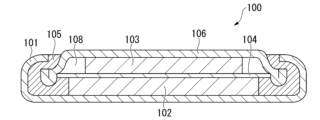
- FIG. 2 is a cross-sectional view of a coin cell used in a method for measuring volumetric capacity density.
- 1 is a cross-sectional view schematically showing an example of a non-aqueous electrolyte secondary battery according to the present invention.
- FIG. 1 is a schematic cross-sectional view showing one embodiment of the positive electrode for a non-aqueous electrolyte secondary battery of the present invention.
- FIG. 3 is a schematic cross-sectional view showing one embodiment of the non-aqueous electrolyte secondary battery of the present invention. Note that FIGS. 1 to 3 are schematic diagrams for explaining the configuration in an easy-to-understand manner, and the dimensional ratio of each component may differ from the actual one.
- the positive electrode for a non-aqueous electrolyte secondary battery (hereinafter sometimes referred to as "positive electrode”) of the present embodiment includes a positive electrode current collector metal body and a composite material laminate.
- the non-aqueous electrolyte secondary battery of this embodiment includes a positive electrode, a negative electrode, and a non-aqueous electrolyte present between the positive electrode and the negative electrode.
- the positive electrode 1 of this embodiment includes a positive electrode current collector metal body 14 and a composite material laminate 16.
- the composite material laminate 16 is present on both sides of the positive electrode current collector metal body 14 .
- the composite material laminate 16 may be present only on one side of the positive electrode current collector metal body 14. That is, the composite material laminate 16 exists on at least one surface of the positive electrode current collector metal body 14 .
- the composite material laminate 16 includes a positive electrode active material layer 12 and a conductive layer 15.
- the conductive layer 15 exists between the positive electrode current collector metal body 14 and the positive electrode active material layer 12 .
- the conductive layer 15 covers at least a portion of the surface of the positive electrode current collector metal body 14 .
- the conductive layer 15 is a conductive coating layer that covers part or all of the surface of the positive electrode current collector metal body 14 .
- the conductive layer 15 is present on both sides of the positive electrode current collector metal body 14, but the conductive layer 15 may be present only on one side of the positive electrode current collector metal body 14.
- the positive electrode current collector metal body 14 and the conductive layer 15 may be collectively referred to as the positive electrode current collector 11.
- a conductive layer 15 and a positive electrode active material layer 12 are arranged in order from the positive electrode current collector metal body 14.
- the positive electrode active material layer 12 includes one or more positive electrode active material particles. It is preferable that the positive electrode active material layer 12 further contains a binder.
- the positive electrode active material layer 12 may further contain a conductive additive.
- the term "conductive additive" refers to a conductive material having a granular or fibrous shape that is mixed with positive electrode active material particles when forming a positive electrode active material layer, and which is mixed with positive electrode active material particles when forming a positive electrode active material layer. Refers to a conductive material that is present in the positive electrode active material layer in a connected manner. The conductive aid exists independently of the positive electrode active material particles.
- the positive electrode active material layer 12 may further contain a dispersant.
- the content of the positive electrode active material particles is preferably 80.0 to 99.9% by mass, more preferably 90 to 99.5% by mass.
- the thickness of the positive electrode active material layer is preferably 30 to 500 ⁇ m, more preferably 40 to 400 ⁇ m, and particularly preferably 50 to 300 ⁇ m.
- the thickness of the positive electrode active material layer is at least the lower limit of the above range, the energy density of a battery incorporating the positive electrode tends to be high, and when it is below the upper limit of the above range, the peel strength of the positive electrode active material layer is high; Peeling can be suppressed during charging and discharging.
- the thickness of the positive electrode active material layer is the total thickness of the two layers located on both sides.
- the positive electrode active material particles contain a positive electrode active material. At least some of the positive electrode active material particles are coated particles. In the coated particles, a coating portion (hereinafter sometimes referred to as “active material coating portion”) containing a conductive material is present on the surface of the positive electrode active material particle.
- active material coating portion is formed in advance on the surface of the positive electrode active material particles, and is present on the surface of the positive electrode active material particles in the positive electrode active material layer. That is, the active material coating portion in this specification is not newly formed in a step after the step of preparing the composition for producing a positive electrode.
- the active material coating portion is not easily lost in the steps after the preparation stage of the composition for producing the positive electrode.
- the active material coating portion still covers the surface of the positive electrode active material.
- the active material coating part will not cover the surface of the positive electrode active material. Covered.
- the active material coating portion preferably exists on 50% or more, preferably 70% or more, and preferably 90% or more of the entire outer surface area of the positive electrode active material particles. That is, the coated particles have a core that is a positive electrode active material and an active material coating that covers the surface of the core, and the area of the active material coating with respect to the surface area of the core, that is, the coverage ratio is 50%. It is preferably at least 70%, more preferably at least 90%, even more preferably at least 90%.
- the upper limit of the coverage is not particularly limited, but is preferably 94% or less, more preferably 97% or less, and even more preferably 100% or less.
- the coverage is preferably 50 to 94%, more preferably 70 to 97%, even more preferably 90 to 100%.
- Examples of methods for producing coated particles include vapor deposition methods and sintering methods.
- Examples of the sintering method include a method in which a composition for producing an active material containing positive electrode active material particles and an organic substance is fired at 500 to 1000° C. for 1 to 100 hours under atmospheric pressure.
- organic substances added to the composition for producing active materials include salicylic acid, catechol, hydroquinone, resorcinol, pyrogallol, phloroglucinol, hexahydroxybenzene, benzoic acid, phthalic acid, terephthalic acid, phenylalanine, water-dispersible phenolic resin, Examples include sucrose, glucose lactose, malic acid citric acid, allyl alcohol propargyl alcohol, ascorbic acid, polyvinyl alcohol, and the like. A mixture of a plurality of types among these may be used, or an organic substance other than the above may be used.
- the impact sintering coating method is performed, for example, by the following procedure.
- a burner is ignited using a mixture of fuel hydrocarbon and oxygen, and the mixture is ignited in a combustion chamber to generate a flame.
- the flame temperature is lowered by reducing the amount of oxygen to the fuel to be less than the equivalent amount for complete combustion.
- a powder supply nozzle is installed behind the frame, and a solid-liquid-gas three-phase mixture consisting of a solution of the organic material to be coated dissolved in a solvent and combustion gas is injected from the powder supply nozzle.
- the temperature of the injected fine powder is lowered, and the injected fine powder is accelerated below the transformation temperature, sublimation temperature, or evaporation temperature of the powder material, and is instantaneously sintered by impact. , coating particles of positive electrode active material.
- the vapor deposition method include vapor deposition methods such as physical vapor deposition and chemical vapor deposition, and liquid deposition methods such as plating.
- the coverage rate can be measured by the following method. First, particles in the positive electrode active material layer are analyzed by energy dispersive X-ray spectroscopy (TEM-EDX) using a transmission electron microscope. Specifically, the outer periphery of the positive electrode active material particles in the TEM image is subjected to elemental analysis using EDX. Elemental analysis is performed on carbon to identify the carbon that coats the positive electrode active material particles. A portion where the carbon coating portion has a thickness of 1 nm or more is defined as the coating portion, and the ratio of the coating portion to the entire circumference of the observed positive electrode active material particles is determined, and this can be taken as the coverage rate.
- TEM-EDX energy dispersive X-ray spectroscopy
- the measurement can be performed on, for example, 10 positive electrode active material particles, and the average value of these can be taken as the coverage.
- the active material coating portion has a thickness of 1 nm to 100 nm, preferably 5 nm to 50 nm, and is formed directly on the surface of the particle (hereinafter sometimes referred to as “core portion”) composed only of the positive electrode active material. This is the layer of This thickness can be confirmed by TEM-EDX used for measuring the coverage ratio described above.
- the coverage rate can also be measured using TEM-EDX, which uses particle elemental mapping of the positive electrode active material particles using elements unique to the positive electrode active material and elements unique to the conductive material contained in the active material coating. It can be calculated.
- the thickness of the active material coating is determined by determining the ratio of the coating area to the entire circumference of the observed positive electrode active material particles, with the area having a thickness of 1 nm or more using an element specific to the conductive material as the coating area. , coverage rate.
- the measurement can be performed on, for example, 10 positive electrode active material particles, and the average value of these can be taken as the coverage.
- the coverage rate of the coated particles of this embodiment is particularly preferably 100%. Note that this coverage rate is an average value for all the positive electrode active material particles present in the positive electrode active material layer, and as long as this average value is greater than or equal to the above lower limit, the positive electrode active material particles that do not have an active material coating part This does not exclude the presence of trace amounts of.
- positive electrode active material particles without an active material coating hereinafter sometimes referred to as “single particles"
- the amount thereof is equal to the amount of positive electrode active material present in the positive electrode active material layer. It is preferably 30% by mass or less, more preferably 20% by mass or less, particularly preferably 10% by mass or less, based on the total amount of particles.
- the lower limit of the amount of single particles relative to the total amount of positive electrode active material particles is not particularly limited, but may be 0.1% by mass or more, and 0.2% by mass or more. It may be 0.3% by mass or more.
- the amount of the single particles relative to the total amount of positive electrode active material particles is preferably 0.3 to 30% by mass or more, more preferably 0.2 to 20% by mass or more, More preferably 0.1 to 10% by mass or more. In one embodiment, it is preferred that no single particles are present in the positive electrode active material layer.
- the conductive material of the active material coating portion contains carbon (that is, conductive carbon).
- the conductive material may be a conductive material consisting only of carbon, or may be a conductive organic compound containing carbon and an element other than carbon. Examples of other elements include nitrogen, hydrogen, and oxygen.
- the content of other elements is preferably 10 atomic % or less, more preferably 5 atomic % or less. It is more preferable that the conductive material constituting the active material coating portion consists only of carbon.
- the content of the conductive material is preferably 0.1 to 4.0% by mass, more preferably 0.5 to 3.0% by mass, and 0.1 to 4.0% by mass, more preferably 0.5 to 3.0% by mass, with respect to the total mass of the positive electrode active material particles having the active material coating portion. More preferably 7 to 2.5% by mass. If the amount is too large, the conductive material may peel off from the surface of the positive electrode active material particles and remain as independent conductive aid particles, which is not preferable.
- Conductive particles that do not contribute to the conductive path become the starting point of self-discharge of the battery or cause undesirable side reactions.
- the positive electrode active material particles preferably include a compound having an olivine crystal structure.
- the compound having an olivine crystal structure is preferably a compound represented by the general formula LiFe x M (1-x) PO 4 (hereinafter also referred to as "general formula (I)").
- general formula (I) 0 ⁇ x ⁇ 1.
- M is Co, Ni, Mn, Al, Ti or Zr.
- a small amount of Fe and M can also be replaced with other elements to the extent that the physical properties do not change. Even if the compound represented by the general formula (I) contains trace amounts of metal impurities, the effects of the present invention are not impaired.
- the compound represented by the general formula (I) is preferably lithium iron phosphate (hereinafter sometimes referred to as "lithium iron phosphate") represented by LiFePO4 .
- lithium iron phosphate particles (hereinafter sometimes referred to as "coated lithium iron phosphate particles") in which at least a portion of the surface is coated with an active material containing a conductive material are more preferable. It is more preferable that the entire surface of the lithium iron phosphate particles be coated with a conductive material from the viewpoint of better battery capacity and cycle characteristics.
- the coated lithium iron phosphate particles can be produced by a known method. For example, lithium iron phosphate powder is produced using the method described in Japanese Patent No.
- the powder is prepared using the method described in GS Yuasa Technical Report, June 2008, Vol. 5, No. 1, pp. 27-31, etc.
- the method can be used to coat at least a portion of the surface of the lithium iron phosphate powder with carbon. Specifically, first, iron oxalate dihydrate, ammonium dihydrogen phosphate, and lithium carbonate are measured in a specific molar ratio, and these are ground and mixed under an inert atmosphere. Next, lithium iron phosphate powder is produced by heat-treating the obtained mixture in a nitrogen atmosphere.
- the lithium iron phosphate powder is placed in a rotary kiln and heat-treated while supplying methanol vapor using nitrogen as a carrier gas, thereby obtaining lithium iron phosphate particles whose surfaces are at least partially coated with carbon.
- the particle size of the lithium iron phosphate particles can be adjusted by changing the grinding time in the grinding process.
- the amount of carbon coating the lithium iron phosphate particles can be adjusted by adjusting the heating time, temperature, etc. in the step of heat treatment while supplying methanol vapor. It is desirable to remove uncoated carbon particles through subsequent steps such as classification and washing.
- the positive electrode active material particles may include one or more other positive electrode active material particles containing a positive electrode active material other than a compound having an olivine crystal structure.
- the other positive electrode active material is preferably a lithium transition metal composite oxide.
- Examples include non-stoichiometric compounds in which part of is replaced with a metal element.
- the metal element include one or more selected from the group consisting of Mn, Mg, Ni, Co, Cu, Zn, and Ge.
- the active material coating portion may be present on at least a portion of the surface of another positive electrode active material particle.
- the content of the compound having an olivine crystal structure is preferably 50% by mass or more, more preferably 80% by mass or more, and even more preferably 90% by mass or more with respect to the total mass of the positive electrode active material particles. It may be 100% by mass.
- the content of the compound having an olivine crystal structure is preferably 50 to 100% by mass, more preferably 80 to 100% by mass, and even more preferably 90 to 100% by mass with respect to the total mass of the positive electrode active material particles.
- the total mass of the positive electrode active material particles also includes the mass of the active material coating portion.
- the content of coated lithium iron phosphate particles is preferably 50% by mass or more, more preferably 80% by mass or more, and 90% by mass or more with respect to the total mass of the positive electrode active material particles. is even more preferable. It may be 100% by mass.
- the content of coated lithium iron phosphate particles is preferably 50 to 100% by mass, more preferably 80 to 100% by mass, and 90 to 100% by mass, based on the total mass of the positive electrode active material particles. 100% by mass is more preferred.
- the thickness of the active material coating portion of the positive electrode active material particles is preferably 1 to 100 nm.
- the thickness of the active material coating portion of the positive electrode active material particles can be measured by a method of measuring the thickness of the active material coating portion in a transmission electron microscope (TEM) image of the positive electrode active material particles.
- the thickness of the active material coating portion present on the surface of the positive electrode active material particles may not be uniform. It is preferable that an active material coating portion with a thickness of 1 nm or more exists on at least a portion of the surface of the positive electrode active material particles, and the maximum thickness of the active material coating portion is 100 nm or less.
- the average particle diameter of the positive electrode active material particles is preferably 0.1 to 20.0 ⁇ m, more preferably 0.5 to 15.0 ⁇ m. When using two or more types of positive electrode active material particles, the average particle diameter of each may be within the above range. When the positive electrode active material particles have an active material coating portion, the average particle diameter of the positive electrode active material particles also includes the thickness of the active material coating portion. When the average particle diameter is equal to or larger than the lower limit of the above range, the composition for producing a positive electrode tends to have better dispersibility, and aggregates tend to be less likely to occur. On the other hand, if it is below the upper limit of the above range, the specific surface area will be appropriately large, making it easy to ensure an area for reaction during charging and discharging.
- the average particle diameter of the positive electrode active material particles in this specification is a volume-based median diameter measured using a particle size distribution analyzer based on a laser diffraction/scattering method.
- the binder contained in the positive electrode active material layer 12 is an organic substance, and examples thereof include polyacrylic acid, lithium polyacrylate, polyvinylidene fluoride, polyvinylidene fluoride-hexafluoropropylene copolymer, styrene-butadiene rubber, polyvinyl alcohol, and polyvinyl. Examples include acetal, polyethylene oxide, polyethylene glycol, carboxymethyl cellulose, polyacrylonitrile, and polyimide. One type of binder may be used, or two or more types may be used in combination. The content of the binder is preferably 1.0% by mass or less, more preferably 0.8% by mass or less with respect to the total mass of the positive electrode active material layer.
- the lower limit of the binder content is preferably 0.1% by mass or more, and 0.3% by mass or more based on the total mass of the positive electrode active material layer. More preferred.
- the content of the binder is preferably 0.1 to 1.0% by mass, more preferably 0.3 to 0.8% by mass.
- Examples of the conductive additive included in the positive electrode active material layer 12 include carbon materials such as graphite, graphene, hard carbon, Ketjen black, acetylene black, and carbon nanotubes. One type of conductive aid may be used, or two or more types may be used in combination.
- the content of the conductive additive in the positive electrode active material layer 12 is preferably 4 parts by mass or less, more preferably 3 parts by mass or less, and further preferably 1 part by mass or less, based on 100 parts by mass of the total mass of the positive electrode active material.
- Conductive additive particles that do not contribute to the conductive path become the starting point of self-discharge of the battery or cause undesirable side reactions.
- the lower limit of the content of the conductive additive is determined as appropriate depending on the type of conductive additive, and for example, It is considered to be more than 0.1% by mass.
- the content of the conductive additive is preferably more than 0.1% by mass and 2.5% by mass or less based on the total mass of the positive electrode active material layer 12, and 0. It is more preferably more than .1% by mass and not more than 2.3% by mass, and even more preferably more than 0.1% by mass and not more than 2.0% by mass.
- the expression that the positive electrode active material layer 12 "does not contain a conductive additive" means that it does not substantially contain it, and does not exclude that it contains it to the extent that it does not affect the effects of the present invention. For example, if the content of the conductive additive is 0.1% by mass or less with respect to the total mass of the positive electrode active material layer 12, it can be determined that the conductive additive is not substantially contained.
- the carbon material used for the conductive aid is bulkier and has a lower apparent density than the conductive carbon that constitutes the active material coating and the conductive carbon that constitutes the conductive layer 15 described below. Therefore, if the amount of carbon contained in the positive electrode active material layer 12 is the same, the volume of the positive electrode active material layer 12 becomes smaller as the amount of the conductive additive in the positive electrode active material layer 12 is smaller. When the volume of the positive electrode active material layer 12 becomes smaller, the volume of the composite material laminate 16 becomes smaller, and the capacity per unit volume (hereinafter sometimes referred to as "volume capacity density") increases. When the volume capacity density increases, the resistance within the composite material laminate 16 decreases, and the cycle characteristics improve.
- the dispersant contained in the positive electrode active material layer 12 is an organic substance, and examples thereof include polyvinylpyrrolidone, polyvinyl alcohol, polyvinyl butyral, and polyvinyl formal.
- the dispersant may be used alone or in combination of two or more.
- the dispersant contributes to improving the dispersibility of particles in the positive electrode active material layer.
- the content of the dispersant is preferably 0.5% by mass or less, more preferably 0.2% by mass or less with respect to the total mass of the positive electrode active material layer.
- the lower limit of the content of the dispersant is preferably 0.01% by mass or more, more preferably 0.05% by mass or more based on the total mass of the positive electrode active material layer.
- the content of the dispersant is preferably 0.01 to 0.5% by mass, more preferably 0.05 to 0.2% by mass.
- the conductive layer 15 is a layer containing carbon (conductive carbon).
- the conductive layer 15 covers at least a portion of the surface of the positive electrode current collector metal body 14 .
- the conductive layer 15 is provided on at least a portion of the surface of the composite material laminate 16 facing the positive electrode current collector metal body 14 .
- "at least a portion of the surface” means 10% to 100%, preferably 30% to 100%, more preferably 50% to 100% of the surface area of the positive electrode current collector metal body.
- the conductive material in the conductive layer 15 only needs to contain conductive carbon. It is preferable that the conductive material in the conductive layer 15 consists only of carbon.
- the conductive layer 15 is preferably a coating layer containing carbon particles such as carbon black and a binder. Examples of the binding material in the conductive layer 15 include those similar to the binding material in the positive electrode active material layer 12.
- the content of conductive carbon in the conductive layer 15 is preferably 50 to 90% by mass, more preferably 55 to 85% by mass, and even more preferably 60 to 90% by mass, based on the total mass of the conductive layer 15.
- a composition containing a conductive material, a binder, and a solvent is coated on the surface of the positive electrode current collector metal body 14 using a known coating method such as a gravure method. , a method of removing the solvent by drying can be exemplified.
- the thickness of the conductive layer 15 is preferably 0.1 to 4.0 ⁇ m, more preferably 0.2 to 3.0 ⁇ m, and even more preferably 0.3 to 2.0 ⁇ m.
- the thickness of the conductive layer can be measured by a method of measuring the thickness of the coating layer in a transmission electron microscope (TEM) image or a scanning electron microscope (SEM) image of a cross section of the conductive layer.
- the thickness of the conductive layer does not have to be uniform. It is preferable that a conductive layer with a thickness of 0.1 ⁇ m or more is present on at least a portion of the surface of the positive electrode current collector metal body 14, and that the maximum thickness of the conductive layer is 4.0 ⁇ m or less.
- the positive electrode current collector metal body 14 is made of a metal material. Examples of the metal material include conductive metals such as copper, aluminum, titanium, nickel, and stainless steel.
- the positive electrode current collector metal body 14 is a foil made of a metal material, that is, a metal foil, and may include an oxide film formed on the surface.
- the thickness of the positive electrode current collector metal body 14 is, for example, preferably 8 to 40 ⁇ m, more preferably 10 to 25 ⁇ m.
- the thickness of the positive electrode current collector metal body 14 can be measured using a micrometer. An example of a measuring device is Mitutoyo's product name "MDH-25M.”
- the positive electrode active material layer 12 and the conductive layer 15 contain conductive carbon. That is, the composite material laminate 16 contains conductive carbon.
- the content of conductive carbon is preferably 0.5% by mass or more and less than 3.0% by mass, more preferably 1.0 to 2.8% by mass, and 1.2% by mass. More preferably 2.6% by mass.
- the content of conductive carbon in the positive electrode active material layer 12 is at least the lower limit of the above range, the amount is sufficient to form a conductive path in the positive electrode active material layer 12, and the cycle characteristics can be further improved.
- the content of conductive carbon in the positive electrode active material layer 12 is below the above upper limit, the volume capacity density can be increased and the cycle characteristics can be further improved.
- the content of conductive carbon with respect to the total mass of the positive electrode active material layer can be calculated from the conductive carbon content and blending amount contained in the positive electrode active material particles and the conductive additive.
- the content of conductive carbon with respect to the total mass of the positive electrode active material layer 12 is determined using a dried material, for example, a powder, which is obtained by peeling off the positive electrode active material layer 12 from the positive electrode and vacuum-drying it in a 120°C environment, as shown below. It can also be measured by the method for measuring conductive carbon content. For example, the outermost surface of the positive electrode active material layer, several micrometers in depth, can be peeled off with a spatula or the like, dried under vacuum at 120° C., and used as the object to be measured.
- the content of conductive carbon measured by the following ⁇ Measurement method for conductive carbon content ⁇ includes carbon in the active material coating and carbon in the conductive agent, and carbon in the binder and dispersant. It does not contain any of the carbon in it.
- the content of conductive carbon with respect to the total mass of the composite material laminate 16, that is, the total amount of conductive carbon in the positive electrode active material layer 12 and conductive carbon in the conductive layer 15 is 0.5 to 3.0% by mass. It is preferably 0.7 to 2.9% by mass, more preferably 0.9 to 2.8% by mass, and even more preferably 1.2 to 2.7% by mass.
- the content of conductive carbon in the composite material laminate 16 is at least the lower limit of the above range, the amount is sufficient to form a conductive path in the composite material laminate 16, and the cycle characteristics can be improved.
- the content of conductive carbon in the composite material laminate 16 is at most the above upper limit, the volume capacity density can be increased, the output can be increased, and the cycle characteristics can be improved.
- the content of conductive carbon with respect to the total mass of the composite material laminate 16 is determined by peeling off only the positive electrode current collector metal body 14 from the positive electrode and drying the remaining part under vacuum in a 120° C. environment, using a dried product, for example, a powder, as the measurement target. , it can be measured by the following ⁇ Measurement method of conductive carbon content>>.
- the content of conductive carbon in the composite material laminate 16 can be determined by infiltrating pure water into the composite material laminate 16, then peeling off the positive electrode current collector metal body 14 with a spatula, etc., and drying the remaining part under vacuum in a 120°C environment. can be used as the object to be measured.
- the conductive carbon content measured using the method for measuring conductive carbon content below includes carbon in the active material coating, carbon in the conductive aid, and carbon in the conductive layer. Contains neither carbon in the material nor carbon in the dispersant.
- ⁇ Measurement method for conductive carbon content [Measurement method A]
- the object to be measured is mixed uniformly, a sample (mass w1) is weighed, and a thermogravimetric differential thermal analysis (TG-DTA) measurement is performed according to the following steps A1 and A2 to obtain a TG curve.
- the following first weight loss amount M1 (unit: mass %) and second weight loss amount M2 (unit: mass %) are determined from the obtained TG curve.
- the content of conductive carbon (unit: mass %) is obtained by subtracting M1 from M2.
- Step A2 Immediately after step A1, the temperature was lowered from 600°C at a rate of 10°C/min, and after being held at 200°C for 10 minutes, the measurement gas was completely replaced with oxygen from argon, and an oxygen stream of 100 mL/min was added.
- the second weight loss amount M2 ( Unit: mass %).
- M2 (w1-w3)/w1 ⁇ 100...(a2)
- [Measurement method B] Mix the measurement object uniformly, weigh 0.0001 mg of the sample accurately, burn the sample under the following combustion conditions, quantify the generated carbon dioxide with a CHN elemental analyzer, and calculate the total carbon content M3 ( Unit: mass%). Further, the first weight loss amount M1 is determined by the procedure of step A1 of the measuring method A. The conductive carbon content (unit: mass %) is obtained by subtracting M1 from M3.
- Combustion conditions Combustion furnace: 1150°C Reduction furnace: 850°C Helium flow rate: 200mL/min Oxygen flow rate: 25-30mL/min
- the binder is polyvinylidene fluoride (PVDF: the molecular weight of the monomer (CH 2 CF 2 ) is 64), the content of fluoride ions (F - ) measured by combustion ion chromatography using the tubular combustion method ( (unit: mass %), the atomic weight of fluorine (19) of the monomer constituting PVDF, and the atomic weight (12) of carbon constituting PVDF using the following formula.
- PVDF polyvinylidene fluoride
- Confirm that the binder is polyvinylidene fluoride by checking the absorption derived from the C-F bond using the Fourier transform infrared spectrum of the sample or the liquid extracted from the sample with N,N-dimethylformamide solvent. I can do it. Similarly, it can be confirmed by nuclear magnetic resonance spectroscopy ( 19 F-NMR) measurement of fluorine nuclei.
- the binder content (unit: mass %) and carbon content (unit: mass %) corresponding to the molecular weight can be determined to determine the origin of the binder.
- the carbon amount M4 can be calculated.
- the conductive carbon content (unit: mass %) can be obtained by subtracting M4 from M3 and further subtracting the amount of carbon derived from the dispersant.
- the conductive carbon that constitutes the active material coating portion of the positive electrode active material and the conductive carbon that is a conductive aid can be distinguished by the following analysis method. For example, when particles in a positive electrode active material layer are analyzed by electron energy loss spectroscopy in a transmission electron microscope (TEM-EELS), particles with a carbon-derived peak around 290 eV only near the particle surface are positive electrode active materials. Particles in which carbon-derived peaks exist even inside the particles can be determined to be conductive additives.
- “near the particle surface” means a region having a depth of, for example, up to 100 nm from the particle surface, and "inside the particle” means a region inside the vicinity of the particle surface.
- Another method is to perform mapping analysis of particles in the positive electrode active material layer by Raman spectroscopy, and particles in which the peaks of carbon-derived G-band and D-band and oxide crystals derived from the positive electrode active material are simultaneously observed are Particles that are positive electrode active materials and in which only G-band and D-band were observed can be determined to be conductive additives.
- Another method is to observe the cross section of the positive electrode active material layer using a scanning spread resistance microscope, and if there is a part on the particle surface with lower resistance than the inside of the particle, the part with lower resistance is the active material. It can be determined that it is conductive carbon present in the coating. A portion that exists independently other than such particles and has a low resistance can be determined to be a conductive aid.
- trace amounts of carbon that can be considered as impurities and trace amounts of carbon that are unintentionally peeled off from the surface of the positive electrode active material during manufacturing are not determined to be conductive additives. Using these methods, it can be confirmed whether or not a conductive additive made of a carbon material is included in the positive electrode active material layer.
- the volume density of the composite material laminate 16 is preferably 2.2 to 2.7 g/cm 3 , more preferably 2.22 to 2.60 g/cm 3 , even more preferably 2.24 to 2.50 g/cm 3 . If the volume density of the composite material laminate 16 is equal to or higher than the above lower limit, the volume capacity density can be increased and the cycle characteristics can be improved. If the volume density of the composite material laminate 16 is below the above-mentioned upper limit, pressing with excessive pressure is not required when manufacturing the positive electrode 1. Therefore, deformation or damage of the positive electrode can be further suppressed by pressing.
- the volume density of the composite material laminate 16 can be adjusted by a combination of the particle diameter of the positive electrode active material particles, the composition of the positive electrode active material layer 12, the thickness of the conductive layer 15, the pressure during pressurization during positive electrode manufacture, and the like.
- the volume density of the composite material laminate 16 can be measured, for example, by the following measuring method.
- the thicknesses of the positive electrode 1 and the positive electrode current collector metal body 14 are each measured using a microgauge, and the thickness of the composite material laminate 16 is calculated from the difference.
- the thickness of the positive electrode 1 and the positive electrode current collector metal body 14 is an average value of values measured at five or more arbitrary points.
- the mass of a measurement sample obtained by punching out the positive electrode 1 to have a predetermined area is measured, and the mass of the positive electrode current collector metal body 14 measured in advance is subtracted to calculate the mass of the composite material laminate 16.
- the volume density of the positive electrode active material layer 12 is calculated based on the following formula (1).
- the volume capacity density of the composite material laminate 16 is 330 to 400 mAh/cm 3 , preferably 340 to 390 mAh/cm 3 , and more preferably 350 to 380 mAh/cm 3 . If the volume capacity density of the composite material laminate 16 is equal to or higher than the lower limit value, the energy density can be increased and the output can be increased. If the volume capacity density of the composite material laminate 16 is equal to or less than the above upper limit value, cycle characteristics can be improved.
- the volume capacity density of the composite material laminate 16 can be adjusted by a combination of the volume density of the composite material laminate 16, the composition of the positive electrode active material layer 12, the thickness of the conductive layer 15, the pressure during pressurization during positive electrode manufacture, etc. can.
- the volumetric capacity density of the composite material laminate 16 can be measured, for example, using the coin cell 100 shown in FIG. 2 by the following measuring method.
- the coin cell 100 includes a battery case 101, a sealing plate 106, a gasket 105, a positive electrode 102, a separator 104, a negative electrode 103, and a non-aqueous electrolyte 108.
- Battery case 101 has a cup shape with an opening at the top end.
- the sealing plate 106 is caulked to the battery case 101 via a gasket 105 made of an insulating material to close the opening of the battery case 101.
- the positive electrode 102, the negative electrode 103, and the separator 104 are located inside the battery case 101.
- the positive electrode 102 and the negative electrode 103 face each other with a separator 104 in between.
- Non-aqueous electrolyte 108 is filled in an internal space surrounded by battery case 101 and sealing plate 106 .
- a method for manufacturing the coin cell 100 will be described below.
- a circular positive electrode 102 with a diameter of 14 mm, that is, a size of ⁇ 14 is obtained.
- the positive electrode to be evaluated has a composite material laminate 16 on both sides, pure water is infiltrated into one side and the composite material laminate 16 is peeled off. 102 (sometimes referred to as "positive electrode").
- the positive electrode to be evaluated has the composite material laminate 16 on only one side, this is referred to as the single-sided positive electrode 102.
- the mass of the single-sided positive electrode 102 is measured.
- the value obtained by subtracting the mass of the positive electrode current collector metal body 14 of ⁇ 14 size from the measured mass of the single-sided positive electrode 102 is defined as mass A, that is, the mass of the composite material laminate 16.
- the mass of the positive electrode current collector metal body 14 of ⁇ 14 size is determined by peeling off the composite material laminate 16 on both sides of the single-sided positive electrode 102 and measuring the mass.
- a 2016 type coin cell is manufactured using the single-sided positive electrode 102.
- a gasket 105 is installed inside the battery case 101.
- a single-sided positive electrode 102 is installed in a 2016 type case 101, which is a battery case in which a gasket 105 is installed.
- the composite material laminate 16 is placed above.
- a sufficient amount of non-aqueous electrolyte 108, for example 50 to 100 ⁇ L, to permeate the single-sided positive electrode 102 is dropped.
- the nonaqueous electrolyte 108 is a liquid obtained by dissolving lithium hexafluorophosphate as an electrolyte in a mixed solvent of 3 parts by volume of ethylene carbonate and 7 parts by volume of diethyl carbonate at a concentration of 1 mol/liter.
- a separator 104 made of polyethylene is punched into a circle with a diameter of 18 mm, that is, a size of ⁇ 18, and a separator 104 with a thickness of 30 ⁇ m is installed on the composite material laminate 16 of the single-sided positive electrode 102, and an amount that sufficiently penetrates into the separator 104 is set. For example, 50 to 100 ⁇ L of electrolyte solution is dropped.
- a negative electrode 103 is formed by punching out a Li metal foil into a circle with a diameter of 16 mm, that is, a size of ⁇ 16. The negative electrode 103 is placed on the separator 104 with the negative electrode 103 facing the single-sided positive electrode 102 via the separator 104 .
- a sealing plate 106 is placed over the opening of the battery case 101, and the sealing plate 106 is caulked to the battery case 101 via the gasket 105 to seal it.
- the electric capacity (mAh/g) is measured using the coin cell 100.
- the coin cell 100 is connected to a charging/discharging device, and constant current charging is performed at a current value of 0.1 mA until the potential (VvsLi/Li + ) reaches 3.8V. Thereafter, the potential is maintained at 3.8 V, and constant voltage charging is performed until the current value reaches 0.01 mA, resulting in a fully charged state. After a 30-minute rest period when the battery is fully charged, discharging is performed at a current value of 0.1 mA until the potential reaches 2.0V.
- the electric capacity obtained during discharge was divided by the mass A to obtain the mass capacity density (mAh/g).
- the obtained mass capacity density is multiplied by the volume density (g/cm 3 ) determined by the above equation (1) to obtain the volume capacity density (mAh/cm 3 ).
- the method for manufacturing the positive electrode 1 of the present embodiment includes a composition preparation step of preparing a positive electrode manufacturing composition containing positive electrode active material particles, and a coating step of coating the positive electrode manufacturing composition onto the positive electrode current collector 11. and has.
- a positive electrode manufacturing composition containing positive electrode active material particles and a solvent is applied onto the conductive layer 15 of the positive electrode current collector 11, dried, and the solvent is removed to form the positive electrode active material layer 12.
- a composite material laminate 16 which is a laminate of the conductive layer 15 and the positive electrode active material layer 12, is provided on the positive electrode current collector metal body 14 to form the positive electrode 1.
- the composition for producing a positive electrode may include a conductive additive.
- the composition for producing a positive electrode may include a binder.
- the composition for producing a positive electrode may also contain a dispersant.
- the positive electrode current collector 11 may be manufactured by forming a conductive layer 15 on one or both sides of the positive electrode current collector metal body 14, or may be purchased from the market.
- the thickness of the positive electrode active material layer 12 can be adjusted by sandwiching a laminate in which the positive electrode active material layer 12 is formed on the positive electrode current collector 11 between two flat jigs and applying pressure uniformly in the thickness direction. . For example, a method of applying pressure using a roll press machine can be used.
- the solvent of the composition for producing a positive electrode is preferably a non-aqueous solvent.
- examples include alcohols such as methanol, ethanol, 1-propanol and 2-propanol, linear or cyclic amides such as N-methylpyrrolidone and N,N-dimethylformamide, and ketones such as acetone.
- the solvent may be used alone or in combination of two or more.
- a non-aqueous electrolyte secondary battery 10 of this embodiment shown in FIG. 3 includes a positive electrode 1 for a non-aqueous electrolyte secondary battery of this embodiment, a negative electrode 3, and a non-aqueous electrolyte.
- the non-aqueous electrolyte secondary battery 10 may further include a separator 2.
- Reference numeral 5 in the figure is an exterior body.
- the positive electrode 1 includes a plate-shaped positive electrode current collector 11 and positive electrode active material layers 12 provided on both surfaces thereof.
- the positive electrode active material layer 12 exists on a part of the surface of the positive electrode current collector 11 .
- the edge of the surface of the positive electrode current collector 11 is a positive electrode current collector exposed portion 13 where the positive electrode active material layer 12 does not exist.
- the conductive layer 15 may or may not be present on the surface of the positive electrode current collector exposed portion 13 . That is, the positive electrode current collector metal body 14 may be exposed.
- a terminal tab (not shown) is electrically connected to an arbitrary location on the positive electrode current collector exposed portion 13 .
- the negative electrode 3 includes a plate-shaped negative electrode current collector 31 and negative electrode active material layers 32 provided on both surfaces thereof.
- the negative electrode active material layer 32 exists on a part of the surface of the negative electrode current collector 31 .
- the edge of the surface of the negative electrode current collector 31 is a negative electrode current collector exposed portion 33 where the negative electrode active material layer 32 does not exist.
- a terminal tab (not shown) is electrically connected to an arbitrary location on the negative electrode current collector exposed portion 33 .
- the shapes of the positive electrode 1, negative electrode 3, and separator 2 are not particularly limited. For example, it may have a rectangular shape in plan view.
- FIG. 3 typically shows a structure in which negative electrode/separator/positive electrode/separator/negative electrode are laminated in this order, the number of electrodes can be changed as appropriate.
- One or more positive electrodes 1 may be used, and any number of positive electrodes 1 may be used depending on the desired battery capacity.
- the number of negative electrodes 3 and separators 2 is one more than the number of positive electrodes 1, and the negative electrodes 3 and separators 2 are stacked so that the outermost layer is the negative electrode 3.
- Negative electrode active material layer 32 contains a negative electrode active material.
- the negative electrode active material layer 32 may further include a binder.
- the negative electrode active material layer 32 may further contain a conductive additive.
- the shape of the negative electrode active material is preferably particulate.
- the negative electrode 3 is prepared by preparing a negative electrode manufacturing composition containing a negative electrode active material, a binder, and a solvent, coating this on the negative electrode current collector 31, drying it, and removing the solvent to form the negative electrode active material. It can be manufactured by a method of forming layer 32.
- the composition for producing a negative electrode may also contain a conductive additive.
- Examples of the negative electrode active material and conductive aid include carbon materials such as natural graphite and artificial graphite, lithium titanate, silicon, silicon monoxide, and silicon oxide.
- Examples of the carbon material include graphite, graphene, hard carbon, Ketjen black, acetylene black, and carbon nanotubes.
- the negative electrode active material and the conductive aid may be used alone or in combination of two or more.
- the binder in the negative electrode manufacturing composition includes polyacrylic acid, lithium polyacrylate, polyvinylidene fluoride, polyvinylidene fluoride-propylene hexafluoride copolymer, styrene-butadiene rubber, polyvinyl alcohol, polyethylene oxide, polyethylene glycol. , carboxymethylcellulose, polyacrylonitrile, polyimide, etc.
- the binder may be used alone or in combination of two or more.
- the solvent in the composition for producing a negative electrode include water and organic solvents.
- organic solvents examples include alcohols such as methanol, ethanol, 1-propanol and 2-propanol, linear or cyclic amides such as N-methylpyrrolidone and N,N-dimethylformamide, and ketones such as acetone.
- the solvent may be used alone or in combination of two or more.
- the total content of the negative electrode active material and the conductive additive is preferably 80.0 to 99.9% by mass, more preferably 85.0 to 98.0% by mass.
- a separator 2 is placed between the negative electrode 3 and the positive electrode 1 to prevent short circuits and the like.
- the separator 2 may hold a non-aqueous electrolyte, which will be described later.
- the separator 2 is not particularly limited, and examples include porous polymer membranes, nonwoven fabrics, and glass fibers.
- An insulating layer may be provided on one or both surfaces of separator 2.
- the insulating layer is preferably a layer having a porous structure in which insulating fine particles are bound with a binder for an insulating layer.
- the thickness of the separator 2 is, for example, 5 to 50 ⁇ m.
- Separator 2 may contain at least one of a plasticizer, an antioxidant, and a flame retardant.
- antioxidants include phenolic antioxidants such as hindered phenolic antioxidants, monophenolic antioxidants, bisphenol antioxidants, and polyphenol antioxidants, hindered amine antioxidants, and phosphorus antioxidants.
- examples include sulfur-based antioxidants, benzotriazole-based antioxidants, benzophenone-based antioxidants, triazine-based antioxidants, and salicylic acid ester-based antioxidants. Among these, phenolic antioxidants and phosphorus antioxidants are preferred.
- the non-aqueous electrolyte fills the space between the positive electrode 1 and the negative electrode 3.
- known nonaqueous electrolytes can be used in lithium ion secondary batteries, electric double layer capacitors, and the like.
- the nonaqueous electrolyte used to manufacture the nonaqueous electrolyte secondary battery 10 includes an organic solvent, an electrolyte, and additives.
- the non-aqueous electrolyte secondary battery 10 after manufacture, particularly after initial charging, contains an organic solvent and an electrolyte, and may also contain residues or traces derived from additives.
- the organic solvent has resistance to high voltage.
- polar solvents such as tetrahydrofuran, 2-methyltetrahydrofuran, dioxolane, and methyl acetate, or mixtures of two or more of these polar solvents.
- the electrolyte is not particularly limited, and includes, for example, lithium perchlorate, lithium hexafluorophosphate, lithium tetrafluoroborate, lithium hexafluoroarsenate, lithium trifluoroacetate, lithium bis(fluorosulfonyl)imide, and lithium bis(trifluoromethanesulfonyl).
- a salt containing lithium such as imide, or a mixture of two or more of these salts.
- Examples of the additive include compound A containing one or both of a sulfur atom and a nitrogen atom.
- the additives may be used alone or in combination of two or more.
- Examples of Compound A include lithium bis(fluorosulfonyl)imide and lithium bis(trifluoromethanesulfonyl)imide.
- Examples of the method for manufacturing the non-aqueous electrolyte secondary battery of this embodiment include a method in which a positive electrode, a separator, a negative electrode, a non-aqueous electrolyte, an exterior body, and the like are assembled by a known method to obtain a non-aqueous electrolyte secondary battery.
- An example of the method for manufacturing the non-aqueous electrolyte secondary battery of this embodiment will be described. For example, an electrode laminate in which positive electrodes 1 and negative electrodes 3 are alternately laminated with separators 2 in between is produced. The electrode laminate is enclosed in an exterior body 5 such as an aluminum laminate bag. Next, a non-aqueous electrolyte is injected into the exterior body 5, and the exterior body 5 is sealed to form a non-aqueous electrolyte secondary battery.
- the positive electrode of this embodiment has a positive electrode current collector metal body and a composite material laminate, the composite material laminate has a conductive layer and a positive electrode active material layer containing positive electrode active material particles, and the conductive layer has a conductive layer.
- the positive electrode active material particles include carbon, and the positive electrode active material particles have an active material coating portion containing conductive carbon, and the content of conductive carbon in the composite material laminate and the volume capacity density of the composite material laminate are within specific ranges.
- the non-aqueous electrolyte secondary battery of this embodiment can be used as a lithium ion secondary battery for industrial use, consumer use, automobile use, residential use, and various other uses.
- the usage form of the non-aqueous electrolyte secondary battery of this embodiment is not particularly limited.
- it can be used in a battery module configured by connecting a plurality of nonaqueous electrolyte secondary batteries in series or in parallel, and a battery system including a plurality of electrically connected battery modules and a battery control system.
- Examples of battery systems include battery packs, stationary storage battery systems, automobile power storage battery systems, automobile auxiliary equipment storage battery systems, and emergency power storage battery systems.
- cycle capacity retention rate> Using a cell manufactured to have a rated capacity of 1 Ah, the cycle capacity retention rate was evaluated using the following steps (1) to (6). Note that the evaluation was performed at room temperature (25° C.). (1) The obtained cell is charged at a 0.2C rate, that is, at a constant current of 200mA, with a final voltage of 3.6V, and then at a constant voltage and a final current of 0.05C rate, that is, 20mA. I charged it with. (2) Discharge to confirm capacity was performed at a constant current at a rate of 0.2C with a final voltage of 2.5V.
- the discharge capacity at this time was defined as a reference capacity, and the reference capacity was defined as a current value at a 1C rate (that is, 1000 mA).
- (3) After charging the cell at a 3.0C rate, that is, at a constant current of 3000mA with a final voltage of 3.8V, pause for 10 seconds, and from this state, at a 3.0C rate and a final voltage of 2.0V. Discharge was performed and paused for 10 seconds.
- the cycle test in (3) was repeated 1000 times.
- the same capacity confirmation as in (2) was carried out.
- the cycle capacity maintenance rate was evaluated under extremely high load conditions of 3.0C rate. That is, this is a condition in which the cycle capacity retention rate is more likely to decrease than the cycle capacity retention rate evaluated under conditions such as a 0.5C rate or a 1.0C rate.
- a negative electrode was manufactured by the following method. 100 parts by mass of artificial graphite as a negative electrode active material, 1.5 parts by mass of styrene-butadiene rubber as a binder, 1.5 parts by mass of carboxymethyl cellulose Na as a thickener, and water as a solvent, A composition for producing a negative electrode with a solid content of 50% by mass was obtained. The obtained composition for producing a negative electrode was applied onto both sides of a copper foil having a thickness of 8 ⁇ m, vacuum dried at 100° C., and then pressed under a load of 2 kN to obtain a negative electrode sheet. The obtained negative electrode sheet was punched out to form a negative electrode.
- a positive electrode current collector was manufactured by the following method.
- a slurry was obtained by mixing 100 parts by mass of carbon black, 40 parts by mass of polyvinylidene fluoride as a binder, and N-methylpyrrolidone as a solvent.
- the amount of N-methylpyrrolidone used was the amount necessary for coating the slurry.
- the obtained slurry was applied to a 15 ⁇ m thick aluminum foil, that is, on both the front and back sides of the positive electrode current collector metal body, using a gravure method so that the total thickness of the conductive layers on both sides of the positive electrode current collector metal body after drying was 2 ⁇ m. After coating, drying and removing the solvent, a positive electrode current collector was obtained.
- the conductive layers on both sides were formed so that the coating amount and thickness were equal to each other.
- the column "Presence or absence of conductive layer" in the table was set to "Presence”.
- presence or absence of conductive layer is "absent” in the table, only a positive electrode current collector without a conductive layer, that is, a positive electrode current collector metal body was used.
- Carbon black or carbon nanotubes were used as the conductive aid. Carbon black and carbon nanotubes have impurities below the quantitative limit and can be considered to have a carbon content of 100% by mass.
- Polyvinylidene fluoride was used as a binder. N-methylpyrrolidone was used as a solvent.
- a positive electrode active material layer was formed by the following method. Positive electrode active material particles, a conductive additive (the amount shown in the table), 1% by mass of a binder, and N-methylpyrrolidone as a solvent were mixed in a mixer to obtain a composition for manufacturing a positive electrode. However, the total amount of the positive electrode active material particles, the conductive additive, and the binder was 100% by mass. The blending amount of the solvent was the amount necessary for coating the positive electrode manufacturing composition. In each example, the amount of the conductive additive was as described in the table. The obtained composition for producing a positive electrode was applied onto both surfaces of a positive electrode current collector, and after preliminary drying, vacuum drying was performed in a 120° C.
- the total coating amount of the positive electrode manufacturing composition on both sides of the positive electrode current collector was 20 mg/cm 2 .
- the positive electrode active material layers on both sides were formed so that the coating amount and thickness were equal to each other.
- the obtained laminate was pressed under pressure to obtain a positive electrode sheet.
- the volume density of the composite material laminate was adjusted by the press pressure of the pressure press.
- a composite material laminate which is a laminate of a conductive layer and a positive electrode active material layer, was formed on the positive electrode current collector metal body.
- the obtained positive electrode sheet was punched out to form a positive electrode.
- the conductive carbon content, volume density, and volume capacity density of the composite material laminate were measured, and the results are shown in the table.
- a non-aqueous electrolyte secondary battery having the configuration shown in FIG. 3 was manufactured by the following method. Hexafluorophosphoric acid was added as an electrolyte to a solvent in which ethylene carbonate (hereinafter referred to as "EC") and diethyl carbonate (hereinafter referred to as "DEC”) were mixed at a volume ratio of EC:DEC of 3:7.
- EC ethylene carbonate
- DEC diethyl carbonate
- a non-aqueous electrolyte was prepared by dissolving lithium at a concentration of 1 mol/liter.
- the positive electrode 1 and the negative electrode 3 of each example were alternately laminated with the separator 2 in between to produce an electrode laminate in which the negative electrode 3 was the outermost layer.
- a polyolefin film with a thickness of 15 ⁇ m was used as a separator.
- the separator 2 and the positive electrode 1 were laminated, and then the negative electrode 3 was laminated on the separator 2.
- Terminal tabs are electrically connected to each of the positive electrode current collector exposed portion 13 and the negative electrode current collector exposed portion 33 of the electrode laminate, and the electrodes are laminated with an aluminum laminate film so that the terminal tabs protrude to the outside.
- the body was sandwiched and the three sides were laminated and sealed. Subsequently, a non-aqueous electrolyte was injected from one side left unsealed, and vacuum-sealed to produce each example of a non-aqueous electrolyte secondary battery, that is, a laminate cell.
- the cycle retention rate (3C) was 84% or more.
- the cycle retention rate (3C) of Examples 1 to 4 which did not contain a conductive aid, was 87% or more.
- the cycle retention rate (3C) of Example 1 which did not contain a conductive aid and contained a large amount of conductive carbon was 94%. That is, even after 1000 cycles of charging and discharging under the high rate condition of 3.0 C rate, the capacity decrease was sufficiently suppressed, and extremely excellent cycle characteristics were achieved.
- Comparative Examples 1 and 3 in which the content of conductive carbon in the composite material laminate is 6.5% by mass and the volume capacity density is 309.8 to 319.9 mAh/ cm3 , have a cycle maintenance rate (3C) was 59-65%.
- Comparative Example 2 in which the content of conductive carbon in the composite material laminate was 2.5% by mass, had a cycle retention rate (3C) of 23%.
- Comparative Example 4 in which the composite material laminate had a volume capacity density of 298.3 Ah/cm 3 , had a cycle retention rate (3C) of 79%.
- Comparative Example 5 in which the composite material laminate had a volume capacity density of 420.0 Ah/cm 3 , had a cycle retention rate (3C) of 31%.
- the cycle maintenance rate (1C) of Example 1 was 99%, and the cycle maintenance rate (1C) of Comparative Example 2 was 97%. Under the low rate condition of 1.0C rate, the cycle characteristics of both were significantly affected. There was no difference. That is, in the present invention, it was found that even after 1000 cycles of charging and discharging under a high rate condition of 3.0 C rate, the decrease in capacity was sufficiently suppressed, and extremely excellent cycle characteristics were achieved. From these results, it was confirmed that the cycle maintenance rate could be improved by applying the present invention.
Landscapes
- Chemical & Material Sciences (AREA)
- Chemical Kinetics & Catalysis (AREA)
- Electrochemistry (AREA)
- General Chemical & Material Sciences (AREA)
- Engineering & Computer Science (AREA)
- Materials Engineering (AREA)
- Composite Materials (AREA)
- Inorganic Chemistry (AREA)
- Manufacturing & Machinery (AREA)
- Crystallography & Structural Chemistry (AREA)
- Battery Electrode And Active Subsutance (AREA)
Priority Applications (2)
| Application Number | Priority Date | Filing Date | Title |
|---|---|---|---|
| US18/846,070 US20250192140A1 (en) | 2022-03-16 | 2023-03-16 | Positive electrode for non-aqueous electrolyte secondary battery, non-aqueous electrolyte secondary battery using same, battery module, and battery system |
| JP2024508253A JPWO2023176929A1 (https=) | 2022-03-16 | 2023-03-16 |
Applications Claiming Priority (2)
| Application Number | Priority Date | Filing Date | Title |
|---|---|---|---|
| JP2022-041372 | 2022-03-16 | ||
| JP2022041372 | 2022-03-16 |
Publications (1)
| Publication Number | Publication Date |
|---|---|
| WO2023176929A1 true WO2023176929A1 (ja) | 2023-09-21 |
Family
ID=88023434
Family Applications (1)
| Application Number | Title | Priority Date | Filing Date |
|---|---|---|---|
| PCT/JP2023/010328 Ceased WO2023176929A1 (ja) | 2022-03-16 | 2023-03-16 | 非水電解質二次電池用正極、並びにこれを用いた非水電解質二次電池、電池モジュール、及び電池システム |
Country Status (3)
| Country | Link |
|---|---|
| US (1) | US20250192140A1 (https=) |
| JP (1) | JPWO2023176929A1 (https=) |
| WO (1) | WO2023176929A1 (https=) |
Citations (2)
| Publication number | Priority date | Publication date | Assignee | Title |
|---|---|---|---|---|
| WO2013005739A1 (ja) * | 2011-07-06 | 2013-01-10 | 昭和電工株式会社 | リチウム二次電池用電極、リチウム二次電池及びリチウム二次電池用電極の製造方法 |
| JP2014017199A (ja) * | 2012-07-11 | 2014-01-30 | Sharp Corp | リチウム二次電池用電極およびその製造方法並びにリチウム二次電池およびその製造方法 |
-
2023
- 2023-03-16 WO PCT/JP2023/010328 patent/WO2023176929A1/ja not_active Ceased
- 2023-03-16 JP JP2024508253A patent/JPWO2023176929A1/ja active Pending
- 2023-03-16 US US18/846,070 patent/US20250192140A1/en active Pending
Patent Citations (2)
| Publication number | Priority date | Publication date | Assignee | Title |
|---|---|---|---|---|
| WO2013005739A1 (ja) * | 2011-07-06 | 2013-01-10 | 昭和電工株式会社 | リチウム二次電池用電極、リチウム二次電池及びリチウム二次電池用電極の製造方法 |
| JP2014017199A (ja) * | 2012-07-11 | 2014-01-30 | Sharp Corp | リチウム二次電池用電極およびその製造方法並びにリチウム二次電池およびその製造方法 |
Also Published As
| Publication number | Publication date |
|---|---|
| JPWO2023176929A1 (https=) | 2023-09-21 |
| US20250192140A1 (en) | 2025-06-12 |
Similar Documents
| Publication | Publication Date | Title |
|---|---|---|
| WO2023176895A1 (ja) | 非水電解質二次電池用正極、並びにこれを用いた非水電解質二次電池、電池モジュール、及び電池システム | |
| US20260051493A1 (en) | Positive electrode for nonaqueous electrolyte secondary batteries, and nonaqueous electrolyte secondary battery, battery module and battery system each using same | |
| JP7234450B1 (ja) | 非水電解質二次電池用正極及びその製造方法、並びにこれを用いた非水電解質二次電池、電池モジュール、及び電池システム | |
| JP7183464B1 (ja) | 非水電解質二次電池用正極、並びにこれを用いた非水電解質二次電池、電池モジュール、及び電池システム | |
| JP7305012B1 (ja) | 非水電解質二次電池、電池モジュール、及び電池システム | |
| JP7149437B1 (ja) | 非水電解質二次電池用正極、並びにこれを用いた非水電解質二次電池、電池モジュール、及び電池システム | |
| JP7138228B1 (ja) | 非水電解質二次電池用正極、並びにこれを用いた非水電解質二次電池、電池モジュール、及び電池システム | |
| JP7197670B2 (ja) | 非水電解質二次電池用正極、並びにこれを用いた非水電解質二次電池、電池モジュール、及び電池システム | |
| US20250192140A1 (en) | Positive electrode for non-aqueous electrolyte secondary battery, non-aqueous electrolyte secondary battery using same, battery module, and battery system | |
| JP7149436B1 (ja) | 非水電解質二次電池用正極、並びにこれを用いた非水電解質二次電池、電池モジュール、及び電池システム | |
| US20260005249A1 (en) | Non-aqueous electrolyte secondary-battery positive electrode, non-aqueous electrolyte secondary battery using the same, battery module, and battery system | |
| US20250201853A1 (en) | Nonaqueous electrolyte secondary battery, battery module, and battery system | |
| WO2022196815A1 (en) | Positive electrode for non-aqueous electrolyte secondary battery, and non-aqueous electrolyte secondary battery, battery module and battery system using the same | |
| WO2023182271A1 (ja) | 非水電解質二次電池用正極、並びにこれを用いた非水電解質二次電池、電池モジュール、及び電池システム | |
| JP2023141406A (ja) | 非水電解質二次電池用正極の製造方法、非水電解質二次電池用正極、並びにこれを用いた非水電解質二次電池、電池モジュール、及び電池システム、正極製造用組成物 | |
| WO2023182239A1 (ja) | 非水電解質二次電池用正極、並びにこれを用いた非水電解質二次電池、電池モジュール、及び電池システム | |
| JP2023029333A (ja) | 非水電解質二次電池用正極、並びにこれを用いた非水電解質二次電池、電池モジュール、及び電池システム | |
| JP2023140733A (ja) | 非水電解質二次電池の正極製造用組成物、非水電解質二次電池用正極、非水電解質二次電池、電池モジュール及び電池システム、並びに非水電解質二次電池用正極の製造方法 | |
| WO2024053606A1 (ja) | 非水電解質二次電池、電池モジュール、および電池システム | |
| JP2023141411A (ja) | 非水電解質二次電池用正極、並びにこれを用いた非水電解質二次電池、電池モジュール、及び電池システム | |
| WO2023249066A1 (ja) | 非水電解質二次電池用正極、並びにこれを用いた非水電解質二次電池、電池モジュール、及び電池システム、非水電解質二次電池用正極の製造方法 | |
| WO2024009988A1 (ja) | 非水電解質二次電池用正極、並びにこれを用いた非水電解質二次電池、電池モジュール、及び電池システム、非水電解質二次電池用正極の製造方法 | |
| JP2023141414A (ja) | 非水電解質二次電池用正極、並びにこれを用いた非水電解質二次電池、電池モジュール、及び電池システム |
Legal Events
| Date | Code | Title | Description |
|---|---|---|---|
| 121 | Ep: the epo has been informed by wipo that ep was designated in this application |
Ref document number: 23770882 Country of ref document: EP Kind code of ref document: A1 |
|
| WWE | Wipo information: entry into national phase |
Ref document number: 18846070 Country of ref document: US |
|
| ENP | Entry into the national phase |
Ref document number: 2024508253 Country of ref document: JP Kind code of ref document: A |
|
| WWE | Wipo information: entry into national phase |
Ref document number: 202447071710 Country of ref document: IN |
|
| NENP | Non-entry into the national phase |
Ref country code: DE |
|
| 122 | Ep: pct application non-entry in european phase |
Ref document number: 23770882 Country of ref document: EP Kind code of ref document: A1 |
|
| WWP | Wipo information: published in national office |
Ref document number: 18846070 Country of ref document: US |