WO2023153085A1 - 充放電装置及び充放電の制御方法 - Google Patents
充放電装置及び充放電の制御方法 Download PDFInfo
- Publication number
- WO2023153085A1 WO2023153085A1 PCT/JP2022/046789 JP2022046789W WO2023153085A1 WO 2023153085 A1 WO2023153085 A1 WO 2023153085A1 JP 2022046789 W JP2022046789 W JP 2022046789W WO 2023153085 A1 WO2023153085 A1 WO 2023153085A1
- Authority
- WO
- WIPO (PCT)
- Prior art keywords
- voltage
- terminal
- charging
- input
- storage element
- Prior art date
- Legal status (The legal status is an assumption and is not a legal conclusion. Google has not performed a legal analysis and makes no representation as to the accuracy of the status listed.)
- Ceased
Links
Images




Classifications
-
- H—ELECTRICITY
- H02—GENERATION; CONVERSION OR DISTRIBUTION OF ELECTRIC POWER
- H02J—ELECTRIC POWER NETWORKS; CIRCUIT ARRANGEMENTS OR SYSTEMS FOR SUPPLYING OR DISTRIBUTING ELECTRIC POWER; SYSTEMS FOR STORING ELECTRIC ENERGY
- H02J7/00—Circuit arrangements for charging or discharging batteries or for supplying loads from batteries
- H02J7/865—Battery or charger load switching, e.g. concurrent charging and load supply
-
- H—ELECTRICITY
- H02—GENERATION; CONVERSION OR DISTRIBUTION OF ELECTRIC POWER
- H02J—ELECTRIC POWER NETWORKS; CIRCUIT ARRANGEMENTS OR SYSTEMS FOR SUPPLYING OR DISTRIBUTING ELECTRIC POWER; SYSTEMS FOR STORING ELECTRIC ENERGY
- H02J7/00—Circuit arrangements for charging or discharging batteries or for supplying loads from batteries
-
- H—ELECTRICITY
- H02—GENERATION; CONVERSION OR DISTRIBUTION OF ELECTRIC POWER
- H02J—ELECTRIC POWER NETWORKS; CIRCUIT ARRANGEMENTS OR SYSTEMS FOR SUPPLYING OR DISTRIBUTING ELECTRIC POWER; SYSTEMS FOR STORING ELECTRIC ENERGY
- H02J7/00—Circuit arrangements for charging or discharging batteries or for supplying loads from batteries
- H02J7/90—Regulation of charging or discharging current or voltage
-
- H—ELECTRICITY
- H02—GENERATION; CONVERSION OR DISTRIBUTION OF ELECTRIC POWER
- H02M—APPARATUS FOR CONVERSION BETWEEN AC AND AC, BETWEEN AC AND DC, OR BETWEEN DC AND DC, AND FOR USE WITH MAINS OR SIMILAR POWER SUPPLY SYSTEMS; CONVERSION OF DC OR AC INPUT POWER INTO SURGE OUTPUT POWER; CONTROL OR REGULATION THEREOF
- H02M3/00—Conversion of DC power input into DC power output
- H02M3/02—Conversion of DC power input into DC power output without intermediate conversion into AC
- H02M3/04—Conversion of DC power input into DC power output without intermediate conversion into AC by static converters
- H02M3/10—Conversion of DC power input into DC power output without intermediate conversion into AC by static converters using discharge tubes with control electrode or semiconductor devices with control electrode
- H02M3/145—Conversion of DC power input into DC power output without intermediate conversion into AC by static converters using discharge tubes with control electrode or semiconductor devices with control electrode using devices of a triode or transistor type requiring continuous application of a control signal
- H02M3/155—Conversion of DC power input into DC power output without intermediate conversion into AC by static converters using discharge tubes with control electrode or semiconductor devices with control electrode using devices of a triode or transistor type requiring continuous application of a control signal using semiconductor devices only
-
- H—ELECTRICITY
- H02—GENERATION; CONVERSION OR DISTRIBUTION OF ELECTRIC POWER
- H02J—ELECTRIC POWER NETWORKS; CIRCUIT ARRANGEMENTS OR SYSTEMS FOR SUPPLYING OR DISTRIBUTING ELECTRIC POWER; SYSTEMS FOR STORING ELECTRIC ENERGY
- H02J2207/00—Details of circuit arrangements for charging or discharging batteries or supplying loads from batteries
- H02J2207/20—Charging or discharging characterised by the power electronics converter
-
- Y—GENERAL TAGGING OF NEW TECHNOLOGICAL DEVELOPMENTS; GENERAL TAGGING OF CROSS-SECTIONAL TECHNOLOGIES SPANNING OVER SEVERAL SECTIONS OF THE IPC; TECHNICAL SUBJECTS COVERED BY FORMER USPC CROSS-REFERENCE ART COLLECTIONS [XRACs] AND DIGESTS
- Y02—TECHNOLOGIES OR APPLICATIONS FOR MITIGATION OR ADAPTATION AGAINST CLIMATE CHANGE
- Y02E—REDUCTION OF GREENHOUSE GAS [GHG] EMISSIONS, RELATED TO ENERGY GENERATION, TRANSMISSION OR DISTRIBUTION
- Y02E60/00—Enabling technologies; Technologies with a potential or indirect contribution to GHG emissions mitigation
- Y02E60/10—Energy storage using batteries
Definitions
- the present disclosure relates to a charging/discharging device and a method of controlling charging/discharging of a storage element by the charging/discharging device, and more particularly to a charging/discharging device that charges DC power supplied from the outside and supplies the charged DC power to the outside. .
- a charging/discharging device has been proposed as a backup power supply that supplies necessary DC power to in-vehicle equipment in place of the battery when the battery installed in the vehicle cannot supply DC power.
- Such a charging/discharging device charges the DC power from the battery while the battery is in a charging state, and supplies the charged DC power to the onboard equipment when the DC power cannot be supplied from the battery. do.
- an H-bridge buck-boost converter that charges and discharges a built-in storage element is known as a charging/discharging device (see Patent Document 1, for example).
- the H-bridge buck-boost converter is a DC-DC converter that bi-directionally bucks up and down DC power.
- the conventional H-bridge buck-boost converter requires at least four switching elements and a circuit for performing complicated control, and has the problem of a large number of parts and a large size.
- an object of the present disclosure is to provide a charging/discharging device suitable for downsizing and a charging/discharging control method.
- a charge/discharge device that charges DC power supplied from the outside and supplies the charged DC power to the outside, comprising: a reference terminal; a buck-boost converter having a first input/output terminal and a second input/output terminal; and a storage element connected between the reference terminal and the second input/output terminal, wherein the buck-boost converter is connected to the reference terminal.
- the polarity of the first DC voltage input from the first input/output terminal is reversed to increase or decrease the voltage, thereby increasing or decreasing the voltage from the second input/output terminal using the potential of the reference terminal as the reference potential. 2.
- the storage element is charged, and the polarity of the third DC voltage input from the second input/output terminal is reversed using the potential of the reference terminal as the reference potential to step up or step down the DC voltage.
- the power storage element is discharged.
- a charging/discharging control method for a storage element by a charging/discharging device, in which the polarity of an input first DC voltage is reversed. a charging step of charging the storage element by stepping up or stepping down the voltage to convert it into a second DC voltage, and outputting the converted second DC voltage to the storage element; and a discharging step of inverting the polarity of the third DC voltage to convert it into a fourth DC voltage, and outputting the converted fourth DC voltage to the outside to discharge the storage element.
- the present disclosure provides a charging/discharging device suitable for downsizing and a charging/discharging control method.
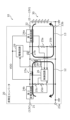
- FIG. 1 is a circuit diagram showing the configuration of a charging/discharging device according to Embodiment 1.
- FIG. 2 is a flowchart showing the operation of the charging/discharging device according to Embodiment 1.
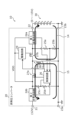
- FIG. 3A is a diagram for explaining the details of the charging step in FIG. 2.
- FIG. 3B is a diagram for explaining the details of the discharge step in FIG. 2;
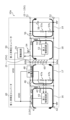
- FIG. 4 is a circuit diagram showing the configuration of the charging/discharging device according to the second embodiment.
- FIG. 5 is a diagram for explaining the operation of the charging/discharging device according to the second embodiment.
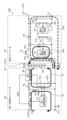
- FIG. 6 is a circuit diagram showing the configuration of the charging/discharging device according to the third embodiment.
- FIG. 7 is a diagram for explaining the operation of the charging/discharging device according to the third embodiment.
- FIG. 1 is a circuit diagram showing the configuration of charging/discharging device 10 according to Embodiment 1.
- the charging/discharging device 10 is a device that charges DC power supplied from the outside and supplies the charged DC power to the outside, and is used as a backup power supply or the like mounted on a vehicle.
- the charging/discharging device 10 is connected between a buck-boost converter 20 having reference terminals 23a and 23b, a first input/output terminal 21 and a second input/output terminal 22, and the reference terminal 23b and the second input/output terminal 22. and a power storage element 30 .
- the reference terminals 23a and 23b are terminals connected to a reference potential such as the ground, and may be one in common, or may be three or more.
- the storage element 30 is a capacitor, and is composed of, for example, a plurality of electric double layer capacitors connected in series.
- the buck-boost converter 20 is a polarity reversal type bidirectional DC-DC converter. That is, the buck-boost converter 20 inverts the polarity of the first DC voltage (for example, 12 V) input from the first input/output terminal 21 using the potential of the reference terminal 23a as a reference potential, and steps it up or down to obtain a reference potential. Using the potential of the terminal 23b as a reference potential, the second input/output terminal 22 outputs a second negative DC voltage (for example, a voltage in the range of 0 to -15 V), thereby charging the storage element 30 to a negative voltage.
- a second negative DC voltage for example, a voltage in the range of 0 to -15 V
- the buck-boost converter 20 inverts the polarity of the third negative DC voltage (for example, voltage in the range of 0 to ⁇ 15 V) input from the second input/output terminal 22 using the potential of the reference terminal 23b as a reference potential.
- the storage element 30 is discharged by outputting a positive fourth DC voltage (eg, 12 V) from the first input/output terminal 21 .
- the buck-boost converter 20 is a polarity-inverting bidirectional DC-DC converter
- the potential of the second input/output terminal is higher than the potential of the first input/output terminal 21 to which a positive voltage is input. 22 becomes low (that is, to a negative potential)
- the storage element 30 can be charged with an arbitrary voltage (voltage stepped up or down), and power is supplied to the outside.
- the polarity of the charged negative potential is inverted and power is supplied to the outside from the second input/output terminal 22, and an arbitrary voltage having the same polarity as the first DC voltage (voltage stepped up or down) is supplied to the outside. It can be realized with a smaller number of parts, and the size of the charging/discharging device 10 can be reduced.
- the buck-boost converter 20 has a first switch element 27a, an inductor 28, and a second switch element 27b as main components.
- the inductor 28 is a choke coil and has a first terminal 28a connected to the reference terminals 23a and 23b (that is, reference potential) and a second terminal 28b.
- the first switch element 27a is a switching element that turns on and off electrical connection between the first input/output terminal 21 and the second terminal 28b of the inductor 28, and is, for example, a PMOS transistor.
- the second switch element 27b is a switching element that turns on and off conduction between the second input/output terminal 22 and the second terminal 28b of the inductor 28, and is, for example, an NMOS transistor.
- the buck-boost converter 20 further includes a first constant current circuit 24a, a second constant current circuit 24b, a control circuit 26, a drive circuit 29, and resistance elements 25a to 25d.
- the first constant current circuit 24a is connected between the second switch element 27b and the second input/output terminal 22, and keeps the current charged in the storage element 30 constant (more specifically, the charging current flowing through limiting the maximum value), for example a resistive element sensing the charging current.
- the first constant current circuit 24a operates by receiving the voltage (for example, 12 V) at the source terminal of the first switch element 27a as the power supply voltage VDD. output to
- a conventional charging/discharging device that charges a storage element with a voltage higher than the input voltage requires a separate power supply that supplies a voltage higher than the input voltage to the constant current circuit that stabilizes the current that charges the storage element. be done.
- the buck-boost converter 20 is a polarity inverting DC-DC converter and generates a voltage lower than the input voltage (that is, a negative voltage). No separate power supply is required.
- the second constant current circuit 24b is connected between the first input/output terminal 21 and the first switch element 27a, and makes constant the current supplied from the first input/output terminal 21 to the outside (that is, the supplied current).
- a circuit for limiting the maximum value of the supply current flowing through it for example a resistive element that senses the supply current.
- a voltage corresponding to the supply current detected here is input to the control circuit 26 .
- Resistive elements 25a and 25b are connected in series between the connection point between second switch element 27b and first constant current circuit 24a and the reference potential, and are used to monitor the charging voltage of storage element 30. be done. A divided voltage obtained by the resistance elements 25 a and 25 b is input to the control circuit 26 .
- the resistance elements 25a and 25b may be connected between the second input/output terminal 22 and the reference potential instead of the connection point between the second switch element 27b and the first constant current circuit 24a. .
- the resistance elements 25c and 25d are connected in series between the connection point between the second constant current circuit 24b and the first switch element 27a and the reference potential, and supplied to the outside from the first input/output terminal 21. Used to monitor voltage (ie supply voltage). A divided voltage obtained by the resistance elements 25 c and 25 d is input to the control circuit 26 .
- the resistance elements 25c and 25d may be connected between the first input/output terminal 21 and the reference potential instead of the connection point between the second constant current circuit 24b and the first switch element 27a. .
- the control circuit 26 performs constant voltage control to keep the charging voltage of the storage element 30 (that is, the voltage at the second input/output terminal 22) constant, and the DC voltage that is supplied to the outside (that is, the supply at the first input/output terminal 21). voltage), constant current control to keep the charging current of the storage element 30 constant, constant current control to keep the DC current supplied to the outside (that is, supply current) constant, and the storage element 30
- a circuit that outputs a drive signal (more specifically, a PWM signal) for controlling ON/OFF and ON duty to the first switching element 27a and the second switching element 27b in order to perform switching control for switching between charging and discharging. be.
- the control circuit 26 is, for example, an IC composed of a comparator, a logic circuit, etc., or an IC composed of a memory storing a program, a processor executing the program, an A/D converter, a D/A converter, etc. is.
- the drive circuit 29 converts the level of the drive signal output from the control circuit 26 into a signal suitable for driving the second switch element 27b, which is an NMOS transistor, and then converts it into a signal suitable for driving the second switch element 27b. This circuit outputs to the gate terminal.
- the drive circuit 29 operates by receiving the voltage (for example, 12V) at the source terminal of the first switch element 27a as the power supply voltage VDD.
- FIG. 2 is a flowchart showing the operation of the charging/discharging device 10 according to Embodiment 1 (that is, the method of controlling the charging/discharging of the storage element 30 by the charging/discharging device 10).
- the flow of basic control by the control circuit 26 is shown.
- the control circuit 26 uses the potential of the reference terminal 23a as the reference potential.
- a negative voltage is generated from the second input/output terminal 22 using the potential of the reference terminal 23b as a reference potential.
- the first switch element 27a and the second switch element 27b are controlled to be turned on and off so as to output a second DC voltage (for example, a voltage in the range of 0 to -15V) (charging step S11).
- the control circuit 26 uses the potential of the reference terminal 23b as a reference potential and inverts the polarity of the negative third DC voltage (for example, a voltage in the range of 0 to ⁇ 15 V) input from the second input/output terminal 22 to step up or step down the voltage.
- the first switch element 27a and the second switch element 27b are set to output a positive fourth DC voltage (for example, 12 V) from the first input/output terminal 21 using the potential of the reference terminal 23a as a reference potential. to control on/off (discharge step S12).
- FIG. 3A is a diagram for explaining the details of charging step S11 in FIG. Here, currents 12 and 13 that flow during charging in the charging/discharging device 10 are shown.
- control circuit 26 turns on the first switch element 27a while turning off the second switch element 27b. Energy is accumulated in the inductor 28 by causing the current 12 to flow through the loop extending from the element 27a and the inductor 28 to the reference terminal 23a.
- the control circuit 26 turns off the first switch element 27a, so that the energy accumulated in the inductor 28 is applied from the first terminal 28a of the inductor 28 to the reference terminal 23b, the storage element 30, and the first constant current circuit 24a. , through the parasitic body diode of the second switch element 27b and to the second terminal 28b of the inductor 28, the current 13 flows.
- the second switch element 27b may be turned on while the current 13 is flowing.
- the electric storage element 30 is switched from the lower terminal (the terminal connected to the reference terminal 23b) to the upper terminal (the second input/output terminal 22) of the electric storage element 30.
- a current 13 flows toward the connected terminal), and the storage element 30 is charged with a negative voltage.
- FIG. 3B is a diagram for explaining details of the discharge step S12 in FIG. Here, currents 14 and 15 that flow during discharge in the charge/discharge device 10 are shown.
- control circuit 26 turns on the second switch element 27b while turning off the first switch element 27a.
- Energy is accumulated in the inductor 28 by causing the current 14 to flow through the loop leading to the second input/output terminal 22, which is the negative voltage terminal of the storage element 30, via the first constant current circuit 24a 27b.
- the control circuit 26 turns off the second switch element 27b, so that the energy accumulated in the inductor 28 is supplied from the second terminal 28b of the inductor 28 to the parasitic body diode of the first switch element 27a and the second switch element 27a.
- a current 15 flows in a loop that reaches the first terminal 28a of the inductor 28 via the constant current circuit 24b, the first input/output terminal 21, and the load between the first input/output terminal 21 and the reference terminal 23a.
- the first switch element 27a may be turned on while the current 15 is flowing.
- the pulsating voltage at the first input/output terminal 21 is smoothed by the capacitance of the load (for example, battery) connected between the reference terminal 23 a and the first input/output terminal 21 .
- the current 15 is supplied from the first input/output terminal 21 to the outside (that is, a positive voltage is supplied to the outside from the first input/output terminal 21).
- the storage element 30 is discharged.
- the operation of constant voltage control to keep the charging voltage of the storage element 30 (that is, the voltage at the second input/output terminal 22) constant is as follows. That is, the control circuit 26 monitors the divided voltage at the connection point of the resistance elements 25a and 25b during charging, and adjusts the on-duty of the first switch element 27a so that the divided voltage becomes the target value. Controlling feedback control maintains the voltage at the second input/output terminal 22 at a predetermined value (for example, a voltage in the range of 0 to -15V).
- the constant voltage control operation for keeping the DC voltage supplied to the outside (that is, the voltage supplied at the first input/output terminal 21) constant is as follows. That is, when DC power is supplied to the outside, the control circuit 26 monitors the divided voltage at the connection point of the resistance elements 25c and 25d, and controls the second switch so that the divided voltage becomes the target value.
- the supply voltage at the first input/output terminal 21 is maintained at a predetermined value (for example, 12 V) by performing feedback control for controlling the on-duty of the element 27b.
- the constant current control operation for keeping the charging current of the storage element 30 constant is as follows. That is, the control circuit 26 monitors the voltage corresponding to the charging current detected by the first constant current circuit 24a during charging, and when the voltage exceeds the threshold, the voltage exceeds the threshold. By limiting the on-duty of the first switch element 27a to a certain value or less so as not to exceed, the charging current is controlled so as not to exceed a predetermined maximum value.
- the operation of constant current control to keep the DC current supplied to the outside constant is as follows. That is, the control circuit 26 monitors the voltage corresponding to the supply current detected by the second constant current circuit 24b when supplying DC power to the outside, and when the voltage exceeds the threshold, In addition, by limiting the on-duty of the second switch element 27b to a certain value or less so that the voltage does not exceed the threshold value, the supply current is controlled so as not to exceed a predetermined maximum value.
- the charging/discharging device 10 is a device that charges DC power supplied from the outside and supplies the charged DC power to the outside.
- a buck-boost converter 20 having an input/output terminal 21 and a second input/output terminal 22, and a storage element 30 connected between a reference terminal 23b and the second input/output terminal 22.
- the second input/output terminal 22 By inverting the polarity of the first DC voltage input from the first input/output terminal 21 with the potential of the terminal 23a as the reference potential to step up or step down, the second input/output terminal 22 with the potential of the reference terminal 23b as the reference potential By outputting the second DC voltage from, the storage element 30 is charged, and the polarity of the third DC voltage input from the second input/output terminal 22 is reversed using the potential of the reference terminal 23b as the reference potential to step up or step down As a result, the polarity reversal type bidirectional DC-DC converter discharges the storage element 30 by outputting the fourth DC voltage from the first input/output terminal 21 with the potential of the reference terminal 23a as the reference potential.
- the buck-boost converter 20 is configured as a polarity-inverting bidirectional DC-DC converter, the storage element 30 is charged with an arbitrary voltage (voltage that has been stepped up or down), and an arbitrary voltage having the same polarity as the first DC voltage is charged. Since the voltage (stepped-up and stepped-down voltage) can be supplied to the outside, it can be realized with a small number of parts, and the size of the charging/discharging device 10 can be reduced.
- the buck-boost converter 20 can be composed of a first switch element 27a, an inductor 28, and a second switch element 27b.
- the inductor 28 has a first terminal 28a connected to the reference terminals 23a and 23b, and a second terminal 28b, and the first switch element 27a connects the first input/output terminal 21 and the second terminal 28b.
- the conduction is turned on and off, and the second switch element 27b turns on and off the conduction between the second input/output terminal 22 and the second terminal 28b.
- the buck-boost converter 20 further controls charging to the storage element 30 by controlling the on/off of the first switch element 27a, and controls the on/off of the second switch element 27b to charge the power from the storage element 30. It may have a control circuit 26 for controlling discharge. This enables constant voltage control and constant current control, which will be described later.
- control circuit 26 may control the on-duty of the first switch element 27a so that the voltage of the second input/output terminal 22 becomes a predetermined value when the storage element 30 is charged.
- the on-duty of the second switch element 27b may be controlled so that the voltage of the first input/output terminal 21 becomes a predetermined value when the DC power is supplied. This enables constant voltage control of the charging voltage and constant voltage control of the supply voltage to the outside.
- the buck-boost converter 20 further includes a first constant current circuit 24a for keeping the current charged in the storage element 30 constant when the storage element 30 is charged, and a first constant current circuit 24a when DC power is supplied to the outside. It may have at least one second constant current circuit 24b for making the current supplied from the input/output terminal 21 to the outside constant. This enables constant current control of the charging current during charging and constant current control of the supply current when DC power is supplied to the outside.
- the charging/discharging control method is a method for controlling charging/discharging of the storage element 30 by the charging/discharging device 10, in which the polarity of the input first DC voltage is reversed to increase or decrease the voltage. and outputting the converted second DC voltage to the storage element 30 to charge the storage element 30, and the polarity of the third DC voltage of the charged storage element 60 is converted into a fourth DC voltage by inverting , and the converted fourth DC voltage is output to the outside to discharge the storage element 60 .
- the polarity reversing DC-DC converter charges the storage element 30 with an arbitrary voltage (stepped up and down voltage), and during external power supply, the polarity reversing DC-DC converter operates at an arbitrary voltage. Since the voltage (stepped-up and stepped-down voltage) can be supplied to the outside, the charging/discharging device 10 can be realized with a small number of parts, and the control is also simplified.
- FIG. 4 is a circuit diagram showing the configuration of the charging/discharging device 10a according to the second embodiment.
- the charging/discharging device 10a is a device that charges DC power supplied from the outside and supplies the charged DC power to the outside, and is used as a backup power supply or the like mounted on a vehicle.
- the charging/discharging device 10a inverts the polarity of the positive first DC voltage input from the input terminal 41 using the potential of the storage element 60 and the reference terminal 42 as a reference potential, and steps it up or down to obtain a negative second DC voltage.
- a first step-up/step-down converter 40 that charges storage element 60 to a negative voltage by outputting the converted negative second DC voltage to storage element 60; 3 By inverting the polarity of the DC voltage and stepping it up or stepping it down, it is converted into a positive fourth DC voltage, and the positive fourth DC voltage after conversion is output from the output terminal 51 to an external voltage using the potential of the reference terminal 52 as a reference potential. and a second step-up/step-down converter 50 that discharges the storage element 60 by outputting the voltage to .
- the storage element 60 is a capacitor having a first terminal 60a connected to the reference terminal 42 (that is, a reference potential) and a second terminal 60b. Consists of a capacitor.
- the first buck-boost converter 40 has a first switch element 44, a first inductor 45, and a first diode 46 as main components.
- the first inductor 45 is a choke coil and has a first terminal 45a connected to a reference potential and a second terminal 45b.
- the first switch element 44 turns on and off application of the input first DC voltage to the second terminal 45b, and is, for example, a PMOS transistor.
- the first diode 46 is composed of an anode connected to the second terminal 60b of the storage element 60 and a cathode connected to the second terminal 45b.
- the first buck-boost converter 40 further has a first constant current circuit 48, a first control circuit 43, and resistance elements 47a and 47b.
- the first constant current circuit 48 is connected between the anode of the first diode 46 and the second terminal 60b of the storage element 60, and makes the current charged in the storage element 60 constant (more specifically, the current flowing through it is constant).
- a circuit for limiting the maximum value of the charging current for example a resistive element that senses the charging current.
- the first constant current circuit 48 operates by receiving the first DC voltage (for example, 12 V) input to the input terminal 41 as the power supply voltage VDD, and controls the voltage corresponding to the detected charging current as the first control voltage. Output to circuit 43 .
- a conventional charging/discharging device that charges a storage element with a voltage higher than the input voltage requires a separate power supply that supplies a voltage higher than the input voltage to the constant current circuit that stabilizes the current that charges the storage element. be done.
- the first buck-boost converter 40 is a polarity-inverting DC-DC converter and generates a voltage lower than the input voltage (that is, a negative voltage). A separate power supply is not required.
- the resistance elements 47 a and 47 b are connected in series between the anode of the first diode 46 and the reference potential, and are used to monitor the charging voltage of the storage element 60 .
- a divided voltage obtained by the resistance elements 47 a and 47 b is input to the first control circuit 43 .
- the resistance elements 47a and 47b may be connected across the storage element 60 instead of between the anode of the first diode 46 and the reference potential.
- the first control circuit 43 performs constant voltage control to keep the charging voltage of the storage element 60 constant (that is, the voltage at the second terminal 60b) and constant current control to keep the charging current of the storage element 60 constant. Secondly, it is a circuit that outputs a drive signal (more specifically, a PWM signal) for controlling on/off and on-duty to the first switch element 44 .
- the first control circuit 43 is composed of, for example, an IC composed of a comparator, a logic circuit, or the like, or a memory storing a program, a processor executing the program, an A/D converter, a D/A converter, or the like. It is an IC that
- the second buck-boost converter 50 has a second switch element 54, a second inductor 55, and a second diode 56 as main components.
- the second inductor 55 is a choke coil and has a third terminal 55a connected to a reference potential and a fourth terminal 55b.
- the second switch element 54 turns on and off the application of the charging voltage of the storage element 60 (that is, the voltage of the second terminal 60b) to the fourth terminal 55b of the second inductor 55, and is, for example, an NMOS transistor.
- the second diode 56 has an anode connected to the fourth terminal 55b of the second inductor 55 and a cathode connected to the output terminal 51 for outputting the fourth DC voltage to the outside.
- the second buck-boost converter 50 further has a second control circuit 53, resistive elements 57a and 57b, a drive circuit 59, and a smoothing capacitor 58.
- Resistive elements 57a and 57b are connected in series between the output terminal 51 and the reference terminal 52, and are used to monitor the fourth DC voltage output to the outside (that is, the voltage at the output terminal 51). .
- a divided voltage obtained by the resistance elements 57 a and 57 b is input to the second control circuit 53 .
- the second control circuit 53 performs constant voltage control to keep the voltage output to the outside (that is, the voltage at the output terminal 51) constant based on the divided voltage obtained by the resistor elements 57a and 57b. , and a driving circuit 59 to output a driving signal (more specifically, a PWM signal) for controlling on-off and on-duty to the second switch element 54 .
- the second control circuit 53 is composed of, for example, an IC composed of a comparator, a logic circuit, or the like, or a memory storing a program, a processor executing the program, an A/D converter, a D/A converter, or the like. It is an IC that
- the drive circuit 59 converts the level of the drive signal output from the second control circuit 53 into a signal suitable for driving the second switch element 54, which is an NMOS transistor, and converts it into a signal suitable for driving the second switch element. This is a circuit for outputting to the gate terminal of 54.
- the drive circuit 59 operates by being supplied with the first DC voltage (for example, 12 V) input to the input terminal 41 as the power supply voltage VDD.
- the smoothing capacitor 58 is a capacitor that smoothes the pulsating voltage appearing at the output terminal 51 with the potential of the reference terminal 52 as a reference potential.
- FIG. 5 is a diagram for explaining the operation of the charging/discharging device 10a according to Embodiment 2 (that is, the method of controlling charging/discharging of the storage element 60 by the charging/discharging device 10a).
- the first buck-boost converter 40 shows currents 16 and 17 flowing during charging
- the second buck-boost converter 50 shows currents 18 and 19 flowing during discharging.
- the first control circuit 43 first turns on the first switch element 44 to switch the first switch element 44 and the first inductor 45 from the input terminal 41 to which the positive first DC voltage is input. Energy is stored in the first inductor 45 by flowing a current 16 through the loop leading to the reference terminal 42 .
- the first control circuit 43 turns off the first switch element 44, so that the energy accumulated in the first inductor 45 is supplied from the first terminal 45a of the first inductor 45 to the storage element 60 and the first constant current.
- a current 17 flows in a loop through the circuit 48 , the first diode 46 and to the second terminal 45 b of the first inductor 45 .
- the first control circuit 43 monitors the voltage at the connection point of the resistance elements 47a and 47b during charging, and controls the on-duty of the first switch element 44 so that the voltage reaches the target value.
- the voltage (second DC voltage) at the second terminal 60b of the storage element 60 is maintained at a predetermined value (for example, voltage in the range of 0 to -15V).
- the first control circuit 43 monitors the voltage corresponding to the charging current detected by the first constant current circuit 48 during charging, and when the voltage exceeds the threshold, the voltage exceeds the threshold.
- the charging current is controlled so as not to exceed a predetermined maximum value.
- the second control circuit 53 first turns on the second switch element 54 to switch the first terminal 60a, which is the reference terminal of the storage element 60 charged to a negative voltage (third DC voltage), to the first terminal 60a.
- Energy is stored in the second inductor 55 by causing the current 18 to flow through the loop that reaches the second terminal 60 b of the storage element 60 via the second inductor 55 and the second switch element 54 .
- the second control circuit 53 turns off the second switch element 54 so that the energy accumulated in the second inductor 55 is applied to the second diode 56 and the smoothing capacitor 58 from the fourth terminal 55b of the second inductor 55 . and the load connected between the reference terminal 52 and the output terminal 51 to the third terminal 55 a of the second inductor 55 . Note that the pulsating current voltage at the output terminal 51 is smoothed by the smoothing capacitor 58 .
- the current 19 is supplied from the output terminal 51 to the outside (that is, a positive voltage (fourth DC voltage) is supplied to the outside from the output terminal 51).
- the storage element 60 is discharged.
- the second control circuit 53 monitors the voltage at the connection point of the resistance elements 57a and 57b during discharge, and controls the on-duty of the second switch element 54 so that the voltage reaches the target value.
- the voltage (fourth DC voltage) supplied to the outside from the output terminal 51 is maintained at a predetermined value (for example, a voltage in the range of 0 to 15V).
- the second buck-boost converter 50 may be provided with a constant current circuit for making constant the output current supplied from the output terminal 51 to the outside.
- the second control circuit 53 monitors the voltage corresponding to the output current sensed by the constant current circuit, and if the voltage exceeds the threshold, the second control circuit 53 controls the voltage so that the voltage does not exceed the threshold.
- the output current is controlled so as not to exceed a predetermined maximum value.
- the charge/discharge device 10a is a device that charges DC power supplied from the outside and supplies the charged DC power to the outside.
- the polarity of the first DC voltage is reversed to increase or decrease the voltage to convert it into a second DC voltage, and the converted second DC voltage is output to the storage element 60 to charge the storage element 60.
- a second buck-boost converter 50 that discharges the storage element 60 .
- the first step-up/down converter 40 which is a polarity-reversing DC-DC converter
- the second step-up/step-down converter 50 which is a DC-DC converter, can supply an arbitrary voltage (stepped-up/step-down voltage) having the same polarity as the first DC voltage to the outside.
- the control is also simplified, which enables miniaturization of the charging/discharging device 10a.
- the first buck-boost converter 40 has a first switch element 44, a first inductor 45, and a first diode 46.
- the first inductor 45 has a first terminal 45a connected to a reference potential. and a second terminal 45b.
- the second buck-boost converter 50 has a second switch element 54, a second inductor 55, and a second diode 56.
- the second diode 56 has an anode connected to the fourth terminal 55b and a cathode connected to the output terminal 51 for outputting the fourth DC voltage to the outside.
- FIG. 6 is a circuit diagram showing the configuration of the charging/discharging device 10b according to the third embodiment.
- the charging/discharging device 10b is a device that charges DC power supplied from the outside and supplies the charged DC power to the outside, and is used as a backup power supply or the like mounted on a vehicle.
- the charging/discharging device 10b inverts the polarity of the positive first DC voltage input from the input terminal 41 using the potential of the storage element 60 and the reference terminal 42 as a reference potential, and steps it up or down to obtain a negative second DC voltage.
- first buck-boost converter 40 and the storage element 60 have the same configurations as those in the second embodiment, detailed description thereof will be omitted.
- an NMOS transistor is shown as a specific example of the first switch element 44 forming the first buck-boost converter 40 .
- the first switch element 44 in the present embodiment may be a PMOS transistor as in the second embodiment.
- the boost converter 70 is a boost DC-DC converter in which the reference terminal on the input side and the reference terminal on the output side are separated (insulated in potential). , and a third diode 76 .
- the third inductor 75 is a choke coil and has a fifth terminal 75a and a sixth terminal 75b connected to the first terminal 60a (that is, reference potential) of the storage element 60 .
- the third switch element 74 turns on and off the connection between the sixth terminal 75b of the third inductor 75 and the reference potential, and is, for example, a PMOS transistor.
- the third diode 76 has an anode connected to the sixth terminal 75b of the third inductor 75 and a cathode connected to the output terminal 71 for outputting the fifth DC voltage to the outside.
- the boost converter 70 further has a third control circuit 73 , resistive elements 77 a and 77 b , a voltage monitor circuit 79 and a smoothing capacitor 78 .
- Resistive elements 77a and 77b are connected in series between the output terminal 71 and the reference terminal 72, and are used to monitor the externally output fifth DC voltage (that is, the voltage at the output terminal 71). .
- a divided voltage obtained by the resistance elements 77 a and 77 b is input to the voltage monitor circuit 79 .
- the voltage monitor circuit 79 converts the voltage input to the in terminal with reference to the potential of the reference terminal 72 into a voltage with reference to the potential of the second terminal 60b of the storage element 60, and outputs the converted voltage from the out terminal. It is an insulated voltage transmission circuit that outputs, and is composed of, for example, a photocoupler. Specifically, the voltage monitor circuit 79 outputs from the out terminal a voltage corresponding to the divided voltage obtained by the resistive elements 77a and 77b, which is input to the in terminal. The voltage output from the out terminal is divided by the resistance elements 77 c and 77 d , and the divided voltage is input to the third control circuit 73 .
- the third control circuit 73 performs constant voltage control to keep the fifth DC voltage output to the outside (that is, the voltage at the output terminal 71) constant based on the divided voltage obtained by the resistance elements 77c and 77d. To do so, a drive signal (more specifically, a PWM signal) for controlling on/off and on-duty is output to the third switch element 74 .
- the third control circuit 73 is composed of, for example, an IC composed of a comparator, a logic circuit, or the like, or a memory storing a program, a processor executing the program, an A/D converter, a D/A converter, or the like. It is an IC that
- the smoothing capacitor 78 is a capacitor that smoothes the pulsating voltage appearing at the output terminal 71 with the potential of the reference terminal 72 as a reference potential.
- FIG. 7 is a diagram for explaining the operation of the charging/discharging device 10b according to Embodiment 3 (that is, the method of controlling the charging/discharging of the storage element 60 by the charging/discharging device 10b).
- the first buck-boost converter 40 shows currents 16 and 17 that flow during charging
- the boost converter 70 shows currents 18a and 19a that flow during discharging.
- the operation of the charge/discharge device 10b during charging is the same as the operation of the first step-up/down converter 40 of the charge/discharge device 10a according to Embodiment 2, so the description is omitted.
- the third control circuit 73 first turns on the third switch element 74 to switch the first terminal 60a, which is the reference terminal of the storage element 60 charged to a negative voltage (third DC voltage), to the first terminal 60a.
- Energy is accumulated in the third inductor 75 by flowing the current 18 a through the loop that reaches the second terminal 60 b of the storage element 60 via the three inductors 75 and the third switch element 74 .
- the third control circuit 73 turns off the third switch element 74 so that the energy accumulated in the third inductor 75 is applied to the third diode 76 and the smoothing capacitor 78 from the sixth terminal 75 b of the third inductor 75 .
- a current 19 a flows through a loop that reaches the fifth terminal 75 a of the third inductor 75 via the load connected between the reference terminal 72 and the output terminal 71 and the first terminal 60 a of the storage element 60 . Note that the pulsating current voltage at the output terminal 71 is smoothed by the smoothing capacitor 78 .
- the current 19a is supplied from the output terminal 71 to the outside (that is, a positive voltage (fifth DC voltage) is supplied to the outside from the output terminal 71).
- the storage element 60 is discharged.
- the boost converter 70 may be provided with a constant current circuit for making the output current supplied to the outside from the output terminal 71 constant.
- the third control circuit 73 monitors the voltage corresponding to the output current sensed by the constant current circuit, and if the voltage exceeds the threshold, controls the third control circuit 73 so that the voltage exceeds the threshold.
- the output current is controlled so as not to exceed a predetermined maximum value.
- the charging/discharging device 10b is a charging/discharging device 10b that charges DC power supplied from the outside and supplies the charged DC power to the outside.
- the charging/discharging device 10b By inverting the polarity of the input first DC voltage and stepping it up or down, it is converted into a second DC voltage, and the converted second DC voltage is output to the storage element 60 to charge the storage element 60 .
- a boost converter 70 that discharges the storage element 60 .
- the first step-up/down converter 40 which is a polarity-reversing DC-DC converter, charges the storage element 60 with an arbitrary voltage (stepped-up/step-down voltage).
- Any voltage having the same polarity as the first DC voltage (boosted voltage) can be externally supplied by the boost converter 70, which is a DC-DC converter, so that the charge/discharge device 10b can be realized with a small number of parts, and the control is also simplified. As a result, the size of the charging/discharging device 10b can be reduced.
- the first buck-boost converter 40 has a first switch element 44, a first inductor 45, and a first diode 46.
- the first inductor 45 has a first terminal 45a connected to a reference potential. and a second terminal 45b.
- the boost converter has a third inductor 75, a third switch element, and a third diode 76.
- the third inductor 75 is connected to the reference potential. It has a connected fifth terminal 75a and a sixth terminal 75b, the third switch element turns on and off the connection between the sixth terminal 75b and the reference potential, and the third diode 76 is connected to the sixth terminal 75b. and a cathode connected to an output terminal 71 for outputting the fifth DC voltage to the outside.
- Embodiments 1 to 3 The charging/discharging device and charging/discharging control method according to the present disclosure have been described above based on Embodiments 1 to 3, but the present disclosure is not limited to these Embodiments 1 to 3. As long as it does not deviate from the gist of the present disclosure, various modifications that a person skilled in the art can think of are applied to each embodiment, and another form constructed by combining some components of each embodiment is also included in the present disclosure. Included in scope.
- the charging/discharging device 10 and the like are devices that are used as a backup power supply mounted on a vehicle, but the application is not limited to this. It can be used as a device for charging DC power supplied from the outside and for supplying the charged DC power to the outside, and as a power supply for supplying DC power to all types of equipment and vehicles.
- the first DC voltage input to the charging/discharging device 10 and the like was a positive voltage, but it may be a negative voltage.
- the polarity of the negative input voltage is reversed, and the power storage element 30 or the like is charged with a positive voltage. It is supplied to the outside as a voltage.
- the DC-DC converter is provided with a constant voltage circuit, a constant current circuit, and a control circuit for controlling them. It is a component. In other words, when constant voltage control and constant current control are unnecessary, or when a control circuit is provided externally, the constant voltage circuit, constant current circuit, and control circuit are not necessarily required for the charging/discharging device. You don't have to be prepared for A charging/discharging device having two polarity-reversing DC-DC converters can realize a charging/discharging device suitable for miniaturization.
- the present disclosure can be used as a charging/discharging device, particularly as a charging/discharging device suitable for downsizing, for example, as a backup power source for a battery mounted on a vehicle.
- buck-boost converter 21 first input/output terminal 22 second input/output terminal 23a, 23b, 42, 52, 72 reference terminal 24a, 48 first constant current circuit 24b second constant current circuit 25a 25d, 47a, 47b, 57a, 57b, 77a to 77d resistor element 26 control circuit 27a, 44 first switch element 27b, 54 second switch element 28 inductor 28a, 45a, 60a first terminal 28b, 45b, 60b second second Terminals 29, 59 Drive circuit 30, 60 Storage element 40 First buck-boost converter 41 Input terminal 43 First control circuit 45 First inductor 46 First diode 50 Second buck-boost converter 51, 71 Output terminal 53 Second control circuit 55 Second inductor 55a Third terminal 55b Fourth terminal 56 Second diode 58, 78 Smoothing capacitor 70 Boost converter 73 Third control circuit 74 Third switch element 75 Third inductor 75a Fifth terminal 75b Sixth terminal 76 Third diode 79 Voltage monitor circuit
Landscapes
- Engineering & Computer Science (AREA)
- Power Engineering (AREA)
- Dc-Dc Converters (AREA)
- Charge And Discharge Circuits For Batteries Or The Like (AREA)
Priority Applications (2)
| Application Number | Priority Date | Filing Date | Title |
|---|---|---|---|
| US18/836,101 US20250167574A1 (en) | 2022-02-10 | 2022-12-20 | Charging and discharging device and method for controlling charging and discharging |
| JP2023580097A JPWO2023153085A1 (https=) | 2022-02-10 | 2022-12-20 |
Applications Claiming Priority (6)
| Application Number | Priority Date | Filing Date | Title |
|---|---|---|---|
| JP2022019225 | 2022-02-10 | ||
| JP2022-019206 | 2022-02-10 | ||
| JP2022-019225 | 2022-02-10 | ||
| JP2022019217 | 2022-02-10 | ||
| JP2022-019217 | 2022-02-10 | ||
| JP2022019206 | 2022-02-10 |
Publications (1)
| Publication Number | Publication Date |
|---|---|
| WO2023153085A1 true WO2023153085A1 (ja) | 2023-08-17 |
Family
ID=87564164
Family Applications (1)
| Application Number | Title | Priority Date | Filing Date |
|---|---|---|---|
| PCT/JP2022/046789 Ceased WO2023153085A1 (ja) | 2022-02-10 | 2022-12-20 | 充放電装置及び充放電の制御方法 |
Country Status (3)
| Country | Link |
|---|---|
| US (1) | US20250167574A1 (https=) |
| JP (1) | JPWO2023153085A1 (https=) |
| WO (1) | WO2023153085A1 (https=) |
Citations (3)
| Publication number | Priority date | Publication date | Assignee | Title |
|---|---|---|---|---|
| JPH11220812A (ja) * | 1998-02-02 | 1999-08-10 | Fuji Electric Co Ltd | 電気自動車の電気システム |
| JP2011155766A (ja) * | 2010-01-27 | 2011-08-11 | Japan Aerospace Exploration Agency | 直列接続された蓄電セルの中間タップとバランス回路とdc−dcコンバータを併用した電力変換装置 |
| JP2018148637A (ja) * | 2017-03-02 | 2018-09-20 | パナソニックIpマネジメント株式会社 | 充電装置、及び車載電源装置 |
-
2022
- 2022-12-20 JP JP2023580097A patent/JPWO2023153085A1/ja active Pending
- 2022-12-20 US US18/836,101 patent/US20250167574A1/en active Pending
- 2022-12-20 WO PCT/JP2022/046789 patent/WO2023153085A1/ja not_active Ceased
Patent Citations (3)
| Publication number | Priority date | Publication date | Assignee | Title |
|---|---|---|---|---|
| JPH11220812A (ja) * | 1998-02-02 | 1999-08-10 | Fuji Electric Co Ltd | 電気自動車の電気システム |
| JP2011155766A (ja) * | 2010-01-27 | 2011-08-11 | Japan Aerospace Exploration Agency | 直列接続された蓄電セルの中間タップとバランス回路とdc−dcコンバータを併用した電力変換装置 |
| JP2018148637A (ja) * | 2017-03-02 | 2018-09-20 | パナソニックIpマネジメント株式会社 | 充電装置、及び車載電源装置 |
Also Published As
| Publication number | Publication date |
|---|---|
| US20250167574A1 (en) | 2025-05-22 |
| JPWO2023153085A1 (https=) | 2023-08-17 |
Similar Documents
| Publication | Publication Date | Title |
|---|---|---|
| JP6685282B2 (ja) | 多相バックコンバータ回路及び方法のための共用ブートストラップキャパシタ | |
| US9214824B2 (en) | Charging control circuit | |
| JP3156657B2 (ja) | 二次電池ユニット | |
| US7298117B2 (en) | Step-up (boost) DC regulator with two-level back-bias switch gate voltage | |
| JP2004135442A (ja) | スイッチング電源装置 | |
| EP3334024B1 (en) | Voltage regulator having boost and charge pump functionality | |
| KR101769335B1 (ko) | 멀티 토플러지를 이용한 dc/dc 컨버터 | |
| JP5951358B2 (ja) | 充電制御回路および充電回路 | |
| US20190267895A1 (en) | Dc-dc converter | |
| US8159089B2 (en) | Power supply circuit and semiconductor device for use therein | |
| EP1879284B1 (en) | DC-DC converter and power supply apparatus | |
| CN106877428B (zh) | 电源管理电路和方法 | |
| JP2010004691A (ja) | フラッシュ用電源装置 | |
| CN210839348U (zh) | 一种非隔离升降压变换器 | |
| US7586212B2 (en) | Multi-output power supply apparatus | |
| JP4591887B2 (ja) | 電源装置、および携帯機器 | |
| WO2023153085A1 (ja) | 充放電装置及び充放電の制御方法 | |
| JP6139422B2 (ja) | 基準電圧出力回路および電源装置 | |
| JP2019129679A (ja) | Dc−dcコンバータおよび電源装置 | |
| JP6904185B2 (ja) | Dc−dcコンバータおよび電源システム | |
| US10103629B2 (en) | High side driver without dedicated supply in high voltage applications | |
| JP2004350344A (ja) | Dc−dcコンバータおよびスイッチングレギュレータ | |
| US20090058385A1 (en) | Step-up DC-DC converter | |
| JP2013229968A (ja) | 充電制御回路および充電回路 | |
| JP7543976B2 (ja) | 電力変換装置 |
Legal Events
| Date | Code | Title | Description |
|---|---|---|---|
| 121 | Ep: the epo has been informed by wipo that ep was designated in this application |
Ref document number: 22926099 Country of ref document: EP Kind code of ref document: A1 |
|
| ENP | Entry into the national phase |
Ref document number: 2023580097 Country of ref document: JP Kind code of ref document: A |
|
| WWE | Wipo information: entry into national phase |
Ref document number: 18836101 Country of ref document: US |
|
| NENP | Non-entry into the national phase |
Ref country code: DE |
|
| 122 | Ep: pct application non-entry in european phase |
Ref document number: 22926099 Country of ref document: EP Kind code of ref document: A1 |
|
| WWP | Wipo information: published in national office |
Ref document number: 18836101 Country of ref document: US |