WO2023152938A1 - 室内機、および空気調和機 - Google Patents
室内機、および空気調和機 Download PDFInfo
- Publication number
- WO2023152938A1 WO2023152938A1 PCT/JP2022/005532 JP2022005532W WO2023152938A1 WO 2023152938 A1 WO2023152938 A1 WO 2023152938A1 JP 2022005532 W JP2022005532 W JP 2022005532W WO 2023152938 A1 WO2023152938 A1 WO 2023152938A1
- Authority
- WO
- WIPO (PCT)
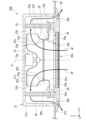
- Prior art keywords
- electrical component
- indoor unit
- component box
- baffle plate
- axial direction
- Prior art date
- Legal status (The legal status is an assumption and is not a legal conclusion. Google has not performed a legal analysis and makes no representation as to the accuracy of the status listed.)
- Ceased
Links
Images




Classifications
-
- F—MECHANICAL ENGINEERING; LIGHTING; HEATING; WEAPONS; BLASTING
- F24—HEATING; RANGES; VENTILATING
- F24F—AIR-CONDITIONING; AIR-HUMIDIFICATION; VENTILATION; USE OF AIR CURRENTS FOR SCREENING
- F24F13/00—Details common to, or for air-conditioning, air-humidification, ventilation or use of air currents for screening
- F24F13/08—Air-flow control members, e.g. louvres, grilles, flaps or guide plates
-
- F—MECHANICAL ENGINEERING; LIGHTING; HEATING; WEAPONS; BLASTING
- F24—HEATING; RANGES; VENTILATING
- F24F—AIR-CONDITIONING; AIR-HUMIDIFICATION; VENTILATION; USE OF AIR CURRENTS FOR SCREENING
- F24F1/00—Room units for air-conditioning, e.g. separate or self-contained units or units receiving primary air from a central station
-
- F—MECHANICAL ENGINEERING; LIGHTING; HEATING; WEAPONS; BLASTING
- F24—HEATING; RANGES; VENTILATING
- F24F—AIR-CONDITIONING; AIR-HUMIDIFICATION; VENTILATION; USE OF AIR CURRENTS FOR SCREENING
- F24F13/00—Details common to, or for air-conditioning, air-humidification, ventilation or use of air currents for screening
- F24F13/20—Casings or covers
-
- F—MECHANICAL ENGINEERING; LIGHTING; HEATING; WEAPONS; BLASTING
- F24—HEATING; RANGES; VENTILATING
- F24F—AIR-CONDITIONING; AIR-HUMIDIFICATION; VENTILATION; USE OF AIR CURRENTS FOR SCREENING
- F24F13/00—Details common to, or for air-conditioning, air-humidification, ventilation or use of air currents for screening
- F24F13/24—Means for preventing or suppressing noise
Definitions
- the present disclosure relates to indoor units and air conditioners.
- Patent Document 1 an indoor unit of an air conditioner is known in which an electric component box is arranged facing a bell mouth.
- the portion of the electrical component box facing the suction port reduces the amount of air sucked into the suction port. Part of the flow may change and the air may collide with each other causing noise.
- a recess in the electrical component box
- the present disclosure aims to provide an indoor unit having a structure capable of suppressing noise generation while ensuring the volume of the electrical component box, and an air conditioner equipped with such an indoor unit. one of the purposes.
- One aspect of the indoor unit according to the present disclosure is an indoor unit of an air conditioner, which includes a fan having an impeller rotatable around a rotating shaft, and a flow opening on a first side in the axial direction of the rotating shaft. a bell mouth having an inlet located on the first side of the blower; and an electrical outlet located on the first side of the bell mouth and positioned at least partially axially opposite the inlet. a component box; and a baffle plate arranged to face the inflow port in the axial direction and to face the inner side of the electrical component box in the radial direction about the rotation shaft.
- One aspect of the air conditioner according to the present disclosure includes the above indoor unit and outdoor unit.
- the indoor unit of the air conditioner it is possible to suppress the occurrence of noise while ensuring the volume of the electrical component box.
- FIG. 1 is a schematic diagram showing a schematic configuration of an air conditioner according to Embodiment 1.
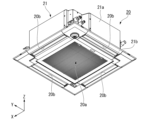
- FIG. Fig. 2 is a perspective view showing the indoor unit according to Embodiment 1;
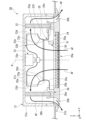
- Fig. 2 is a cross-sectional view showing the indoor unit according to Embodiment 1;
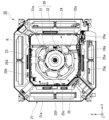
- FIG. 2 is a bottom view of part of the indoor unit according to Embodiment 1;
- 1 is a perspective view showing a bell mouth according to Embodiment 1.
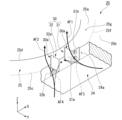
- FIG. FIG. 3 is a perspective view showing the air guide member, the electrical component box, and a part of the bell mouth in Embodiment 1;
- FIG. 4 is a cross-sectional view showing an indoor unit according to Embodiment 2; It is the figure which looked at a part of indoor unit in Embodiment 2 from the lower side.
- FIG. 12 is a perspective view showing a part of the air guide member, the electrical component box, and the bell mouth in Embodiment 2;
- FIG. 11 is a cross-sectional
- the drawings show the X-axis, Y-axis, and Z-axis as appropriate.
- the X-axis indicates one of the horizontal directions.
- the Y-axis indicates the other horizontal direction.
- the Z-axis indicates the vertical direction.
- the horizontal direction along the X axis is called “first horizontal direction X”
- the horizontal direction along the Y axis is called “second horizontal direction Y”
- the vertical direction along the Z axis is called It is called “vertical direction Z”.
- the first horizontal direction X, the second horizontal direction Y, and the vertical direction Z are directions orthogonal to each other.
- the side of the vertical direction Z to which the Z-axis arrow points (+Z side) is the upper side, and the opposite side of the vertical direction Z to which the Z-axis arrow points (-Z side) is the lower side.
- the vertical direction Z corresponds to the axial direction of the rotation axis R described later.
- the lower side corresponds to the "first side” in the axial direction of the rotating shaft R
- the upper side corresponds to the "second side” opposite to the first side in the axial direction of the rotating shaft R.
- FIG. 1 is a schematic diagram showing a schematic configuration of an air conditioner 100 according to Embodiment 1.
- the air conditioner 100 includes an outdoor unit 10, an indoor unit 20, and a circulation path section 18.
- the outdoor unit 10 is arranged outdoors.
- the indoor unit 20 is arranged indoors.
- the outdoor unit 10 and the indoor unit 20 are connected to each other by a circulation path portion 18 through which the refrigerant 19 circulates.
- the air conditioner 100 can adjust the temperature of the indoor air by exchanging heat between the refrigerant 19 flowing through the circulation path section 18 and the indoor air in which the indoor unit 20 is arranged.
- the refrigerant 19 for example, a fluorine-based refrigerant or a hydrocarbon-based refrigerant having a low global warming potential (GWP) can be used.
- GWP global warming potential
- the outdoor unit 10 has a housing 11, a compressor 12, a heat exchanger 13, a flow control valve 14, a blower 15, a four-way valve 16, and a controller 17.
- a compressor 12 , a heat exchanger 13 , a flow control valve 14 , a blower 15 , a four-way valve 16 , and a controller 17 are accommodated inside the housing 11 .
- the compressor 12 , the heat exchanger 13 , the flow control valve 14 and the four-way valve 16 are provided in a portion of the circulation path section 18 located inside the housing 11 .
- Compressor 12 , heat exchanger 13 , flow control valve 14 , and four-way valve 16 are connected by a portion of circulation path portion 18 located inside housing 11 .
- the four-way valve 16 is provided in a portion of the circulation path portion 18 that is connected to the discharge side of the compressor 12 .
- the four-way valve 16 can reverse the direction of the coolant 19 flowing through the circulation path portion 18 by switching a part of the circulation path portion 18 .
- the path connected by the four-way valve 16 is the path indicated by the solid line in the four-way valve 16 in FIG. 1
- the refrigerant 19 flows through the circulation path portion 18 in the direction indicated by the solid arrow in FIG.
- the path connected by the four-way valve 16 is the path indicated by the dashed line in the four-way valve 16 in FIG. 1
- the refrigerant 19 flows in the circulation path section 18 in the direction indicated by the dashed arrow in FIG.
- the indoor unit 20 includes a housing 21, a heat exchanger 22, and a fan 23.
- the indoor unit 20 is capable of a cooling operation for cooling the air in the room in which the indoor unit 20 is arranged and a heating operation for warming the air in the room in which the indoor unit 20 is arranged.
- the refrigerant 19 flowing through the circulation path portion 18 flows in the direction indicated by the solid arrow in FIG. That is, when the indoor unit 20 is in a cooling operation, the refrigerant 19 flowing through the circulation path portion 18 flows through the compressor 12, the heat exchanger 13 of the outdoor unit 10, the flow control valve 14, and the heat exchanger 22 of the indoor unit 20. in that order back to the compressor 12 .
- the heat exchanger 13 inside the outdoor unit 10 functions as a condenser
- the heat exchanger 22 inside the indoor unit 20 functions as an evaporator.
- the refrigerant 19 flowing through the circulation path portion 18 flows in the direction indicated by the dashed line in FIG.
- the refrigerant 19 flowing through the circulation path portion 18 flows through the compressor 12, the heat exchanger 22 of the indoor unit 20, the flow control valve 14, and the heat exchanger 13 of the outdoor unit 10. in that order back to the compressor 12 .
- the heat exchanger 13 inside the outdoor unit 10 functions as an evaporator
- the heat exchanger 22 inside the indoor unit 20 functions as a condenser.
- FIG. 2 is a perspective view showing the indoor unit 20.
- FIG. FIG. 3 is a cross-sectional view showing the indoor unit 20.
- the indoor unit 20 in Embodiment 1 is a ceiling-embedded indoor unit that is embedded in the ceiling.
- the indoor unit 20 further includes an electrical component box 24 , a bell mouth 25 and a drain pan 26 .
- the housing 21 accommodates a heat exchanger 22, a blower 23, an electrical component box 24, a bell mouth 25, and a drain pan 26 inside.
- the housing 21 has a housing main body portion 21a and a decorative panel 21b attached to the lower side of the housing main body portion 21a.
- the housing main body 21a accommodates the heat exchanger 22, the blower 23, the electrical component box 24, the bell mouth 25, and the drain pan 26 inside.
- the housing main body 21a is embedded in the ceiling in the room where the indoor unit 20 is installed.
- the decorative panel 21b is exposed in the room where the indoor unit 20 is installed.
- the housing 21 has an inlet 20a and an outlet 20b.
- the suction port 20a and the blowout port 20b are opened on the lower surface of the decorative panel 21b.
- the suction port 20a is positioned in the center of the indoor unit 20 when viewed in the vertical direction Z.
- a plurality of outlets 20b are provided.
- the plurality of outlets 20b are arranged to surround the inlet 20a when viewed in the vertical direction Z.
- outlets 20b are provided.
- the blower 23 is fixed to the lower surface of the top plate portion 21c of the housing main body portion 21a.
- the blower 23 has a drive section 23a and an impeller 23b.
- the drive unit 23a rotates the impeller 23b around the rotation axis R.
- a rotation axis R shown as appropriate in the drawings is a virtual axis extending in the vertical direction Z. As shown in FIG. That is, the axial direction of the rotation axis R is the vertical direction Z. As shown in FIG.
- the rotation axis R passes through the center of the indoor unit 20 when viewed in the vertical direction Z.
- the radial direction around the rotation axis R is simply called “radial direction”
- the circumferential direction around the rotation axis R is simply called "circumferential direction”.
- the drive unit 23a in the first embodiment is a motor.
- the driving portion 23a is fixed to the lower surface of the top plate portion 21c.
- the drive unit 23a may have any configuration as long as it can rotate the impeller 23b around the rotation axis R.
- the impeller 23b is rotatable around the rotation axis R.
- the impeller 23b is connected to the lower side of the driving portion 23a.
- the impeller 23b is rotated around the rotation axis R by the driving portion 23a.
- the impeller 23b includes a base portion 23e that is connected to the driving portion 23a and spreads radially outward from the driving portion 23a, a shroud portion 23f that is arranged below the base portion 23e with an interval therebetween, and the base portion 23e and the shroud portion 23f. and a plurality of blade portions 23g arranged in the vertical direction Z.
- the shroud part 23f has a cylindrical shape centered on the rotation axis R and opened on both sides in the vertical direction Z.
- the inner diameter of the shroud portion 23f and the outer diameter of the shroud portion 23f increase toward the upper side.
- a lower end portion of the shroud portion 23f is an intake port 23c that opens downward.
- An upper end portion of the shroud portion 23f is a radial outer edge portion of the shroud portion 23f.
- the space between the radially outer edge of the shroud portion 23f and the radially outer edge of the base portion 23e in the vertical direction Z is partitioned in the circumferential direction by a plurality of vane portions 23g, thereby forming a plurality of exhausts opening radially outward.
- a mouth 23d is formed.
- 23 d of several exhaust ports are arrange
- the heat exchangers 22 are arranged facing each other on the radially outer side of each exhaust port 23d. The intervals between the plurality of exhaust ports 23d may be equal or may be different from each other.
- Air is sent to the heat exchanger 22 by the blower 23 .
- the heat exchanger 22 has a frame shape surrounding the blower 23 .
- the heat exchanger 22 is arranged facing the exhaust port 23 d of the blower 23 .
- the drain pan 26 is positioned below the heat exchanger 22 .
- the drain pan 26 has a frame shape surrounding the rotation axis R when viewed in the vertical direction Z.
- the drain pan 26 has a drain pan body portion 26a and a flange portion 26b.
- the drain pan body portion 26 a is positioned below the heat exchanger 22 .
- the drain pan main body 26a has a frame shape surrounding the rotation axis R when viewed in the vertical direction Z.
- the drain pan body portion 26a can receive dew condensation water generated on the outer surface of the heat exchanger 22 from below.
- the flange portion 26b protrudes radially inward from the upper end portion of the radially inner edge portion of the drain pan main body portion 26a.
- the flange portion 26b has a frame shape surrounding the rotation axis R when viewed in the vertical direction Z. As shown in FIG.
- the bell mouth 25 is located below the blower 23.
- the bellmouth 25 is a member for guiding air to the air intake port 23c of the blower 23 .
- the bell mouth 25 is made of resin, for example.
- FIG. 4 is a view of part of the indoor unit 20 as seen from below. In FIG. 4, illustration of the decorative panel 21b is omitted.
- FIG. 5 is a perspective view showing the bell mouth 25.
- the bellmouth 25 has a bellmouth body portion 25a and a fixed portion 25b.
- the bellmouth main body 25a has a cylindrical shape centered on the rotation axis R and opened on both sides in the vertical direction Z. As shown in FIG. 3, the inner diameter of the bell mouth body portion 25a and the outer diameter of the bell mouth body portion 25a decrease upward. In a cross section along the rotation axis R, the inner surface 25g of the bell mouth main body 25a extends in a curved line whose inclination with respect to the vertical direction Z decreases toward the upper side. An upper end portion of the bellmouth main body portion 25a is inserted into the air intake port 23c of the blower 23 .
- the fixed portion 25b spreads radially outward from the lower end portion of the bellmouth body portion 25a.
- the fixed portion 25b has a substantially square frame shape.
- the fixed portion 25b has a plate shape whose plate surface faces the vertical direction Z.
- the radial outer edge of the fixed portion 25 b is positioned below the flange portion 26 b of the drain pan 26 .
- the fixed portion 25b is fixed to the flange portion 26b by, for example, bolts.
- the bell mouth 25 is thereby fixed to the drain pan 26 .
- a concave portion 25e that is recessed upward is formed on the lower surface of the fixed portion 25b.
- the concave portion 25e is formed on one side (+Y side) in the second horizontal direction Y of the fixed portion 25b.
- the recess 25e extends in the first horizontal direction X.
- a radially inner edge portion of the concave portion 25e at the center portion in the first horizontal direction X is formed in the bellmouth body portion 25a.
- the portion of the fixed portion 25b in which the concave portion 25e is formed protrudes upward from the portion of the fixed portion 25b in which the concave portion 25e is not formed.
- the bellmouth 25 has an inlet 25c that opens to the first side in the axial direction of the rotation axis R, that is, to the lower side.
- the inflow port 25c is the lower end of the bellmouth main body 25a.
- the inlet 25c has a circular shape centered on the rotation axis R. As shown in FIG.
- the inflow port 25c is arranged above the suction port 20a of the indoor unit 20 with a space therebetween.
- the inner edge of the inflow port 25c is located radially inside the inner edge of the suction port 20a.
- the bell mouth 25 has an outflow port 25d that opens upward on the second side opposite to the first side in the axial direction of the rotation axis R, that is, on the upper side.
- the outflow port 25d is the upper end portion of the bell mouth body portion 25a.
- the outflow port 25 d is located inside the air intake port 23 c of the blower 23 .
- the outflow port 25d has a circular shape with the rotation axis R as the center.
- the inner edge of the outflow port 25d is located radially inside the inner edge of the inflow port 25c.
- the inner diameter of the outflow port 25d is smaller than the inner diameter of the inflow port 25c.
- the inner diameter of the outflow port 25d is smaller than the inner diameter of the air intake port 23c of the blower 23 .
- FIG. 6 is a perspective view showing a later-described air guide member 30, an electrical component box 24, and a part of a bell mouth 25 according to the first embodiment.
- the electrical component box 24 has a substantially rectangular parallelepiped box shape extending in the first horizontal direction X.
- electronic parts such as a circuit board are accommodated inside the electrical component box 24 .
- the electronic components housed inside the electrical component box 24 constitute a control section that controls the indoor unit 20 .
- the control unit controls the blower 23 by controlling the drive unit 23a.
- the electrical component box 24 is located below the bell mouth 25.
- the electrical component box 24 is attached to the lower surface of the fixed portion 25 b of the bell mouth 25 .
- the electrical component box 24 is in contact with the lower surface of the fixed portion 25b.
- the upper end portion of the electrical component box 24 is fitted into a recess 25e formed in the lower surface of the fixed portion 25b.
- the electrical component box 24 and the flange portion 26b of the drain pan 26 sandwich the fixed portion 25b.
- the electrical component box 24 protrudes to both sides in the first horizontal direction X from the bellmouth main body 25a.
- At least part of the electrical component box 24 is arranged facing the inlet 25c of the bell mouth 25 in the vertical direction Z.
- the radial inner portion of the central portion of the electrical component box 24 in the first horizontal direction X is arranged to face the inlet 25c in the vertical direction Z.
- a radially inner portion of the central portion of the electrical component box 24 in the first horizontal direction X protrudes radially inward from a boundary 25f between the bellmouth body portion 25a and the fixed portion 25b.
- the boundary 25f is a boundary between the inner surface 25g of the inlet 25c and the lower surface of the fixed portion 25b.
- At least part of the electrical component box 24 overlaps the outflow port 25d of the bell mouth 25 when viewed in the vertical direction Z.
- the radial inner portion of the electrical component box 24 overlapping the inlet 25c when viewed in the vertical direction Z overlaps the outlet 25d when viewed in the vertical direction Z.
- the radially inner portion of the electrical component box 24 is located above the radially outer edge of the suction port 20a and arranged to face the radially outer edge of the suction port 20a in the vertical direction Z. ing.
- the indoor unit 20 includes an air guide member 30.
- the air guide member 30 is made of resin, for example.
- a plurality of airflow guiding members 30 are arranged at intervals in the first horizontal direction X.
- Two air guide members 31 and 32 are provided as the air guide member 30 .
- the two air guide members 31 and 32 are arranged symmetrically with each other in the first horizontal direction X.
- the air guide members 31 and 32 are fixed to the electrical component box 24 . More specifically, the air guide members 31 and 32 are fixed with bolts to a mounting surface 24a, which is a surface of the outer surface of the electrical component box 24 facing radially inward.
- the mounting surface 24a is a radially inner surface of a portion of the electrical component box 24 that overlaps the inlet 25c when viewed in the vertical direction Z. As shown in FIG. The mounting surface 24a is a part of the surface of the electrical component box 24 on the other side in the second horizontal direction Y (-Y side). The mounting surface 24a is located radially inside the inner edge of the inlet 25c. The mounting surface 24a is a flat surface orthogonal to the second horizontal direction Y. As shown in FIG.
- the air guide member 31 is located away from the air guide member 32 on one side (+X side) in the first horizontal direction X.
- the air guide member 31 has an air guide plate 31a and a fixing portion 31b.
- the air guide plate 31a and the fixing portion 31b are also made of resin.
- the baffle plate 31a is arranged to face the inner side of the electrical component box 24 in the radial direction about the rotation axis R.
- the baffle plate 31 a is attached to the electrical component box 24 . More specifically, the baffle plate 31a is attached to the attachment surface 24a of the electrical component box 24 via the fixing portion 31b.
- the baffle plate 31 a protrudes radially inward from the mounting surface 24 a of the electrical component box 24 .
- the baffle plate 31a protrudes from the mounting surface 24a to the other side in the second horizontal direction Y (-Y side).
- the baffle plate 31a has a rectangular plate shape.
- the plate surface of the baffle plate 31a faces in a crossing direction that crosses both the axial direction and the radial direction of the rotating shaft R.
- the first horizontal direction X is the intersecting direction in which the surface of the baffle plate 31a faces.
- the plate surface of the baffle plate 31a is orthogonal to the first horizontal direction X.
- the baffle plate 31a is positioned on one side (+X side) of the first horizontal direction X with respect to the rotation axis R.
- the baffle plate 31a is arranged apart in the first horizontal direction X from both ends in the first horizontal direction X in a portion of the electrical component box 24 that overlaps the inlet 25c when viewed in the vertical direction Z. As shown in FIG.
- the baffle plate 31a is arranged facing the inlet 25c of the bell mouth 25 in the vertical direction Z.
- the baffle plate 31a is positioned radially inward of the inner edge of the outlet 25d. That is, the baffle plate 31a overlaps the outflow port 25d when viewed in the vertical direction Z.
- the radially inner end of the baffle plate 31a is positioned radially outward from the radial center between the rotation axis R and the inner edge of the outflow port 25d.
- the position in the second horizontal direction Y of the radially inner end portion of the baffle plate 31a is closer to the mounting surface 24a than the center in the second horizontal direction Y between the rotation axis R and the mounting surface 24a.
- the baffle plate 31a extends in the vertical direction Z from the upper end of the electrical component box 24 to the lower end.
- the upper end of the baffle plate 31 a is located at the same position in the vertical direction Z as the upper end of the electrical component box 24 .
- the lower end of the baffle plate 31 a is located at the same position in the vertical direction Z as the lower end of the electrical component box 24 .
- the plate thickness of the baffle plate 31a is large enough to prevent the baffle plate 31a from vibrating due to the flow of air flowing into the inflow port 25c, and the baffle plate 31a does not easily resist the air flowing into the inflow port 25c. It is preferable to make it as small as possible.
- the plate thickness of the baffle plate 31a is, for example, preferably 1 mm or more and 5 mm or less, more preferably about 2 mm.
- the plate thickness of the baffle plate 31a is not limited to the numerical range described above, and is not particularly limited.
- the fixed part 31b protrudes from the end of the baffle plate 31a on one side in the second horizontal direction Y (+Y side) to one side in the first horizontal direction X (+X side).
- the fixed portion 31b is fixed to the electrical component box 24 .
- the air guide member 31 is fixed to the electrical component box 24 .
- the fixing portion 31b is fixed to the mounting surface 24a with two bolts.
- the fixed portion 31b is rectangular plate-shaped. A plate surface of the fixing portion 31b faces the second horizontal direction Y. As shown in FIG.
- the air guide member 32 is located away from the air guide member 31 on the other side (-X side) in the first horizontal direction X.
- the air guide member 32 has an air guide plate 32a and a fixing portion 32b.
- the indoor unit 20 includes two baffle plates, the baffle plate 31a and the baffle plate 32a.
- the two baffle plates 31a and 32a are arranged side by side with a gap in the first horizontal direction X, that is, the intersecting direction in which the plate surfaces of the baffle plates 31a and 32a face.
- the configuration of the baffle plate 32a is the same as the configuration of the baffle plate 31a, except that the position in the first horizontal direction X is different. As shown in FIG.
- the baffle plate 32a is located on the other side (-X side) of the first horizontal direction X with respect to the rotation axis R. As shown in FIG. The baffle plate 32a is arranged apart in the first horizontal direction X from both ends in the first horizontal direction X in a portion of the electrical component box 24 that overlaps the inlet 25c when viewed in the vertical direction Z. As shown in FIG.
- the distance in the first horizontal direction X between the rotating shaft R and the baffle plate 32a is the same as the distance in the first horizontal direction X between the rotating shaft R and the baffle plate 31a.
- the interval in the first horizontal direction X between the baffle plate 31a and the baffle plate 32a is 3/3 of the maximum dimension in the first horizontal direction X of the portion of the electrical component box 24 that overlaps the inlet 25c when viewed in the vertical direction Z. is one or more of In the first embodiment, the interval in the first horizontal direction X between the baffle plate 31a and the baffle plate 32a is the distance in the first horizontal direction X in the portion of the electrical component box 24 that overlaps the inlet 25c when viewed in the vertical direction Z. It is about half the maximum size.
- the distance between the adjacent baffle plates 31a and 32a is the same throughout the axial direction of the rotation axis R, that is, the vertical direction Z.
- the plate surface of the baffle plate 31a and the plate surface of the baffle plate 32a are parallel to each other.
- the plate surface of the baffle plate 31a and the plate surface of the baffle plate 32a are arranged parallel to the vertical direction Z. As shown in FIG.
- baffle plate 30a when the baffle plates 31a and 32a are not particularly distinguished, the two baffle plates 31a and 32a may be collectively referred to as the baffle plate 30a.
- the fixing portion 32b protrudes from the end of the baffle plate 32a on one side (+Y side) in the second horizontal direction Y toward the other side ( ⁇ X side) in the first horizontal direction X.
- the fixed portion 32b is fixed to the electrical component box 24 in the same manner as the fixed portion 31b.
- the air guide member 32 is fixed to the electrical component box 24 .
- the fixing portion 32b is rectangular plate-shaped. A plate surface of the fixing portion 32b faces the second horizontal direction Y. As shown in FIG.
- arrows AF indicate the flow of air generated by driving the blower 23 .
- air is sucked into the interior of the indoor unit 20 through the suction port 20a.
- Indoor air sucked into the interior of the indoor unit 20 through the inlet 20a flows into the bell mouth 25 through the inlet 25c and flows out of the bell mouth 25 through the outlet 25d.
- the air that flows into the inlet 25c includes air that flows from the radially outer side to the radially inner side of the bellmouth body portion 25a and flows into the inlet 25c.
- the air flowing out from the outflow port 25d flows into the impeller 23b from the intake port 23c.
- the air that has flowed into the impeller 23b is discharged radially outward from the plurality of exhaust ports 23d.
- the air discharged radially outward from the plurality of air outlets 23d passes through the heat exchanger 22 and is blown into the room from each of the four air outlets 20b.
- the air flows into the inlet 25c.
- a part of the flow of air may be changed by the electrical component box 24 and collide in the space radially inside the electrical component box 24 .
- two air flows AF3 and AF4 directed radially inward from different circumferential positions strike the lower surface of the electrical component box 24 and approach each other. They may bend in the circumferential direction and collide with each other in the radially inner space of the electrical component box 24 . In this case, noise is generated due to the collision of different air flows AF3 and AF4.
- the indoor unit 20 includes the air guide plate 30a arranged to face the inlet 25c in the axial direction of the rotation axis R, that is, in the vertical direction Z.
- the baffle plate 30a is arranged facing the inside of the electrical component box 24 in the radial direction about the rotation axis R. As shown in FIG. Therefore, at least part of the air flowing into the inlet port 25c whose flow has been changed by the electrical component box 24 can be further changed by the baffle plate 30a in the space radially inside the electrical component box 24. can. Thereby, in the space radially inside the electrical component box 24, it is possible to suppress the collision of different air flows. Therefore, it is possible to suppress the occurrence of noise.
- Embodiment 1 like two different air flows AF1 and AF2 shown in FIG. , AF2 can be flowed in the axial direction of the rotating shaft R, that is, in the vertical direction Z by being rectified by the pair of baffle plates 31a and 32a. Therefore, the air flow AF1 and the air flow AF2 can be suppressed from going between the pair of baffle plates 31a and 32a, and the air flow AF1 and the air flow AF2 are directed in the radial direction of the electrical component box 24. Collision with each other in the inner space can be suppressed. Thereby, it can suppress that noise arises.
- the electrical component box 24 is shaped so as to avoid the inlet 25c. No need to change. Thereby, it is not necessary to form a concave portion in the electrical component box 24 so as to avoid the inlet 25c, and it is possible to prevent the volume of the electrical component box 24 from being reduced.
- the volume of the electrical component box 24 can be secured while suppressing the generation of noise.
- the volume of the electrical component box 24 can be secured by enlarging the electrical component box 24 as a whole.
- the area around the inflow port 25c where the electrical component box 24 is arranged becomes large, and the electrical component box 24 tends to block the air flowing toward the inflow port 25c. Therefore, problems such as increased resistance to the air flowing into the bell mouth 25 and increased noise may occur.
- the noise can be suppressed while securing the volume of the electrical component box 24 without increasing the size of the electrical component box 24 as a whole, so the occurrence of the above problem can be suppressed.
- At least a portion of the electrical component box 24 and the baffle plate 30a overlap the outflow port 25d of the bell mouth 25 when viewed in the axial direction of the rotation axis R, that is, in the vertical direction Z.
- the portion of the electrical component box 24 that overlaps the inlet 25c of the bell mouth 25 in the vertical direction Z becomes large, and the flow of air flowing into the inlet 25c is more easily changed by the electrical component box 24. Therefore, when the baffle plate 30a is not provided, the noise caused by the collision of the air flows tends to be particularly large.
- Embodiment 1 by rectifying the flow of air with the baffle plate 30a, it is possible to suppress the occurrence of noise as described above. That is, when at least a portion of the electrical component box 24 overlaps the outlet 25d of the bell mouth 25 as seen in the axial direction of the rotation axis R, the effect of suppressing noise by the air guide plate 30a can be obtained more effectively.
- the plate surface of the baffle plate 30a faces the first horizontal direction X, that is, the direction that intersects both the axial direction and the radial direction of the rotation axis R.
- a plurality of baffle plates 30a are arranged at intervals in the first horizontal direction X. As shown in FIG. Therefore, as described above, the air whose flow has been changed by the electrical component box 24 can be guided in the axial direction of the rotation axis R by the plurality of baffle plates 31a and 32a, thereby preventing the air flows from colliding with each other. It can be suitably suppressed. Thereby, it is possible to further suppress the occurrence of noise.
- the plurality of baffle plates 31a and 32a are arranged in the first horizontal direction X from both ends in the first horizontal direction X in the portion of the electrical component box 24 that overlaps the inlet 25c when viewed in the vertical direction Z. They are spaced apart in the horizontal direction X. Therefore, it is possible to prevent the distance between the plurality of baffle plates 31a and 32a from becoming too large. Accordingly, it is possible to suppress the inflow of different air flows between the plurality of baffle plates 31a and 32a, and suppress the collision of the different air flows between the plurality of baffle plates 31a and 32a. can. Therefore, it is possible to further suppress the occurrence of noise.
- the air guide plates 31a and 32a are inclined with respect to the vertical direction Z so that the distance between the adjacent air guide plates 31a and 32a increases toward the upper side, the air guide plates 31a and 32a The projected area in the vertical direction Z is increased. Therefore, the air flowing into the inflow port 25c receives greater resistance from the baffle plates 31a and 32a.
- the two baffle plates 31a and 32a are inclined with respect to the vertical direction Z so that the distance between the adjacent baffle plates 31a and 32a decreases upward, the two baffle plates 31a and 32a The guided air tends to collide with each other after passing through the baffle plates 31a and 32a.
- the interval between the adjacent baffle plates 31a and 32a is the same throughout the axial direction of the rotation axis R, that is, the vertical direction Z. Therefore, it is possible to prevent the air guided by the air guide plates 31a and 32a from colliding with each other after passing through the air guide plates 31a and 32a while suppressing an increase in the resistance that the air receives from the air guide plates 31a and 32a. can be suppressed.
- the interval in the first horizontal direction X between the baffle plate 31a and the baffle plate 32a is the maximum dimension in the first horizontal direction X of the portion of the electrical component box 24 that overlaps the inlet 25c when viewed in the vertical direction Z.
- the baffle plate 30 a is attached to the electrical component box 24 . Therefore, the baffle plate 30a can be preferably and easily disposed at a position facing the inlet 25c of the bell mouth 25 in the vertical direction Z and at a position facing the inner side of the electrical component box 24 in the radial direction. .
- FIG. 7 is a cross-sectional view showing indoor unit 220 according to the second embodiment.
- FIG. 8 is a bottom view of part of the indoor unit 220 according to the second embodiment. In FIG. 8, illustration of the decorative panel 21b is omitted.
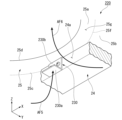
- FIG. 9 is a perspective view showing air guide member 230, electrical component box 24, and part of bell mouth 25 according to the second embodiment.
- the description may be omitted by appropriately assigning the same reference numerals to the same configurations as those of the above-described embodiment.
- only one air guide member 230 is provided in the second embodiment.
- the air guide member 230 is located on the other side (-X side) of the first horizontal direction X with respect to the rotation axis R. As shown in FIG. As shown in FIG. 9, the air guide member 230 has an air guide plate 230a and a fixing portion 230b.
- the baffle plate 230a has a rectangular plate shape.
- the plate surface of the baffle plate 230a faces the axial direction of the rotation axis R, that is, the vertical direction Z.
- the plate surface of the baffle plate 230a is perpendicular to the vertical direction Z.
- the baffle plate 230 a protrudes radially inward from the lower end portion of the electrical component box 24 .
- the baffle plate 230a extends from the lower end portion of the mounting surface 24a toward the other side in the first horizontal direction X ( ⁇ X side) toward the other side in the second horizontal direction Y ( ⁇ Y side).
- the baffle plate 230a is positioned on the other side (-X side) of the first horizontal direction X with respect to the rotation axis R.
- the baffle plate 230a extends from the end on the other side in the first horizontal direction X to the other side in the second horizontal direction Y (-Y side) of the portion of the electrical component box 24 that overlaps the inlet 25c when viewed in the vertical direction Z. protrudes to
- the downward facing surface of the plate surfaces of the baffle plate 230 a is located below the center of the electrical component box 24 in the vertical direction Z.
- the downward facing surface of the plate surface of the air guide plate 230 a is arranged at the same position in the vertical direction Z as the lower surface of the electrical component box 24 .
- Other configurations of baffle plate 230a are the same as other configurations of baffle plate 30a in the first embodiment.
- the fixed part 230b protrudes upward from the end of the baffle plate 230a on one side in the second horizontal direction Y (+Y side).
- the fixed part 230b is fixed to the electrical component box 24 .
- the air guide member 230 is fixed to the electrical component box 24 .
- Other configurations of the fixing portion 230b are the same as the other configurations of the fixing portions 31b and 32b in the first embodiment.
- the configuration of the indoor unit 220 other than the air guide member 230 is the same as that of the indoor unit 20 in the first embodiment.
- the plate surface of the baffle plate 230a faces the vertical direction Z.
- the downward facing surface is located below the center of the electrical component box 24 in the vertical direction Z.
- the air flow AF5 shown in FIG. Immediately after flowing into the radially inner space of 24, it can be applied to the downward facing surface of the plate surface of the baffle plate 230a.
- the flow velocity of the air that hits the downward facing surface of the baffle plate 230a decreases.
- the air flow AF5 which hits the plate surface of the baffle plate 230a and whose velocity is reduced, flows along the plate surface of the baffle plate 230a, and then flows into the inlet 25c without hitting the baffle plate 230a.
- the noise generated by the collision of the air can be reduced.
- one baffle plate 230a can suppress the generation of noise, so the number of parts of the indoor unit 220 can be reduced compared to the case where a plurality of baffle plates 230a are provided. Moreover, the occurrence of noise can be suppressed by one baffle plate 230a without adjusting the intervals between the plurality of baffle plates. Therefore, regardless of the relative positional relationship between the bell mouth 25 and the electrical component box 24, for example, the occurrence of noise can be stably suppressed by the baffle plate 230a.
- the downward facing surface of the plate surfaces of the baffle plate 230 a is arranged at the same position in the vertical direction Z as the lower surface of the electrical component box 24 . Therefore, there is no step between the downward facing surface of the baffle plate 230a and the lower surface of the electrical component box 24, and the air flow is not disturbed by the step. Thereby, it is possible to further suppress the occurrence of noise.
- FIG. 10 is a cross-sectional view showing part of the indoor unit 320 according to Embodiment 3. As shown in FIG. In addition, in the following description, the description may be omitted by appropriately assigning the same reference numerals to the same configurations as those of the above-described embodiment.
- the air guide member 330 is fixed to the bellmouth 25 in the third embodiment.
- the air guide member 330 has an air guide plate 330a and a fixing portion 330b.
- the baffle plate 330a is the same as the baffle plate 230a of the second embodiment except that it is arranged radially inside the electrical component box 24 with a gap therebetween.
- the fixing portion 330b extends downward from the inner surface 25g of the bell mouth 25. As shown in FIG.
- the baffle plate 330a is connected to the lower end of the fixing portion 330b. Thus, the baffle plate 330a is attached to the bell mouth 25 via the fixing portion 330b.
- the baffle plate 330 a can be arranged without changing the electrical component box 24 .
- the shape of the baffle plate is not particularly limited.
- the baffle plate may be in the shape of a polygonal plate other than a square, may be in the shape of a disk, or may be in the shape of an elliptical plate.
- the material that constitutes the baffle plate is not particularly limited.
- the baffle plate may be made of metal.
- the baffle plate may be attached to any part of the indoor unit as long as it is arranged radially inside the electrical component box.
- a method for fixing the baffle plate is not particularly limited. For example, if the baffle plate is made of metal, the baffle plate may be attached to the electrical component box by welding.
- a fixing portion connected to the baffle plate may be provided as in each of the above-described embodiments, and the fixing portion may be welded to the electrical component box for fixing.
- the baffle plate may be directly welded and fixed to the electrical component box without providing the part.
- the number of baffle plates is not particularly limited as long as it is one or more. Three or more baffle plates may be provided.
- the electrical component box is located on the first side (lower side) of the bell mouth, and if at least a part of it is arranged facing the inlet of the bell mouth in the axial direction (vertical direction Z), what kind of configuration is possible? may be
- the electrical component box as a whole may face the inlet in the axial direction.
- the bell mouth may not have a recess into which the electrical component box is fitted.
- the electrical box may be spaced apart on the first side (lower side) of the bell mouth.
- a support member may be provided that supports the electrical component box from the first side (lower side).
- the indoor unit of the present disclosure may be any type of indoor unit.
- the axial direction of the rotating shaft of the blower in the indoor unit may be any direction, and may be a direction that intersects the vertical direction.
Landscapes
- Engineering & Computer Science (AREA)
- Chemical & Material Sciences (AREA)
- Combustion & Propulsion (AREA)
- Mechanical Engineering (AREA)
- General Engineering & Computer Science (AREA)
- Air Filters, Heat-Exchange Apparatuses, And Housings Of Air-Conditioning Units (AREA)
- Air-Conditioning Room Units, And Self-Contained Units In General (AREA)
- Air-Flow Control Members (AREA)
Priority Applications (7)
| Application Number | Priority Date | Filing Date | Title |
|---|---|---|---|
| GB2407339.7A GB2629920A (en) | 2022-02-14 | 2022-02-14 | Indoor unit and air conditioner |
| DE112022006635.0T DE112022006635T5 (de) | 2022-02-14 | 2022-02-14 | Inneneinheit und Klimaanlage |
| CN202280085287.5A CN118613687A (zh) | 2022-02-14 | 2022-02-14 | 室内机以及空调机 |
| US18/706,130 US20240426512A1 (en) | 2022-02-14 | 2022-02-14 | Indoor unit and air conditioner |
| PCT/JP2022/005532 WO2023152938A1 (ja) | 2022-02-14 | 2022-02-14 | 室内機、および空気調和機 |
| JP2023580014A JP7558434B2 (ja) | 2022-02-14 | 2022-02-14 | 室内機、および空気調和機 |
| AU2022440462A AU2022440462B2 (en) | 2022-02-14 | 2022-02-14 | Indoor unit and air conditioner |
Applications Claiming Priority (1)
| Application Number | Priority Date | Filing Date | Title |
|---|---|---|---|
| PCT/JP2022/005532 WO2023152938A1 (ja) | 2022-02-14 | 2022-02-14 | 室内機、および空気調和機 |
Publications (1)
| Publication Number | Publication Date |
|---|---|
| WO2023152938A1 true WO2023152938A1 (ja) | 2023-08-17 |
Family
ID=87563980
Family Applications (1)
| Application Number | Title | Priority Date | Filing Date |
|---|---|---|---|
| PCT/JP2022/005532 Ceased WO2023152938A1 (ja) | 2022-02-14 | 2022-02-14 | 室内機、および空気調和機 |
Country Status (7)
| Country | Link |
|---|---|
| US (1) | US20240426512A1 (https=) |
| JP (1) | JP7558434B2 (https=) |
| CN (1) | CN118613687A (https=) |
| AU (1) | AU2022440462B2 (https=) |
| DE (1) | DE112022006635T5 (https=) |
| GB (1) | GB2629920A (https=) |
| WO (1) | WO2023152938A1 (https=) |
Citations (6)
| Publication number | Priority date | Publication date | Assignee | Title |
|---|---|---|---|---|
| JPH01263437A (ja) * | 1988-04-15 | 1989-10-19 | Matsushita Refrig Co Ltd | 空気調和機 |
| JP2004183994A (ja) * | 2002-12-04 | 2004-07-02 | Mitsubishi Heavy Ind Ltd | 空調用室内ユニットおよび天井設置型空気調和機 |
| JP2011106801A (ja) * | 2009-10-20 | 2011-06-02 | Hitachi Appliances Inc | 空気調和機の室内機 |
| JP2012072926A (ja) * | 2010-09-28 | 2012-04-12 | Hitachi Appliances Inc | 空気調和機の室内機 |
| JP2018025356A (ja) * | 2016-08-10 | 2018-02-15 | 日立ジョンソンコントロールズ空調株式会社 | 室内機および空気調和機 |
| WO2021014562A1 (ja) * | 2019-07-23 | 2021-01-28 | 三菱電機株式会社 | 空気調和機の室内機 |
Family Cites Families (1)
| Publication number | Priority date | Publication date | Assignee | Title |
|---|---|---|---|---|
| JP3593418B2 (ja) | 1996-07-03 | 2004-11-24 | 東芝キヤリア株式会社 | 天井カセット形空気調和機 |
-
2022
- 2022-02-14 WO PCT/JP2022/005532 patent/WO2023152938A1/ja not_active Ceased
- 2022-02-14 DE DE112022006635.0T patent/DE112022006635T5/de active Pending
- 2022-02-14 CN CN202280085287.5A patent/CN118613687A/zh active Pending
- 2022-02-14 JP JP2023580014A patent/JP7558434B2/ja active Active
- 2022-02-14 US US18/706,130 patent/US20240426512A1/en active Pending
- 2022-02-14 GB GB2407339.7A patent/GB2629920A/en active Pending
- 2022-02-14 AU AU2022440462A patent/AU2022440462B2/en active Active
Patent Citations (6)
| Publication number | Priority date | Publication date | Assignee | Title |
|---|---|---|---|---|
| JPH01263437A (ja) * | 1988-04-15 | 1989-10-19 | Matsushita Refrig Co Ltd | 空気調和機 |
| JP2004183994A (ja) * | 2002-12-04 | 2004-07-02 | Mitsubishi Heavy Ind Ltd | 空調用室内ユニットおよび天井設置型空気調和機 |
| JP2011106801A (ja) * | 2009-10-20 | 2011-06-02 | Hitachi Appliances Inc | 空気調和機の室内機 |
| JP2012072926A (ja) * | 2010-09-28 | 2012-04-12 | Hitachi Appliances Inc | 空気調和機の室内機 |
| JP2018025356A (ja) * | 2016-08-10 | 2018-02-15 | 日立ジョンソンコントロールズ空調株式会社 | 室内機および空気調和機 |
| WO2021014562A1 (ja) * | 2019-07-23 | 2021-01-28 | 三菱電機株式会社 | 空気調和機の室内機 |
Also Published As
| Publication number | Publication date |
|---|---|
| GB2629920A (en) | 2024-11-13 |
| CN118613687A (zh) | 2024-09-06 |
| AU2022440462B2 (en) | 2025-06-19 |
| JP7558434B2 (ja) | 2024-09-30 |
| JPWO2023152938A1 (https=) | 2023-08-17 |
| DE112022006635T5 (de) | 2024-11-28 |
| US20240426512A1 (en) | 2024-12-26 |
| AU2022440462A1 (en) | 2024-05-23 |
| GB202407339D0 (en) | 2024-07-10 |
Similar Documents
| Publication | Publication Date | Title |
|---|---|---|
| JP4502057B2 (ja) | 床置型空気調和機の室内機 | |
| JP6311427B2 (ja) | 空気調和装置 | |
| EP4400777A1 (en) | Ceiling-embedded air conditioner | |
| JP5293684B2 (ja) | 空気調和機の室内機 | |
| JP7558434B2 (ja) | 室内機、および空気調和機 | |
| WO2016170652A1 (ja) | 室内機および空気調和装置 | |
| JP7005355B2 (ja) | 空気調和機 | |
| CN113302401B (zh) | 送风机、室内机以及空调机 | |
| CN113203119A (zh) | 天花板嵌入式空调 | |
| WO2023135782A1 (ja) | 遠心送風機、および室内機 | |
| JP2012002165A (ja) | ターボファンおよびそれを用いた空気調和機 | |
| JP3846468B2 (ja) | ターボファン | |
| JP7629706B2 (ja) | 空気調和機の室内機 | |
| JP2003240261A (ja) | 一体型空気調和機 | |
| JP2004156886A (ja) | 空調用室内ユニットおよび天井埋込型空気調和機 | |
| WO2023152802A1 (ja) | 室内機及びこれを備えた空気調和装置 | |
| CN118475775A (zh) | 叶轮、离心送风机以及室内机 | |
| WO2023002956A1 (ja) | 空気調和機 | |
| TW202443032A (zh) | 離心送風機、空調機及冷凍循環裝置 | |
| JP2023070306A (ja) | 天井埋込型空調機 | |
| JP2016161160A (ja) | 空気調和機 | |
| WO2019198150A1 (ja) | 空気調和機 | |
| WO2018168707A1 (ja) | 両吸込型遠心ファン | |
| JPH11325498A (ja) | 空気調和装置 |
Legal Events
| Date | Code | Title | Description |
|---|---|---|---|
| 121 | Ep: the epo has been informed by wipo that ep was designated in this application |
Ref document number: 22925959 Country of ref document: EP Kind code of ref document: A1 |
|
| WWE | Wipo information: entry into national phase |
Ref document number: 2023580014 Country of ref document: JP |
|
| WWE | Wipo information: entry into national phase |
Ref document number: 18706130 Country of ref document: US |
|
| ENP | Entry into the national phase |
Ref document number: 202407339 Country of ref document: GB Kind code of ref document: A Free format text: PCT FILING DATE = 20220214 Ref document number: 2022440462 Country of ref document: AU Date of ref document: 20220214 Kind code of ref document: A |
|
| WWE | Wipo information: entry into national phase |
Ref document number: 2407339.7 Country of ref document: GB |
|
| WWE | Wipo information: entry into national phase |
Ref document number: 202280085287.5 Country of ref document: CN |
|
| WWE | Wipo information: entry into national phase |
Ref document number: 202427048208 Country of ref document: IN Ref document number: 2401004187 Country of ref document: TH |
|
| WWE | Wipo information: entry into national phase |
Ref document number: 112022006635 Country of ref document: DE |
|
| WWP | Wipo information: published in national office |
Ref document number: 2407339.7 Country of ref document: GB |
|
| 122 | Ep: pct application non-entry in european phase |
Ref document number: 22925959 Country of ref document: EP Kind code of ref document: A1 |