WO2023136141A1 - 耐炎化ポリフェニレンエーテル繊維及び補強繊維を含む耐炎化不織布、耐炎化ポリフェニレンエーテル及び補強繊維を含む耐炎化成型体、並びにそれらの製造方法 - Google Patents
耐炎化ポリフェニレンエーテル繊維及び補強繊維を含む耐炎化不織布、耐炎化ポリフェニレンエーテル及び補強繊維を含む耐炎化成型体、並びにそれらの製造方法 Download PDFInfo
- Publication number
- WO2023136141A1 WO2023136141A1 PCT/JP2022/048253 JP2022048253W WO2023136141A1 WO 2023136141 A1 WO2023136141 A1 WO 2023136141A1 JP 2022048253 W JP2022048253 W JP 2022048253W WO 2023136141 A1 WO2023136141 A1 WO 2023136141A1
- Authority
- WO
- WIPO (PCT)
- Prior art keywords
- flame
- resistant
- polyphenylene ether
- nonwoven fabric
- fibers
- Prior art date
- Legal status (The legal status is an assumption and is not a legal conclusion. Google has not performed a legal analysis and makes no representation as to the accuracy of the status listed.)
- Ceased
Links
Images
Classifications
-
- D—TEXTILES; PAPER
- D04—BRAIDING; LACE-MAKING; KNITTING; TRIMMINGS; NON-WOVEN FABRICS
- D04H—MAKING TEXTILE FABRICS, e.g. FROM FIBRES OR FILAMENTARY MATERIAL; FABRICS MADE BY SUCH PROCESSES OR APPARATUS, e.g. FELTS, NON-WOVEN FABRICS; COTTON-WOOL; WADDING ; NON-WOVEN FABRICS FROM STAPLE FIBRES, FILAMENTS OR YARNS, BONDED WITH AT LEAST ONE WEB-LIKE MATERIAL DURING THEIR CONSOLIDATION
- D04H1/00—Non-woven fabrics formed wholly or mainly of staple fibres or like relatively short fibres
- D04H1/40—Non-woven fabrics formed wholly or mainly of staple fibres or like relatively short fibres from fleeces or layers composed of fibres without existing or potential cohesive properties
- D04H1/42—Non-woven fabrics formed wholly or mainly of staple fibres or like relatively short fibres from fleeces or layers composed of fibres without existing or potential cohesive properties characterised by the use of certain kinds of fibres insofar as this use has no preponderant influence on the consolidation of the fleece
- D04H1/4326—Condensation or reaction polymers
-
- D—TEXTILES; PAPER
- D04—BRAIDING; LACE-MAKING; KNITTING; TRIMMINGS; NON-WOVEN FABRICS
- D04H—MAKING TEXTILE FABRICS, e.g. FROM FIBRES OR FILAMENTARY MATERIAL; FABRICS MADE BY SUCH PROCESSES OR APPARATUS, e.g. FELTS, NON-WOVEN FABRICS; COTTON-WOOL; WADDING ; NON-WOVEN FABRICS FROM STAPLE FIBRES, FILAMENTS OR YARNS, BONDED WITH AT LEAST ONE WEB-LIKE MATERIAL DURING THEIR CONSOLIDATION
- D04H1/00—Non-woven fabrics formed wholly or mainly of staple fibres or like relatively short fibres
- D04H1/40—Non-woven fabrics formed wholly or mainly of staple fibres or like relatively short fibres from fleeces or layers composed of fibres without existing or potential cohesive properties
- D04H1/42—Non-woven fabrics formed wholly or mainly of staple fibres or like relatively short fibres from fleeces or layers composed of fibres without existing or potential cohesive properties characterised by the use of certain kinds of fibres insofar as this use has no preponderant influence on the consolidation of the fleece
- D04H1/4382—Stretched reticular film fibres; Composite fibres; Mixed fibres; Ultrafine fibres; Fibres for artificial leather
Definitions
- the present invention relates to a flame-resistant nonwoven fabric containing flame-resistant polyphenylene ether fibers and reinforcing fibers, a flame-resistant molded article containing flame-resistant polyphenylene ether and reinforcing fibers, and methods for producing them.
- Polyphenylene ether (hereinafter also referred to as PPE) is excellent in heat resistance, flame retardancy, strength, chemical resistance, etc., so molded articles formed from polyphenylene ether are used in a wide range of fields.
- Flame-resistant polyphenylene ether fibers, which are flame-resistant materials, and nonwoven fabrics made of such fibers have been known (for example, Patent Document 1). Such molded bodies were not known.
- fiber-reinforced resin composites made of thermoplastic resin and reinforcing fibers such as carbon fiber and glass fiber are lightweight and have excellent specific strength and specific rigidity. It is used in a wide range of applications such as automobile applications and aircraft applications.
- reinforcing fibers are sometimes used as continuous fibers in order to improve mechanical properties.
- continuous fibers have poor formability, and it may be difficult to produce a fiber-reinforced resin composite having a complicated shape. Therefore, it is known to manufacture a fiber-reinforced resin composite having a complicated shape by using discontinuous fibers as reinforcing fibers.
- thermoplastic resin and carbon fiber and non-woven fabrics for forming the molded article
- molding materials for forming the molded article
- a molded article made of a thermoplastic resin and carbon fibers in a specific weight ratio, wherein the carbon fibers are monofilament-like and have a specific weight average fiber length and orientation parameter, and a molding material therefor e.g. , U.S. Pat. No. 5,300,000, at least one first fiber as a fusion fiber made of a high-performance thermoplastic and at least one second fiber made of a high-performance material with a higher temperature stability compared to said fusion fiber.
- Patent Document 5 A certain prepreg sheet (for example, Patent Document 5), a nonwoven fabric used for producing a heat-resistant resin composite containing heat-resistant thermoplastic fibers, reinforcing fibers, and polyester binder fibers (for example, Patent Document 6), etc. are known. ing.
- Patent Document 1 discloses a non-woven fabric made of flame-resistant polyphenylene ether fiber, but the non-woven fabric is a non-woven fabric made only of flame-resistant polyphenylene ether fiber. No nonwoven fabric made of fibers was disclosed.
- the nonwoven fabric of Patent Document 1 has a limiting oxygen index (LOI value) exceeding 40 and has high flame retardancy. However, it has limitations and is not sufficient in fields requiring even higher flame retardancy (for example, fields requiring flame retardancy with an LOI value of 50 or more).
- Patent Documents 2 to 6 flame resistance was not considered, and it was not sufficient in the field of high flame retardancy.
- an object of the present invention is to provide a flame-retardant nonwoven fabric containing a flame-resistant polyphenylene ether fiber and a reinforcing fiber imparted with higher flame retardancy (flame resistance) and heat resistance, and a flame-retardant fabric containing a flame-resistant polyphenylene ether and a reinforcing fiber.
- An object of the present invention is to provide molded articles and methods for producing them.
- the present inventors have found that a nonwoven fabric containing a flame-resistant polyphenylene ether fiber and a reinforcing fiber having a specific chemical structure detectable by infrared spectroscopy, a flame-resistant nonwoven fabric containing a flame-resistant polyphenylene ether and a reinforcing fiber
- the present inventors have found that the above problems can be solved by using a molded product, and have completed the present invention. That is, the present invention consists of the following configurations.
- the 1% mass loss temperature of the reinforcing fibers is preferably 400°C or higher.
- the LOI value of the flame-resistant nonwoven fabric is preferably 50 or more.
- the average fiber length of the reinforcing fibers is preferably 15 mm or more.
- the thickness of the flame-resistant nonwoven fabric is preferably 1 mm or more and 30 mm or less.
- the number of crimps in the flame-resistant polyphenylene ether fiber is preferably 2/25 mm or more and 24/25 mm or less.
- the reinforcing fibers are preferably carbon fibers and/or glass fibers.
- the present invention also provides a method for producing a flame-resistant nonwoven fabric containing flame-resistant polyphenylene ether fibers and reinforcing fibers, forming a nonwoven comprising polyphenylene ether fibers and reinforcing fibers; A step of heat-treating the obtained nonwoven fabric in air at 120° C. or higher and 240° C. or lower for 1 hour or longer and 30 hours or shorter to make it infusible; A method for producing a flame-resistant nonwoven fabric, comprising a step of heat-treating an infusibilized non-woven fabric in air at 260° C. or higher and 400° C. or lower for 0.1 hour or longer and 10 hours or shorter to make it flame resistant.
- the LOI value of the flame-resistant molded body is preferably 46 or more.
- the average fiber length of the reinforcing fibers is preferably 15 mm or more.
- the reinforcing fibers are preferably carbon fibers and/or glass fibers.
- the molded body is a molded body formed by pressing a nonwoven fabric containing polyphenylene ether fibers and reinforcing fibers and subjected to a flameproofing treatment.
- the present invention provides a method for producing a flame-resistant molded article comprising flame-resistant polyphenylene ether and reinforcing fibers, comprising: pressing a nonwoven fabric containing polyphenylene ether fibers and reinforcing fibers to form a molded body; A step of heat-treating the obtained molded body in the air at 120° C. or more and 240° C. or less for 1 hour or more and 30 hours or less to make it infusible; It relates to a method for producing a flame-resistant molded article, comprising a step of heat-treating an infusibilized molded article in air at 260° C. or higher and 400° C. or lower for 0.1 hour or longer and 10 hours or shorter to make it flame resistant. .
- A/B absorbance height ratio
- the flame-resistant nonwoven fabric of the present invention is made of flame-resistant polyphenylene ether fibers and reinforcing fibers, so that the entanglement of the fibers can be controlled, and as a result, appropriate voids can be formed in the nonwoven fabric. It is considered that high flame retardancy is imparted. Therefore, the flame-resistant nonwoven fabric of the present invention can be suitably used for flame-resistant sheets and the like that require high flame retardancy.
- a two-stage heat treatment infusibilization treatment and flameproofing treatment
- the flame-resistant molded body of the present invention was measured by infrared spectroscopy, and the absorbance height A at the wavenumber 1732 cm
- the absorbance height A at the wavenumber 1732 cm
- A/B absorbance height ratio
- the absorbance height B at a wavelength of 1600 cm ⁇ 1 from which it is derived
- very high flame retardancy and heat resistance It shows the sex.
- flame retardancy flame retardancy exceeding the flame retardancy expected from the flame retardancy of the flame-resistant polyphenylene ether itself and the flame retardancy of the reinforcing fiber itself is imparted.
- the flame-resistant molded article of the present invention can be suitably used for flame-resistant parts and the like that require high flame retardancy.
- a two-step heat treatment infusibilization treatment and flameproofing treatment is performed to produce a flameproof molded product having extremely high flame retardancy, flame resistance, heat resistance, etc. It is something that can be done.
- the flame-resistant nonwoven fabric of the present invention contains a flame-resistant polyphenylene ether fiber and a reinforcing fiber, and the flame-resistant polyphenylene ether fiber is measured by infrared spectroscopy, and the wavenumber derived from C ⁇ O stretching vibration is 1732 cm ⁇ 1 .
- the absorbance height ratio (A/B) between the absorbance height A of the benzene ring and the absorbance height B at a wavelength of 1600 cm derived from skeletal vibration due to stretching between the carbons of the benzene ring is 0.42 or more. Characterized by
- the LOI value of the flame-resistant nonwoven fabric of the present invention is preferably 50 or more, more preferably 60 or more, and even more preferably 65 or more. It is preferable that the LOI value is within the above range because the obtained flame-resistant nonwoven fabric has excellent flame retardancy.
- the LOI value is the limiting oxygen index, and the larger the LOI value, the more excellent the flame retardancy. Therefore, the larger the LOI value, the better, and the upper limit is not particularly limited.
- the basis weight of the flame-resistant nonwoven fabric of the present invention is not particularly limited, and can be appropriately determined according to the purpose for which the nonwoven fabric is used. is more preferred. Also, it is preferably 3000 g/m 2 or less, more preferably 2000 g/m 2 or less.
- the thickness of the flame-resistant nonwoven fabric of the present invention is not particularly limited, and can be appropriately determined according to the purpose for which the nonwoven fabric is used. is more preferable, and it is even more preferable to be about 1 mm or more. Also, the thickness is preferably about 100 mm or less, more preferably about 80 mm or less, and even more preferably about 30 mm or less.
- the mass ratio of the flame-resistant polyphenylene ether fiber and the reinforcing fiber contained in the flame-resistant nonwoven fabric of the present invention is not particularly limited, and can be appropriately determined according to the purpose for which the nonwoven fabric is used.
- the fiber mass ratio is preferably about 95/5 or more and 5/95 or less, more preferably about 90/10 or more and 10/90 or less, and about 60/40 or more and 40/60 or less. is more preferred. It is preferable that the mass ratio is in the above range because a uniform nonwoven fabric with good handleability can be obtained.
- the content of the flame-resistant polyphenylene ether in the flame-resistant nonwoven fabric of the present invention is preferably 5% by mass or more, more preferably 10% by mass or more, relative to the total amount of the flame-resistant nonwoven fabric. Also, the content is preferably 95% by mass or less, more preferably 90% by mass or less, relative to the total amount of the flame-resistant nonwoven fabric. When the content of the flame-resistant polyphenylene ether is within the above range, both flame retardancy and strength can be achieved, which is preferable.
- the method for producing the flame-resistant nonwoven fabric of the present invention is not particularly limited, it can be suitably produced by the method for producing the flame-resistant nonwoven fabric of the present invention, which will be described later.
- the flame-resistant polyphenylene ether fibers, reinforcing fibers, etc. contained in the flame-resistant nonwoven fabric of the present invention will be described in detail below.
- the flameproof polyphenylene ether fiber used in the present invention is formed by subjecting polyphenylene ether fiber to a flameproof treatment.
- the flame-resistant treatment may be performed on the polyphenylene ether fiber before forming the non-woven fabric, or may be performed on the non-woven fabric formed from the untreated polyphenylene ether fiber and the reinforcing fiber, but the flame-resistant non-woven fabric can be produced more easily. More preferred is the method of flameproofing the nonwoven fabric.
- the absorbance height ratio (A/B) to the absorbance height B at the derived wavelength of 1600 cm ⁇ 1 is 0.42 or more.
- the peak at a wavelength of 1732 cm ⁇ 1 derived from the C ⁇ O stretching vibration is formed by flameproofing the polyphenylene ether fiber.
- the absorbance height ratio is within the above range, extremely high flame retardancy can be imparted.
- the LOI value (limiting oxygen index) of the flame-resistant polyphenylene ether fiber itself exceeds 30. It is possible. Also, heat resistance and the like can be imparted.
- the flame-resistant nonwoven fabric of the present invention contains such flame-resistant polyphenylene ether fibers and reinforcing fibers, so that extremely high flame retardancy (flame resistance) and heat resistance can be imparted.
- the upper limit of the absorbance height ratio is not particularly limited, but is preferably 3.0 or less, more preferably 2.0 or less, and further preferably 1.5 or less. preferable. The flameproof treatment method will be described later.
- the number of crimps of the flame-resistant polyphenylene ether fiber used in the present invention is preferably 2/25 mm or more and 24/25 mm or less. By setting the number of crimps within the above range, the entanglement between the flame-resistant polyphenylene ether fiber and the reinforcing fiber is improved, and a highly uniform nonwoven fabric can be formed, which is preferable. Since the number of crimps of the flame-resistant polyphenylene ether fiber is the same as the number of crimps of the polyphenylene ether fiber before the flame-retarding treatment, the preferable range of the number of crimps and the crimping method are those described in the later-described polyphenylene ether fiber. is the same as
- the polyphenylene ether fiber to be flameproofed is not particularly limited as long as it contains a polyphenylene ether component.
- the polyphenylene ether component is not particularly limited, and those commonly used in this field can be mentioned.
- the following general formula (1) (wherein R 1 and R 2 are each independently a hydrogen atom or an optionally substituted hydrocarbon group having 1 to 10 carbon atoms, and R 3 is each independently represents a hydrocarbon group having 1 or more and 10 or less carbon atoms which may have a substituent)
- R 1 and R 2 in the general formula (1) include hydrogen atom, methyl group, ethyl group, propyl group, isopropyl group, n-butyl group, isobutyl group, t-butyl group, pentyl group, and cyclopentyl.
- alkyl groups having 1 to 10 carbon atoms such as hexyl group, cyclohexyl group, octyl group and decyl group;
- Aralkyl groups having 7 to 10 carbon atoms such as the following aryl group, benzyl group, 2-phenylethyl group and 1-phenylethyl group can also be mentioned.
- the substituent includes a halogen atom such as a fluorine atom, an alkoxy group such as a methoxy group, and the like.
- a halogen atom such as a fluorine atom
- an alkoxy group such as a methoxy group
- Specific examples of the hydrocarbon group having a substituent include, for example, a trifluoromethyl group.
- R 1 and R 2 are preferably a hydrogen atom or a methyl group, more preferably a hydrogen atom.
- R 3 in the general formula (1) examples include methyl group, ethyl group, propyl group, isopropyl group, n-butyl group, isobutyl group, t-butyl group, pentyl group, cyclopentyl group, hexyl group and cyclohexyl.
- alkyl groups having 1 to 10 carbon atoms such as octyl and decyl groups
- aryl groups having 6 to 10 carbon atoms such as phenyl, 4-methylphenyl, 1-naphthyl and 2-naphthyl groups
- aralkyl groups having 7 or more and 10 or less carbon atoms such as groups, 2-phenylethyl groups, 1-phenylethyl groups, and the like.
- examples of the substituent include a halogen atom such as a fluorine atom and an alkoxy group such as a methoxy group.
- Specific examples of the hydrocarbon group having a substituent include, for example, a trifluoromethyl group.
- R 3 is preferably a methyl group.
- repeating unit of general formula (1) examples include 2,6-dimethyl-1,4-phenylene ether, 2,6-diethyl-1,4-phenylene ether, 2-methyl-6-ethyl Repeating units derived from -1,4-phenylene ether, 2,6-dipropyl-1,4-phenylene ether can be mentioned. Among these, repeating units derived from 2,6-dimethyl-1,4-phenylene ether are preferred.
- the polyphenylene ether can contain a repeating unit other than the general formula (1) within a range that does not impair the effects of the present invention.
- the content of repeating units other than those of general formula (1) is not particularly limited as long as it does not impair the effects of the present invention. Preferably, it is more preferably not included.
- the weight average molecular weight (Mw) is preferably 40,000 or more, more preferably 50,000 or more. Also, the weight average molecular weight (Mw) is preferably 100,000 or less, more preferably 80,000 or less. Also, the number average molecular weight (Mn) is preferably 7,000 or more, more preferably 8,000 or more. Also, the number average molecular weight (Mn) is preferably 30,000 or less, more preferably 20,000 or less. Also, the molecular weight distribution (Mw/Mn) is preferably 3.5 or more and 8.0 or less, more preferably 4.0 or more and 6.0 or less.
- Polyphenylene ether generally has a high melt viscosity, and when polyphenylene ether is contained in a high content, it was considered difficult to melt mold it alone. Therefore, when obtaining a polyphenylene ether melt-spun fiber, a method using a polyphenylene ether containing a polyphenylene ether component having a rearrangement structure, a polyphenylene ether component having a high glass transition temperature and a polyphenylene ether component having a low glass transition temperature It is preferable to use a method of mixing By these methods, the melt viscosity of the polyphenylene ether can be lowered, so that the polyphenylene ether can be melted and a melt-spun fiber can be formed.
- polyphenylene ether having rearrangement structure examples include the following general formula (2): (wherein R 1 and R 2 are each independently a hydrogen atom or an optionally substituted hydrocarbon group having 1 to 10 carbon atoms, and R 3 is each independently A hydrocarbon group having 1 to 10 carbon atoms which may have a substituent, and R 3′ represents a divalent group in which one hydrogen atom is removed from R 3 ) It is preferable to use a polyphenylene ether containing a polyphenylene ether component having a rearranged structure represented by. By having such a dislocation structure, the fluidity is improved to the extent that melt molding is possible, and melt-spun fibers, non-woven fabrics, and the like can be formed.
- R 1 , R 2 , and R 3 in general formula (2) are the same as those in general formula (1).
- " ⁇ " in the general formula (2) indicates that the structure beyond it is not particularly limited.
- the "-" portion may be formed from phenylene ether units that are continuous with para bonds, and may have a portion that is partially ortho-bonded therein.
- R 3′ represents a divalent group obtained by removing one hydrogen atom from R 3 and is preferably a methylene group.
- the polyphenylene ether component having a rearrangement structure is a homopolymer having a repeating unit of the general formula (1), a copolymer containing two or more different repeating units of the general formula (1), or the general formula
- a copolymer containing repeating units of formula (1) and repeating units other than formula (1) preferably has a dislocation structure represented by formula (2).
- the amount of rearrangement in the polyphenylene ether component having the rearrangement structure is not particularly limited, but is preferably 0.01 mol% or more with respect to all polyphenylene ether structural units in the polyphenylene ether component. It is more preferably 0.05 mol % or more, still more preferably 0.1 mol % or more, and particularly preferably 0.15 mol % or more. Further, it is preferably 2 mol % or more in order to obtain fine fibers with a single filament fineness of 15 dtex or less.
- the upper limit of the dislocation amount is not particularly limited, but is preferably 20 mol% or less, more preferably 18 mol% or less, further preferably 5 mol% or less, and 4 mol% or less.
- the amount of rearrangement in the polyphenylene ether component having a rearrangement structure is within the above range, the fluidity is improved to the extent that melt molding is possible, and a melt-spun fiber can be obtained, which is preferable.
- the dislocation amount can be measured by the method described in Examples.
- the method for forming the polyphenylene ether component having the rearrangement structure is as described below.
- the method for lowering the melt viscosity by mixing polyphenylene ethers having a high Tg and a low Tg will be described in the method for producing polyphenylene ether fibers.
- the polyphenylene ether fiber used in the present invention can contain a resin component other than the polyphenylene ether component.
- Resin components other than polyphenylene ether include styrene, polyethylene, polypropylene, polyamides such as polyamide 4, polyamide 6, polyamide 10, polyamide 11, polyamide 66, polyamide 6T and polyamide 6T/11, and polyesters such as polyethylene terephthalate and polybutylene terephthalate. , polycarbonate, and the like.
- the content is preferably 5% by mass or less, more preferably 2% by mass or less, and more preferably not contained (0% by mass).
- the content of polyphenylene ether is preferably 95% by mass or more, more preferably 98% by mass or more, in all components forming the fiber, and substantially only polyphenylene ether (100% by mass) is more preferable.
- the content of the polyphenylene ether in the polyphenylene ether fiber is within the above range, the obtained fiber not only has excellent mechanical strength, but also has excellent heat resistance, chemical resistance, flame retardancy, etc., which is preferable. .
- Additives such as lubricants, plasticizers, antioxidants, UV absorbers, dulling agents, and antistatic agents can also be added to the polyphenylene ether fiber within a range that does not impair the effects of the present invention.
- Polyphenylene ether fibers can be produced by various production methods such as melt spinning, dry spinning, and wet spinning. Among these, melt spinning is preferable because productivity can be increased.
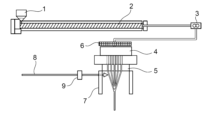
- Polyphenylene ether which is a raw material, is put into an extruder 2 equipped with a cylinder and a screw from a hopper 1 in FIG. It can pass through and be discharged from the spinning nozzle 5 to obtain a melt-spun fiber.
- a filter 6 made of metal nonwoven fabric or the like on the filter medium 4 . It is preferable to install the filter 6 because it is possible to remove foreign substances and to prevent clogging of the filter medium 4 and the like.
- a heat insulating space 7 is provided immediately below the spinning nozzle 5, and an inert gas such as nitrogen is introduced 8 into the area for spinning. More preferably, the torch 9 introduces heated inert gas.
- the temperature of the heated inert gas is preferably 100° C. or higher and 500° C. or lower, more preferably 200° C. or higher and 400° C. or lower.
- the spinning speed is not particularly limited, and can be appropriately set according to the required fineness, etc., but in order to stably obtain fine fineness fibers, the spinning speed is about 100 m/min or more and 5000 m/min or less. 100 m/min or more and 3000 m/min or less is more preferable.
- the single hole discharge rate of the spinning nozzle is preferably 1.0 g/min or less, more preferably 0.8 g/min or less, and even more preferably 0.6 g/min or less.
- the lower limit of the single hole discharge rate is not particularly limited, but it is preferably 0.05 g/min or more, more preferably 0.1 g/min or more, and further preferably 0.12 g/min or more. preferable.
- a homopolymer having a repeating unit of the general formula (1) or a copolymer containing two or more different repeating units of the general formula (1), or the general formula (1 ) and a copolymer having a repeating unit other than the repeating unit of general formula (1).
- Examples of the content of repeating units other than those represented by general formula (1) in the copolymer include those described above. Among these, homopolymers having repeating units of the general formula (1) are preferred.
- homopolymers having repeating units of the general formula (1) include poly(2,6-dimethyl-1,4-phenylene ether), poly(2,6-diethyl-1,4- phenylene ether), poly(2-methyl-6-ethyl-1,4-phenylene ether), poly(2,6-dipropyl-1,4-phenylene ether) and the like. (2,6-dimethyl-1,4-phenylene ether) is preferred.
- poly(2,6-dimethyl-1,4-phenylene ether) commercially available products can be suitably used. Specifically, for example, PPO640, PPO646, PPOSA120 manufactured by SABIC Innovative Plastic, ) manufactured by Zylon S201A and Zylon S202A.
- polyphenylene ether having a high Tg and a low Tg can be mixed to lower the melt viscosity.
- the glass transition temperature of the polyphenylene ether component having a high glass transition temperature is preferably 170°C or higher, more preferably 200°C or higher, and even more preferably 210°C or higher.
- the upper limit of the glass transition temperature is not particularly limited, it is preferably 230° C. or less. It is preferable that the raw material polyphenylene ether have a glass transition temperature within the above range, since a polyphenylene ether fiber having high heat resistance can be obtained.
- the glass transition temperature of the polyphenylene ether component having a low glass transition temperature is preferably less than 170°C.
- the content of the polyphenylene ether having a glass transition temperature of 170° C. or higher is preferably 70% by mass or more, more preferably 80% by mass or more, more preferably 90% by mass, in the raw polyphenylene ether component. It is more preferable that it is above.
- the upper limit of the content of the polyphenylene ether having a glass transition temperature of 170° C. or higher is not particularly limited, but is preferably 100% by mass or less. In the present invention, if the polyphenylene ether having a high glass transition temperature (that is, a high molecular weight) is included in the above range, the obtained polyphenylene ether fiber is excellent in mechanical strength, heat resistance, chemical resistance, flame retardancy, etc. Therefore, it is preferable.
- resin components and additives other than the polyphenylene ether component can be included along with the raw material polyphenylene ether. Resin components and additives other than the polyphenylene ether component are as described above. In addition, the content of resin components other than the polyphenylene ether component is preferably 5% by mass or less, more preferably 2% by mass or less, and even more preferably not contained (0% by mass).
- a single-screw extruder or a twin-screw extruder that can be commonly used in this field can be used.
- the peripheral speed of the screw is not particularly limited, and can be within the range normally used in this field. However, when forming fibers using polyphenylene ether having a rearranged structure, the peripheral speed of the screw is required to cause a rearrangement reaction of the polyphenylene ether as a raw material, and is 3.6 m / min or more. It is preferably 3.7 m/min or more, more preferably 3.8 m/min or more.
- the upper limit of the peripheral speed of the screw is not particularly limited, but is preferably 94.2 m/min or less.
- the screw rotation speed and setting the peripheral speed of the screw by increasing the screw rotation speed and setting the peripheral speed of the screw to 3.6 m / min or more, a high shearing force can be applied to the raw material polyphenylene ether in the cylinder, and as a result, the polyphenylene ether molecules It is capable of chain scission to form a polyphenylene ether having a rearranged structure. Formation of the polyphenylene ether having the rearrangement structure enables melt spinning of the polyphenylene ether.
- the temperature in the cylinder is, for example, preferably 250° C. or higher and 350° C. or lower, more preferably 280° C. or higher and 330° C. or lower.
- polyphenylene ether fibers used in the present invention may be short fibers, and can be obtained, for example, by cutting the tow-shaped fibers obtained by combining the polyphenylene ether fibers.
- the glass transition temperature of the polyphenylene ether fiber used in the present invention is preferably 170°C or higher, more preferably 175°C or higher, and even more preferably 180°C or higher. Since the glass transition temperature is within the above range, extremely high heat resistance can be imparted.
- the upper limit is not particularly limited, it is preferably 300° C. or lower, more preferably 250° C. or lower.
- the polyphenylene ether fibers used in the present invention are preferably crimped because they are well entwined with the reinforcing fibers and can form a highly uniform nonwoven fabric.
- the number of crimps is not particularly limited, it is preferably 2 crimps/25 mm or more and 24 crimps/25 mm or less. If the number of crimps is less than 2/25 mm, the entanglement between the reinforcing fibers and the polyphenylene ether fibers is poor, making it impossible to pass the reinforcing fibers through a carding machine while opening them, making it difficult to form a nonwoven fabric. be.
- the number of crimps exceeds 24/25 mm, the entanglement of the polyphenylene ether fibers is so strong that the passage through the carding machine becomes poor, and it may become difficult to form a web.
- the number of crimps of the polyphenylene ether fiber is more preferably 2.5/25 mm or more, still more preferably 3/25 mm or more, and particularly preferably 5/25 mm or more.
- the number of crimps is more preferably 22/25 mm or less, even more preferably 20/25 mm or less, and particularly preferably 15/25 mm or less. A method for crimping the polyphenylene ether fiber will be described later.
- the polyphenylene ether fiber is preferably coated with an oil agent, and the amount of the oil agent adhered is preferably 0.03% by mass or more, and preferably 0.05% by mass or more, relative to the mass of the fiber. It is more preferably 0.07% by mass or more, still more preferably 0.08% by mass or more, and particularly preferably 0.1% by mass or more. Also, the upper limit of the amount of oil agent adhered is not particularly limited, but is usually about 5% by mass or less. Since polyphenylene ether fibers are easily electrified, it is preferable to set the oil agent adhesion amount within the above range because electrification can be suppressed when the polyphenylene ether fibers are passed through a carding machine, making it easier to produce a web.
- the oil agent is not particularly limited, and an oil agent generally used for spinning can be used.
- Spinning oils impart smoothness and antistatic properties to fibers, and include, for example, water-insoluble oils, water-soluble oils, and emulsifying oils. Among these, water-soluble oils are preferred.
- the amount of residual solvent in the polyphenylene ether fiber is not particularly limited, but is preferably 3% by mass or less, more preferably 2% by mass or less, further preferably 1% by mass or less, and 0.5% by mass or less. It is more preferably not more than 0.1% by mass, and particularly preferably not more than 0.1% by mass. It is preferable from the viewpoint of improving heat resistance that the amount of residual solvent in the polyphenylene ether fiber is within the above range.
- the fineness of the polyphenylene ether fiber is not particularly limited, and can be appropriately determined according to the purpose for which the fiber is used. is more preferred. When the fineness is within the above range, the entanglement between the fibers becomes strong, and the strength as a nonwoven fabric is improved, which is preferable.
- the lower limit of fineness is not particularly limited, but it is preferably 0.1 dtex or more, more preferably 0.2 dtex or more.
- the average fiber length of the polyphenylene ether fiber is not particularly limited, and can be appropriately adjusted depending on the application. be.
- Reinforcing Fibers are not particularly limited, but examples thereof include carbon fibers, glass fibers, basalt fibers, PBO fibers, and metal fibers.
- inorganic reinforcing fibers carbon fiber, glass fiber, balsato fiber, metal fiber
- At least one of the fibers is more preferable.
- Examples of the carbon fibers include polyacrylonitrile (PAN)-based, pitch-based, and rayon-based carbon fibers.
- PAN polyacrylonitrile
- pitch-based pitch-based
- rayon-based carbon fibers are preferable from the viewpoint of dispersibility with polyphenylene ether fibers.
- the material of the glass fiber is not particularly limited, and various glass fibers such as E glass, C glass, A glass, S glass, and S-2 glass can be mentioned. Among these, E glass is preferable.
- the fineness of the reinforcing fiber is not particularly limited, and can be appropriately adjusted according to the application. 100 dtex or less.
- the average fiber length of the reinforcing fibers is not particularly limited and can be appropriately adjusted depending on the application, but is usually 1 mm or more and 200 mm or less.
- the average fiber length of the reinforcing fibers is preferably 2 mm or longer, more preferably 5 mm or longer, still more preferably 10 mm or longer, still more preferably 15 mm or longer, and particularly preferably 20 mm or longer. preferable. Also, it is preferably 150 mm or less, more preferably 120 mm or less, and even more preferably 100 mm or less.
- the average fiber length of the reinforcing fiber is within the above range, the dispersibility with the polyphenylene ether fiber is improved, making it easier to form a uniform nonwoven fabric, which is preferable.
- the 1% weight loss temperature of the reinforcing fiber of the present invention is preferably 400°C or higher, more preferably 420°C or higher, and even more preferably 450°C or higher. It is preferable that the 1% mass reduction temperature is within the above range because the heat resistance of the obtained nonwoven fabric is improved.
- the content of the reinforcing fibers in the nonwoven fabric is preferably 10% by mass or more, more preferably 20% by mass or more, and even more preferably 30% by mass or more. Also, the content is preferably 90% by mass or less, more preferably 80% by mass or less, and even more preferably 70% by mass or less. If the fiber content of the reinforcing fibers is less than 10% by mass, the heat resistance and flame retardance of the nonwoven fabric may be inferior, and if it exceeds 90% by mass, the nonwoven fabric may not be formed, which is not preferable.
- the flame-resistant nonwoven fabric of the present invention contains the flame-resistant polyphenylene ether fiber and the reinforcing fiber, and a sizing agent can be added to improve the interfacial adhesive strength between the flame-resistant polyphenylene ether fiber and the reinforcing fiber.
- the sizing agent is not particularly limited, and examples thereof include epoxy resins, urethane resins, polyester resins, vinyl ester resins, polyamide resins, polyether resins, acrylic resins, polyolefin resins, polyimide resins, and modified products thereof.
- a suitable sizing agent can be appropriately selected according to the components of the polyphenylene ether fiber. Moreover, this sizing agent can also be used in combination of two or more. Among these, epoxy resin-based sizing agents are preferred.
- the amount of the sizing agent added is not particularly limited, it is preferably 0.1 to 5% by mass.
- nonwoven fabric of the present invention can also contain thermoplastic fibers other than polyphenylene ether within a range that does not impair the effects of the present invention.
- the nonwoven fabric of the present invention may contain binder fibers in addition to the flame-resistant polyphenylene ether fibers and reinforcing fibers, but may not contain binder fibers in the present invention.
- the method for producing the flame-resistant nonwoven fabric containing the flame-resistant polyphenylene ether fiber and the reinforcing fiber of the present invention comprises: forming a nonwoven comprising polyphenylene ether fibers and reinforcing fibers; A step of heat-treating the obtained nonwoven fabric in air at 120° C. or higher and 240° C. or lower for 1 hour or longer and 30 hours or shorter to make it infusible; It is characterized by including a step of heat-treating the infusibilized nonwoven fabric in the air at 260° C. or higher and 400° C. or lower for 0.1 hour or longer and 10 hours or shorter to make it flame resistant.
- the polyphenylene ether fiber, the flameproof polyphenylene ether fiber, and the reinforcing fiber are as described above.
- a nonwoven fabric containing polyphenylene ether fibers and reinforcing fibers can be formed by a method commonly used in this field.
- a nonwoven fabric can be formed by forming a web by a carding method using a machine, and subjecting the obtained web to a web fiber bonding treatment such as a needle punch method or a spunlace method.
- a step of attaching an oil solution to the polyphenylene ether fibers and a step of crimping the polyphenylene ether fibers can be included.
- the method of attaching the oil agent is not particularly limited, and methods commonly used in this field can be mentioned.
- the spinning oil can be applied to the polyphenylene ether melt-spun fibers using a gear pump.
- the ejection amount is not particularly limited, and may be an ejection amount capable of achieving the target oil adhesion amount. It is more preferable to be about 0.015 g/min or more and 0.4 g/min or less.
- the crimping process is not particularly limited as long as it is a process capable of achieving the desired number of crimps. Examples thereof include false twisting, pressing, gearing, and composite crimping. However, among these, indentation is preferable from the viewpoint of productivity. A preferred number of crimps is as described above.
- the nonwoven fabric obtained above is subjected to infusibilization treatment and flameproofing treatment.
- the nonwoven fabric containing polyphenylene ether fibers and reinforcing fibers is treated in the air at 120°C or higher and 220°C or lower for 1 hour or longer and 30 hours or shorter.
- air means an environment that is not particularly regulated.
- the treatment temperature is 120° C. or higher, preferably 140° C. or higher, and more preferably 160° C. or higher.
- the treatment temperature is 240° C. or lower, preferably 230° C. or lower, and more preferably 220° C. or lower.
- the treatment time is 1 hour or longer, preferably 1.5 hours or longer, and more preferably 2 hours or longer.
- the treatment time is 30 hours or less, preferably 25 hours or less, and more preferably 23 hours or less.
- flameproofing treatment is performed in air at 260°C or higher and 400°C or lower for 0.1 hour or longer and 10 hours or shorter.
- air is an environment that is not specifically conditioned.
- the treatment temperature is 260° C. or higher, preferably 270° C. or higher, and more preferably 280° C. or higher.
- the treatment temperature is 400° C. or lower, preferably 380° C. or lower, and more preferably 360° C. or lower.
- the treatment time is 0.1 hour or longer, preferably 0.3 hour or longer, and more preferably 0.5 hour or longer.
- the treatment time is 10 hours or less, preferably 8 hours or less, and more preferably 6 hours or less.
- a non-woven fabric containing polyphenylene ether fibers and reinforcing fibers is subjected to infusibility treatment and flame resistance treatment.
- Non-woven fabrics can also be formed.
- the infusibilization treatment and flameproofing treatment of the polyphenylene ether fiber can be carried out by the same methods as those of the nonwoven fabric mentioned above.
- the reinforcing fibers are as described above.
- the absorbance height ratio (A/B) is also as described above.
- Flame-resistant polyphenylene ether is polyphenylene ether that has been flame-resistant. Moreover, the polyphenylene ether may be one containing the aforementioned polyphenylene ether component.
- the LOI value of the flame-resistant molded product is preferably 46 or more, more preferably 48 or more, and even more preferably 50 or more.
- the LOI value is the limiting oxygen index, and the larger the LOI value, the more excellent the flame retardancy. Therefore, the larger the LOI value, the better, and the upper limit is not particularly limited.
- the deflection temperature under load of the flame-resistant molded article under a load of 1.80 MPa is preferably 250°C or higher, more preferably 280°C or higher, and even more preferably 300°C or higher.
- the shape of the flame-resistant molded article is not particularly limited, and can be appropriately determined according to the purpose for which the flame-resistant molded article is used. and can be formed into the required shape using a mold.
- the thickness is not particularly limited and can be appropriately determined according to the purpose for which the molded product is used. It is more preferable to be about 0.05 mm or more and 80 mm or less.
- the mass ratio of the polyphenylene ether and the reinforcing fiber contained in the molded article of the present invention is not particularly limited, and can be appropriately determined according to the purpose for which the molded article is used. , more preferably about 90/10 or more and 10/90 or less, and even more preferably about 60/40 or more and 40/60 or less.
- the content of the flame-resistant polyphenylene ether in the flame-resistant molded article of the present invention is preferably 5% by mass or more, more preferably 10% by mass or more, relative to the total amount of the flame-resistant molded article. Moreover, it is preferably 95% by mass or less, more preferably 90% by mass or less, relative to the total amount of the molded product.
- the content of the flame-resistant polyphenylene ether is within the above range, both flame retardancy and strength can be achieved, which is preferable.
- the content of the reinforcing fiber in the flame-resistant molded article of the present invention is preferably 5% by mass or more, more preferably 10% by mass or more, relative to the total amount of the flame-resistant molded article. Moreover, it is preferably 90% by mass or less, more preferably 95% by mass or less, relative to the total amount of the molded product. It is preferable that the content of the reinforcing fiber is within the above range, because excellent mechanical strength is exhibited.
- the molded article of the present invention contains flame-resistant polyphenylene ether and reinforcing fibers, but may contain other components.
- the content of other components is preferably 5% by mass or less, more preferably 3% by mass or less, and more preferably not contained (0% by mass) relative to the total amount of the molded product.
- the same components as those that can be contained in the above-described nonwoven fabric can be mentioned.
- the method for producing the flame-resistant molded article of the present invention is not particularly limited, and the molded article can be produced by pressing and molding a non-woven fabric containing polyphenylene ether fibers and reinforcing fibers and subjecting the molded article to the above-mentioned flame-resistant treatment. Specifically, it can be produced satisfactorily by the method for producing a flame-resistant molded article of the present invention, which will be described later.
- the method for producing a flame-resistant molded article containing flame-resistant polyphenylene ether and reinforcing fibers comprises a step of pressing a non-woven fabric containing polyphenylene ether fibers and reinforcing fibers to form a molded article.
- a step of heat-treating the molded body in the air at 120° C. or more and 240° C. or less for 1 hour or more and 30 hours or less to make it infusible (infusibilization treatment); It is characterized by including a step of flameproofing by heat treatment at 400° C. or less for 0.1 hour or more and 10 hours or less (flameproof treatment).
- the non-woven fabric containing polyphenylene ether fiber and reinforcing fiber, infusibilization treatment, and flameproofing treatment are as described above.
- the pressing temperature is not particularly limited, but is preferably 260°C or higher, more preferably 280°C or higher.
- the upper limit is not particularly limited, but is preferably 420° C. or lower, more preferably 400° C. or lower.
- the pressing pressure is not particularly limited, it is preferably 0.5 MPa or higher, more preferably 1 MPa or higher. Moreover, it is preferably 50 MPa or less, more preferably 40 MPa or less. By setting the press working pressure within the above range, the gaps between the reinforcing fibers are sufficiently impregnated with the resin, which is preferable.
- the pressing time is not particularly limited, but is preferably 0.5 seconds or longer, more preferably 10 seconds or longer, and even more preferably 30 seconds or longer. Also, it is preferably 1200 seconds or less, more preferably 600 seconds or less. By setting the press working time within the above range, it is possible to achieve both impregnation of the resin between the reinforcing fibers and suppression of thermal deterioration, which is preferable.
- the press working can be performed by a method commonly used in this field.
- the flame-resistant nonwoven fabric and the flame-resistant molded product of the present invention can be used, for example, in sound absorbing materials for automobiles, interior materials for automobiles, heat insulating materials, fire extinguishing cloths for home use, fireproof covers, surface materials for ducts, plastic flameproof materials, fire spread prevention materials, and dust. It can be used for scattering prevention surface materials, cement reinforcing materials, friction materials, gland packing, sealing materials, firefighting clothing, welding spark protection sheets, etc., but in particular, fields such as aerospace materials that require a high level of flame resistance. Can be preferably used in.
- thermogravimetry device model: TGA Q50 manufactured by TA Instruments Co., Ltd.
- 10 mg of reinforcing fiber is packed in a platinum pan and heated from 20 ° C. to 900 ° C. at 20 ° C./min. The temperature was measured when the mass decreased by 1%.
- Thickness 20 arbitrary locations were selected and measured with a constant pressure thickness measuring instrument (7 gf/cm 2 ) manufactured by Ozaki Seisakusho Co., Ltd.).
- Weight per unit area Measured according to JIS L1906 (2000) 5.2 mass per unit area.
- LOI value flame retardant It was measured according to JIS L 1091 E method. The oxygen index was determined when combustion continued for 50 mm or more, and propane gas was used as the heat source of the igniter.
- glass transition temperature (Tg) glass transition temperature (Tg) Using a differential scanning calorimeter (model: DSC-Q100) manufactured by TA Instruments Co., Ltd., 2 mg of fiber is measured from 30 ° C. to 250 ° C. in a nitrogen atmosphere at a temperature increase rate of 10 ° C./min, The temperature at the intersection of the extended line of the baseline below the glass transition temperature and the tangent line showing the maximum slope at the transition portion was defined as the glass transition temperature (Tg).
- Example 1 Poly (2,6-dimethyl-1,4-phenylene ether) (PPO640, glass transition temperature (Tg): 221 ° C., manufactured by SABIC Innovative Plastic), a twin-screw extruder manufactured by Technobell Co., Ltd. (product name: KZW15TW) -30 MG).
- the twin-screw extruder the cylinder has 4 zones, the cylinders are respectively cylinders 1, 2, 3, and 4 from the hopper side, cylinders 1 to 3 are set to 290 ° C., cylinder 4 and cylinder head The part was set to 310° C., the screw rotation speed was set to 700 rpm, and the peripheral speed of the screw was set to 33.0 m/min.
- a gear pump is installed downstream of the extruder, and a nozzle (nozzle hole diameter: 0.50 mm, nozzle hole land length: 1 .0 mm, number of nozzle holes: 24) (total discharge amount: 12.64 g/min).
- the polymer discharged from the nozzle was wound up at a spinning speed of 1053 m/min.
- a gear pump with a capacity of 0.06 cc/rev was used to apply a spinning oil (discharge rate: 0.36 g/min), and the amount of oil applied to the obtained fiber was 0.2% by mass. rice field.
- the resulting fiber had a dislocation structure (amount of dislocation structure: 2.8 mol % with respect to the total PPE units) and had a glass transition temperature of 205°C.
- Polyphenylene ether fibers were combined to 10000 dtex and crimped with a commercially available crimper to produce a polyphenylene ether staple.
- the crimping process was performed by heating to 100° C. or higher with steam.
- PAN-based carbon fiber with an average fiber length of 50 mm obtained by opening a carbon fiber bundle (product name: T700, filament diameter: 7 ⁇ m, 1% mass loss temperature: 520 ° C., manufactured by Toray Industries, Inc.) 52% by mass and an average fiber length of 51 mm
- a carbon fiber bundle product name: T700, filament diameter: 7 ⁇ m, 1% mass loss temperature: 520 ° C., manufactured by Toray Industries, Inc.
- carding was performed with a commercially available carding machine to form a web, and the fibers were entangled by a needle punch method to form a nonwoven fabric.
- the obtained nonwoven fabric had a thickness of 2.6 mm and a basis weight of 250 g/m 2 .
- Example 2 A flame-resistant nonwoven fabric was produced in the same manner as in Example 1, except that the reinforcing fiber mass content was 40% by mass. Each evaluation result is shown in Table 1.
- Example 3 In the same manner as in Example 1, except that glass fibers with an average fiber length of 70 mm (E glass, filament diameter: 10 ⁇ m, 1% mass loss temperature: >500 ° C., Nitto Boseki Co., Ltd.) were used as reinforcing fibers. A modified nonwoven fabric was produced. Each evaluation result is shown in Table 1.
- Example 4 A flame-resistant nonwoven fabric was produced in the same manner as in Example 3, except that the reinforcing fiber mass content was 40% by mass. Each evaluation result is shown in Table 1.
- Comparative example 1 A flame-resistant nonwoven fabric was produced in the same manner as in Example 1 except that a nonwoven fabric produced using only the polyphenylene ether fibers obtained in Example 1 without containing carbon fibers was used, and various evaluations were performed. Each evaluation result is shown in Table 1.
- Comparative example 2 A nonwoven fabric was produced in the same manner as in Example 1, except that the flameproofing treatment was not performed, and various evaluations were performed. Each evaluation result is shown in Table 1.
- Comparative example 3 Carding of PAN-based carbon fibers (product name: T700, filament diameter: 7 ⁇ m, 1% mass loss temperature: 520° C., manufactured by Toray Industries, Inc.) with an average fiber length of 50 mm obtained by opening a carbon fiber bundle using a commercially available carding machine. After being processed into a web by doing so, the fibers were entangled by a needle punching method to form a nonwoven fabric.
- Example 5 A crimped polyphenylene ether fiber was prepared in the same manner as in Example 1.
- PAN-based carbon fiber with an average fiber length of 70 mm (product name: T700, filament diameter: 7 ⁇ m, 1% mass loss temperature: 520 ° C., manufactured by Toray Industries, Inc.) obtained by opening a carbon fiber bundle 52% by weight and an average fiber length of 51 mm
- T700 filament diameter
- 1% mass loss temperature 520 ° C.
- carding was performed with a commercially available carding machine to form a web, and the fibers were entangled by a needle punch method to form a nonwoven fabric.
- the fiber mass ratio of the carbon fibers was 52% by mass
- the thickness of the obtained nonwoven fabric was 2.8 mm
- the basis weight was 300 g/m 2 .
- the non-woven fabrics were layered so as to have a basis weight of 3000 g/m 2 and were compression-molded with a heat press at 350° C. under a pressure of 10 MPa for 2 minutes to form a flat plate.
- Example 6 A flame-resistant nonwoven fabric was produced in the same manner as in Example 5, except that the reinforcing fiber mass content was 40% by mass. Each evaluation result is shown in Table 1.
- Example 7 In the same manner as in Example 5, except that the reinforcing fibers were glass fibers with an average fiber length of 70 mm (E glass, filament diameter: 10 ⁇ m, 1% mass loss temperature: >500 ° C., Nitto Boseki Co., Ltd.). A modified nonwoven fabric was produced. Each evaluation result is shown in Table 1.
- Comparative example 4 A molded body was produced in the same manner as in Example 3 except that the infusible and flameproofing treatments were not performed, and various evaluations were performed. Each evaluation result is shown in Table 2.
- Comparative example 5 A molded body was produced in the same manner as in Comparative Example 4 except that the carbon fiber was not mixed, and various evaluations were performed. Each evaluation result is shown in Table 2.
- Comparative example 6 The molding obtained in Comparative Example 5 was treated for flame resistance in the same manner as in Example 3, but the shape could not be maintained and evaluation could not be performed.
- the flame-resistant molded article of the present invention has an LOI value of 55 or more, indicating that it has extremely high flame retardancy.
- the deflection temperature under load was 300° C. or higher, indicating that it had high heat resistance.
- Comparative Example 4 which was not subjected to flameproofing treatment
- Comparative Example 5 which did not contain carbon fiber and was not subjected to flameproofing treatment
- both flame retardancy and heat resistance were insufficient.
- Comparative Example 6 in which a molded body containing no carbon fiber was subjected to a flameproofing treatment, the shape of the molded body could not be maintained.
Landscapes
- Engineering & Computer Science (AREA)
- Textile Engineering (AREA)
- Chemical & Material Sciences (AREA)
- Chemical Kinetics & Catalysis (AREA)
- Nonwoven Fabrics (AREA)
Abstract
本発明の目的は、より高度な難燃性、耐熱性が付与された耐炎化ポリフェニレンエーテル繊維及び補強繊維を含む耐炎化不織布、耐炎化ポリフェニレンエーテル及び補強繊維を含む耐炎化成型体、並びにそれらの製造方法を提供することにある。本発明は、耐炎化ポリフェニレンエーテル繊維及び補強繊維を含み、前記耐炎化ポリフェニレンエーテル繊維の赤外分光法による測定で、C=O伸縮振動に由来する波数1732cm-1の吸光度高さAとベンゼン環の炭素と炭素間の伸縮による骨格振動に由来する波長1600cm-1の吸光度高さBとの吸光度高さ比(A/B)が0.42以上であることを特徴とする耐炎化不織布、及びその製造方法に関する。また、本発明は、耐炎化ポリフェニレンエーテル及び補強繊維を含み、前記耐炎化ポリフェニレンエーテルの赤外分光法による測定で、C=O伸縮振動に由来する波数1732cm-1の吸光度高さAとベンゼン環の炭素と炭素間の伸縮による骨格振動に由来する波長1600cm-1の吸光度高さBとの吸光度高さ比(A/B)が0.42以上であることを特徴とする耐炎化成型体、及びその製造方法に関する。
Description
本発明は、耐炎化ポリフェニレンエーテル繊維及び補強繊維を含む耐炎化不織布、耐炎化ポリフェニレンエーテル及び補強繊維を含む耐炎化成型体、並びにそれらの製造方法に関する。
ポリフェニレンエーテル(以下、PPEと表記することもある)は、耐熱性、難燃性、強度、耐薬品性等に優れるため、ポリフェニレンエーテルから形成される成形体は幅広い分野で利用されており、その耐炎化物である耐炎化ポリフェニレンエーテル繊維及び当該繊維からなる不織布が知られていたが(例えば、特許文献1)、耐炎化ポリフェニレンエーテル繊維と炭素繊維等の補強繊維を含む不織布や当該不織布から形成された成型体は知られていなかった。
また、熱可塑性樹脂と、炭素繊維やガラス繊維等の強化繊維からなる繊維強化樹脂複合体は、軽量であり、比強度、比剛性に優れているため、電気・電子用途、土木・建築用途、自動車用途、航空機用途等の幅広い用途に用いられている。繊維強化樹脂複合体では、力学特性を高めるため、強化繊維を連続繊維で使用することがある。しかしながら、そのような連続繊維は、賦形性が悪く、複雑な形状を有する繊維強化樹脂複合体の製造が困難な場合がある。そこで、強化繊維を不連続繊維とすることで、複雑な形状を有する繊維強化樹脂複合体を製造することが知られている。
また近年、製品の安全・安心といった社会意識の高まりから、耐熱性素材への要求も高まっており、例えば、耐熱性繊維と未延伸ポリフェニレンサルファイド繊維とを特定の重量比で混綿してウェブを形成し、該未延伸繊維が加圧下で可塑化し融着作用を生じる温度条件で熱圧着を行う耐熱性不織布の製造方法が知られている(例えば、特許文献2)。
また、熱可塑性樹脂と炭素繊維を含む成型体や当該成型体を形成するための不織布(成形材料)として種々のものが知られていた。例えば、特定の重量比の熱可塑性樹脂と炭素繊維からなる成形体であって、前記炭素繊維が単繊維状であり、特定の重量平均繊維長、配向パラメータを有する成形体及びその成形材料(例えば、特許文献3)、高性能の熱可塑性物質からなる溶融ファイバとしての少なくとも一つの第1のファイバと、前記溶融ファイバと比較して温度安定度が高い高性能材料からなる少なくとも一つの第2の補強ファイバと、バインダーとを含む不織マット、及び当該不織マットから製造されるファイバ複合体(例えば、特許文献4)、炭素繊維と熱可塑性樹脂繊維を含む不織布からなる成型体の中間体であるプリプレグシート(例えば、特許文献5)、耐熱性熱可塑性繊維と強化繊維とポリエステル系バインダー繊維を含む耐熱性樹脂複合体を製造するために用いられる不織布(例えば、特許文献6)等が知られている。
特許文献1には、耐炎化ポリフェニレンエーテル繊維からなる不織布が開示されているが、当該不織布は、耐炎化ポリフェニレンエーテル繊維のみからなる不織布であり、特許文献1には、耐炎化ポリフェニレンエーテル繊維と補強繊維からなる不織布については何ら開示されていないものであった。特許文献1の不織布の限界酸素指数(LOI値)は40を超えるものであり、高い難燃性を有するものであるが、耐炎化ポリフェニレンエーテル繊維のみからなる不織布では、付与できる難燃性にも限界があり、さらに高度な難燃性を必要とする分野(例えば、LOI値が50以上の難燃性を求める分野)においては十分なものではなかった。
特許文献2~6においては、耐炎化については検討がなされておらず、高度な難燃性を有する分野においては十分なものではなかった。
そこで、本発明の目的は、より高度な難燃性(耐炎性)、耐熱性が付与された耐炎化ポリフェニレンエーテル繊維及び補強繊維を含む耐炎化不織布、耐炎化ポリフェニレンエーテル及び補強繊維を含む耐炎化成型体、並びにそれらの製造方法を提供することにある。
本発明者らは、鋭意検討を行った結果、赤外分光法で検出可能な特定の化学構造を有する耐炎化ポリフェニレンエーテル繊維と補強繊維を含む不織布、耐炎化ポリフェニレンエーテル及び補強繊維を含む耐炎化成型体とすることにより、上記課題が解決できることを見出し、本発明を完成するに至った。すなわち本発明は、以下の構成からなる。
本発明は、耐炎化ポリフェニレンエーテル繊維及び補強繊維を含み、
前記耐炎化ポリフェニレンエーテル繊維の赤外分光法による測定で、C=O伸縮振動に由来する波数1732cm-1の吸光度高さAとベンゼン環の炭素と炭素間の伸縮による骨格振動に由来する波長1600cm-1の吸光度高さBとの吸光度高さ比(A/B)が0.42以上であることを特徴とする耐炎化不織布に関する。
前記耐炎化ポリフェニレンエーテル繊維の赤外分光法による測定で、C=O伸縮振動に由来する波数1732cm-1の吸光度高さAとベンゼン環の炭素と炭素間の伸縮による骨格振動に由来する波長1600cm-1の吸光度高さBとの吸光度高さ比(A/B)が0.42以上であることを特徴とする耐炎化不織布に関する。
前記補強繊維の1%質量減少温度が、400℃以上であることが好ましい。
前記耐炎化不織布のLOI値が、50以上であることが好ましい。
前記補強繊維の平均繊維長が、15mm以上であることが好ましい。
前記耐炎化不織布の厚みが、1mm以上30mm以下であることが好ましい。
耐炎化ポリフェニレンエーテル繊維の捲縮数が、2個/25mm以上24個/25mm以下であることが好ましい。
前記補強繊維が、炭素繊維及び/又はガラス繊維であることが好ましい。
また、本発明は、耐炎化ポリフェニレンエーテル繊維及び補強繊維を含む耐炎化不織布の製造方法であって、
ポリフェニレンエーテル繊維及び補強繊維を含む不織布を形成する工程、
得られた不織布を、空気中で、120℃以上240℃以下で、1時間以上30時間以下熱処理して不融化する工程、
不融化した不織布を、空気中で、260℃以上400℃以下で、0.1時間以上10時間以下熱処理して耐炎化する工程を含むことを特徴とする、耐炎化不織布の製造方法に関する。
ポリフェニレンエーテル繊維及び補強繊維を含む不織布を形成する工程、
得られた不織布を、空気中で、120℃以上240℃以下で、1時間以上30時間以下熱処理して不融化する工程、
不融化した不織布を、空気中で、260℃以上400℃以下で、0.1時間以上10時間以下熱処理して耐炎化する工程を含むことを特徴とする、耐炎化不織布の製造方法に関する。
また、本発明は、耐炎化ポリフェニレンエーテル及び補強繊維を含み、
前記耐炎化ポリフェニレンエーテルの赤外分光法による測定で、C=O伸縮振動に由来する波数1732cm-1の吸光度高さAとベンゼン環の炭素と炭素間の伸縮による骨格振動に由来する波長1600cm-1の吸光度高さBとの吸光度高さ比(A/B)が0.42以上であることを特徴とする耐炎化成型体に関する。
前記耐炎化ポリフェニレンエーテルの赤外分光法による測定で、C=O伸縮振動に由来する波数1732cm-1の吸光度高さAとベンゼン環の炭素と炭素間の伸縮による骨格振動に由来する波長1600cm-1の吸光度高さBとの吸光度高さ比(A/B)が0.42以上であることを特徴とする耐炎化成型体に関する。
前記耐炎化成型体のLOI値が、46以上であることが好ましい。
前記補強繊維の平均繊維長が、15mm以上であることが好ましい。
前記補強繊維が、炭素繊維及び/又はガラス繊維であることが好ましい。
前記成型体が、ポリフェニレンエーテル繊維及び補強繊維を含む不織布をプレスして成型した成型体を耐炎化処理したものであることが好ましい。
さらに、本発明は、耐炎化ポリフェニレンエーテル及び補強繊維を含む耐炎化成型体の製造方法であって、
ポリフェニレンエーテル繊維及び補強繊維を含む不織布をプレスして成型体を形成する工程、
得られた成型体を、空気中で、120℃以上240℃以下で、1時間以上30時間以下熱処理して不融化する工程、
不融化した成型体を、空気中で、260℃以上400℃以下で、0.1時間以上10時間以下熱処理して耐炎化する工程を含むことを特徴とする、耐炎化成型体の製造方法に関する。
ポリフェニレンエーテル繊維及び補強繊維を含む不織布をプレスして成型体を形成する工程、
得られた成型体を、空気中で、120℃以上240℃以下で、1時間以上30時間以下熱処理して不融化する工程、
不融化した成型体を、空気中で、260℃以上400℃以下で、0.1時間以上10時間以下熱処理して耐炎化する工程を含むことを特徴とする、耐炎化成型体の製造方法に関する。
本発明の耐炎化不織布は、赤外分光法による測定で、C=O伸縮振動に由来する波数1732cm-1の吸光度高さAとベンゼン環の炭素と炭素間の伸縮による骨格振動に由来する波長1600cm-1の吸光度高さBとの吸光度高さ比(A/B)が0.42以上である耐炎化ポリフェニレンエーテル繊維と補強繊維を均一に含むことで、非常に高度な難燃性、耐熱性を示すものである。特に難燃性については、耐炎化ポリフェニレンエーテル繊維自体の難燃性と、補強繊維自体の難燃性から予想される難燃性を超える難燃性が付与されるものである。これは、本発明の耐炎化不織布は、耐炎化ポリフェニレンエーテル繊維と補強繊維からなることで、繊維同士の絡み合いを制御でき、その結果、不織布に適度な空隙を形成することができるために、より高い難燃性が付与されると考えられる。従って、本発明の耐炎化不織布は、高度な難燃性が要求される耐炎シート等に好適に用いることができる。また、本発明の製造方法によると、2段階の熱処理(不融化処理、耐炎化処理)を行うことで、非常に高度な難燃性、耐熱性等を有する耐炎化不織布を製造することができるものである。
また、本発明の耐炎化成型体は、赤外分光法による測定で、C=O伸縮振動に由来する波数1732cm-1の吸光度高さAとベンゼン環の炭素と炭素間の伸縮による骨格振動に由来する波長1600cm-1の吸光度高さBとの吸光度高さ比(A/B)が0.42以上である耐炎化ポリフェニレンエーテルと補強繊維を含むことで、非常に高度な難燃性、耐熱性を示すものである。特に難燃性については、耐炎化ポリフェニレンエーテル自体の難燃性と、補強繊維自体の難燃性から予想される難燃性を超える難燃性が付与されるものである。従って、本発明の耐炎化成型体は、高度な難燃性が要求される耐炎部品等に好適に用いることができる。また、本発明の製造方法によると、2段階の熱処理(不融化処理、耐炎化処理)を行うことで、非常に高度な難燃性、耐炎性、耐熱性等を有する耐炎化成型体を製造することができるものである。
1.耐炎化不織布
本発明の耐炎化不織布は、耐炎化ポリフェニレンエーテル繊維及び補強繊維を含み、前記耐炎化ポリフェニレンエーテル繊維の、赤外分光法による測定で、C=O伸縮振動に由来する波数1732cm-1の吸光度高さAとベンゼン環の炭素と炭素間の伸縮による骨格振動に由来する波長1600cm-1の吸光度高さBとの吸光度高さ比(A/B)が0.42以上であることを特徴とする。
本発明の耐炎化不織布は、耐炎化ポリフェニレンエーテル繊維及び補強繊維を含み、前記耐炎化ポリフェニレンエーテル繊維の、赤外分光法による測定で、C=O伸縮振動に由来する波数1732cm-1の吸光度高さAとベンゼン環の炭素と炭素間の伸縮による骨格振動に由来する波長1600cm-1の吸光度高さBとの吸光度高さ比(A/B)が0.42以上であることを特徴とする。
本発明の耐炎化不織布のLOI値は、50以上であることが好ましく、60以上であることがより好ましく、65以上であることがさらに好ましい。LOI値が前記範囲にあることで、得られた耐炎化不織布の難燃性が優れるため好ましい。ここで、LOI値とは、限界酸素指数のことであり、LOI値が大きい程、難燃性に優れるものである。従って、LOI値は大きければ大きい程好ましいものであり、その上限値は特に限定されないものである。
本発明の耐炎化不織布の目付は、特に限定されず、不織布が使用される目的に応じて適宜決定できるが、例えば、10g/m2以上であることが好ましく、20g/m2以上であることがより好ましい。また、3000g/m2以下であることが好ましく、2000g/m2以下であることがより好ましい。
本発明の耐炎化不織布の厚さは、特に限定されず、不織布が使用される目的に応じて適宜決定できるが、例えば、0.01mm以上程度であることが好ましく、0.05mm以上程度であることがより好ましく、1mm以上程度であることがさらに好ましい。また、厚さは、100mm以下程度であることが好ましく、80mm以下程度であることがより好ましく、30mm以下程度であることがさらに好ましい。
本発明の耐炎化不織布に含まれる耐炎化ポリフェニレンエーテル繊維と補強繊維の質量比は、特に限定されず、不織布が使用される目的に応じて適宜決定できるが、例えば、耐炎化ポリフェニレンエーテル繊維/補強繊維の質量比が、95/5以上5/95以下程度であることが好ましく、90/10以上10/90以下程度であることがより好ましく、60/40以上、40/60以下程度であることがさらに好ましい。質量比が前記範囲にあることで、均一で取り扱い性の良い不織布を得られるため好ましい。
本発明の耐炎化不織布中の耐炎化ポリフェニレンエーテルの含有量は、耐炎化不織布全量に対して5質量%以上であることが好ましく、10質量%以上であることがより好ましい。また、耐炎化不織布全量に対して95質量%以下であることが好ましく、90質量%以下であることがより好ましい。耐炎化ポリフェニレンエーテルの含有量が前記範囲にあることで、難燃性と強度を両立できるため好ましい。
本発明の耐炎化不織布の製造方法は、特に限定されるものではないが、後述の本発明の耐炎化不織布の製造方法により好適に製造することができる。
以下、本発明の耐炎化不織布に含まれる耐炎化ポリフェニレンエーテル繊維、補強繊維等について詳細に説明する。
1-1.耐炎化ポリフェニレンエーテル繊維
本発明で用いる耐炎化ポリフェニレンエーテル繊維は、ポリフェニレンエーテル繊維を耐炎化処理することにより形成される。耐炎化処理は、不織布を形成する前のポリフェニレンエーテル繊維に行っても良く、未処理のポリフェニレンエーテル繊維と補強繊維から形成した不織布に行っても良いが、耐炎化不織布の製造がより簡易にできることより、不織布を耐炎化処理する方法が好ましい。
本発明で用いる耐炎化ポリフェニレンエーテル繊維は、ポリフェニレンエーテル繊維を耐炎化処理することにより形成される。耐炎化処理は、不織布を形成する前のポリフェニレンエーテル繊維に行っても良く、未処理のポリフェニレンエーテル繊維と補強繊維から形成した不織布に行っても良いが、耐炎化不織布の製造がより簡易にできることより、不織布を耐炎化処理する方法が好ましい。
本発明で用いる耐炎化ポリフェニレンエーテル繊維は、赤外分光法による測定で、C=O伸縮振動に由来する波数1732cm-1の吸光度高さAとベンゼン環の炭素と炭素間の伸縮による骨格振動に由来する波長1600cm-1の吸光度高さBとの吸光度高さ比(A/B)が0.42以上である。前記C=O伸縮振動に由来する波長1732cm-1のピークは、ポリフェニレンエーテル繊維を耐炎化処理することにより形成される。このようなC=O構造を特定量有するポリフェニレンエーテル繊維を用いることで、優れた難燃性(耐炎性)、耐熱性等を付与できる。なお、本発明においては、C=O伸縮振動に由来するピークやベンゼン環の炭素と炭素間の伸縮による骨格振動に由来するピークは、赤外分光法による測定誤差を考慮して、それぞれ、波長1732±10cm-1、1600±10cm-1の範囲のピークとする。
前記C=O伸縮振動に由来する波数1732cm-1の吸光度高さAとベンゼン環の炭素と炭素間の伸縮による骨格振動に由来する波長1600cm-1の吸光度高さBとの吸光度高さ比(A/B)は0.42以上であり、0.45以上であることが好ましく、0.50以上であることがより好ましい。吸光度高さ比が前記範囲にあることで、非常に高い難燃性を付与できるものであり、具体的には、耐炎化ポリフェニレンエーテル繊維自体のLOI値(限界酸素指数)が30を超えることができるものである。また、耐熱性等も付与できる。本発明の耐炎化不織布は、このような耐炎化ポリフェニレンエーテル繊維と補強繊維を含むことで、非常に高度な難燃性(耐炎性)、耐熱性を付与できるものである。また、前記吸光度高さ比の上限値は特に限定されるものではないが、3.0以下であることが好ましく、2.0以下であることがより好ましく、1.5以下であることがさらに好ましい。耐炎化処理方法については、後述する。
本発明で用いる耐炎化ポリフェニレンエーテル繊維の捲縮数が、2個/25mm以上24個/25mm以下であることが好ましい。捲縮数を前記範囲にすることで、耐炎化ポリフェニレンエーテル繊維と補強繊維との絡みが良好になり、均一性の高い不織布を形成することができるため、好ましい。耐炎化ポリフェニレンエーテル繊維の捲縮数は、耐炎化処理前のポリフェニレンエーテル繊維の捲縮数と同じであるため、捲縮数の好ましい範囲、捲縮方法は、後述のポリフェニレンエーテル繊維に記載のものと同じである。
<ポリフェニレンエーテル繊維>
前記耐炎化処理されるポリフェニレンエーテル繊維は、特に限定されるものではなく、ポリフェニレンエーテル成分を含むものであればよい。
前記耐炎化処理されるポリフェニレンエーテル繊維は、特に限定されるものではなく、ポリフェニレンエーテル成分を含むものであればよい。
前記ポリフェニレンエーテル成分としては、特に限定されるものではなく、本分野において通常用いられているものを挙げることができる。具体的には、下記一般式(1):

(式中、R1、R2は、それぞれ独立に、水素原子、又は、置換基を有していてもよい炭素数1以上10以下の炭化水素基であり、R3は、それぞれ独立に、置換基を有していてもよい炭素数1以上10以下の炭化水素基を表す)
で表される繰り返し単位を有する単独重合体、又は異なる2種以上の一般式(1)の繰り返し単位を含有する共重合体や、前記一般式(1)の繰り返し単位と一般式(1)以外の繰り返し単位を有する共重合体を挙げることができる。
で表される繰り返し単位を有する単独重合体、又は異なる2種以上の一般式(1)の繰り返し単位を含有する共重合体や、前記一般式(1)の繰り返し単位と一般式(1)以外の繰り返し単位を有する共重合体を挙げることができる。
前記一般式(1)中のR1、R2としては、例えば、水素原子、メチル基、エチル基、プロピル基、イソプロピル基、n-ブチル基、イソブチル基、t-ブチル基、ペンチル基、シクロペンチル基、ヘキシル基、シクロヘキシル基、オクチル基、デシル基等の炭素数1以上10以下のアルキル基、フェニル基、4-メチルフェニル基、1-ナフチル基、2-ナフチル基等の炭素数6以上10以下のアリール基、ベンジル基、2-フェニルエチル基、1-フェニルエチル基等の炭素数7以上10以下のアラルキル基等も挙げることができる。
前記炭化水素基が置換基を有する場合、その置換基としては、フッ素原子等のハロゲン原子、メトキシ基等のアルコキシ基等が挙げられる。置換基を有する炭化水素基の具体例としては、例えば、トリフルオロメチル基等を挙げることができる。
これらの中でも、R1、R2としては、水素原子、メチル基が好ましく、水素原子であることがより好ましい。
前記一般式(1)中のR3としては、例えば、メチル基、エチル基、プロピル基、イソプロピル基、n-ブチル基、イソブチル基、t-ブチル基、ペンチル基、シクロペンチル基、ヘキシル基、シクロヘキシル基、オクチル基、デシル基等の炭素数1以上10以下のアルキル基、フェニル基、4-メチルフェニル基、1-ナフチル基、2-ナフチル基等の炭素数6以上10以下のアリール基、ベンジル基、2-フェニルエチル基、1-フェニルエチル基等の炭素数7以上10以下のアラルキル基等も挙げることができる。
前記炭化水素基が置換基を有する場合、その置換基としては、フッ素原子等のハロゲン原子、メトキシ基等のアルコキシ基が挙げられる。置換基を有する炭化水素基の具体例としては、例えば、トリフルオロメチル基等を挙げることができる。
これらの中でも、R3としては、メチル基が好ましい。
前記一般式(1)の繰り返し単位としては、具体的には、2,6-ジメチル-1,4-フェニレンエーテル、2,6-ジエチル-1,4-フェニレンエーテル、2-メチル-6-エチル-1,4-フェニレンエーテル、2,6-ジプロピル-1,4-フェニレンエーテルから誘導される繰り返し単位を挙げることができる。これらの中でも、2,6-ジメチル-1,4-フェニレンエーテルから誘導される繰り返し単位が好ましい。
また、前記ポリフェニレンエーテルは、本発明の効果を損なわない範囲で、前記一般式(1)以外の繰り返し単位を含むことができる。このような一般式(1)以外の繰り返し単位の含有量は、本発明の効果を損なわない範囲であれば特に限定されないが、例えば、前記共重合体中に5モル%以下程度であることが好ましく、含まないことがより好ましい。
前記ポリフェニレンエーテルの分子量は特に限定されるものではないが、重量平均分子量(Mw)が40,000以上であることが好ましく、50,000以上であることがより好ましい。また、重量平均分子量(Mw)は、100,000以下であることが好ましく、80,000以下であることがより好ましい。また、数平均分子量(Mn)は、7,000以上であることが好ましく、8,000以上であることがより好ましい。また、数平均分子量(Mn)は、30,000以下であることが好ましく、20,000以下であることがより好ましい。また、分子量分散(Mw/Mn)は、3.5以上8.0以下であることが好ましく、4.0以上6.0以下であることがより好ましい。
ポリフェニレンエーテルは、一般的に、高い溶融粘度を有しており、ポリフェニレンエーテルを高含有で含む場合や、それ単独では溶融成形が難しいとされていた。従って、ポリフェニレンエーテル溶融紡糸繊維を得る際には、転位構造を有するポリフェニレンエーテル成分を含むポリフェニレンエーテルを用いる方法や、高ガラス転移点温度を有するポリフェニレンエーテル成分と低ガラス転移点温度を有するポリフェニレンエーテル成分を混合する方法等を用いることが好ましい。これらの方法により、ポリフェニレンエーテルの溶融粘度を低下させることができるため、ポリフェニレンエーテルの溶融が可能となり、溶融紡糸繊維を形成することができるものである。
<転位構造を有するポリフェニレンエーテル>
前記転位構造を有するポリフェニレンエーテルとしては、例えば、下記一般式(2):
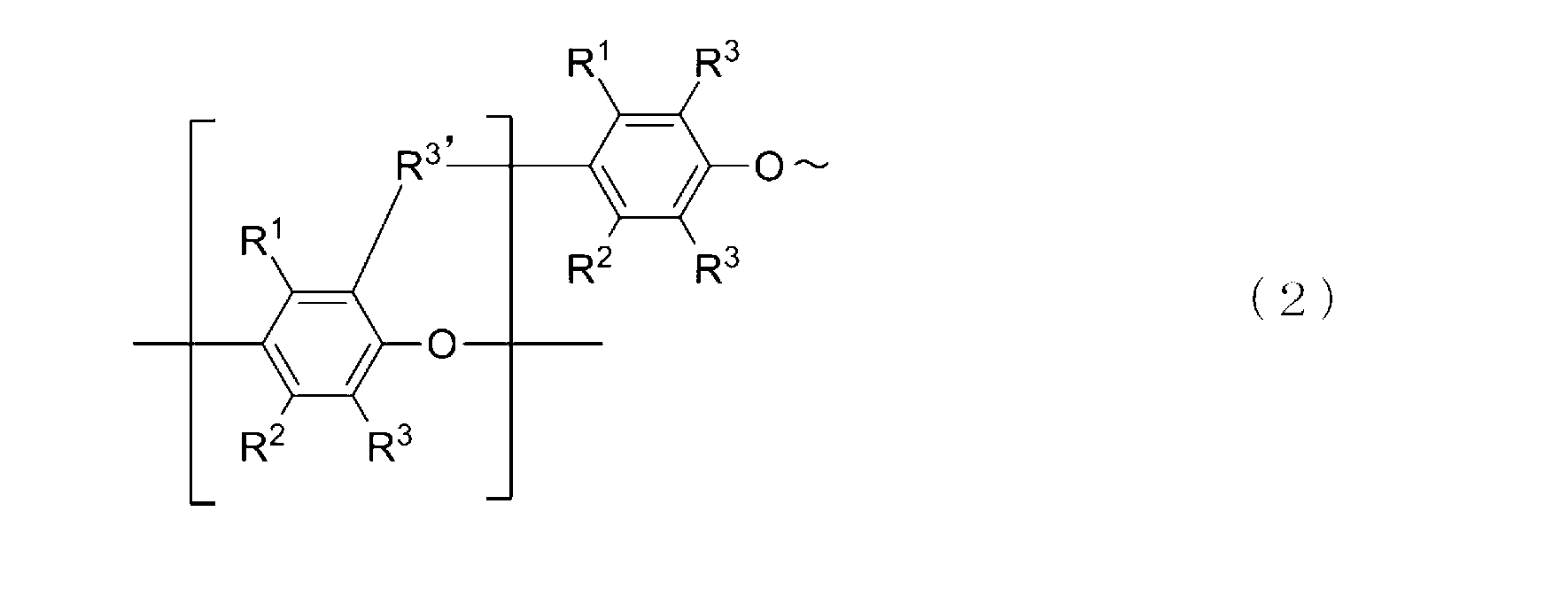
(式中、R1、R2は、それぞれ独立に、水素原子、又は、置換基を有していてもよい炭素数1以上10以下の炭化水素基であり、R3は、それぞれ独立に、置換基を有していてもよい炭素数1以上10以下の炭化水素基であり、R3’は、前記R3から水素原子が1個除かれた2価の基を表す)
で表される転位構造を有するポリフェニレンエーテル成分を含むポリフェニレンエーテルとすることが好ましい。このような転位構造を有することで、溶融成形が可能な程度に流動性が向上して、溶融紡糸繊維や不織布等を形成することができるものである。
前記転位構造を有するポリフェニレンエーテルとしては、例えば、下記一般式(2):
で表される転位構造を有するポリフェニレンエーテル成分を含むポリフェニレンエーテルとすることが好ましい。このような転位構造を有することで、溶融成形が可能な程度に流動性が向上して、溶融紡糸繊維や不織布等を形成することができるものである。
前記一般式(2)中のR1、R2、R3としては、前記一般式(1)のものと同様のものを例示することができる。前記一般式(2)中の「~」は、その先の構造は特に限定されないことを示す。「~」の部分は、パラ結合で連続するフェニレンエーテル単位から形成されていてもよく、また、その中に部分的にオルト位で結合する部分を有していてもよい。
前記R3’は、前記R3から水素原子が1個除かれた2価の基を表し、メチレン基であることが好ましい。
前記転位構造を有するポリフェニレンエーテル成分は、前記一般式(1)の繰り返し単位を有する単独重合体、異なる2種以上の一般式(1)の繰り返し単位を含有する共重合体、又は、前記一般式(1)の繰り返し単位と一般式(1)以外の繰り返し単位を含む共重合体中に、前記一般式(2)で表される転位構造を有するものが好ましい。
前記転位構造を有するポリフェニレンエーテル成分における転位量は、特に限定されるものではないが、前記ポリフェニレンエーテル成分中の全ポリフェニレンエーテル構造単位に対して、0.01モル%以上であることが好ましく、0.05モル%以上であることがより好ましく、0.1モル%以上であることがさらに好ましく、0.15モル%以上であることが特に好ましい。さらに単糸繊度が15dtex以下の細繊度の繊維を得るには2モル%以上が好ましい。また、転位量の上限値は特に限定されないが、20モル%以下であることが好ましく、18モル%以下であることがより好ましく、5モル%以下であることがさらに好ましく、4モル%以下であることが特に好ましい。転位構造を有するポリフェニレンエーテル成分における転位量が前記範囲にあることで、溶融成形が可能な程度に流動性が向上し、溶融紡糸繊維とすることができるため、好ましい。転位量の測定方法は、実施例に記載の方法により測定することができる。
前記転位構造を有するポリフェニレンエーテル成分の形成方法は、後述の通りである。
前記、高Tgと低Tgを有するポリフェニレンエーテルを混合して、溶融粘度を低下させる方法については、ポリフェニレンエーテル繊維の製造方法で説明する。
<ポリフェニレンエーテル成分以外の成分>
本発明で用いるポリフェニレンエーテル繊維には、前記ポリフェニレンエーテル成分以外の樹脂成分を含むことができる。ポリフェニレンエーテル以外の樹脂成分としては、スチレン、ポリエチレン、ポリプロピレンやポリアミド4、ポリアミド6、ポリアミド10、ポリアミド11、ポリアミド66、ポリアミド6T、ポリアミド6T/11等のポリアミド、ポリエチレンテレフタレート、ポリブチレンテレフタレート等のポリエステル、ポリカーボネート等を挙げることができる。但し、その含有量は、5質量%以下であることが好ましく、2質量%以下であることがより好ましく、含まない(0質量%)ことがさらに好ましい。
本発明で用いるポリフェニレンエーテル繊維には、前記ポリフェニレンエーテル成分以外の樹脂成分を含むことができる。ポリフェニレンエーテル以外の樹脂成分としては、スチレン、ポリエチレン、ポリプロピレンやポリアミド4、ポリアミド6、ポリアミド10、ポリアミド11、ポリアミド66、ポリアミド6T、ポリアミド6T/11等のポリアミド、ポリエチレンテレフタレート、ポリブチレンテレフタレート等のポリエステル、ポリカーボネート等を挙げることができる。但し、その含有量は、5質量%以下であることが好ましく、2質量%以下であることがより好ましく、含まない(0質量%)ことがさらに好ましい。
本発明で用いるポリフェニレンエーテル繊維において、ポリフェニレンエーテルの含有量が、繊維を形成する全成分中95質量%以上であることが好ましく、98質量%以上であることがより好ましく、実質的にポリフェニレンエーテルのみ(100質量%)からなることがさらに好ましい。ポリフェニレンエーテル繊維における前記ポリフェニレンエーテルの含有量が前記範囲にあることで、得られた繊維の機械的強度に優れるのみならず、耐熱性、耐薬品性、難燃性等に優れるものであり、好ましい。
また、前記ポリフェニレンエーテル繊維には、本発明の効果を損なわない範囲で、滑剤、可塑剤、酸化防止剤、紫外線吸収剤、ダル剤、静電防止剤等の添加剤も添加することができる。
<ポリフェニレンエーテル繊維の製造方法>
ポリフェニレンエーテル繊維の製造方法としては、溶融紡糸や乾式紡糸や湿式紡糸等の各種製造方法により製造することができる。これらの中でも、生産性が高くできること等から、溶融紡糸が好ましい。
ポリフェニレンエーテル繊維の製造方法としては、溶融紡糸や乾式紡糸や湿式紡糸等の各種製造方法により製造することができる。これらの中でも、生産性が高くできること等から、溶融紡糸が好ましい。
ポリフェニレンエーテル溶融紡糸繊維を製造する場合の一例を、図1を用いて説明する。原料であるポリフェニレンエーテルを図1のホッパー1からシリンダー及びスクリューを備えた押出機2に投入し、溶融したポリフェニレンエーテルはギアポンプ3により吐出速度を計量し、微細なサンドなどで構成された濾材4を通過して紡糸ノズル5から吐出されて、溶融紡糸繊維を得ることができる。また、濾材4上には、金属不織布などで構成されたフィルター6を設置することが好ましい。フィルター6を設置することで、あらかじ異物を除去することができ、前記濾材4の目詰まり等を防ぐことができるため好ましい。
また、紡糸ノズル5の直下には、保温スペース7を設け、当該領域に、窒素等の不活性ガスを導入8して紡糸することが、酸化的架橋によるノズル詰まりの抑制の観点から好ましく、加熱トーチ9により、加熱した不活性化ガスを導入することがより好ましい。加熱した不活性ガスの温度は、100℃以上500℃以下であることが好ましく、200℃以上400℃以下であることがより好ましい。
紡糸速度は、特に限定されるものではなく、求められる繊度等に応じて適宜設定することができるが、細繊度の繊維を安定して得るためには、100m/分以上5000m/分以下程度であることが好ましく、100m/分以上3000m/分以下程度であることがより好ましい。
前記紡糸ノズルの単孔吐出量は、1.0g/分以下であることが好ましく、0.8g/分以下であることがより好ましく、0.6g/分以下であることがさらに好ましい。また、単孔吐出量の下限は特に限定されないが、0.05g/分以上であることが好ましく、0.1g/分以上であることがより好ましく、0.12g/分以上であることがさらに好ましい。単孔吐出量を前記範囲にすることで、細繊度のポリフェニレンエーテル繊維を得ることができるため好ましい。
原料であるポリフェニレンエーテルとしては、前記一般式(1)の繰り返し単位を有する単独重合体、又は異なる2種以上の一般式(1)の繰り返し単位を含有する共重合体や、前記一般式(1)の繰り返し単位と一般式(1)以外の繰り返し単位を有する共重合体を挙げることができる。前記共重合体における一般式(1)以外の繰り返し単位の含有量としては、前述のものを挙げることができる。これらの中でも、前記一般式(1)の繰り返し単位を有する単独重合体が好ましい。
前記一般式(1)の繰り返し単位を有する単独重合体としては、具体的には、ポリ(2,6-ジメチル-1,4-フェニレンエーテル)、ポリ(2,6-ジエチル-1,4-フェニレンエーテル)、ポリ(2-メチル-6-エチル-1,4-フェニレンエーテル)、ポリ(2,6-ジプロピル-1,4-フェニレンエーテル)等を挙げることができるが、これらの中でも、ポリ(2,6-ジメチル-1,4-フェニレンエーテル)が好ましい。
前記ポリ(2,6-ジメチル-1,4-フェニレンエーテル)としては、市販品も好適に用いることができ、具体的は、例えば、SABIC Innovative Plastic製のPPO640、PPO646、PPOSA120、旭化成ケミカルズ(株)製のザイロンS201A、ザイロンS202A等を挙げることができる。
また、前述の通り、ポリフェニレンエーテルを溶融するに当たり、高Tgと低Tgを有するポリフェニレンエーテルを混合して、溶融粘度を低下させることができる。
高ガラス転移点温度を有するポリフェニレンエーテル成分のガラス転移点温度は、170℃以上であることが好ましく、200℃以上であることがより好ましく、210℃以上であることさらに好ましい。また、ガラス転移点温度の上限値は特に限定されないが、230℃以下であることが好ましい。原料であるポリフェニレンエーテルのガラス転移点温度が前記範囲にあることで、高い耐熱性を有するポリフェニレンエーテル繊維が得られるため、好ましい。
低ガラス転移点温度を有するポリフェニレンエーテル成分のガラス転移点温度は、170℃未満であることが好ましい。ガラス転移点温度が170℃未満のポリフェニレンエーテルを加えることで、溶融粘度が低下して、流動性が向上する。
前記ガラス転移点温度が170℃以上であるポリフェニレンエーテルの含有量は、原料であるポリフェニレンエーテル成分中、70質量%以上であることが好ましく、80質量%以上であることがより好ましく、90質量%以上であることがさらに好ましい。また、ガラス転移点温度が170℃以上であるポリフェニレンエーテルの含有量の上限値は特に限定されるものではないが、100質量%以下であることが好ましい。本発明においては、ガラス転移点温度が高い(すなわち高分子量)のポリフェニレンエーテルを前記範囲で含むことが、得られるポリフェニレンエーテル繊維の機械的強度、耐熱性、耐薬品性、難燃性等に優れるため、好ましい。
また、原料であるポリフェニレンエーテルと共に、ポリフェニレンエーテル成分以外の樹脂成分や添加剤を含むことができる。ポリフェニレンエーテル成分以外の樹脂成分や添加剤としては、前述の通りである。また、ポリフェニレンエーテル成分以外の樹脂成分の含有量は、原料中に5質量%以下であることが好ましく、2質量%以下であることがより好ましく、含まない(0質量%)ことがさらに好ましい。
前記シリンダー及びスクリューを備えた押出機としては、本分野で通常用いることができる単軸押出機や二軸押出機を用いることができる。本発明においては、二軸押出機を用いることが好ましい。
スクリューの周速については、特に限定されず、本分野において通常用いる範囲とすることができる。但し、転位構造を有するポリフェニレンエーテルを用いて繊維を形成する場合、前記スクリューの周速は、原料であるポリフェニレンエーテルの転位反応が起こるスクリューの周速が必要であり、3.6m/min以上であり、3.7m/min以上であることが好ましく、3.8m/min以上であることがより好ましい。また、スクリューの周速の上限値は、特に限定されないが、94.2m/min以下であることが好ましい。本発明においては、スクリュー回転数上げてスクリューの周速を3.6m/min以上とすることで、シリンダー内の原料ポリフェニレンエーテルに高剪断力を付与することができ、その結果、ポリフェニレンエーテルの分子鎖を切断して、転位構造を有するポリフェニレンエーテルが形成できるものである。前記転位構造を有するポリフェニレンエーテルが形成することで、ポリフェニレンエーテルの溶融紡糸を可能にしたものである。
シリンダー内の温度は、低すぎると樹脂の流動性が悪く、高すぎると流動性は改善されるものの、樹脂の熱分解による発泡現象が発生するため、そのバランスが取れる加工温度を選択する必要がある。シリンダー内の温度としては、例えば、250℃以上350℃以下であることが好ましく、280℃以上330℃以下であることがより好ましい。
また、本発明で用いるポリフェニレンエーテル繊維は、短繊維であってもよく、例えば、前記ポリフェニレンエーテル繊維を合糸してトウ状にした繊維をカットすることにより得ることができる。
本発明で使用するポリフェニレンエーテル繊維のガラス転移温度は、170℃以上であることが好ましく、175℃以上であることがより好ましく、180℃以上であることがさらに好ましい。ガラス転移温度が前記範囲にあることで、非常に高い耐熱性を付与できるものである。また、上限値は特に限定されるものではないが、300℃以下であることが好ましく、250℃以下であることがより好ましい。
本発明で使用するポリフェニレンエーテル繊維は、捲縮加工が施されたものが、補強繊維との絡みが良好で、均一性の高い不織布を形成することができるため好ましい。捲縮数としては、特に限定されないが、2個/25mm以上24個/25mm以下であることが好ましい。捲縮数が2個/25mmより小さいと、補強繊維とポリフェニレンエーテル繊維の絡みが悪く、補強繊維を開繊しながらカード機を通過させることができなくなり、不織布化することが困難になる場合がある。また、捲縮数が24個/25mmを超えると、ポリフェニレンエーテル繊維の絡み合いが強すぎてカード機の通過性が悪くなり、ウェブを形成することが困難になる場合がある。本発明においては、ポリフェニレンエーテル繊維の捲縮数を、2個/25mm以上24個/25mm以下とすることで、ポリフェニレンエーテル繊維と補強繊維との絡みが良好になり、均一性の高い不織布を形成することができるため好ましい。捲縮数は、2.5個/25mm以上であることがより好ましく、3個/25mm以上であることがさらに好ましく、5個/25mm以上であることが特に好ましい。また、捲縮数は、22個/25mm以下であることがより好ましく、20個/25mm以下であることがさらに好ましく、15個/25mm以下であることが特に好ましい。ポリフェニレンエーテル繊維に捲縮を付与する方法としては、後述の通りである。
前記ポリフェニレンエーテル繊維は、油剤が付着していることが好ましく、油剤付着量は、繊維の質量に対して、0.03質量%以上であることが好ましく、0.05質量%以上であることがより好ましく、0.07質量%以上であることがさらに好ましく、0.08質量%以上であることがさらに好ましく、0.1質量%以上であることが特に好ましい。また、油剤付着量の上限値は特に限定されないが、通常、5質量%以下程度である。ポリフェニレンエーテル繊維は、帯電しやすいため、油剤付着量を前記範囲にすることで、ポリフェニレンエーテル繊維をカード機に通す際の帯電を抑制でき、ウェブを作製がより容易になるため好ましい。
前記油剤としては、特に限定されるものではなく、一般的に紡糸の際に使用される油剤を使用することができる。紡糸油剤は、繊維に平滑性や帯電防止性を付与するものであり、例えば、水不溶性油剤、水溶性油剤、乳化油剤等を挙げることができ、これらの中でも、水溶性油剤が好ましい。
前記ポリフェニレンエーテル繊維の残留溶媒量は、特に限定されないが、3質量%以下であることが好ましく、2質量%以下であることがより好ましく、1質量%以下であることがさらに好ましく、0.5質量%以下であることがさらに好ましく、0.1質量%以下であることが特に好ましい。ポリフェニレンエーテル繊維の残留溶媒量が前記範囲にあることで、耐熱性向上の観点から好ましい。
前記ポリフェニレンエーテル繊維の繊度は、特に限定されず、繊維が使用される目的に応じて適宜決定できるが、例えば、100dtex以下であることが好ましく、95dtex以下であることがより好ましく、90dtex以下であることがさらに好ましい。繊度が前記範囲にあることで、繊維同士の絡み合いが強くなり、不織布としての強度が向上するため好ましい。また、繊度の下限値は特に限定されるものではないが、0.1dtex以上であることが好ましく、0.2dtex以上であることがより好ましい。
前記ポリフェニレンエーテル繊維の平均繊維長は特に制限されず、用途に応じて適宜調整することができるが、通常、1mm以上200mm以下であり、好ましくは2mm以上180mm以下、より好ましくは5mm以上150mm以下である。
1-2.補強繊維
補強繊維としては、特に限定されるものではないが、例えば、炭素繊維、ガラス繊維、バサルト繊維、PBO繊維、金属繊維等を挙げることができる。これらの中でも、本発明の耐炎化不織布の耐熱性、機械的強度をより向上させることができることより、無機系補強繊維(炭素繊維、ガラス繊維、バルサト繊維、金属繊維)が好ましく、炭素繊維及びガラス繊維の少なくとも一方であることがより好ましい。
補強繊維としては、特に限定されるものではないが、例えば、炭素繊維、ガラス繊維、バサルト繊維、PBO繊維、金属繊維等を挙げることができる。これらの中でも、本発明の耐炎化不織布の耐熱性、機械的強度をより向上させることができることより、無機系補強繊維(炭素繊維、ガラス繊維、バルサト繊維、金属繊維)が好ましく、炭素繊維及びガラス繊維の少なくとも一方であることがより好ましい。
前記炭素繊維としては、ポリアクリロニトリル(PAN)系、ピッチ系、レーヨン系等の各種炭素繊維を挙げることができる。これらの中でも、ポリフェニレンエーテル繊維との分散性の観点から、ポリアクリロニトリル系炭素繊維が好ましい。
前記ガラス繊維の材質は、特に限定されるものではなく、Eガラス、Cガラス、Aガラス、Sガラス、S-2ガラス等の各種ガラス繊維を挙げることができる。これらの中でもEガラスが好ましい。
前記補強繊維の繊度は特に制限されず、用途に応じて適宜調整することができるが、通常、0.1dtex以上100dtex以下であり、好ましくは0.5dtex以上100dtex以下、より好ましくは0.1dtex以上100dtex以下である。
前記補強繊維の平均繊維長は特に制限されず、用途に応じて適宜調整することができるが、通常、1mm以上200mm以下である。補強繊維の平均繊維長は、2mm以上であることが好ましく、5mm以上であることがより好ましく、10mm以上であることがさらに好ましく、15mm以上であることがさらに好ましく、20mm以上であることが特に好ましい。また、150mm以下であることが好ましく、120mm以下であることがより好ましく、100mm以下であることがさらに好ましい。補強繊維の平均繊維長が前記範囲であることにより、ポリフェニレンエーテル繊維との分散性が向上し、均一な不織布を形成しやすくなるため、好ましい。
本発明の補強繊維の1%重量減少温度は400℃以上であることが好ましく、420℃以上であることがより好ましく、450℃以上であることがさらに好ましい。1%質量減少温度が前記範囲にあることで、得られた不織布の耐熱性が向上するため好ましい。
前記補強繊維の含有率は、不織布中に、10質量%以上であることが好ましく、20質量%以上であることがより好ましく、30質量%以上であることがさらに好ましい。また、含有率は、90質量%以下であることが好ましく、80質量%以下であることがより好ましく、70質量%以下であることがさらに好ましい。補強繊維の繊維含有率が10質量%未満であると、不織布の耐熱性・難燃性に劣る場合があり、90質量%を超えると不織布の形成ができない場合があるため好ましくない。
1-3.その他の成分
本発明の耐炎化不織布は、前記耐炎化ポリフェニレンエーテル繊維と補強繊維を含むものであるが、耐炎化ポリフェニレンエーテル繊維と補強繊維の界面接着強度を向上させるため、サイジング剤を付与することができる。サイジング剤は、特に限定されず、例えば、エポキシ樹脂、ウレタン樹脂、ポリエステル樹脂、ビニルエステル樹脂、ポリアミド樹脂、ポリエーテル樹脂、アクリル樹脂、ポリオレフィン樹脂、ポリイミド樹脂やその変性物が挙げられる。なお、ポリフェニレンエーテル繊維の成分に応じ、適したサイジング剤を適宜選択することができる。また、このサイジング剤は二種類以上を組み合わせて使用することも可能である。これらの中でも、エポキシ樹脂系のサイジング剤であることが好ましい。
本発明の耐炎化不織布は、前記耐炎化ポリフェニレンエーテル繊維と補強繊維を含むものであるが、耐炎化ポリフェニレンエーテル繊維と補強繊維の界面接着強度を向上させるため、サイジング剤を付与することができる。サイジング剤は、特に限定されず、例えば、エポキシ樹脂、ウレタン樹脂、ポリエステル樹脂、ビニルエステル樹脂、ポリアミド樹脂、ポリエーテル樹脂、アクリル樹脂、ポリオレフィン樹脂、ポリイミド樹脂やその変性物が挙げられる。なお、ポリフェニレンエーテル繊維の成分に応じ、適したサイジング剤を適宜選択することができる。また、このサイジング剤は二種類以上を組み合わせて使用することも可能である。これらの中でも、エポキシ樹脂系のサイジング剤であることが好ましい。
前記サイジング剤の添加量は、特に限定されないが、0.1~5質量%であることが好ましい。
また、本発明の不織布は、本発明の効果を損なわない範囲で、ポリフェニレンエーテル以外の熱可塑繊維を含むこともできる。
本発明の不織布には、耐炎化ポリフェニレンエーテル繊維と補強繊維以外に、バインダー繊維を含むこともできるが、本発明においてはバインダー繊維を含まなくてもよい。
2.耐炎化不織布の製造方法
本発明の耐炎化ポリフェニレンエーテル繊維及び補強繊維を含む耐炎化不織布の製造方法は、
ポリフェニレンエーテル繊維及び補強繊維を含む不織布を形成する工程、
得られた不織布を、空気中で、120℃以上240℃以下で、1時間以上30時間以下熱処理して不融化する工程、
不融化した不織布を、空気中で、260℃以上400℃以下で、0.1時間以上10時間以下熱処理して耐炎化する工程を含むことを特徴とする。
本発明の耐炎化ポリフェニレンエーテル繊維及び補強繊維を含む耐炎化不織布の製造方法は、
ポリフェニレンエーテル繊維及び補強繊維を含む不織布を形成する工程、
得られた不織布を、空気中で、120℃以上240℃以下で、1時間以上30時間以下熱処理して不融化する工程、
不融化した不織布を、空気中で、260℃以上400℃以下で、0.1時間以上10時間以下熱処理して耐炎化する工程を含むことを特徴とする。
前記ポリフェニレンエーテル繊維、耐炎化ポリフェニレンエーテル繊維、補強繊維については、前述の通りである。
ポリフェニレンエーテル繊維と補強繊維を含む不織布の形成は、本分野において通常用いられる方法により形成することができるが、例えば、ポリフェニレンエーテル繊維と補強繊維を前述の割合でブレンダー機により混綿し、その後、カード機によりカーディング方式によりウェブを形成し、得られたウェブを、ニードルパンチ法、スパンレース法等のウェブ繊維結合処理を行うことにより不織布を形成することができる。
また、前記不織布を形成する前に、ポリフェニレンエーテル繊維に油剤を付着させる工程や、ポリフェニレンエーテル繊維に捲縮加工を施す工程を含むことができる。
油剤の付着方法としては、特に限定されるものではなく、本分野において通常用いられる方法を挙げることができる。具体的には、ポリフェニレンエーテル溶融紡糸繊維にギアポンプを用いて紡糸油剤を塗布することができる。その吐出量は、特に限定されるものではなく、目的の油剤付着量を達成できる吐出量であればよく、例えば、0.01g/min以上0.5g/min以下程度であることが好ましく、0.015g/min以上0.4g/min以下程度であることがより好ましい。吐出量を前記範囲にすることで、油剤付着量を適切な範囲にすることができ、その結果、ポリフェニレンエーテル繊維がカード機を通過する際の帯電を防止することができ、均一な不織布を製造することが容易になるため好ましい。
前記捲縮加工としては、目的の捲縮数となるように加工できる方法であれば特に限定されるものではなく、例えば、仮撚加工、押込加工、ギア加工、複合捲縮加工等が挙げられるが、これらの中でも、生産性の観点から、押込加工が好ましい。好ましい捲縮数は、前述の通りである。
本発明の製造方法においては、上記で得られた不織布に、不融化処理・耐炎化処理を行う。
前記不融化処理では、ポリフェニレンエーテル繊維と補強繊維を含む不織布を、空気中で、120℃以上220℃以下で、1時間以上30時間以下処理をする。ここで、空気中とは、特に調整されていない環境のことである。また、処理温度は、120℃以上であり、140℃以上であることが好ましく、160℃以上であることがより好ましい。また、処理温度は、240℃以下であり、230℃以下であることが好ましく、220℃以下であることがより好ましい。また、処理時間は、1時間以上であり、1.5時間以上であることが好ましく、2時間以上であることがより好ましい。また、処理時間は、30時間以下であり、25時間以下であることが好ましく、23時間以下であることがより好ましい。前記処理時間及び処理温度とすることで、引き続き行う耐炎化処理において、ポリフェニレンエーテル繊維が溶融してしまうことなく、適切な耐炎化処理を施すことができる。
前記不融化処理の後に、耐炎化処理として、空気中で、260℃以上400℃以下で、0.1時間以上10時間以下処理をする。空気中とは、特に調整されていない環境のことである。また、処理温度は、260℃以上であり、270℃以上であることが好ましく、280℃以上であることがより好ましい。また、処理温度は、400℃以下であり、380℃以下であることが好ましく、360℃以下であることがより好ましい。また、処理時間は、0.1時間以上であり、0.3時間以上であることが好ましく、0.5時間以上であることがより好ましい。また、処理時間は、10時間以下であり、8時間以下であることが好ましく、6時間以下であることがより好ましい。前記処理時間及び処理温度とすることで、不織布中のポリフェニレンエーテル繊維にC=O結合構造が形成され、非常に高い難燃性(耐炎性)、耐熱性等を示す耐炎化された不織布とすることができるものである。
本発明の製造方法においては、ポリフェニレンエーテル繊維と補強繊維を含む不織布を、不融化処理、耐炎化処理するものであるが、予め不融化処理、耐炎化処理したポリフェニレンエーテル繊維と、補強繊維を用いて不織布を形成することもできる。ポリフェニレンエーテル繊維の不融化処理、耐炎化処理は、前記不織布の不融化処理、耐炎化処理と同じ方法を挙げることができる。
3.耐炎化成型体
本発明の耐炎化成型体は、赤外分光法による測定で、C=O伸縮振動に由来する波数1732cm-1の吸光度高さAとベンゼン環の炭素と炭素間の伸縮による骨格振動に由来する波長1600cm-1の吸光度高さBとの吸光度高さ比(A/B)が0.42以上である耐炎化ポリフェニレンエーテルと補強繊維を含むことを特徴とする。
本発明の耐炎化成型体は、赤外分光法による測定で、C=O伸縮振動に由来する波数1732cm-1の吸光度高さAとベンゼン環の炭素と炭素間の伸縮による骨格振動に由来する波長1600cm-1の吸光度高さBとの吸光度高さ比(A/B)が0.42以上である耐炎化ポリフェニレンエーテルと補強繊維を含むことを特徴とする。
補強繊維については、前述の通りである。また、吸光度高さ比(A/B)についても、前述の通りである。
耐炎化ポリフェニレンエーテルは、ポリフェニレンエーテルを耐炎化したものである。また、ポリフェニレンエーテルは、前述のポリフェニレンエーテル成分を含むものであればよい。
前記耐炎化成型体のLOI値は、46以上であることが好ましく、48以上であることがより好ましく、50以上であることがさらに好ましい。LOI値が前記範囲にあることで、非常に高い耐炎性を付与できるものである。ここで、LOI値とは、限界酸素指数のことであり、LOI値が大きい程、難燃性に優れるものである。従って、LOI値は大きければ大きい程好ましいものであり、その上限値は特に限定されないものである。
前記耐炎化成型体の1.80MPaの荷重における荷重たわみ温度が、250℃以上であることが好ましく、280℃以上であることがより好ましく、300℃以上であることがさらに好ましい。荷重たわみ温度が高いほど、成型体の耐熱性が高いことを意味するものであって、荷重たわみ温度は、高ければ高いほど好ましいものである。従って、荷重たわみ温度の上限値は特に限定されないが、例えば、600℃以下程度である。
耐炎化成型体の形状としては、特に限定されず、耐炎化成型体が使用される目的に応じて適宜決定でき、例えば、膜状(フィルムやフィルム状のものを含む)、板状に成型できるし、金型を用いて必要な形状にすることができる。板状にする場合には、その厚さは、特に限定されず、成型体が使用される目的に応じて適宜決定できるが、例えば、0.01mm以上、100mm以下程度であることが好ましく、0.05mm以上、80mm以下程度であることがより好ましい。
本発明の成型体に含まれるポリフェニレンエーテルと補強繊維の質量比は、特に限定されず、成型体が使用される目的に応じて適宜決定できるが、例えば、95/5以上、5/95以下程度であることが好ましく、90/10以上、10/90以下程度であることがより好ましく、60/40以上、40/60以下程度であることがさらに好ましい。
本発明の耐炎化成型体中の耐炎化ポリフェニレンエーテルの含有量は、耐炎化成型体全量に対して5質量%以上であることが好ましく、10質量%以上であることがより好ましい。また、成型体全量に対して95質量%以下であることが好ましく、90質量%以下であることがより好ましい。耐炎化ポリフェニレンエーテルの含有量が前記範囲にあることで、難燃性と強度を両立できるため好ましい。
本発明の耐炎化成型体中の補強繊維の含有量は、耐炎化成型体全量に対して5質量%以上であることが好ましく、10質量%以上であることがより好ましい。また、成型体全量に対して90質量%以下であることが好ましく、95質量%以下であることがより好ましい。補強繊維の含有量が前記範囲にあることで、優れた機械強度を発現するため好ましい。
本発明の成型体は、耐炎化ポリフェニレンエーテルと補強繊維を含むものであるが、その他の成分を含んでいてもよい。その他の成分の含有量は、成型体全量に対して、5質量%以下であることが好ましく、3質量%以下であることがより好ましく、含まない(0質量%)ことがさらに好ましい。また、その他の成分としては、前述の不織布に含むことができるその他の成分と同様のものを挙げることができる。
本発明の耐炎化成型体の製造方法は、特に限定されるものではなく、ポリフェニレンエーテル繊維及び補強繊維を含む不織布をプレスして成型した成型体を前述の耐炎化処理することにより製造することができ、具体的には、後述の本発明の耐炎化成型体の製造方法により良好に製造することができる。
4.耐炎化成型体の製造方法
本発明の耐炎化ポリフェニレンエーテル及び補強繊維を含む耐炎化成型体の製造方法は、ポリフェニレンエーテル繊維及び補強繊維を含む不織布をプレスして成型体を形成する工程、得られた成型体を、空気中で、120℃以上240℃以下で、1時間以上30時間以下熱処理して不融化する工程(不融化処理)、不融化した成型体を、空気中で、260℃以上400℃以下で、0.1時間以上10時間以下熱処理して耐炎化する工程(耐炎化処理)を含むことを特徴とする。
本発明の耐炎化ポリフェニレンエーテル及び補強繊維を含む耐炎化成型体の製造方法は、ポリフェニレンエーテル繊維及び補強繊維を含む不織布をプレスして成型体を形成する工程、得られた成型体を、空気中で、120℃以上240℃以下で、1時間以上30時間以下熱処理して不融化する工程(不融化処理)、不融化した成型体を、空気中で、260℃以上400℃以下で、0.1時間以上10時間以下熱処理して耐炎化する工程(耐炎化処理)を含むことを特徴とする。
ポリフェニレンエーテル繊維及び補強繊維を含む不織布、不融化処理、耐炎化処理については、前述の通りである。
プレス加工温度は、特に限定されないが、260℃以上が好ましく、280℃以上がより好ましい。また、上限値は、特に限定されないが、420℃以下が好ましく、400℃以下がより好ましい。プレス加工温度を前記範囲にすることで、ポリフェニレンエーテルの粘度が十分に高く、補強繊維の隙間に含侵して、その結果、成型体の力学物性が良好になる。
プレス加工圧は、特に限定されるものではないが、例えば、0.5MPa以上であることが好ましく、1MPa以上であることがより好ましい。また、50MPa以下であること好ましく、40MPa以下とすることがより好ましい。プレス加工圧を前記範囲にすることで、補強繊維の隙間に樹脂が十分含侵するため好ましい。
プレス加工の時間は、特に限定されるものではないが、0.5秒以上であることが好ましく、10秒以上であることがより好ましく、30秒以上であることがさらに好ましい。また、1200秒以下であることが好ましく、600秒以下であることがより好ましい。プレス加工の時間を前記範囲とすることで、補強繊維間の樹脂の含侵性と、熱劣化の抑制を両立できるため好ましい。
前記プレス加工は、本分野で通常行われている方法で行うことができる。
本発明の耐炎化不織布、耐炎化成型体は、例えば、自動車用吸音材、自動車内装材、断熱材、家庭用消火布、防火カバー、ダクト用表面材、プラスチック防炎材、延焼防止材、粉塵飛散防止用表面材、セメント補強材、摩擦材、グランドパッキング、シール材、消防服、溶接火花防護シート等に用いることができるが、特に高度な難燃性が要求される航空宇宙材料等の分野において好適に用いることができる。
以下、実施例及び比較例を示して本発明をより具体的に説明するが、本発明は以下の実施例によって限定されるものではない。なお、以下の実施例における物性等の評価方法は以下の通りである。
(1)繊度
試料の任意の場所5点を選び、光学顕微鏡を用いて単繊維径をn=20で測定して、全平均値(D)を求めた。同じ場所5点の繊維を取り出し、密度勾配管を用いて繊維の比重をn=5で測定し、全平均値(p)を求めた。ついで、平均単繊維径より求めた単繊維断面積と平均比重から10000mあたりの繊維重量である繊度[dtex]を求めた。
試料の任意の場所5点を選び、光学顕微鏡を用いて単繊維径をn=20で測定して、全平均値(D)を求めた。同じ場所5点の繊維を取り出し、密度勾配管を用いて繊維の比重をn=5で測定し、全平均値(p)を求めた。ついで、平均単繊維径より求めた単繊維断面積と平均比重から10000mあたりの繊維重量である繊度[dtex]を求めた。
(2)捲縮数
JIS L 1015:2010 8.12.1に準拠して測定した。
JIS L 1015:2010 8.12.1に準拠して測定した。
(3)油剤付着量
JIS L 1015:2010 8.22 a)に準拠して測定した。但し溶剤は、エタノール・ベンゼン混合液から、エタノールのみに変更し測定を実施した。
JIS L 1015:2010 8.22 a)に準拠して測定した。但し溶剤は、エタノール・ベンゼン混合液から、エタノールのみに変更し測定を実施した。
(4)吸光度高さ比(A/B)
実施例、比較例で得られた不織布、成型体をそのまま測定試料とした。
赤外分光光度計(FTIR)(製品名:3100FT-IR/600UMA、バリアン社製)を用い、得られた試料を顕微透過法により以下の条件で吸光度を測定した。
(測定条件)
視野:80mm×80mm
測定波長範囲:400cm-1から4000cm-1
積算回数:128回
分解能:4cm-1
得られたスペクトルの、波長1550~1480cm-1の最小値及び1900~1800cm-1の最小値を結ぶ基準線を引き、当該基準線からのピーク高さ(ピーク吸光度高さ)で評価を実施した。
1742~1722cm-1のピーク高さを吸光度高さA、1610~1590cm-1のピーク高さを吸光度高さBとし、A/Bの値で規定した。
実施例、比較例で得られた不織布、成型体をそのまま測定試料とした。
赤外分光光度計(FTIR)(製品名:3100FT-IR/600UMA、バリアン社製)を用い、得られた試料を顕微透過法により以下の条件で吸光度を測定した。
(測定条件)
視野:80mm×80mm
測定波長範囲:400cm-1から4000cm-1
積算回数:128回
分解能:4cm-1
得られたスペクトルの、波長1550~1480cm-1の最小値及び1900~1800cm-1の最小値を結ぶ基準線を引き、当該基準線からのピーク高さ(ピーク吸光度高さ)で評価を実施した。
1742~1722cm-1のピーク高さを吸光度高さA、1610~1590cm-1のピーク高さを吸光度高さBとし、A/Bの値で規定した。
(5)1%質量減少温度
TAインスツルメンツ(株)製の熱重量測定装置(型式:TGA Q50)を用いて、補強繊維10mgを白金パンに詰め、20℃から900℃まで20℃/分で昇温し、質量が1%減少したときの温度を測定した。
TAインスツルメンツ(株)製の熱重量測定装置(型式:TGA Q50)を用いて、補強繊維10mgを白金パンに詰め、20℃から900℃まで20℃/分で昇温し、質量が1%減少したときの温度を測定した。
(6)繊維質量含有率(Wf)
500℃×4hオーブンで熱処理し、処理前後の質量より以下の式で求めた。
繊維質量含有率(%)=処理後質量/処理前質量×100
500℃×4hオーブンで熱処理し、処理前後の質量より以下の式で求めた。
繊維質量含有率(%)=処理後質量/処理前質量×100
(7)厚み
任意の場所20点を選択して、(株)尾崎製作所製の定圧厚み測定器(7gf/cm2)にて測定した。
任意の場所20点を選択して、(株)尾崎製作所製の定圧厚み測定器(7gf/cm2)にて測定した。
(8)目付量
JIS L1906(2000)5.2 単位面積当たりの質量に準拠して測定した。
JIS L1906(2000)5.2 単位面積当たりの質量に準拠して測定した。
(9)LOI値(難燃性)
JIS L 1091 E法に準拠して測定した。酸素指数の決定は50mm以上燃焼し続けた時で、点火器の熱源はプロパンガスを用いた。
JIS L 1091 E法に準拠して測定した。酸素指数の決定は50mm以上燃焼し続けた時で、点火器の熱源はプロパンガスを用いた。
(10)ポリフェニレンエーテル繊維中の転位構造量
共鳴周波数600MHzの1H-NMR測定にて行った。測定装置は、BRUKER社製のNMR装置(装置名:AVANCE-NEO600)を用い、測定は以下の通りに行った。
実施例及び比較例で得られたポリフェニレンエーテル繊維10mgを重クロロホルムに溶解後、その溶液を2時間以内にNMRチューブに充填し測定を行った。ロック溶媒には重クロロホルムを用い、待ち時間を1秒、データ取り込み時間を4秒、積算回数を64回とした。また、溶媒として重ベンゼンを用いても良い。
転位構造量の解析は以下の通り実施した。
ポリフェニレンエーテルの3、5位のR1、R2基のプロトンに由来するピークと、転移構造中のR3’で示される2価の基(メチレン基等)のプロトンに由来するピークのそれぞれのピーク積分値をA、Bとし、転位構造量は以下の式により求めた。
転位構造量(mol%)=(B/(A+B))×100
共鳴周波数600MHzの1H-NMR測定にて行った。測定装置は、BRUKER社製のNMR装置(装置名:AVANCE-NEO600)を用い、測定は以下の通りに行った。
実施例及び比較例で得られたポリフェニレンエーテル繊維10mgを重クロロホルムに溶解後、その溶液を2時間以内にNMRチューブに充填し測定を行った。ロック溶媒には重クロロホルムを用い、待ち時間を1秒、データ取り込み時間を4秒、積算回数を64回とした。また、溶媒として重ベンゼンを用いても良い。
転位構造量の解析は以下の通り実施した。
ポリフェニレンエーテルの3、5位のR1、R2基のプロトンに由来するピークと、転移構造中のR3’で示される2価の基(メチレン基等)のプロトンに由来するピークのそれぞれのピーク積分値をA、Bとし、転位構造量は以下の式により求めた。
転位構造量(mol%)=(B/(A+B))×100
(11)ガラス転移温度(Tg)
TAインスツルメンツ(株)製の示差走査熱量分析計(型式:DSC-Q100)を用いて、繊維2mgを、窒素雰囲気下において30℃から250℃まで、昇温速度10℃/分にて測定し、ガラス転移温度以下のベースラインの延長線と遷移部における最大傾斜を示す接線との交点の温度をガラス転移温度(Tg)とした。
TAインスツルメンツ(株)製の示差走査熱量分析計(型式:DSC-Q100)を用いて、繊維2mgを、窒素雰囲気下において30℃から250℃まで、昇温速度10℃/分にて測定し、ガラス転移温度以下のベースラインの延長線と遷移部における最大傾斜を示す接線との交点の温度をガラス転移温度(Tg)とした。
(12)荷重たわみ温度
JIS K7191に準じて測定した。荷重は、1.80MPaで行った。
JIS K7191に準じて測定した。荷重は、1.80MPaで行った。
実施例1
ポリ(2,6-ジメチル-1,4-フェニレンエーテル)(PPO640、ガラス転移点温度(Tg):221℃、SABIC Innovative Plastic製)を、(株)テクノベル製2軸押出機(製品名:KZW15TW-30MG)を用いて押出した。前記2軸押出機は、シリンダーが4ゾーンを有しており、ホッパー側からシリンダーをそれぞれ、シリンダー1、2、3、4とし、シリンダー1~3は290℃に設定し、シリンダー4およびシリンダーヘッド部は310℃に設定し、スクリュー回転数は700rpmに設定してスクリューの周速を33.0m/minとした。
ポリ(2,6-ジメチル-1,4-フェニレンエーテル)(PPO640、ガラス転移点温度(Tg):221℃、SABIC Innovative Plastic製)を、(株)テクノベル製2軸押出機(製品名:KZW15TW-30MG)を用いて押出した。前記2軸押出機は、シリンダーが4ゾーンを有しており、ホッパー側からシリンダーをそれぞれ、シリンダー1、2、3、4とし、シリンダー1~3は290℃に設定し、シリンダー4およびシリンダーヘッド部は310℃に設定し、スクリュー回転数は700rpmに設定してスクリューの周速を33.0m/minとした。
押出機の下流には、ギアポンプを設置し、金属不織布フィルター(製品名:NF-07、日本精線(株)製)を介してノズル(ノズル孔直径:0.50mm、ノズル孔ランド長:1.0mm、ノズル孔数:24個)へ押し出した(総吐出量:12.64g/分)。ノズルから吐出されたポリマーを、紡糸速度1053m/分にて巻き取った。巻き取りの際に、容量0.06cc/revのギアポンプを用いて紡糸油剤を塗布し(吐出量:0.36g/min)、得られた繊維の油剤付着量は、0.2質量%であった。得られた繊維は、転位構造を有するものであり(転位構造量:全PPEユニットに対して2.8mol%)、ガラス転移温度は205℃であった。
ポリフェニレンエーテル繊維を10000dtexに合糸し、市販のクリンパーにてクリンプ加工を行い、ポリフェニレンエーテルステープルを作製した。クリンプ加工では水蒸気で100℃以上に加熱して加工した。
炭素繊維束を開繊した平均繊維長50mmのPAN系炭素繊維(製品名:T700、フィラメント径:7μm、1%質量減少温度:520℃、東レ(株)製)52質量%と平均繊維長51mmのポリフェニレンエーテルステープル48質量%を市販のブレンダーで混綿した後、市販のカード機によりカーディングすることによりウェブ状に加工した後、ニードルパンチ法にて繊維を交絡させ、不織布とした。得られた不織布の厚みは2.6mm、目付は250g/m2であった。
このようにして得られた不織布を空気中で、200℃×22時間熱処理(不融化処理)したのち、0.5℃/分で320℃まで昇温し、空気中で、320℃×2時間熱処理(耐炎化処理)をし、耐炎化させた。
得られた耐炎化不織布を赤外分光法で測定すると、1732cm-1にC=O伸縮振動に由来するピークが観測された。また、C=O伸縮振動に由来する波数1732cm-1の吸光度高さAとベンゼン環の炭素と炭素間の伸縮による骨格振動に由来する波長1600cm-1の吸光度高さBとの吸光度高さ比(A/B)は、0.59であった。
実施例2
補強繊維質量含有率を40質量%にした以外は実施例1と同様の方法により、耐炎化不織布を製造した。各評価結果は表1に示す。
補強繊維質量含有率を40質量%にした以外は実施例1と同様の方法により、耐炎化不織布を製造した。各評価結果は表1に示す。
実施例3
補強繊維を、平均繊維長70mmのガラス繊維(Eガラス、フィラメント径:10μm、1%質量減少温度:>500℃、日東紡績(株))にした以外は実施例1と同様の方法により、耐炎化不織布を製造した。各評価結果は表1に示す。
補強繊維を、平均繊維長70mmのガラス繊維(Eガラス、フィラメント径:10μm、1%質量減少温度:>500℃、日東紡績(株))にした以外は実施例1と同様の方法により、耐炎化不織布を製造した。各評価結果は表1に示す。
実施例4
補強繊維質量含有率を40質量%にした以外は実施例3と同様の方法により、耐炎化不織布を製造した。各評価結果は表1に示す。
補強繊維質量含有率を40質量%にした以外は実施例3と同様の方法により、耐炎化不織布を製造した。各評価結果は表1に示す。
比較例1
実施例1で得られたポリフェニレンエーテル繊維のみで、炭素繊維を入れずに作製した不織布を用いた以外は実施例1と同様にして耐炎化不織布を作製し、各種評価を行った。各評価結果は表1に示す。
実施例1で得られたポリフェニレンエーテル繊維のみで、炭素繊維を入れずに作製した不織布を用いた以外は実施例1と同様にして耐炎化不織布を作製し、各種評価を行った。各評価結果は表1に示す。
比較例2
耐炎化処理を行わなかった以外は実施例1と同様にして不織布を作製し、各種評価を行った。各評価結果は表1に示す。
耐炎化処理を行わなかった以外は実施例1と同様にして不織布を作製し、各種評価を行った。各評価結果は表1に示す。
比較例3
炭素繊維束を開繊した平均繊維長50mmのPAN系炭素繊維(製品名:T700、フィラメント径:7μm、1%質量減少温度:520℃、東レ(株)製)を市販のカード機によりカーディングすることによりウェブ状に加工した後、ニードルパンチ法にて繊維を交絡させ、不織布とした。
炭素繊維束を開繊した平均繊維長50mmのPAN系炭素繊維(製品名:T700、フィラメント径:7μm、1%質量減少温度:520℃、東レ(株)製)を市販のカード機によりカーディングすることによりウェブ状に加工した後、ニードルパンチ法にて繊維を交絡させ、不織布とした。
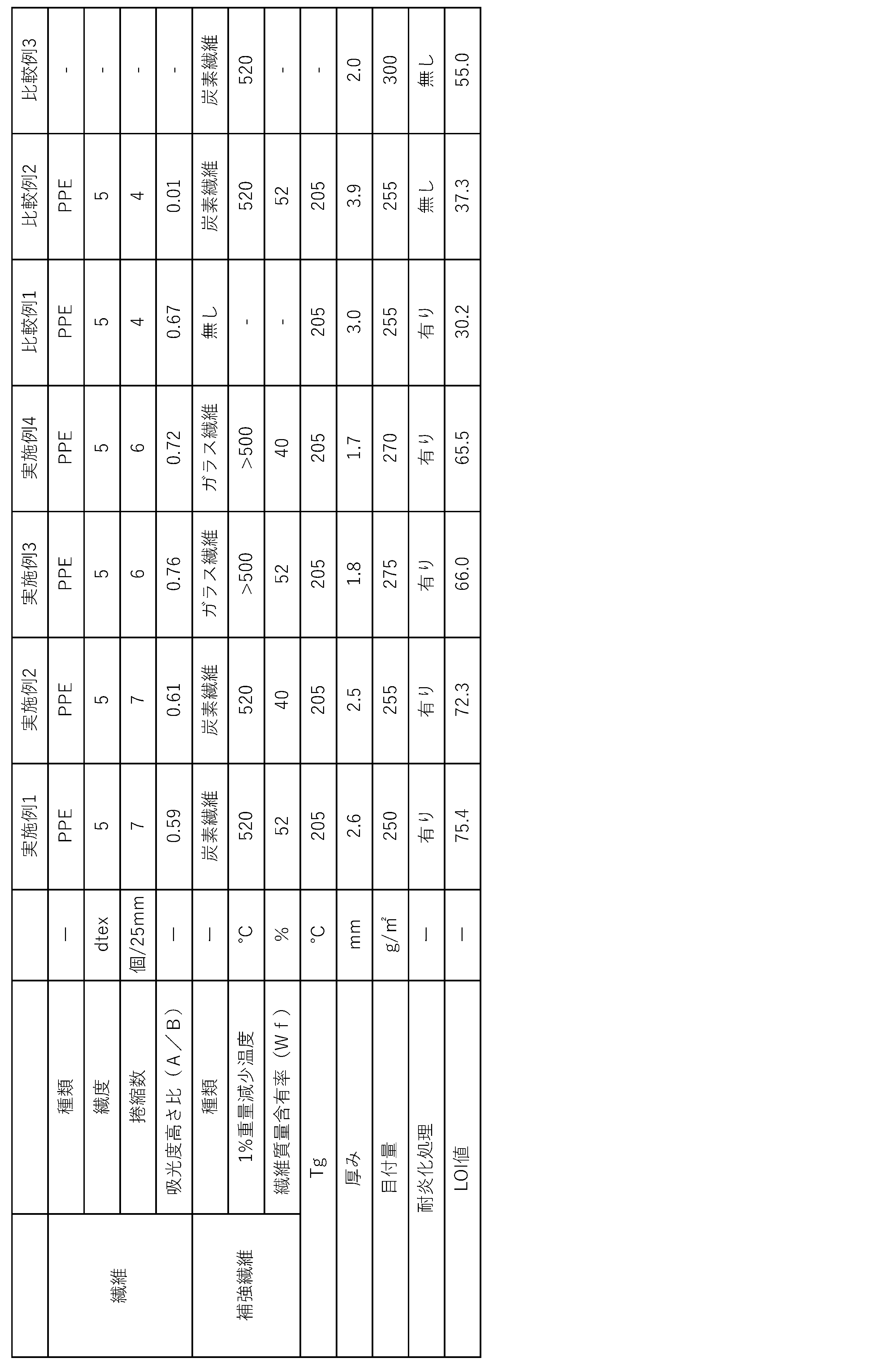
表1から明らかなように、本発明の耐炎化不織布はいずれもLOI値が65以上であり、非常に高度な難燃性を有していることが分かった。一方、補強繊維を添加していない比較例1、耐炎化処理を施していない比較例2、炭素繊維のみからなる比較例3では、難燃性の点で十分なものではなかった。
実施例5
実施例1と同様の方法で、クリンプ加工を施したポリフェニレンエーテル繊維を準備した。
実施例1と同様の方法で、クリンプ加工を施したポリフェニレンエーテル繊維を準備した。
炭素繊維束を開繊した平均繊維長70mmのPAN系炭素繊維(製品名:T700、フィラメント径:7μm、1%質量減少温度:520℃、東レ(株)製)52重量%と平均繊維長51mmのポリフェニレンエーテルステープル48質量%を市販のブレンダーで混綿した後、市販のカード機によりカーディングすることによりウェブ状に加工した後、ニードルパンチ法にて繊維を交絡させ、不織布とした。炭素繊維の繊維質量率は52質量%であり、得られた不織布の厚みは2.8mm、目付は300g/m2であった。
不織布を目付3000g/m2になるように重ね、ヒートプレス機にて350℃で、圧力10MPaの下、2分間圧縮成型して平板を成形した。
ヒートプレスしたサンプルを空気中で、200℃×22時間熱処理(不融化処理)したのち、0.5℃/分で320℃まで昇温し、空気中で、320℃×2時間熱処理(耐炎化処理)をし、耐炎化させた。
得られた耐炎化ポリフェニレンエーテルと補強繊維よりなる成型体を赤外分光法で測定すると、1732cm-1にC=O伸縮振動に由来するピークが観測された。また、C=O伸縮振動に由来する波数1732cm-1の吸光度高さAとベンゼン環の炭素と炭素間の伸縮による骨格振動に由来する波長1600cm-1の吸光度高さBとの吸光度高さ比(A/B)は、1.18であった。
実施例6
補強繊維質量含有率を40質量%にした以外は実施例5と同様の方法により、耐炎化不織布を製造した。各評価結果は表1に示す。
補強繊維質量含有率を40質量%にした以外は実施例5と同様の方法により、耐炎化不織布を製造した。各評価結果は表1に示す。
実施例7
補強繊維を、平均繊維長70mmのガラス繊維(Eガラス、フィラメント径:10μm、1%質量減少温度:>500℃、日東紡績(株))にした以外は実施例5と同様の方法により、耐炎化不織布を製造した。各評価結果は表1に示す。
補強繊維を、平均繊維長70mmのガラス繊維(Eガラス、フィラメント径:10μm、1%質量減少温度:>500℃、日東紡績(株))にした以外は実施例5と同様の方法により、耐炎化不織布を製造した。各評価結果は表1に示す。
比較例4
不融化・耐炎化処理を行わなかった以外は実施例3と同様にして成型体を作製し、各種評価を行った。各評価結果は表2に示す。
不融化・耐炎化処理を行わなかった以外は実施例3と同様にして成型体を作製し、各種評価を行った。各評価結果は表2に示す。
比較例5
炭素繊維を混合しなかった以外は比較例4と同様にして成型体を作製し、各種評価を行った。各評価結果は表2に示す。
炭素繊維を混合しなかった以外は比較例4と同様にして成型体を作製し、各種評価を行った。各評価結果は表2に示す。
比較例6
比較例5で得られた成型体を、実施例3と同様の方法で耐炎化処理したが、形状を維持することができず、評価をすることができなかった。
比較例5で得られた成型体を、実施例3と同様の方法で耐炎化処理したが、形状を維持することができず、評価をすることができなかった。
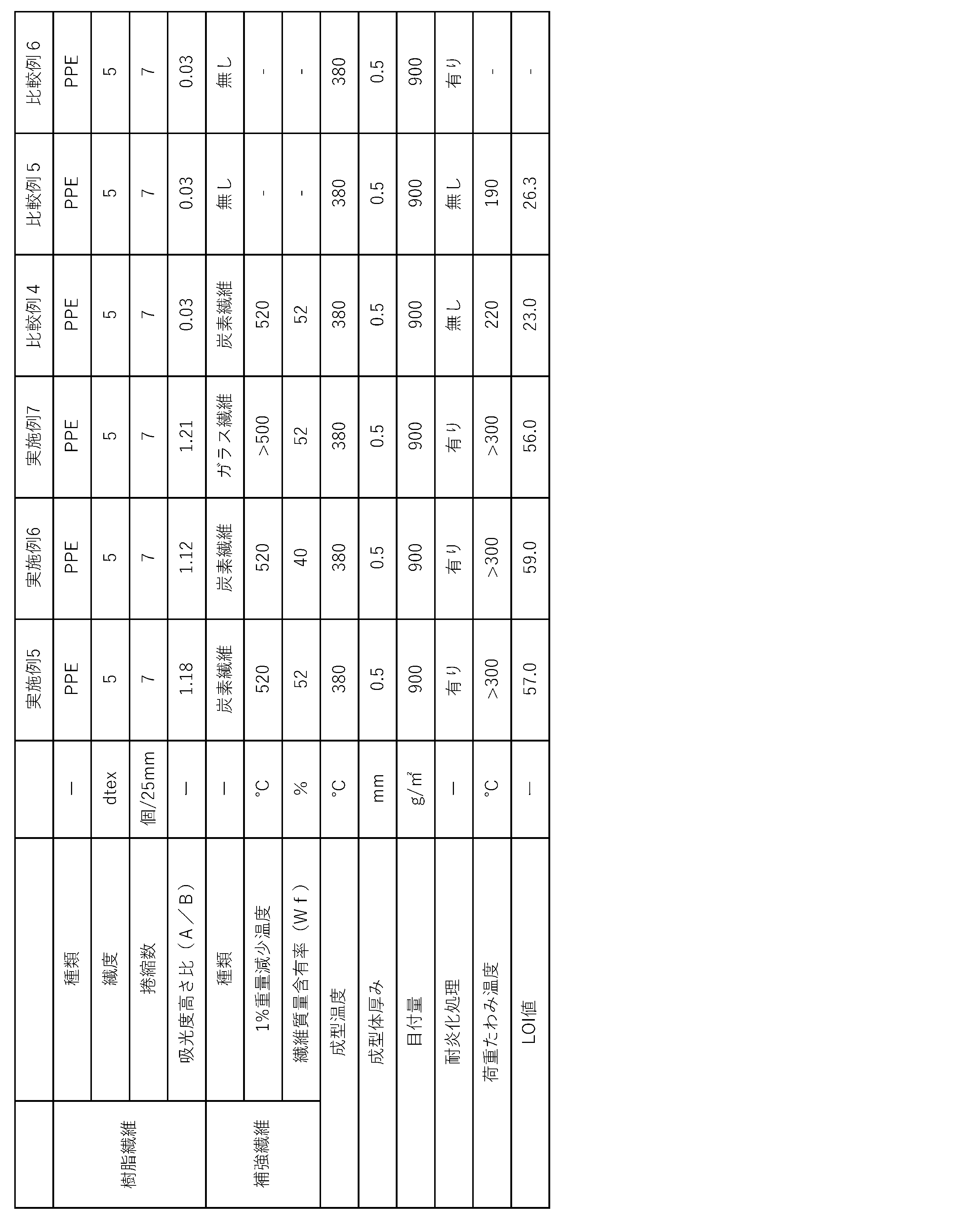
表2から明らかなように、本発明の耐炎化成型体はLOI値が55以上であり、非常に高度な難燃性を有していることが分かった。また、荷重たわみ温度が300℃以上であり、高い耐熱性を有していることが分かった。一方、耐炎化処理を施していない比較例4、炭素繊維を含まず、かつ、耐炎化処理を施していない比較例5では、難燃性、耐熱性のいずれもが十分なものではなかった。炭素繊維を含まない成型体に耐炎化処理を施した比較例6では、成型体の形状を維持することができなかった。
1 ホッパー
2 押出機
3 ギアポンプ
4 濾材
5 紡糸ノズル
6 フィルター
7 保温スペース
8 不活性ガスの導入
9 加熱トーチ
2 押出機
3 ギアポンプ
4 濾材
5 紡糸ノズル
6 フィルター
7 保温スペース
8 不活性ガスの導入
9 加熱トーチ
Claims (14)
- 耐炎化ポリフェニレンエーテル繊維及び補強繊維を含み、
前記耐炎化ポリフェニレンエーテル繊維の赤外分光法による測定で、C=O伸縮振動に由来する波数1732cm-1の吸光度高さAとベンゼン環の炭素と炭素間の伸縮による骨格振動に由来する波長1600cm-1の吸光度高さBとの吸光度高さ比(A/B)が0.42以上であることを特徴とする耐炎化不織布。 - 前記補強繊維の1%質量減少温度が、400℃以上であることを特徴とする請求項1に記載の耐炎化不織布。
- 前記耐炎化不織布のLOI値が、50以上であることを特徴とする請求項1又は2に記載の耐炎化不織布。
- 前記補強繊維の平均繊維長が、15mm以上であることを特徴とする請求項1~3のいずれかに記載の耐炎化不織布。
- 前記耐炎化不織布の厚みが、1mm以上30mm以下であることを特徴とする請求項1~4のいずれかに記載の耐炎化不織布。
- 耐炎化ポリフェニレンエーテル繊維の捲縮数が、2個/25mm以上24個/25mm以下であることを特徴とする請求項1~5のいずれかに記載の耐炎化不織布。
- 前記補強繊維が、炭素繊維及び/又はガラス繊維であることを特徴とする請求項1~6のいずれかに記載の耐炎化不織布。
- 耐炎化ポリフェニレンエーテル繊維及び補強繊維を含む耐炎化不織布の製造方法であって、
ポリフェニレンエーテル繊維及び補強繊維を含む不織布を形成する工程、
得られた不織布を、空気中で、120℃以上240℃以下で、1時間以上30時間以下熱処理して不融化する工程、
不融化した不織布を、空気中で、260℃以上400℃以下で、0.1時間以上10時間以下熱処理して耐炎化する工程を含むことを特徴とする、耐炎化不織布の製造方法。 - 耐炎化ポリフェニレンエーテル及び補強繊維を含み、
前記耐炎化ポリフェニレンエーテルの赤外分光法による測定で、C=O伸縮振動に由来する波数1732cm-1の吸光度高さAとベンゼン環の炭素と炭素間の伸縮による骨格振動に由来する波長1600cm-1の吸光度高さBとの吸光度高さ比(A/B)が0.42以上であることを特徴とする耐炎化成型体。 - 前記耐炎化成型体のLOI値が、46以上であることを特徴とする請求項9に記載の耐炎化成型体。
- 前記補強繊維の平均繊維長が、15mm以上であることを特徴とする請求項9又は10に記載の耐炎化成型体。
- 前記補強繊維が、炭素繊維及び/又はガラス繊維であることを特徴とする請求項9~11のいずれかに記載の耐炎化成型体。
- 前記成型体が、ポリフェニレンエーテル繊維及び補強繊維を含む不織布をプレスして成型した成型体を耐炎化処理したものであることを特徴とする請求項9~12のいずれかに記載の耐炎化成型体。
- 耐炎化ポリフェニレンエーテル及び補強繊維を含む耐炎化成型体の製造方法であって、
ポリフェニレンエーテル繊維及び補強繊維を含む不織布をプレスして成型体を形成する工程、
得られた成型体を、空気中で、120℃以上240℃以下で、1時間以上30時間以下熱処理して不融化する工程、
不融化した成型体を、空気中で、260℃以上400℃以下で、0.1時間以上10時間以下熱処理して耐炎化する工程を含むことを特徴とする、耐炎化成型体の製造方法。
Priority Applications (1)
| Application Number | Priority Date | Filing Date | Title |
|---|---|---|---|
| JP2023573973A JPWO2023136141A1 (ja) | 2022-01-17 | 2022-12-27 |
Applications Claiming Priority (2)
| Application Number | Priority Date | Filing Date | Title |
|---|---|---|---|
| JP2022005123 | 2022-01-17 | ||
| JP2022-005123 | 2022-01-17 |
Publications (1)
| Publication Number | Publication Date |
|---|---|
| WO2023136141A1 true WO2023136141A1 (ja) | 2023-07-20 |
Family
ID=87278978
Family Applications (1)
| Application Number | Title | Priority Date | Filing Date |
|---|---|---|---|
| PCT/JP2022/048253 Ceased WO2023136141A1 (ja) | 2022-01-17 | 2022-12-27 | 耐炎化ポリフェニレンエーテル繊維及び補強繊維を含む耐炎化不織布、耐炎化ポリフェニレンエーテル及び補強繊維を含む耐炎化成型体、並びにそれらの製造方法 |
Country Status (2)
| Country | Link |
|---|---|
| JP (1) | JPWO2023136141A1 (ja) |
| WO (1) | WO2023136141A1 (ja) |
Cited By (1)
| Publication number | Priority date | Publication date | Assignee | Title |
|---|---|---|---|---|
| WO2025004855A1 (ja) * | 2023-06-27 | 2025-01-02 | 東洋紡エムシー株式会社 | 捲縮ポリフェニレンエーテル繊維、不織布、成型体、耐炎化不織布、耐炎化成型体、並びに捲縮ポリフェニレンエーテル繊維及び不織布の製造方法 |
Citations (4)
| Publication number | Priority date | Publication date | Assignee | Title |
|---|---|---|---|---|
| JPH0457949A (ja) * | 1990-06-25 | 1992-02-25 | Kawasaki Steel Corp | ピッチ系炭素繊維を主成分とする混紡フェルトの製造方法 |
| JP2002266217A (ja) * | 2001-03-08 | 2002-09-18 | Mitsubishi Rayon Co Ltd | 炭素繊維不織布およびその製造方法 |
| JP2006104643A (ja) * | 2004-09-08 | 2006-04-20 | Osaka Gas Chem Kk | 混紡フェルトおよび炭素繊維フェルト |
| WO2021111707A1 (ja) * | 2019-12-03 | 2021-06-10 | 東洋紡株式会社 | 耐炎化ポリフェニレンエーテル成形体、及び、耐炎化ポリフェニレンエーテル成形体の製造方法 |
Family Cites Families (2)
| Publication number | Priority date | Publication date | Assignee | Title |
|---|---|---|---|---|
| JP3950410B2 (ja) * | 2002-12-10 | 2007-08-01 | 名古屋油化株式会社 | 繊維、繊維集合体、繊維集合体成形物 |
| EP3978240A4 (en) * | 2019-06-27 | 2022-08-24 | Panasonic Intellectual Property Management Co., Ltd. | RESIN COMPOSITION, PREPREG, RESIN ADHED FILM, RESIN ADHED METAL FILM, METAL CLAD LAMINATE FILM AND CIRCUIT BOARD |
-
2022
- 2022-12-27 JP JP2023573973A patent/JPWO2023136141A1/ja active Pending
- 2022-12-27 WO PCT/JP2022/048253 patent/WO2023136141A1/ja not_active Ceased
Patent Citations (4)
| Publication number | Priority date | Publication date | Assignee | Title |
|---|---|---|---|---|
| JPH0457949A (ja) * | 1990-06-25 | 1992-02-25 | Kawasaki Steel Corp | ピッチ系炭素繊維を主成分とする混紡フェルトの製造方法 |
| JP2002266217A (ja) * | 2001-03-08 | 2002-09-18 | Mitsubishi Rayon Co Ltd | 炭素繊維不織布およびその製造方法 |
| JP2006104643A (ja) * | 2004-09-08 | 2006-04-20 | Osaka Gas Chem Kk | 混紡フェルトおよび炭素繊維フェルト |
| WO2021111707A1 (ja) * | 2019-12-03 | 2021-06-10 | 東洋紡株式会社 | 耐炎化ポリフェニレンエーテル成形体、及び、耐炎化ポリフェニレンエーテル成形体の製造方法 |
Cited By (1)
| Publication number | Priority date | Publication date | Assignee | Title |
|---|---|---|---|---|
| WO2025004855A1 (ja) * | 2023-06-27 | 2025-01-02 | 東洋紡エムシー株式会社 | 捲縮ポリフェニレンエーテル繊維、不織布、成型体、耐炎化不織布、耐炎化成型体、並びに捲縮ポリフェニレンエーテル繊維及び不織布の製造方法 |
Also Published As
| Publication number | Publication date |
|---|---|
| JPWO2023136141A1 (ja) | 2023-07-20 |
Similar Documents
| Publication | Publication Date | Title |
|---|---|---|
| JP7437624B2 (ja) | 耐炎化ポリフェニレンエーテル成形体、及び、耐炎化ポリフェニレンエーテル成形体の製造方法 | |
| US5763103A (en) | Biregional precursor fiber having an outer oxidation stabilized region and method of manufacture | |
| JP7554392B2 (ja) | ポリフェニレンエーテル溶融紡糸繊維及びその製造方法、並びに、紙及び布帛 | |
| JP7647824B2 (ja) | ポリフェニレンエーテル溶融押出成形体、及び、ポリフェニレンエーテル溶融押出成形体の製造方法 | |
| CN115362288B (zh) | 不熔融化聚苯醚纤维、不熔融化聚苯醚成形体、碳纤维、活性碳纤维、碳纤维成型体、活性碳纤维成型体及其制造方法 | |
| Acatay | Carbon fibers | |
| JPH02503333A (ja) | 難燃性高耐熱性ポリイミド繊維および該繊維からなる成形体 | |
| WO2023136139A1 (ja) | ポリフェニレンエーテル繊維及び補強繊維を含む不織布、ポリフェニレンエーテル及び補強繊維を含む成型体、並びにそれらの製造方法 | |
| JP6697583B2 (ja) | 成形体の製造方法及び成形体 | |
| Horrocks et al. | Thermally resistant fibres | |
| CN113272486A (zh) | 阻燃非织造纤维幅材 | |
| JP7803888B2 (ja) | 繊維補強熱可塑性マトリックス複合材料 | |
| KR101298662B1 (ko) | 높은 내열성 및 높은 벌키성을 갖는 복합 부직포 및 그의 제조방법 | |
| CN117916414B (zh) | 耐火化聚苯醚成形体、耐火化聚苯醚纤维成形体、碳成形体、活性碳成形体及它们的制造方法 | |
| CN115341337B (zh) | 一种蓬松型储热熔喷材料的制备工艺及其应用 | |
| JP7437628B2 (ja) | 耐炎化ポリフェニレンエーテル成形体、及び、耐炎化ポリフェニレンエーテル成形体の製造方法 | |
| JP6652494B2 (ja) | ポリエーテルイミド系繊維とその製造方法および該繊維を含む繊維構造物 | |
| JP2016125163A (ja) | ポリエーテルイミド系繊維およびポリエーテルイミド系繊維集合体 | |
| WO2025004855A1 (ja) | 捲縮ポリフェニレンエーテル繊維、不織布、成型体、耐炎化不織布、耐炎化成型体、並びに捲縮ポリフェニレンエーテル繊維及び不織布の製造方法 | |
| Lin et al. | Preparation of flame retardant polyamide 6 fibers with melamine cyanurate and bicyclic phosphates via melt spinning | |
| WO2003029541A1 (en) | Moldable high performance nonwoven, woven, and knit forms | |
| JPH0351354A (ja) | 鉱物繊維複合物 | |
| JPH03137260A (ja) | 耐熱性不織布の製造方法 | |
| JPH0359156A (ja) | 耐熱性高密度フェルト |
Legal Events
| Date | Code | Title | Description |
|---|---|---|---|
| 121 | Ep: the epo has been informed by wipo that ep was designated in this application |
Ref document number: 22920657 Country of ref document: EP Kind code of ref document: A1 |
|
| WWE | Wipo information: entry into national phase |
Ref document number: 2023573973 Country of ref document: JP |
|
| NENP | Non-entry into the national phase |
Ref country code: DE |
|
| 122 | Ep: pct application non-entry in european phase |
Ref document number: 22920657 Country of ref document: EP Kind code of ref document: A1 |