WO2023100809A1 - 波長変換膜形成用組成物 - Google Patents
波長変換膜形成用組成物 Download PDFInfo
- Publication number
- WO2023100809A1 WO2023100809A1 PCT/JP2022/043769 JP2022043769W WO2023100809A1 WO 2023100809 A1 WO2023100809 A1 WO 2023100809A1 JP 2022043769 W JP2022043769 W JP 2022043769W WO 2023100809 A1 WO2023100809 A1 WO 2023100809A1
- Authority
- WO
- WIPO (PCT)
- Prior art keywords
- group
- wavelength conversion
- acrylate
- composition
- conversion film
- Prior art date
- Legal status (The legal status is an assumption and is not a legal conclusion. Google has not performed a legal analysis and makes no representation as to the accuracy of the status listed.)
- Ceased
Links
Images

Classifications
-
- G—PHYSICS
- G03—PHOTOGRAPHY; CINEMATOGRAPHY; ANALOGOUS TECHNIQUES USING WAVES OTHER THAN OPTICAL WAVES; ELECTROGRAPHY; HOLOGRAPHY
- G03F—PHOTOMECHANICAL PRODUCTION OF TEXTURED OR PATTERNED SURFACES, e.g. FOR PRINTING, FOR PROCESSING OF SEMICONDUCTOR DEVICES; MATERIALS THEREFOR; ORIGINALS THEREFOR; APPARATUS SPECIALLY ADAPTED THEREFOR
- G03F7/00—Photomechanical, e.g. photolithographic, production of textured or patterned surfaces, e.g. printing surfaces; Materials therefor, e.g. comprising photoresists; Apparatus specially adapted therefor
- G03F7/004—Photosensitive materials
- G03F7/09—Photosensitive materials characterised by structural details, e.g. supports, auxiliary layers
- G03F7/105—Photosensitive materials characterised by structural details, e.g. supports, auxiliary layers having substances, e.g. indicators, for forming visible images
-
- C—CHEMISTRY; METALLURGY
- C08—ORGANIC MACROMOLECULAR COMPOUNDS; THEIR PREPARATION OR CHEMICAL WORKING-UP; COMPOSITIONS BASED THEREON
- C08K—Use of inorganic or non-macromolecular organic substances as compounding ingredients
- C08K3/00—Use of inorganic substances as compounding ingredients
- C08K3/18—Oxygen-containing compounds, e.g. metal carbonyls
- C08K3/20—Oxides; Hydroxides
- C08K3/22—Oxides; Hydroxides of metals
-
- C—CHEMISTRY; METALLURGY
- C08—ORGANIC MACROMOLECULAR COMPOUNDS; THEIR PREPARATION OR CHEMICAL WORKING-UP; COMPOSITIONS BASED THEREON
- C08K—Use of inorganic or non-macromolecular organic substances as compounding ingredients
- C08K5/00—Use of organic ingredients
- C08K5/0008—Organic ingredients according to more than one of the "one dot" groups of C08K5/01 - C08K5/59
- C08K5/0041—Optical brightening agents, organic pigments
-
- C—CHEMISTRY; METALLURGY
- C08—ORGANIC MACROMOLECULAR COMPOUNDS; THEIR PREPARATION OR CHEMICAL WORKING-UP; COMPOSITIONS BASED THEREON
- C08K—Use of inorganic or non-macromolecular organic substances as compounding ingredients
- C08K5/00—Use of organic ingredients
- C08K5/36—Sulfur-, selenium-, or tellurium-containing compounds
- C08K5/45—Heterocyclic compounds having sulfur in the ring
-
- C—CHEMISTRY; METALLURGY
- C08—ORGANIC MACROMOLECULAR COMPOUNDS; THEIR PREPARATION OR CHEMICAL WORKING-UP; COMPOSITIONS BASED THEREON
- C08L—COMPOSITIONS OF MACROMOLECULAR COMPOUNDS
- C08L101/00—Compositions of unspecified macromolecular compounds
-
- C—CHEMISTRY; METALLURGY
- C09—DYES; PAINTS; POLISHES; NATURAL RESINS; ADHESIVES; COMPOSITIONS NOT OTHERWISE PROVIDED FOR; APPLICATIONS OF MATERIALS NOT OTHERWISE PROVIDED FOR
- C09D—COATING COMPOSITIONS, e.g. PAINTS, VARNISHES OR LACQUERS; FILLING PASTES; CHEMICAL PAINT OR INK REMOVERS; INKS; CORRECTING FLUIDS; WOODSTAINS; PASTES OR SOLIDS FOR COLOURING OR PRINTING; USE OF MATERIALS THEREFOR
- C09D201/00—Coating compositions based on unspecified macromolecular compounds
-
- C—CHEMISTRY; METALLURGY
- C09—DYES; PAINTS; POLISHES; NATURAL RESINS; ADHESIVES; COMPOSITIONS NOT OTHERWISE PROVIDED FOR; APPLICATIONS OF MATERIALS NOT OTHERWISE PROVIDED FOR
- C09D—COATING COMPOSITIONS, e.g. PAINTS, VARNISHES OR LACQUERS; FILLING PASTES; CHEMICAL PAINT OR INK REMOVERS; INKS; CORRECTING FLUIDS; WOODSTAINS; PASTES OR SOLIDS FOR COLOURING OR PRINTING; USE OF MATERIALS THEREFOR
- C09D4/00—Coating compositions, e.g. paints, varnishes or lacquers, based on organic non-macromolecular compounds having at least one polymerisable carbon-to-carbon unsaturated bond ; Coating compositions, based on monomers of macromolecular compounds of groups C09D183/00 - C09D183/16
-
- C—CHEMISTRY; METALLURGY
- C09—DYES; PAINTS; POLISHES; NATURAL RESINS; ADHESIVES; COMPOSITIONS NOT OTHERWISE PROVIDED FOR; APPLICATIONS OF MATERIALS NOT OTHERWISE PROVIDED FOR
- C09D—COATING COMPOSITIONS, e.g. PAINTS, VARNISHES OR LACQUERS; FILLING PASTES; CHEMICAL PAINT OR INK REMOVERS; INKS; CORRECTING FLUIDS; WOODSTAINS; PASTES OR SOLIDS FOR COLOURING OR PRINTING; USE OF MATERIALS THEREFOR
- C09D7/00—Features of coating compositions, not provided for in group C09D5/00; Processes for incorporating ingredients in coating compositions
- C09D7/40—Additives
- C09D7/41—Organic pigments; Organic dyes
-
- C—CHEMISTRY; METALLURGY
- C09—DYES; PAINTS; POLISHES; NATURAL RESINS; ADHESIVES; COMPOSITIONS NOT OTHERWISE PROVIDED FOR; APPLICATIONS OF MATERIALS NOT OTHERWISE PROVIDED FOR
- C09D—COATING COMPOSITIONS, e.g. PAINTS, VARNISHES OR LACQUERS; FILLING PASTES; CHEMICAL PAINT OR INK REMOVERS; INKS; CORRECTING FLUIDS; WOODSTAINS; PASTES OR SOLIDS FOR COLOURING OR PRINTING; USE OF MATERIALS THEREFOR
- C09D7/00—Features of coating compositions, not provided for in group C09D5/00; Processes for incorporating ingredients in coating compositions
- C09D7/40—Additives
- C09D7/60—Additives non-macromolecular
- C09D7/61—Additives non-macromolecular inorganic
-
- C—CHEMISTRY; METALLURGY
- C09—DYES; PAINTS; POLISHES; NATURAL RESINS; ADHESIVES; COMPOSITIONS NOT OTHERWISE PROVIDED FOR; APPLICATIONS OF MATERIALS NOT OTHERWISE PROVIDED FOR
- C09K—MATERIALS FOR MISCELLANEOUS APPLICATIONS, NOT PROVIDED FOR ELSEWHERE
- C09K11/00—Luminescent materials, e.g. electroluminescent or chemiluminescent
- C09K11/02—Use of particular materials as binders, particle coatings or suspension media therefor
-
- C—CHEMISTRY; METALLURGY
- C09—DYES; PAINTS; POLISHES; NATURAL RESINS; ADHESIVES; COMPOSITIONS NOT OTHERWISE PROVIDED FOR; APPLICATIONS OF MATERIALS NOT OTHERWISE PROVIDED FOR
- C09K—MATERIALS FOR MISCELLANEOUS APPLICATIONS, NOT PROVIDED FOR ELSEWHERE
- C09K11/00—Luminescent materials, e.g. electroluminescent or chemiluminescent
- C09K11/06—Luminescent materials, e.g. electroluminescent or chemiluminescent containing organic luminescent materials
-
- G—PHYSICS
- G02—OPTICS
- G02B—OPTICAL ELEMENTS, SYSTEMS OR APPARATUS
- G02B5/00—Optical elements other than lenses
- G02B5/02—Diffusing elements; Afocal elements
-
- G—PHYSICS
- G02—OPTICS
- G02B—OPTICAL ELEMENTS, SYSTEMS OR APPARATUS
- G02B5/00—Optical elements other than lenses
- G02B5/20—Filters
-
- G—PHYSICS
- G03—PHOTOGRAPHY; CINEMATOGRAPHY; ANALOGOUS TECHNIQUES USING WAVES OTHER THAN OPTICAL WAVES; ELECTROGRAPHY; HOLOGRAPHY
- G03F—PHOTOMECHANICAL PRODUCTION OF TEXTURED OR PATTERNED SURFACES, e.g. FOR PRINTING, FOR PROCESSING OF SEMICONDUCTOR DEVICES; MATERIALS THEREFOR; ORIGINALS THEREFOR; APPARATUS SPECIALLY ADAPTED THEREFOR
- G03F7/00—Photomechanical, e.g. photolithographic, production of textured or patterned surfaces, e.g. printing surfaces; Materials therefor, e.g. comprising photoresists; Apparatus specially adapted therefor
- G03F7/0005—Production of optical devices or components in so far as characterised by the lithographic processes or materials used therefor
- G03F7/0007—Filters, e.g. additive colour filters; Components for display devices
-
- G—PHYSICS
- G03—PHOTOGRAPHY; CINEMATOGRAPHY; ANALOGOUS TECHNIQUES USING WAVES OTHER THAN OPTICAL WAVES; ELECTROGRAPHY; HOLOGRAPHY
- G03F—PHOTOMECHANICAL PRODUCTION OF TEXTURED OR PATTERNED SURFACES, e.g. FOR PRINTING, FOR PROCESSING OF SEMICONDUCTOR DEVICES; MATERIALS THEREFOR; ORIGINALS THEREFOR; APPARATUS SPECIALLY ADAPTED THEREFOR
- G03F7/00—Photomechanical, e.g. photolithographic, production of textured or patterned surfaces, e.g. printing surfaces; Materials therefor, e.g. comprising photoresists; Apparatus specially adapted therefor
- G03F7/004—Photosensitive materials
-
- G—PHYSICS
- G03—PHOTOGRAPHY; CINEMATOGRAPHY; ANALOGOUS TECHNIQUES USING WAVES OTHER THAN OPTICAL WAVES; ELECTROGRAPHY; HOLOGRAPHY
- G03F—PHOTOMECHANICAL PRODUCTION OF TEXTURED OR PATTERNED SURFACES, e.g. FOR PRINTING, FOR PROCESSING OF SEMICONDUCTOR DEVICES; MATERIALS THEREFOR; ORIGINALS THEREFOR; APPARATUS SPECIALLY ADAPTED THEREFOR
- G03F7/00—Photomechanical, e.g. photolithographic, production of textured or patterned surfaces, e.g. printing surfaces; Materials therefor, e.g. comprising photoresists; Apparatus specially adapted therefor
- G03F7/004—Photosensitive materials
- G03F7/027—Non-macromolecular photopolymerisable compounds having carbon-to-carbon double bonds, e.g. ethylenic compounds
-
- G—PHYSICS
- G03—PHOTOGRAPHY; CINEMATOGRAPHY; ANALOGOUS TECHNIQUES USING WAVES OTHER THAN OPTICAL WAVES; ELECTROGRAPHY; HOLOGRAPHY
- G03F—PHOTOMECHANICAL PRODUCTION OF TEXTURED OR PATTERNED SURFACES, e.g. FOR PRINTING, FOR PROCESSING OF SEMICONDUCTOR DEVICES; MATERIALS THEREFOR; ORIGINALS THEREFOR; APPARATUS SPECIALLY ADAPTED THEREFOR
- G03F7/00—Photomechanical, e.g. photolithographic, production of textured or patterned surfaces, e.g. printing surfaces; Materials therefor, e.g. comprising photoresists; Apparatus specially adapted therefor
- G03F7/004—Photosensitive materials
- G03F7/027—Non-macromolecular photopolymerisable compounds having carbon-to-carbon double bonds, e.g. ethylenic compounds
- G03F7/028—Non-macromolecular photopolymerisable compounds having carbon-to-carbon double bonds, e.g. ethylenic compounds with photosensitivity-increasing substances, e.g. photoinitiators
-
- G—PHYSICS
- G03—PHOTOGRAPHY; CINEMATOGRAPHY; ANALOGOUS TECHNIQUES USING WAVES OTHER THAN OPTICAL WAVES; ELECTROGRAPHY; HOLOGRAPHY
- G03F—PHOTOMECHANICAL PRODUCTION OF TEXTURED OR PATTERNED SURFACES, e.g. FOR PRINTING, FOR PROCESSING OF SEMICONDUCTOR DEVICES; MATERIALS THEREFOR; ORIGINALS THEREFOR; APPARATUS SPECIALLY ADAPTED THEREFOR
- G03F7/00—Photomechanical, e.g. photolithographic, production of textured or patterned surfaces, e.g. printing surfaces; Materials therefor, e.g. comprising photoresists; Apparatus specially adapted therefor
- G03F7/004—Photosensitive materials
- G03F7/027—Non-macromolecular photopolymerisable compounds having carbon-to-carbon double bonds, e.g. ethylenic compounds
- G03F7/032—Non-macromolecular photopolymerisable compounds having carbon-to-carbon double bonds, e.g. ethylenic compounds with binders
-
- C—CHEMISTRY; METALLURGY
- C08—ORGANIC MACROMOLECULAR COMPOUNDS; THEIR PREPARATION OR CHEMICAL WORKING-UP; COMPOSITIONS BASED THEREON
- C08K—Use of inorganic or non-macromolecular organic substances as compounding ingredients
- C08K3/00—Use of inorganic substances as compounding ingredients
- C08K3/18—Oxygen-containing compounds, e.g. metal carbonyls
- C08K3/20—Oxides; Hydroxides
- C08K3/22—Oxides; Hydroxides of metals
- C08K2003/2237—Oxides; Hydroxides of metals of titanium
- C08K2003/2241—Titanium dioxide
-
- C—CHEMISTRY; METALLURGY
- C09—DYES; PAINTS; POLISHES; NATURAL RESINS; ADHESIVES; COMPOSITIONS NOT OTHERWISE PROVIDED FOR; APPLICATIONS OF MATERIALS NOT OTHERWISE PROVIDED FOR
- C09K—MATERIALS FOR MISCELLANEOUS APPLICATIONS, NOT PROVIDED FOR ELSEWHERE
- C09K2211/00—Chemical nature of organic luminescent or tenebrescent compounds
- C09K2211/10—Non-macromolecular compounds
- C09K2211/1018—Heterocyclic compounds
- C09K2211/1022—Heterocyclic compounds bridged by heteroatoms, e.g. N, P, Si or B
-
- C—CHEMISTRY; METALLURGY
- C09—DYES; PAINTS; POLISHES; NATURAL RESINS; ADHESIVES; COMPOSITIONS NOT OTHERWISE PROVIDED FOR; APPLICATIONS OF MATERIALS NOT OTHERWISE PROVIDED FOR
- C09K—MATERIALS FOR MISCELLANEOUS APPLICATIONS, NOT PROVIDED FOR ELSEWHERE
- C09K2211/00—Chemical nature of organic luminescent or tenebrescent compounds
- C09K2211/10—Non-macromolecular compounds
- C09K2211/1018—Heterocyclic compounds
- C09K2211/1025—Heterocyclic compounds characterised by ligands
- C09K2211/1029—Heterocyclic compounds characterised by ligands containing one nitrogen atom as the heteroatom
- C09K2211/1037—Heterocyclic compounds characterised by ligands containing one nitrogen atom as the heteroatom with sulfur
-
- C—CHEMISTRY; METALLURGY
- C09—DYES; PAINTS; POLISHES; NATURAL RESINS; ADHESIVES; COMPOSITIONS NOT OTHERWISE PROVIDED FOR; APPLICATIONS OF MATERIALS NOT OTHERWISE PROVIDED FOR
- C09K—MATERIALS FOR MISCELLANEOUS APPLICATIONS, NOT PROVIDED FOR ELSEWHERE
- C09K2211/00—Chemical nature of organic luminescent or tenebrescent compounds
- C09K2211/10—Non-macromolecular compounds
- C09K2211/1018—Heterocyclic compounds
- C09K2211/1025—Heterocyclic compounds characterised by ligands
- C09K2211/1092—Heterocyclic compounds characterised by ligands containing sulfur as the only heteroatom
Definitions
- the present invention relates to a composition for forming a wavelength conversion film, and more specifically, to a composition for forming a wavelength conversion film that is suitably used for various displays such as liquid crystal displays, organic EL displays and micro LED displays.
- Micro LED displays are expected to be next-generation displays following liquid crystal displays and organic EL displays because they are capable of high contrast and high brightness, and have a wide range of applications such as large screens and transparent displays.
- a micro LED display usually has a micro LED chip in each pixel.
- As a method of arranging this LED chip there is an RGB-LED method in which LEDs of three colors are mounted.
- a wavelength conversion method that can solve this problem is attracting attention. In the wavelength conversion method, only a blue LED chip is used and red and green lights are extracted by a wavelength conversion material, and there is an advantage that the three primary colors can be produced using only the blue LED chip.
- Patent Document 3 Those using derivatives (Patent Document 3, etc.), those using rhodamine derivatives (Patent Document 4), and those using pyrromethene derivatives (Patent Documents 5 and 6, etc.) are disclosed.
- wavelength conversion materials are generally required to have properties such as good wavelength conversion efficiency, color purity and light resistance.
- a composition containing a binder resin made of a specific methacrylic polymer, a specific fluorescent dye, and a photopolymerizable acrylic acid ester has high performance and good light resistance. It is disclosed to be a material.
- a technique of adding a light stabilizer has been disclosed in order to prevent deterioration of the organic light-emitting material and improve its durability (Patent Document 8, etc.).
- Patent Document 8 by adding fine particles to the wavelength conversion material, light scattering in the color conversion layer increases the optical path length and improves the blue light absorption rate, and at the same time, the light reflected at the interface is scattered again. is known to improve luminous efficiency (Patent Documents 9, 10, etc.).
- wavelength conversion film-forming compositions are required to further improve the wavelength conversion efficiency and durability of wavelength conversion materials from the viewpoint of improving the performance of displays.
- JP-A-2002-348568 JP 2007-273440 A Japanese Patent Application Laid-Open No. 2002-317175 Japanese Patent Application Laid-Open No. 2001-164245 JP 2011-241160 A JP 2014-136771 A JP 2006-89724 A JP 2011-149028 A WO2020/189678 WO2019/181698
- the present invention has been made in view of the above circumstances, and an object of the present invention is to provide a composition for forming a wavelength conversion film that gives a wavelength conversion film that is excellent in wavelength conversion efficiency and durability.
- the present inventors have made intensive studies to solve the above problems, and found that the composition for forming a wavelength conversion film containing a phosphor and a binder contains a phosphor having a specific structure. The inventors have found that the problem can be solved and completed the present invention.
- the present invention provides the following composition for forming a wavelength conversion film.
- Ar 1 and Ar 2 are each independently an aromatic ring that may have a substituent; R 1 and R 2 are each independently a hydrogen atom and a substituent; an optionally substituted alkyl group, an optionally substituted cycloalkyl group, an optionally substituted aryl group, or an optionally substituted heteroaryl group, and R 1 and R 2 may bond with each other to form a ring with the adjacent nitrogen atom, and either or both of R 1 and R 2 bond with Ar 2 to form a ring with the adjacent nitrogen atom.
- one of Y 1 and Y 2 is —SO 2 — and the other is —S— or —SO 2 —.) 2. Furthermore, 1 composition for forming a wavelength conversion film containing (C) light scattering particles. 3. 2. The composition for forming a wavelength conversion film according to 2, wherein the light scattering particles (C) are titanium oxide particles. 4. 3. The composition for forming a wavelength conversion film according to any one of 1 to 3, wherein the binder (B) contains a resin. 5. 3. The composition for forming a wavelength conversion film according to any one of 1 to 3, wherein the binder (B) contains a polymerizable monomer and a photopolymerization initiator. 6. 3.
- the present invention it is possible to provide a composition for forming a wavelength conversion film that provides a wavelength conversion film with excellent wavelength conversion efficiency and durability.
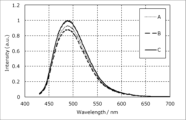
- FIG. 1 shows fluorescence spectra (excitation light wavelength: 410 nm) of substrates A, B and C obtained in Example 1.
- FIG. 1 shows fluorescence spectra (excitation light wavelength: 448 nm) of substrates A, B and C obtained in Comparative Example 1.
- FIG. 1 shows fluorescence spectra (excitation light wavelength: 448 nm) of substrates A, B and C obtained in Comparative Example 1.
- composition for forming a wavelength conversion film of the present invention is characterized by containing (A) a phosphor represented by the following formula (1) and (B) a binder.
- solid content means components other than the solvent which comprise the composition for wavelength conversion film formation.
- Ar 1 and Ar 2 are each independently an optionally substituted aromatic ring, and R 1 and R 2 are each independently a hydrogen atom and a substituent.
- an alkyl group optionally having substituents, a cycloalkyl group optionally having substituents, an aryl group optionally having substituents, or a heteroaryl group optionally having substituents, and R 1 and R 2 may be bonded to each other to form a ring together with the adjacent nitrogen atoms, and either one or both of R 1 and R 2 are bonded to Ar 2 to form a ring together with the adjacent nitrogen atoms
- one of Y 1 and Y 2 is --SO 2 -- and the other is --S- or --SO 2 --.
- the aromatic rings represented by Ar 1 and Ar 2 include a benzene ring as a monocyclic aromatic hydrocarbon ring, and a naphthalene ring, anthracene ring, phenanthrene ring, fluorene ring, and pyrene ring as polycyclic aromatic hydrocarbon rings. , a triphenylene ring, and the like.
- the aromatic rings represented by Ar 1 and Ar 2 may have a substituent.
- substituents include halogen atoms, alkyl groups described later, cycloalkyl groups described later, halogenated alkyl groups, aryl groups described later, heteroaryl groups described later, cyano groups, and nitro groups.
- the number thereof is preferably 1 to 6, more preferably 1 to 3.
- Ar 1 and Ar 2 are preferably substituted or unsubstituted aromatic rings from the viewpoint of increasing the maximum absorption wavelength and the maximum fluorescence wavelength and further improving light resistance, and substituted or unsubstituted monocyclic aromatic carbonized A hydrogen ring is more preferred.
- Halogen atoms include fluorine, chlorine, bromine and iodine atoms.
- the alkyl group may be linear or branched, and specific examples thereof include methyl group, ethyl group, n-propyl group, isopropyl group, n-butyl group, isobutyl group, sec-butyl group, Examples thereof include alkyl groups having 1 to 10 carbon atoms such as tert-butyl groups, and alkyl groups having 1 to 6 carbon atoms are preferred.
- the above alkyl group may have a substituent.
- substituents include a halogen atom, a cycloalkyl group described later, an aryl group described later, a heteroaryl group described later, a cyano group, a nitro group, and the like.
- the number thereof is preferably 1 to 6, more preferably 1 to 3.
- the cycloalkyl group includes a cycloalkyl group having 3 to 10 carbon atoms such as a cyclopropyl group, a cyclobutyl group, a cyclopentyl group, a cyclohexyl group and a cycloheptyl group, and a cycloalkyl group having 4 to 8 carbon atoms is preferable.
- the cycloalkyl group may have a substituent.
- substituents include halogen atoms, the alkyl groups described above, aryl groups described later, heteroaryl groups described later, cyano groups, and nitro groups.
- the number thereof is preferably 1 to 6, more preferably 1 to 3.
- the halogenated alkyl group includes a trifluoromethyl group, a pentafluoroethyl group, and the like.
- the aryl group may be a monocyclic aryl group, a condensed aryl group or a polycyclic aryl group. Specific examples thereof include a phenyl group as the monocyclic aryl group, and a naphthyl group and anthracenyl as the condensed aryl group. group, phenanthrenyl group, fluorenyl group, pyrenyl group, triphenylenyl group and the like. groups are preferred.
- the aryl group may have a substituent.
- substituents include halogen atoms, the above alkyl groups, the above aryl groups, heteroaryl groups described later, cyano groups, and nitro groups.
- the number thereof is preferably 1 to 6, more preferably 1 to 3.
- the heteroaryl group may be either a monocyclic heteroaryl group or a condensed heteroaryl group, and the monocyclic heteroaryl group includes pyrrolyl, thienyl, furanyl, imidazolyl, pyrazolyl, thiazolyl, oxazolyl, and pyridyl. and pyrazyl group, and the condensed heteroaryl group includes indolyl group, isoindolyl group, benzimidazolyl group, quinolyl group, isoquinolyl group, quinoxalyl group and the like.
- the heteroaryl group may have a substituent.
- substituents include the above halogen atoms, the above alkyl groups, the above aryl groups, the above heteroaryl groups, cyano groups, and nitro groups.
- the number thereof is preferably 1 to 6, more preferably 1 to 3.
- R 1 and R 2 are preferably substituted or unsubstituted aryl groups or substituted or unsubstituted heteroaryl groups, more preferably substituted or unsubstituted aryl groups, and still more preferably unsubstituted aryl groups.
- R 1 and R 2 may combine with each other to form a ring together with the adjacent nitrogen atoms.
- Examples of the ring formed by bonding R 1 and R 2 together with the adjacent nitrogen atoms include the following groups.
- R 1 and R 2 may combine with Ar 2 to form a ring with the adjacent nitrogen atom.
- the ring formed by combining one or both of R 1 and R 2 with Ar 2 to form the adjacent nitrogen atom include the following groups.
- the bonding position of the group represented by —NR 1 R 2 to Ar 2 is not particularly limited.
- Ar 2 is a benzene ring
- a compound represented by the following formula (1') is likely to be formed.
- Ar 1 , Y 1 and Y 2 are the same as above.
- R 1 and R 2 are each independently a hydrogen atom, an optionally substituted alkyl group, an optionally substituted cycloalkyl group, an optionally substituted aryl or a heteroaryl group which may have a substituent, wherein R 1 and R 2 may combine with each other to form a ring together with the adjacent nitrogen atoms, and any of R 1 and R 2 One or both may be attached to adjacent benzene rings to form rings with adjacent nitrogen atoms.
- one of Y 1 and Y 2 is --SO 2 -- and the other is --S- or --SO 2 --.
- one of Y 1 and Y 2 is -SO 2 - and the other is -S-, and Y 1 is -S- and more preferably Y 2 is --SO 2 --.
- Y 1 and Y 2 are -S- or -SO 2 -, and Y 2 is -SO 2 -. and more preferably both Y 1 and Y 2 are --SO 2 --.
- a compound represented by the following formula (1-1) or (1-2) is preferable as the condensed thiophene compound that satisfies the above conditions.
- R 1a and R 2a each independently have a hydrogen atom, an optionally substituted alkyl group, or a a cycloalkyl group which may be substituted, or an aryl group which may have a substituent, and R 1a and R 2a may combine with each other to form a ring together with the adjacent nitrogen atoms.
- Preferred specific examples of the compound represented by the above formula (1) include compounds represented by the following formulas (1-1B) to (1-6B).
- the fused-ring thiophene compound represented by formula (1) may exist as a solvate, and both are included in the scope of the present invention.
- the solvate is not particularly limited as long as it is a solvate of the condensed thiophene compound represented by the above formula (1) and a solvent.
- Solvents for forming solvates include dichloromethane, chloroform, acetonitrile, diethyl ether, ethyl acetate, methanol, ethanol, hexane, cyclohexane, toluene, acetone, dimethylformamide, dimethylsulfoxide, tetrahydrofuran, and the like.
- the compound represented by the above formula (1) can be synthesized by a known method, for example, by the method described in JP-A-2018-145422.
- the content of the phosphor (A) is preferably 0.1% by mass or more, more preferably 0.3% by mass or more, more preferably 0.5% by mass in the solid content. % or more is more preferable.
- the upper limit of the content of the (A) phosphor is not particularly limited, but considering that the fluorescence quantum yield decreases when the concentration of the phosphor is increased, it is preferably 30% by mass or less in the solid content, 10% by mass or less is more preferable, 7% by mass or less is even more preferable, and 5% by mass or less is even more preferable.
- the binder (B) may be selected from known resins and the like used as binders in the composition for forming a wavelength conversion film.
- resins that are used as the base resin of the composition for forming a wavelength conversion film.
- examples include polystyrene (PS), polyethylene (PE), polypropylene (PP), polyester, and polyimide.
- Polyolefin resins such as polyamide and polymethylpentene; Acrylic resins such as polymethyl methacrylate (PMMA), methyl methacrylate-methacrylic acid copolymer, benzyl methacrylate-methacrylic acid copolymer, ethylene-vinyl acetate copolymer (EVA); polyvinyl butyrate (PVB); cellulose ester resins such as triacetylcellulose (TAC) and nitrocellulose.
- PS polystyrene
- PE polyethylene
- PP polypropylene
- polyester and polyimide.
- Polyolefin resins such as polyamide and polymethylpentene
- Acrylic resins such as polymethyl methacrylate (PMMA), methyl methacrylate-methacrylic acid cop
- the resin may be an alkali-soluble resin, which will be described later, or may contain both an alkali-soluble resin and other resins. Among these, acrylic resins are preferred, and methyl methacrylate-methacrylic acid copolymers are more preferred. Commercially available products may be used for each of the above resins, and those obtained by reaction of unsaturated double bond groups may be synthesized according to conventional methods such as radical polymerization using a polymerization initiator.
- the average molecular weight of the resin is not particularly limited, but its weight average molecular weight (Mw) is usually 5,000 to 100,000, preferably 10,000 to 50,000.
- Mw weight average molecular weight
- an average molecular weight is a polystyrene conversion value by a gel permeation chromatography.
- a polymerizable monomer and a photopolymerization initiator may be blended and polymerized after film formation. These can also be used in combination with the resins described above.
- the polymerizable monomer is not particularly limited as long as it is used together with a photopolymerization initiator and is polymerized by light irradiation, but an ethylenically unsaturated monomer is preferred.
- any of monofunctional monomers, bifunctional monomers and tri- or higher-functional monomers can be used as the ethylenically unsaturated monomers.
- Monofunctional monomers include, for example, a mono(meth)acrylate represented by the following formula (M1), a mono(meth)acrylamide compound represented by the following formula (M2), and an amide compound represented by the following formula (M3). is mentioned.
- R m1 represents a hydrogen atom or a methyl group
- R m2 represents a monovalent hydrocarbon group (excluding those containing an ethylenically unsaturated group).
- the hydrocarbon group may be linear, branched or cyclic.
- the number of carbon atoms in R m2 is preferably 10 or less from the viewpoint of excellent ejection stability in the inkjet method and excellent effect of improving the external quantum efficiency.
- the hydrocarbon group may be substituted and may have, for example, an ether bond.
- R m1 is the same as above.
- R m3 and R m4 each independently represent a hydrogen atom or a monovalent hydrocarbon group (excluding those containing an ethylenically unsaturated group).
- the hydrocarbon group may be linear, branched or cyclic.
- R m3 and R m4 may combine with each other to form a ring.
- the total number of carbon atoms of R m3 and R m4 is preferably 10 or less in terms of excellent ejection stability in the inkjet method and excellent effect of improving the external quantum efficiency.
- the hydrocarbon group may be substituted and may have, for example, an ether bond.
- R m5 represents a hydrogen atom or a methyl group
- R m6 represents a monovalent hydrocarbon group having an ethylenically unsaturated group.
- the above hydrocarbon group may be linear, branched or cyclic.
- the number of carbon atoms in R m6 is preferably 10 or less from the viewpoint of excellent ejection stability in the inkjet method and excellent effect of improving the external quantum efficiency.
- the hydrocarbon groups may be substituted and may have, for example, ether linkages.
- mono (meth) acrylates represented by the formula (M1) include methyl (meth) acrylate, ethyl (meth) acrylate, propyl (meth) acrylate, butyl (meth) acrylate, amyl (meth) acrylate, 2-ethylhexyl (meth)acrylate, octyl (meth)acrylate, nonyl (meth)acrylate, dodecyl (meth)acrylate, hexadecyl (meth)acrylate, octadecyl (meth)acrylate, cyclohexyl (meth)acrylate, methoxyethyl (meth)acrylate , Butoxyethyl (meth)acrylate, Phenoxyethyl (meth)acrylate, Nonylphenoxyethyl (meth)acrylate, Glycidyl (meth)acrylate, Dimethylaminoethyl (meth)acrylate,
- mono(meth)acrylamide compound represented by the above formula (M2) include 4-(meth)acryloylmorpholine, (meth)acrylamide, N-methyl(meth)acrylamide, N,N-dimethyl(meth) acrylamide, N-ethyl(meth)acrylamide, N,N-diethyl(meth)acrylamide, N-isopropyl(meth)acrylamide, N,N-diisopropyl(meth)acrylamide and the like.
- amide compound represented by the above formula (M3) examples include N-vinylformamide, N-vinylacetamide, N-allylformamide, N-allylacetamide and the like.
- ethoxyethoxyethyl (meth)acrylate N-vinylformamide, 4-(meth)acryloylmorpholine, N,N-dimethylacrylamide, N,N-diethyl(meth)acrylamide is preferably used.
- the monofunctional monomer is preferably 10,000 mPa ⁇ s or less, more preferably 8,000 mPa ⁇ s or less, still more preferably 5,000 mPa ⁇ s or less, and further preferably 5,000 mPa ⁇ s or less, from the viewpoint of easily improving ejection stability in the inkjet method. Those having a viscosity of 1,000 mPa ⁇ s or less are preferable.
- the viscosity of a monomer having an ethylenically unsaturated group such as a monofunctional monomer is the viscosity at 25°C measured by an EMS viscometer, for example.
- a monomer having a high viscosity can also be suitably used by combining with a monomer having a low viscosity.
- a highly viscous monomer can also be suitably used.
- bifunctional monomers include di(meth)acrylates represented by the following formula (M4) and di(meth)acrylamide compounds represented by the following formula (M5).
- a plurality of R m7 each independently represents a hydrogen atom or a methyl group
- R m8 represents a divalent hydrocarbon group (excluding those containing an ethylenically unsaturated group).
- the divalent hydrocarbon group may be linear, branched or cyclic.
- the number of carbon atoms in the divalent hydrocarbon group is preferably 10 or less from the viewpoint of excellent ejection stability and an excellent effect of improving the external quantum efficiency.
- the divalent hydrocarbon group may be substituted, and may have an ether bond, for example.
- a plurality of R m9 each independently represent a hydrogen atom or a methyl group
- a plurality of R m10 each independently represent a hydrogen atom or a monovalent hydrocarbon group (provided that the ethylenic excluding those containing unsaturated groups).
- the above monovalent hydrocarbon group may be linear, branched or cyclic.
- the number of carbon atoms in R m10 is preferably 7 or less from the viewpoint of excellent ejection stability in the inkjet method and excellent effect of improving the external quantum efficiency.
- the above monovalent hydrocarbon group may be substituted, and may have an ether bond, for example.
- R m11 represents a divalent hydrocarbon group (excluding those containing an ethylenically unsaturated group).
- the divalent hydrocarbon group may be linear, branched or cyclic.
- the number of carbon atoms in the divalent hydrocarbon group is preferably 10 or less from the viewpoint of excellent ejection stability and an excellent effect of improving the external quantum efficiency.
- the divalent hydrocarbon group may be substituted, and may have an ether bond, for example.
- di(meth)acrylate represented by formula (M4) examples include 1,3-butylene glycol di(meth)acrylate, 1,4-butanediol di(meth)acrylate, and 1,5-pentanediol.
- di(meth)acrylamide compound represented by the above formula (M5) examples include N,N-[oxybis(2,1-ethanediyloxy-3,1-propanediyl)]bisacrylamide and the like.
- a commercial product may be used as the di(meth)acrylamide compound, and specific examples include FOM-03008 (manufactured by Fuji Film Wako Pure Chemical Industries, Ltd.).
- dipropylene glycol di(meth)acrylate, 1,6-hexanediol di(meth)acrylate, neopentyl glycol di(meth)acrylate, 1,8-octanediol di( Meth)acrylate, 1,9-nonanediol di(meth)acrylate, and 1,10-decanediol di(meth)acrylate are preferably used.
- the bifunctional monomer is preferably 10,000 mPa ⁇ s or less, more preferably 8,000 mPa ⁇ s or less, even more preferably 5,000 mPa ⁇ s or less, and further preferably 10,000 mPa ⁇ s or less, more preferably 8,000 mPa ⁇ s or less, and furthermore, from the viewpoint of easily improving ejection stability in the inkjet method.
- Those having a viscosity of 1,000 mPa ⁇ s or less are preferable.
- the above viscosity is the viscosity at 25°C.
- a monomer having a high viscosity can also be suitably used by combining with a monomer having a low viscosity.
- a highly viscous monomer can also be suitably used.
- Trifunctional or higher monomers include, for example, tri(meth)acrylate, tetra(meth)acrylate, and penta(meth)acrylate represented by the following formula (M6), and tri(meth)acrylate represented by the following formula (M7).
- acrylamide compounds, and tetra(meth)acrylamide compounds include, for example, tri(meth)acrylate, tetra(meth)acrylate, and penta(meth)acrylate represented by the following formula (M6), and tri(meth)acrylate represented by the following formula (M7).
- a plurality of R m12 each independently represent a hydrogen atom or a methyl group
- R m13 is a trivalent hydrocarbon group (excluding those containing an ethylenically unsaturated group).
- the above trivalent hydrocarbon group may be linear, branched or cyclic.
- the number of carbon atoms in the hydrocarbon group is preferably 10 or less, more preferably 5 or less, from the viewpoint of excellent ejection stability and an excellent effect of improving the external quantum efficiency.
- the trivalent hydrocarbon group may be substituted, and may have an ether bond, for example.
- a plurality of R m14 each independently represent a hydrogen atom or a methyl group
- a plurality of R m15 each independently represent a hydrogen atom or a monovalent hydrocarbon group (provided that the ethylenic excluding those containing unsaturated groups).
- the above monovalent hydrocarbon group may be linear, branched or cyclic.
- the number of carbon atoms in R m15 is preferably 7 or less from the viewpoint of excellent ejection stability in the inkjet method and excellent effect of improving the external quantum efficiency.
- the above monovalent hydrocarbon group may be substituted, and may have an ether bond, for example.
- a plurality of R m16 each independently represents a divalent hydrocarbon group (excluding those containing an ethylenically unsaturated group).
- the divalent hydrocarbon group may be linear, branched or cyclic.
- the number of carbon atoms in the divalent hydrocarbon group is preferably 10 or less from the viewpoint of excellent ejection stability and an excellent effect of improving the external quantum efficiency.
- the divalent hydrocarbon group may be substituted, and may have an ether bond, for example.
- tri(meth)acrylate represented by formula (M6) include glycerin tri(meth)acrylate, trimethylolethane tri(meth)acrylate, trimethylolpropane triacrylate, pentaerythritol triacrylate, and the like. .
- tetra(meth)acrylate examples include pentaerythritol tetraacrylate and ditrimethylolpropane tetraacrylate.
- penta(meth)acrylate examples include dipentaerythritol pentaacrylate and dipentaerythritol hexaacrylate.
- tri(meth)acrylamide compound represented by the above formula (M7) include N,N-bis(2-acrylamidoethyl)acrylamide.
- a commercial product may be used as the tri(meth)acrylamide compound, and a specific example thereof includes FOM-03007 (manufactured by FUJIFILM Wako Pure Chemical Industries, Ltd.).
- tetra(meth)acrylamide compounds include N-[tris(3-acrylamidopropoxymethyl)methyl]acrylamide, N,N-1,2-ethanediylbis ⁇ N-[2-(acryloylamino)ethyl]acrylamide ⁇ etc. are mentioned.
- Commercially available tetra(meth)acrylamide compounds may be used, and specific examples thereof include FOM-03006 and FOM-03009 (manufactured by Fuji Film Wako Pure Chemical Industries, Ltd.).
- glycerin tri(meth)acrylate, dipentaerythritol pentaacrylate, and dipentaerythritol hexaacrylate are preferably used among the above-described trifunctional or higher-functional monomers.
- the trifunctional monomer is preferably 10,000 mPa ⁇ s or less, more preferably 8,000 mPa ⁇ s or less, still more preferably 5,000 mPa ⁇ s or less, and further preferably 10,000 mPa ⁇ s or less, more preferably 8,000 mPa ⁇ s or less, and furthermore preferably 5,000 mPa ⁇ s or less.
- Those having a viscosity of 1,000 mPa ⁇ or less are preferred.
- the above viscosity is the viscosity at 25°C.
- a monomer having a high viscosity can also be suitably used by combining with a monomer having a low viscosity.
- a highly viscous monomer can also be suitably used.
- a photoradical polymerization initiator As the photopolymerization initiator, a photoradical polymerization initiator, a photocationic polymerization initiator, etc. can be used. Considering compatibility with general manufacturing methods of the wavelength conversion member, it is preferable to use a photoradical polymerizable compound. On the other hand, from the viewpoint that a cured film (a cured product of the composition for forming a wavelength conversion film) can be formed without being inhibited by oxygen in the curing process, it is preferable to use a photo-cationically polymerizable compound.
- photoradical polymerization initiator a molecular cleavage type or hydrogen abstraction type photoradical polymerization initiator is preferably used.
- Molecular cleavage type photoradical polymerization initiators include, for example, benzoin isobutyl ether, 2,4-diethylthioxanthone, 2-isopropylthioxanthone, 2,4,6-trimethylbenzoyldiphenylphosphine oxide, phenyl (2,4,6- trimethylbenzoyl)ethylphosphinate, 2-benzyl-2-dimethylamino-1-(4-morpholinophenyl)-butan-1-one, bis(2,6-dimethoxybenzoyl)-2,4,4-trimethylpentyl Phosphine oxide, bis(2,4,6-trimethylbenzoyl)phenylphosphine oxide, (2,4,6-trimethylbenzoyl)ethoxyphenylphosphine oxide.
- molecular cleavage type photoradical polymerization initiators include, for example, 1-hydroxycyclohexylphenyl ketone, benzoin ethyl ether, benzyl dimethyl ketal, 2-hydroxy-2-methyl-1-phenylpropan-1-one, 2, 2-dimethoxy-1,2-diphenylethan-1-one, 2,2-dimethoxy-2-phenylacetophenone, 1-(4-isopropylphenyl)-2-hydroxy-2-methylpropan-1-one, 2- Methyl-1-(4-methylthiophenyl)-2-morpholinopropan-1-one may be used in combination.
- hydrogen abstraction type photoradical polymerization initiators examples include benzophenone, 4-phenylbenzophenone, isophthalphenone, and 4-benzoyl-4'-methyl-diphenylsulfide.
- a molecular cleavage type radical photopolymerization initiator and a hydrogen abstraction type photoradical polymerization initiator may be used in combination.
- the photoradical polymerization initiator can also be obtained as a commercial product.
- Commercially available products include Omnirad (registered trademark; hereinafter the same) manufactured by IGM Resin, acylphosphine oxide compounds such as TPO-H, Omnirad TPO-L, Omnirad 819; Omnirad 651, Omnirad 184, Omnirad 1173, Omnirad 2959, Omnirad 127, Omnirad 907, Omnirad 369, Omnirad 369E, Omnirad 379EG, and other alkylphenone-based compounds; Omnirad MBF, "Omnirad 754,” and other intramolecular hydrogen abstraction compounds; Irgacure (registered trademark) manufactured by BASF Japan.
- Omnirad registered trademark
- Irgacure registered trademark
- OXE01 Irgacure OXE02, Irgacure OXE03, Irgacure OXE04, oximes such as TR-PBG-304 and TR-PBG-305 manufactured by Changzhou Power Electronics New Materials Co., Ltd., NCI-831 and NCI-930 manufactured by ADEKA Co., Ltd. Examples include ester compounds.
- the oxime ester compounds include, for example, compounds described in JP-A-2004-534797, compounds described in JP-A-2000-80068, compounds described in International Publication No. 2012/45736, international Compounds described in Publication No. 2015/36910, compounds described in JP-A-2006-36750, compounds described in JP-A-2008-179611, compounds described in International Publication No. 2009/131189, Special Table 2012 -526185, the compound described in JP-A-2012-519191, the compound described in WO 2006/18973, the compound described in WO 2008/78678, JP 2011-132215
- Examples include oxime ester compounds such as those described in JP-A-2003-120003.
- a chain transfer agent may be used in combination. By using a chain transfer agent, the reaction rate of the photoradical reaction can be increased.
- a chain transfer agent is defined in the Dictionary of Polymers, Third Edition (edited by the Society of Polymer Science, 2005), pp. 683-684.
- the chain transfer agent for example, a group of compounds having SH, PH, SiH and GeH in the molecule is used. They can either hydrogen-donate to less active radical species to generate radicals, or they can be oxidized and then deprotonated to generate radicals.
- thiol compounds e.g., 2-mercaptobenzimidazoles, 2-mercaptobenzthiazoles, 2-mercaptobenzoxazoles, 3-mercaptotriazoles, 5-mercaptotetrazoles, etc.
- polyfunctional Thiol compounds are particularly preferred.
- polyfunctional thiol any compound having two or more thiol (SH) groups may be used.
- polyfunctional thiol compounds include ethylene glycol bisthiopropionate (EGTP), butanediol bisthiopropionate (BDTP), trimethylolpropane tristhiopropionate (TMTP), pentaerythritol tetrakisthiopropionate.
- PETP tetraethylene glycol bis(3-mercaptopropionate), dipentaerythritol hexakis(3-mercaptopropionate), pentaerythritol tetrakis(thioglycolate), Karenz (registered trademark, hereinafter the same) MT BD1 , Karenz MT PE1, Karenz MT NR1 (manufactured by Showa Denko K.K.), and the like.
- Photocationic polymerization initiators include polyarylsulfonium salts such as triphenylsulfonium hexafluoroantimonate and triphenylsulfonium hexafluorophosphate; diphenyliodonium hexafluoroantimonate, p-nonylphenyliodonium hexafluoroantimonate and the like. and polyaryliodonium salts of.
- the photocationic polymerization initiator can also be obtained as a commercial product.
- Examples of such commercially available products include CPI-100P manufactured by San-Apro Co., Ltd., Omnicat (registered trademark; the same applies hereinafter) 270 manufactured by IGM Resin, Irgacure 290 manufactured by BASF Japan, etc.
- the content of the photopolymerization initiator is preferably 0.1% by mass or more, more preferably 0.5% by mass or more, and 1% by mass with respect to 100% by mass of the polymerizable monomer.
- the above is more preferable.
- the upper limit of the content is preferably 40% by mass or less, more preferably 30% by mass or less, and even more preferably 20% by mass or less, from the viewpoint of film forming properties and the transparency, heat resistance, and light resistance of the cured film. preferable.
- an alkali-soluble resin When blending a polymerizable monomer and a photopolymerization initiator, an alkali-soluble resin may be further blended.
- the composition By adding an alkali-soluble resin to the composition for forming a wavelength conversion film of the present invention, the composition can be used as a composition for forming a resist film.
- an alkali-soluble resin is a resin having an alkali-soluble group.
- alkali-soluble groups include phenolic hydroxy groups, carboxyl groups, acid anhydride groups, imide groups, sulfonyl groups, phosphoric acid groups, boronic acid groups, active methylene groups, and the like.
- the active methylene group means a methylene group ( --CH.sub.2-- ) having a carbonyl group at an adjacent position and having reactivity with a nucleophilic reagent.
- a group represented by the following formula (b1) is more preferable as the active methylene group.
- R b represents an alkyl group, an alkoxy group or a phenyl group, and the dashed line represents a bond.
- the alkyl group represented by R b includes, for example, an alkyl group having 1 to 20 carbon atoms, preferably an alkyl group having 1 to 5 carbon atoms.
- Specific examples of such alkyl groups include methyl, ethyl, n-propyl and i-propyl groups. Among these, a methyl group, an ethyl group and an n-propyl group are preferred.
- the alkoxy group represented by R b includes, for example, an alkoxy group having 1 to 20 carbon atoms, preferably an alkoxy group having 1 to 5 carbon atoms.
- Specific examples of such alkoxy groups include methoxy, ethoxy, n-propoxy, i-propoxy, n-butoxy, i-butoxy, s-butoxy and t-butoxy groups. .
- methoxy group, ethoxy group, n-propoxy group and the like are preferable.
- the alkali-soluble resin has at least one organic group selected from the group consisting of a phenolic hydroxy group and a carboxy group and has a number average molecular weight of 2,000 to 50,000. is preferred.
- the alkali-soluble resin preferably has a number average molecular weight in the range of 2,000 to 50,000. and obtain the required sensitivity. On the other hand, when the number-average molecular weight is 2,000 or more, film loss in the exposed areas is less likely to occur during development, and sufficient curability can be obtained.
- the alkali-soluble resin is not particularly limited as long as it has the structure described above, and there are no particular restrictions on the skeleton of the main chain of the polymer that constitutes the resin, the types of side chains, and the like.
- alkali-soluble resin examples include acrylic resins, polyhydroxystyrene resins, polyimide precursors, polyimides, polyesters, and the like.
- an alkali-soluble resin made of a copolymer obtained by polymerizing multiple types of monomers can also be used.
- the alkali-soluble resin may be a blend of multiple types of alkali-soluble resins.
- an acrylic polymer which is an acrylic resin
- the acrylic polymer refers to a resin obtained by a polymerization reaction of a monomer having an unsaturated double bond group and a reaction of the unsaturated double bond group portion.
- the alkali-soluble acrylic polymer a monomer exhibiting alkali solubility, that is, a monomer having at least one selected from the above-described alkali-soluble groups, and at least one monomer selected from the group of monomers copolymerizable with these monomers. Examples thereof include copolymers formed with a monomer as an essential structural unit.
- the number average molecular weight of the alkali-soluble resin is preferably 2,000 to 50,000. When the number average molecular weight is 50,000 or less, residue is less likely to occur.
- the above "monomers having at least one selected from alkali-soluble groups” include monomers having a carboxyl group, and monomers having a phenolic hydroxy group and an imide group. These monomers are not limited to having one carboxyl group or phenolic hydroxy group, and may have a plurality of them.
- monomers having a carboxy group examples include acrylic acid, methacrylic acid, crotonic acid, mono-(2-(acryloyloxy)ethyl)phthalate, mono-(2-(methacryloyloxy)ethyl)phthalate, N-(carboxyphenyl)maleimide. , N-(carboxyphenyl)methacrylamide, N-(carboxyphenyl)acrylamide and the like.
- Monomers having a phenolic hydroxy group include hydroxystyrene, N-(hydroxyphenyl)acrylamide, N-(hydroxyphenyl)methacrylamide, N-(hydroxyphenyl)maleimide, 4-hydroxyphenylmethacrylate and the like.
- Examples of monomers having an imide group include maleimide and the like.
- the ratio of the monomer having an alkali-soluble group and an unsaturated double bond group is preferably 5 to 90 mol% of all the monomers used in the production of the alkali-soluble acrylic polymer. , more preferably 10 to 60 mol %, most preferably 10 to 40 mol %. Sufficient alkali solubility is obtained when the ratio of the monomer having an alkali-soluble group and an unsaturated double bond group is 10% by mass or more.
- the alkali-soluble acrylic polymer may be further copolymerized with a monomer having a hydroxyalkyl group and an unsaturated double bond group in order to further stabilize the pattern shape after curing.
- monomers having a hydroxyalkyl group and an unsaturated double bond group include 2-hydroxyethyl acrylate, 2-hydroxypropyl acrylate, 4-hydroxybutyl acrylate, 2,3-dihydroxypropyl acrylate, 2-hydroxyethyl methacrylate, 2-hydroxypropyl methacrylate, 4-hydroxybutyl methacrylate, 2,3-dihydroxypropyl methacrylate, glycerin monomethacrylate, 5-acryloyloxy-6-hydroxynorbornene-2-carboxylic-6-lactone and the like.
- the ratio of the monomer having a hydroxyalkyl group and an unsaturated double bond group in the production of the alkali-soluble acrylic polymer is preferably 10 to 60% by mass, more preferably 15 to 50% by mass, and even more preferably 20 to 50% by mass. 40% by mass.
- the ratio of the monomer having a hydroxyalkyl group and an unsaturated double bond group is 10% by mass or more, an effect of stabilizing the pattern shape of the copolymer can be obtained.
- the ratio is 60% by mass or less, the content of the alkali-soluble group is in an appropriate range, and sufficient properties such as developability can be obtained.
- the alkali-soluble acrylic polymer may further be copolymerized with an N-substituted maleimide compound in order to increase the Tg of the copolymer.
- N-substituted maleimide compounds include N-methylmaleimide, N-ethylmaleimide, N-phenylmaleimide, N-cyclohexylmaleimide and the like. From the viewpoint of transparency, those having no aromatic ring are preferred, from the viewpoints of developability, transparency and heat resistance, those having an alicyclic skeleton are more preferred, and cyclohexylmaleimide is even more preferred.
- the ratio of the N-substituted maleimide in the production of the alkali-soluble acrylic polymer is preferably 10-60% by mass, more preferably 15-50% by mass, and even more preferably 20-40% by mass.
- the ratio of the N-substituted maleimide is 10% by mass or more, the Tg of the copolymer becomes high, so that the finally obtained wavelength conversion film also has a high Tg, and sufficient heat resistance and light resistance can be obtained. Sufficient transparency is obtained as the ratio is 60 mass % or less.
- the alkali-soluble acrylic polymer may be a copolymer containing monomers other than the above-described monomers (hereinafter referred to as other monomers) as constitutional units.
- Other monomers may specifically be copolymerizable with at least one selected from the group consisting of monomers having a carboxyl group and monomers having a phenolic hydroxy group. is not particularly limited as long as it does not impair the Specific examples of such monomers include acrylate compounds, methacrylate compounds, acrylamide compounds, acrylonitrile, styrene compounds and vinyl compounds. Specific examples of the other monomers are listed below, but are not limited thereto.
- acrylic acid ester compound examples include methyl acrylate, ethyl acrylate, isopropyl acrylate, benzyl acrylate, naphthyl acrylate, anthryl acrylate, anthryl methyl acrylate, phenyl acrylate, glycidyl acrylate, phenoxyethyl acrylate, 2,2,2.
- methacrylate compounds include methyl methacrylate, ethyl methacrylate, isopropyl methacrylate, benzyl methacrylate, naphthyl methacrylate, anthryl methacrylate, anthryl methyl methacrylate, phenyl methacrylate, glycidyl methacrylate, phenoxyethyl methacrylate, -trifluoroethyl methacrylate, tert-butyl methacrylate, cyclohexyl methacrylate, isobornyl methacrylate, 2-methoxyethyl methacrylate, methoxytriethylene glycol methacrylate, 2-ethoxyethyl methacrylate, 2-aminomethyl methacrylate, tetrahydrofurfuryl methacrylate, 3- Methoxybutyl methacrylate, 2-methyl-2-adamantyl methacrylate, ⁇ -butyrolactone meth
- acrylamide compounds include N-methylacrylamide, N-methylmethacrylamide, N,N-dimethylacrylamide, N,N-dimethylmethacrylamide, N-methoxymethylacrylamide, N-methoxymethylmethacrylamide, N-butoxymethyl acrylamide, N-butoxymethyl methacrylamide, and the like.
- vinyl compound examples include methyl vinyl ether, benzyl vinyl ether, cyclohexyl vinyl ether, vinylnaphthalene, vinylanthracene, vinylcarbazole, allyl glycidyl ether, 3-ethenyl-7-oxabicyclo[4.1.0]heptane, 1,2-epoxy-5-hexene, 1,7-octadiene monoepoxide and the like.
- styrene compound examples include styrene having no hydroxy group. Specific examples thereof include styrene, ⁇ -methylstyrene, chlorostyrene, bromostyrene and the like.
- the ratio of the other monomers is preferably 80% by mass or less, more preferably 50% by mass or less, and even more preferably 20% by mass or less.
- the ratio of other monomers is 80% by mass or less, the effects of the present invention can be sufficiently obtained.
- the method for obtaining the above-mentioned alkali-soluble acrylic polymer is not particularly limited. a monomer having at least one selected from the group consisting of; a monomer having a hydroxyalkyl group; optionally, an N-alkoxymethyl group, an N-hydroxymethyl group, an alkoxysilyl group, an epoxy group, an oxetane group, a vinyl group and a blocked isocyanate and at least one group selected from self-crosslinking groups such as N-alkoxymethyl groups, N-hydroxymethyl groups, alkoxysilyl groups, epoxy groups, vinyl groups and blocked isocyanate groups.
- the solvent used is not particularly limited as long as it dissolves the monomers constituting the alkali-soluble acrylic polymer and the alkali-soluble acrylic polymer. Specific examples include the following solvents.
- propylene glycol monomethyl ether propylene glycol monomethyl ether acetate, 2-heptanone, propylene glycol propyl ether, propylene glycol propyl ether acetate, ethyl lactate, butyl lactate and the like are from the viewpoint of good coating properties and high safety. more preferred. These may be used individually by 1 type, and may be used in combination of 2 or more type.
- the alkali-soluble acrylic polymer thus obtained is usually in the form of a solution dissolved in a solvent.
- the solution of the specific copolymer obtained as described above is added to diethyl ether, water, or the like under stirring to cause reprecipitation, and after filtering and washing the generated precipitate, normal pressure or reduced pressure is applied.
- the specific copolymer can be powdered by drying at room temperature or by heating. By such an operation, the polymerization initiator and unreacted monomers coexisting with the specific copolymer can be removed, and as a result, a purified powder of the specific copolymer can be obtained. If the purification cannot be sufficiently performed in one operation, the obtained powder may be redissolved in a solvent and the above operation may be repeated.
- the powder of the specific copolymer may be used as it is, or the powder may be redissolved in an appropriate solvent, for example, the solvent used in the polymerization reaction described above and used as a solution. good too.
- polyimide precursors such as polyamic acid, polyamic acid ester, partially imidized polyamic acid, and polyimides such as carboxylic acid group-containing polyimides can be used. In particular, it can be used without being limited to its type.
- the polyamic acid which is a polyimide precursor, can generally be obtained by polycondensing (a) a tetracarboxylic dianhydride and (b) a diamine compound.
- tetracarboxylic dianhydride is not particularly limited, and specific examples include pyromellitic dianhydride, 3,3′,4,4′-biphenyltetracarboxylic dianhydride, 3,3′, 4,4′-benzophenonetetracarboxylic dianhydride, 3,3′,4,4′-diphenyl ether tetracarboxylic dianhydride, 3,3′,4,4′-diphenylsulfonetetracarboxylic dianhydride, etc.
- aromatic tetracarboxylic acid 1,2,3,4-cyclobutanetetracarboxylic dianhydride, 1,2-dimethyl-1,2,3,4-cyclobutanetetracarboxylic dianhydride, 1,2,3 ,4-tetramethyl-1,2,3,4-cyclobutanetetracarboxylic dianhydride, 1,2,3,4-cyclopentanetetracarboxylic dianhydride, 1,2,3,4-cyclohexanetetracarboxylic acid Acid dianhydrides, alicyclic tetracarboxylic dianhydrides such as 3,4-dicarboxy-1,2,3,4-tetrahydro-1-naphthalenesuccinic dianhydride, 1,2,3,4 Aliphatic tetracarboxylic dianhydrides such as -butanetetracarboxylic dianhydride can be mentioned. These may be used individually by 1 type, and may be used in combination of 2 or more type.
- the diamine compound (b) is also not particularly limited, and specific examples include 2,4-diaminobenzoic acid, 2,5-diaminobenzoic acid, 3,5-diaminobenzoic acid, 4,6-diamino -1,3-benzenedicarboxylic acid, 2,5-diamino-1,4-benzenedicarboxylic acid, bis(4-amino-3-carboxyphenyl) ether, bis(4-amino-3,5-dicarboxyphenyl) ether, bis(4-amino-3-carboxyphenyl)sulfone, bis(4-amino-3,5-dicarboxyphenyl)sulfone, 4,4'-diamino-3,3'-dicarboxybiphenyl, 4,4 '-diamino-3,3'-dicarboxy-5,5'-dimethylbiphenyl, 4,4'-diamino-3,3'
- the blending ratio of both compounds that is, the total number of moles of (b) diamine compound/(a) tetracarboxylic dianhydride
- the total number of moles of the substance is desirably 0.7 to 1.2. Similar to a conventional polycondensation reaction, the closer this molar ratio is to 1, the higher the polymerization degree of polyamic acid produced and the higher the molecular weight.
- the terminal amino groups of the residual polyamic acid can be reacted with a carboxylic acid anhydride to protect the terminal amino groups.
- carboxylic anhydrides include phthalic anhydride, trimellitic anhydride, maleic anhydride, naphthalic anhydride, hydrogenated phthalic anhydride, methyl-5-norbornene-2,3-dicarboxylic acid.
- Anhydrides, itaconic anhydride, tetrahydrophthalic anhydride and the like can be mentioned.
- the reaction temperature for the reaction between the diamine compound and the tetracarboxylic dianhydride is usually -20 to 150°C, preferably -5 to 100°C.
- a reaction temperature of 5 to 40° C. and a reaction time of 1 to 48 hours are appropriately selected.
- a reaction temperature of 40 to 90° C. and a reaction time of 10 hours or longer it is more preferable to select a reaction temperature of 40 to 90° C. and a reaction time of 10 hours or longer.
- the reaction temperature can be selected from -20 to 150°C, preferably from -5 to 100°C.
- the reaction between the diamine compound and the tetracarboxylic dianhydride can be carried out in a solvent.
- Solvents that can be used at that time include N,N-dimethylformamide, N,N-dimethylacetamide, N-methylpyrrolidone, N-vinylpyrrolidone, N-methylcaprolactam, dimethylsulfoxide, tetramethylurea, pyridine, dimethylsulfone, Hexamethylsulfoxide, m-cresol, ⁇ -butyrolactone, ethyl acetate, butyl acetate, ethyl lactate, methyl 3-methoxypropionate, methyl 2-methoxypropionate, ethyl 3-methoxypropionate, ethyl 2-methoxypropionate, 3 - ethyl ethoxypropionate, ethyl 2-ethoxypropionate, ethylene glycol dimethyl ether, diethylene glycol
- the solution containing polyamic acid thus obtained can be used as it is for preparing a negative photosensitive resin composition.
- the polyamic acid can also be used after being precipitated and isolated in a poor solvent such as water, methanol, or ethanol.
- any polyimide can also be used as the alkali-soluble resin.
- the polyimide used in the present invention is obtained by chemically or thermally imidizing 50% or more of a polyimide precursor such as the polyamic acid.
- the polyimide preferably has a group selected from a carboxyl group and a phenolic hydroxy group in order to impart alkali solubility.
- a method of introducing a carboxy group or a phenolic hydroxy group into a polyimide includes a method of using a monomer having a carboxy group or a phenolic hydroxy group, and a method of blocking an amine terminal with an acid anhydride having a carboxy group or a phenolic hydroxy group. and a method for imidizing a polyimide precursor such as polyamic acid to an imidization rate of 99% or less.
- Such a polyimide can be obtained by synthesizing a polyimide precursor such as the polyamic acid described above and then subjecting it to chemical imidization or thermal imidization.
- a chemical imidization method a method of adding excess acetic anhydride and pyridine to a polyimide precursor solution and reacting at room temperature to 100° C. is generally used.
- a thermal imidization method a method of heating a polyimide precursor solution at a temperature of 180 to 250° C. while dehydrating it is generally used.
- a phenol novolac resin can also be used as the alkali-soluble resin.
- Polyester polycarboxylic acid can also be used as the alkali-soluble resin.
- a polyester polycarboxylic acid can be obtained from an acid dianhydride and a diol by the method described in WO 2009/051186.
- acid dianhydrides include the above-mentioned (a) tetracarboxylic dianhydrides.
- Diols include aromatic diols such as bisphenol A, bisphenol F, 4,4′-dihydroxybiphenyl, benzene-1,3-dimethanol and benzene-1,4-dimethanol, hydrogenated bisphenol A and hydrogenated bisphenol F.
- 1,4-cyclohexanediol 1,3-cyclohexanedimethanol, 1,4-cyclohexanedimethanol; ethylene glycol, propylene glycol, 1,4-butanediol, 1,6-hexanediol, etc. and the like.
- the alkali-soluble resin of the present invention further has a self-crosslinking group, or a group that reacts with at least one group selected from the group consisting of a hydroxy group, a carboxyl group, an amide group and an amino group (hereinafter also referred to as a crosslinkable group). It is preferable that the copolymer further has a
- self-crosslinkable groups include N-alkoxymethyl groups, N-hydroxymethyl groups, alkoxysilyl groups, epoxy groups, oxetane groups, vinyl groups, and blocked isocyanate groups.
- crosslinkable groups include N-alkoxymethyl groups, N-hydroxymethyl groups, alkoxysilyl groups, epoxy groups, vinyl groups, blocked isocyanate groups, and the like.
- the content is preferably 0.1 to 0.9 per repeating unit in the alkali-soluble resin. From the viewpoint of solvent resistance, the number is more preferably 0.1 to 0.8.
- the alkali-soluble resin further has a repeating unit having at least one selected from the crosslinkable group and the self-crosslinkable group
- a repeating unit having at least one selected from the crosslinkable group and the self-crosslinkable group for example, in the case of an alkali-soluble acrylic polymer, it has radical polymerizability and An unsaturated compound having at least one selected from a crosslinkable group and the above self-crosslinkable group may be copolymerized.
- unsaturated compounds having radical polymerizability and further having an N-alkoxymethyl group include N-butoxymethylacrylamide, N-isobutoxymethylacrylamide, N-methoxymethylacrylamide, N-methoxymethylmethacrylamide, Examples include N-methylolacrylamide.
- monomers having radical polymerizability and further having a hydroxymethylamide group include N-hydroxymethylacrylamide and N-hydroxymethylmethacrylamide.
- radically polymerizable monomers having an alkoxysilyl group include 3-acryloyloxytrimethoxysilane, 3-acryloyloxytriethoxysilane, 3-methacryloyloxytrimethoxysilane, 3-methacryloyloxytriethoxy Silane etc. are mentioned.
- unsaturated compounds having radical polymerizability and epoxy groups include glycidyl acrylate, glycidyl methacrylate, glycidyl ⁇ -ethyl acrylate, glycidyl ⁇ -n-propyl acrylate, and ⁇ -n-butyl.
- glycidyl methacrylate, 6,7-epoxyheptyl methacrylate, o-vinylbenzyl glycidyl ether, m-vinylbenzyl glycidyl ether, p-vinylbenzyl glycidyl ether, and 3,4-epoxycyclohexyl methacrylate are preferred. . These may be used individually by 1 type, and may be used in combination of 2 or more type.
- Examples of unsaturated compounds having radical polymerizability and having an oxetane group include (meth)acrylic acid esters having an oxetane group.
- Specific examples of such monomers include 3-(methacryloyloxymethyl)oxetane, 3-(acryloyloxymethyl)oxetane, 3-(methacryloyloxymethyl)-3-ethyl-oxetane, 3-(acryloyloxymethyl)- 3-ethyl-oxetane, 3-(methacryloyloxymethyl)-2-trifluoromethyloxetane, 3-(acryloyloxymethyl)-2-trifluoromethyloxetane, 3-(methacryloyloxymethyl)-2-phenyl-oxetane, 3-(acryloyloxymethyl)-2-phenyl-oxetane, 2-(methacryloyloxymethyl)oxetane, 2-(methacryloy
- monomers having radical polymerizability and further having a vinyl group include 2-(2-vinyloxyethoxy)ethyl acrylate and 2-(2-vinyloxyethoxy)ethyl methacrylate.
- radically polymerizable monomers having a blocked isocyanate group include 2-(0-(1′-methylpropylideneamino)carboxyamino)ethyl methacrylate, 2-(3,5- dimethylpyrazolyl)carbonylamino)ethyl and the like.
- the content of structural units derived from an unsaturated compound having radical polymerizability and having at least one group selected from the crosslinkable group and the self-crosslinkable group is It is preferably 10 to 70% by mass, more preferably 20 to 60% by mass, based on all repeating units of the soluble resin.
- the content of this structural unit is 10% by mass or more, the heat resistance and surface hardness of the cured film are improved.
- the content of this structural unit is 70% by mass or less, the storage stability of the radiation-sensitive resin composition is improved.
- the alkali-soluble resin of the present invention When used in combination with the polymerizable monomer described above, it is preferred that the alkali-soluble resin has a substituent capable of reacting with the polymerizable monomer.
- a method for obtaining an alkali-soluble resin having a substituent capable of reacting with a polymerizable monomer is not particularly limited as long as a resin having stable properties can be obtained. Examples include a method of copolymerization, and a method of synthesizing an alkali-soluble resin having no substituents capable of reacting with the polymerizable monomer, and then adding a compound having a substituent capable of reacting with the polymerizable monomer by thermal reaction.
- the alkali-soluble resin is an alkali-soluble acrylic polymer
- the polymerizable monomer reacts with the reactive substituents during the polymerization process, and gelation may proceed, so the latter method is not recommended. Synthesis is preferred.
- glycidyl methacrylate and 3,4-epoxycyclohexylmethyl methacrylate are added to an alkali-soluble acrylic polymer synthesized using a monomer having radical polymerizability and a carboxyl group or a phenolic hydroxyl group. and the like.
- a monomer having radical polymerizability and a carboxyl group or a phenolic hydroxyl group. and the like are added to an alkali-soluble acrylic polymer synthesized using a monomer having radical polymerizability and a carboxyl group or a phenolic hydroxyl group. and the like.
- the monomer having radical polymerizability and a carboxyl group or a phenolic hydroxyl group. and the like.
- by reducing the molar ratio of the monomer to be added to the carboxyl group or phenolic hydroxyl group in the resin it is possible to react with the polymerizable monomer while maintaining the alkali solubility of the resin derived from the carb
- thermoreactive group in the resin is A method of adding a monomer having a substituent capable of reacting with a possible polymerizable monomer can be mentioned. Specifically, (meth)acrylic acid, 2-carboxyethyl (meth)acrylate, or the like is added to an alkali-soluble acrylic polymer obtained by copolymerizing glycidyl methacrylate, 3,4-epoxycyclohexylmethyl methacrylate, or the like. method.
- the proportion of repeating units having a substituent capable of reacting with a polymerizable monomer is preferably 5 to 60% by mass, more preferably 10 to 10% of all repeating units in the alkali-soluble resin. 50% by mass, more preferably 10 to 40% by mass.
- the content of this structural unit is 5% by mass or more, the heat resistance and chemical resistance of the cured film are improved.
- the content of this structural unit is 60% by mass or less, the pattern formability of the radiation-sensitive resin composition is improved.
- the alkali-soluble resin may be a mixture of multiple types of alkali-soluble resins.
- the content thereof is preferably 10% by mass or more, and preferably 20% by mass or more, based on the total 100% by mass of the polymerizable monomer and the alkali-soluble resin, from the viewpoint of film-forming properties. More preferably, 30% by mass or more is even more preferable.
- the upper limit of the content thereof is preferably 90% by mass or less, more preferably 80% by mass or less, and even more preferably 70% by mass or less, from the viewpoint of pattern formability.
- the content of the binder (B) is preferably 70 to 99.9% by mass, more preferably 85 to 99.9% by mass, and even more preferably 90 to 99% by mass in the solid content.
- the composition for forming a wavelength conversion film of the present invention may further contain (C) light scattering particles.
- the light scattering particles scatter the light that has entered the wavelength conversion film in the film, thereby substantially extending the optical path length in the wavelength conversion film and improving the light absorption rate. It has a function of improving luminous efficiency by re-scattering the light that has been reflected back into the wavelength conversion film.
- the light scattering particles can be appropriately selected according to the purpose, and may be organic fine particles or inorganic fine particles. Among these, inorganic fine particles having a large refractive index are preferable from the viewpoint of enhancing the scattering performance of the particles.
- the light scattering particles can be appropriately selected according to the purpose, and may be organic fine particles or inorganic fine particles. Among these, inorganic fine particles having a large refractive index are preferable from the viewpoint of enhancing the scattering performance of the particles.
- organic fine particles examples include polymethyl methacrylate beads, acrylic-styrene copolymer beads, melamine beads, polycarbonate beads, styrene beads, crosslinked polystyrene beads, polyvinyl chloride beads, and benzoguanamine-melamine formaldehyde beads.
- the inorganic fine particles include inorganic oxide particles made of at least one oxide selected from silicon, zirconium, titanium, indium, zinc, antimony, cerium, niobium, tungsten, and the like.
- Specific examples of the inorganic oxide particles include SiO 2 , ZrO 2 , TiO 2 (hereinafter also referred to as titanium oxide particles), BaTiO 3 , In 2 O 3 , ZnO, Sb 2 O 3 , ITO, and CeO 2 . , Nb 2 O 5 and WO 3 .
- TiO2 , BaTiO3 , ZrO2 , CeO2 and Nb2O5 are preferred, and TiO2 is more preferred .
- rutile type TiO 2 is preferable to anatase type because it has lower catalytic activity and therefore has higher film durability and also has a higher refractive index.
- These particles may be surface-treated.
- specific materials for surface treatment include heterogeneous inorganic oxides such as silicon oxide and zirconium oxide, metal hydroxides such as aluminum hydroxide, organosiloxanes, and organic acids such as stearic acid. be done. These surface treatment materials may be used singly or in combination.
- the average particle size of the light scattering particles is more than 50 nm and less than 200 nm.
- the lower limit of the average particle size is preferably 60 nm or more, more preferably 70 nm or more.
- the average particle diameter exceeding 100 nm is more preferable from the viewpoint of low total light reflectance at the i-line (365 nm).
- the upper limit of the average particle size is preferably 190 nm or less, more preferably 180 nm or less, from the viewpoint of the storage stability of the composition, since sedimentation tends to occur if the particle size is too large.
- the average particle size of the light scattering particles is the average particle size determined by transmission electron microscope observation.
- titanium oxide particles include PT-401M (rutile type, average particle size 70 nm), PT-401L (rutile type, average particle size 130 nm), PT-501R (rutile type, average particle size 180 nm) and the like, but not limited thereto. It should be noted that the average particle size of the exemplified light scattering particles may vary by ⁇ 10 nm.
- the content of the light scattering particles (C) is preferably 0.1 to 20% by mass, more preferably 0.2 to 15% by mass, more preferably 0.3 to 10% by mass in the solid content. is even more preferred.
- the composition for forming a wavelength conversion film of the present invention may optionally contain a component (C), a light stabilizer, an antioxidant, a surfactant, and a polymer.
- a component (C) a light stabilizer, an antioxidant, a surfactant, and a polymer.
- Various known additives such as a dispersant, a flame retardant, a transparent agent, an ultraviolet absorber, a cross-linking agent, and a filler may be included.
- a fluorosurfactant is preferred, and a nonionic fluorosurfactant is more preferred.
- Specific examples thereof include Futergent series, 212M, 215M, 250, 222F, FTX-218 and DFX-18 manufactured by Neos Co., Ltd., but are not limited to these.
- a surfactant when used, its blending amount is not particularly limited, but it is preferably 0.01 to 1% by mass, more preferably 0.01 to 0.5% by mass, based on the solid content of the composition for forming a wavelength conversion film. .
- a polymer dispersant is a polymer compound that has a weight average molecular weight of 750 or more and a functional group that has an affinity for light scattering particles.
- the polymer dispersant has the function of dispersing the light scattering particles.
- the polymer dispersant adsorbs to the light scattering particles via a functional group having affinity for the light scattering particles, and electrostatic repulsion and/or steric repulsion between the polymer dispersants causes the light scattering particles to be dispersed in the composition.
- disperse to The polymer dispersant is preferably bonded to the surface of the light scattering particles and adsorbed to the light scattering particles, but may be free in the wavelength-converting film-forming composition.
- Functional groups that have affinity for light scattering particles include acidic functional groups, basic functional groups and nonionic functional groups.
- Acidic functional groups have dissociative protons and may be neutralized with bases such as amines and hydroxide ions, while basic functional groups are neutralized with acids such as organic acids and inorganic acids.
- acidic functional groups include a carboxy group (--COOH), a sulfo group (--SO 3 H), a sulfate group (--OSO 3 H), a phosphonic acid group (--PO(OH) 2 ), and a phosphate group (--OPO ( OH) 2 ), phosphinic acid group (--PO(OH)--), mercapto group (--SH) and the like.
- Basic functional groups include primary amino groups, secondary amino groups, tertiary amino groups, ammonium groups, imino groups, and nitrogen-containing heterocyclic groups such as pyridine, pyrimidine, pyrazine, imidazole and triazole.
- Nonionic functional groups include hydroxy group, ether group, thioether group, sulfinyl group (--SO--), sulfonyl group (--SO 2 --), carbonyl group, formyl group, ester group, carbonate group, amide group, Carbamoyl group, ureido group, thioamide group, thioureido group, sulfamoyl group, cyano group, alkenyl group, alkynyl group, phosphine oxide group, phosphine sulfide group and the like.
- the polymeric dispersant may be a polymer (homopolymer) of a single monomer, or a copolymer (copolymer) of a plurality of types of monomers. Further, the polymeric dispersant may be any of random copolymers, block copolymers and graft copolymers. When the polymeric dispersant is a graft copolymer, it may be a comb-shaped graft copolymer or a star-shaped graft copolymer.
- polymer dispersants include acrylic resins, polyester resins, polyurethane resins, polyamide resins, polyethers, phenol resins, silicone resins, polyurea resins, amino resins, epoxy resins, polyethyleneimine, polyallylamine, polyimides, and the like. be done.
- polymer dispersant it is possible to use commercial products, for example, BYK DISPERBYK series and BYK series, BASF Efka series, Lubrizol Solsperse series, Ajinomoto Fine Techno Ajisper PB series manufactured by Co., Ltd., TEGO series manufactured by Evonik, Disparon series manufactured by Kusumoto Kasei Co., Ltd., and the like can be used.
- DISPERBYK-130 DISPERBYK-161, DISPERBYK-162, DISPERBYK-163, DISPERBYK-164, DISPERBYK-166, DISPERBYK-167, DISPERBYK-168, DISPERBYK-170 and DISPERBYK manufactured by BYK.
- DISPERBYK-174 DISPERBYK-180, DISPERBYK-182, DISPERBYK-183, DISPERBYK-184, DISPERBYK-185, DISPERBYK-2000, DISPERBYK-2001, DISPERBYK-2008, DISPERBYK-2009, DISPER BYK-2020, DISPER BYK-2022 , DISPERBYK-2025, DISPERBYK-2050, DISPERBYK-2070, DISPERBYK-2096, DISPERBYK-2150, DISPERBYK-2155, DISPERBYK-2163, DISPERBYK-2164; EFKA4010, EFKA4015, EFKA4046, EFKA4047, EFKA4061, EFKA4080, EFKA4300, EFKA4310, EFKA4320, EFKA4330, EFKA4340, EFKA4560,
- the amount of the dispersant is preferably 1 to 100% by mass, more preferably 5 to 50% by mass, relative to the light scattering particles.
- composition for forming a wavelength conversion film of the present invention may contain a solvent as necessary.
- aromatic or halogenated aromatic hydrocarbon solvents such as benzene, toluene, xylene, ethylbenzene and chlorobenzene; aliphatic hydrocarbons such as n-heptane, n-hexane and cyclohexane; diethyl ether, tetrahydrofuran, Ether solvents such as 1,4-dioxane and 1,2-dimethoxyethane; Ketone solvents such as acetone, methyl ethyl ketone, methyl isobutyl ketone, cyclohexanone, and cyclopentanone; Ethyl acetate, n-hexyl acetate, ethyl lactate, ⁇ -butyrolactone , propylene carbonate, diisopropyl malonate and other ester solvents;
- the solid content concentration of the wavelength-converting film-forming composition fluctuates depending on the desired thickness of the wavelength-converting film, the coating method, and the like. Although it cannot be specified, it is usually 10 to 70% by mass, preferably 20 to 60% by mass.
- the upper limit of the viscosity at 25° C. of the wavelength conversion film-forming composition is 10,000 mPa ⁇ s or less, preferably 1,000 mPa ⁇ s or less. Considering storage stability, the lower limit is preferably 5 mPa ⁇ s or more, more preferably 10 mPa ⁇ s or more.
- a viscosity means the measured value by an EMS viscometer.
- the wavelength-converting film-forming composition of the present invention comprises the above-described components (A) and (B), optionally used component (C), other additives such as surfactants, and solvents in any order. It can be prepared by mixing with
- composition for forming a wavelength conversion film of the present invention described above is applied, for example, onto a substrate, the solvent is evaporated by heating or the like as necessary, and the active energy ray (for example, ultraviolet light) is irradiated as necessary.
- a wavelength conversion film can be obtained by carrying out.
- coating methods include reverse roll coater, blade coater, slit die coater, direct gravure coater, offset gravure coater, kiss coater, natural roll coater, air knife coater, roll blade coater, variver roll blade coater, two stream coater, Examples include methods using a rod coater, wire bar coater, applicator, dip coater, curtain coater, spin coater, knife coater, inkjet, and the like.
- Heating can be performed, for example, using a general heating device such as an oven or a hot plate.
- the heating conditions are not particularly limited as long as the film can be formed, but the temperature is preferably 60 to 200° C. for 5 minutes to 2 hours, and more preferably 80 to 200° C. for 15 minutes to 1 hour. In addition, you may heat-harden in steps.
- Irradiation of ultraviolet light is not particularly limited as long as it can form a film, but light sources such as mercury lamps, metal halide lamps, xenon lamps, LEDs, etc. are used, and if necessary, bandpass filters are combined to expose wavelengths other than the intended exposure wavelength. can be irradiated with light from which the light is removed.
- the wavelength of the light to be irradiated is preferably 200 to 440 nm, and particularly preferably includes light with a wavelength of 300 to 400 nm.
- the exposure amount is preferably 10 to 4,000 mJ/cm 2 .
- ultraviolet light irradiation may be performed after heating, ultraviolet light irradiation may be performed and then heating may be performed, ultraviolet light irradiation may be performed after heating, and then further heating may be performed. good too.
- the thickness of the wavelength conversion film is not particularly limited, but is usually 1 to 1,000 ⁇ m, preferably 3 to 500 ⁇ m, more preferably 5 to 100 ⁇ m.
- the haze of the wavelength conversion film is not particularly limited, but from the viewpoint of increasing the amount of light that can be absorbed by the phosphor by scattering incident light within the film, it is preferably 18% or more, It is preferably 30% or more, more preferably 40% or more.
- the upper limit of the haze value is not particularly limited, it is usually about 95%.
- the haze value in the present invention is a value measured according to ASTM D1003-61.
- the conditions for measuring the haze value include, for example, conditions for measuring a film having a thickness of 10 ⁇ m formed from a composition containing 6.7% by mass of titanium oxide particles.
- the base material may be appropriately selected from those used as a base material for forming this type of film.
- Glass substrates and polymer plates are preferred.
- Specific examples of glass include soda-lime glass, barium-strontium-containing glass, lead glass, aluminosilicate glass, borosilicate glass, barium borosilicate glass, and quartz.
- Specific examples of polymers include polycarbonate, acrylic, polyethylene terephthalate, polyether sulfide, polysulfone, and the like.
- a coating film is formed using a composition (negative photosensitive resin composition) containing an alkali-soluble resin, a polymerizable monomer and a photopolymerization initiator, a predetermined pattern is formed on the resulting coating film.
- a mask having a A sharp relief pattern on the end face can be obtained by heating for 10 minutes.
- alkaline developer examples include aqueous solutions of alkali metal hydroxides such as potassium carbonate, sodium carbonate, potassium hydroxide and sodium hydroxide; quaternary ammonium hydroxides such as tetramethylammonium hydroxide, tetraethylammonium hydroxide and choline Aqueous solutions of; alkaline aqueous solutions such as aqueous solutions of amines such as ethanolamine, propylamine and ethylenediamine. Further, known surfactants and the like for developing solutions can be added to these developers.
- alkali metal hydroxides such as potassium carbonate, sodium carbonate, potassium hydroxide and sodium hydroxide
- quaternary ammonium hydroxides such as tetramethylammonium hydroxide, tetraethylammonium hydroxide and choline Aqueous solutions of
- alkaline aqueous solutions such as aqueous solutions of amines such as ethanolamine, propylamine and ethylened
- a 0.1 to 2.58% by mass aqueous solution of tetraethylammonium hydroxide is generally used as a photoresist developer, and the composition of the present invention also uses this alkaline developer to prevent swelling, etc. It can be developed well without causing the problem of .
- any method such as a liquid heaping method, a dipping method, or a rocking immersion method can be used.
- the development time at that time is usually 15 to 180 seconds.
- the photosensitive resin film is washed with running water, followed by air drying using compressed air or compressed nitrogen or by spinning to remove moisture on the substrate, resulting in a patterned film.
- the washing time is usually about 20 to 120 seconds.
- the resulting patterned film is post-baked for heat curing, resulting in a good relief pattern with excellent heat resistance, transparency, planarization, low water absorption, chemical resistance, etc. is obtained.
- a hot plate, an oven, or the like can be used for heating the pattern forming film.
- a heating temperature selected from the temperature range of 140 to 270 ° C. is applied for 5 to 30 minutes on a hot plate and 30 to 90 minutes in an oven. There is a method of doing. By post-baking under such conditions, a cured film having a good pattern shape can be obtained.
- the wavelength conversion film obtained from the composition of the present invention is excellent in wavelength conversion efficiency and durability. It can be preferably used as.
- the molecular weight of the polymer was measured using a GPC system manufactured by JASCO Corporation as an apparatus and Shodex (registered trademark) KF-804L and 803L as columns under the following conditions. Column oven: 40°C Flow rate: 1 mL/min Eluent: Tetrahydrofuran
- ⁇ MMA methyl methacrylate
- MAA methacrylic acid
- AIBN ⁇ , ⁇ '-azobisisobutyronitrile
- C1 3-(2-benzothiazolyl)-7-(diethylamino) coumarin (coumarin 6 , manufactured by Tokyo Chemical Industry Co., Ltd.)
- B2 KAYARAD DPHA (dipentaerythritol polyacrylate, manufactured by Nippon Kayaku Co., Ltd., polymerizable monomer)
- OXE-02 Irgacure OXE02 (manufactured by BASF)
- C1 Titanium oxide particles PT-401L (rutile type, average particle size 130 nm, manufactured by Ishihara Sangyo Co., Ltd.)
- D1 Megafac (registered trademark) R-40 (manufactured by DIC Corporation
- 1 H-NMR spectra were measured using a nuclear magnetic resonance apparatus AVANCE III HD (Bruker). Chemical shift values are expressed in ppm, and deuterated dimethylsulfoxide and deuterated chloroform were used as solvents. In the 1 H-NMR spectrum, signals derived from residual protons of the solvent were used, and dimethyl sulfoxide was set at ⁇ 2.50 ppm or chloroform at ⁇ 7.26 ppm as an internal standard. Thin layer chromatography (TLC) was performed using glass plates coated with 0.25 mm of silica gel 60F-254 (Merck). Silica gel chromatography was performed using silica gel 60N spherical neutral (Kanto Kagaku Co., Ltd.) as a packing material.
- TLC Thin layer chromatography
- a diphenylamino group was introduced into compound 1 using the Buchwald-Hartwig coupling reaction, and compound 2 was obtained with a yield of 94%. Specifically, synthesis was performed as follows.
- N,N-diphenylbenzo[b]benzo[4,5]thieno[2,3-d]thiophen-2-amine (Compound 2; 100 mg, 0.245 mmol) was dissolved in 1,2-dichloroethane (10 mL). rice field. Meta-chloroperbenzoic acid (m-CPBA (containing 30% by mass of water); 604 mg, 2.45 mmol) was added thereto. The temperature was raised to 70° C. and the mixture was stirred for 48 hours. The mixture was returned to room temperature, saturated aqueous sodium hydrogen carbonate solution was added, and the mixture was extracted with chloroform three times. Anhydrous sodium sulfate was added to the combined organic layer for dehydration, and the filtrate was concentrated under reduced pressure.
- m-CPBA containing 30% by mass of water
- D50 50% cumulative diameter
- Preparation Example 2 Preparation of Light Scattering Particle Dispersion Liquid 2 To a 500 ml styrene bottle, a particle dispersant D3 was added in an amount of 20% by mass based on the solid content of the light scattering particles C1. A slurry was obtained by adjusting the content to be mass % and disper-stirring at 1,000 rpm for 30 minutes. Next, after transferring the entire amount of the slurry to the slurry tank, using a bead mill device Labominister DMS65 manufactured by Ashizawa Fine Tech Co., Ltd., with 60% by volume of zirconia beads with a diameter of 0.2 mm, the liquid feeding speed is 60 ml / min.
- a light scattering particle dispersion liquid 1 was obtained by performing 10-pass treatment under the condition of a disk peripheral speed of 8 m/s.
- the particle size distribution of the resulting dispersion was measured using Nanotrac UPA (manufactured by Microtrac).
- CPN was used as the diluent, and the 50% cumulative diameter (D50) of the particles in the dispersion was calculated on a volume basis using analysis software MicrotracDMS manufactured by Nikkiso Co., Ltd. based on the scattering that occurred when the diluted sample was irradiated with laser light. However, it was 185 nm and the volume average particle diameter was 191 nm.
- composition for forming wavelength conversion film Preparation of composition for formation of wavelength conversion film
- evaluation thereof Preparation of composition for formation of wavelength conversion film
- a composition for forming a wavelength conversion film was prepared by filtering using a PTFE filter with a pore size of 0.2 ⁇ m.
- the composition ratio in Table 1 represents the ratio in terms of solid content.
- Example 1 which satisfies the requirements of the present invention, the fluorescence intensity retention rate after light irradiation was high not only in a nitrogen atmosphere but also in air, and excellent light resistance was exhibited.
- Comparative Example 1 using a dye that did not satisfy the requirements of the present invention the fluorescence intensity retention rate after light irradiation was low both in the nitrogen atmosphere and in the air, and the light resistance was poor.
- the absorption peak wavelength was measured using an ultraviolet-visible spectrophotometer UV-2600 manufactured by Shimadzu Corporation, and a fluorescence spectrometer (F-7000 manufactured by Hitachi Ltd.) was used in Examples 2-3. Fluorescence spectra of Comparative Example 2 and Example 4 were measured at an excitation wavelength of 450 nm and an excitation wavelength of 400 nm, respectively. After that, the absolute quantum yield was measured using an absolute quantum yield measuring device C9920-02G manufactured by Hamamatsu Photonics KK at the same excitation wavelength. Table 4 shows the evaluation results.
- Evaluation 3 Evaluation of light resistance of Examples 2 to 4 and Comparative Example 2
- composition for forming wavelength-converting film Preparation of composition for forming wavelength-converting film and its evaluation (6) Preparation of composition for forming wavelength-converting film
- Each component was mixed according to the composition shown in Table 5.
- Examples 5 and 6 and Comparative Example 3 were prepared using light scattering particle dispersion 1
- Examples 7 and 8 and Comparative Example 4 were prepared using light scattering particle dispersion 2.
- the resulting mixture was filtered using a polytetrafluoroethylene (PTFE) filter with a pore size of 5.0 ⁇ m to prepare a composition for forming a wavelength conversion film.
- PTFE polytetrafluoroethylene
- the composition ratio in Table 5 represents the mass ratio in terms of solid content.
- Example 7 and 8 and Comparative Example 4 After applying the resin compositions of Examples 5 to 8 and Comparative Examples 3 to 4 onto a quartz substrate using a spin coater, they were prebaked on a hot plate at a temperature of 100°C for 120 seconds. .
- the coating film was irradiated with ultraviolet light having a light intensity of 3 mW/cm 2 at 365 nm and an exposure amount of 500 mJ/cm 2 using a PLA-600FA ultraviolet irradiation apparatus manufactured by Canon Inc. Then, post-baking was performed at 160° C. for 30 minutes to obtain a coating film sample having a film thickness of 10 ⁇ m.
- the haze value of the obtained coating film sample was measured using a turbidity meter NDH5000 manufactured by Nippon Denshoku Industries Co., Ltd., according to the measurement method according to ASTM D 1003-61.
- the coating film sample is placed on a blue LED light (emission peak wavelength 450 nm) manufactured by CCS Co., Ltd., the LED light is turned on, and the light emitted through the coating film sample is It was measured using a spectral irradiance meter USR-45, and was designated as result (1).
- the light emitted only from the LED light except for the coating film sample was measured in the same manner as the result (2).
- the number of photons of light with a wavelength of 480 nm or less in result (2) was defined as the "number of excitation light photons.”
- the number of photons of light with a wavelength of 480 nm or less in result (1) was defined as the "number of transmitted light photons.”
- the number of photons of light with a wavelength exceeding 480 nm in result (1) was defined as the "number of emitted photons.”
- “Blue light absorption rate” and "conversion efficiency” were calculated by the following formulas.
- Table 6 shows the evaluation results of (7) and (8) above.
Landscapes
- Chemical & Material Sciences (AREA)
- Physics & Mathematics (AREA)
- Organic Chemistry (AREA)
- General Physics & Mathematics (AREA)
- Engineering & Computer Science (AREA)
- Materials Engineering (AREA)
- Life Sciences & Earth Sciences (AREA)
- Wood Science & Technology (AREA)
- Chemical Kinetics & Catalysis (AREA)
- Health & Medical Sciences (AREA)
- Medicinal Chemistry (AREA)
- Polymers & Plastics (AREA)
- Optics & Photonics (AREA)
- Spectroscopy & Molecular Physics (AREA)
- Inorganic Chemistry (AREA)
- Architecture (AREA)
- Structural Engineering (AREA)
- Polymerisation Methods In General (AREA)
- Optical Filters (AREA)
Abstract
Description
マイクロLEDディスプレイでは、通常、各画素に微小LEDチップが配置される。
このLEDチップの配置の方式として三色のLEDを実装するRGB-LED方式があるが、この方式においては、LEDの発光制御の複雑さ、赤色LEDの性能の低さが課題とされており、この課題を解決できる波長変換方式が注目されている。
波長変換方式では、青色LEDチップのみを使用し、波長変換材料によって赤色、緑色の光を取り出すもので、青色LEDチップのみを用いて三原色を作ることができるという利点がある。
この点、例えば、特許文献7には、特定のメタアクリル系重合体からなるバインダー樹脂、特定の蛍光色素および光重合可能なアクリル酸エステルを含む組成物が、高性能で耐光性のよい赤色変換材料となることが開示されている。
また、有機発光材料の劣化を防ぎ、耐久性を向上させるため、光安定化剤を添加する技術も開示されている(特許文献8等)。
さらに、波長変換材料に微粒子を添加することで、色変換層内での光の散乱により光路長が増大して青色光吸収率が向上するとともに、界面で反射された光が再度散乱されることで発光効率が向上することが知られている(特許文献9,10等)。
1. (A)下記式(1)で表される蛍光体と(B)バインダーとを含有する波長変換膜形成用組成物。
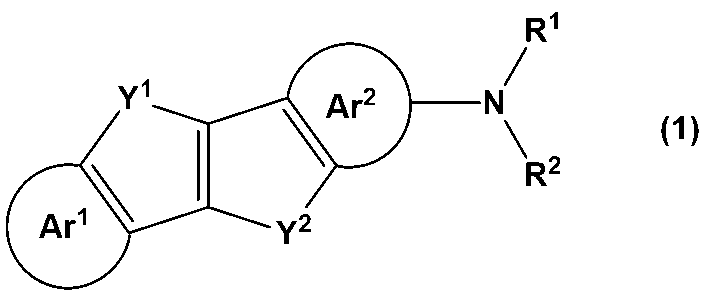
2. さらに、(C)光散乱粒子を含有する1の波長変換膜形成用組成物。
3. 上記(C)光散乱粒子が、酸化チタン粒子である2の波長変換膜形成用組成物。
4. 上記(B)バインダーが、樹脂を含む1~3のいずれかの波長変換膜形成用組成物。
5. 上記(B)バインダーが、重合性モノマーおよび光重合開始剤を含む1~3のいずれかの波長変換膜形成用組成物。
6. 上記(B)バインダーが、アルカリ可溶性樹脂、重合性モノマーおよび光重合開始剤を含む1~3のいずれかの波長変換膜形成用組成物。
7. 上記(A)蛍光体の含有量が、固形分中0.1質量%以上である1~6のいずれかの波長変換膜形成用組成物。
8. 上記(C)光散乱粒子の含有量が、固形分中1質量%以上である2~7のいずれかの波長変換膜形成用組成物。
9. 上記組成物から形成される膜のヘイズ値が18%以上である1~8のいずれかの波長変換膜形成用組成物。
本発明の波長変換膜形成用組成物は、(A)下記式(1)で表される蛍光体と(B)バインダーとを含有することを特徴とする。なお、以下の説明において、固形分とは、波長変換膜形成用組成物を構成する溶媒以外の成分を意味する。
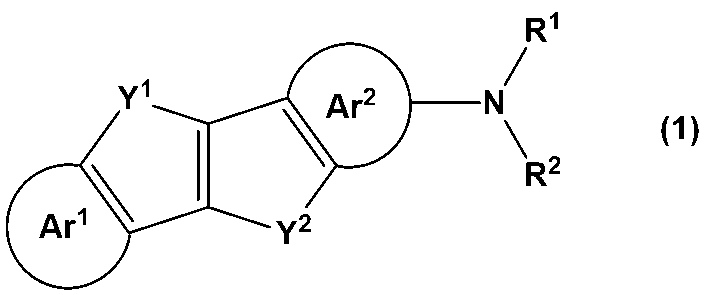


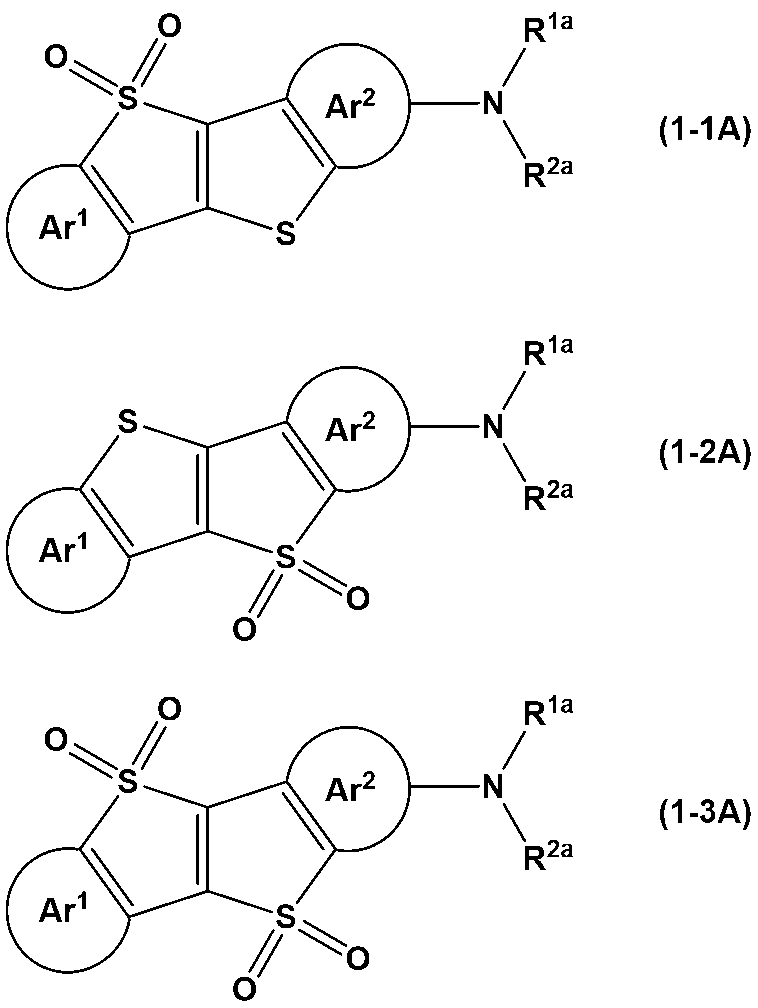
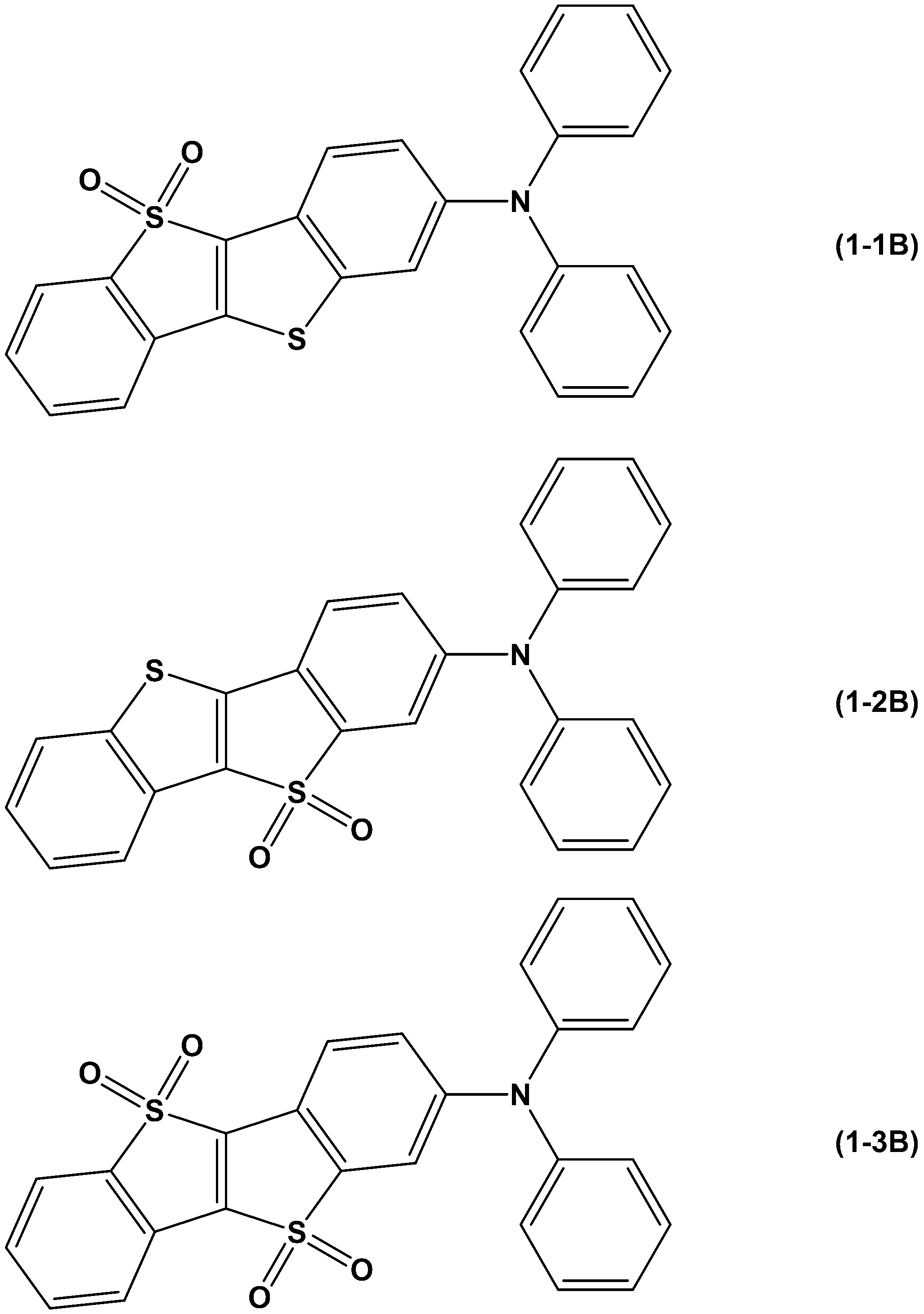
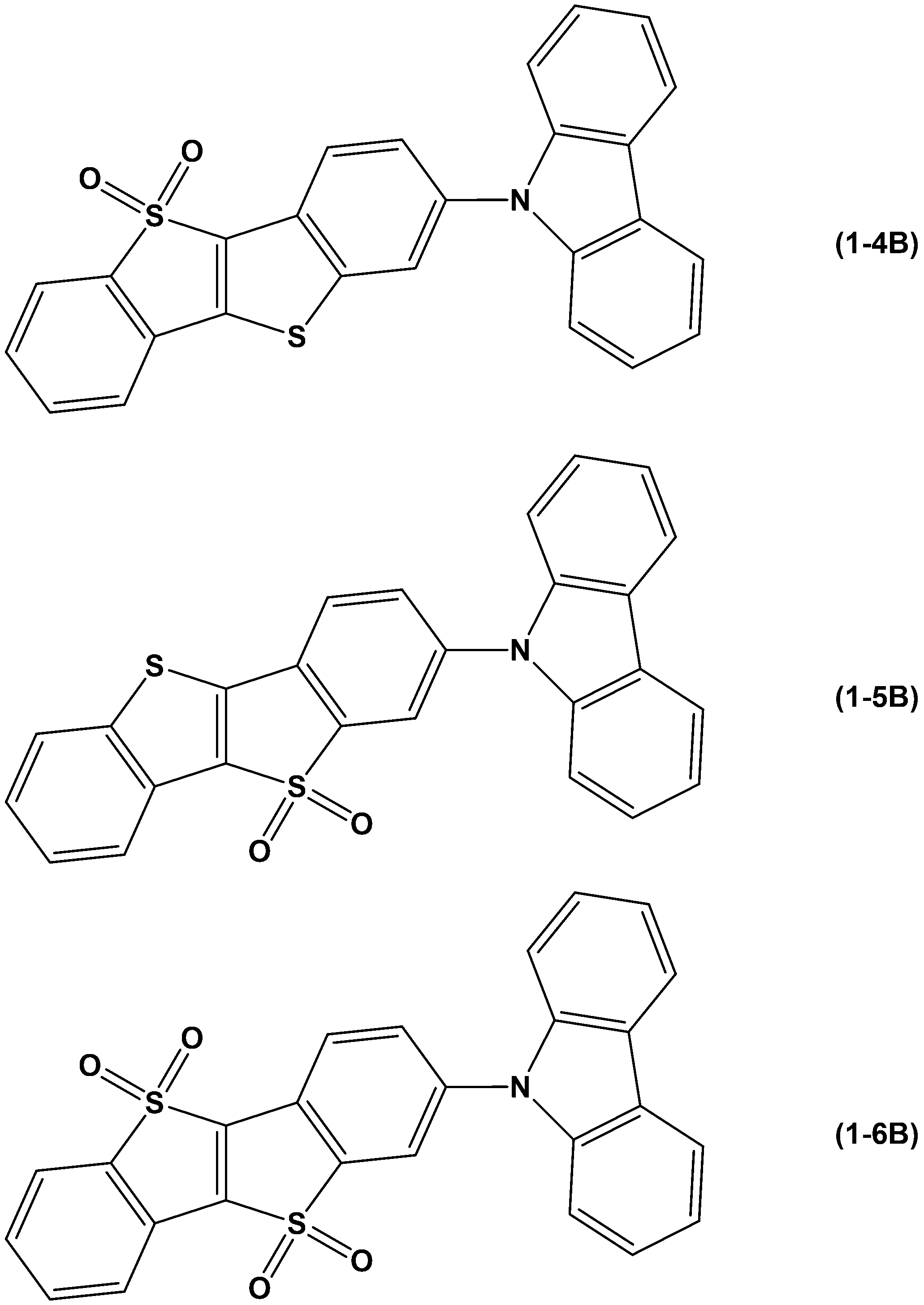
これらの中でも、アクリル系樹脂が好ましく、メタクリル酸メチル-メタクリル酸共重合体がより好ましい。
上記各樹脂は、市販品を用いてもよく、不飽和二重結合基の反応により得られるものは重合開始剤を用いたラジカル重合等の常法に従って合成したものを用いてもよい。
上記重合性モノマーとしては、光重合開始剤と共に用いられ、光の照射によって重合するものであれば特に限定されないが、エチレン性不飽和モノマーが好ましい。本発明では、上記エチレン性不飽和モノマーとしては、単官能モノマー、二官能モノマーおよび三官能以上のモノマーのいずれも用いることができる。
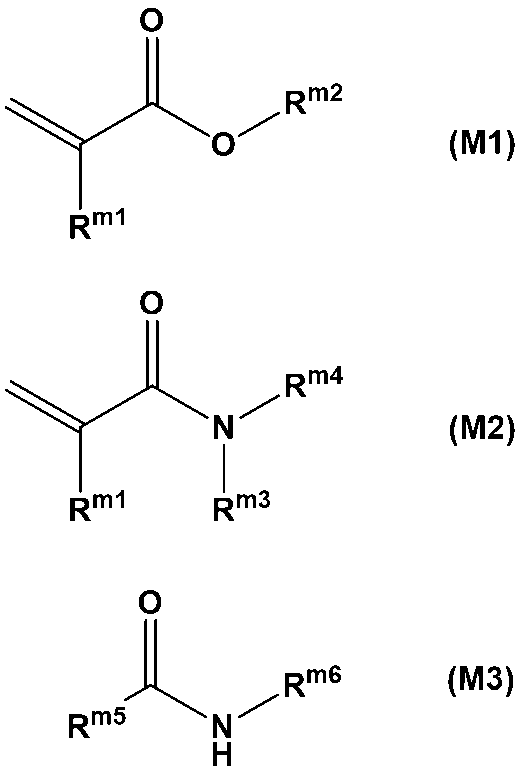


アルカリ可溶性アクリル重合体としては、アルカリ可溶性を発現するモノマー、すなわち前述のアルカリ可溶性基から選ばれる少なくとも1種を有するモノマーと、これらのモノマーと共重合可能なモノマーの群から選ばれる少なくとも1種のモノマーとを、必須の構成単位として形成された共重合体が挙げられる。上記アルカリ可溶性樹脂の数平均分子量は、2,000~50,000が好ましい。数平均分子量が50,000以下であると、残渣が生じにくい。
カルボキシ基を有するモノマーとしては、アクリル酸、メタクリル酸、クロトン酸、モノ-(2-(アクリロイルオキシ)エチル)フタレート、モノ-(2-(メタクリロイルオキシ)エチル)フタレート、N-(カルボキシフェニル)マレイミド、N-(カルボキシフェニル)メタクリルアミド、N-(カルボキシフェニル)アクリルアミド等が挙げられる。
以下、当該その他モノマーの具体例を挙げるが、これらに限定されるものではない。
本発明においては、上記特定共重合体の粉体をそのまま用いてもよく、あるいはその粉体を適宜な溶媒、例えば、上述した重合反応に用いられる溶媒に再溶解して溶液の状態として用いてもよい。
2,4-ジアミノフェノール、3,5-ジアミノフェノール、2,5-ジアミノフェノール、4,6-ジアミノレゾルシノール、2,5-ジアミノハイドロキノン、ビス(3-アミノ-4-ヒドロキシフェニル)エーテル、ビス(4-アミノ-3-ヒドロキシフェニル)エーテル、ビス(4-アミノ-3,5-ジヒドロキシフェニル)エーテル、ビス(3-アミノ-4-ヒドロキシフェニル)メタン、ビス(4-アミノ-3-ヒドロキシフェニル)メタン、ビス(4-アミノ-3,5-ジヒドロキシフェニル)メタン、ビス(3-アミノ-4-ヒドロキシフェニル)スルホン、ビス(4-アミノ-3-ヒドロキシフェニル)スルホン、ビス(4-アミノ-3,5-ジヒドロキシフェニル)スルホン、2,2-ビス(3-アミノ-4-ヒドロキシフェニル)ヘキサフルオロプロパン、2,2-ビス(4-アミノ-3-ヒドロキシフェニル)ヘキサフルオロプロパン、2,2-ビス(4-アミノ-3,5-ジヒドロキシフェニル)ヘキサフルオロプロパン、4,4’-ジアミノ-3,3’-ジヒドロキシビフェニル、4,4’-ジアミノ-3,3’-ジヒドロキシ-5,5’-ジメチルビフェニル、4,4’-ジアミノ-3,3’-ジヒドロキシ-5,5’-ジメトキシビフェニル、1,4-ビス(3-アミノ-4-ヒドロキシフェノキシ)ベンゼン、1,3-ビス(3-アミノ-4-ヒドロキシフェノキシ)ベンゼン、1,4-ビス(4-アミノ-3-ヒドロキシフェノキシ)ベンゼン、1,3-ビス(4-アミノ-3-ヒドロキシフェノキシ)ベンゼン、ビス[4-(3-アミノ-4-ヒドロキシフェノキシ)フェニル]スルホン、ビス[4-(3-アミノ-4-ヒドロキシフェノキシ)フェニル]プロパン、2,2-ビス[4-(3-アミノ-4-ヒドロキシフェノキシ)フェニル]ヘキサフルオロプロパン等のフェノール性ヒドロキシ基を有するジアミン化合物;
1,3-ジアミノ-4-メルカプトベンゼン、1,3-ジアミノ-5-メルカプトベンゼン、1,4-ジアミノ-2-メルカプトベンゼン、ビス(4-アミノ-3-メルカプトフェニル)エーテル、2,2-ビス(3-アミノ-4-メルカプトフェニル)ヘキサフルオロプロパン等チオフェノール基を有するジアミン化合物、1,3-ジアミノベンゼン-4-スルホン酸、1,3-ジアミノベンゼン-5-スルホン酸、1,4-ジアミノベンゼン-2-スルホン酸、ビス(4-アミノベンゼン-3-スルホン酸)エーテル、4,4’-ジアミノビフェニル-3,3’-ジスルホン酸、4,4’-ジアミノ-3,3’-ジメチルビフェニル-6,6’-ジスルホン酸等のスルホン酸基を有するジアミン化合物が挙げられる。また、p-フェニレンジアミン、m-フェニレンジアミン、4,4’-メチレン-ビス(2,6-エチルアニリン)、4,4’-メチレン-ビス(2-イソプロピル-6-メチルアニリン)、4,4’-メチレン-ビス(2,6-ジイソプロピルアニリン)、2,4,6-トリメチル-1,3-フェニレンジアミン、2,3,5,6-テトラメチル-1,4-フェニレンジアミン、o-トリジン、m-トリジン、3,3’,5,5’-テトラメチルベンジジン、ビス[4-(3-アミノフェノキシ)フェニル]スルホン、2,2-ビス[4-(3-アミノフェノキシ)フェニル]プロパン、2,2-ビス[4-(3-アミノフェノキシ)フェニル]ヘキサフルオロプロパン、4,4’-ジアミノ-3,3’-ジメチルジシクロヘキシルメタン、4,4’-ジアミノジフェニルエーテル、3,4-ジアミノジフェニルエーテル、4,4’-ジアミノジフェニルメタン、2,2-ビス(4-アニリノ)ヘキサフルオロプロパン、2,2-ビス(3-アニリノ)ヘキサフルオロプロパン、2,2-ビス(3-アミノ-4-トルイル)ヘキサフルオロプロパン、1,4-ビス(4-アミノフェノキシ)ベンゼン、1,3-ビス(4-アミノフェノキシ)ベンゼン、ビス[4-(4-アミノフェノキシ)フェニル]スルホン、2,2-ビス[4-(4-アミノフェノキシ)フェニル]プロパン、2,2-ビス[4-(4-アミノフェノキシ)フェニル]ヘキサフルオロプロパン、2,2’-ビス(トリフルオロメチル)ベンジジン等のジアミン化合物を挙げることができる。これらは、1種単独で使用してもよく、2種以上を組み合わせて使用してもよい。
このようなカルボン酸無水物の例としてはフタル酸無水物、トリメリット酸無水物、無水マレイン酸、ナフタル酸無水物、水素化フタル酸無水物、メチル-5-ノルボルネン-2,3-ジカルボン酸無水物、無水イタコン酸、テトラヒドロフタル酸無水物等を挙げることができる。
また、末端アミノ基を酸無水物で保護する場合の反応温度は-20~150℃、好ましくは-5~100℃の任意の温度を選択することができる。
ポリイミドへのカルボキシ基またはフェノール性ヒドロキシ基の導入方法としては、カルボキシ基またはフェノール性ヒドロキシ基を有するモノマーを用いる方法、カルボキシ基またはフェノール性ヒドロキシ基を有する酸無水物でアミン末端を封止する方法、および、ポリアミド酸等のポリイミド前駆体をイミド化する際にイミド化率を99%以下にする方法等が挙げられる。
化学イミド化の方法としては、一般的にポリイミド前駆体溶液に過剰の無水酢酸およびピリジンを添加し室温から100℃で反応させる方法が用いられる。また、熱イミド化の方法としては、一般的にポリイミド前駆体溶液を温度180~250℃で脱水しながら過熱する方法が用いられる。
酸二無水物としては、上記(a)テトラカルボン酸二無水物が挙げられる。
ジオールとしては、ビスフェノールA、ビスフェノールF、4,4’-ジヒドロキシビフェニル、ベンゼン-1,3-ジメタノール、ベンゼン-1,4-ジメタノール等の芳香族ジオール、水添ビスフェノールA、水添ビスフェノールF、1,4-シクロヘキサンジオール、1,3-シクロヘキサンジメタノール、1,4-シクロヘキサンジメタノール等の脂環族ジオール;エチレングリコール、プロピレングリコール、1,4-ブタンジオール、1,6-ヘキサンジオール等の脂肪族ジオール等が挙げられる。
重合性モノマーと反応可能な置換基を有するアルカリ可溶性樹脂を得る方法は安定した特性の樹脂が得られるものであれば特に限定されないが、例えば、重合性モノマーと反応可能な置換基を有するモノマーを共重合する方法、重合性モノマーと反応可能な置換基を持たないアルカリ可溶性樹脂を合成し、次いで熱反応により重合性モノマーと反応可能な置換基を持つ化合物を付加する方法が挙げられる。アルカリ可溶性樹脂がアルカリ可溶性アクリル重合体である場合には前者の方法を行うと重合過程で重合性モノマーと反応可能な置換基が反応しゲル化が進行するおそれがあるため、後者の方法での合成が好ましい。
また別の例として、例えば、ラジカル重合性を有し、さらに熱反応基を有するモノマーを共重合して得られたアルカリ可溶性アクリル重合体に対し、樹脂中の熱反応性基との熱反応が可能な重合性モノマーと反応可能な置換基を有するモノマーを付加する方法が挙げられる。具体的には、メタクリル酸グリシジル、メタクリル酸3,4-エポキシシクロヘキシルメチルなどを共重合したアルカリ可溶性アクリル重合体に対し、(メタ)アクリル酸、(メタ)アクリル酸2-カルボキシエチルなどを付加する方法が挙げられる。
本発明のアルカリ可溶性樹脂において、重合性モノマーと反応可能な置換基を有する繰り返し単位の割合はアルカリ可溶性樹脂が有する全ての繰り返し単位中、好ましくは5~60質量%であり、より好ましくは10~50質量%であり、さらに好ましくは10~40質量%である。この構成単位の含有量が5質量%以上であると、硬化膜の耐熱性や耐薬品性が向上する。一方、この構成単位の含有量が60質量%以下であると、感放射線性樹脂組成物のパターン形成性が向上する。
表面処理を行う場合、表面処理の具体的な材料としては、酸化ケイ素や酸化ジルコニウム等の異種無機酸化物、水酸化アルミニウム等の金属水酸化物、オルガノシロキサン、ステアリン酸等の有機酸等が挙げられる。これら表面処理材は、1種を単独で用いても、複数種を組み合わせて用いてもよい。
その具体例としては、ネオス(株)製のフタージェントシリーズ、212M、215M、250、222F、FTX-218、DFX-18等が挙げられるが、これらに限定されるものではない。
界面活性剤を用いる場合、その配合量に特に制限はないが、波長変換膜形成用組成物の固形分中0.01~1質量%が好ましく、0.01~0.5質量%がより好ましい。
BASF社製のEFKA4010、EFKA4015、EFKA4046、EFKA4047、EFKA4061、EFKA4080、EFKA4300、EFKA4310、EFKA4320、EFKA4330、EFKA4340、EFKA4560、EFKA4585、EFKA5207、EFKA1501、EFKA1502、EFKA1503およびEFKA PX-4701;
ルーブリゾール社製のソルスパース3000、ソルスパース9000、ソルスパース13240、ソルスパース13650、ソルスパース13940、ソルスパース11200、ソルスパース13940、ソルスパース16000、ソルスパース17000、ソルスパース18000、ソルスパース20000、ソルスパース21000、ソルスパース24000、ソルスパース26000、ソルスパース27000、ソルスパース28000、ソルスパース32000、ソルスパース32500、ソルスパース32550、ソルスパース32600、ソルスパース33000、ソルスパース34750、ソルスパース35100、ソルスパース35200、ソルスパース36000、ソルスパース37500、ソルスパース38500、ソルスパース39000、ソルスパース41000、ソルスパース54000、ソルスパース71000およびソルスパース76500;
味の素ファインテクノ(株)製のアジスパーPB821、アジスパーPB822、アジスパーPB881、PN411およびPA111;
エボニック社製のTEGO Dispers650、TEGO Dispers660C、TEGO Dispers662C、TEGO Dispers670、TEGO Dispers685、TEGO Dispers700、TEGO Dispers710およびTEGO Dispers760W;ならびに
楠本化成(株)製のディスパロンAQ-320、ディスパロンAQ-330、ディスパロンAQ-340、ディスパロンAQ-360、ディスパロンAQ-380等が挙げられる。
なお、本発明において、粘度とはEMS粘度計による測定値を意味する。
塗布方法としては、例えば、リバースロールコーター、ブレードコーター、スリットダイコーター、ダイレクトグラビアコーター、オフセットグラビアコーター、キスコーター、ナチュラルロールコーター、エアーナイフコーター、ロールブレードコーター、バリバーロールブレードコーター、トゥーストリームコーター、ロッドコーター、ワイヤーバーコーター、アプリケーター、ディップコーター、カーテンコーター、スピンコーター、ナイフコーター、インクジェット等による方法が挙げられる。
加熱条件は、膜を形成できる限り特に制限はないが、60~200℃で5分~2時間が好ましく、80~200℃で15分~1時間がより好ましい。なお、段階的に加熱硬化させてもよい。
波長変換膜のヘイズは、特に制限されるものではないが、入射光を膜内で散乱させることにより蛍光体が吸収することのできる光の量を多くする観点から、好ましくは18%以上、より好ましくは30%以上、より好ましくは40%以上である。ヘイズ値の上限は、特に限定されないが、通常95%程度である。なお、本発明においてヘイズ値は、ASTM D1003-61に従って測定される値である。また、本発明において、上記ヘイズ値の測定条件としては、例えば、酸化チタン粒子の含有量を6.7質量%とした組成物から形成される膜厚10μmの膜について測定する条件が挙げられる。
ガラスの具体例としては、ソーダ石灰ガラス、バリウム・ストロンチウム含有ガラス、鉛ガラス、アルミノケイ酸ガラス、ホウケイ酸ガラス、バリウムホウケイ酸ガラス、石英等が挙げられる。
ポリマーの具体例としては、ポリカーボネート、アクリル、ポリエチレンテレフタレート,ポリエーテルサルファイド、ポリスルフォン等が挙げられる。
カラムオーブン:40℃
流量:1mL/分
溶離液:テトラヒドロフラン
・MMA:メチルメタクリレート
・MAA:メタクリル酸
・AIBN:α,α’-アゾビスイソブチロニトリル
・CPN:シクロペンタノン
・A2:3-(2-ベンゾチアゾリル)-7-(ジエチルアミノ)クマリン(クマリン6、東京化成工業(株)製)
・B2:KAYARAD DPHA(ジペンタエリスリトールポリアクリレート、日本化薬(株)製、重合性モノマー)
・B3:OXE-02:Irgacure OXE02(BASF社製)
・C1:酸化チタン粒子 PT-401L(ルチル型、平均粒子径130nm、石原産業(株)製)
・D1:メガファック(登録商標)R-40(DIC(株)製)
・D2:フタージェントDFX-18(ネオス(株)製)
・D3:AQ-320(ポリエーテルリン酸エステル、楠本化成(株)製)
MMA80.0g、MAA20.0g、AIBN2.5gをCPN190.0gに溶解し、90℃にて20時間反応させることによりアクリル重合体溶液B1(固形分濃度30質量%)を得た。得られたアクリル重合体のMnは9,900、Mwは17,300であった。
ACS Materials Lett. 2021,3,42-49の記載の合成方法に従って上記式(1-2B)で表される蛍光色素化合物A1を得た。
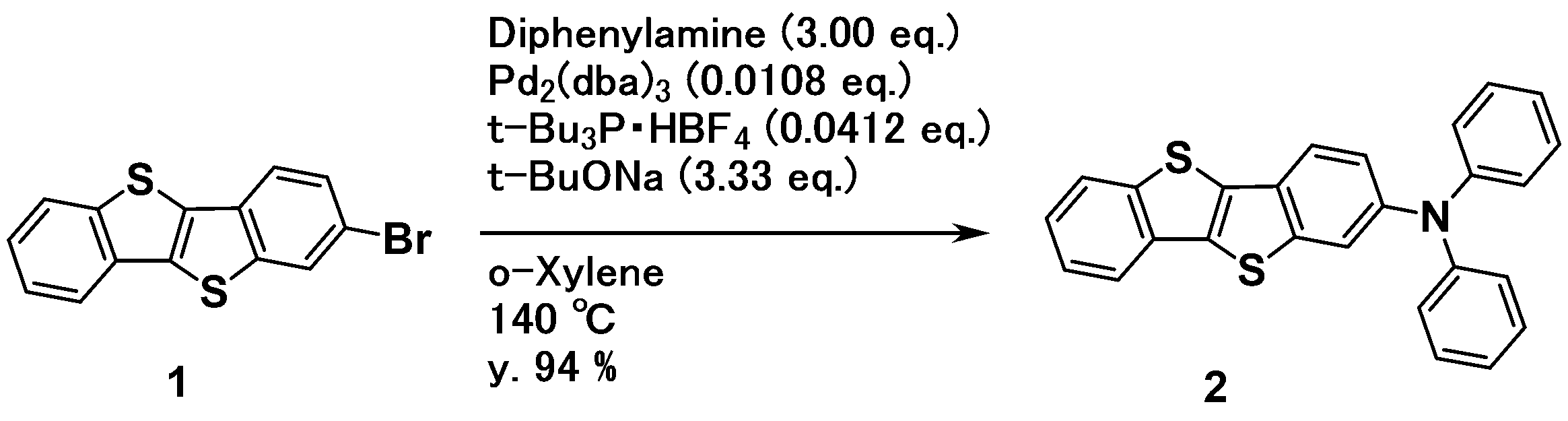
1H-NMR(500MHz,CDCl3):δ 7.90(d,JHH=8.0Hz,1H),7.82(d,JHH=8.0Hz,1H),7.72(d,JHH=8.0Hz,1H),7.56(d,JHH=1.5Hz,1H),7.45-7.36(m,2H),7.30-7.26(m,4H),7.22(dd,JHH=8.5Hz,2.0Hz,1H),7.15-7.13(m,4H),7.07-7.04(m,2H)
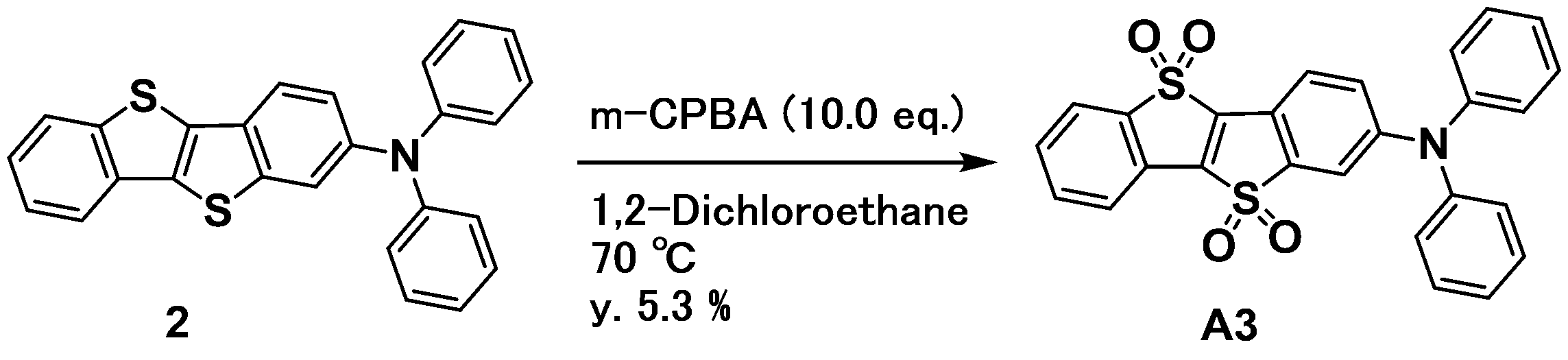
1H-NMR(500MHz,Dimethylsulfoxide-d6):δ 8.17(d,JHH=7.5Hz,1H),7.82(d,JHH=7.5Hz,1H),7.77-7.72(m,2H),7.64(d,JHH=9.0Hz,1H),7.50-7.47(m,4H),7.31-7.29(m,6H),7.24(d,JHH=2.5Hz,1H),7.09-7.07(m,1H)

1H-NMR(500MHz,CDCl3):δ 8.17(d,JHH=8.0Hz,2H),8.12-8.08(m,2H),7.98-7.93(m,2H),7.67(d,JHH=8.0Hz,1H),7.52-7.42(m,6H),7.33-7.30(m,2H)
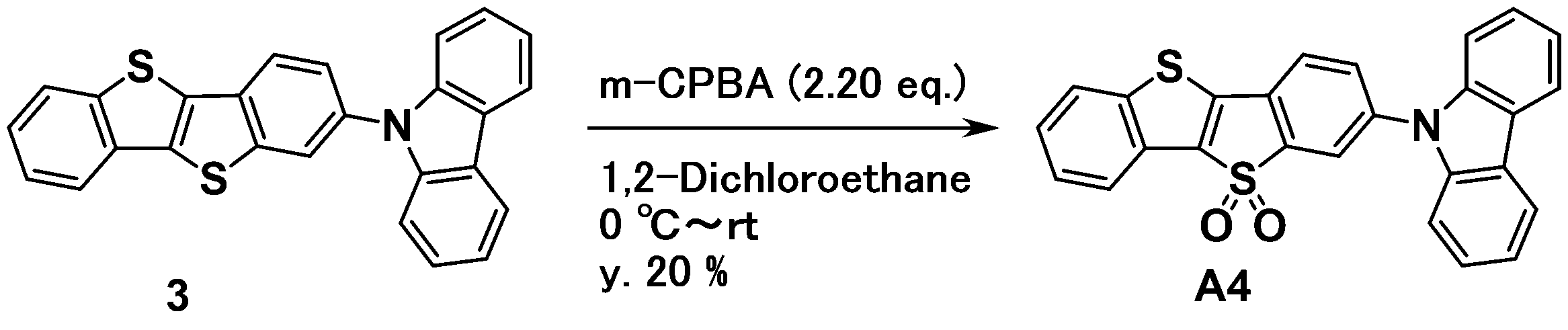
1H-NMR(500MHz,CDCl3):δ 8.15(d,JHH=8.0Hz,2H),8.09(d,JHH=8.0Hz,1H),8.04(s,1H),7.93(d,JHH=8.5Hz,1H),7.83(d,JHH=8.5Hz,1H),7.74(d,JHH=7.5Hz,1H),7.59-7.44(m,6H),7.36-7.33(m,2H)
光散乱粒子C1に対し固形分比で50質量%の量のアクリル重合体溶液B1を加え、さらにCPNを加えて固形分濃度が30質量%となるように調整した。その後直径1mmのジルコニアボールを用いて48時間のボールミル処理を行い、光散乱粒子分散液1を得た。得られた分散液の粒度分布をNanotrac UPA(Microtrac社製)を用いて測定した。希釈液には分散液の溶媒を用い、希釈サンプルにレーザー光を照射した際に生じる散乱から日機装(株)製解析ソフトMicrotracDMSを用い、体積基準で分散液中粒子の50%累積径(D50)を算出したところ、181nmであり、体積平均粒子径は189nmであった。
500mlスチロール瓶に、光散乱粒子C1に対し固形分比で20質量%の量の粒子分散剤D3加え、さらにCPNを加えて固形分濃度が30質量%となるように調整し、1,000rpmで30分間ディスパー攪拌することでスラリーを得た。次に、スラリー全量をスラリータンクに移した後、アシザワファインテック社製ビーズミル装置ラボミニスターDMS65を用いて、直径0.2mmのジルコニアビーズを60体積%充填した状態で、送液速度60ml/min、ディスクの周速8m/sの条件で10パス処理を行うことで、光散乱粒子分散液1を得た。得られた分散液の粒度分布をNanotrac UPA(Microtrac社製)を用いて測定した。希釈液にはCPNを用い、希釈サンプルにレーザー光を照射した際に生じる散乱から日機装(株)製解析ソフトMicrotracDMSを用い、体積基準で分散液中粒子の50%累積径(D50)を算出したところ185nmであり、体積平均粒子径は191nmであった。
(1)波長変換膜形成用組成物の調製
表1に示す組成で各成分を混合し、得られた混合物を孔径が0.2μmのPTFEフィルターを用いて濾過することで、波長変換膜形成用組成物を調製した。なお、表1中の組成比は固形分での比を表すものとする。
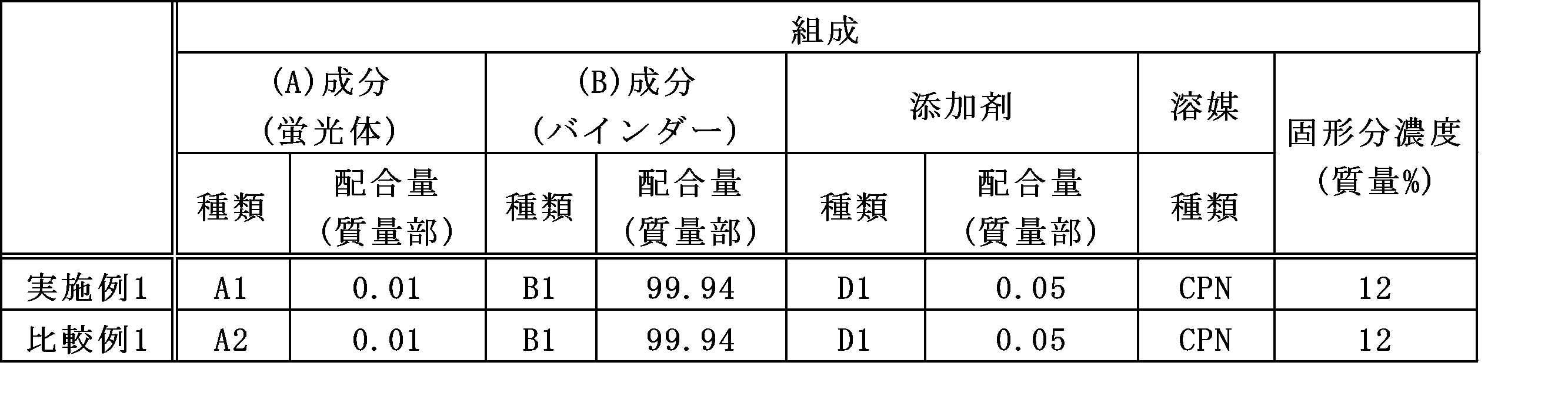
実施例1および比較例1の波長変換膜形成用組成物を石英基板上にスピンコーターを用いて塗布した後、100℃で120秒間、ホットプレート上でプリベークを行い、その後、160℃で30分間のポストベークを行って膜厚1μmの塗膜試料形成基板をそれぞれ3枚得た。これらを基板A、B、Cと称する。次に、基板Aは窒素雰囲気下で、基板Bは大気中で青色LEDライト(シーシーエス(株)製、発光ピーク波長450nm、照度2.1mW/cm2)の上にそれぞれ重ね、LEDライトを点灯し、20時間の光照射を行った。この間、基板Cは大気中で遮光した状態で保管した。その後、全ての基板について蛍光分光器((株)日立製作所製 F-7000)を用い、実施例1および比較例1について、以下に示す各基板Cの極大吸収波長で励起した蛍光スペクトルの測定を行った。基板Aの蛍光スペクトルのピーク強度を基板Cの蛍光スペクトルのピーク強度で割った値を窒素雰囲気下での蛍光強度維持率、基板Bの蛍光スペクトルのピーク強度を基板Cの蛍光スペクトルのピーク強度で割った値を大気中での蛍光強度維持率とした。評価の結果を表2に示す。
〈基板Cの極大吸収波長〉
実施例1:410nm
比較例1:448nm

(3)波長変換膜形成用組成物の調製
表3に示す組成で各成分を混合し、得られた混合物を孔径が0.2μmのPTFEフィルターを用いて濾過することで、波長変換膜形成用組成物を調製した。なお、表3中の組成比は固形分での比を表すものとする。

実施例2~4および比較例2の波長変換膜形成用組成物を石英基板上にスピンコーターを用いて塗布した後、100℃で120秒間、ホットプレート上でプリベークを行い、その後、160℃で30分間のポストベークを行って膜厚1μmの塗膜試料形成基板を得た。
上記(4)で用いた基板と同じ条件で作製した塗膜試料に対し、VAC社製グローブボックス内での窒素雰囲気下で、シーシーエス(株)製青色LED露光装置を用いて450nmの波長の光を20時間照射した。光照射後の塗膜試料に対し、評価2と同様に波長450nm励起で蛍光スペクトルの測定を行った。光照射後の蛍光スペクトルのピーク強度を光照射前の蛍光スペクトルのピーク強度で割った値を「蛍光強度維持率」とした。得られた結果を表4に示す。
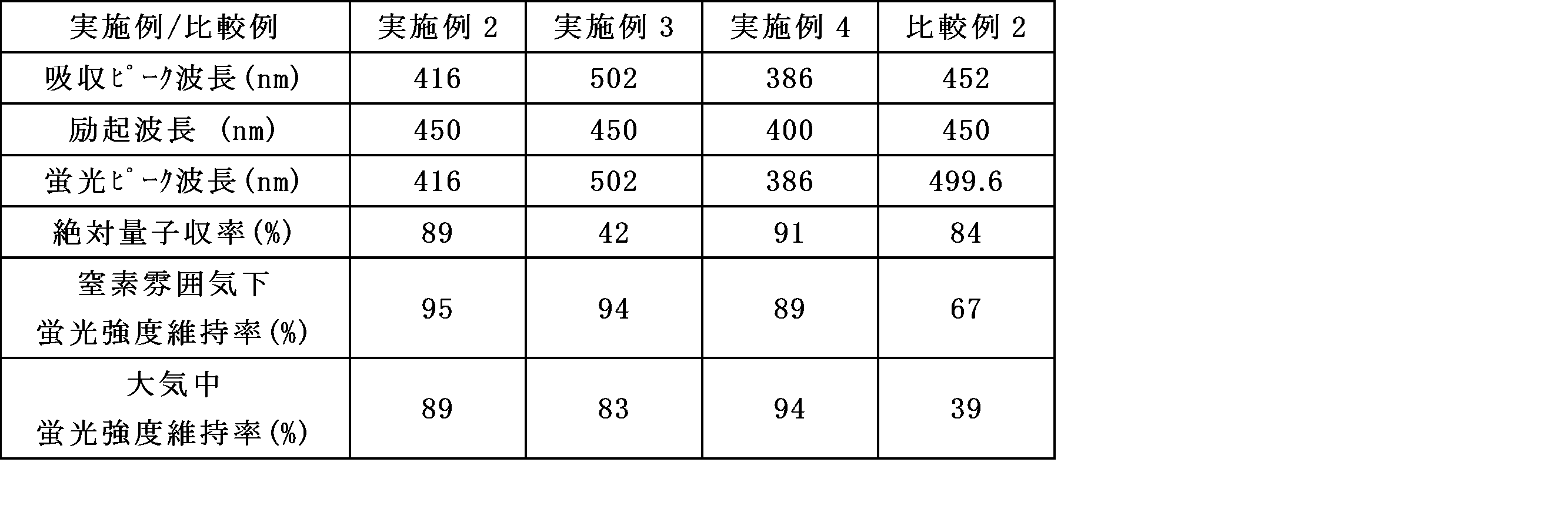
(6)波長変換膜形成用組成物の調製
表5に示す組成で各成分を混合した。実施例5、6および比較例3は光散乱粒子分散液1を用いて、実施例7、8および比較例4は光散乱粒子分散液2を用いて調製した。得られた混合物を孔径が5.0μmのポリテトラフルオロエチレン(PTFE)フィルターを用いて濾過することで、波長変換膜形成用組成物を調製した。なお、表5中の組成比は固形分での質量比を表すものとする。

実施例5~8および比較例3~4の樹脂組成物を石英基板上にスピンコーターを用いて塗布した後、温度100℃で120秒間ホットプレート上においてプリベークを行った。実施例7、8および比較例4では、この塗膜にキヤノン(株)製紫外線照射装置PLA-600FAにより365nmにおける光強度が3mW/cm2の紫外線を500mJ/cm2の露光量で照射した。次いで、160℃で30分間のポストベークを行うことで膜厚10μmの塗膜試料を得た。
同様に、塗膜試料を除きLEDライトのみから発せられた光を同様に測定し、結果(2)とした。得られた分光放射照度スペクトルから、結果(2)の480nm以下の波長の光の光子数を「励起光光子数」とした。同様に、結果(1)の480nm以下の波長の光の光子数を「透過光光子数」とした。同様に結果(1)の480nmを超える波長の光の光子数を「発光光子数」とした。
以下の式により「青色光吸収率」および「変換効率」を算出した。
青色光吸収率 = (励起光光子数 - 透過光光子数)÷ 励起光光子数
変換効率 = 発光光子数 ÷ 励起光光子数
上記(7)で用いたものと同じ条件で作製した塗膜試料各3枚に対し、大気中で、シーシーエス(株)製青色LED露光装置を用いて450nmの波長の光を64時間照射した。光照射後の塗膜試料に対し、評価1と同様に青色光吸収率、変換効率の測定を行った。光照射後の青色光吸収率を光照射前の青色光吸収率で割った値を青色光吸収率の「維持率」、光照射後の変換効率を光照射前の変換効率で割った値を変換効率の「維持率」とした。

Claims (9)
- (A)下記式(1)で表される蛍光体と(B)バインダーとを含有する波長変換膜形成用組成物。

- さらに、(C)光散乱粒子を含有する請求項1記載の波長変換膜形成用組成物。
- 上記(C)光散乱粒子が、酸化チタン粒子である請求項2記載の波長変換膜形成用組成物。
- 上記(B)バインダーが、樹脂を含む請求項1記載の波長変換膜形成用組成物。
- 上記(B)バインダーが、重合性モノマーおよび光重合開始剤を含む請求項1記載の波長変換膜形成用組成物。
- 上記(B)バインダーが、アルカリ可溶性樹脂、重合性モノマーおよび光重合開始剤を含む請求項1記載の波長変換膜形成用組成物。
- 上記(A)蛍光体の含有量が、固形分中0.1質量%以上である請求項1記載の波長変換膜形成用組成物。
- 上記(C)光散乱粒子の含有量が、固形分中1質量%以上である請求項2記載の波長変換膜形成用組成物。
- 上記組成物から形成される膜のヘイズ値が18%以上である請求項1~8のいずれか1項記載の波長変換膜形成用組成物。
Priority Applications (3)
| Application Number | Priority Date | Filing Date | Title |
|---|---|---|---|
| CN202280077776.6A CN118318191A (zh) | 2021-11-30 | 2022-11-28 | 波长转换膜形成用组合物 |
| KR1020247015312A KR20240120714A (ko) | 2021-11-30 | 2022-11-28 | 파장 변환막 형성용 조성물 |
| JP2023564964A JPWO2023100809A1 (ja) | 2021-11-30 | 2022-11-28 |
Applications Claiming Priority (2)
| Application Number | Priority Date | Filing Date | Title |
|---|---|---|---|
| JP2021-194627 | 2021-11-30 | ||
| JP2021194627 | 2021-11-30 |
Publications (1)
| Publication Number | Publication Date |
|---|---|
| WO2023100809A1 true WO2023100809A1 (ja) | 2023-06-08 |
Family
ID=86612206
Family Applications (1)
| Application Number | Title | Priority Date | Filing Date |
|---|---|---|---|
| PCT/JP2022/043769 Ceased WO2023100809A1 (ja) | 2021-11-30 | 2022-11-28 | 波長変換膜形成用組成物 |
Country Status (5)
| Country | Link |
|---|---|
| JP (1) | JPWO2023100809A1 (ja) |
| KR (1) | KR20240120714A (ja) |
| CN (1) | CN118318191A (ja) |
| TW (1) | TW202338018A (ja) |
| WO (1) | WO2023100809A1 (ja) |
Cited By (1)
| Publication number | Priority date | Publication date | Assignee | Title |
|---|---|---|---|---|
| WO2025047700A1 (ja) * | 2023-08-30 | 2025-03-06 | 日産化学株式会社 | 波長変換膜形成用組成物及びその用途 |
Citations (6)
| Publication number | Priority date | Publication date | Assignee | Title |
|---|---|---|---|---|
| JP2004263179A (ja) * | 2003-02-14 | 2004-09-24 | Idemitsu Kosan Co Ltd | 色変換材料組成物及びそれを用いた色変換膜 |
| JP2011241160A (ja) * | 2010-05-17 | 2011-12-01 | Yamamoto Chem Inc | 色変換材料、該材料を含む組成物、該組成物を使用した色変換光学部品および該色変換光学部品を使用した発光素子 |
| WO2018159848A1 (ja) * | 2017-03-02 | 2018-09-07 | 国立大学法人名古屋大学 | 縮環チオフェン化合物及びそれを用いた油滴染色剤 |
| WO2019181698A1 (ja) * | 2018-03-23 | 2019-09-26 | 東レ株式会社 | 感光性樹脂組成物、硬化膜、色変換基板、画像表示装置、および硬化膜の製造方法 |
| JP2021076790A (ja) * | 2019-11-13 | 2021-05-20 | 東レ株式会社 | 色変換フィルム、それを含む光源ユニット、ディスプレイおよび照明 |
| JP2022143648A (ja) * | 2021-03-18 | 2022-10-03 | 日産化学株式会社 | 波長変換膜形成用組成物及び波長変換膜 |
Family Cites Families (8)
| Publication number | Priority date | Publication date | Assignee | Title |
|---|---|---|---|---|
| JP4005749B2 (ja) | 1999-12-13 | 2007-11-14 | 出光興産株式会社 | 色変換膜及び有機エレクトロルミネッセンス素子 |
| JP4948713B2 (ja) | 2001-04-19 | 2012-06-06 | 三井化学株式会社 | 色変換材料、該材料を含む組成物、該組成物を使用した色変換光学部品および該色変換光学部品を使用した発光素子 |
| JP4948714B2 (ja) | 2001-05-24 | 2012-06-06 | 三井化学株式会社 | 色変換材料、該材料を含む組成物、該組成物を使用した色変換光学部品および該色変換光学部品を使用した発光素子 |
| JP2006089724A (ja) | 2004-08-25 | 2006-04-06 | Idemitsu Kosan Co Ltd | 赤色変換材料組成物及び赤色変換膜 |
| JP5221859B2 (ja) | 2006-03-09 | 2013-06-26 | 株式会社Adeka | クマリン化合物を含有してなるフィルム、クマリン化合物とマトリクスを含む色変換層、該色変換層を含む色変換フィルタ、補色層、補色フィルタならびに多色発光デバイス |
| JP5527269B2 (ja) | 2011-04-06 | 2014-06-18 | セイコーエプソン株式会社 | インク組成物、インクジェット記録方法、及び記録物 |
| JP6279209B2 (ja) | 2013-01-17 | 2018-02-14 | 山本化成株式会社 | 波長変換層、及びこれを用いた波長変換フィルタ |
| US20220185974A1 (en) | 2019-03-19 | 2022-06-16 | Konica Minolta, Inc. | Wavelength conversion film, wavelength conversion device, light-emitting member, authentication device, wristband-type electronic device and biometric device |
-
2022
- 2022-11-28 KR KR1020247015312A patent/KR20240120714A/ko active Pending
- 2022-11-28 WO PCT/JP2022/043769 patent/WO2023100809A1/ja not_active Ceased
- 2022-11-28 CN CN202280077776.6A patent/CN118318191A/zh not_active Withdrawn
- 2022-11-28 JP JP2023564964A patent/JPWO2023100809A1/ja active Pending
- 2022-11-30 TW TW111145930A patent/TW202338018A/zh unknown
Patent Citations (6)
| Publication number | Priority date | Publication date | Assignee | Title |
|---|---|---|---|---|
| JP2004263179A (ja) * | 2003-02-14 | 2004-09-24 | Idemitsu Kosan Co Ltd | 色変換材料組成物及びそれを用いた色変換膜 |
| JP2011241160A (ja) * | 2010-05-17 | 2011-12-01 | Yamamoto Chem Inc | 色変換材料、該材料を含む組成物、該組成物を使用した色変換光学部品および該色変換光学部品を使用した発光素子 |
| WO2018159848A1 (ja) * | 2017-03-02 | 2018-09-07 | 国立大学法人名古屋大学 | 縮環チオフェン化合物及びそれを用いた油滴染色剤 |
| WO2019181698A1 (ja) * | 2018-03-23 | 2019-09-26 | 東レ株式会社 | 感光性樹脂組成物、硬化膜、色変換基板、画像表示装置、および硬化膜の製造方法 |
| JP2021076790A (ja) * | 2019-11-13 | 2021-05-20 | 東レ株式会社 | 色変換フィルム、それを含む光源ユニット、ディスプレイおよび照明 |
| JP2022143648A (ja) * | 2021-03-18 | 2022-10-03 | 日産化学株式会社 | 波長変換膜形成用組成物及び波長変換膜 |
Non-Patent Citations (1)
| Title |
|---|
| TAKI MASAYASU, KAJIWARA KEIJI, YAMAGUCHI ERIKO, SATO YOSHIKATSU, YAMAGUCHI SHIGEHIRO: "Fused Thiophene- S , S -dioxide-Based Super-Photostable Fluorescent Marker for Lipid Droplets", ACS MATERIALS LETTERS, vol. 3, no. 1, 4 January 2021 (2021-01-04), pages 42 - 49, XP093069921, ISSN: 2639-4979, DOI: 10.1021/acsmaterialslett.0c00451 * |
Cited By (1)
| Publication number | Priority date | Publication date | Assignee | Title |
|---|---|---|---|---|
| WO2025047700A1 (ja) * | 2023-08-30 | 2025-03-06 | 日産化学株式会社 | 波長変換膜形成用組成物及びその用途 |
Also Published As
| Publication number | Publication date |
|---|---|
| KR20240120714A (ko) | 2024-08-07 |
| TW202338018A (zh) | 2023-10-01 |
| JPWO2023100809A1 (ja) | 2023-06-08 |
| CN118318191A (zh) | 2024-07-09 |
Similar Documents
| Publication | Publication Date | Title |
|---|---|---|
| CN103635541B (zh) | 染料分散液、彩色滤光片用感光性树脂组合物、彩色滤光片、液晶显示装置及有机发光显示装置 | |
| TWI825078B (zh) | 感光性樹脂組成物、硬化膜、色變換基板、圖像顯示裝置、及硬化膜的製造方法 | |
| TWI465852B (zh) | 著色層形成用感放射線性組成物、彩色濾光片及彩色液晶顯示元件 | |
| JP4985859B1 (ja) | カラーフィルタ用赤色顔料分散液及びその製造方法、カラーフィルタ用赤色感光性樹脂組成物及びその製造方法、カラーフィルタ、液晶表示装置、及び有機発光表示装置 | |
| CN107428935A (zh) | 二胺化合物、使用其的耐热性树脂或耐热性树脂前体 | |
| TWI734795B (zh) | 感光性樹脂組成物、感光性薄片、硬化膜、元件、有機el顯示裝置、半導體電子零件、半導體裝置及有機el顯示裝置之製造方法 | |
| CN104880910A (zh) | 着色组合物、着色固化膜和显示元件 | |
| JP6078999B2 (ja) | カラーフィルタ用赤色顔料分散液及びその製造方法、カラーフィルタ用赤色感光性樹脂組成物及びその製造方法、カラーフィルタ、並びに、液晶表示装置及び有機発光表示装置 | |
| CN103365081B (zh) | 着色组合物、彩色滤光片、显示元件及颜料分散液 | |
| KR20130048126A (ko) | 착색 수지 조성물, 착색 경화막, 컬러 필터, 액정 표시장치, 유기 el 디스플레이 및 고체 촬상 소자 | |
| TW202428577A (zh) | 波長變換膜形成用組成物 | |
| JP2018091940A (ja) | 有機el表示装置向け光学部材用感光性組成物、有機el表示装置向け光学部材、および有機el表示装置 | |
| CN105315722A (zh) | 成盐染料和着色固化性树脂组合物 | |
| KR20240120714A (ko) | 파장 변환막 형성용 조성물 | |
| CN107817649B (zh) | 感光性树脂组合物、聚酰胺树脂及其制造方法、化合物及其制造方法、固化膜及其制造方法 | |
| JP7840021B2 (ja) | 縮環チオフェン化合物およびそれを含む波長変換膜形成用組成物 | |
| JP2014115381A (ja) | 着色樹脂組成物 | |
| JP2014041289A (ja) | 着色樹脂組成物 | |
| WO2022196389A1 (ja) | 波長変換材料 | |
| JP2024082753A (ja) | 波長変換膜形成用組成物 | |
| JP2014056214A (ja) | 着色樹脂組成物 | |
| WO2025047702A1 (ja) | パターン形成用組成物及びその用途 | |
| WO2025047700A1 (ja) | 波長変換膜形成用組成物及びその用途 | |
| WO2024214539A1 (ja) | 波長変換膜形成用組成物および化合物 | |
| CN116323713A (zh) | 固化性组合物及固化膜 |
Legal Events
| Date | Code | Title | Description |
|---|---|---|---|
| 121 | Ep: the epo has been informed by wipo that ep was designated in this application |
Ref document number: 22901241 Country of ref document: EP Kind code of ref document: A1 |
|
| ENP | Entry into the national phase |
Ref document number: 2023564964 Country of ref document: JP Kind code of ref document: A |
|
| WWE | Wipo information: entry into national phase |
Ref document number: 202280077776.6 Country of ref document: CN |
|
| NENP | Non-entry into the national phase |
Ref country code: DE |
|
| 122 | Ep: pct application non-entry in european phase |
Ref document number: 22901241 Country of ref document: EP Kind code of ref document: A1 |