WO2023090315A1 - アセトアミノフェンの製造方法 - Google Patents
アセトアミノフェンの製造方法 Download PDFInfo
- Publication number
- WO2023090315A1 WO2023090315A1 PCT/JP2022/042371 JP2022042371W WO2023090315A1 WO 2023090315 A1 WO2023090315 A1 WO 2023090315A1 JP 2022042371 W JP2022042371 W JP 2022042371W WO 2023090315 A1 WO2023090315 A1 WO 2023090315A1
- Authority
- WO
- WIPO (PCT)
- Prior art keywords
- acetaminophen
- reaction
- porous body
- monolithic porous
- catalyst
- Prior art date
- Legal status (The legal status is an assumption and is not a legal conclusion. Google has not performed a legal analysis and makes no representation as to the accuracy of the status listed.)
- Ceased
Links
Images

Classifications
-
- C—CHEMISTRY; METALLURGY
- C07—ORGANIC CHEMISTRY
- C07C—ACYCLIC OR CARBOCYCLIC COMPOUNDS
- C07C231/00—Preparation of carboxylic acid amides
-
- C—CHEMISTRY; METALLURGY
- C07—ORGANIC CHEMISTRY
- C07C—ACYCLIC OR CARBOCYCLIC COMPOUNDS
- C07C231/00—Preparation of carboxylic acid amides
- C07C231/10—Preparation of carboxylic acid amides from compounds not provided for in groups C07C231/02 - C07C231/08
-
- B—PERFORMING OPERATIONS; TRANSPORTING
- B01—PHYSICAL OR CHEMICAL PROCESSES OR APPARATUS IN GENERAL
- B01J—CHEMICAL OR PHYSICAL PROCESSES, e.g. CATALYSIS OR COLLOID CHEMISTRY; THEIR RELEVANT APPARATUS
- B01J23/00—Catalysts comprising metals or metal oxides or hydroxides, not provided for in group B01J21/00
- B01J23/38—Catalysts comprising metals or metal oxides or hydroxides, not provided for in group B01J21/00 of noble metals
- B01J23/40—Catalysts comprising metals or metal oxides or hydroxides, not provided for in group B01J21/00 of noble metals of the platinum group metals
- B01J23/44—Palladium
-
- B—PERFORMING OPERATIONS; TRANSPORTING
- B01—PHYSICAL OR CHEMICAL PROCESSES OR APPARATUS IN GENERAL
- B01J—CHEMICAL OR PHYSICAL PROCESSES, e.g. CATALYSIS OR COLLOID CHEMISTRY; THEIR RELEVANT APPARATUS
- B01J35/00—Catalysts, in general, characterised by their form or physical properties
- B01J35/40—Catalysts, in general, characterised by their form or physical properties characterised by dimensions, e.g. grain size
-
- B—PERFORMING OPERATIONS; TRANSPORTING
- B01—PHYSICAL OR CHEMICAL PROCESSES OR APPARATUS IN GENERAL
- B01J—CHEMICAL OR PHYSICAL PROCESSES, e.g. CATALYSIS OR COLLOID CHEMISTRY; THEIR RELEVANT APPARATUS
- B01J35/00—Catalysts, in general, characterised by their form or physical properties
- B01J35/50—Catalysts, in general, characterised by their form or physical properties characterised by their shape or configuration
- B01J35/56—Foraminous structures having flow-through passages or channels, e.g. grids or three-dimensional [3D] monoliths
-
- B—PERFORMING OPERATIONS; TRANSPORTING
- B01—PHYSICAL OR CHEMICAL PROCESSES OR APPARATUS IN GENERAL
- B01J—CHEMICAL OR PHYSICAL PROCESSES, e.g. CATALYSIS OR COLLOID CHEMISTRY; THEIR RELEVANT APPARATUS
- B01J35/00—Catalysts, in general, characterised by their form or physical properties
- B01J35/60—Catalysts, in general, characterised by their form or physical properties characterised by their surface properties or porosity
- B01J35/66—Pore distribution
-
- C—CHEMISTRY; METALLURGY
- C07—ORGANIC CHEMISTRY
- C07C—ACYCLIC OR CARBOCYCLIC COMPOUNDS
- C07C231/00—Preparation of carboxylic acid amides
- C07C231/22—Separation; Purification; Stabilisation; Use of additives
- C07C231/24—Separation; Purification
Definitions
- the present invention relates to a method for producing acetaminophen useful as a pharmaceutical.
- Acetaminophen is an antipyretic analgesic that has been used frequently for a long time, and is a highly safe drug that can be administered not only to adults but also to children.
- a batch-type reaction method is conventionally known as a method for producing acetaminophen.
- a method for producing acetaminophen by adding para-nitrophenol, acetic acid and a metal catalyst to a reaction vessel, adding hydrogen, and reacting them at high temperature Patent Document 1.
- the reaction temperature is high, and the reaction is difficult to control because it is accompanied by intense heat generation when the catalyst is added. Therefore, a safer and more productive industrial manufacturing method is desired.
- Patent Document 2 As a method for increasing productivity, there is a continuous reaction method. For example, para-nitrophenol is added to an acetic anhydride/acetic acid solution to form a solution, and the solution is placed in a column filled with a noble metal catalyst, specifically a Pd/C catalyst, at a hydrogen pressure of 8 MPa to 10 MPa and a reaction temperature of 90 to 140°C.
- a noble metal catalyst specifically a Pd/C catalyst
- Patent Document 2 There is known a method for continuously producing acetaminophen by passing and reacting.
- Patent Document 2 requires equipment capable of withstanding extremely high pressure conditions, and the reaction temperature is also high. Further, when the reaction is continuously performed for a long time under high temperature and high pressure, deterioration of the catalyst may be accelerated.
- Patent Document 3 acetaminophen as a carrier for metal-supported catalysts for products.
- An object of the present invention is to provide a method for continuously producing acetaminophen safely and inexpensively at low reaction temperature and low reaction pressure, with high selectivity and good yield.
- the present inventors found that when a solution containing para-nitrophenol, together with an acetylating agent and hydrogen, is continuously passed through a column filled with a catalyst in which a metal element is supported on a monolithic porous body, the reaction can be performed under a low reaction pressure and It was found that acetaminophen can be obtained safely and inexpensively with high selectivity and good yield even at the reaction temperature.
- the present invention is characterized by the following.
- a method for producing acetaminophen by passing a solution containing paranitrophenol together with an acetylating agent and hydrogen through a column packed with a catalyst to cause an acetaminophenation reaction, wherein the catalyst is Acetaminophen is a metal-supported catalyst in which a metal element is supported on a monolithic porous material, and the reaction temperature of the acetaminophen reaction is 0° C. to 60° C. and the reaction pressure is 0.1 MPa to 1 MPa. Production method.
- the monolithic porous body has a skeleton made of an inorganic compound with a three-dimensional continuous network structure, and furthermore, through holes formed in the gaps of the skeleton and extending from the surface of the skeleton toward the inside
- [8] According to any one of [1] to [7], characterized in that the metal element supported amount of the metal-supported catalyst is 0.1% by mass to 10% by mass with respect to the metal-supported catalyst. method for producing acetaminophen.
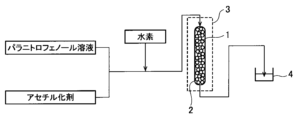
- FIG. 1 is a system diagram of a flow synthesis system showing an embodiment of the method for producing acetaminophen of the present invention.
- FIG. 2 is a system diagram of a flow synthesis system equipped with a back pressure valve showing another embodiment of the method for producing acetaminophen of the present invention.
- a solution containing paranitrophenol (hereinafter sometimes referred to as "paranitrophenol solution”) is continuously passed through a column filled with a catalyst together with an acetylating agent and hydrogen.
- a method for continuously producing acetaminophen through an acetamination reaction by passing a liquid through the catalyst (hereinafter, this step may be referred to as the "acetamination step of the present invention"), wherein the catalyst
- a metal-supported catalyst in which a metal element is supported on a monolithic porous body (hereinafter sometimes referred to as “a monolithic porous body of the present invention”) (hereinafter sometimes referred to as a “metal-supported metal catalyst of the present invention”).
- the acetoamination reaction is characterized in that the reaction temperature is 0° C. to 60° C. and the reaction pressure is 0.1 MPa to 1 MPa.
- acetamination step of the present invention There is no particular limitation on how the acetamination step of the present invention is carried out.
- a para-nitrophenol solution is continuously passed through a reaction vessel 3 equipped with a column 2 packed with the metal-supported catalyst 1 of the present invention, together with an acetylating agent and hydrogen.
- p-nitrophenol is continuously acetaminated with an acetylating agent and hydrogen in the presence of the metal-supported catalyst of the present invention, and the reaction product liquid containing acetaminophen flowing out of the column 2 is received in the recovery tank 4.
- a method by a synthetic system is mentioned.
- the flow synthesis system shown in FIG. 2 differs from the flow synthesis system shown in FIG. 1 in that a back pressure valve 5 is provided in the flow path for feeding the reaction product liquid from the reaction vessel 3 to the recovery tank 4, and the rest of the configuration is the same. It is said that This flow synthesis system will be described later.
- Para-nitrophenol which is a raw material for producing acetaminophen, may be a commercially available product, or may be obtained by applying a known method.
- the solvent used for the para-nitrophenol solution is not particularly limited as long as it can dissolve para-nitrophenol and does not hinder the progress of the reaction.
- the solvent include aliphatic alcohol solvents having 1 to 4 carbon atoms such as methanol, ethanol and propanol; and aliphatic carboxylic acid solvents having 1 to 3 carbon atoms such as formic acid, acetic acid and propionic acid. From the viewpoint of cost, reactivity, etc., aliphatic carboxylic acid solvents having 1 to 3 carbon atoms are preferred, and acetic acid is particularly preferred.
- One of these solvents may be used alone, or two or more of them may be used in any combination and ratio. From the viewpoint of ease of solvent removal, it is preferable to use one solvent alone.
- the concentration of para-nitrophenol in the para-nitrophenol solution is not particularly limited as long as it does not interfere with the flow to the column.
- the concentration of para-nitrophenol in the para-nitrophenol solution is usually 0.1% by mass to 50% by mass, preferably 5% by mass to 40% by mass, particularly preferably 10% by mass to 30% by mass, from the viewpoint of productivity and reactivity. % by mass.
- the amount of hydrogen (hydrogen gas) used is not particularly limited as long as the reaction proceeds.
- the amount of hydrogen (hydrogen gas) to be used is usually 1 mol or more, preferably 3 mol or more, and usually 20 mol or less, preferably 10 mol or less, per 1 mol of para-nitrophenol.
- Hydrogen may be continuously injected into and mixed with the paranitrophenol solution or the paranitrophenol solution containing the acetylating agent in the flow channel before the column 2, or may be directly pressurized into the column 2.
- Hydrogen may be used by dissolving part or all of it in the solvent of the para-nitrophenol solution. Before the para-nitrophenol solution passes through the column 2, hydrogen is preferably used by thoroughly mixing the above amount with the solvent.
- Hydrogen can be used by mixing it with an inert gas such as nitrogen, helium, or argon, but it is preferable to use hydrogen alone.
- an inert gas such as nitrogen, helium, or argon
- the acetylating agent is not particularly limited as long as it can acetylate an amino group.
- the acetylating agent one or more of acetic anhydride, acetyl chloride and the like are usually used. Acetic anhydride is preferred from the viewpoint of cost and reactivity.
- the amount of acetylating agent used is not particularly limited.
- the amount of the acetylating agent to be used is generally 1 mol to 10 mol, preferably 1 mol to 5 mol, more preferably 1 mol to 2 mol, per 1 mol of para-nitrophenol, from the viewpoint of cost and reactivity.
- the acetylating agent may be premixed with a solution containing paranitrophenol, or may be injected into the paranitrophenol solution feed channel before and/or after the column 2 to be continuously mixed with the paranitrophenol solution. Alternatively, it may be injected into the column 2 separately from the para-nitrophenol solution and continuously mixed with the para-nitrophenol solution in the column 2.
- the acetylating agent is preferably continuously mixed with the para-nitrophenol solution in the flow channel before the column 2 from the viewpoint that the unstable intermediate can be rapidly converted into the target product.
- the metal-supported catalyst of the present invention is a catalyst in which a metal is immobilized by supporting a metal element on a carrier.
- the metal element that can be used in the metal-supported catalyst of the present invention is not particularly limited as long as it has the activity of reducing the nitro group.
- the metal elements palladium (Pd), platinum (Pt), rhodium (Rh), ruthenium (Ru), Ag (silver) and mixtures of two or more thereof can be used.
- Pd alone or a mixture of Pd and at least one selected from Pt, Rh, Ru and Ag is preferred. From the viewpoint of catalytic performance, Pd and/or Pt, especially Pd alone is preferred.
- the lower limit of the metal element content in the metal-supported catalyst of the present invention is usually 0.1% by mass or more, preferably 0.3% by mass or more, and more preferably 0.3% by mass or more. is 0.5% by mass or more, and the upper limit is usually 10% by mass or less, preferably 7% by mass or less.
- the carrier means a substance that serves as a base for immobilizing the metal element without inhibiting the reaction.
- the structure of the carrier in the present invention is generally a monolithic porous body, preferably an inorganic monolithic porous body.
- the monolith porous body has a high porosity and specific surface area, it is possible to efficiently carry out the flow and reaction of the solution.
- the monolithic porous material has micrometer-order through-holes inside the particles, and the solution diffuses quickly to the deep part of the particles. can be reduced, and reactivity and productivity can be improved.
- Each particle of the monolithic porous material of the present invention has a skeleton with a three-dimensional continuous network structure, furthermore, through holes formed in the gaps of the skeleton and the surface extending from the surface of the skeleton toward the inside It is preferable to have a structure composed of dispersedly formed pores (hereinafter sometimes referred to as a “two-step hierarchical porous structure”).
- a structure composed of dispersedly formed pores hereinafter sometimes referred to as a “two-step hierarchical porous structure”.
- a co-continuous structure composed of through holes and pores having different sizes in two steps is preferable.
- constituent materials of the monolith porous body used in the present invention include inorganic compounds such as silica gel or titanium oxide, and organic compounds such as epoxy resin.
- an inorganic compound is preferable, and silica gel is particularly preferable, from the viewpoint of cost and chemical stability.
- the shape of the monolithic porous material used in the present invention can be block, granular, or powdery. From the viewpoint of improving flow path resistance and reactivity, the shape of the monolithic porous body is preferably granular.
- the pore size, through-hole size, and particle size of the carrier are such that the mode pore size of the pore size distribution of the through-holes is at least 5 times the mode pore size of the pores, and the particle size is 5 times the mode size of the through-holes.
- the skeleton of each particle of the granular porous material maintains a three-dimensional continuous network structure with a two-step hierarchical porous structure (Patent Document 3).
- the monolithic porous body of the present invention preferably has a mode pore size of 1 nm or more and 100 nm or less in the pore size distribution, and more preferably 2 nm or more and 20 nm or less.
- the monolithic porous material of the present invention is preferably a porous carrier having such relatively large pores.
- the mode pore diameter of the pore size distribution of the through-holes is 5 times or more, preferably 5 to 100 times, particularly 5 to 50 times the mode pore diameter of the pores. It is preferable from the viewpoint of productivity.
- the most frequent pore diameter in the pore diameter distribution of the through-holes is preferably 0.1 ⁇ m or more and 50 ⁇ m from the viewpoint of reactivity and productivity, and the most frequent pore diameter is more preferably 0.1 ⁇ m or more. 30 ⁇ m or less.
- the monolithic porous material of the present invention is in the form of particles, and the particle diameter is preferably two times or more the most frequent pore diameter of the through holes, and the particle diameter is preferably 1000 to 5000 times the most frequent pore diameter of the through holes. It is preferable from the viewpoint of reactivity and productivity.
- the particle diameter of the particulate monolithic porous material of the present invention is usually 20 ⁇ m to 500 ⁇ m, preferably 50 ⁇ m to 500 ⁇ m, particularly preferably 50 ⁇ m to 250 ⁇ m. If the particle size of the monolithic porous material is too small, flow resistance may increase and productivity may decrease, and if it is too large, reactivity may decrease.
- the most frequent pore diameters of the pores and through-holes of the monolithic porous body can be measured according to conventional methods such as a mercury intrusion method and a nitrogen gas adsorption method.
- the particle size of the monolithic porous material is the particle size of the sieve used for classification.
- the monolithic porous material used in the present invention commercially available products such as DualPore (registered trademark) manufactured by DPS, MonoTrap (registered trademark) manufactured by GL Sciences, and MonoPure manufactured by Kikotec can be used.
- a catalyst in which Pd is supported on a monolithic porous body composed of a skeleton made of a compound having a three-dimensional continuous network structure (hereinafter sometimes referred to as "Pd/DualPore (registered trademark)").
- Pd/DualPore registered trademark
- a catalyst in which Pt is supported on a monolithic porous body composed of a skeleton made of a compound having a three-dimensional continuous network structure (hereinafter sometimes referred to as “Pt/DualPore (registered trademark)”) is preferable, and Pd/DualPore ( registered trademark) is particularly preferred.
- acetaminophen can be obtained with high selectivity and good yield even at low pressure and low temperature, with high efficiency, safety and low cost.
- the metal-supported catalyst of the present invention can be produced by conventionally known methods such as the method described in Yamada, T. et al. Catal. Sci. Technol. 2020, 10, 6359.
- a monolithic porous material and a metal salt are added to an organic solvent, the metal is reduced after sufficient stirring, and the produced metal-adsorbed monolithic porous material is collected by filtration, washed with water and methanol, and dried. be able to.
- a flow synthesis system suitable for carrying out the method for producing acetaminophen of the present invention uses a reaction vessel having an inlet and an outlet, and includes "input of raw materials from the inlet”, “reaction” and “recovery of the product from the outlet”. ” at the same time, the concept of which is well known to those skilled in the art (for example, “Flow Micro Synthesis” (Kagaku Dojin), 2014, p. 9).
- the column filled with the metal-supported catalyst of the present invention has a thin tubular shape.
- the material of the column according to the present invention is not particularly limited.
- materials for the column include glass, stainless steel (SUS), Hastelloy, and Teflon (registered trademark), with SUS and Hastelloy being preferred.
- the size of the column is not particularly limited as long as it is suitable for the reaction.
- a column with a diameter of 10 mm ⁇ length of 100 mm, a column with a diameter of 10 mm ⁇ length of 250 mm, or the like can be used.
- the shape of the column may be helical or ring-shaped, but is usually a straight tube.
- the cross-sectional shape of the column is usually circular or rectangular, preferably circular. That is, the column is preferably cylindrical.
- the number of columns is not particularly limited, it is usually 1 to 10,000 for industrial use.
- a column may be used in which a column reaction zone is formed by uniting or combining a plurality of column-forming members.
- An example of a catalyst-packed column is a 4.6 mm ⁇ 100 mm SUS column packed with Pd/DualPore (registered trademark) (Pd: 0.39 g, 0.04 mmol/g, DualPore (registered trademark)). and Pd/DualPore (registered trademark) (Pd: 0.39 g, 0.09 mmol/g, DualPore (registered trademark)) packed in a 4.6 mm ⁇ 100 mm SUS column as close-packed as possible.
- Pd/DualPore registered trademark
- Pd/DualPore registered trademark
- the tube used for the channel for introducing and discharging the substrate, etc. into the column There are no particular restrictions on the tube used for the channel for introducing and discharging the substrate, etc. into the column.
- a specific example of the tube is a Teflon (registered trademark) tube with an inner diameter of 1 mm.
- Substrates, etc. can be introduced into and discharged from the column by liquid transfer using a syringe pump, diaphragm pump, mass controller, or the like.
- a back pressure valve or an in-line analyzer may be provided in the channel on the outflow side of the reaction product liquid from the column.
- the reaction temperature of the acetoamination reaction of the present invention means the external temperature of the column packed with the supported metal catalyst of the present invention.
- the reaction temperature is generally 0° C. to 60° C., preferably 5° C. to 50° C., particularly preferably 10° C. to 40° C., from the viewpoint of reactivity and productivity. If the reaction temperature is lower than the above lower limit, the reactivity may decrease. If the reaction temperature is higher than the above upper limit, the yield and purity may decrease due to side reactions, and the metal-supported catalyst of the present invention may deteriorate.
- the lower limit of the reaction pressure for the acetoamination reaction of the present invention is usually 0.1 MPa or more, preferably 0.2 MPa or more, and the upper limit is usually 1 MPa or less, preferably 0.8 MPa or less, and particularly preferably 0.6 MPa or less. be.
- the reaction pressure can be adjusted by using a back pressure valve or the like to apply back pressure to the flow path after passage through the column filled with the metal-supported catalyst of the present invention.
- the reaction time of the acetoamination reaction of the present invention means the time (residence time) during which the reaction solution stays in the column packed with the metal-supported catalyst of the present invention. Although the reaction time varies depending on the reaction temperature and reaction pressure, it is usually 1 second or more and 60 seconds or less.
- Space velocity (S/V) is the amount of solution of para-nitrophenol passing through the catalyst per unit time divided by the column volume. From the viewpoint of productivity, the space velocity (S/V) is usually 100 h -1 to 1000 h -1 , preferably 120 h -1 to 700 h -1 , particularly preferably 140 h -1 to 400 h -1 .
- the target product, acetaminophen is isolated from the reaction product liquid obtained in the acetaminolation step of the present invention by subjecting the reaction product liquid to treatments such as pressure release, neutralization, liquid separation, concentration, and filtration.
- treatments such as pressure release, neutralization, liquid separation, concentration, and filtration.
- purification means such as crystallization and column chromatography may be used.
- each abbreviation represents the following compounds.
- PAP para-aminophenol
- APAP acetaminophen
- PAAPA 4-acetamidophenyl acetate
- PNP para-nitrophenol
- PNPA 4-nitrophenyl acetate
- AcOH acetic acid
- MeOH methanol
- PAAPA and PNPA are by-products.
- Example 1 A SUS column with an inner diameter of 4.6 mm and a length of 100 mm was packed with catalyst 1 (Pd/DualPore (registered trademark) (1)) as a reaction vessel, and acetaminophen was added using the flow synthesis system shown in FIG. Synthesized.
- catalyst 1 Pd/DualPore (registered trademark) (1)
- S/V is the space velocity (h -1 ), which is obtained by dividing the amount of para-nitrophenol solution passing through the catalyst per unit time by the column volume.
- the feed rate of the paranitrophenol solution was kept at 4.5 mL/min using diaphragm and cylinder pumps.
- the hydrogen gas feed rate was maintained at 375 mL/min using a mass controller.
- the reaction vessel was kept at 30° C. with a water bath.
- Example 2 In Example 1, the reaction was carried out in the same manner as in Example 1, except that the metal-supported catalyst, the feed rate of the para-nitrophenol solution, and the hydrogen equivalent were changed as shown in Table 3. The obtained reaction product liquid was analyzed in the same manner as in Example 1, and the results are summarized in Table 3.
- Example 1 In Example 1, catalyst 1 (Pd/DualPore (registered trademark) (1)) was added to catalyst 6 (5% Pd/C (beads) (manufactured by N.E. The solution was changed to a methanol solution of nitrophenol (concentration 0.84 mol / L), and the supply rate, hydrogen equivalent (molar amount of hydrogen per 1 mol of para-nitrophenol) and reaction pressure (back pressure) of the solution were as shown in Table 3. The reaction was carried out in the same manner as in Example 1, except that the The obtained reaction product liquid was analyzed in the same manner as in Example 1, and the results are summarized in Table 3.
- Pd/carbon 5% Pd/carbon (powder) was also considered, but Pd/carbon (powder) has a very small particle size and a very large pressure loss, so it cannot be used under high pressure. and para-nitrophenol solution cannot be passed through the reaction vessel and the reaction does not proceed. Therefore, Pd/carbon (beads) was used in this comparative example.
- Example 7 In Example 1, the reaction was carried out in the same manner as in Example 1, except that catalyst 1 (Pd/DualPore (registered trademark) (1)) was changed to catalyst 5 (Pd/DualPore (registered trademark) (5)). gone. As a result of analyzing the obtained reaction product liquid in the same manner as in Example 1, S/V was 163/h.
- Example 2 In Example 1, catalyst 1 (Pd/DualPore (registered trademark) (1)) was added to catalyst 7 (10% Pd/DIAION (registered trademark) HP20 (manufactured by Mitsubishi Chemical Corporation)), and an acetic acid solution of para-nitrophenol was added to para-nitrophenol. Changed to a methanol solution of nitrophenol (concentration 0.84 mol/L), changed the supply rate of the solution to 4 mL/min, changed the hydrogen equivalent to 3.6 MR, and changed the reaction pressure (back pressure) to 0.5 MPa. Except for this, the reaction was carried out in the same manner as in Example 1. As a result of analyzing the resulting reaction product liquid in the same manner as in Example 1, the S/V was 30/h.
- Examples 1 to 7 and Comparative Examples 1 and 2 the use of monolithic porous bodies increases the space velocity (S/V) and improves productivity.
- Examples 1 to 6 and Comparative Example 1 the use of a monolithic porous body allows a smaller amount of metal to be supported, a shorter reaction time, a higher selectivity, and a better Acetaminophen can be efficiently obtained with high yield.
- acetaminophen can be obtained efficiently with a good yield by increasing the amount of Pd supported.
- Examples 4 and 5 acetaminophen can be efficiently obtained with high selectivity and good yield even when the hydrogen equivalent is reduced to a value close to the minimum equivalent of 3 equivalents required for the reaction. be able to.
- the method for producing acetaminophen of the present invention does not require high-pressure reaction equipment, and under mild conditions of low reaction temperature and low reaction pressure, safely and inexpensively produces para-nitrophenol with high selectivity and good yield. It is possible to continuously produce acetaminophen, which is useful as a pharmaceutical product, from this, and is industrially useful.
Landscapes
- Chemical & Material Sciences (AREA)
- Organic Chemistry (AREA)
- Engineering & Computer Science (AREA)
- Materials Engineering (AREA)
- Chemical Kinetics & Catalysis (AREA)
- Organic Low-Molecular-Weight Compounds And Preparation Thereof (AREA)
- Catalysts (AREA)
Priority Applications (4)
| Application Number | Priority Date | Filing Date | Title |
|---|---|---|---|
| JP2023561598A JPWO2023090315A1 (https=) | 2021-11-16 | 2022-11-15 | |
| CN202280075018.0A CN118176177A (zh) | 2021-11-16 | 2022-11-15 | 对乙酰氨基酚的制造方法 |
| US18/705,667 US20250011278A1 (en) | 2021-11-16 | 2022-11-15 | Method for producing acetaminophen |
| EP22895596.9A EP4434964A4 (en) | 2021-11-16 | 2022-11-15 | ACETAMINOPHEN PRODUCTION PROCESS |
Applications Claiming Priority (2)
| Application Number | Priority Date | Filing Date | Title |
|---|---|---|---|
| JP2021186485 | 2021-11-16 | ||
| JP2021-186485 | 2021-11-16 |
Publications (1)
| Publication Number | Publication Date |
|---|---|
| WO2023090315A1 true WO2023090315A1 (ja) | 2023-05-25 |
Family
ID=86397017
Family Applications (1)
| Application Number | Title | Priority Date | Filing Date |
|---|---|---|---|
| PCT/JP2022/042371 Ceased WO2023090315A1 (ja) | 2021-11-16 | 2022-11-15 | アセトアミノフェンの製造方法 |
Country Status (5)
| Country | Link |
|---|---|
| US (1) | US20250011278A1 (https=) |
| EP (1) | EP4434964A4 (https=) |
| JP (1) | JPWO2023090315A1 (https=) |
| CN (1) | CN118176177A (https=) |
| WO (1) | WO2023090315A1 (https=) |
Citations (6)
| Publication number | Priority date | Publication date | Assignee | Title |
|---|---|---|---|---|
| JPH072746A (ja) * | 1993-04-30 | 1995-01-06 | Hoechst Celanese Corp | アシルアミノフェノールの製造方法 |
| JP2010207777A (ja) * | 2009-03-12 | 2010-09-24 | Osaka Municipal Technical Research Institute | カラムリアクター及びその製造方法 |
| CN102060729A (zh) * | 2010-12-28 | 2011-05-18 | 刘瑞平 | 一种连续性高效制备对乙酰氨基苯酚的方法 |
| JP2013517253A (ja) * | 2010-01-13 | 2013-05-16 | ディーエスエム アイピー アセッツ ビー.ブイ. | マイクロ反応システムを使ったアシル化 |
| JP2014091092A (ja) * | 2012-11-05 | 2014-05-19 | Hitachi Chemical Techno Service Co Ltd | マイクロリアクター及びその製造方法、並びに、合成システム及び合成分離分析システム |
| JP2021186485A (ja) | 2020-06-03 | 2021-12-13 | 株式会社大一商会 | 遊技機 |
Family Cites Families (7)
| Publication number | Priority date | Publication date | Assignee | Title |
|---|---|---|---|---|
| US3076030A (en) * | 1960-11-03 | 1963-01-29 | Abbott Lab | Process for the preparation of acetylaminophenols |
| WO2014083729A1 (ja) * | 2012-11-30 | 2014-06-05 | 国立大学法人京都大学 | マクロ多孔性モノリスとその製造方法 |
| JP6284142B2 (ja) * | 2013-01-13 | 2018-02-28 | 国立大学法人京都大学 | マクロ多孔性モノリスとその製造方法およびその応用 |
| WO2017154024A1 (en) * | 2016-03-08 | 2017-09-14 | Reddy G Pratap | A process for synthesis of paracetamol |
| US11173480B2 (en) * | 2017-09-29 | 2021-11-16 | Sng Inc. | Catalyst in which metal is carried on inorganic porous body having hierarchical porous structure, and method for manufacturing said catalyst |
| JP7404795B2 (ja) * | 2019-11-08 | 2023-12-26 | Jnc株式会社 | 多糖類担体金属触媒 |
| US20230192596A1 (en) * | 2020-05-18 | 2023-06-22 | Api Corporation | Method for producing acetaminophen |
-
2022
- 2022-11-15 JP JP2023561598A patent/JPWO2023090315A1/ja active Pending
- 2022-11-15 US US18/705,667 patent/US20250011278A1/en active Pending
- 2022-11-15 EP EP22895596.9A patent/EP4434964A4/en not_active Withdrawn
- 2022-11-15 CN CN202280075018.0A patent/CN118176177A/zh active Pending
- 2022-11-15 WO PCT/JP2022/042371 patent/WO2023090315A1/ja not_active Ceased
Patent Citations (6)
| Publication number | Priority date | Publication date | Assignee | Title |
|---|---|---|---|---|
| JPH072746A (ja) * | 1993-04-30 | 1995-01-06 | Hoechst Celanese Corp | アシルアミノフェノールの製造方法 |
| JP2010207777A (ja) * | 2009-03-12 | 2010-09-24 | Osaka Municipal Technical Research Institute | カラムリアクター及びその製造方法 |
| JP2013517253A (ja) * | 2010-01-13 | 2013-05-16 | ディーエスエム アイピー アセッツ ビー.ブイ. | マイクロ反応システムを使ったアシル化 |
| CN102060729A (zh) * | 2010-12-28 | 2011-05-18 | 刘瑞平 | 一种连续性高效制备对乙酰氨基苯酚的方法 |
| JP2014091092A (ja) * | 2012-11-05 | 2014-05-19 | Hitachi Chemical Techno Service Co Ltd | マイクロリアクター及びその製造方法、並びに、合成システム及び合成分離分析システム |
| JP2021186485A (ja) | 2020-06-03 | 2021-12-13 | 株式会社大一商会 | 遊技機 |
Non-Patent Citations (4)
| Title |
|---|
| "Flow-Micro Synthesis", 2014, KAGAKU DOJIN, pages: 9 |
| LI YUE; MA YUXUAN; ZHANG YUANYUAN; WANG XIAOJING; BAI FENGHUA: "Preparation of N-acetyl-para-aminophenol via a flow route of a clean amination and acylation of p-nitrophenol catalyzing by core-shell Cu2O@CeO2", ARABIAN JOURNAL OF CHEMISTRY, ELSEVIER, AMSTERDAM, NL, vol. 13, no. 12, 7 October 2020 (2020-10-07), AMSTERDAM, NL , pages 8613 - 8625, XP086379125, ISSN: 1878-5352, DOI: 10.1016/j.arabjc.2020.09.047 * |
| See also references of EP4434964A4 |
| YAMADA, T. ET AL., CATAL. SCI. TECHNOL., vol. 10, 2020, pages 6359 |
Also Published As
| Publication number | Publication date |
|---|---|
| EP4434964A4 (en) | 2025-11-19 |
| JPWO2023090315A1 (https=) | 2023-05-25 |
| US20250011278A1 (en) | 2025-01-09 |
| EP4434964A1 (en) | 2024-09-25 |
| CN118176177A (zh) | 2024-06-11 |
Similar Documents
| Publication | Publication Date | Title |
|---|---|---|
| US7663008B2 (en) | Method of catalytic reaction using micro-reactor | |
| Straathof et al. | Visible light photocatalytic metal-free perfluoroalkylation of heteroarenes in continuous flow | |
| TWI442971B (zh) | 氫化有機化合物之連續方法及反應器 | |
| Lebl et al. | Scalable continuous flow hydrogenations using Pd/Al2O3-coated rectangular cross-section 3D-printed static mixers | |
| JP4216074B2 (ja) | 有機金属骨格材料およびその製造方法 | |
| JP2021102628A (ja) | 非イオン性造影剤の調製に有用な中間体の調製プロセス | |
| Mándity et al. | Harnessing the versatility of continuous‐flow processes: Selective and efficient reactions | |
| JP2000508653A (ja) | 超臨界水素化 | |
| Wernik et al. | Continuous flow heterogeneous catalytic reductive aminations under aqueous micellar conditions enabled by an oscillatory plug flow reactor | |
| Pieber et al. | Aerobic oxidations in continuous flow | |
| JP7690955B2 (ja) | アセトアミノフェンの製造方法 | |
| US7253329B2 (en) | Selective hydrogenation of cyclododecatriene to cyclododecene | |
| JP5598952B2 (ja) | マイクロリアクター、およびマイクロリアクターを利用した液相化学反応方法 | |
| Guan et al. | High-pressure asymmetric hydrogenation in a customized flow reactor and its application in multi-step flow synthesis of chiral drugs | |
| WO2023090315A1 (ja) | アセトアミノフェンの製造方法 | |
| JP2015172025A (ja) | 連続的フロー多段階反応による医薬品の製造方法 | |
| Iio et al. | Fine-Bubble–Slug-Flow Hydrogenation of Multiple Bonds and Phenols | |
| CN114773207A (zh) | 一种利用微填充床进行选择性硝基还原氢化反应的方法及催化剂 | |
| JP4424858B2 (ja) | 水素化エステルの製造方法、それに用いる水素化触媒および該触媒の製造方法 | |
| JP2003521525A (ja) | 化学プロセス | |
| Simonov et al. | Hydrogenation of ethyl p-nitrobenzoate on Pd/Sibunit catalysts | |
| CN114956959B (zh) | 一种采用连续流加氢微反应器生产1-乙基环己醇的工艺 | |
| Tomlin et al. | A Survey of Continuous API Syntheses: Insights at the Interface of Chemistry and Chemical Engineering | |
| CN115960107A (zh) | 一种基于微通道反应器的连续加氢脱苄合成taiw的方法 | |
| RU2169728C1 (ru) | Способ жидкофазного восстановления ароматических нитросоединений в реакторе с жестким ячеистым катализатором |
Legal Events
| Date | Code | Title | Description |
|---|---|---|---|
| 121 | Ep: the epo has been informed by wipo that ep was designated in this application |
Ref document number: 22895596 Country of ref document: EP Kind code of ref document: A1 |
|
| WWE | Wipo information: entry into national phase |
Ref document number: 2023561598 Country of ref document: JP |
|
| WWE | Wipo information: entry into national phase |
Ref document number: 18705667 Country of ref document: US |
|
| WWE | Wipo information: entry into national phase |
Ref document number: 202280075018.0 Country of ref document: CN |
|
| WWE | Wipo information: entry into national phase |
Ref document number: 2022895596 Country of ref document: EP |
|
| ENP | Entry into the national phase |
Ref document number: 2022895596 Country of ref document: EP Effective date: 20240617 |
|
| WWW | Wipo information: withdrawn in national office |
Ref document number: 2022895596 Country of ref document: EP |