WO2023074312A1 - ゴム製品、シール材用の試験治具及び試験装置並びに漏れ検知部材 - Google Patents
ゴム製品、シール材用の試験治具及び試験装置並びに漏れ検知部材 Download PDFInfo
- Publication number
- WO2023074312A1 WO2023074312A1 PCT/JP2022/037574 JP2022037574W WO2023074312A1 WO 2023074312 A1 WO2023074312 A1 WO 2023074312A1 JP 2022037574 W JP2022037574 W JP 2022037574W WO 2023074312 A1 WO2023074312 A1 WO 2023074312A1
- Authority
- WO
- WIPO (PCT)
- Prior art keywords
- sealing material
- leakage
- test
- detection member
- leak
- Prior art date
- Legal status (The legal status is an assumption and is not a legal conclusion. Google has not performed a legal analysis and makes no representation as to the accuracy of the status listed.)
- Ceased
Links
Images






Classifications
-
- G—PHYSICS
- G01—MEASURING; TESTING
- G01M—TESTING STATIC OR DYNAMIC BALANCE OF MACHINES OR STRUCTURES; TESTING OF STRUCTURES OR APPARATUS, NOT OTHERWISE PROVIDED FOR
- G01M3/00—Investigating fluid-tightness of structures
- G01M3/02—Investigating fluid-tightness of structures by using fluid or vacuum
- G01M3/04—Investigating fluid-tightness of structures by using fluid or vacuum by detecting the presence of fluid at the leakage point
- G01M3/042—Investigating fluid-tightness of structures by using fluid or vacuum by detecting the presence of fluid at the leakage point by using materials which expand, contract, disintegrate, or decompose in contact with a fluid
- G01M3/045—Investigating fluid-tightness of structures by using fluid or vacuum by detecting the presence of fluid at the leakage point by using materials which expand, contract, disintegrate, or decompose in contact with a fluid with electrical detection means
-
- G—PHYSICS
- G01—MEASURING; TESTING
- G01M—TESTING STATIC OR DYNAMIC BALANCE OF MACHINES OR STRUCTURES; TESTING OF STRUCTURES OR APPARATUS, NOT OTHERWISE PROVIDED FOR
- G01M3/00—Investigating fluid-tightness of structures
- G01M3/02—Investigating fluid-tightness of structures by using fluid or vacuum
- G01M3/04—Investigating fluid-tightness of structures by using fluid or vacuum by detecting the presence of fluid at the leakage point
- G01M3/20—Investigating fluid-tightness of structures by using fluid or vacuum by detecting the presence of fluid at the leakage point using special tracer materials, e.g. dye, fluorescent material, radioactive material
- G01M3/22—Investigating fluid-tightness of structures by using fluid or vacuum by detecting the presence of fluid at the leakage point using special tracer materials, e.g. dye, fluorescent material, radioactive material for pipes, cables or tubes; for pipe joints or seals; for valves; for welds; for containers, e.g. radiators
- G01M3/223—Investigating fluid-tightness of structures by using fluid or vacuum by detecting the presence of fluid at the leakage point using special tracer materials, e.g. dye, fluorescent material, radioactive material for pipes, cables or tubes; for pipe joints or seals; for valves; for welds; for containers, e.g. radiators for pipe joints or seals
-
- F—MECHANICAL ENGINEERING; LIGHTING; HEATING; WEAPONS; BLASTING
- F16—ENGINEERING ELEMENTS AND UNITS; GENERAL MEASURES FOR PRODUCING AND MAINTAINING EFFECTIVE FUNCTIONING OF MACHINES OR INSTALLATIONS; THERMAL INSULATION IN GENERAL
- F16J—PISTONS; CYLINDERS; SEALINGS
- F16J15/00—Sealings
- F16J15/02—Sealings between relatively-stationary surfaces
- F16J15/06—Sealings between relatively-stationary surfaces with solid packing compressed between sealing surfaces
- F16J15/064—Sealings between relatively-stationary surfaces with solid packing compressed between sealing surfaces the packing combining the sealing function with other functions
-
- G—PHYSICS
- G01—MEASURING; TESTING
- G01M—TESTING STATIC OR DYNAMIC BALANCE OF MACHINES OR STRUCTURES; TESTING OF STRUCTURES OR APPARATUS, NOT OTHERWISE PROVIDED FOR
- G01M3/00—Investigating fluid-tightness of structures
- G01M3/02—Investigating fluid-tightness of structures by using fluid or vacuum
- G01M3/04—Investigating fluid-tightness of structures by using fluid or vacuum by detecting the presence of fluid at the leakage point
- G01M3/042—Investigating fluid-tightness of structures by using fluid or vacuum by detecting the presence of fluid at the leakage point by using materials which expand, contract, disintegrate, or decompose in contact with a fluid
- G01M3/045—Investigating fluid-tightness of structures by using fluid or vacuum by detecting the presence of fluid at the leakage point by using materials which expand, contract, disintegrate, or decompose in contact with a fluid with electrical detection means
- G01M3/047—Investigating fluid-tightness of structures by using fluid or vacuum by detecting the presence of fluid at the leakage point by using materials which expand, contract, disintegrate, or decompose in contact with a fluid with electrical detection means with photo-electrical detection means, e.g. using optical fibres
-
- G—PHYSICS
- G01—MEASURING; TESTING
- G01M—TESTING STATIC OR DYNAMIC BALANCE OF MACHINES OR STRUCTURES; TESTING OF STRUCTURES OR APPARATUS, NOT OTHERWISE PROVIDED FOR
- G01M3/00—Investigating fluid-tightness of structures
- G01M3/02—Investigating fluid-tightness of structures by using fluid or vacuum
- G01M3/04—Investigating fluid-tightness of structures by using fluid or vacuum by detecting the presence of fluid at the leakage point
- G01M3/16—Investigating fluid-tightness of structures by using fluid or vacuum by detecting the presence of fluid at the leakage point using electric detection means
- G01M3/18—Investigating fluid-tightness of structures by using fluid or vacuum by detecting the presence of fluid at the leakage point using electric detection means for pipes, cables or tubes; for pipe joints or seals; for valves; for welds; for containers, e.g. radiators
- G01M3/183—Investigating fluid-tightness of structures by using fluid or vacuum by detecting the presence of fluid at the leakage point using electric detection means for pipes, cables or tubes; for pipe joints or seals; for valves; for welds; for containers, e.g. radiators for pipe joints or seals
-
- G—PHYSICS
- G01—MEASURING; TESTING
- G01M—TESTING STATIC OR DYNAMIC BALANCE OF MACHINES OR STRUCTURES; TESTING OF STRUCTURES OR APPARATUS, NOT OTHERWISE PROVIDED FOR
- G01M3/00—Investigating fluid-tightness of structures
- G01M3/38—Investigating fluid-tightness of structures by using light
-
- F—MECHANICAL ENGINEERING; LIGHTING; HEATING; WEAPONS; BLASTING
- F16—ENGINEERING ELEMENTS AND UNITS; GENERAL MEASURES FOR PRODUCING AND MAINTAINING EFFECTIVE FUNCTIONING OF MACHINES OR INSTALLATIONS; THERMAL INSULATION IN GENERAL
- F16L—PIPES; JOINTS OR FITTINGS FOR PIPES; SUPPORTS FOR PIPES, CABLES OR PROTECTIVE TUBING; MEANS FOR THERMAL INSULATION IN GENERAL
- F16L2201/00—Special arrangements for pipe couplings
- F16L2201/30—Detecting leaks
-
- Y—GENERAL TAGGING OF NEW TECHNOLOGICAL DEVELOPMENTS; GENERAL TAGGING OF CROSS-SECTIONAL TECHNOLOGIES SPANNING OVER SEVERAL SECTIONS OF THE IPC; TECHNICAL SUBJECTS COVERED BY FORMER USPC CROSS-REFERENCE ART COLLECTIONS [XRACs] AND DIGESTS
- Y02—TECHNOLOGIES OR APPLICATIONS FOR MITIGATION OR ADAPTATION AGAINST CLIMATE CHANGE
- Y02E—REDUCTION OF GREENHOUSE GAS [GHG] EMISSIONS, RELATED TO ENERGY GENERATION, TRANSMISSION OR DISTRIBUTION
- Y02E60/00—Enabling technologies; Technologies with a potential or indirect contribution to GHG emissions mitigation
- Y02E60/30—Hydrogen technology
- Y02E60/50—Fuel cells
Definitions
- the present invention relates to a rubber product, a test jig and testing device for sealing materials, and a leak detection member. More particularly, the present invention relates to rubber products such as seal products for sealing pipes and the like, test jigs and test devices for seal materials, and leak detection members.
- sealing materials such as packings and gaskets are widely used in automobiles and electrical appliances. More specifically, for example, between cell assemblies in a fuel cell is sealed with a gasket (rubber) (see Patent Document 1, for example).
- This gasket prevents hydrogen leakage from the fuel cell, and there are concerns that hydrogen leakage may cause various problems. Therefore, the inspection (seal inspection) before assembly to the fuel cell is particularly important, and it is required to check the presence or absence of leakage and the location of leakage in the seal inspection.
- Patent Document 2 requires work to be attached to the gasket or the like to be inspected when performing a seal inspection. Moreover, after the inspection is finished, it is necessary to peel off the sheet from the gasket to be inspected, and there is a concern that the inspection object may be damaged when the sheet is peeled off.
- the present invention has been made in view of such prior art, and its object is to avoid damaging the inspection object during seal inspection, and furthermore, to check the presence or absence of leakage.
- An object of the present invention is to develop a test jig and testing device for rubber products and seal materials, and a leak detection member, which can detect the position of the leak simply and accurately.
- test jigs and testing devices for rubber products and sealing materials, and leak detection members are provided.
- a rubber product that contains a gaschromic material that reversibly changes color or changes electrical resistance due to an oxidation-reduction reaction.
- a sealing material for sealing a gap between two members The rubber product according to the above [1], which contains a gaschromic material that reversibly changes color or changes electric resistance by an oxidation-reduction reaction, and is cyclic.
- the leakage detection member contains a gaschromic material that reversibly changes color or changes electric resistance by oxidation-reduction reaction,
- a test jig for a sealing material wherein a color of a portion of the leakage detection member where leakage from the sealing material is recognized changes with leakage from the sealing material.
- test jig according to any one of [4] to [8]; and a photographing unit for recording changes in the leak detection member in the test jig.
- a cylindrical elastic portion made of an elastic material containing a gaschromic material that reversibly changes color or changes electrical resistance by an oxidation-reduction reaction; and at least a pair of electrodes arranged on the outer peripheral surface of the tubular elastic portion.
- the rubber product of the present invention has the effect of being able to easily and accurately detect the presence or absence of leakage and its location.
- this rubber product as a sealing material (sealing product), it is possible to avoid damaging the inspection object during the seal inspection, and furthermore, it is possible to easily and accurately check the presence or absence of leakage and its position. It is effective in being able to detect well.
- test jig for sealing materials of the present invention has the effect of being able to easily and accurately detect the presence or absence of leakage in the sealing material and its position.
- the sealing material testing device of the present invention has the effect of being able to detect the presence or absence of leakage in the sealing material and its position simply and accurately.
- the leak detection member of the present invention has the effect of being able to easily and accurately detect the presence or absence of leakage of gas, etc. from a pipe or the like, and the location of the leakage.
- FIG. 1 is a plan view schematically showing a sealing material that is one embodiment of the rubber product of the present invention
- FIG. 1 is a perspective view schematically showing a sealing material that is one embodiment of the rubber product of the present invention
- FIG. 4 is an explanatory view schematically showing a state in which a sealing material, which is one embodiment of the rubber product of the present invention, is tested for the presence or absence of leakage, etc.
- FIG. FIG. 2 is an explanatory view schematically showing a state after testing the presence or absence of leakage of the rubber product shown in FIG. 1; BRIEF DESCRIPTION OF THE DRAWINGS FIG.
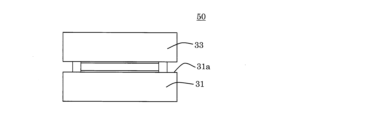
- FIG. 1 is a side view schematically showing a partly see-through of one embodiment of a test jig for a sealing material of the present invention
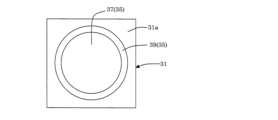
- FIG. 6 is an explanatory view schematically showing a state in which the upper member of the test jig for the sealing material shown in FIG. 5 is seen through
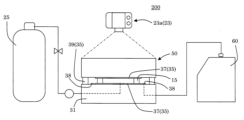
- FIG. 2 is an explanatory view schematically showing a state in which a seal material leakage test is performed in one embodiment of the seal material test apparatus of the present invention.
- FIG. 6 is an explanatory view schematically showing a state after a test for the presence or absence of leakage of the sealing material using the test jig for the sealing material shown in FIG. 5
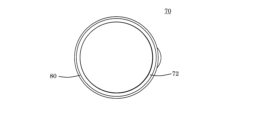
- 1 is a side view schematically showing one embodiment of a leak detection member of the present invention
- FIG. 1 is a plan view schematically showing one embodiment of a leak detection member of the present invention
- FIG. It is explanatory drawing which shows typically the state which attached the leakage detection member shown in FIG. 9 to the fastening part of piping.
- FIG. 10 is an explanatory view schematically showing a state in which leakage is monitored using the leak detection member shown in FIG. 9;
- FIG. 4 is an explanatory diagram schematically showing a state in which another embodiment of the leak detection member of the present invention is attached to a fastening portion of a pipe;
- FIG. 10 is an explanatory diagram schematically showing a state in which still another embodiment of the leak detection member of the present invention is attached to a fastening portion of a pipe;
- Rubber products One embodiment of the rubber product of the present invention contains a gaschromic material that reversibly changes color or changes electrical resistance by oxidation-reduction reaction. With this rubber product, the presence or absence of leakage and the location of leakage can be easily and accurately detected.
- a gaschromic material is a material whose color changes reversibly or whose electrical resistance value changes due to an oxidation-reduction reaction.
- gaschromic materials include transition metal oxides such as tungsten oxide, vanadium oxide, niobium oxide, tantalum oxide, zirconium oxide, and chromium oxide, as described later.
- transition metal oxides such as tungsten oxide, vanadium oxide, niobium oxide, tantalum oxide, zirconium oxide, and chromium oxide, as described later.
- the light transmittance changes due to the oxidation-reduction reaction (that is, the transmittance in a specific wavelength band changes greatly), so that the color appears to change.
- the rubber product of the present invention can be produced, for example, as follows. First, a solid containing platinum (Pt) and tungsten oxide (WO 3 ) is synthesized by a conventionally known method (see, for example, JP-A-2017-181996). Next, the synthesized solid matter is pulverized. Examples of means for pulverizing solids include bead mills, jet mills, and mortars. In order to improve the dispersibility of Pt and WO3 in rubber products, surface treatment may be performed with an arbitrary dispersant.
- Pt platinum
- WO 3 tungsten oxide
- the pulverized solid (sometimes referred to as “Pt/WO 3 ”) is mixed with raw rubber together with other components.
- the timing of mixing is not particularly limited as long as it is at a stage before vulcanization of rubber, such as during kneading or during introduction of a vulcanizing agent.
- the device for mixing is not particularly limited, and a general device used for kneading rubber such as a kneader and rolls can be employed.
- liquid rubber is used as the raw material rubber, it may be mixed manually without using a device. After that, the rubber material mixed with Pt/WO 3 is formed into an arbitrary shape and vulcanized to produce a rubber product.
- Seal products One embodiment of the rubber product of the present invention is the seal product 10 shown in FIGS.
- This sealing product 10 is a sealing material for sealing a gap between two members (for example, pipes or separators), and is a gaschromic material that reversibly changes color or changes electrical resistance by oxidation-reduction reaction. It contains material and is annular.
- the seal product 10 can easily and accurately detect the presence or absence of leakage and its position.
- the seal product 10 is a device that prevents fluid from leaking from the inside of the machine to the outside, and specifically includes oil seals, rubber gaskets, O-rings, and the like.
- sealing products such as O-rings and gaskets are devices that are attached to the joints between machines and prevent liquids and gases inside the machines from leaking to the outside.
- leaks may occur due to insufficient airtightness due to factors such as disturbances and sudden defects.
- the sealing medium is a colorless gas (such as hydrogen), it tends to be difficult to accurately visually identify the leak location.
- Gases that are sealing media include gases such as H 2 and He that are highly permeable to matter.
- H 2 is widely known to have an explosion risk due to its reaction with O 2 . Therefore, although it is difficult to completely eliminate the leakage of H2 to the outside, it is required to minimize the amount of leakage from the viewpoint of ensuring safety.
- sealing products used to fill gaps between fastening parts are often formed of elastic bodies with relatively low density, and therefore there is a concern that permeation leakage may occur.
- the sealing product itself can be used as a sensor by mixing a gaschromic material with a polymeric material such as resin.
- seal product itself as a sensor in this way not only facilitates accurate identification of the leak occurrence site, but also saves the trouble of installing another sensor device.
- the rubber product (specifically, the seal product) of the present invention leakage can be detected using the peripheral member as it is.
- gaschromic materials are reversible, the same product can be used repeatedly, making it economical.
- the time for the reversible reaction can be adjusted by using a polymeric material with a low gas permeability or by stacking polymeric materials to form two layers.
- a polymer material to be used a material suitable for the specifications and the environment for observing leakage can be appropriately selected.
- minute leaks for example, very small leaks of less than 0.1 cc/min
- the detection method can be selected, such as image processing of images acquired by a camera or acquisition of electrical signals, and the gas chromism color development performance (color tone and maintenance time) and resistance value change performance can be controlled in the usage environment. .
- the seal product of this embodiment can be applied not only to identify the leak position, but also to visualize the gas flow. For example, it can be applied to visualize unevenness in the flow rate of hydrogen flowing on the power generation surface of a fuel cell. That is, there is a flow of hydrogen inside the seal product, and the inner surface portion of the seal product is strongly discolored (deeply discolored) in a portion closer to a region where the flow rate of hydrogen is large (high flow rate region), and is farther from the high flow rate region. The inner surface portion of the seal product is lightly discolored. Therefore, by checking the degree of discoloration of the inner surface of the seal product, the hydrogen flow rate distribution can be known.
- Such sealing products can be used as sealing materials in contact with hydrogen gas. It can be applied to seals or gaskets for hydrogen piping in
- an elastic material mixed with a gaschromic material is applied to a sealing product (a sealing material that is used in a fuel cell and is in contact with hydrogen in the cell) as in the present invention
- the oxidation-reduction reaction of the gaschromic material causes a rubber (sealing material).
- hydrogen can be converted to water in the product).
- the seal product of the present embodiment contains a gaschromic material, and the seal product itself changes in response to leakage directly, so the position of the leak can be detected more accurately and easily. can.
- hydrogen gas when used, hydrogen leakage can be prevented, and the risk of accidents due to hydrogen leakage can be reduced.
- a hydrogen detection sheet see, for example, Patent Document 2
- a gap may occur between the leak detection target and the hydrogen detection sheet. There is a concern that it is not possible to detect In other words, since the portion where the gap is generated is discolored widely as a whole, the presence of the leak can be recognized, but there is a tendency that it is not sufficient to accurately confirm the location of the leak.
- the leak detection target when a leak occurs, the leak detection target (the seal product itself) changes color as described above, so the leak position can be accurately grasped. Furthermore, unlike the above-mentioned hydrogen detection sheet, a separate member is not used for the leak detection target and this separate member is not directly attached to the leak detection target. (detection object) can be avoided from being damaged.
- the sealing product of the present embodiment has elasticity, and the material thereof is not particularly limited. Examples include acrylonitrile-butadiene rubber (NBR).
- NBR acrylonitrile-butadiene rubber
- the seal product of this embodiment can be transparent. If it is transparent, leakage due to cracks or the like inside the seal product can be reliably confirmed from the outside by its discoloration. As long as the inside of the seal product can be visually recognized, it can be colored or colorless, but it is preferably colorless.
- transparent is a concept that includes not only completely transparent but also transparent enough to transmit light (translucent).
- a gaschromic material is a material whose color changes reversibly or whose electrical resistance value changes due to an oxidation-reduction reaction.
- Such gaschromic materials include, for example, transition metal oxides such as tungsten oxide, vanadium oxide, niobium oxide, tantalum oxide, zirconium oxide, and chromium oxide.
- transition metal oxides such as tungsten oxide, vanadium oxide, niobium oxide, tantalum oxide, zirconium oxide, and chromium oxide.
- the reaction of the gaschromic material is a reversible oxidation-reduction reaction, and the higher the hydrogen concentration, the higher the change performance, such as the easier it is to develop color and the lower the resistance value.
- the higher the oxygen concentration the lower the ability to change color development and resistance value.
- the higher the temperature the more activated the reaction, and the quicker the responsiveness of color development and resistance value.
- the changing performance can be enhanced by increasing the blending amount of the gaschromic material in the polymeric material.
- the sealing product 10 is not particularly limited as to its usage conditions, but is used in a temperature environment of, for example, -60°C to 230°C. And it can be detected with high accuracy.
- hydrogen is used as a fuel gas for polymer electrolyte fuel cells, and this hydrogen is sealed inside the cell using a sealing product.
- a sealing product There is a concern that such hydrogen may leak very slightly when the battery is subjected to shock, vibration, or the like. Therefore, by using the sealing product of the present embodiment, the presence or absence and location of leakage can be reliably and easily detected.
- the seal product 10 can be attached to the test section 21 of the test device 100 and tested to confirm the presence or absence of leakage and its location.
- the test apparatus 100 includes a test section 21, an imaging section 23 for recording changes in the seal product 10 attached to the test section 21, and a test fluid supply section 25 for supplying a test fluid such as hydrogen to the test section 21.
- the member (upper member 22) that presses the seal product 10 from above in the test section 21 has a transparent member so that changes in the seal product 10 can be observed during the test.
- This testing apparatus 100 can be used to test the presence or absence of leakage in the seal product 10. If there is leakage in the seal product 10, as shown in FIG. 27 is confirmed. In this way, the presence or absence of a leak and its location can be easily detected.
- Test jig 50 is a test jig for conducting a leak test of an annular sealing material that seals a gap between two members.
- the test jig 50 includes a mounting table 31 having a mounting surface 31a on which a sealing material is placed, an upper arrangement member 33 disposed above the sealing material mounted on the mounting table 31, and a mounting table. and a leak detection member 35 located outside the sealing material placed on the 31 .
- the leak detection member 35 contains a gaschromic material that reversibly changes its color or changes its electrical resistance value by an oxidation-reduction reaction.
- the test jig 50 changes the color or electrical resistance value of the portion of the leakage detecting member 35 where leakage from the sealing material is recognized in accordance with leakage from the sealing material, and detects the presence or absence of leakage and the location of the leakage. can be detected.
- Such a sealing material test jig 50 can easily and accurately detect the presence or absence of leakage in the sealing material and its position. Further, the test jig 50 is for placing the sealing material on the mounting table 31 during the seal inspection, so that it is possible to avoid damaging the inspection object during the seal inspection.
- the test jig 50 is attached to the test portion of a test device 200 for testing the sealing performance of the sealing material 15, and then, using a test fluid such as hydrogen, the test fluid is
- a test fluid such as hydrogen
- the test fluid is This is a jig that detects the presence or absence of leaks and the location of leaks based on changes in color, etc.
- the sealing material 15 a test product for testing sealing performance
- the test apparatus 200 has the same configuration as the test apparatus 100 except that the test jig 50 is installed in the test section.
- FIG. 8 is a plan view showing a state after the test jig 50 is attached to the test device 200 and the sealing performance of the sealing material 15 is tested. This is an example showing that a part is discolored and a discolored portion 27 is developed.
- a sealing material is the same as the sealing product described above, but it is a device that prevents fluid from leaking from the inside of the machine to the outside, and specifically includes oil seals, rubber gaskets, O-rings, etc.
- the mounting table 31 has a mounting surface 31a on which the sealing material 15 is mounted. As long as it has the mounting surface 31a in this way, there are no particular restrictions on its material, shape, size, and the like.
- the material of the mounting table 31 is not particularly limited as long as the material does not leak the test fluid when the sealing material is sandwiched.
- Examples of the material of the mounting table 31 include resin, glass, steel materials such as stainless steel, and aluminum.
- FIGS. 5 and 6 show a cubic mounting table 31, and show an example of having a mounting surface 31a on which the sealing material 15 is mounted on the top surface.
- the upper arrangement member 33 is arranged above the sealing material mounted on the mounting table 31 .
- the material, shape, size, etc. of the upper arranged member 33 are not particularly limited and can be determined as appropriate.
- FIG. 5 shows a cubic upper arranged member 33, and a sheet member 37 as a leakage detection member 35 is arranged on the surface on the mounting table 31 side.
- the material of the upper arranged member 33 is not particularly limited as long as it is a material that does not leak the test fluid when the sealing material is clamped, like the mounting table 31 .
- Examples of materials for the upper arranged member 33 include resin, glass, steel materials such as stainless steel, and aluminum.
- the upper arranged member 33 can be made of resin or glass, and in the case of resin, it can be made of a transparent material.
- transparent materials include acrylic resins and polycarbonates.
- the leak detection member 35 is positioned outside the sealing material 15 mounted on the mounting table 31, and contains a gaschromic material that reversibly changes color or changes electrical resistance by an oxidation-reduction reaction. there is The leakage detection member 35 and the sealing material 15 may be arranged so as to be in contact with each other, or may be arranged with a gap therebetween.
- the material of the leak detection member 35 is not particularly limited, but examples include resin and rubber.
- the position of the leak detection member 35 is not particularly limited as long as it is positioned outside the sealing material 15 .
- the leakage detection member 35 may be arranged as a sheet member 37 on the surface of the mounting table 31 or the upper arranged member 33 , or may be arranged as a protrusion 39 on the mounting table 31 . Note that both the sheet member 37 and the protrusion 39 may be used as the leakage detection member 35 . In this way, the presence or absence of leakage and its location can be confirmed more accurately.
- the test jig 50 may further include a sheet-shaped sheet member 37 arranged on at least one of the mounting table 31 side and the upper arranged member 33 side of the sealing material 15.
- a sealing material is arranged so as to be positioned outside the sheet member 37 .
- At least one of the sheet members 37 can constitute at least a part of the leak detection member 35 .
- this sheet member 37 is in the form of a sheet, which includes the case of being in the form of a “thin film”.
- the arrangement of the sheet member 37 is not particularly limited, and the arrangement range (the film formation range in the case of producing a thin film sheet member by film formation) may be the entire surface of the mounting table 31 or the like, or the contact surface of the sealing material. It may be a part such as when (boundary) with.
- the sheet member 37 may be a single-layer sheet, or may be a multi-layered sheet having a thin film in which a gas chromic material is dispersed using a polymeric material as a binder, and a polymeric material film further disposed on this thin film. You can use a sheet.
- the test jig 50 may further include a projecting portion 39 projecting from the mounting surface 31a of the mounting table 31, and when testing the sealing material 15, the inner surface of the projecting portion 39 is brought into contact with the sealing material 15.
- the protrusion 39 can constitute at least a part of the leak detection member 35 .
- the protrusion 39 may have a continuous annular shape as shown in FIG. 6, or may have a discontinuous annular shape.
- the distribution state of the gaschromic material in the protrusion 39 may be limited to the inner surface portion in contact with the sealing member 15, or may be dispersed over the entire surface.
- the projecting portion 39 may be formed integrally with the mounting table 31 or may be formed separately from the mounting table 31 . If it is separate from the mounting table 31 , it is preferably fixed to the mounting table 31 .
- the protruding portion 39 can be made of an elastic material, and the material is not particularly limited, but for example, fluororubber can be mentioned.
- Test equipment One embodiment of the testing apparatus of the present invention is a testing apparatus 200 for sealants shown in FIG.
- the seal material 15 is set at a predetermined position, and then a test fluid such as hydrogen is supplied to the seal surface (the area inside the seal material) to prevent leakage of the test fluid from the seal surface. It is a testing machine for detection.
- the test apparatus 200 includes the test jig 50 described above, an imaging unit 23 for recording changes in the leak detection member 35 in the test jig 50, a test fluid supply unit 25, and a leak amount measurement unit 60. ing.
- the test jig 50 and the test fluid supply section 25 are connected by piping.
- the test jig 50 functions as a test section.
- the test fluid supply unit 25 is a tank or the like for supplying a test fluid such as hydrogen to the test jig 50 which is the test unit.
- Such a sealing material test apparatus 200 is provided with the above-described test jig 50, so that the presence or absence of leakage in the sealing material 15 and its position can be detected simply and accurately. Since the portion 60 can measure the leakage amount of the leaking fluid, the leakage countermeasure effect is improved.
- the first method is to disassemble the test jig 50 after the test and check it
- the second method is to configure a part of the test jig 50 with a transparent member and check it during the test.
- the leak position can be specified by analyzing the image captured by the imaging unit 23 such as a camera.
- the test apparatus 200 shown in FIG. 7 has at least one (preferably, the upper arranged member 33) of two members (that is, the upper arranged member 33 and the mounting table 31 of the test jig 50) that sandwich the sealing material 15. , a transparent member (for example, acrylic resin, glass, etc.) through which light can pass.
- This test apparatus 200 adopts the second method described above, and detects discoloration of the leaking portion with the camera 23a (photographing unit 23).
- the imaging unit 23 is not particularly limited as long as it can record the presence or absence of leakage in the sealing material 15 and its position, and a predetermined device can be appropriately adopted.
- the leakage amount measuring unit 60 measures the amount of leakage of the leaking fluid, and is a distributed rubber sheet that is a probe arranged between the sealing material 15 to be tested and the protrusion 39 (leak detection member 35). 38.
- Specific examples of the leak rate measurement unit 60 include a pressure gauge, a flow meter, a leak detector, and the like, and the leak rate can be detected by changes in the electrical resistance of the dispersion rubber sheet 38 .
- the above-described test jig 50 alone can only confirm the change in color and cannot grasp the amount of leakage. It becomes possible to distinguish places where minute leaks are likely to occur. Since it is conceivable that the cause of leakage differs depending on the amount of leakage, by using the leakage amount measuring unit 60 and the test jig 50 in combination, countermeasures against leakage can be taken more effectively.
- the leakage detection member of the present invention comprises a tubular elastic portion made of an elastic material containing a gaschromic material whose color reversibly changes or electrical resistance changes due to an oxidation-reduction reaction, and the tubular elastic portion. and at least one pair of electrodes arranged on the outer peripheral surface.
- a leak detection member can easily and accurately detect the presence or absence of leakage of gas or the like from a pipe or the like and the location of the leakage.
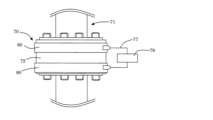
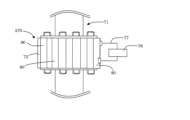
- the leak detection member 70 includes a cylindrical elastic portion 72 made of an elastic material containing a gaschromic material whose color reversibly changes or whose electric resistance value changes due to an oxidation-reduction reaction, and the cylindrical elastic portion 72. and a pair of electrodes 80 respectively arranged on the outer peripheral surface of the one end surface 73 side and the other end surface 75 side.
- Such a leak detection member 70 can easily and accurately detect the presence or absence of leakage of gas or the like from a pipe or the like and the location of the leakage.
- the leak detection member 70 is attached to a joint (fastening portion) of the hydrogen pipe 71 or the like, and leaks from the joint or the like are detected by changes in color or electrical resistance. It is an instrument that detects by Furthermore, as shown in FIG. 11, by attaching a conducting wire 77 to the leak detection member 70 and connecting it to a measuring device 79 such as a voltmeter or an ammeter, when a leak occurs, not only the color change but also the electrical resistance Leakage can be detected by checking the change in
- the tubular elastic portion 72 is tubular and made of an elastic material containing a gaschromic material whose color is reversibly changed or whose electric resistance value is changed by an oxidation-reduction reaction.
- the size and opening shape of the tubular elastic portion 72 are not particularly limited as long as they are tubular, and can be appropriately determined in accordance with the shape and size of the piping to which the leak detection member 70 is attached.
- the shape of the cylindrical elastic portion 72 can be cylindrical.
- the cylindrical elastic portion 72 may have a slit or a notch formed in its central axis direction. This is because the formation of the slits and notches facilitates work such as piping. In addition, even when a part is missing due to the formation of a notch, it corresponds to the "cylindrical shape".
- the material of the elastic material of the tubular elastic portion 72 is not particularly limited. (NBR) and the like.
- a pair of electrodes The pair of electrodes 80 are arranged on the outer peripheral surface of the cylindrical elastic portion 72 on one end surface 73 side and the other end surface 75 side, respectively.
- Electrodes can be adopted for the pair of electrodes 80, and the positions of the electrodes can be determined as appropriate without any particular limitations.
- each electrode may have a ring shape arranged along the outer peripheral surface of the cylindrical elastic portion 72, and a part of the ring structure may be missing.
- a measuring instrument 79 such as an ammeter can be connected to each of the electrodes 80 as shown in FIG. Leakage can be confirmed (detected).
- FIG. 12 shows the state of use of the leak detection member 70, and the leak detection member 70 is arranged at a plurality of fastening portions present in the pipe. Then, an electric signal is transmitted wirelessly or the like in each leak detection member 70 and observed.
- the leak detection member 90 arranged at the portion where gas leakage occurs the color of the tubular elastic portion 72 changes, and the current resistance value of the tubular elastic portion 72 also changes.
- leak detection members 70 may be attached to joints of pipes through which hydrogen flows, and electrical signals sent from these may be monitored for 24 hours. By monitoring the electric signal in this way, even if a leak occurs, it is possible to quickly identify the joint where the leak has occurred from among many joints.
- FIG. 13 shows a leak detection member 170 of another embodiment of the leak detection member of the present invention.
- the leak detection member 170 includes a tubular elastic portion 72 and a plurality of pairs of electrodes 80 arranged on the surface of the tubular elastic portion 72 .
- the multiple pairs of electrodes 80 are arranged side by side in the direction in which the cylindrical elastic portion 72 extends (the central axis direction).
- FIG. 14 shows a leak detection member 270 of another embodiment of the leak detection member of the present invention.
- the leak detection member 270 includes a tubular elastic portion 72 and a plurality of pairs of electrodes 80 arranged on the surface of the tubular elastic portion 72.
- the plural pairs of electrodes 80 extend from the tubular elastic portion 72. It is arranged so as to extend along the direction (central axis direction). By providing a plurality of pairs of electrodes 80 in this way, it is possible to detect leak positions in the circumferential direction.
- the rubber product of the present invention can be used as a sealing material in joints (fastened parts) of pipes and the like.
- INDUSTRIAL APPLICABILITY The test jig and testing apparatus for sealing materials of the present invention can be used as a jig or device for testing the presence or absence of leakage in sealing materials at joints of pipes and the like.
- INDUSTRIAL APPLICABILITY The leak detection member of the present invention can be used to detect the presence or absence of leaks in joints of pipes and the like.
Landscapes
- Physics & Mathematics (AREA)
- General Physics & Mathematics (AREA)
- Engineering & Computer Science (AREA)
- General Engineering & Computer Science (AREA)
- Mechanical Engineering (AREA)
- Examining Or Testing Airtightness (AREA)
- Electrochromic Elements, Electrophoresis, Or Variable Reflection Or Absorption Elements (AREA)
- Sealing Material Composition (AREA)
- Compositions Of Macromolecular Compounds (AREA)
Priority Applications (5)
| Application Number | Priority Date | Filing Date | Title |
|---|---|---|---|
| CN202280071118.6A CN118139922A (zh) | 2021-11-01 | 2022-10-07 | 橡胶制品、密封件用的试验夹具和试验装置、以及泄漏检测部件 |
| US18/702,584 US20250146897A1 (en) | 2021-11-01 | 2022-10-07 | Rubber product, test jig and test device for sealing member, and leakage detection member |
| EP22886643.0A EP4428190A4 (en) | 2021-11-01 | 2022-10-07 | RUBBER PRODUCT, TEST TEMPLATE AND TEST DEVICE FOR SEALANT MATERIAL, AND LEAK DETECTION ELEMENT |
| JP2023556265A JP7512538B2 (ja) | 2021-11-01 | 2022-10-07 | ゴム製品、シール材用の試験治具及び試験装置並びに漏れ検知部材 |
| JP2024102524A JP2024123212A (ja) | 2021-11-01 | 2024-06-26 | ゴム製品、シール材用の試験治具及び試験装置並びに漏れ検知部材 |
Applications Claiming Priority (2)
| Application Number | Priority Date | Filing Date | Title |
|---|---|---|---|
| JP2021178658 | 2021-11-01 | ||
| JP2021-178658 | 2021-11-01 |
Publications (1)
| Publication Number | Publication Date |
|---|---|
| WO2023074312A1 true WO2023074312A1 (ja) | 2023-05-04 |
Family
ID=86159306
Family Applications (1)
| Application Number | Title | Priority Date | Filing Date |
|---|---|---|---|
| PCT/JP2022/037574 Ceased WO2023074312A1 (ja) | 2021-11-01 | 2022-10-07 | ゴム製品、シール材用の試験治具及び試験装置並びに漏れ検知部材 |
Country Status (5)
| Country | Link |
|---|---|
| US (1) | US20250146897A1 (https=) |
| EP (1) | EP4428190A4 (https=) |
| JP (2) | JP7512538B2 (https=) |
| CN (1) | CN118139922A (https=) |
| WO (1) | WO2023074312A1 (https=) |
Families Citing this family (3)
| Publication number | Priority date | Publication date | Assignee | Title |
|---|---|---|---|---|
| JP7533360B2 (ja) * | 2021-05-26 | 2024-08-14 | 株式会社三洋物産 | 遊技機 |
| CN120651436B (zh) * | 2025-08-21 | 2025-10-28 | 河北友联橡胶制品有限公司 | 一种橡胶密封圈性能检测装置及方法 |
| CN120820287B (zh) * | 2025-09-15 | 2025-12-02 | 德阳天和机械制造有限责任公司 | 一种汽车发动机壳体加工材料检测设备及方法 |
Citations (8)
| Publication number | Priority date | Publication date | Assignee | Title |
|---|---|---|---|---|
| JP2014228105A (ja) * | 2013-05-24 | 2014-12-08 | 本田技研工業株式会社 | 高圧ガス容器および高圧ガス容器シール部のガス漏れ判定方法 |
| JP2015501296A (ja) * | 2011-10-27 | 2015-01-15 | 上海交通大学 | メルカプト基を含有する多官能基の多面体オリゴマーシルセスキオキサン化合物及びその組成物、並びにインプリント用ソフトテンプレート |
| JP2016161397A (ja) * | 2015-03-02 | 2016-09-05 | コニカミノルタ株式会社 | 流体漏れ検知装置 |
| WO2017047290A1 (ja) | 2015-09-18 | 2017-03-23 | 住友理工株式会社 | 燃料電池用セルシール部材の収納用トレイ |
| JP2017181996A (ja) | 2016-03-31 | 2017-10-05 | 学校法人東京理科大学 | クロミックシート及びクロミックシートの製造方法 |
| JP2018172538A (ja) * | 2017-03-31 | 2018-11-08 | 福岡県 | 高圧ガス用シール部材に用いられるためのゴム組成物および高圧ガス用シール部材 |
| US20200088648A1 (en) * | 2018-09-17 | 2020-03-19 | Qualitrol Company Llc | Gas analyzer with chemochromic sensor assembly |
| JP2021502044A (ja) * | 2017-10-26 | 2021-01-21 | リンテック・オブ・アメリカ・インコーポレイテッド | カーボンナノチューブシートをラップする筋肉 |
Family Cites Families (4)
| Publication number | Priority date | Publication date | Assignee | Title |
|---|---|---|---|---|
| US8591818B2 (en) * | 2005-04-29 | 2013-11-26 | Gary Bokerman | Gas permeable chemochromic compositions for hydrogen sensing |
| US20100127460A1 (en) * | 2008-11-26 | 2010-05-27 | Odyssian Technology, Llc | Seals with integrated leak detection capability |
| CN102435402B (zh) * | 2011-12-01 | 2014-06-25 | 西北核技术研究所 | 一种密封圈漏率检测装置 |
| CN108072497A (zh) * | 2016-11-08 | 2018-05-25 | 元素之有限公司 | 用于感测氢气和硫化氢气体泄漏的自熔合聚硅氧烷带 |
-
2022
- 2022-10-07 EP EP22886643.0A patent/EP4428190A4/en active Pending
- 2022-10-07 US US18/702,584 patent/US20250146897A1/en active Pending
- 2022-10-07 WO PCT/JP2022/037574 patent/WO2023074312A1/ja not_active Ceased
- 2022-10-07 CN CN202280071118.6A patent/CN118139922A/zh active Pending
- 2022-10-07 JP JP2023556265A patent/JP7512538B2/ja active Active
-
2024
- 2024-06-26 JP JP2024102524A patent/JP2024123212A/ja active Pending
Patent Citations (8)
| Publication number | Priority date | Publication date | Assignee | Title |
|---|---|---|---|---|
| JP2015501296A (ja) * | 2011-10-27 | 2015-01-15 | 上海交通大学 | メルカプト基を含有する多官能基の多面体オリゴマーシルセスキオキサン化合物及びその組成物、並びにインプリント用ソフトテンプレート |
| JP2014228105A (ja) * | 2013-05-24 | 2014-12-08 | 本田技研工業株式会社 | 高圧ガス容器および高圧ガス容器シール部のガス漏れ判定方法 |
| JP2016161397A (ja) * | 2015-03-02 | 2016-09-05 | コニカミノルタ株式会社 | 流体漏れ検知装置 |
| WO2017047290A1 (ja) | 2015-09-18 | 2017-03-23 | 住友理工株式会社 | 燃料電池用セルシール部材の収納用トレイ |
| JP2017181996A (ja) | 2016-03-31 | 2017-10-05 | 学校法人東京理科大学 | クロミックシート及びクロミックシートの製造方法 |
| JP2018172538A (ja) * | 2017-03-31 | 2018-11-08 | 福岡県 | 高圧ガス用シール部材に用いられるためのゴム組成物および高圧ガス用シール部材 |
| JP2021502044A (ja) * | 2017-10-26 | 2021-01-21 | リンテック・オブ・アメリカ・インコーポレイテッド | カーボンナノチューブシートをラップする筋肉 |
| US20200088648A1 (en) * | 2018-09-17 | 2020-03-19 | Qualitrol Company Llc | Gas analyzer with chemochromic sensor assembly |
Non-Patent Citations (2)
| Title |
|---|
| ISHIHARA RYO; YAMAGUCHI YUKI; TANABE KANTA; MAKINO YOSHIHIRO; NISHIO KEISHI: "Preparation of Pt/WO3-coated polydimethylsiloxane membrane for transparent/flexible hydrogen gas sensors", MATERIALS CHEMISTRY AND PHYSICS, ELSEVIER SA, SWITZERLAND, TAIWAN, REPUBLIC OF CHINA, vol. 226, 1 January 1900 (1900-01-01), Switzerland, Taiwan, Republic of China , pages 226 - 229, XP085606002, ISSN: 0254-0584, DOI: 10.1016/j.matchemphys.2018.12.052 * |
| See also references of EP4428190A4 |
Also Published As
| Publication number | Publication date |
|---|---|
| CN118139922A (zh) | 2024-06-04 |
| US20250146897A1 (en) | 2025-05-08 |
| EP4428190A4 (en) | 2026-01-14 |
| EP4428190A1 (en) | 2024-09-11 |
| JP7512538B2 (ja) | 2024-07-08 |
| JPWO2023074312A1 (https=) | 2023-05-04 |
| JP2024123212A (ja) | 2024-09-10 |
Similar Documents
| Publication | Publication Date | Title |
|---|---|---|
| WO2023074312A1 (ja) | ゴム製品、シール材用の試験治具及び試験装置並びに漏れ検知部材 | |
| CN109313100B (zh) | 阀用耐压检查装置和其检查方法、以及氢气检测单元 | |
| CN105829850B (zh) | 用于运行测压转换器的方法以及测压转换器 | |
| JP6675515B2 (ja) | 漏洩排出検出 | |
| JPH07332600A (ja) | パイプラインの内部と外部との間で信号を連絡させる装置 | |
| CN110828008A (zh) | 一种核燃料辐照考验装置参数监测及取样系统 | |
| CN211178836U (zh) | 差压检测装置 | |
| JP6025876B2 (ja) | 密閉機構、密閉機構を有する搬送装置、および密閉機構を操作する方法 | |
| CN111855548A (zh) | 一种压力管路腐蚀损伤的监测探针、系统及其方法 | |
| CN109799028A (zh) | 可旋转式压力变送器 | |
| JP2007248313A (ja) | 定電位電解式ガスセンサ | |
| US20210278305A1 (en) | Sensor system with a leakage detector | |
| CN220490577U (zh) | 一种基于水压气密性试验的氢循环试验系统 | |
| CN115924024B (zh) | 一种压缩空气控制型船舶艉密封装置检验与校准装置 | |
| JP7647544B2 (ja) | セパレータのリーク検査装置 | |
| CN211626832U (zh) | 基于气液作用下的压力容器防泄漏缺陷检测装置 | |
| KR102843877B1 (ko) | 수소가스 유동 흐름 및 누출 검사용 유동흐름 검사장치 | |
| CN223283817U (zh) | 油封正负压试验装置 | |
| CN214502817U (zh) | 一种气密性检测装置 | |
| CN217954272U (zh) | 一种在线气体分析仪预处理样气质量快速检测的装置 | |
| CN223664202U (zh) | 一种油封气密测试机构 | |
| CN223511638U (zh) | 一种溶液浓度自动检测开关阀门 | |
| CN117629894B (zh) | 一种可调谐半导体激光多气体检测设备 | |
| CN221945962U (zh) | 气体检测装置 | |
| CN217359807U (zh) | 气体报警器 |
Legal Events
| Date | Code | Title | Description |
|---|---|---|---|
| 121 | Ep: the epo has been informed by wipo that ep was designated in this application |
Ref document number: 22886643 Country of ref document: EP Kind code of ref document: A1 |
|
| WWE | Wipo information: entry into national phase |
Ref document number: 2023556265 Country of ref document: JP |
|
| WWE | Wipo information: entry into national phase |
Ref document number: 202280071118.6 Country of ref document: CN |
|
| WWE | Wipo information: entry into national phase |
Ref document number: 2022886643 Country of ref document: EP |
|
| NENP | Non-entry into the national phase |
Ref country code: DE |
|
| ENP | Entry into the national phase |
Ref document number: 2022886643 Country of ref document: EP Effective date: 20240603 |
|
| WWP | Wipo information: published in national office |
Ref document number: 18702584 Country of ref document: US |