WO2023067835A1 - ガス分離膜 - Google Patents
ガス分離膜 Download PDFInfo
- Publication number
- WO2023067835A1 WO2023067835A1 PCT/JP2022/020333 JP2022020333W WO2023067835A1 WO 2023067835 A1 WO2023067835 A1 WO 2023067835A1 JP 2022020333 W JP2022020333 W JP 2022020333W WO 2023067835 A1 WO2023067835 A1 WO 2023067835A1
- Authority
- WO
- WIPO (PCT)
- Prior art keywords
- gas separation
- membrane
- sulfonated polyimide
- sulfonated
- membranes
- Prior art date
- Legal status (The legal status is an assumption and is not a legal conclusion. Google has not performed a legal analysis and makes no representation as to the accuracy of the status listed.)
- Ceased
Links
Images


Classifications
-
- B—PERFORMING OPERATIONS; TRANSPORTING
- B01—PHYSICAL OR CHEMICAL PROCESSES OR APPARATUS IN GENERAL
- B01D—SEPARATION
- B01D71/00—Semi-permeable membranes for separation processes or apparatus characterised by the material; Manufacturing processes specially adapted therefor
- B01D71/06—Organic material
- B01D71/58—Other polymers having nitrogen in the main chain, with or without oxygen or carbon only
- B01D71/62—Polycondensates having nitrogen-containing heterocyclic rings in the main chain
- B01D71/64—Polyimides; Polyamide-imides; Polyester-imides; Polyamide acids or similar polyimide precursors
-
- B—PERFORMING OPERATIONS; TRANSPORTING
- B01—PHYSICAL OR CHEMICAL PROCESSES OR APPARATUS IN GENERAL
- B01D—SEPARATION
- B01D71/00—Semi-permeable membranes for separation processes or apparatus characterised by the material; Manufacturing processes specially adapted therefor
- B01D71/06—Organic material
- B01D71/58—Other polymers having nitrogen in the main chain, with or without oxygen or carbon only
- B01D71/62—Polycondensates having nitrogen-containing heterocyclic rings in the main chain
- B01D71/64—Polyimides; Polyamide-imides; Polyester-imides; Polyamide acids or similar polyimide precursors
- B01D71/641—Polyamide-imides
-
- B—PERFORMING OPERATIONS; TRANSPORTING
- B01—PHYSICAL OR CHEMICAL PROCESSES OR APPARATUS IN GENERAL
- B01D—SEPARATION
- B01D53/00—Separation of gases or vapours; Recovering vapours of volatile solvents from gases; Chemical or biological purification of waste gases, e.g. engine exhaust gases, smoke, fumes, flue gases, aerosols
- B01D53/22—Separation of gases or vapours; Recovering vapours of volatile solvents from gases; Chemical or biological purification of waste gases, e.g. engine exhaust gases, smoke, fumes, flue gases, aerosols by diffusion
-
- B—PERFORMING OPERATIONS; TRANSPORTING
- B01—PHYSICAL OR CHEMICAL PROCESSES OR APPARATUS IN GENERAL
- B01D—SEPARATION
- B01D53/00—Separation of gases or vapours; Recovering vapours of volatile solvents from gases; Chemical or biological purification of waste gases, e.g. engine exhaust gases, smoke, fumes, flue gases, aerosols
- B01D53/22—Separation of gases or vapours; Recovering vapours of volatile solvents from gases; Chemical or biological purification of waste gases, e.g. engine exhaust gases, smoke, fumes, flue gases, aerosols by diffusion
- B01D53/228—Separation of gases or vapours; Recovering vapours of volatile solvents from gases; Chemical or biological purification of waste gases, e.g. engine exhaust gases, smoke, fumes, flue gases, aerosols by diffusion characterised by specific membranes
-
- B—PERFORMING OPERATIONS; TRANSPORTING
- B01—PHYSICAL OR CHEMICAL PROCESSES OR APPARATUS IN GENERAL
- B01D—SEPARATION
- B01D69/00—Semi-permeable membranes for separation processes or apparatus characterised by their form, structure or properties; Manufacturing processes specially adapted therefor
- B01D69/02—Semi-permeable membranes for separation processes or apparatus characterised by their form, structure or properties; Manufacturing processes specially adapted therefor characterised by their properties
-
- B—PERFORMING OPERATIONS; TRANSPORTING
- B01—PHYSICAL OR CHEMICAL PROCESSES OR APPARATUS IN GENERAL
- B01D—SEPARATION
- B01D71/00—Semi-permeable membranes for separation processes or apparatus characterised by the material; Manufacturing processes specially adapted therefor
- B01D71/06—Organic material
- B01D71/76—Macromolecular material not specifically provided for in a single one of groups B01D71/08 - B01D71/74
-
- B—PERFORMING OPERATIONS; TRANSPORTING
- B01—PHYSICAL OR CHEMICAL PROCESSES OR APPARATUS IN GENERAL
- B01D—SEPARATION
- B01D71/00—Semi-permeable membranes for separation processes or apparatus characterised by the material; Manufacturing processes specially adapted therefor
- B01D71/06—Organic material
- B01D71/76—Macromolecular material not specifically provided for in a single one of groups B01D71/08 - B01D71/74
- B01D71/82—Macromolecular material not specifically provided for in a single one of groups B01D71/08 - B01D71/74 characterised by the presence of specified groups, e.g. introduced by chemical after-treatment
-
- C—CHEMISTRY; METALLURGY
- C08—ORGANIC MACROMOLECULAR COMPOUNDS; THEIR PREPARATION OR CHEMICAL WORKING-UP; COMPOSITIONS BASED THEREON
- C08G—MACROMOLECULAR COMPOUNDS OBTAINED OTHERWISE THAN BY REACTIONS ONLY INVOLVING UNSATURATED CARBON-TO-CARBON BONDS
- C08G73/00—Macromolecular compounds obtained by reactions forming a linkage containing nitrogen with or without oxygen or carbon in the main chain of the macromolecule, not provided for in groups C08G12/00 - C08G71/00
- C08G73/06—Polycondensates having nitrogen-containing heterocyclic rings in the main chain of the macromolecule
- C08G73/10—Polyimides; Polyester-imides; Polyamide-imides; Polyamide acids or similar polyimide precursors
- C08G73/1039—Polyimides; Polyester-imides; Polyamide-imides; Polyamide acids or similar polyimide precursors comprising halogen-containing substituents
-
- C—CHEMISTRY; METALLURGY
- C08—ORGANIC MACROMOLECULAR COMPOUNDS; THEIR PREPARATION OR CHEMICAL WORKING-UP; COMPOSITIONS BASED THEREON
- C08G—MACROMOLECULAR COMPOUNDS OBTAINED OTHERWISE THAN BY REACTIONS ONLY INVOLVING UNSATURATED CARBON-TO-CARBON BONDS
- C08G73/00—Macromolecular compounds obtained by reactions forming a linkage containing nitrogen with or without oxygen or carbon in the main chain of the macromolecule, not provided for in groups C08G12/00 - C08G71/00
- C08G73/06—Polycondensates having nitrogen-containing heterocyclic rings in the main chain of the macromolecule
- C08G73/10—Polyimides; Polyester-imides; Polyamide-imides; Polyamide acids or similar polyimide precursors
- C08G73/1042—Copolyimides derived from at least two different tetracarboxylic compounds or two different diamino compounds
-
- C—CHEMISTRY; METALLURGY
- C08—ORGANIC MACROMOLECULAR COMPOUNDS; THEIR PREPARATION OR CHEMICAL WORKING-UP; COMPOSITIONS BASED THEREON
- C08G—MACROMOLECULAR COMPOUNDS OBTAINED OTHERWISE THAN BY REACTIONS ONLY INVOLVING UNSATURATED CARBON-TO-CARBON BONDS
- C08G73/00—Macromolecular compounds obtained by reactions forming a linkage containing nitrogen with or without oxygen or carbon in the main chain of the macromolecule, not provided for in groups C08G12/00 - C08G71/00
- C08G73/06—Polycondensates having nitrogen-containing heterocyclic rings in the main chain of the macromolecule
- C08G73/10—Polyimides; Polyester-imides; Polyamide-imides; Polyamide acids or similar polyimide precursors
- C08G73/1057—Polyimides containing other atoms than carbon, hydrogen, nitrogen or oxygen in the main chain
- C08G73/1064—Polyimides containing other atoms than carbon, hydrogen, nitrogen or oxygen in the main chain containing sulfur
-
- C—CHEMISTRY; METALLURGY
- C08—ORGANIC MACROMOLECULAR COMPOUNDS; THEIR PREPARATION OR CHEMICAL WORKING-UP; COMPOSITIONS BASED THEREON
- C08G—MACROMOLECULAR COMPOUNDS OBTAINED OTHERWISE THAN BY REACTIONS ONLY INVOLVING UNSATURATED CARBON-TO-CARBON BONDS
- C08G73/00—Macromolecular compounds obtained by reactions forming a linkage containing nitrogen with or without oxygen or carbon in the main chain of the macromolecule, not provided for in groups C08G12/00 - C08G71/00
- C08G73/06—Polycondensates having nitrogen-containing heterocyclic rings in the main chain of the macromolecule
- C08G73/10—Polyimides; Polyester-imides; Polyamide-imides; Polyamide acids or similar polyimide precursors
- C08G73/1067—Wholly aromatic polyimides, i.e. having both tetracarboxylic and diamino moieties aromatically bound
-
- C—CHEMISTRY; METALLURGY
- C08—ORGANIC MACROMOLECULAR COMPOUNDS; THEIR PREPARATION OR CHEMICAL WORKING-UP; COMPOSITIONS BASED THEREON
- C08J—WORKING-UP; GENERAL PROCESSES OF COMPOUNDING; AFTER-TREATMENT NOT COVERED BY SUBCLASSES C08B, C08C, C08F, C08G or C08H
- C08J5/00—Manufacture of articles or shaped materials containing macromolecular substances
- C08J5/18—Manufacture of films or sheets
-
- B—PERFORMING OPERATIONS; TRANSPORTING
- B01—PHYSICAL OR CHEMICAL PROCESSES OR APPARATUS IN GENERAL
- B01D—SEPARATION
- B01D2257/00—Components to be removed
- B01D2257/50—Carbon oxides
- B01D2257/504—Carbon dioxide
-
- B—PERFORMING OPERATIONS; TRANSPORTING
- B01—PHYSICAL OR CHEMICAL PROCESSES OR APPARATUS IN GENERAL
- B01D—SEPARATION
- B01D2258/00—Sources of waste gases
- B01D2258/06—Polluted air
-
- B—PERFORMING OPERATIONS; TRANSPORTING
- B01—PHYSICAL OR CHEMICAL PROCESSES OR APPARATUS IN GENERAL
- B01D—SEPARATION
- B01D2325/00—Details relating to properties of membranes
- B01D2325/20—Specific permeability or cut-off range
-
- Y—GENERAL TAGGING OF NEW TECHNOLOGICAL DEVELOPMENTS; GENERAL TAGGING OF CROSS-SECTIONAL TECHNOLOGIES SPANNING OVER SEVERAL SECTIONS OF THE IPC; TECHNICAL SUBJECTS COVERED BY FORMER USPC CROSS-REFERENCE ART COLLECTIONS [XRACs] AND DIGESTS
- Y02—TECHNOLOGIES OR APPLICATIONS FOR MITIGATION OR ADAPTATION AGAINST CLIMATE CHANGE
- Y02C—CAPTURE, STORAGE, SEQUESTRATION OR DISPOSAL OF GREENHOUSE GASES [GHG]
- Y02C20/00—Capture or disposal of greenhouse gases
- Y02C20/40—Capture or disposal of greenhouse gases of CO2
Definitions
- the present invention relates to high-performance gas separation membranes containing novel sulfonated polyimides.
- CO2 capture can be achieved by a number of techniques such as the use of amine-based solvents and pressure swing adsorption (PSA), but gas separation using separation membranes is characterized by low energy consumption, low capital investment costs, simple and straightforward It is the most effective method because it has many advantages such as manipulation.
- PSA pressure swing adsorption
- gas separation technology using separation membranes can be used to produce nitrogen, enrich oxygen from air, remove CO2 from natural gas, hydrogen recovery from ammonia purge steam, and olefin-paraffin
- Other industrial uses have also been found, such as separation.
- Membrane separation performance is essentially determined by the membrane material itself.
- materials such as zeolites, polymers, metal-organic frameworks (MOFs), and hybrid materials have been extensively investigated for gas separation applications.
- aromatic polyimide a type of aromatic heterocyclic polymer, is the most attractive due to its excellent heat resistance, high mechanical strength and elastic modulus, excellent film-forming ability, and excellent chemical resistance.
- membrane material Several polyimide membranes have been commercialized for gas separation applications.
- Permeability coefficient and permeation selectivity are two important parameters for evaluating gas separation performance.
- the development of membranes with both high permeability coefficient and high permselectivity has always been the most important research target in this field.
- Robeson reported the first empirical upper limit relationship for membrane separation of gases in 1991 and a revised version in 2008 (Non-Patent Document 1). The main challenge is to develop new membranes whose separation performance exceeds the upper limit.
- Polyimides are generally synthesized by a two-step reaction from dianhydride and diamine monomers.
- the relationship between polyimide structure and gas separation performance has been well studied over the past several decades. Obtaining high gas separation performance often requires new dianhydride and/or diamine monomers, the synthesis of which involves complex reaction sequences. It would be highly desirable to develop a facile approach that could significantly improve gas separation performance without the need for complex monomer synthesis procedures.
- Non-Patent Document 3 K. Tanaka et al. synthesized 6 from 1,4,5,8-naphthalenetetracarboxylic dianhydride and 2,2-bis(4-(4-aminophenoxy)-3-sulfophenyl)hexafluoropropane. A membered-ring sulfonated polyimide membrane has been reported to have a selectivity to CO 2 /N 2 of 36, but a much lower CO 2 permeability coefficient (Non-Patent Document 4).
- An object of the present invention is to provide a gas separation membrane containing a novel sulfonated polyimide and having excellent gas separation performance.
- the present invention relates to a gas separation membrane containing a sulfonated polyimide represented by the following general formula (1).
- Ar is an aryl group
- X is greater than 0 and 1 or less
- M + is H + or a metal cation.
- the aryl group is preferably one or more aryl groups represented by the following chemical formulas (2) to (7).
- the metal cation is preferably a monovalent to trivalent metal cation.
- the gas separation membrane (sulfonated polyimide membrane) of the present invention contains sulfonated polyimide with a specific chemical structure and has excellent gas separation performance. Moreover, gas separation performance can be easily improved by introducing metal cations into the sulfonic acid groups by cation exchange treatment.
- Gas separation membranes (sulfonated polyimide membranes) of the present invention are useful in various gas mixtures, especially in the production of nitrogen or enrichment of oxygen from air, CO2 recovery from flue gas, and removal of CO2 from natural gas. It has excellent separation performance.
- the sulfonated polyimide of the present invention has the following characteristics. 1) It has a highly rigid polymer backbone that ensures a high gas permeability coefficient due to its high volume fraction. 2) In polyvalent cation types such as Al 3+ , the unique ionic interaction-induced polymer chain packing can provide special volume fractions, thus increasing the gas permeability of the membrane. 3) Sulfonic acid groups have high affinity for CO2 but little affinity for nitrogen or methane, thus high selectivity for CO2 / N2 and CO2 / CH4 gas pairs bring. 4) Strong interchain interactions due to highly polar sulfonate anions and metal counterions ensure excellent anti-plasticization and anti-aging performance of the membrane.
- Some selected sulfonated polyimide membranes of the present invention (closed black circles) and the membrane proposed by Robeson in 2008 (LM Robeson, The upper bound revisited, J. Membr. Sci. 320 (2008) 390- 400) is a graph showing a comparison of O 2 /N 2 separation performance.
- Some selected sulfonated polyimide membranes of the present invention (closed black circles) and the membrane proposed by Robeson in 2008 (LM Robeson, The upper bound revisited, J. Membr. Sci. 320 (2008) 390- 400) is a graph showing a comparison of CO 2 /N 2 separation performance.
- the gas separation membrane of the present invention contains a sulfonated polyimide represented by the following general formula (1). (Wherein, Ar is an aryl group, X is greater than 0 and 1 or less, and M + is H + or a metal cation.)
- aryl group is not particularly limited, it is preferably one or more aryl groups represented by the following chemical formulas (2) to (7).
- the metal cation is not particularly limited, it is preferably a monovalent to trivalent metal cation, more preferably a divalent or trivalent metal cation, and still more preferably a trivalent metal cation.
- Monovalent metal cations include, for example, Li + , Na + , and K + .
- Divalent metal cations include, for example, Mg 2+ , Ca 2+ , Zn 2+ and the like.
- Examples of trivalent metal cations include Al 3+ and Fe 3+ .
- the sulfonated diamine 9,9-bis(4-aminophenyl)fluorene-2,7-disulfonic acid (BAPFDS) is described in the literature (X. Guo et al., Macromolecules 2002, 35, 6707-6713). The method can be modified and synthesized. Specific examples of the sulfonation reaction are shown below. Detailed synthetic procedures are as follows. 9,9-bis(4-aminophenyl)fluorene and concentrated sulfuric acid were added to a dry four-necked flask equipped with a mechanical stirrer, nitrogen inlet and nitrogen outlet. The mixture was stirred mechanically at room temperature until the solids were completely dissolved. The reaction mixture was heated at 80-150° C.
- sulfonated polyimide The sulfonated polyimides were synthesized by a conventional one-step high temperature polymerization method. Specific examples of the polymerization reaction are shown below. The detailed polymerization procedure is as follows. To a dry three-necked flask equipped with a magnetic stirrer, nitrogen inlet, nitrogen outlet, and condenser was added the sulfonated diamine BAPFDS, organic solvent and organic base under a stream of nitrogen. The mixture was stirred to completely dissolve the solids.
- the non-sulfonated diamine, 1,4,5,8-naphthalenetetracarboxylic dianhydride (NTDA) and benzoic acid are then added to the flask and the reaction mixture is stirred at room temperature for 30 minutes followed by 1 hour at 80°C. Continuously heated for ⁇ 6 hours and 180°C for 1-10 hours. The reaction mixture was cooled to room temperature and then isoquinoline was added. The reaction mixture was again heated at 180° C. for an additional 2-10 hours. After cooling to room temperature, the highly viscous polymer solution was poured into methanol. The resulting fibrous precipitate was collected by filtration, thoroughly washed with methanol and dried under vacuum to obtain the sulfonated polyimide in the form of triethylammonium salt.
- NTDA 1,4,5,8-naphthalenetetracarboxylic dianhydride
- benzoic acid benzoic acid
- Non-sulfonated diamines are preferably 2,4,6-trimethyl-1,3-phenylenediamine (TrMPD), 2,3,5,6-tetramethyl-1,4-phenylenediamine (TeMPD ), 2,2′-bis(trifluoromethyl)benzidine (BTFBz), 3,7-diamino-2,8-dimethyldibenzothiophenesulfone (DDBT), 9,9-bis(4-aminophenyl)fluorene (BAPF ), and 9,9-bis(4-amino-3,5-dimethylphenyl)fluorene (BADMPF).
- TrMPD 2,4,6-trimethyl-1,3-phenylenediamine
- TeMPD 2,3,5,6-tetramethyl-1,4-phenylenediamine
- BTFBz 2,2′-bis(trifluoromethyl)benzidine
- DDBT 3,7-diamino-2,8-dimethyldibenzo
- Examples of the organic solvent include, but are not limited to, m-cresol and p-chlorophenol.
- Examples of the organic base include, but are not limited to, triethylamine and pyridine.
- the molar ratio of dianhydride (NTDA) and total diamine (BAPFDS + non-sulfonated diamine) is preferably controlled to 1:1, and the molar fraction of sulfonated diamine BAPFDS in total diamine x is 0 ⁇ x ⁇ 1 is in the range of
- the total monomer concentration is preferably controlled at 8-30 w/v%. It is preferable to control the molar ratio of the organic base and BAPFDS to 2-3:1. It is preferable to control the molar ratio of benzoic acid and NTDA to 0.5-3:1. It is preferable to control the molar ratio of isoquinoline and NTDA to 0.5-3:1.
- the sulfonated polyimides of the present invention are well soluble in many organic solvents such as m-cresol, 1-methylpyrrolidone (NMP), N,N-dimethylacetamide (DMAc), and dimethylsulfoxide (DMSO).
- organic solvents such as m-cresol, 1-methylpyrrolidone (NMP), N,N-dimethylacetamide (DMAc), and dimethylsulfoxide (DMSO).
- a sulfonated polyimide membrane can be formed, for example, by the following method.
- the sulfonated polyimide is dissolved in a suitable organic solvent to obtain a homogeneous solution of 5% or less.
- the resulting polymer solution is cast on a glass plate and heated at 60-150° C. for 0.5-10 hours to evaporate the organic solvent.
- the as-cast film is stripped from the glass plate, immersed in a suitable non-solvent to remove any residual casting solvent, and finally dried at room temperature or elevated temperatures up to 150°C.
- the resulting sulfonated polyimide membrane is in the form of the triethylammonium salt.
- the "appropriate organic solvent” examples include m-cresol, 1-methylpyrrolidone (NMP), N,N-dimethylacetamide (DMAc), N,N-dimethylformamide (DMF), and dimethylsulfoxide (DMSO). etc.
- the "non-solvent” is one in which the sulfonated polyimide is insoluble, and examples thereof include methanol, ethanol, 1-propanol, isopropanol, acetone, and ethyl acetate.
- the sulfonated polyimide membrane in the triethylammonium salt form is completely converted to the proton form by immersion in an aqueous solution of hydrochloric acid or sulfuric acid at room temperature or at elevated temperatures up to 90° C. for a sufficiently long time (usually 5-48 hours).
- the sulfonated polyimide membrane is removed and washed thoroughly with deionized water to remove traces of residual free acid.
- the sulfonated polyimide membrane is dried at room temperature or elevated temperature up to 150° C. for a period of time (usually 1-24 hours).
- the concentration of the hydrochloric acid or sulfuric acid solution is variable and preferably ranges from 0.01 to 1.0M.
- ⁇ Metal cation exchange> The proton form of the sulfonated polyimide membrane is immersed in the selected aqueous salt solution at room temperature for a sufficiently long time (usually 1-48 hours) to completely convert the sulfonated polyimide membrane to the metal cation form.
- the sulfonated polyimide membrane is removed and washed thoroughly with deionized water to remove traces of residual free salts.
- the sulfonated polyimide membrane is dried at room temperature or elevated temperature up to 150° C. for a period of time (usually 1-24 hours).
- the salts include LiCl, NaCl, KCl, AgNO3 , MgCl2 , CaCl2 , BaCl2 , NiCl2 , ZnCl2 , CuCl2 , Pb( NO3 ) 2 , Al( NO3 ) 3 , and Fe 2 (SO 4 ) 3 and the like, but are not limited to these.
- the concentration of the saline solution is variable and preferably ranges from 0.01 to 1.0M.
- the gas separation membrane of the present invention is not subject to any restrictions on its shape. That is, all conceivable membrane shapes are possible, such as flat membrane, cylindrical or spiral element.
- Figures 1-3 show some selected gas separation membranes of the present invention (sulfonated polyimide membranes) and a membrane proposed by Robeson in 2008 (LM Robeson, The upper bound revisited, J. Membr. Sci. 320 (2008) 390-400) for O2 / N2 , CO2 / N2 and CO2 / CH4 separation performance. It can be seen that the gas separation membranes of the present invention have excellent gas separation performance approaching or exceeding the upper limit of the membranes proposed by Robeson in 2008.
- Example 1 Synthesis of 9,9-bis(4-aminophenyl)fluorene-2,7-disulfonic acid (BAPFDS)
- BAPFDS 9,9-bis(4-aminophenyl)fluorene-2,7-disulfonic acid
- SPI-1 is 1,4,5,8-naphthalenetetracarboxylic dianhydride (NTDA), BAPFDS synthesized in Example 1, and 3,7-diamino-2,8-dimethyldibenzothiophenesulfone (DDBT). was synthesized by random condensation polymerization of The molar ratio of BAPFDS and DDBT was controlled at 1:1. Detailed synthetic procedures are as follows.
- the reaction mixture was cooled to room temperature and then 1.032 g isoquinoline was added. The reaction mixture was again heated at 180° C. for an additional 10 hours. After cooling to room temperature, the highly viscous polymer solution was diluted with 5 mL of m-cresol and poured into methanol. The resulting fibrous precipitate was collected by filtration, thoroughly washed with methanol, and dried under vacuum to obtain the triethylammonium salt form of sulfonated polyimide (SPI-1).
- SPI-1 The viscosity reduction of SPI-1 is 1.26 dL/g at 31° C. with a polymer concentration of 0.5 g/dL in DMSO.
- Example 3 (Synthesis of triethylammonium salt form sulfonated polyimide (SPI-2)) SPI-2 was synthesized in the same manner as in Example 2, except that the molar ratio of BAPFDS and DDBT was controlled to 1:2. The viscosity reduction of SPI-2 is 1.62 dL/g at 31° C. with a polymer concentration of 0.5 g/dL in DMSO.
- Example 4 (Synthesis of triethylammonium salt form sulfonated polyimide (SPI-3)) SPI-3 was synthesized in the same manner as in Example 2, except that the molar ratio of BAPFDS and DDBT was controlled at 2:1. The viscosity reduction of SPI-3 is 1.34 dL/g at 31° C. with a polymer concentration of 0.5 g/dL in DMSO.
- Example 5 (Synthesis of triethylammonium salt form sulfonated polyimide (SPI-4)) SPI-4 was synthesized in the same manner as in Example 2, except that BTFBz was used as a non-sulfonated diamine instead of DDBT, and the molar ratio of BAPFDS and BTFBz was controlled to 1:1.
- the viscosity reduction of SPI-4 is 2.12 dL/g at 31° C. with a polymer concentration of 0.5 g/dL in DMSO.
- Example 6 Formation of sulfonated polyimide membrane
- NMP NMP was allowed to evaporate at 80° C. for 6 hours.
- the resulting cast film was peeled off from the glass plate, immersed in methanol to completely remove residual NMP, and finally dried in a vacuum oven at 120° C. for 10 hours to obtain a sulfonated polyimide membrane.
- the resulting sulfonated polyimide membrane is in the form of the triethylammonium salt.
- Example 7 The sulfonated polyimide membranes in the triethylammonium salt form were each immersed in 0.1 M hydrochloric acid aqueous solution at room temperature for a total of 24 hours to convert them completely to the proton form. The membrane was removed and washed thoroughly with deionized water to remove traces of residual free acid. The membrane was then dried at 120° C. for 10 hours.
- Example 8 metal cation exchange
- the sulfonated polyimide membrane in proton form was immersed in 0.1 M aqueous salt solutions (LiCl, NaCl, KCl, CaCl 2 , Al(NO 3 ) 3 ) at room temperature for 24 hours to completely convert the membrane to the metal cation form. It was confirmed that The membrane was removed and washed thoroughly with deionized water to remove traces of residual free salt. The membrane was then dried at 120° C. for 10 hours.
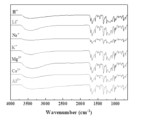
- FIG. 5 is an FT-IR spectrum of SPI-1 films of the present invention in various cationic forms (H + , Li + , Na + , K + , Mg 2+ , Ca 2+ , Al 3+ ).
- a very broad band around 3400 cm ⁇ 1 is due to moisture absorbed by the membrane.
- Example 9 (Gas separation performance) Table 1 shows the permeability coefficients and selectivities of sulfonated polyimide membranes in proton form and metal cation form at 35° C. and 0.1 MPa (upstream pressure).
- Comparative example 1 The five-membered ring sulfonated polyimide reported by Y. K. Kim et al. has a chemical structure represented by the following general formula (2) (Y. K. Kim et al., J. Membr. Sci. 226 (2003) 145-158) .
- Said sulfonated polyimides have been synthesized by random condensation polymerization of 3,3′,4,4′-benzophenonetetracarboxylic dianhydride, 2,2′-benzidinedisulfonic acid, and m-phenylenediamine. The molar ratios of m-phenylenediamine and 2,2'-benzidine disulfonic acid are controlled at 9:1 and 8:2.
- Membrane H-SPI 1091 is a protonated sulfonated polyimide with a 9:1 molar ratio of m-phenylenediamine and 2,2'-benzidine disulfonic acid.
- Membrane K-SPI 1082 is a sulfonated polyimide of the potassium cation type with a molar ratio of m-phenylenediamine and 2,2'-benzidine disulfonic acid of 8:2.
- the five-membered ring sulfonated polyimide membranes in cationic form exhibit very low oxygen permeability coefficients and moderate or very low O 2 /N 2 selectivities.
- H-SPI 1091 is the only one with high O 2 /N 2 selectivity (9.3) but lowest oxygen permeability (0.56 Barrer).
- metal cation exchange treatment significantly reduces selectivity.
- the O 2 /N 2 separation performance of the present invention is clearly far superior to the 5-membered ring sulfonated polyimide membrane reported by YK Kim et al.
- Comparative example 2 The chemical structure of the 6-membered ring sulfonated polyimide reported by K. Tanaka et al. (K. Tanaka et al., Polymer 47 (2006) 4370-4377) and the corresponding non-sulfonated polyimide film are shown below.
- the polyimide is made from 1,4,5,8-naphthalenetetracarboxylic dianhydride (NTDA) and 2,2-bis(4-(4-aminophenoxy)-3-sulfophenyl)hexafluoropropane (BAPHFDS)
- NTDA 1,4,5,8-naphthalenetetracarboxylic dianhydride
- BAPHFDS 2,2-bis(4-(4-aminophenoxy)-3-sulfophenyl)hexafluoropropane
- BAPHF 2,2-bis(4-(4-aminophenoxy)-3-sulfophenyl)hexafluoropropane
- the gas separation membrane of the present invention can be used as a separation membrane that permeates and separates a specific gas from a mixed gas.
Landscapes
- Chemical & Material Sciences (AREA)
- Chemical Kinetics & Catalysis (AREA)
- Polymers & Plastics (AREA)
- Organic Chemistry (AREA)
- Health & Medical Sciences (AREA)
- Medicinal Chemistry (AREA)
- Engineering & Computer Science (AREA)
- Manufacturing & Machinery (AREA)
- Analytical Chemistry (AREA)
- General Chemical & Material Sciences (AREA)
- Oil, Petroleum & Natural Gas (AREA)
- Materials Engineering (AREA)
- Separation Using Semi-Permeable Membranes (AREA)
Priority Applications (4)
| Application Number | Priority Date | Filing Date | Title |
|---|---|---|---|
| US18/575,980 US20240335797A1 (en) | 2021-10-21 | 2022-05-16 | Gas separation membrane |
| CN202280060804.3A CN117980060A (zh) | 2021-10-21 | 2022-05-16 | 气体分离膜 |
| JP2023554242A JPWO2023067835A1 (https=) | 2021-10-21 | 2022-05-16 | |
| EP22883148.3A EP4420768A4 (en) | 2021-10-21 | 2022-05-16 | GAS SEPARATION MEMBRANE |
Applications Claiming Priority (2)
| Application Number | Priority Date | Filing Date | Title |
|---|---|---|---|
| JP2021-172533 | 2021-10-21 | ||
| JP2021172533 | 2021-10-21 |
Publications (1)
| Publication Number | Publication Date |
|---|---|
| WO2023067835A1 true WO2023067835A1 (ja) | 2023-04-27 |
Family
ID=86058926
Family Applications (1)
| Application Number | Title | Priority Date | Filing Date |
|---|---|---|---|
| PCT/JP2022/020333 Ceased WO2023067835A1 (ja) | 2021-10-21 | 2022-05-16 | ガス分離膜 |
Country Status (5)
| Country | Link |
|---|---|
| US (1) | US20240335797A1 (https=) |
| EP (1) | EP4420768A4 (https=) |
| JP (1) | JPWO2023067835A1 (https=) |
| CN (1) | CN117980060A (https=) |
| WO (1) | WO2023067835A1 (https=) |
Citations (5)
| Publication number | Priority date | Publication date | Assignee | Title |
|---|---|---|---|---|
| JP2003064181A (ja) * | 2001-08-24 | 2003-03-05 | Yamaguchi Technology Licensing Organization Ltd | 新規スルホン化芳香族ポリイミド |
| JP2003277501A (ja) * | 2002-03-22 | 2003-10-02 | Toyota Motor Corp | ポリイミド樹脂、ポリイミド樹脂の製造方法、電解質膜及び電解質溶液並びに燃料電池 |
| JP2005272666A (ja) * | 2004-03-25 | 2005-10-06 | Japan Science & Technology Agency | ポリイミド樹脂およびその製造方法 |
| JP2013229121A (ja) * | 2012-04-24 | 2013-11-07 | Nitto Denko Corp | プロトン伝導性の高分子電解質膜ならびにそれを用いた膜・電極接合体および燃料電池 |
| CN108043232A (zh) * | 2017-12-06 | 2018-05-18 | 上海交通大学 | 一种六元环聚酰亚胺共聚物分离膜及其制备方法和用途 |
Family Cites Families (19)
| Publication number | Priority date | Publication date | Assignee | Title |
|---|---|---|---|---|
| US4880442A (en) * | 1987-12-22 | 1989-11-14 | E. I. Du Pont De Nemours And Company | Polyimide gas separation membranes |
| US4954144A (en) * | 1989-09-12 | 1990-09-04 | Air Products And Chemicals, Inc. | Polyimide membranes and their use for gas separation |
| US5178650A (en) * | 1990-11-30 | 1993-01-12 | E. I. Du Pont De Nemours And Company | Polyimide gas separation membranes and process of using same |
| US5234471A (en) * | 1992-02-04 | 1993-08-10 | E. I. Du Pont De Nemours And Company | Polyimide gas separation membranes for carbon dioxide enrichment |
| US5248319A (en) * | 1992-09-02 | 1993-09-28 | E. I. Du Pont De Nemours And Company | Gas separation membranes made from blends of aromatic polyamide, polymide or polyamide-imide polymers |
| US5322549A (en) * | 1993-06-04 | 1994-06-21 | E. I. Du Pont De Nemours And Company | Polyimides and gas separation membranes prepared therefrom |
| US5725633A (en) * | 1995-06-30 | 1998-03-10 | Praxair Technology, Inc. | Sulfonated polyimide gas separation membranes |
| US5716430A (en) * | 1996-05-03 | 1998-02-10 | L'air Liquide Societe Anonyme Pour L'etude Et, L'exploitation Des Procedes Georges Claude | Nitrated polyimide gas separation membranes |
| JP3698107B2 (ja) * | 2002-02-15 | 2005-09-21 | 宇部興産株式会社 | 新規分離膜およびその製造方法 |
| JP2005270817A (ja) * | 2004-03-25 | 2005-10-06 | Honda Motor Co Ltd | 車載用気体分離膜 |
| US8613362B2 (en) * | 2009-03-27 | 2013-12-24 | Uop Llc | Polymer membranes derived from aromatic polyimide membranes |
| US8231785B2 (en) * | 2009-05-12 | 2012-07-31 | Uop Llc | Staged membrane system for gas, vapor, and liquid separations |
| US9088030B2 (en) * | 2011-03-30 | 2015-07-21 | Nitto Denko Corporation | Polyimide, polyimide-based polymer electrolyte membrane, membrane-electrode assembly, and polymer electrolyte fuel cell |
| US20150328594A1 (en) * | 2014-05-14 | 2015-11-19 | Uop Llc | Polyimide membranes with very high separation performance for olefin/paraffin separations |
| US10682606B2 (en) * | 2017-07-07 | 2020-06-16 | Saudi Arabian Oil Company | Multilayer aromatic polyamide thin-film composite membranes for separation of gas mixtures |
| CN110628023B (zh) * | 2019-09-05 | 2021-10-08 | 上海交通大学 | 一种适用于中高温燃料电池的结晶性磺化聚酰亚胺嵌段共聚物质子交换膜及其制备方法 |
| US11896936B2 (en) * | 2021-01-14 | 2024-02-13 | Saudi Arabian Oil Company | Poly(imide-oxadiazole) membranes for gas separation applications |
| WO2023074031A1 (ja) * | 2021-10-25 | 2023-05-04 | 日東電工株式会社 | 気体分離膜 |
| CN116262205A (zh) * | 2021-12-14 | 2023-06-16 | 日东电工株式会社 | 复合反渗透膜及其制造方法 |
-
2022
- 2022-05-16 CN CN202280060804.3A patent/CN117980060A/zh active Pending
- 2022-05-16 JP JP2023554242A patent/JPWO2023067835A1/ja active Pending
- 2022-05-16 EP EP22883148.3A patent/EP4420768A4/en active Pending
- 2022-05-16 WO PCT/JP2022/020333 patent/WO2023067835A1/ja not_active Ceased
- 2022-05-16 US US18/575,980 patent/US20240335797A1/en active Pending
Patent Citations (5)
| Publication number | Priority date | Publication date | Assignee | Title |
|---|---|---|---|---|
| JP2003064181A (ja) * | 2001-08-24 | 2003-03-05 | Yamaguchi Technology Licensing Organization Ltd | 新規スルホン化芳香族ポリイミド |
| JP2003277501A (ja) * | 2002-03-22 | 2003-10-02 | Toyota Motor Corp | ポリイミド樹脂、ポリイミド樹脂の製造方法、電解質膜及び電解質溶液並びに燃料電池 |
| JP2005272666A (ja) * | 2004-03-25 | 2005-10-06 | Japan Science & Technology Agency | ポリイミド樹脂およびその製造方法 |
| JP2013229121A (ja) * | 2012-04-24 | 2013-11-07 | Nitto Denko Corp | プロトン伝導性の高分子電解質膜ならびにそれを用いた膜・電極接合体および燃料電池 |
| CN108043232A (zh) * | 2017-12-06 | 2018-05-18 | 上海交通大学 | 一种六元环聚酰亚胺共聚物分离膜及其制备方法和用途 |
Non-Patent Citations (6)
| Title |
|---|
| H. FU ET AL., J. APPL. POLYM. SCI., vol. 51, 1994, pages 1405 - 1409 |
| K. TANAKA ET AL., POLYMER, vol. 47, 2006, pages 4370 - 4377 |
| L. M.ROBENSON: "The upper bound revisited", J. MEMBR. SCI., vol. 320, 2008, pages 390 - 400 |
| See also references of EP4420768A4 |
| X. GUO ET AL., MACROMOLECULES, vol. 35, 2002, pages 6707 - 6713 |
| Y. K. KIM ET AL., J. MEMBR. SCI., vol. 226, 2003, pages 145 - 158 |
Also Published As
| Publication number | Publication date |
|---|---|
| EP4420768A4 (en) | 2025-10-15 |
| CN117980060A (zh) | 2024-05-03 |
| US20240335797A1 (en) | 2024-10-10 |
| JPWO2023067835A1 (https=) | 2023-04-27 |
| EP4420768A1 (en) | 2024-08-28 |
Similar Documents
| Publication | Publication Date | Title |
|---|---|---|
| Li et al. | Mechanically robust thermally rearranged (TR) polymer membranes with spirobisindane for gas separation | |
| CA2666101C (en) | Hollow fiber and polymer dope derived from polyamic acid | |
| CN102099513B (zh) | 中空纤维、用于形成中空纤维的掺杂溶液组合物和使用所述掺杂溶液组合物制备中空纤维的方法 | |
| Li et al. | Synthesis of room temperature ionic liquids based random copolyimides for gas separation applications | |
| KR101676586B1 (ko) | 중합체, 중합체 막 및 이의 제조 방법 | |
| CA2666106A1 (en) | Dope solution composition derived from polyimide and method of preparing a hollow fiber therefrom | |
| CN114854060A (zh) | 一种用于气体分离的含氟聚酰亚胺膜的制备方法 | |
| CN103846022A (zh) | 一种共聚聚酰亚胺中空纤维气体分离膜的制备方法 | |
| EP2281926A2 (en) | Hollow fiber, dope solution composition for forming a hollow fiber, and method for manufacturing a hollow fiber using the same | |
| Hayek et al. | Fluorinated copolyimide membranes for sour mixed‐gas upgrading | |
| Kammakakam et al. | PEG–imidazolium-functionalized 6FDA–durene polyimide as a novel polymeric membrane for enhanced CO 2 separation | |
| CN103846023A (zh) | 一种共聚聚酰亚胺气体分离膜材料及其制备和应用 | |
| Wang et al. | De‐carboxylation of cross‐linkable triptycene‐based polyimides for CO2 separation | |
| CN108114615A (zh) | 一种聚酰亚胺气体分离膜材料及制备和应用 | |
| CN114716676A (zh) | 一种聚酰亚胺在气体分离膜中的应用 | |
| Xu et al. | Synthesis of polyimides containing Tröger's base and triphenylmethane moieties with a tunable fractional free volume for CO 2 separation | |
| CN109833784A (zh) | 一种含硅聚酰亚胺气体分离膜及制备方法 | |
| Qian et al. | Six-membered ring copolyimides as novel high performance membrane materials for gas separations | |
| CN113372554B (zh) | 半脂环族聚酰亚胺及其薄膜在气体分离中的应用 | |
| KR20210127255A (ko) | 6FDA-6FpDA-유형 호모-폴리이미드로부터 유래된 방향족 코-폴리이미드 가스 분리 멤브레인 | |
| WO2023067835A1 (ja) | ガス分離膜 | |
| Yu et al. | Synthesis, properties and gas separation performance of poly (arylene ether sulfone) containing imide pendant groups | |
| KR101599898B1 (ko) | 기체분리용 가교구조를 갖는 열전환 폴리(벤즈옥사졸-이미드) 막의 제조방법 및 그에 의하여 제조된 기체분리막 | |
| CN110433672B (zh) | 一种非共平面大位阻聚酰亚胺气体分离膜及其制备方法 | |
| Saedi et al. | Preparation and characterization of an amino‐cellulose (AC) derivative for development of thin‐film composite membrane for CO2/CH4 separation |
Legal Events
| Date | Code | Title | Description |
|---|---|---|---|
| 121 | Ep: the epo has been informed by wipo that ep was designated in this application |
Ref document number: 22883148 Country of ref document: EP Kind code of ref document: A1 |
|
| WWE | Wipo information: entry into national phase |
Ref document number: 2023554242 Country of ref document: JP |
|
| WWE | Wipo information: entry into national phase |
Ref document number: 202280060804.3 Country of ref document: CN |
|
| WWE | Wipo information: entry into national phase |
Ref document number: 2022883148 Country of ref document: EP |
|
| NENP | Non-entry into the national phase |
Ref country code: DE |
|
| ENP | Entry into the national phase |
Ref document number: 2022883148 Country of ref document: EP Effective date: 20240521 |