WO2023053592A1 - 生体情報取得デバイス - Google Patents
生体情報取得デバイス Download PDFInfo
- Publication number
- WO2023053592A1 WO2023053592A1 PCT/JP2022/024005 JP2022024005W WO2023053592A1 WO 2023053592 A1 WO2023053592 A1 WO 2023053592A1 JP 2022024005 W JP2022024005 W JP 2022024005W WO 2023053592 A1 WO2023053592 A1 WO 2023053592A1
- Authority
- WO
- WIPO (PCT)
- Prior art keywords
- rigid
- information acquisition
- acquisition device
- biosensor
- main body
- Prior art date
- Legal status (The legal status is an assumption and is not a legal conclusion. Google has not performed a legal analysis and makes no representation as to the accuracy of the status listed.)
- Ceased
Links
Images






Classifications
-
- A—HUMAN NECESSITIES
- A61—MEDICAL OR VETERINARY SCIENCE; HYGIENE
- A61B—DIAGNOSIS; SURGERY; IDENTIFICATION
- A61B7/00—Instruments for auscultation
- A61B7/02—Stethoscopes
- A61B7/04—Electric stethoscopes
-
- A—HUMAN NECESSITIES
- A61—MEDICAL OR VETERINARY SCIENCE; HYGIENE
- A61B—DIAGNOSIS; SURGERY; IDENTIFICATION
- A61B5/00—Measuring for diagnostic purposes; Identification of persons
- A61B5/02—Detecting, measuring or recording for evaluating the cardiovascular system, e.g. pulse, heart rate, blood pressure or blood flow
- A61B5/0205—Simultaneously evaluating both cardiovascular conditions and different types of body conditions, e.g. heart and respiratory condition
- A61B5/02055—Simultaneously evaluating both cardiovascular condition and temperature
-
- A—HUMAN NECESSITIES
- A61—MEDICAL OR VETERINARY SCIENCE; HYGIENE
- A61B—DIAGNOSIS; SURGERY; IDENTIFICATION
- A61B5/00—Measuring for diagnostic purposes; Identification of persons
- A61B5/24—Detecting, measuring or recording bioelectric or biomagnetic signals of the body or parts thereof
- A61B5/25—Bioelectric electrodes therefor
- A61B5/251—Means for maintaining electrode contact with the body
- A61B5/257—Means for maintaining electrode contact with the body using adhesive means, e.g. adhesive pads or tapes
- A61B5/259—Means for maintaining electrode contact with the body using adhesive means, e.g. adhesive pads or tapes using conductive adhesive means, e.g. gels
-
- A—HUMAN NECESSITIES
- A61—MEDICAL OR VETERINARY SCIENCE; HYGIENE
- A61B—DIAGNOSIS; SURGERY; IDENTIFICATION
- A61B5/00—Measuring for diagnostic purposes; Identification of persons
- A61B5/24—Detecting, measuring or recording bioelectric or biomagnetic signals of the body or parts thereof
- A61B5/25—Bioelectric electrodes therefor
- A61B5/279—Bioelectric electrodes therefor specially adapted for particular uses
- A61B5/28—Bioelectric electrodes therefor specially adapted for particular uses for electrocardiography [ECG]
- A61B5/282—Holders for multiple electrodes
-
- A—HUMAN NECESSITIES
- A61—MEDICAL OR VETERINARY SCIENCE; HYGIENE
- A61B—DIAGNOSIS; SURGERY; IDENTIFICATION
- A61B5/00—Measuring for diagnostic purposes; Identification of persons
- A61B5/68—Arrangements of detecting, measuring or recording means, e.g. sensors, in relation to patient
- A61B5/6801—Arrangements of detecting, measuring or recording means, e.g. sensors, in relation to patient specially adapted to be attached to or worn on the body surface
- A61B5/6813—Specially adapted to be attached to a specific body part
- A61B5/6823—Trunk, e.g., chest, back, abdomen, hip
-
- A—HUMAN NECESSITIES
- A61—MEDICAL OR VETERINARY SCIENCE; HYGIENE
- A61B—DIAGNOSIS; SURGERY; IDENTIFICATION
- A61B7/00—Instruments for auscultation
- A61B7/003—Detecting lung or respiration noise
-
- A—HUMAN NECESSITIES
- A61—MEDICAL OR VETERINARY SCIENCE; HYGIENE
- A61B—DIAGNOSIS; SURGERY; IDENTIFICATION
- A61B7/00—Instruments for auscultation
- A61B7/008—Detecting noise of gastric tract, e.g. caused by voiding
-
- H—ELECTRICITY
- H04—ELECTRIC COMMUNICATION TECHNIQUE
- H04R—LOUDSPEAKERS, MICROPHONES, GRAMOPHONE PICK-UPS OR LIKE ACOUSTIC ELECTROMECHANICAL TRANSDUCERS; ELECTRIC HEARING AIDS; PUBLIC ADDRESS SYSTEMS
- H04R17/00—Piezoelectric transducers; Electrostrictive transducers
- H04R17/02—Microphones
-
- A—HUMAN NECESSITIES
- A61—MEDICAL OR VETERINARY SCIENCE; HYGIENE
- A61B—DIAGNOSIS; SURGERY; IDENTIFICATION
- A61B2560/00—Constructional details of operational features of apparatus; Accessories for medical measuring apparatus
- A61B2560/04—Constructional details of apparatus
- A61B2560/0462—Apparatus with built-in sensors
- A61B2560/0468—Built-in electrodes
-
- A—HUMAN NECESSITIES
- A61—MEDICAL OR VETERINARY SCIENCE; HYGIENE
- A61B—DIAGNOSIS; SURGERY; IDENTIFICATION
- A61B2562/00—Details of sensors; Constructional details of sensor housings or probes; Accessories for sensors
- A61B2562/02—Details of sensors specially adapted for in-vivo measurements
- A61B2562/0271—Thermal or temperature sensors
Definitions
- the present disclosure relates to a biological information acquisition device that acquires body sounds such as lung sounds (breathing sounds, secondary murmurs) and heart sounds generated from a living body as biological information.
- Patent Document 1 discloses a biosensor that acquires a respiratory sound waveform, a heart sound waveform, an electrocardiogram waveform, etc. as biological information.
- the biosensor has a substrate, a cover plate covering the substrate, and a piezoelectric element for acquiring a respiratory sound waveform disposed between the substrate and the cover plate.
- the piezoelectric element may not be able to accurately acquire the respiratory sound waveform and the heart sound waveform.
- an object of the present disclosure is to provide a biometric information acquisition device capable of acquiring biometric information with high accuracy by enhancing close contact with a living body.
- a main body having a facing surface that faces a living body when worn; a first biosensor provided on the main body so that at least a portion thereof protrudes from the facing surface of the main body, the first biosensor including a first contact surface that comes into contact with a living body; and an adhesive tape that is attached to the facing surface of the main body and has a thickness smaller than the amount of protrusion of the first biosensor from the facing surface.
- a main body having a facing surface that faces a living body when worn; a first biosensor provided on the main body and having a first contact surface that contacts a living body;
- a biological information acquisition device is provided, wherein the main body includes a first rigid section that supports the first biological sensor, and a deformable section that supports the first rigid section and is deformable.
- biometric information acquisition device capable of acquiring biometric information with high accuracy by enhancing close contact with a living body.
- FIG. 1 is an upper perspective view of a biological information acquisition device according to an embodiment of the present disclosure
- FIG. Lower perspective view of the biological information acquisition device Side view of biometric information acquisition device Top view of biometric information acquisition device
- Upper exploded perspective view of the biological information acquisition device Lower exploded perspective view of the biological information acquisition device
- FIG. 4 is a diagram showing a biological information acquisition device attached to a living body;
- Schematic bottom view of a biological information acquisition device according to another embodiment of the present disclosure
- Schematic bottom view of a biological information acquisition device according to yet another embodiment of the present disclosure
- Schematic bottom view of a biometric information acquisition device according to a different embodiment of the present disclosure
- Schematic bottom view of a biological information acquisition device according to still another embodiment of the present disclosure
- a bioacoustic sensor includes a main body including a facing surface that faces a living body when worn, and a first body that is provided in the main body so that at least a portion thereof protrudes from the facing face of the main body and contacts the living body. and an adhesive tape attached to the facing surface of the main body and having a thickness smaller than the amount of protrusion of the first biosensor from the facing surface. .
- biometric information acquisition device that can acquire biometric information with high accuracy by enhancing the close contact with the living body.
- the first biosensor includes a diaphragm having the first contact surface and at least a portion of which protrudes from the facing surface of the main body, and a piezoelectric element for detecting vibration of the diaphragm. It may be a bioacoustic sensor that measures the sound emitted by.
- the biometric information acquisition device further includes a second biosensor provided on the main body so that at least a portion protrudes from the facing surface, the second biosensor having a second contact surface that contacts the living body, A distance to the first contact surface of the first biosensor may be greater than a distance from the facing surface to the second contact surface of the second biosensor.
- the second biosensor is an electrocardiographic sensor that includes a plurality of electrodes each having the second contact surface and acquires an electrocardiographic waveform of a living body, and the plurality of electrodes of the second biosensor Electrodes may be provided on the body such that the first biosensor is positioned between the plurality of electrodes.
- the second contact surfaces of the plurality of electrodes of the second biosensor are in contact with a living body through a conductive gel, and the surface of the conductive gel in contact with the living body is the first biosensor.
- the plurality of electrodes may be provided on the body so as to lie substantially coplanar with the first contact surface of the.
- the main body includes a first rigid section that supports the first biosensor, a plurality of second rigid sections that respectively support the plurality of electrodes of the second biosensor, and the first rigid body. and a deformable portion that supports the portion and the plurality of second rigid portions and is softer than the first rigid portion and the plurality of second rigid portions.
- the first biosensor may protrude from the facing surface of the main body toward the living body to a greater extent than the plurality of second rigid bodies.
- the biological information acquisition device may further include a temperature sensor that acquires body temperature, and the temperature sensor may acquire body temperature via at least one of the plurality of electrodes.
- a biological information acquisition device includes a main body including a facing surface that faces a living body when worn, and a first biosensor provided on the main body and provided with a first contact surface that contacts the living body.
- the main body includes a first rigid portion that supports the first biosensor, and a deformable portion that supports the first rigid portion and is softer than the first rigid portion.
- biometric information acquisition device that can acquire biometric information with high accuracy by enhancing the close contact with the living body.
- the first biosensor is a bioacoustic sensor that includes a diaphragm having the first contact surface and a piezoelectric element that detects vibration of the diaphragm, and that measures the sound emitted by a living body. good.
- the biometric information acquisition device may further include a second biosensor having a second contact surface that contacts a living body, and the main body may include a second rigid portion that supports the second biosensor. good.
- the second biosensor is an electrocardiographic sensor that includes a plurality of electrodes each having the second contact surface and acquires an electrocardiogram waveform of a living body, and the second rigid body portion includes a plurality of , the plurality of electrodes of the second biosensor may be provided on the plurality of second rigid bodies.
- the second electrode is not limited to a rectangular shape, and may be circular.
- the first rigid section may be arranged between the plurality of second rigid sections.
- the first rigid body may be spaced apart from each of the plurality of second rigid bodies.
- FIG. 1 is an upper perspective view of a biological information acquisition device according to one embodiment of the present disclosure.
- FIG. 2 is a bottom perspective view of the biometric information acquisition device.
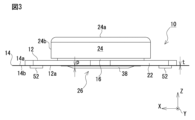
- FIG. 3 is a side view of the biometric information acquisition device.
- FIG. 4 is a top view of the biometric information acquisition device.
- the XYZ orthogonal coordinate system shown in the drawing is for facilitating understanding of the embodiments of the present disclosure, and does not limit the embodiments.
- the X-axis direction indicates the longitudinal direction of the biometric information acquisition device, the Y-axis direction indicates the lateral direction, and the Z-axis direction indicates the height direction.
- a biological information acquisition device 10 according to the present embodiment shown in FIG. 1 is a device that acquires a biological sound waveform generated from a living body as biological information.
- the biological information acquisition device 10 is configured to acquire body sounds, electrocardiographic waveforms, and body temperature as biological information.
- the body 12 of the biometric information acquisition device 10 is attached to the living body via the adhesive tape 14.
- the main body 12 of the biological information acquisition device 10 is plate-shaped and has a facing surface 12a that faces the living body when worn.
- the adhesive tape 14 is a double-sided tape, and the opposing surface 12a of the main body 12 is adhered to one adhesive surface 14a.
- the other adhesive surface 14b of the adhesive tape 14 is attached to the living body. That is, the facing surface 12a of the main body 12 of the biological information acquisition device 10 is attached to the living body via the adhesive tape 14 .
- the adhesive tape 14 is composed of a first tape having one surface that is a weakly viscous adhesive surface that can be attached to a living body and the other surface that is a smooth surface, and one surface that is the other surface of the first tape. and a second tape having a strong adhesive surface to be attached to the body 12 and having a strong adhesive surface to be attached to the main body 12 on the other surface.
- the body 12 of the biological information acquisition device 10 includes a first rigid body portion 16 that is substantially undeformable, second rigid body portions 18 and 20, and these rigid body portions 16, 18 and 20. and a deformable portion 22 that is supportively deformable.
- the first rigid section 16 and the second rigid sections 18 and 20 in the main body 12 of the biological information acquisition device 10 are made of a material such as hard resin that does not substantially deform.
- the deformable portion 22 is made of a softer (deformable) material than the rigid portion, such as soft resin, rubber, or cloth. In other words, the deformable portion 22 deforms more easily than the first rigid portion 16 and the second rigid portions 18 , 20 .
- being soft or easily deformable means having a relatively small elastic modulus such as Young's modulus or rigidity modulus.
- the facing surface 12a of the main body 12 of the biological information acquisition device 10 has high adhesiveness to the living body as compared with the case where the main body 12 is made only of non-deformable material such as hard resin. can adhere to. That is, even if the shape of the skin surface of the living body changes, the deformable portion 22 deforms accordingly, so that the facing surface 12a of the main body 12 can continue to be in close contact with the living body without gaps. By deforming the deformable portion 22, it is possible to reduce the impact on the main body 12 even when the adhesive tape is peeled off and dropped.
- the first rigid body part 16 is arranged in the center of the main body 12 in the longitudinal direction (X-axis direction).
- the second rigid portions 18 and 20 are arranged to face each other in the longitudinal direction with the first rigid portion 16 interposed therebetween. That is, the first rigid portion 16 is arranged between the second rigid portions 18 and 20 .
- the first rigid portion 16 is spaced apart from the second rigid portions 18 and 20, respectively.
- the portions sandwiched between the rigid portions 16 , 18 , 20 are deformation portions 22 .
- the second rigid parts 18 and 20 are provided at both ends of the main body 12 in the longitudinal direction. By separating the rigid body portions from each other in this manner, the main body 12 is easily deformed.
- the first rigid section 16 and the second rigid sections 18 and 20 of the main body 12 of the biological information acquisition device 10 are each provided with a plurality of components necessary for acquiring biological information.
- FIG. 5 is an upper exploded perspective view of the biological information acquisition device.
- FIG. 6 is a bottom exploded perspective view of the biological information acquisition device.
- FIG. 7 is a cross-sectional view of the biometric information acquisition device along line AA in FIG.
- FIG. 8 is a cross-sectional view of the biometric information acquisition device taken along line BB of FIG. 9 is a cross-sectional view of the biometric information acquisition device taken along line CC of FIG.
- the first rigid portion 16 has a substantially cylindrical shape with a bottom, and includes a bottom plate portion 16a and a height direction ( and an annular wall portion 16b extending in the Z-axis direction).
- the outer surface 16c of the bottom plate portion 16a of the first rigid portion 16 forms part of the facing surface 12a of the main body 12.
- a lid 24 is detachably attached to the first rigid body portion 16 .
- the lid body 24 includes a top plate portion 24a facing the bottom plate portion 16a of the first rigid portion 16 with a gap therebetween, and a height direction (Z an annular wall portion 24 b extending in the axial direction) and surrounding the annular wall portion 16 b of the first rigid portion 16 .
- the lid 24 is fixed to the first rigid portion 16 by rotating it in one rotational direction about the rotational center line extending in the height direction. When rotated in the other rotational direction, the lid 24 becomes detachable from the first rigid portion 16 .
- the first rigid section 16 is provided with a bioacoustic sensor 26 as a first biosensor and a control board 28 .
- the bioacoustic sensor 26 is a sensor that acquires a bioacoustic waveform of a living body, and its constituent elements are incorporated in the bottom plate portion 16 a of the first rigid body portion 16 .
- the bioacoustic sensor 26 includes a disk-shaped diaphragm 30 having a contact surface 30a that contacts the living body, and a disk-shaped diaphragm that detects the vibration of the diaphragm 30. of piezoelectric elements 32 .
- the vibration plate 30 and the piezoelectric element 32 are not limited to the disk shape, and may be square, rectangular, or other shapes.
- the bioacoustic sensor 26 is arranged between the diaphragm 30 and the piezoelectric element 32, includes an annular vibration transmission member 34 connecting the outer peripheral edge portion of the first surface 32a of the .
- the piezoelectric element 32 is attached via a double-faced tape 36 to the top surface of the protruding portion 16d of the first rigid portion 16 protruding toward the living body at the central portion of the second surface 32b.
- a signal line 32c of the piezoelectric element 32 passes through a through hole 16e formed in the bottom plate portion 16a of the first rigid portion 16 and is connected to the control board 28.
- FIG. As a result, when the diaphragm 30 vibrates, the piezoelectric element 32 as a whole bends and deforms, and the piezoelectric element 32 can detect vibration with high resolution.
- a thin film sheet 38 that covers and protects the bioacoustic sensor 26 is attached to the outer surface 16 c of the first rigid body portion 16 . Therefore, the contact surface 30a of the diaphragm 30 comes into contact with the living body through the film sheet 38. As shown in FIG.
- the bioacoustic sensor 26 is provided on the main body 12, that is, the first rigid body portion 16, so that at least a portion thereof protrudes from the facing surface 12a of the main body 12. Specifically, at least a portion of the diaphragm 30 of the bioacoustic sensor 26 protrudes from the facing surface 12a of the main body 12 .
- a contact surface 30a is provided at the distal end of the projecting portion.
- the contact surface 30a of the diaphragm 30 of the bioacoustic sensor 26 protruding from the facing surface 12a comes into strong contact with the living body.
- the diaphragm 30 vibrates as if in synchronism with the vibration of the living body.
- the piezoelectric element 32 can detect the vibration of the living body with high accuracy through the diaphragm 30 .
- the main body 12 of the biological information acquisition device 10 includes the deformation section 22 as described above. Therefore, even if the shape of the skin surface of the living body changes, the deformation portion 22 deforms accordingly, so that the facing surface 12a of the main body 12 can continue to be in close contact with the living body without gaps. As a result, the bioacoustic sensor 26 can continue to detect the vibration of the living body while maintaining high accuracy.
- the bioacoustic sensor 26 is provided on the first rigid body portion 16 instead of the deformable portion 22 of the main body 12 .
- the vibration of the part of the living body with which the bioacoustic sensor 26 contacts is transmitted to the bioacoustic sensor 26 with little loss.
- the bioacoustic sensor 26 is provided in the deformable portion 22, part of the vibrational energy of the living body is used to deform the deformable portion 22, and the vibration transmitted to the bioacoustic sensor 26 is attenuated. As a result, the vibration detection accuracy of the bioacoustic sensor 26 is lowered. Therefore, the bioacoustic sensor 26 is provided on the first rigid portion 16 instead of on the deformable portion 22 .
- the amount p of protrusion from the facing surface 12 a of the main body 12 of the bioacoustic sensor 26 is larger than the thickness t of the adhesive tape 14 . That is, the adhesive tape 14 has a thickness t that is smaller than the protrusion amount p of the bioacoustic sensor 26 .
- the adhesive tape 14 is formed with a through hole 14c through which the bioacoustic sensor 26 passes. A notch may be formed in the adhesive tape 14 instead of the through hole 14c. That is, the adhesive tape 14 is arranged so as to avoid the bioacoustic sensor 26 (so as not to overlap in plan view).
- control board 28 is accommodated within a space S defined by the first rigid body portion 16 and the lid body 24 .
- the control board 28 is a circular circuit board and has a battery 40 mounted on one surface thereof. The battery 40 can be replaced by removing the lid 24 from the first rigid portion 16 . 5 and 6, a flexible printed board 42 is connected to the control board 28. As shown in FIGS. Details of the control board 28 and the flexible printed board 42 will be described later.
- each of the second rigid parts 18 and 20 is provided with a second biosensor 44 .
- the second biosensor 44 is an electrocardiographic sensor that acquires an electrocardiographic waveform of a living body, and a plurality of electrodes 46 and 48 that contact the living body are attached to the second rigid body parts 18 and 20, respectively. is provided.
- the electrodes 46, 48 are attached to the second rigid parts 18, 20 via an annular double-sided tape 50, as shown in FIGS.
- the plurality of electrodes 46 and 48 of the electrocardiographic sensor 44 are preferably separated in order to obtain a good electrocardiogram waveform. Therefore, in the biological information acquisition device 10, the plurality of electrodes 46, 48 are provided on the main body 12 such that the bioacoustic sensor 26 is positioned therebetween. As a result, the biological information acquisition device 10 is miniaturized while separating the plurality of electrodes 46 and 48 as much as possible.
- each of the plurality of electrodes 46, 48 of the electrocardiographic sensor 44 has contact surfaces 46a, 48a that come into contact with the living body.
- the contact surfaces 46a and 48a are located on the anti-living body side with respect to the facing surface 12a of the main body 12.
- the contact surface 30a of the bioacoustic sensor 26 is located closer to the living body than the contact surfaces 46a and 48a.
- a conductive gel 52 is attached to the contact surfaces 46a, 48a of the plurality of electrodes 46, 48.
- FIG. Thereby, the contact surfaces 46 a and 48 a come into contact with the living body through the conductive gel 52 .
- the plurality of electrodes 46 and 48 are provided on the main body 12 so that the surface 52a of the conductive gel 52 that contacts the living body is substantially flush with the contact surface 30a of the bioacoustic sensor 26 .
- the adhesive tape 14 is formed with through holes 14d through which the conductive gel 52 passes.
- a notch may be formed in the adhesive tape 14 instead of the through hole 14d. That is, the adhesive tape 14 is arranged so as to avoid the conductive gel 52 (so as not to overlap in plan view).
- the distance from the facing surface 12a of the main body 12 to the contact surfaces 46a and 48a should be smaller than the distance from the facing surface 12a to the contact surface 30a of the bioacoustic sensor 26.
- the contact surface 30a of the bioacoustic sensor 26 can be brought into closer contact with the living body.
- the bioacoustic sensor 26 in order for the contact surface 30a of the bioacoustic sensor 26 to be in close contact with the living body, the bioacoustic sensor 26 should be provided with a plurality of second contact surfaces extending from the facing surface 12a of the main body 12 toward the living body. It is preferable that it protrudes greatly compared to the rigid parts 18 and 20 .
- surfaces 18a and 20a of the second rigid body portions 18 and 20, which face the living body constitute part of the facing surface 12a of the main body 12. As shown in FIG. Thereby, the contact surface 30a of the bioacoustic sensor 26 can be brought into closer contact with the living body.
- the biological information acquisition device 10 has a temperature sensor 54 that detects the temperature of the electrodes 46 .
- the temperature sensor 54 indirectly detects the body temperature of the living body by detecting the temperature of the electrode 46 in contact with the living body.
- the body temperature here is the temperature of the skin surface. If the temperature sensor is capable of measuring core body temperature, the body temperature is core body temperature.
- the temperature sensor 54 is connected to electrodes other than the electrodes 46 and 48, and can measure body temperature if it is in contact with the living body. For example, it may be in the bioacoustic sensor 26 .
- the electrocardiographic sensor 44 acquires an electrocardiographic waveform of the living body based on changes in potential difference between the electrodes 46 and 48 .
- FIG. 10 is a block diagram of the control system of the biometric information acquisition device.
- control board 28 of the biological information acquisition device 10 is provided with an amplifier/filter circuit 56 for amplifying and filtering the output value (voltage signal) from the bioacoustic sensor 26 (piezoelectric element 32). It is The control board 28 is also provided with, as a component of the electrocardiogram sensor 44, an arithmetic circuit 58 that calculates an electrocardiogram waveform based on the potential difference between the plurality of electrodes 46 and 48.
- the bioacoustic waveform from the bioacoustic sensor 26 processed by the amplifier/filter circuit 56 is analog-digital converted (A/D converted) by an MPU (microprocessor unit) 60 provided on the control board 28 .
- MPU microprocessor unit
- the electrocardiogram waveform calculated by the arithmetic circuit 58 and the body temperature from the temperature sensor 54 are also A/D converted by the MPU 60 .
- the MPU 60 is a unit that includes a CPU, memory, various circuits, and the like and executes various processes.
- the biological sound waveform data, electrocardiogram waveform data, and body temperature data created by A/D conversion by the MPU 60 are transmitted to an external device via the wireless communication module 62 provided on the control board 28 . These data are also stored in a storage device 64 such as a memory provided on the control board 28 .
- the wireless communication module 62 is a wireless communication module conforming to a wireless communication standard such as Bluetooth, for example, and transmits biosound waveform data, electrocardiographic waveform data, and temperature data to a mobile terminal, for example. Note that if the biological information acquisition device 10 has an output module such as a display capable of outputting biological sound waveform data and/or has a writer module that writes data to a storage medium such as a memory card, the wireless communication module may be omitted. is possible.
- the control board 28 is provided with an operation button 66 for starting or stopping acquisition of the biological sound waveform, electrocardiographic waveform, and body temperature.
- the operation button 66 is operated via a through hole 24c formed in the top plate portion 24a of the lid 24, as shown in FIG.
- the plurality of electrodes 46 and 48 of the electrocardiographic sensor 44 and the temperature sensor 54 are connected to the control board 28 via the flexible printed board 42.
- FIG. The flexible printed board 42 has a first connection end 42a connected to the control board 28, a second connection end 42b connected to the electrode 46, and a third connection end 42c connected to the electrode 48.
- the temperature sensor 54 is mounted on the second connection end 42b of the flexible printed circuit board 42.
- the plurality of electrodes 46 and 48 are electrically connected to the flexible printed circuit board 42 via spring terminals 68 provided at the second and third connecting ends 42b and 42c of the flexible printed circuit board 42, respectively.
- Electrical connection via the spring terminal 68 facilitates manufacture of the biological information acquisition device 10 compared to electrical connection via solder. Moreover, the electrodes 46 and 48 are urged toward the living body by the spring terminal 68, and the adhesion between the living body and the electrodes 46 and 48 is improved.
- the plurality of electrodes 46 and 48 of the electrocardiographic sensor 44 come into contact with the spring terminals 68 of the flexible printed circuit board 42 inside the second rigid parts 18 and 20 of the main body 12 . This maintains the contact.
- the electrodes 46 , 48 and the spring terminal 68 contact each other at the deformation portion 22 of the main body 12 , the deformation of the deformation portion 22 may break the contact.
- the electrodes 46,48 are in contact with the spring terminals 68 within the substantially non-deformable second rigid portions 18,20.
- a rigid cover plate 70 covering the second and third connection ends 42b, 42c of the flexible printed circuit board 42 in the second rigid parts 18, 20 is connected to the second rigid parts 18, 20 via double-sided tape 72. It is attached to the second and third connection ends 42b and 42c.
- the cover plate 70 functions as a retainer that receives the reaction force of the spring terminals 68 .
- the bottom plate portion 16a of the first rigid body portion 16 has a portion of the flexible printed circuit board 42 (control board) extending along the annular wall portion 16b. 28) are formed therein.
- FIG. 11 shows, as an example, a biological information acquisition device attached to a living body.
- the biometric information acquisition device 10 is attached to the body B of the living body via the adhesive tape 14. As shown in FIG. Then, when the operation button 66 is pressed, the biological information acquisition device 10 starts acquiring the biological sound waveform, the electrocardiogram waveform, and the body temperature as biological information, and transmits these data to the external device via the wireless communication module 62. . Acquisition of biometric information may be started after, for example, a switch provided on the mobile terminal is operated other than the operation button 66 . In FIG. 11, it is attached near the clavicle of the body, but it is not limited to this, and may be attached to the abdomen, back, neck, etc. according to the biological information to be acquired.
- biometric information acquisition device that can acquire biometric information with high accuracy by enhancing the close contact with the living body.
- the biological information acquisition device 10 acquires lung sound waveforms, electrocardiographic waveforms, and body temperature as biological information.
- a bioacoustic sensor may measure other body sounds produced by a living body, such as cardiac waveforms or intestinal peristaltic sounds. That is, the biometric information acquisition device according to the embodiment of the present disclosure is a device that acquires biometric information by contacting a living body.
- the electrocardiographic sensor 44 acquires an electrocardiographic waveform using two electrodes 46 and 48 .
- the number of electrodes is not limited to two.
- the electrocardiographic sensor has three electrodes.
- the body 12 of the biological information acquisition device 10 has the opposing surface 12a attached to the living body via the adhesive tape 14 having adhesive surfaces on both sides. can be pasted.
- this embodiment is not limited to this.
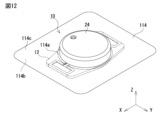
- FIG. 12 is a perspective view of the biometric information acquisition device showing another form of attachment to the living body.
- the biometric information acquisition device 10 is attached to the living body via an adhesive tape 114 .
- the adhesive tape 114 has a through hole 114a through which the cover 24 of the biometric information acquisition device 10 passes.
- One surface 114b of the adhesive tape 114 is an adhesive surface, and the other surface 114c is a smooth surface.
- the adhesive tape 114 may cover the entire biological information acquisition device 10 instead of providing the through hole 114a.
- the biological information acquisition device may be fixed to the living body by a band wrapped around the living body, clothes worn by the living body, or the like instead of the adhesive tape.
- the contour shape of the body 12 of the biological information acquisition device 10 that is, the contour shape of the deformable portion 22 corresponds to the height direction (Z axial direction), it has a generally rectangular shape.
- embodiments of the present disclosure are not limited to this.
- FIG. 13 is a schematic bottom view of a biometric information acquisition device according to another embodiment of the present disclosure.
- the deformable portion 122 of the main body 112 has the minimum necessary shape.
- the deformable portion 122 includes a central portion 122a that holds the first rigid body portion 116 provided with the bioacoustic sensor 126, and a second rigid body portion 122a that is provided with the electrodes 146 and 148 of the electrocardiographic sensor 144, respectively.
- outer portions 122b, 122c that hold portions 118, 120;
- the deformable portion 122 also includes a belt-like connecting portion 122d connecting the central portion 122a and the outer portion 122b, and a belt-like connecting portion 122e connecting the central portion 122a and the outer portion 122c.
- the strip-shaped connecting portions 122d and 122e are smaller than the central portion 122a and the outer portions 122b and 122c in size in the lateral direction (Y-axis direction) of the biological information acquisition device 110 . Therefore, it becomes easier for the outer portion to be displaced with respect to the central portion of the main body 112, that is, the main body 122 is more likely to deform. As a result, the facing surface 112a of the main body 122 is likely to come into close contact with the living body.
- the electrodes 46 and 48 of the electrocardiographic sensor 44 are rectangular when viewed in the height direction (Z-axis direction) of the biological information acquisition device 10. is.
- embodiments of the present disclosure are not limited to this.
- FIG. 14 is a schematic bottom view of a biometric information acquisition device according to yet another embodiment of the present disclosure.
- electrodes 246 and 248 of an electrocardiographic sensor 244 have a circular shape in the height direction (as viewed in the Z-axis direction). That is, it has a shape similar to that of the bioacoustic sensor 226 . It should be noted that the shape of the electrodes of the electrocardiographic sensor may be a shape other than a rectangular shape or a circular shape.
- the bioacoustic sensor 26 is arranged between the electrodes 46 and 48 . That is, the electrodes 46 and 48 are arranged such that their angular positions with respect to the bioacoustic sensor 26 differ by 180 degrees.
- embodiments of the present disclosure are not limited to this.
- FIG. 15 is a schematic bottom view of a biometric information acquisition device according to another embodiment of the present disclosure.
- the electrodes 346, 348 of the bioacoustic sensor 326 and the electrocardiographic sensor 344 are not aligned. Instead, the electrodes 346, 348 are positioned such that their angular positions with respect to the bioacoustic sensor 326 differ by 90 degrees. As such, the angular position of each of the electrodes 346, 348 with respect to the bioacoustic sensor 326 may be other angular positions. However, in order to obtain a good electrocardiographic waveform, it is preferable that the two electrodes of the electrocardiographic sensor are separated.
- the bioacoustic sensor 26 and the electrocardiographic sensor 44 are provided inseparably in the biological information acquisition device 10 .
- embodiments of the present disclosure are not limited to this.
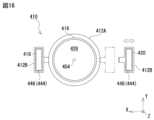
- FIG. 16 is a schematic bottom view of a biometric information acquisition device according to yet another embodiment of the present disclosure.
- the main body includes a main part 412A including a first rigid section 416, a bioacoustic sensor 426, a control board, a battery, etc., and a heart.
- Optional parts 412B including electrodes 446 and 448 of electric sensor 444, second rigid body parts 418 and 420, and conductive gel can be separated.
- the main part 412A can be reused and the optional part 412B can be thrown away.
- the opposite method of use is also possible.
- body sounds can be acquired only with the main part 412A.
- the main part 412A and the option part 412B are provided with connectors for electrically connecting to each other. Moreover, when the optional part 412B is used up, the temperature sensor 454 for measuring the body temperature of the living body is provided in the main part 412A. The temperature sensor 454 measures the body temperature, for example, through the diaphragm of the bioacoustic sensor 426 that contacts the living body.
- the biological information acquisition device includes a main body having a facing surface that faces a living body when worn, and a main body that is attached to the main body so that at least a portion of the main body protrudes from the facing surface.
- a first biosensor provided and having a first contact surface that comes into contact with a living body; and a thin adhesive tape.
- a biological information acquisition device includes a main body having a facing surface that faces a living body when worn, and a first contact surface that is provided on the main body and contacts the living body. and a first biosensor, wherein the main body includes a first rigid part that supports the first biosensor, and a deformable part that supports the first rigid part and is deformable. It is what it is.
- the present disclosure is applicable to devices that are in close contact with a living body and acquire its biological information.
Landscapes
- Health & Medical Sciences (AREA)
- Life Sciences & Earth Sciences (AREA)
- Engineering & Computer Science (AREA)
- Heart & Thoracic Surgery (AREA)
- Public Health (AREA)
- Veterinary Medicine (AREA)
- General Health & Medical Sciences (AREA)
- Animal Behavior & Ethology (AREA)
- Surgery (AREA)
- Biomedical Technology (AREA)
- Molecular Biology (AREA)
- Medical Informatics (AREA)
- Physics & Mathematics (AREA)
- Cardiology (AREA)
- Pathology (AREA)
- Biophysics (AREA)
- Acoustics & Sound (AREA)
- Physiology (AREA)
- Pulmonology (AREA)
- Chemical & Material Sciences (AREA)
- Dispersion Chemistry (AREA)
- Signal Processing (AREA)
- Measuring And Recording Apparatus For Diagnosis (AREA)
Priority Applications (2)
| Application Number | Priority Date | Filing Date | Title |
|---|---|---|---|
| JP2023551072A JP7733354B2 (ja) | 2021-09-29 | 2022-06-15 | 生体情報取得デバイス |
| US18/598,309 US20240245381A1 (en) | 2021-09-29 | 2024-03-07 | Biological information acquisition device |
Applications Claiming Priority (2)
| Application Number | Priority Date | Filing Date | Title |
|---|---|---|---|
| JP2021159265 | 2021-09-29 | ||
| JP2021-159265 | 2021-09-29 |
Related Child Applications (1)
| Application Number | Title | Priority Date | Filing Date |
|---|---|---|---|
| US18/598,309 Continuation US20240245381A1 (en) | 2021-09-29 | 2024-03-07 | Biological information acquisition device |
Publications (1)
| Publication Number | Publication Date |
|---|---|
| WO2023053592A1 true WO2023053592A1 (ja) | 2023-04-06 |
Family
ID=85780552
Family Applications (1)
| Application Number | Title | Priority Date | Filing Date |
|---|---|---|---|
| PCT/JP2022/024005 Ceased WO2023053592A1 (ja) | 2021-09-29 | 2022-06-15 | 生体情報取得デバイス |
Country Status (3)
| Country | Link |
|---|---|
| US (1) | US20240245381A1 (https=) |
| JP (1) | JP7733354B2 (https=) |
| WO (1) | WO2023053592A1 (https=) |
Cited By (2)
| Publication number | Priority date | Publication date | Assignee | Title |
|---|---|---|---|---|
| JP2025171922A (ja) * | 2024-05-08 | 2025-11-20 | 富民 王 | 生理信号検出装置、並びにこの生理信号検出装置を用いたパーソナルコンピューター装置 |
| EP4652936A1 (en) * | 2024-05-23 | 2025-11-26 | Decentralized Biotechnology Intelligence Co., Ltd. | Wearable physiological signal sensing system |
Families Citing this family (1)
| Publication number | Priority date | Publication date | Assignee | Title |
|---|---|---|---|---|
| CN114788694B (zh) * | 2022-03-25 | 2024-10-01 | 东莞永胜医疗制品有限公司 | 一种感应器及膝关节支具 |
Citations (7)
| Publication number | Priority date | Publication date | Assignee | Title |
|---|---|---|---|---|
| JP2009515632A (ja) * | 2005-11-17 | 2009-04-16 | コーニンクレッカ フィリップス エレクトロニクス エヌ ヴィ | 音響結合検出器を有する血流センサー |
| JP2012055354A (ja) * | 2010-09-06 | 2012-03-22 | Univ Of Tsukuba | 診断装置 |
| US20150150503A1 (en) * | 2012-05-29 | 2015-06-04 | The Board Of Trustees Of The Leland Stanford Junior University | Apparatus, systems, and methods for monitoring extravascular lung water |
| JP2017169648A (ja) * | 2016-03-22 | 2017-09-28 | 国立大学法人秋田大学 | 生体センサ |
| WO2020137212A1 (ja) * | 2018-12-26 | 2020-07-02 | 富士フイルム株式会社 | 聴診器および電子聴診装置 |
| CN211796425U (zh) * | 2020-02-21 | 2020-10-30 | 复旦大学附属中山医院 | 一种同步监测动态体温和动态心电图的装置和系统 |
| WO2021020201A1 (ja) * | 2019-07-26 | 2021-02-04 | 富士フイルム株式会社 | 聴診器 |
Family Cites Families (3)
| Publication number | Priority date | Publication date | Assignee | Title |
|---|---|---|---|---|
| US20060047215A1 (en) | 2004-09-01 | 2006-03-02 | Welch Allyn, Inc. | Combined sensor assembly |
| US20160120434A1 (en) | 2014-10-31 | 2016-05-05 | Irhythm Technologies, Inc. | Wireless physiological monitoring device and systems |
| CN213883264U (zh) | 2020-10-05 | 2021-08-06 | 华中科技大学同济医学院附属协和医院 | 一种新型电子听诊器 |
-
2022
- 2022-06-15 JP JP2023551072A patent/JP7733354B2/ja active Active
- 2022-06-15 WO PCT/JP2022/024005 patent/WO2023053592A1/ja not_active Ceased
-
2024
- 2024-03-07 US US18/598,309 patent/US20240245381A1/en active Pending
Patent Citations (7)
| Publication number | Priority date | Publication date | Assignee | Title |
|---|---|---|---|---|
| JP2009515632A (ja) * | 2005-11-17 | 2009-04-16 | コーニンクレッカ フィリップス エレクトロニクス エヌ ヴィ | 音響結合検出器を有する血流センサー |
| JP2012055354A (ja) * | 2010-09-06 | 2012-03-22 | Univ Of Tsukuba | 診断装置 |
| US20150150503A1 (en) * | 2012-05-29 | 2015-06-04 | The Board Of Trustees Of The Leland Stanford Junior University | Apparatus, systems, and methods for monitoring extravascular lung water |
| JP2017169648A (ja) * | 2016-03-22 | 2017-09-28 | 国立大学法人秋田大学 | 生体センサ |
| WO2020137212A1 (ja) * | 2018-12-26 | 2020-07-02 | 富士フイルム株式会社 | 聴診器および電子聴診装置 |
| WO2021020201A1 (ja) * | 2019-07-26 | 2021-02-04 | 富士フイルム株式会社 | 聴診器 |
| CN211796425U (zh) * | 2020-02-21 | 2020-10-30 | 复旦大学附属中山医院 | 一种同步监测动态体温和动态心电图的装置和系统 |
Cited By (2)
| Publication number | Priority date | Publication date | Assignee | Title |
|---|---|---|---|---|
| JP2025171922A (ja) * | 2024-05-08 | 2025-11-20 | 富民 王 | 生理信号検出装置、並びにこの生理信号検出装置を用いたパーソナルコンピューター装置 |
| EP4652936A1 (en) * | 2024-05-23 | 2025-11-26 | Decentralized Biotechnology Intelligence Co., Ltd. | Wearable physiological signal sensing system |
Also Published As
| Publication number | Publication date |
|---|---|
| JPWO2023053592A1 (https=) | 2023-04-06 |
| JP7733354B2 (ja) | 2025-09-03 |
| US20240245381A1 (en) | 2024-07-25 |
Similar Documents
| Publication | Publication Date | Title |
|---|---|---|
| US20240245381A1 (en) | Biological information acquisition device | |
| KR101674579B1 (ko) | 생체용 전극 및 이를 포함하는 생체신호 측정장치 | |
| US20190239769A1 (en) | Electronic device including detachable measurement module and attachment pad | |
| TWI533845B (zh) | 無線電子聽診器裝置 | |
| US20080312524A1 (en) | Medical Sensor Having Electrodes and a Motion Sensor | |
| US20180177482A1 (en) | Biological sound measurement apparatus | |
| KR102780302B1 (ko) | 생체 신호 측정용 전자 장치 | |
| JP6783416B1 (ja) | 計測対象物の内部圧力又は剛性を測定する測定装置 | |
| CN114207552A (zh) | 可穿戴电子装置及组装方法 | |
| US11759137B2 (en) | Electronic device for providing guide information | |
| JP7280246B2 (ja) | 子宮収縮及び胎児心拍数を測定する装置 | |
| US11045093B2 (en) | Sensor unit | |
| JP7305449B2 (ja) | 医療センサ | |
| JPWO2019240118A1 (ja) | 音取得装置 | |
| WO2019151349A1 (ja) | 測定装置 | |
| JP2003070759A (ja) | 携帯型心電計及びその装着方法並びに使用方法 | |
| JP7593451B2 (ja) | 生体活動検出センサ | |
| WO2021181735A1 (ja) | 生体音響センサおよびそれを備えた聴診器 | |
| US10925507B2 (en) | Physiological information detection sensor | |
| WO2024093722A1 (zh) | 腕戴设备的交互装置和腕戴设备 | |
| KR101999359B1 (ko) | 호흡 센싱 디바이스 및 이를 포함하는 호흡 모니터링 시스템 | |
| US20250302424A1 (en) | Auscultation device and auscultation system | |
| US20200085328A1 (en) | Device for Monitoring of Patient's Vital Signs | |
| JP2026001547A (ja) | 電子聴診装置及び振動検出装置 | |
| KR20250081098A (ko) | 피부 부착형 생체 신호 모니터링 장치 |
Legal Events
| Date | Code | Title | Description |
|---|---|---|---|
| 121 | Ep: the epo has been informed by wipo that ep was designated in this application |
Ref document number: 22875471 Country of ref document: EP Kind code of ref document: A1 |
|
| WWE | Wipo information: entry into national phase |
Ref document number: 2023551072 Country of ref document: JP |
|
| NENP | Non-entry into the national phase |
Ref country code: DE |
|
| 122 | Ep: pct application non-entry in european phase |
Ref document number: 22875471 Country of ref document: EP Kind code of ref document: A1 |